Does Canada
Have a Problem with
Occupational Fraud?
By the Certified General
Acknowledgements
CGA-Canada takes this opportunity to thank Rock Lefebvre, P.Adm, MBA, CFE, FCIS, FCGA, Elena Simonova, MA (Econ), MPA, and Kevin Girdharry, M.Sc (Econ) of our Research and Standards Department and to recognize the valuable contributions made by Synovate and the Canadian companies who generously participated in the CGA-Canada survey of Presence of Occupational Fraud in Canadian SMEs.
Appreciation is extended also to Association members, and team contributors who provided support, expertise, and peer review to the exercise.
Electronic access to this report can be obtained at www.cga.org/canada ISBN 978-1-55219-656-4
© By the Certified General Accountants Association of Canada, December 2011. Reproduction in whole or in part without written permission is strictly prohibited.
Does Canada
Have a Problem with
Occupational Fraud?
By the Certified General
Table of Contents
Foreword ... 7
1. Executive Summary ... 9
2. Introduction ... 13
3. Occupational Fraud in SMEs – An Overview ... 17
3.1. What is Occupational Fraud? ... 17
3.2. What Do We Know about the Presence of Occupational Fraud in Canada? ... 19
3.2.1. Official Statistics on Incidences of Occupational Fraud ... 19
3.2.2. Private Sources of Information on Incidences of Occupational Fraud ... 21
3.2.3. The Lack of Consistency in the Information Available .... 22
4. Findings From CGA-Canada’s Survey of Presence of Occupational Fraud in SMEs ... 25
4.1. Incidents of Occupational Fraud ... 25
4.1.1. Prevalence of Occupational Fraud in SMEs ... 26
4.1.2. Characteristics of the Single Largest Incident of Occupational Fraud ... 27
4.1.3. Impact of Occupational Fraud on SMEs ... 29
4.2. Occupational Fraud Prevention and Detection ... 34
4.2.1. Level of Risk of Occupational Fraud ... 34
4.2.2. Fraud Prevention Measures ... 37
4.2.3. Fraud Detection Measures ... 39
4.2.4. Need for Improvement of Fraud Prevention and Detection Measures... 41
5. Should the Modest Level of Financial Losses From Occupational Fraud be Comforting? ... 45
5.1. Is the Level of Financial Losses Truly Low? ... 45
5.2. Importance of Non-financial Consequences of Occupational Fraud ... 47
6. Conclusions ... 49
7. Appendix A: Survey Methodology and Questionnaire ... 53
List of Figures
Figure 1: Types of Occupational Fraud Experienced by SMEs ... 27 Figure 2: Type of the Single Largest Incident of Occupational Fraud
Experienced by SMEs ... 28 Figure 3: Range of Financial Losses Incurred due to
Occupational Fraud ... 29 Figure 4: Aspects of Business Negatively Affected due to
Occupational Fraud ... 31 Figure 5: Internal Policies and Practices Revised as a Result of
Occupational Fraud ... 33 Figure 6: Perceived Level of Risk of Occupational Fraud ... 34 Figure 7: Types of Occupational Fraud to which Companies Are
Perceived to Be Susceptible ... 36 Figure 8: Occupational Fraud Prevention Measures and Techniques
Used by SMEs ... 38 Figure 9: Occupational Fraud Detection Measures and Techniques
Used by SMEs ... 40 Figure 10: Need for a Significant Improvement in Occupational Fraud
Prevention and Detection Measures ... 42
List of Tables
Table 1: Profile of Companies-participants in the CGA-Canada’s Survey ... 54
Foreword
Many of us have at one time or another been curiously drawn to the subject of occupational fraud. Whether observed in our own work environments or exposed through broader media, we often find ourselves perplexed by the apparent ease with which an otherwise responsible organization can be financially violated by its own agents or employees. The simple fact of the matter of it is that we generally have confidence in the folks that work shoulder to shoulder in achieving the wellbeing of a collective venture. And that is received as a positive condition.
As history has shown us, there can however be the occasional breach or abuse of the confidence placed in people. That is not to say that all individuals are necessarily capable or willing to resort to occupational fraud; but rather that businesses need be mindful of the prospect of occupational fraud and of the relative unpredictability of the potential or eventual aggressor.
Recognizing that individual occupational frauds are more often than not dwarfed by larger more discernable frauds and scandals, The Certified General Accountants Association of Canada (CGA-Canada) considers it timely to direct some attention to the inherent opportunity for occupational fraud within the domestic environment. Moreover, it is conceivable that in the current economic landscape of slow growth and deleveraging, the propensity for occupational fraud may in fact intensify.
As the following pages corroborate, we are pleased that there is relatively little alarm with Canada’s exposure to occupational fraud. That said we can conservatively estimate that $3.2 billion is lost to Canadian businesses annually from occupational fraud alone. These findings are based on data compiled from our random national survey sample of 802 companies having fewer than 500 employees; considered to be adequately representative of the sector. And as acknowledged by our survey participants, there is room for improvement within individual companies and within the aggregate SME sector.
While we have undoubtedly all heard the anecdotal tales of occupational fraud, there is little comprehensive and conclusive reference that empirically measures the frequency, intensity, severity, and impact of occupational fraud. As such, this paper intents to contextualize the Canadian experience and to impart some best practice for consideration by those having an active interest in the
comprehension of fraud, the economic impact of fraud, or in the more technical dimensions of prevention, deterrence, and detection of occupational fraud. Anthony Ariganello, CPA (Delaware), FCGA
President and Chief Executive Officer
Executive Summary
Small and medium-sized enterprises (SMEs) form a very important segment of the Canadian economy constituting the majority of business establishments and contributing more than half of business-sector GDP. Despite the importance of SMEs as a collective force, the visibility and economic power of small businesses suffer due to their size and frequent turnover. When it comes to the issue of businesses being subject to fraud, the moderate visibility of SMEs only contributes to the challenge of assessing the real scope of the problem. Two other challenges – focusing on a specific type of fraud in SMEs and gathering information about fraudulent activities – further impede our ability to understand whether or not fraud presents an acute threat to SMEs and whether concomitant elevated attention should be accorded.
Given the highly uncertain and unstable economic outlook, our limited knowledge regarding the true scale of fraud victimization of SMEs is particularly worrisome as deterioration in the economic situation may further exacerbate the risk of fraud. Recognizing the outlined challenges and limitations, CGA-Canada saw it timely to investigate the level of vulnerability of Canada’s largest segment of businesses – SMEs – to fraud. For that purpose, CGA-Canada commissioned a survey seeking to examine the prevalence and types of occupational fraud experienced by SMEs and to gather information on prevention and detection methods used by SMEs to safeguard against occupational fraud. Occupational fraud was chosen as the focus of the analysis as the presence and the size of the workforce are the two elements most common to all SMEs. As the following pages reveal, it can be reasonably contended that:
A substantial number of different types of occupational fraud exist.
Although occupational fraud is only one among many types of fraud to which SMEs are exposed, the taxonomy of occupational fraud is vast and includes more than 50 distinctive types of deception. However, the notion of occupational fraud should not be confused with the notion of “white-collar crime” as the latter may or may not involve the misuse of the employing organization’s resources. The profile of a typical white-collar perpetrator is also noticeably different from that of a perpetrator committing occupational fraud.
The majority of SMEs are not prepared to respond to occupational fraud, and more than half do not undertake periodic assessments of risks of fraud. Only one fifth (20%) of all surveyed SMEs have a Fraud Response Plan while the overwhelming majority (80%) do not. Some 59% of the surveyed SMEs do not undertake periodic assessments of the risks of occupational fraud, and companies that experienced fraud in the last fiscal year are not more likely to engage in this activity. However, SMEs victimized by fraud tend to make some adjustments as a result of fraud victimization: the majority (57%) of them revise disciplinary actions to be administered in case of fraud while 2 in 5 victim companies modify protocols for hiring and retaining employees, and adjust policies and channels for reporting employees’ concerns about fraud.
A large proportion of SMEs believe the risk of occupational fraud is low; however, 1 in 4 SMEs experienced incidents of occupational fraud in the last fiscal year. Only 5% of SMEs believe that occupational fraud poses a high risk for them while the majority (74%) believe that their exposure is low. Moreover, one quarter (26%) of surveyed SMEs do not see themselves as susceptible to any particular type of occupational fraud. However, one quarter (26%) of SMEs report to have experienced at least one incident of occupational fraud in the past fiscal year. This translates into an estimated 290,000 Canadian SMEs victimized by occupational fraud in 2010. The most often cited type of occupational fraud experienced by SMEs relates to misappropriation of inventory or assets; followed by misappropriation of cash; and misrepresentation of employment credentials, internal or external documents. Reoccurrence of fraud is common: at least one fifth of SMEs that experienced misappropriation of cash, inventory or assets confirmed that those types of fraud occurred four or more times in their respective companies in the last fiscal year.
The awareness of risks and implications of occupational fraud improves among SMEs that experienced incidents of fraud. SMEs that encountered at least one incident of occupational fraud in the last fiscal year are more than twice as likely to gauge the risk of occupational fraud as either high or moderate compared to companies that did not experience fraud incidents. Victimized SMEs are also much more likely to assess their companies as susceptible to any given type of occupational fraud, agree that they need improvements in fraud prevention and detection measures, and have a Fraud Response Plan. However, previous victimization of an SME by way of occupational fraud does not seem to improve the SME’s propensity to use fraud prevention and detection measures.
Financial losses incurred by individual SMEs due to occupational fraud are not large; however, non-monetary negative consequences of fraud are reported by many. For more than half (55%) of the reporting SMEs, financial losses experienced due to occupational fraud do not exceed $1,000; for another 26% of reporting companies, losses range between $1,000 and $5,000. Meanwhile, less than 1% of SMEs report being victimized by an occupational fraud event exceeding $200,000. In turn, 61% of victim companies gauge that fraudulent activities negatively affect the moral of their employees; at least one fifth agree that a company’s business relationships, reputation, value, and public and client trust suffered as a result of fraud.
Nearly all SMEs utilize occupational fraud prevention measures; in turn, 1 in 10 companies does not have any fraud detection measures in place. The two most commonly used techniques of occupational fraud prevention include clear and uniform accounting procedures, and frequent financial reviews and/or reconciliations: 4 in 5 of surveyed SMEs utilize these measures. Reliance on a wide range of measures is common: 49% of SMEs have six or more fraud prevention measures in place. When it comes to fraud detection, 11% of SMEs do not incorporate any particular fraud detection techniques in their business activities. Among SMEs that use at least one fraud detection measure, 69% rely on a system of monitoring and safeguarding assets; whereas 59% and 49% rely on internal and/or external auditors respectively to detect fraud. Unlike prevention measures, the use of multiple fraud detection measures is not very common: 52% of SMEs utilize three or less fraud detection measures at a time. The majority of SMEs (60%) do not think that a significant improvement in occupational fraud prevention and/or detection is needed in their company.
SMEs’ experiences with, and attitude toward occupational fraud varies with company characteristics. Larger SMEs (those generating more than $5 million in annual revenues or employing between 20 and 499 employees) have higher awareness of the risk of occupational fraud, but are also more likely to be victimized by fraud and experience larger financial losses when compared to smaller SMEs. Likewise, larger SMEs show higher propensity to conduct periodic assessment of risks of occupational fraud, use fraud prevention and detection techniques, and be equipped with a Fraud Response Plan. The SME’s industry affiliation is also important. Companies operating in service-producing industries for example are less likely to conduct periodic assessment of fraud risks, but tend to experience higher financial losses from occupational fraud when compared to SMEs in goods-producing industries.
Noticeable regional differences are likewise observed. Reporting companies located in Québec are less likely to experience occupational fraud: only 16% of Québec SMEs encountered incidents of occupational fraud in the last fiscal year; in Ontario and British Columbia this proportion is almost twice higher (31% and 37% respectively), whereas Canada averages at 26%. Québec SMEs are also consistently less likely to use fraud prevention and detection measures compared to Canada overall; however they more often agreed that a significant improvement in the area of occupational fraud prevention is needed. A number of other provincial variations also exist; however, with no particular pattern.
Very few sources provide information on the presence and prevalence of occupational fraud in Canadian business, and none of them are comprehensive. Statistics Canada’s Survey of Fraud against Businesses – the only source of official statistics on business fraud in Canada – is focused on a narrow set of industries and provides very few details regarding occupational fraud. Private sources of information on incidents of occupational fraud are primarily limited to a few studies offered by the Association of Certified Fraud Examiners (ACFE) and PricewaterhouseCoopers. However, these sources are either focused on characteristics of the fraud and its perpetrators without addressing the issue of fraud prevalence, or touch upon it but only briefly. In addition to the scarcity of information on incidences of occupational fraud in Canada, the existing sources do not provide a consistent picture.
Based on these findings, it is reasonable to espouse the following four conclusions. First, SMEs are not highly concerned with issues related to occupational fraud; the lack of first-hand experience with occupational fraud may be a contributing factor. Second, the magnitude of financial losses incurred by SMEs resulting from occupational fraud suggests that this type of fraud does not present a significant problem for the SME sector; however such an inference may benefit from additional consideration. Third, a multi-faceted information gap regarding the presence and impact of occupational fraud on SMEs continues to exist. And lastly, room for improvement on issues of occupational fraud exists for businesses.
Introduction
Small and medium-sized enterprises (SMEs) form a highly important segment of the Canadian economy. They account for some 1.14 million business entities or 99.7%1 of all businesses with employees located in Canada. Likewise, SMEs contribute significantly to the Canadian labour force: some 6.8 million Canadians are employed by SMEs accounting for 63.9% of all private sector employees and nearly half (47.3%) of all those employed in Canada.2 SMEs are particularly important in such industries as construction, accommodation and food, forestry, and non-institutional health care where they provide 4 out of 5 jobs. Not less impressive is the contribution of small business to the economy itself: SMEs produce more than half (54.2%) of Canada’s business-sector GDP.3 Beyond the economic statistics, the importance of the SME sector is often linked to its critical role as a backbone of local communities as they have a unique ability to meet special market needs and interests that may be overlooked by larger businesses. Although SMEs enter and exit the market much more frequently than their larger counterparts, such a turnover is often seen as a conduit that introduces new and innovative products and processes into the economy, and as a channel that facilitates greater labour mobility through job creation.
Despite the importance of SMEs as a collective force, the visibility and economic power of individual business establishments suffer due to their size and frequent turnover. It is quite seldom that SMEs can promote their name and brand by engaging in extensive advertising campaigns or sponsoring public events to the same extent as their larger listed counterparts. Very few SMEs are listed on stock exchanges and publicly traded; as such, their wellbeing is not of equal interest to the larger audience of potential investors and financial analysts. Likewise, the relatively small size of a particular SME seldom places it in a position of a newsmaker outside of its local community in terms of recruitment, layoffs, closures, or other hardships that businesses may encounter in their day-to-day dealings. Moreover, one half of SMEs do not survive in the marketplace for more than 5 years.4
1 Industry Canada (2011). Key Small Business Statistics, p. 7.
2 Industry Canada (2011). Key Small Business Statistics, p. 19, and CANSIM Table 282-0011. The numbers presented exclude the following industries: agriculture, fishing and trapping, private household services, religious organizations and military personnel of defence services. 3 Leung, D. and Rispoli, L. (2011). The Contribution of Small and Medium-sized Businesses to Gross
Domestic Product: A Canada-United States Comparison, Statistics Canada, Catalogue no. 11F0027M – No. 070.
4 Industry Canada (2011). Key Small Business Statistics, p. 14.
2
SMEs form a highly
important segment of
the Canadian economy,
but visibility of individual
SMEs suffers due to
their size and frequent
turnover
When it comes to the issue of businesses being victims of fraud – whether committed by external perpetrators or by employees – the subdued visibility of SMEs only further contributes to the challenge of assessing the real scope of the problem. A fraudulent activity that victimized an SME is rarely a subject of the news headlines unless the scheme affected hundreds of businesses and the monetary value of the damage may be measured in millions of dollars. Two other challenges – focusing on a specific type of fraud and gathering information about fraudulent activities – further impede our ability to understand whether or not fraud presents a meaningful threat to SMEs and thus should be accorded elevated attention.
In broad terms, fraud can be defined as an act whereby an individual or group of individuals by deceit, falsehood or other fraudulent means, defrauds the public or any person or business, of any property, money, valuable security, or service.5 However, a dozen divergent types of fraud may easily fit under this definition including securities-related frauds such as Ponzi schemes, accounting frauds that overstate the value of company revenues and assets, mass marketing fraud that victimizes consumers, mortgage and real estate fraud, identity fraud, tax fraud and money laundering, fraud in public procurement, health care and immigration fraud, etc.
When speaking about victimization of businesses, fraud is believed to be industry-specific: the business process and the array of products and services vary greatly from one industry to the other and so does the vulnerability to and likelihood of different types of fraud. As SMEs constitute the vast majority of all businesses in the Canadian economy, they are present in all industries and are in all types of business, and thus may be subject to a diverse range of fraudulent activities. It is then impossible to speak about the presence of fraud in SMEs without narrowing the consideration to either a specific industry or a specific type of fraud, or both.
As will be further discussed in Section 3.2, our knowledge of the extent of fraud victimization of Canadian business is rather limited, particularly when it comes to SMEs. Very few industry associations or other centralized agencies collect data on fraud from businesses while information that is collected is often incomprehensive and incomparable between industries.6 Police records may be a useful and reliable source of information, but it is assumed that they are not very representative of fraud committed against businesses as the reporting rate is low. Complementing police records with information available in company records may also be problematic as SMEs often do not keep track of incidents
5 Taylor-Butts, A. and Perreault, S. (2009). Fraud Against Businesses in Canada: Results from a National Survey, Statistics Canada, Catalogue no. 85-571-X, p. 6.
6 Statistics Canada (2005). A Feasibility Report on Improving the Measurement of Fraud in Canada.
Subdued visibility of
SMEs contributes to the
challenge of assessing
the real scope of SMEs
fraud victimization
of fraud in their internal or accessible records.7 At the same time, it is believed that SMEs are particularly vulnerable to fraud because of the limited financial and human resources dedicated to effective fraud detection and prevention.8 Although the Canadian economy experienced a relatively quick recovery after the 2008-2009 recession and financial crisis, the global economic outlook has deteriorated again over the summer and fall of 2011. Ongoing deleveraging by banks and households, increased fiscal austerity and declining business and consumer confidence is expected to restrain growth across advanced economies. Acute fiscal and financial strains in Europe have intensified the fear of severe dislocations in global funding markets. The “R” word is again becoming part of our vernacular in the United States, Europe and even Canada. Given the highly uncertain and unstable economic outlook, our limited knowledge regarding the true scale of fraud victimization of SMEs is particularly worrisome. Research shows that economic downturn may present a heightened risk of fraud as recession conditions impose increased pressures, present individuals with greater incentives to commit fraud, and may also increase gaps in control systems as fewer resources are deployed to focus on internal controls.
Recognizing the challenges and limitations outlined above, CGA-Canada sees it timely to assess the level of vulnerability of Canada’s largest segment of business establishments – SMEs – to fraud. For that purpose, CGA-Canada commissioned a survey that sought to examine the prevalence and types of occupational fraud experienced by SMEs and to gather information on prevention and detection methods used by SMEs to safeguard against occupational fraud. Occupational fraud (versus other forms of fraud) was chosen as the focus of the examination as the existence and the size of the workforce are the two elements that are common to all SMEs, but also differentiate them from other types of business. Moreover, previous research suggested that small businesses may be disproportionally victimized by occupational fraud when compared to their larger counterparts.9
In the following text, we begin with a brief overview of the notion of occupational fraud and our current knowledge on its prevalence in SMEs. We then present the key findings of CGA-Canada’s survey of the presence of occupational fraud in Canadian SMEs and provide additional considerations
7 Statistics Canada (2005). A Feasibility Report on Improving the Measurement of Fraud in Canada, p. 12-14
8 Peltier-Rivest, D. (2009). An Analysis of the Victims of Occupational Fraud: A Canadian Perspective,
Journal of Financial Crime, Vol. 16, No. 1, p. 65
9 Association of Certified Fraud Examiners (2010). Report to the Nations on Occupational Fraud and Abuse, and Peltier-Rivest, D. (2007). Detecting Occupational Fraud in Canada: A Study of its Victims and Perpetrators, Association of Certified Fraud Examiners.
Our limited knowledge
regarding the true scale
of fraud victimization
of SMEs is particularly
worrisome given the
highly uncertain and
unstable economic
outlook
supplementing selected survey results. We conclude by highlighting the most salient aspects of our findings, along with some practical recommendations. Appendix A describes the survey methodology and replicates the administered survey questionnaire.
Occupational Fraud in SMEs –
An Overview
Three elements are thought to constitute the core of any fraudulent activity and thus be present in all fraud cases. An act of fraud includes (i) a material false statement or action that has been made with the purposeful intent to deceive, whereas (ii) the victim of fraud relied upon the purposefully false statement or action of the perpetrator, and (iii) incurred damage as a result of false statement or action of the perpetrator.10 Although the core notion of occupational fraud is also based on these three elements, a number of additional aspects form the definition and distinctive nature of occupational fraud. The paragraphs that follow discuss in more detail the notion of occupational fraud as well as the extent of knowledge regarding the presence of occupational fraud in the Canadian marketplace.
3.1. What is Occupational Fraud?
The Association of Certified Fraud Examiners (ACFE) defines occupational fraud as the “use of one’s occupation for personal enrichment through the deliberate misuse or misappropriation of the employing organization’s resources or assets”.11 It is not uncommon that occupational fraud is colloquially referred to as “employee fraud” or “internal fraud”; the essence, nevertheless, remains the same – it is fraud that is committed by employees, managers and company owners where the victim of fraud is the organization itself. Four key elements are usually present in an occupational fraud scheme: the scheme is clandestine, it violates the perpetrator’s duties to the organization, it is committed for direct or indirect financial gain of the perpetrator, and it costs the organization assets, revenues or reserves.12
The ACFE has developed a detailed taxonomy of occupational fraud according to which there are three mutually exclusive categories of fraud: asset misappropriation, corruption, and fraudulent statements. Asset misappropriation is a scheme that involves the theft or misuse of an organization’s assets. Common examples of asset misappropriation include false invoicing, payroll fraud, and skimming. Corruption is a scheme in which a perpetrator uses his or her influence in a business or official transaction to obtain an unauthorized benefit contrary to that person’s duty to his or her employer. Examples of corruption include paying or accepting bribes or illegal gratuities, engaging in self-dealing transactions or engaging in conflicts of interest. Fraudulent statements fraud is a scheme
3
10 Lord, A. T. (2010). The Prevalence of Fraud: What Should We, as Academics, Be Doing to Address the Problem? Accounting and Management Information Systems, Vol. 9, No. 1, p. 5
11 ACFE (1996). Report to the Nation on Occupational Fraud and Abuse, p. 2.
12 Saksena, P. N. (2010). Ethical Theories and the Incidence of Occupational Fraud, Proceedings of the Academy of Accounting and Financial Studies, Vol. 15, No. 2, p. 34
Occupational fraud is
fraud that is committed
by employees, managers
and company owners
where the victim of fraud
is the organization itself
that involves the deliberate misstatement or falsification of an organization’s financial or non-financial statements. In order to meet the definition of occupational fraud, fraudulent statements must bring direct or indirect financial benefit to the perpetrator. Common examples include recording fictitious sales, concealing liabilities or expenses, and falsifying employment credentials.13 It should be recognized that the detailed taxonomy of occupational fraud further subdivides asset misappropriation, corruption, and fraudulent statements into more than 50 sub-categories.
The notion of white-collar crime often comes to mind when speaking about occupational fraud, particularly so since a number of high-profile white-collar crimes have shaken the world in the past decade including those of Enron, WorldCom, Tyco, ImClone, and cases of Bernard Madoff and Earl Jones. Although white-collar crime often involves fraud, the notion of occupational fraud should not be confused with the notion of white-collar crime. White-collar crime may be a corporate or an occupational crime. The first category includes offenses committed by corporations and their officials for the benefit of the corporation and its principals. The second category of crime is committed in the course of activity in a legitimate occupation and can be committed by employees against employers, employers against employees, or by those who by virtue of their occupation provide services and goods to the public.14 Occupational fraud, in turn, is a crime committed by an individual against the employing organization and legitimate employment is a condition for occupational fraud.
Similarly, there is a difference between the typical white-collar offender and the offender that commits occupational fraud. The typical white-collar offender is frequently characterized as a highly educated white male, aged forty on average, situated in the upper managerial ranks of his organization, who commits a one-time criminal act.15 Unlike white-collar perpetrators who share distinct sets of characteristics, characteristics of offenders committing occupational fraud vary based on the specific type of fraud committed. Research shows that individuals who commit asset misappropriation are typically younger and have significantly lower levels of education than those who engage in either corruption or fraudulent statements. Moreover, individuals that commit assets misappropriation and corruption are also less likely to be managers or executives compared to individuals who commit fraudulent statements. In addition, there is a nearly equal likelihood for the occupational fraud offender
13 ACFE (2008). Report to the Nation on Occupational Fraud and Abuse, p. 10, and ACFE (2007).
Detecting Occupational Fraud in Canada: A Study of its Victims and Perpetrators, p. 8.
14 Green S. P. (2004). The Concept of White Collar Crime in Law and Legal Theory, Buffalo Criminal Law Review, Vol. 8, No. 1, p. 109.
15 Holtfreter, K. (2005). Is Occupational Fraud “Typical” White-collar Crime? A Comparison of Individual and Organizational Characteristics, Journal of Criminal Justice, Vol. 33, p. 354.
The notion of
occupational fraud
should not be confused
with the notion of
white-collar crime
to be male or female and the majority of these perpetrators are employees rather than managers or executives.16
3.2. What Do We Know about the Presence
of Occupational Fraud in Canada?
Two most common sources of information may be sought out to inform us regarding the prevalence of occupational fraud in Canada, and specifically in SMEs: (i) official statistics collected by government agencies, and (ii) information gathered by other interested groups and stakeholders involved in the matters of fraud analysis and prevention. The paragraphs that follow explore these sources in greater detail.
3.2.1. Official Statistics on Incidences of Occupational Fraud
The data from Statistics Canada suggest that 87,695 incidents of fraud substantiated by police took place in 2010; 7% of those cases were related to identity fraud.17 Although the number of fraud incidents appears to be large, it says very little about the seriousness of the offence, its nature and the nature of the victim, the method by which it was committed, and the monetary value of the damage caused. Similarly, this statistic naturally provides no information or estimates on incidents of fraud that were not reported to the police. In fact, very limited information is available on what is understood by “fraud” in the data provided by Statistics Canada. The total number of incidents of fraud includes cheque and credit card fraud, but also contains the “other” category which may comprise securities-related frauds, insider trading, accounting fraud, mass marketing fraud, mortgage and real estate fraud, and other types of fraud. As such, there is little in the way of official public statistics that can be used to at least somewhat understand the nature of fraud and its victims, leaving aside the issues related to such a specific type of fraud as occupational fraud in SMEs. Recognizing the existence of the information gap regarding fraudulent activities in Canada, the Canadian Centre for Justice Statistics (CCJS) undertook a study in 2005 to assess the feasibility of improving the measurement of fraud by collecting data directly from business and business associations. The analysis prompted Statistics Canada to recommend introducing a survey of businesses to gather data that allows measuring the nature and extent of fraud experienced by businesses.18 This recommendation was implemented in 2008 when Statistics Canada conducted the Survey of Fraud Against Businesses (SFAB) seeking to build a standard, more comprehensive picture of the prevalence and characteristics of business fraud in Canada.
16 Holtfreter, K. (2005). Is Occupational Fraud “Typical” White-collar Crime? A Comparison of Individual and Organizational Characteristics, Journal of Criminal Justice, Vol. 33, p. 359-360
17 Based on CANSIM Table 252-0051.
18 Statistics Canada (2005). A Feasibility Report on Improving the Measurement of Fraud in Canada, Catalogue no. 85-569-XIE, p. 14.
There is little in the way
of official public statistics
that can be used to
at least somewhat
understand the nature
of fraud and its victims
Although the introduction of the SFAB was an important step in improving the availability of fraud-related information, both the scope and the regularity of the survey have continued to present the main deficiency of this data collection tool. The survey covered only three industries – retail, banking, and health and property insurance – that together account for a mere 16.5%19 of all business establishments in Canada. In addition, the survey focused primarily on types of fraud that were specific to those industries. Although the survey collected data on both non-employee and employees (i.e. occupational) fraud,20 it included an only limited categorization of the types of occupational fraud, namely assets misappropriation and financial misrepresentation. In turn, such forms of occupational fraud as corruption and non-financial fraudulent statements were not included in the survey. Moreover, the survey was conducted only once – in 2008 – and does not allow analysing changes in prevalence of fraudulent activities over time.
As a result of the recognized shortcomings, the SFAB provides only limited information on occupational fraud, and does not attempt to examine the link between occupational fraud and the size of the company. In instances where the SFAB does offer some insights on the differences in fraud-related experience of businesses of different sizes, the information is imparted as it relates to fraud in general and not specifically to occupational fraud. Below, we provide those few extracts from the SFAB results that speak about occupational fraud and the company size differentials:21
• Overall, only 15% of businesses experienced occupational fraud; these included 19% of surveyed retail establishments, 3% of insurance establishments and 5% of banks. The prevalence of fraudulent activities did not differ among small (5 to 19 employees), medium (20 to 49 employees) and large (50 or more employees) establishments.
• The use of fraud prevention and detection methods was more common among large and medium-sized businesses than among small ones. More than three-quarters (76%) of large businesses reported using pre-employment screening as a fraud prevention measure while only 45% of small businesses used the same method. Similarly, 87% of large establishments conducted management training to prevent fraud; in small establishments, this method was utilized only in 69% of the cases. To detect fraud, large establishments used internal and external audits in 63% and 28% of the cases respectively; 59% of them deployed detection technology in order to identify fraud.
19 Based on Industry Canada (2011). Key Small Business Statistics, Table 4, p. 11.
20 For the purpose of consistency in terminology used in this report, we refer to employee fraud discussed in the SFAB as “occupational fraud”.
21 As presented in Taylore-Butts, A. and Perreault, S. (2009). Fraud Against Businesses in Canada: Results from a National Survey, Catalogue no. 85-571-X.
For small establishments these proportions stood at a lower level: 52%, 17% and 48% respectively.
3.2.2. Private Sources of Information on Incidences of Occupational Fraud
Private sources of information on incidences of occupational fraud in Canada are relatively scarce. One of the best known and more comprehensive private sources is represented by the series of reports made public by the ACFE; however their primary focus is the United States. In 1996, the ACFE published an exploratory study on the status of occupational fraud and abuse in the United States; the study intended to establish baseline measures of the frequency and types of occupational fraud occurring in different kinds of organizations. Since then, the ACFE has subsequently repeated the study in 2002, 2004, 2006, 2008 and 2010 enlarging the scope of the analysis to incorporate some specific regional considerations as well as expanding it to the global scale in 2010 by drawing information from fraud cases throughout the world.
One of the specific regional considerations undertaken by the ACFE was a study aiming to describe how occupational fraud is committed in Canada, identifying the nature of the likely perpetrators, and the main characteristics of the victim entities. The study was based on the survey of Canadian members of the ACFE who were asked to provide detailed information about the largest occupational fraud case investigated since January 2004. Although the study does not contain information on the prevalence of occupational fraud, the following findings of ACFE’s analysis may be pertinent to the current discussion:22
• Some 42.2% of occupational fraud cases occurred in small businesses (those with less than 100 employees); businesses employing between 100 and 999 employees accounted for 14.5% of fraud cases whereas large businesses with more than 1,000 employees were victims in the remaining 43.4% of the cases.
• Small companies suffer disproportionately large losses from occupational fraud with a median loss of $150,000 representing 11%23 of their annual sales. That contrasted noticeably with the $100,000 in median loss experienced by companies employing between 100 and 999 employees. • More than one third (35.1%) of occupational fraud cases in small
business is detected through tips from employees, vendors, customers or anonymous sources.
22 Based on Peltier-Rivest, D. (2007). Detecting Occupational Fraud in Canada: A Study of its Victims and Perpetrators, Association of Certified Fraud Examiners.
23 Peltier-Rivest, D. (2009). An Analysis of the Victims of Occupational Fraud: A Canadian Perspective, Journal of Financial Crime, Vol. 16, No. 1, p. 64-65.
Private sources of
information on incidences
of occupational fraud
in Canada are relatively
scarce
Some Canada-specific information on occupational fraud may also be obtained from a PricewaterhouseCoopers publication. In its 2009 global economic crime survey,24 PricewaterhouseCoopers touched upon the issue of occupational fraud, albeit only briefly. According to that survey, 47%25 of Canadian companies reported asset misappropriation which was also the most prevalent type of fraud reported.
3.2.3. The Lack of Consistency in the Information Available
In addition to the scarcity of information on incidences of occupational fraud in Canada, the existing sources do not provide a consistent picture. Statistics Canada’s survey suggests that only 15% of businesses experience occupational fraud; however, this proportion is three times higher (47%) based on the information collected by PricewaterhouseCoopers. At the same time, Statistic Canada’s survey shows that the prevalence of fraudulent activities does not differ among establishments of different size. In turn, the ACFE study suggests that small businesses are much more likely to be victims of occupational fraud compared to their larger counterparts and experience disproportionately higher financial losses.
The differences in the methodology and the scope of the studies may be the reason for diverging findings. As was mentioned above, Statistics Canada’s survey was focused on only three specific, service-producing industries. Although the ACFE’s analysis did not contain industry limitations, it was based on information derived from a relatively small number of fraud cases – a total of 90 occupational fraud cases were examined with 35 of those cases occurring in small businesses that employ less than 100 employees. Given the fact that some 1.12 million Canadian businesses are small,26 conclusions derived from a sample of 35 fraud cases may not be fully representative of the actual situation prevalent in the marketplace. The PricewaterhouseCoopers survey may likewise have been underrepresented given that the Canadian sample included only 52 companies.27
Although the described sources of information on occupational fraud bear some shortcomings and provide somewhat diverging findings, they continue to present the best available reference materials on occupational fraud in Canadian business – our literature analysis yielded no other source that provides
24 PricewaterhouseCoopers (2009). Economic Crime in a Downturn – The 2009 Global Economic Crime Survey: The Canadian Perspective.
25 Derived based on the information that 56% of surveyed Canadian companies experienced incidents of economic crime in the 12 months prior to the survey, whereas 83% of those that experienced economic crime reported victimization through asset misappropriation.
26 Industry Canada (2011). Key Small Business Statistics, July 2011, Table 1, p. 7.
27 PricewaterhouseCoopers (2009). The Global Economic Crime Survey – Economic Crime in a Downturn, p. 19.
In addition to the
scarcity of information
on incidences of
occupational fraud in
Canada, the existing
sources do not provide
a consistent picture
information on the prevalence of occupational fraud in Canada, leaving aside the discussion of the issue as it pertains to Canadian SMEs.
Summing up the discussion above, the following points are deemed to be important. First, several key elements are typically present in an occupational fraud scheme: the scheme is clandestine, it violates the perpetrator’s duties to the organization, it is committed for direct or indirect financial gain of the perpetrator and it costs the organization assets, revenues or reserves. The detailed taxonomy of occupational fraud includes more than 50 distinctive types of fraud. Second, the nowadays popular and often used term of “white-collar crime” should not be bluntly interpreted as occupational fraud as it may or may not involve misuse of the employing organization’s resources. The profile of a typical white-collar perpetrator is also noticeably different from that of a perpetrator committing occupational fraud. Third, neither official statistics collected by government agencies nor information gathered by other interested groups and stakeholders provide a comprehensive picture of the degree of victimization of Canadian business by different types of fraud. Similarly, none of the studies conducted to date focus on fraud in SMEs.
Findings From CGA-Canada’s Survey
of Presence of Occupational Fraud
in SMEs
The survey commissioned by CGA-Canada sought to examine the level of vulnerability of Canadian SMEs28 to occupational fraud and to gather information on the prevalence and types of occupational fraud experienced by SMEs. The survey also aimed to identify prevention and detection methods used by SMEs to safeguard against occupational fraud. For that purpose, the survey asked respondents to reflect on the state of affairs and events that had occurred over the past fiscal year by examining two broad elements: (i) the overall number of occupational fraud incidents experienced by SMEs (with particular attention to characteristics of the single largest incident of occupational fraud), and (ii) measures used by SMEs to prevent and detect incidents of occupational fraud. The findings of the survey are presented in this section under the two main themes identified above. Appendix A, in turn, contains the description of the survey methodology and questionnaire.
For the purpose of the survey, occupational fraud is understood as the use of one’s occupation for personal enrichment through the deliberate misuse or misappropriation of the employing organization’s resources or assets.29 Direct theft where no deceit is involved is not considered fraud. An incident of occupational fraud is understood as either a one-time event of occupational fraud, or a set of events repeated over time that originate from the same source, which have come to the attention of the respondent company.
4.1. Incidents of Occupational Fraud
Respondents were asked to reflect on the number of incidents of occupational fraud experienced by their companies during the last fiscal year as well as to provide some details regarding the single largest incident of occupational fraud that took place during that year. The types of occupational fraud were categorized into six groups – misappropriation of cash, misappropriation of inventory or assets, theft of proprietary information and intellectual property, assets/revenue overstatement or understatement, misrepresentation of employment credentials or internal and/or external documents, and corruption.30 Respondents were also offered an option to indicate other types of occupational fraud that were not included in the list of answer options.
28 For the purpose of this survey, small and medium-sized enterprises (SMEs) are understood as those employing between 5 and 499 employees.
29 Adopted from ACFE (1996). Report to the Nation on Occupational Fraud and Abuse, p. 2. 30 For the purpose of the survey, the term “corruption” includes conflict of interest, accepting gifts,
gratuities or secret commissions from vendors or other business contacts.
4.1.1. Prevalence of Occupational Fraud in SMEs
One quarter (26%) of surveyed SMEs reported to have experienced at least one incident of occupational fraud in the past fiscal year; and another 4% of respondents were not sure whether or not occupational fraud had occurred in their companies.31 These proportions translate into an estimated 290,000 Canadian SMEs that were victims to occupational fraud in 2010 and another 50,000 that do not rule out this possibility.
Noticeable regional differences existed in the likelihood of SMEs to report incidents of fraud: only 16% of those surveyed in Québec told us that their companies encountered at least one incident of occupational fraud in the last fiscal year; in Ontario and British Columbia this proportion was almost twice higher and stood at 31% and 37% respectively.32 The company size was another factor that influenced the likelihood of reporting incidents of occupational fraud. One quarter (26%) of SMEs generating less than $5 million dollars in annual revenue reported to have experienced incidents of occupational fraud; among larger SMEs (those with annual revenues exceeding $5 million dollars) this proportion stood at 36%. These results held true when the size of the company was measured by the number of employees.
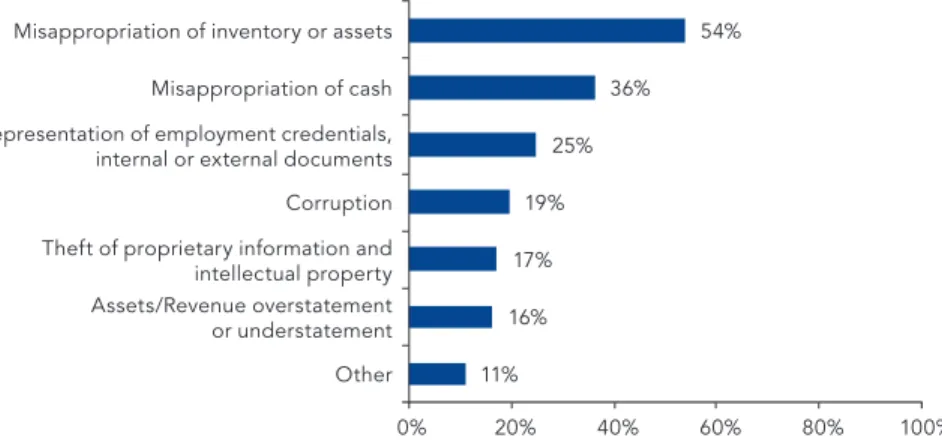
SMEs with weakening company performance were also somewhat more susceptible to occupational fraud. Some 32% of companies that had experienced a significant decline in their financial performance in the past three years reported to have been subject to occupational fraud. Among those whose performance did not deteriorate, only 25% reported incidents of fraud. Such company characteristics as number of years in business and industry sector did not seem to noticeably influence the odds of reporting occupational fraud. The most often cited type of occupational fraud experienced by SMEs was misappropriation of inventory or assets: 54% of companies reporting fraud said they encountered at least one incident of misappropriation of inventory or assets in the last fiscal year. At a distant second and third most often named types of occupational fraud were misappropriation of cash and misrepresentation of employment credentials through internal or external documents – some 36% and 25% of SMEs respectively indicated that they experienced those types of fraud (Figure 1).
31 The 4% of respondents refer to those who chose the option “don’t know’ when asked to reflect on the number of incidents of each types of occupational fraud that have occurred in their companies in the last fiscal year. As the “none” and “refuse” options were also available to respondents, the preference accorded to the “don’t know” option is treated as insufficient knowledge of whether or not incidents of occupational fraud have occurred.
32 Differences also existed among other provinces; however the sample size for those provinces does not allow for a reliable regional comparison.
26% of surveyed
SMEs experienced at
least one incident of
occupational fraud in
the past fiscal year
Survey respondents were provided with an option to indicate the frequency with which occupational fraud occurred in the last fiscal year. Although “one” was the most often indicated number of incidents for all types of occupational fraud, at least one fifth of respondents that experienced misappropriation of cash, inventory or assets, and corruption said that those types of fraud occurred four or more times in their companies in the last fiscal year.
4.1.2. Characteristics of the Single Largest Incident of Occupational Fraud
To better understand the means of detecting occupational fraud and its consequences for SMEs, survey respondents were asked to reflect on the single largest incident of occupational fraud that occurred in their companies in the last fiscal year. Misappropriation of inventory or assets was most often identified by respondents as the largest case of occupational fraud in their company: 34% of respondents who experienced fraud told us so. For another 26% of SMEs that encountered fraud, misappropriation of cash was the most notable fraud incident.
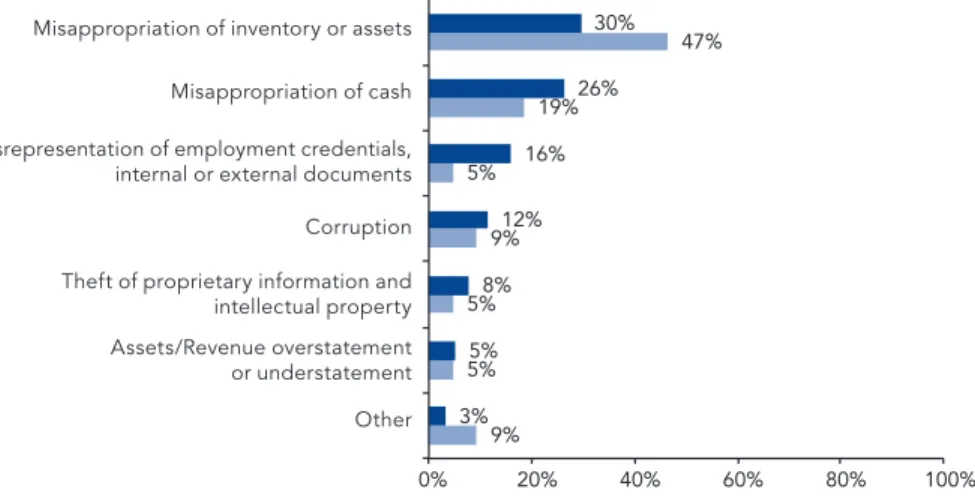
When surveyed companies were grouped into smaller SMEs (those generating less than $5 million in annual revenue) and larger SMEs (those generating $5 million and more in annual revenue), some differences were observed in the type of occupational fraud identified as the single largest incident. For instance, misappropriation of inventory or assets was much more often identified as the most notable fraud episode by larger SMEs than was the case for smaller SMEs. In turn, smaller SMEs were more likely than larger SMEs to report misrepresentation of employment credentials, and internal or external documents as the single largest incident of fraud (Figure 2).
Figure 1 – Types of Occupational Fraud Experienced by SMEs
11% 16% 17% 19% 25% 36% 54% 0% 20% 40% 60% 80% 100% Other Assets/Revenue overstatement or understatement Theft of proprietary information and intellectual property Corruption Misrepresentation of employment credentials, internal or external documents Misappropriation of cash Misappropriation of inventory or assets
% of SMEs reporting occupational fraud
Misappropriation of
inventory or assets was
most often identified
by respondents as
the largest case of
occupational fraud in
their company
Most often, the single largest incident of occupational fraud was exposed thanks to employees. Some 24% of SMEs that experienced occupational fraud indicated that the single largest case of fraud was uncovered as it was reported by employees. For another 22% of respondents, the single largest fraud incident was identified by internal audit and/or compliance personnel, whereas it was reported by managers, or customers and business contacts respectively in 16% and 10% of the cases. Three other methods of fraud detection – data mining and analysis, surprise controls, and external auditors – were noticeably less frequent in leading to detecting the largest incident of fraud. It may be of interest to note that in 9% of the cases, the largest episode of fraud was uncovered by accident. 9% 5% 5% 9% 5% 19% 47% 3% 5% 8% 12% 16% 26% 30% 0% 20% 40% 60% 80% 100% Other Assets/Revenue overstatement or understatement Theft of proprietary information and intellectual property Corruption Misrepresentation of employment credentials, internal or external documents Misappropriation of cash Misappropriation of inventory or assets
Figure 2 – Type of the Single Largest Incident of Occupational Fraud Experienced by SMEs
% of SMEs reporting occupational fraud in each group
SMEs with annual revenue under $5 million SMEs with annual revenue of $5 million or more
Note: Due to the relatively small sample size of the “SMEs with annual revenue of $5 million and more” category, the percentages presented in the figure above should be viewed as indicative of the relative prevalence of different types of occupational fraud rather than as a precise measurement of the frequency of fraud occurrence.
The single largest
incident of occupational
fraud was most often
exposed thanks to
employees
4.1.3. Impact of Occupational Fraud on SMEs
Financial losses incurred by SMEs due to incidents of reported occupational fraud over the last fiscal year were not very substantial. For more than half (55%) of SMEs that experienced occupational fraud, financial losses associated with fraud did not exceed $1,000; another 26% of companies assessed that their losses ranged between $1,000 and $5,000. Only 7% of SMEs experiencing occupational fraud said that their financial losses exceeded $25,000 (Figure 3); and only two companies (or less than 1% of those experiencing fraud) reported an estimated loss of more than $200,000.
The company size and sector of operations were two company characteristics that were somewhat likely to affect the extent of financial losses experienced by SMEs resulting from occupational fraud. For instance, SMEs with annual revenue in excess of $5 million reported losses greater than $25,000 twice more often compared with SMEs generating less than $5 million in annual revenues (12% vs. 6%). These results held true when the size of the company was measured by the number of employees. Similarly, SMEs operating in the service-producing industries were three times more likely to report losses in excess of $25,000 compared to SMEs affiliated with goods-producing industries. However, these differences did not change the main trend: regardless of the company’s characteristics, more than half of respondents that experienced fraud in the last fiscal year assessed their losses as fairly modest – not exceeding $1,000.
Figure 3 – Range of Financial Losses Incurred due to Occupational Fraud 55% 26% 12% 7% 0% 20% 40% 60% 80% 100% $1 to $1,000 $1,000 to $5,000 $5,000 to $25,000 more than $25,000 % o f SM E s re p o rt in g o cc up at io na l f ra u d
For 55% of SMEs that
experienced occupational
fraud, financial losses
associated with fraud
did not exceed $1,000
It is worth noting that the findings of CGA-Canada’s survey regarding the scale of financial losses incurred due to occupational fraud differ markedly compared to findings of the Canada-specific study undertaken by the ACFE in 2007. According to the ACFE’s data, the median, occupational fraud-related financial loss of a small business with less than 100 employees is $150,00033 whereas the average loss suffered by a small business is $1,188,462.34 Although the exact cause of the discrepancy cannot be identified, a number of possible explanations may be offered. For instance, information regarding monetary impact of fraud may be seen as sensitive by businesses and thus not fully reflected in the survey that collects data directly from business establishments which was the case of CGA-Canada’s survey. The ACFE survey did not face this limitation as the information was provided by fraud examiners who may be seen as a more neutral party than victimized businesses when it comes to assessing the consequences of fraud incidents. On the other hand, the ACFE survey did not seek to collect information from a representative sample of respondents, but rather from fraud examiners who were willing to provide information. As such, certain predispositions of survey participants due to self-selection may have disproportionately transmuted in the size of fraud cases described. Moreover, the ACFE survey assessed financial losses based on the information regarding the largest fraud case investigated by respondents. This, naturally, may lead to an overestimation of losses when they are generalized from the level of an individual case to the level of the sector.
In addition to the financial consequences of fraud, survey respondents were also asked to reflect on other negative effects associated with occupational fraud. As seen from the top chart of Figure 4, the negative impact on staff morale was by far the most often identified aspect of business that was affected by occupational fraud – 61% of SMEs that experienced fraud in the last fiscal year agreed. At a noticeable distance, such elements as business relationships, company’s reputation, public and client trust and company’s value were indicated by at least one fifth of respondents as other non-financial negative consequences of occupational fraud. The majority of respondents that chose the “Other” answer option, noted that occupational fraud experienced by their companies affected management’s confidence in staff.
The likelihood of respondents to report certain aspects of business as negatively affected by occupational fraud fluctuated depending on the company’s characteristics. The age of business was particularly influential in this regard. As seen from the bottom chart of Figure 4, younger SMEs were at least twice more likely than their older counterparts to feel that occupational fraud
33 Peltier-Rivest, D. (2007). Detecting Occupational Fraud in Canada: A Study of its Victims and Perpetrators, ACFE, p. 18.
34 Peltier-Rivest, D. (2009). An Analysis of the Victims of Occupational Fraud: A Canadian Perspective, Journal of Financial Crime, Vol. 16, No. 1, p. 65.
The negative impact
on staff morale was the
most often identified
aspect of business
that was affected by
occupational fraud
negatively affected business relationships and company value. Larger SMEs (those employing between 20 and 499 employees) felt stronger than smaller SMEs employing 5 to 19 employees that occupational fraud negatively affects staff moral and company reputation: the proportion of respondents indicating those answer options were 67% vs. 58% and 30% vs. 21% respectively. In turn, SMEs operating in goods-producing industries were more likely than their services-producing counterparts to experience a negative impact on company value (29% vs. 20% respectively).
Figure 4 – Aspects of Business Negatively Affected due to Occupational Fraud
% of SMEs reporting occupational fraud
Other Company’s ability to attract and retain employees Company’s value Public/client trust Company’s reputation Business relationships Staff morale 8% 16% 21% 22% 24% 26% 61% 0% 20% 40% 60% 80% 100%
% of SMEs reporting occupational fraud in each group
Other Public/client trust Company’s ability to attract and retain employees Company’s reputation Company’s value Business relationships Staff morale 10% 25% 16% 24% 14% 20% 63% 3% 16% 17% 25% 38% 39% 56% 0% 20% 40% 60% 80% 100%
SMEs in business for 15 years or less SMEs in business for more than 15 years
Once an incident of occupational fraud is uncovered, some adjustments may reasonably be expected to the company’s internal policies and practices aiming at preventing similar incidents in the future. The survey asked SMEs that experienced occupational fraud in the last fiscal year to identify those changes. The majority (57%) of respondents said that their companies revised disciplinary actions to be administered in the case of fraud. The other two most often cited changes related to modifying protocols for hiring and retaining employees, and adjusting policies and channels for reporting employees’ concerns about fraud: 45% and 42% of respondents respectively indicated those changes (top chart of Figure 5). Two additional measures – strengthening the system of internal controls and improving physical safeguards to secure company assets – were most often mentioned by respondents as “other” policies and practices that were adjusted as a result of detected occupational fraud.
When companies were grouped into smaller SMEs (those employing between 5 and 19 employees) and larger SMEs (those with 20 to 499 employees), a number of differences emerged in the type of policies that were adjusted as a result of occupational fraud. For instance, smaller SMEs accorded much greater attention to revising protocols for hiring and retaining employees (58% vs. 32% respectively) when compared to larger SMEs. Similarly, smaller SMEs were much more likely to modify the company’s code of ethics and conduct than was the case with larger SMEs, and to alter the quantity/ frequency of fraud awareness and ethics training among employees (bottom chart of Figure 5). The sector of company’s operations somewhat affected the likelihood of revising company’s policies related to segregation of duties: 48% of goods-producing SMEs said that they adjusted these policies as a result of incidents of occupational fraud. Among services-producing SMEs this proportion stood at 37%.
57% of SMEs
that experienced
occupational fraud said
their companies revised
disciplinary actions to
be administered in the
case of fraud
Figure 5 – Internal Policies and Practices Revised as a Result of Occupational Fraud
% of SMEs reporting occupational fraud
Protocol establishing investigation procedures Quantity/frequency of fraud awareness and ethics training among employees Quantity/frequency of fraud awareness and ethics training among management Fraud response plan Other Policy regarding finacial review/reconciliation Company’s code of ethics and conduct Protocol establishing segregation of duties Policies and channels for reporting employees’ concerns about fraud Protocols for hiring and retaining employees Disciplinary actions to be administered in the case of fraud
8% 18% 23% 25% 29% 32% 33% 39% 42% 45% 57% 0% 20% 40% 60% 80% 100%
% of SMEs reporting occupational fraud in each group
Protocol establishing investigation procedures Quantity/frequency of fraud awareness and ethics training among employees Quantity/frequency of fraud awareness and ethics training among management Fraud response plan Other Policy regarding finacial review/reconciliation Company’s code of ethics and conduct Protocol establishing segregation of duties Policies and channels for reporting employees’ concerns about fraud Protocols for hiring and retaining employees Disciplinary actions to be administered in the case of fraud
6% 9% 22% 18% 38% 28% 28% 45% 43% 32% 60% 10% 26% 28% 32% 34% 35% 42% 43% 49% 58% 66% 0% 20% 40% 60% 80% 100%
SMEs with 5 to 19 employees SMEs with 20 to 499 employees
4.2. Occupational Fraud Prevention and Detection
All survey respondents – including those who reported incidents of occupational fraud, but also those who did not – were asked to reflect on the measures that were in place in their companies in the last fiscal year aimed at prevention and detection of incidents of occupational fraud.
4.2.1. Level of Risk of Occupational Fraud
Overall, surveyed respondents did not think that occupational fraud presents a significant peril for their companies. Only 5% of SMEs gauged that occupational fraud poses a high risk for them, another 21% thought that the risk is moderate while the majority (74%) of surveyed SMEs believed that their exposure to the risk of occupational fraud is low.
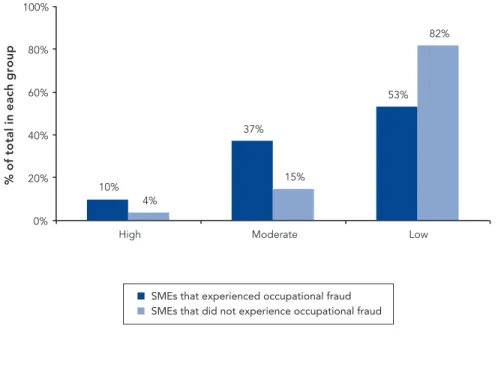
Some difference in respondents’ perception of risk existed depending on company characteristics. The most notable difference appeared when surveyed SMEs were grouped into those that have experienced occupational fraud in the last fiscal year and those which did not. SMEs that encountered at least one incident of occupational fraud were more than twice more likely to gauge the risk of occupational fraud as either high or moderate; however, the majority (53%) still believed that occupational fraud posed a low risk for their businesses (Figure 6).
Figure 6 – Perceived Level of Risk of Occupational Fraud
% o f to ta l i n e ac h g ro up 10% 37% 53% 4% 15% 82% 0% 20% 40% 60% 80% 100%
High Moderate Low
SMEs that experienced occupational fraud SMEs that did not experience occupational fraud