Full Terms & Conditions of access and use can be found at
https://www.tandfonline.com/action/journalInformation?journalCode=mpmr20
ISSN: 1530-9576 (Print) 1557-9271 (Online) Journal homepage: https://www.tandfonline.com/loi/mpmr20
The Intersection of Nonprofit Roles and Public
Policy Implementation
Jamie Levine Daniel & Rachel Fyall
To cite this article: Jamie Levine Daniel & Rachel Fyall (2019): The Intersection of Nonprofit Roles and Public Policy Implementation, Public Performance & Management Review, DOI: 10.1080/15309576.2019.1601114
To link to this article: https://doi.org/10.1080/15309576.2019.1601114
Published online: 02 May 2019.
Submit your article to this journal
Article views: 17
The Intersection of Nonprofit Roles and Public Policy
Implementation
Jamie Levine Daniela and Rachel Fyallb a
Indiana University–Purdue University;bUniversity of Washington
ABSTRACT
Many nonprofit organizations implement policy through ser-vice delivery. In addition, these nonprofits serve other roles in their communities. Policy implementation strategies that over-look the many roles nonprofits play may misunderstand implementation challenges or fail to maximize the benefits of public-nonprofits partnerships. We aim to inform policy imple-mentation by presenting a narrative that explores the inter-section of these nonprofit roles and policy implementation through nonprofit service delivery. We situate this focus on nonprofits as policy implementers within a framework of non-profit roles. We present commentary that integrates policy implementation and nonprofit roles by focusing on four themes: nonprofit role simultaneity, service delivery/policy implementation perceptual asymmetry, nonprofit roles over time, and network participation. Accounting for this multidi-mensionality can help government actors facilitate partner-ships that enable service delivery while also recognizing what nonprofits do independent of their formal arrangements with governments.
KEYWORDS Nonprofit roles; policy implementation; public service provision; public-nonprofit partnership
Long-established practices in government contracting enlist nonprofit organizations to implement public policy (Smith & Lipsky, 1993). In addition to delivering public services, nonprofits play other roles in their communities. Nonprofit roles refer to the different kinds of contributions or functions of nonprofits as they pursue their missions. While the boundaries, understand-ing, and influence of nonprofit roles continue to evolve (discussed more below), an early categorization defines these roles as service provision, advo-cacy, expression, community building, and“value guardian” of individual pro-social action (Salamon, 2003, pp. 11–14). The nonprofit roles framework serves to recognize and name the multidimensional motivators or ethos underlying nonprofit behavior. For example, a soup kitchen may use the pro-cess of serving food to those in need (service provision) as a way to foster an inclusive community (community building). Likewise, an after-school tutoring
CONTACT Jamie Levine Daniel [email protected] O’Neill School of Public and Environmental Affairs,
Indiana University–Purdue University Indianapolis, 801 W. Michigan St., Indianapolis, IN 46202, USA.
ß2019 Taylor & Francis Group, LLC
nonprofit may view feedback to the local school board (advocacy) as funda-mentally intertwined with its program activities (service provision). Regardless of the type of service or program a nonprofit provides, the nonprofit roles framework emphasizes the potential for each nonprofit to serve multiple roles while pursuing its mission (Moulton & Eckerd,2012).
The nonprofit roles framework identifies service provision as one of the roles through which nonprofit organizations shape their communities, as well as broader civil society (Salamon, 2003). Nonprofit service provision may be funded by a variety of sources, including private donors, foundations, fees-for-service, and public sources. Situating publicly-funded nonprofit services within a policy process framework reveals another characterization for these organizations: policy implementers. In other words, public policy research classifies publicly funded nonprofit service providers as policy implementers. Acknowledging the intersection between the nonprofit service provision role and nonprofits as policy implementers offers one example of how two related literatures—nonprofit management and public policy— describe the same phenomenon in different terms.
The divergent framing between nonprofit and public policy research can have adverse consequences for public policy and public management schol-ars attempting to understand and predict nonprofit behavior. Government actors might view the process of defining public services as unidirectional: through the policy process, policymakers and public administrators deter-mine the ideal mix of goods and services, and then use public resources to hire nonprofit organizations to meet local demand. This model views non-profits as responsive partners, where government formulates policies and distributes resources to nonprofit organizations that customize service pro-vision to meet local needs (Young, 1998). However, looking at nonprofits solely as policy implementers ignores the multitude of distinctive roles non-profits play in democratic society. Accounting for this multidimensionality can help government actors facilitate partnerships that enable service deliv-ery while also recognizing what nonprofits do independent of their formal arrangements with governments.
The purpose of this article is to highlight some of the intersections between the nonprofit roles framework and nonprofit policy implementation. We aim to inform policy implementation by presenting a narrative that articulates these intersections and some of their consequences. We start by offering a window into the multidimensionality of nonprofits using the non-profit roles framework. We then provide a brief overview of the practice of policy implementation through nonprofit service delivery, including some of the most prominent theoretical foundations guiding scholarship on this topic. The main contribution of the article is the subsequent commentary that integrates nonprofit roles and policy implementation by focusing on
four themes: nonprofit role simultaneity, service delivery/policy implementa-tion perceptual asymmetry, nonprofit roles over time, and network participa-tion. We conclude with a discussion that offers avenues for future research.
Nonprofit roles: A framework for understanding nonprofit multidimensionality
From the perspective of nonprofit scholarship and practice, nonprofit ser-vice provision—whether publicly funded or not—is just one of the many ways that nonprofits contribute to or shape their communities. The universe of nonprofits is large; the Internal Revenue Service’s typology of tax-exempt organizations includes thirty-seven classifications, including labor unions and chambers of commerce (Internal Revenue Service, 2018). Within the 501(c)(3) classification for charitable organizations, nonprofits range from universities to soup kitchens to recreational sports leagues. Even more not-able, simple classifications based on a particular organizational attribute overlook important intraorganizational variation in missions, priorities, and values (Fyall & Levine Daniel, 2018; Fyall, Moore, & Gugerty, 2018). Recognizing this complexity, the framework of nonprofit roles offers one way to explore the multidimensionality of nonprofit organizations.
The nonprofit roles framework articulates the scope of functions and/or contributions nonprofits can make to society at large. Frumkin (2002) organizes the different nonprofit functions across two dimensions: rationale (instrumental versus expressive) and orientation (supply-side versus demand-side). The possible combinations of the rationale and orientation dimensions result in four functions of nonprofit and voluntary action: ser-vice delivery, social entrepreneurship, civic and political engagement, and values and faith. Salamon’s (2003) role categories differ slightly, and corres-pond more directly to nonprofit contributions to American society: the ser-vice role, the advocacy role, the expressive role, the community-building role, and the value guardian role.
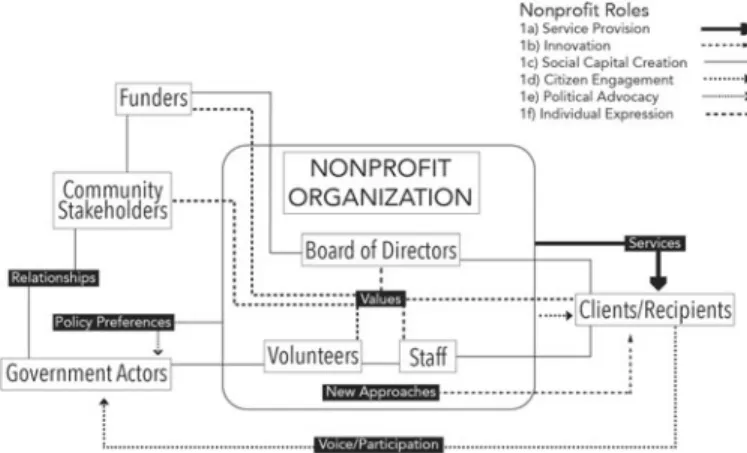
Moulton and Eckerd (2012) further the nonprofit role framework using an empirical approach, developing a nonprofit sector public role index that more fully defines each role. Their index identifies six distinct roles: service provision, innovation, political advocacy, citizen engagement, social capital creation, and individual expression. We adopt the Moulton and Eckerd classification of nonprofit roles, since it offers the greatest specificity as well as future opportunities for empirical testing. Figure 1 offers a visual representation of each nonprofit role to accompany the descriptions.
From a policy perspective, service provision is the most intuitive of the roles, conveying the transmission of a program or service by the nonprofit to an identified set of clients or recipients (Figure 1a). Service delivery has
Fi gu re 1. N o n p ro fi t rol es — key st ak eh o ld ers an d re so u rc e tr an sf ers .
an instrumental rationale and demand-side orientation, meaning that ser-vice delivery is outcome-focused and driven by the needs of a nonprofit’s community. This role coincides well with the idea of nonprofits as policy implementers, so long as the policymaking entity and nonprofit provider share a similar perspective on their community’s needs and intended pro-gram outcomes.
The innovation role also has an instrumental rationale, but with a sup-ply-side orientation (Figure 1b). Nonprofits prioritizing innovation focus on new approaches to programs or activities that often represent responses to external pressures or attempts to manage resource dependencies (Hillman, Withers, & Collins, 2009; Levine Daniel & Moulton, 2017; Pfeffer & Salancik, 1978; Porter, 1979; Vining, 2011). The innovation role encom-passes the concept of social entrepreneurship, emphasizing the (often) indi-vidualistic impulse to pursue new solutions for social problems (Dempsey & Sanders, 2010).
The social capital creation, citizen engagement, and political advocacy roles are all demand-oriented with expressive rationales. Unlike the out-come-focused instrumental rationale, the expressive rationale emphasizes values, meaning, and process. The social capital creation role refers to non-profits promoting a sense of community and providing a place for people to feel a sense of belonging. As Figure 1c illustrates, nonprofits prioritizing their social capital creation roles facilitate relationship development among their various stakeholders. A focus on social capital can also reflect an effort to build relationships among those feeling excluded from broader civil society (Schneider, 2007).
Nonprofits prioritizing the citizen engagement role foster their clients’ direct participation in democratic processes such as promotion of public education campaigns, voter education and participation, and community organizing, rather than pursuing specific policy outcomes (Figure 1d). Here, the nonprofits may not have unified policy preferences but instead work to amplify the political voices of their clients. The citizen engagement role embodies de Tocqueville’s observation of voluntary associations as a crucial training ground for a thriving democracy (Baggetta, 2009; Tocqueville, 1835). This participation in public life is often viewed as an expression of social capital (e.g., Putnam, Leonardi, and Nanetti (1994)); however, this linkage is not visible in all nonprofits emphasizing these roles. As such, the two roles deserve separate consideration.
The political advocacy role emphasizes nonprofits as policy advocates, engaging in and attempting to influence the policy process toward a par-ticular goal (Figure 1e). Political science scholarship tends to focus on the advocacy role as carried out primarily by nonprofits without a robust ser-vice delivery component, such as 501(c)(4) and 527 organizations, but
nonprofit scholarship illuminates the policy advocacy activities of 501(c)(3) service providers (Bushouse, 2017). Nonprofit advocacy activities may include days of action, public comment at city council meetings, public education events, encouraging supporters to contact their legislators about an upcoming vote, or employing a lobbyist to represent the nonprofits’ interests (Bass, Arons, Guinane, Carter, & Rees, 2007; Prentice, 2018).
The individual expression role recognizes how nonprofit organizations reflect the values of their stakeholders, often serving as the “organizational expression” of stakeholders’ views (Rothschild & Milofsky, 2006, p. 137). For example, volunteers and donors express their values through the choices they make in committing time or money, as well as any conditions they attach to these contributions. Service recipients may also see their pro-gram involvement as an expression of values—a case that is especially clear in congregations and other faith-based institutions. The voluntary nature of nonprofit participation means that each interaction between a stakeholder and a nonprofit offers the potential opportunity for values expression, resulting in the circulation of values throughout and across a nonprofit (Figure 1f).
Nonprofits as policy implementers
As demonstrated in various roles within the nonprofit roles framework, nonprofit activity frequently intersects with government actors and institu-tions. Here, we focus on the public sector’s long history of relying on non-profits to implement public policy. As far back as 1980, Salamon asserts,
“over 40% of the funds spent by federal, state, and local governments in the United States for a broad range of human service activities supported delivery by nonprofit organizations” (1993, p. 19). Estimates from 2007 purport that, among local governments, nonprofit organizations account for approximately 8% of public service delivery overall with significant vari-ation by service area—nonprofits provide at least 35% of local public serv-ices in the areas of day care, substance abuse, mental health, homeless shelters, and arts and culture (Warner & Hefetz, 2008). As for state govern-ments, a 1998 survey with state executives revealed that 71% of state administrative agencies contract with the nonprofit sector (Choi, Cho, Wright, & Brudney, 2005). Recent analyses confirm the longevity of this arrangement: an estimated $137 billion in public money went to nonprofits in 2012 (Pettijohn, Boris, De Vita, & Fyffe, 2013).
Given the prevalence of nonprofit providers as policy implementers, the public policy and public management scholarship draws from its own set of theories and frameworks in an attempt to unpack the policy implemen-tation function of nonprofits. We offer a brief review of three of the most
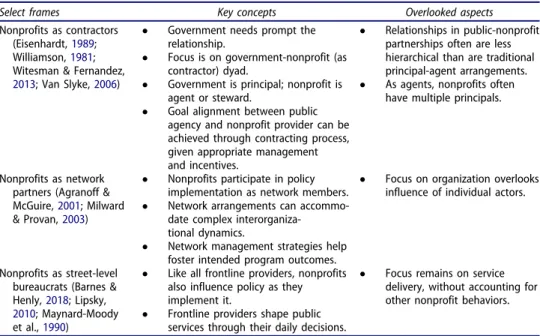
prominent theoretical frames here: nonprofits as contractors, nonprofits as network partners, and nonprofits as street-level bureaucrats. We also identify how each frame rests on assumptions that fail to recognize essential aspects of nonprofit behavior. Table 1 summarizes each frame, key assumptions, and overlooked aspects relevant to nonprofits in policy implementation.
Contracting theories are often applied to third-party policy implement-ers, regardless of which sectors are involved (Fernandez, 2009). The con-tracting frame originates with the government entity, which may use transaction costs to inform whether it should contract out, based on factors like the specificity of the product or service and market availability (Brown & Potoski, 2003; Williamson, 1981). Once the decision to contract out has been made, agency theory envisions the contracting relationship as between a resource-rich principal and a skilled agent (Eisenhardt, 1989). Self-interest motivates both the principal and the agent, making monitoring and incen-tive alignment essential for effecincen-tive contracting.
While agency theory is often applied to public sector contracting, pre-suming nonprofits are motivated primarily by self-interest is an awkward fit. Acknowledging the public benefit missions of charitable nonprofits, public managers may have more success treating nonprofit contractors as
“stewards” rather than “agents” (Van Slyke, 2006). Stewardship theory maintains the expectation of a resourceful principal but expects greater goal alignment between public agency and nonprofit provider (Witesman & Fernandez,2013). This expected goal alignment favors nonprofit contrac-tors under certain market conditions, though assumed goal alignment can
Table 1. Nonprofits and Policy Implementation: Theoretical Frames.
Select frames Key concepts Overlooked aspects
Nonprofits as contractors (Eisenhardt,1989; Williamson,1981; Witesman & Fernandez, 2013; Van Slyke,2006)
Government needs prompt the relationship.
Focus is on government-nonprofit (as contractor) dyad.
Government is principal; nonprofit is agent or steward.
Goal alignment between public agency and nonprofit provider can be achieved through contracting process, given appropriate management and incentives.
Relationships in public-nonprofit partnerships often are less hierarchical than are traditional principal-agent arrangements.
As agents, nonprofits often have multiple principals.
Nonprofits as network partners (Agranoff & McGuire,2001; Milward & Provan,2003)
Nonprofits participate in policy implementation as network members.
Network arrangements can accommo-date complex interorganiza-tional dynamics.
Network management strategies help foster intended program outcomes.
Focus on organization overlooks influence of individual actors.
Nonprofits as street-level bureaucrats (Barnes & Henly,2018; Lipsky, 2010; Maynard-Moody et al.,1990)
Like all frontline providers, nonprofits also influence policy as they implement it.
Frontline providers shape public services through their daily decisions.
Focus remains on service delivery, without accounting for other nonprofit behaviors.
also be a detriment if it tempts public managers to underinvest in contract oversight responsibilities (Brown, Potoski, & Van Slyke, 2006).
Contracting theories speak to the practicalities of structuring defined part-nership agreements, but this frame clearly situates the government as the
“principal” actor, thereby downplaying nonprofit complexity. Contracting theory emphasizes the contract itself, leaving less room to consider the con-tracting organizations more broadly. Extensions of the competitive contract-ing model, such as relational contractcontract-ing, acknowledge the importance of the contracting organization beyond a single contract (Bertelli & Smith,
2010; Dehoog, 1990), but the focus remains on the government-contractor dyad to the exclusion of potentially relevant stakeholders and motivations outside of this relationship.
The concept of resource interdependence is less hierarchical than con-tracting theories, noting that public-nonprofit partnerships demonstrate
“a simultaneous two-way flow of resources,” such as funds, information, service delivery capacity, and/or political legitimacy (Saidel, 1991, p. 550). Some proponents of an interdependence perspective argue, “it is critical that the balance of power [in public-nonprofit partnerships] be approxi-mately equal,” thus recommending the strengthening of nonprofit capacity and leverage in government negotiations (Cho & Gillespie, 2006, p. 505). In addition, given the multiple stakeholders whose preferences nonprofits must address, nonprofits are agents with multiple principals whose prefer-ences reflect varying degrees of power, legitimacy, and urgency (Mitchell, Wood, & Agle, 1997; Van Puyvelde, Caers, Du Bois, & Jegers, 2012).
In place of an exclusive focus on the relationship between a government entity and a single nonprofit contractor, scholars frequently use the frame of networks and collaboration to examine nonprofit policy implementation among many actors. Rather than a simple “make or buy” decision, empha-sizing the network considers “multiorganizational arrangements for solving problems that cannot be achieved, or achieved easily, by single organ-izations” (Agranoff & McGuire, 2001, p. 296). As compared to contracting and resource-related theories, a primary strength of the network frame is the ability to incorporate the influence of complex interorganizational dynamics, such as the effects of the stability of network relationships on service delivery, political power and social capital across relationships, and multisectoral interactions across many actors (Agranoff & McGuire, 2001; Herranz,2006; Milward & Provan, 2003; Negoita, 2018).
Although resource dependency and network concepts are able to incorp-orate the complexity of the nonprofit environment, these organizational-and network-level frames leave little room for the values organizational-and behaviors of the individual actors comprising nonprofit service organizations. In con-trast, street-level bureaucracy theory explains the behaviors of frontline
public service providers in certain conditions (Lipsky, 2010). Research on street-level bureaucracy tends to include the nonprofit employees within con-tracting agencies, often examining nonprofit and public employees jointly (e.g., Barnes & Henly, 2018; Maynard-Moody, Musheno, & Palumbo, 1990). This theory and related research help convey similarities of frontline workers regardless of their sector of employment, highlighting the individual-level cop-ing decisions made by frontline workers and the aggregate effects of such decisions. The tradeoff of the street-level bureaucracy frame, however, is the de-emphasis of organizational and sectoral effects, such as the unique func-tion of nonprofits in policy implementafunc-tion (Fyall, 2017).
Each of these frames differs in their perspectives on the relationship between public agencies and their nonprofit partners, but they share a focus on service delivery. Underscoring this point, network literature usu-ally specifies if the particular network of interest is a formal service delivery network, rather than an informal or information-sharing network (Kilduff & Tsai, 2003)—implying that these network functions can and should be considered separately. Other nonprofit behaviors may seem irrelevant or unrelated to policy implementation, but nonprofits may not neatly distin-guish between “policy-implementing” activities and other organizational priorities. Indeed, understanding how the multidimensionality of nonprofit organizations also applies to policy-implementing nonprofits is essential for facilitating positive public-nonprofit partnerships.
Integrating nonprofit roles and policy implementation
The nonprofit roles framework articulates the diverse contributions and functions of nonprofit organizations. Policy implementation investigates the specific function of publicly funded nonprofit service delivery. Policy implementation fits neatly within the service provision role; however, non-profits that implement policy also play other nonprofit roles. Theories and practices that focus exclusively on nonprofits as policy agents through the service delivery role overlook other roles that can influence policy imple-mentation and public-nonprofit partnerships. To facilitate a more nuanced understanding of the intersection between nonprofit roles and policy imple-mentation, we present four themes that demonstrate how nonprofit multi-dimensionality can influence nonprofit policy implementation.
Nonprofit role simultaneity
Nonprofit policy implementers simultaneously serve other roles in their communities. The service provision role indicates a nonprofit policy imple-menter’s commitment to addressing unmet needs, yet responding to unmet
community needs is just one of many priorities for nonprofits. Figure 2
illustrates the multidimensionality of nonprofit organizations who serve multiple roles, and why policy implementation through service delivery may not be the nonprofit’s sole focus.
A single action or process may fulfill multiple nonprofit roles, necessitat-ing the qualification of organizational effectiveness “by adding and provid-ing evidence for ‘according to (whom)’” (Herman & Renz, 1997, p. 202). Policymakers and those managing contracts with nonprofit providers appropriately capitalize on the nonprofit role of service provision, yet this is likely to be just one of many roles realized by the nonprofit, and align-ment between service provision and other roles is not guaranteed. Nonprofits may have priorities that are more expressive than instrumental, such as building social capital among and between stakeholder groups and offering outlets for individual values. A nonprofit with dual roles of service provision and individual expression may be reluctant to change its service delivery mode in order to serve more people if the change would diminish the volunteer experience.
Government agencies are often aware of the multiple roles of nonprofit organizations, but these roles tend to be considered in silos—sometimes intentionally. For example, nonprofits with a strong political advocacy role use a variety of tactics to communicate their policy preferences to govern-ment representatives (Fyall, 2016). Public hearings and other venues for feedback on potential policies are expected outlets for nonprofits’ political advocacy. Contracting processes for selecting partners tend to focus on a formal proposal or application; a nonprofit’s priorities outside of the appli-cation are largely irrelevant to the decision-making process.
Contracting can address some of the potential challenges posed by the intersection between simultaneous roles and service delivery; however, the interaction of roles and service delivery can happen outside the contracts.
For example, contracts may specify one type of service but a nonprofit’s integrated service model may offer unexpected or uncontracted benefits for clients. In these cases, contract specificity is not a fix because the relevant activities are external to the contract. In addition, the roles nonprofits pri-oritize may change midcontract. For example, many nonprofits experienced increased financial support and engagement from advocacy-oriented stake-holders following the 2016 Presidential election (Kaplan, 2017). This exter-nal shock has likely led to changes in role identification and prioritization that cannot be captured in a contract unless they affect the nonprofit’s abil-ity to fulfill the contract as promised. More likely, a new role prioritization influences the character or values espoused by providers without triggering contract adjustments.
Food pantries run by churches as a venue for the mission-fulfillment of their congregation provide an example where simultaneous roles can detract from nonprofit-provided public services. Congregation-affiliated food pantries are important frontline providers in the emergency food pol-icy field. National-level policies support and subsidize a substantial portion of the food commodities provided by food pantries. Yet, many food pan-tries serve an important role in their congregations as venues for volunteer service in addition to the benefits to service recipients. Pantries intending to fulfill an individual expression role in concert with service delivery may not pursue opportunities to streamline services if they diminish volunteer autonomy or engagement. This can be a detriment to public policy imple-mentation in that service quality or quantity may suffer because of the joint role of individual expression.
Nonprofit service provision/public policy implementation perceptual asymmetry
Finding nonprofit partners with a strong service provision role does neces-sarily guarantee successful or effective policy implementation. From a pol-icy perspective, finding the ideal nonprofit partner(s) relies on two assumptions: (1) the community in question has nonprofit organizations with the capacity and willingness to partner; and (2) public and nonprofit organizations share the same conceptualization of service delivery. In many communities, however, governments have limited choices about potential nonprofit partners. Factors related to supply and social structures tend to explain a community’s nonprofit composition, rather than demand (Grønbjerg & Paarlberg, 2001), thus affecting the composition and nature of available partners.
Once a partnership is established, public and nonprofit actors in existing contractual relationships may both assume a static definition of service
delivery. However, nonprofits demonstrate philanthropic particularism, the tendency of nonprofit organizations to serve niche communities rather than the general public (Salamon, 1995). Policy implementation by non-profits amplifies their particularistic behavior since the aggregate preferen-ces of nonprofit providers constitute the public service environment (Fyall,
2016). Particularism influences the expression of the service delivery role, since nonprofits aim to orient the services they provide toward the prior-ities of their organizational stakeholders. The varying ways in which non-profits carry out the service delivery role has implications for the equity and distribution of public programs and services.
Contract compliance and evaluation often rely on output measures. While these measures are likely appropriate for examining the aggregate effects of policy implementation, they may gloss over other service delivery details, such as program recruitment strategies or service intensity (“the amount of time committed to individual clients” (Alter, 1990, p. 484)). By overlooking the breadth of a nonprofit’s service delivery objectives, and by not being aware of the effects on service delivery they may be inadvert-ently shaping, government reporting requirements can frustrate nonprofit partners who feel that their true contributions are not recognized. Sowa, Selden, and Sandfort (2004) acknowledge the need for both objective and perceptual measures of effectiveness that allow for organizational and pro-grammatic variation. Nonprofit roles and the validated nonprofit role index (Moulton & Eckerd, 2012) can provide some common language for some perceptual measures.
Nonprofit childcare services exemplify the ways in which goal alignment between public and nonprofit partners can be challenged by the larger non-profit context. Many nonnon-profit childcare centers focus exclusively on their service delivery role as a childcare provider. The skill and quality of child-care providers, however, can vary substantially. In thin (generally rural) markets, nonprofit providers often lack the resources, incentives, and cul-ture of quality needed to deliver high quality care. As Cleveland & Krashinsky (2009, p. 459) observe, “If governments are using nonprofit agencies to deliver service quality, special programs or subsidies directed at quality improvement are likely to be required for agencies in thin markets.” In other words, the effectiveness of nonprofit policy implementation requires more than finding nonprofit partners with a dedication to service delivery.
Key characteristics of service delivery may also vary substantially within service-focused nonprofits, as illustrated by different approaches to housing for those experiencing homelessness. Requests for proposals (RFPs) to
“house the homeless” can yield responses from providers willing to house the same number from the same target population (such as single adults)
for the same cost in the same timeframe. However, the philosophical approach to housing individuals diverges. A “housing first” strategy places individuals in housing without requiring participation in treatment or social services. This approach is supported by rigorous research, which indicates better long-term outcomes when housing is not conditional on other behaviors. In contrast, a “housing ready” approach maintains that individuals should earn their access to housing by proving their
“readiness”—often through the adoption of a “clean and sober” lifestyle. This older strategy uses permanent housing as a carrot to induce prosocial behaviors, and individuals who do not maintain these behaviors are at risk of losing their housing. The “housing ready” approach is not supported by research, meaning that making housing access contingent on service par-ticipation or other behaviors does not reduce the likelihood of homeless-ness nor encourage long-term behavioral improvements. While nonprofits pursuing either strategy may offer competitive proposals, the long-term implications for policy are likely to differ substantially.
Nonprofit roles over time
Current or past experiences with particular nonprofit providers or provider arrangements may not guarantee future nonprofit behaviors, in part because the role(s) nonprofits serve can change over time. Contracting practices may assume that past performance predicts future behavior, and that increasing resources from government to the nonprofit will lead to increases in service delivery. However, unless the mission of the nonprofit is to execute a single contract, the organization exists outside of this con-tract. In addition, nonprofit organizations are impacted by changes in the sociopolitical environments in which they operate (Neal, 2008; Wicker & Breuer, 2015). Government actors at all levels shape the direction of public policies. Changes in administration can upset the balance of current arrangements, as can changes in donor preferences and support levels.
Emergency food provision provides an example of changing roles over time. As utilization trends change, food pantries have changed their own interpretation of their role(s). For example, food pantry stakeholders frus-trated at seeing increasingly chronic need among clients (Berner & O’Brien,
2004) may choose to engage more in political advocacy to address root issues. Since some nonprofits believe that reliance on public funding has “a negative impact on the organizational autonomy to take strategic decisions such as defining the NPOs’ mission, the working procedures, the results to be achieved, and the target groups to be reached” (Verschuere & De Corte,
2014, p. 304), these organizations may: (a) not to enter into contracts; or (b) have to accept identity conflicts between the service delivery role and
the political advocacy that could negatively impact both service provision and advocacy efforts.
Nonprofit roles and network participation
Roles help explain why nonprofit providers of public services may not be interested in participating in larger networks. Public service delivery net-works are now the norm in many policy areas. In fact, funding stipulations often mandate partnerships among agencies (Doerfel, Atouba, & Harris,
2017). However, factors that affect one-to-one partnerships (role simultan-eity, perceptions of service delivery, the influence of time), as well as supply and social structures, also affect network composition and may take on greater importance in a network setting. Just as organizational identity can be dynamic, so can networks, which has implications for contract specifica-tion and formalizaspecifica-tion (De Corte, Verschuere, & De Bie, 2017). Similarly, just as nonprofit roles can affect contracts on a dyadic level (e.g., non-profit-public entity), so too can roles affect membership in and perform-ance of networks. Nonprofits emphasizing individual expression may not want to join a community coalition if the nature of other members presents a conflict. For example, nonprofits involved with reproductive services nearly always have strong ideological, faith, and/or political foun-dations that inform an individual nonprofit’s service decisions. Coalition work across such ideologically diverse nonprofits may be futile, even if the proposed network goal would benefit all organizations.
In addition, network members bring “differently defined communities and notions of public interest, which could align, conflict, or co-exist while not interacting with one another” (Hundley, Brock, & Jensen, 2016, p. 95). The degree to which these differences matter may reflect the roles nonprof-its prioritize. Nonprofit organizations emphasizing individual expression may not see the need to join these networks, especially if their key stake-holders do not see the need to so (van Raaij, 2006). Similarly, nonprofits focusing on the creation of social capital may be reluctant to join networks if they perceive potential negative effects on their ability to focus on rela-tionship development, especially if the organizations and/or their stakehold-ers feel excluded from broader civil society. If the networks exhibit values or goals that do not align with the roles nonprofits choose to emphasize, network participation may be a nonstarter.
Policy actors may want to reconsider funding requirements tied to net-working or partnering within the community if this requirement would alienate otherwise essential partners that do not value network activities. Recognizing the difference between voluntary and mandated networks, and the appropriate evaluation criteria for each, may help defuse perceived
conflict within a network (Willem & Lucidarme, 2014). One criterion deserving attention is the network’s managing structure. As Piatak, Romzek, LeRoux, and Johnston (2018, p.170) note, informal management mechanism help address goal conflict through “shared norms and facilita-tive behaviors.” Understanding the roles nonprofits play can help service network coordinators develop targeted strategies that speak to the diversity of agencies within the network.
Discussion and conclusion
We set out to explore how the multidimensionality of nonprofits affects the provision of public service as implemented by nonprofit organizations. We summarize nonprofit roles as an organizing structure for nonprofit com-plexity. We synthesize common literature relevant to the intersection of nonprofits and policy implementation (nonprofits as contractors, network partners, and street-level bureaucrats), highlighting key assumptions as well as what these frames miss about nonprofits as policy implementers. We integrate nonprofit roles and policy implementation to explore some of the challenges presented in using nonprofits as policy implementers, emphasiz-ing what shapes nonprofit actors’ choices related to service delivery.
Studying nonprofits solely through the lens of implementation fails to tell the whole story of how and why nonprofits may or may not make ideal policy implementation partners. As Bushouse (2017, p. 60) notes, “[G]overnment’s reliance on nonprofit organizations to deliver the services created opportunities for collaboration but also tensions within nonprofit organizations . . .” She specifically points to “professionalization and advocacy”; we illustrate how these tensions extend beyond advocacy to policy implementation. We build on the work of Moulton and Eckerd (2012) and others to offer a visual represen-tation of nonprofit roles, and apply the framework to questions of policy implementation.
From a theoretical perspective, we aim to build a bridge between scholar-ship on public policy, public management, and nonprofit organizations by specifically focusing on the intersection between nonprofit roles and policy implementation. While public policy and management scholarships rarely engage with the complexity of the nonprofit landscape, nonprofit research too often overlooks the potential influence of nonprofit behavior on policy outcomes (Fyall, 2017). Our larger goal in integrating policy implementa-tion concepts with the nonprofit roles framework is to showcase how exist-ing research silos inhibit our collective knowledge on the public-nonprofit dynamic—a finding that others have also asserted (Mitchell & Schmitz,
Future researchers can delve further into the themes identified here to answer questions about the intersection of nonprofit roles and public pol-icy, as well as to explore other aspects of nonprofit multidimensionality. Within the frame of nonprofit roles, we suggest empirical evaluation of concepts within each theme. Some of this has been done within specific mission types. For example, Kim (2017) used Moulton and Eckerd’s (2012) nonprofit roles scale to examine how arts and culture organizations balance commitment to civic engagement with market-based pressures.
New research within each role can propel related research that looks
across roles. MacIndoe and Beaton (2019) find that nonprofit political advocacy responds to perceptions of the policy environment. Do these per-ceptions also influence the relationships between nonprofits and their gov-ernment funders? Deslatte, Schatteman, & Stokan (2019) conclude that, among local economic development organizations, divergent nonprofit forms are associated with different types of land use policies. Can compar-ing the priorities of other nonprofit roles among these two nonprofit forms help explain these policy differences?
In addition, we have treated policy implementation as a uniform concept, but policies can be distributive, constituent, regulative, or redistributive (Lowi, 1972). Policy type might affect application of our commentary. For example, policy type might help predict the extent to which roles may enhance or detract from implementation. Policy type may predict the likeli-hood of nonprofit roles changing over time, or nonprofit willingness to join service delivery networks. Future research could explore how variation in policy type interacts with nonprofit roles. Our narrative also opens up avenues to explore implementation interventions; for example, the best way(s) to educate public managers about nonprofit dimensionality and to evaluate their incorporation into their work with particular nonprofits. Along these lines, we also suggest there is room to develop heuristics for incorporating nonprofit roles into contracts and other partnering activities.
Our commentary extends into the network literature and offers opportu-nities to explore the interaction of networking mechanisms and specific nonprofit roles. For example, what is the relationship between nonprofit roles and formal participation requirements for public service networks? How does this relationship affect service-related outcomes? For nonprofits emphasizing a social capital role, how does the composition of the network affect a nonprofit’s willingness to join the network (formally or informally) or pursue spinoff projects (Shrestha, 2019)?
Our goal was to highlight some of the intersections between nonprofit roles and public policy implementation. The nonprofit roles framework offers a window into how the multidimensionality of nonprofits intersects with this policy implementation. Understanding the four key themes of
nonprofit role simultaneity, service delivery/policy perceptual implementa-tion asymmetry, nonprofit roles over time, and network participaimplementa-tion can help maximize the benefits and mitigate the risks of using nonprofits to implement public policy.
Acknowledgments
The authors wish to thank Sanjay Pandey, Jasmine McGinnis Johnson and the anonymous reviewers whose feedback helped shape this article. We also wish to thank Amanda Keating for her graphic design work, and Eve Fyall for inspiring us.
Notes on contributors
Jamie Levine Daniel is assistant professor in the Paul H. O’Neill School of Public and
Environmental Affairs at Indiana University-Purdue University, Indianapolis. Her research interests include nonprofit management, nonprofit roles, resource acquisition, organiza-tional identity, and collaboration
Rachel Fyall is assistant professor in the Daniel J. Evans School of Public Policy &
Governance at the University of Washington. Her research examines the ways in which nonprofits shape public policy through advocacy and policy implementation.
ORCID
Jamie Levine Daniel http://orcid.org/0000-0003-4009-0437 Rachel Fyall http://orcid.org/0000-0002-3886-9479
References
Agranoff, R., & McGuire, M. (2001). Big questions in public network management research. Journal of Public Administration Research and Theory, 11(3), 295–326. doi:10. 1093/oxfordjournals.jpart.a003504
Alter, C. (1990). An exploratory study of conflict and coordination in interorganizational service delivery systems. Academy of Management Journal, 33(3), 478–502. doi:10.5465/ 256577
Baggetta, M. (2009). Civic opportunities in associations: Interpersonal interaction, governance experience and institutional relationships. Social Forces, 88(1), 175–199. doi:10.1353/sof.0.0231
Barnes, C. Y., & Henly, J. R. (2018).“They Are Underpaid and Understaffed”: How clients interpret encounters with street-level bureaucrats. Journal of Public Administration
Research and Theory,28(2), 165–181. doi:10.1093/jopart/muy008
Bass, G. D., Arons, D. F., Guinane, K., Carter, M. F., & Rees, S. (2007).Seen but not heard:
Strengthening nonprofit advocacy. Washington, DC: The Aspen Institute.
Berner, M., & O’Brien, K. (2004). The shifting pattern of food security support: Food stamp and food bank usage in North Carolina.Nonprofit and Voluntary Sector Quarterly,33(4), 655–672. doi:10.1177/0899764004269145
Bertelli, A. M., & Smith, C. R. (2010). Relational contracting and network management.
Journal of Public Administration Research and Theory,20(Suppl_1), 21–40.
Brown, T. L., & Potoski, M. (2003). Production and service explanations for government service production decisions. Journal of Public Administration Research and Theory,
13(4), 441–468. doi:10.1093/jpart/mug030
Brown, T. L., Potoski, M., & Van Slyke, D. M. (2006). Managing public service contracts: Aligning values, institutions, and markets.Public Administration Review,66(3), 323–331. doi:10.1111/j.1540-6210.2006.00590.x
Bushouse, B. K. (2017). Leveraging nonprofit and voluntary action research to inform pub-lic popub-licy.Policy Studies Journal,45(1), 50–73. doi:10.1111/psj.12195
Cho, S., & Gillespie, D. F. (2006). A conceptual model exploring the dynamics of govern-ment–nonprofit service delivery. Nonprofit and Voluntary Sector Quarterly, 35(3), 493–509. doi:10.1177/0899764006289327
Choi, Y.-S., Cho, C.-L., Wright, D. S., & Brudney, J. L. (2005). Dimensions of contracting for service delivery by American state administrative agencies: Exploring linkages between intergovernmental relations and intersectoral administration.Public Performance
and Management Review,29(1), 46–66.
Cleveland, G., & Krashinsky, M. (2009). The nonprofit advantage: Producing quality in thick and thin child care markets. Journal of Policy Analysis and Management, 28(3), 440–462.
De Corte, J., Verschuere, B., & De Bie, M. (2017). Networks for welfare provision: Getting a grip on processes of social exclusion by evaluating network effectiveness.Social Policy
and Administration,51(7), 1174–1190. doi:10.1111/spol.12241
de Tocqueville, A. (1835). Democracy in America. London, UK: Saunders and Otley. Retrieved fromhttp://polisci2.ucsd.edu/foundation/03Tocqueville1835.pdf
Dehoog, R. (1990). Competition, negotiation, or cooperation: Three models for ser-vice contracting. Administration and Society, 22(3), 317–340. doi:10.1177/00953997 9002200303
Dempsey, S. E., & Sanders, M. L. (2010). Meaningful work? Nonprofit marketization and work/life imbalance in popular autobiographies of social entrepreneurship.Organization,
17(4), 437–459. doi:10.1177/1350508410364198
Deslatte, A., Schatteman, A. M., & Stokan, E. (2019). Handing over the keys: Nonprofit economic development corporations and their implications for accountability and inclu-sion. Public Performance and Management Review, 42(1), 90–114. doi:10.1080/15309576. 2018.1441726
Doerfel, M. L., Atouba, Y., & Harris, J. L. (2017). (Un)Obtrusive control in emergent net-works: Examining funding agencies’ control over nonprofit networks. Nonprofit and
Voluntary Sector Quarterly,46(3), 469–487. doi:10.1177/0899764016664588
Eisenhardt, K. M. (1989). Agency theory: An assessment and review. Academy of
Management Review,14(1), 57–74. doi:10.5465/amr.1989.4279003
Fernandez, S. (2009). Understanding contracting performance. Administration and Society,
41(1), 67–100. doi:10.1177/0095399708330257
Frumkin, P. (2002).On being nonprofit : a conceptual and policy primer. Cambridge, MA: Harvard University Press.
Fyall, R. (2016). The power of nonprofits: Mechanisms for nonprofit policy influence.
Public Administration Review,76(6), 938–948. doi:10.1111/puar.12550
Fyall, R. (2017). Nonprofits as advocates and providers: A conceptual framework. Policy
Fyall, R., & Levine Daniel, J. (2018). Pantries and policy implementation: Using nonprofit priorities to understand variation in emergency food assistance.Nonprofit and Voluntary
Sector Quarterly,47(4_Suppl), 11S–33S. doi:10.1177/0899764017753318
Fyall, R., Moore, M. K., & Gugerty, M. K. (2018). Beyond NTEE codes: Opportunities to understand nonprofit activity through mission statement content coding. Nonprofit and
Voluntary Sector Quarterly,47(4), 677–701. doi:10.1177/0899764018768019
Grønbjerg, K. A., & Paarlberg, L. (2001). Community variations in the nonprofit sector community variations in the size and scope of the nonprofit sector: Theory and prelim-inary findings. Nonprofit and Voluntary Sector Quarterly, 30(4), 684–706. doi:10.1177/ 0899764001304004
Herman, R. D., & Renz, D. O. (1997). Multiple constituencies and the social construction of nonprofit organization effectiveness. Nonprofit and Voluntary Sector Quarterly, 26(2), 185–206. doi:10.1177/0899764097262006
Herranz, J. (2006). The multisectoral trilemma of network.Journal of Public Administration
Research and Theory,18(1), 1–31. doi:10.1093/jopart/mum004
Hillman, A. J., Withers, M., & Collins, B. J. (2009). Resource dependence theory: A review.
Journal of Management,35(6), 1404–1427. doi:10.1177/0149206309343469
Hundley, M., Brock, E. S., & Jensen, L. S. (2016). Fiduciary responsibilities to whom? Federal grant recipients’ perceptions of the public interest. Journal of Public Budgeting,
Accounting and Financial Management,28(1), 71–101.
Internal Revenue Service. (2018). Publication 557: Tax-exempt status for your organization.
Department of the Treasury. Retrieved from February 1, 2019, https://www.irs.gov/pub/
irs-pdf/p557.pdf.
Kaplan, L. (2017). How far does the post-election nonprofit giving surge extend? Non
Profit Newsj Nonprofit Quarterly, Retrieved fromhttps://nonprofitquarterly.org/2017/04/
17/far-post-election-nonprofit-giving-surge-extend/
Kilduff, M., & Tsai, W. (2003). Social networks and organizations. Thousand Oaks, CA: Sage.
Kim, M. (2017). Characteristics of civically engaged nonprofit arts organizations: The results of a national survey. Nonprofit and Voluntary Sector Quarterly, 46(1), 175–198. doi:10.1177/0899764016646473
Levine Daniel, J., & Moulton, S. (2017). Beyond cans and capacity: Nonprofit roles and ser-vice network objectives in an emergency food network. Nonprofit Management and
Leadership,28(1), 47–64. doi:10.1002/nml.21267
Lipsky, M. (2010). Street-level bureaucracy: Dilemmas of the individual in public services.
New York, NY: Russel Sage Foundation.
Lowi, T. J. (1972). Four systems of policy, politics, and choice. Public Administration
Review,32(4), 298–310. doi:10.2307/974990
MacIndoe, H., & Beaton, E. (2019). Friends or foes? How managerial perceptions of the political opportunity structure shape nonprofit advocacy. Public Performance and
Management Review,42(1), 59–89. doi:10.1080/15309576.2018.1498362
Maynard-Moody, S., Musheno, M., & Palumbo, D. (1990). Street-wise social policy: Resolving the dilemma of street-level influence and successful implementation. The
Western Political Quarterly,43(4), 833–848. doi:10.2307/448738
Milward, H. B., & Provan, K. (2003). Managing the hollow state Collaboration and con-tracting.Public Management Review,5(1), 1–18. doi:10.1080/1461667022000028834 Mitchell, G. E., & Schmitz, H. P. (2019). The nexus of public and nonprofit management.
Public Performance and Management Review, 42(1), 11–33. doi:10.1080/15309576.2018.
Mitchell, R. K., Wood, D. J., & Agle, B. (1997). Toward a theory of stakeholder identifica-tion and salience: Defining the principle of who and what really counts. Academy of
Management Review,22(4), 853–886. doi:10.2307/259247
Moulton, S., & Eckerd, A. (2012). Preserving the publicness of the nonprofit sector.
Nonprofit and Voluntary Sector Quarterly, 41(4), 656–685. doi:10.1177/08997640114
19517
Neal, R. (2008). The importance of the state: Political dimensions of a nonprofit network in Oaxaca, Mexico. Nonprofit and Voluntary Sector Quarterly, 37(3), 492–511. doi:10. 1177/0899764007310422
Negoita, M. (2018). Beyond performance management: A networked production model of public service delivery. Public Performance and Management Review, 41(2), 253–276. doi:10.1080/15309576.2017.1408473
Pandey, S. K., & McGinnis Johnson, J. (2019). Nonprofit management, public administra-tion, and public policy: Separate, subset, or intersectional domains of inquiry? Public
Performance and Management Review,42(1), 1–10. doi:10.1080/15309576.2018.1557382
Pettijohn, S. L., Boris, E. T., De Vita, C. J., & Fyffe, S. D. (2013).Nonprofit-government
con-tracts and grants: Findings from the 2013 national survey. Washington, DC: The Urban
Institute.
Pfeffer, J., & Salancik, G. R. (1978). The external control of organizations: A resource
dependence perspective. New York, NY: Harper & Row.
Piatak, J., Romzek, B., LeRoux, K., & Johnston, J. (2018). Managing goal conflict in public service delivery networks: Does accountability move up and down, or side to side?
Public Performance and Management Review,41(1), 152–176. doi:10.1080/15309576.2017.
1400993
Porter, M. (1979). How competitive forces shape strategy.Harvard Business Review, 57(2), 137–145.
Prentice, C. R. (2018). The “State” of nonprofit lobbying research: Data, definitions, and directions for future study. Nonprofit and Voluntary Sector Quarterly, 47(4_suppl), 204S–217S. doi:10.1177/0899764018758957
Putnam, R. D., Leonardi, R., & Nanetti, R. Y. (1994).Making democracy work: Civic
tradi-tions in modern Italy. Princeton, NJ: Princeton University Press.
Rothschild, J., & Milofsky, C. (2006). The centrality of values, passions, and ethics in the nonprofit sector. Nonprofit Management and Leadership, 17(2), 137–143. doi:10.1002/ nml.139
Saidel, J. R. (1991). Relationship between state agencies and nonprofit organizations. Public
Administration Review,51(6), 543–553. doi:10.2307/976605
Salamon, L. M. (1993). The marketization of welfare: Changing nonprofit and for-profit roles in the American welfare state. Social Science Review, 67(1), 16–39. doi:10.1086/ 603963
Salamon, L. M. (1995). Partners in public service: Government-nonprofit relations in the
modern welfare state. Baltimore, MD: Johns Hopkins University Press.
Salamon, L. M. (2003). The resilient sector: The state of nonprofit America. Washington, DC: Brookings Institution Press.
Schneider, J. A. (2007). Connections and disconnections between civic engagement and social capital in community-based nonprofits. Nonprofit and Voluntary Sector Quarterly,
36(4), 572–597. doi:10.1177/0899764006297236
Shrestha, M. K. (2019). Network structure and spinoff effects in a collaborative public program. Public Performance and Management Review, 1–28. doi:10.1080/ 15309576.2018.1549085
Smith, S. R., & Lipsky, M. (1993). Nonprofits for hire: The welfare state in the age of
con-tracting. Cambridge, MA: Harvard University Press.
Sowa, J. E., Selden, S. C., & Sandfort, J. R. (2004). No longer unmeasurable? A multidimen-sional integrated model of nonprofit organizational effectiveness. Nonprofit and
Voluntary Sector Quarterly,33(4), 711–728. doi:10.1177/0899764004269146
Van Puyvelde, S., Caers, R., Du Bois, C., & Jegers, M. (2012). The governance of nonprofit organizations. Nonprofit and Voluntary Sector Quarterly, 41(3), 431–451. doi:10.1177/ 0899764011409757
van Raaij, D. P. A. M. (2006). Norms network members use: An alternative perspective for indicating network success or failure. International Public Management Journal, 9(3), 249–270. doi:10.1080/10967490600899549
Van Slyke, D. M. (2006). Agents or stewards: Using theory to understand the government-nonprofit social service contracting relationship. Journal of Public Administration
Research and Theory,17(2), 157–187. doi:10.1093/jopart/mul012
Verschuere, B., & De Corte, J. (2014). The impact of public resource dependence on the autonomy of NPOs in their strategic decision making. Nonprofit and Voluntary Sector
Quarterly,43(2), 293–313. doi:10.1177/0899764012462072
Vining, A. R. (2011). Public agency external analysis using a modified“Five Forces” frame-work. International Public Management Journal, 14(1), 63–105. doi:10.1080/10967494. 2011.547819
Warner, M., & Hefetz, A. (2008). Managing markets for public service: The role of mixed public-private delivery of city services. Public Administration Review, 68(1), 155–166. doi:10.1111/j.1540-6210.2007.00845.x
Wicker, P., & Breuer, C. (2015). How the economic and financial situation of the commu-nity affects sport clubs’ resources: Evidence from multi-level models. International
Journal of Financial Studies,3(1), 31–48. doi:10.3390/ijfs3010031
Willem, A., & Lucidarme, S. (2014). Pitfalls and challenges for trust and effectiveness in collaborative networks. Public Management Review, 16(5), 733–760. doi:10.1080/ 14719037.2012.744426
Williamson, O. E. (1981). The economics of organization: The transaction cost approach.
American Journal of Sociology,87(3), 548–577. doi:10.1086/227496
Witesman, E. M., & Fernandez, S. (2013). Government contracts with private organizations: Are there differences between nonprofits and for-profits?Nonprofit and Voluntary Sector
Quarterly,42(4), 689–715. doi:10.1177/0899764012442592
Young, D. R. (1998). Third party government. In J. M. Shafritz (Ed.), International
Encyclopedia of Public Policy and Administration (pp. 2252–2254). Boulder, CO: