The Open University’s repository of research publications
and other research outputs
Refining Open Educational Resources For Both Learner
And Institution
Thesis
How to cite:
Law, Patrina (2019). Refining Open Educational Resources For Both Learner And Institution. PhD thesis The Open University.
For guidance on citations see FAQs.
c
2018 The Author Version: Version of Record
Copyright and Moral Rights for the articles on this site are retained by the individual authors and/or other copyright owners. For more information on Open Research Online’s data policy on reuse of materials please consult the policies page.
Refining open educational
resources for both learner and
institution
Submitted for the degree of Doctor of Philosophy by Published Work
Learning and Teaching Innovation
The Open University
October 2018
2
Part 1 Covering paper
The title for the proposed thesis is ‘Refining open educational resources for both learner and institution’. It examines the impact of open educational resources (OER) created by The Open University (OU) and recent developments to recognise, motivate and reward learners through the issuing of free open digital badges.
This PhD by Published Work submission will follow a standard format:
PART 1 – COVERING PAPER PART 2 – THE PUBLICATIONS
3
Contents
Acknowledgements ... 5 Abstract ... 6 Chapter 1 Introduction ... 8 Structure of Part 1 ... 9Biographical and contextual review of this study ... 10
My role at The Open University and its relationship with OER ... 10
The Open University’s interest in digital badging ... 15
A theoretical basis for this study... 17
Biographical and contextual review of this study: a summary ... 18
Methods ... 21
Chapter 2. Literature review ... 25
Defining informal and non-formal learning ... 26
Access to free learning ... 30
The rationale for OER ... 32
The origins of digital badges ... 35
Digital badges in education ... 36
Literature review: a summary ... 40
Chapter 3. Interrelationship between the papers ... 42
The publications ... 42
Theme 1: The challenges of repurposing formal learning content as OER ... 44
Reuse of OER by educators ... 49
Contribution to the field within Theme 1 ... 51
Theme 2: Supporting the motivations of informal learners using OER ... 55
Comparisons with MOOCs ... 60
Recognition for informal learning ... 61
Contribution to the field within Theme 2 ... 64
Theme 3: Delivering an institutional business model for OER... 67
A business model for OER ... 68
The refinement of OER in practice ... 70
Contribution to the field within Theme 3 ... 73
Interrelationship between the papers: a summary ... 75
Chapter 4. The publications ... 78
4
Summary of Publication 1 ... 78
Citations and reception of Publication 1 ... 79
Publication 2 ... 79
Summary of Publication 2 ... 80
Citations and reception of Publication 2 ... 80
Publication 3 ... 82
Summary of Publication 3 ... 82
Citations and reception of Publication 3 ... 85
Publication 4 ... 87
Summary of Publication 4 ... 87
Citations and reception of Publication 4 ... 89
Publication 5 ... 90
Summary of Publication 5 ... 91
Citations and reception of Publication 5 ... 92
Publication 6 ... 93
Summary of Publication 6 ... 93
Citations and reception of Publication 6 ... 94
Publication 7 ... 96
Summary of Publication 7 ... 96
Citations and reception of Publication 7 ... 97
Publication 8 ... 98
Summary of Publication 8 ... 99
Citations and reception of Publication 8 ... 99
Publication 9 ... 102
Summary of Publication 9 ... 102
Citations and reception of Publication 9 ... 104
Publication 10 ... 105
Summary of Publication 10 ... 105
Citations and reception of Publication 10 ... 106
Publication 11 ... 107
Summary of Publication 11 ... 107
Citations and reception of Publication 11 ... 109
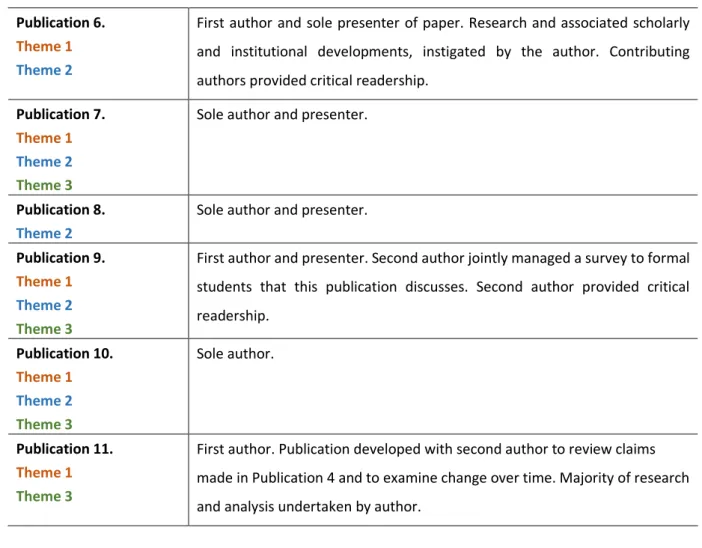
Contribution by the author to publications ... 110
Awards ... 111
Chapter 5 Conclusions ... 113
5
Acknowledgements
My adventures into Open Educational Resources (OER) research began in the Institute of Educational
Technology (IET) in 2008 when I was welcomed by Professor Patrick McAndrew and Professor Martin
Weller, established and respected figures in the OER movement, to contribute to their projects. Their
encouragement to ask my own questions of the movement gave me the confidence to continue to
research OER after leaving the Institute four years later. Alongside Patrick and Martin, I am especially
grateful to Dr Leigh-Anne Perryman who, in ignoring the barriers apparent to many staff in
non-academic positions, co-researched and co-authored with me as a peer during the early stages of my
research into OER.
I would also like to thank another co-author, Dr Anne Jelfs, for her guidance into research
methodology, friendship and shared vision. Anne has provided solid advice and was a much-needed
rock to which to anchor during difficult times during our careers.
I am also grateful to Mark Leuba for his altruistic vision for open badges, for his good humour and
trust, and for inviting me to work alongside international colleagues to help shape his vision.
Finally, I am extremely grateful to my supervisors, Professor Denise Whitelock and Professor Allison
Littlejohn, for their support, encouragement, honesty and tenacity to draw out the evidence
presented in this thesis. Denise was the one who suggested that I pursue the path of a PhD by
Published Work and gave me the confidence – through her own great energy for research and
scholarship – that I might be capable of achieving such a thing.
Last and most importantly, I would like to dedicate this thesis to my mum, Yvonne Law, and to Andrew
Law, for their enduring encouragement, patience and support, and especially to my son Torin, for
asking his own great questions and for demonstrating tremendous resilience in face of life’s
6
Abstract
The Open Educational Resources (OER) movement over the past ten years has described many
benefits of releasing learning for free, including business remunerations to institutions as well as a
means to altruistically reach underserved groups. By examining learner behaviour and motivation, the
papers collated for this PhD by Published Work bring a critical analysis to the experience of delivering
OER addressing the broad research question “How can the refinement of OER benefit both learner
and institution?”.
A range of qualitative and quantitative research methodologies and associated website analytics are
used to investigate the challenges of repurposing OER together with how the motivations of those
wishing to take advantage of OER usage can be better supported. During the five-year time line of
these papers, formal students and informal learners, predominantly UK-based, were surveyed by the
author generating several thousand responses.
These surveys focussed mainly on a large institutional endeavour to deliver OER at The Open
University, key findings from which show the business impact of open educational practice where
literature had provided only theoretical assumptions. The data also exposes the many and varied
motivations of learners using OER where literature has focused largely on the experience and attitudes
of educators.
The thesis reveals learners’ problems with OER usability more generally, and critically, the desire for
certification of OER study against the prohibitive costs of studying in higher education. It describes the
development by the author and associated impact of the application of digital badges (or
‘micro-credentials’) to reward users of OER as recognition for informal learning achievements.
The thesis includes recommendations that extend beyond one institution’s OER policy, regarding the
design and curation of OER globally to better serve the needs of learners, particularly those who
7 more cohesively to explore the potential of a framework of core work-related skills needed for a digital
economy.
It is concluded that there is an economy of scale to the delivery of OER, but that the key to successful
impact is through robust open educational practice, instructional design and tangible recognition to
8
Chapter 1 Introduction
This submission for the degree of PhD by Published Work draws together findings from work
conducted from 2011 to 2017. The eleven publications reflect a journey of research, refinement,
experimentation and re-evaluation in the context of my role as the Head of Free Learning for the Open
University (OU), responsible for the commissioning of free learning materials on the University’s public
learning platforms.
My thesis is framed in terms of the following three themes:
1. The challenges of repurposing formal learning content as Open Education Resources (OER).
2. Supporting the motivations of informal learners using OER.
3. The refinement of OER in support of the social and business mission of delivering free learning.
While I have attempted to address each of these research themes in turn in Chapter 3, my work has
been undertaken in the context of using the OU’s systems and platforms available to me. However,
the implications of my work are wide-ranging, particularly around digital badging for OER and to
inform how changes in open educational practice can positively impact educational institutions’
formal and informal learners.
In order to research the impact of benefits to the learner and institution and the factors that influence
that impact, the engagement of learners was measured though qualitative and quantitative data
collection methods and the review of website analytics. The majority of the studies undertaken for
this research were focused on the OpenLearn platform, the OU’s free learning website that has
delivered excerpts of the University’s taught modules as Open Educational Resources (OER) since
2006. Due to direct access to the platform and its users, routes to feedback were clear and easily
accessible and presented an opportunity for rapid data collection given the extremely large body of
people using the platform (over six million a year). Refinement of OER was approached with scale in
mind and a view to influencing open educational practice within the OU and Higher Education
9 I make extensive use of my knowledge in learning design for open, untutored study and have broad
and embedded interests in the application of free learning in support of outreach and business impact.
My thesis reflects this since it comprises an analysis of project-based and institutional attempts to
adapt formal learning for use as OER and in the commissioning and evaluation of new OER for target
groups and purposes. The majority of the thesis is based on work I have led myself: both the
refinement of OER and the evaluation of its impact. This process is ongoing and has led to fundamental
changes in the practice of learning design for OER at the OU and the application of digital badges to
reward and motivate learners. It demonstrates that this ongoing evaluation and refinement not only
benefits learners but greatly improves business impact and directly influences the strategy for free
learning provision.
Structure of Part 1
A PhD by Published Work should provide the following in Part 1: Covering paper:
a) a summary of each publication;
b) the interrelationship between the publications;
c) a critical review of the current state of knowledge and research in the field, and indicate
how the candidate's work has contributed to the field; and
d) commentary on the reception of the publications, as indicated by citations and reviews, and
the standing of the journals in which they were published.
This chapter provides a biographical and contextual summary of my professional role and its
relationship with research, and research methods used. Chapter 2 gives a summary of definitions of
informal and non-formal learning, followed by a literature review of current work around the function
of OER and theoretical business benefits to institutions delivering them, and the growing application
of digital badges in education (requirement c)). Chapter 3 explores my contribution to the field,
addressing each of my key research themes and the interrelationship between the publications
10 the context in which they were written and their reception since publication (requirements a) and d)).
Chapter 5 provides a summary of conclusions from the thesis overall, the developing future direction
of OER and digital badging at The Open University and more widely in higher education (HE). The
publications themselves are published in Part 2.
Biographical and contextual review of this study
This section considers the context for the work described in this submission, focusing on my role when
the work took place (the second decade of the 21st century), the institutional setting (The Open
University, UK), its relationship with OER, learning platforms and channels that were evaluated, and
the growing interest in digital badges. It does not provide a full history of the OER movement, but
instead, focusses on the application and development of OER to increase reach (altruism) and for
business purposes, coupled with opportunities to experiment with digital badging as a means to
reward and motivate informal learners. This was (and remains) a critical activity in proving the worth
and impact of OER as an institutional and global educational endeavour.
My role at The Open University and its relationship with OER
My role in the OU has always included an element of research. It is wide-ranging inasmuch as it
straddles both professional and academic work, the practice of which became apparent when I joined
the Institute of Educational Technology (IET) in 2004. Whilst I was ostensibly employed on an
academic-related contract, the work of my team was in support of research projects and the
evaluation of the OU’s formal taught modules. The concept of this dual role led me to be involved in
my first research project in 2009 to look in more detail at the blurred boundaries of academic and
professional life (Whitchurch & Law, 2010). Whitchurch had described an emerging “third space” for
HE professionals who are capable of performing ‘blended’ roles, comprising elements of both
academic and professional activity (Whitchurch, 2009). At that time, this “third space” activity wasn’t
11 and it is recognised that my role today as an HE professional requires me to evaluate for both business
and academic (public) purposes as there is perceived worth in this dual activity and skill set.
My skills as a researcher have grown given the numerous studies, datasets and varied projects I have
commissioned, evaluated and been tasked to research, as part of my developing professional role in
HE and within that, OER. I have learnt much about handling open course development and analysis
and have refined my approach to questionnaire design to complement associated data analytics, over
time. My approaches and methods are discussed more fully later in this chapter.
The specific activities I undertook during the time that the publications were written for this thesis are
described in Chapter 3 but began with the Open Learning Network (OLnet) (OLnet, 2016) and Bridge
to Success (Bridge to Success, 2012) projects which provided the first opportunity to work with the
OER research community as a whole. The successes and challenges of repurposing formal learning
content as OER (for the Bridge to Success project) and the potential impact of that activity weren’t the
only large OER projects being undertaken in the University at the time. Other projects in separate units
and faculties were researching and developing OER for different audiences, for example, the
International Development Office delivering free educational content for teachers in Africa (TESSA,
2017)) and the Open Media Unit in producing OER for publication on the OpenLearn platform, iTunes
U and YouTube.
As a result of observing this apparent disconnect between the various large-scale OER activities in the
University at this time, I set up the OER Advisory Group in 2012, which comprised project leads,
principle academics and Directors, to discuss and share ideas and outputs and to deliver the
University’s Open Educational Media Operating Policy (The Open University, 2016b). This policy
provided a means to define what open educational media is to the University, its main purpose and
guiding principles regarding delivery and development. It provided a means to clarify the relationship
between the Open University’s Charter and the operating guidelines to deliver free learning via
12 Through its mission to provide OER at scale, OpenLearn was launched in 2006, and while not a unique
presence on the global stage in providing free adult learning content, it was the only site of its kind
based in the UK. Other OER sites, such as the Saylor Foundation platform and free course materials
issued through OpenCourseWare (Massachusetts Institute of Technology’s (MIT) free course extract
website) were established in the early to mid-2000s as non-profit-making entities with a mission to
provide free learning under a Creative Commons licence. (The Creative Commons licence itself, was
founded in 2001.) Like MIT’s OpenCourseWare, OpenLearn helped to lift the lid on formal university
teaching material, giving learners a taster of study and access to content they might not otherwise
have been able to afford to use.
The William and Flora Hewlett Foundation began investing in OER projects in 2002. They define OER
to be “teaching, learning, and research resources that reside in the public domain or have been
released under an intellectual property license that permits their free use and re-purposing by others.
Open educational resources include full courses, course materials, modules, textbooks, streaming
videos, tests, software, and any other tools, materials, or techniques used to support access to
knowledge” (William and Flora Hewlett Foundation, 2017).
When OpenLearn was launched as the result of a two-year William and Flora Hewlett
Foundation-funded project, the OU attempted to release 5% of its taught courses into the public domain as OER.
The University continued to undertake this activity after funding ended in 2008 as it complemented
the OU’s Royal Charter which states that it should “promote the educational well-being of the
community generally” (The Open University, 1969, p.iv) and was already doing this through its
broadcast relationship with the British Broadcasting Corporation (BBC). OpenLearn was merged with
the Open2.net website in 2010, a platform where learners could find out more about BBC-OU
programmes and connect with subject information and topical articles. OpenLearn is now globally
recognised as one of the leading OER platforms for range of content and usability (MOOCLab, 2016).
13 (MOOC) and nano-degree providers and is ranked in the first page of search results for the term “free
course” despite an extensive range of free learning available online today.
After I had started my research journey into OER, I observed this institutional endeavour to produce
OER at scale as one which had become almost completely uncoupled from OER research – a separation
of practice and research – and presented an opportunity to me to reconnect these worlds. Many of
the large OER-funded projects at the time were focused on examining the efficacy of OER projects in
the US or indeed, instigating them. As a co-author of the successful bid to the Hewlett Foundation to
fund the OER Research Hub in 2012, I became more immersed in research methods and outputs
around OER and was successfully appointed as a research fellow for the project, which I undertook in
addition to my day-to-day work. I took this opportunity to identify the gap in research for UK-based
institutional OER delivery, investigating and uncovering major issues to support OER in the UK,
particularly through the provision of recognition and reward for OER by the application of digital
badges.
This activity set me in good stead to move to the position of Head of Commissioning for OpenLearn
and the University’s channels on iTunes U and YouTube in 2013. It was here that I was able to extend
my research into the refinement of OER and to understanding the motivations of informal learners,
and relate this activity to direct practice in the commissioning of new OER.
This refinement took the form of researching learners’ motivations for, and expectations of, their
learning experience and responding to this by modifying my commissioning approach and
development and design of online learning. From a technological perspective it also involved me
working with IT developers and usability designers to improve the online learning experience and to
enable progress tracking, issuing of certificates and digital badges through automated means.
The announcement that The Open University would own and develop FutureLearn came late in 2012,
14 • Maintaining the world-leading brand of UK HE, which currently has 18 of the top 100
universities
• Building an international growth opportunity within the UK HE sector, where direct
exports in 2008/09 were £7.9bn
• Building innovation in UK HE by developing world-leading online teaching and learning
practices.”
(The Open University, 2013).
I was swiftly required to incorporate the commissioning and production of the University’s MOOCs for
FutureLearn in to my work. This required a research strategy that went beyond web analytics, so the
surveys that I had co-devised for the OER Research Hub and for OpenLearn, were used as a basis for
the qualitative evaluation of all FutureLearn courses and remain so to this day. During this period I
was also piloting the use of digital badges in OER and examining their impact, along with the
responsibility of reporting the impact of the first ten Open University MOOCs on FutureLearn.
With an uncertain future, I focussed my commissioning recommendations and research lens on
OpenLearn where the opportunities for greatest impact, both from an outreach perspective and in
the generation of new student enquiries, appeared greatest. As the University invested millions of
pounds into the FutureLearn business and associated production costs (Kernohan, 2015), the impact
on the team creating free courses for OpenLearn that I had inherited, was significant inasmuch as I
was required to lead on their development for a period of around two years.
However, by 2015 the Open University’s FutureLearn MOOC production activity had been reassigned
to a small team whose remit was to develop “revenue MOOCs” of a particular shape and size using
established production processes. I was then able to reinvigorate open educational practice and the
design of OpenLearn courses that were being developed as a by-product of formal course production.
Research into the development and impact of Badged Open Courses (BOCs), MOOCs and OpenLearn
15 that would see the complete refinement of free courses and modifications to open educational
practice at the University.
The Open University’s interest in digital badging
The rise in the use of digital badges in education globally, is discussed in detail in Chapter 2. At the
Open University, initial work in the use of badges as rewards for completion or attendance in a small
number of short courses was undertaken during 2013 as part of externally-funded learning and
teaching research projects. These were hosted on the Cloudworks platform (JISC & The Open
University, 2013) and were issued to small numbers, in recognition for learners’ participation in a
community activity, submission of a piece of work and completion of tasks. Badges were also being awarded through the University’s iSpot project to users for contributing an observation or identifying others’ observations (The OpenScience Laboratory, 2016). This activity was not
connected to the Open University’s taught curriculum and did not feed into formal learning and
teaching practice.
My interest in the area of digital badging inspired me to commission an internal report in 2012,
undertaken by an external educational consultant, to ascertain who was issuing digital badges for
educational purposes and the institutional risks and benefits of doing so. The report stated that:
“Individual enthusiasts account for many of the early badging initiatives and a Digital Media
and Learning (DML) competition has been used to encourage experimentation and innovation
in this area (Humanities, Arts, Science, and Technology Alliance and Collaboratory, 2012). It is
evident from competition entries that USA organisations feature much more than those from
other countries... NASA has made a commitment to the use of digital badges in its support of
the US national K12 curriculum for children …”
16 Further, there appeared to be little involvement in digital badging from UK Higher Education
Institutions at this time aside from The University of Wolverhampton and Liverpool Hope University
for the DigitalMe project (DigitalMe, 2016) and by Lincoln University (Lincoln University, 2012).
The perceived risks to The Open University of adopting digital badging for its free learning provision
were around that of maintaining academic credibility and high quality branding with a clear distinction
being made between the value of badges and formal accreditation. The FutureLearn strategy for
badging MOOC content was not clear at this time and no direct conflict of effort nor interest, could be
identified.
There was, at the time that my research began, no strategic will to incorporate digital badging into
mainstream teaching and learning activities at the Open University. I was also aware that there was
no clear strategy for research underpinning the development and delivery of OER, no attempts to
understand the motivations of learners using OER and no work to understand how the refinement of
OER could benefit the institution and learners, including the University’s own students. Coupled with
the fact that increased tuition fees in England and Wales was negatively affecting student recruitment
and retention (adopted by the Open University in 2011), it was becoming clear that the University
should link research into OER provision with theorised business benefits of delivering it, to obtain
empirical data.
My role afforded the opportunity to influence commissioning with my own research, exploring the
overarching research question “How can the refinement of OER benefit both learner and institution
alike?”. I began to research the motivations of learners using OER and undertook subsequent
refinements of OER provision in response to their needs. The experience of repurposing formal
learning content for use as OER at the OU had not been fully researched in terms of process and cost
and the impact on learning outcomes. Neither had the subsequent benefits to institutions been
adequately analysed from a business gain perspective. There had also been no intent to research the
17 refinements to design and delivery of such free learning could improve outcomes and satisfaction: all
issues that underpin the main research themes that this study addresses.
The disruption of being required to develop bespoke, media-rich, short courses for FutureLearn
provided a worthwhile experience in how to approach the development and design of free courses
and BOCs and to research the associated business and outreach impact of this activity.
A theoretical basis for this study
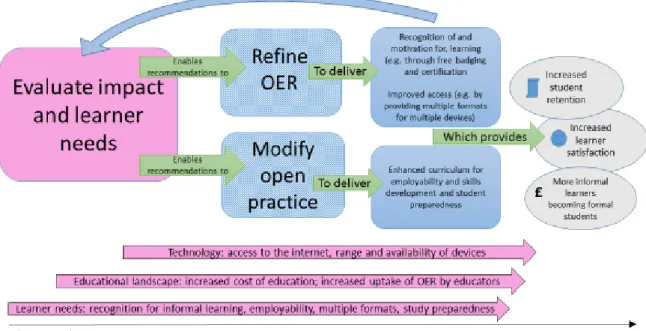
The research, refinement and its associated benefit and modification to practice discussed in this
thesis is represented by the author in Figure 1. It summarises the relationship between research and
impact against changes in technology, educational landscape and learner needs. Whilst it describes
how the refinement of OER on OpenLearn is enabling improved employability, outreach and
motivation to its learners as well as improving its function to support a business model, it is applicable
to the international OER movement as a whole.
Figure 1. A framework for researching and refining OER to benefit both learner and institution.
The approach to the research and action represented through this framework is most closely aligned
with pragmatism as a contemporary theory of learning. Elkjaer (2009) describes this as whereby
18 oriented towards the past. This is evident from subjects’ exercising playful anticipatory imagination
(‘what-of’) rather than causal thinking based upon a priori propositions (‘if-then’).” (p.74) Elkjaer
describes how this approach is different from experiential learning because it is more than just a
feedback process in a closed circle of separate consequences. Pragmatism requires action and thinking
and is essentially experimental. In the case of refining OER against a backdrop of rapidly changing
technology and the impact this is having on access to information and learning, the approach taken in
my research fits with a contemporary theoretical basis for an evolving landscape.
Biographical and contextual review of this study: a summary
This study tracks the correlation between the refinement of OER for social and pedagogical impact
and the positive impact to open educational practice and the business of investing in such an activity.
My introduction to OER research and large scale OER development and commissioning was set in the
context of an institution that had multiple OER projects being undertaken, with no common spine of
applied research around use or impact to inform strategy and commissioning. OpenLearn in particular
was a world class provision of free learning with a significant budget yet had received very little
consistent research. Further, the institutional business case for OER provision was not well formed,
nor regularly interrogated.
My role as an OER commissioner allowed me to connect research into learners’ experiences,
expectations and desires of using OER with the practice of delivering it, and to influence internal open
educational practice at a time when external factors presented extensive challenges and
opportunities. I was granted permission to undertake research, with administrative support in
planning and the delivery of questionnaires and follow-up analyses from colleagues in IET, but
undertook all the associated planning, proposals, data analysis and report writing in my own time.
Recommendations from this research around fundamental changes to the learning management
system used to deliver the OU’s OER and the resources required to improve OER delivery (within the
19 governing structures, Directors and the then Pro Vice Chancellor (Learning & Teaching). With
acceptance of these recommendations, I was able to pilot digital badging in free courses, influence
commissioning strategy in response to learner needs and through project work, provide guidelines for
the extensive refinement of formal taught modules for their use as OER.
As an applied researcher working in a professional role, this opportunity presented a favourable
juncture of circumstances with which to research, refine and pilot new OER, experiment with
recognition for informal learning and influence open educational practice in support of the business
and social mission of the Open University. Whilst the hitherto lack of activity in this area may appear
critical of the activities of policy-makers and OER researchers at the Open University at the time, I was
(and remain) supported and encouraged by such colleagues in my endeavours. A timeline setting out
the educational and technological landscape, including significant internal developments, and how
they relate to the research presented in this thesis is shown in Figure 2.
The literature review for this study (Chapter 2) reveals how definitions of informal learning have not
fully addressed the impact of technology nor the desires of learners to have their informal learning
achievements recognised in a modern technological landscape. Literature theorised the business
benefits of OER provision but lacked empirical data to provide evidence of this. The recent application
of digital badges to education has been theorised in the literature but lacks a robust spine of case
studies from which to evidence impact. Further, there was no evidence in the literature of the
application of digital badges to OER and their potential to enhance outreach and business impact.
This study provides a reframing of informal learning in a modern context. It has revealed the
challenges of repurposing formal learning content as OER. The work revealed in this study has made
a contribution to the field in understanding the motivations of informal learners using OER. Critically,
by responding to the needs of informal learners, this study has shown a virtuous relationship between
the refinement of OER to serve both business and social goals, particularly through the application of
21 Key to acronyms used in Figure 2
B2S Bridge to Success (Bridge to Success, 2012)
HEAR Higher Education Achievement Report (HEAR, 2016) OLnet Open Learning Network (OLnet, 2016)
VLE Virtual learning environment VoIP Voice Over IP
Methods
Livingstone (2006) notes “To study self-directed informal learning using sample survey techniques …
we have to strike a resolve to focus on those things that people can identify for themselves as
intentional learning projects or deliberate learning activities beyond prescribed curricula and without
externally authorized instructors. Documenting informal training requires a… reliance on respondents’
self-reports… Such measures can at least provide benchmarks for understanding the extent and
changing patterns of informal learning activities.” (p.208) He goes on to say that “…researchers do
have to engage in an initial orienting process precisely because most people do not register much of
the informal learning they do until they have a chance to reflect on it.” (p.217)
For me, this orienting and reflecting process has taken place in the context of my methodology,
through the analysis of learners self-selecting to participate in a survey relating to the provision of free
learning. Further, that those learners have chosen to enrol on a free course. Hence, I primarily used
quantitative data collection methods via the issuing of surveys, with associated website analytics, and
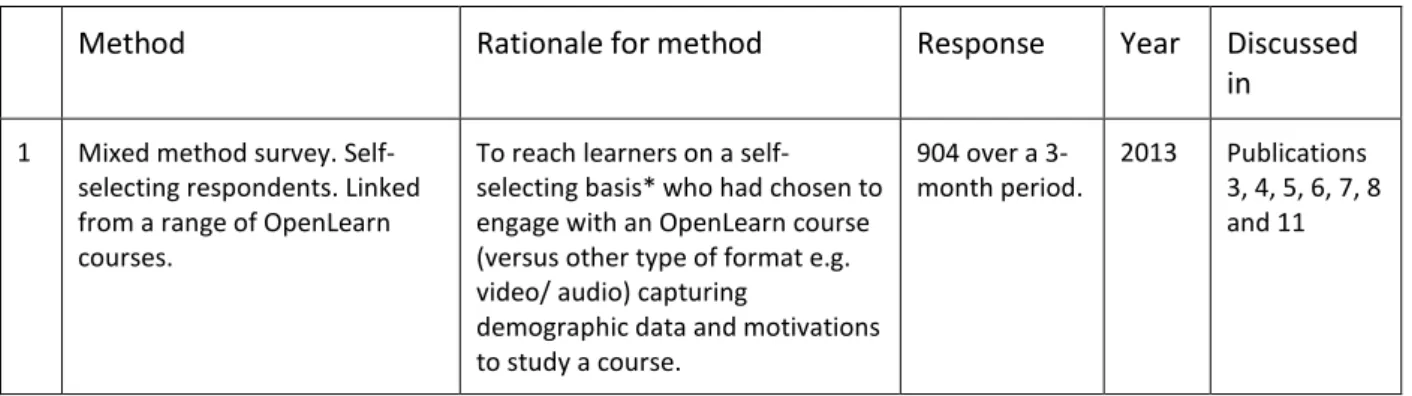
qualitative data collection via open comments in surveys. See Table 1 for a breakdown of methods
used for the publications discussed in this thesis.
Table 1 Methods of, and rationale for, data collection.
Method Rationale for method Response Year Discussed
in
1 Mixed method survey. Self-selecting respondents. Linked from a range of OpenLearn courses.
To reach learners on a self-selecting basis* who had chosen to engage with an OpenLearn course (versus other type of format e.g. video/ audio) capturing
demographic data and motivations to study a course. 904 over a 3-month period. 2013 Publications 3, 4, 5, 6, 7, 8 and 11
22
2 Mixed method survey. Self-selecting respondents. Linked from courses on iTunes U.
To reach learners on a self-selecting basis who had chosen to engage with an OU course (versus other type of format e.g.
video/audio) capturing
demographic data and motivations to study a course. 2,200 over a 3-month period. 2013 Publications 3, 4, 5 and 6.
3 Mixed method survey. Self-selecting respondents. Linked from a range of OpenLearn content.
To reach learners on a self-selecting basis engaging with all content types on OpenLearn capturing demographic data and motivations to use the platform.
1,067 2013 Publication 4
4 Mixed method survey. Self-selecting respondents. Linked from a range of OpenLearn courses.
A repeat of the 2013 course survey to compare data and note any trends or changes over a 12-month period. 741 over a 3-month period.** 2014 Publications 5, 7, 8 and 11
5 Mixed method survey. Self-selecting respondents. Linked from the end of the pilot badged courses on OpenLearn.
To reach learners on a self-selecting basis who had chosen to engage with one of the pilot badged courses (Succeed with maths or Learning to learn), capturing demographic data, motivation to study the course and earn a digital badge.
194 during pilot (4 months)
2014 Publications 6, 7 and 9
6 Mixed method surveys. Self-selecting respondents. Linked from the start and end of six BOCs on OpenLearn.
To reach learners on a self-selecting basis who had chosen to engage with one of six BOCs, capturing demographic data, motivations to study the course and earn a digital badge.
1,942 over a 5-month period. 2015 Publications 7, 9 and 10 7 Telephone interviews to informal learners – respondents of the 2013 Openlearn and iTunes U surveys (items 1 and 2, above) – who had declared a disability and who approved being contacted for further research.
To learn about disabled learners’ experience of the OU’s OER in more depth and to gather open responses about what could be improved. Planning and interview transcription supported by IET.
16
approached; 5 interviewed.
2015 Publications 8 and 10
8 Mixed method survey. Issued to 10,000 OU students across undergraduate and
postgraduate qualifications.
To reach formal OU students in order to ascertain usage of OpenLearn, their motivations for use, perceived outcomes and issues with the platform’s provision.
1,127 2015 Publication 9
9 Internal university student performance analytics.
To assess OU students who identified as being an OpenLearn user to examine any correlation with retention, versus those students who identified as not being a user of OpenLearn.
23
10 Mixed method survey. Issued by email to 250 respondents of 6, above, who had declared they would be sharing their badge with an employer.
To learn from those who had opted in to be contacted for further research.
105 2015 Publication 10
11 Mixed method survey. Self-selecting respondents. Linked from a range of OpenLearn courses.
A repeat of the 2013 and 2014 course surveys to compare data and note any trends or changes.
1,362 2015 Publication 11
12 Platform analytics Moodle, Google and ComScore analytics are able to provide data relating to visitor numbers, dwell times, search engine queries and onward journey of learners.
N/A 2013-16
Publications 3-11
* Enrolment and provision of an email address is not necessary to use OpenLearn content. Hence the need to provide links on an opt-in basis from within content pages.
** The 2013 and 2014 OpenLearn surveys remained open after first analysis for Publications 3 and 4. At time of analysis for Publication 7, they were closed had attracted 1,177 and 3,133 responses, respectively, noted above.
Published work in the OER field is wide-ranging in terms of the breadth of OER type, strategy and
delivery available and hence associated methodology applied to research. Publications on the
application of digital badging are more narrow and have tended to be case study-based and reports
of project outcomes, with little or no availability of broad statistical data given that its application in
education is a more recent phenomenon.
I regularly undertake desk research on developments in digital badging in order to stay abreast of their
application to education. Similarly, during my tenure in the IET, I actively sought to follow the
high-profile philanthropically-funded projects (mostly US-funded) to produce and evaluate the uptake of
OER and these projects’ outputs at the time in order to positively influence my approach to the
delivery and research of OER.
When I began to instigate my own research reported in this thesis, preliminary desk research was
undertaken to gain insight into the work of others and to ascertain where gaps in knowledge existed.
Based on this, and particularly in relation to surveys undertaken with OpenLearn learners, surveys
undertaken for this study were always concluded with a request for respondents to be contacted for
24 learners specifically undertaking informal learning for professional development to learn more about
the impact on them of earning a badge.
For the survey issued to formal OU students (item 8 in Table 1), I worked through the University’s
Student Statistics Support Team (SSST) as a mandatory activity and complied with the Human Research
Ethics Committee (HREC) guidelines. (The SSST are responsible for sampling formal OU students for
any research to ensure that over-surveying doesn’t take place and in order to target using preferred
survey-issuing mechanisms.) At the start of my research into OER users, studies involving self-selecting
human participants using informal learning did not require the work of the University’s HREC for
logging and approval. Hence the survey detailed as item 8 in Table 1 is the only survey that required
HREC approval. In fact, HREC were approached for approval for the telephone interviews detailed in
item 7 of Table 1 in 2015 because it was possible that some of these respondents may also be formal
OU students; HREC confirmed that they did not need to give their approval for that particular study.
Current practice, particularly in light of the EU General Data Protection Regulation (GDPR) of 2018,
requires research involving self-selecting informal learners to be logged and approved by the HREC.
It is important to acknowledge the potential subjectivity and bias of the author in researching
non-formal learners, particularly those using OpenLearn, for which the author was a lead commissioner
during much of the period that the research for this thesis was undertaken. This may have led to
unconsciously compromising an objective view of the data and miss occasions to delve deeper into it.
Response rates to questionnaires are given in each publication and in Table 1 where a review of data
is provided both from studies of learners globally using OpenLearn, third-party platforms and the
Open University’s formal students. Data was also shared with the OER Research Hub and contributed
to the body of knowledge gathered and published as part of that project.
This activity overall provided new knowledge that I was able to publish, particularly in the fields of
OER provision and research, and digital badging. It enabled the identification of further areas of
25
Chapter 2. Literature review
This chapter begins with a discussion around the definitions of informal and non-formal learning, how
delivery and access to such learning has changed with the availability of new technologies, and how
use of the terms has changed over time. In addition, the ways in which the literature has dealt with
the supposed benefits and function of OER during the period of my research is explored and the
growing application of digital badges to education.
The boundaries of this literature review reflect the time during which the papers were written with
the earliest paper cited as 1993 in a discussion about definitions of informal learning. For digital
badging and its application to education in particular, no literature existed in this area until early
blogging on this subject in 2012.
At the start of a career that touched on research, the notion of “Journeys from Informal to Formal
Learning”, or “JIFL”, as it was known in The Open University, was widely understood institutionally. In
the context of my role, my initial understanding as a practitioner was that all learners using
OpenLearn, watching a free educational video on YouTube or sponsored BBC broadcast were informal
learners. Those that specifically self-identified through surveys on OpenLearn as educators or formal students using OER became apparent over the course of my research, but in explaining the offering of free educational content per se, this was all categorised as informal learning provision – a
particularly Open University-centric use of the term. As a large educational institution, the use of term
‘informal’ to describe free learning provision was accepted parlance (despite not necessarily being
recognised elsewhere) and is a term I have used in several of the titles for the publications in this
thesis.
The various perspectives that help explain the conflation of these terms is discussed in this chapter.
They arise from a variety of contexts with which to explain informal learning – work-based,
self-directed and education-led – and are important to the central ideas of this study in a time of rapid
26 Further, definitions have not adequately evolved with the advent of new technologies and there
remains a tension in applying old, established terms to informal and non-formal learning in a modern,
digital context.
Defining informal and non-formal learning
Wikipedia provides a modern definition of informal learning as one that is a “pervasive ongoing
phenomenon of learning via participation or learning via knowledge creation, in contrast with the
traditional view of teacher-centered learning via knowledge acquisition. The term is often conflated,
however, with non-formal learning, and self-directed learning” (Wikipedia, 2016). There are a number
of deviations from this definition which are discussed below in literature that seeks to develop
frameworks and identifying features in educational and work-based contexts i.e. it is context-specific
and within that, deviations occur.
Eraut (1999) describes many informal learning activities as being those that are only recognised for
what they are after the fact and that the gaining of new skills or knowledge may begin only in an
incidental manner. Further, Eraut (2000a) later goes on to completely dismiss informal learning as a
term with which to engage with any meaning. He describes it as something that has “so many other
features of a situation – dress, discourse, behaviour, diminution of social differences, etc. – that its
colloquial application as a descriptor of learning contexts may have little to do with learning per se.”
(p.114). In a similar vein, The Organisation for Economic Cooperation and Development (OECD, n.d.)
describe informal learning as “never organised, has no set objective in terms of learning outcomes
and is never intentional from the learner’s standpoint. Often it is referred to as learning by experience
or just as experience. The idea is that the simple fact of existing constantly exposes the individual to
learning situations.” (OECD, n.d.)
Watkins and Marsick (1993) and Stern and Sommerlad (1999) writing from the perspective of
workplace learning however, do not dismiss informal learning as a term. They suggest that formal and
27 Eraut (2000a) alights upon non-formal learning as a term to be a worthy juxtaposition to formal
learning: it is not provided by an educational institution and has no associated award, in direct contrast to formal learning where there is the presence of an educator, a prescribed framework and
that learning is an organised activity. Within non-formal learning he argues that there are distinctions
in levels of learning intent where at one end of the scale is deliberative learning with “time specifically
set aside for that purpose” and at the other, implicit learning, where there is “no awareness of learning
at the time it takes place” (p.115).
Billet (2001), also writing from the perspective of workplace learning, does not address the term
non-formal learning per se. He argues that learning is part of all human life and is something that takes
place outside of formal educational settings with formal and informal learning being equally valuable
in the formation of skills.
Beckett & Hager (2002) take this view further, suggesting that learning is a holistic process to people
and that informal learning as such is both more common and more effective than formal learning.
They argue that informal learning is driven by an individual, rather than by teachers or trainers. A
European Community (EC) commissioned document defined three categories of learning in 2001 –
informal, non-formal and informal learning – with non-formal learning identified as sitting on this
sliding scale between informal and formal (Unspecified, 2001). These categories of learning were
defined as:
Informal learning: “Learning resulting from daily life activities related to work, family or leisure. It is not structured (in terms of learning objectives, learning time or learning support)
and typically does not lead to certification. Informal learning may be intentional but in most
cases it is non-intentional (or “incidental”/random).” (p.32)
Non-formal learning: “Learning that is not provided by an education or training institution and typically does not lead to certification. It is, however, structured (in terms of learning
28 objectives, learning time or learning support). Non-formal learning is intentional from the
learner’s perspective.” (p.33)
Formal learning: “Learning typically provided by an education or training institution, structured (in terms of learning objectives, learning time or learning support) and leading to
certification. Formal learning is intentional from the learner’s perspective.” (p.32)
The EC definition of non-formal combines elements of Eraut’s definition of formal (a prescribed
framework to study) with his definition of non-formal (no certification and no educational institution
involvement) and in doing so, broadens the definitions available in the literature. However, whilst the
advantages of Eraut’s work and the definitions provided by the EC are such they provide a
learner-centric perspective, the disadvantage of applying them stem from the era in which they were written
and hence the absence of digital technology as any organising principle.
Later in the literature Marsick (2009) highlights the need for “a unifying framework for understanding
informal learning” (p.267) that would enable comparison by theorists and educational practitioners
and provide an agreed set of principles. Even within workplace settings, Marsick acknowledges that
this is almost always context-specific and that it is difficult to capture the details of learning when it is
intertwined with work. Whilst Marsick does not discuss non-formal learning in her analysis nor bring
in the influence of technology on learner behaviour, she defines informal learning in the workplace as
taking place “within three basic strategy configurations: extended training, directed reflection, or
reflective innovation” (p.267) which is indeed aligned with the EC definition of non-formal learning. It
helps to illustrate why there is a conflation of terms as described in the Wikipedia definition of 2016.
Whilst Eraut (1999; 2000a; 2000b), Billet (2001), Beckett & Hager (2002) and Marsick’s (2009) work
show some agreement that learning types can be described on a sliding scale, although as discussed,
their definitions of informal learning differ significantly. They refer to the workplace setting and
partially align with the EC definitions of lifelong learning for policy. However, Livingstone (2006) draws
29 conflation of meaning between informal and formal learning in his analysis of a wide range of
literature around continuing education, much of it North American. Livingstone (2006) noted this
conflation when he wrote: “Drawing boundaries between forms of learning can be very difficult.
Distinguishing teachers from learners is often complicated in educational settings in which extensive
interaction or independent inquiry are encouraged.” (p.205)
Livingstone (1999) had earlier defined informal learning as “any activity involving the pursuit of
understanding, knowledge or skill which occurs outside the curricula of educational institutions, or
the courses or workshops offered by educational or social agencies” (p.51). Livingstone (2006) went
on to say that “forms of intentional or tacit learning in which we engage either individually or
collectively without direct reliance on a teacher or an externally-organised curriculum can be termed
self-directed or collective informal learning” (p.2).
Through Livingstone’s lens on adult education he sees non-formal education or further education as
that which is a teacher-led, structured curriculum which is followed voluntarily. Further, Livingstone
(2006) argues that “When teachers or mentors take responsibility for instructing others without
sustained reference to an intentionally organized body of knowledge…. such as guiding them in
acquiring job skills… the form of learning is informal education or informal training.” (p.204) thereby
placing educators as the organising principle for all categories of learning thus far defined.
Livingstone’s approach is more relevant to the work of understanding the use of OER by learners and
the field within which this thesis is set given that it is based on the experience of researching adult
learning. However as with those who draw on work-placed settings, it needs some stretch of the
imagination to apply it to informal and non-formal learning in the context of OER in a digital setting.
The literature has provided a useful basis from which to describe learners’ interaction with, or receipt
of, OER, because it draws out implicit or intentional interaction with learning in a variety of contexts.
A learner-centric view of learning (versus educator-centric) resonates with the work in this thesis,
30 of themselves. However, the definitions and the various conceptual elements within the definitions
do not reflect a modern context in which technology has changed access to learning. Further, the
literature that discusses definitions of informal, formal and non-formal learning has developed to
include two broad camps: work-based learning and learning provided by social agencies or educational
institutions. Hence, non-formal learning applied through the work in this thesis is one that combines
elements of Livingstone’s learner-centric view with the modern, technological landscape and can be
defined as: self-directed engagement with the provision of learning materials in a variety of contexts
and through a range of technological affordances.
This intersection of definitions described in the context of a changing and increasing access to free
learning and changes in technology are expanded on below.
Access to free learning
At the turn of the twentieth century when Livingstone first started assessing informal learning
definitions, the OER revolution – critically, the OpenCourseWare initiative (1999) and the Creative
Commons licence (2001) – was just becoming known. This was around eight years before the first
MOOCs were published and more widespread access to so-called Web 2.0 technologies, and 2006 was
the year that OpenLearn was launched by The Open University.
At this time, writers began to note the impact of Web 2.0 technology on approaches to learning.
McLoughlin & Lee (2007) argued that modern society embraces an environment for learning on
demand; Selwyn (2007) noted the direct impact and importance of social media to support informal
learning; and Clough et al. (2007) the impact of mobile devices in support of social online learning.
Dabbagh and Kitsantas (2012), in studying learning approaches of undergraduate students, noted the
use of social media tools by students for learning, under the umbrella description of Personal Learning
Environments (PLEs). They note that these are by their nature, self-directed and are a learner-centred
view of learning, examples including blogs, the use of YouTube, Google Docs, Twitter and wikis.
31 constantly seek information to address a problem at work, school, or to just satisfy a curiosity. To do
so, they take advantage of digital and networked technologies not only to seek information, but also
to share information” (p.3) and that “…PLEs can serve as platforms for both integrating formal and
informal learning and fostering self-regulated learning in higher education contexts.” (p.3)
Over the course of conducting my research, it became clear that HE professionals amid whom I was
working, referred to two camps of learning to describe the use of paid-for and free educational
provision: formal and informal learning, respectively. The literature I was examining (discussed in the
previous section) sought to explain three camps – informal, non-formal and formal – but even here,
there were grey areas plus Livingstone’s additional categories of self-directed or collective informal
learning, which does not allow for informal learning itself, being self-directed. The literature does not provide a neat description of the provision of informal learning as expressed by the Open University
as a means to describe the publication of OER as a business proposition, but instead focuses on the
learner as recipient, reflector and/or self-director.
These different constructs on learning have provided a starting point from which to explore how
learners and educators engage with OER particularly with the growth in access to new technologies
and social media. In the context of making scholarly and business recommendations and in my
research of OpenLearn one could argue that across the spectrum of definitions, informal and
non-formal learning are taking place. Innon-formal learning remained an accepted term with which to examine
engagement with free learning materials because of the mixture of approaches being taken by
learners and the varied contexts in which they were learning.
It is Eraut’s (1999) notion that informal learning is incidental that fits with the approach taken by many
who have ended up browsing educational content provided by educational institutions for free, and
within that group, any learner searching for information that is filtered by a search engine. For the
32 of searching for information, is continually propelled by the ubiquitousness of the Internet through
mobile devices.
This increasing availability of the Internet has increased online access and has served the OER
community well in providing more routes to access free learning. For this study it has also provided
an opportunity to review definitions of informal learning through the lens of large-scale OER provision,
later discussed in Chapter 3.
The rationale for OER
In the Hewlett Foundation white paper of 2013 (The William and Flora Hewlett Foundation, 2013) it is
stated that “Since the Hewlett Foundation began investing in open educational resources in 2002, the
field has blossomed from the seed of an idea into a global movement” (p.6). The organisation funded
MIT’s online course project -- OpenCourseWare – and continue to support the movement declaring
“OER is poised to improve access to and quality of schooling for students, self-taught learners,
educators, and institutions around the world” (p.6). They describe OER as “teaching, learning, and
research resources that reside in the public domain or have been released under an intellectual
property license that permits their free use and re-purposing by others. Open educational resources
include full courses, course materials, modules, textbooks, streaming videos, tests, software, and any
other tools, materials, or techniques used to support access to knowledge” (The William and Flora
Hewlett Foundation, 2016).
The Organisation for Economic Co-operation and Development (OECD, 2007) states that “OER is … a
fascinating technological development and potentially a major educational tool.” Further, that “It
accelerates the blurring of formal and informal learning, and of educational and broader cultural
activities.” (p.9)
The OECD authors noted in 2007 that OER was part of a trend of openness that complemented other
ideological trends occurring at the time such as in the sharing of software programmes and research
33 technologies for distance education as an “irrational exuberance that characterised the time” (p.4). It
was, according to Materu (2004), the o-decade (open source software, open access publishing, open
standards). In 2007, the OECD (OECD, 2007) identified “over 3,000 open courseware courses available
from over 300 universities worldwide.” (p.10). Instead of reshaping itself to become involved in online
learning programmes at this time, MIT took a different approach. In 1999, it announced that it would
develop MIT OpenCourseWare, which D’Antoni (2009) describes as “an adventure that became the
model for open sharing of educational content that was presented to the international meeting at
UNESCO in 2002 when the term Open Educational Resources was adopted.” (p.5)
Although Google now provides a filter to search by educational provider and by licence, the current
availability of free courses, educational videos or open textbooks now available as OER is hard to
quantify, as the number of projects, OER types and providers has expanded so greatly. For example,
OpenLearn now hosts over 900 free courses; the OU’s channel on YouTube hosts over 2,500 videos;
and MIT’s OpenCourseWare site alone lists 3,417 free courses in its catalogue.
Despite citing the Hewlett Foundation’s definition of OER (The William and Flora Hewlett Foundation,
2016) Witthaus et al. (2016) describe three types of open learning with associated characteristics:
open education/open universities; MOOCs; and OER.
The use of educational within the term OER has been minimally discussed in relation to its intersection
with informal learning. Downes (2006) argues “It seems clear, based on the discussion, that there
ought not be an a priori stipulation that something may, or may not be, an educational resource. Such
stipulation may only serve to limit discussion unproductively.” (p.3) Further, that “it should be clear
that learning extends beyond the scope of formal learning, and hence that resources not used in a
formal environment may yet be instances of OERs.” (p.3) Through the broad uptake of OER as informal
learning provision we have moved a long way from viewing OER as being materials mostly provided
for teaching as self-directed informal learners make use of OER provided by educational institutions
34 crossover of OER and informal learning: “It is sometimes argued that to acknowledge and strengthen
the importance of this role of OER, the term “education” should be replaced by “learning” and a better
term would be “open learning resources” but chose to keep the term OER given that the movement
had grown so rapidly and that it would be “unwise” to change it. (p.36)
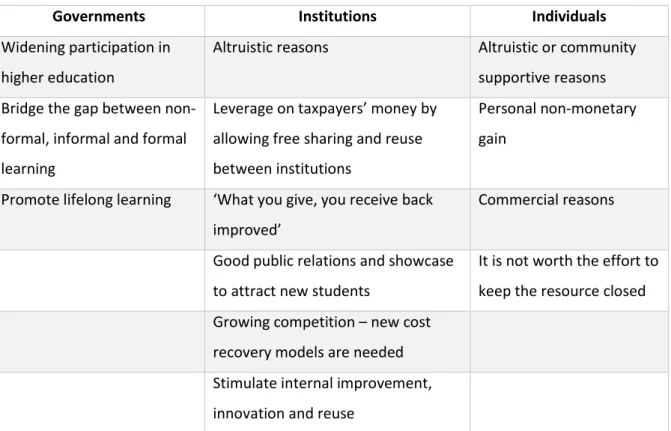
A positive rationale for OER was neatly summarised by the OECD in their 2007 paper (Table 3) and
remain largely unchallenged today. I have provided an up-to-date analysis in my final paper for this
thesis, of the supposed benefits of OER particularly in relation to its function as a sustainable business
model, citing Dholakia et al, 2006; Downes, 2006; Koohang et al., 2007; Guthrie et.al, 2008; Lane,
2008; Wiley, 2010; Bitter-Rijpkema & De Langen, 2012; Daniel, 2012; Stacey, 2012; UNESCO, 2012;
and de Langen, 2013. The subject is also discussed and brought up to date in Chapter 3.
Table 3. Drivers, inhibitors and motivations for developing and sharing open educational resources (adapted from OECD, 2007, p.70)
Governments Institutions Individuals
Widening participation in higher education
Altruistic reasons Altruistic or community supportive reasons Bridge the gap between
non-formal, informal and formal learning
Leverage on taxpayers’ money by allowing free sharing and reuse between institutions
Personal non-monetary gain
Promote lifelong learning ‘What you give, you receive back improved’
Commercial reasons
Good public relations and showcase to attract new students
It is not worth the effort to keep the resource closed Growing competition – new cost
recovery models are needed Stimulate internal improvement, innovation and reuse
Where OER provision was ostensibly preoccupied with the delivery of lecture notes and video lectures
at the turn of the century, it now incorporates entire project and business endeavours to release OER
35 as OER. Indeed, research and literature is dominated by US-funded and US-focused OER initiatives.
Some Massive Open Online Courses (MOOCs) could now be viewed as a subset of OER, where they
make use of the intellectual property licence. However, whilst there are exceptions, MOOC platforms
tend to release copyrighted material that does not permit them for free use and repurposing and do
so for commercial purposes. In terms of their place within the rationale for OER, this is discussed in
more detail in Chapter 3 in setting the context for Theme 3 (The refinement of OER in support of the
social and business mission of delivery free learning).
Since its first outing by MIT, OER has developed over time and has reached new audiences with the
increasing rise in access to the Internet and through mobile technology. Despite this increasing OER
provision and uptake, at the time the research undertaken for the publications in this thesis was being
undertaken, literature had not examined the demographics, motivations, desires nor intentions of
users of OER, but instead focussed on a rationale for OER and theoretical business models for its
provision.
With this increasing provision of, and access to OER, came a panoply of open technologies and
principles that characterised the first decade of the 21st century, and the development of digital
badges in 2012, a philanthropically-funded digital open technology standard designed to reward
learning. Whilst not directly linked to OERs at the time of their release they provide an opportunity to
reward informal and non-formal learning, an opportunity explored and researched by the author, and
described in more detail in Chapter 3.
The origins of digital badges
Digital badges themselves are digital tokens of accomplishment. They can contain claims and evidence
about learning and are intended to circulate in social networks that badge issuers and earners
participate in (Knight & Casilli, 2012). O’Byrne et al. (2015) provide a complementary and more