Archive University of Zurich Main Library Strickhofstrasse 39 CH-8057 Zurich www.zora.uzh.ch Year: 2009
Biodiversity and ecosystem functioning: The effects of tree and litter diversity
Haase, J U
Abstract: Global changes and declines in biodiversity at all taxonomic levels have intensified the scientific effort to understand the functional role of biodiversity as a regulator of ecosystem processes. Although evidence for a positive relationship between biodiversity and ecosystem functioning is accumulating from studies mainly performed in grasslands, little is known about the importance of this relationship in forest ecosystems, despite their huge ecological and socioeconomic importance. In this thesis I therefore assessed the effects of tree diversity on above- and belowground productivity and on litter decomposition along an experimentally manipulated diversity gradient in a temperate forest system, using different approaches including field and pot experiments. In chapter 1, I quantified the relative contributions of complemen-tarity and selection to net effects of tree diversity on above- and belowground productivity, and assessed whether this relationship is influenced by planting density. I found that total productivity was increased in mixed compared with monospecific stands and that tree diversity effects on productivity occurred be-low rather than above ground and were density-dependent. Positive effects of tree diversity were related to complementarity rather than selection and were more pronounced at low planting density. This study demonstrates the potential role of niche separation in driving the biodiversity ecosystem functioning relationship in trees, and highlights the significance of belowground processes for driving this pattern. Chapter 2 looks deeper into the role of belowground competition in affecting root allocation of saplings. I tested whether trees increase root allocation in response to the presence of neighbours, and whether this response is more pronounced in the presence of con- compared with heterospecific competitors. Although belowground competition in tree pairs led to increased root production and root allocation, this effect was independent of the identity of the competitor, perhaps because neighbour recognition mechanisms are absent in trees. Increased root production more generally may have implications for carbon stor-age and nutrient retention within forest systems. In chapter 3, I examined the functional importance of ”after-life” effects of tree species diversity and its interaction with soil fauna on a crucial ecosystem process, leaf litter decomposition. In particular I investigated the relative importance of different direct and indirect pathways through which litter species diversity can influence decomposition. Different litter species compositions varied greatly in decomposition rates, which interactively with soil fauna was more important than litter diversity per se for litter decomposition. However, decomposition in mixtures re-sulted in synergistic effects only in the absence of soil fauna, suggesting that small litter diversity effects may be masked by soil fauna activity. In chapter 4, I quantified intraspecific variation in litter quality and decomposition and the ecological consequences of intraspecific diversity on decomposition rates. Us-ing European beech as a model species, I showed that there was considerable intraspecific variation in litter decomposition rates, although this was not related to litter quality. However, I also found syner-gistic effects on decomposition of mixing litter from different individuals, demonstrating the significance of intraspecific variation on this ecosystem process. Overall this study demonstrates the importance of biodiversity both among and within species for ecosystem functioning. However, diversity effects were relatively weak, and species composition was a consistently better predictor of variation in productiv-ity and decomposition. This underscores the importance of specific species traits in driving ecosystem
ZORA URL: https://doi.org/10.5167/uzh-21136 Dissertation
Originally published at:
Haase, J U. Biodiversity and ecosystem functioning: The effects of tree and litter diversity. 2009, Uni-versity of Zurich, Faculty of Science.
OF
T
REE AND
L
ITTER
D
IVERSITY
Dissertation zur
Erlangung der naturwissenschaftlichen Doktorwürde (Dr. sc. nat.) vorgelegt der Mathematisch-naturwissenschaftlichen Fakultät der Universität Zürich von
Josephine Ulrike Haase aus
Deutschland
Promotionskomitee: Prof. Dr. Andrew Hector (Vorsitz) Dr. Daniel Prati (Leitung der Dissertation)
Dr. Harald Auge Prof. Dr. Bernhard Schmid
Prof. Dr. Stefan Scheu
T
ABLEOFC
ONTENTSG
ENERALI
NTRODUCTION7
C
HAPTER1
Positive effects of tree diversity on productivity are
density-dependent
25
C
HAPTER2
Root proliferation in response to belowground competition is
independent of neighbour identity in tree saplings
49
C
HAPTER3
Soil fauna and litter species composition interactively determine
litter decomposition in a temperate system
65
C
HAPTER4
Phenotypic variation causes synergistic effects of intraspecific
diversity on litter decomposition
89
G
ENERALD
ISCUSSION113
S
UMMARY125
Z
USSAMENFASSUNG127
A
CKNOWLEDGMENTS131
C
URRICULUMV
ITAE135
General Introduction
ThefuncTIonalImporTanceofbIodIversITyforecosysTem processes
Over the last decades, communities and ecosystems globally have undergone dramatic changes due to anthropogenic activities, accompanied by rapid declines and changes in biodiversity at all levels, from biotopes to species and genetic variation contained within species. This has boosted ecological research to understand the functional importance of biodiversity as a regulator of ecosystem processes, dynamics and functioning as well as the consequences of its loss (reviewed by Kinzig et al. 2002, Loreau et al. 2002b, Hooper et al. 2005, Balvanera et al. 2006, Cardinale et al. 2006, Cardinale et al. 200). Driven by the question: “Does biodiversity matter for ecosystem integrity, functioning, and the ecosystem’s provision of goods and services to humanity?” (Schulze and Mooney 1993), researchers have accumulated evidence for a positive relationship between biodiversity and ecosystem functioning in the past decade (e.g. Hooper et al. 2005, Srivastava and Vellend 2005, Balvanera et al. 2006, Cardinale et al. 2006, 200).
Ecosystem processes such as primary productivity (e.g. Hector et al. 1999, Tilman et al. 2001, Roscher et al. 2005) and invasion resistance (e.g. Tilman 199, Knops et al. 1999, Naeem et al. 2000), defining ecosystem stability and resilience (e.g. McCann 2000, Loreau et al. 2002a), have been reported to be positively affected by biodiversity. Furthermore, it is increasingly recognised that biodiversity can simultaneously enhance multiple ecosystem processes and thus is required to maintain multifunctional ecosystems (Hector and Bagchi 200). A preponderance of studies has however focused on biodiversity at the species or the functional group level, thus neglecting intraspecific genetic variation, the variation that matters not only to evolution but also to ecology (Dawkins 1979, 1982). Intraspecific genetic variation as well genetic diversity (i.e. the amount of genetic variation present) can have wide-ranging ecological consequences for ecosystem processes and functions (Whitham et al. 2003, 2006, Madritch et al. 2009). It has
been shown for example that intraspecific genetic diversity in plants determines the diversity of associated invertebrate communities above and below ground as well as community structure, and increases aboveground productivity (e.g. Crutsinger et al. 2006, 200). Others have demonstrated the importance of intraspecific genetic variation and diversity for ecosystem
5 4 3 2 1 0 1 2 4 5 4 3 2 1 0 1 2 4 4 5 3 2 1 0 1 2 4 Ecosystem variable
a) Null model b) Selection effect c) Complementarity effect Niche distribution:
Competitive strength
Biodiversity ecosystem functioning relationship:
Environmental variable
Plant species diversity Example
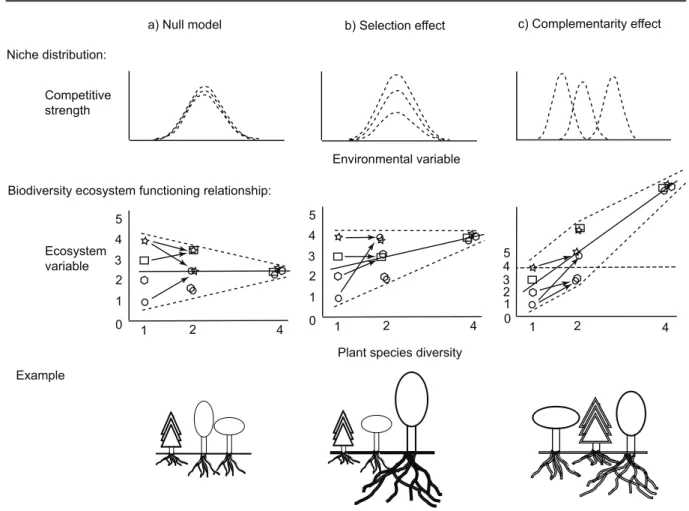
Fig. 1. The figure (adapted from Schmid 2003) presents three different scenarios for the relationship
between biodiversity and ecosystem functioning. The first row shows the relative positions of the niches of different species along an environmental gradient, and their relative competitive strength. The second row shows the expected relationship between biodiversity and ecosystem functioning for each scenario. The four symbols represent different species, which in species mixtures are overlaid. Arrows indicate which species are combined in a given mixture. The null model includes only additive effects of mixing species, i.e. mixture performance is the mean of the component species. Given the selection effect, the mixture performance is largely determined by species with particular traits that come to dominate the community. A positive selection effect, i.e. higher-than-average monoculture performance, is presented here. Complementarity arises when the community performance is enhanced through niche partitioning or direct positive interactions (facilitation).
processes such as decomposition and nutrient cycling (e.g. Madritch and Hunter 2002, Schweitzer et al. 2005). These effects were comparable to the effects of plant species diversity observed in other studies and may therefore have important, though under-appreciated, importance in ecosystem functioning (e.g. Schweitzer et al. 2005, Crutsinger et al. 2006).
Although the mechanisms underlying the positive biodiversity ecosystem functioning relationship are still discussed controversially, two mechanisms are widely accepted (Fig. 1). Firstly, as diversity levels increase there is a higher probability of including species with favourable characteristics for the ecosystem function in question (known as the “sampling effect”, Aarssen 199, Huston 199, Tilman et al. 199). The sampling effect is a special case of the “selection effect” (sensu Loreau and Hector 2001, and the “dominance effect” of Fox 2005), which can be generalised to include other situations in which particular species (including species with a lower-than-average performance) come to dominate the community. The “selection effect” according to Loreau and Hector (2001) measures the covariance between changes in species relative abundances in mixtures and their performance in monoculture. Nevertheless, the terms “sampling” and “selection” are often used synonymously (Huston 199, Cardinale et al. 2006). However, in both cases the biodiversity ecosystem functioning relationship is driven by the traits of particular species. Secondly, positive diversity effects might result from niche partitioning or direct positive interactions (i.e. facilitation) among species with different traits, decreasing interspecific competition in more diverse communities (Naeem et al. 1994, Tilman et al. 1996, Loreau 1998). This for example enables resources to be used more efficiently than if one or few species with similar traits compete for the same resources. Both mechanisms are, however, not mutually exclusive and transitions between them may occur over longer time spans (Pacala and Tilman 2002), particularly given the potential for competitive interactions among species to change over time.
planTcompeTITIon
Since the earliest days of ecological thinking, competitive interactions both within and among species have been recognized to be among the major forces shaping populations and structuring plant communities (e.g. Clements 1929, Gause 1934). It is commonly assumed that competitive interactions within species are more intense compared with competition among different species, because individuals of one species are generally more similar in their niche requirements (e.g. Goldberg and Barton 1992). This should lead to a stronger response to intra- compared with interspecific competition.
Scientists have studied the evolution of competitive traits and strategies, and it was Darwin himself who studied what we now call behavioural traits in plants (Darwin 10 in Novoplansky 2009). Besides their limited mobility, plants have the ability to make adaptive decisions and to show considerable plasticity in their physiology and morphology in response to cues and signals they perceive from their environment (Hodge 2009, Novoplansky 2009). This perhaps prompted researchers to draw parallels between animal and plant behavioural mechanisms, since plastic responses related e.g. to resource allocation of each individual in a competitive setting may be dependent on the responses of its neighbours (e.g. Gersani et al. 2001). Those plastic responses regarding foraging for resources are of particular interest, since plant roots contribute to net primary productivity and are important for the regulation of heterotrophic soil organisms and soil carbon sequestration (e.g. Bessler et al. 2009). Therefore, plant competitive behaviour may have implications for processes operating at larger ecological scales (Novoplansky 2009), and for the role of plant competition in determining the diversity and functioning of communities and ecosystems (e.g. Grime 199, Tilman 192).
TreedIversITyandecosysTemfuncTIonInG
Until now investigations of the biodiversity ecosystem functioning relationship have been mainly limited to grasslands, old-field communities and aquatic or terrestrial microcosm systems (Schmid et al. 2001, Hooper et al. 2005, Balvanera et al. 2006, Cardinale et al. 2006, 200). Consequently, the importance of biodiversity for ecosystem processes and functioning in forest ecosystems still remains poorly understood, despite their overwhelming ecological and socioeconomic importance (e.g. Scherer-Lorenzen et al. 2005, 200b, Leuschner et al. 2009). Forests (including plantations) cover over 30% of the Earth’s surface, store more than 0% of the biomass carbon of the planet and account for 65% of the annual carbon fixation (net primary productivity) (Scherer-Lorenzen et al. 200b and references therein). However, compared to herbaceous vegetation, forest ecosystems face even more dramatic changes in their biological diversity (WRI 2000).
In European forests, tree species composition and diversity has shifted massively towards mostly monospecific managed stands due to the increasing demand for timber production. Today, conifer species comprise 0 % and broadleaved deciduous species 30 % of the European forests, the reverse of the potential natural vegetation (Körner 2005). Therefore, there is a great need for studying the functional consequences of tree diversity for ecosystem processes and functioning, particularly now as Central European Forestry is conducting a broad-scale conversion of monocultures into mixed forest stands and attempting to re-establish more natural forest communities with less common species (e.g. Gardiner 1999, MCPFE 2003, Scherer-Lorenzen et al. 2005).
Observational and comparative studies have been a vital tool in describing correlations between tree diversity and ecosystem processes across existing forest stands (e.g. Caspersen and Pacala 2001, Szwagrzyk and Gazda 200, Vila et al. 200). However, they have often been criticised due to the potential for co-varying factors to confound interpretations and for their inability
to isolate cause and effect in the biodiversity ecosystem functioning relationship (Lawton et al. 199, Wardle 2001). In contrast, experimental approachs allow the manipulation of tree diversity levels as a response variable, thus investigating consequences of species loss or species addition on ecosystem processes while keeping confounding factors, such as environmental conditions, constant (see Schmid 2002 for a distinction of both approaches). Since silvicultural research focused mainly on monocultures and two-species mixtures (e.g. Kelty et al. 1992, Pretzsch 2005) with highly productive varieties of economically important timber species (Vila et al. 2005), experimental forest plantations manipulating tree diversity over a wider gradient and with less common species are needed to assess the functional importance of tree diversity (Scherer-Lorenzen et al. 200b).
Today, there are nine large-scale tree diversity experiments encompassing the boreal (Satakunta Tree Species Diversity Experiment, Finland: e.g. Vehvilainen and Koricheva 2006), the temperate (ORPHEE, France, BIOTREE, Germany: e.g. Scherer-Lorenzen et al. 200b), the sub-tropical (BEF-China: <http://www.bef-china.de/>) and the tropical (Sardinilla Project, Panama: e.g. Scherer-Lorenzen et al. 200a, Potvin and Gotelli 200, Sabah Biodiversity Project, Borneo: <http://www.searrp.org/research_sabah_biodiversity.cfm>) zones and another one soon to be established in Belgium (FORBIO, Scherer-Lorenzen personal communication). These plantations are designed to investigate the biodiversity ecosystem functioning relationship at a scale relevant to forest management, but also the mechanisms underlying this relationship (Scherer-Lorenzen et al. 200b, Healy et al. 200). However, their focus is mainly aboveground and as far as they do consider soil processes, they marginalise the importance of resource-input to the soil subsystem via dead organic material.
afTerlIfeeffecTs ofTreedIversITy: leaflITTer
Whereas past research has typically focused on aboveground processes, the “after life effects” (Findlay et al. 1996) of plant diversity on key ecosystem processes belowground, such as
decomposition and nutrient mineralization, only recently became recognized and are still poorly understood (Wardle 2002, Gartner and Cardon 2004, Hättenschwiler et al. 2005). However, most aboveground net primary productivity enters the detrital pathway as plant litter, thereby mediating biodiversity effects aboveground (Coleman and Crossley 1996). Together with belowground plant litter (e.g. dead roots and mycorrhiza, root exudates), these inputs to the soil subsystem constitute the main resource of energy and matter for a highly diverse soil community connected by complex interactions involved in decomposition processes (e.g. Hättenschwiler et al. 2005). The recycling of nutrients and carbon from litter during decomposition is a fundamental ecosystem process that has a major control over nutrient mineralization and availability (Swift et al. 199, Cadish and Giller 199). Recycled nutrients available for plant uptake in turn affect plant growth, thereby feeding back on community dynamics and structure as well as ecosystem productivity (Wardle 2002, Bardgett 2005). In managed forests aboveground litter is composed primarily of leaf litter and fine woody debris, whereas tree stems are removed. Thus, nutrient recycling in these systems depend entirely on the input of rapidly decomposed litter components as opposed to the long-lasting effects of wood decomposition in unmanaged forests.
In natural ecosystems, the leaf litter of individual species and individuals within species seldom decomposes in isolation, but rather in mixtures of litter from several species and individuals. However, potential interactions among litters during decomposition have only recently been considered in decomposition studies and a general pattern in mechanisms underlying decomposition in litter mixtures has not yet emerged (Gartner and Cardon 2004, Hättenschwiler et al. 2005). Some studies report decomposition to be increased with increasing litter diversity (e.g. Bardgett and Shine 1999, Hector et al. 2000, Spehn et al. 2005), while others show no or idiosyncratic effects (e.g. Blair et al. 1990, Wardle et al. 199). These observed diversity effects have been proposed to be caused by nutrient transfer among litter types, stimulation or inhibition of microorganisms by specific litter compounds, and positive feed backs of soil fauna due to greater habitat and food diversity in structurally more diverse litter layers, although experimental evidence is scarce (reviewed by Hättenschwiler et al. 2005). Furthermore, the
role of litter diversity for the composition, diversity and activity of soil organisms is still poorly understood, as well as the subsequent consequences of the soil food-web structure on ecosystem processes (Wardle 2002, Hättenschwiler et al. 2005).
lInkInGaboveGroundbIodIversITywIThbelowGroundprocesses: The kreInITzexperImenT The Kreinitz experiment in Germany (near Kreinitz, Saxony, 51°23´N, 13°15´E, 95 m a.s.l.), established in November 2005, was specifically designed to link aboveground biodiversity with belowground processes. In this experiment, tree species and aboveground litter diversity and composition are manipulated (1) to study the effects of tree and litter diversity on ecosystem processes and functioning, such as plant productivity, decomposition and nutrient cycling, (2) to quantify the effects of tree and litter diversity on the structure and stability of soil food webs but also (3) on aboveground tree parasites and pathogens.
The experimental plots vary in tree and corresponding litter diversity (one, two, three, five or
Tree species C/N Litter1 pH Mycorrhiza2 Insects3 Specialists4
Fraxinus excelsior Tilia cordata Fagus sylvatica Quercus petraea Picea abies Pinus sylvestris 21 3 51 53 48 66 1 2 3 3 3 4.5 6.4 5.4 4.3 4.8 4.1 4.2 VA VA, Ecto Ecto Ecto Ecto VA, Ecto 145 20 25 699 29 335 44 2 44 252 5 15 1Half-time for litter decomposition [years], 2VA: vesicular-arbuscular mycorrhiza, Ecto: ectomycorrhiza, 3Number of associated phytophagous insects, 4Number of phytophagous insects specific to the tree genus
Data from: Schulze et al. (1996), Harley & Harley (1987), Brändle & Brandl (2001).
six species) and composition (all possible species combinations). Two control plots (no trees or litter) were additionally established, and leaf litter is applied annually at a rate of 600 g m-2. The species pool contains six temperate tree species: Fagus sylvatica L., Fraxinus excelsior
L., Tilia cordata Mill., Quercus petraea (Matt.) Liebl., Pinus sylvestris L. and Picea abies (L.) Karst., all native and common in Central European forests, representing economically important timber species. Most of them naturally co-occur in mixtures although not all combinations are equally common. F. sylvatica is the dominant deciduous tree in unmanaged forests often growing in almost monospecific stands. In Central European forest plantations, monocultures of P. sylvestris and P. abies dominate, and P. abies has been planted even outside its natural distribution. It is, however, a recognized goal of Central European forestry to increase diversity of managed forests by gradually replacing monocultures of P. sylvestris and P. abies with more species rich communities of deciduous trees. The litter of the tree species cover a range of decomposition rates, with F. excelsior and T. cordata having rather fast-decomposing leaf litter,
F. sylvatica and Q. petraea slow-decomposing leaf litter, and P. sylvestris and P. abies slow-decomposing needles (Table 1). Furthermore, these tree species vary in their type of mycorrhiza and the number of associated aboveground insect species (Table 1).
This thesis was conducted within the framework of the Kreinitz experiment, which was used for some of the studies presented here. In addition to the studies covered by this thesis, I measured tree growth and mortality in the Kreinitz experiment over a period of three years and have been involved with the management of this large-scale field study, in particular helping to coordinate the replanting of trees, and litter collection and application. This work contributes to the long-term monitoring and investigation of the effects of tree and litter diversity on ecosystem processes in this experimental set up.
ThesIsouTlIne
The goal of this thesis was to explore whether the positive relationship between biodiversity and ecosystem functioning found in grasslands also applies to temperate tree communities, and whether it can be found for processes occurring both above and below ground. The work was motivated by three fundamental questions:
(1) Does tree diversity positively affect ecosystem processes?
(2) Are diversity effects consistent across different ecosystem processes? (3) Are tree diversity effects also important at the intraspecific level?
Due to high initial mortality of tree saplings and repeated replacement of dead individuals, the Kreinitz experiment was limited in the extent to which it could be used to address these questions within the time frame of this thesis. Furthermore, the field experiment is only partially suitable to directly measure and quantify effects of tree diversity below ground and therefore I established further pot experiments to complement the field approach. Moreover, additional experiments aimed at understanding specific processes were performed, one of which (chapter 3) was conducted within the Kreinitz experiment. For the pot experiments I used substrate from the field site and the same set of species as used in the Kreinitz experiment so that the findings can be directly linked to the results emerging from the long-term field experiment.
Chapter 1 reports the results of a pot experiment in which I manipulated the number of tree species and their composition to study their effects on productivity. Specifically the aim was to quantify the relative contributions of complementarity and selection to net effects of tree diversity on productivity. Furthermore, I varied community planting density to test its influence on the relationship between tree diversity and productivity, a confounding factor often overlooked in biodiversity research. Allowing destructive harvests, this approach has the particular strength of allowing the quantification of diversity effects and underlying mechanisms below ground.
Chapter 2 focuses specifically on species interactions occurring below ground, namely root competition. Herbaceous plants can sometimes overproduce roots and intensify root allocation in response to neighbouring roots beyond a level that would be optimal for the individual growing along. I investigated whether this competitive strategy also applies to trees. Moreover, I test whether trees react specifically to different neighbouring species, hypothesising that the effect of root overproduction in response to belowground competition is more intense for intra- compared to interspecific competition.
Chapter 3 explores the “after life effects” of tree diversity: the significance of leaf litter species diversity for a key ecosystem process, decomposition. I performed three complementary decomposition trials within the Kreinitz experiment to disentangle the different direct and indirect pathways through which litter diversity acts on decomposition processes, an attempt seldomly made in litter diversity experiments. Furthermore, I studied the functional importance of soil fauna for litter decomposition along this diversity gradient.
Chapter 4 assesses effects of intraspecific variation and diversity on decomposition processes, an important aspect rarely considered in biodiversity research. I choose European beech (Fagus sylvatica L.) as a model system to investigate variation in litter quality and decomposition among and within populations and whether litter quality affects decomposition. Furthermore, I test the effects of intraspecific diversity (i.e. mixing of litter individuals) on decomposition, hypothesising that decomposition rates would be faster in mixtures with a higher intraspecific diversity.
references
Aarssen, L. W. 199. High productivity in grassland ecosystems: Effected by species diversity or productive species? Oikos 80:183-184.
Balvanera, P., A. B. Pfisterer, N. Buchmann, J. S. He, D. Raffaelli, and B. Schmid. 2006. Quantifying the evidence for biodiversity effects on ecosystem functioning and services. Ecology Letters 9
:1146-1156.
Bardgett, R. D. 2005. The Biology of Soil. Oxford University Press, Oxford.
Bardgett, R. D. and A. Shine. 1999. Linkages between plant litter diversity, soil microbial biomass and ecosystem function in temperate grasslands. Soil Biology & Biochemistry 31:31-321.
Bessler, H., V. M. Temperton, C. Roscher, N. Buchmann, B. Schmid, E. D. Schulze, W. W. Weisser, and C. Engels. 2009. Aboveground overyielding in grassland mixtures is associated with reduced biomass partitioning to belowground organs. Ecology 90:1520-1530.
Blair, J. M., R. W. Parmelee, and M. H. Beare. 1990. Decay rates, nitrogen fluxes, and decomposer communities of single-species and mixed-species foliar litter. Ecology 71:196-195.
Brändle, M. and R. Brandl. 2001. Species richness of insects and mites on trees: expanding Southwood. Journal of Animal Ecology 70:491-504.
Cadish, G. and K. E. Giller. 1997. Driven by Nature: Plant Litter Quality and Decomposition. CAB International, Wallingford.
Cardinale, B. J., D. S. Srivastava, J. E. Duffy, J. P. Wright, A. L. Downing, M. Sankaran, and C. Jouseau. 2006. Effects of biodiversity on the functioning of trophic groups and ecosystems. Nature 443 :99-992.
Cardinale, B. J., J. P. Wrigh, M. W. Cadotte, I. T. Carroll, A. Hector, D. S. Srivastava, M. Loreau, and J. J. Weis. 2007. Impacts of plant diversity on biomass production increase through time because of species complementarity. Proceedings of the National Academy of Sciences of the United States of America 104:1123-112.
Caspersen, J. P. and S. W. Pacala. 2001. Successional diversity and forest ecosystem function. Ecological Research 16:95-903.
Clements, F. E. 1929. Plant Competition: An Analysis of Community Function. Carnegie Institute of Washington, Washington DC, USA.
Coleman, D. C. and D. A. Crossley. 1996. Fundamentals of Soil Ecology. Academic Press, San Diego (CA).
Crutsinger, G. M., M. D. Collins, J. A. Fordyce, Z. Gompert, C. C. Nice, and N. J. Sanders. 2006. Plant genotypic diversity predicts community structure and governs an ecosystem process. Science
313:966-96.
Crutsinger, G. M., W. N. Reynolds, A. T. Classen, and N. J. Sanders. 2008. Disparate effects of plant genotypic diversity on foliage and litter arthropod communities. Oecologia 158:65-5.
Darwin, C. R. 1880. The Power of Movement in Plants. John Murray, London, UK. Dawkins, R. 1979. The Selfish Gene. Oxford University Press, Oxford.
Dawkins, R. 192. The Extended Phenotype. Oxford University Press, New York (NY).
Findlay, S., M. Carreiro, V. Krischik, and C. G. Jones. 1996. Effects of damage to living plants on leaf litter quality. Ecological Applications 6:269-25.
Fox, J. W. 2005. Interpreting the ‘selection effect’ of biodiversity on ecosystem function. Ecology Letters
Gardiner, J. J. 1999. Changing forests, management and growing conditions. Pages 17-19 in A. F. M. Olsthoorn, H. H. Bartelink, J. J. Gardiner, H. Pretzsch, H. J. Hekhuis, and A. Franc, editors. Management of Mixed-species Forest: Silviculture and Economics, IBN Scientific Contributions, vol. 15 DLO Institute for Forestry and Nature Research, Wageningen.
Gartner, T. B. and Z. G. Cardon. 2004. Decomposition dynamics in mixed-species leaf litter. Oikos
104:230-246.
Gause, G. F. 1934. The Struggle for Existence. Williams and Wilkins, Baltimore, MD, USA.
Gersani, M., J. S. Brown, E. E. O’Brien, G. M. Maina, and Z. Abramsky. 2001. Tragedy of the commons as a result of root competition. Journal of Ecology 89:660-669.
Goldberg, D. E. and A. M. Barton. 1992. Patterns and consequences of interspecific competition in natural communities: A review of field experiments with plants. American Naturalist 139:1-01. Grime, J. P. 1979. Plant Strategies and Vegetation Processes. Wiley, Chichester.
Harley, J. L. and E. L. Harley. 1987. A checklist of mycorrhiza in the British flora: Addenda, errata and index. New Phytologist 107:741-749.
Hättenschwiler, S., A. V. Tiunov, and S. Scheu. 2005. Biodiversity and litter decomposition in terrestrial ecosystems. Annual Review of Ecology Evolution and Systematics 36:191-21.
Healy, C., N. J. Gotelli, and C. Potvin. 2008. Partitioning the effects of biodiversity and environmental heterogeneity for productivity and mortality in a tropical tree plantation. Journal of Ecology 96 :903-913.
Hector, A. and R. Bagchi. 200. Biodiversity and ecosystem multifunctionality. Nature 448:1-U16. Hector, A., A. J. Beale, A. Minns, S. J. Otway, and J. H. Lawton. 2000. Consequences of the reduction
of plant diversity for litter decomposition: Effects through litter quality and microenvironment. Oikos
90:35-31.
Hector, A., B. Schmid, C. Beierkuhnlein, M. C. Caldeira, M. Diemer, P. G. Dimitrakopoulos, J. A. Finn, H. Freitas, P. S. Giller, J. Good, R. Harris, P. Hogberg, K. Huss-Danell, J. Joshi, A. Jumpponen, C. Korner, P. W. Leadley, M. Loreau, A. Minns, C. P. H. Mulder, G. O’Donovan, S. J. Otway, J. S. Pereira, A. Prinz, D. J. Read, M. Scherer-Lorenzen, E. D. Schulze, A. S. D. Siamantziouras, E. M. Spehn, A. C. Terry, A. Y. Troumbis, F. I. Woodward, S. Yachi, and J. H. Lawton. 1999. Plant diversity and productivity experiments in European grasslands. Science 286:1123-112.
Hodge, A. 2009. Root decisions. Plant Cell and Environment 32:628-640.
Hooper, D. U., F. S. Chapin, J. J. Ewel, A. Hector, P. Inchausti, S. Lavorel, J. H. Lawton, D. M. Lodge, M. Loreau, S. Naeem, B. Schmid, H. Setälä, A. J. Symstad, J. Vandermeer, and D. A. Wardle. 2005. Effects of biodiversity on ecosystem functioning: A consensus of current knowledge. Ecological Monographs 75:3-35.
Huston, M. A. 199. Hidden treatments in ecological experiments: Re-evaluating the ecosystem function of biodiversity. Oecologia 110:449-460.
Kelty, M. J., B. C. Larson, and C. D. Oliver. 1992. The Ecology and Silviculture of Mixed-Species Forests. Kluwer, Dordrecht.
Kinzig, A. P., S. Pacala, and D. Tilman. 2002. Functional Consequences of Biodiversity: Empirical Progress and Theoretical Extensions. Princeton University Press, Princeton, USA.
Knops, J. M. H., D. Tilman, N. M. Haddad, S. Naeem, C. E. Mitchell, J. Haarstad, M. E. Ritchie, K. M. Howe, P. B. Reich, E. Siemann, and J. Groth. 1999. Effects of plant species richness on invasion dynamics, disease outbreaks, insect abundances and diversity. Ecology Letters 2:26-293.
Scherer-Lorenzen, C. Körner, and E.-D. Schulze, editors. Forest Diversity and Function: Temperate and Boreal Systems, Ecological Studies 16. Springer, Berlin.
Lawton, J. H., S. Naeem, L. J. Thompson, A. Hector, and M. J. Crawley. 1998. Biodiversity and ecosystem function: getting the Ecotron experiment in its correct context. Functional Ecology 12:848-852.
Leuschner, C., H. F. Jungkunst, and S. Fleck. 2009. Functional role of forest diversity: Pros and cons of synthetic stands and across-site comparisons in established forests. Basic and Applied Ecology 10 :1-9.
Loreau, M. 199. Separating sampling and other effects in biodiversity experiments. Oikos 82 :600-602.
Loreau, M., A. Downing, M. Emmerson, A. Gonzalez, J. Hughes, P. Inchausti, J. Joshi, J. Norberg, and O. Sala. 2002a. A new look at the relationship between diversity and stability. Pages 9-91 in M. Loreau, S. Naeem, and P. Inchausti, editors. Biodiversity and Ecosystem Functioning. Oxford University Press, Oxford.
Loreau, M. and A. Hector. 2001. Partitioning selection and complementarity in biodiversity experiments. Nature 412:2-6.
Loreau, M., S. Naeem, and P. Inchausti. 2002b. Biodiversity and Ecosystem Functioning: Synthesis and Perspectives. Oxford University Press, Oxford, UK.
Madritch, M. D., S. L. Greene, and R. L. Lindroth. 2009. Genetic mosaics of ecosystem functioning across aspen-dominated landscapes. Oecologia 160:119-12.
Madritch, M. D. and M. D. Hunter. 2002. Phenotypic diversity influences ecosystem functioning in an oak sandhills community. Ecology 83:2084-2090.
McCann, K. S. 2000. The diversity-stability debate. Nature 405:22-233.
MCPFE. 2003. Vienna Resolution 4: Conserving and Enhancing Forest Biological Diversity in Europe. Fourth Ministerial Conference on the Protection of Forest in Europe.
Naeem, S., J. M. H. Knops, D. Tilman, K. M. Howe, T. Kennedy, and S. Gale. 2000. Plant diversity increases resistance to invasion in the absence of covarying extrinsic factors. Oikos 91:9-10. Naeem, S., L. J. Thompson, S. P. Lawler, J. H. Lawton, and R. M. Woodfin. 1994. Declining biodiversity
can alter the performance of ecosystems. Nature 368:734-737.
Novoplansky, A. 2009. Picking battles wisely: plant behaviour under competition. Plant Cell and Environment 32:726-741.
Pacala, S. and D. Tilman. 2002. The transition from sampling to complementarity. Pages 151-166 in A. P. Kinzig, S. W. Pacala, and D. Tilman, editors. The Functional Consequences of Biodiversity: Empirical Progress and Theoretical Extensions. Princeton University Press, Princeton.
Potvin, C. and N. Gotelli. 200. Biodiversity enhances individual performance but does not affect survivorship in tropical trees. Ecology Letters 11:21-223.
Pretzsch, H. 2005. Diversity and productivity in forests: Evidence from long-term experimental plots. Pages 41-64 in M. Scherer-Lorenzen, C. Körner, and E.-D. Schulze, editors. Forest Diversity and Function: Temperate and Boreal Systems, Ecological Studies 16. Springer, Berlin.
Roscher, C., V. M. Temperton, M. Scherer-Lorenzen, M. Schmitz, J. Schumacher, B. Schmid, N. Buchmann, W. W. Weisser, and E. D. Schulze. 2005. Overyielding in experimental grassland communities - irrespective of species pool or spatial scale. Ecology Letters 8:419-429.
Scherer-Lorenzen, M., J. L. Bonilla, and C. Potvin. 2007a. Tree species richness affects litter production and decomposition rates in a tropical biodiversity experiment. Oikos 116:2108-2124.
and Boreal Systems, Ecological Studies, 16. Springer, Berlin.
Scherer-Lorenzen, M., E.-D. Schulze, A. Don, J. Schumacher, and E. Weller. 2007b. Exploring the functional significance of forest diversity: A new long-term experiment with temperate tree species (BIOTREE). Perspectives in Plant Ecology, Evolution and Systematics 9:53-0.
Schmid, B. 2002. The species richness-productivity controversy. Trends in Ecology & Evolution 17 :113-114.
Schmid, B. (2003) Die funktionelle Bedeutung der Artenvielfalt. Biologie unserer Zeit 33:35-365. Schmid, B., J. Joshi, and F. Schläpfer. 2001. Empirical evidence for biodiversity-ecosystem functioning
relationships. Pages 120-150 in A. P. Kinzig, S. W. Pacala, and D. Tilman, editors. The Functional Consequences of Biodiversity: Empirical Progress and Theoretical Extensions. Princeton University Press, Princeton.
Schulze, E.-D. and H. A. Mooney. 1993. Biodiversity and Ecosystem Function. Springer, Berlin, Heidelberg, New York.
Schulze, E. D., F. A. Bazzaz, K. J. Nadelhoffer, T. Koike, and S. Takatsuki. 1996. Biodiversity and ecosystem function of temperate deciduous broad-leaved forests. Pages 1-9 in H. A. Mooney, J. H. Cushman, E. Medina, O. E. Sala, and E. D. Schulze, editors. Functional Roles of Biodiversity: A Global Perspective. John Wiley, Chichester.
Schweitzer, J. A., J. K. Bailey, S. C. Hart, and T. G. Whitham. 2005. Nonadditive effects of mixing cottonwood genotypes on litter decomposition and nutrient dynamics. Ecology 86:2834-2840.
Spehn, E. M., A. Hector, J. Joshi, M. Scherer-Lorenzen, B. Schmid, E. Bazeley-White, and e. al. 2005. Ecosystem effects of biodiversity manipulations in European grasslands. Ecological Monographs
75:3-63.
Srivastava, D. S. and M. Vellend. 2005. Biodiversity-ecosystem function research, Is it relevant to conservation? Annual Review in Ecology and Evolution Systematics 36:267-294.
Swift, M. J., O. W. Heal, and J. M. Anderson. 1979. Decomposition in Terrestrial Ecosystems. Blackwell Science, Oxford.
Szwagrzyk, J. and A. Gazda. 2007. Above-ground standing biomass and tree species diversity in natural stands of Central Europe. Journal of Vegetation Sciences 18:555-562.
Tilman, D. 192. Resource Competition and Community Structure. Princeton University Press, Princeton, New Jersey, USA.
Tilman, D. 199. Community invasibility, recruitment limitation, and grassland biodiversity. Ecology
78:1-92.
Tilman, D., C. L. Lehman, and K. T. Thomson. 199. Plant diversity and ecosystem productivity: theoretical considerations. Proceedings of the National Academy of Sciences 94:15-161.
Tilman, D., P. B. Reich, J. Knops, D. Wedin, T. Mielke, and C. Lehman. 2001. Diversity and productivity in a long-term grassland experiment. Science 294:843-845.
Tilman, D., D. Wedin, and J. Knops. 1996. Productivity and sustainability influenced by biodiversity in grassland ecosystems. Nature 379:1-20.
Vehvilainen, H. and J. Koricheva. 2006. Moose and vole browsing patterns in experimentally assembled pure and mixed forest stands. Ecography 29:497-506.
Vila, M., P. Inchausti, J. Vayreda, O. Barrantes, C. Gracia, J. J. Ibanez, and T. Mata. 2005. Confounding factors in the observational productivity-diversity relationship in forests. Pages 65-6 in M. Scherer-Lorenzen, C. Körner, and E.-D. Schulze, editors. Forest Diversity and Function: Temperate and Boreal Systems, Ecological Studies 16. Springer, Berlin.
Vila, M., J. Vayreda, L. Comas, J. J. Ibanez, T. Mata, and B. Obon. 2007. Species richness and wood production: a positive association in Mediterranean forests. Ecology Letters 10:241-250.
Wardle, D. A. 2001. No observational evidence for diversity enhancing productivity in Mediterranean shrublands. Oecologia 129:620-621.
Wardle, D. A. 2002. Communities and Ecosystems: Linking the Aboveground and Belowground Components. Princeton University Press, Princeton.
Wardle, D. A., K. I. Bonner, and K. S. Nicholson. 199. Biodiversity and plant litter: Experimental evidence which does not support the view that enhanced species richness improves ecosystem function. Oikos 79:247-258.
Whitham, T. G., J. K. Bailey, J. A. Schweitzer, S. M. Shuster, R. K. Bangert, C. J. Leroy, E. V. Lonsdorf, G. J. Allan, S. P. DiFazio, B. M. Potts, D. G. Fischer, C. A. Gehring, R. L. Lindroth, J. C. Marks, S. C. Hart, G. M. Wimp, and S. C. Wooley. 2006. A framework for community and ecosystem genetics: From genes to ecosystems. Nature Reviews Genetics 7:510-523.
Whitham, T. G., W. P. Young, G. D. Martinsen, C. A. Gehring, J. A. Schweitzer, S. M. Shuster, G. M. Wimp, D. G. Fischer, J. K. Bailey, R. L. Lindroth, S. Woolbright, and C. R. Kuske. 2003. Community and ecosystem genetics: A consequence of the extended phenotype. Ecology 84:559-53.
WRI. 2000. World Resources 2000-2001: People and Ecosystems: The Fraying Web of Life.in W. R. Institute, editor. World Resources Institute, Washington, DC.
chapter 1
positive effects of tree diversity on productivity are
density-dependent
Josephine Haase, Harald Auge, Andy Hector, Daniel Prati absTracT
Evidence is accumulating that plant diversity positively affects productivity in grasslands. Whether diversity also increases forest productivity has hardly been studied, despite the huge ecological and economic importance of forest ecosystems. Furthermore, although it is well known that density influences intra- and interspecific interactions, its impact on the relationship between diversity and ecosystem functioning has largely been neglected. This is especially true for ecological interactions occurring below ground.
We planted six temperate tree species in monoculture and mixtures (two, three and six species) at two densities (six or twelve individuals per pot) to investigate the effects of diversity, species composition and density on tree growth, productivity and the underlying mechanisms. After two years of growth, total productivity was increased in mixed compared to monospecific stands. Diversity effects occurred below rather than above ground and were density-dependent. These positive diversity effects were more pronounced at low density and were related to complementarity rather than to the selection effect.
Increased productivity at higher tree diversity has important implications for the management of forests for timber production and as carbon sinks. We emphasise, however, that tree spacing and species composition are crucial considerations when implementing the concept of mixed stands in silviculture.
Key words: belowground interactions, biodiversity and ecosystem functioning, density, productivity, temperate trees, trees, tree growth
InTroducTIon
Evidence for a positive relationship between biodiversity and ecosystem functioning, particularly regardingproductivity and nutrient retention, has been accumulating in recent years (see recent reviews by Hooper et al. 2005, Srivastava and Vellend 2005, Balvanera et al. 2006, Cardinale et al. 2006, 200). Positive effects of biodiversity on productivity have been related to (1) “complementarity” (Naeem et al. 1994, Tilman et al. 1996, Loreau 1998) and (2) “sampling” (Aarssen 199, Huston 199, Tilman et al. 199; similar to the selection/dominance effect in Loreau and Hector 2001 and Fox 2005, see below). Complementarity can arise when individual species differ in their resource use (or another niche axis) or when they interact positively with each other (facilitation), leading to a higher community-performance than expected from performance in monoculture. The sampling effect describes the increased probability of including a particularly high performing species which comes to dominate a community when the number of species rises. In this case the community-performance should not exceed that of the best performing species in monoculture. The selection effect (Loreau and Hector 2001; or dominance effect, Fox 2005) is similar to the sampling effect but relates the relative abundance of species in mixtures to their performance in monoculture (Hector et al. 2009). Positive selection effects occur when species with higher-than-average monoculture biomass come to dominate in mixtures and negative selection effects with the opposite relationship (Hector et al. 2009). So far investigations in terrestrial systems have been mainly limited to grasslands and old-field communities, where complementarity seems to be the dominant force driving the positive biodiversity ecosystem functioning relationship (e.g. Spehn et al. 2005, Cardinale et al. 200). Currently there is growing interest in studying this relationship and assessing whether the same holds true for forest communities (e.g. Orians et al. 1996, Scherer-Lorenzen et al. 2005a, 200, Ewel and Mazzarino 200, Potvin and Gotelli 200, Leuschner et al. 2009). However, some methods (e.g. additive partitioning, Loreau and Hector 2001, tripartite partitioning, Fox
2005) developed to quantify the relative contributions of complementarity and selection to net biodiversity effects on ecosystem functioning require that all species grown in mixtures are also grown in monoculture (but see Hector et al. 2009), which is logistically challenging in long-lived forest communities. Furthermore, the potential influence of confounding effects of community density on the biodiversity ecosystem functioning relationship and expression of complementarity and selection has largely been neglected in biodiversity studies so far (but see Polley et al. 2003, He et al. 2005 for grassland studies). This, to our knowledge, is particularly true for forest communities. However, increasing density may in part compensate for low diversity (He et al. 2005) and may amplify selection effects by intensifying species interactions (Polley et al. 2003).
Recently established experimental forest plantations manipulating tree diversity are a useful tool to investigate underlying mechanisms of the relationship between biodiversity and ecosystem functioning (e.g. Scherer-Lorenzen et al. 2005b, 200, Potvin and Gotelli 200), but they are often limited in their ability to do so below ground. However, belowground species interactions define resource exploitation and thereby to a large extent also ecosystem productivity and sustainability (e.g. Cannell et al. 1992, Kelty et al. 1992, Jose et al. 2006).(e.g. Cannell et al. 1992, Kelty et al. 1992, Jose et al. 2006). Furthermore, interactionsbelow ground may have implications for forest management as well as forest dynamics and carbon sequestration in the face of climate change (e.g. Dhôte 2005, Gleixner et al. 2005, Mund and Schulze 2005). Nevertheless, these interactions have received very little attention. The approach of establishing pot experiments, as a complement to long-term field experiments, has the strength of allowing direct measurements of productivitythrough destructive harvests, of assessing the potential influence of confounding effects of planting density on the relationship between biodiversity and ecosystem functioning, and particularly of allowing the investigation of underlying mechanisms below ground. Necessarily, investigations are restricted to early stages of tree growth. However, the establishment period may be crucial for the development of biodiversity ecosystem functioning relationships, as has been shown for herbivore pressure, which is lower in young mixed compared to young monospecific stands
(Vehvilainen and Koricheva 2006, Scherer-Lorenzen et al. 200).
This study was stimulated by recent changes in Central European forest policy, which increasingly favours the planting of mixed forests over pure monocultures and the establishment of less common species (Gardiner 1999, MCPFE 2003, Scherer-Lorenzen et al. 2005a). By establishing tree communities differing in diversity, composition and density in pots, we addressed the following questions:
(1) Does stand productivity increase with increasing levels of tree diversity?
(2) What are the relative contributions of complementarity vs. selection to net biodiversity effects?
(3) How does tree density affect the relationship between biodiversity and ecosystem functioning and its underlying mechanisms?
(4) To what extent are tree diversity effects on productivity determined by mechanisms occurring below ground relative to above ground?
meThods
Study System
To study the effects of species diversity and density, we selected six temperate tree species:
Fagus sylvatica L., Fraxinus excelsior L., Tilia cordata Mill., Quercus petraea (Matt.) Liebl.,
Pinus sylvestris L. and Picea abies (L.) Karst.. These species are native, common trees in Central European forests and represent economically important timber species. Most of them naturally co-occur in mixtures although not all combinations are equally common. F. sylvatica is the dominant deciduous tree in unmanaged forests often growing in almost monospecific stands. In Central European forest plantations, monocultures of P. sylvestris and P. abies dominate, and
P. abies has been planted even outside its natural distribution. It is, however, a recognized goal of Central European forestry to increase diversity of managed forests by gradually replacing
monocultures of P. sylvestris and P. abies with more species rich communities of deciduous trees.
Saplings of each tree species were obtained from a nursery (F�rst P�ckler, Zeischa, Germany)obtained from a nursery (F�rst P�ckler, Zeischa, Germany)(F�rst P�ckler, Zeischa, Germany) and were from the same region as the substrate used for our experiment. The substrate was taken from the upper 10 cm soil horizon of an old fallow site (Kreinitz, Saxony, Germany, 51°23´N, 13°15´E, 95 m a.s.l.) which is currently afforested with the same set of tree species. The soil at that site is characterized as a nutrient poor sandy Cambisol, with a pH of 7.47 and initial nutrient contents of 0.69 % organic carbon, 0.0 % nitrogen and 9. mg kg-1 plant available P. At planting, species varied in age (one to three years old) and height (15-40 cm),At planting, species varied in age (one to three years old) and height (15-40 cm), although all individuals of one species were of the same age and approximate height. The initialThe initial age and size of trees was similar to that of saplings commonly used for reforestation.
Experimental Design
In April 2006, the saplings were planted into 130 L pots (60 cm diameter, 47 cm height) at two densities (six and twelve individuals per pot at low and high density, respectively). Trees at each density level were equally spaced and planted in a regular pattern (Scherer-Lorenzen et al. 2005b). The assignment of individual species to planting positions within a pot varied among blocks in order to randomize potential neighbourhood effects on ecosystem variables (Pacala and Deutschman 1995, Stoll and Prati 2001).A diversity gradient was established by planting individuals from all six tree species in monocultures, two-, three- and six-species mixtures, including the 15 possible two-species and the 20 possible three-species mixtures. Each combination of density and the 42 different species compositions (6 monocultures, 15 two-species and 20 three-species mixtures, and one six-species mixture) was replicated four times in a randomised block design, resulting in a total of 336 pots with 3024 trees.
Prior to planting, each pot was filled with 3 cm gravel (8-16 mm) and 3 cm sand (0-2 mm) to ensure drainage, and ca. 100 L of sieved substrate. The pots were then placed outdoors in an
experimental garden in Bad Lauchstädt, Germany (51°24´N, 11°53´E, 118 m a.s.l.). During the first growing season, the experimental garden was covered with shade cloth (reduction of light by approximately 45 %) and during winter the pots were embedded in straw to prevent frost damage to the roots. Infestation of trees by fungal pathogens and herbivores was treated usingof trees by fungal pathogens and herbivores was treated usingby fungal pathogens and herbivores was treated usingand herbivores was treated using Ortiva (Syngenta, Germany) and Neudosan (Neudorff, Germany) as necessary (i.e. potential(Syngenta, Germany) and Neudosan (Neudorff, Germany) as necessary (i.e. potential diversity effects via natural enemies (Petermann et al. 200) were not examined), and treesrees were watered as needed using a drip irrigation system with no fertilization. All pots receivedwatered as needed using a drip irrigation system with no fertilization. All pots received the same amounts of water and pesticide. Excess water drained through holes in the base of the pots.
Measurements and statistical analyses
Before planting, roots of the trees were cut to a length of 20 cm. Initial height, trunk diameter and fresh biomass per individual were recorded. Dead individuals were replaced 5 weeks after planting and again in autumn 2006 (30 weeks after planting). Height and trunk diameter were measured twice during the experiment (after 20 weeks and at harvest). Likewise, the leaf area index (LAI) was measured in the first and second growing season (after 14 and 59 weeks) with a LAI meter (LAI-2000, LI-COR Biosciences). One measurement above and two measurements below the canopy were taken in each pot with three quarters of the “fish eye” optical sensor covered to avoid side effects of neighbouring pots. All trees were harvested after 1 weeks at the end of their second growing period, separated into shoots and roots, dried at 60°C and weighed. Trees were harvested before their roots filled out the pots completely.
Plant size at harvest (height, trunk diameter, above- and belowground biomass and root/shoot-ratio) and LAI were analysed using mixed-effect models with sequential sums of squares (PROC MIXED in SAS, version 9.1, SAS Institute Inc., Cary, NC, USA). Density, diversity and the density x diversity interaction were tested as fixed factors, whereas block, species composition (nested within diversity) and the density x species composition interaction were considered random. Initial plant size (initial height, trunk diameter or biomass, respectively), replacement
of dead individuals (the number of individuals replaced in each pot in spring and autumn 2006, respectively) and mortality (the number of dead individuals at harvest) were included as covariates in the fixed term of the model.
Recent criticism questions the use of biomass ratios to test biological hypotheses because allocation patterns may change allometrically with plant size (Müller et al. 2000). Therefore, values for root/shoot-ratio were additionally adjusted for total biomass (model as above with total biomass as a covariate). The absolute increase in height and trunk diameter over time of every individual was fitted by a linear relationship using a least-squares regression (R 2.6.2). The slopes of these regressions were then analysed with the mixed-effect model approach (see above).
Different measures were used to compare mixture yields relative to their component monocultures. The additive partitioning method (Loreau and Hector 2001) was applied to the biomass data to partition the net biodiversity effect (NE) on productivity into the complementarity effect (CE) and the selection effect (SE). This method assesses the yield of species mixtures relative to a weighted average of the monoculture yields of all of the component species, under the null hypothesis of identical intra- and interspecific interactions (Loreau and Hector 2001, Hector et al. 2002). This was calculated on a per block and density-level basis. Additionally, the SE was further divided into a dominance effect (DE) and a trait-dependent complementarity effect (TDCE) as proposed by Fox (2005). However, the SE (after Loreau and Hector 2001) almost exclusively reflected the DE, whereas TDCE was negligible. Therefore, only the partitioning of NE into CE and SE is presented. Furthermore, complementarity was assessed in relative terms by calculating the relative yield total (RYT) - the sum of every species’ yield in mixture divided by its yield in monoculture - for each species mixture (Harper 19, Hector 199). Values of RYT greater than one indicate overyielding (Hector et al. 2002). We further tested for transgressive overyielding (i.e. mixture yields in excess of any component monoculture) following Loreau (199; Dmax > 0). The different components of the biodiversity effects, RYT and Dmax of the species mixtures were analysed with similar models as plant growth (see above).
A priori orthogonal contrasts were used to test the hypotheses (i) that plant growth and productivity is lower in monocultures compared to all species mixtures and (ii) that this effect depends on density (monocultures vs. mixtures x density). Additionally, data were reanalysed after excluding all pots with dead trees at harvest (n = 16), but most results did not change qualitatively. Dead trees at harvest (n = 19) were excluded from all analyses.
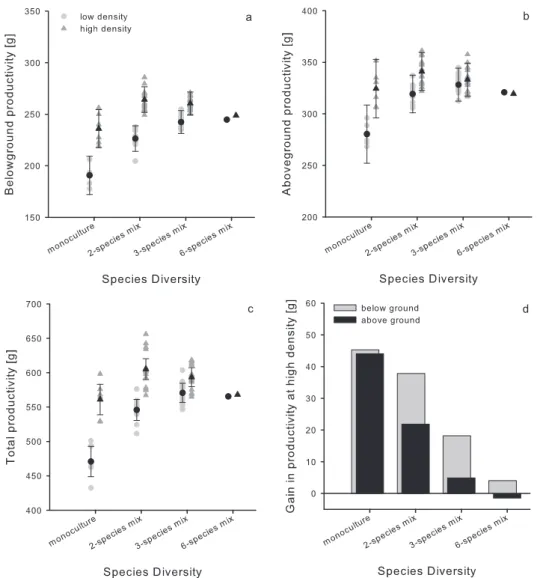
Fig. 1. Effects of density and diversity on the stand (a) belowground, (b) aboveground and (c) total productivity, as well as (d) proportion of productivity gained by doubling the number of trees planted (i.e. differences in productivity at high and low density). Black points (low density) and triangles (high density) are estimated mean productivity ± standard error of different monocultures and species mixtures (light grey points and triangles). For statistical analyses see Table 1.
resulTs
Effects of tree density and diversity on stand productivity and leaf area index
Stand productivity increased with increasing levels of diversity, with the main difference being between monocultures and species mixtures (Table 1, Fig. 1). On average, total productivity was increased by 11 % in mixed compared to monospecific stands (contrast monocultures vs. mixtures: mixed model, F1,3 = 7.48, P = 0.009, Fig. 1c). However, this positive relationship was much more pronounced at low density (19 % average increase in productivity in mixed stands compared to only 5 % at high density; Table 1, contrast monocultures vs. mixtures x density:
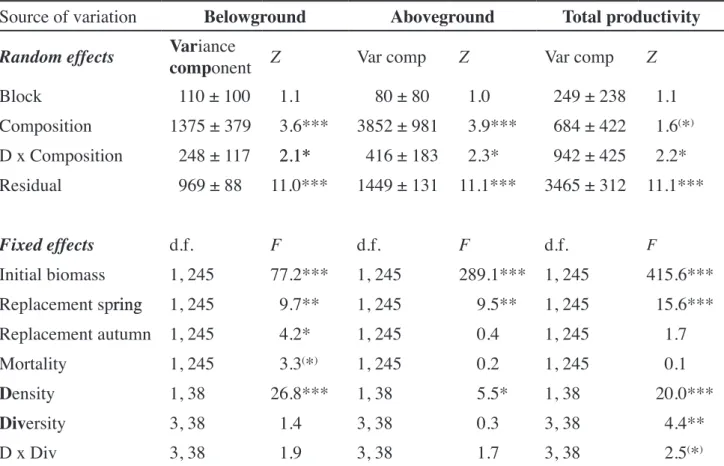
Table 1. Results of the mixed models (restricted maximum likelihood method) for stand productivity. Each variance component is followed by one standard error and levels of significance were determined from Wald Z-tests. The containment method was used to determine the degrees of freedom (d.f.). Levels of significance: (*)P < 0.1, *P < 0.05, **P < 0.01, ***P < 0.001.
Composition = species composition.
Source of variation Belowground Aboveground Total productivity
Random effects Variance
component Z Var comp Z Var comp Z
Block 110 ± 100 1.1 0 ± 0 1.0 249 ± 238 1.1 Composition 135 ± 39 3.6*** 352 ± 91 3.9*** 684 ± 422 1.6(*) D x Composition 248 ± 117 2.1*2.1* 416 ± 183 2.3* 942 ± 425 2.2* Residual 969 ± 11.0*** 1449 ± 131 11.1*** 3465 ± 312 11.1*** Fixed effects d.f. F d.f. F d.f. F Initial biomass 1, 245 .2*** 1, 245 29.1*** 1, 245 415.6***
Replacement springring 1, 245 9.** 1, 245 9.5** 1, 245 15.6***
Replacement autumn 1, 245 4.2* 1, 245 0.4 1, 245 1.
Mortality 1, 245 3.3(*) 1, 245 0.2 1, 245 0.1
Density 1, 3 26.*** 1, 3 5.5* 1, 3 20.0***
Diversity 3, 3 1.4 3, 3 0.3 3, 3 4.4**
mixed model, F1,3 = 3.61, P = 0.065, Fig. 1c). When analysed separately, tree diversity had no significant effect on above- or belowground productivity (Table 1, Fig. 1a, b). However, belowground productivity tended to increase with increasing diversity, but at low density only (diversity effect at low density: mixed model, F3,3 = 2.26, P = 0.09, Fig. 1a). Above ground this tendency was much weaker (Fig. 1b).
Higher planting density also increased stand productivity, although mainly at low diversity (marginal density x diversity interaction, Table 1, Fig. 1d). At the six-species diversity level, pots with six and 12 tree individuals (low and high density, respectively) were equally productive (Fig. 1). In other words, mean productivity per tree in six-species mixtures was halved (above ground by 50 %, below ground 49 %) at high density (Fig. 1). However, density did not affect the mean root/shoot-ratio, even after adjusting for total biomass (mixed model, F1,3 = 0.06 and
F1,3 = 0.19, respectively, both P > 0.1), nor did diversity (mixed model, F3,3 = 0.04, adjusted
for total biomass: F3,3 = 0.05, both P > 0.1). Within a given diversity level, species composition affected productivity depending on density (Table 1, Fig. 1). This was also true for the mean root/shoot-ratio, also after adjusting for total biomass (mixed model, Z = 4.23 and Z = 4.21,
respectively, both P < 0.001).
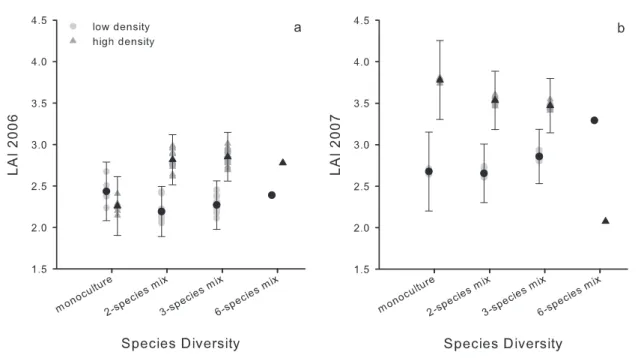
The LAI in the first growing season was higher in mixed compared to monospecific stands, but at high density only (contrast monocultures vs. mixtures x density: mixed model, F1,3 = 4.26, P = 0.046), resulting in an overall increased LAI at high planting density in mixtures with high
compared to low diversity (density x diversity interaction, mixed model, F3,3 = 2.5, P = 0.074,
Fig. 2a). A year later, this effect was reversed and LAI decreased in high diversity mixtures at high density, so that LAI was higher at high density only in mixtures with low diversity (density x diversity interaction, mixed model, F3,3 = 3.0, P = 0.039, Fig. 2b). In both years, the LAI varied with species composition (mixed model, 2006: Z = 2.25, P = 0.012, 200: Z = 3.59, P < 0.001). Nevertheless, variation among monocultures and species mixtures was smaller in the second compared to the first year (Fig. 2).
Biodiversity effects and relative yield total
The net biodiversity effect (NE) on above- and belowground productivity, and its components the complementarity effect (CE) and the selection effect (SE), were significantly positive overall, with the exception of SE on aboveground productivity (Appendix 1, 2). All three effects on above- and belowground productivity were reduced at high density, whereas diversity had no effect (Appendix 1, 2, Fig. 3). Although not significant, the NE on belowground productivity tended to be positively related to diversity, based on the increase of CE, but at low density only (Fig. 3). This tendency was not found above ground (Fig. 3). At high density, biodiversity effects tended to decrease with increasing diversity and values for NE and SE on aboveground productivity even became negative (Fig. 3). Despite the seemingly high variation in biodiversity effects between different species mixtures, particularly above ground, species composition only significantly affected values of the selection effect (Appendix 1, 2).
Fig. 2. Effects of density and diversity on the leaf area index (LAI) measured in (a) the first and (b)
second growing season. Black points (low density) and triangles (high density) are estimated mean LAI ± standard error of different monocultures and species mixtures (light grey points and triangles). For statistical analyses see text.
Overyielding was detected for most mixtures, as indicated by values of relative yield totals (RYT) of above- and belowground productivity significantly greater than one (Appendix 1, 2), supporting the results for CE (see above, Fig. 3). Both above and below ground the RYT was higher at low density, whereas diversity had no effect (Appendix 1, 2, Fig. 4). Overyielding above ground was transgressive at low density in 47 % of the two-species mixtures, but non-transgressive at high density (Fig. 4). Below ground, mixtures were non-transgressively overyielding at low and non-transgressively overyielding at high density (Fig. 4). Transgressive overyielding (i.e. Dmax) above ground declined with increasing diversity (mixed model, F2,33 = 4.95, P = 0.013, Fig. 4). At high density, the same pattern could be found for RYT above and below
Fig. 3. Effects of density and diversity on the biodiversity effects (NE = CE + SE) for aboveground (top three panels) and belowground productivity (bottom three panels). Black points (low density) and triangles (high density) are estimated mean effect size on productivity ± 95 % confidence intervals of different species mixtures (light grey points and triangles). For statistical analyses see Appendix 1 and 2.
ground and for transgressive overyielding below ground (Fig. 4). The effect, however, was not significant (Appendix 1, 2, mixed model, F2,33 = 0.94, P > 0.1).
Tree growth
Average tree size and aboveground growth did not differ among different diversity levels (mixed model, height: F3,3 = 0.23, trunk diameter: F3,3 = 0.12, height increase over time: F3,3 = 0.1, diameter increase over time: F3,3 = 0.05, all P > 0.1). Only trunk diameter and its increase over time tended to increase with increasing diversity but at low density only (mixed model, density x diversity F3,3 = 2.51, P = 0.03 and F3,3 = 2.47, P = 0.0, respectively). However, within a given diversity level different monocultures and species mixtures varied considerably in all variables describing size and growth above ground (mixed model, height: Z = 3.46, trunk
diameter: Z = 3., height increase over time: Z = 4, diameter increase over time: Z = 4.02, all P < 0.001).
dIscussIon
Overall we found a positive effect of tree diversity on total productivity, via increases in below- but not aboveground productivity, in experimental temperate tree communities. This to our knowledge is the first time that effects of tree diversity have been quantified and separately tested for above- and belowground productivity. However, our results contrast those from temperate forest plantations, which show positive mixture-effects on aboveground productivity (e.g. Assmann 190, Knoke et al. 2005, Pretzsch 2005, Pretzsch and Schütze 200). Many of these silvicultural experiments are, however, only partially suitable to address biodiversity ecosystem functioning issues, because they are mostly limited to two-species mixtures of economically important species and particular varieties selected for high productivity (Kelty et al. 1992, Pretzsch 2005, Vila et al. 2005). Observational studies have produced inconsistent results on the biodiversity ecosystem functioning relationship in temperate forests, with some studies reporting a positive effect (Caspersen and Pacala 2001, Vila et al. 200), and others no