
Use of open source mathematics textbooks in
university courses
1Vilma Mesa
AbstractIn theUndergraduate Teaching and Learning in Mathematics with Open Software and Text-books project we study the use of open source textbooks in the teaching and learning of mathematics at the university level (Beezer et al.,2018). The project gathers (a) real-time, individualized viewing data from three dynamic university textbooks for calculus, linear al-gebra, and abstract algebra; (b) ongoing surveys of users’ descriptions of the textbook use; (c) users’ questionnaires (beliefs and attitudes towards mathematics, technology, teaching, and learning); and (d) student performance (tests of knowledge and grades). The textbooks have been enhanced with a variety of features (WeBWorK, Geogebra, Interactive Reading Questions, and computational cells). In this article I highlight the theoretical and method-ological approaches used in the project to answer two questions: How do students and instructors use textbooks? and How can we develop textbooks that will improve teaching and learning?
Keywords: open-source textbooks, university textbook use, data analytics, calculus, linear algebra, abstract algebra.
Resumen
En el proyectoUndergraduate Teaching and Learning in Mathematics with Open Software and Textbooks se estudia el uso de libros de texto de código abierto en la enseñanza y el aprendizaje de las matemáticas a nivel universitario (Beezer et al.,2018). El proyecto recoge (a) datos de visualización individualizados en tiempo real de tres libros de texto universitarios dinámicos para cálculo, álgebra lineal y álgebra abstracta; (b) encuestas continuas de las descripciones de los usuarios sobre el uso de libros de texto; (c) cues-tionarios de los usuarios (creencias y actitudes hacia las matemáticas, la tecnología, la enseñanza y el aprendizaje); y (d) desempeño del estudiante (pruebas de conocimiento y calificaciones). Los libros de texto se han mejorado con una variedad de características (WeBWorK, Geogebra, Preguntas interactivas de lectura y celdas computacionales). En este artículo se destacan los enfoques teóricos y metodológicos utilizados en el proyecto
1 V. Mesa
School of Education, University of Michigan, Ann Arbor, Michigan, USA [email protected]
1Este trabajo corresponde a la participación de la autora en una mesa redonda plenaria realizada en la XV
CIAEM, celebrada en Medellín, Colombia, del 5 al 10 de mayo de 2019.
2El resumen y las palabras clave en español fueron agregados por los editores.
Recibido por los editores el 10 de junio de 2019 y aceptado el 28 de julio de 2019.
Cuadernos de Investigación y Formación en Educación Matemática. 2019. Año 14. Número 18. pp 162–169. Costa Rica
para responder dos preguntas: ¿Cómo usan los libros de texto los estudiantes y los in-structores? y ¿Cómo podemos desarrollar libros de texto que mejoren la enseñanza y el aprendizaje?
Palabras clave: libros de texto de código abierto, uso de libros de texto universitarios, análisis de datos, cálculo, álgebra lineal, álgebra abstracta.
Within the array of resources for teaching and learning, the textbook continues to be the most prevalent one for instructors and students. Textbook formats have been changing from paper to digital, open source formats, including sophisticated tools such as computing cells, annotation tools, and powerful search engines, easing access at relatively low cost. Importantly, open source textbooks never expire or go out of print and can be distributed at no cost to students, making them practically fully accessible. The study we report here is part of a large funded project that seeks to describe how instructors and students use three open-source, technologically enhanced textbooks: Active Calculus (Boelkins,2018), Linear Algebra (Beezer,2017), and Abstract Algebra (Judson, 2017). These textbooks have been created in a markup language called PreTeXt that allows for the textbooks to be viewed in any device and in any platform.
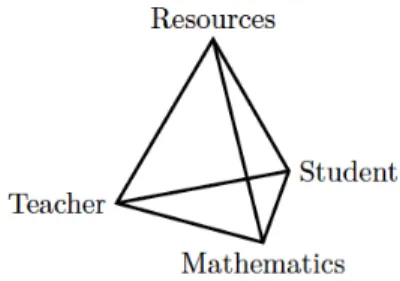
We use Rezat and Strässer’s (2012) didactical tetrahedron to investigate how resources mediate instruction (Cohen, Raudenbush, & Ball,2003). Our conceptualization of instruc-tion, as the interactions between the instructor, students, and the mathematics content, is depicted in the base of the tetrahedron (Figure 1).
Figure 1. The didactical tetrahedron, that indicates how resources mediate the various elements of in-struction (Rezat & Strässer,2012, p. 241)
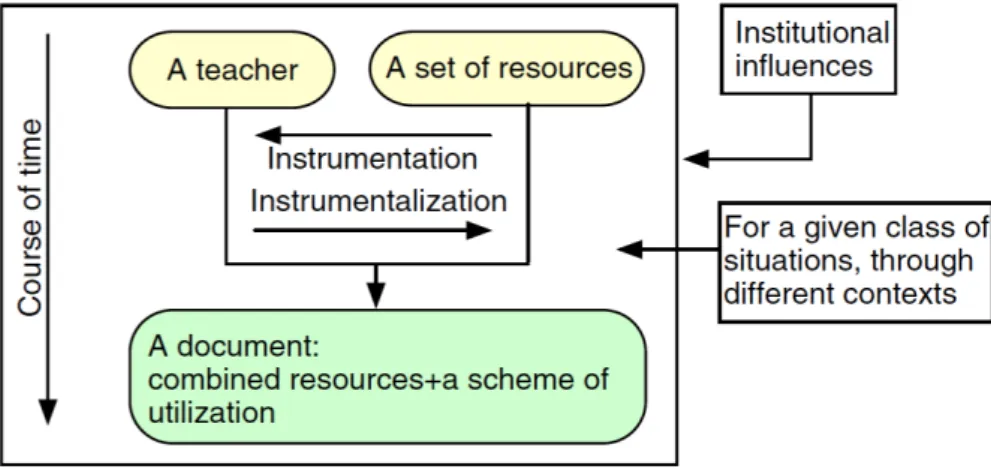
To understand how resources are used, we follow Gueudet and Trouche (2009) in their de-finition of documents: the combination of a set of resources plus the schemes of utilization given by the users (instructor and students). Resources are defined as the collection instru-ments gathered for a particular purpose (e.g., textbook, past lecture notes, syllabi in the case of the instructor; class notes, homework, index cards in the case of the students). Schemes of utilization include the processes that users engage in as they use the resources. These schemes have three distinct components, a material component (how the physical textbook or software is manipulated), a mathematical component (e.g., how the mathematical definitions
are changed from canonical definitions), and the didactical component (e.g., how specific features are used by instructors and students). We seek to describe two processes, instru-mentation, that considers the influences on the user of the set of available resources, and
instrumentalization, how the users change the resources as they use them (see Figure 2).
Figure 2. The documentational approach (Gueudet and Trouche2009).
We do these by attending to two areas of instructors’ work: lesson planning and its enact-ment seeking to identify operational invariants, instructors’ beliefs that shape the design, and use of resources (e.g., beliefs about ways with which students better understand defin-itions). Two areas of students’ work were considered: how they read the textbook and how they prepare for exams.
1. Methods
We use a mixed methods design to gather use data from students and instructors as they engage with the textbooks (see Figure 3).
Figure 3. Data collection over a full term. An X indicates the timing of data collection for each type of data. The continuous line for computer generated data represents data that is automatically collected as users interact with the textbooks.
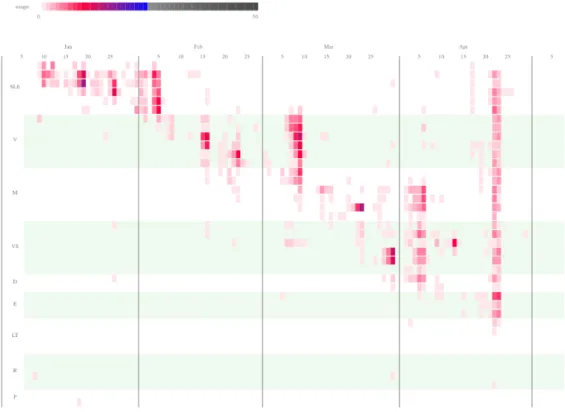
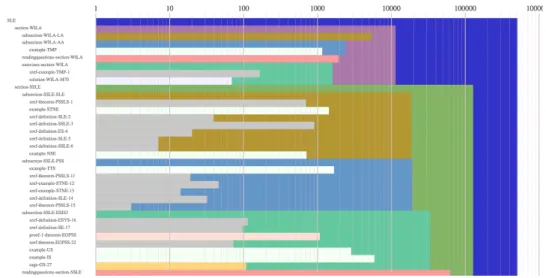
Instructors and students fill out surveys at different points in time to describe their beliefs and attitudes towards mathematics and technology. We collect tests of students’ knowledge at the beginning and at the end of the semester to gather information about their knowledge growth. In addition we collect student and instructor logs (online surveys with four to seven questions about the use of the textbook during the past two weeks). In addition we collect computer generated viewing data (see Figure 4) which can be navigated at the user level (see Figure 5), time spent and number of clicks done on each textbook section and element (see Figure 6).
To analyze the data we use ongoing natural language processing (Blei, Ng, & Jordan,2003) to gather themes from all the student responses to logs. Instructors’ responses are analyzed manually to identify the schemes of use of their textbooks. We aggregate across semesters to identify recurring themes and triangulate the log and viewing data with the time data to corroborate themes and patterns of viewing.
2. Results
I report briefly on findings from (1) the analysis of bi-weekly log data from 102 students from four instructors in four different states who were using a dynamic linear algebra textbook (Beezer, 2017) in the Spring semester of 2018. The textbook includes common linear algebra chapters (e.g., systems of linear equations, matrices, vector spaces, etc.) and (2) the various documents that instructors and students created as they used the textbooks. Analysis of bi-weekly log data
The analysis of the viewing data revealed, unsurprisingly, that viewing tended to occur during the days when the classes were offered (mostly during class sessions), close to exams days, or when homework was due. The students mainly used solutions of exercises—in 17,405 viewings, 81% of the viewing time was for solutions of exercises, 15% for examples, and 5% for all the other elements. In the log responses students reported that they checked the textbook the day before class or the last day of their break; they also used it to study for the upcoming class, or when they were stuck, missed class, or had not understood their instructor’s explanation. Students reported using mainly problems, exercises, and examples as they were preparing for class. When asked about their use of theorems, definitions, and examples, students said those were mainly used when producing notes for later use because they wanted to make sure they were connecting ideas and knew the basic definitions. We found six themes in the analysis of student responses to their viewing of the linear algebra textbook (n = 120). The students indicated:
• Theme 1: Viewing the textbook to study the material (58%); in addition, they mentioned some ways in which they do so. Students said that they:
• Theme 2: Start viewing examples (skipping text); then attempt the examples; and if need be, view the text to clarify ideas (17%).
• Theme 3: Start viewing homework; if the solution is wrong, read solution in detail to understand what problems they had (10%).
• Theme 4: Viewing to read word for word (8%).
• Theme 5: Viewing to cross-reference with class work (5%).
• Theme 6: Viewing formulas and definitions and keep track on personal document (3%).
Figure 4. Viewing data for a course using the linear algebra textbook.
Figure 6. Data collection over a full term.
Here are some illustrative examples:
• "I normally spend a couple of hours studying the book, I don’t have a set schedule or timetable for my studying. I also use my textbook to review and touch up on things I haven’t looked at in a while." (Theme 1)
• "Feb 19 Mon, Chapter M 6-9 PM: I was looking over example problems to help me prepare for my quiz, and I looked at definitions and theorems to help explain notation and solutions." (Theme 2)
Analysis of documents
Instructors created lecture notes, syllabi, personal notes, and assessments, all with the goal of facilitating their teaching of the course. Students created class notes, homework docu-ments or solutions, and textbook notes in order to improve their understanding, for practice, and reminders or memorization. Both students and instructors used many other resources. In terms of the instructors, they relied on colleagues, past notes, notes from when they were students, other textbooks, Wolfram alpha and other mathematical programs such as Sage, Maple or Mathematica, the textbook authors, and programming software, such as Python. Students mentioning working with classmates, the Internet, Google, YouTube, Chegg, Khan Academy, class lecture videos, other printed and HTML textbooks, family members, and their instructors. Students did not use the open-source feature and infrequently used com-putational cells.
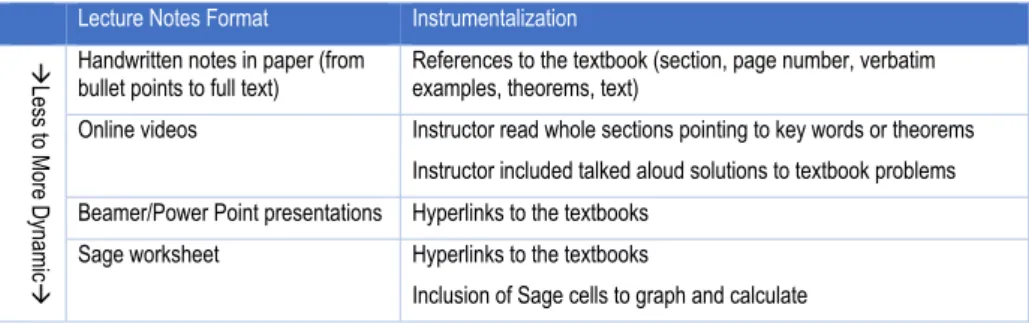
Figure 7 summarizes the instrumentalization processes for the documentlecture notesthat we have found. They range from the less to more dynamic instrumentalizations: how in each of those uses, the textbook was used to shape thelecture notes.
168 Mesa
Lecture Notes Format Instrumentalization
→ Le ss to M or e D yn am ic →
Handwritten notes in paper (from bullet points to full text)
References to the textbook (section, page number, verbatim examples, theorems, text)
Online videos Instructor read whole sections pointing to key words or theorems
Instructor included talked aloud solutions to textbook problems
Beamer/Power Point presentations Hyperlinks to the textbooks
Sage worksheet Hyperlinks to the textbooks
Inclusion of Sage cells to graph and calculate
Figure 7. Various instrumentalizations of the documentLecture notes, from less to more dynamic.
During class time, some instructors copied their notes on the blackboard, whereas some distribute them ahead of time to the students, either as PowerPoints that they could annotate by printing them, or as Sage worksheets that students could compile and manipulate in real time. The rules of actions and the reasons students and instructors had to use various documents are given in Figure 8.
Rules of Action When/Why
S
tu
de
nt
s Read Study for examinations or class (study notes)
Look for definitions Clarify meaning to work out homework (homework solution) Study examples and proofs Work out the homework (homework solution)
In
st
ru
ct
or
s Identify major course topics Create syllabus before the term starts
Identify theorems and definitions Create lecture notes for each class; ensure consistency Identify examples Clarify definitions and theorems in class (lecture notes) Figure 8. Rules of action, reasons, and situations for using documents by students and instructors.
3. Discussion
We were able to identify various ways in which the students and the instructors created documents and instrumentalized the textbooks as they created those documents. While the documents created are not novel, we are able to clearly identify them and illustrate the ways in which the users used them. We found that students and instructors seemed reluctant to take full advantage of novel features (such as the programming cells) opting instead for using their usual processes of document generation. We speculated that by itself, the design of the textbooks is insufficient for facilitating the adoption of alternative ways of using these textbooks in generating those documents. We noticed that students did not use features that were not required by their instructors and that they used those that their instructors said were important to use (e.g., definitions, theorems, examples, proofs). Instructors might need training about ways to take advantage of the open nature of the textbooks. Some instructors, for example, only associated open source with the free access of the textbooks. We are planning gatherings and conversations with designers, authors, and instructors, so that the process of creating the textbooks becomes more transparent. Textbook
Use of open source mathematics textbooks in university courses 169
production is expensive, and thus, research that documents how open access textbooks can be made widely available is important. Yet, without knowing how to best take advantage of the new technologies, we might not realize their potential within mathematics classrooms. Acknowledgment
Funding for this work has been provided by the National Science Foundation (IUSE 1624634, 1821114). Any opinions, findings, and conclusions or recommendations expressed in this material are those of the author(s) and do not necessarily reflect the views of the National Science Foundation. Thanks to David Farmer, the American Institute of Mathemat-ics and the members of the Research in Teaching MathematMathemat-ics in Undergraduate Settings (RTMUS) at the University of Michigan for their research support.
Referencias y bibliografía
Beezer, R. (2017). First course in linear algebra. Gig Harbour, WA: Congruent Press. Available at http://lin-ear.pugetsound.edu/. HTML available athttp://linear.ups.edu/html/fcla.html.
Beezer, R., Judson, T., Farmer, D., Morrison, K., Mesa, V., & Lynds, S. (2018). Undergraduate Teaching and learning in Mathematics with Open Software and Textbooks (UTMOST): National Science Foundation (DUE 1821706,1821329,1821114,1821509).
Blei, D. M., Ng, A. Y., & Jordan, M. I. (2003). Latent Dirichlet allocation. Journal of machine Learning research, 3(Jan), 993-1022.
Boelkins, M. (2018). Active Calculus. Available at https://activecalculus.org/single/: CreateSpace Independent Publishing Platform.
Cohen, D. K., Raudenbush, S. W., & Ball, D. L. (2003). Resources, instruction, and research. Educational Evaluation and Policy Analysis, 25, 119-142.
Gueudet, G., & Trouche, L. (2009). Towards new documentation systems for mathematics teachers? Educational Studies in Mathematics, 71, 199-218.
Judson, T. (2017).Abstract algebra: Theory and applications. Available at http://abstract.pugetsound.edu/. HTML available athttp://abstract.ups.edu/aata/. Orthogonal Publishing L3C.
Rezat, S., & Strässer, R. (2012). From the didactical triangle to the socio-didactical tetrahedron: Artifacts as fundamental constituents of the didactical situation.ZDM Mathematics Education, 44, 641-651.
doi:10.1007/s11858-012-0448-4
Weinberg, A., Wiesner, E., Benesh, B., & Boester, T. (2012). Undergraduate students’ self-reported use of math-ematics textbooks. Problems, Resources, and Issues in Mathematics Undergraduate Studies, 22(2), 152-175. doi:10.1080/10511970.2010.509336
![[S535.Ebook] Ebook Free Advanced Linear Algebra Textbooks In Mathematics By Bruce Cooperstein.pdf](data:image/gif;base64,R0lGODlhAQABAIAAAP///wAAACH5BAEAAAAALAAAAAABAAEAAAICRAEAOw==)