International e-Journal of Criminal Science
Artículo 1, Número 9 (2015) http://www.ehu.es/inecs ISSN: 1988-7949
Correspondence should be addressed to Kelvin Leong e-mail: [email protected]
Leong & Sung
A review of spatio-temporal pattern analysis approaches on
crime analysis
Kelvin Leong & Anna Sung
Department of Business and Management, Glyndwr University, Wrexham,
Wales, U.K.
Received 23 November 2014; Accepted 26 January 2015; Available online 2 February 2015
Abstract
This review aims to summarize spatio-temporal pattern analysis approaches for crime analysis. Spatio-temporal pattern analysis is a process that obtains knowledge from geo-and-time-referenced data and creates knowledge for crime analysts. In practice, knowledge needs vary amongst different situations. In order to obtain relevant types of knowledge, different types of spatio-temporal pattern analysis approaches should be used. However, there is a lack of related systematic review which discussed how to obtain related knowledge from different types of spatio-temporal crime pattern. This paper summarizes spatio-temporal patterns into five major categories: (i) spatial pattern, (ii) temporal pattern, (iii) frequent spatio-temporal pattern, (iv) unusual spatio-temporal pattern and (v) spatio-temporal effect due to intervention. In addition, we also discuss what knowledge could be obtained from these patterns, and what corresponding approaches, including various data mining techniques, could be used to find them. The works of this paper could provide a reference for crime analysts to select appropriate spatio-temporal pattern analysis approaches according to their knowledge needs.
Keywords: Spatio-temporal pattern analysis, data mining, knowledge discovery, crime analysis.
International e-Journal of Criminal Science
Artículo 1, Número 9 (2015) http://www.ehu.es/inecs ISSN: 1988-7949
2
1 Introduction
Spatio-temporal pattern analysis is a key task in crime analysis. Spatio-temporal pattern analysis is a process that extracts information and knowledge from geo-and-time-referenced data and creates knowledge for crime analysts. The basic objective of spatial crime pattern analysis is to find spatial crime patterns and then use the patterns to help identifying the root causes of the crimes. For example, if a large number of thefts occurred in a specific area, criminologists would be interested to study the environmental settings at or close to this specific area, and then the settings could provide clues to criminologists to investigate whether or not thefts occurred more often in other areas with similar environment setting. The key assumption behind spatial crime pattern analysis is that crimes would correlate with environment settings and this assumption is supported by related theories, such as environmental criminology (Brantingham and Brantingham, 1991) and broken windows theory (Wilson and Kelling, 1982). The key concept of environmental criminology suggests that environmental factors would influence criminal activity while the broken windows theory suggests that maintaining and monitoring urban environment in a well-condition may stop further serious crimes.
Many empirical studies support the existence of correlation between crimes and environmental settings. For examples, previous study (Roncek and Bell, 1981) indicated that alcohol consumption seemed to contribute to increased levels of violence. Other previous studies (Curry and Spergel, 1988; Anselin et al, 2000) indicated that crime was correlated with poverty and a lack of social control, but violence to be correlated with their measure of social disorganization. Moreover, spatial crime pattern analysis might take different types of spatial factors into consideration. For example, the spatial
International e-Journal of Criminal Science
Artículo 1, Número 9 (2015) http://www.ehu.es/inecs ISSN: 1988-7949
3 relationship between hurricanes and crime distribution were studied in Leitner et al (2011) and Leitner and Helbich (2011).
Temporal pattern is often considered together with spatial pattern in crime analysis. The key theories behind spatio-temporal crime analysis include routine activity theory (Cohen and Felson, 1979) and rational choice theory (Cornish et al, 1986). In brief, routine activities theory suggests three necessary conditions for most crime – a motivated offender, a suitable target and the absence of a capable guardian. Rational Choice Theory believes that reasoning actor who weighs means and ends, costs and benefits, and makes a rational choice to commit crimes. Simply put, both theories indicate that crime distribution is determined by the intersection in time and space of suitable targets and motivated offenders.
Empirical studies related to near repeat victimization suggests that there is an elevated risk of burglary following an initial incident, and there are regularities in the timing and spacing of these repeats (Grubesic and Mack, 2008; Johnson et al, 1997; Johnson et al, 2007; Bowers and Johnson, 2005).
In spatio-temporal crime pattern analysis, the challenge is how to identify patterns from the dynamic interplay between space, time and crime. This is a challenge because crime patterns are considered to vary with time and location (Skogan, 1990; Loukaitou-sideris, 1999; Harries, 1999). As per Ratcliffe (2002), crime follows opportunity, it does not necessarily follow that opportunities remain constant over time. Also, opportunities are unevenly distributed across time and space, and the availability of motivated offenders and suitable targets changes for many locations throughout the day (Brantingham and Brantingham, 1984).
Many works were proposed to tackle the issues related to the interactions between spatial pattern and temporal pattern of crimes. Xue and Brown (2003) analyzed criminal
International e-Journal of Criminal Science
Artículo 1, Número 9 (2015) http://www.ehu.es/inecs ISSN: 1988-7949
4 behaviors in space and time as spatial choice models, and showed that they provide efficient and accurate predictions of future crime patterns. On the other hand, Clarke (1995) showed that situational crime prevention can reduce crime by altering the environment. It aims to stop crime before they occur. Situational crime prevention can also mean improving street lighting, adding video surveillance cameras or just getting more pedestrians on the streets. Brown, Liu and Xue (2001) assumed criminal incidents were random events in space and time and a model based on transition density was suggested. It reported on the use of locations and location features of prior crimes to predict the probable areas of future crimes. Grubesic and Mack (2008) explore the utility of statistical measures for identifying and comparing the spatio-temporal footprints of different crime types. The study shows that different crime types have dramatically different spatio-temporal signatures.
In crime analysis practice, crime analysts need different types of knowledge in different situations. For examples, in one situation a crime analyst may wish to know how many thefts were occurred in the same shopping mall in last month but another situation a crime analyst may wish to know which area has the highest theft rate in last year.
In order to obtain different types of knowledge, different types of spatio-temporal pattern analysis approaches should be used. However, there is a lack of related systematic review which discussed how to obtain related knowledge from different types of spatio-temporal crime pattern. This paper summarizes spatio-temporal patterns into five major categories: (i) spatial pattern, (ii) temporal pattern, (iii) frequent spatio-temporal pattern, (iv) unusual spatio-spatio-temporal pattern and (v) spatio-spatio-temporal effect due to intervention. In addition, we also discuss what knowledge could be obtained from these patterns, and what corresponding approaches, including various data mining techniques, could be used to find them. The works of this paper could provide a useful
International e-Journal of Criminal Science
Artículo 1, Número 9 (2015) http://www.ehu.es/inecs ISSN: 1988-7949
5 reference for crime analysts, criminologists and researchers to select appropriate spatio-temporal pattern analysis approaches according to their knowledge needs.
2 Spatio-temporal patterns in crime analysis
The five major categories of spatio-temporal pattern as mentioned in previous will be discussed in the following sub-sections.
2.1 Spatial pattern
Spatial events generally are not spread evenly across maps. They clump in some areas and are absent in others. Spatial pattern analysis is a process to investigate the dispersion of spatial events. Crime can form very different patterns at different scales of analysis (Brantingham et al, 1976; Lim et al, 2007; Brantingham et al, 2009). Two major types of spatial pattern, (i) hotspot and (ii) collocation and topological relationships, are summarized as follows.
- Hotspot
Hotspot is widely studied spatial crime pattern (Eck et al, 2005). Hotspot is a geographic area with higher-than-average incidences of certain events. In general, hotspot analysis finds static spatial patterns by spatial clustering.
Spatial clustering is an approach of spatial pattern analysis – it refers grouping a set of spatial events into groups according to their similarity. , that is, by classifying objects into groups, or, more precisely, partitioning a data set into subsets (clusters) based on some criteria of similarity (Roddick and Spiliopoulou, 1999; Ester, Kriegel and Sander, 2001; Shekhar et al, 2003). Several clustering techniques include Point locations, Hierarchical, Partitioning, Density and Clumping techniques etc are used to find
International e-Journal of Criminal Science
Artículo 1, Número 9 (2015) http://www.ehu.es/inecs ISSN: 1988-7949
6 hotspot. According to Eck et al (2005), the general techniques for discovering crime hotspots were mean center, standard deviation distance, standard deviation ellipse, and data clustering.
The history of spatial clustering can be traced back to 1850s, when Dr. John Snow performed data analysis to prove that cholera was spread by the drinking of water infected with cholera bacteria. A common approach in spatial clustering is to use geographic distance as similarity measure, it stems from a unique property in that "Everything is related to everything else but nearby things are more related than distant
things" (Tobler, 1970), the concept is so called the first law of geography. A typical
distance-based spatial clustering pattern is called hotspot, that is, a geographic area with higher-than-average incidences of certain events. Hotspot has a variety of applications, such as disease control (Chaikaew et al, 2009) and traffic accident analysis (Cheng and Washington, 2005).
Kernel density approaches (Rosenblatt, 1956; Parzen, 1962) is widely used to produce hotspot map. For example, the Hot Spot Detective programme (McCullagh, 2006; Ratcliffe, 2002) uses the kernel estimation approach developed in Gatrell et al (1996) to transform spatial point patterns of criminal incidents into a smooth image. Figure 1 shows an example of hotspot map created by kernel estimation approach.
International e-Journal of Criminal Science
Artículo 1, Número 9 (2015) http://www.ehu.es/inecs ISSN: 1988-7949
7
Figure 1 – An example of hotspot map created by kernel estimation approach
- Collocation and topological relationships
Other than hotspot, Collocation and topological relationships (Egenhofer, 1989; Egenhofer and Franzosa, 1991) between spatial objects (e.g. different types of crime, environmental settings, etc) are important information in spatial crime pattern analysis. For example, a crime analyst may be interested to study whether or not shop thefts are more likely to occur inside shopping malls.
A total of 242 types of topological relation between fuzzy regions were summarized in Bejaoui et al (2009). Some typical topological spatial relationships are illustrated as examples in figure 2. Based on the geometry data types such as points, lines and polygons, spatial SQL (Egenhofer, 1994) could be used to find topological spatial relationships between spatial objects.
International e-Journal of Criminal Science
Artículo 1, Número 9 (2015) http://www.ehu.es/inecs ISSN: 1988-7949
8
Figure 2 - Examples of topological spatial relationships.
Related data mining approaches such as collocation pattern mining (Huang et al, 2004) is proposed, the collocation pattern mining identifies groups of spatial phenomena that are related to each other by the locational frequency at which they occur in a spatial neighbourhood (Yoo and Shekhar, 2006) .
2.2 Temporal pattern
Temporal pattern analysis is inherently more complex than spatial crime pattern analysis because temporal data could be presented and organized in different measures such as seconds, minutes, days, weeks, months, years and others. Moreover, different temporal measures could also be associated by different relationships, such as duration and interval etc.
Traditional temporal analysis aims to analyze time-series data in order to obtain relevant knowledge, meaningful patterns and other useful characteristics of the time-series data.
A B A B A B A contains B B inside A A touch B B touch A A overlay by intersect B B overlay by intersect A A B A disjoint B B disjoint A
International e-Journal of Criminal Science
Artículo 1, Número 9 (2015) http://www.ehu.es/inecs ISSN: 1988-7949
9 A time series is a sequence of data points measured typically at equal time intervals. Different temporal data mining approaches were proposed in order to deal with different knowledge needs. In general, these temporal data mining approaches are categorized (Han and Kamber, 2000) into four categories as: (i) trend analysis, (ii) similarity search, (iii) periodicity analysis and (iv) sequential mining. In addition, we also discuss another type of temporal pattern (v) evolution. Following is the discussion.
- Trend analysis
Trend analysis, such as ANOVA and Hierarchical Linear Modeling, generally refers to extracting underlying temporal patterns in long-term time series data over several years. Temporal patterns in trend analysis are usually decomposed into four movement components: (1) long term or trend movements, (2) cyclic movements (i.e. long term oscillation occurring in a time series), (3) seasonal movements (i.e. recur annually) and (4) irregular or random movements. Based on the four decomposed movement components, analysts could better study the changes of a particular topic over time.
Related patterns in trend analysis are widely discussed in crime analysis. For example, seasonal violent crime patterns in England and Wales were found in previous study (Field 1992). In crime analysis practices, traditionally regression models are widely adopted together with various trend analysis techniques in order to support temporal crime pattern analysis, i.e. in the citations between brackets (Cohen and Felson, 1979; Brown and Oxford, 2001; Greenberg, 2001; Felson and Cohen 1980).
- Similarity search
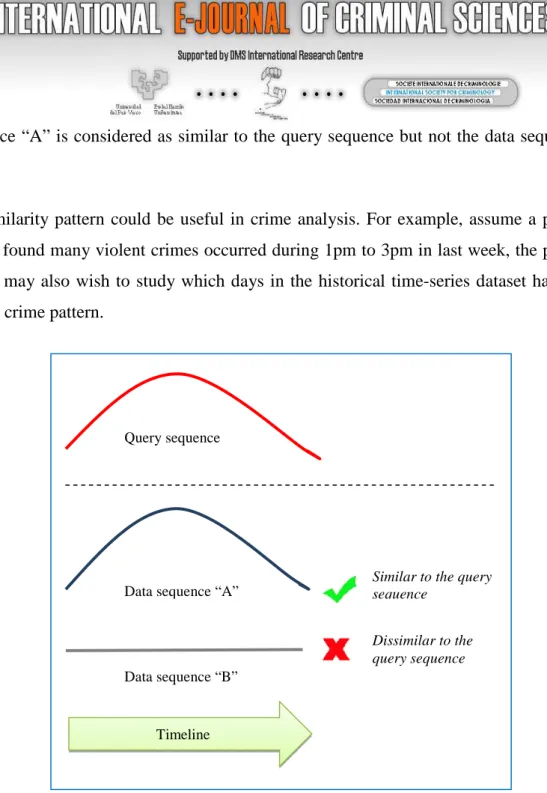
Similarity search in time-series analysis finds data sequences that differ only slightly from the given query sequence. For example, given a query sequence in figure 3, data
International e-Journal of Criminal Science
Artículo 1, Número 9 (2015) http://www.ehu.es/inecs ISSN: 1988-7949
10 sequence “A” is considered as similar to the query sequence but not the data sequence “B”.
Similarity pattern could be useful in crime analysis. For example, assume a police officer found many violent crimes occurred during 1pm to 3pm in last week, the police officer may also wish to study which days in the historical time-series dataset had the similar crime pattern.
Figure 3 - Examples of periodicity pattern.
In order to conduct similarity search in time-series analysis, many techniques require data transformation, that is, to transform the data from the time domain to the frequency domain. DFT (Discrete Fourier Transform) and DWT (Discrete Wavelet
Query sequence
Similar to the query sequence
Dissimilar to the query sequence Data sequence “A”
Data sequence “B”
International e-Journal of Criminal Science
Artículo 1, Número 9 (2015) http://www.ehu.es/inecs ISSN: 1988-7949
11 Transform) are the two most popular data-independent transformations (Wu et al, 2000).
- Periodicity analysis
Periodicity analysis search for recurring patterns in time-series databases, for example in figure 4, Calvin sits in front of computer everyday 9:00am except weekend. This form of data mining analysis can be organized into three categories: full periodic (e.g. vehicle theft occurs from 6:00am to 6:30pm every day!), partial periodic (e.g. vehicle theft occurs from 6:00am to 6:30pm every weekend, but such type of theft at other times do not have much regularity) or cyclic periodic (e.g. if vehicle theft occurs on Monday, it will occur again on Tuesday).
Figure 4 - Examples of periodicity pattern.
Periodicity crime pattern is a key element in the famous routine activity theory (Cohen and Felson, 1979) in crime analyses. For example, researchers correlate the hourly activities and their link to crime opportunity (Felson and Boba, 2010).
International e-Journal of Criminal Science
Artículo 1, Número 9 (2015) http://www.ehu.es/inecs ISSN: 1988-7949
12 Mining sequential patterns aims to find frequently occurring patterns related to time sequences. Sequential pattern mining (Agrawal and Srikant, 1995; Srikant and Agrawal, 1996) has been widely studied to several application domains, such as stock market analysis, climate prediction, diseases control and sales forecasting (Ramirez et
al, 1998; Ramirez et al, 2000). An example of a sequential pattern in crime analysis is
“an offender who committed theft is likely to buy drug within one week”.
The basic concepts of mining sequential patterns were introduced and explained in Agrawal and Srikant (1995). Given a set of sequences, each sequence contains a list of elements and each element contains set of items. Based on a user-specified minimum support threshold, sequential pattern mining can find all the frequent sub-sequences whose occurrence frequency in the set of sequences in no less than the minimum support threshold.
Generalized Sequential Patterns (GSP) is more comprehensive than SP because it integrates with time constraints and relaxes the definition of transaction; also it considers the knowledge of taxonomies.
In recent years, many solutions have been proposed to improve the efficiency of sequence patterns mining process, such as SPADE algorithm (Zaki, 2001), and PrefixSpan (Han et al, 2001).
- Evolution
Evolution Rules (ER) (Wang, Yang and Muntz, 2001; Wang, Yang and Yang, 1999) intend to discover the correlation among numerical attribute evolutions. For example, an employee suspected of corruption who’s bank balances from an interval of $1,000,000 and $1,450,000 to an interval of $5,000,000 to $5,500,000, and then to an interval $6,000,000 to $6,500,000. The concern of ER is that the mined attributes must be in
International e-Journal of Criminal Science
Artículo 1, Número 9 (2015) http://www.ehu.es/inecs ISSN: 1988-7949
13 numerical form, so users have to change the original narrative attributes into numerical form.
2.3 Frequent spatio-temporal pattern
Frequent spatio-temporal pattern analysis aims to study the interplay between space, time and event. Four types of spatio-temporal pattern, (i) spatio-temporal hotspot, (ii) spatio-temporal collocation and topological relationships, (iii) spatio-temporal sequence and (iv) spatio-temporal association rule are discussed as follows.
- Spatio-temporal hotspot
Spatio-temporal hotspot aims to add temporal information on spatial hotspot. A simple method of display for the temporal information of spatial crime hotspots is to combine a spatial crime hotspot map with a graphical display of aoristic signatures (Ratcliffe, 2002) as per figure 5 – an aoristic signature is a chart that shows the crime measures distributed across a complete range of study times for a hotspot.
Figure 5 – An example of crime hotspot with aoristic signature. Hotspot
International e-Journal of Criminal Science
Artículo 1, Número 9 (2015) http://www.ehu.es/inecs ISSN: 1988-7949
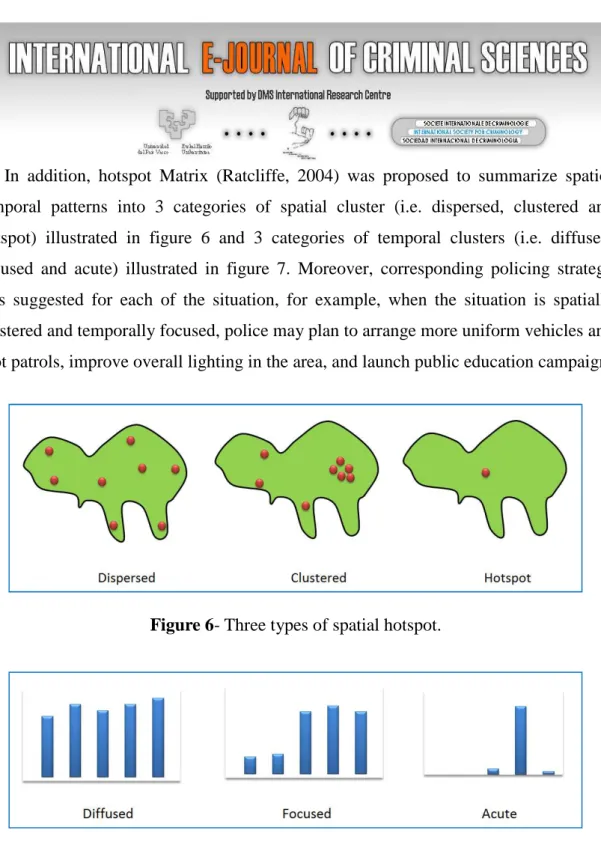
14 In addition, hotspot Matrix (Ratcliffe, 2004) was proposed to summarize spatio-temporal patterns into 3 categories of spatial cluster (i.e. dispersed, clustered and hotspot) illustrated in figure 6 and 3 categories of temporal clusters (i.e. diffused, focused and acute) illustrated in figure 7. Moreover, corresponding policing strategy was suggested for each of the situation, for example, when the situation is spatially clustered and temporally focused, police may plan to arrange more uniform vehicles and foot patrols, improve overall lighting in the area, and launch public education campaign.
Figure 6- Three types of spatial hotspot.
International e-Journal of Criminal Science
Artículo 1, Número 9 (2015) http://www.ehu.es/inecs ISSN: 1988-7949
15 - Spatio-temporal collocation and topological patterns
Data mining techniques are able to find collocation pattern (Huang et al, 2004; Zhang et al, 2004) and topological patter (Wang, Hsu and Lee, 2005; Hsu, Lee and Wang 2008c), that is, the intra-relationships of spatial patterns in a fixed temporal view. For example, the TopologyMiner proposed in Wang, Hsu and Lee (2005) aims to find topological patterns with temporal information within a time window, such as “There is a higher incidence of earthquake in a region during or soon after
a high atmospheris pressure occurs in the nearby region.” This technique can find
the intra-relationships of events within a given time window and the events found by the technique may form different patterns (i.e. star, clique, or star-clique) (figure 8). Star pattern refers to a situation that different spatial events are related to one common spatial event. Clique pattern refers to a situation that different spatial events are all related to each other. The star-clique pattern refers to a situation that one spatial event is related to a spatial event which is from a group of spatial events, and in this group of spatial events, different spatial events are all related to each other inside the group.
Figure 8- Example of topological patterns (A, B, C, D and E refer to different spatial
International e-Journal of Criminal Science
Artículo 1, Número 9 (2015) http://www.ehu.es/inecs ISSN: 1988-7949
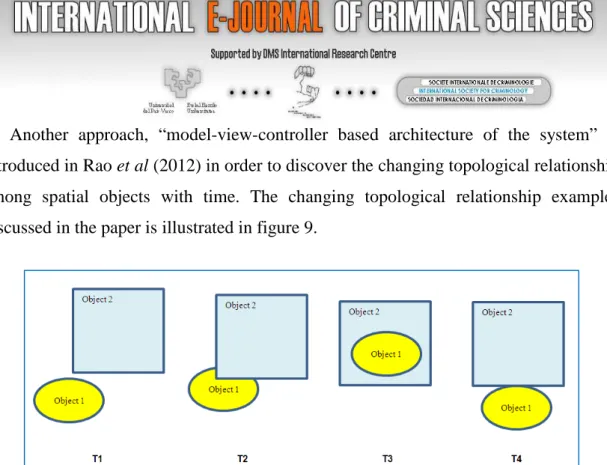
16 Another approach, “model-view-controller based architecture of the system” is introduced in Rao et al (2012) in order to discover the changing topological relationship among spatial objects with time. The changing topological relationship examples discussed in the paper is illustrated in figure 9.
Figure 9- Changing of spatio-temporal topological relationship among spatial objects
from T1 to T4.
A practical application related to spatio-temporal collocation and topological relationships in crime analysis is the linkage analysis discussed in Henry and Bryan (2000). Figure 10 shows an example of linkage analysis – it indicates that the links between the locations of vehicle theft and vehicle recovered. The linkage analysis could provide knowledge to analysts about where is more likely to recover a theft vehicle.
International e-Journal of Criminal Science
Artículo 1, Número 9 (2015) http://www.ehu.es/inecs ISSN: 1988-7949
17
Figure 10- Examples of linkage analysis applied for vehicle theft and recovered study.
- Spatio-temporal sequence
Spatio-temporal sequence refers to find the inter-relationships of spatial patterns in different temporal views. For examples, flow pattern mining and generalized flow pattern mining (Hsu et al, 2008a; Hsu et al, 2008b) can incorporate temporal views into spatial pattern analysis. These two approaches aim to describe (i) how one event in some area implies the occurrence of another event in a second area or, (ii) how the changes of event in one area can affect the events in another area. An example of flow pattern is shown in figure 11 – it indicates “forest fire always occurs at one region prior
International e-Journal of Criminal Science
Artículo 1, Número 9 (2015) http://www.ehu.es/inecs ISSN: 1988-7949
18
Figure 11 – Example of flow pattern.
Both flow pattern mining and generalized flow pattern mining can shows a sequence of eventsets (e.g. forest fire and haze in figure 2.13) sorted by time such that for any two consecutive eventsets, However, the flow pattern they rely heavily on the assumption that these events will repeat themselves in exactly the same locations, for example: from forest fire (2,2) to haze (3,3). The generalized flow pattern emphasis “relative address”, for example, forest fire always leads to haze in its North-eastern neighbours.
- Spatial association rule
Spatial association rule mining is an approach to discover association rules among spatial itemsets and possibly some non-spatial itemsets. GeoMiner (Han et al, 1997) is designed and implemented as an extension to Spatial SQL for spatial data mining – including spatial association rule mining. Temporal association rule mining (Ale and Rossi, 2000) is the approach to discover the interesting association rules which only
International e-Journal of Criminal Science
Artículo 1, Número 9 (2015) http://www.ehu.es/inecs ISSN: 1988-7949
19 appear in a particular time period. Based on temporal association rule, calendar-based temporal association rules (Li et al, 2001) discovers association rules during the time intervals specified by user-given calendar schemas. However, both spatial association rule mining and temporal association rule mining cannot be used to incorporate spatial and temporal relationship together. On the other hand, Spatio-temporal association rules (STARs) concept is introduced in Verhein and Chawla (2006) that describe how objects move between regions over time.
2.4 Unusual spatio-temporal pattern
We suggest that unusual temporal pattern is extended from frequent spatio-temporal pattern. This specific category of pattern could be in different forms of frequent spatio-temporal pattern, such as hotspot, collocation and topological relation or sequence, but the occurring of this type of pattern would be determined as exceptional and unusual. Many approaches have been developed in order to determine whether or not a spatio-temporal pattern is attributable to random chance. Some of them are summarized as follows.
The typical approaches include Moran’ I, Local Geary’s C, Gi, Gi*, Point Pattern Analysis, STAC ellipses and NNI, they are used to identify the local association between an observation and its neighbours, up to a specified distance from the observation (Chainey and Ratcliffe, 2005; IACA, 2013; Eck et al, 2005).
Given a set of features and an associated attribute, Moran’s I (Moran, 1950) evaluates whether the pattern expressed is clustered (Moran’s I value near +1.0), dispersed, or random (Moran’s I value near -1.0) as per figure 12. Moreover, The Moran's I function also calculate a Z score value that indicates whether or not we can reject the null hypothesis (i.e. there is no spatial clustering). Many GIS systems, such as ArcGIS, have built-in function of Moran’s I.
International e-Journal of Criminal Science
Artículo 1, Número 9 (2015) http://www.ehu.es/inecs ISSN: 1988-7949
20
Figure 12– Example of Moran’s I.
Nearest Neighbor Index (NNI) identifies if there is statistical evidence of clustering and therefore hotspots in point data. Test statistic (Z-score and P value) is used to indicate if result is statistically significant (Chainey and Ratcliffe, 2005). The NNI method is supported by many GIS systems, including the crime mapping software program, CrimeSTAT (Levine, 1996; Levine, 2008).
Gi and Gi* (Getis and Ord, 1992) compares local averages to global averages. The difference between Gi and Gi* is that Gi* includes the value of the point in its calculation while Gi excludes this value and only considers the value of its nearest neighbors against the global average (Chainey and Ratcliffe, 2005). GIS systems, such as ArcGIS, support Gi and Gi* functions.
Knox test (Knox and Bartlett, 1964) and Jacquez k-Nearest Neighbor Test (Jacquez, 1996) were employed in (Grubesic and Mack, 2008) to evaluate the spatio-temporal crime clusters in Cincinnati, Ohio. Risk-adjusted Nearest Neighbor Hierarchical Clustering (RNNH) and Support Vector Machines (SVMs) were used in Zeng et al (2004) and Chang et al (2005) to detect and evaluate the spatio-temporal crime hotspots for the Tucson city boundary. These approaches were used to test whether there is a statistically significant spatio-temporal pattern within a defined distance and time period. In addition, Scan statistics-based spatio-temporal hotspot (Naus, 1963;
International e-Journal of Criminal Science
Artículo 1, Número 9 (2015) http://www.ehu.es/inecs ISSN: 1988-7949
21 Kulldorff, 1997; Kulldorff et al, 1998) (figure 13) is able to find space-time clusters and test whether an event is randomly distributed over space and time. Scan statistics-based spatio-temporal hotspot is widely used in crime analysis, epidemiology to find unusual clusters of events. For example in Hagenauer et al (2011), researchers use this technique to detect and evaluate spatio-temporal crime hotspot.
Figure 13- Concept of scan statistics-based spatio-temporal hotspot.
2.5 Spatio-temporal effects due to intervention
We consider that spatio-temporal effect due to intervention is a specific category of spatio-temporal pattern extended from unusual spatio-temporal pattern. A typical example of spatio-temporal effect related to policing interventions is displacement.
Displacement theory (Barr and Pease, 1990; Braga et al, 1999, Weisburd and Green, 1995b) argues that, in some cases, implementing anti-crime campaign in a particular target area does not actually prevent crime but merely shifts it to nearby areas. Many empirical studies have been conducted to evaluate displacement effects. For example, in an analysis (Braga et al, 1999) of a police crackdown in Jersey City, New Jersey,
International e-Journal of Criminal Science
Artículo 1, Número 9 (2015) http://www.ehu.es/inecs ISSN: 1988-7949
22 researchers reports evidence of property crime displacement. However, more often the previous findings suggested the policing interventions cause crime diffusions. The crime diffusion is the reverse of displacement and it occurs when reductions of crime are achieved in areas that are close to the interventions, even though those areas were not actually targeted by the intervention itself (Clarke and Weisburd, 1994). In a systematic review (Bowers et al, 2011) , researchers identified 2,500 studies related to spatial displacement or diffusion and selected 44 focus studies for further evaluation, they suggest there was a trend in favour of a diffusion of benefit. Other then these positive and negative unintended consequences (i.e. diffusion of benefit and displacement), spatial crime relocation could be an intended outcome; Barr and Pease (1990) claimed such intended outcome as “benign displacement”, for example, the relocation of a street drug market from a residential area to a remote area would produce less community harm.
In crime analysis, John E. Eck, (Eck, 2002) concluded two practical approaches are commonly used for evaluation the effects of due to a policing intervention: the pre-post testing with a control group, and the multiple time series. These two approaches are explained as follows.
The pre-post testing approach compares the crime rates of the treatment area and catchment area before and after a policing intervention. The treatment area refers to the areas within the coverage of the policing intervention. The catchment area refers to the areas which are identified as those to which crime potential displaces or crime control benefit diffuses (Weisburd and Green, 1995a) . If the crime rates decrease in the treatment area but increase in the catchment area after the intervention, then displacement is determined, if the crime rates decrease in both areas then diffusion is determined. In practice, many pre-post approach applications, such as weighted displacement quotient (WDQ) (Bowers and Johnson, 2003), would incorporate a control
International e-Journal of Criminal Science
Artículo 1, Número 9 (2015) http://www.ehu.es/inecs ISSN: 1988-7949
23 area measurement to adjust the result for differences in an area not related to the treatment or catchment areas. The function of control area is to provide an indication of what was happing in unaffected areas, and is a broad indication of trends over the same period of time as the intervention. The key advantage of pre-post testing approach is that it could show a comparison of crime patterns (such as crime rate) between with (post) and without (pre) the police intervention. A key limitation of pre-post testing approach is that if the crime pattern normally fluctuates, then a change of crime pattern may simply be a normal periodic fluctuation, that is, a change may be due to its automatic process rather than to the police intervention.
The time series approach compares the pre-intervention trend with post-intervention trend on the specific areas (treatment area, buffer area and control area). The approach could incorporate sensitivity to seasonality patterns and control for subtle trends in changing patterns over time. Many previous studies use time series along with pre-post approach to evaluate the effect of intervention. For example, in Ratcliffe et al (2009), both the approaches are used together to evaluate the crime reduction effects of public CCTV cameras in Philadelphia, PA. A key disadvantage of time series approach is that if the time series exhibits seasonality, there should be 4 to 5 cycles of observations in order to fit a seasonal model to the data. In other words, it requires many historical data in a series in order to obtain a fair conclusion. However, it may not be easy to obtain sufficient historical data to conduct related evaluation.
3. Discussion and conclusion
In Criminology, theoretical and empirical studies indicate that spatio-temporal crime patterns are correlated with some factors, but not just randomly occur. Spatio-temporal crime pattern analysis helps identify the spatio-temporal crime pattern from a dataset and forecast what would be likely happen in other situations, such as in the future or in
International e-Journal of Criminal Science
Artículo 1, Número 9 (2015) http://www.ehu.es/inecs ISSN: 1988-7949
24 other dataset.
Different types of spatio-temporal pattern analysis approaches would provide different knowledge. In this paper, we summarized spatio-temporal patterns in five major categories. Table 1 summarizes what knowledge could be obtained from these patterns. These knowledge are spatial information, temporal information, whether or not the pattern is unusal and whether or not the pattern is likely related to a predefined intervention.
Related knowledge obtained from corresponding categories of spatio-temporal pattern Categories of spatio-temporal pattern Spatial information Temporal information Whether or not the pattern is unusal
Whether or not the pattern is likely related to a predefined intervention Spatial pattern Temoral pattern Frequent spatio-temporal pattern Unusual spatio-temporal pattern Spatio-temporal effect due to intervention
Table 1 – Related knowledge obtained from corresponding categories of
International e-Journal of Criminal Science
Artículo 1, Número 9 (2015) http://www.ehu.es/inecs ISSN: 1988-7949
25 In addition, we further suggest that the spatial and temporal information from these five categories of spatio-temporal pattern could be generally classified into two types: position based and relation based. The position based spatial and temporal information focus on where or when (or both) a pattern occurred, for example, many thefts occurred inside a shopping mall last Wednesday. On the other than, the relation based spatial and temporal information focus on how and which (or both) the patterns occurred, for example, thefts and burglaries were often occurred together in close spatial proximity last year. Table 2 summarizes the categories of spatio-temporal patterns discussed in sections 2.1 to 2.5 into position based and relation based information.
Position based Relation based Spatial pattern - Hotspot
- Collocation and topological relationships Temporal pattern - Trend pattern - Similarity pattern - Periodicity pattern - Sequential pattern - evolution
Frequent spatio-temporal pattern, Unusal spatial temoral pattern
- Spatio-temporal hotspot
- Spatio-temporal collocation and topological relationships
- Spatio-temporal sequence - Spatio-temporal association rule
Spatio-temporal effect due to intervention
- Displacement and diffusion
Table 2 - Spatial and temporal information provided to analysts from different
International e-Journal of Criminal Science
Artículo 1, Número 9 (2015) http://www.ehu.es/inecs ISSN: 1988-7949
26 We believe this is the first time that a study like this has been conducted, to review and to discuss the relationship between spatio-temporal crime pattern and related knowledge. Moreover, this paper also discussed how related data mining techniques could be used to support spatio-temporal crime pattern analysis. The work of this paper could provide a reference for crime analysts, criminologists and researchers to select appropriate spatio-temporal pattern analysis approaches according to their knowledge needs.
International e-Journal of Criminal Science
Artículo 1, Número 9 (2015) http://www.ehu.es/inecs ISSN: 1988-7949
Correspondence concerning this article should be addressed to: Kevin Leong [email protected]
References
Agrawal, R. and Srikant, R. 1995, "Mining sequential patterns", Proceedings of the 11th
International Conference on Data EngineeringIEEE, , pp. 3.
Ale, J.M. and Rossi, G.H. 2000, "An approach to discovering temporal association rules", Proceedings of the 2000 ACM symposium on Applied computing-Volume
1ACM, , pp. 294.
Anselin, L., Cohen, J., Cook, D., Gorr, W. and Tita, G. 2000, "Spatial analyses of crime", Criminal Justice, vol. 4, pp. 213-262.
Barr, R. and Pease, K. 1990, "Crime placement, displacement, and deflection", Crime
and justice, , pp. 277-318.
Bejaoui, L., Pinet, F., Bédard, Y. and Schneider, M. 2009, "Qualified topological relations between spatial objects with possible vague shape", International
Journal of Geographical Information Science, vol. 23, no. 7, pp. 877-921.
Bowers, K.J. and Johnson, S.D. 2005, "Domestic Burglary Repeats and Space-Time Clusters The Dimensions of Risk", European Journal of Criminology, vol. 2, no. 1, pp. 67-92.
Bowers, K., Johnson, S., Guerette, R.T., Summers, L. and Poynton, S. 2011, "Spatial Displacement and Diffusion of Benefits Among Geographically Focused Policing Initiatives", Campbell Systematic Reviews, vol. 3.
Bowers, K. and Johnson, S. 2003, "Measuring the Geographical Displacement and Diffusion of Benefit Effects of Crime Prevention Activity", Journal of
Quantitative Criminology, vol. 19, no. 3, pp. 275-301.
Braga, A.A., Weisburd, D.L., Waring, E.J., Mazerolle, L.G., Spelman, W. and Gajewski, F. 1999, "Problem-oriented policing in violent crime places: a randomized controlled experiment", Criminology, vol. 37, no. 3, pp. 541-580. Brantingham, P.L., Brantingham, P.J., Vajihollahi, M. and Wuschke, K. 2009, "Crime
analysis at multiple scales of aggregation: a topological approach" in Putting
crime in its place Springer, , pp. 87-107.
Brantingham, P.J., Dyreson, D.A. and Brantingham, P.L. 1976, "Crime seen through a cone of resolution", American Behavioral Scientist, vol. 20, no. 2, pp. 261-273. Brantingham, P.J. and Brantingham, P.L. 1991, Environmental Criminology, Waveland
Press Incorporated.
Brantingham, P.J. and Brantingham, P.L. 1984, Patterns in Crime, Macmillan publishing, New York.
International e-Journal of Criminal Science
Artículo 1, Número 9 (2015) http://www.ehu.es/inecs ISSN: 1988-7949
28 Brown, D.E. and Oxford, R.B. 2001, "Data mining time series with applications to
crime analysis", Systems, Man, and Cybernetics, 2001 IEEE International
Conference on, pp. 1453.
Brown, D.E., Liu, H. and Xue, Y. 2001, "Mining preferences from spatio-temporal data", Proc. of the First SIAM International Conference of Data Mining. Chaikaew, N., Tripathi, N.K. and Souris, M. 2009, "Exploring spatial patterns and
hotspots of diarrhea in Chiang Mai, Thailand", International Journal of Health
Geographics, vol. 8, no. 36.
Chainey, S. and Ratcliffe, J. 2005, GIS and crime mapping, John Wiley and Sons. Chang, W., Zeng, D. and Chen, H. 2005, "Prospective spatio-temporal data analysis for
security informatics", Intelligent Transportation Systems, 2005. Proceedings.
2005 IEEEIEEE, , pp. 1120.
Cheng, W. and Washington, S.P. 2005, "Experimental evaluation of hotspot
identification methods", Accident Analysis and Prevention, vol. 37, no. 5, pp. 870-881.
Clarke, R.V. and Weisburd, D. 1994, "Diffusion of crime control benefits: Observations on the reverse of displacement", Crime prevention studies, vol. 2, pp. 165-184. Clarke, R.V. 1995, "Situational crime prevention" in Building a Safer Society: Strategic
Approaches to Crime Prevention, eds. M.H. Tonry and D.P. Farrington,
University of Chicago Press, Chicago IL, pp. 91-150.
Cohen, L.E. and Felson, M. 1979, "Social Change and Crime Rate Trends: A Routine Activity Approach", American Sociological Review, vol. 44, no. 4, pp. 588-608. Cornish, D., Derek, C. and Clarke, R.V. 1986, "Introduction" in The reasoning criminal,
eds. D. Cornish, C. Derek and R.V. Clarke, Springer-Verlag, New York, pp. 1-16.
Curry, G.D. and Spergel, I.A. 1988, "Gang homicide, delinquency, and community",
Criminology, vol. 26, no. 3, pp. 381-406.
Eck, J. 2002, Assessing Responses to Problems: An Introductory Guide for Police
Problem-Solvers, Department of Justice, Office of Community Oriented
Policing Services, Washington D.C.
Eck, J., Chainey, S., Cameron, J. and Wilson, R. 2005, Mapping crime: Understanding
hotspots, National Institute of Justice, Washington DC.
Egenhofer, M.J. 1989, "A formal definition of binary topological relationships" in
Foundations of data organization and algorithms Springer, , pp. 457-472.
Egenhofer, M.J. 1994, "Spatial SQL: A query and presentation language", Knowledge
International e-Journal of Criminal Science
Artículo 1, Número 9 (2015) http://www.ehu.es/inecs ISSN: 1988-7949
29 Egenhofer, M.J. and Franzosa, R.D. 1991, "Point-set topological spatial relations",
International Journal of Geographical Information System, vol. 5, no. 2, pp.
161-174.
Ester, M., Kriegel, H. and Sander, J. 2001, "Algorithms and applications for spatial data mining", Geographic Data Mining and Knowledge Discovery, vol. 5, no. 6. Felson, M. and Boba, R.L. 2010, Crime and everyday life, Sage.
Felson, M. and Cohen, L.E. 1980, "Human ecology and crime: A routine activity approach", vol. 8, pp. 389-406.
Field, S. 1992, "The effect of temperature on crime", British Journal of Criminology, vol. 32, no. 3, pp. 340-351.
Gatrell, A.C., Bailey, T.C., Diggle, P.J. and Rowlingson, B.S. 1996, "Spatial point pattern analysis and its application in geographical epidemiology", Transactions
of the Institute of British geographers, , pp. 256-274.
Getis, A. and Ord, J.K. 1992, "The analysis of spatial association by use of distance statistics", Geographical Analysis, vol. 24, no. 3, pp. 189-206.
Greenberg, D.F. 2001, "Time series analysis of crime rates", vol. 17, pp. 291-327. Grubesic, T.H. and Mack, E.A. 2008, "Spatio-temporal interaction of urban crime", vol.
24, pp. 285-306.
Hagenauer, J., Helbich, M. and Leitner, M. 2011, "Visualization of crime trajectories with self-organizing maps: a case study on evaluating the impact of hurricanes on spatio-temporal crime hotspots", Proceedings of the 25th conference of the
International Cartographic Association, Paris.
Han, J., Koperski, K. and Stefanovic, N. 1997, "GeoMiner: a system prototype for spatial data mining", ACM SIGMOD RecordACM, , pp. 553.
Han, J. and Kamber, M. 2000, "Mining text database" in Data mining: Concepts and
techniques Morgon Kaufmann Publishers, , pp. 410-427.
Han, J., Pei, J., Mortazavi-Asl, B., Pinto, H., Chen, Q., Dayal, U. and Hsu, M. 2001, "Prefixspan: Mining sequential patterns efficiently by prefix-projected pattern growth", proceedings of the 17th international conference on data engineering, pp. 215.
Harries, K. 1999, Mapping crime: principle and practice, US Department of Justice, Washington DC.
Henry, L. and Bryan, B. 2000, "Visualizing the spatio-temporal patterns of motor vehicle theft in Adelaide, South Australia", Conference on crime mapping:
Adding value to crime prevention and control.
Hsu, W., Lee, M.L. and Wang, J. 2008a, "Mining flow patterns in spatio-temporal data" in Temporal and spatio-temporal data mining IGI Publising, Hershey, USA, pp. 157-188.
International e-Journal of Criminal Science
Artículo 1, Número 9 (2015) http://www.ehu.es/inecs ISSN: 1988-7949
30 Hsu, W., Lee, M.L. and Wang, J. 2008b, "Mining generalized flow patterns" in
Temporal and spatio-temporal data mining IGI Publising, Hershey, USA, pp.
189-208.
Hsu, W., Lee, M.L. and Wang, J. 2008c, Temporal and spatio-temporal data mining, IGI Pububling.
Huang, Y., Shekhar, S. and Xiong, H. 2004, "Discovering colocation patterns from spatial data sets: a general approach", IEEE Transactions on Knowledge and
Data Engineering, vol. 16, no. 12, pp. 1472-1485.
IACA, S. 2013, "Identifying High Crime Areas", .
Jacquez, G.M. 1996, "A k nearest neighbour test for space–time interaction", Statistics
in medicine, vol. 15, no. 18, pp. 1935-1949.
Johnson, S.D., Bernasco, W., Bowers, K.J., Elffers, H., Ratcliffe, J., Rengert, G. and Townsley, M. 2007, "Space–time patterns of risk: a cross national assessment of residential burglary victimization", Journal of Quantitative Criminology, vol. 23, no. 3, pp. 201-219.
Johnson, S.D., Bowers, K. and Hirschfield, A. 1997, "New insights into the spatial and temporal distribution of repeat victimization", British Journal of Criminology, vol. 37, no. 2, pp. 224-241.
Knox, E. and Bartlett, M. 1964, "The detection of space-time interactions", Applied
Statistics, , pp. 25-30.
Kulldorff, M. 1997, "A spatial scan statistic", Communications in Statistics-Theory and
methods, vol. 26, no. 6, pp. 1481-1496.
Kulldorff, M., Athas, W.F., Feurer, E.J., Miller, B.A. and Key, C.R. 1998, "Evaluating cluster alarms: a space-time scan statistic and brain cancer in Los Alamos, New Mexico", American Journal of Public Health, vol. 88, no. 9, pp. 1377-1380. Leitner, M., Barnett, M., Kent, J. and Barnett, T. 2011, "The impact of Hurricane
Katrina on reported crimes in Louisiana: a spatial and temporal analysis", The
Professional Geographer, vol. 63, no. 2, pp. 244-261.
Leitner, M. and Helbich, M. 2011, "The impact of hurricanes on crime: a spatio-temporal analysis in the city of Houston, Texas", Cartography and Geographic
Information Science, vol. 38, no. 2, pp. 213-221.
Levine, N. 2008, "CrimeStat: A Spatial Statistical Program for the Analysis of Crime Incidents" in Encyclopedia of GIS, eds. S. Shekhar and H. Xiong, Springer, , pp. 187-193.
Levine, N. 1996, "Spatial statistics and GIS: Software tools to quantify spatial patterns",
International e-Journal of Criminal Science
Artículo 1, Número 9 (2015) http://www.ehu.es/inecs ISSN: 1988-7949
31 Li, Y., Ning, P., Wang, X.S. and Jajodia, S. 2001, "Discovering Calendar-based
Temporal Association Rules", Proceedings of international symposium on
temporal representation and reasoning (TIME)IEEE, , pp. 111.
Lim, M., Metzler, R. and Bar-Yam, Y. 2007, "Global pattern formation and ethnic/cultural violence", Science (New York, N.Y.), vol. 317, no. 5844, pp. 1540-1544.
Loukaitou-sideris, A. 1999, "Hot Spots of Bus Stop Crime", Journal of the American
Planning Association, vol. 65, no. 4, pp. 395-411.
McCullagh, M.J. 2006, "Detecting hotspots in time and space", ISG06, .
Moran, P.A. 1950, "Notes on continuous stochastic phenomena", Biometrika, vol. 37, no. 1-2, pp. 17-23.
Naus, J.I. 1963, Clustering of random points in line and plane, Harvard University Press.
Parzen, E. 1962, "On estimation of a probability density function and mode", Annals of
mathematical statistics, vol. 33, no. 3, pp. 1065-1076.
Ramirez, J.C.G., Peterson, L.L. and Peterson, D.M. 1998, "A Sequence Building Approach to Pattern Discovery in Medical Data.", Proceedings of the 11th
Florida artificial intellengence research symposium (FLAIRS-98), ed. D.J.
Cook, AAAI Press, Menlo Park, CA, pp. 188.
Ramirez, J.C., Cook, D.J., Peterson, L.L. and Peterson, D.M. 2000, "An event set approach to sequence discovery in medical data", Intelligent Data Analysis, vol. 4, no. 6, pp. 513-530.
Rao, K.V., Govardhan, A. and Rao, K.C. 2012, "Mining Topological Relationship Patterns from spatiotemporal Databases", International Journal, .
Ratcliffe, J. 2002, "HotSpot Detective 2.0 for MapInfo Professional 7.0", . Ratcliffe, J.H. 2004, "The hotspot matrix: A framework for the spatio‐temporal
targeting of crime reduction", Police practice and research, vol. 5, no. 1, pp. 5-23.
Ratcliffe, J.H. 2002, "Aoristic Signatures and the Spatio-Temporal Analysis of High Volume Crime Patterns", Journal of Quantitative Criminology, vol. 18, no. 1, pp. 23-43.
Ratcliffe, J.H., Taniguchi, T. and Taylor, R.B. 2009, "The Crime Reduction Effects of Public CCTV Cameras: A Multi‐Method Spatial Approach", Justice Quarterly, vol. 26, no. 4, pp. 746-770.
Roddick, J.F. and Spiliopoulou, M. 1999, "A bibliography of temporal, spatial and spatio-temporal data mining research", ACM SIGKDD Explorations Newsletter, vol. 1, no. 1, pp. 34-38.
International e-Journal of Criminal Science
Artículo 1, Número 9 (2015) http://www.ehu.es/inecs ISSN: 1988-7949
32 Roncek, D.W. and Bell, R. 1981, "Bars, blocks, and crimes", Journal of Environmental
Systems, vol. 11, no. 1, pp. 35-47.
Rosenblatt, M. 1956, "Remarks on some nonparametric estimates of a density function",
The Annals of Mathematical Statistics, vol. 27, no. 3, pp. 832-837.
Shekhar, S., Zhang, P., Huang, Y. and Vatsavai, R.R. 2003, "Trends in spatial data mining" in Data mining: Next generation challenges and future directions, eds. H. Kargupta, A. Joshi, K. Sivakumar, Y. Yesha and A. Joshi, AAAI/MIT Press, , pp. 357-380.
Skogan, W.G. 1990, Disorder and decline: Crime and the spiral of decay in American
neighbourhoods, University of California Press, Los Angeles.
Srikant, R. and Agrawal, R. 1996, "Mining sequential patterns: Generalizations and performance improvements", vol. 1057, pp. 1-17.
Tobler, W.R. 1970, "A computer movie simulating urban growth in the Detroit region",
Economic geography, vol. 46, pp. 236.
Verhein, F. and Chawla, S. 2006, "Mining spatio-temporal association rules, sources, sinks, stationary regions and thoroughfares in object mobility databases",
Database Systems for Advanced ApplicationsSpringer, , pp. 187.
Wang, J., Hsu, W. and Lee, M.L. 2005, "A Framework for Mining Topological Patterns in Spatio-temporal Databases", Proceedings of the 14th ACM International
Conference on Information and Knowledge Management, pp. 429.
Wang, W., Yang, J. and Muntz, R. 2001, "TAR: temporal association rules on evolving numerical attributes", Proceedings of the 17th IEEE International Conference on
Data Engineering, pp. 283.
Wang, W., Yang, J. and Yang, J. 1999, Temporal Association Rules with Numerical
Attributes, UCLA Tech.
Weisburd, D. and Green, L. 1995a, "Measuring immediate spatial displacement: Methodological issues and problems", Crime and place, vol. 4, pp. 349-361. Weisburd, D. and Green, L. 1995b, "Policing drug hot spots: The Jersey City drug
market analysis experiment", Justice Quarterly, vol. 12, no. 4, pp. 711-735. Wilson, J.Q. and Kelling, G.L. 1982, "Broken windows: The police and neighborhood
safety", Atlantic monthly, vol. 249, no. 3, pp. 29-38.
Wu, Y., Agrawal, D. and El Abbadi, A. 2000, "A comparison of DFT and DWT based similarity search in time-series databases", Proceedings of the ninth
international conference on Information and knowledge managementACM, , pp.
488.
Yifei Xue and Brown, D.E. 2003, "A decision model for spatial site selection by criminals: a foundation for law enforcement decision support", Systems, Man,
International e-Journal of Criminal Science
Artículo 1, Número 9 (2015) http://www.ehu.es/inecs ISSN: 1988-7949
33
and Cybernetics, Part C: Applications and Reviews, IEEE Transactions on, vol.
33, no. 1, pp. 78-85.
Yoo, J.S. and Shekhar, S. 2006, "A joinless approach for mining spatial colocation patterns", Knowledge and Data Engineering, IEEE Transactions on, vol. 18, no. 10, pp. 1323-1337.
Zaki, M.J. 2001, "SPADE: An efficient algorithm for mining frequent sequences",
Machine Learning, vol. 42, no. 1-2, pp. 31-60.
Zeng, D., Chang, W. and Chen, H. 2004, "A comparative study of spatio-temporal hotspot analysis techniques in security informatics", Intelligent Transportation
Systems, 2004. Proceedings. The 7th International IEEE Conference onIEEE, ,
pp. 106.
Zhang, X., Mamoulis, N., Cheung, D.W. and Shou, Y. 2004, "Fast Mining of Spatial Collocations", Proceedings of the 10th ACM SIGKDD International Conference