Certification Protocol
For
Certifica Minas Café - UTZ Certified
Certification Protocol
Version 1.1, February 2014
Copies of this document are available for free in electronic format on the UTZ Certified Training Center website:
http://www.utzcertified-trainingcenter.com
Please send your comments or suggestions to:
Or via regular mail to:
UTZ Certified Standards and Certification Department De Ruyterkade 6 bg
1013 AA Amsterdam The Netherlands
© UTZ Certified 2013
No part of this publication may be reproduced, stored in a retrieval system, or transmitted in any form or by any means, electronic, mechanical, photocopying, recording or otherwise without full attribution.
Contents
1. Introduction ... 3
2. Abbreviations ... 4
3. Scope ... 4
4. Date of Compliance... 4
5. Recognition of equivalency between CMC and UTZ year 1 ... 4
6. Certificate and license ... 5
7. Traceability of CMC-UTZ Coffee ... 5
7.1. Registration in GIP ... 5
7.2. Recording transactions in GIP ... 5
8. Certification process ... 6
9. Non-continuity and Suspensions ... 8
9.1. Non-continuity ... 8
9.2. Suspensions ... 8
10. Obligations of CBs, annual report and un-announced audits ... 8
Annex I - CMC–UTZ Combined certificate ... 10
1.
Introduction
As the largest coffee producer in the world, Brazil produces one third of the world's supply, and from Brazil, is the state of Minas Gerais (MG) is the largest coffee producing region in Brazil.
In recent years, certification standards gained momentum in the main production areas, as they seek to ensure and recognize sustainable production systems, and open new markets for the world’s coffee supply. Minas Gerais is no exception to this occurrence.
Currently, several certification standards are present in Minas Gerais, and are focused in different sectors of the agricultural production.
One of these standards in Minas Gerais is the governmental standard for sustainable production, Certifica Minas, which was created to certify local products such as coffee, cachaza and cheese. The UTZ Certified program is also present in the region, and is focused on the professionalization of the production as a pathway to sustainability.
The members of Certifica Minas Café (CMC) are all producers belonging to organized groups, while UTZ Certified MG members in Minas Gerais are mostly individual farm owners.
In order to join efforts to promote the sustainability of Brazilian coffee, UTZ Certified and CMC have agreed to start a project to recognize the CMC certification as equivalent to the UTZ Certified Code of Conduct Group Certification year 1.
In case the certification scope of CMC is extended in the future (e.g. to Individual and Multisite Certification and/or Chain of Custody), the equivalence with other UTZ certification scopes will also be considered during this cooperation.
This project benefits CMC coffee producers in MG, by increasing their access to international markets by representing an internationally recognized label.
This document contains the protocol to be followed by producers and Certification Bodies, as well as the Certification Standards involved in the CMC-UTZ Certified certification, so as to enable and facilitate the certification of CMC producers against the UTZ program.
2.
Abbreviations
CMC: Certifica Minas Café UTZ: UTZ Certified
EMATER-MG: Technical Assistance and Rural Training Organization in Minas Gerais Estate (Empresa
de Assistência Técnica e Extensão Rural do Estado de Minas Gerais)
IMA: Minas Gerais Estate’s Agricultural Institute (Instituto Mineiro de Agropecuária)
CoC: UTZ Certified Code of Conduct
CB: Certification Body
GIP: Good Inside Portal (traceability and certificate management system of UTZ Certified)
ICS: Internal Control System
3.
Scope
This document applies to the following parties:
Certificate holder: CMC-UTZ producers group
CMC : EMATER-MG, IMA
Certification Bodies: Independent third party that conducts the audits against certification
standards.
UTZ Certified: Standards and Certification Department of UTZ Certified
4.
Date of Compliance
Recognition of equivalence between CMC and UTZ CoC Year 1 is possible since 1st of February 2013.
Members who receive the audit 3 months before or 3 months after the beginning to the harvest can apply to this recognition of equivalence retrospectively.
5.
Recognition of equivalency between CMC and
UTZ year 1
Hold a CMC certificate is equivalent to hold a “UTZ Certified Code of Conduct group (or multi-group) certification, Year 1 of compliance”.
This equivalence is not applicable to individual farms or processing units, i.e. a CMC certificate cannot be equivalent to a Code of Conduct for Individual or Multisite certification, nor to a Chain of Custody certification.
CMC certification can be equivalent to an UTZ CoC Year 1 certification, only if the CB that conducts the CMC audit is approved separately by both CMC and UTZ Certified.
CMC producer groups that hold a CMC-UTZ Certificate are expected to remain in the UTZ program and comply with the UTZ continuous improvement during subsequent certifications.
CMC producer groups will need to comply, the year after the equivalence was granted, with UTZ Certified year 2.
The first audit to a producer group that applies to this equivalence is conducted against the CMC standard.
Subsequent audits are conducted against the UTZ Standard.
Already UTZ Certified producers or producers who have been UTZ certified in the last 3 years, including CMC-UTZ producers, cannot apply to the recognition of their CMC certification as UTZ CoC year 1 certification.
The UTZ Certified Certification Protocol will apply for subsequent years of certification (year 2 onwards)
6.
Certificate and license
The “combined CMC-UTZ certificate”1 is valid for the CMC and the UTZ Standards.
It is issued by an independent CB, separately approved by CMC and UTZ Certified to conduct respective audits.
The certificate is valid for 1 year.
After the first audit (conducted against CMC Standard), the CB sends the CMC-UTZ certificate by email to UTZ Certified2 within 20 working days (4 weeks) of completing the audit, together with a copy of the “CMC-UTZ commitment”3, signed by the representative of the producer group. UTZ Certified creates a license in the GIP (also called TP issued license), with the same validity of the certificate, to allow the group to trade the coffee as UTZ.
After subsequent audits (conducted against the UTZ Certified Code of Conduct, year 2, 3 or 4), the CB
uploads the CMC-UTZ certificate and the results of the audit in the GIP, requesting in this way a
license, with the same validity of the certificate, to allow the group to trade coffee as UTZ.
7.
Traceability of CMC-UTZ Coffee
7.1.
Registration in GIP
A CMC-UTZ producer group needs to hold an account in the GIP. In order to do so, producer groups need to register in the UTZ system4.
To facilitate the identification of CMC-UTZ groups, the producer group needS to name the account in GIP using the following format:
CMC-UTZ [Name of producer group] e.g. CMC-UTZ Grupo Belo Horizonte
7.2.
Recording transactions in GIP
A CMC-UTZ producer group must use the GIP to record:
Sales of certified coffee
Deliveries of certified coffee to certified warehouses
1 Annex I 2 [email protected] 3 Annex II 4www.goodinsideportal.org
8.
Certification process
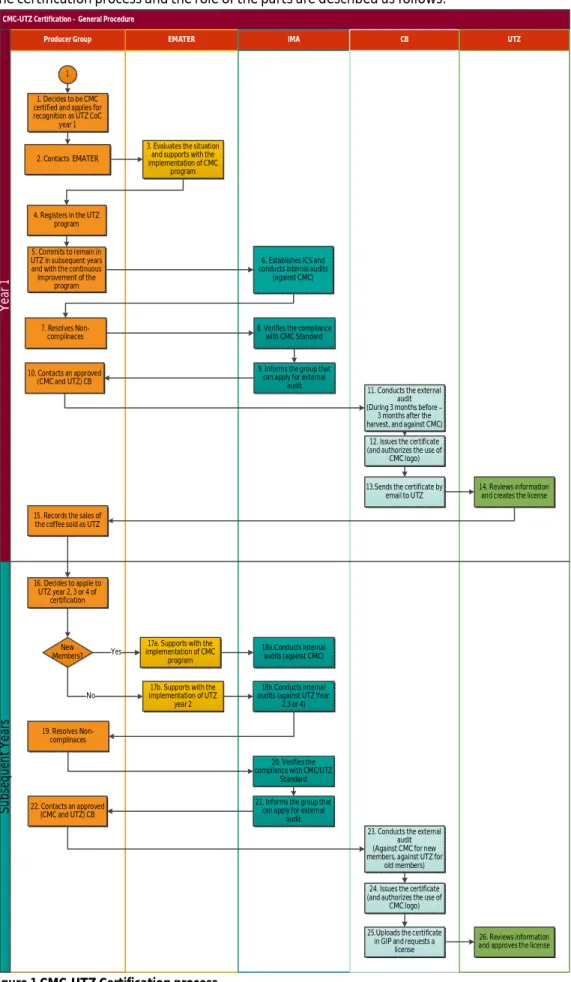
The certification process and the role of the parts are described as follows:
CMC-UTZ Certification - General Procedure
EMATER
Producer Group IMA CB UTZ
S u b se q u en t Y e ar s Y e ar 1 1. Decides to be CMC certified and applies for recognition as UTZ CoC
year 1
3. Evaluates the situation and supports with the implementation of CMC
program
6. Establishes ICS and conducts internal audits
(against CMC)
7. Resolves Non-complinaces
11. Conducts the external audit (During 3 months before –
3 months after the harvest, and against CMC)
12. Issues the certificate (and authorizes the use of
CMC logo)
14. Reviews information and creates the license 4. Registers in the UTZ
program
5. Commits to remain in UTZ in subsequent years and with the continuous improvement of the
program
15. Records the sales of the coffee sold as UTZ 10. Contacts an approved
(CMC and UTZ) CB
8. Verifies the compliance with CMC Standard
13.Sends the certificate by email to UTZ 9. Informs the group that
can apply for external audit 2. Contacts EMATER
16. Decides to applie to UTZ year 2, 3 or 4 of
certification
17a. Supports with the implementation of CMC program 18a.Conducts internal audits (against CMC) 1 New Members? 18b.Conducts internal audits (against UTZ Year
2,3 or 4) No
Yes
17b. Supports with the implementation of UTZ
year 2
19. Resolves Non-complinaces
20. Verifies the compliance with CMC/UTZ
Standard
21. Informs the group that can apply for external
audit 22. Contacts an approved
(CMC and UTZ) CB
23. Conducts the external audit (Against CMC for new members, against UTZ for
old members)
24. Issues the certificate (and authorizes the use of
CMC logo)
25.Uploads the certificate in GIP and requests a
license
26. Reviews information and approves the license
1. The producer group decides to apply for the double certification (CMC and UTZ CoC year 1).
2. The producer group contacts EMATER to apply to CMC certification and to receive
information about the equivalency to the UTZ Code of Conduct year 1 certification, and the conditions to apply to the double certification.
3. EMATER evaluates the situation of the producer group and supports the group with the implementation of the CMC program.
4. The producer group registers in the UTZ Certified program5
5. The representative of the producer group signs a commitment form6 (sent by UTZ Certified during the registration process) to remain in the UTZ program and comply with the continuous improvement of UTZ Certified; i.e. comply with year 2 of UTZ certification in the next year of certification and move on to subsequent years of compliance in subsequent certifications. A list of the members of the group who want to apply for the CMC-UTZ equivalence and who commit to remain in the UTZ program is attached to the commitment form.
6. IMA establishes the ICS and conducts the internal audits against the CMC standard. Internal audits can be conducted at any time of the year.
7. The producer group resolves the non-compliances (if applicable) 8. IMA checks if the non-compliances are resolved.
9. IMA informs the group that the external audit can be performed.
10. The producer group contacts an approved CB. The CB must be approved to conduct CMC audits and UTZ audits. The first external audit (aimed to recognize the CMC certification as equivalent to the UTZ CoC year 1 certification) should take place during the period between 3 months before and 3 months after the beginning of the harvest, for old and new CMC members.
11. The CB conducts the external audit to the CMC group. This first external audit is conducted against the CMC standard, taking into account the requirements of previous point (10). The sample to be audited is calculated based on the total of members of the CMC group according with the CMC requirements (i.e., square root of the total members of the group, rounded up to the next whole number).When the members of the group who want to apply to CMC-UTZ certification is less than the total members of the CMC group, the sample to be audited (number and producers to be audited)
is not affected.
12. The CB issues a CMC certificate that covers the entire group, and a “combined CMC-UTZ certificate” that covers the members of the group who decided to apply for this equivalence, and gives approval to the producer group to use the CMC logo.
13. The CB sends the certificate by email to UTZ Certified along with a copy of the commitment signed by the representative of the producer group and a list of members of the group.
14. UTZ Certified reviews the information and creates an “UTZ License” in the GIP to allow the CMC-UTZ producer group to sell the product as UTZ Coffee.
15. The producer group records all the sales of UTZ coffee in the GIP.
Subsequent years:
16. The producer decides to apply for subsequent year of certification (2, 3, or 4) 17. EMATER supports the group with the implementation of:
a. The CMC program for new members and
b. UTZ CoC year 2,3, or 4 (what applies) for old members 18. IMA conducts internal audits against:
a. The CMC program for new members and
b. UTZ CoC year 2,3, or 4 (what applies) for old members 19. The producer group resolves the non-compliances (if applicable) 20. IMA checks if the non-compliances are resolved.
21. IMA informs the group that the external audit can be performed.
22. The producer group contacts an approved CB. The CB must be approved to conduct CMC audits and UTZ audits.
23. The CB conducts the external audit. The audit must take place during the period between 3 months before and 3 months after the beginning of the harvest, for old and new CMC members. The sample to be physically audited needs to be the square root (rounded up to the next whole number) of the
5
The number of members to be registered in GIP is the total of members of the group who decided to apply to CMC-UTZ certification (e.g. A CMC group decides to apply for CMC-UTZ Certification, but only 50 members of the group want to be CMC-UTZ, the group to be register is the group of 50 UTZ-CMC members).
total of members of the CMC group. The square root of the CMC-UTZ members needs to be observed and the CB needs to make sure that that number of producer within the CMC-UTZ group will receive a physical audit.7
24. The CB issues to (2) Certificates: a CMC certificate that covers the entire group, and a “combined CMC-UTZ certificate” that covers the members of the group who remained in the UTZ program. The CB gives approval to the producer group to use the CMC logo.
25. The CB uploads the certificate, results of the audit (summary report) and requests a license for the producer group in the GIP.
26. UTZ Certified reviews the information and approves the license in the GIP to allow the CMC-UTZ producer group to sell the product as UTZ Coffee.
27. The producer group records all the sales of UTZ coffee in the GIP.
9.
Non
-continuity and Suspensions
9.1.
Non-continuity
If a producer group that holds the CMC - UTZ certification decides not to apply for an UTZ CoC year 2for the next certification period, the producer group cannot keep the UTZ CoC year 1 certification and cannot make its CMC certificate equivalent to UTZ CoC year 1 for the next 3 years.
If a producer group who holds the CMC - UTZ certification applies to UTZ CoC year 2 certification for the next certification period, but does not comply, i.e. does not pass the audit, the producer group cannot keep the UTZ year 1 certification and cannot make its CMC certificate equivalent to UTZ CoC year 1 for the next 3 years..
After a producer group reaches UTZ CoC year 2 certification, the latest version of the UTZ Certified Certification Protocol applies.
9.2.
Suspensions
The CMC suspension rules apply for CMC producers groups that hold a CMC-UTZ certification.
A suspension from the CMC program will result in an automatic suspension from the UTZ Certified program.
The CB must inform UTZ Certified by email about the suspension. UTZ Certified will then suspend the license of the producer group in the GIP and the group cannot sell the certified product as UTZ from the date of suspension onwards.
If the suspension comes from the CMC program, IMA will inform the CB, which will follow the regular procedure.
In case the suspension is lifted, the CB must inform UTZ Certified by email.
UTZ Certified will then lift the suspension in the GIP and the producer group will once again be able to sell the certified product as UTZ.
10.
Obligations of CBs, annual report and
un-announced audits
CBs conducting CMC-UTZ combined audits need to comply with the UTZ Certified Certification Protocol. The CB needs to report annually, in the beginning of the year (January), to UTZ Certified the number of “Combined CMC-UTZ Certificates” issued during the calendar year.
This information can be included in the annual report, however, the “CMC-UTZ year 1” audits cannot be added to the number of UTZ audits nor be included in the calculation of the quota of unannounced audits.
Audits conducted against subsequent years of compliance (2, 3 or 4) to groups that hold a CMC-UTZ certificate, need to be included in the annual report as an UTZ audit, and must be included for the calculation of the quota of un-announced audits.
Annex I - CMC–UTZ Combined certificate
CERTIFICADO CMC-UTZ
CÓDIGO DE CONDUTA - CAFÉ
Com base em uma auditoria segundo os regulamentos estabelecidos na versão [mês, ano] do Protocolo de Certificação UTZ Certified e em um contrato assinado, a [Nome da EC] por meio deste certifica que os locais/áreas listados abaixo atendem ao [Código CMC/UTZ Código de Conducta], versão [mês, ano]. Isso garante que os critérios sociais, ambientais e econômicos para a produção de café estabelecidos no [Código CMC/UTZ Código de Conducta] foram atendidos.
Informações do detentor de certificado
Nome: CMC-UTZ XXXXX
Número de membro UTZ Certified: [UTZ_CF100000XXXX] Endereço:
Informações da produção
Área certificada total (Ha.): Arábica
Robusta
(Volume em kgs de Pergaminho Verde*) Ano Volume
a. Volume certificado do ano corrente: [ano] [volume em kgs]
b. Estoque físico** dos anos de certificação anterior: [ano] [volume em kgs] +
=============
c. Volume total certificado do ano corrente [ano] [volume em kgs]
Arábica
[volume em kgs] Robusta
d. Volume colhido no ano de certificação anterior: [ano] [volume em kgs]
* A caixa aplicável está marcada.
** Estoque físico: o volume de café UTZ Certified do ano da certificação anterior, menos o volume de café UTZ Certified vendido durante esse ano (UTZ Certified e não-UTZ Certified), menos o volume de café colocado um armazém certificado UTZ e anunciado no GIP durante esse ano
Informações de armazenamento no Good Inside Portal
Volume certificado em armazém (no momento da auditoria)*: [volume em kgs] Arábica
[volume em kgs] Robusta
* O volume de armazém reflete o volume anunciado como entrega no Good Inside Portal no momento da auditoria. Esse volume deve corresponder ao volume certificado estocado num armazém físico.
Informações de Cadeia de Custódia (somente se aplicável)
Beneficiadoras incluídas nesse certificado de Código de Conduta (apenas beneficiadoras possuídas pelo detentor do certificado).
- [Por favor, preencha com o nome do benefício, copie este campo se o detentor do certificado possui mais de um benefício]
Informações do certificado
Nome(s) da(s) fazenda(s) ou grupo certificada(o)(s): Data inicial de validade do certificado: [dia/mês/ano] Data final de validade do certificado: [dia/mês/ano] Número do certificado da Entidad de Certificação: Data da primeira certificação UTZ Certified: [dia/mês/ano]
Emitido por
Nome da Entidad de Certificação:
Data de emissão do certificado: [data/mês/ano]
Auditor líder: Assinatura do auditor líder:
A [Nome da EC] é credenciada segundo o escopo da ISO 65 [Nome do escopo] por [Nome da Agência Credenciadora] e aprovada pela UTZ Certified.
Este certificado permanece sendo propriedade de [Nome da EC] e pode ser revogado em caso de encerramento, conforme estabelecido no contrato, ou em caso de mudanças ou desvios dos dados mencionados acima. O licenciado é obrigado a informar a [Nome da EC] imediatamente sobre qualquer mudança nos dados acima mencionados. Apenas um certificado original e assinado é válido.
Signature
Annex II - Declaration for CMC-UTZ certified
producer groups
Declaration for CMC-UTZ certified producer groups
Date: Click here to enter text.
Mr./Ms./Mrs. (name) Click here to enter text.
Position in organization: Click here to enter text.
Name of organization:
Click here to enter text.
UTZ Member ID number (coffee): UTZ_CF Click here to enter text.
By submitting this form, the undersigned declares to Stichting UTZ Certified (“UTZ Certified”) that: 1. the producer group that s/he represents (“the group”) is registered with the UTZ Certified Coffee Program
2. the group commits to remain in the UTZ program after its Certifica Minas Café (CMC) certification has been recognized as equivalent to the “UTZ Certified Code of Conduct for Group Certification year 1” (UTZ CoC year 1) by implementing the UTZ Certified Code of Conduct with a continuous improvement approach and reaching subsequent UTZ Certification years of compliance (2, 3 and 4) on the subsequent years.
The undersigned is aware that if the group decides not to apply for an UTZ CoC year 2 for the next certification period, or if the group does not comply, i.e. does not pass the audit, for an UTZ CoC year 2, the producer group cannot keep the UTZ CoC year 1 certification and cannot make its CMC certificate equivalent to UTZ CoC year 1 for the next 3 years.
The undersigned declares that s/he has the authorization of the group members, as it is declared on documentation signed by them, to sign the above declaration on behalf of the Group.