Journal of Agricultural Education 81 Volume 47, Number 3, 2006
EFFECTS OF A MATH-ENHANCED CURRICULUM AND INSTRUCTIONAL APPROACH ON THE MATHEMATICS ACHIEVEMENT OF AGRICULTURAL
POWER AND TECHNOLOGY STUDENTS: AN EXPERIMENTAL STUDY
Brian A. Parr, Assistant Professor University of Georgia
M. Craig Edwards, Associate Professor James G. Leising, Professor & Head
Oklahoma State University
Abstract
The purpose of this study was to empirically test the hypothesis that students who participated in a contextualized, mathematics-enhanced high school agricultural power and technology curriculum and aligned instructional approach would develop a deeper and more sustained understanding of selected mathematical concepts than those students who participated in the traditional curriculum and instruction. This study included teachers and students from 38 high schools in the state of Oklahoma (18 experimental classrooms; 20 control classrooms). Students were enrolled in an agricultural power and technology course in the spring of 2004. The total number of students participating was 447 (206 experimental; 241 control). The experimental design employed was a posttest only control group design. One-way analysis of variance (ANOVA) was used to test the study’s null hypothesis. The math-enhanced agricultural power and technology curriculum and aligned instructional approach did significantly affect (p < .05) a student’s need for postsecondary mathematics remediation as measured by a mathematics placement test used to determine a student’s need for remediation at the postsecondary level. A one-year replication of the study is recommended.
Introduction
The need for increased student achievement in secondary mathematics in the United States is well established. The National Assessment of Educational Progress (NAEP) reported that in the year 2000, 35% of 12th grade students performed at a “Below Basic” level on the math portion of their assessment. What is more, 83% of students performed at a level lower than “Proficient” (National Center for Education Statistics, 2004).
The need for improved student performance in mathematics is acutely apparent in the state of Oklahoma. In 2004, the Oklahoma State Board of Education reported that only 27% of all students who completed an algebra 1 class scored in the range of “satisfactory” or “advanced” performance level on the Oklahoma core curriculum end of instruction examination
for algebra 1. A full one-fourth of all algebra 1 students in the state scored “unsatisfactory” on their end of instruction examinations (Oklahoma State Board of Education, 2004).
A reflection of this discrepancy in mathematics achievement is the remedial course work in mathematics offered by many universities in the United States. For example, the National Center for Education
Statistics (2003) reported that in fall 2000 22% of postsecondary students
required remedial course work in mathematics. In addition, the Center determined that 71% of all Title IV, degree granting, two- and four-year institutions that admit freshmen were offering at least one remedial mathematics course. Even though two-year public schools were the most likely institutions to provide remedial courses (98% reported that they did so), public four-year universities were close behind with
Journal of Agricultural Education 82 Volume 47, Number 3, 2006 80% reporting that they offered at least one
such course.
This remedial instruction not only delays a student’s progress toward completion of a degree but it is also a significant cost to the American public. To that end, researchers from the state of Michigan reported that remedial education may be taxing the United States economy at a rate of 16.6 billion dollars per year (Mackinac Center for Public Policy, 2000). This is a staggering figure that should be considered when developing approaches to reform in education.
In order for secondary agricultural education to remain effective in producing well prepared and highly qualified graduates, programs must provide a strong emphasis on traditional academic skills (National Research Council, 1988). Newcomb (1995) supported this position when he stated, “The need to have [agricultural education] students graduate with the demonstrated capacity to think at the higher levels of Bloom’s taxonomy is more urgent than ever. The nature of the world we live in demands it” (p. 4). Moreover, it is essential that the modern secondary agricultural education curriculum develop well-rounded individuals who are capable of adapting to the ever-expanding and increasingly complex agriculture and food system in which they may be employed (National Research Council).
Recent secondary mathematics education literature suggests that a trend toward reform in mathematics education has materialized as a form of contextualized learning. The impetus for this movement was summarized by Yager (n.d.) when the author stated, “Since the mid 1980s, we have learned more about learning. We now know that most students do not learn what teachers teach. Instead they retain explanations personally constructed to account for phenomena in the rational
universe” (¶ 7). To that end, Romberg (1994) asserted that academic retention by students increases when subject matter is presented through familiar contexts. Moreover, Bailey (1998) contended that specific coursework should be developed through which mathematics may be presented in a contextual manner, including agricultural education:
Agriculturally based activities, such as 4H and Future Farmers of America [, now FFA,] have for many years used the farm setting and students’ interests in farming to teach a variety of skills. It only takes a little imagination to think of how to use the social, economic, and scientific bases of agriculture to motivate and illustrate skills and knowledge from all of the academic disciplines. (p. 27)
Also in support of contextually-based instruction in mathematics is the National Council of Teachers of Mathematics (NCTM). The council has determined that effective teaching of mathematics should include providing students with opportunities to develop a deeper sense of meaning as an outcome of their instruction (Kahle, 1998). According to the NCTM (2005), “The opportunity to experience mathematics in context is important. What is more, students should connect mathematical concepts to their daily lives, . . . ” (Connections section, ¶ 3).
Theoretical Framework
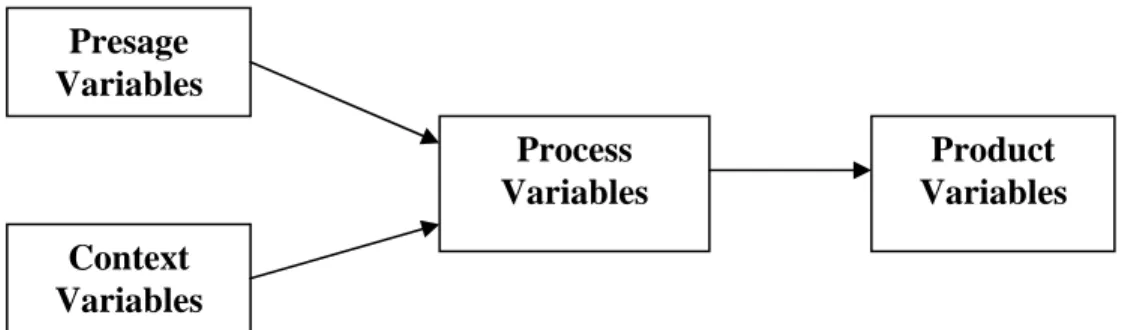
The theoretical framework for this study rests upon the model of teaching and learning posited by Dunkin and Biddle in 1974 (Figure 1), who refined and operationalized concepts espoused by Mitzel (1960).
Journal of Agricultural Education 83 Volume 47, Number 3, 2006
Figure 1. Model for the study of classroom teaching. Adapted from Dunkin and Biddle (1974). According to Dunkin and Biddle (1974),
the variables which contribute to teaching and learning may be organized and analyzed within four general classes. Presage
variables are defined as characteristics of teachers that may be examined to determine their influence on the teaching process. These characteristics may include, but are not limited to, teacher training as well as general formative experiences encountered throughout the teacher’s life. The presage variables identified in this study included professional development activities preparing teachers to create and teach math-enhanced lessons in the context of agricultural power and technology. This set of activities included curriculum development, teaching method acquisition, as well as general interdisciplinary team building strategies. Dunkin and Biddle defined context variables as conditions to which the teacher must adjust. The context variables identified in this study included the Oklahoma agricultural power and technology curriculum, the mathematics inherent (or embedded) in that curriculum,
as well as selected characteristics of students enrolled in their courses during the spring 2004 semester.
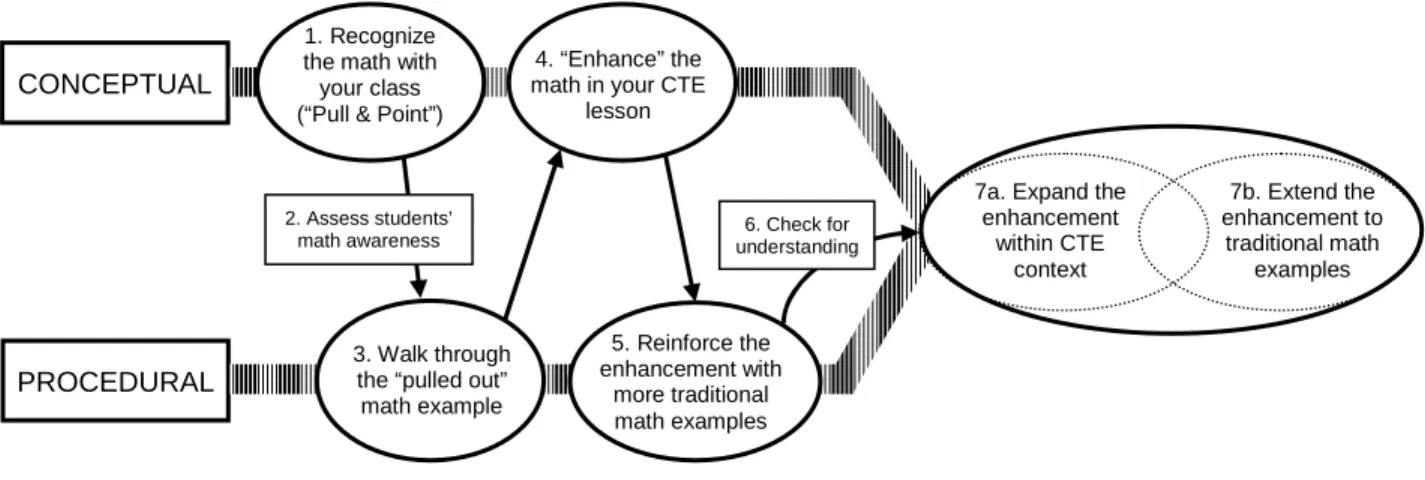
Process variables refer to the actual activities that occur during the act of teaching. The process variables for this study included a prescribed method of delivery of math-enhanced lessons in the context of agricultural power and technology, i.e., “The ‘7-Elements’ of a Math-Enhanced Lesson” (Stone, Alfeld, Pearson, Lewis, & Jensen, 2004; Figure 2).
Product variables represent changes in
student behavior as a result of the interaction of all other variables. The product variable of interest was level of student performance on a mathematics examination used to determine an individual’s need for mathematics remediation at the postsecondary level. The study’s design included a control or “counterfactual
group” for the purpose of testing treatment effects by comparingperformance
of experimental and control students by group at conclusion of the experiment. Presage Variables Context Variables Process Variables Product Variables
Journal of Agricultural Education 84 Volume 47, Number 3, 2006
Figure 2. The National Research Center model: The “7 Elements” of a math-enhanced lesson. From an unpublished draft report of Year 1 of Math-in-CTE study by J. R. Stone III, C. Alfeld, D. Pearson, M. Lewis, and S. Jensen, 2004, St. Paul: University of Minnesota.. Reprinted with permission.
Purpose
The purpose of this study was to empirically test the hypothesis that students who participate in a contextualized, mathematics-enhanced high school agricultural power and technology curriculum and aligned instructional approach would develop a deeper and more sustained understanding of selected mathematical concepts than students who participated in the traditional curriculum, thus resulting in less need for postsecondary mathematics remediation.
Research Questions and Null Hypothesis
The following research questions guided the study: 1) What were selected characteristics of students enrolled in, and instructors teaching, agricultural power and technology in the state of Oklahoma during the spring 2004 semester? 2) Does a math-enhanced agricultural power and technology curriculum and aligned instructional approach affect a student’s need for postsecondary math remediation? The following null hypothesis guided the study’s statistical analysis: Ho There is no difference between the two study groups on a mathematics placement test used to determine a student’s need for mathematics remediation at the postsecondary level.
Methods and Procedures
This study employed a posttest only control group experimental design (Campbell & Stanley, 1963). Thirty-eight agriculture teachers volunteered to participate in the study. Before teachers agreed to take part in the study, researchers explained that each teacher would be randomly assigned to either the experimental or control group to increase the probability of equality among the two groups of students who would provide data for analysis. Subsequently, classrooms were randomly assigned to either the experimental or control group. The assignment involved intact groups of students; thus, the “unit of analysis” was by classroom. In addition to the random assignment to groups, the two groups (experimental and control) were assessed to determine level of equivalence concerning basic mathematics aptitude (Campbell & Stanley; Tuckman, 1999) prior to the treatment. The two groups were not significantly different (p > .05) based on their performance on the Terra Nova CAT™ Basic Battery Examination (Tables 2 & 3). Following the treatment, comparisons were made between group means on a posttest measure designed to determine a student’s need for postsecondary remediation in mathematics.
CONCEPTUAL
PROCEDURAL
3. Walk through the “pulled out”
math example 1. Recognize the math with your class (“Pull & Point”)
4. “Enhance” the math in your CTE
lesson
5. Reinforce the enhancement with
more traditional math examples
7a. Expand the enhancement within CTE context 7b. Extend the enhancement to traditional math examples 2. Assess students’
Journal of Agricultural Education 85 Volume 47, Number 3, 2006 This design was chosen primarily on the
basis of its robust nature concerning validity and reliability. According to Tuckman (1999), this type of experimental design “. . . provide[s] completely accurate controls for all sources of internal validity” (p. 161). In addition, Dunkin and Biddle (1974) contended that their model (Figure 1) could be used as an explanatory framework for describing the effects of an experimental treatment of the kind implemented.
The ACCUPLACER (Elementary Algebra test, The College Board; 35 items) was the posttest used to compare performance of the groups as it related to student need for postsecondary mathematics remediation. The examination has an internal consistency reliability coefficient of .92 (Cronbach’s alpha) (College Entrance Examination Board, 2002). This examination was very similar in format to “pencil and paper,” standardized tests used often to assess student mathematics achievement. According to Campbell and Stanley (1963),
. . . in research on teaching, one is interested in generalizing to a setting in which testing is a regular phenomenon. Especially if the experiment can use regular classroom examinations as Os, but probably also if the experimental Os are similar to those usually used, no undesirable interaction of testing and X
would be present. (p. 18)
The experimental intervention (or treatment) embedded in this design required the preparation of agriculture teachers (i.e., a presage variable) to develop and implement a math-enhanced curriculum in the context of an agricultural power and technology course. The experimental group agriculture teachers had math teacher “partners” to assist them in developing math-enhanced lesson plans in the context of agricultural power and technology, and in how to enhance student understanding of the embedded mathematics within the lessons.
Eighteen agriculture teachers and their math teacher partners were randomly assigned to the experimental group, and 20 agriculture teachers to the control group. Initially, two additional teachers were
randomly assigned to the experimental group but both teachers chose to not participate in the study prior to the first professional development meeting. This design yielded an overall N of 447 agricultural power and technology students (experimental n = 206; control n = 241) who provided data for analysis. Prior to the study beginning, teachers provided curriculum artifacts that documented the math instruction in their courses. Analysis of those artifacts provided little evidence of explicit mathematics instruction in either group. The experimental group teachers implemented a math-enhanced agricultural power and technology curriculum and instructional approach (i.e., process variables). The control group teachers taught the traditional curriculum (Oklahoma Department of Vocational and Technical Education, 2000) and were instructed to use the same instructional approach they used in the past.
This study was a part of a larger investigation that included the collection of data concerning other aspects of student achievement. Therefore, each student was randomly assigned (within the class) to take one of three posttest measures. This random assignment was performed for at least two purposes. First, the administration of multiple posttests to each student could have introduced a level of test fatigue that resulted in negative effects on student performance (Enderlin & Osborne, 1992). Second, this decision was made to reduce the expense of posttesting while protecting the integrity of posttest results. For these reasons, the number of students who took the pre-treatment measure of math equivalence (N = 447) does not match the number of students who took the ACCUPLACER posttest (n = 125).
The partnering of high school math teachers with agricultural power and technology teachers encouraged instructors to function as a team. The pairs of teachers (agriculture and math) spent five days together in professional development during the fall of 2003. The purpose of this activity was to create mathematically-enhanced lessons in the context of agricultural power and technology. The role of math teachers was to work with their agriculture teacher
Journal of Agricultural Education 86 Volume 47, Number 3, 2006 partners to identify and develop content as
well as to design lesson activities to more fully contextualize mathematics terminology, principles, and concepts embedded in the curriculum.
Prior to developing the math-enhanced lessons, a panel of experts convened to identify specific mathematical constructs that were present in the Oklahoma agricultural power and technology curriculum. It was determined that there were nine constructs in the existing curriculum that aligned with state and national mathematics standards (Parr, 2004). The teacher teams were charged with developing a lesson to address one of the identified constructs, which would result in 18 lessons. The development of two lessons per construct meant that teachers had some choice regarding which lessons would be most appropriate for their program so long as they addressed each of the nine constructs. Following review of lesson drafts, it was determined that two of the lessons were very similar and should be combined into one lesson. So, ultimately, 17 lessons were developed that emphasized selected math concepts embedded in the agricultural power and technology curriculum. During the spring 2004 semester, math teachers continued to collaborate with agriculture teachers concerning specific questions related to the math-enhanced lessons and to facilitate teachers’ reflections about lessons taught.
Accordingly, the treatment was defined as a series of math-enhanced learning experiences (i.e., lessons) designed to raise the embedded, contextualized mathematics
found in the agricultural power and technology curriculum to a level of explicit instruction intended to facilitate student learning of selected mathematics competencies and to improve a student’s ability to transfer that competence to new and novel settings (Stone, Alfeld, Pearson, Lewis, & Jensen, 2005). The treatment (i.e., process variable) was delivered as a series of nine lessons each of which addressed a specific math construct over the spring 2004 semester. For example, a lesson that explained the proper method of area calculation when constructing a greenhouse or agricultural mechanics facility addressed a construct that aligned with state and national mathematics education standards (e.g., NCTM Geometry Standard for Grades 9-12). The lessons were to be taught using the prescribed math instructional model (Figure 2). This teaching approach was supported by mathematics education literature (e.g., Bickmore-Brand, 1993 and Kiong & Yong, 2001). Agriculture teachers were expected to deliver their lessons without any outside assistance from their math teacher partners or other math education professionals during the act of teaching.
A concise view of the treatment implemented in this study and listing of each facet is presented in Table 1. The elements of the treatment described were delivered only to experimental group teachers and students. Control group teachers were instructed to make no change relative to the teaching of mathematics in their agricultural power and technology classes.
Journal of Agricultural Education 87 Volume 47, Number 3, 2006 Table 1
Overview of the Treatment
Experimental Group Teachers Experimental Group Students
Preparation Phase Preparation Phase
Math and agriculture teacher collaboration and professional development
Teachers participated in: - Team building activities - Curriculum mapping
- Lesson plan development and refinement - Peer evaluations of lessons that provided feedback to other teachers
- Training in seven-step instructional approach
Students were told that their class would participate in the study and the need for questionnaires and testing was explained
Permission (i.e., “passive consent”) was obtained from students and their parents
Presentation Phase Presentation Phase Implementation of the seven-step instructional
approach
- Presentation of curriculum materials developed in professional development
Students received math-enhanced lessons delivered through the
seven- step approach Continued collaboration/reflection between math and
agriculture teachers throughout the semester - Debriefing following each math enhanced lesson Observation of math-enhanced lesson by researcher - Researcher observed and scripted one lesson presentation per teacher
Note. Adapted from Parr, 2004, p. 56.
Findings
Frequencies and percentages were calculated for selected personal characteristics of student and teacher participants in the study. One-way analysis of variance (ANOVA) was used to compare experimental and control groups’ classroom means to test the research hypothesis.
Selected Characteristics of Students and Teachers
Student participants were asked to respond to questions that described selected personal characteristics. The questionnaire revealed that the majority of students were male (84.4%) and of European/Anglo descent (58.5%). One-fourth of the students reported their ethnicity as Native American.
About one-third (31.8 %) of the students were seniors in high school, a similar number (34.5%) were juniors, and about one-fourth (26.4%) were sophomores; the remaining students were either freshmen (6.1%) or did not respond to the question of grade level. Most of the students (82.7%) were between the ages of 16 and 18, and the majority held self-reported grade point averages ranging from 2.6 to 4.0 (72%).
The data collected about agriculture teacher participants (n = 38) revealed that 86.8% of the teachers were male, and 2.6% were female; 10.8% elected not to report their gender. The data also indicated that 73.7% of teachers identified themselves as being of European/Anglo descent, and 15.8% were Native American; 10.8% did not report their ethnicity.
Journal of Agricultural Education 88 Volume 47, Number 3, 2006
Pre-treatment Analysis
The Terra Nova CAT™ Basic Battery (CTB/McGraw-Hill) examination (46 items) was used as a pre-treatment measure to establish the equivalence of groups regarding general mathematics aptitude.
This test was chosen because it is
a nationally-normed and reliable test of math skills (McGraw-Hill, 2000) with an internal reliability coefficient of .91 (Cronbach’s alpha). No significant difference (p = .07) was detected
concerning math aptitude (Tables 2 & 3).
Table 2
Descriptive Statistics for Student Math Performance by Group on the Terra Nova CAT™Basic Battery Examination (Pre-treatment Measure of Equivalence)
n M SD SE Minimum Maximum
Control 20 20.31 3.60 .80 15.88 30.78
Experimental 18 22.34 3.15 .74 17.71 28.24
Total 38 21.27 3.50 .57 15.88 30.78
Table 3
Comparative Analysis of Student Math Performance by Group Means as Measured by the Terra
Nova CAT™Basic Battery Examination (Pre-treatment Measure of Equivalence)
SS df MS F p Between Groups 38.94 1 38.94 3.39 .07 Within Groups 413.98 36 11.50 Total 452.92 37 Posttest Analysis
Means were calculated by group for the purpose of comparative statistical analysis following the treatment. One-way analysis of variance (ANOVA) was used to compare the experimental and control groups’ classroom means to test the study’s research hypothesis: Ho There is no difference between the two study groups on a mathematics placement test used to determine a student’s need for mathematics remediation at the postsecondary level.
An analysis was conducted on student mathematics performance by group using an examination to assess student need for
mathematics remediation as measured by a college placement test (i.e.,
ACCUPLACER; 35 items) taken after the
treatment was administered. The control group students achieved a mean score of 13.01 on this measure with a standard deviation of 3.24 while the experimental
group had a mean score of 15.56 with a standard deviation of 2.92 (Table 4). Analysis revealed a significant
difference (p = .017) in level of performance between groups following the treatment at
an a priori determined alpha level of .05 (Table 5). Thus, the null hypothesis
was rejected. The practical significance of this difference was evaluated based on
the calculation of an effect size, i.e.,
Cohen’s d. The effect size for this difference was .83, which was
described by Cohen as “large” (as cited in Shavelson, 1996).
Journal of Agricultural Education 89 Volume 47, Number 3, 2006 Table 4
Descriptive Statistics for Student Math Performance by Group on the ACCUPLACER Examination
n M SD SE Minimum Maximum
Control 19 13.01 3.24 .74 6.67 21.33
Experimental 18 15.56 2.92 .69 11.00 22.00
Total 37 14.25 3.31 .54 6.67 22.00
Note. Students were randomly selected from within intact classrooms to take the ACCUPLACER examination (n = 125).
Table 5
Comparative Analysis of Student Math Performance by Group Means as Measured by the ACCUPLACER Examination SS df MS F p Between Groups 60.29 1 60.29 6.32* .017a Within Groups 334.06 35 9.55 Total 394.35 36b a
Effect size = .83 per Cohen’s d (as cited in Shavelson, 1996). b Degrees of freedom differ for the ACCUPLACER examination when compared to the pre-treatment measure (Table 3) due to the random assignment of the three posttest measures. One class was populated by two students so there was no “third” student to whom the ACCUPLACER could be administered; thus, one degree of freedom was eliminated.
*p < .05.
Conclusions
The math-enhanced Agricultural Power and Technology curriculum and aligned instructional approach that was implemented as this study’s experimental treatment did significantly affect (p < .05) student performance on a mathematics placement test used to determine a student’s need for mathematics remediation at the postsecondary level. To that end, findings of this study are consistent with much of the previously published literature concerning the value of contextually-based teaching and learning. The results support what other researchers (Chiasson & Burnett, 2001; Enderlin & Osborne, 1992; Parnell, 1996; Secretary’s Commission on Achieving Necessary Skills, 1991) have concluded, i.e., providing a context in which learning may take place does hold value for improving
student comprehension and retention of subject matter. Findings also support Shinn et al. (2003), i.e., “Secondary agricultural education, through the use of relevant curriculum delivered from a student-centered perspective by skillful teachers, has high potential for engaging students in active, hands-on/minds-on learning environments rich with opportunities for learning mathematics” (p. 16).
Recommendations for Further Research
Even though the treatment implemented in this study was administered over a relatively short period of time (i.e., one semester), results revealed that, within this particular population, a math-enhanced agricultural power and technology curriculum and aligned instructional approach did significantly affect a student’s
Journal of Agricultural Education 90 Volume 47, Number 3, 2006 need for postsecondary mathematics
remediation. Moreover, the practical significance of this finding was in the category of a “large” effect size. However, due to the singularity of this study, one should practice caution if generalizing results beyond the 38 classrooms investigated. Accordingly, additional experiments (i.e., replications) should be designed and implemented to explore further the effectiveness of using agricultural power and technology as a useful context for teaching and learning mathematics, especially those constructs deemed appropriate for determining whether students need mathematics remediation at the postsecondary level. Additionally, future investigations should also focus on the value of implementing this model in other agriculture courses that have significant mathematics components embedded in their curricula. And, because the treatment described was limited to only one semester, future experiments should be longer, e.g., one academic year.
Additional investigation should be conducted regarding the evaluation instrument employed in this study (i.e., the ACCUPLACER test). Its content should be analyzed to determine which mathematics concepts or principles may be taught more effectively by using a contextualized, math-enhanced curriculum and aligned instructional approach that is delivered through an agricultural power and technology course.
The treatment described in this study involved multiple elements of a somewhat complex nature (Table 1) that could result in various “rival hypotheses” emerging when interpreting its results (Campbell & Stanley, 1963, pp. 7, 13, & 14). So, more research is needed about specific effects that different elements of the treatment may have had on student mathematics performance. Repeating this study under similar conditions could create important opportunities for explaining further the effects of these elements and their respective magnitudes.
More systematic inquiry should be performed concerning the effects of collaboration between math and agriculture teachers on student achievement in
mathematics. For example, agriculture teachers involved in this study spent several hours over the course of a semester reflecting and debriefing with math teacher partners concerning their delivery of math-enhanced lessons. Additional research should be performed to more accurately determine the value of this type of cross-disciplinary collaboration and its effect on student achievement.
Implications and Discussion
According to the National Assessment of Vocational Education (U.S. Department of Education, 2004), little concrete evidence exists about how career and technical education can contribute to student performance in other subject areas such as mathematics. What is more, Myers and Dyer (2004) recommended that empirical research should be performed to determine how secondary agricultural education could contribute to student achievement across the school curriculum. This study contributes empirical evidence toward those ends.
Myers and Dyer (2004) also recommended that, “Once this information is obtained, studies are needed to identify the best methods teacher educators can employ to prepare teachers for this expanded role” (p. 50). So, inquiries should be carried out regarding how to effectively prepare pre-service secondary agricultural education teachers to provide contextualized instruction similar to that described by this study. Then, appropriate training could be incorporated into selected pre-service courses that comprise agriculture teacher preparation programs.
This study revealed that school-based reform concerning curriculum integration is effective but it requires a significant investment of time and other resources. These findings are consistent with conclusions published in the National Assessment of Vocational Education
(NAVE) report (U.S. Department of
Education, 2004). The report’s authors also stated that, “. . . secondary vocational education itself is not likely to be a widely effective strategy for improving academic achievement or college attendance without substantial modifications to policy,
Journal of Agricultural Education 91 Volume 47, Number 3, 2006
curriculum, and teacher training” (p. 2).
However, the NAVE report provided
evidence that such “substantial modifications” could result in a significant increase in student achievement. This study addressed two of the three areas targeted for change: curriculum improvement and teacher development. In addition, this study provided support for an increase in cross-disciplinary team building activities among teachers. Consequently, efforts should be made by school administrators to provide teachers with opportunities for professional development that includes a focus on integrating subject matter and building collaboration between teachers of different disciplines (Hernandez & Brendefur, 2003).
The issue of increased student achievement in mathematics is a serious matter facing public education. Not only is concern for achievement in the general population of students at a high level; but, specifically, the mathematics achievement of agricultural education students in at least one state has been found to be below the state average as well as below the level of other career and technical education concentrators (Woglom, Parr, & Morgan, 2005). So, agricultural educators are encouraged to put concerted effort toward developing and implementing contextualized curricula and teaching approaches that show promise for demonstrating agricultural education’s value for supporting student learning across the curriculum.
References
Bailey, T. (1998). Integrating vocational and academic education. In National Research Council, High school mathematics at work: Essays and examples for the education of all students. Washington DC: National Academy Press.
Bickmore-Brand, J. (1993). Implications from recent research in language arts for mathematical teaching. In J. Bickmore-Brand (Ed.), Language in mathematics (pp. 1-9). Portsmouth, NH: Heinemann.
Campbell, D. T., & Stanley, J. C. (1963). Experimental and
quasi-experimental designs for research. Chicago: Rand McNally.
Chiasson, T. C., & Burnett, M. F. (2001). The influence of enrollment in agriscience courses on the science achievement of high school students.
Journal of Agricultural Education, 42(1), 60-70.
College Entrance Examination Board. (2002). The accuplacer online student guide. Retrieved August 1, 2004, from http://cpts.accuplacer.com/docs/StudentGuid e.html
Dunkin, M. J., & Biddle, B. J. (1974).
The study of teaching. New York: Holt,
Rinehart and Winston.
Enderlin, K. J., & Osborne, E. W. (1992). Student achievement, attitudes, and thinking skill attainment in an integrated science/agriculture course. Proceedings of the Nineteenth Annual National Agricultural
Education Research Meeting (pp. 37-44).
St. Louis, MO.
Hernández, V. M., & Brendefur, J. L. (2003). Developing authentic, integrated, standards-based mathematics curriculum: [More than just] an interdisciplinary collaborative approach. Journal of Vocational Education Research, 28(3), 259-283. Retrieved June 29, 2004, from http://scholar.lib.vt.edu/ejournals/JVER/v28 n3/pdf/v28n3.pdf
Kahle, J. B. (1998). Science and mathematics education: Finding common ground. In National Research Council, High school mathematics at work: Essays and examples for the education of all students. Washington DC: National Academy Press.
Kiong, P. L., & Yong, H. T. (2001). Scaffolding as a teaching strategy to enhance mathematics learning in the classrooms. Proceeding of the 2001 Research Seminar in Science and Mathematics Education, Sarawak, Malaysia.
Retrieved October 20, 2004, from http://www2.moe.gov.my/~mpbl/Research/2 001_8_paul.htm
Journal of Agricultural Education 92 Volume 47, Number 3, 2006 Mackinac Center for Public Policy.
(2000, September). The cost of remedial education: How much Michigan pays when students fail to learn basic skills. Midland, MI: Greene, J. P. Retrieved January 3, 2005, from http://www.mackinac.org/archives/ 2000/s2000-05.pdf
McGraw-Hill. (2000). CAT™ Prepublication: Technical bulletin. Monterey, CA: McGraw-Hill.
Mitzel, H. E. (1960). Teacher effectiveness. In C. W. Harris (Ed.),
Encyclopedia of educational research (3rd ed.). New York: The MacMillan Company.
Myers, B. E., & Dyer, J. E. (2004). Agriculture teacher education programs: A synthesis of the literature. Journal of Agricultural Education, 45(3), 44-52.
National Center for Education Statistics. (2003, November). Remedial education at degree-granting postsecondary institutions in fall 2000 (NCES 2004-010). Washington DC. Retrieved August 1, 2004, from http://nces.ed.gov/pubs2004/2004010.pdf
National Center for Education Statistics. (2004). National assessment of educational progress: The nation’s report card 2000
[Data file]. Available from National Center for Education Statistics Web site, http://www.nces.ed.gov/nationsreportcard/n aepdata
National Council of Teachers of Mathematics. (2005). Overview of principles and standards for school mathematics. Retrieved June 2, 2005, from http://www.nctm.org/standards/overview. htm
National Research Council. (1988).
Understanding agriculture: New directions for education. Danville, IL: The Interstate Printers and Publishers.
Newcomb, L. H. (1995, December). The genius of the agricultural education model for nurturing higher order thinking.
The Agricultural Education Magazine, 68(6), 4, 6.
Oklahoma Department of Vocational and Technical Education. (2000).
Agricultural power and technology: Welding instructor’s manual. Stillwater, Oklahoma. Curriculum and Instructional Materials Center.
Oklahoma State Board of Education. (2004). Oklahoma school testing program end of instruction (EOI) tests: State level
results. Retrieved August 1, 2004, from
http://sde.state.ok.us
Parnell, D. (1996). Cerebral context.
Vocational Education Journal, 71(3), 18-21. Parr, B. A. (2004). Effects of a math-enhanced curriculum and instructional approach on the performance of secondary education students enrolled in an agricultural power and technology course: An experimental study. Unpublished doctoral dissertation, Oklahoma State University, Stillwater, Oklahoma.
Romberg, T. A. (1994). Classroom instruction that fosters mathematical thinking and problem solving: Connections between theory and practice. In A. Schoenfeld (Ed.), Mathematical thinking
and problem solving. Hillsdale, NJ:
Lawrence Erlbaum Associates.
Secretary’s Commission on Achieving Necessary Skills. (1991). What work requires of schools: A scans report for America 2000. U. S. Department of Labor. Retrieved August 20, 2004, from http://wdr.doleta.gov/SCANS/whatwork/wh atwork.pdf
Shavelson, R. J. (1996). Statistical reasoning for the behavioral sciences (3rd ed.). Needham Heights, MA: Simon and Schuster.
Shinn, G. C., Briers, G. E., Christiansen, J. E., Edwards, M. C., Harlin, J. F., Lawver, D. E., et al. (2003). Improving student achievement in mathematics: An important role for secondary agricultural education in
the 21st century. Monograph, National
Council for Agricultural Education.
Journal of Agricultural Education 93 Volume 47, Number 3, 2006 http://www.agedhq.org/AgEdResearchWork
GroupMonographMathematics02Dec03.pdf Stone, J. R. III, Alfeld, C., Pearson, D., Lewis, M., & Jensen, S. (2004). Unpublished draft report of Year 1 Math-in-CTE study [since revised]. St. Paul: University of Minnesota.
Stone, J. R., III, Alfeld, C., Pearson, D., Lewis, M. V., & Jensen, S. (2005). Building academic skills in context: Testing the value
of enhanced math learning in career and technical education (Pilot Study). St.
Paul, MN: National Research Center for Career and Technical Education, University of Minnesota.
Tuckman, B. W. (1999). Conducting educational research (5th ed.). New York: Thompson.
United States Department of Education. (2004). National assessment of vocational
education final report to congress: Executive summary. Retrieved November 3, 2004, from http://www.ed.gov/rschstat/eval/ sectech/nave/navefinal.pdf
Woglom, C., Parr, B. A., & Morgan, J. A. (2005). A comparison of commonwealth accountability standardized test scores between high school agricultural education/career and technical education students and the Kentucky state standards.
Journal of Southern Agricultural Education Research, 55, 33-45. Retrieved November 19, 2005, from http://pubs.aged.tamu.edu/ jsaer/Vol55Whole.pdf
Yager, R. E. (n. d.). Real-world learning: A necessity for the success of current reform efforts. Eisenhower National Clearinghouse for Mathematics and Science
Education. Retrieved October 20, 2003,
from http://www.enc.org/topics/inquiry/
context/document.shtm?input=FOC-000884-index
BRIAN A. PARR is an Assistant Professor in the Department of Agricultural Leadership, Education, and Communication at the University of Georgia, 106 NESPAL Building, P. O. Box 748, Tifton, GA 31793. E-mail: [email protected].
M. CRAIG EDWARDS is an Associate Professor in the Department of Agricultural Education, Communications, and 4-H Youth Development at Oklahoma State University, 456 Agriculture Hall, Stillwater, OK 74078-6031. E-mail: [email protected].
JAMES G. LEISING is Professor and Head in the Department of Agricultural Education, Communications, and 4-H Youth Development at Oklahoma State University, 448 Agriculture Hall, Stillwater, OK 74078-6031. E-mail: [email protected].