An Ada design pattern recognition tool for AADL
performance analysis
Vincent Gaudel
Frank Singhoff
Alain Plantec
St ´ephane Rubini
LISyC/EA 3883, University of Brest20, av Le Gorgeu
CS 93837, 29238 Brest Cedex 3, France
{gaudel,singhoff,plantec,rubini}@univ-brest.fr
Pierre Dissaux
J ´er ˆome Legrand
Ellidiss Technologies 24, quai de la douane29200 Brest, France
{pierre.dissaux,jerome.legrand}@ellidiss.com
ABSTRACT
This article deals with performance verification of architec-ture models of time embedded systems. Although real-time scheduling theory provides numerous analytical meth-ods called feasibility tests for scheduling analysis, their use is a complicated task. In order to assist an architecture model designer in early verification, we provide an approach, based on real-time specific design patterns, enabling an au-tomatic schedulability analysis. This analysis is based on existing feasibility tests, whose selection is deduced from the compliance of the system to a design pattern and other system’s properties. Those conformity verifications are in-tegrated into a schedulability tool called Cheddar. We show how to model the relationships between design patterns and feasibility tests and design patterns themselves. Based on these models, we apply a model-based engineering process to generate, in Ada, a feasibility test selection tool. The tool is able to detect from an architecture model which are the feasibility tests that the designer can apply. We explain a method for a designer willing to use this approach. We also describe the design patterns defined and the selection algorithm.
Keywords
AADL, Cheddar, Ada framework, Design Patterns, Real-time schedulability analysis, Platypus
General Terms
Performance, Reliability, Verification.
Categories and Subject Descriptors
SOFTWARE ENGINEERING [Software/Program
Ver-ification]: Validation
Permission to make digital or hard copies of all or part of this work for personal or classroom use is granted without fee provided that copies are not made or distributed for profit or commercial advantage and that copies bear this notice and the full citation on the first page. To copy otherwise, to republish, to post on servers or to redistribute to lists, requires prior specific permission and/or a fee.
SIGAda’11,November 6–10, 2011, Denver, Colorado, USA. Copyright 2011 ACM 978-1-4503-1028-4/11/11 ...$5.00.
1.
INTRODUCTION
A real-time system is called critical when its dysfunction could lead to serious damages upon persons or the envi-ronment. The validation of such systems is therefore cru-cial. Real-time scheduling theory provides tools to validate such systems, especially analytical methods called feasibil-ity tests. Yet, their use implies a high level of expertise in the real-time scheduling theory: the common draw to all these feasibility tests is that they need the system to fulfill a set of specific assumptions calledapplicability constraints. Those are based on architectural and environmental proper-ties. Unfortunately, the large number of feasibility tests and applicability constraints complicates the use of such meth-ods. That may explain why they are unused in many prac-tical cases, although it could be profitable.
In our approach, we aim to help real-time architecture de-signers by automatically select relevant feasibility tests. To do so, we explicitly model relationships between architec-tural models and real-time scheduling analysis. The model-ing of relationships is provided by a set of real-time design patterns for whom we are able to select applicable feasibility tests [5, 13].
We have provided five design patterns based on AADL (Architecture Analysis and Description Language[15]) com-munication and synchronization protocols between tasks. We model those design patterns by sets of assumptions on properties of architectural models. We analyze architectural models to verify their compliance to design patterns. When an architecture is compliant with one design pattern, we automatically propose to the designer to compute a set fea-sibility tests assigned to the corresponding design pattern.
In this article, we present a prototype which is able to se-lect feasibility tests applicable to an architecture model com-pliant to a design pattern. This prototype is integrated with the performance analysis environment Cheddar and is gen-erated by a model driven engineering process. We present our approach from a designer’s perspective. We show how to model relationships between architectural properties and a set of feasibility tests. Then, we present an algorithm to analyze compliance of an architecture model to a design pat-tern and finally, we explain how we can generate our Ada prototype from our feasibility tests and design pattern mod-els.
the approach from the designer’s point of view. Section 3 contains a description of our five design patterns. Section 4 presents the architecture model of a simplified automotive system as a case study. Then, in section 5 the algorithm is presented. In section 6 we explain our engineering process and present the prototype evaluation. Related works follow in section 7, before conclusion in section 8.
2.
PROPOSED APPROACH
In this section, we describe what we call feasibility tests and applicability constraints. Then we give a brief presenta-tion of our five design patterns, followed by the descrippresenta-tion of the proposed method from the designer’s perspective.
2.1
The issue of critical system schedulability
analysis
Real-time scheduling theory enables designers to analyze the temporal behavior of a set of tasks with the use of an-alytical methods called feasibility tests. For example, Liu and Layland [10] have defined periodic tasks characterized by three parameters: deadline (Di), period (Pi), and
capac-ity (Ci). Each time a taski is activated, it has to perform
a job whose execution time is bounded byCiunits of time
beforeDi units of time after the task release time. Those
parameters are used to compute some feasibility tests. Fea-sibility tests evaluate different performance criteria: proces-sor utilization factor, worst case response time, deadlocks and priority inversions due to data access, memory foot-print analysis, etc. Liuet al. have proposed equation (1) to perform schedulability analysis. This feasibility test com-putes the processor utilization factor for a system compliant with the following assumptions: all tasks must be periodic, independent and synchronous [7]; the scheduling protocol must be preemptiveEarliest Deadline First or preemptive
Least Laxity First.
U = n X i=1 Ci Pi ≤1 (1)
This feasibility test is a necessary and a sufficient condi-tion if∀i : Di = Pi.
We see that applying a feasibility test to a system im-plies that the system has to meet a set of architectural assumptions. In the next sections, those assumptions will be called ”applicability constraints”. An applicability con-straint expresses properties of architecture components such as task periodicity, scheduling protocol, communication pro-tocol, etc.
2.2
Design pattern description
In order to select applicable feasibility tests, we have de-fined five real-time design patterns: Synchronous data-flow,
Ravenscar,Blackboard,Queued buffer andUnplugged. Each of those design patterns provides an architectural solution to a synchronization problem between tasks by defining an inter-task communication protocol. There exists numer-ous other synchronization paradigms that could justify such specification. We use a pragmatic approach: the previous design patterns are all related to standards or industrial practices. For example,Synchronous data-flow implements Meta-H communication paradigms [20]. Ravenscar is re-lated to the Ada 2005 Ravenscar profile [2].Blackboard and
Queued buffer model communication services that exist in ARINC 653 [1].
We assume that architecture models potentially compliant with our design patterns are written in AADL (Architecture Analysis and Description Language[15]). AADL is a textual and graphical architecture design language for model-based engineering of real-time systems.
The five design patterns work as follows:
1. Synchronous data-flowachieves data sharing through AADL data ports. Each task reads its input data ports at dispatch time and writes its output data ports at completion time. The execution platform deals with the data synchronization: there is no explicit protocol needed.
2. In Ravenscar, data are shared asynchronously, un-der the control of inheritance ceiling priority proto-col. Ravenscar allows tasks to share data protected by semaphores. Semaphores can be used to build multi-ple synchronization protocols such as critical sections, readers/writers, producers/consumers, etc.
3. Blackboardimplements the readers/writers commu-nication protocol: only the last value produced can be consumed by tasks.
4. Queued bufferimplements the producers/consumers communication protocol: messages are handled by a FIFO protocol.
5. Unpluggedmodels independent tasks: tasks that do not communicate with each other.
2.3
Method from designer perspective
In the previous section, we have described feasibility tests and real-time design patterns. In this one, we define how we intend to assist real-time architecture designers. Figure 1 describes the method for designing an architecture model with the use of our design patterns. (1) A designer provides an architecture model. (2) An analysis is performed upon the architecture model in order to check its compliance to one of our design patterns. (4) Once the compliance to a design pattern is met, we provide a list of feasibility tests, (6) and we compute them to perform schedulability analysis. During each of steps 2, 4 and 6, the designer may have to come back to the design phase. First at step (3), when we check the compliance of the architecture model to a design pattern: if it is not compliant, we are not able to provide a list of feasibility tests, so we give to the designer infor-mation (metrics and non-met applicability constraints) in order to assist him to fulfill the compliance of his architec-ture model to a real-time design pattern. During step (4), if the list of feasibility tests does not satisfy the designer (he might want to use a particular feasibility test or the list of selected feasibility tests may not be sufficient to prove the schedulability of the system), we provide alternative lists of feasibility tests and the reasons for their non-selection (5). Finally, once the schedulability analysis has proceeded, the designer may have to loop if the model is not schedulable (7).
3.
HOW WE MODEL DESIGN PATTERNS
In order to perform the analysis explained in the previous section, we model different entities implied in the feasibility
Figure 1: Method from the designer’s perspective.
tests selection. In this section, we first present the language we use to model our design patterns. Then we describe how we model the relationships between architectural models and feasibility tests.
1
SCHEMATasks;
2
ENTITYGeneric Task
3 . . . 4 Capacity : Natural; 5 Deadline : Natural; 6
Start Time : Natural;
7 P r i o r i t y : Priority Range; 8 . . . 9 END ENTITY; 10 . . . 11
ENTITYPeriodic Task SUBTYPE OF( Generic Task ) ;
12
Period : Natural type;
13 J i t t e r : Natural type; 14 END ENTITY; . . . 15 ENDSCHEMA;
Figure 2: Excerpt from Cheddar meta-model: Generic Task and Periodic Task entities.
Our approach is developed within the Cheddar Project [18], an analysis environment for real-time applications writ-ten in Ada. Cheddar already implements numerous feasibil-ity tests. Yet, an architecture designer has to select feasi-bility tests applicable to his architecture model, which is a hard task.
Cheddar provides an architecture language to model real-time systems. The architecture language is based on a meta-model. An instance within this meta-model is composed of several sets of entities: tasks, resources, dependencies, pro-cessors, buffers, networks and address spaces. The Ched-dar meta-model is written in the EXPRESS language [19] and provides all the tools we need to model real-time design patterns. Figure 2 gives an excerpt of this meta-model. A generic task is defined by its capacity, its deadline, its release time and priority among others. A periodic task is defined as a generic task for which period and jitter are defined.
3.1
Structure of the EXPRESS models
In order to make explicit the relationships between ar-chitectural models and feasibility tests, we model design patterns by the applicability constraints they meet. Thus,
Figure 3: List of applicability constraints for feasi-bility tests selection.
Figure 4: Association Model.
design patterns are modeled, with EXPRESS, by sets of ap-plicability constraints structured as follows.
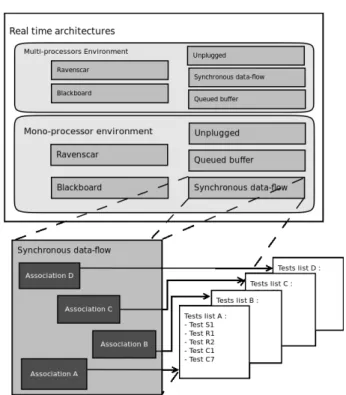
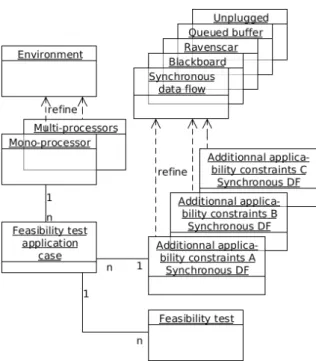
Figure 3 represents the set of all real-time architecture types we can model with the Cheddar meta-model. Each box contains a subset of real-time architectures that meets the same applicability constraints. The more the background color of the boxes is dark, the more the number of met ap-plicability constraints increases. There are various types of applicability constraints. Some are relative to the deploy-ment environdeploy-ment: one cannot use the same feasibility tests for a mono-processor environment or a multi-processor envi-ronment (light gray). Others are relative to the used design pattern (medium gray). For each design pattern, we define severalassociations(dark gray) between additional applica-bility constraints and feasiapplica-bility tests (126 for Synchronous data-flow). Applicability constraints are structured by envi-ronments, design patterns and associations. Figure 4 shows the association between those entities and feasibility tests.
3.2
How we model applicability constraints
For each subset of real-time systems (see. 3.1), we model all the applicability constraints with EXPRESS. For exam-ple, Synchronous data-flow applicability constraints on an architecture model are: (1) all tasks are periodic, (2) there is no buffer, (3) there is no data component, (4) data shar-ing protocol is sampled, immediate or delayed1and (5) there is no hierarchical scheduler (which means no shared address space between processors). EXPRESS enables the definition ofOCL(Object Constraint Language)-likeconstraints [21] on the meta-model instances. Figure 5 gives the example of Synchronous data-flow applicability constraint number (1). This constraint is checked for all generic task instances. It returns true when the size of the set of non-periodic tasks of the architecture model is equal to zero. The Cheddar 1Sampled, immediate and delayed are AADL communica-tion protocols [15].
Figure 6: AADL graphic representation of the au-tomotive architecture model.
meta-model is enriched by anOCL-likeconstraint for each applicability constraint.
4.
CASE STUDY: EXAMPLE OF AN
AR-CHITECTURE MODEL COMPLIANT
WITH SYNCHRONOUS DATA-FLOW
In this section, we present a case study of an architecture model compliant with Synchronous data-flow that will be used to illustrate the feasibility tests selection algorithm.
Let’s consider a simplified version of an automotive em-bedded system. The architecture model is written in AADL. Figure 6 gives an AADL graphic representation of its ar-chitecture model. This system implements three functions: headlights control, windshield wiper control and ESC (Elec-tronic Stability Control) which is a trajectory correction system. It contains twelve tasks communicating with each other through AADL data-ports. Each task reads its input memory slots at dispatch time and writes its output memory slots at completion time. There are four tasks reading sen-sor values (rain, speed, direction and light sensen-sors) and five tasks sending instructions to actuators (windshield wiper, injection, braking system, direction and headlights actua-tors). The windshield wiper control task receives data from rain and speed sensors reading tasks and transmits a value to the task communicating with the windshield wiper actu-ator. The headlights control task receives data from light sensor reading task and transmits a value to the task com-municating with the headlights actuator. The ESC control task receives data from speed and direction sensors read-ing tasks and transmits values to tasks communicatread-ing with injection, braking system and direction actuators.
All tasks have a 30ms period, a 30ms deadline and a 2ms capacity. The system is deployed on a mono-processor en-vironment. All tasks are simultaneously released and the scheduling protocol is preemptive deadline monotonic. All five applicability constraints relative to the Synchronous data-flow design pattern are met: no buffer, nor data component, data sharing protocol is sampled and there are no shared address space between processors.
1
RULEa l l t a s k s a r e p e r i o d i c FOR( ge ne ri c ta sk ) ;
2
WHERE
3
R1 : SIZEOF( QUERY( t<∗g ener ic ta sk | NOT( ’ TASKS. PERIODIC TASK’ IN TYPEOF( t ) ) ) ) = 0 ;
4
END RULE;
Figure 5: Example of applicability constraint modeled in EXPRESS: Synchronous data-flow applicability constraint number (1).
Figure 7: Graphic representation of dependency graph built in step 1.
5.
FEASIBILITY TESTS SELECTION
AL-GORITHM
In order to evaluate our approach, we implemented in Ada a prototype integrated into Cheddar. This section describes the algorithm used for the prototype. As we explained in section 2.3, the prototype analyses the compliance of an AADL architecture model to a design pattern, informs the designer of potential modifications of his architecture model and selects a list of feasibility tests. This algorithm is com-posed of four steps. In this section, we will describe it step by step and apply the steps to the case study presented in the previous section.
5.1
Step 1 : Model analysis to build Graph
The AADL architecture model is parsed by Cheddar, and stored as a set of Cheddar meta-model entities. Cheddar also computes dependencies between tasks for each data port communication, precedence constraint, shared data, mes-sage queue, etc.
An architecture model instance can be composed of sev-eral design patterns. Thus we have to identify which part of the system is a design pattern instance and the number and types of each design pattern instances. To do so, the first step builds a directed graph containing all tasks of the system and dependencies between those tasks. Thus, we cre-ate one node per task and one edge per dependency. Each dependency models a task synchronization or communica-tion. There is one type of node and one type of edge for each dependency type (and then for each type of synchro-nization/communication).
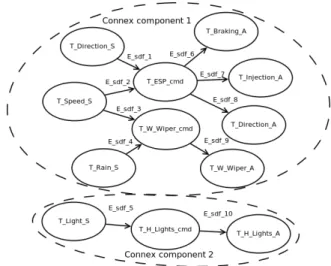
Figure 7 gives the graphical representation of the
depen-Figure 8: Connectivity components for synchronous data-flow edge in dependency graph built in step 1.
dency graph resulting of step 1 for the example of section 4. It contains twelve nodes and ten Synchronous data-flow edges.
5.2
Step 2 : Graph analysis to extract
poten-tial instances
Once the dependency graph is built, we look for subgraphs which are design pattern instances. Extracted subgraphs are calledpotential instances. We extract connectivity compo-nents for each type of edge. A connectivity component for one type of edge with no intersection with any other connec-tivity component is considered as a design pattern potential instance. If there is no potential instances, nodes and edges shared between two connectivity components are identified. Tasks and dependencies corresponding to those nodes and edges are the ones the designer has to modify in order to make his architecture model compliant with a design pat-tern.
Figure 8 represents the two connectivity components of the case study. The first one contains the three nodes rela-tive to the headlights control tasks, and the second one the rest of the graph. Thus, there are two potential synchronous data-flow instances in the example.
5.3
Step 3 : Instantiation Confirmation
Each design pattern has a set of constraints. Extracted potential instances need to be analyzed in order to confirm actual design patterns instances. To do so, all potential instances are checked one by one by a verification of the applicability constraints relative to the design pattern.
For the simplified car system case study, all five applica-bility constraints of synchronous data-flow (see section 3.2)
1
. . .
2
SCHEMAASSOCIATION 17;
3
USE FROMMono Processor Environment;
4
USE FROMSynchronous Data Flow;
5
USE FROMSimultaneous Release Time Constraint;
6
USE FROMPeriod Equal Deadline Constraint;
7
USE FROMPreemptive Deadline Monotonic ;
8
USE FROMFeasibility tests Taxonomy ( test S1 , test C5 , test C7 , test R1 , test R2 ) ;
9 10
ENDSCHEMA;
11
. . . .
Figure 9: EXPRESS model of an association be-tween feasibility tests, execution environment, de-sign pattern and applicability constraints.
are checked for the two potential instances. Synchronous data-flow applicability constraints are met in our automo-tive system example. Then, two Synchronous data-flow in-stances are identified in this example.
5.4
Step 4 : Applicability constraints
verifica-tion for feasibility tests selecverifica-tion
At the previous steps, we have verified that our architec-ture model is compliant with a design pattern. Now, we must find the feasibility tests that the designer is allowed to apply.
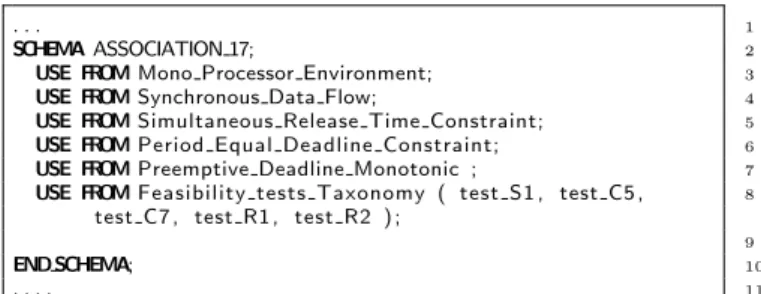
An association between a design pattern, its applicability constraints, an execution environment and a list of feasibility tests is modeled by an EXPRESS entity. Figure 9 gives an example of this type of entity for our automotive case
study. Each USE FROM EXPRESS statement models
one or several applicability constraints. If allUSE FROM statements are met, it means that the feasibility tests listed in the EXPRESS entity can be applied on the architecture model.
In our automotive case study, five feasibility tests have been selected: one based on exhaustive simulation (test S1), two based on processor utilization factor (test C5, test C7) and two based on worst case response time (test R1, test R2)[16].
6.
PROTOTYPING AND EVALUATION
6.1
The prototype engineering protocol
One goal of our approach is to enable the creation of new design patterns at a meta-level. Thus, one can model a new design pattern and automate additional real-time scheduling theory knowledge. Figure 11 presents the prototype engi-neering/evaluation protocol. Based on the design patterns modeling, we first implemented manually a prototype in-tegrated to Cheddar. This manually written version has been used to validate the design patterns modeling and the feasibility test selection algorithm. Once the prototype is evaluated, the Cheddar meta-model is enriched and checked within Platypus [14]. The Ada code of a new version of the prototype is then generated [12, 17]. For example, the Ada code generated for the applicability constraint presented in figure 5 is shown in figure 10.
At the time of the writing of this article, the prototype was able to recognize and select feasibility tests for the three design patterns: Synchronous Data Flow, Ravenscar and Unplugged, in the case of a mono-processor environment.
1 2
package bodyAll Tasks Are Periodic i s
3 4
function R1 QUERY1 Condition ( t : Generic Task Ptr) return
boolean i s
5
begin
6
return not ( Element In List ( To Unbounded String( ”TASKS. PERIODIC TASK”) , Type Of( t ) ) ) ;
7
end R1 QUERY1 Condition;
8 9
function R1 ( Sys : System) return boolean i s
10
begin
11
Context := Sys;
12
return ( Get Number Of Elements( Select And Copy ( s y s . Tasks,
R1 QUERY1 Condition’Access) ) = Generic Task Set.
Element Range(0)) ;
13
end R1;
14 15
end All Tasks Are Periodic;
Figure 10: Generated Ada package for a given ap-plicability constraint: ”All task are periodic”.
Figure 11: Prototype engineering protocol.
6.2
Evaluation
For the evaluation of our approach and the prototype, we aim to validate multiple points: the prototype itself (robust-ness, scaling, generated applicability constraints, ...) and the approach. Thus, the evaluation is divided in two parts. The first one consists in testing the implementation of the prototype with generated architectures covering all appli-cability constraints and design patterns. The second one consists in testing our approach with case studies.
6.2.1
Evaluation of generated architectures
We have designed an architecture generator. Architec-tures generation is parameterizable. The parameters are the elements of generated architectures: for each generation, we choose which elements to generate and their numbers. The elements taken into account are the following: processor, core, task, buffer, dependency, message, resource and ad-dress space.
First, we generate architectures compliant with one de-sign pattern, with a varying number of tasks and commu-nication. Second, we generate architectures that are not compliant with any design patterns: an architecture model is generated for each applicability constraint. For example, a synchronous data flow instance with an extra sporadic task is generated in order to evaluate the constraint all tasks
are periodic. At last set of architecture model is generated randomly. Figure 12 gives an overview of the number of generated architectures.
In the sequel, we selected feasibility tests for each gener-ated architecture. The names of selected feasibility tests for each architecture, or the non-compliance to a design pattern, are stored in a file. Based on the AADL documentation, the selection or non-selection of feasibility tests for each archi-tecture is then manually validated.
Design Patterns Number of Generated architectures
Synchronous data flow 40
Ravenscar 40
Unplugged 40
Uncompliant 16
Random 40
Figure 12: Number of generated architectures com-pliant, or not, with a given design pattern.
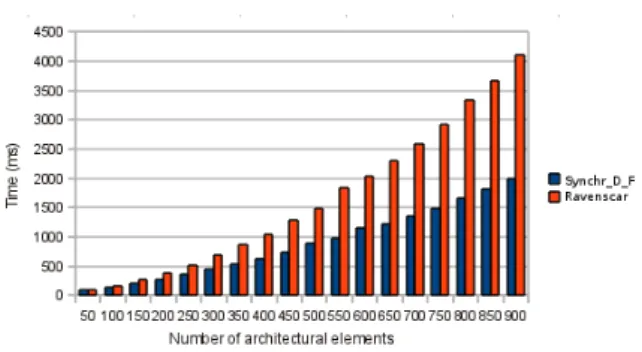
Figure 13 gives the response time of the design pattern recognition algorithm, depending on the number of tasks and dependencies. This evaluation has been performed un-der Ubuntu 10.04 on a processor Intel(R) Dual CPU T2330 1.60GHz with 2,0GiB RAM memory. This evaluation shows that our prototype is robust to scaling, which is important from an industrial perspective. Moreover, the computation time required to check the compliance and to select feasibil-ity tests is linear to the number of tasks in the system. For the second set of generated architectures, all the unmet ap-plicability constraints have been found. As pointed by figure 13, the response time of the design pattern recognition algo-rithm for large systems (1000 tasks and 1000 dependencies) is reasonable for an interactive design tool.
6.2.2
Evaluation of case studies
We have investigated two case studies : the automotive system presented in section 4 and the mars pathfinder archi-tecture [4]. The feasibility tests selected for the automotive system are described in section 5.4. Those five feasibility tests are enough to prove the schedulability of the system.
The mars pathfinder architecture is an instance of the Ravenscar design pattern. It contains seven tasks. Four of them share a data component. The access to the shared data is made by a mutex. The tasks’s priorities are static and the scheduling protocol is Rate Monotonic. With the use of our approach, we select five feasibility tests : one based on exhaustive simulation (test S1), two based on processor utilization factor (test C3, test C4) and two based on worst case response time (test R1, test R2)[16].
7.
RELATED WORKS
Multiples approaches also investigate the domain of con-straints checking within real-time systems.
Gilleset al. define a constraint language for AADL called REAL (Requirement Enforcement Analysis Language)[8]. REAL is developed by Telecom-Paris-Tech and ISAE and should be adopted as an AADL standard annex. REAL en-ables one to express different kinds of constraints directly on AADL architecture models. Authors have shown it could be used to express applicability constraints similar to those we aim to model. OCL (Object Constraint Language) enables
Figure 13: Response times for the design pattern recognition algorithm in function of the number of tasks and dependencies (number of tasks = number of dependencies).
to express the same constraints we use, but for UML mod-els[21]. Another specification approach related to our design patterns can be found in the HOOD method and in the defi-nition of HRT-HOOD whose goal is to comply with the Ada Ravenscar model [3]. Panunzioet al. define an engineering process based on the RCM meta-model (Ravenscar Compu-tation Model)[11]. Performance verifications are proceeded by the MAST framework [9]. Like Cheddar, MAST imple-ments several feasibility tests. Finally, PPOOA proposes an approach similar to our design patterns [6]. PPOOA is implemented as an UML extension and provides a set of predefined synchronization mechanisms. Moreover, the au-thors underline the importance of applying feasibility tests early in the design process and use Cheddar to do so. Each of those methods studies the validation of a set of real-time architectures with a static number of design patterns. In our approach, we would like to let the designer specify new design patterns and automatically generate the validation tool.
8.
CONCLUSION
In this article, we have presented an approach enabling the automatic selection of feasibility tests in order to do the verification of real-time systems. We have proposed a design method. We use design patterns based on inter-task com-munication protocols to reduce the diversity of architecture models. Thus, an algorithm was defined to check the com-pliance of the architecture model to a design pattern and to select a specific set of feasibility tests. In order to evalu-ate our work, we have generevalu-ated code within Cheddar and made a prototype. Now, we will look for the analysis of more complex systems, resulting of design patterns compo-sition. For now, we are able to compose design pattern two by two based on static rules. A second future work consists in designing a simple process to define new design patterns.
9.
ACKNOWLEDGMENTS
We would like to thank Ellidiss Technologies and Region Bretagne for their support to this project.
10.
REFERENCES
[1] Arinc.Avionics Application Software Standard Interface. The Arinc Committee, January 1997. [2] A. Burns, B. Dobbing, and G. Romanski. The
ravenscar tasking profile for high integrity real-time programs. In Lars Asplund, editor,Reliable Software Technologies Ada-Europe, volume 1411 ofLecture Notes in Computer Science, pages 263–275. Springer Netherlands, 1998.
[3] A. Burns and A.J. Wellings.HRT-HOOD: a structured design method for hard real-time Ada systems,
volume 3. Elsevier Science, 1995.
[4] F. Cottet, J. Delacroix, C. Kaiser, and Z. Mammeri.
Scheduling in real-time systems. Wiley Online Library, 2002.
[5] P. Dissaux and F. Singhoff. Stood and Cheddar : AADL as a Pivot Language for Analysing
Performances of Real Time Architectures. Proceedings of the European Real Time System conference. Toulouse, France, January 2008.
[6] J. Fern´andez S´anchez and G. M´armol Acitores. Modelling and Evaluating Real-Time Software Architectures.Reliable Software
Technologies–Ada-Europe 2009, LNCS Springer, Volume 5570, pages 164–176, 2009.
[7] L. George, N. Rivierre, and M. Spuri. Preemptive and Non-Preemptive Real-time Uni-processor Scheduling. INRIA Technical report number 2966, 1996.
[8] O. Gilles and J. Hugues. Expressing and enforcing user-defined constraints of AADL models. In2010 15th IEEE International Conference on Engineering of Complex Computer Systems, pages 337–342. IEEE, 2010.
[9] G. Harbour, G. Garcia, P. Gutierrez, D. Moyano, et al. MAST: Modeling and analysis suite for real time applications. InReal-Time Systems, 13th Euromicro Conference on, 2001., pages 125–134. IEEE, 2002. [10] C.L. Liu and J.W. Layland. Scheduling algorithms for
multiprogramming in a hard-real-time environment.
Journal of the ACM (JACM), 20(1):46–61, 1973. [11] M. Panunzio and T. Vardanega. A metamodel-driven
process featuring advanced model-based timing analysis. InReliable software technologies: Ada-Europe 2007: 12th Ada-Europe International Conference on Reliable Software Technologies, Geneva, Switzerland, June 25-29, 2007: proceedings, pages 128–141. LNCS Springer-Verlag New York Inc, Volume 4498, 2007. [12] A. Plantec and F. Singhoff. Refactoring of an Ada 95
Library with a Meta CASE Tool.ACM SIGAda Ada Letters, ACM Press, New York, USA, 26(3):61–70, November 2006.
[13] A. Plantec, F. Singhoff, P. Dissaux, and J. Legrand. Enforcing applicability of real-time scheduling theory feasibility tests with the use of design-patterns. In Tiziana Margaria and Bernhard Steffen, editors,
Leveraging Applications of Formal Methods, Verification, and Validation, volume 6415 ofLecture Notes in Computer Science, pages 4–17. Springer Berlin / Heidelberg, 2010.
[14] Platypus Technical Summary and download. http://cassoulet.univ-brest.fr/mme/, 2007. [15] SAE. Architecture Analysis and Design Language
(AADL) AS-5506A. Technical report, The Engineering Society For Advancing Mobility Land Sea Air and Space, Aerospace Information Report, Version 2.0, January 2009.
[16] F. Singhoff. A taxonomy of real-time scheduling theory feasibility tests. LISyC Technical report, number singhoff-01-2010, Available at
http://beru.univ-brest.fr/~singhoff/cheddar, February 2010.
[17] F. Singhoff and A. Plantec. Towards User-Level extensibility of an Ada library : an experiment with Cheddar. Proceedings of the 12th International Conference on Reliable Software Technologies, Ada-Europe. LNCS Springer-Verlag, Volume 4498, pages 180-191, Geneva, June 2007.
[18] F. Singhoff, A. Plantec, P. Dissaux, and J. Legrand. Investigating the usability of real-time scheduling theory with the Cheddar project.Real-Time Systems, 43(3):259–295, 2009.
[19] P. Spiby. ISO 10303 industrial automation systems–product data representation and
exchange–part 11: Description methods: The express language reference manual.ISO DIS, pages 10303–11, 1992.
[20] S. Vestal. Meta-H User’s Manual, Version 1.27. Technical report, download at
http://www.htc.honeywell.com/metah/uguide.pdf, 1998.
[21] Jos Warmer and Anneke Kleppe.The Object
Constraint Language: Getting Your Models Ready for MDA. Addison-Wesley Longman Publishing Co., Inc., Boston, MA, USA, 2 edition, 2003.