World Library and Information Congress:
71th IFLA General Conference and Council
"Libraries - A voyage of discovery"
August 14th - 18th 2005, Oslo, Norway
Conference Programme: http://www.ifla.org/IV/ifla71/Programme.htm
3rd Version: September 28, 2005
Code Number: 027-E
Meeting: 75 Reference and Information Services
Virtual versus Face-to-Face Reference: Comparing Users' Perspectives on Visits to Physical and Virtual Reference Desks in Public and Academic Libraries
Kirsti Nilsen
University of Western Ontario London, Ontario, Canada
Abstract
This paper compares face-to-face and virtual reference services based on the Library Visit Study, an ongoing research project that focuses on users' perceptions of their
experiences asking questions of physical and virtual reference "desks." Data from 261 in-person and 85 virtual reference transaction accounts (both email and chat) show that, based on the "willingness to return" criterion, virtual reference results in lower
satisfaction than does face-to-face reference. Underlying problems that are associated with user dissatisfaction were identified in face-to-face reference and carry over to virtual reference, including lack of reference interviews, unmonitored referrals and failure to follow-up. The reasons for ongoing failures are examined and solutions that can help improve both face-to-face and virtual reference are included.
Introduction
Since 1991, a group of Canadian researchers at The University of Western Ontario has been engaged in a long-term project that we call the Library Visit Study, examining what happens when users ask reference questions in libraries. My colleagues Catherine Ross and Patricia Dewdney and I have been seeking to determine users' perceptions about reference services and to try to understand what makes users satisfied and willing to return. The study has been conducted in three phases (1991-993, 1998-2000, and
2003-2005) and several articles1 have been published, along with the book Conducting the Reference Interview.2
The first two phases of the research examined on what happens when patrons ask questions face-to-face at reference desks in libraries, and the last phase looks at what happens when patrons ask questions at virtual reference desks. In this paper, I am focusing on the findings that compare user experiences at the two types of reference desks in order to suggest how both face-to-face and virtual reference can be improved. This paper will not address questions such as how much time was spent during the transactions, or whether the answers were correct. Rather, the paper focuses on user satisfaction with the experience as a whole, and then considers causes of dissatisfaction, in particular, the behaviour of reference staff that users described or inferred in their accounts of their visits to face-to-face and virtual reference desks.
Methodology
All three phases of the Library Visit Study have used the same methodology, developed originally from a teaching exercise. For the face-to-face component (phases 1 and 2), beginning MLIS students in consecutive offerings of a first term course at The University of Western Ontario each visited a Canadian public or academic library of their own choiice and asked a question that interested them personally and that was unrelated to their course work. For the virtual component (phase 3), students in advanced courses at the University of Western Ontario and at the University of Toronto have asked similar questions at virtual reference desks (also at different Canadian academic and public libraries) using either chat or email services..
Following their face-to-face or virtual visits, the students write an account of exactly what happened after they asked their question, reflect on their experiences, summarizing what aspects they found helpful or unhelpful, and complete a questionnaire evaluating their experience as a user of the reference service. In the case of virtual reference, the written accounts and questionnaires are supplemented by copies of the emails exchanged or transcripts of chat sessions that provide an additional source of evidence that is not so easily available for face-to-face transactions.
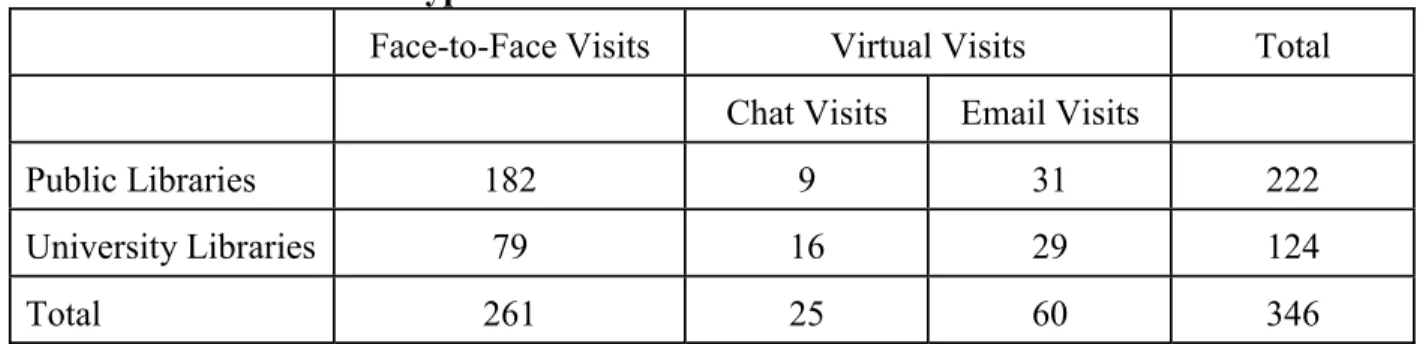
This paper provides data from 261 face-to-face reference transactions conducted during 1991-1993 and 1998-2000, and from 85 virtual transactions conducted during 2003-2005. Table 1 table provides data on the number and type of libraries visited. Table 1. Number and Types of Libraries Visited
Face-to-Face Visits Virtual Visits Total Chat Visits Email Visits
Public Libraries 182 9 31 222
University Libraries 79 16 29 124
Total 261 25 60 346
More users chose to go to email virtual reference sites than to chat sites, probably because many had never used chat before and felt uncomfortable in trying it for a course assignment.
User Satisfaction
Research on face-to-face reference based on unobtrusive and observational studies has consistently shown a success rate in the 55% to 65% area. The classic example is the 55% rule suggested by Peter Hernon and Charles R. McClure's study based on correctness of answers to unobtrusive questions.3 Joan Durrance's observational study of 266 face-to-face interviews found a 63% success rate based on the "willingness to return" criterion (see below).4 Much evaluation of virtual reference service has been done by individual libraries that gather satisfaction data from their users, often using pop-up questionnaires. The data produced from these questionnaires may be useful for
internal reasons, but those who take the time to fill out the questionnaires are usually highly satisfied and users who have "disappeared" during the transaction cannot be surveyed. A few empirical studies of virtual reference have been done, and the findings are consistent with those for face-to-face reference. For example, an unobtrusive study of virtual reference services by Neal Kaske and Julie Arnold found that where success was measured by correctness of answers, the success rate for 180 email sessions and 107 chat transactions was 59.8% and 54.9% respectively.5 It appears that the 55% rule still holds.
Throughout the Library Visit Study, a single measure of user satisfaction has been used, that is, "Willingness to Return." This user-centred indicator of satisfaction was first proposed by Durrance in 1989, who argued that it permits a comparison of factors
including the user's "ability to identify the professional, interpersonal style, interviewing skill, search strategies used, as well as accuracy of responses.6 Thus this measure pulls together the factors we are considering in this paper (staff behaviour), as well as other factors that will be considered in future data analysis.
In the questionnaire which our users fill out they are asked (for face-to-face encounters) "Given the nature of this interaction, if you had the option, would you return to this staff member again with another question?", and (for virtual encounters) "Given the nature of this interaction, if you had the option, would you return to this digital reference site again with another question?" Table 2provides the data comparing face-to-face and virtual reference encounters and comparing chat and email encounters. Table 2 Would you be willing to return? Percent Responding "Yes"
Virtual Reference (n=85) Face-to-Face
Reference
(n = 261) Email (n= 60) Chat (n=25) VirtualTotals Public Libs 61% (111 / 182) 58% (18 / 31) 78% (7 / 9) 62.5% University Libs 75% (59 / 79) 52% (15 /29) 62.5% (10 /16) 55.5%
When all transactions at both face-to-face and virtual reference desks at both public and academic libraries are combined 63.6% were willing to return, 61%.to public libraries and 68% to university libraries. Overall this does not look bad, but it still means that more than one-third of users are unsatisfied. These data clearly show that users were not as satisfied with virtual visits as they were with face-to-face ones. However, the data need to be interpreted with caution because the total number of virtual visits is low, and because the beginning MLIS students who do the face-to-face visits may be less critical (because they have not yet been introduced to reference interviewing) than are the advanced students who undertake the virtual visits. However, because they are more critical, we can perhaps learn more from their observations than we would from users randomly selected from the general population (who seldom say anything critical about libraries). Those visiting university libraries for face-to-face encounters were more satisfied than those visiting public libraries. however, for virtual visits, the reverse is true, with higher satisfaction rates noted at public libraries, than at university libraries. Those using chat showed a higher satisfaction rate than did those using email, and for both email and chat, the satisfaction rate was highest among those who used public libraries. The number of visits to chat and email services is too low to calculate significance and these findings might not hold up over a larger sample. However, the data have remained remarkably consistent from the beginning of data gathering in 2003, so it is likely that even with more accounts, the proportions will remain close to those in Table 2. It appears that the 55% rule applies for email. Chat services elicit more positive feedback, but even here almost one-third said they would not return. What makes users unwilling to return ? Causes of Dissatisfaction
Users often point to barriers to access. At the face-to-face reference desk they note a lack of clear signage for reference desks, lack of any means of identifying professional
librarians, unapproachable busy library staff hunkering down in front of their computers.7 At the virtual reference desk they note deeply hidden links to these services, requirements for personal information that would never be asked for in face-to-face encounters, lack of description of the service or instruction, and technical barriers. However these barriers are not keeping people from returning to the service. Some users are unsatisfied with the answer received, though not all who receive unsatisfactory answers say that they will not return.8 What, then, makes users unsatisfied? Through the Library Visit Study, three underlying problems that result in user dissatisfaction have been identified, and these are all related to staff behaviour: (1) bypassing the reference interview, (2) unmonitored referrals, and (3) failure to ask follow up questions. As Table 3shows, these failures occur in both face-to-face and virtual interviews.. Let's look at each in turn.
Table 3 Percent of Library Visits in Which Problem Behaviours Were Reported
Behaviours Face-to Face
(n =261) Virtual Reference (n=85) No Reference Interview Unmonitored Referral No Follow-up 49% (n=129) 37% (n=96) 63% (n=165) 80% (n=68) 38% (n=32) 73% (n=62)
• Bypassing the reference interview occurs when the librarian takes the user's initial statement at face value and makes no attempt to determine if the question posed is what the user really wants to know. In the Library Visit Study we identify a reference
interview as occurring when the librarian asks at least one question to find out more about the user's information need. It is counted as a reference interview if a clarifying question is asked at any time during the transaction by any staff member including a second attempt when a patron starts over again with a second librarian. Also counted are responses that are not formally questions but have the performative function of a
question, such as repeating the key words of the user's statement and pausing strategically to encourage further elaboration. The same criteria apply to virtual interviews, however the performative question is less likely to occur (though in a chat transaction the librarian could do the same by repeating the key words with a question mark).
Often in face-to-face interviews, the librarian hears the question and turns to the computer and begins to type something. Usually the patron has no idea what is being typed. We call this the "without speaking she began to type" manoeuvre, after which a call number scribbled on a piece of paper and handed to the patron with the comment, "Browse in this area." Sometimes this manoeuvre helps the patron, often it does not. In virtual interviews, the librarian usually asks no questions and often simply supplies the user with some URLs and closes with "Hope this helps!" Very often, it doesn't.
Data in published studies on virtual reference tend to focus on number and type of users and questions, speed of response, accuracy of answers, sources used to answer the questions and system issues. Other than the research done for the Library Visit Study, very little has been published on the extent to which interviews occur at the virtual reference desk. In the face-to-face transactions examined for the Library Visit Study (see Table 3), only 51% involved a reference interview, (consistent with earlier research that showed that interviews occurred in only about 50% of transactions9), Virtual transactions seldom reach even 50%; of the total virtual transactions done for the Library Visit Study only 20% involved an interview. Of the email transactions, only 10% (6 of 60) included interviews (three of these were deemed to be interviews only because users were required to fill in forms which asked many of the questions that would be asked in a good
reference interview). While interviewing is recommended for email transactions,10 it is seldom done. I have not located any other studies of frequency of interviews using email, though keeping copies of email exchanges can be easily done. Chat transcripts offer an innate advantage over face to face or email transactions because they automatically provide a fine grained and accurate record which can be used by researchers to examine aspects of the transaction. A few studies have been done of the frequency of interviews in chat transactions. One, by David Ward, found that 48% (47 of 98) chat transcripts
involved a reference interview,11 and in an unpublished study done for a Canadian collaborative digital reference service, Diane Granfield reports that of 661 chat transcripts analyzed by MLIS students, only 36% had reference interviews12 These findings are consistent with those of the Library Visit Study, in which 44% (11 of 25) of the chat transactions involved an interview.
• Unmonitored Referrals occur when a staff member refers the user to a source, either inside or outside of the library, but doesn't check whether the user gets a helpful answer.
This scenario is often the result of "without speaking she began to type", when the patron is handed a slip of paper with a call number and told to browse in that area. Often, the in-library patron wanders off to find the relevant section of the in-library, does not find
anything helpful and leaves disappointed. In virtual reference, the unmonitored referral occurs when URLs are sent with no information attached as to the source of the site or where the needed information can be found in it. The patron receiving the URL tries it, discovers it has nothing of relevance and doesn't come back to the virtual service again. In both cases, the staff member has not confirmed that the information is really available in the source referred to, so the referral has not been monitored. Usually there is no follow-up statement from the librarian (see below) so the user does not come back to the reference desk and the librarian happily records another successful interaction. In the articles published from the Library Visit Study .we have quoted many unhappy users who never found what they wanted. In virtual reference, the problem is compounded when the staff member does a quick and dirty Google search and sends along some URLs, Because there has been no reference interview, the librarian assumes that the patron has never heard of Google and is incapable of doing a search on it. As one user wrote, "I was disappointed that the librarian assumed that I had not already tried a basic web search. If I showed enough competence to complete the web form, I should think I would be capable of typing 'animal tracks' in Google as [the librarian] did." Virtual reference should be seen as a "post-Goggle" environment.
As the data in Table 3 show, about 62% of librarians do monitor their referrals in both face-to-face and virtual transactions. This still leaves almost 40% of patrons being sent on wild goose chases. Sometimes this problem results from the desire to get rid of the user, described so well by Ross and Dewdney in their article on negative closure.13
The problem with unmonitored referrals is that users have not been helped with their information need. They may leave and never return. Before referring patrons to call number areas or sending along URLs, librarians need to check if the information the user is asking for is really in the source. In face-to-face reference it isn't always practical for the staff member to accompany the patron to the location where the books are located, but call numbers should be specific and include book titles and authors (e.g. not "look in this area") and the patron should be urged to return to the desk if the search is not fruitful (using follow-up). In asynchronous email exchanges, there is time to check whether the needed information is contained in the items to which the user is referred. Both face-to-face and virtual users are referred to virtual sites, and these should be checked for the needed information and the names and authority of the sites should be provided along with the URLs. It is too easy to inadvertently delete a URL, and without the added information, all is lost.
• Follow Up occurs when the librarian makes an effort to check on the helpfulness of the answer by asking the user if the information provided fully met his or her information need and by inviting the user to return for further help if the answer was not adequate or sufficient. This is very easily done in both face-to-face and virtual transaction yet is routinely overlooked. In Ward's study, it was found that there was follow-up in 22.5% (22 of 98) of chat transcripts analyzed.14 As Table 3shows, in the Library Visit Study follow-up occurred only 27% of the time in both face-to-face and virtual transactions,
had helped the patron or not. Follow-up allows the librarian to recover from past mistakes, and should be routinely included in every face-to-face and virtual reference transaction,
Why Do These Problems Persist?
In 1984, MarjorieMurfin and Charles Bunge noted that a factor strongly
associated with inadequate reference service is the unmonitored referral,15.and in 1985, Ralph Gers and Lillie J. Seward noted that the behaviour "most strongly associated with correctness of answers…is questioning the user to determine specifically what his or her question is" and that follow-up is the "single most important" behaviour in the reference transaction.16 The continuing failure to conduct reference interviews, to monitor
referrals, and to ask follow-up questions in face-to-face interviews is bad enough, but the data for virtual transactions is depressing.
Why do librarians bypass the reference interview and follow-up to such an extent in both face-to face and virtual transactions? Some blame the "bad-guy" users for not specifically asking for what they need, others assume that patrons know what information will answer their questions, and others argue that there is no time for the reference
interview, that busy librarians must take the question at face value, and move on. The blame-the-user response takes no account of the fact that many patrons do not have a clear idea of what information is needed and most patrons have no idea of the complexity of libraries or of how librarians can help them.17 The "I don't have time to do reference interviews" attitude results in wasting more time: both for library staff and for users. Users spend time fruitlessly looking at materials provided in unmonitored referrals and library staff spend time looking for call numbers and sending URLs that do not help the user in any event. In addition, overlooking the interview can be costly to the library system. Often, users reported that books were ordered from other branches or other libraries which were of no use to them.
Some virtual reference services limit the type of questions that can be asked to "quick ready-reference" possibly based, as Joseph Janes notes, on the incorrect notion that it's impossible to do a reference interview in this environment, and therefore only factual questions should be asked for.18 The problem with this tactic is that users have no idea what a quick ready reference question is, and librarians are sometimes surprised that what looks like a quickly answered question turns out to be very complicated.
The explanation as to why the two different modes of virtual reference have such different incidences of reference interviews (10% for email and 44% for chat) clearly relates to the technology. It is not easy to conduct a reference interview in email,
sometimes the user doesn't respond to clarifying questions, and too many back and forth exchanges can result in annoyed users and difficulties if different staff members deal with the same query. It's best to send some information with the first reply from the librarian along with the clarifying question(s); it's even better to have a good form that users must fill in that substitutes for the interview.19
Because the technology allows for a reference interview to occur in chat
transactions, there is no excuse for overlooking the reference interview, yet in the Library Visit Study, 56% of these transactions made no attempt to interview the patrons, even worse than the 49% avoidance of interviews in face-to-face transactions. Why do librarians conducting chat transaction overlook the interview in chat? In the literature,
librarians report that they feel rushed when doing chat transactions, they worry that the patron is waiting, and feel that they have to send a quick response.20 In other words, the technology is urging them to move through the reference transaction quickly. Yet most reports suggest that chat transactions always take longer than in-person reference transactions. As we noted in the Library Visit Study, because there was no interview some of that time was being spent pushing inappropriate pages to patrons. If libraries are going to spend so much time providing chat services, it stands to reason that they should be trying to do it right.
In both face-to-face and virtual reference, it. would be much more cost and time efficient if, at the outset, a few minutes were taken to conduct a reference interview to find out what the patron really wants to know before starting to search library catalogues or bombard him or her with URLs, and pushed pages.
. Solutions
Some people argue that we should not try to compare face-to-face and virtual reference, that virtual reference is so different from face-to-face reference —visual and aural cues are lost, expectations of users are heightened—that the criteria by which we judge them should be completely different. I disagree. We need to ask why we are providing virtual reference services. Is it only to show the world that libraries are cool, up-to-date, and technologically savvy? Is it only to give the patron a chance to connect with someone in the library? Or is it to help users with their information needs and answer their questions? If we do want to answer patron questions, then we should judge our virtual services using the same criteria that we use for in-person reference.
Education and training of reference librarians needs to ensure that librarians not only know the reference sources but understand the importance of interpersonal
communication in the reference process.21 The criteria for providing face-to-face and virtual reference services are readily available and can be used in training library staff. The Reference and User Services Association (RUSA) provides various guidelines on behavioural performance and professional competencies that are useful documents for training. 22 To improve virtual reference RUSA also has guidelines on implementing and maintaining virtual reference services that provide many suggestions, including referring to the behavioural performance and competencies documents. 23 Jana Smith Ronan has developed behavioral guidelines for chat librarians, based on the RUSA24 The IFLA Digital Reference Guidelines 25 in which interviewing is identified as one of the skills needed by digital librarians; the document refers to the RUSA behavioral guidelines as well. All of these guidelines can assist us in improving reference services and set a standard that individual libraries offering face-to-face and virtual reference can strive to achieve.
Notes
1 The articles to date, in the order published are: Patricia Dewdney and Catherine
Sheldrick Ross, “Flying a light aircraft: reference service evaluation from a user’s viewpoint,” RQ 34 no. 2 (1994): 217-30; Catherine Sheldrick and Patricia
strategies in the reference transaction," Reference & User Services Quarterly 38 no. 2 (1998): 151-63. Catherine Sheldrick Ross, and Kirsti Nilsen, “Has the Internet changed anything in reference? The Library Visit Study phase 2," Reference and User Services Quarterly 40 no. 2 (2000): 147-55; Kirsti Nilsen, "The Library Visit Study: user experiences at the virtual reference desk," Information Research 9 no. 2 (2004) Paper no. 171,available at http://informationr.net/ir/9-2/paper171.html, (25 April 25, 2005); Kirsti Nilsen and Catherine Sheldrick Ross, (forthcoming, 2005), "Evaluating virtual reference from the users' perspective," Reference Librarian. 2 Catherine Sheldrick Ross, Kirsti Nilsen, and Patricia Dwdney, Conducting the Reference Interview: A How-To-Do-It Manual for Librarians (New York: Neal Schuman, London: Facet), 2002.
3.See for example, Peter Hernon and Charles R. McClure, "Unobtrusive reference
testing: the 55 % rule," Library Journal 111 (April 15, 1986): 37-41
4 Joan C. Durrance, "Reference success: does the 55 percent rule tell the whole
story?" Library Journal 114 no. 7 (April 15, 1989): 31-36..
5 Neal Kaske and Julie Arnold. "An unobtrusive evaluation of online real time
library reference services," Library Research Round Table, American Library Association Annual Conference, Atlanta, Georgia, June 15, 2002, available at http://www.lib.umd.edu/groups/digref/LRRT.html. (25 April 2005)
6 Durrance, "Reference success, 34.
7 Ross, Nilsen, and Dewdney, Conducting the Reference Interview, 47-48. 8 Durrance, "Reference success, " 35.
9 Ross, Nilsen, and Dewdney, Conducting the reference Interview, 71-72.
10 Eileen G. Abels, "The e-mail reference interview," RQ 35 no. 3 (1996): 345-58. 11 David Ward, "Using virtual reference transcripts for staff training," Reference Services Review 31 no. 1 2003: 46-56.
12 The 36% with reference interviews occurred on transcripts for all types of
questions combined (reference, policy, technical) and it is not yet known how many of the reference questions resulted in interviews. .Diane Granfield, "Ontario Collaborative Virtual Reference Project" (Toronto: Ryerson University Library), [power point
presentation at Faculty of Information Studies, University of Toronto, February 1, 2005; and personal communication, April 25, 2005.
14 Ward, "Using virtual reference transcripts for staff training," 53.
15 Marjorie Murfin and Charles Bunge, "Evaluating reference service from the
patron point of view: some interim national survey results," The Reference Librarian 11 (1984): 175-82.
16 Ralph Gers and Lillie J. Seward, "Improving reference performance: results of a
statewide study," Library Journal 110 no. 8 (November 1, 1985): 32-35.
17 See "Why Didn't You Say So in the First Place?" in Ross, Nilsen, and Dewdney, Conducting the Reference Interview, 17-29.
18 Joseph Janes, Introduction to Reference Work in the Digital Age (New York:
Neal Schuman, 2003), 54.
19 Janes, Introduction to Reference Work in the Digital Age, 55-68.
20 See, for example, Kelly Broughton, "Our experiment in online, real-time
reference,: Computers in Libraries 24 no. 4 (2001): 26-28, 30-31.
21 See, for example, Marie L. Radford, The Reference Encounter: Interpersonal Communication in the Academic Library (Chicago: Association of College and Research Libraries, American Library Association, 1999).
22 Reference and User Services Association, Guidelines for Behavioral Performance of Reference and Information Service Providers; Professional
Competencies for Reference and User Services Librarians, (Chicago: ALA, June 2004; January, 2003) available at
http://www.ala.org/ala/rusa/rusaprotools/referenceguide/Default2277.htm (28 April 28, 2005)
23 Reference and User Services Association, Guidelines for Implementing and Maintaining Virtual Reference Services (Chicago: ALA, June, 2004), available at http://www.ala.org/ala/rusa/rusaprotools/referenceguide/virtrefguidelines.htm (28 April 2005).
24 Jana Smith Ronan, Chat Reference: A Guide to Live Virtual Reference Services
(Wesport, Conn: Libraries Unlimited, 2003), 149-59.
25 IFLA, Reference and Information Services Section, IFLA Digital Reference Guidelines The Hague: IFLA, last revised April 2005) available at