PDF hosted at the Radboud Repository of the Radboud University
Nijmegen
The following full text is a publisher's version.
For additional information about this publication click this link.
http://hdl.handle.net/2066/112949
Please be advised that this information was generated on 2016-08-22 and may be subject to
change.
The perfect solution for detecting sarcasm in tweets #not
Christine Liebrecht
Centre for Language Studies Radboud University Nijmegen
P.O. Box 9103 NL-6500 HD Nijmegen
Florian Kunneman
Centre for Language Studies Radboud University Nijmegen
P.O. Box 9103 NL-6500 HD Nijmegen
Antal van den Bosch
Centre for Language Studies Radboud University Nijmegen
P.O. Box 9103 NL-6500 HD Nijmegen
Abstract
To avoid a sarcastic message being understood in its unintended literal meaning, in microtexts such as messages on Twitter.com sarcasm is often explicitly marked with the hashtag ‘#sar-casm’. We collected a training corpus of about 78 thousand Dutch tweets with this hashtag. Assuming that the human labeling is correct (annotation of a sample indicates that about 85% of these tweets are indeed sarcastic), we train a machine learning classifier on the har-vested examples, and apply it to a test set of a day’s stream of 3.3 million Dutch tweets. Of the 135 explicitly marked tweets on this day, we detect 101 (75%) when we remove the hashtag. We annotate the top of the ranked list of tweets most likely to be sarcastic that do not have the explicit hashtag. 30% of the top-250 ranked tweets are indeed sarcastic. Analysis shows that sarcasm is often signalled by hy-perbole, using intensifiers and exclamations; in contrast, non-hyperbolic sarcastic messages often receive an explicit marker. We hypothe-size that explicit markers such as hashtags are the digital extralinguistic equivalent of non-verbal expressions that people employ in live interaction when conveying sarcasm.
1 Introduction
In the general area of sentiment analysis, sarcasm plays a role as an interfering factor that can flip the polarity of a message. Unlike a simple negation, a sarcastic message typically conveys a negative opin-ion using only positive words – or even intensified positive words. The detection of sarcasm is there-fore important, if not crucial, for the development
and refinement of sentiment analysis systems, but is at the same time a serious conceptual and tech-nical challenge. In this paper we introduce a sar-casm detection system for tweets, messages on the microblogging service offered by Twitter.1
In doing this we are helped by the fact that sar-casm appears to be a well-understood concept by Twitter users, as seen by the relatively accurate use of an explicit marker of sarcasm, the hashtag ‘#sar-casm’. Hashtags in messages on Twitter (tweets) are explicitly marked keywords, and often act as cate-gorical labels or metadata in addition to the body text of the tweet. By using the explicit hashtag any remaining doubt a reader may have is taken away: the message is intended as sarcastic.
In communication studies, sarcasm has been widely studied, often in relation with, or encom-passed by concepts such as irony as a broader cate-gory term, and in particular in relation with (or syn-onymous to) verbal irony. A brief overview of def-initions, hypotheses and findings from communica-tion studies regarding sarcasm and verbal irony may help clarify what the hashtag ‘#sarcasm’ conveys. 1.1 Definitions
Many researchers treat irony and sarcasm as strongly related (Attardo, 2007; Brown, 1980; Gibbs and O’Brien, 1991; Kreuz and Roberts, 1993; Muecke, 1969; Mizzau, 1984), and sometimes even equate the terms in their studies in order to work with an usable definition (Grice, 1978; Tsur et al., 2010). We are interested in sarcasm as a linguistic phenomenon, and how we can detect it in social
me-1http://www.twitter.com
dia messages. Yet, Brown (1980) warns that sarcasm ‘is not a discrete logical or linguistic phenomenon’ (p. 111), while verbal irony is; we take the liberty of using the term sarcasm while verbal irony would be the more appropriate term. Even then, according to Gibbs and Colston (2007) the definition of ver-bal irony is still a ‘problem that surfaces in the irony literature’ (p. 584).
There are many different theoretical approaches to verbal irony. Burgers (2010), who provides an overview of approaches, distinguishes a number of features in ironic utterances that need to be included in an operational definition of irony: (1) irony is al-ways implicit (Giora, 1995; Grice, 1978), (2) irony is evaluative (Attardo, 2000; Kotthoff, 2003; Sper-ber and Wilson, 1995), it is possible to (3) distin-guish between a non-ironic and an ironic reading of the same utterance (Grice, 1975; Grice, 1978), (4) between which a certain type of opposition may be observed (see also Kawakami, 1984, 1988, summa-rized in (Hamamoto, 1998; Partington, 2007; Seto, 1998). Burgers’ own definition of verbal irony is ‘an evaluative utterance, the valence of which is implic-itly reversed between the literal and intended evalu-ation’ (Burgers, 2010, p. 19).
Thus, a sarcastic utterance involves a shift in eval-uative valence, which can go two ways: it could be a shift from a literally positive to an intended neg-ative meaning, or a shift from a literally negneg-ative to an intended positive evaluation. Since Reyes et al. (2012b) also argue that users of social media of-ten use irony in utterances that involve a shift in evaluative valence, we use Burgers’ (2010) defini-tion of verbal irony in this study on sarcasm, and we use both terms synonymously. The definition of irony as saying the opposite of what is meant is com-monly used in previous corpus-analytic studies, and is reported to be reliable (Kreuz et al., 1996; Leigh, 1994; Srinarawat, 2005).
Irony is used relatively often in dialogic interac-tion. Around 8% of conversational turns between American college friends contains irony (Gibbs, 2007). According to Gibbs (2007), group members use irony to ‘affirm their solidarity by directing com-ments at individuals who are not group members and not deemed worthy of group membership’ (p. 341). When an individual sees a group’s normative stan-dards violated, he uses sarcasm to vent frustration.
Sarcasm is also used when someone finds a situa-tion or object offensive (Gibbs, 2007). Sarcasm or irony is always directed at someone or something; its target. A target is the person or object against whom or which the ironic utterance is directed (Liv-nat, 2004). Targets can be the sender himself, the addressee or a third party (or a combination of the three). Burgers (2010) showed that in Dutch written communication, the target of the ironic utterance is often a third party. These findings may be interest-ing for our research, in which we study microtexts of up to 140 characters from Twitter.
Sarcasm in written and spoken interaction may work differently (Jahandarie, 1999). In spoken in-teraction, sarcasm is often marked with a special intonation (Attardo et al., 2003; Bryant and Tree, 2005; Rockwell, 2007) or an incongruent facial ex-pression (Muecke, 1978; Rockwell, 2003; Attardo et al., 2003). Burgers (2010) argues that in writ-ten communication, authors do not have clues like ‘a special intonation’ or ‘an incongruent facial expres-sion’ at their disposal. Since sarcasm is more diffi-cult to comprehend than a literal utterance (Gibbs, 1986; Giora, 2003; Burgers, 2010), it is likely that addressees do not pick up on the sarcasm and in-terpret the utterances literally. Acoording to Gibbs and Izett (2005), sarcasm divides its addressees into two groups; a group of people who understand sar-casm (the so-called group of wolves) and a group of people who do not understand sarcasm (the so-called group ofsheep). In order to ensure that the ad-dressees detect the sarcasm in the utterance, senders use linguistic markers in their utterances. According to Attardo (2000) those markers are clues a writer can give that ‘alert a reader to the fact that a sen-tence is ironical’ (p. 7). On Twitter, the hashtag ‘#sarcasm’ is a popular marker.
1.2 Intensifiers
There are sarcastic utterances which would still be qualified as sarcastic when all markers were re-moved from it (Attardo et al., 2003), for example the use of a hyperbole (Kreuz and Roberts, 1995). It may be that a sarcastic utterance with a hyper-bole (‘fantastic weather’ when it rains) is identi-fied as sarcastic with more ease than a sarcastic ut-terance without a hyperbole (‘the weather is good’ when it rains). While both utterances convey a
erally positive attitude towards the weather, the ut-terance with the hyperbolic ‘fantastic’ may be eas-ier to interpret as sarcastic than the utterance with the non-hyperbolic ‘good’. Such hyperbolic words which strengthen the evaluative utterance are called intensifiers. Bowers (1964) defines language inten-sity as ‘the quality of language which indicates the degree to which the speaker’s attitude toward a con-cept deviates from neutrality’ (p. 416). According to Van Mulken and Schellens (2012), an intensifier is a linguistic element that can be removed or re-placed while respecting the linguistic correctness of the sentence and context, but resulting in a weaker evaluation. A commonly used way to intensify ut-terances is by using word classes such as adverbs (‘very’) or adjectives (‘fantastic’ instead of ‘good’). It may be that senders use such intensifiers in their tweets to make the utterance hyperbolic and thereby sarcastic, without using a linguistic marker such as ‘#sarcasm’.
1.3 Outline
In this paper we describe the design and imple-mentation of a sarcasm detector that marks unseen tweets as being sarcastic or not. We analyse the pre-dictive performance of the classifier by testing its ca-pacity on test tweets that are explicitly marked with the hashtag #sarcasme (Dutch for ‘sarcasm’), left out during testing, and its capacity to rank likely sar-castic tweets that do not have the #sarcasme mark. We also provide a qualitative linguistic analysis of the features that the classifier thinks are the most discriminative. In a further qualitative analysis of sarcastic tweets in the test set we find that the use of an explicit hashtag marking sarcasm occurs rela-tively often without other indicators of sarcasm such as intensifiers or exclamations.
2 Related Research
The automatic classification of communicative con-structs in short texts has become a widely researched subject in recent years. Large amounts of opinions, status updates and personal expressions are posted on social media platforms such as Twitter. The au-tomatic labeling of their polarity (to what extent a text is positive or negative) can reveal, when aggre-gated or tracked over time, how the public in
gen-eral thinks about certain things. See Montoyo et al. (2012) for an overview of recent research in senti-ment analyis and opinion mining.
A major obstacle for automatically determining the polarity of a (short) text are constructs in which the literal meaning of the text is not the intended meaning of the sender, as many systems for the de-tection of polarity primarily lean on positive and negative words as markers. The task to identify such constructs can improve polarity classification, and provide new insights into the relatively new genre of short messages and microtexts on social media. Previous works describe the classification of irony (Reyes et al., 2012b), sarcasm (Tsur et al., 2010), satire (Burfoot and Baldwin, 2009), and hu-mor (Reyes et al., 2012a).
Most common to our research are the works by Reyes et al. (2012b) and Tsur et al. (2010). Reyes et al. (2012b) collect a training corpus of irony based on tweets that consist of the hashtag #irony in order to train classifiers on different types of features (sig-natures, unexpectedness, style and emotional sce-narios) and try to distinguish #irony-tweets from tweets containing the hashtags #education, #hu-mour, or #politics, achieving F1-scores of around
70. Tsur et al. (2010) focus on product reviews on the World Wide Web, and try to identify sarcastic sentences from these in a semi-supervised fashion. Training data is collected by manually annotating sarcastic sentences, and retrieving additional train-ing data based on the annotated sentences as queries. Sarcasm is annotated on a scale from 1 to 5. As fea-tures, Tsur et al. look at the patterns in these sen-tences, consisting of high-frequency words and con-tent words. Their system achieves an F1-score of79
on a testset of product reviews, after extracting and annotating a sample of 90 sentences classified as sar-castic and 90 sentences classified as not sarsar-castic.
In the two works described above, a system is tested in a controlled setting: Reyes et al. (2012b) compare irony to a restricted set of other topics, while Tsur et al. (2010) took from the unlabeled test set a sample of product reviews with 50% of the sentences classified as sarcastic. In contrast, we apply a trained sarcasm detector to a real-world test set representing a realistically large sample of tweets posted on a specific day of which the vast majority is not sarcastic. Detecting sarcasm in social media is,
arguably, a needle-in-a-haystack problem (of the 3.3 million tweets we gathered on a single day, 135 are explicitly marked with the hashtag #sarcasm), and it is only reasonable to test a system in the context of a typical distribution of sarcasm in tweets. Like in the research of (Reyes et al., 2012b), we train a classifier based on tweets with a specific hashtag.
3 Experimental Setup
3.1 Data
For the collection of tweets for this study we make use of a database provided by the Netherlands e-Science Centre, consisting of a substantial portion of all Dutch tweets posted from December 2010 on-wards.2 From this database, we collected all tweets that contained the marker ‘#sarcasme’, the Dutch word for sarcasm with the hashtag prefix. This re-sulted in a set of 77,948 tweets. We also collected all tweets posted on a single day, namely February 1, 2013.3 This set of tweets contains approximately 3,3 million tweets, of which 135 carry the hashtag #sarcasme.
3.2 Winnow classification
Both the collected tweets with a #sarcasme hash-tag and the tweets that were posted on a single day were tokenized and stripped of punctuation. Capi-tals were not removed, as they might be used to sig-nal sarcasm (Burgers, 2010). We made use of word uni-, bi- and trigrams as features. Terms that oc-curred three times or less or in two tweets or less in the whole set were removed, as well as the hashtag #sarcasme. Features were weighted by theχ2 met-ric.
As classification algorithm we made use of Bal-anced Winnow (Littlestone, 1988) as implemented in the Linguistic Classification System.4 This algo-rithm is known to offer state-of-the-art results in text classification, and produces interpretable per-class weights that can be used to, for example, inspect the highest-ranking features for one class label. The
α and β parameters were set to 1,05 and 0,95 re-spectively. The major threshold (θ+) and the minor
2http://twiqs.nl/ 3
All tweets from February 1, 2013 onwards were removed from the set of sarcasm tweets.
4http://www.phasar.cs.ru.nl/LCS/
threshold (θ−) were set to 2,5 and 0,5. The number of iterations was bounded to a maximum of three. 3.3 Experiment
In order to train the classifier on distinctive features of sarcasm in tweets, we combined the set of 78 thousand sarcasm tweets with a random sample of other tweets posted on February 1, 2013 as back-ground corpus. We made sure the backback-ground cor-pus did not contain any of the 135 explicitly marked sarcasm tweets posted that day. As the size of a background corpus can influence the performance of the classifier (in doubt, a classifier will be biased by the skew of the distribution of classes in the training-data), we performed a comparitive experiment with two distributions between sarcasm-labeled tweets and background tweets: in the first variant, the di-vision between the two is 50%–50%, in the second, 25% of the tweets are sarcasm-labeled, and 75% are background.
4 Results
To evaluate the outcome of our machine learning ex-periment, we ran two evaluations. The first evalu-ation focuses on the 135 tweets with explicit #sar-casme hastags posted on February 1, 2013. We mea-sured how well these tweets were identified using the true positive rate (TPR), false positive rate (FPR, also known as recall), and their joint score, the area under the curve (AUC). AUC is a common evalua-tion metric that is argued to be more resistant to skew than F-score, due to using TPR rather than precision (Fawcett, 2004). Results are displayed in Table 1. The first evaluation, on the variant with a balanced distribution of the two classes, leads to a retrieval of 101 of the 135 sarcasm-tweets (75%), while nearly 500 thousand tweets outside of these were also clas-sified as being sarcastic. When a quarter of the train-ing tweets has a sarcasm label, a smaller amount of 76 sarcasm tweets are retrieved. The AUC scores for the two ratios indicates that the 50%–50% balance leads to the highest AUC score (0.79) for sarcasm. Our subsequent analyses are based on the outcomes when using this distribution in training.
Besides generating an absolute winner-take-all classification, our Balanced Winnow classifier also assigns scores to each label that can be seen as its
Pos/Neg Ratio # Training # Test
Training Examples Label tweets tweets TPR FPR AUC Classified Correct 50/50 sarcasm 77,948 135 0,75 0,16 0,79 487,955 101 background 77,499 3,246,806 0,79 0,25 0,77 2,575,206 2,575,173 25/75 sarcasm 77,948 135 0,56 0,05 0,75 162,400 76 background 233,834 3,090,472 0,92 0,43 0,74 2,830,103 2,830,045
Table 1: Scores on the test set with two relative sizes of background tweets (TPR = True Positive Rate, FPR = False Positive Rate, AUC = Area Under the Curve
confidence in that label. We can rank its predictions by the classifier’s confidence on the ‘sarcasm’ la-bel and inspect manually which of the top-ranking tweets is indeed sarcastic. We generated a list of the 250 most confident ‘sarcasm’-labeled tweets. Three annotators (the authors of this paper) made a judge-ment for these tweets as being either sarcastic or not. In order to test for intercoder reliability, Cohen’s Kappa was used. In line with Siegel and Castellan (1988), we calculated a mean Kappa based on pair-wise comparisons of all possible coder pairs. The mean intercoder reliability between the three possi-ble coder pairs is substantial (κ=.79).
When taking the majority vote of the three an-notators as the golden label, a curve of the preci-sion at all points in the ranking can be plotted. This curve is displayed in Figure 1. As can be seen, the overall performance is poor (the average precision is 0.30). After peaking at 0.50 after 22 tweets, pre-cision slowly decreases when descending to lower rankings. During the first five tweets, the curve is at 0.0; these tweets, receiving the highest overall con-fidence scores, are relatively short and contain one strong sarcasm feature in the classifier without any negative feature.
5 Analysis
Our first closer analysis of our results concerns the reliability of the user-generated hastag #sarcasme as a golden label, as Twitter users cannot all be as-sumed to be experts in sarcasm or understand what sarcasm is. The three annotators who annotated the ranked classifier output also coded a random sam-ple of 250 tweets with the #sarcasme hashtag from the training set. The average score of agreement be-tween the three possible coder pairs turned out to be moderate (κ = .54). Taking the majority vote over
Figure 1: Precision at{1. . .250}on the sarcasm class
the three annotations as the reference labeling, 85% (212) of the 250 annotated #sarcasme tweets were found to be sarcastic.
While the classifier performance gives an impres-sion of its ability to distinguish sarcastic tweets, the strong indicators of sarcasm as discovered by the classifier may provide additional insight into the us-age of sarcasm by Twitter users: in particular, the typical targets of sarcasm, and the different linguis-tic markers that are used. We thus set out to ana-lyze the feature weights assigned by the Balanced Winnow classifier ranked by the strength of their connection to the sarcasm label, taking into account the 500 words andn-grams with the highest positive weight towards the sarcasm class. These words and
n-grams provide insight into the topics Twitter users are talking about: their targets. People often talk about school and related subjects such as homework, books, exams, classes (French, chemistry, physics), teachers, the school picture, sports day, and (return-ing from) vacation. Another popular target of
sar-casm is the weather: the temperature, rain, snow, and sunshine. Apart from these two common top-ics, people tend to be sarcastic about social media itself, holidays, public transport, soccer, television programs (The Voice of Holland), celebrities (Justin Bieber), the church, the dentist and vacuum clean-ing. Many of these topics are indicative of the young age, on average, of Twitter users.
The strongest linguistic markers of sarcastic ut-terances are markers that can be seen as syn-onyms for #sarcasme, such as sarcasme (without #),#ironieandironie(irony),#cynismeandcynisme
(cynicism), or words that are strongly related to those concepts by marking the opposite of the ex-pressed utterance: #humor, #LOL, #joke (grapje), and#NOT.
Second, the utterances contain much positive ex-clamations that make the utterance hyperbolic and thereby sarcastic. Examples of those markers in Dutch are (with and without # and/or capitals): jip-pie, yes, goh, joejip-pie, jeej, jeuj, yay, woehoe, and
wow.
We suspected that the sarcastic utterances con-tained intensifiers to make the tweets hyperbolic. The list of strongest predictors show that some inten-sifiers are indeed strong predictors of sarcasm, such as geweldig (awesome), heerlijk (lovely), prachtig
(wonderful), natuurlijk (of course), gelukkig (for-tunately), zoooo (soooo), allerleukste (most fun),
fantastisch(fantastic), and heeel(veeery). Besides these intensifiers many unmarked positive words oc-cur in the list of strongest predictors as well, such as fijn (nice), gezellig (cozy), leuk (fun), origi-neel(original),slim(smart),favoriet(favorite), nut-tig (useful), and chill. Considerably less negative words occur as strong predictors. This supports our hypothesis that the utterances are mostly positive, while the opposite meaning is meant. This find-ing corresponds with the results of Burgers (2010), who show that 77% of the ironic utterances in Dutch communication are literally positive.
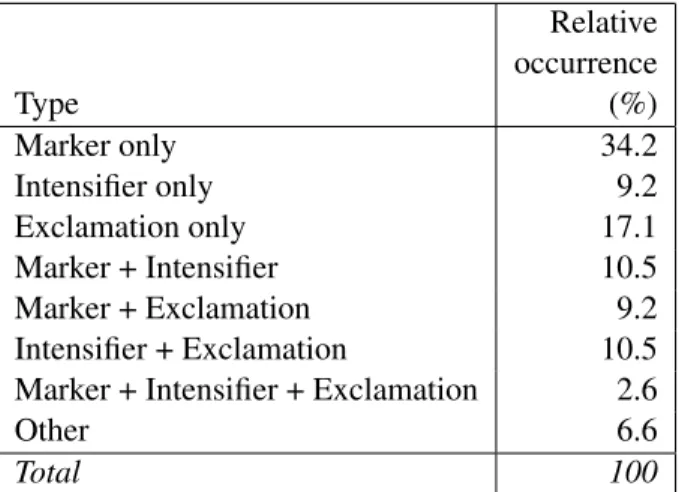
To inspect whether sarcastic tweets are always in-tensified to be hyperbolic, we need to further analyse the sarcastic tweets our classifier correctly identifies. Analyzing the 76 tweets that our classifier correctly identifies in the top-250 tweets the classifier rates as sarcastic, we see that intensifiers do not dominate in occurrence; supporting numbers are listed in
Ta-Relative occurrence Type (%) Marker only 34.2 Intensifier only 9.2 Exclamation only 17.1 Marker + Intensifier 10.5 Marker + Exclamation 9.2 Intensifier + Exclamation 10.5 Marker + Intensifier + Exclamation 2.6
Other 6.6
Total 100
Table 2: Relative occurrence (%) of word types and their combinations in the tweets annotated as sarcastic by a majority vote.
ble 2. About one in three sarcastic tweets, 34.2%, are not hyperbolic at all: they are only explicitly marked, most of the times with a hashtag. A major-ity of 59.2% of the tweets does contain hyperbole-inducing elements, such as an intensifier or an ex-clamation, or combinations of these elements. A full combination of explicit markers, intensifiers, and ex-clamations only rarely occurs, however (2.6%). The three categories of predictive word types do cover 93.4% of the tweets.
6 Conclusion
In this study we developed and tested a system that detects sarcastic tweets in a realistic sample of 3.3 million Dutch tweets posted on a single day, trained on a set of nearly 78 thousand tweets, harvested over time, marked by the hashmark #sarcasme by the senders. The classifier is able to correctly detect 101 of the 135 tweets among the 3.3 million that were explicitly marked with the hashtag, with the hashtag removed. Testing the classifier on the top 250 of the tweets it ranked as most likely to be sar-castic, it attains only a 30% average precision. We can conclude that it is fairly hard to distinguish sar-castic tweets from literal tweets in an open setting, though the top of the classifier’s ranking does iden-tify many sarcastic tweets which were not explicitly marked with a hashtag.
An additional linguistic analysis provides some insights into the characteristics of sarcasm on Twit-ter. We found that most tweets contain a literally
positive message, take common teenager topics as target (school, homework, family life) and further contain three types of words: explicit markers (the wordsarcasmeand pseudo-synonyms, with or with-out the hashmark #), intensifiers, and exclamations. The latter two categories of words induce hyper-bole, but together they only occur in about 60% of sarcastic tweets; in 34% of the cases, sarcastic tweets are not hyperbolic, but only have an explicit marker, most of which hashtags. This indicates that the hashtag can and does replace linguistic markers that otherwise would be needed to mark sarcasm. Arguably, extralinguistic elements such as hashtags can be seen as the social media equivalent of non-verbal expressions that people employ in live inter-action when conveying sarcasm. As Burgers (2010) show, the more explicit markers an ironic utterance contains, the better the utterance is understood, the less its perceived complexity is, and the better it is rated. Many Twitter users already seem to apply this knowledge.
Although in this research we focused on the Dutch language, our findings may also apply to lan-guages similar to Dutch, such as English and Ger-man. Future research would be needed to chart the prediction of sarcasm in languages that are more dis-tant to Dutch. Sarcasm may be used differently in other cultures (Goddard, 2006). Languages may use the same type of marker in different ways, such as a different intonation in spoken sarcasm by English and Cantonese speakers (Cheang and Pell, 2009). Such a difference between languages in the use of the same marker may also apply to written sarcastic utterances.
Another strand of future research would be to ex-pand our scope from sarcasm to other more sub-tle variants of irony, such as understatements, eu-phemisms, and litotes. Based on Giora et al. (2005), there seems to be a spectrum of degrees of irony from the sarcastic ‘Max is exceptionally bright’ via the ironic ‘Max is not exceptionally bright’, the un-derstatement ‘Max is not bright’ to the literal ‘Max is stupid’. In those utterances, there is a gap between what is literally said and the intended meaning of the sender. The greater the gap or contrast, the easier it is to perceive the irony. But the negatednot bright
is still perceived as ironic; more ironic than the lit-eral utterance (Giora et al., 2005). We may need to
combine the sarcasm detection task with the prob-lem of the detection of negation and hedging mark-ers and their scope (Morante et al., 2008; Morante and Daelemans, 2009) in order to arrive at a compre-hensive account of polarity-reversing mechanisms, which in sentiment analysis is still highly desirable.
References
S. Attardo, J. Eisterhold, J. Hay, and I. Poggi. 2003. Visual markers of irony and sarcasm. Humor, 16(2):243–260.
S. Attardo. 2000. Irony as relevant inappropriateness.
Journal of Pragmatics, 32(6):793–826.
S. Attardo. 2007. Irony as relevant inappropriateness. In R. W. Gibbs, R. W. Gibbs Jr., and H. Colston, ed-itors,Irony in language and thought: A cognitive sci-ence reader, pages 135–170. Lawrence Erlbaum, New York, NY.
J. W. Bowers. 1964. Some correlates of language in-tensity. Quarterly Journal of Speech, 50(4):415–420, December.
R. L. Brown. 1980. The pragmatics of verbal irony. In R. W. Shuy and A. Shnukal, editors, Language use and the uses of language, pages 111–127. Georgetown University Press, Washington, DC.
G. A. Bryant and J. E. Fox Tree. 2005. Is there an ironic tone of voice? Language and Speech, 48(3):257–277. C. Burfoot and T. Baldwin. 2009. Automatic satire de-tection: Are you having a laugh? In Proceedings of the ACL-IJCNLP 2009 Conference Short Papers, pages 161–164. Association for Computational Lin-guistics.
C. F. Burgers. 2010. Verbal irony: Use and effects in written discourse. Ipskamp, Nijmegen, The Nether-lands.
H. S. Cheang and M. D. Pell. 2009. Acoustic markers of sarcasm in Cantonese and English. The Journal of the Acoustical Society of America, 126:1394.
T. Fawcett. 2004. ROC graphs: Notes and practical considerations for researchers. Technical Report HPL-2003-4, Hewlett Packard Labs.
R. W. Gibbs and H. Colston. 2007. Irony as persua-sive communication. In R. W. Gibbs, R. W. Gibbs Jr., and H. Colston, editors,Irony in language and thougt: A cognitive science reader, pages 581–595. Lawrence Erlbaum, New York, NY.
R. W. Gibbs and C. Izett. 2005. Irony as persuasive com-munication. In H. Colston and A. Katz, editors, Fig-urative language comprehension: Social and cultural influences, pages 131–151. Lawrence Erlbaum, New York, NY.
R. W. Gibbs and J. O’Brien. 1991. Psychological as-pects of irony understanding. Journal of pragmatics, 16(6):523–530.
R. W. Gibbs. 1986. On the psycholinguistics of sar-casm. Journal of Experimental Psychology: General, 115(1):3.
R. W. Gibbs. 2007. On the psycholinguistics of sarcasm. In R. W. Gibbs, R. W. Gibbs Jr., and H. Colston, ed-itors, Irony in language and thougt: A cognitive sci-ence reader, pages 173–200. Lawrence Erlbaum, New York, NY.
R. Giora, O. Fein, J. Ganzi, N. Levi, and H. Sabah. 2005. On negation as mitigation: the case of negative irony.
Discourse Processes, 39(1):81–100.
R. Giora. 1995. On irony and negation. Discourse pro-cesses, 19(2):239–264.
R. Giora. 2003. On our mind: Salience, context, and figurative language. Oxford University Press. C. Goddard. 2006. ”lift your game Martina!”:
Dead-pan jocular irony and the ethnopragmatics of Aus-tralian English. APPLICATIONS OF COGNITIVE LINGUISTICS, 3:65.
H. Grice. 1975. Logic and conversation. In P. Cole and J. Morgan, editors,Speech acts: Syntax and semantics, pages 41–58. Academic Press, New York, NY. H. Grice. 1978. Further notes on logic and conversation.
In P. Cole, editor,Pragmatics: syntax and semantics, pages 113–127. Academic Press, New York, NY. H. Hamamoto. 1998. Irony from a cognitive perspective.
In R. Carston and S. Uchida, editors, Relevance the-ory: Applications and implications, pages 257–270. John Benjamins, Amsterdam, The Netherlands. K. Jahandarie. 1999. Spoken and written discourse: A
multi-disciplinary perspective. Greenwood Publishing Group.
H. Kotthoff. 2003. Responding to irony in different con-texts: On cognition in conversation. Journal of Prag-matics, 35(9):1387–1411.
R. J. Kreuz and R. M. Roberts. 1993. The empiri-cal study of figurative language in literature. Poetics, 22(1):151–169.
R. J. Kreuz and R. M. Roberts. 1995. Two cues for verbal irony: Hyperbole and the ironic tone of voice.
Metaphor and symbol, 10(1):21–31.
R. Kreuz, R. Roberts, B. Johnson, and E. Bertus. 1996. Figurative language occurrence and co-occurrence in contemporary literature. In R. Kreuz and M. Mac-Nealy, editors,Empirical approaches to literature and aesthetics, pages 83–97. Ablex, Norwood, NJ. J. H Leigh. 1994. The use of figures of speech in print
ad headlines. Journal of Advertising, pages 17–33. N. Littlestone. 1988. Learning quickly when irrelevant
attributes abound: A new linear-threshold algorithm.
Machine Learning, 2:285–318.
Z. Livnat. 2004. On verbal irony, meta-linguistic knowl-edge and echoic interpretation. Pragmatics & Cogni-tion, 12(1):57–70.
M. Mizzau. 1984. L’ironia: la contraddizione consen-tita. Feltrinelli, Milan, Italy.
A. Montoyo, P. Mart´ınez-Barco, and A. Balahur. 2012. Subjectivity and sentiment analysis: An overview of the current state of the area and envisaged develop-ments. Decision Support Systems.
R. Morante and W. Daelemans. 2009. Learning the scope of hedge cues in biomedical texts. In Proceed-ings of the Workshop on BioNLP, pages 28–36. Asso-ciation for Computational Linguistics.
R. Morante, A. Liekens, and W. Daelemans. 2008. Learning the scope of negation in biomedical texts. In Proceedings of the 2008 Conference on Empirical Methods in Natural Language Processing, pages 715– 724.
D. C. Muecke. 1969. The compass of irony. Oxford Univ Press.
D. C. Muecke. 1978. Irony markers. Poetics, 7(4):363– 375.
A. Partington. 2007. Irony and reversal of evaluation.
Journal of Pragmatics, 39(9):1547–1569.
A. Reyes, P. Rosso, and D. Buscaldi. 2012a. From hu-mor recognition to irony detection: The figurative lan-guage of social media. Data & Knowledge Engineer-ing.
A. Reyes, P. Rosso, and T. Veale. 2012b. A multidimen-sional approach for detecting irony in twitter. Lan-guage Resources and Evaluation, pages 1–30. P. Rockwell. 2003. Empathy and the expression and
recognition of sarcasm by close relations or strangers.
Perceptual and motor skills, 97(1):251–256.
P. Rockwell. 2007. Vocal features of conversational sarcasm: A comparison of methods. Journal of psy-cholinguistic research, 36(5):361–369.
K.-i. Seto. 1998. On non-echoic irony. In R. Car-son and S. Uchida, editors, Relevance theory: Appli-cations and impliAppli-cations, pages 239–255. John Ben-jamins, Amsterdam, The Netherlands.
S. Siegel and N. Castellan. 1988. Nonparametric statis-tics for the behavioral sciences. McGraw Hill, New York.
D. Sperber and D. Wilson. 1995. Relevance: Commu-nication and cognition. Blackwell Publishers, Oxford, UK, 2nd edition.
D. Srinarawat. 2005. Indirectness as a politeness strat-egy of Thai speakers. In R. Lakoff and S. Ide, editors,
Broadening the horizon of linguistic politeness, pages 175–193. John Benjamins, Amsterdam, The Nether-lands.
O. Tsur, D. Davidov, and A. Rappoport. 2010. Icwsm– a great catchy name: Semi-supervised recognition of sarcastic sentences in online product reviews. In Pro-ceedings of the Fourth International AAAI Conference on Weblogs and Social Media, pages 162–169. M. Van Mulken and P. J. Schellens. 2012. Over
lood-zware bassen en wapperende broekspijpen. gebruik en perceptie van taalintensiverende stijlmiddelen. Tijd-schrift voor taalbeheersing, 34(1):26–53.