Ministry of Water Resources
Ministry of Environmental Protection
EU – China
River Basin Management Programme
Technical Report 075
No.1 Document Water Resource Supply Security
Ben Piper, Zhang Wang and Liao Sihui
Document Information:
Document No: T-075 Date of Draft: 15 June 2012 Date of Issue 31 July 2012 Author: Ben Piper (TOR 454)
Zhang Wang (TOR 467) Liao Sihui
Checked by: Lars Skov Andersen Approved by: Lars Skov Andersen
Table of Contents
1
Introduction
1
1.1
Strategic studies
1
1.2
Technical studies
2
1.3
Key issues for Water Resource Security Strategy
2
1.4
Structure of the report
4
2
Recent studies on water resources in China
5
2.1
World Bank – Addressing Water Scarcity in China; Analytical and
Advisory Assistance programme (AAA)
5
2.2
ADB – Strategy for Drought Management (TA 7261-PRC) leading
to “Drying Up – What to do about droughts in the People’s Republic
of China”
7
2.3
DfID – Water Resource Demand Management Assistance Project
(WRDMAP)
9
2.4
Water Entitlements and Trading (WET) Project
10
2.4.1
Water Resources Allocation Plans and Environmental
Flows
11
2.4.2
Allocation and management of water rights within
irrigation districts
11
2.4.3
Other aspects of water entitlement and trading systems
11
3
Water resource supply security in Chinese context
13
3.1
Introduction
13
3.2
Situation and challenges
13
3.2.1
Population growth and urbanisation
13
3.2.2
Estimation of the water resources
14
3.2.3
Increasing of water use and competing demand
15
3.2.4
Over use of water in many places
15
3.3
Water resources gross control
16
3.3.1
Definition and requirements of gross control
16
3.3.2
Water drawing licensing gross control indexes
19
3.4
Water resource fee
20
3.4.1
Overview
20
3.4.2
Water prices
21
3.4.3
Irrigation water charges
22
4
Water resource assessments
23
4.1
Surface water
24
4.2
Groundwater
24
4.3
Environmental Flows
26
4.4
Assessment of water resource availability, review and publication
26
4.4.1
Current status
26
4.4.2
Scenario assessments
27
4.4.3
Outcome of the assessments
27
5
Demand forecasts
29
6
Risks
33
6.1
Climate change
34
6.2
Water quality
34
7
Planning
36
7.1
Strategic planning
38
7.1.1
Water for Life White Paper
38
7.1.2
National Water Resource Strategy
39
7.1.3
Water neutrality
39
7.2
Drought planning
39
8
Next steps
41
8.1
Urgent initial improvement during the 12
thFYP (2012-2015)
41
8.2
Medium term improvements during the 13
thFYP (2016-2020)
42
8.3
Fulfilment of the No.1 Document objectives during the 14
thand 15
thFYP 2021- 2030
42
9
References
43
List of Appendices
1
Introduction
This report compiles the background to the technical work on water resources, water demands and water allocations that has been identified during the Strategic Knowledge Exchange (SKE) on strategies for implementation of the Government of China 2011 No.1 Document on “Accelerating Water
Conservancy Reform and Development in China (No.1 Document) between the EU China River Basin Management Programme (RBMP) and the Development Research Centre (DRC) of the Chinese Ministry of Water Resources (MWR). The report draws on a number of strategic and other studies undertaken both in China, in EU Member States and elsewhere. These studies have informed the development of the Water Resources Security element of the SKE Strategy Analysis Paper published as RBMP Technical Report 081 No.1 Document Strategic Knowledge Exchange - An EU Perspective and Overview.
1.1
Strategic studies
There are a number of recent studies that have examined various aspects of water resources planning and management in China. These studies have been undertaken over a much longer duration and with more resources than have been available for this SKE. The common themes from these studies have been taken forwarded and consolidated into recommendations in the Strategy Analysis Paper.
The main recent China specific studies (see Chapter 2 for summaries) identified during the SKE are:
• Asian Development Bank – TA 7621 Strategy for Drought Management, culminating in the report “Drying-up - What to do about droughts in the People’s Republic of China” published during the course of the SKE in April 2012.
• Department for International Development (DfID) – China – UK, Water Resources Demand Management Assistance Project (WRDMAP) which over the period 2005-2010 produced a series of Advisory Notes, Thematic Papers and Guidance Notes in an Integrated Water Resources Management Document Series to support Water Resources Departments (WRD) and Water Affairs Bureaus (WAB) at provincial, municipal and county levels in their efforts to achieve sustainable water use.
• World Bank – 47111 “Addressing China’s Water Scarcity Recommendations for Selected Water Resource Management Issues”. This report synthesizes the main findings and recommendations from over 30 technical reports, case studies, and background papers prepared for the World Bank’s Analytical and Advisory Assistance (AAA) program entitled “Addressing China’s Water Scarcity:
• Australia China Environment Development Program – Water Entitlements and Trading Program (WET), 2006.
Other broader-based studies, which again include the themes of demand-side management and risk-based approaches to water resource planning include:
• 2030 Water Resources Group - Charting Our Water Future Economic frameworks to inform decision-making (2009).
• UN World Water Development Report (WWDR) – Managing Water under Risk and Uncertainty (2012).
• World Resources Institute; Freshwater Sustainability Analyses.
• European Environment Agency - Towards efficient use of water resources in Europe (2012).
The common theme from all these studies and reports is the need for strategic water resources planning to move away from relying on supply-side infrastructure options to meet increasing demands towards a more balanced approach in which demand-side management and constraining the growth in new demands as well as requiring greater water use efficiency in existing demands lies alongside supply-side infrastructure to deliver the strategy. International best-practice now requires a more risk-based approach to water resource assessments and water allocations.
In England and Wales this has been enshrined in what is called the “twin-track” approach, while in China the Three Red Lines in the No. 1 Document now include maintaining water quality as a fundamental objective, so this now becomes a “triple-track” approach for China.
1.2
Technical studies
Technical studies required to underpin robust water resource planning are available from agencies within MWR, from international agencies and from the academic sector, in both China and elsewhere. The disparate nature of these studies, and sometimes the more academic rather than practical focus means that the outcomes are rarely brought together into single bodies of work that can inform the development and application of strategy.
1.3
Key issues for Water Resource Security Strategy
The basic assumption for water resource security planning is that there should be sufficient resources available to meet the anticipated demands. If the resources available, once the essential environmental requirements of rivers and lakes have been allowed for, are insufficient, then some form of intervention is required to achieve a balance. In China this has traditionally been the construction of additional supply-side infrastructure, but increasingly (and as required by the No. 1 Document) more attention is being given to demand-side measures through water allocations and the promotion of water use efficiency targets. To date water pricing does not seem to have been widely implemented as a measure to control consumption and demand.
The key issues are then:
• What are the design conditions for planning? Should these be based on the supplies available and demands expected for average years, or the supplies available and demands expected during drier than average years?
• Having set the appropriate design conditions, what water resources are required to meet
environmental requirements, and then what is then available for consumptive and non-consumptive uses?
• Having identified the water resources available, how are these allocated between the individual consumptive and non-consumptive sectors? If drought conditions do occur, what is the
management response at national, regional and local level?
• What technical analysis is available to inform the planning and management decisions? In particular what forecasting tools are available to set water resource allocations for the coming dry season?
• In times of drought how are restrictions to the agreed allocations calculated and implemented by the various administrative and other bodies?
One of the recurring themes from the recent strategic studies from ADB, DfID and the World Bank is the need to distinguish between water scarcity and drought, and related to this the difference between risk management and disaster management.
Water scarcity is a result of water demands exceeding the available supplies. Assessing water scarcity needs to take into account the natural seasonal variability of river flows, especially for those river catchments with distinct wet and dry seasons, where dry season flows may approach zero. In areas of low rainfall, annual totals can be highly variable both spatially and from year to year.
Whilst the concept of water scarcity is sometimes applied more to surface water systems than to groundwater, it is equally important to areas, where groundwater is the major water resource. Overexploitation of groundwater is an increasing problem. When abstraction exceeds long-term recharge the magnitude of water use is not sustainable and can lead to the mining of groundwater, falling groundwater levels, decline in baseflow to surface water courses, risks to water quality and higher power usage for pumping.
Water scarcity should not be confused with drought, which occurs as a result of a shortfall of rainfall as compared with the rainfall that normally occurs (long term average seasonal or annual rainfall).. A systematic assessment of water scarcity provides the basis for a risk-management approach to water resource planning which internationally has become the main policy approach for water resource management, and when droughts do occur the basis for drought management. Risk management seeks to allow for a given level of risk that the water resources available will be not be able to meet all
allocations in full and that resilience is built into the system to deal with part of that risk. The data and analytical approaches used to assess the risk and make water allocations are also available to underpin managerial and operational decisions when droughts do happen.
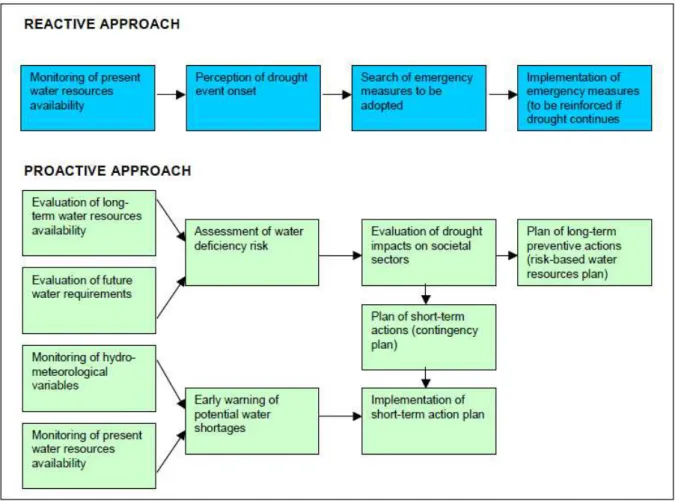
Droughts are a normal feature of the various climatic conditions across China; they have occurred in the past, they occur now and will continue to occur in the future, perhaps with more widespread and significant effects as a result of climate change. In the past, drought management in China has tended to be more reactive than proactive, with water allocation restrictions and emergency supply-side measures only being implemented once drought conditions have occurred and the impacts are being felt.
Another feature of international water resource planning best-practice is transparency and stakeholder engagement. Consultation and the publication of documents in the public domain are a requirement of the WFD, and are referred to explicitly in the No. 1 Document.
1.4
Structure of the report
The remaining chapters of this Technical Report refer to various studies, policy documents and published strategies to illustrate examples of international best-practice that could inform the approach to deliver the water resource planning objectives of the No.1 Document.
The following chapters of the report cover:
• Key features from recent studies on water resource issues in China
• Water resource assessments
• Demand forecasts
• Approaches to risk-based management in Water Resources Planning (to include natural variability, climate change variability, and threats from pollution – for instance Water Safety Plans)
• Planning (to include water allocation, strategic planning and drought planning)
• Next steps for water resources analysis to underpin delivery of the No.1 Document and the Three Red Lines
2
Recent studies on water resources in China
There are four recent studies which contain a wealth of technical, policy, and institutional information and analysis of the water resource sector in China. Key features of the analysis and recommendations from these studies that feed into implementation of the No.1 Document are reproduced and/or
summarised in this chapter.
2.1
World Bank – Addressing Water Scarcity in China; Analytical
and Advisory Assistance programme (AAA)
The overarching objective of the Analytical and Advisory Assistance (AAA) programme was to assist the Government of China to develop, adopt, and implement an integrated set of policy and institutional reforms needed to more effectively address China’s water scarcity and build a water scarcity-saving society. Specifically, the AAA aimed to:
• improve the understanding of key water-related policy and institutional issues and recommend specific policy and institutional reforms to address them
• engage concerned parties, including Government policy-making entities and other stakeholders, to raise awareness and establish consensus on integrated water resource management
• create an enabling environment for the recommended actions by reducing cross-sectoral and inter-jurisdictional differences and enhancing cooperation on the ground.
The AAA built on the large number of existing and ongoing studies in China and international experiences in integrated water resource management. Analytical studies undertaken for the AAA focussed on the key areas where incremental work was requires to fill gaps in understanding of the issues and actions required to address them. The thematic studies included:
•
Water Pricing, Willingness-to-Pay and Affordability•
Water Pollution Emergency Prevention and Responses•
Water Rights and Compensations for Ecological and Environmental Services in River Basins•
Strategic Direction forChinaUrban Water SectorThe final report was published in 2009 and synthesises the main findings and recommendations from over 30 technical reports, case studies, and background papers produced under the AAA Programme. The main messages from the final report are quoted below and include:
• China needs to move from a traditional water management system with the government as the
main decision-maker towards a modern approach to water governance that relies on (a) a sound legal framework, (b) effective institutional arrangements, (c) transparent decision making and information disclosure, and (d) active public participation .
Improving water governance will require the government to reform existing laws and regulations, strengthen law enforcement, reform and unify the organizational framework for better decision making at the national level and greater local ownership and participation at the river basin level, and strengthen legal provisions for public information and participation.
• To allow greater scope for market-based approaches, China needs to establish clear property
rights for water.
Prerequisites include the development of basin-level water resource allocation plans that give first priority to ecological needs, the conversion of traditional water allocation entitlements into tradable water rights, and the strengthening of water administration by clarifying the conditions, procedures, rights and obligations of the state, communities, enterprises and individuals for the withdrawal, consumption, protection and transfer of water rights.
• To provide appropriate incentives for the adoption of water saving technologies and behaviours,
water prices need to be allowed to rise to reflect its full scarcity value.
The first step is for water and sewerage prices to at least cover the financial needs of the water supply and sewerage enterprises. The social impact of the price increases, especially those affecting the poor, can be addressed by implementing an increasing block tariff approach and other social protection measures for residential consumers.
• To enhance incentives for the protection of water sources, China needs to vigorously pilot
market-oriented mechanisms for ecological compensation.
Mechanisms such as the payments for ecological services approach will improve the effectiveness of ecological compensation and reduce the financial burden on the government of providing adequate incentives for protecting the upstream ecosystems that are essential for the long-term supply of good quality water.
• To control and solve China's serious water pollution problem, the government has to use all
available legal, institutional and policy instruments to mobilize the public and motivate polluting sectors to comply with applicable regulations.
This will require a strengthening of the wastewater discharge permit system, more aggressive use of the litigation systems to protect the public interest, greater attention to the control of non-point pollution from agriculture, and better preparedness for water pollution disasters.
“Some of the recommendations, such as the reforms of river basin commissions and the water resource fee management as well as water quality monitoring and disclosure, may not be in line with sectoral or local interests but we believe that they are essential for the nation to effectively address the emerging water scarcity crisis." says Jian Xie, World Bank Senior Environmental Specialist and Principal Author of this report.
2.2
ADB – Strategy for Drought Management (TA 7261-PRC) leading
to “Drying Up – What to do about droughts in the People’s
Republic of China”
The objective of the ADB Technical Assistance (TA) was to review and analyse the history and impacts of drought in China, review the existing legal and institutional frameworks; policies’ regulations and emergency responses to drought and make recommendations regarding the potential for a drought risk management strategy for China. This was a different, more strategic-based approach than the type of emergency action that has been and still is the common response to drought management in China.
Information, research, forecasting, monitoring and planning, and changing attitudes and funding mechanisms were identified as the key at the national and provincial levels, whilst planning, water saving/efficiency and conservation and education will be the key at the water use end. The TA Final Report concluded that considerable changes in attitudes and thinking would be required to implement such a change.
Recommendations from the TA Final Report follow through to the report “Drying Up” which
consolidates the highlights from several recent ADB technical studies that provide good references for examining how the PRC could address water security issues, especially drought and environmental degradation.
The key messages from “Drying Up” which are recurring themes in the No.1 Document are:
• Droughts are natural occurrences in China with some regions being particularly prone to and at risk from drought conditions. Water shortages caused by economic development and unconstrained water consumption are exacerbating the effects of dry periods and droughts. Whilst such water shortages can be addressed by major capital infrastructure, the report notes that a more cost-effective and environmentally sustainable approach would involve three tracks:
- First, prioritize risk assessment and reduction plans, of which demand management is essential.
- Second, make optimal use of infrastructure by including non-structural technical options and non-traditional infrastructure to bring demand down to sustainable levels.
- Third, reform water management at the local level in order to achieve the healthy ecosystems - the long-term benefit of demand management.
• A risk reduction approach to droughts would spare the PRC much of the unnecessary hardships currently experienced. Droughts cannot be prevented, but the severity of their effects can be reduced through better systems and demand management. The PRC has the national systems for monitoring and forecasting droughts, but its early warning system must be further developed so that sub-national governments can respond early and quickly. Provinces and cities should assess the risks associated with current water resource extraction rates and demand levels.
Unsustainable consumption rates put populations, industries, and economies at greater risk during a drought. This is unnecessary risk. More conservative consumption in normal times can create water savings in reservoirs and natural ecosystems, which will be useful in droughts and for long-term ecosystem rehabilitation.
• Use an optimal mix of infrastructure for saving water instead of just spending it. The current infrastructure path in the PRC is still navigating toward increasing water supply while opportunities for saving water are vastly under-explored. Provinces, cities, and industries can invest in
technologies and systems that can increase available supply by saving water and with greater cost effectiveness than building storage.
• Demand management offers short-term gains in increased supply capacity and availability and long-term gains in more productive ecosystems. Strategic management is the key to achieving specific results, whether they are near-term results (such as water savings) or long-term results (healthier and more productive ecosystems). The traditional way of managing water resources is a large part of the problem - too many agencies are managing a shared, crucial resources and sometimes with contradictory and possibly conflicting interests. Water resources need a reliable system of user rights and allocations that consider the needs throughout a watershed irrespective of jurisdictional boundaries.
The following schematic from the TA Final Report (Figure 1) gives a good illustration of the difference between the current reactive approach and the more risk based and proactive approach to drought management:
Figure 1 Contrasting approaches to drought management
2.3
DfID – Water Resource Demand Management Assistance Project
(WRDMAP)
The project aimed to support the reforms required by the 2002 Chinese Water Law which has been enacted to, amongst other aspects, improve livelihoods through equitable access to and sustainable use of water resources, particularly for poorer people.
Integrated water resources management (IWRM), river basin management, demand management and the creation of examples of water saving societies are key elements of WRDMAP. As with the ADB and the World Bank studies referred to above, these are recurring themes in the No.1 Document.
The 5 year project involved developing and implementing pilot studies for the first three years in the provinces of Gansu and Liaoning. The results and water resources management improvements generated over this time have been broadly disseminated both within the two provinces and also throughout China during the remainder of the project.
A key output of the Water Resources Demand Management Project (WRDMAP) is the IWRM Document Programme prepared to help inform water resources professionals at various levels of government and different organisations of the basics of integrated water resources management (IWRM) and water
was undertaken at central, provincial, municipality and county levels based a number of case studies, three in Gansu Province and three in Liaoning Province. This process enabled a detailed assessment to be
undertaken of current practices in relation to the then current water sector legislation and identify areas where general guidance would probably be useful for a broader number of water sector professionals in the country. These guideline documents would serve as the foundation material for a nationwide dissemination
programme, initiated during the course of the project and to be continued by the Ministry of Water Resources thereafter. These documents have been produced in Chinese and English with the former being in both hard copy and digital formats. The digital versions are available from the website (www.wrdmap.com); in total there are over 70 documents in both languages.
The Document Series comprises different elements as summarised below:
Thematic Papers (TP)
These are position papers related to selected topics of water resources management. They cover international best practice; background to the topic from experience in other countries; and current practices and issues as are believed to exist in China.
The thematic papers are intended as a source of information and to provide material or a basis for the development of Advisory Notes.
Advisory Notes (AN)
These are a major output of the project and should be seen as the backbone of the IWRM or WRDMAP dissemination programme. An AN, which is subject matter related, is a structured compendium of advice on issues related to the topic and covers how to undertake or perform a particular aspect of water resources management at the municipality and county levels. This is classed as being the operational level of water resources management.
Examples (EX)
The examples are provincial level case study reports related to different topics. Some of these have been developed into concise documented examples to support the Advisory Notes.
Manuals
The Manuals are more comprehensive documents related to topics that have been investigated in considerable depth.
A list of these reports can be found at http://www.wrdmap.com/documents/WRDMAP_Guides_v2.pdf.
2.4
Water Entitlements and Trading (WET) Project
The Water Entitlements and Trading (WET) Project was a joint initiative between the MWR and the Australian Department of Agriculture, Fisheries and Forestry. The objectives of the project were to:
• Review the current systems, laws, and practices in China related to water entitlements and trading
• Provide recommendations on a framework for water entitlements and trading that can be implemented across China
• Identify the steps to implementation, including developing plans to implement the framework in two pilot catchments.
The report makes recommendations on the key policy and technical requirements necessary to implement a water entitlements and trading system in China. The water rights framework developed promotes a system for allocating water that is consistent and transparent, and which recognises:
• long-term and annual rights to take water at the regional, abstractor and farmer levels
• ecological requirements for water.
2.4.1
Water Resources Allocation Plans and Environmental Flows
Water resources allocation plans (WRAPs) underpin the entire WET system. They are the mechanism for allocating water amongst regions and for setting a cap on abstractions. They are also the tool for providing for environmental flows. WRAPs should be a regulatory instrument, providing clear direction for resource managers in how to allocate and manage the resource. The WET report includes detailed analysis and recommendations on the requirements for making and implementing WRAPs.
Flow regimes are critical for ecological health. The requirement for environmental flows should be considered during the water allocation process and flows should be set based on the best available science, recognising the importance of maintaining natural variability – in terms of duration, timing, frequency and size of flows – to the extent possible. Environmental flows are much more than just a fixed percentage of the mean flow. The report outlined a methodology for identifying ecological assets and determining (and providing) the flows that are important to their health.
2.4.2
Allocation and management of water rights within irrigation districts
The WET study produced draft guidelines for the allocation and management of water within irrigation districts. These guidelines detail a process for allocating water to water user associations (WUAs). This process includes both the allocation of long-term rights as well as the annual allocation process. The guidelines also make recommendations in respect of the process for establishing and managing WUAs, in a way consistent with the requirements of a WET system.
A pilot study in Hangjin irrigation district in Inner Mongolia Autonomous Region was used to
demonstrate the allocation of water rights within an irrigation district. The water available to the district was allocated amongst WUAs in the district, and an annual planning system was developed.
2.4.3
Other aspects of water entitlement and trading systems
In addition to these key components, work was completed in respect of the following:
• Water abstraction permit management
• Public water supply management
This study involved an assessment of the current approaches in China to allocating water for public water supply, and the role of abstraction permits in this process.
• Water resources management modelling
An assessment of suitable modelling tools to support a WET system in China was completed.
• Water accounting
The report includes an overview of the Australian approach to water accounting. It considered the current situation in respect of water information management in China and identified
improvements that could be made.
A review of the 2006 Ordinance on Management of Water Abstraction Permit and Water Resources Fee (Decree 460 [2006] of the State Council) made as part of the WET project is included as Appendix 1.
3
Water resource supply security in Chinese context
3.1
Introduction
The Chinese Government has been attaching great importance to the reform and development of water affairs. The No.1 Document defined a clear implementation calendar to promote long-term economic development and social harmony and stability by initialising water sector reform and development and establishing the institutional framework for water infrastructure management and development within the next 5 and 10 years or even longer period.
In the No.1 Document, the Three Red Lines were proposed:
• The first red line sets water quantity objectives in rivers, lakes and groundwater. It requires the “total quantity control of water abstraction”
• The second red line sets objectives for water use efficiency. This will accelerate the development of national standards regarding water use quotas for high water consumption industries and the service industry
• The third red line sets maximum permissible pollution load for Water Functional Zones, which are catchments, reaches of rivers or lakes that must meet specific water quality standards.
In terms of water supply security the objectives are enshrined in the first two of the Three Red Lines.
This will accelerate the development of national standards regarding water use quotas for high water consumption industries and the service industry. It is only through the aggressive promotion of water efficiency that increases in demand can be kept to the levels set in the No.1 Document, namely less than 635 billion m3 in 2015 and 670 billion m3 by 2020.
3.2
Situation and challenges
3.2.1
Population growth and urbanisation
China’s large and growing population, combined with further urbanisation and industrialisation, means that water supply security is becoming increasingly threatened (Figure 2).
Figure 2 The history and trends of population and economy
3.2.2
Estimation of the water resources
The total water resource in China is 2,850 billion m3, of which the surface water amount is 2,750 billion m3 (96%) and the underground water amount is 825 billion m3. The non-overlapping water amount between the underground water and the surface water is 100 billion m3.
In the recent two decades, the precipitation of the four northern water resource zones including
Huanghe, Huaihe, Haihe and Liaohe has dropped by 6% on average, the river runoff has decreased by 17% and the total water resources have reduced by 12% (Figure 3).
Figure 3 Comparison between assessment results of the period from 1980 to 2000 and the period
3.2.3
Increasing of water use and competing demand
The national water consumption increased from 440 billion m3 in 1980 to 570 billion m3 in 2006 with the annual growth being 1.5%.The annual growth of urban domestic water consumption was 6.7%, of industrial water consumption 4.4%, while agriculture as the largest consumer remained almost constant (Figure 4).
Figure 4 The history of domestic, industrial and agricultural water consumption
3.2.4
Over use of water in many places
The development and utilisation rate of the national water resources is 19%, that of northern China is 48% and that of southern China is 13%, while the Hai River basin reaches up to 106% (Figure 5).
The national water resources is 570 billion m3, which the actual water consumption is 395 billion m3, which equals to 49% of the available water resources. The overuse problem of water resources in North China is serious (Figure 6).
Figure 6 The water consumption rate by river basin
3.3
Water resources gross control
The basis for control is given in Article 47(1) of the Water Law:
“The country exercises a system combining gross control and quota management for water use”
3.3.1
Definition and requirements of gross control
For gross control it is necessary first to solve the issue of the relationship between man and nature, namely, to define the gross amount of water available for economy and society on the conditions of overall coordination of water for life, productive uses and ecological environment.
The gross control demands that the available gross amount of water available in river basins should be allocated to regions to set the overall and specific water drawing and use restriction indexes and the macroscopic direction requirements for water drawing licensing levels.
The gross control requirements were raised in such aspects as water quantity, water quality, the maximum water quantity and the minimum discharge, and specific indexes were defined for regional section control and management of major water users, thus establishing a control system for water drawing licensing management and even water resource management.
The gross control is realised in many aspects: planning, water allocation, water drawing licensing, water drawing licensing management, water function zone layout management, water resources dispatching, etc.
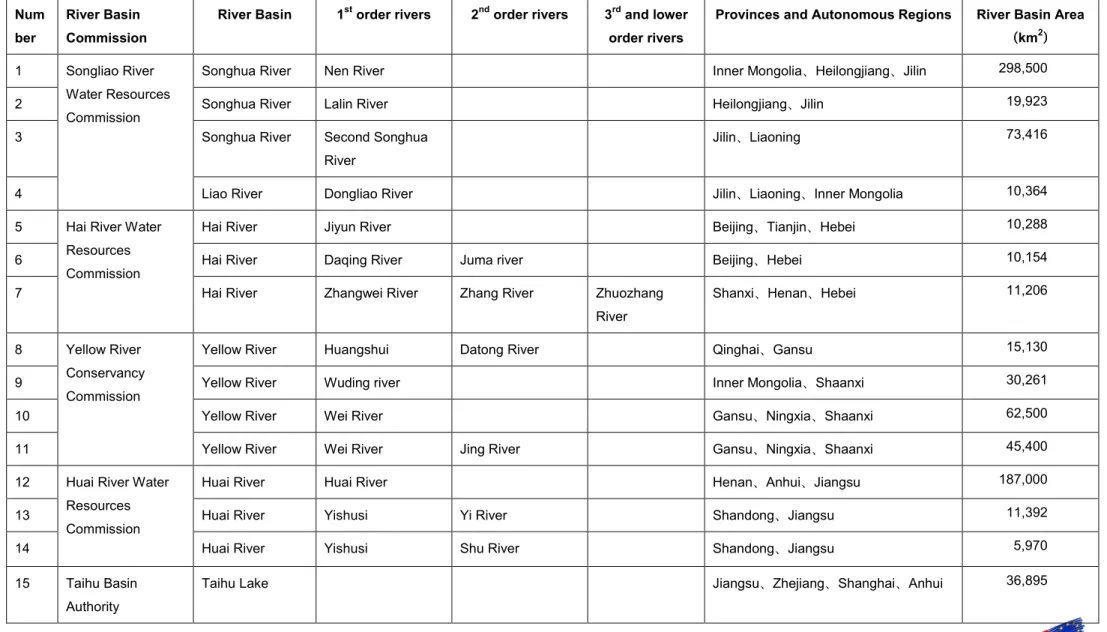
Table 1 Preliminary list of rivers and river basins planned for gross control (2010-2012)
Num ber
River Basin Commission
River Basin 1st order rivers 2nd order rivers 3rd and lower order rivers
Provinces and Autonomous Regions River Basin Area
( ( ( (km2)))) 1 Songliao River Water Resources Commission
Songhua River Nen River Inner Mongolia、Heilongjiang、Jilin 298,500
2 Songhua River Lalin River Heilongjiang、Jilin 19,923
3 Songhua River Second Songhua
River
Jilin、Liaoning 73,416
4 Liao River Dongliao River Jilin、Liaoning、Inner Mongolia 10,364
5 Hai River Water
Resources Commission
Hai River Jiyun River Beijing、Tianjin、Hebei 10,288
6 Hai River Daqing River Juma river Beijing、Hebei 10,154
7 Hai River Zhangwei River Zhang River Zhuozhang
River
Shanxi、Henan、Hebei 11,206
8 Yellow River
Conservancy Commission
Yellow River Huangshui Datong River Qinghai、Gansu 15,130
9 Yellow River Wuding river Inner Mongolia、Shaanxi 30,261
10 Yellow River Wei River Gansu、Ningxia、Shaanxi 62,500
11 Yellow River Wei River Jing River Gansu、Ningxia、Shaanxi 45,400
12 Huai River Water
Resources Commission
Huai River Huai River Henan、Anhui、Jiangsu 187,000
13 Huai River Yishusi Yi River Shandong、Jiangsu 11,392
14 Huai River Yishusi Shu River Shandong、Jiangsu 5,970
15 Taihu Basin
Authority
Num ber
River Basin Commission
River Basin 1st order rivers 2nd order rivers 3rd and lower order rivers
Provinces and Autonomous Regions River Basin Area
( ( ( (km2)))) 16 Changjiang Water Resources Commission
Changjiang River Han River Henan、Hubei、Chongqin、Sichuan、
Shaanxi、Gansu
154,804
17 Changjiang River Jialing River Sichuan、Chongqin、Gansu、Shanxi 159,357
18 Changjiang River Tuo River Sichuan、Chongqin 27,631
19 Changjiang River Chishui River Yunnan、Guizhou、Sichuan 19,231
20 Changjiang River Min River Qinghai、Sichuan 135,411
21 Pearl River Water
Resources Commission
Pearl River Xi River Hongshui river Beipan River Yunnan, GuiZhou 26,590
22 Pearl River Bei River Jiangxi、Guangxi、Guangdong、
Hunan
46,710
23 Pearl River Dong River Jiangxi、Guangdong 35,340
24 Pearl River Han River Jiangxi、Fujian、Guangdong 30,112
25 Pearl River Xi River Huangni river Yunnan, GuiZhou 8,164
3.3.2
Water drawing licensing gross control indexes
It is stipulated in Article 7 of Management Regulations on Water Drawing Licensing and Collection of Water Resource Fee (See also Appendix 1):
“To implement water drawing licensing, it’s necessary to adhere to considerations of both surface water and groundwater and the principles of combining sourcing and saving with the latter coming first and combining gross control and quota management.
The gross water consumption for those approved for water drawing in any river basin shall not exceed the availability of water resources of the basin.
The gross water approved for drawing in an administrative region shall not exceed the water quantity available for drawing and use of the region issued by the river basin organ or the superior water administration; and the gross groundwater approved for drawing and use shall not exceed the groundwater quantity available for draft in the region, which shall also meet requirements by exploitation and utilisation of groundwater. ”
It is stipulated in Article 15 of Management Regulations on Water Drawing Licensing and Collection of Water Resource Fee:
"The approved water allocation plan or the signed agreement is a reference for determining the water drawing licensing gross control of river basins and administrative regions.
For rivers and lakes crossing provincial ….. borders, if no water allocation plan has been developed or no agreement has been signed yet, the water drawing licensing gross control indexes of relevant provinces, …., should be proposed by river basin management agencies in accordance with water resource conditions of river basins, comprehensive plans of water resources, comprehensive plans of river basins and middle/long-term water supply and demand plans, in combination with present situations of water drawing and water supply and demand of relevant provinces ….., and through negotiations with water administrations of the People’s Governments of relevant provinces ………., and then submitted to the competent water administration under the State Council for approval. The water drawing licensing gross control indexes of administrative regions of cities or counties should be set by competent water administrations of the People's Governments of relevant provinces ….. in accordance with water drawing licensing gross control indexes of such provinces …. in combination with local present situations of water drawing and water supply and demand, and submitted to relevant river basin management agencies for reference. ”
3.3.3
Current challenges in gross control
• Connection between comprehensive plans of water resources and water drawing licensing gross control indexes
• Connection between water allocation plans and water drawing licensing gross control indexes
• Connection between water quantity approved in water drawing licenses and the annual water drawing allocation plans
• Connection between water drawing licensing gross control indexes and reasonable water quotas
• Centralised management and allocation of water quantity and quality, groundwater and surface water
• Management of free acquisition and transfer transactions of water drawing rights.
3.4
Water resource fee
3.4.1
Overview
According to Management Regulations on Water Drawing Licensing and Collection of Water Resource Fee (April 15, 2006):
“The water resource fee shall be prepared by the competent price authority of the people’s government of each province …….. along with finance and water administration
departments at the same level, and submitted to the people’s government at the same level for approval and to the competent price authority and finance and water
administration departments under the State Council for filing. However, the water resource fee for water infrastructure directly under the Central Government or crossing provinces …., that are required to be approved by the river basin management agencies, shall be prepared by the competent price authority under the State Council along with finance and water administration departments under the State Council.”
Article 29 In preparing the water resource fee, the following principles shall be observed:
1 Promote rational exploitation, utilisation, saving and protection of water resources;
2 Adapt to local conditions of water resources and local economic and social development levels;
3 Make overall planning of rational exploitation and utilisation of surface water and groundwater to avoid overdraft of groundwater;
4 Take full account of differences in different industries and sectors.
The standard of water resource fee is reference to these principles developed around a very big difference, such as Beijing is 1.1 CNY/m3, but in Guangzhou only 0.12 CNY/m3.
Article 36: The water resource charge shall be included in the budget in full, in accordance with the approved departmental budget co-ordination arrangements by the financial sector, mainly for the conservation, protection and management of water resources and can also be used for the rational development of water resources.
The main purpose of the water resource charge includes the following aspects: operation, maintenance, equipment, staff salaries and other costs.
3.4.2
Water prices
In China the water rate consists of three parts, namely:
• a sum of resource water rate
• environmental water rate
• engineering water rate.
The resource water rate is the water resource fee, based on the scarcity of water resources. The environment water rate, derived from environmental remediation and compensation, is a governmental institutional charge, including a sewage treatment fee and a pollutant disposal fee. The engineering water rate includes two parts to cover the cost of bulk water infrastructure and cost of piped water supply, respectively.
Though China has demanded that the urban water supply to implement a two-part water pricing mode combining supply capacity and volumetric pricing or a hierarchical volumetric pricing mode (increasing block tariffs or similar) step by step, the volumetric pricing mode is being implemented and some cities are implementing or will implement the hierarchical water quantity pricing mode. Changsha in Hunan Province, for instance, implemented the hierarchical water quantity pricing mode from 1 February 2012. Other cities, like Guangzhou and Beijing, will try the hierarchical water quantity pricing mode as well. However, there are still few implementing the hierarchical water quantity pricing mode at present.
The water rate is different for different water users, which can be categorised into five categories by use nature: domestic, industrial, administrative institution, business service and special sectors like bathing and car washing. Generally speaking, the domestic water rate is the lowest while the special sector water rate is the highest.
It's stated in Management Measures for Urban Water Price (23 September 1998):
“A seasonal water rate can be implemented in any region featuring tourism or seasonal consumption”.
At present the seasonal water rate is scarce in China, but it’s still being implemented in some places. For example, the seasonal water rate is being implemented in Baoding, Hebei, and other regions, like Jiangsu Province and Dongguan, Guangdong Province, are planning to exercise the seasonal water rate step by step.
3.4.3
Irrigation water charges
Generally the total water rate is paid in accordance with the irrigation area reported by farmers at the beginning of each year and the water rate per mu estimated on the basis of experience. The water rate may also be paid at the end of each irrigation season, but in that case it may be difficult to collect. In some river basins, it is necessary to buy a water ticket in advance in order to receive irrigation water.
The fee for irrigation water charge is low averaging only 57% of the costs of supplying irrigation water. In addition the collection is low, so in total the agricultural water charges collected in 2005 covered only 38% of the actual supply cost.
In particular, the water charge has declined dramatically since the taxation reform in rural areas. Besides, the agricultural water charge is deducted or exempted by local governments in some economically developed regions. Wenling and Yongkang of Zhejiang Province and Dongguan and Foshan of Guangdong Province have stopped collecting the agricultural water charge since 2004 and all exempt agricultural water rates are paid from the local budget. Such practices have had a huge social influence, making it more difficult for water administrations in other places to collect the water charge.
4
Water resource assessments
Robust assessments of water resource availability are an essential component of all aspects of water resource planning. Such assessments rely on good historic time-series of rainfall, evaporation and river flows at appropriate spatial and temporal scale, together with accurate records of abstractions (from surface water and groundwater), diversions and effluent discharges, and groundwater levels.
One of the main differences between current EU best-practice and China is the transparency of the analysis and its availability in the public domain for scrutiny and comment.
With increasing risks from climate change, unsustainable exploitation of natural water resources and increasing demands, the need for reliable assessments becomes even more important, and will be an essential component of work to deliver the No.1 Document. Work undertaken for the SKE suggests that assessments of surface water resources in China is already in line with EU best-practice, however there do appear to be major differences in the interpretation and use of the outputs from that analysis and the approach to dissemination in the public domain combined with stakeholder engagement. For groundwater resources, the approach seems to be less integrated and there appear to be major uncertainties about the current status of groundwater resources (except that in northern China they are considered to be massively overexploited), the current level of abstraction, and estimates of long-term recharge from which assessments of sustainable abstraction could be made.
The following chapters draw on recent experience in England and Wales, which has been brought together to meet the requirements of the WFD and therefore is consistent with the EU WFD Common Implementation Strategy. These technical studies provide the quantitative evidence-base for the Water White Paper published in the UK by the Department of the Environment, Food and Rural Affairs in December 2011. The Water White Paper is a strategic policy document prepared by the Government that describes a future for water management in which the water sector is resilient, the environment is protected, and in which water is valued as a precious resource that underpins future environmental, social and economic welfare. The White Paper is based on a series of technical papers on water resource assessments, environmental requirements, scenarios of future demands, and the risks to water resources from climate change. These technical studies themselves draw on the work to meet the requirements of the WFD. These studies and the consolidation into the policy document give a useful template from which the approach to deliver the No.1 Document can be developed.
4.1
Surface water
Current EU best-practice for WFD resource assessments has evolved over time. In England and Wales, the process has evolved from Catchment Abstraction Management Systems through to the Resource Assessment and Management Framework that underpins the 1st round of WFD River Basin Management Plans.
The process involves the following steps:
• Use of observed flow data combined with infilling techniques such as rainfall-runoff modelling or some form of statistical analysis such as Low-Flows 20001
to establish a long timeseries of observed river flows at all points of interest down to River Basin Districts
• Using observed records for artificial influences (in this case abstractions, discharges, reservoir releases, and any diversions) to calculate the “naturalised” flow, that is the flow that would have occurred if there had been no man-made interventions
• Calculate the characteristics of the naturalised flow regime for each point of interest.
The same approach has been followed for all River Basin Districts in England and Wales and the results have been used to populate a Water Resource GIS. The GIS system is then made available to regional and local staff to interpret the outputs and identify and correct any gross errors in the input data – see Chapter 4.4.
The hydrological analysis that now provides the flow regime characteristics under naturalised conditions has evolved over many years and is based on the following components:
• Long time series of observed river flows, subject to regular quality assurance and comparative analysis to ensure consistent data quality
• Development of regional and national hydrological processes (such as Low Flows 2000) and specific rainfall-runoff modelling applications
• Assessment of the potential changes to observed river flow and groundwater regimes at national scale that might occur as a result of climate change (such as The Future Flows and Groundwater Levels (FFGWL) project, which undertook a consistent assessment of the impact of climate change on river flows and groundwater levels across England, Wales and Scotland using the latest projections from the UK Climate Impact Programme2
.
4.2
Groundwater
Assessments of groundwater availability and hence the magnitude of the sustainable abstraction that can be supported by a given aquifer unit are often more difficult than assessments of surface water availability. Whilst recording changes in groundwater levels over time does give an indication of whether a groundwater body is being overexploited or not, the assessment of groundwater availability
1
A decision support tool designed to estimate river flows at ungauged sites and to aid the development of catchment and regional water resources http://www.ceh.ac.uk/products/software/CEHSoftware-LOWFLOWS2000.htm.
2
can be improved by new survey technology combined with modelling. Denmark, which depends crucially on its groundwater resources for all water supplies and therefore has a thorough knowledge of its groundwater resources, has during the past 10 years mapped all groundwater priority areas using air-borne geophysics and subsequently developed a national groundwater resources model to assess impacts of groundwater abstraction on both surface and groundwater resources observations using traditional and more recent innovative measures, and the construction and use of numerical
groundwater models. These can be very data hungry to set up and calibrate and require periodic review and updating to ensure that they are still appropriate. The underlying principle for groundwater planning is that reliable base data well-distributed in both space and time are required, whether for high-level assessments or for modelling
Many documents report the steady decline in groundwater resources across China’s main aquifers and that abstraction exceeds long-term recharge and hence is unsustainable. There are various academic papers in the international literature on groundwater issues, but there does not seem to be any national assessment of groundwater resources across China. For long-term sustainable water resource planning, particularly in rural regions, where water supply security relies entirely on groundwater, robust assessment of groundwater that pulls together the interests, responsibilities and current work
programmes of the various Ministries and other Agencies is urgently required:
• Past and current status of groundwater resources through analysis of observed groundwater levels. If the location and number of observation boreholes is insufficient then a programme to drill and equip monitoring boreholes is urgently required
• Groundwater surveys applying modern geophysical methods to identify potential freshwater aquifers as the interface of freshwater and saline water in areas suffering salinity intrusion
• Assessment of long-term recharge, together with estimates of inter-annual variability
• Assessment of potential impact of climate change on recharge and variability
• Quantitative analysis of groundwater abstractions
• Analysis of groundwater quality and past trends to identify areas where groundwater quality has been compromised
• Regional assessments of groundwater.
In addition to the components of a fundamental groundwater resource assessment programme recent academic papers suggest other features of groundwater status and areas for further work that are relevant to water resource security.
The research undertaken for the SKE points to the urgent need for a comprehensive and systematic analysis of the status of groundwater resources and groundwater quality across the whole of China. Some academic studies have already been undertaken, using case studies at a small scale, but there do not appear to have been any large-scale assessments Whilst there is no doubt that in some regions the exploitation of groundwater is unsustainable, it is often these regions where rural water supplies are
Two side impacts of falling groundwater levels are the decline of vegetation and the increased power required for abstraction, especially for irrigation. The implementation of steps to achieve more sustainable rates of groundwater abstraction, and eventually rises in groundwater levels, would also achieve reductions in power consumption and of greenhouse gas emissions.
4.3
Environmental Flows
A parallel exercise is needed to assess the environmental flow requirements for each point of interest, expressed in terms of an Environmental Flow Indicator. A full discussion of how environmental flows can be set is included in the RBMP Water Ecology Security Technical Report 078.
4.4
Assessment of water resource availability, review and
publication
4.4.1
Current status
The assessments of surface water and groundwater are combined with the assessment of
environmental flows to provide assessments of the water that is available for other uses, in particular abstraction for consumptive and non-consumptive uses without causing unsustainable environmental impacts. The requirements of minimum flows to maintain water quality requirements will have been addressed through the environmental flows.
This essential feature of the WFD classification system is to give an assessment of the current ecological status of all water bodies through an understanding of monitored flows and ecological impacts. Characterisation of risks of failing to achieve good status objectives or of allowing ecological status to deteriorate by the target date of 2015 needs to incorporate predictions of how these pressures may change in the future.
In England and Wales a precautionary fully licensed water allocation scenario was considered as the worst case prediction – assuming abstraction rates increase to their licensed limits, but holding discharges at recent actual rates. A further assessment was then made taking account of the potential impacts of climate change on river flows and groundwater.
A key feature of the approach was to assess water resource availability under two different abstraction conditions:
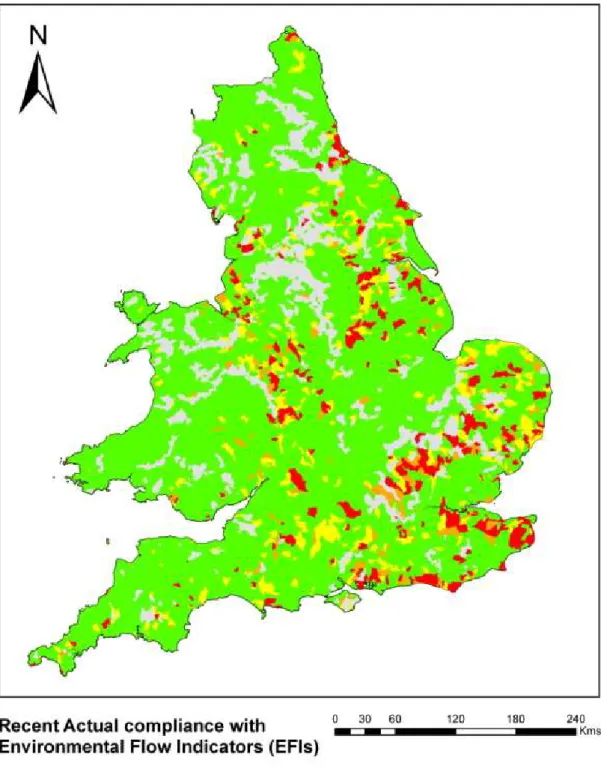
• Recent actual: this condition represents the abstraction and discharges experienced in recent years
• Fully licensed: this condition allows for all abstractions and discharges at the rates permitted by existing abstraction licences.
For the implementation of WFD in England and Wales, the initial review of GIS results focused on:
• hydrological risk maps comparing artificial influences (groundwater and surface water abstraction and discharges) with Environmental Flow Indicators defining allowable abstraction impacts for WFD screening of rivers, lakes and estuaries
• areas where, based on this assessment, there may be water available for further abstraction licensing
• areas where there would be a requirement to reduce abstraction, if it was necessary to meet the WFD flow screening indicator, together with an estimate of the quantity of reduction required
• components of WFD groundwater body classification: i.e. groundwater abstraction pressures and impacts on the groundwater balance – to combine with the assessments of risks to wetlands and saline intrusion which had already been reviewed.
Having estimated natural flows and environmental flow requirements, the resource assessment continues with the calculation of flows influenced by abstractions and discharges according to various scenarios, and then with the comparison of scenario flows against environmental flow requirements to produce the resource availability summary for specified scenarios.
4.4.2
Scenario assessments
Scenario flows are all based on the combined (or ‘net’) impact of all discharges minus all abstractions on natural flows. The three scenarios considered are:
Recent Actual (RA): both abstractions and discharges at ‘typical’ recent actual rates. This scenario provides an indication of current flows which should be consistent with the currently observed condition of the ecology
Full Licensed (FL): abstractions increased to full licensed limits but discharges held at ‘typical’ recent actual rates. This is a worst-case precautionary scenario and is used to underpin decision making for abstraction licensing, and also to characterise future flow risks for WFD
Future Predicted (FP): this scenario was introduced to provide a more credible prediction of future flow pressures and risks. It is initially estimated for 2015 (the default deadline for WFD objectives) based on regionally and sectorally defined abstraction rate growth factors which are applied to recent actual values, subject to licensed limits.
4.4.3
Outcome of the assessments
The risk-based approach for WFD assessments requires assessments of available water resources to be made at different levels of risk. Typically the assessments are based on selected percentiles of the flow duration curve, with Q95, Q70, Q50 and Q30 being the most usual comparators. Basing the
assessment of available water resources on the magnitude of the natural flow available for 95% of the time (Q95) provides environmental protection in all but drought years and means that abstractors have
reasonable certainty that their requirements will be met in full. A typical example of the results for England and Wales is shown in Figure 7.
The precise flow percentile that is appropriate for the different river basins in China will need to be assessed to ensure that the percentile chosen provides the appropriate balance between
Figure 7 Water resource security in England and Wales. Source: Managing Water Abstraction (June 2010)
5
Demand forecasts
WRDMAP Thematic Paper 1.8: Water Demand Forecasting (May 2010) provides an excellent
reference document. It compares existing practice in China with international practice. The paper notes that demand forecasting practice in China tends to be based on norms for each sector of demand, rather than ranges to allow for uncertainties. In addition and especially for consumptive agricultural demands it is necessary to consider water requirements not only in a “normal” year” when direct rainfall may provide an important component of crop water requirements and hence reduce the demand for irrigation water, but also in a “dry” year when rainfall will supply a smaller component and more irrigation will be required.
The paper also recognises the importance of water demand management and the need for demand forecasts to allow for different targets for water use efficiency. Forecasts also need to account for the impact of achieving greater water use efficiency on the net abstraction (total water abstracted minus the water returned, either though wastewater discharge or through leakage from irrigation canals and over-application to irrigated crops draining back into surface watercourses), rather than just the gross abstraction.
Demand forecasts are undertaken for a range of different purposes over different time horizons and at different spatial scales. For strategic water resource planning forecasts of demand for each of the main sectors are required typically at the scale of the WFD River Basin District. The importance and hence the selection of each sector will depend on the socio-economic and physical characteristics of the area for which the forecast is being calculated, and will generally include:
• Domestic consumption for both urban and rural communities
• Large-scale industry
• Power industry
• Small-scale industry
• Service and business sectors
• Large-scale irrigation
• Small-scale and subsistence agriculture.
An important feature of any application developed for strategic demand forecasts is the flexibility to allow for different assumptions on growth, unit water consumption (for example per capita consumption, water use per unit of output (such as tonnes produced or GDP, or water use per unit area), and water
The relationship between growth and forecast demand is complex. There are various factors that determine how much water people, industry, businesses and agriculture will use in the future. The factors include population growth, the migration from rural areas to urban areas, increasing affluence and the purchase of water using appliances, water efficient technology, and incentives for people, irrigators and industry to use water wisely. The demand forecasts also need to be able to account of water efficiency targets set by government and/or regulators. It is also becoming increasingly evident that water use efficiency can have other side benefits such as reduced energy use for heating water in both domestic premises and in industrial production.
A demand forecast therefore requires information on population growth, where and in what types of accommodation people will live, technological advances in industrial production processes and irrigation, and the overall growth in the economy. One way of combining these sorts of assumptions into a coherent framework for strategic studies is to develop scenarios of possible societal futures, which then give a range of possible future demands. This identifies an envelope of possible future demands within which the actual future may lie, with no single scenario more likely to occur than any other. The UK Foresight Programme was created in 1994 to help the UK Government to think
systematically about the future (http://www.bis.gov.uk/foresight). The programme has delivered advice to the government about how to ensure contemporary political, policy, regulatory, and strategic planning decisions are robust to future uncertainties. The Foresight Programme informed the development of the scenarios used for recent water resource planning in England and Wales.
Scenarios are a tool for thinking about different possible futures, and can be used to inform policy making. Using scenarios to explore and rehearse uncertainties may highlight a number of issues of potential options which require further detailed investigation or analysis. The scenarios used in the assessment considered a range of potential future scenarios based on different types of society (conservationist through to consumerist) and governance (growth-focused through to sustainability focused).
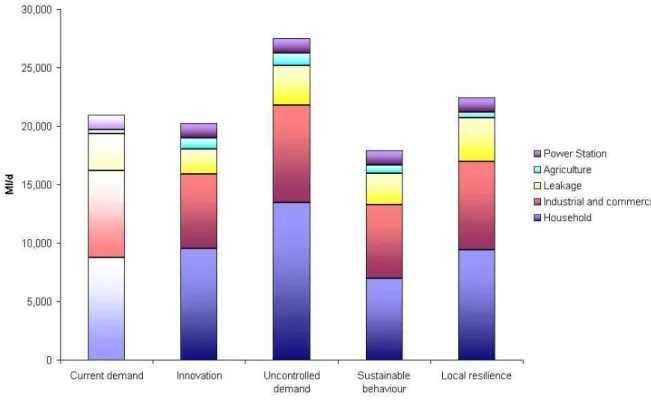
A typical set of scenarios developed for England and Wales is illustrated below, based on different types of society (conservationist through to consumerist) and different types of governance (growth-focused through to sustainability-focused). Whilst the assumptions behind each of these scenarios will not necessarily apply to China, the examples illustrate the type of issues that could be considered to develop scenarios to inform long-term strategic planning. The overall approach to scenario development is outlined in
• Sustainable behaviour Individuals pride themselves in being as efficient as possible and being seen as ‘green’ is a positive attribute. This drives demand down in most sectors. But as it is primarily achieved through good will of individual citizens, the savings could be seen as more vulnerable than those achieved under some other scenarios.
• Innovation - The core drivers of demand here are the level of regulation and the resulting technological innovation. This is a world where society expects Government and scientists to solve the problems of climate change and resource shortfalls so they can carry on living their lives as they wish. Although sustainable development is at the core of the scenario, this is delivered through means other than a shift in societal values.
• Local resilience - This scenario is driven by a need to implement efficiency measures in order to get by. The level of efficiency savings that can be achieved are controlled by the limited
technology available and by limited funds for investment in the technology that does exist. The Government has neither the capital nor the political will to invest in strong regulation under this scenario and hence the drive to find improvements is limited. In addition to this, because people’s drive to use less (of everything) is controlled by the need to survive rather than a desire to protect the environment, the savings they are prepared to achieve are limited.
• Unconstrained demand - The focus on growth and consumerism under this scenario is clearly reflected in the water demand figures. The scenario shows what could happen to demand where neither society nor Government takes action to control the demand for water (or many other goods). With the focus on cutting costs, water and energy efficiency measures are often forgotten or are at least given a lower priority. The result is a very large increase in demand.
The demand scenarios illustrated in Figure 8 are defined on one axis in terms of societal attitudes and behaviour around consumption. At one end of the axis, consumption patterns are constrained. At the opposite end, individuals exist in an intensified 'desire' economy in which there is greater consumption of goods. The second axis refers to international governance systems. At one end, governance systems and decision focus on long term sustainability concerns, such as climate change and
resource depletion. At the opposite end, governance is based on rules to maximise economic growth.
Figure 8 Demand scenarios
The change in total water demand resulting from projection of the four scenarios from 2008 to 2050 is illustrated in Figure 9.
Figure 9 Scenario modelling of future water demand in England and Wales (Source: UK Environment Agency, 2011. The Case for Change – Water Availability)
Modern China has for a long time been characterised by growth-led governance moving from local resilience towards uncontrolled demand, a trend that was broken by the 11th Five Year Plan advocating economic development based on innovation and sustainable use of resources.
6
Risks
The risks inherent in long-term strategic water resource planning come from a number of sources of which the main ones are:
• The natural variability in climate and hence river flows and recharge to groundwater
• Uncertainties about the current status of water availability and demands
• Uncertainties in forecasts of future demands
• The savings in consumption associated with specific water efficiency targets, incentives and/or requirements are not met
• Potential for loss of viable water resources as a result of pollution
• That past hydrology is not a good representation of the future and observed flow timeseries may not be stationary
• Climate change has the potential to alter the availability of water resources and to change the range, duration and frequency of extreme events.
Despite the uncertainty about using past hydrology to shape future strategic plans, flow characteristics and statistics derived from observed records are the starting point for long-term strategic planning. As discussed in Ch