
i
Nusrath Jahan Mouri
IOT PROTOCOLS AND SECURITY
Faculty of Computing and Electrical Engineering
Master of Science Thesis
i
ABSTRACT
Nusrath Jahan Mouri: IoT Protocols and Security Master of Science Thesis
Tampere University Information Technology July 2019
During the past years, there has been an exponential growth of internet connected devices all over the world. In future the growth of these devices is expected to grow at the higher rate. There are some studies estimating that Internet of Things (IoT) will be able to connects 500 billion devices by 2030. IoT smart devices are remotely accessible and are possible to control using existing network infrastructure.
At present, the usage of Internet of Things has increased rapidly. IoT is a dynamic global network between smart objects or things connected over the internet. IoT wireless network can connect anyone with anything at any place. With the rapid growth of IoT, security threats and vulnerabilities of the linked objects are also increasing continuously. Now, IoT security has become the most paramount technological research work over the world. The main objective of all IoT applications is to maintaining privacy and secure data transmission between devices. Due to the heterogeneous characteristics and constrained devices it is challenging to deploy security mechanisms in IoT compare to traditional network.
In this thesis, we highlight the importance of security in the IoT sector by studying a wide range of IoT security issues. Furthermore, we described several challenges derived from the existing IoT protocols and the security features of IoT protocols are also explained. In addition, implementation of UDP communication protocol and MQTT protocol using Contiki OS and Zolertia RE-Mote devices are added to the work. Cryptographic methods AES [1] and ECC [2] are described in the thesis and the implementation of AES-128 to secure device communication and ECC key generation process are also added to the thesis work.
ii
Preface
This M.Sc. thesis work was completed at the Department of Pervasive Computing, Tampere University and was supported by the Internet of Things research team, working for a project under the supervision of Antonis Michalas.
First of all, I would like to start by thanking my supervisors, Antonis Michalas for introducing me to the topic and for guiding me throughout the complete process and Elena-Simona Lohan for providing the guidance to complete the thesis work.
I would like to thank my husband Syed Golam Mahmud, without his belief and support it was not possible to complete the thesis work.
Finally, I would like to thank my family, especially my father who have always stood by me and his belief in me has been the source of motivation for me in my entire life.
Tampere, 2 July 2019
iii
Contents
1. INTRODUCTION ... 1 1.1 Motivation ... 1 1.2 Thesis Objectives ... 2 1.3 Author’s Contribution ... 3 1.4 Limitations ... 3 1.5 Organization ... 4 2. IoT OVERVIEW ... 5 2.1 IEEE 802.15.4 ... 52.2Bluetooth Low Energy ... 6
2.3 WSN ... 6
2.4 Internet Protocol version 6 (IPv6)... 7
2.5 6LoWPAN ... 8
2.6 Contiki ... 9
2.7 TCP ... 9
2.8 UDP ... 10
2.9 MQTT ... 10
3. IoT SECURITY AND CHALLENGES ... 12
3.1 Security Issues in IoT ... 12
3.2 Protocols for IoT Layers and Security ... 14
3.2.1 IEEE 802.15.4 Protocol and Security ... 16
3.2.2 6LoWPAN Protocol and Security ... 17
3.2.3 RPL Protocol and Security ... 19
3.2.4 CoAP Protocol and Security ... 21
3.2.5 MQTT Protocol ... 25
3.3 CoAP and MQTT ... 26
3.4 DTLS Security Protocol ... 27
3.5 The Advanced Encryption Standard (AES) ... 29
3.6 Elliptic Curve Cryptography (ECC) ... 30
3.7 Security Threats in IoT Application Layer ... 32
3.8 IoT Security Challenges ... 33
4. EXPERIMENTAL RESULTS WITH ZOLERTIA ... 36
iv
4.2 Tools Utilized ... 37
4.2.1 Operating Systems ... 37
4.2.2 6LowPAN Border Router ... 37
4.2.3 Digital Grove Light Sensor ... 39
4.2.4 Zolertia RE-Mote as a hardware platform ... 39
4.3 Test Implementation and Results... 40
4.3.1 Printing text message ... 40
4.3.2 Data reading from a Digital Light Sensor ... 41
4.3.3 Implementation of UDP Protocol ... 43
4.3.4 Implementation of MQTT Protocol ... 45
4.3.5 Encrypted message ... 46
4.3.6 Secure message Transmission ... 48
4.3.7 Message Encryption using ECC ... 49
5. CONCLUSIONS ... 56
5.1 Conclusion and Future Work ... 56
5.2 Problems encountered ... 57
v
List of Figures
Figure 1: IoT Architecture [9] ... 2
Figure 2: Wireless Sensor Network Topologies [23]... 7
Figure 3: 6LoWPAN Layers ... 8
Figure 4: MQTT Architecture ... 11
Figure 5: IoT Layered Architecture [51] ... 15
Figure 6: 6LowPAN vs. Traditional IP Protocol Stack [55]... 18
Figure 7: Client-server model in CoAP ... 22
Figure 8: CoAP architecture [61] ... 23
Figure 9: DTLS Handshake Process [61] ... 25
Figure 10: Zolertia Z1 Mote [77] ... 36
Figure 11: Zolertia Firefly [77] ... 36
Figure 12: 6LBR Border Router ... 38
Figure 13: CETIC 6LBR ... 38
Figure 14: Digital Grove Light Sensor with Zolertia RE-Mote ... 39
Figure 15: Zolertia RE-Mote ... 40
Figure 16: Hello message in a Zolertia RE-Mote ... 41
Figure 17: Testing with Digital Grove Light Sensor ... 42
Figure 18: UDP Client ... 43
Figure 19: UDP Server ... 43
Figure 20: Border Router ... 44
Figure 21: Wireshark capture for UDP protocol ... 44
Figure 22: MQTT Clients connected to Border Router ... 45
Figure 23: MQTT Client publishing data ... 46
Figure 24: Message Encryption and Decryption ... 46
Figure 25: Device sending Encrypted Message ... 48
Figure 26: Device Decrypting received message ... 49
vi
List of Tables
Table 1: IoT layers and protocols [40] ... 16
Table 2: RPL control messages with functions ... 20
Table 3: RPL Features [45] ... 20
Table 4: Differences between CoAP and MQTT [58] ... 27
Table 5: AES Features and Advantages [64] ... 30
Table 6: ECC Features and Advantages ... 32
Table 7: Security measures [1] ... 33
vii
LIST OF SYMBOLS AND ABBREVIATIONS
IoT BLE WSN IPv6 IETF 6LoWPAN MQTT CoAP REST DTLS HTTP AES ECC ESP IPSec ICMPv6 6LBR Internet of Things Bluetooth Low Energy Wireless Sensor Network Internet Protocol version 6 Internet Engineering Task Force
IPv6 over Low power Wireless Personal Area Network MQ Telemetry Transport
Constrained Application Protocol Representational State Transfer Datagram Transport Layer Security Hypertext Transfer Protocol
Advanced Encryption Standard Elliptic-Curve Cryptography Encapsulating Security Payload Internet Protocol Security
Internet Control Message Protocol for IPv6 6LoWPAN Border Router
1
1. INTRODUCTION
1.1 Motivation
At present, communication technology is no longer limited to person-to-person communication but can also connect people with a wide range of devices all over the world. In near future, it is expected that everything and everyone in our society will be connected. Internet of Things (IoT) was introduced to fulfill this present technology demands. The term IoT was invented by Kevin Ashton in 1999 [3]. Even though the concept exists for almost 20 years there is still no unique definition about the field. Internet of Things allows people to connect with devices, sensors, services using a wired or wireless network from anywhere to achieve a specific goal. ‘Thing’ is used as a physical or virtual object that can communicate with other objects or users in IoT. Different organizations and group of researchers elucidated IoT definition in their own way. Stephan Haller et al. [4] defined IoT as “A world where physical objects are seamlessly integrated into the information network, and where the physical objects can become active participants in business processes. Services are available to interact with these ‘smart objects’ over the Internet, query their state and any information associated with them, considering security and privacy issues”. According to Gartner [5], “The Internet of Things (IoT) is the network of physical objects that contain embedded technology to communicate and sense [6] or interact with their internal states or the external environment”. IoT smart devices are remotely accessible and are possible to control using existing network infrastructure. To manage the efficient and secure connectivity between devices and objects over the internet, Internet Engineering Task Force (IETF) [7] designed a lightweight IPv6 network routing protocol for IoT [8]. According to Cisco [5], IoT will be able to connect 500 billion devices to the internet by 2030.
Along with the exponential increase in the number of IoT usage, security threats and effects on privacy has grown severely in communication. Secure data transmission and maintaining privacy and trust are the primary motive for all IoT applications. Due to the heterogeneous characteristics of the Internet of Things, privacy protection is a great challenge for any IoT applications [3]. IoT is mostly using constrained devices with low processing power, limited memory, battery supported compared to traditional internet. Therefore, it is difficult to extend security functionalities on these light IoT devices.
2
Figure 1: IoT Architecture [9]
1.2 Thesis Objectives
The purpose of this thesis is to describe the importance of IoT security, security protocols that are introduced for implementing in different IoT layers and the security challenges in IoT. Chapter 3 will cover all these mentioned contexts. In case of transferring sensitive data over the Internet using IoT, security and privacy are important topics to focus on by the organizations or businesses before implementing IoT network [10]. Since all IoT devices will be connected over the Internet, it is important to have security schemes that will protect the devices from malicious attack and to keep transmitted data immune. Applying security could be the biggest challenge for compatible speed and performance. Nowadays, enormous research work is going on to evolve challenges associated with the security and privacy issues in IoT. Finally, the implementation of some example programs in Zolertia Re-Mote hardware devices will be added to this thesis work to evaluate the performance of Zolertia IoT constrained devices at Chapter 4.
IoT Gateway Home & Buildings Healthcare Media IoT Devices Service Provider
Industries IoT Cloud
Server Mobile Phone PC Light Sensor IoT Device Sensor User
3
1.3 Aut
hor’s Contribution
In this thesis, the Author’s contribution are as follows:
• Presenting the importance of IoT security and the challenges which make it difficult to implement the security scheme in the IoT devices as well as in the IoT networks.
• Describing the IoT protocols and the security features of these protocols that are now popular to the developers.
• Implementing an experimental study based on Zolertia RE-Mote devices (see Chapter 4). • Implementation of UDP (User Datagram Protocol) and MQTT (Message Queuing Telemetry Transport) protocols and secure communication between devices using AES-128 encryption method.
• Drawing conclusions on the theoretical and experimental studies and discussing the possible future directions in the addressed research field.
1.4 Limitations
This thesis is focused on the theoretical description of IoT protocols and the security features of all those protocols that have been proposed as mean to protect IoT from several security and privacy threats. In addition, some security protocols and cryptographic algorithms are described in Chapter 3. Apart from the theoretical work, we also conducted some experiments that help us to test the applicability of popular cryptographic functions on IoT devices with constraint resources. Our testbed conformed from a number of interconnected Re-Mote Zolertia devices running on Contiki OS [14] - an operating system that has been built to fit squarely the specific needs of IoT. Implementation of MQTT communication protocol will be tested using Contiki OS, but other protocols like COAP, DTLS, and other operating systems will not be covered. Zolertia Re-Mote devices are used as hardware platforms for the testing and implementation part in Chapter 4, because of the availability and for some attractive features like the communication range between 100 meters and 20 km, ARM Cortex-M3 32 MHz clock speed. Contiki OS supports the software that is developed for Zolertia hardware. A digital Grove light sensor is used to obtain real data for the testing purpose. A brief description of Zolertia hardware and the utilized sensors will be presented in Chapter 4.
4
1.5 Organization
Chapter 2 presents the background knowledge about the technologies and protocols that are being used for both hardware and software implementation in this thesis writing.
Chapter 3 describes a list of security issues and challenges for IoT. Furthermore, some security protocols that are designed for different IoT layers are described. More precisely, a brief description of MQTT [11], DTLS [12], COAP [13] protocols are provided to analyze security issues for constrained Node Networks.
Chapter 4 illustrates the concepts of hardware devices and tools that are used for the experiments to get the desired results. All the test procedures are included in this chapter. Finally, in Chapter 5 we conclude this study by highlighting the main points as well as some possible future directions.
5
2. IoT OVERVIEW
In this chapter, we present the main technologies that will be used in this thesis work. A variety of protocols and communication technologies are used for the IoT. A brief description of IoT technologies, protocols and operating system are presented below for making it easier to understand the use of each technology and protocols. Further details will be added to other chapters based on the thesis work.
2.1
IEEE 802.15.4
IEEE 802.15.4 [14] is a broadly used mesh network communication standard, the first version was released in 2003. This standard is intended to use in low-data-rate and low-cost communications between inexpensive devices to achieve the lowest power consumption. At present, various network layer protocols such as 6LoWPAN, ZigBee and IEEE 802.15.5 run over IEEE 802.15.4 based networks.
This standard provides physical layer, medium access control sublayer (MAC) of the OSI model specifications for low-data-rate wireless connectivity with portable or fixed devices with limited battery consumption requirements. As a MAC mechanism this standard uses a CSMA / CA protocol. These characteristics make IEEE 802.15.4 contrasted from Wi-Fi technology, which requires more power and offers large bandwidth. It describes the smaller range of wireless communication compared to Wi-Fi. It supports 10-meter communication range with a transfer rate of 250 Kbit/s.
IEEE 802.15.4 standard supports network topologies such as star and peer-to-peer and two types of network nodes: Full Function Device (FFD) and Reduced Function Device (RFD). FFD can operate all operations and can communicate to all other devices for sending and receiving data in the network. RFD is simpler and can only communicate with FFD nodes in the network. It uses 64-bit or short 16-bit IEEE addressing modes for each node. Devices that support IEEE 802.15.4 can use one of 868/915/2450 MHz frequency bands for operations.
6
2.2
Bluetooth Low Energy
Bluetooth Low Energy (BLE) [15] is a wireless communication technology designed for short-range communication, developed by the Bluetooth Special Interest Group (SIG). BLE succeed in the market as Bluetooth 4.0 by 2011. It is quite different than classic Bluetooth. The primary difference is in power consumption. BLE is used only for the applications that are applicable to transferring the short amount of data and therefore it can run over a small battery for several years. But it is not ideal for phone calls [15].
The key features of BLE are low cost, low power consumption, enhanced range, multi-vendor interoperability. Classic Bluetooth and BLE both operate in the same spectrum range 2.4 GHz ISM band, but they use different channels. Bluetooth Low Energy has the data transfer rate up to 1 Mbit/s and the possible range is over 100 m. It supports full AES-128 encryption to provide encryption and authentication of data packets. BLE technology is now being used by numerous numbers of applications like security, low power sensor devices, entertainment, healthcare [16] [17] [18] [19], automotive industries to provide a wireless connection between manufacturers and consumers [20].
2.3 WSN
Wireless Sensor Network (WSN) [21] can be generally defined as a network that may control and sense surrounded environment as well as establishes device-gateway communication where devices are acting as network nodes and border routers are performing as gateway. In WSN, data is forwarded to multiple nodes and data forwarded to other networks using a gateway. Wireless Sensor Network nodes act as sensor nodes, actuator nodes, clients and gateways. Sensor nodes can sense some data like temperature, pressure, humidity, power of light from the environment and forward it to the sink node that can process data to produce some control commands. The Border router is used between a WSN mesh network and the Internet. Nowadays WSN is mostly used for IoT applications and systems for its low power needs.
The wireless sensor network nodes are organized according to the topologies illustrated in Figure 2. Sensor nodes publish data to other nodes and receive status from other nodes to detect each other. Data forwarding process between nodes differs for different topologies. WSN devices
7
are battery dependent and spending low energy. Due to these energy-saving criteria, there is the possibility of security threats [22].
Star Tree Mesh
Gateway Router End node
Figure 2: Wireless Sensor Network Topologies [23]
Operating systems that are used for WSN are: Tiny OS, Contiki, MANTIS, BTunt [22]. Mostly common communication standards for WSN are 6LoWPAN, ZigBee and Bluetooth [22]. Some applications for wireless sensor network are the security system, healthcare, military applications, industrial applications, environmental monitoring, and smart buildings [23].
2.4 Internet Protocol version 6 (IPv6)
Internet Protocol version 6 (IPv6) [24] is the newest version of Internet Protocol standardized by the Internet Engineering Task Force (IETF) to conquer old version IPv4 to get over new technical challenges. IPv6 uses 128 bits for each IPv6 address which means it has 2128 options
for the addresses while IPv4 uses 32 bits only for each address. This extension of IP address length brings some benefits like the immense number of addresses, easier address management, end-to-end IPsec possibility, and address auto-configuration methods. IPv6 is not only differing on a large number of addresses than IPv4 but also offers divers improvements over IPv4 [25]:
▪ Simplifies efficient routing process ▪ Allocation of the hierarchical address
8 ▪ Mandatory IPsec network layer security
▪ Assure Quality of Service (QoS) in terms of performance ▪ IPv6 provides Stateless Address Autoconfiguration (SLAAC)
▪
Extension of the header without including any additional fields.
2.5 6LoWPAN
6LoWPAN [24] is the acronym for IPv6 over Low power Wireless Personal Area Networks has been developed by IETF. It is a protocol used to transmit IP packets in networks based on IEEE 802.15.4 standard. This 6LoWPAN concept comes with the idea of using low power devices with limited processing (CPU, Memory) capabilities as the network nodes for the Internet of Things (IoT). 6LoWPAN layers are presented in Figure 3.
Application
TCP/UDP
IPv6
6LoWPAN (Adaptation)
IEEE 802.15.4 MAC
IEEE 802.15.4 PHY
Figure 3: 6LoWPAN LayersThe main goal of 6LoWPAN is to act as an adaptation layer between the standard IEEE 802.15.4 and IPv6 [24]. It provides the encapsulation and header compression methods to solve the different packet size problems between IEEE 802.15.4 and IPv6 layers [24]. Stateless header compression is used to reduce the large IPv6 and UDP header to some bytes [24]. Communication range for 6LowPAN is 45 to 90 meters [22]. Some functions of the 6LoWPAN protocol are device and service discovery, security, packet size adaptation, address resolution and optimization [26]. Star and Mesh topologies are included in 6LoWPAN protocol [24]. Due to uncertain radio connectivity, battery drain, and physical difficulty devices supported by 6LoWPAN tends to be unreliable [24].
9
2.6 Contiki
Contiki is an open source operating system for the Internet of Things (IoT) and Wireless Sensor Networks (WSN) [24]. It connects small microcontrollers with low cost and low power properties to the Internet [24]. It was developed by a group of developers from the Swedish Institute of Computer Science [27]. Contiki Applications are written in C programming language [27]. Contiki supports both IPv4 and IPv6 along with 6LoWPAN, RPL and COAP low-power wireless standards [24].
Instant Contiki consists of a single file download for users that have all tools and compilers included to ease software development for Contiki [27]. Some key features of Contiki OS are [27]:
▪ Multi-tasking Operating System ▪ Power and Memory efficient ▪ Highly portable Operating System
▪ Possible to load and unload application programs in run time using event-driven kernel
2.7 TCP
Transmission Control Protocol (TCP) is designed as a network communication protocol to transmit packet data between nodes over the Internet [28]. TCP is a transport layer protocol in the Open Systems Interconnection (OSI) model. It was mainly designed for the wired network [29]. It is a connection-oriented protocol. Before data transmission between the source node and destination nodes, TCP establishes a connection between nodes. This connection establishment is renowned as handshaking, which needs three packets transmission before sending any user data packets.
TCP divides a large amount of data packet to smaller packets for transmission. Header size for TCP is 20 bytes, included in each packet. It sends all data packets sequentially. It provides acknowledgment (ACKs) for packets received by the destination node. If the source node does not receive the correct ACK from the receiver node then It resends the data packet [30]. Thus, TCP ensures data reliability and integrity. These make TCP communication process a bit slower. This protocol is responsible for error checking and error recovery. HTTP, HTTPs, FTP, SMTP protocols could be used as TCP traffic source [31]. Applications that need more reliability and
10
needs to receive data in a sequence like email, web browsing, files downloading uses TCP protocol.
2.8 UDP
User Datagram Protocol (UDP) is similarly a communication protocol that is used to transmit data between nodes. It is a connectionless protocol. UDP does not need to establish any connection between sender and receiver before user data transmission. When an application using UDP protocol, it just sends all data packets to the destination directly. If the receiver does not receive data accurately or some part of the data is missing, UDP does not resending the data that is not reached correctly [30]. Thus, UDP is faster than TCP protocol but not ensuring data reliability and integrity.
UDP is responsible for error checking but does not attempt to recover error, just discard the packet. It is not receiving any acknowledgment from the destination node. UDP header size is 8 bytes [14]. Data packets are not sent in any sequence. Each packet sent independently, and integrity is checked in the destination if the packets arrive [31]. DNS, DHCP, NFS, RIP protocols could be used as UDP traffic source [31]. Applications that do not need any error correction and needs faster data transmission like the online game, VoIP, video or audio streaming are suitable for UDP protocol.
2.9 MQTT
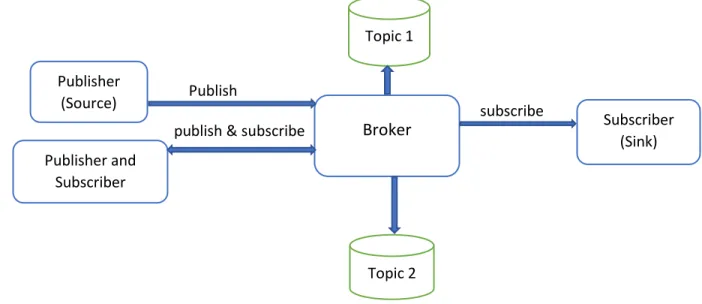
MQ Telemetry Transport (MQTT) is a messaging protocol designed in 1999 and works on top of TCP/IP protocol [24]. Two types of messages “Publish and Subscribe” are used on an MQTT connection [32]. It is designed to minimize network bandwidth and to work with low resources consumption [24]. An MQTT broker is used to publish data on a specific topic and for receiving data on a topic.
MQTT Architecture is designed in Figure 4. A client node is publishing data with a topic name to the broker and the clients also can subscribe data from the broker with a specific topic name. The broker is ready to reply for data sending to the clients based on their requirements. MQTT
11
provides three different levels of Quality of Service (QoS) that defines how the messages are delivered between nodes [24]:
• QoS 0: broker or client delivers the message once without any confirmation. • QoS 1: broker or client delivers the message with confirmation at least once.
• QoS 2: broker or client delivers the message with four-step handshaking exactly once.
Publish
subscribe publish & subscribe
Figure 4: MQTT Architecture
MQTT minimizes protocol overheads and provides high-efficiency communication for IoT [32]. Furthermore, it reduces bandwidth consumption while at the same time increases scalability. It has keep-alive message function, if any clients disconnected broker can detect that node [24]. Broker keeps published data of a topic, therefore, if any new subscriber connected with the same topic can subscribe all data based on this topic from MQTT broker [24]. MQTT is mostly suitable for IoT because of remote sensing and controlling capability. It is possible to provide security by adding a username and password to the data packet in the protocol.
Topic 2 Topic 1
Broker
Publisher (Source) ()(9 Subscriber (Sink) Publisher and Subscriber12
3. IoT SECURITY AND CHALLENGES
3.1 Security Issues in IoT
IoT can be defined as the internet of objects. IoT objects interact with the other components like mobile, data collectors, laptops, smart devices for data sharing, collecting and management in the context of service provided. With the rapid growth of IoT, IoT devices are responsible for transmitting and collecting a large number of data between devices. Due to the vast number of connected devices, there is a high risk of data stealing, device, and network manipulation. With the increasing number of IoT devices, security concerns are becoming the major issues all over the world. A research study on Internet of Things [33] by Hewlett-Packard Development Company, 2014 found that 80% of devices failed to require strong passwords, 60% did not use encryption during downloading software updates, 70% failed to encrypt data transmission via local network and the Internet and 80% of devices collecting personal information which could be harmful if it is transmitted by any devices without encryption.
IoT is the biggest revolution in the IT industry [34]. It is easier to conduct attacks on IoT devices. Some dynamic threats and challenges for IoT devices are listed below [34, 35, 36]:
• Due to the lack of security mechanisms and impotent encryption process transmitted data can be attacked or misused by the unauthorized interference during the data transmission across the network. Maintaining data integrity and confidentiality are must be needed during data transmission.
• Personal information or messages from the sender to the receiver can be affected by the attacker and wrong information can be sent [37].
• IoT devices are resource constrained means they have limited computational and storage capabilities. It is not possible for the developers to adding required features to defend against the security threats.
• Life becomes easier with the use of IoT that provides several facilities to everyday lives. But it influences the users’ privacy [38] [39] [40]. If the IoT device compromised the collected data, then it will be difficult for the user to keep trust in IoT.
• Some security vulnerabilities in network services like Exploitable UDP Services, DoS via Network Device Fuzzing, Buffer Overflow, Denial-of-Service [41], [42], [43]might allow an attacker to acquire unauthorized access to the IoT device.
13
• Insecure cloud interface [44], [45], [46], [47], [48] and insecure mobile interface due to the poor authentication and unencrypted data transmission might allow unauthorized access to the device and the collected data.
• If the web interface that is used to the user and device interaction is not secure, then it is easier for the attackers to gain access to the IoT device.
• In some IoT applications, device life is shorter, and some applications have longer device life. Security techniques should be designed based on device lifetime and application. If the device life is longer than it should have the option to update security features to defend from new attacks and security threats.
• Open source software is useful for quick development in IoT systems. To protect from malicious attacks, developers need to be careful to choose the software and for open source software validity must have a framework. Most of the IoT edge devices use same open source software which may have the same vulnerabilities. It increases the possibility of full system collapse if an attacker uses the same vulnerabilities to all edge devices and attacks all network devices.
To protect devices from the above-mentioned security threats it is important not only to provide reliable but also realistic (i.e. efficient) solutions. As the IoT devices are resource constrained, it is not possible to directly employ the traditional security mechanisms like the other Internet devices. There are some limitations to apply traditional security schemes directly in the IoT devices based on hardware, software, and network which are discussed below [49]:
• Most of the IoT devices are battery dependent. Thus, using low power CPU that has the lowest computation power is considered as of paramount importance. However, using such a processor makes it difficult to execute computationally heavy cryptographic algorithms. • IoT devices have limited memory than other traditional devices and use a lightweight
version of Operating System. Therefore, traditional security algorithms cannot be used in these devices with small memory as the process might not get enough space after booting up the operating system and some software. However, Traditional security algorithms are not designed with memory efficiency consideration.
• Sometimes IoT devices are needed to place in some remote area and not possible to monitoring continuously. If a single IoT device from a network is attacked by an unauthorized person, an attacker might change the programs of the device or may replace the device with another malicious node.
14
• Installing a dynamic security scheme in IoT device is not possible as the operating system and protocol stack might not be able to receive and integrate new code and library. • IoT devices might use IP networking to communicate with IoT service provider and
proprietary network protocol for network communication simultaneously. For these characteristics of IoT devices, traditional security methods become unsuitable for the devices.
• An IoT device can join or leave the network at any time and this adding or removing device characteristics make a network topology dynamic. Security models that exist for the digital systems do not work duly with these topological changes.
• IoT devices might be connected via wired or wireless link to the local and global network. It is difficult to find any security protocol that can work for both wired and wireless connectivity.
3.2 Protocols for IoT Layers and Security
A Protocol is the set of rules that are used by the end node of a network connection to communicate with the other end nodes of the same network or the different network. In this subsection 3.2, IoT layers are mentioned in Figure 5 and the most common security protocols listed in Table 1 that are used for Machine-to-Machine (M2M) communication in IoT different layers will be described briefly.
Perception Layer is responsible for data collection. It is the lowest layer of the IoT. This layer uses sensors and actuators to perform different measurements like temperature, humidity, and pressure. IoT nodes perform the required function for data collection and RFID, ZigBee, some other sensor nodes are involved in this layer [50]. It is important to secure this layer to protect the data that could be damaged by a malicious attack. Some possible security threats are DoS attack, routing attack and hardware damage. Attackers can destroy a sensor node by replacing the node or by electronically interrogating the nodes to get the access and to change the important information. Physical security like abnormal sensor reading detection and cryptographic elements implementation has to be provided at the perception layer [50].
Network Layer in IoT is the same as the TCP/IP network layer. Data transmission is the main task of this layer. Similar to the traditional TCP/IP network layer this layer has several security
15
issues as well. Some of those common security threats are unauthorized access to the networks, lack of confidentiality and data integrity, DoS attack, storage attack, eavesdropping information, gateway attack and so on [50]. To protect the network layer from such attack key management, precise authentication, unauthorized access detection, and negotiation should be implemented.
Camera RFID
Hospital Wearable device Smart Home
Figure 5: IoT Layered Architecture [51]
Application Layer provides the services that are requested by the user. There is no universal standard for the IoT application layer construction as because of the availability of many different devices and manufacturers [50]. This layer can provide high-quality services to meet user demands. A large number of devices and nodes makes it challenging for the layer to secure data efficiently because of the massive amount of data and information transformation. Availability of so many different applications and the user makes it difficult to manage authentication and authorization. There are many security threats to the application layer. Attackers can steal user data by known application vulnerabilities. If the coders are not more conscious about their codes in the application, attackers can upload malicious codes which can lead to the software attack. Attackers can destroy the complete application or service.
Application Layer Perception Layer Network Layer Wireless and Wired Networks
16
IoT Layer IoT Protocol Security Protocol
Application MQTT, COAP User defined
Transport UDP DTLS
Network IPv6, RPL IPsec, RPL security
Adoptation 6LoWPAN ---
Perception IEEE 802.15.4 802.15.4 security
Table 1: IoT layers and protocols [52]
3.2.1 IEEE 802.15.4 Protocol and Security
IoT PHY and MAC both layers are supported by the IEEE 802.15.4 protocol [10] which was established in 2003. It was designed as a principle for a protocol stack towards short range and energy efficient communication. The frequency band 2.42 GHz is mostly used for this protocol. It supports short-range communication at 250 Kbit/s. IEEE 802.15.4 security is implemented in the MAC layer, not designed for the PHY layer. IEEE 802.15.4 PHY layer is responsible to manage signal, energy and channel selection [53]. IEEE 802.15.4 MAC layer provides other services like physical channel access, frames validity, time slots, and security and node organizations [53]. Carrier Sense Multiple Access (CSMA/CA) method is used to avoid collisions during data transmissions. MAC layer provides multiple security levels.
IEEE 802.15.4 protocol has a stable mechanism and it provides various security services [10]. The security depends on symmetric cryptography and Advanced Encryption Standard (AES). This provides data authentication, data encryption, and confidentiality. Access control is another security service that can activate the nodes to find more security information for processing the security of the message [10]. Security-enabled flag inside the control field of the frame used to secure MAC frames during the communication [54]. Auxiliary Security Header is responsible to have information about the frame security and security enabled control flag is responsible for the signals of the presence of this header. A new feature known as Time Synchronized Channel Hopping was introduced in 2008 which provides services to protect from replay attacks. It requires
17
acknowledgment-based or frame-based synchronization between end devices. Receiver node calculates the difference between the estimated arrival time and the exact arrival time of a frame and then send it to the sender with the acknowledgment to synchronize the time clock according to receiver’s clock [53]. The usage of Absolute Slot Number (ASN) that stores the total number of timeslots as a global frame counter value can be used to protect from the replay attack and semantic attack [53]. But the IEEE 802.15.4 specification does not define how to do key management. Reem et al [10] state that, “the IEEE 802.15.4 protocol security has a limitation that it is not using key management model for the cases in which the end nodes might reuse the nonce value”. The AES-128 block cipher uses 128-bit symmetric keys, but the upper layers are responsible to do the key generation, distribution, and replacement [54].
3.2.2 6LoWPAN Protocol and Security
The IPv6 over Low power Wireless Personal Area Networks (6LoWPAN) is a network protocol standardized by IETF to enable direct connection to the Internet for constrained resource devices [54]. The widely supported standard IEEE 802.15.4 for low-power wireless embedded communications released in 2003 was the reason for 6LoWPAN standardization. The first 6LoWPAN specification was introduced in 2007. 6LoWPAN defines a set of rules that are generally used to integrate all sensor nodes into IPv6 networks. It supports star and mesh topologies and the combination of both star and mesh topology. As it supports low-power, low cost, battery supplied, IP-driven devices and large mesh network, it is becoming a suitable option for the Internet of Things (IoT) applications. It defines the frame format and header compression mechanisms for IPv6 packets during the transmission over IEEE 802.15.4 networks [54]. Different specifications have been developed to support IPv6 over Bluetooth Low Energy (BLE) and some other networks.
This 6LoWPAN protocol has the freedom of physical layer and frequency band [10]. It is possible for the constrained devices to establish network connectivity with any other IPv6 enabled device using the 6LoWPAN protocol. The adaptation layer can be classified in various RFC (Request for Comments) documents. RFC 4919 is responsible to discuss the goals and assumptions used to perform the works by the group of IETF 6LoWPAN [53]. RFC 6282 presents how the UDP header compression could be done following the context of the 6LoWPAN adaptation layer [53]. RFC 4944 defines the mechanisms that are used to transmit IPv6 packets over IEEE 802.15.4 networks with header compressions [53]. RFC 6606 represents the
18
6LoWPAN routing requirements. 6LoWPAN adaptation layer does not contain any special security mechanisms. It relies on the security mechanisms that are available for the lower layer (Section 3.2.1-IEEE 802.15.4 security) or upper layer (Section 3.2.4-COAP) for securing communications [41]. But the adaptation layer RFC documents include some of the security vulnerabilities and requirements to consider the importance of network-layer security [40]. Identification was one of the problems that represent RFC 4944 is involved with the possibility of extracting EUI-64 interface that can compromise the 6LoWPAN unique interface identifier [40]. RFC 4944 document is also involved with the discussion of mesh routing mechanisms and neighbor discovery on IEEE 802.15.4 which might be a threat to security. MAC layer AES security may provide some fundamentals for developing the mechanisms to protect from such threats [40]. The usage of compression UDP was another major issue which reduces an UDP port numbers (16) to 4 bits [7]. Hence, it creates the possibility of receiving the wrong message or incorrect payload by an application [7]. Difference between 6LoWPAN and IP protocol stack is presented in Figure 6.
Figure 6: 6LowPAN vs. Traditional IP Protocol Stack [55]
Jorge Granjal et. al [53] has mentioned some possible solutions for the protection from the security threats. The use of Internet Protocol Security (IPsec) for end-to-end IoT provides authentication and encryption at the network layer. Design of compressed security header for the
6LowPAN Protocol Stack IP Protocol Stack
CoAP, XMPP Application HTTTP, XMPP
UDP, ICMPv6 Transport TCP, UDP, ICMP
IPv6 Network IP
6LowPAN adaptation
IEEE 802.15.4, BLE, PLC Data Link Ethernet
CoAP - Constrained Application Protocol
XMPP – Extensible Messaging and Presence Protocol 6LowPAN – IPv6 over Low Power Personal Area Networks BLE – Bluetooth Low Energy
19
Authentication Header (AH) and Encapsulating Security Payload (ESP) for 6LoWPAN in transport and tunnel modes was another proposed solution [10]. Security implementation against packet fragmentation attacks was one more approach. The fragmentation attacks may cause the buffer overflow or the misuse of available computational capability. The proposed solution is to add a new field namely timestamp for the protection against unidirectional replays and a nonce for the protection against bidirectional replays to the fragmentation header of 6LoWPAN to solve these issues [53]. Key Management is one of the important security functionalities to ensure long-term and effective security for applications. One possible solution for key management is to reduce the payload information and IKE headers using the 6LoWPAN protocol [10].
3.2.3 RPL Protocol and Security
RPL is a lightweight IPv6 distance vector routing protocol for Low power and Lossy Networks (LLNs) was standardized in 2011 by the IETF group with a goal of providing routing solutions for IoT. It supports Point-to-point, Multipoint-to-point, and Point-to-multipoint traffic patterns [24]. Different functions can be used based on scenarios for the path selection in the RPL routing protocol to make the network more efficient and for flexible structure [56]. RPL builds a Destination Oriented Directed Acyclic Graph (DODAG) for each root device which is identified by a DODAGID [53]. RPL can response on a sudden topology change of the network and is able to provide optimal path selection based on functions [56]. The RPL routing protocol supports several types of control messages and all these messages are encapsulated in ICMPv6 packets [53]. In table 2 functions of these control messages are listed.
RPL Control Messages Functions
DODAG Information Object (DIO) Carries information to join a DODAG which exists and select list of parents.
DODAG Information Solicitation (DIS) Request for a DIO message from a RPL node.
Destination Advertisement Object (DAO) Used to propagate destination and routing information from leaf nodes to the root.
20
DAO Acknowledgment (DAO-ACK) Sent by the parent as an acknowledgment on the reception of DAO.
Consistency Check (CC) Used to synchronize counter values among communicating nodes.
Table 2: RPL control messages with functions
The current RPL specifications include SHA-256 to use digital signatures and AES/CCM including128-bit keys for MAC to support authenticity and integrity [53]. RPL message is entirely maintaining RPL security. In an RPL ICMPv6 message, IPv6 header and the ICMPv6 header is not encrypted but this fields required for the correct packet decryption. A Consistency Check RPL control message can help a sensor device to establish a challenge response with a motive to authenticating the counter value of another node [10]. For example, if any receiver is maintaining incoming counter value for message originator while a message is received with the initialized counter value, then the receiver can start resynchronization with the sender by sending a consistency check message to the source [53]. This counter fields technique provides security against replay attacks.
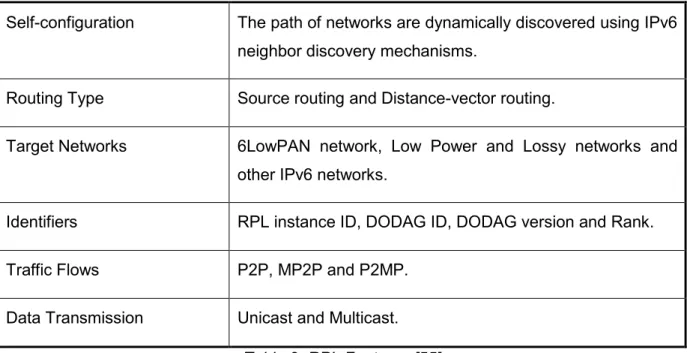
Self-configuration The path of networks are dynamically discovered using IPv6 neighbor discovery mechanisms.
Routing Type Source routing and Distance-vector routing.
Target Networks 6LowPAN network, Low Power and Lossy networks and other IPv6 networks.
Identifiers RPL instance ID, DODAG ID, DODAG version and Rank.
Traffic Flows P2P, MP2P and P2MP.
Data Transmission Unicast and Multicast.
21
Table 3 represents some key features of RPL protocol. RPL also has three different security modes which can be applied to routing control messages [53]:
• Unsecured: RPL uses this mode as default. It does not apply any additional security to the routing control messages.
• Preinstalled: The security is applied by a node to join the RPL instance as a router or host device using a preconfigured symmetric key. This symmetric key is used to provide data authentication, confidentiality, and data integrity for RPL control messages.
• Authenticated: RPL applies this security mode only to the routers. When a device joining the network with a preconfigured symmetric key means using preinstalled mode since it can obtain a cryptographic key from the authority to act as a router. The authentication and authorization of the devices are assured by the key authority.
The RPL specifications recently define that it is not mandatory to use symmetric cryptography to support the authenticated mode, but how the asymmetric cryptography can be used to authenticity and to retrieve the key by the node which is ready to act as the router is not specified. The future RPL versions may clarify this issue. Lack of security mechanisms and internal attacks are the limitations of RPL security. Adding version number, authentication based on signatures and one-way hash chain can be used to protect against the internal attack [10].
3.2.4 CoAP Protocol and Security
Constrained Application Protocol (CoAP) [57] is a web transfer protocol, developed for constrained networks and constrained nodes in IoT [58]. IETF designed CoAP using a subset of the HTTP methods to target constrained devices [59]. It uses REST (Representational State Transfer) architecture where resources are identified by Universal Resource Identifier (URI) [60]. REST is commonly used with HTTP but runs over UDP for the transactions [10]. The main goal for developing CoAP protocol is to match the special requirements of IoT especially machine-to-machine (M2M) applications and considering energy [57]. Some key features of CoAP protocol are [57] [58]:
• Constrained web protocol supports M2M requirements. • Asynchronous message exchanges.
22
• Supports content-type and Universal Resource Identifier. • UDP supports uni-cast and multi-cast requests.
• Security binding to Datagram Transport Layer Security (DTLS). • Simple proxy and caching capabilities.
• Parsing complexity and Low header overhead.
• HTTP mapping for integration with existing networks and Web technologies.
• Confirmable and Acknowledgement messages can be used to provide reliable communications.
Request
Client Server Response
Figure 7: Client-server model in CoAP
CoAP architecture can be divided into two different layers: response/request layer and message layer [10]. The message layer is responsible for exchanging messages between end nodes over UDP while the second layer is used to response on transferred messages to avoid arrival delay, packet lost. CoAP is a reliable protocol with some valuable features like multicast requests, retransmissions and duplicate detection [10]. The communication between CoAP server and client is peer-to-peer [57]. CoAP uses binary format for message encoding and a fixed-length binary header. Each message contains message ID for reliability and to detect duplicate of the message [57]. To provide reliability sender sends message as Confirmable (CON) with message ID and recipient sends back Acknowledgement (ACK) with the same message ID [57]. If the recipient fails to process a Confirmable message, it sends back Reset (RST) message instead of ACK [57]. Four different methods are defined in CoAP based on RESTful architecture [60] [10]:
• GET: is used for retrieving resource representation identified by URI request. • POST: is used for transferring information representation.
• PUT: is used for updating resources on server.
• DELETE: is used for deleting identified resources by the URI request.
CoAP protocol requires additional protocol to provide security as like the traditional protocols [50]. Datagram Transport Layer Security (DTLS) and IPsec is generally used for the message encryption. DTLS protocol is applicable to the transport layer. The basic encryption algorithms
23
AES/CCM provides authentication, integrity and confidentiality. DTLS adds 13 bytes/ datagrams overhead after the initial handshake process completed [51]. 6LowPAN header employs10 bytes of IPv6 header while 4 bytes are required by the CoAP header therefore, the DTLS compression is needed [50]. DTLS also can provide security for replay attacks using a nonce value to each CoAP packet and each nonce value should be different from another [40]. Figure 8 represents the CoAP Architecture for constrained node networks.
Figure 8: CoAP architecture [61]
In addition to DTLS security protocol, CoAP defines four different security modes that can be used in the applications are [49] [7]:
• NoSec: This mode does not provide any security and CoAP messages are not including any security elements before transmission.
• PreSharedKey: This mode is used by the devices that are pre-cofigured with symmetric cryptographic keys to confirm secure communication. Applications can use one key for group of devices or one key for one device. This is suitable for the devices that does not supports public key cryptography.
PUT Temperature 20
PUT Humidity 80
PUT Light 18
CoAP Constrained Environment CoAP Server ACK ACK ACK Client-1 Resources Resources Client-2 Resources Client-3 Resources CoAP Client-1 CoAP Client-2 CoAP Client-3
24
• RawPublicKey: It requires public key for authentication. Devices using this method are programmed with the list of asymmetric keys so the devices does not need any certificate to start a DTLS session.
• Certificates: This mode also supports authentication with public key and the applications that are participating to certificate chain for checking the validity of certificates. Devices that has asymmetric key pair and an X.509 certificate that can be validated using certificates mode and root keys.
ECC (Ecliptic Curve Cryptography) is public key cryptography which supports both RawPublicKey and Certificates modes [51]. ECC using the Elliptic Curve Digital Signature Algorithm (ECDSA) to support device authentication and for key agreement using the Elliptic Curve Diffie-Hellman Algorithm with Ephemeral keys (ECDHE) [40]. The devices using NoSec security mode sending packets without any security elements, using “coap” method in URI addresses [51]. In addition, different modes need to support mandatory-to-implement cipher suite for each mode based on AES/CCM and ECC. Applications with PreSharedKey mode supports TLS_PSK_WITH_AES_128_CCM_8 suite for the authentication using pre shared key and 8-byte nonce value [53]. The RawPublicKey security mode required TLS_ECDHE_ECDSA_WITH_AES_128_CCM_8 suite using ECDSA-capable public keys [51]. This mode uses SHA-256 to compute hash function. Applications using Certificates mode also required TLS_ECDHE_ECDSA_WITH_AES_128_CCM_8 security suite and supports public key transport in X.509 certificate [40].
CoAP security is still under scrutiny because of the controversy and challenges to implement security elements. Maintaining the high performance as well as managing security and protection together is the biggest challenge. To provide end-to-end security in CoAP protocol DTLS can be implemented as the official application layer security protocol but DTLS also has some limitations [10]. Since DTLS was not designed for constrained devices [62], it is heavyweight protocol with long headers. The long header of DTLS is compressed by using 6LowPAN as well as the large message and handshake compression is also needed [62]. DTLS does not support the CoAP proxy modes [10]. In addition, the author [63] indicates that in some end-to-end communication process a HTTP client needs the CoAP server in the backend to access resources. A mapping is required between CoAP and HTTP in the application layer and 6LowPAN Border Router (6lbr) cab be used as proxy [63]. To ensure if there is a malicious code the proxy must translate the packet without scanning [10]. Here the challenge is multi-cast messages in group communications are not supported by DTLS. Hence it is possible to translate the proxy from HTTP to CoAP and
25
has to decide the message as uni-cast or multi-cast [10]. As like all other protocols robust key management could be the solution for CoAP [10]. Key Management can help to ensure security standards that are applied and to solve the multi-cast message issue in DTLS [10].
Figure 9: DTLS Handshake Process [61]
3.2.5 MQTT Protocol
MQTT [11] is an application layer protocol as like CoAP which is designed by Andy Stanford-Clark and Arlen Nipper [62]. MQTT protocol standard v3.1.1 is widely used for IoT system. A client device using MQTT always establishes connection to the server. A client publishes application message to the server/broker that is interesting topic to other clients in the network. All published data to the server has a specific topic name. Client can subscribe to request application message that it is interested to receive and can unsubscribe to remove a request [63]. Application message is the data carried by MQTT protocol across the network. Server acts as an intermediary between clients which are publishing and subscribing application messages on same topic. Some sessions
Client Hello Verify Request
Client Hello
Server Hello, Server key exchange, Done Client key exchange, [ChangeCipherSpec], Finished
Protocol Stack [ChangeCipherSpec], Finished
Process of DTLS Handshake Application (CoAP) Security (DTLS) Transport (UDP) Network (IPv6) MAC (IEE802.15.4) Client Server
26
between clients and the server lasts as long as the network connection and others can be connected consecutively [63].
MQTT protocol do not have overall security mechanism. It does not include encryption capabilities but only has authentication mechanism [62]. A MQTT Mosquitto broker can authenticate the client connection using three different ways: client id, username and passwords, client certificates [64].
• Client ID: All clients must have a client ID. When a client wants to subscribe a topic, client id links the topic to the client and to the TCP connection. MQTT broker remembers client id and subscribed topic. To provide client security Mosquitto broker allows to impose client id prefix restrictions on the client name [64].
• Username and passwords: To establish a connection with client, an MQTT broker requires a valid username and password from the client. The username and password is transmitted using a clear text which is not secure without transport encryption form like SSL [64].
• Client certificates (X.509): A digital certificate provided by the recognized authority to each client which is used for Transport Layer Security (TLS). It is the most secure authentication method but difficult to implement on large number of clients [64].
3.3 CoAP and MQTT
Both the IoT application layer protocol CoAP and MQTT are described in the previous sections. Different IoT applications are commonly using these two protocols based on the protocol features. Some of the key differences between CoAP and MQTT are discussed in Table 4.
Features CoAP MQTT Communication Model Publish-Subscribe or Request-Response Publish-Subscribe
Messaging Synchronous and Asynchronous Asynchronous
Header size 4 bytes 2 bytes
27
Application reliability Confirmable and Non-Confirmable messages, Acknowledgements and Retransmissions
3 levels Quality of Service
Transport Layer UDP-based but TCP can be used TCP-based but UDP can be used
Application Layer Single Layer with two sub-layer Messages Layer and Request-Response Layer
Single Layer
Security DTLS or IPSec Not defined
Performance Lower overhead and packet loss Lower delays
Table 4: Differences between CoAP and MQTT [65]
3.4 DTLS Security Protocol
Datagram Transport Layer Security is employed as the security protocol to provide a secure channel between constrained nodes to transfer secure application messages [12]. Constrained-Node Networks (CNN) should concentrate on the device lightweight-ness before the security implementation. Traditional security protocols are not suitable for constrained nodes since the resources are limited [12]. The DICE (DTLS In Constrained Environments) group is delivering absolute efforts to support the use of DTLS for IoT environments [66]. Now, some of the hardware designer of constrained nodes started to integrate additional cryptographic modules as well as AES. However, still now there are no specific cryptographic algorithms that is designed specifically for CNN [12].
CNN relies on the UDP protocol for data transmission due to the simple connection-less architecture of this protocol. But operating connection-less protocol is more complex than the connection-oriented protocol while for flow control it does not maintain any sequence number. Employing security functionalities on UDP protocol is also complex. DTLS is one of the protocols to secure UDP for CNN. Many works have been done by the IETF standardization group DICE to fit large and heavy DTLS into CN as it was not designed for CNN [12]. DTLS is a heavy protocol for constrained IoT devices in terms of time duration and energy consumption. It consists of three sub-protocols which are handshake protocol, alert protocol and change cipher spec protocol [67].
28
Figure 9 represents the DTLS handshake process. To establish a secure end-to-end connection DTLS handshake process uses three rounds of message communication. To prevent DOS attack for multiple ‘ClientHello’ message transmission, cookie mechanism is added to the first hello transmission. Server and client negotiate the cipher suite to use in their sessions after all mutual hello message transmission done. At last after the reception of ‘Finished’ message both devices start to exchange encrypted messages which is not possible to decrypt by the third party [12]. This handshake process requires various message exchanges between client and server which is a heavy process for constrained nodes. In the networks with low transmission quality like CNN, retransmission of handshake messages occurs as regular practice. While the handshake process should be completed to start the secure session, it is important to analyze the network condition earlier.
Session duration is important to constrained nodes because the setup of repeated session requires the additional handshake. Session restarting process is specified in the standard to avoid the complete handshake every time. However, excessive session preservation could be the reason for poor performance of servers, specifically if servers are constrained devices. Hence, administrator should examine the network flow first and then they can start configuring the session duration and session resumption. Longer session duration increases the possibility of being affected by the attackers [12]. To process DTLS in constrained nodes required memory buffer is needed. In the DTLS standard 214 bytes are fixed as maximum plaintext fragment length. For this, in ‘ClientHello’ message an extension of Maximum Fragment Length Negotiation can be added, which allows the client to inform the server how much memory buffers (maximum size) it can use [12]. Among all application layer protocols for CNN, CoAP and LwM2M has defined the usage of DTLS protocol to establish a secure communication.
DTLS uses three different authentication modes to setup the secure communication are [66] [12]:
• Pre-shared Key (PSK) based Authentication: To use this mode for authentication, the secret key should be known to the server and client previously. This secret key needs to be made of various random combinations to keep it safe from adversary attack. Each PSK pair forms with a client ID and the corresponding secret key. Hence, server should know the correspond PSK pair for the client that the client will use to connect to it beforehand. This Pre-shared key mode is the most popular authentication mode that consumes less bandwidth and limited resources [12].
29
• Raw Public Key (RPK) based Authentication: RPK is lightweight in comparison to traditional PKI and does not require any additional structure to convey the public key. It stores the information of public key into the ‘SubjectPublicKeyInfo’ field of the existing certificate message structure. To exchange the public keys, additional messages and ‘server_certificate_type’ and ‘client_certificate_type’ are used in the handshake process [12].
• Certificate based Authentication: This Certificate based Authentication mode provides the highest security level. It provides mutual authentication. Since it generates a large communication overhead, it requires the use of cached info extension to minimize the overhead. For this extension, there is no need to send the entire certificate chain by the server in every DTLS handshake [12].
Cipher-suites that are used for these three different authentication modes in CoAP protocol are already mentioned in section 3.2.4. These cipher-suites for different credential types need AES for their confidentiality. To provide AES functionality embedded hardware module or software library can be used. Constrained nodes are encouraged to use embedded hardware module to achieve the performance efficiencies for example low network latency and lowest power consumption [12]. If a device chip does not support hardware module, then have to use the software AES in it. However, software AES is not efficient for high speed required applications or real time applications and it also requires higher memory than the hardware AES. Therefore, now manufacturers started to load AES in hardware as well as other modules like SHA, CCM and even Public Key HW Accelerator driver for ECC calculation [12].
3.5 The Advanced Encryption Standard (AES)
Advanced Encryption Standard [1] is a symmetric key algorithm. Symmetric key algorithms are used for cryptography in which only one key is used to encrypt plaintext and to decrypt the ciphertext [68]. It uses fixed block size. AES contains three block ciphers AES-128, AES-192 and AES-256 [1]. Each of these ciphers using a block length of 128, 192 and 256 bits respectively. Both the sender and receiver must have to know the same secret key. AES-128 uses 10 rounds for 128-bit keys, 192-bit uses 12 rounds and 14 rounds for 256-bit keys [1]. A round is used to process several steps including substitution, transposition and finally to transform the plaintext to the ciphertext. AES key features and advantages are presented in Table 5.
30
Features Operations Advantages
AES gives full specification and details of design.
It performs computations on bytes.
AES provides high/fast security.
It uses larger key sizes. In the final round, it performs XOR operation to get the ciphertext.
It uses low power consumption.
It is faster and stronger than DES. The number of rounds in AES is variable and depends on the key length.
AES is fast equally in hardware and software implementation.
AES design is based on
substitution-permutation network.
AES uses 128-bits block as 16 bytes which is arranged in 4x4 matrix.
For 128 bits, almost 2128 attempts are needed to break. So, it is difficult to hack it.
Table 5: AES Features and Advantages [69]
AES has two main functions: key schedule and round transformation. Key schedule is a process that derives the round keys from the cipher key. AES algorithm defines number of round transformations to be performed on the data stored in an array. The first step is to put the data into an array. Then the cipher transformations are repeated over several encryption rounds. The first encryption round is the substitution of data using a fixed substitution table. The second round shifts the data rows where each row is shifted to the left and then the mixing of columns using special mathematical function [65]. In the next transformation a simple XOR operation performed between the 4x4 matrix and the encryption key [63].
3.6 Elliptic Curve Cryptography (ECC)
Elliptic Curve Cryptography [70] is an asymmetric key algorithm that is using public key encryption technique to create efficient cryptographic keys. Asymmetric key algorithm uses pair of keys: public key and private key to complete the message encryption and decryption process. If the message is encrypted using a public key from the pair, then it is only possible to decrypt using the other private key of the same pair. ECC algorithm was first proposed for cryptography in 1985 by Neal Koblitz (University of Washington), and Victor S. Miller (IBM) [71] [2]. It can be used in conjunction with some asymmetric encryption methods such as Diffie-Hellman and RSA. Instead of using some traditional methods ECC uses the properties of the elliptic curve equation
31
to generate keys. According to researchers, this method can accomplish the same level of security with 164-bit key while other system requires 1024-bit key [72]. Elliptic curve supports several cryptographic schemes such as:
• Key agreement scheme (ECDH, ECDHE): Elliptic Curve Diffie-Hellman (ECDH) is a method where clients can agree for an elliptic curve public/private key pair over an insecure channel which is normally used to derive another secret key. This derived key can be used for symmetric key cipher. It is also possible to share the key directly but due to the Diffie-Hellman exchange it contains weak bits. Hash of this shared key can be used as solution to remove the weak bits [67].
• Encryption scheme (ECIES, PSEC): Elliptic Curve Integrated Encryption Scheme (ECIES) is a public key mechanism that provides encryption, key exchange capabilities and digital signature. It is responsible to organize both message authentication scheme and symmetric key encryption [67].
• Digital signature scheme (ECDSA): Elliptic Curve Digital Signature Algorithm is based on the elliptic curve cryptography and it has important differences in comparison to the Digital Signature Algorithm (DSA). It uses ECC private key to sign the data and for the signature verification uses ECC public key. For the process repetition the signature of the data changes because of the involvement of a random value in the ECDSA algorithm. This random value is automatically created by the signature creation process and during signature verification it is recalculated [68]. Some key features and advantages of ECC are presented in Table 6.
Features Advantages
ECC uses a shorter encryption key. The shorter ECC key is faster.
It provides same level of security strength like RSA but uses much shorter key length than RSA.
Due to the use of a key with a shorter length, the generated ciphertexts and signatures are also smaller.
It uses public key and private key for each node.
It requires less computational power in comparison to other asymmetric encryption methods such as RSA.
32 Most suitable for wireless devices with limited memory and computing power.
Signatures can be computed in two stages, allowing latency much lower than inverse throughput.
Table 6: ECC Features and Advantages
3.7 Security Threats in IoT Application Layer
Security is the most important topic for IoT. The main goal of IoT security is to provide reliable connection, confidentiality and providing proper authentication mechanisms about the transmitted data for each node connected to the network. Many security principles should be enabled to each IoT layer for efficient use of the
![Figure 1: IoT Architecture [9]](https://thumb-us.123doks.com/thumbv2/123dok_us/350473.2538559/10.918.120.842.132.626/figure-iot-architecture.webp)
![Figure 2: Wireless Sensor Network Topologies [23]](https://thumb-us.123doks.com/thumbv2/123dok_us/350473.2538559/15.918.143.792.193.509/figure-wireless-sensor-network-topologies.webp)
![Table 1: IoT layers and protocols [52]](https://thumb-us.123doks.com/thumbv2/123dok_us/350473.2538559/24.918.106.833.109.403/table-iot-layers-and-protocols.webp)
![Figure 6: 6LowPAN vs. Traditional IP Protocol Stack [55]](https://thumb-us.123doks.com/thumbv2/123dok_us/350473.2538559/26.918.109.818.512.875/figure-lowpan-vs-traditional-ip-protocol-stack.webp)
![Figure 8: CoAP architecture [61]](https://thumb-us.123doks.com/thumbv2/123dok_us/350473.2538559/31.918.203.712.307.631/figure-coap-architecture.webp)
![Figure 9: DTLS Handshake Process [61]](https://thumb-us.123doks.com/thumbv2/123dok_us/350473.2538559/33.918.123.723.260.749/figure-dtls-handshake-process.webp)
![Table 5: AES Features and Advantages [69]](https://thumb-us.123doks.com/thumbv2/123dok_us/350473.2538559/38.918.110.849.108.519/table-aes-features-and-advantages.webp)
![Figure 10: Zolertia Z1 Mote [77] Figure 11: Zolertia Firefly [77]](https://thumb-us.123doks.com/thumbv2/123dok_us/350473.2538559/44.918.395.789.606.797/figure-zolertia-z-mote-figure-zolertia-firefly.webp)