LINGUISTIC MISCONCEPTIONS AND
TEACHER TRAINING
© Zoltán NAGY
(University of Debrecen, Debrecen, Hungary)
Received: 24.09.2013; Accepted: 24.05.2014; Published online: 07.07.2014
Nowadays the cogitation upon the language is unheeded at the Hungarian schools therefore the content and the structure of the curricula suggest misconceptions. This study presents and denies a
myth of the homogeneous language and a myth of the rules of the language. There are important topics that are not mentioned during
the grammar classes, e.g. the fact that language is embedded in societies or the linguistic diversity. This paper argues that these topics
should be emphasized at school because these ones give the background of a scientific approach. Besides the curriculum and textbook development it is essential to assess and then improve the pre-service teachers’ language attitudes. In accordance with this the study submits some results of an empirical survey that was done at the
University of Debrecen in the spring of 2013 (n=166). Our empirical survey presents that pre-service teachers are more tolerant than not
regarding the varieties, but they overrate the importance of the standard language.
Keywords: pre-service teachers, linguistics, language attitudes, first
language (L1) pedagogy
First language at the Hungarian schools – What do we teach
in grammar classes?
What is language like on the basis of the curriculum framework and
textbooks?
There are few phenomena that are more unavoidable than human language. In conversations we communicate with each other in a language. We listen to the radio in a language. In writing we code the vocal language, during reading we interpret it. When we learn something, we do it mostly with the help of a language, unless we learn a profession by mimicry.
Due to the statement that language is such a fundamental part of our everyday life, our terms with the language are not neutral: we always evaluate the language and in concordance with the language we evaluate the speaker as well. From these facts it does not emerge that we can make consistent, well-founded and accurate statements about language. It is a huge deficiency of school and especially the grammar classes that they do not teach the pupils to cogitate upon the language: at school they learn the word-classes, the types of relative clauses, the oratory speech structure, but the
fundamental questions are skipped. For example: what do we do when we speak? Why do we speak to our teacher and to our parents differently? Why is it bothering when one is addressed in a different language variety?
What knowledge can we acquire about human language at school? It is worth overlooking the concerning topics of the Hungarian curriculum framework (http://kerettanterv.ofi.hu). In grades 5 and 6 the next main topics are taught:
• Communicative competence, comprehension and production of verbal texts
• Reading, reading comprehension • Writing, composition
• Orthography
• The structure of words and word meaning • The structure of language
It is advantageous that skills developement has a dominant role in the curriculum, however, the developement of cogitation about language is skipped. There are several questions that we could discuss according to the interests and abilities of this age group. For example: Why do we speak different languages? How large is the Hungarian language?
Instead, we start with the discussion of the structure of the words and language without starting from scratch. It is like making the students to swot Kepler's laws of planetary motion without mentioning anything about the subsistence, the basic structure of the Solar System. In the last years the pedagogy, mostly constructivism, reflected on the importance of acquired knowledge (Nahalka, 2008:185).
It is worth analysing what is acquired knowledge like in Hungarian grammar. The curriculum framework enumerates the expected previous knowledge the concrete thematic units want to build. Nevertheless, these are mostly equals with knowledge that was taught about the same phenomenon in lower grades.
This practice corresponds to Comenus’ theory of concentricity. Nowadays there is a question on the agenda if it is worth re-teaching the material taught in the grades 5-8 in the grades 9-12 again. I think it would be really useful and effective, because the material taught in the grades 5-8 – ideally – can agglomerate to a holistic unit in the pupils’ mind, and they will have wide view on the whole subject. For instance, in the case of history the ages from the antiquity until present days are taught during elementary school, hence the students will be able to set and interpret every fact in this wider context in secondary school. (Of course, this is an ideal case, as the achievement depends on the interests, abilities of the student, but leastways we can state that it is within the bounds of possibility at this composition of the curriculum.) At the same time I think that this re-teaching makes sense if due to this the students receive qualitatively new knowledge. Although I submit that there is just a quantitative expansion of the knowledge in the Hungarian grammar classes. Although at first sight the curriculum framework is based on the acquired knowledge, in fact it is based on the lexical one, and there is no wider context which is emphasized by the constructivist pedagogy.
The situation is not promising in case of the curriculom of grades 7 and 8, either. The main topics are aimilar with grades 5 and 6, except last one, what is here “Stability and change in the language”.
The penult topic does not give information about language in general, its purpose is only the extension of the pieces of information about syntax.
During the teaching of the last topic it is not mentioned either, for example, what are the reasons for the changing of language.
According to the curriculum framework and textbooks it is conspicuous, that the analysis of the structure of language is the most underlined pursuit in grammar classes. The words “structure”, “system” and “role” occur altogether 48 times in the tabular part of the curriculum framework. Also textbooks contain a lot of categories, enumerations, tables. In addition, orthography has a topping status, what is persistent part of the curriculum. The subsistence of orthography is ignored, even though it would be important to realize that orthography is the recommendation of the Hungarian Academy of Sciences and not a law.
In regard to the lack of explicit discussion about the subsistence of language, the students are forced to create their “naive theories” of what the language is. The most presumptive solution is: language is something that has system, has rules, that is written according to grammatical rules, and in speech we apply these rules.
I do not examine the secondary school curricula because the thoroughgoing analysis of secondary school textbooks is already done by V. Verécze. The systematic thinking over the language is not required either at secondary school, at the same time we can find definitions of language here and there. Verécze (2011:433) assesses that language is considered as a tool of communication, by whose actuation we can speak.
On the basis of textbooks, language has further important features: it is considered uniform and homogeneous. The presentation of this feature is considerably antinomic and varied by textbook, since the diversified character of language is undeniable in accordance with our everyday experiences. The gist of the linguistic homogeneity is summarized by Bezeczky (2002:23-24).
Because of the presented features it is possible to issue misconceptions about language. In the following part of this chapter I attempt to confute two misconceptions that are important from education’s point of view.
(1)The homogeneous language is the tool of communication. Schools are supposed to teach the standard and so preserve the homogeneity of language. If there was not a standard norm, the language would dissever, and speakers would not understand one other.
(2)Language is composed of rules, and we apply these rules during speaking. The school is supposed to teach these rules, because we can only speak properly, if we recognise the structure and rules of our language.
These statements would be comprehensible and confutable by means of language philosophy. The argumentation of the like-minded linguistic papers is based on this, particularly by the grounds of the works of V. Békés (1997).
The myth of the homogeneous language
In the last decades a huge part of Hungarian linguists regarded language as a uniform and homogeneous unit in reality, on the score of reasons not specified here, others conversely recognized the variety. We apprehend the variety at several levels: people speak otherwise in Hungarian in Debrecen and Budapest, otherwise a young man and an elder one etc., but people speak in different situations differently again. However, greater part of the researchers who assume the latter approach agree that it is necessary to explore one variety, because the exploration of more/all varieties could
textbooks used in the Hungarian schools angle a homogeneous language, but there are appreciable differences among the approaches.
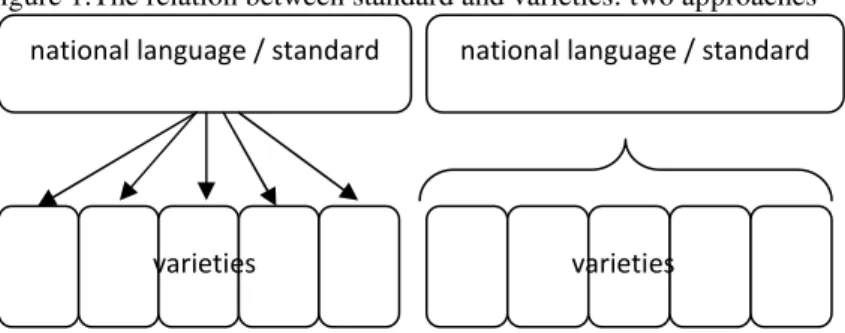
In the volume by Balázs and Benkes for 10th grade students, language is explicitly understood as a unified whole: “There is but one Hungarian language but it has numerous varieties” (Balázs & Benkes, 2002:41). He further elaborates on the language’s homogenous, unified quality on the following page: “The language variety is not an independent language for it does not fundamentally differ from the vernacular, however phonetical, grammatical, and chiefly lexical modifications may be observed in them.” (Balázs & Benkes, 2002:42). In opposition to this – and supporting the modern sociolinguistics’ view – in the textbook by Antalné, we find that: “Our mother tongue exists through a number of variably different language varieties. The collection of these varieties is the national language” (Antalné & Raátz, 2003:176). The main opposition between the above mentioned two approaches can be summarized in the figure below:
Figure 1.The relation between standard and varieties: two approaches
Both concepts agree on the fact that writing’s object is the national language or the vernacular, its concern is to present them. This notion coincides with the concept present in textbooks.
There are several ways to expel varieties in order to arrange language into an organic variety. First of all, in some cases, certain modes can be deemed marginal or non-existant. Second, giving advice on language cultivation can be used to cut certain elements out – e.g.: “Such back-derivation is not considered desirable” (Benczédy et al., 1971:166) – even though there is no known effect of language cultivation on the way people talk. (Obviously, language cultivators deny this, but there had not yet been any scientific proof of the usefulness of their work. By language cultivation I mean pseudoscience that evaluates linguistic pnenomena, and also language users, on the basis of ad hoc principles, and it strives to suppress or eradicate language forms that are deemed inappropriate.) Third, phenomena are not arranged by verbal modes, but written ones (e.g. Keszler, 2000:52). This has the advantage of written language showing much less tendency for variants than verbal. It is important to note, however, that writing is an artificially and arbitrarily formed system which is not identical to verbality, its only use is the latter’s coding.
I do not find the argument acceptable that considering lingusitic diversity renders written language impossible. In the recent Czech descriptive grammar (Mluvnice současné češtiny), for example, phenomena are
presented by corpus linguistic data marked with percentile proportion. For example, we may find that the kost-type nouns have a declined form that fluctuates between the forms kostmi and kostma. In writing it is almost always present as kostmi, while in speech it is only 5%, and in the remaining cases kostma (Cvrček, 2010:180). The issue quickly got a lot of bad press,
from laymen and professionals alike, saying that it is pointless to think the “everybody speaking as they please” notion could lead somewhere.
national language / standard
varieties national language / standard
Essentially connected to this is the understanding that language is indeed diverse, but should be seen and presented as something homogenous. The thought might feed from a kind of fear that if everybody spoke as they please, the language would come apart and individuals would not be able to understand each other. Thus it is the schools’ responsibility to teach an organic vernacular (standard) which helps mutual understanding. Due to this uplifted function do the individuals find the vernacular often a prettier, more correct variety that should be followed.
The above understanding ignores the fact that the language is spoken by people. The goal of conversation is usually not transmission of information, but the strengthening of emotional bonds. Cognitive sciences, like psycholinguistics, support this notion. Sándor (2002) brings other convincing arguments for the inseparability of language and community. It follows from the above that language cannot be organic and homogenous for it would oppose its most basic function. Even so, the attempt to speak an organic, normative language variety originates from a number of factors. First, there is a very strong need for rule-abiding in humans. Second, language is strictly connected with concepts like culture or national feeling, and it is believed that an organic national feeling can only be created by an organic language. Third, the posession of the normative language variety relates to a higher place in social hierarchy (Kontra, 2005). Since language is spoken by people who interact with each other, the assumption that without an organic language certain groups would not understand each other is false. Network research is one of the most popular and most dynamically growing science in the latest years, but its assumptions and statements are almost a hundred years old. By the notion of six degrees of separation, every two people may know each other through six mutual acquaintances at the most. Nowadays, on social sites this number might be closer to three or four.
Of course, every speaker is a member of lots of smaller and bigger communities and the amount and strength of the relations among these communities can be various. There are less and less intensive relations between two communities, there is bigger chance that the speech of these groups will be more different. At the same time, it is important to note, to speak and to understand something are different. It is not a need to use a form of a language to understand it. Because of the big amount of the relations it is a natural situation that we understand a lot of phrases without using them. And through the radio, television and internet we always touch with the “other”. We can imagine this like a huge metaphorical network “that indicates the weaker and stronger interactive relations among the languages [of the individual speakers]” (Fehér, 2012:72). (Finally, it should be noted that there is a totally different approach that is based on the anxiety of the dissolution of the varieties, e.g. dialects.)
The myth of the rules of the language
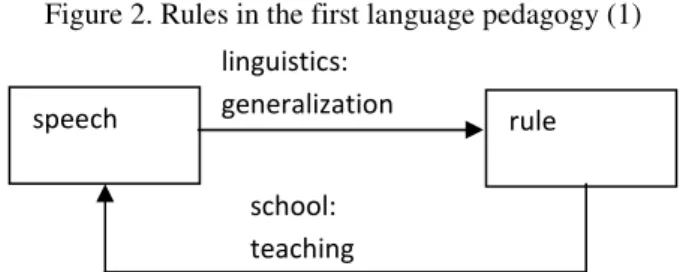
Grammar classes put emphasis on the role of rules. Let’s start with the phrasing of a textbook of Hungarian language subject pedagogy: by knowing of “the rules of the proper stating” (Szemere, 1971:21) the student will be able to use the first language in a “consciously correct” (Szemere, 1971:21) way. The textbook is inconsequent because it recognises that “first language knowledge of the child is absolutely instinctive” (Szemere, 1971:20). The point of the rules in first language pedagogy we can visualize as follows:
Figure 2. Rules in the first language pedagogy (1)
Naturally, the word ’rule’ may have various meanings but it is to be regretted that these do not dissever in the textbooks. It may mean, for instance, orthographical rule by agreement of a fellowship, it can be based on language etiquette, or can be principle that facilitates systematisation and comprehension. Generative grammars define rules more concretely: for example, in synthax rules mean operations and restrictions by which “from the elements of the lexicon the possible Hungarian sentences – and only these – are generatable” (É. Kiss et al, 1999:17).
I would like to illustrate the problematical feature of the model sketched above with an example from the French language. The letter h is not pronounced in the French. In spite of that, in certain cases the h behaves like a consonant in speech (so liaison is prohibited before that), but in other cases it does not. Generalizing from this we can state the rule: there is h aspiré and h muet in the French language, at the former liaison is prohibited and at the latter it is compulsory.
What is the problem? We either declare that the French prime minister does not speak French properly or we take notice that the model is wrong. Theoretically, the model is problematic, because describes the topic of the study (speech) in such a way that affects it by the result of the description. The other problem is the fact that the “rules” appearing in this process are not equivalent in truth. By the linguistic description descriptive rules came into being by means of the ability to write down, understand and systematize the phenomena, i.e. make them appropriate for scientifical use. However, the rules that are taught are prescriptive rules in part, and their function is to give a normative frame of our expected speech. Of course, descriptive and prescriptive rules are not totally equivalent. Demonstrating with the aforesaid French example: by the descriptive rule the adjective hasardeux contains h aspiré but in certain cases contains h muet. By the prescriptive rule the word hasardeux contains (i.e. has to contain) h aspiré. Regarding this distinction we can expand our figure:
Figure 3. Rules in the first language pedagogy (2)
Thus, prescriptive rules are taught in part in grammar classes and these are the rules of a normative language. In grammar textbooks the rules and the examples for analysis are written in accordance with the norms of the standard that is not equal to the language spoken by the children. That is no wonder that children feel these examples strange and they learn the grammar reluctantly. Furthermore, the descriptive and prescriptive rules do not
speech rule
school: teaching linguistics: generalization
speech descriptive rules
school: teaching linguistics: generalization
dissever in textbooks explicitly, the pupils find a lot of rules with totally different meanings.
I do not want to state that teachers have to neglect the standard but they have to highlight that it is only one of the varieties that is not better or more proper that the other ones. The Hungarian grammar teachers have to distinguish the different kinds of rules and they have to think over that to make mug rules is not effective (Kontra, 2005).
Language attitudes of pre-service teachers
If we would like to develop the first language education at schools, we have to shape the pre-service teachers’ outlook upon language. The first step is to examine how pre-service teachers conceive of first language and certain linguistic phenomena.
The reason for our attitude study was the structural change of the Hungarian teacher training system: in September 2013 the system became undivided and connected with this a first language training modul was initiated by statute. The primary aim of the attitude study made together with Edina Kovács in the spring of 2013 was to assess the first language training needs of the pre-service teachers of the University of Debrecen (n=166, N=660) and connected with this we put questions on their attitude toward first language and we recorded the background variables as well. We reached the students with paper-based questionnaire. We will expand our research and we plan focus-group interviews as well so the results published now are preliminary.
There are relatively few former researches in this topic, the pre-service teachers’ language and communication attitudes were not examined concretely. It is a topic of great importance because the proportion of the teachers’ speaking is considerably overrepresented in the classes. It presents the importance and dominance of teachers’ communication that communication is launched by teachers at the 94% of the cases and the proportion of teachers’ speaking is 48% by an analysis of lessons recorded on video tape (Antalné, 2006:21).
To examine the first language attitude, we put five statements that were rateable in four-grade scales. Hereafter we present the statements, the results and their interpretations.
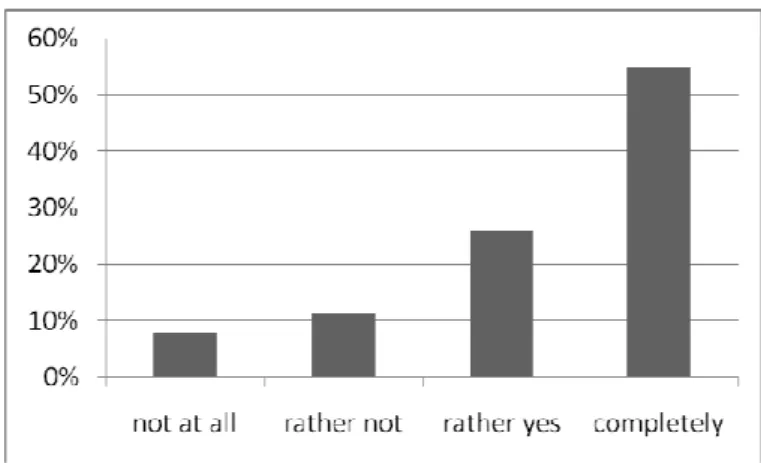
Figure 4. (1) “I think language cultivation is necessary in Hungary”
The relatively high espousal of the language cultivation is not surprising seeing that standard has a high prestige. Kontra (2005) cites Klára Sándor
and literature if language cultivation is necessary in Hungary. Out of them 95 students replied “yes”, 2 replied “not” and 3 replied “I don’t know”. Notwithstanding, there is no real knowledge about the language cultivation because the 2nd most frequent answer to the question “why?” was the following: “language cultivation is necessary because it is important”.
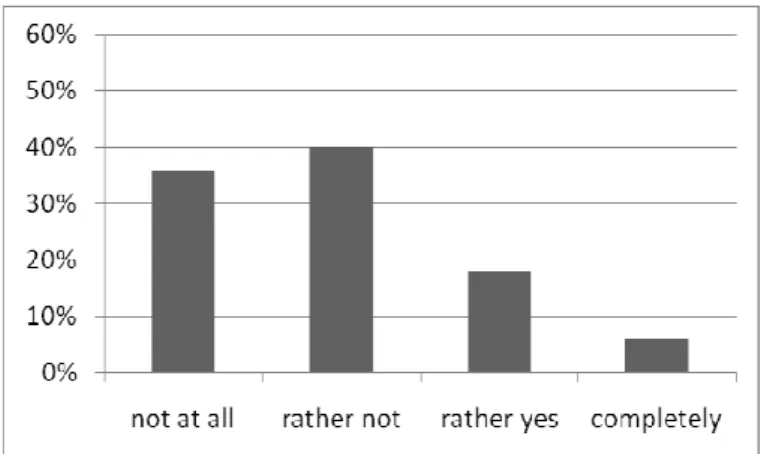
Figure 5. (2) “It is strange for me when somebody speaks in dialect”
Linguicism (linguistic discrimination) origins from the lack of tolerance. Lingvistic diversity is natural regarding the biological attributes. At the same time the role that language indicates the identity can cause the prejudices as well. The group membership is signed by the same speech, so who speaks other is not member of the group (think of the etymology of the Greek
βάρβαρος or the Russian немцы). A huge part of respondents seems to be
tolerant of the other dialects although we used a word for the dialect suggesting lower prestige (Hun. tájszólás).
Figure 6. (3) “I do not think teachers may speak in dialect in class”
Speaking in dialect in class is less accepted compared with the tolerance of the dialects, but the bulk of the students would accept a teacher speaking in dialect.
Figure 7. (4) “I think standard variety of first language should be used and taught at school”
The prestige of the standard is high. At the same time the statement is conceived exclusively: it is about the obligatory use and teaching of the standard expelling the other varieties. Fortunately, a huge proportion of the respondents chose the category “rather yes” so they do not accept the exclusiveness of the standard at the school.
Figure 8. (5) “It is important to correct the students’ language mistakes immediately”
We did not define what we mean by language mistake, because we wanted to check how respondents choose the extreme categories (“not at all” – “completely”). High proportion of the students chose the category “rather yes”.
Summarizing this chapter we can see that the standard plays an important role but the pre-service teachers abstain from the extreme approaches. We have to emphasize the importance of the further researches in this topic and the shaping of the pre-service teachers’ view paying respect to their acquired knowledge.
Conclusion
The aim of this study was to present the features of contemporary first language education in Hungary. We assessed that the cogitation upon language is unheeded in grammar classes. It is advantageous that skills developement is emphasized by the curriculum framework, but theoretical knowledge stands without a broader context. The researches in various fields of sciences underline the fact that language is diverse and it is embedded in societies. If we would like to build upon these features at school we have to shape the teachers’ linguistic consciousness and tolerance. Our empirical survey presents that pre-service teachers are rather tolerant than not regarding the varieties but they overrate the importance of language cultivation and the standard. We hope that our succeeding researches will specify these results.
References
ANTALNÉ SZABÓ Á. (2006). A tanári beszéd empririkus kutatások tükrében. Budapest: Magyar Nyelvtudományi Társaság.
ANTALNÉ SZABÓ Á., & RAÁTZ J. (2003). Magyar nyelv és kommunikáció. Tankönyv a 9-10. évfolyam számára. Budapest: Nemzeti Tankönyvkiadó.
BALÁZS G., & BENKES Zs. (2002). Magyar nyelv a gimnáziumok és a
szakközépiskolák 10. évfolyama számára. Budapest: Nemzeti Tankönyvkiadó. BÉKÉS V. (1997). A hiányzó paradigma. Debrecen: Latin Betűk.
BENCZÉDY J., FÁBIÁN P., RÁCZ E., & VELCSOV M. (1971). A mai magyar nyelv. Budapest: Tankönyvkiadó.
BEZECZKY G. (2002). Metafora, narráció, szociolingvisztika. Budapest: Akadémiai. CVRČEK, V. (Ed.) (2010). Mluvnice současné čestiny. Praha: Karolinum.
É. KISS K., KIEFER F., & SIPTÁR P. (1999). Új magyar nyelvtan. Budapest: Osiris. FEHÉR K. (2012). Anyanyelv és közösség. Magyar Nyelvőr, 135 (1), 65-77.
KESZLER B. (Ed.) (2000). Magyar grammatika. Budapest: Nemzeti Tankönyvkiadó. KONTRA M. (2005). Mi a lingvicizmus, és mit lehet ellene tenni? In Közérzeti
barangoló. Műhely- és előadás-tanulmányok (pp. 175-202). Szabadka:
Magyarságkutató Tudományos Társaság.
NAHALKA I. (2008). A tanulásra vonatkozó tudományos nézetek fejlődése. In Didaktika szöveggyűjtemény (pp. 171-199). Debrecen: Kossuth Egyetemi Kiadó.
SÁNDOR K. (2002). A nyelvi arisztokratizmus alkonya. In: Mobilközösség –
mobilmegismerés. Budapest: MTA Filozófiai Kutató Intézete.
SZEMERE Gy. (1971). A magyar nyelvtan tanítása. Budapest: Tankönyvkiadó. VERÉCZE V. (2011). Nyelvtantanítás társas-kognitív nyelvészeti alapon.
(Szemantikafejezet középiskolásoknak). In Juvenalia IV. Debreceni bölcsész diákkörösök antológiája (pp. 429-441). Debrecen: Debreceni Egyetemi Kiadó.