Ministry of Transport and Energy
Danish Road Institute
Report 153
2007
Optimized thin layers
for highways
Reports published by the Danish Road Directorate can be requested from the bookshop:
Telephone +45 4322 7300 Telefax +45 4363 1969 e-mail [email protected] Road Directorate Guldalderen 12 DK-2640 Hedehusene Denmark Telephone +45 7244 7000 Telefax +45 7244 7105 Roadinstitute.dk
Title Optimized thin layers for highways - Inter•noise paper 2007
Dated September 2007
Author Hans Bendtsen, Bent Andersen, Sigurd Thomsen Published by Road Directorate, Danish Road Institute
Copyright Road Directorate, All rights reserved Photo Hans Bendtsen
Print Electronic ISSN electronic 0909-1386
Danish Road Institute
Report 153
2007
Hans Bendtsen
Bent Andersen
Sigurd Thomsen
Optimized thin layers
for highways
Ministry of Transport and Energy
- Inter
•noise paper 2007
3
Contents
Preface ... 5 Forord ... 6 1. Introduction ... 7 2. Optimization ... 8 3. Test pavements... 104. Noise measurements and results ... 13
4.1 Passenger cars ... 13
4.2 Trucks... 16
5. Conclusions ... 18
6. Acknowledgements ... 19
5
Preface
There is a great need for durable noise reducing pavements for highways. The concept for noise reduction is to create a pavement texture, with big cavities at the pavement surface in order to reduce the noise generated from air pumping, and ensuring a smooth surface so noise generated by vibration of the tyres will not be increased.Open textured pavements are open only at the upper part and are not expected to need spe-cial winter maintenance.
European experiences with thin layers have been further developed. Four different pavement concepts are used: Open graded asphalt concrete (DAC-open), Stone Mas-tics Asphalt (SMA), a thin layer constructed as an UTLAC (Ultra Thin Layer Asphalt Concrete), and semi porous pavement (PAC).
In 2006 10 optimized thin layers were laid on a Danish highway near Herning. Maxi-mum aggregate sizes were in the range of 6 to 8 mm. Dense Asphalt Concrete with 11 mm maximum aggregate size is a reference pavement. The results from the first series of SPB noise measurements are presented in this paper from Inter·noise 2007.
6
Forord
Der er et stort behov for holdbare støjreducerende belægninger til landeveje. Støjre-duktionen kan optimeres ved at skabe en belægningsoverflade med store fordybninger, der kan reducere støjen fra luftpumpning samt ved at tilstræbe en jævn overfladestruk-tur, som sikrer at den vibrationsgenererede dæk støj ligeledes reduceres.
Belægninger med en åben overfladetekstur er kun åbne i den øverste del af overfladen, hvorfor der ikke kan forventes specielle problemer med vintervedligeholdelse. På baggrund af europæiske erfaringer er en række støjreducerende tyndlagsbelægninger optimeret i dette forsøg. Belægninger fra 4 forskellige belægningstyper er inkluderet i dette eksperiment.
Åben asfaltbeton (ABå), Skærvemastiks (SMA), kombinationsbelægninger (TBk) samt semi-drænasfalt (DA). 10 optimerede tyndlagsbelægninger blev i 2006 udlagt på en landevej ved Herning med en maksimal stenstørrelse på 6 og 8 mm. En tæt asfalt-beton (AB11t) anvendes som reference. I dette konference paper fra Inter·noise 2007 præsenteres den første serie af støjmålinger.
7
1. Introduction
The Danish Road Institute (DRI) and the Road and Hydraulic Engineering Institute in the Netherlands (DWW) carry out a co-operation called the DRI-DWW noise abatement program [1] which is a part of the Dutch Noise Innovation Program on Road Traffic (the IPG program) [2]. One of the projects in the DRI-DWW noise abatement program is dedicated to development and testing of noise reducing thin layer pavements. As an important part of this project an objective is to develop and test promising concepts for optimized noise reducing thin layer pavements.
Part of the background is a first Danish project with a test section with 6 types of thin layers including a reference pavement (Dense Asphalt Concrete with 11 mm maximum aggregate size) that was established on a highway in 2004 (the M10 experiment [5]). Relative to the reference there was a noise reduction (based on statistical pass-by (SPB) measurements according to ISO 11819-1 [8]) for the thin layers of 1 to 3 dB when the pavements were new and after one year. The tendency was a slightly lower noise reduction in year 1.
In order to increase the noise reduction a new test section with optimized thin layer pavements was constructed in the autumn 2006 on a new two lane highway near Herning (the Herning experiment [6]). The speed limit on most of the test sections is 90 km/h - but 130 km/h at two of them. Both the acoustical and the structural dura-bility of the thin layers are in focus in this project.
8
2. Optimization
Porous pavements are open in the whole thickness of the layer with connected cavi-ties. As a contrast to this, open textured pavements are open only at the upper part of the pavement with cavities having a depth less than the maximum size of the aggre-gate used for the pavement. The basic concept of using open textured pavements for noise reduction is to create a pavement structure, with as big cavities at the surface of the pavement as possible in order to reduce to some extent the noise generated from the air pumping effect, and at the same time ensuring a smooth surface so the noise generated by the vibrations of the tyres will not be increased. Such a noise reducing open textured pavement can be thin, as the mechanisms determining the noise generation only depend on the surface structure of the pavement.
Figure 1. Principal sketches of pavements with “positive” and “negative” shape of surface texture [4].
Figure 1 illustrates two types of pavements with open surfaces texture. The pavement with a “positive” structure will increase the noise generated from vibrations in the tyre while the pavement with a “negative” structure will reduce the noise generated from vibrations in the tyre. A cubic aggregate shape can be used to create a pavement sur-face with a “negative” texture.
Figure 2. Sketch to describe the relation between road surface texture parameters and noise generating mechanisms.
MPD
H
X
9
Generally there is not a good correlation between tyre road noise and the Mean Profile Depth (MPD). In [7] an empirical framework for the description of the tyre/road noise has been suggested (see Figure 2). A special measure for unevenness (X) has been developed in order to describe the difference in height between the highest points on a road surface profile measured by laser over a length of 1 meter. Another measure (H) was also introduced to describe the average distance between the highest points in the road profile. Both parameters X and H are indicators for the smoothness of a pavement surface. The Mean Profile Depth (MPD) is also included in the description, as an indicator for the openness of a pavement surface.
Increased difference in height on the pavement surface (X) will lead to increased noise. Increased distance between the high points on the surface (H) will also lead to increased noise. Where as an increase in MPD will lead to decreased noise. Presented in simple words the following has to be achieved in order to obtain as little tyre/road noise as possible:
x The highest points of a road surface should have the same height (reduce X) in order to secure a smooth pavement surface and by this reduce the noise generated from vibrations in the tyre.
x The distance between these high points should be as small as possible (reduce H) also in order to secure a smooth pavement surface and by this reduce the noise generated from vibrations in the tyre.
x The cavities between the top points of the pavement surface should be as deep and big as possible (increase MPD) in order to reduce the noise generated by air pumping.
This can be used as design criteria for development of thin noise reducing surfaces by following these recommendations:
x Use of a cubic stone material with sharp edges and a uniform shape will help to ensure that the highest points of a road surface will have the same height (X small). x Good compaction after the laying of a pavement will also help to ensure that the
highest points of a road surface will have the same height (X small).
x Use of a small maximum aggregate size will help to ensure that the distance between these high points will be as small as possible (H small).
x A high built-in air void will help to ensure that the cavities between the top points of the pavement surface will be as deep and big as possible (MPD great). This can be obtained by using a “steep” aggregate size distribution with filler and very small aggregates combined with big aggregates but without aggregates of the sizes in between.
10
3. Test pavements
On the background of the above recommendations a series of thin layer pavements has been developed in close cooperation with the contraction company who has produced most of the pavements. Different pavement types can be used as the background for the development of noise reducing thin layers [6]:
x Open graded (but dense) asphalt concrete (DAC-o) with a (built-in) Marshall air void of approx. 8 - 14 %.
x Stone Mastics Asphalt (SMA) with a (built-in) Marshall air void of at least. 4 % . x A thin layer constructed as an UTLAC (Ultra Thin Layer Asphalt Concrete)
(Danish designation TB k). On the existing road surface a thick layer of polymer modified bitumen emulsion is spread. On the top of this unbroken bitumen emulsion a very open graded mix is paved (like porous asphalt) with a (built-in) Marshall air void of approx. 14 % or even more. The unbroken bitumen emulsion “boils up” in the air voids of the warm asphalt mix leaving only the upper part of the structure open. This reduces the built-in air void of the final pavement because the pores of the pavement are filled with bitumen.
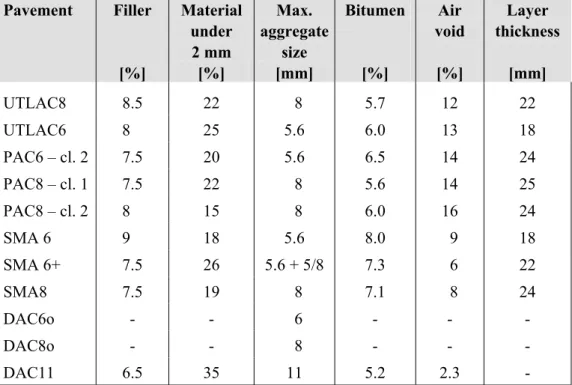
x Semi porous (PAC cl 1) or porous asphalt concrete pavements (PAC cl 2). A total of 10 pavements from these 4 types with maximum aggregate sizes of 6 or 8 mm have been selected for full scale testing (see Table 1). Dense Asphalt Concrete with 11 mm maximum aggregate size is also constructed at the test site is to be used as a reference pavement with the same age and load as the test pavements. The SMA6+ pavement is an SMA6 with some extra aggregate at the size of 8 mm to open up the surface texture.
11
Table 1. Specifications of the test pavements. The air void has been measured on Marshall cores. Pavement Filler [%] Material under 2 mm [%] Max. aggregate size [mm] Bitumen [%] Air void [%] Layer thickness [mm] UTLAC8 8.5 22 08 5.7 12 22 UTLAC6 8.0 25 5.6 6.0 13 18 PAC6 – cl. 2 7.5 20 5.6 6.5 14 24 PAC8 – cl. 1 7.5 22 08 5.6 14 25 PAC8 – cl. 2 8.0 15 08 6.0 16 24 SMA 6 9.0 18 5.6 8.0 09 18 SMA 6+ 7.5 26 5.6 + 5/8 7.3 06 22 SMA8 7.5 19 08 7.1 08 24 DAC6o - - 06 - - - DAC8o - - 08 - - - DAC11 6.5 35 11 5.2 2.3 - 0,075 0,25 0,5 1 2 4 5,6 8 11,2 16 22,4 31,5 0 20 40 60 80 100
Sieve (Size of particles) [mm]
C u m u la ti v e % p a s s in g UTLAC6 PAC6 cl-2 SMA 6+ SMA 6 DAC11
Figure 3. Aggregate size distribution curves for the reference pavement and some of the test pavements with 6 mm maximum aggregate size.
12
13
4. Noise measurements and results
The measurements were carried out according to the standardized SPB measurement method [8] when the pavements were one month old. The speed and maximum A-weighted free-field noise levels (LpAFmax – without reflections from nearby facades,
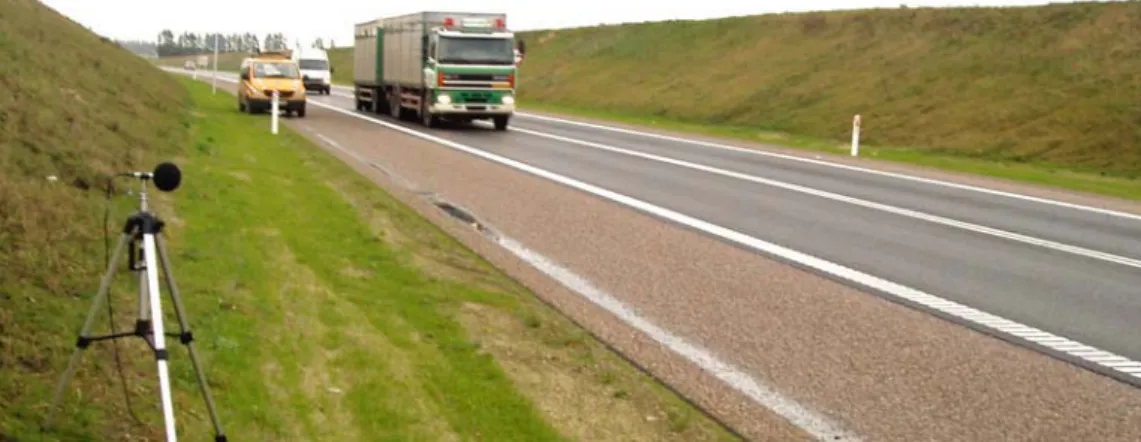
signs or the like) has been measured at 1.2m height and at a distance of 7.5 m from the middle of the driving lane for single vehicles maintaining a constant speed (passenger cars (P), trucks and busses with two axles (L), and trucks and busses with multiple axles (F). Delivery vans, 4WD vehicles and the like are not included, since these vehi-cles, considering the noise emission, are very different. The microphone was placed 1.20 m above the road surface on the grass verge beside the hard shoulder/emergency lane.
The speed for every individual vehicle was measured by radar. A logarithmic regres-sion analysis of the relation between the measured maximum A-weighted noise levels
(LpAFmax,7.5m) and the speed for every vehicle in each vehicle category has been carried
out. The results in the following are presented for non standard reference speeds of 90 km/h for passenger cars and 80 km/h for the heavy vehicles. The pavements were dry during the measurements. Temperature corrections have been made to 20 °C.
4.1 Passenger cars
73 74 75 76 77 78 79 Lveh [d B ]UTLAC8 PAC8 cl-1 Ref. M10 PAC8 cl-2 DAC11 SMA8 SMA6 DAC8o UTLAC6 PAC6 cl-2 SMA6+ DAC6o
Figure 4. Maximum A-weighted noise level (passenger cars) with the time weighting F, at a distance of 7.5 m and a speed of 90 km/h when the pavements were about one month old. The bars indicate a 95% confidence interval.
14
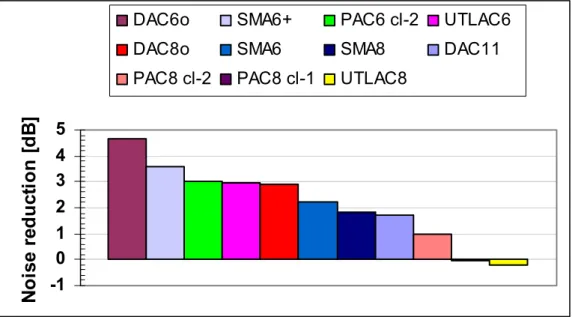
The results for passenger cars can be seen in Figure 4. There is a range of nearly 5 dB between the noisiest and the most silent of the test pavements. The noise from the Dense Asphalt Concrete (DAC11) is in the middle of the ranking of all the pavements. It has a noise level of 76.8 dB, which is unusual for a new Danish reference pavement. In previous Danish experiments on the M10 highway and at an urban test road other Dense Asphalt Concrete (DAC11) reference pavements had a noise emission at 90 km/h when new of 78.5 dB (in Figure 4 called Ref.M10). It has been decided to use the Ref.M10 as a reference for the Herning experiment in this first measurement se-ries. The noise reduction in the following is relative to this Ref.M10 reference value of 78.5 dB. The noise reduction for passenger cars can be seen in Figure 5 where the best pavement (DAC6o) has a reduction of 4.7 dB.
-1 0 1 2 3 4 5
N
o
is
e
r
e
duc
ti
on [
d
B
]
DAC6o SMA6+ PAC6 cl-2 UTLAC6 DAC8o SMA6 SMA8 DAC11 PAC8 cl-2 PAC8 cl-1 UTLAC8
Figure 5. Noise reduction for passenger cars relative to the Ref.M10 pavement at a speed of 90 km/h when the pavements were about one month old.
15 40 45 50 55 60 65 70 63 100 160 250 400 630 1000 1600 2500 4000 6300 Frequency [Hz] [d B (A )]
DAC11 PAC8 cl-1 SMA6 SMA6+ SMA8 UTLAC8 Ref. M10
Figure 5. A-weighted 1/3-octave band spectra for passenger cars at 90 km/h - Part one.
40 45 50 55 60 65 70 63 100 160 250 400 630 1000 1600 2500 4000 6300 Frequency [Hz] [d B( A) ]
DAC11 DAC6o DAC8o PAC6 cl-2
PAC8 cl-2 UTLAC6 Ref. M10
16
The results of the 1/3-octave-band analyses can be seen in Figure 5 and 6. Above 1000 Hz the noise from the air pumping effect is considered to be dominating. It can be seen that the noise above 1.6 kHz from all test pavements is smaller the noise from the reference pavement Ref.M10. This indicates that the air pumping noise has been reduced. The DAC6o was the most noise reducing pavement. Especially in the high frequencies it has a lower level than the reference (Ref.M10) indicating that the pave-ment has an open surface texture reducing the air pumping noise. It also has a low noise level at the low frequencies between 300 and 1000 Hz the where the noise from vibrations in the tyre is considered to be dominating - indicating that the pavement also has an smooth texture caused by the small aggregate size of 6 mm . New porous pavements (with a thickness about 70 mm) normally have a dip in the frequency spec-tra in the range 500 - 1000 Hz [9]. This is not seen at these three semi porous (DAC8 cl.1) or porous pavements (DAC6 cl.2 and DAC8 cl.2). Due to their small thickness maximum absorption is expected in the range 1.2 - 1.6 kHz. The results indicate that the pavements do not have a noise absorbing effect which is normal for thicker, new porous pavements [9].
4.2 Trucks
The noise reduction for two-axle and multi-axle trucks relative to the Ref.M10 pavement at a speed of 80 km/h can be seen in figure 7 and 8. For two-axle trucks the DAC6o pavement (that was the best for passenger cars) has a reduction of 4.1 dB. The SMA8 pavement has an even higher reduction of 4.5 dB.
For the multi-axle trucks the DAC6o pavement (that was the best for passenger cars) has a reduction of 2.9 dB. The SMA8 pavement has an even higher reduction of 3.9 dB.
Generally the best pavements also have a good noise reducing effect on heavy vehicles. 0 1 2 3 4 5 N o is e re d u k ti o n [d B ]
SMA8 DAC6o PAC8 cl-2 SMA6 DAC8o UTLAC8 DAC11 PAC6 cl-2 PAC8 cl-1 SMA6+
Figure 7. Noise reduction for two-axle trucks relative to the Ref.M10 pavement at a speed of 80 km/h when the pavements were about one month old.
17 0 1 2 3 4 5 N o is e re duk ti on [ d B ]
SMA8 SMA6+ PAC6 cl-2 DAC6o DAC8o PAC8 cl-2 PAC8 cl-1 SMA6 DAC11 UTLAC6 UTLAC8
Figure 8. Noise reduction for multi-axle trucks relative to the Ref.M10 pavement at a speed of 80 km/h when the pavements were about one month old.
The results of the 1/3-octave-band analyses for multi-axle trucks for some of the pavements can be seen in Figure 9. It can be seen that the noise reduction relative to the reference pavement Ref.M10 takes place at frequencies above 1000 Hz. This indi-cates that the air pumping noise has been reduced also for the heavy vehicles.
45 50 55 60 65 70 75 80 63 100 160 250 400 630 1000 1600 2500 4000 6300 Frequency [Hz] [d B (A )]
DAC11 DAC6o DAC8o PAC6 cl-2
PAC8 cl-2 UTLAC6 Ref. M10
Figure 9. A-weighted 1/3-octave band spectra for multi-axle trucks at 80 km/h for some of the pavements.
18
5. Conclusions
A total of 11 test sections have been constructed near Herning in Denmark. SPB noise measurements have been performed when the pavements were one month old. For passenger cars there is a range of nearly 5 dB between the noisiest and the most quiet of the test pavements. For two-axle and multi-axle trucks the range is 4 respec-tively 3 dB. There is a noise reduction in the frequency range over 1000 Hz (reduced air pumping noise) and for some pavements also at lower frequencies (reduced tyre vibration noise). For passenger cars the best pavement (open graded asphalt concrete, DAC6o) has a noise reduction of 4.7 dB relative to a Dense Asphalt Concrete
(DAC11) of the same age. The thin layers also have a good noise reducing effect on trucks in the high frequency range.
It is planned to continue the measurements in the coming years in order to monitor both the acoustical and the structural development of all the test sections near Herning.
19
6. Acknowledgements
This project has been carried out in co-operation with our Dutch colleagues at the Road and Hydraulic Engineering Institute in the Netherlands (DWW) and the project is financed by the Dutch Noise Innovation Program on Road Traffic (the IPG pro-gram) and the Danish Road Institute/ Road Directorate. A Danish project group with the following members has been established to run the full scale testing project: x Hans Bendtsen, Road Directorate/ Danish Road Institute, project leader. x Jørn Raaberg, Road Directorate/ Danish Road Institute.
x Erik Nielsen, Road Directorate/ Danish Road Institute. x Sigurd N. Thomsen, Road Directorate/ Danish Road Institute. x Bent Andersen, Road Directorate/ Danish Road Institute. x Tony K. Andersen, Road Directorate, Construction Division. x Finn Christiansen, Road Directorate, Construction Division. x Jochim Kempe, Road Directorate, Construction Division. x Jørn Bank Andersen, NCC Roads.
20
7. References
[1] The DRI-DWW Noise Abatement Program - Project description. Note 24, 2005. Danish Road Institute, Road Directorate (www.roadinstitute.dk).
[2] Noise Innovation Program. Road Traffic. (The IPG programme). DWW report 2002-073.
[3] International Experiences with Thin Layer Pavements. Milestone M2. Note xx, 2005. Danish Road Institute, Road Directorate (www.roadinstitute.dk).
[4] French Experiences on Noise Reducing Thin Layers. Note xx, 2005. Danish Road Institute, Road Directorate (www.roadinstitute.dk).
[5] Noise reducing thin layers for highways. Hans Bendtsen, Sigurd N. Thomsen. CD-ROM proceedings, Inter.Noise 2006, Honolulu, Hawaii, USA.
[6] Promising concepts. Noise reducing thin layers. Milestone M3. Note 36, 2006. Danish Road Institute, Road Directorate (www.roadinstitute.dk).
[7] Fujikawa, T.; Oshinoa , Y.; Mikami, T.; Tachibana, H. Examination on Effects of Road Roughness Parameters for Abating Tire/Road Noise. CD-ROM Pro-ceedings, Inter.Noise conference 2004 in Prague.
[8] DS/ISO 11819-1: 1997. “Acoustics – Measurement of the influence of road sur-faces on traffic noise – Part 1: Statistical Pass-By Method”. 1997-09-15. [9] Traffic noise at two-layer porous asphalt. Øster Søgade, Year No. 7. Note 46,
Rapport / Report Nr.
No.
Titel/Title/Shortcut Forfatter/Author 137 Traffic management and noise reducing pavements
- Recommendations on additional noise reducing measures
Hans Bendtsen Jürgen Haberl, Johan Litzka Ernst Pucher Ulf Sandberg Greg Watts 138 Mechanistic Design of Semi-Rigid Pavements
- An Incremental Approach
Finn Thøgersen Christian Busch Anders Henrichsen 139 Holdbarhed af Drænasfalt Carsten Bredahl Nielsen Jørn Raaberg Erik Nielsen 140 Indbygning af skrivekridt - Et fuldskalaforsøg Sten Thorsen Poul Panduro Knud A. Pihl 141 Noise reducing pavements
- State of the art in Denmark
Hans Bendtsen Bent Andersen
142 Economic assessment of traffic noise in planning – Danish experiences
Lars Ellebjerg Hans Bendtsen 143 Organising urban noise abatement
- New ideas
Hans Bendtsen Lene Nøhr Michelsen Brian Kristensen 144 Two-layer porous asphalt
- for urban roads
Hans Bendtsen Bent Andersen Jørn Råberg Lars Ellebjerg Jørgen Kragh 145 Thin noise reducing pavements
- Experiences
Hans Bendtsen Bent Andersen 146 Cost-benefit analysis on noise-reducing pavements Lars Ellebjerg 147 Traffic management and noise - INTER-NOISE 2006 Hans Bendtsen Lars Ellebjerg 148 Noise reducing thin layers for highways - INTER-NOISE
2006
Hans Bendtsen Sigurd N. Thomsen 149 Noise reducing thin pavements – urban roads Sigurd N. Thomsen Hans Bendtsen Bent Andersen 150 Integration of noise in PM Systems
- Pavement Management and noise
Hans Bendtsen Bjarne Shmidt 151 Noise Control through Traffic Flow Measures
- Effects and Benefits
Lars Ellebjerg 152 Noise from Railway Crossings – Inter·Noise Paper 2007 Hans Bendtsen Sigurd N.Thomsen 153 Optimized thin layers for highways
- Inter·noise paper 2007
Hans Bendtsen Bent Andersen Sigurd N. Thomsen
Road Directorate Niels Juels Gade 13 P.O. Box 9018 DK-1022 Copenhagen K Denmark Telephone +45 7244 3333 Telefax +45 3315 6335 Road Directorate Guldalderen 12 DK-2640 Hedehusene Denmark Telephone +45 7244 7000 Telefax +45 7244 7105 Road Directorate Thomas Helsteds Vej 11 P.O. Box 529 DK-8660 Skanderborg Denmark Telephone +45 7244 2200 Telefax +45 8652 2013 [email protected] Roadinstitute.dk
![Figure 1. Principal sketches of pavements with “positive” and “negative” shape of surface texture [4]](https://thumb-us.123doks.com/thumbv2/123dok_us/274652.2528217/10.892.236.807.814.988/figure-principal-sketches-pavements-positive-negative-surface-texture.webp)