University of Rhode Island University of Rhode Island
DigitalCommons@URI
DigitalCommons@URI
Open Access Dissertations
2013
Professional Development in Historical Inquiry: Exploring Changes
Professional Development in Historical Inquiry: Exploring Changes
in Two Social Studies Teachers' Knowledge, Beliefs, and Practices
in Two Social Studies Teachers' Knowledge, Beliefs, and Practices
Thalia Wood
University of Rhode Island, [email protected]
Follow this and additional works at: https://digitalcommons.uri.edu/oa_diss
Recommended Citation Recommended Citation
Wood, Thalia, "Professional Development in Historical Inquiry: Exploring Changes in Two Social Studies Teachers' Knowledge, Beliefs, and Practices" (2013). Open Access Dissertations. Paper 17.
https://digitalcommons.uri.edu/oa_diss/17
This Dissertation is brought to you for free and open access by DigitalCommons@URI. It has been accepted for inclusion in Open Access Dissertations by an authorized administrator of DigitalCommons@URI. For more information, please contact [email protected].
PROFESSIONAL DEVELOPMENT IN HISTORICAL INQUIRY: EXPLORING
CHANGES IN TWO SOCIAL STUDIES TEACHERS’ KNOWLEDGE, BELIEFS, AND PRACTICES
BY
THALIA WOOD
A DISSERTATION SUBMITTED IN PARTIAL FULLFILLMENT
OF THE REQUIREMENTS FOR THE DEGREE OF DOCTOR OF
PHILOSOPHY IN EDUCATION
UNIVERSITY OF RHODE ISLAND
AND
RHODE ISLAND COLLEGE
DOCTOR OF PHILOSOPHY DISSERTATION
OF
Thalia Wood
APPROVED:
Dissertation Committee:
Major Professor Julie Coiro
Committee Theresa Deeney
Ellen Bigler
Ron Dufour
RIC: Alexander Sidorkin
Dean, Feinstein School of Education-RIC
URI: Nasser H. Zawia
Dean, The Graduate School – URI
UNIVERSITY OF RHODE ISLAND
AND
RHODE ISLAND COLLEGE
ABSTRACT
Educators in the social studies content area have struggled for over a century with
how to best instruct their students in critical thinking. A growing group of researchers in
the discipline of history, one of the major components of social studies education, support
teaching the domain-specific skills of historical thinking through the process of historical
inquiry. Nevertheless, many social studies teachers lack the pedagogical content
knowledge to instruct their students in historical thinking skills through historical inquiry.
This multiple case study sought to examine how two social studies teachers might change
their knowledge, beliefs and practices after engaging in eight historical inquiry
professional development sessions. The professional development in historical inquiry
incorporated many characteristics shown to be effective based on research studies. The
theoretical frameworks for the study included social constructivist learning theory,
expert/novice learning theory, and teacher change theory. Analysis of data from teacher
and student interviews, teacher surveys, classroom observations, teacher reflective
journals, artifact review, and audio recordings of the professional development sessions
revealed significant patterns within and across the two case study participants. Changes
observed in the teachers’ knowledge, beliefs and practices indicated they were able to instruct their students in historical thinking skills through historical inquiry within their
respective curriculums. However, both teachers faced the challenges of curriculum
design and time constraints, and students’ varied developmental and motivation levels.
Findings from this study have implications for how to support social studies teachers as
they develop pedagogical content knowledge in historical inquiry in order to teach their
iii
ACKNOWLEDGEMENTS
To my major professor, Julie Coiro, this unbelievable journey would not have
been possible without your never-ending support, guidance, patience, and most of all,
inspiration. Each step along the journey you gave me strategies to help solve the
dilemmas I faced and shared scholarly articles to augment my research. I knew from the
moment I began working with you that the journey would be challenging, but ever so
rewarding. You always expected only the best from me and for that I am very
appreciative. You moved me along the continuum of novice to expert in the field of
education research. I am deeply honored to have had the opportunity to work with you
and I will be forever grateful.
To my committee members, Theresa Deeney, Ellen Bigler and Ronald Dufour, I
appreciate your feedback and the time and patience you provided over these many years.
Your encouragement and support also made this journey possible. Each of you provided
a special area of expertise to my research. And to Nedra Reynolds, for being the chair
person of my dissertation defense, I am grateful for your commitment to the process and
your time.
To Bruce VanSledright, thank you for taking time out of your busy schedule to
meet with me so many years ago at the University of Maryland while I attended the
National History Day competition with my students. Your work and that of Sam
Wineburg and others in the field of history education inspired me to begin this journey
into examining historical thinking and historical inquiry.
To my colleagues, Mrs. Jilley and Mrs. Ryan, your desire to always improve your
iv
HIPD, to be interviewed, observed and to share your ideas, concerns and hopes enabled
me to conduct my research and to provide a glimpse into your lives as educators in this
most challenging time of education reform. I learned so much from you. Your
dedication to your students and to the teaching profession is admirable. Thank you!
To the student volunteers, Paul, Cole, Brittany and Alan, thank you for sharing
your experiences and ideas about learning social studies. Your learning is at the heart of
this study.
To the other HIPD participants, Wayne, Tim, Alan and Jon, thank you for your
willingness to participate, to share your ideas, strategies and concerns. Mostly, thank you
for showing how beneficial a collaborative professional learning community can be.
To Joan Foley, social studies educator and public school administrator, thank you
for your time, effort and support in observing the case study teachers, as well as in
helping to conduct the inter-rater reliability check. I appreciate your hard work, patience
and support.
To Kees DeGroot, PhD in Education faculty member, thank you for sharing your
knowledge about qualitative research and for your encouragement along the way.
To Professor Linford Fisher, thank you for sharing your expertise in history with
the participants of the HIPD. Most importantly, thank you for showing how productive
the connection between higher education and K-12 educators can be.
To all of my dear friends, colleagues, students and school district administrators,
v DEDICATION This dissertation is dedicated to my family.
To my husband, Leonard, for encouraging me so many years ago to pursue a PhD,
your continuous support, encouragement and love enabled me to complete this journey.
To my son, Robert, you are the reason I keep working so hard. I hope I have instilled in
you my love of learning and the importance of working hard to achieve one’s goals. I love you both more than all the revisions on this dissertation. Let life’s adventures begin anew!
To my parents and grandparents, Evelyn and Philip, Genevieve and Philip and
Thalia and John, who are in heaven, your love and encouragement provided the
foundation that enabled me to pursue my education. I think of you often and know you
have been with me every step of the way. My memories of you are everlasting.
To my brother, John and my sisters, Gina, Stephanie, Athena and Elaine and
sister-in-law, Joan, for always believing in me and supporting my endeavors over the
years. Thank you for being my fan club. I love you all.
To Andrew, my godson, I am so happy that you too, have discovered the love of
learning and I know it will serve you well throughout your life.
To God, thank you for giving me the self-discipline and the perseverance to finish
vi TABLE OF CONTENTS ABSTRACT ... ii ACKNOWLEDGEMENTS ... iii DEDICATION...v TABLE OF CONTENTS ... vi
LIST OF TABLES ... xiv
LIST OF FIGURES ...xv
CHAPTER 1 Introduction ...1
Statement of the Problem ...1
Purpose of the Study ...2
Background ...4
Significance of the Study ...7
Research Questions ...8
Overview of Research Design ...8
Methods and Procedures ...9
Participants ...9
Two Case Study Teachers ...9
Four Student Volunteers ...9
Data Sources ...9
Implementation of Historical Inquiry Professional Development ...10
Analysis...11
Organization of the Dissertation ...13
CHAPTER 2 Review of the Literature ...14
vii
Theoretical Frameworks ...17
Social Constructivist Theory of Learning ...17
Expert/Novice Theory of Learning ...19
Teacher Change Theory ...21
Critical Thinking ...23 Historical Thinking ...26 Historical Inquiry ...35 Professional Development ...39 Teacher Change ...42 Chapter Summary ...46 CHAPTER 3 Methodology ...47 Introduction ...47 Research Design...47
The Role of the Researcher ...49
Setting of the Study ...51
Methodology and Procedures ...54
Description of Intervention and Key Concepts ...54
Study Population and Location ...64
Sampling Procedures ...64
Case Study Teacher Participants ...65
Student Participants ...66
Data Collection Sources and Timetable ...66
Pre-Post Teacher Surveys ...67
viii
Field Notes ...70
Classroom Observations ...73
Teacher Self-Report Logs ...75
Student Interviews ...75
Artifact Review ...75
HIPD Session Audio Recordings ...76
Data Processing and Data Analysis ...76
Preliminary Organization and Analysis ...78
Cross-Case Analysis ...84
Validity, Reliability and Credibility ...85
Chapter Summary ...87
CHAPTER 4 Findings ...88
Introduction ...88
Individual Case Portraits ...91
Mrs. Jilley’s Individual Case Portrait ...91
Mrs. Ryan’s Individual Case Portrait ...93
Individual Case Study Findings ...95
Pre-Existing Knowledge, Beliefs and Practices of Case Study Participants ...96
Mrs. Jilley’s Pre-Existing Knowledge ...96
Mrs. Jilley’s Pre-Existing Knowledge about Teaching and Learnin in General ...96
Mrs. Jilley’s Pre-Existing Knowledge about Social Studies Content and Pedagogy ...98
Mrs. Jilley’s Pre-Existing Knowledge about Historical Thinking and Historical Inquiry ...99
ix
Mrs. Jilley’s Pre-Existing Beliefs ...100
Mrs. Jilley’s Pre-Existing Beliefs about Teaching and Learning in General ...100
Mrs. Jilley’s Pre-Existing Beliefs about Students’ Ability to Think Historically and to Engage in Historical Inquiry ...104
Mrs. Jilley’s Pre-Existing Beliefs about Professional Support Systems ...105
Mrs. Jilley’s Pre-Existing Practices ...106
Mrs. Jilley’s Pre-Existing Instructional Practices ...106
Mrs. Jilley’s Pre-Existing Professional Practices ...109
Mrs. Ryan’s Pre-Existing Knowledge ...110
Mrs. Ryan’s Pre-Existing Knowledge about Teaching and Learning in General ...110
Mrs. Ryan’s Pre-Existing Knowledge about Social Studies Content and Pedagogy ...111
Mrs. Ryan’s Pre-Existing Knowledge about Historical Thinking and Historical Inquiry ...113
Mrs. Ryan’s Pre-Existing Beliefs ...116
Mrs. Ryan’s Pre-Existing Beliefs about Teaching and Learning in General ...116
Mrs. Ryan’s Pre-Existing Beliefs about Students’ Ability to Think Historically and to Engage in Historical Inquiry ...121
Mrs. Ryan’s Pre-Existing Beliefs about Professional Support Systems ...122
Mrs. Ryan’s Pre-Existing Practices ...123
Mrs. Ryan’s Pre-Existing Instructional Practices ...123
x
Changes in Knowledge, Beliefs, and Practices that Occurred After
Participating in Eight HIPD Sessions ...126
Changes in Knowledge for Mrs. Jilley ...126
Changes in Mrs. Jilley’s Knowledge about Teaching and Learning in General ...127
Changes in Mrs. Jilley’s Knowledge about Social Studies Content and Pedagogy ...127
Changes in Mrs. Jilley’s Knowledge about Historical Thinking Skills and Historical Inquiry ...128
Changes in Beliefs for Mrs. Jilley...135
Changes in Mrs. Jilley’s Beliefs about Teaching and Learning in General ...136
Changes in Mrs. Jilley’s Beliefs about Middle School Students’ Ability to Think Historically and to Engage in Historical Inquiry ...139
Changes in Mrs. Jilley’s Beliefs about Professional Support Systems ...142
Changes in Practices for Mrs. Jilley ...145
Changes in Mrs. Jilley’s Instructional Practices ...145
Changes in Mrs. Jilley’s Professional Practices ...152
Changes in Knowledge for Mrs. Ryan ...154
Changes in Mrs. Ryan’s Knowledge about Teaching and Learning in General ...154
Changes in Mrs. Ryan’s Knowledge about Social Studies Content and Pedagogy ...155
Changes in Mrs. Ryan’s Knowledge about Historical Thinking Skills and Historical Inquiry ...156
xi
Changes in Mrs. Ryan’s Beliefs about Teaching and Learning in
General ...165
Changes in Mrs. Ryan’s Beliefs about Middle School Students’ Ability to Think Historically and to Engage in Historical Inquiry ...171
Changes in Mrs. Ryan’s Beliefs about Professional Support Systems ...175
Changes in Practices for Mrs. Ryan ...177
Changes in Mrs. Ryan’s Instructional Practices ...178
Changes in Mrs. Ryan’s Professional Practices ...187
Cross-Case Analysis ...189
Cross Case Patterns of Change in Knowledge for Mrs. Jilley and Mrs. Ryan ...190
Similarities in the Changes in Knowledge between Mrs. Jilley and Mrs. Ryan ...190
Differences in the Changes in Knowledge between Mrs. Jilley and Mrs. Ryan ...194
Cross Case Patterns of Change in Beliefs for Mrs. Jilley and Mrs. Ryan ...197
Similarities in the Changes in Beliefs between Mrs. Jilley and Mrs. Ryan ...198
Differences in the Changes in Beliefs between Mrs. Jilley and Mrs. Ryan ...201
Cross Case Patterns of Change in Practice for Mrs. Jilley and Mrs. Ryan ...204
Similarities in the Changes in Practice between Mrs. Jilley and Mrs. Ryan ...205
Differences in the Changes in Practice between Mrs. Jilley and Mrs. Ryan ...208
xii
Chapter Summary ...210
CHAPTER 5 Discussion ...212
Introduction ...212
Summary of Qualitative Findings from Individual and Cross Case Analysis ...212 Discussion of Findings ...214 Finding 1 ...214 Finding 2 ...217 Finding 3 ...219 Finding 4 ...220 Implications ...222
Limitations of the Study ...231
Recommendations for Further Study ...233
Concluding Thoughts ...238
APPENDICES Appendix A: Sample HIPD Session Power Point Presentation ...240
Appendix B: RI Professional Development Standards ...242
Appendix C: SCIM-C Historical Inquiry Strategy ...243
Appendix D: HIPD Web Resources ...245
Appendix E: SCIM-C Strategy Implementation Sharing Protocol ...246
Appendix F: Guiding Questions for Seixas Article ...247
Appendix G: Summary of Barton’s Article on Primary Sources ...248
Appendix H: Pre-HIPD Participant Survey ...249
Appendix I: Post-HIPD Participant Survey ...253
xiii
Appendix K: Post-HIPD Teacher Interview Protocol ...259
Appendix L: Post-Study Teacher Interview Protocol ...261
Appendix M: Wikispace Teacher Self-Report Journal (Screen Shot) ...262
Appendix N: Pre and Post-HIPD Student Interview Protocols ...263
Appendix O: Historical Thinking and Historical Inquiry Participant Definitions...265
Appendix P: Summary of Pre-Existing Knowledge, Beliefs and Practices...266
Appendix Q: Mrs. Jilley SCIM-C Modifications for Observations 2, 3, and 4 ...267
Appendix R: Mrs. Ryan SCIM-C Modifications for Observations 2, 3, and 4 ...270
Appendix S: Mrs. Ryan Sample Overhead T-Chart Comparing Sources ...274
Appendix T: Mrs. Ryan Graphic Organizer for SCIM-C ...275
xiv LIST OF TABLES
TABLE PAGE
Table 3.1 Time Table for Data Collection ...55
Table 3.2 Wording for Pre/Post Survey Items across Three Constructs of KBP Paradigm and Scores for Mrs. Jilley and Mrs. Ryan ...68
xv LIST OF FIGURES
FIGURE PAGE
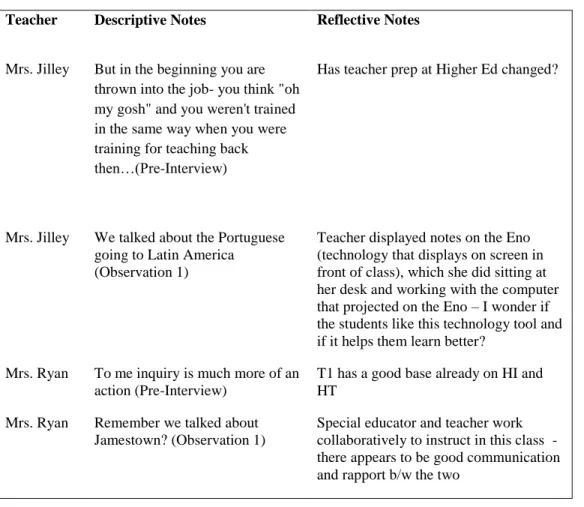
Figure 3.1. Sample of Field Notes ...72
Figure 3.2. Sample of Researcher’s Reflective Journal ...73
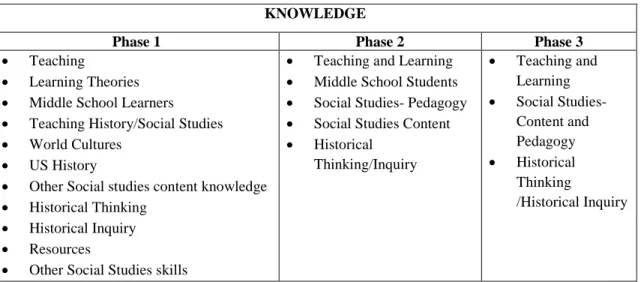
Figure 3.3. Three Phases of Collapsing Codes using the KBP Conceptual Paradigm
to Create a Final Coding Scheme ...81
Figure 4.1 Similarities and Differences in Changes in Knowledge for
Mrs. Jilley and Mrs. Ryan ...191
Figure 4.2 Similarities and Differences in Changes in Beliefs for Mrs.
Jilley and Mrs. Ryan ...197
Figure 4.3 Similarities and Differences in Changes in Practices for Mrs.
Jilley and Mrs. Ryan ...205
Figure 5.1. RETHI-KBP Rubric – Rubric for Evaluating Teacher’s Expertise in Historical Inquiry in terms of Knowledge, Beliefs and Practices (RETHI-KBP) ...229
1 CHAPTER 1
Introduction
“Doing history, engaging in those restless reexaminations of and investigations into the past, beckons the future” (VanSledright, 2002a, p. 150).
Statement of the Problem
If the purpose of history education is to ensure that our children have the right to
investigate and reexamine evidence of the past to develop their own interpretations of the
past, in effect to learn to think critically, then it is the responsibility of educators to make
certain that this occurs in our schools. History teachers play a major role in ensuring that
students understand and think critically about the past in order to better understand the
present and future (Stearns, 2002). The study of history is seen as “a tool for changing
how we think, for promoting a literacy not of names and dates, but of discernment,
judgment and caution” (Wineburg, 2001, p. ix).
Yet, teachers of history have a long-standing reputation for using instructional
practices guided by textbooks and factual recitation as opposed to practices that foster
critical thinking and a deep understanding of history (Ashby, Lee & Shemilt, 2005; Bain,
2005; Barton & Levstik, 2004; Cuban, 1983, 1991; Evans, 2004; Nelson, 2001;
Newmann, 1990; Seixas, 1993; Thornton, 1991, 1998, 2005; VanSledright, 2004;
Wineburg, 2001). Increasingly, teachers are being evaluated based upon their students’
learning outcomes. In the current climate of accountability and high stakes testing,
teachers must be given the tools to help their students learn. Historical inquiry is one
strategy used to develop critical thinking skills in students (Ashby, Lee & Shemilt, 2005;
2
without the proper learning, history teachers cannot be expected to take up the complex
process of historical inquiry in their classrooms in ways that will foster their students’
domain-specific critical thinking skills of historical thinking.
Purpose of the Study
The purpose of this study was to examine how the pedagogical content
knowledge, beliefs, and practices of two social studies teachers might change given the
opportunity to engage in sustained professional development in historical inquiry. A
qualitative case study design was chosen to provide a window into the journey these two
teachers took as they learned how to develop the types of thinking skills that would
enable their students to critically examine events and issues of the past, present and
future, and to use their knowledge to make informed decisions.
Few studies exist in professional development of teaching history (Von Hover,
2008). Most of the research on professional development for history describes the
different types of workshops and institutes available for teachers, but provides only
“anecdotal” or teacher self-report data such as the Teaching American History (TAH) Grant programs (2003, p. 359). Moreover, Van Hover contends that research needs to
“focus on what happens in the classroom following professional development and whether/how professional development impacts teacher learning and student learning
over time.” (p. 366). What is missing from the research is the “systemic evidence” (p. 359) that reveals whether the professional development experiences of teachers are
impacting teacher pedagogical practices and beliefs and student learning in the area of
history. This study sought to address some of these gaps by offering a rich description of
3
on historical inquiry changed their pedagogical content knowledge over the course of six
months.
The study was also designed to reveal how teachers’ knowledge, beliefs, and
practices about teaching history and student learning influenced their pedagogical choices
and repertoire of applied instructional practices. Richardson (1990) pointed out that
studies on learning-to-teach have examined the personal nature of teachers by
investigating who teachers are and their beliefs about teaching and learning. Results of
Hollingsworth’s (1989) longitudinal study of fourteen pre-service elementary and
secondary math teachers showed their “prior beliefs about teaching and learning strongly
affected their patterns of intellectual growth” (p. 13). Moreover, research suggests teachers’ beliefs influence their instructional practices, as well as how they believe content should be taught and how students learn (Cochran-Smith & Lytle, 1999; Pajares,
1992; Richardson, 1996; Simmons, Emory, Carter, Coker, Finnegan, et al., 1999). In
order to use an inquiry-based approach to teaching history, teachers need to feel confident
in their ability to do so and must believe that it is an effective way to instruct history
content (Damnjanovic, 1999; Harwood, Hanson & Lotter, 2006; Lotter, Harwood, &
Bonner, 2007).
Therefore, Richardson (1990) suggested taking the research results from both the
teacher change and the learning to-teach literature and incorporating a component of
teacher reflection into professional development opportunities. In this way, Richardson
saw an avenue for fostering teacher change whereby the teacher has control over the
process. Richardson also noted that change should focus on practical and cognitive
4
quickly adjust a situation or context and take action on the basis of knowledge gained
from similar situations in the past” (p. 13). The professional learning experiences used in
the present study took into account these theories of teacher change. Knowledge and
practice in how to implement historical inquiry in the classroom was provided in the
professional development sessions. The goals of the professional development were to
enhance teachers’ understanding of historical inquiry and how it can serve to foster historical thinking skills in their students. Teachers were given opportunities to reflect on
their practice and were given control over the process as they began to develop historical
inquiry lessons of their own.
Background
To positively influence teacher change, there needs to be a change in the way
content knowledge is wedded to pedagogical practices. New curriculum guidelines, state
and federal standards and mandates are unlikely to promote significant changes in how
teachers instruct, unless teachers receive specialized learning in pedagogy and its
supporting theories (Thornton, 1998). Ironically, as far back as the early 1900s, education
leaders recognized the importance of helping students think deeply about history (Bruner,
1960; Dewey, 1916; Evans, 2004; Giroux, 1978; Rugg, 1923). Yet, the way history
teachers have taught over the past century has remained static. “For some unaccountable
reason, it has been held that boys and girls must not think about historical material or be
taught to reason or be led to approach events with the historical spirit…” remarked the
Committee of Seven of the American Historical Association (1900).
So, how should teachers engage students in the study of history? In fact, no
5
educators, are constantly barraged with new trends (e.g., student-centered instruction;
inquiry-based instruction; using primary sources rather than textbooks) and new
mandates (Bain, 2005). Unfortunately, creating student-centered activities requires more
planning, as does the use of primary sources instead of textbooks. As a result, teachers
often resort to what they know best and feel most comfortable teaching, rather than trying
to adopt new ways of teaching.
Federal and state mandates have complicated the situation even further. To
prepare students for high stakes tests, many states have revised their curricula at both the
elementary and secondary level or completely restructured their schools. In Indiana, for
example, Von Zastrow and Janc (2004) found the No Child Left Behind legislation
resulted in only eighteen minutes on the average of instructional time for social studies
instruction, because the schools emphasized mathematics and reading instruction instead
(Levstik, 2008).
And yet, recent National Assessment for Educational Progress [NAEP] (2002,
2007) scores reveal a strong correlation between instructional time and test performance
in social studies. In history, instructional practices such as reading the text, examining
primary sources, and using technology all had a positive impact on student scores at all
three levels (fourth, eighth and twelfth grades) (Levstik, 2008). In addition, research
funded by the National Research Council of the National Academies (Donovan &
Bransford, 2005) recommended educators “reform history teaching to make it more
effective and engaging” (Bain as cited in Donovan & Bransford, 2005, p. 179). Bain (2005) quoted G. Stanley Hall and other early twentieth century education leaders as
6
who merely hear recitations, keeping the finger on the place in the textbook and only
asking the questions conveniently printed for them in the margin or the back of the book” (p. 179). Over a century has passed and the controversy has not been resolved. Yet, there
is increasing evidence that suggests the teaching of historical inquiry renders the study of
history more effective and engaging (Bain, 2005; Barton & Levstik, 2004; Lee & Ashby,
2000; VanSledright, 2002a; Wineburg, 2001).
As a veteran history teacher, Bain (2005) contended that placing historical inquiry
at the heart of traditional curricular mandates enables students’ development of historical thinking skills while also meeting national standards. Bain’s inquiry-based instructional
strategies “help students grapple with historical problems as they learn historical content and construct historical meaning” (p. 181). Bain advocated the teaching of history by
“problematizing historical accounts [which] helps move school history beyond
reproducing others conclusions to understanding how people produced their conclusions
while considering the limitations and strengths of various interpretations of events” (p.181). Instructional practices that help students reach these conclusions are what many,
including Bain, refer to as historical inquiry.
Elsewhere, the Organization of American Historians has strongly supported
historical inquiry as revealed below in the following excerpt from the National History
Standards on Historical Thinking, Standards 1-5 (1995):
Real historical understanding requires that students have opportunity to create historical narratives and arguments of their own. Such narratives and arguments may take many forms-essays, debates, and editorials… None, however, more powerfully initiates historical thinking than those issues, past and present, that challenge students to enter knowledgeably into the historical record and to bring sound historical perspectives to bear in the analysis of a problem. (p. 1).
7
Therefore, this study sought to examine how the instructional practices of social studies
teachers might change given the opportunity to engage in historical inquiry professional
development.
Significance of the Study
This study is significant for a number of reasons. First and foremost, all content
area teachers must address the need for improved teacher quality (Darling-Hammond,
1999). Since teacher quality is now being assessed in terms of learning outcomes, social
studies educators need to examine their instructional practices to determine if indeed,
their students are learning. Findings from this study can provide rich data about how
teachers integrate new ways of thinking and practice into their instruction during and
after having participated in professional development sessions that incorporated many of
the recent research-based recommendations on effective professional development and
the development of historical thinking skills. This study is also important because it
seeks to examine the instructional practice of historical inquiry in which students are
actively engaged in examining events of the past, rather than simply memorizing names
and dates. Finally, the process of historical inquiry may help to develop historical
thinking skills, thereby enabling students to begin to think more critically about issues
and events of the past, present and future (Barton & Levstik, 2004; Bain, 2005; Seixas,
2004; VanSledright, 2002a; Wineburg, 2001).
If we are to ensure that our students learn to make reasoned decisions as citizens
of our nation (Barton & Levstik, 2004, Common Core State Standards, 2010), social
8
teachers to develop their pedagogical content knowledge in historical thinking skills and
historical inquiry can students learn to examine the past using the lens of historical
thinking.
Research Questions
The purpose of this study was to examine how the pedagogical content knowledge
of two social studies teachers might change given the opportunity to engage in sustained
professional development in historical inquiry. Two main research questions guided this
study:
Research Question 1: How do two teachers take up the process of implementing
historical inquiry methods into their instruction while participating in professional
development over the course of six months? Three particular areas of focus included:
A. Were there observable changes in each teacher’s knowledge of key constructs related to historical inquiry and historical thinking?
B. Were there observable changes in each teacher’s beliefs about teaching historical inquiry and their assumptions about which skills are most important for students?
C. Were there observable changes in teacher’s implementation of historical inquiry practices?
Research Question 2: Were there similarities and differences in the teachers’ experiences
as a result of their participation in the Historical Inquiry Professional Development
(HIPD) and their attempt to implement historical inquiry in their classrooms?
Overview of the Research Design
This qualitative multiple-case and cross-case study (Yin, 2003; Stake, 1995)
9
historical inquiry process in their classrooms. The focus of the study was to answer the
“how” questions about contextual conditions (Yin, 2003) relevant to the research questions. “In doing a case study, [the] goal [is] to expand and generalize theories (analytic generalizations) and not to enumerate frequencies (statistical generalizations)” (Yin, 2003, p. 10); “the investigator makes an effort to generalize a particular set of
results to a larger theory” (p. 37). Therefore in this study, the researcher tried to find
patterns in the ways in which teachers changed their knowledge, beliefs, and instructional
practices as social studies educators after participating in a professional development
opportunity focused on how the historical inquiry process can be used to develop
students’ historical thinking skills.
Methods and Procedures Participants
Two case study teachers. Two middle school social studies teachers volunteered
to participate in the Historical Inquiry Professional Development along with four other
secondary level social studies teachers. The two middle school teachers also agreed to be
the case study participants in this multiple case study.
Four student volunteers. Two student volunteers from each of the case study
teacher’s classes agreed to participate in both pre and post interviews to help triangulate evidence collected.
Data Sources
A number of data sources were used to gather evidence for the study. First, both
the teacher participants and the student volunteers from their respective classes agreed to
10
the end of the professional development, the participants completed surveys. Classroom
observations for the teacher participants were conducted four times during the course of
the study and artifacts were collected from each of the teachers. The case study teachers
kept a reflective journal, as did the researcher. Finally, audio recordings were made of
the professional development sessions.
Implementation of the Historical Inquiry Professional Development
Prior to conducting the study, the researcher designed an eight-session plan for a
Historical Inquiry Professional Development (HIPD) experience for social studies
teachers. The design of the HIPD was informed primarily by the work of Barton (2005),
Hicks, Doolittle & Ewing (2004), VanSledright (2002a), and Wineburg (2001).
Of the six secondary social studies teachers from the district who volunteered to
participate in the HIPD, two teachers agreed to participate in the case study portion of the
professional development. One month before the professional development began the two
case-study teachers and their students (two student volunteers for each teacher) were
interviewed to help the researcher develop a baseline sense of the knowledge, beliefs, and
practices of each teacher at the outset of the study.
Then the Historical Inquiry Professional Development (HIPD) intervention took
place over the course of four months. Each of the eight sessions was approximately two
hours in length, beginning in January and running through April. The first session was a
one-hour introductory session, in which participants were introduced to the process of
historical inquiry as a means of fostering historical thinking skills as well as several other
11
Barton and Levstik (2004), Barton (2005), Lee & Ashby (2000); VanSledright (2002a;
2004), and Wineburg (2001).
Other sessions focused on learning the theories that support historical inquiry,
actively engaging in historical inquiry, sharing experiences with implementation and
discussing the tools of history with an expert historian. While engaging in the HIPD, the
participants implemented the historical inquiry activities into their classrooms on at least
three occasions. Data was collected throughout this period and after the HIPD sessions
ended, at which time the researcher conducted post-interviews and post-classroom
observations with each case study teacher.
Analysis
Multiple case study (Stake, 1995; Yin, 2003) and cross-case study (Yin, 2003)
methodologies were applied to analyze data related to the research questions. The
processing and analysis of the data occurred concurrently. First, I sifted through the raw
data to uncover patterns and regularities, as well as global themes, in a process that
revealed relevant coding categories (Bogdan & Biklen, 1998) useful for examining
changes in each teacher’s knowledge, beliefs, and practices. These initial categories were informed by a Knowledge, Beliefs, and Practices (KBP) paradigm the researcher
developed by adapting Schrader & Lawless’ (2004) Knowledge, Attitudes, and Behaviors (KAB) paradigm for examining teacher change. Then, I ranked these categories in terms
of relevance to my research questions and cited evidence that supported placing data in
particular categories.
Through several phases, coding categories were collapsed until I arrived at a
12
constructs of Knowledge and Beliefs, and two categories for the construct of Practices.
Patterns in the categories of the three constructs were examined in each of the individual
teachers and then compared across the two teachers to answer both research questions.
Throughout this process, I was continually aware of the research questions to avoid
analyzing data that was outside the scope of the present study (Yin, 2003). Also, as a
participant-researcher, I had a unique insider role in the context of this study. To ensure
the internal validity of my data, I asked a retiredcolleague to be a co-observer in one of
my classroom observations for each teacher – thus providing evidence of investigator
triangulation (Denzin, 1989), as recommended by Stake (1995).
The use of multiple data sources (e.g., questionnaires, interviews, participant
observation, teacher reflection journals, teacher artifacts and audio recordings of
professional development sessions) were designed to provide a thick and rich description
of each teacher’s journey during the professional development experience while also offering sufficient triangulation of data. The use of multiple sources of data served as a
second type of triangulation protocol, called methodological triangulation, and is likely to
“illuminate or nullify some extraneous influences” (Stake, 1995, p. 114). Lastly, member checking and establishing an acceptable level of inter-rater reliability was a vital
component of triangulation in this multiple case study. The two teachers were asked to
review pieces of writing where their actions or words were featured and offer critical
observations, interpretations, and other feedback that provided clarity, as well as
13
Organization of the Dissertation
This dissertation is organized into five chapters. Chapter 1 introduces the
statement of the problem, an overview of the research including the significance of the
study, as well as a general overview of the methods and procedures used in the study.
Chapter 2 is a review of the literature pertaining to the theoretical frameworks of the
study, as well as relevant research in the areas of critical thinking, historical thinking,
historical inquiry, professional development, and teacher change. Chapter 3 provides a
detailed description of the methodology used in the study. Chapter 4 presents the
individual case studies of the two teacher participants and a cross-case analysis. Chapter
5 presents a discussion of the findings, limitations, implications and recommendations for
14 CHAPTER 2 Review of the Literature
Introduction
Critical thinking has been viewed as an important goal of instruction in social
studies for over a century, yet little progress has been made in this area in terms of
classroom practice. Historically, educational theorists have advocated for the use of
critical thinking in social studies as early as the 1890s when the Committee of Ten of the
American Historical Association promoted “training of the mind” (as cited in Evans, 2004, p. 9) and encouraged teaching mental powers and the importance of understanding
cause and effect in the schools. Then, in 1896, the Committee of Seven of the American
Historical Association composed of university and college teachers of history made
recommendations emphasizing the teaching of students in the art of “thinking
historically” (as cited in Evans, 2004, p. 11) and even went so far as to claim that the methods of modern history were empirically similar to those in the discipline of science.
Throughout the 20th Century, other progressive education theorists supported the
development of critical thinking skills in students of history and the other disciplines of
social studies (Dewey, 1916; Rugg, 1923). In the 1960s, Jerome Bruner’s theories
inspired the New Social Studies Movement which attempted to incorporate problem
solving and inquiry-based learning into social studies curricula (Bruner, 1960).
Furthermore, American cultural critic Henry Giroux (1978) also advocated for the crucial
role social studies teachers might play in developing students’ critical thinking skills by engaging students in reading and writing on social studies-related topics. He viewed the
15
defined the teacher’s role as that of mediator between theory and facts. From Giroux’s perspective, teachers should help students develop critical thinking skills by engaging
them in the examination of historical problems.
However, throughout the century, vocal opponents of the emphasis on critical
thinking skills claimed that history should be taught in such a way as to ensure the
heritage of American society (see Gagnon, 1989; Hirsch, 1987; Ravitch, 1987). These
conservative historians and many in the public are still convinced that children should
know the nation’s “official” history by being able to recall national and local heroes, as well as important events. The heritage narrative has been considered America’s “official” history (VanSledright, 2002, p. 13).
Some attempts were made to encourage teachers to help students develop more
critical thinking skills in history by actually “doing history.” However, considerable
resistance and lack of adequate professional development prevented progress in this area.
In fact, as early as the 1950s, social studies teachers complained about inadequate teacher
preparation in using the “problems method” in social studies (Avery, 1957). According to Cuban (1992), “instruction in social studies has been (and is) marked more by stability than change” (p. 204), and in fact, teachers of social studies, especially on the secondary level, continued to practice primarily teacher-directed instruction. Teachers of social
studies continued to be content experts, but lacked significant learning in the pedagogy
used to instruct this content. This might be a result of inadequate professional
development efforts to change teacher’s pedagogical content knowledge.
Shulman (1987) explained pedagogical content knowledge as “the blending of
16
are organized, represented and adapted to the diverse interests and abilities of learners,
and presented for instruction” (p. 8). If social studies teachers are expected to help students develop critical thinking skills, then they must learn the pedagogical content
knowledge necessary to help their students develop these skills.
In the 1990s, followers of the standards movement became increasingly critical of
the rote memorization of dates and in favor of developing deeper analysis skills, which in
turn, encouraged educators to revisit the idea of reforming instructional practices in the
area of social studies to include a whole set of standards devoted to historical thinking
skills (VanSledright 2002a). Unfortunately, several studies (Adler, 1991; Armento, 1996;
Van Hover, 2008) indicated that professional development for social studies teachers has
been “particularistic and unsystematic” (as cited in Van Hover, 2008, p. 352). A review of the literature showed that most social studies professional development followed the
traditional one-day or after school workshop model, which lacked many of the
characteristics of research-based effective development recommendations (see Borko,
2004; Chung Wei, Darling-Hammond, Anfree, Richardson, & Orphanos, 2009). Many
social studies teachers in the 21st century have received little or no learning in the area of
how to define or teach critical thinking, and more specifically, historical thinking skills.
And yet, effective teachers are viewed as having long-lasting impact on their students
(Bransford, Darling-Hammond, & LePage, 2005; Levstik, 2008; Smith & Niemi, 2001).
As a way to address this gap in professional development for social studies
teachers, this study examined the observable changes in knowledge, beliefs and
instructional practices of two case-study middle school teachers who participated in a
17
studies indicate this is an important area for research (see for example, Bossard, Chace,
Dove, Hoover, Merryfield, et al., 1996; Van Hover, 2008; Wilson & Berne, 1999;
Wineburg & Grossman, 1998). In the area of history, numerous opportunities exist for
teachers to engage in workshops or institutes, but there are very few systematic studies
that examine the impact of these teacher-learning experiences on classroom instruction or
student achievement. Those studies that do exist emphasize content-mastery and rely
heavily on self-report data (Van Hover, 2008). Even some of the studies conducted on
the Teaching American History (TAH) grant-supported summer institutes provide insight
into the participants’ “habits of mind” about what constitutes history and historical
understanding, but they do not examine the impact on classroom practice (Van Hover,
2008, p. 359). This study attempts to examine what actually happens in the classroom
over the course of a professional development experience.
Theoretical Frameworks
Three theoretical frameworks informed this study, which examined teachers as
they interacted with students while engaged in historical inquiry in an effort to develop
historical thinking skills.
Social constructivist theory of learning. The first theory, social constructivism,
emphasizes the importance of learners being actively engaged in and responsible for their
own learning. According to this theory, learning takes place in a social context and is
both dialogic and recursive in nature (Vygotsky, 1978). Vygotsky laid the groundwork
for social constructivist theory with an emphasis on the apprentice-like nature of the
learner-teacher relationship, whereby “the most effective learning occurs when the adult
18
2005, p. 24). Vygotsky identified the stage of learning in which the learner still needs the
support of a more capable or knowledgeable individual as the Zone of Proximal
Development (ZPD). More specifically, Vygotsky defined ZPD as "the distance between
the actual developmental level as determined by independent problem solving and the
level of potential development as determined through problem solving under adult
guidance, or in collaboration with more capable peers" (Vygotsky, 1978, p. 86).
Vygotsky’s assumptions about this zone of proximal development suggest that teachers can scaffold middle school students’ ability to think historically within a social
constructivist setting. Similarly, these assumptions also suggest that a professional
development instructor can scaffold teachers’ ability to think historically within a social constructivist setting.
Fosnot (2005) applied these principles of social constructivism to better explain
how to prepare teachers for this role as a facilitator or more capable peer. As active
members in their classroom learning community, students are encouraged to work within
their zone of proximal development under the guidance of their teacher. In a social
constructivist’s classroom, “The educator is not to dispense knowledge but to provide students with opportunities and incentives to build it up,” (Fosnot, 2005, p. 7) with time for activity, discourse, interpretation, and reflection. From this perspective, in a social
constructivist learning environment, learners are encouraged to develop their own
hypothesis, craft their own questions, demonstrate alternative solutions and defend and
discuss these solutions (Fosnot, 2005). As the teacher models historical inquiry and
guides students through the process, students should be able to develop historical
19
teachers who are learning to teach students how to think historically must first engage in
professional development that uses the social constructivist model for learning.
Therefore, this study examined two teachers who engaged in a professional development
experience in which the social constructivist model was used to foster their understanding
of historical thinking skills and their use of historical inquiry practices in their
classrooms.
Expert/novice theory of learning. A second body of work that informed this
study relates to expert/novice theories of learning (Alexander, 2003; Bransford & Brown,
2000). Like social constructivist theories, theoretical work in this area also points to the
significance of teacher-student relationships and the teacher’s guiding role. According to
Bransford and Brown, “experts have acquired extensive knowledge that affects what they notice and how they organize, represent, and interpret information in their environment” (p. 31). Experts are also able to “chunk” information related to a specific function or strategy, they can recognize types of problems, and are adept at retrieving the knowledge
that is “relevant to a particular task” (p. 33).
Bransford and Brown (2000) conducted research in several areas, including
history. They summarized their findings that distinguish experts from novices by
indicating experts notice features and meaningful patterns of information, they possess a
great deal of content knowledge that reflects contexts of applicability, and they are able
to flexibly retrieve important aspects of their knowledge in their approach to new
situations (p. 31). Bransford and Brown also explain that an expert in a particular content
area does not necessarily guarantee the expert’s ability to teach the content. Two important qualities of experts that are pertinent to the present study focus on experts’
20
development of organized conceptual structures or schemas and their possession of
underlying concepts and principles to which they connect their knowledge. For example,
Wineburg (1991) showed how expert historians, unlike high school students, were able to
provide elaborate understandings, offer alternative explanations for events, and use
corroborating evidence that drew on their prior knowledge and understanding of the
relationships among various historical concepts (in Bransford & Brown, 2000, p. 38).
Moreover, Alexander (2003) pointed out that one is not simply either an expert or
a novice. The academic domain of history, Alexander argued, requires the organization of
vast bodies of knowledge and experience that help enable us to understand the world and
the events that have shaped it. An expert does not reach this level of knowledge and
experience, suddenly. Rather, in her application of the expert-novice theory to
educational contexts, Alexander conceptualizes the movement of novice to expert on a
continuum along which the novice goes through several stages of development.
Consequently, she developed the Model of Domain Learning (MDL) for educational
settings not only to acknowledge qualities of expertise, but also to emphasize the
developmental changes that take place along “the journey from novice to expert” (p. 10). Alexander (2003) designed the Model of Domain Learning to help examine the
development along a continuum of three stages of development: acclimation,
competence and proficiency. As one moves along the continuum, one would exhibit
certain levels of knowledge. The two basic components of Alexander’s Model of
Domain Learning are domain and topic knowledge. Domain knowledge refers to the
“breadth” of knowledge, whereas topic knowledge refers to the “depth” of knowledge. In addition to these components, Alexander asserted there are specific qualitative and
21
quantitative changes that occur in one’s knowledge base as an individual progresses
toward expertise (Alexander, 2003).
For historians, these changes might involve surface level strategies eventually
being replaced by deep-processing strategies such as judging reliability and validity,
perspective-taking, corroborating, and interpretation; the heuristic tools of historical
thinking. Thus, each of these processes is an important instructional practice that, when
framed in historical inquiry, can help move students along the continuum from novice
historians toward practices that are more reflective of expert historians (Wineburg, 1991).
This study sought to examine how the two teachers moved along the continuum from
novice to expert as learners in how to teach historical inquiry to their middle school
students, whom they hoped to similarly move along the continuum of acquiring historical
thinking skills.
Teacher change theory. The third theoretical framework for this study is teacher
change. Research on teacher change can be categorized into three types of research
models: empirical-rational, power-coercive and normative-reeducative (Richardson &
Placer, 2002). This study used the normative-reeducative approach, which emphasizes
analyzing how teachers make sense of and contribute to their own classroom settings.
Change is assumed to take place as a result of deep reflection on beliefs and practice,
rather than being imposed from outside.
For the present study, teachers were studied through a social constructivist lens as
they moved along the continuum from novice to expert. The Knowledge, Attitudes and
Behavior (KAB) paradigm (Schrader & Lawless, 2004) is one way that has been used to
22
expertise. The term knowledge, in this paradigm, refers to all the “information a person possesses or accrues related to a particular field of study (p. 9). Attitude is defined as
having three components: cognitive, affective and conative. Schrader and Lawless
(2004) define cognitive attitude as “a belief or idea associated with a particular
psychological object; affective attitude is the individual’s evaluation of a psychological
object as well as the emotion associated with that object; and conative attitude is the overt
action or predisposition toward the object” (p. 10-11). The third element in their
paradigm, which they label asbehavior, is the way in which a person “responds to a
certain set of conditions” (p. 11).
For the sake of the present study, the KAB paradigm was modified to the
Knowledge, Beliefs, and Practices (KBP) paradigm to more closely align with the
terminology used in much of the education research literature. In this study, knowledge
referred to teachers’ knowledge about teaching and learning, specifically in the area of social studies; beliefs were teachers’ firmly held convictions about teaching and learning in social studies, and practices were the ways in which teachers carried out their
professional responsibilities of teaching and learning. Further details about the KBP
paradigm are discussed in Chapter 3. Using this adapted KBP paradigm model to
examine changes over time can provide useful insights into how two teachers change in
similar and different ways over the course of the professional development experience.
Within the framework of the normative-reeducative strategy, the study examined
naturalistic change to see how and in what direction the teachers’ knowledge, beliefs and practices changed. Naturalistic change takes place when it is voluntary, collaborative and
23
the study took into account the biography, experience, personality and context of each
teacher, all of which plays a role in naturalistic change. Furthermore, the professional
development provided during this study offered an opportunity for collaboration among
participants and an opportunity to engage in a social constructivist learning experience as
are typical of naturalistic change (Richardson & Placer, 2002).
Critical Thinking
Critical thinking is an essential skill that students must develop in order to be
responsible citizens who can make informed decisions. Thus, because students need to
develop this skill, so must teachers. If teachers hope to move students and themselves
along the continuum from novice to expert in the study of history, then teachers must
help students develop critical thinking skills for history or the domain-specific skills of
historians known as historical thinking skills. When historians examine evidence from the
past, they employ strategies for analyzing sources, interpreting events and corroborating
evidence. These critical thinking skills are essential to understanding the past. According
to Willingham (2007), critical thinking involves three types of thinking: “reasoning,
making judgments and decisions, and problem-solving” (p. 11). Kuhn (1999) argues
further that these critical thinking skills are “situated in a developmental framework” (p.
17) and that both researchers and educators need to know what it means to develop
“inquiry strategies.”
In her analysis, Kuhn (1999) further broke down these critical thinking skills into
three subcategories including metacognition, metastrategic skills and epistemological
skills. Metacognition, Kuhn explained, is defined as “thinking about one’s own thought”
24
developed steps of historical thinking, as they reflect on their own interpretations and
how they arrived at them. Metastrategic skills are those thinking skills used to
strategically select and monitor which thinking skills to apply in any given situation
(Kuhn, 1999). Epistemological meta-knowing is a person’s “broader understanding of
knowledge and knowing” (p. 19). Therefore, teachers must first have an understanding of how they use these critical thinking skills, which are essential to developing the
domain-specific skills of historical thinking. In turn, their own understanding of these skills will
facilitate the movement of their students along the continuum of developing historical
thinking skills.
The present study focused on how two teachers help middle school students to
acquire historical thinking skills through the use of the historical inquiry process. Kuhn
(1999) firmly believed that middle school students are capable of thinking critically.
Therefore, they should be able to learn how to think historically. In her analysis of
critical thinking, she proposed four levels of epistemological meta-knowing, the highest
of which is the evaluative level, the level which most middle school students attain. This
level of critical thinking is a complex mental process requiring discernment, analysis and
evaluation, as do the skills required for historical thinking.
Although Kuhn suggests these epistemological levels of knowing are usually
attained by adolescents, VanSledright (2002a) observed some of these levels of
development in nine and ten year old students. In his study, VanSledright (2002a)
reported that with instruction in the heuristic techniques of historical thinking, fifth grade
students were able to “identify the nature of sources (primary and secondary), and cross
25
and analyze historical evidence critically” (p. 149). VanSledright (2002a) admitted that
not all students achieved the same levels of historical understanding because of language
barriers, general reading comprehension difficulties, or their tendency to make quick
judgments (p. 149). Nevertheless, other researchers support the teaching of historical
thinking to students as young as 7 and 8 year olds, providing ideas and strategies for
helping young children investigate the past using the tools of historians (Lee & Ashby,
2000; Levstik & Barton, 2005). Consequently, teachers of middle school students with
the proper learning might be able to help their students have a deeper understanding of
history by engaging them in historical inquiry.
In the area of social studies and more specifically history, critical thinking has
been viewed as an important goal of instruction for over a century. Specifically, some
researchers such as Cornbleth (1985) and Thornton (1998) have regarded critical thinking
in social studies as a primary educational outcome. Cornbleth (1985) defined critical
thinking as “informed skepticism” whereby individuals do not just accept things at face value. Although, Thornton (1998) admitted that no definitive model of critical thinking in
social studies or history exists, he identified the following:
Characteristics of (social studies) classrooms in which the critical thinking approach is being used: (a) connecting students’ experiences and the curriculum; (b) providing at least some opportunity for students to construct meanings for themselves; (c) allowing for the possibility, even the likelihood, that different students will take away different understandings from a lesson; and (d) questioning students’ taken-for-granted views of the world (p. 233).
Therefore, historical thinking might be said to fill the void of critical thinking in one area
of social studies. The domain-specific tools of historical thinking, as described next,
26 Historical Thinking
A growing group of educators and historians recognize that domain-specific skills
exist in history, as in other content areas (Bain, 2005; Lee & Ashby, 2000; Levstik &
Barton, 2005; VanSledright, 2002c; Wineburg, 2001). Bransford and Brown (2000)
explain “expertise in a domain helps people develop a sensitivity to patterns of meaningful information that are not available to novices” (p. 33). For instance,
electronics technicians are able to decipher complex circuit diagrams, physicists are able
to quickly recognize how wind currents affect airplane travel, and chess masters are able
to consider moves on the chess board not considered by less experienced players.
Historians also have developed a set of domain-specific skills in their examination
of the past. These processes, often referred to as “historical thinking skills,” include the
ability to understand what it was like during a certain time period, to recapture the spirit
of the time, and to make sense of people’s actions; in effect to reconstruct the past. This
study sought to help social studies teachers learn about the instructional strategies to help
students develop these historical thinking skills. If teachers of history are expected to
help students learn the domain-specific skills of history, then they should instructed in
how to best instruct their students in historical inquiry.
Disagreement over teaching historical thinking skills persists, with advocates and
opponents fervently arguing their positions. Opponents of teaching the domain-specific
skills of history held great sway in the late 1980s, forming the Bradley Commission on
History in Schools, which was funded by the Lynde and Barry Bradley Foundation
(Evans, 2004). Behaviorists like Ravitch (1985; 1987), Hirsch (1987), and Gagnon
27
historical inquiry draws students’ attention away from learning the content. Instead, they
called for a return to teaching American and world history as a story. Ravitch (1987)
argued, “History is above all a retelling of what happened in the past and should
emphasize content knowledge” (as cited in Evans, 2004, p. 156).
Similarly, Hirsch’s (1987) notion of “Core Knowledge” advocated a specific content knowledge in history that all students in the United States should know. This
content should be appropriately sequenced and uniformly paced using an objective
assessment to determine student mastery. Hirsch rejected the idea that students can learn
tools of inquiry and, instead supported memorization and repeated practice as a means of
learning history, much like the behavioral theorists of the mid-1900s. The report that
came out of the Bradley Commission emphasized a return to a more content-focused
curriculum for history in grades K-6, as well as a requirement of no less than 4 years of
content-driven history for grades 7-12. Not surprisingly, The Bradley Report did not
address one of the key problems facing the teachers of history; how to make history
relevant and meaningful to students (Evans, 2004).
Contrary to these behaviorist perspectives, advocates of the historical inquiry
approach believed that teaching historical thinking skills does not preclude the instruction
of content. In fact, many educational researchers in the area of history (Bain, 2005;
Barton & Levstik, 2004; Lee & Ashby, 2000; Stearns, et al., 2004; VanSledright, 2002a;
Wineburg, 2001) argued students must have a certain amount of content knowledge in
order to make informed decisions and to think critically. In other words, historical
content knowledge is essential for practicing historical thinking skills. Along with
28
asserted that teaching historical thinking skills to students does not mean that teachers are
“training mini-historians” (p. 40). Along with learning the content of history, when students learn the tools of the discipline, they will become more engaged with substantive
history and therefore have a deeper understanding of the past. Consequently, the
Historical Inquiry Professional Development used in the present study was designed to
provide space for teachers to grapple with how best to balance instruction of content and
skills in their own classroom practices.
Various historians, educators and groups have defined historical thinking skills in
slightly different ways (Lee & Ashby, 2000; National Center for History in the Schools,
1996; Seixas, 1996; VanSledright, 2002a; Wineburg, 2001). However, each definition
includes key aspects of the tools historians use to examine the past. For this study,
historical thinking was defined as “a series of investigative or heuristic tools that help us construct viable interpretations of the past” (VanSledright, 2002a, p. 6). Thus, when
adolescents are asked to think historically, they are asked to engage in four specific
cognitive acts that will guide them in making their own interpretation of past events
(VanSledright, 2002b). These cognitive acts include the ability to: (1) identify key
aspects of a source; (2) discern a source’s reliability and perspective; (3) corroborate
details revealed by one source with others from the same time period; (4) construct
evidenced- based interpretations of past events. While these cognitive acts are quite
complex, social constructivist and expert/novice learning theories suggest that students
can develop these skills in a classroom setting where they are encouraged to actively