E n d o s c o p e R e p ro c e s s i n g M e t h o d s
A P r o s p e c t i v e S t u d y o n t h e I m p a c t o f
H u m a n F a c t o r s a n d A u t o m a t i o n
V O L U M E 3 3 • N U M B E R 4 J u l y / A u g u s t 2 0 1 0 www.gastroenterologynursing.comThe Official Leader in Science and Practice
G
astroenterology
N
ursing
G
astroenterology
N
ursing
Reprinted with permission from Gastroenterology Nursing,
Volume 33
•Number 54, July/August 2010.
Copyright © 2010 by Society of Gastroenterology
Nurses and Associates, Inc.
VOLUME 33 | NUMBER 4 | JULY/AUGUST 2010 3
Endoscope Reprocessing Methods
A Prospective Study on the Impact of Human Factors
and Automation
Cori L. Ofstead, MSPH Harry P. Wetzler, MD, MSPH Alycea K. Snyder, BA Rebecca A. Horton, DPT
I
nfection control has recently received a consider-able amount of attention. Each year, there are more than 2 million healthcare-associated infec-tions causing 90,000 deaths in the United States (Cockshut-Miller, 2004). Gastrointestinal (GI) endo-scopes are used in more than 10 million procedures annually (Rutala & Weber, 2004), and contaminated endoscopes have been linked to more outbreaks of healthcare-associated infections than any other med-ical device (Rutala, Weber, & Healthcare InfectionReceived December 3, 2009; accepted March 22, 2010.
About the authors: Cori L. Ofstead, MSPH, is President and Chief Executive Officer, Ofstead & Associates, Inc., Saint Paul, Minnesota. Harry P. Wetzler, MD, MSPH, is Medical Director, Ofstead & Associates, Inc., Saint Paul, Minnesota.
Alycea K. Snyder, BA, was Research Associate, Ofstead & Associates, Inc., Saint Paul, Minnesota, when this article was written.
Rebecca A. Horton, DPT, is Senior Research Associate, Ofstead & Associates, Inc., Saint Paul, Minnesota.
Correspondence to:Cori L. Ofstead, MSPH, Ofstead & Associates, Inc., Saint Paul, Minnesota (e-mail: [email protected]).
DOI:10.1097/SGA.0b013e3181e9431a
Control Practices Advisory Committee, 2008). Recent endoscope reprocessing problems have increased awareness of reprocessing challenges and shortcom-ings (Daigh, 2009; Stearns, 2009).
To prevent infections, several organizations have pub-lished endoscope reprocessing guidelines (Association of Operating Room Nurses, 1998; Nelson et al., 2003; Rutala et al., 2008; Society of Gastroenterology Nurses and Associates, Inc. [SGNA], 2010). Audits have shown that healthcare workers neglect to follow reprocessing guidelines, and the main cause of endoscopy-associated infections is failure to adhere to recommended protocols (Cowen, 2001; Nelson, 2005; Nelson et al., 2003; Rutala & Weber, 2004).
Automation can standardize processes and elimi-nate human shortcomings (Martiny, Floss, & Zuhlsdorf, 2004; Zuhlsdorf, Emmrich, Floss, & Martiny, 2002). According to the Centers for Disease Control and Prevention (CDC), “automated endo-scope reprocessors (AER) offer several advantages over manual reprocessing: they automate and standardize several important reprocessing steps, reduce the likeli-hood that an essential reprocessing step will be ABSTRACT
The main cause of endoscopy-associated infections is failure to adhere to reprocessing guidelines. More information about factors impacting compliance is needed to support the development of effective interventions. The purpose of this multisite, observational study was to evaluate reprocessing practices, employee perceptions, and occupational health issues. Data were collected utilizing interviews, surveys, and direct observation. Written reprocessing policies and procedures were in place at all five sites, and employees affirmed the importance of most recommended steps. Nevertheless, observers documented guideline adherence, with only 1.4% of endoscopes reprocessed using manual cleaning methods with automated high-level disinfection versus 75.4% of those reprocessed using an automated endoscope cleaner and reprocessor. The majority reported health problems (i.e., pain, decreased flexibility, numb-ness, or tingling). Physical discomfort was associated with time spent reprocessing (p⫽.041). Discomfort dimin-ished after installation of automated endoscope cleaners and reprocessors (p⫽.001). Enhanced training and accountability, combined with increased automation, may ensure guideline adherence and patient safety while improving employee satisfaction and health.
Reprinted and electronically distributed by Advanced Sterilization Products with permission from Gastroenterology Nursing, Volume 33 Number 54, July / August 2010 Copyright 2010 by Society of Gastroenterology Nurses and Associates, Inc. For Individual Use Only - Not for Reproduction
skipped, and reduce personnel exposure to high-level disinfectants or chemical sterilants” (Rutala et al., 2008, p. 15).
Prior to this study, no data had been available regarding the routine clinical use of a new endoscope cleaning and reprocessing (ECR) machine, which stan-dardizes cleaning and high-level disinfection (HLD) processes, eliminates brushing, performs alcohol flush-ing and forced air dryflush-ing, and keeps complete records for each endoscope (Food and Drug Administration [FDA], 2005, 2006, 2008). The main purpose of this study was to evaluate the practices used to reprocess endoscopes, employee perceptions about reprocessing methods, and occupational health in settings using ECR and/or manual cleaning with HLD (MHLD) methods.
Methods
This prospective, multisite, observational study was conducted from October 2008 through April 2009. Sites were recruited from diverse geographic regions in the United States, and all were utilizing some type of automation to reprocess endoscopes. Data were col-lected via interviews, surveys, and direct observation, which is considered the “gold standard” method for evaluating healthcare worker adherence to infection control guidelines (The Joint Commission [TJC], 2009).
Research Personnel and Training
at the Sites
Each site identified a site coordinator (SC) to manage study activities within its institution. The SCs were registered nurses (RNs) or endoscopy center managers with primary responsibility for overseeing the repro-cessing facility and related activities. To ensure consis-tency, a single observer was appointed at each site to document actual practices used during endoscope reprocessing for the duration of the study. In accor-dance with TJC recommendations, observers were healthcare workers who did not work in the reprocess-ing area and were not managers or supervisors (e.g., a respiratory therapist). The research team provided training for observers regarding research methods, sci-entific documentation, and activities frequently per-formed during endoscope reprocessing. Observers were given a tour by the SC, who explained endoscope components and described the facility’s reprocessing methods.
Data Collection Instruments and Protocols
Instrument design was based on scientific literature and discussions with managers and reprocessing per-sonnel from several institutions. Surveys and log sheets were pilot-tested and refined prior to use. Researchers
interviewed infection control and endoscopy center managers. Site coordinators completed a survey about institutional variables. Front-line reprocessing person-nel completed surveys about reprocessing tasks, proce-dural delays and associated pressures, satisfaction, and occupational health issues at study initiation (“base-line”) and 4-6 weeks after ECR installation or after baseline MHLD data were collected (“follow-up”). They also completed a survey about the ECR 1 week after installation. Surveys were returned directly to the research team.
Observers used a structured log sheet and stop-watch to document reprocessing practices for 15 endo-scopes at baseline and 15 endoendo-scopes at follow-up. Observation sessions occurred during 2-hour time periods over 4 or 5 days at baseline and at follow-up and were scheduled during normal business hours. Each observer remained in the reprocessing room from the time that a dirty endoscope was delivered until reprocessing was completed and the endoscope was hung up or available for use with another patient. The observer did not document any activities that occurred in patient care areas before the endoscope was delivered to the reprocessing area (e.g., bedside precleaning).
Each site approved the study protocol, and repro-cessing personnel gave informed consent prior to sur-vey completion. No experimental treatments or devices were used, and no patient data were collected. Prior to analysis, survey and log sheet data were aggregated and site identifiers were blinded.
Statistical Analyses
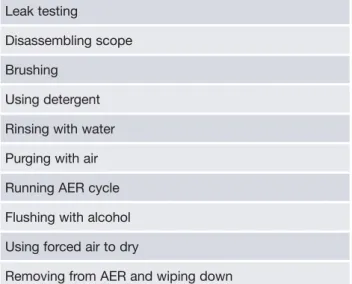
Compliance with endoscope reprocessing guidelines was defined on the basis of completion of 12 steps recommended by the SGNA, CDC, and Multi-Society Guidelines (Nelson et al., 2003; Rutala et al., 2008; SGNA, 2010). Personnel were responsible for performing each of the tasks listed in Table 1 (MHLD) or Table 2 (ECR). A completed ECR cycle included a leak test, channel and component clean-ing, detergent immersion and flush, water rinse, air purge, HLD cycle, alcohol flush, and forced air drying (FDA, 2005, 2006, 2008). Personnel were responsible for the final exterior wipe-down follow-ing ECR.
Data were entered into Microsoft Office Excel 2007 spreadsheets using a double data entry method-ology. SPSS (Version 14.0) for Windows was used for analyses. The analysis utilized frequency distribu-tions and contingency tables initially broken down by type of reprocessing method (MHLD or ECR) and data collection period. Differences were tested using Fisher’s exact test and the chi-square test for trends, when appropriate. When differences between
Endoscope Reprocessing Methods
VOLUME 33 | NUMBER 4 | JULY/AUGUST 2010 5
groups were not statistically significant, results were combined.
Results
Site Characteristics and Response Rates
Six sites were recruited for participation in the study, and five submitted complete data sets. The sixth site did not complete data collection because of unanticipated personnel changes that occurred shortly after study ini-tiation. Sites included two gastroenterology specialty centers, two multispecialty hospitals, and one outpatient surgery center. Survey response rates were very high, with more than 87% of expected surveys completed.
The data set included 36 baseline, 34 follow-up, and 23 one-week surveys. Observers submitted 99% of expected log sheets. Data on 183 GI endoscopes were analyzed.
All managers affirmed that their facilities had writ-ten reprocessing policies and procedures. Four were based on the SGNA guideline, one was based on the SGNA and American Society of Gastrointestinal Endoscopy (ASGE) guidelines (ASGE Standards of Practice Committee, 2008), and one site had developed its own internal policies.
The average number of endoscopy procedures varied by site (from 10 per week to 250 per week). Managers indicated that their institutions used one or more types of automation for reprocessing. At baseline, three sites uti-lized mechanical irrigators (Medivators Scope Buddy), three used AERs from Advanced Sterilization Products (ASP), one used a Steris System 1 Sterile Processing System, and two used ASP’s Evotech ECR. New Evotech systems were installed at four sites, whereas one site used only MHLD for the duration of the study.
Employee Characteristics
Sites employed between 4 and 13 persons who were trained to reprocess endoscopes, including scope tech-nicians or medical equipment specialists (26%), RNs (50%), and others (24%). Observers documented that 24% of reprocessing was performed by RNs during this study. Three fourths of respondents had reprocessed endoscopes for more than 1 year, and approximately 40% had done so for 5 years or more. One-half report-ed working 8 hours or less per week reprocessing endo-scopes, whereas 20% spent 25 hours or more per week on this task. Reprocessing personnel also performed other duties at four sites. The fifth site had staff devot-ed entirely to reprocessing.
Employee Perceptions About
Reprocessing Tasks
More than 90% of survey respondents considered the leak test, brushing, and water rinse steps to be very important, and 79% believed air purging was very important. Most respondents (⬎90%) reported liking endoscope setup, patient care, and removing clean endo-scopes from the HLD systems, and 87% liked loading the AER or the ECR machine. Less popular tasks were leak testing, bedside wipe-down, alcohol flush (each liked by approximately 60%), and manual cleaning (defined as brushing/flushing) before disinfection (47%). The majority (65%) of personnel using MHLD methods stated that they typically spent 1-2 minutes brushing each endoscope. Longer brushing times were reported by 18% of respondents, and shorter times by 18%. When using MHLD, 12% of employees found leaks in the last month; 22% of employees using the ECR machine found leaks.
TABLE 1.Observed Steps for Manual Cleaning With High-Level Disinfection Reprocessing Leak testing
Disassembling scope Brushing
Using detergent Rinsing with water Purging with air Running AER cycle Flushing with alcohol Using forced air to dry
Removing from AER and wiping down Note. AER⫽automatic endoscopic reprocessing.
TABLE 2.Observed Steps for ECR Machine Use Disassembling scope
Attaching all connectors
Entering data using touch screen Ensuring reservoirs are adequately filled
Running ECR cycle (including leak test, channel and component cleaning, detergent immersion and flush, water rinse, air purge, high-level disinfection cycle, alcohol flush, forced air drying)
Verifying cycle completion (or restarting after addressing reasons for cycle failure)
Removing from ECR and wiping down
More than 97% of respondents rated their repro-cessing systems as very easy or easy to use. The major-ity of personnel (⬎71%) described MHLD and ECR methods as excellent or very good. Differences between groups were not significant.
Occupational Health Issues
At the time of study initiation (baseline survey), the majority of employees reported health problems, which they attributed to reprocessing endoscopes (Figure 1). Symptoms included respiratory ailments related to fumes or odors in the reprocessing area (reported by 18% of respondents) and physical discomfort (reported by 50% of respondents). For those with physical dis-comfort, symptoms involved employees’ backs or necks (91%), hips, legs, or feet (76%), and hands or arms (47%). The most common problems reported were pain (92%), problems with flexibility (36%), and numbness or tingling (30%) in one or more bodily region. At follow-up, health problems occurred less fre-quently among personnel using the new ECR machine than those using MHLD (p⫽.001).
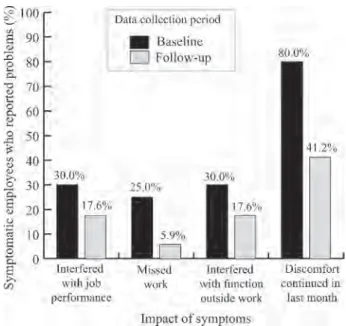
At baseline, nearly one third of employees with occupational health problems believed the symptoms interfered with their ability to function inside and out-side of work (Figure 2). Employees reported missing work because of these health problems (p⫽.000).
At baseline, there was a linear relationship between physical symptoms and the number of hours spent reprocessing each week (p ⫽ .041) (Figure 3). This association was not found at follow-up (p⫽.472).
Managers at three sites were aware that employees had experienced occupational health problems, and one reported that employees had current health prob-lems associated with reprocessing endoscopes. Sites added floor cushions, removed and reattached sinks at a more appropriate height, rearranged schedules for
shorter cleaning periods, and sent employees to physi-cal therapy to address occupational health problems.
Reprocessing Efficiency
Three fourths (75%) of employees reported feeling pressure to work quickly when reprocessing endo-scopes. One respondent acknowledged skipping steps or doing them more quickly than they liked because of this pressure. Automated endoscope reprocessing cycle failures in the past week were reported by 10% of respondents. Endoscopic cleaning and reprocessing cycle failures were more common, with 52% of respondents reporting one to three cycle failures in the past week, and 21% reporting four or more. ECR
FIGURE 1. Occurrence of symptoms attributed to endo-scope reprocessing by reprocessing method used over time (p⫽.001).
FIGURE 2.Impact of occupational health problems attrib-uted to reprocessing endoscopes (p⫽.000).
FIGURE 3.Association between the occurrence of physical discomfort attributed to reprocessing and hours spent reprocessing endoscopes per week at baseline (p⫽.041).
Endoscope Reprocessing Methods
VOLUME 33 | NUMBER 4 | JULY/AUGUST 2010 7
failures were generally due to user error (e.g., incom-plete channel connections, failure to refill reservoirs). Approximately 46% of personnel reported procedural delays due to a lack of clean and disinfected endo-scopes. There were no significant differences in the occurrence of procedural delays by method used (MHLD vs. ECR).
Observed Performance
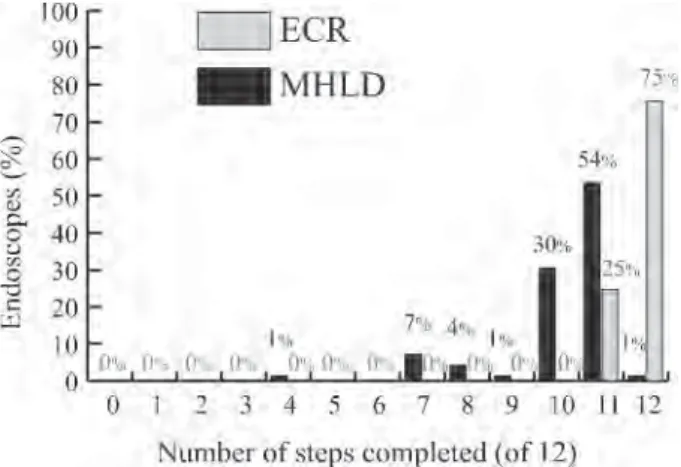
Personnel performed all 12 required steps for 1 of 69 (1.4%) endoscopes reprocessed using MHLD, and for 86 of 114 (75.4%) endoscopes reprocessed using ECR. There were significant differences in the number of steps skipped by method (p⫽.000). Table 3 illustrates the completion of required steps for endoscopes reprocessed using MHLD. Less than half of endo-scopes had all components brushed. Alcohol flush and forced-air drying steps were commonly skipped. Observers documented that 22% of wet leak tests per-formed prior to MHLD were perper-formed using sudsy water. Figure 4 shows that personnel skipped two or
more steps for 44.9% of MHLD-reprocessed endo-scopes and for 0% of ECR-reprocessed endoendo-scopes. The only step skipped for endoscopes reprocessed using ECR was the final wipe-down (25% skipped).
Time spent brushing varied considerably (Figure 5a). Median brush time was 1 minute 12 seconds at baseline and 1 minute 34 seconds at follow-up (range from 10 seconds to 7 minutes 44 seconds). The site with the high-est rate of documented brushing of all endoscope chan-nels and components (Site B) had the longest brushing times. Brushing times at Site E (MHLD only) were short-er and decreased significantly from baseline to follow-up (mean value ⫽ 1 minute 10 seconds at baseline and 42 seconds at follow-up; p ⫽ .000). Personnel flushed endoscopes with detergent for a minimum of 18 seconds and a maximum of 2 minutes 45 seconds. Time spent rinsing with water ranged from 1 minute 17 seconds to 3 minutes 20 seconds (Figure 5b). Sites B and E used a mechanical channel irrigator with a programmed timer and had more consistent flush times than Site A.
Discussion
Safe endoscope reprocessing requires meticulous adher-ence to guidelines. Human error is a principal cause of deficient reprocessing (Alfa, Olson, & DeGagne, 2006; Nelson, 2005; Rutala & Weber, 2004). Guidelines may be valuable for detailing proper practices but can be ineffective for changing behavior (TJC, 2009).
This is the first study that evaluated reprocessing practices in clinical settings before and after the intro-duction of a new ECR method. Although managers affirmed that written reprocessing policies and proce-dures were in place and employees acknowledged the importance of reprocessing steps, direct observation revealed that GI endoscopes were generally not reprocessed in accordance with guidelines. We found that only 1 of 69 endoscopes was reprocessed properly when manual reprocessing methods were used. In spite
FIGURE 4. Personnel completion of endoscope repro-cessing steps (p⫽.000).
TABLE 3. Documented Completion of Steps During Manual Cleaning With High-Level Disinfection Reprocessing
Observed Activity
Steps Completed (%) (n⫽69)
Leak test performed in clear
water 77
Disassemble endoscope
completely 100
Brush all endoscope
channels and components 43 Immerse endoscope
completely in detergent 99 Immerse components
completely in detergent 99 Flush endoscope with
detergent 99
Rinse endoscope with water 96 Purge endoscope with air 84 Load and complete automated
cycle for high-level disinfection 100 Flush endoscope with alcohol 86 Use forced air to dry
endoscope 45
Wipe down external surfaces
of reprocessing inadequacies observed in this study, employees performed critical steps more consistently than reported by other researchers who found that 64% of endoscopes were correctly immersed in detergent, 68% were rinsed with water, and 89% were flushed with alcohol (Alfa, Olson, DeGagne, & Jackson, 2002). Jackson and Ball (as cited in Nelson et al., 2003) also found reprocessing deficiencies in every 1 of 19 primary care clinics that performed flexible sigmoidoscopies.
Nonadherence with reprocessing guidelines can have serious implications. Seoane-Vazquez, Rodriguez-Monguio, Visaria, and Carlson (2006) evaluated data related to 70 outbreaks of endoscopy-related infections and found that the primary cause was deficient repro-cessing practices. They concluded that the improvement of quality control systems could have prevented 91% of the infections and suggested that surveillance systems be improved to reduce the burden of endoscopy-related events.
The leak-testing results were not surprising. Other researchers have reported one third of endoscope leaks are overlooked by personnel (Dix, 2007) and even sea-soned technicians commonly miss leaks (Ellis, 2006). According to Ellis (2006), technicians sometimes “… combine the cleaning with the leak test and dunk the scope in a tub of enzymatic solution, so you’re looking for bubbles within bubbles” (“Leak Testing,” ¶ 10). The failure to perform a proper leak test could also have serious implications. Continuing to use a damaged endoscope could result in further damage and related expenses (Dix, 2008).
In this study, personnel brushed all components on less than 50% of endoscopes, and brushing times var-ied considerably. Some endoscopes received less than 30 seconds of brushing, and only 2 of 76 brush times
were longer than 3 minutes. Others have suggested that proper manual cleaning takes substantially longer time than that found in this study (Alfa et al., 2006). The lack of meticulous brushing is problematic because improper cleaning “… can overwhelm the high-level disinfection process and result in a contaminated device regardless of subsequent steps” (Burdick, & Hambrick, 2004, p. 718). Observed brushing times were lower than indicated on surveys, which suggests that employee self-report of reprocessing practices was unreliable. The significant reduction in documented brushing times from baseline to follow-up at the MHLD-only site (p⫽
.000) indicates the need for continuous monitoring, as any positive impact the observer may have had seems to have waned by the end of the study.
Others have reported that the automation of clean-ing and HLD processes reduces the impact of human shortcomings and results in more consistent endoscope reprocessing (ASGE Standards of Practice Committee, 2008; Rutala et al., 2008; Zuhlsdorf et al., 2002). We found consistency improved when automated devices were used. The use of a Scope Buddy at two sites result-ed in detergent flush times that were quite consistent. The use of an ECR machine further improved consis-tency, with 100% of endoscopes being leak-tested, cleaned, treated with HLD, and dried with alcohol and forced air. Even with ECR, however, employees some-times skipped the final wipe-down.
User error was the most common cause of cycle fail-ures. These errors were documented automatically and required employees to address the issues and restart the cycles. ECR documentation ensured that partially reprocessed endoscopes were not returned to circula-tion and allowed managers to identify problems with the technology and employee performance.
FIGURE 5.Observed cleaning times at manual high-level disinfection sites: (a) brushing durations; (b) flushing durations.
Endoscope Reprocessing Methods
VOLUME 33 | NUMBER 4 | JULY/AUGUST 2010 9
Our findings provide new information about the context in which guideline nonadherence occurs. First, reprocessing endoscopes involves a complicated series of steps, and a substantial proportion of employees indicated they disliked leak testing, manual cleaning, and flushing with alcohol. Observers documented that these tasks were often skipped or improperly per-formed. Although observers did not document bedside precleaning, survey data indicated that approximately 40% of employees do not like performing this step. Direct observation revealed that the final wipe-down was frequently skipped. The improper performance of bedside precleaning or the final wipe-down, whether MHLD or ECR methods are used, could have a nega-tive impact on reprocessing effecnega-tiveness.
Second, the need to rapidly handle a high volume of endoscopes and prevent procedural delays may con-tribute to a stressful work environment (Dix, 2007; Hession, 2003). We found that most employees felt pres-sure to work quickly, and many attributed procedural delays to a lack of reprocessed endoscopes. According to Hession, “On a typical day, two rooms were delayed three times each, for a total of 1 hour of idle time due to instrument processing delay” (2003, p. 112). Procedural delays impact patient satisfaction and have financial implications (Hession, 2003).
Third, most employees experienced health problems, including respiratory problems, pain, tingling, numb-ness, and decreased flexibility, attributed to reprocess-ing endoscopes. Several workers indicated that the symptoms interfered with their job performance. At baseline, we found a linear association between hours worked and symptoms experienced. After four of the sites had begun to use the new ECR machine, signifi-cantly fewer workers reported discomfort attributed to reprocessing and the linear relationship between hours spent reprocessing and symptoms disappeared.
Study Limitations
Direct observation was used to document practices used for reprocessing endoscopes from a convenience sample (i.e., nonrandomized) of endoscopes. The SCs and observers scheduled observation times at their discretion, which could have impacted the findings. The presence of an observer may have affected employee behavior because of a “Hawthorne effect” (Kohli et al., 2009), potentially resulting in higher adherence levels than those that occur when employ-ees are not being monitored. The findings may not be generalizable because they came from a small number of diverse sites that volunteered to participate. This was an open-label observational study, and personnel were aware of which reprocessing methods were being used, which could have affected the results. The impli-cations of the observed variability in reprocessing
prac-tices are unknown because there was no laboratory confirmation of cleaning effectiveness, and no patient outcomes data were collected.
Conclusions
This multisite study documented extensive nonadher-ence with reprocessing guidelines when manual repro-cessing methods were used. We identified a constella-tion of factors that may contribute to nonadherence, including employee dislike of manual reprocessing tasks, pressure to work quickly, and occupational health problems attributed to reprocessing. Automation resulted in better compliance with guidelines and reduced symptoms associated with reprocessing.
Enhanced training programs may improve perform-ance of some tasks; however, these human factors are unlikely to be modified through education alone. Routine monitoring of reprocessing practices would allow man-agement to identify and correct deficiencies. Ongoing audits and continuous vigilance may be required to ensure compliance with guidelines. Endoscopy center managers should also address time pressures and health problems experienced by employees. The use of ECRs may be helpful in this regard, as they have preset repro-cessing cycle times, reduce the need for hands-on involve-ment by personnel, and provide docuinvolve-mentation for all cycles. In addition, the use of more automated reprocess-ing methods will improve compliance with reprocessreprocess-ing guidelines that have been developed to ensure patient safety.
ACKNOWLEDGMENTS
The authors thank Geoff Alexander (Gordian Health Solutions) and Doug Anderson, PhD (ATS Laboratories), for their expert consultation regarding study methods and instruments. The authors are grateful for the data entry and editorial support provided by Kayla Dean and Jeremy Ward. Funding for this study was provided by Advanced Sterilization Products.
REFERENCES
Alfa, M. J., Olson, N., & DeGagne, P. (2006). Automated washing with the Reliance Endoscope Processing System and its equiva-lence to optimal manual cleaning. American Journal of Infection Control, 34(9), 561-570.
Alfa, M. J., Olson, N., DeGagne, P., & Jackson, M. (2002). A survey of reprocessing methods, residual viable bioburden, and soil levels in patient-ready endoscopic retrograde cholioangiopan-creatography duodenoscopes used in Canadian centers. Infection Control & Hospital Epidemiology, 23(4), 198-206.
ASGE Standards of Practice Committee. (2008). Infection control dur-ing GI endoscopy. Gastrointestinal Endoscopy, 67(6), 781-790. Association of Operating Room Nurses. (1998). Recommended
practices for use and care of endoscopes. AORN Journal, 67(1), 229-232.
Burdick, J. S., & Hambrick, D. (2004). Endoscope reprocessing and repair costs. Gastrointestinal Endoscopy Clinics of North America, 14(4), 717-724.
Cockshut-Miller, L. (2004). Meeting JCAHO’s infection control requirements: A priority focus area. Oakbrook Terrace, IL: Joint Commission Resources.
Cowen, A. E. (2001). The clinical risks of infection associated with endoscopy. Canadian Journal of Gastroenterology, 15(5), 321-331. Daigh, J. D. (2009). Endoscopy procedures at the U.S. Department of Veterans Affairs: What happened, what has changed? Washington, DC: U.S. Department of Veterans Affairs, House Committee on Veterans’ Affairs. Retrieved February 12, 2010, from http://www. veterans.house.gov/hearings/hearing.aspx?NewsID=417
Dix, K. (2007, March 30). Scope leak testing. Endo Nurse. Retrieved February 12, 2010, from http://www.endonurse.com/artcles/ 07aprfeat2.html
Dix, K. (2008, April 1). The high price of scope leaks. Endo Nurse. Retrieved from http://www.endonurse.com/articles/high_price_ of_scope_leaks.html
Ellis, K. (2006, November 7). Endoscope cleaning and repair. Endo Nurse. Retrieved February 12, 2010, from http://www. endonurse.com/articles/681feat2.html
Food and Drug Administration. (2005). 510(k) clearance summary of safety and effectiveness: K040883 EvoTechTM Integrated
Endoscope Disinfection System. Retrieved February 12, 2010, from http://www.accessdata.fda.gov/cdrh_docs/pdf4/K040883.pdf Food and Drug Administration. (2006). 510(k) clearance summary
K061899: EvoTechTM Integrated Endoscope Disinfection
System. Retrieved from http://www.accessdata.fda.gov/cdrh_ docs/pdf6/K061899.pdf
Food and Drug Administration. (2008). 510(k) clearance summary: K082392: EvoTechTM Endoscope Cleaner and Reprocessor.
Retrieved from http://www.accessdata.fda.gov/cdrh_docs/pdf8/ K082392.pdf
Hession, S. M. (2003). Endoscope disinfection by ortho-phthalalde-hyde in a clinical setting: An evaluation of reprocessing time and costs compared with glutaraldehyde. Gastroenterology Nursing, 26(3), 110-114.
Kohli, E., Ptak, J., Smith, R., Taylor, E., Talbot, E. A., & Kirkland, K. B. (2009). Variability in the Hawthorne effect with regard to
hand hygiene performance in high- and low-performing inpa-tient care units. Infection Control & Hospital Epidemiology, 30(3), 222-225.
Martiny, H., Floss, H., & Zuhlsdorf, B. (2004). The importance of cleaning for the overall results of processing endoscopes. Journal of Hospital Infection, 56(Suppl. 2), S16-S22.
Nelson, D. B. (2005). Recent advances in epidemiology and preven-tion of gastrointestinal endoscopy related infecpreven-tions. Current Opinions in Infectious Diseases, 18(4), 326-330.
Nelson, D. B., Jarvis, W. R., Rutala, W. A., Foxx-Orenstein, A. E., Isenberg, G., Dash, G. R., et al. (2003). Multi-society guideline for reprocessing flexible gastrointestinal endoscopes. Society for Healthcare Epidemiology of America. Infection Control & Hospital Epidemiology, 24(7), 532-537.
Rutala, W. A., & Weber, D. J. (2004). Reprocessing endoscopes: United States perspective. Journal of Hospital Infection, 56(Suppl. 2), S27-S39.
Rutala, W. A., Weber, D. J., & Healthcare Infection Control Practices Advisory Committee. (2008). Guideline for disinfec-tion and sterilizadisinfec-tion in healthcare facilities. Atlanta, GA: Centers for Disease Control and Prevention.
Seoane-Vazquez, E., Rodriguez-Monguio, R., Visaria, J., & Carlson, A. (2006). Exogenous endoscopy-related infections, pseudo-infections, and toxic reactions: Clinical and economic burden.
Current Medical Research & Opinion, 22(10), 2007-2021. Society of Gastroenterology Nurses and Associates, Inc. (2010).
Standards of infection control in reprocessing of flexible gastroin-testinal endoscopes. Gastroenterology Nursing, 33(1), 70-80. Stearns, C. (2009). Endoscopy procedures at the U.S. Department of
Veteran’s Affairs: What happened, what has changed?
Washington, DC: House Committee on Veterans’ Affairs. Retrieved from http://www.veterans.house.gov/hearings/hearing. aspx?NewsID=417
The Joint Commission. (2009). Measuring hand hygiene adherence: Overcoming the challenges[Monograph]. Oakbrook Terrace, IL: Author.
Zuhlsdorf, B., Emmrich, M., Floss, H., & Martiny, H. (2002). Cleaning efficacy of nine different cleaners in a washer-disinfector designed for flexible endoscopes. Journal of Hospital Infection, 52(3), 206-211.