EKHK18: 15 credit bachelor thesis Supervisor: Kamaruddin Abdulsomad Examiner: Prince Aboyage
Word count: 11 725
1
The role of e-commerce in the economic development of Vietnam
during 1990 to 2020
EKHK18: 15 credit bachelor thesis Supervisor: Kamaruddin Abdulsomad Examiner: Prince Aboyage
Word count: 11 725
2 Abstract
This study will discuss the role of e-commerce in the economic development of Vietnam during 1990 to 2020. During the recent years, Vietnam has had a remarkable economic growth and is seen as one of the promising countries of technological development and e-commerce. However, the country still has a long way to go in economic development. This study accounts for how the new trading market; e-commerce can be utilized for a developing country, in this case Vietnam, in order to develop and catch up the developed countries in the new era of globalization. According to the UNDP, developing countries should adopt e-commerce in order to enhance both their social and economic development as well as their international interaction. Out of the 97 million people living in Vietnam, 37% of the
population is using e-commerce, but this number is expected to grow. This research conducts a case-study of the most dominant e-commerce sector of Vietnam, the consumer goods sector. This is a representative case, by looking at the direction of the trend of this sector, one can draw conclusions and predictions on how e-commerce development can help promote economic development in Vietnam. This will be done through a mixed method; entailing a qualitative research collected from various scientific articles, websites along with other literature. Whilst the other part consists of a quantitative method with data collected from various data bases and other statistical forums. The scope of the study reaches from 1990-2020, since it was in the 1990’s the Internet emerged.
EKHK18: 15 credit bachelor thesis Supervisor: Kamaruddin Abdulsomad Examiner: Prince Aboyage
Word count: 11 725 3
Table of contents
List of Abbreviations... 4 List of Figures... 5 1. Introduction ... 61.1 Scope of the study and Relevance ... 6
1.2 Aim and Research questions ... 7
1.3 Outline of the thesis ... 8
2. Background... 9
3. Previous Literature ... 11
3.1 The Flying Geese Paradigm... 11
3.2 Factors of e-commerce ... 12
3.3 Role of e-commerce in developed countries ... 13
3.4 Digitalization spread to developing countries ... 15
3.5 The study’s contribution to the discussion ... 16
4. Analytical Framework ... 17
4.1 Factors of economic development ... 17
4.2 Role of e-commerce for economic development ... 18
4.3. Limitations of the analytical framework ... 22
5. Methods and Data... 22
5.1 Research Design ... 22
5.2 Data Collection ... 24
5.3 Limitations of the methodology... 27
6. Analysis/Discussion ... 29
6.1 The rise of e-commerce in Vietnam ... 31
6.2 Consumer goods sector ... 33
6.3 Consumer patterns ... 37
6.4 Global competitiveness and trade ... 40
6.5 Government regulations ... 42
7. Concluding remarks ... 46
EKHK18: 15 credit bachelor thesis Supervisor: Kamaruddin Abdulsomad Examiner: Prince Aboyage
Word count: 11 725
4 List of Abbreviations
ASEAN Association of Southeast Asian Nations B2B Business-to-business
B2C Business-to-consumer C2A Consumer-to-administration C2B Consumer-to-business C2C Consumer-to-consumer EDI Electronic Data Interchange EFT Electronic Fund Transfer
EVBN EU-Vietnam Business Network FDI Foreign Direct Investment
FGP Flying Geese Paradigm GDP Gross Domestic Product
ICT Information and Communication Technology
UNCTAD United Nations Conference on Trade and Development UNDP United Nations Development Programme
EKHK18: 15 credit bachelor thesis Supervisor: Kamaruddin Abdulsomad Examiner: Prince Aboyage
Word count: 11 725
5 List of Figures
Figure 1: Map of Vietnam
Figure 2: The Flying Geese Paradigm
Figure 3: E-commerce as an analytical model, 1990–2020
Figure 4: Indicators of e-commerce and economic development, 1990-2020 Figure 5: Historical Timeline of E-commerce, 1970–2020
Figure 6: People using the internet (% of total population), ASEAN countries, 1990-2019 Figure 7: Population of Vietnam (in millions), 1990–2020
Figure 8: Online Purchases of Consumer Goods in Vietnam, 2019 Figure 9: Vietnam's GDP (in USD billions), 1990–2019
Figure 10: Urbanization growth in Vietnam, 2008–2018 Figure 11: Top Transactional Websites in Vietnam, 2019
p.9 p.12 p.19 p.25 p.31 p.32 p.34 p.36 p.36 p.40 p.41
EKHK18: 15 credit bachelor thesis Supervisor: Kamaruddin Abdulsomad Examiner: Prince Aboyage
Word count: 11 725
6 1. Introduction
Vietnam has experienced a remarkable economic growth during the last few decades and it is expected to continue (The World Bank, 2020). The country is seen as one of the promising countries when it comes to technological development (Hoang Linh, 2020a). Despite this, the country still has a long way to go when it comes to economic development, since they are still categorized as a developing country, classified as a lower middle-income country (The World Bank, 2020). This is partly due to not being included in the international trade market
acquired from electronic commerce (e-commerce) and globalization (Phillips, 2016).
According to the UNDP (2005, cited in Alyoubi, 2015) developing countries should adopt e-commerce in order to enhance both their social and economic development as well as their international interaction. E-commerce or digital trade has reshaped the whole trading system, opening up for new international markets. This new trading market is expected to have a significant impact on countries’ economic development (World Trade Organization, 2018, pp. 6-10). Therefore, this research looks at how the transition from a traditional commerce trading market to an e-commerce market can be utilized for Vietnam in order to promote economic development.
Before going further into the study, it is important to establish the definition for e-commerce used throughout this research. According to Decree 52/2013/ND-CP (2013, cited in EVBN, 2018 p.15) e-commerce can be defined as the following” e-commerce activity means conducting part or the whole of the process of commercial activity by electronic means connected to the Internet, mobile telecommunications network or other open networks” (EVBN, 2018, p. 15).
1.1 Scope of the study and Relevance
E-commerce has acted as a facilitator to spur countries economic growth and finally economic development, by allowing them to expand their commerce market and enter new trading markets internationally (Alyoubi, 2015, p. 480). Vietnam is considered as one of Asia’s most open economies, with a remarkable development in trade liberalization during
EKHK18: 15 credit bachelor thesis Supervisor: Kamaruddin Abdulsomad Examiner: Prince Aboyage
Word count: 11 725
7 recent years (Le Trong, 2020). There is a big school arguing that Vietnam is one of the
promising e- commerce giants, therefore it is relevant to look at how the case of Vietnam can represent other developing countries, situated in similar situations (Hoang Linh, 2020b). Nonetheless, their e-commerce market experiences many barriers. A major obstacle for economic development in Vietnam is their lack of connectivity and interactivity (Le Trong, 2020).
Furthermore, Vietnam is located in a region where developing countries have succeeded with a technological development during the last decades. Technological innovations have
reshaped the economic and social development of Asia, which have grown to become the powerhouse of world economic growth during the last decades. Asia consists of some of the largest and wealthiest economies in the world, thanks to the technological revolution adopted (Li & Piachaud, 2018, p. 2). This development will be discussed by applying” The Flying Geese Paradigm” to the case of Vietnam in order to see how the South-East Asian peers have managed. Some of these countries also belong to” The Association of Southeast Asian Nations”, also known as ASEAN. ASEAN was founded by Indonesia, Malaysia, Philippines, Singapore and Thailand and was established on 8th of august 1967. Since then, Brunei
Darussalam, Vietnam Lao PDR, Myanmar and Cambodia has joined, together constituting the 10 member states ASEAN has today (ASEAN, 2017).
1.2 Aim and Research questions
During the last decades a new form of industrialization has taken place; the third industrialization driven by technological development (Ben-Ami, 2015). This led to the globalization and liberalization which we can see in the world today, countries are now more interconnected and integrated than they were before. Globalization is the spread of
technology, information, goods and jobs worldwide, driven by free trade and open markets. Globalization provides an opportunity for economic growth through widening markets. Nonetheless, this opportunity is not distributed equally between countries, often excluding developing countries (Kopp, 2020). Therefore, this study aims at discussing how e-commerce can be utilized as a tool for Vietnam to spur their economic development, by broadening and developing their e-commerce market. Since e-commerce can be used as an opportunity for
EKHK18: 15 credit bachelor thesis Supervisor: Kamaruddin Abdulsomad Examiner: Prince Aboyage
Word count: 11 725
8 developing countries to be included in the global trading system and market (World Trade Organization, 2018, p. 13).
E-commerce has not only changed the outlook of the structure of a commerce market but has also changed consumption patterns (Scalefast, 2020). The aim is to look at how an increasing e-commerce market can improve economic development in Vietnam in general. With a focus on the actual transition from a traditional commerce to e-commerce and how the change of consumer patterns can promote economic development in Vietnam.
To reach aforementioned aim, the following research question is posed:
- How can the transition from a traditional commerce market to an e-commerce market promote economic development in Vietnam?
To answer this overarching question, I will be analyzing the online consumer goods sector. The aim is to be able to draw predictions of e-commerce impact on economic development in general based on the data retrieved for this specific sector.
An important aspect of this change of trading system is government regulations. It is the government’s responsibility to implement the regulations and policies needed for an e-commerce environment (UNCTAD, 2003). Therefore, the following sub-question is posed:
- What has the government in Vietnam done so far in order to promote e-commerce? 1.3 Outline of the thesis
The following outline is applied in this thesis; I will start off the thesis with providing some background information regarding Vietnams economy and a brief e-commerce history in order to put the subject of the study into context. I will then review the previous literature presenting relevant aspects and theories on economic development and e-commerce, after this I will present the analytical framework I have developed. Following this I present the
methodology conducted and the data analyzed. I then discuss and analyze the findings from the data and connect them to the analytical framework as well as the previous literature. Lastly, with some concluding remarks I summarize my findings.
EKHK18: 15 credit bachelor thesis Supervisor: Kamaruddin Abdulsomad Examiner: Prince Aboyage
Word count: 11 725
9 2. Background
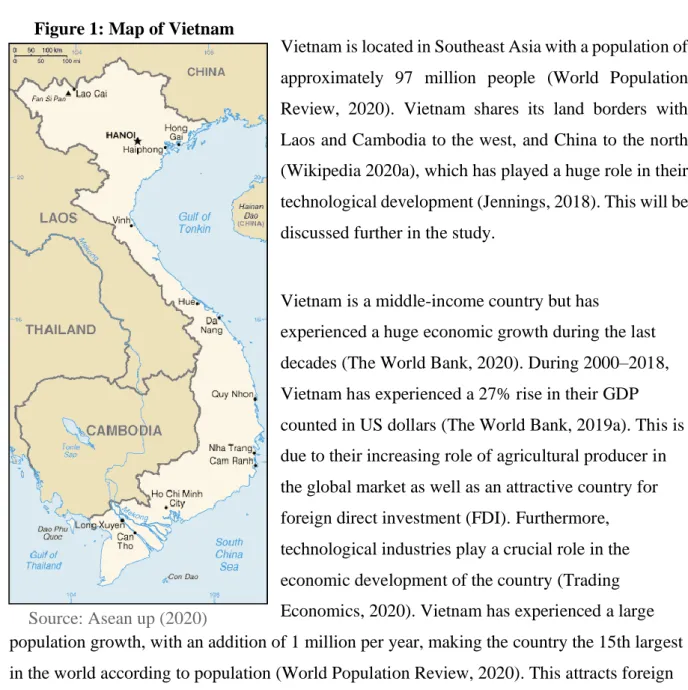
Vietnam is located in Southeast Asia with a population of approximately 97 million people (World Population Review, 2020). Vietnam shares its land borders with Laos and Cambodia to the west, and China to the north (Wikipedia 2020a), which has played a huge role in their technological development (Jennings, 2018). This will be discussed further in the study.
Vietnam is a middle-income country but has
experienced a huge economic growth during the last decades (The World Bank, 2020). During 2000–2018, Vietnam has experienced a 27% rise in their GDP counted in US dollars (The World Bank, 2019a). This is due to their increasing role of agricultural producer in the global market as well as an attractive country for foreign direct investment (FDI). Furthermore, technological industries play a crucial role in the economic development of the country (Trading Economics, 2020). Vietnam has experienced a large population growth, with an addition of 1 million per year, making the country the 15th largest in the world according to population (World Population Review, 2020). This attracts foreign investors and companies as a large population equivalates to a large consumer base
(McKinsey & Company, 2019, p. 6).
This study will use the time frame of 1990 to 2020. The start year of 1990 is chosen since the development of the Internet as we know it emerged during the 1990’s. This marks a crucial milestone; it was this new technological platform which essentially led to e-commerce developing (Wikipedia, 2020b). The scope of the study ends with 2020 as e-commerce is an ongoing development process.
Figure 1: Map of Vietnam
EKHK18: 15 credit bachelor thesis Supervisor: Kamaruddin Abdulsomad Examiner: Prince Aboyage
Word count: 11 725
10 Along with the internet exploding during the last decades and becoming more and more popular e-commerce has become a new phenomenon which has grown and outcompeted retailing. The Internet has developed the way consumers and companies interact with each other, consequently creating a new marketplace for this interaction. With this rapid
development of global interaction, e-commerce has entered into a new era allowing companies to sell their products across borders (World Trade Organization, 2018, p. 3). The e-commerce market is based on five different types of markets depending on the seller and buyer: 1. Business-to-business (B2B) 2. Business-to-consumer (B2C) 3. Consumer-to-business (C2B) 4. Consumer-to-consumer (C2C) 5. Consumer-to-administration (C2A)
The two major types of e-commerce markets today are the to-business and consumer market (D'Errico, 2019). This study examines the consequences of a consumer market; however, the biggest e-commerce market is actually the
business-to-business market. It has been around since the beginning of e-commerce history; the market was based on electronic data interchange (EDI) which was invented already in the
1970’s/1980’s. The business-to-business e-commerce market accounts for a striking majority of the total e-commerce revenue and increased global value chains. However, the changes sparked by the business-to-consumer e-commerce market has a more significant impact on countries’ economies and consumer behaviors. The aim of this paper is to analyze how the new e-commerce market has promoted Vietnams economic development. A part of the analysis is to examine how the change in consumer behaviors as a consequence of this transition mean for economic development. It is indicated that the business-to-consumer has had a larger impact on economies and consumers, therefore, it is more relevant to use this market for the case study (Chris G. Christopher, 2011). Furthermore, it is the leading sector in Vietnams e-commerce market (Kemp & Moey, 2019).
EKHK18: 15 credit bachelor thesis Supervisor: Kamaruddin Abdulsomad Examiner: Prince Aboyage
Word count: 11 725
11 Consumer goods also known as final goods are goods intended to be sold to the average consumer by businesses. They are the final results of production and manufacturing such as clothes, food and jewelry. Raw materials such as copper are not considered consumer goods as they are not the end result and must be transformed into further usable products
(Chappelow, 2019). 3. Previous Literature
In this section, I will review the previous literature which has acted as a guideline for my own study by both providing the direction of the research questions chosen as well as providing background context which creates the basis for my analytical framework. There are certain recurrent themes for the topic of e-commerce in Vietnam found in the previous literature, which will be reviewed below.
3.1 The Flying Geese Paradigm
The technological development in South East Asia has been a hot topic for a while, discussed by many scholars. A theory used broadly in the literature to explain this phenomenon is “The Flying Geese Paradigm” (FGP), which explains the catching- up process of technological development in Southeast Asia with Japan in the lead (Trinh Ha, 2005). Therefore, it is relevant to apply this theory to the case of Vietnam.
According to Trinh Ha (2005), an important element of this theory is that growth can be achieved through learning among the economies of the ladder, this is demonstrated by the geese flying in a formation with one goose in the lead and the rest following. Japan is seen as the leading power in this development theory. Therefore, by applying this theory to the case of Vietnam there will be a comparison to the Asian peers. One can see elements in the Vietnamese technological development already found in other South-East Asian countries (Trinh Ha, 2005).
EKHK18: 15 credit bachelor thesis Supervisor: Kamaruddin Abdulsomad Examiner: Prince Aboyage
Word count: 11 725
12 Figure 2: The Flying Geese Paradigm
Source: Econfix (2017)
This paradigm also describes the different stages of development, which can be applied to the case of Vietnam in order to see what stage they are at and how they should proceed in order to reach the next stage. At an early stage of development, the country relies on a natural resource production and its labour. Development into the next stage occurs when a more diversified industrial structure takes place. When enough capital and technology are accumulated nationally or through FDI, the industries of the country can shift from a natural resource production toward a technology-intensive production (Trinh Ha, 2005, pp. 74-75). E-commerce is part of this technology which can lead to the shift (World Trade Organization, 2018).
E-commerce has played a huge role for already developed countries on their economic growth since this has increased the national productivity through breaking down market barriers and allowing companies to interact globally (World Trade Organization, 2018, p. 11). Many literature claims that even though e-commerce in Vietnam is lagging behind other Southeast Asian countries such as Singapore, Malaysia and Thailand, the country is expected to have a fast-growing digital economy due to their potential to a dynamic e-commerce market (Hoang Linh, 2020a).
3.2 Factors of e-commerce
There are two main factors that have contributed to the growth and development of
e-commerce. The first one is globalization. During the last decades a new industrialization wave has emerged, known as globalization. Which has promoted worldwide integration; countries are more connected than ever before (Taylor & Francis Group, 2020). It allows countries and
EKHK18: 15 credit bachelor thesis Supervisor: Kamaruddin Abdulsomad Examiner: Prince Aboyage
Word count: 11 725
13 companies to reach new markets and expand their businesses outside their country borders. Creating an opportunity to generate more money and endorse economic development (Kopp, 2020).
The second factor is information and communication technology innovations (Taylor & Francis Group, 2020). Information and Communication Technologies or ICTs are the technological innovations that grants access to information through telecommunications. These include; the Internet, wireless networks, mobile phones, iPads, along with other technologies (Cristensson, 2010). ICTs has developed the infrastructure and platforms of e-commerce, such as improved logistics and securing international payments (Taylor & Francis Group, 2020).
3.3 Role of e-commerce in developed countries
Another theme found in the literature is the role of e-commerce in already developed
countries. By looking at developed countries, one can draw useful lessons of the impact of e-commerce on the economy. This can be used in order to draw parallels to what Vietnam is currently experiencing and predict if they will have a similar economic trajectory.
ICT and e-commerce have a huge impact on the national economic performance, as it enhances productivity. A report conducted by UNCTAD (2003) shows a growth trend in countries which are heavily technology penetrated (UNCTAD, 2003). A huge beneficial effect of e-commerce is the reduction of costs that leads to increased productivity. This has a direct effect on economic growth. Many scholars argue that a crucial effect of e-commerce is reduced transactions costs (World Trade Organization, 2018, pp. 8-9). Transaction costs are the costs entailed in the market exchange between two parties such as the monitoring and enforcement costs. An e-commerce marketplace does not require as costly maintenance of the market as a traditional one, since they do not need as many resources to operate (Globerman, 2001).
One common theme found for a successful e-commerce market is having sound governmental laws and regulations (UNCTAD, 2003). This is an aspect where Vietnam is lacking (U.S. Embassies abroad, 2018). The government should encourage greater understanding of how to
EKHK18: 15 credit bachelor thesis Supervisor: Kamaruddin Abdulsomad Examiner: Prince Aboyage
Word count: 11 725
14 use the ICTs in the best way in order to achieve the best practices. They should also
implement policies which facilitates access to e-commerce and increases efficiency (UNCTAD, 2003).
3.3.1 The effect of e-commerce on a micro level
The aim of this study is to look at e-commerce and development on a macro level, however, to gain an understanding of how e-commerce can affect on every level I will mention some effects on a micro scale as well. The effects from a micro perspective are similar to the effects on a macro level, as they go hand in hand; the consequences of micro level activities will be seen on a macro level. Therefore, looking at a micro level, global competitiveness and trade encouraged by e-commerce can lead to an increased global value chain for Vietnam (Chris G. Christopher, 2011).
Furthermore, the paper will examine how the change of consumer behaviour can promote economic development in Vietnam. As mentioned, this study looks at e-commerce from a macro perspective, therefore the analysis will look at consumer behaviour from a broader picture. Nonetheless, the individual online consumers have also drawn benefits from this behaviour change. The growth of e-commerce market has placed a downward pressure on the consumer prices, making it less expensive for shoppers to buy goods (Chris G. Christopher, 2011). Furthermore, the search tools for consumers has improved along with e-commerce, leading to a reduction of search costs. As the search costs decreases, consumers search more after products leading to the companies adapting their products to match the demand and therefore providing better quality products (Prieger & Heil, 2009, pp. 4-5).
For the domestic businesses, e-commerce has provided a service where companies can gather further information on consumer behaviour. Allowing them to price discriminate,
differentiating their goods and customize their products towards the demand, consequently increasing their sales (Prieger & Heil, 2009, pp. 4-5).
EKHK18: 15 credit bachelor thesis Supervisor: Kamaruddin Abdulsomad Examiner: Prince Aboyage
Word count: 11 725
15 3.4 Digitalization spread to developing countries
It is often stated that developing countries are not a part of this new digitalization wave, however, this does not mean that e-commerce is not thriving in some developing countries. Using China as an example, where e-commerce trade has reached new heights, with a 120% increase in the last decade. This is hardly a surprise as out of all the Asian countries, China is seen as the country with the greatest potential to become a world leader in the global e-commerce market (Alyoubi, 2015, p. 480), having the largest Internet usage in the world (Thomala, 2020). Strongly enhancing the Chinese presence in the international trading market (Alyoubi, 2015, p. 480). Nonetheless, the country likewise Vietnam is still struggling to realize the full potential of e-commerce due to state restrictions and inadequate payment systems and telecommunication facilities (Stylianou, et al., 2003, p. 32).
During the last decades, internet usage has had a large increase in developing countries. One out of three people are using the internet in developing countries. This rate of growth is directly related with the development of e-commerce markets. This expansion indicates that the developing countries are a part of this new digitalization era to some extent (Kumar, et al., 2014, p. 26).
In the majority of Asian countries, many enterprises recognize e-commerce as the wave of the future, encouraging the governments to prioritize improving infrastructure and enforcing the skills needed for developing an e-commerce market (UNCTAD, 2003).
3.4.1 Obstacles of e-commerce in developing countries
E-commerce has the potential to provide many opportunities for these countries on a global scale. By adopting technological advancement, it enhances international trade, increased investments, business transactions and expanded market penetration. But the conclusion reached by previous literature is that the reality is disappointing. The majority of developing countries are far from experiencing the same reality as the developed countries, due to many structural factors which act as obstacles, hindering an e-commerce market to flourish
EKHK18: 15 credit bachelor thesis Supervisor: Kamaruddin Abdulsomad Examiner: Prince Aboyage
Word count: 11 725
16 According to Alyoubi (2015), the obstacles varies between different countries, but the most common barriers include a lack of the managerial skills needed in order to structure and implement an e-commerce market. He states that these countries often have a fragmented infrastructure causing a lack in interactivity and connectivity. Another obstacle experienced in these countries is the absence of a comprehensive regulatory environment for e-commerce. In comparison to developed countries, regulatory support has a stronger impact on e-commerce in developing countries (Alyoubi, 2015, p. 481).
An important aspect of government regulations is trade barriers. The difference in trade barriers between developing countries and developed countries, positions the country’s relation to e-commerce and role in the global trading market. It can either hinder a country’s economic development or give them a head start depending on how open their economy is. This is often the reason why developing countries fall behind the developed countries. Trade barriers can be divided into four main classifications: market access, domestic tax regulations, development obstacles and internet literacy. These barriers are often experienced by
developing countries, by identifying these different barriers and overcoming them it will help the country promote economic growth. One can overcome these barriers by implementing laws and regulations encouraging an open market. However, countries need to ensure that it will not jeopardize their domestic interests. This may be the reason why many developing countries not prioritize these aspects, as it threatens their national interests (Piazza, et al., 2017).
3.5 The study’s contribution to the discussion
Lastly, regarding the academic contribution of this study I have identified a gap in the current literature. Most studies in the area of e-commerce and technological development in Asia focuses on Japan and China, there is a lack of studies with an emphasize on Vietnam. The studies that do focus on Vietnam, lacks a thorough analysis on the structure of the Vietnamese e-commerce market. Many of the previous literature mentions how Vietnam is one of the promising e-commerce giants but fails at explaining why. Therefore, the analytical framework built in this study will account for a detailed analysis of what aspects works in the Vietnamese e-commerce market and where they are failing, with the goal to spread the knowledge.
EKHK18: 15 credit bachelor thesis Supervisor: Kamaruddin Abdulsomad Examiner: Prince Aboyage
Word count: 11 725
17 Furthermore, the analytical framework provides a model for an e-commerce structure with the most important factors for economic development. Since the e-commerce market is relatively new, with the market increasing hugely during the last few years, there is not much data on the issue yet. The same applies to the e-commerce market in Vietnam, it is only during the last two decades that e-commerce was introduced in Vietnam. Therefore, the analytical framework can act as a guideline for developing countries in order to understand what aspects of society they should invest in, in order to achieve a successful e-commerce market.
Most importantly, this paper will further contribute to the discussion of how e-commerce can be associated with economic development for developing countries by looking at the impact it has had so far.
4. Analytical Framework
Throughout this study I will be using the concept of e-commerce as an analytical framework, in this section I will motivate how e-commerce can be converted to an analytical model. The model is based on the relationship between e-commerce and economic development. It analyzes how the advancement from a traditional market to an e-commerce market leads to economic development, by looking at the consequences this change bring.
4.1 Factors of economic development
The first step in building this model is to establish the crucial elements needed in order to reach economic development. After some research, one can conclude that there are three major factors for development:
1. Human resources
2. Investment in physical capital 3. Investments in technology
All of these factors contribute to economic development since investments in these different areas of society leads to increased productivity (Woodruff, 2019). Increased productivity is one of the main drivers for economic development. Productivity is a measurement calculating
EKHK18: 15 credit bachelor thesis Supervisor: Kamaruddin Abdulsomad Examiner: Prince Aboyage
Word count: 11 725
18 the efficiency of a production of a country, where a country combines capital and labour to produce more but with the same level of factor inputs. Leading to achieving economic development at a lower cost (Riley, 2018).
Furthermore, these three factors of economic development relate to e-commerce. Firstly, the most given is investments in technology, as e-commerce is a technological invention (World Trade Organization, 2018). The crucial role of technology in the promotion of economic development has been around for centuries. Starting with the industrial revolution, where people realized that technological innovations creates a leverage towards other countries, optimizing the countries production costs (The World Trade Organization, 2018, p. 3). Technological innovations still play a decisive role in the globalized world economy we currently live in. Scholars argue that the reason for differences in economic development and income inequality is due to the diverse levels in technological advances different countries possesses. Investments in better technology leads to increased productivity as the same quantity of labor are able to be more productive (Woodruff, 2019).
A huge part of the development of e-commerce is investment in physical capital. These consists of purchases and investments in capital goods such as machines, computers, tools along with other production equipment which can develop e-commerce. Investments in capital goods leads to economic development since it allows companies and countries to produce revenue on a long-term perspective by increasing their productivity (Ross, 2019). The last category is human resources, it also plays an important role in economic
development and e-commerce. A prerequisite for economic development is a skilled workforce, human capital can be encouraged through education (Woodruff, 2019). Human capital is needed in order for an e-commerce platform to function. Even though e-commerce businesses are being mainly operationalized through digitalization, human resources are still required. Automation of the human resources role in e-commerce is not possible as of yet, it requires humans to solve consistently increasing and evolving issues. Therefore, an investment in human capital will enhance e-commerce (Barr & Davis, 2018).
4.2 Role of e-commerce for economic development
The next step in building this model is to see the consequences of e-commerce and how they can lead to economic development. There are many effects of e-commerce, but for this
EKHK18: 15 credit bachelor thesis Supervisor: Kamaruddin Abdulsomad Examiner: Prince Aboyage
Word count: 11 725
19
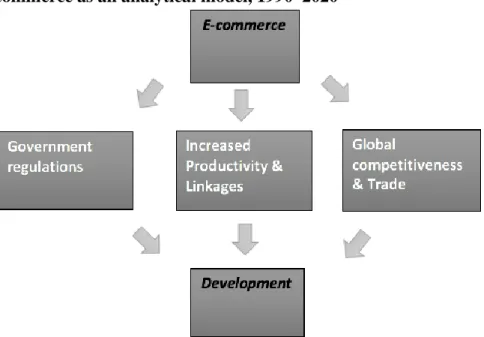
framework I have chosen to include the most relevant ones. Below is the e-commerce model which acts as the basis for the analytical framework.
Figure 3: E-commerce as an analytical model, 1990–2020
Sources: Riley (2018) and Lopez Gonzales & Ferencz (2018), adapted by researcher: Klara Lind (2020)
4.2.1 Increased productivity and Linkages
Increased productivity is an important driving force for increased living standards as it quantifies how an economy uses its available economic assets and resources. This can lead to improvements in various aspects of society, three of the major consequences include:
• Lower unit costs- A reduction of unit costs can generate lower prices for consumers, which encourages higher demand. Leading to more output as well as increasing employment.
• Increased competitiveness and trade- Along with lower unit costs, productivity growth lead to increased competitiveness for companies and countries in global trading
markets.
• Higher wages- Increased productivity leads to greater efficiency for workers, which creates an incentive for companies to afford higher wages for their workers (Riley, 2018).
EKHK18: 15 credit bachelor thesis Supervisor: Kamaruddin Abdulsomad Examiner: Prince Aboyage
Word count: 11 725
20 All these three aspects lead to economic development. However, there are some barriers for productivity, also known as productivity gaps. These include, lack of access to high
technological innovations, unskilled labour force, insufficient management and lack of competition within domestic markets (Riley, 2018).
E-commerce can improve all of the aforementioned aspects. Increased productivity by employing e-commerce instead for traditional commerce is achieved through various factors, the biggest one being reduction of unit costs such as transactions costs. As stated by
Globerman (2001), transaction costs are the costs entailed in the e-commerce process, often comprised of the following:
1. Search costs- the costs for businesses to search for market information on consumers, sellers, products and prices of products in order to adapt to the demand.
2. Contracting costs- includes the costs of developing and employing contracts between businesses or consumers.
3. Monitoring costs- the costs of monitoring the e-commerce market.
4. Adaptation costs- which are the costs associated with adapting the contracts over a period of time (Globerman, 2001, p. 13).
5. Shipping and handling costs- which deals with the delivery costs of goods (Kokemuller, 2020).
All these reductions of costs, enables the e-commerce to function at a lower cost, since the
same quantity of labor are able to be more productive (Woodruff, 2019). Furthermore, these reductions of costs have a large implication for other linkages to economic development. The reduction of information costs facilitates transactions within and across domestic borders. Ultimately, giving the opportunity for any given e-commerce business to expand their market area. Larger markets have an advantage in global trade, they are often regarded as more reliable and efficient due to their lower average costs (Prieger & Heil, 2009, pp. 3-4). The increased productivity along with the profit margins and increased competitiveness stimulated by e-commerce places a downward pressure on inflation (Chris G. Christopher, 2011). Inflation is the increase of goods and services on a long-term perspective. The increased competitiveness between companies has raised the consumer awareness of price
EKHK18: 15 credit bachelor thesis Supervisor: Kamaruddin Abdulsomad Examiner: Prince Aboyage
Word count: 11 725
21 and quality of different products, making it difficult for the producers to increase the prices. The effect will be a lower or no increase at all of the price, which leads to a lower inflation (Calson-Öhman, 2018, pp. 7-8).
However, this potential effect on inflation will only be sustained if the growth of e-commerce has stabilized throughout the markets, which can take a long time (ECB, 2015).
4.2.2 Global competitiveness and trade
E-commerce has an impact on competitiveness on both a micro and macroeconomic level. This study will focus on a macroeconomic perspective, hence the effect on global
competitiveness. Global competitiveness is a crucial element of economies and economic development (Schwab, 2019). The competitive pressure has increased due to e-commerce since it has created a new platform for selling services and goods where companies can compete. The countries that adopt e-commerce have an advantage over those who are stuck in the traditional way (Tang, et al., 2000). Furthermore, productivity growth and lower unit costs lead to increased competitiveness of companies in the global market (Riley, 2018).
4.2.3 Government regulations
In order to be included in the international trade market, countries need to look over their government regulations to ensure that they have government policies allowing for an e-commerce environment to exist. The government plays a decisive role for a country’s economic development, it is the largest powerhouse when it comes to e-commerce. Without the right cybersecurity laws and managerial skills, it is impossible for an e-commerce market to be put into place and be utilized (Lopez Gonzales & Ferencz, 2018). Consequently,
steering the country into a certain economic trajectory. It is crucial that the developing countries have a rigid development strategy to be able to manage the rapid swings that can result from an increasing e-commerce usage (Chris G. Christopher, 2011).
Therefore, the most important linkage between e-commerce and development is government regulations (Lopez Gonzales & Ferencz, 2018).
EKHK18: 15 credit bachelor thesis Supervisor: Kamaruddin Abdulsomad Examiner: Prince Aboyage
Word count: 11 725
22 4.3. Limitations of the analytical framework
The aim of this section is to provide transparency by listing the possible limitations of the analytical framework. A limitation due to the time constraint given, is that the analytical model does not consider all effects of both e-commerce and economic development. E-commerce has endless consequences for economic development, it has changed the entire world economy, naturally having a huge impact on countries’ economies on multiple levels (World Trade Organization, 2018, pp. 6-10). To overcome this bias, the aspects for the framework has been derived by collecting data from previous literature. General themes have been detected and used to build this model, the most frequently mentioned aspects of e-commerce and economic development in the literature has been employed.
Furthermore, the analytical framework can seem biased since it mainly brings up positive consequences. E-commerce does not only entail advantages for developing countries but also lead to negative effects for economic development. The aim of this paper is to see how the adoption of e-commerce can lead to economic development, hence emphasizing the positive effect for economic development. It is angled in order to fit the purpose of the research question. Therefore, the analytical framework fails at emphasizing the negative effects for economic growth as this opposes the focus. However, this is addressed in the analysis, where it will be made apparent that e-commerce does not only have a positive impact on economic development.
5. Methods and Data
In this section, I will explain and motivate the methods and data retained in my research. I begin with outlining the research design, followed by sections on data sources. Lastly, I point out the limitations of the methodology and any sources of bias found in the data.
5.1 Research Design
The research design of this study consists of a mixed-method case-study approach. By using a mixed method, it allows me to triangulate. Since it allows me to analyze, compare and
EKHK18: 15 credit bachelor thesis Supervisor: Kamaruddin Abdulsomad Examiner: Prince Aboyage
Word count: 11 725
23 integrate main findings from the qualitative data along with the statistics retrieved from the quantitative data in order to answer the research questions, capturing different dimensions of the topic (Creswell, 2014).
5.1.1 Case selection
The research consists of a case-study in order to provide an in- depth analysis of the
phenomenon of e-commerce in a real-life context (Crowe, et al., 2011, p. 1). Furthermore, the study conducts a case-study of the consumer goods sector in Vietnam. The consumer goods sector is chosen as it is the main sector within the Vietnamese e-commerce market (Kemp & Moey, 2019). There will be a minor comparative element to the case by applying ”the flying geese paradigm” where the situation in Vietnam is compared to the peer countries in the paradigm.
The case-study of Vietnam provides a backdrop to the findings found on the connection between e-commerce and economic development. The case study does not suffer from external validity since it is one of many cases in Southeast-Asia that has had a similar experience. Therefore, this is a representative case, it exemplifies a situation which could happen in other countries (Bryman, 2012, p. 70).
At the beginning of the research process, it was decided that Asia would be the area of choice. Asia creates an interesting paradox, partly consisting of countries thriving due to their
technology intensive structure whilst there are also countries characterized by weak states (Cockerham & Pang, 2017, p. 1).
Furthermore, I wanted to choose a case that regarded a developing country. The economic gap between developed countries and developing countries will increase if developing countries does not catch up shortly. Therefore, it is relevant to examine how e-commerce can help a developing country reach economic development (Bloomberg, 2018). After some research, one could conclude that Vietnam has had an outstanding growth during the last years and is seen as the most promising country within e-commerce, instinctively capturing my interest (Hoang Linh, 2020a). Therefore, the case of Vietnam was chosen.
EKHK18: 15 credit bachelor thesis Supervisor: Kamaruddin Abdulsomad Examiner: Prince Aboyage
Word count: 11 725
24 The ambition from the start was to cover the whole e-commerce market in Vietnam, however after a while, I realized that this was would be too excessive and time consuming. Therefore, I decided to choose a sector within the e-commerce market in Vietnam which would represent the whole market. Naturally, I chose the sector which is the most dominant and have the largest potential to continue expanding. Thus, the case study focuses on the online consumer goods market.
5.2 Data Collection
My case study of e-commerce in Vietnam is based on secondary data. The study is based on an analytical framework I developed which integrates factors of both qualitative as well as of quantitative nature. By combining the two methods, I believe that the qualitative data can validate any possible connections between indicators found in the quantitative part. The scope of the data collection is from 1990 and onwards, as the year of 1990 marks the beginning for the Internet which sparked the idea for an e-commerce market developing (Wikipedia, 2020b). However, as e-commerce entered Vietnam in late 1990’s (Wikipedia, 2019), most of the data is from the year 2000 and onwards, spanning around 20 years; two decades. Thus, encompassing the entire historic timeline of e-commerce in Vietnam.
5.2.1 Qualitative data
The primary research method for this case study is a qualitative research method, based on data collection from news articles, research reports, scientific articles, e-books along with other online literature.
The main research question opens up for both a qualitative and quantitative research method. Whilst the sub-question merely allows for a qualitative data approach. The sub-question seeks to understand the element of government regulations. To derive this information, data is gathered from various government publications, news articles and press releases.
EKHK18: 15 credit bachelor thesis Supervisor: Kamaruddin Abdulsomad Examiner: Prince Aboyage
Word count: 11 725
25 5.2.2 Quantitative data
This study also consists of a quantitative research method which will act as an overview. By employing a quantitative method, it allows me to gather statistical measurements to analyze the e-commerce market in Vietnam (Bryman, 2012, p. 160). In this case the aim is to examine the relationship between e-commerce and economic development in Vietnam. The quantitative data is collected from various data bases such as The World Bank, Statista and DataReportal. In order to achieve a better understanding of what factors are influencing this relationship, the quantitative data collection consists of several e-commerce indicators. The following section will include a brief explanation of the chosen variables.
5.2.2.1 Indicators
During this data collection there was a total of five different indicators which was taken into consideration. The different indicators were collected from different aspects of e-commerce, in order to ensure an as accurate research as possible. These were based on the relationship between e-commerce and economic development. The indicators can be divided into three main themes. Economic growth, Demographics and E-commerce. All indicators are interrelated in some way, therefore certain indicators overlap and can fit into multiple categories.
Figure 4: Indicators of e-commerce and economic development, 1990-2020
Sources: DataReportal (2019 & 2020), The World Bank (2019), Trading Economics (2020) and EVBN (2018)
The first category; economic growth includes only one indicator, as it has the most definite correlation to economic growth. The aim of this research is to look at economic growth and finally economic development. Therefore, Gross Domestic Product (GDP) is a given indicator
EKHK18: 15 credit bachelor thesis Supervisor: Kamaruddin Abdulsomad Examiner: Prince Aboyage
Word count: 11 725
26 to include in the study, since it is the most common way to measure a country’s economic growth. GDP calculates the sum of gross value by all producers in the country, excluding subsidies not counted into the value of the products. The data is counted in current US dollars, converted from local currency; Vietnamese dong, by using official exchange rates (The World Bank, 2019a).
This indicator will not be emphasized since it is difficult to isolate the factor of e-commerce from the data. It works as a comparative complement, in order to comprehend the growth of the consumer goods sector there will be a comparison to the country’s GDP growth. The data for this indicator is collected from The World Bank’s database and Trading Economics. The next theme is e-commerce with a focus on the consumer goods sector. Indicators are collected of the consumer goods sector as well as for the whole e-commerce market in Vietnam. The data consists of two parts; the growing trend of the consumer goods sector as well as the consumer patterns this entails.
The trend of internet usage will be analyzed. This indicator is relevant to use as without the Internet there is no e-commerce market (Wikipedia, 2020b). Therefore, it also determines the start year of the data collection. The aim of this indicator is to see the increase of internet usage in relation to the adoption of commerce, in order to get a grip of the growth of the e-commerce market since it emerged. The data for this indicator was collected form The World Bank’s database. It calculates the amount of people that has used the internet from any given device (The World Bank, 2019b).
A crucial part of this analysis is to see what type of devices the Vietnamese consumers use. This indicator examines the mobile traffic, it is used in order to gain an understanding of who benefits from the e-commerce market in Vietnam. The data is retrieved from DataReportal, and the statistics shows the mobile connections as a percentage of the total population (Kemp, 2020).
EKHK18: 15 credit bachelor thesis Supervisor: Kamaruddin Abdulsomad Examiner: Prince Aboyage
Word count: 11 725
27 The last category of indicators is demographics, which is used to analyze the consumer
patters. The demographics of a country can tell a lot about the health of the country, hence its economic development (Hayes, 2018).
The first indicator for this category is the total population of Vietnam. This variable is necessary to include in order to calculate what different indicators mean in proportion to the population. Therefore, this indicator is used to draw connections to the share of the
population. This data was retrieved from The World Bank. The total population is based on the total population of the country, including all residents regardless their citizenship (The World Bank, 2019c). However, the data from this source only reaches until 2018, data for later years was therefore complemented by DataReportal.
Lastly, the indicator of urbanization is included in this study. The aim of this indicator is to see the structure of Vietnam’s population as well as who benefits from the new market of e-commerce. The study will analyze the urbanization trend in relation to e-commerce and how this can affect the Vietnamese population. Furthermore, the study will look at the biggest consumer base and what class they belong to. The data was collected from multiple data bases; DataReportal and EVBN, a research report funded by the European Union.
5.3 Limitations of the methodology
This section will point out the possible limitations of the methodology and data used in this study. A general limitation for the quantitative part is that the indicators chosen may contain bias. It can be challenging to draw concrete conclusions from merely quantitative data since the indicators chosen can be affected by hidden factors, making it difficult to distinguish what is due to e-commerce and not. One has to be aware of that when finding a pattern between two variables it does not mean that there is a correlation between them since there could be other variables effecting it (Palacio, 2019). Therefore, I have chosen to include qualitative data to strengthen the possible connections found in the quantitative part.
Furthermore, a limitation is that the data used in this study is based on secondary data, meaning that the data collection is reliant on other sources. A limitation with the data derived
EKHK18: 15 credit bachelor thesis Supervisor: Kamaruddin Abdulsomad Examiner: Prince Aboyage
Word count: 11 725
28 from the qualitative data collection is that there is an evident language barrier, therefore the data on government regulations and laws is collected from sources translated in English. Resulting in a dependency bias.
5.3.1 Source criticism of data
There are many different aspects one can take into account while conducting source criticism, this study will be based on the following source criticism template:
• Accuracy and area of coverage- deals with questions regarding the reliability and relevance of the source. To what extent is the source accurate? How relevant is the source for the topic being researched? How large area does the source cover? Does the source have dependency?
• Authority- Who is the author and/or publisher behind the information, is it a trustworthy person?
• Objectivity- Is the information portrayed in an objective matter?
• Currency- Is the information from the source close to the event being researched? (Lund University, 2020).
I have used many sources throughout this study, however, there is one source that has been more meaningful for this study than the rest; DataReportal. The study is mainly based on the reports provided by DataReportal. This source has provided me with almost all statistics and indicators used for the quantitative data as well as some data for the qualitative part.
Therefore, it is relevant to question its credibility, by answering the different questions posed in the aforementioned source criticism template.
Firstly, regarding accuracy and topic coverage, DataReportal contains reports on the e-commerce market and internet usage for different countries worldwide. As my topic is focusing on Vietnam, I only used the material on Vietnam. The website provides reports covering the e-commerce market of Vietnam from the years 2011-2020. The report is very relevant as it is covering the exact topic for this study, without any excessive information. Another aspect of accuracy is concerning references, whether the source is citing other sources or is independent. One may question the credibility of the source in this aspect, since
EKHK18: 15 credit bachelor thesis Supervisor: Kamaruddin Abdulsomad Examiner: Prince Aboyage
Word count: 11 725
29 it is not independent, it has gathered its data from various databases such as: Global Web Index, Statista, GSMA Intelligence and App Annie etc. On one hand, this makes it less credible since it creates dependency, however, on the other hand the sources used by the website are credible as they have the same purpose as DataReportal which is to provide with real statistics and data.
The authority and objectivity aspect relate to the former, the source is published by an author, but the website belongs to an organization. Quantitative sources are usually seen as more objective than qualitative sources. DataReportal achieves objectivity through providing real statistics that is backed up by various sources with the same statistics. Since the source covers many countries, it is more likely to have an objective role and does not provide with
misleading information in order to portray Vietnam in a certain way.
Lastly, regarding currency the source is up to date since it provides data for current days. I mostly used data for 2018 to 2020 from this website, which makes it credible since it is close to the event.
For remaining sources, a general source criticism can be conducted. I have tried to examine the credibility of a source to the possible extent before using it for the study. When doing this I have taken certain aspects into consideration; the date it was written/published, if the
website is well-known and who has written the piece. Sources without these aspects has been disregarded to a large extent. Having an author representing the text comforts me as a
researcher since it means that the author can stand behind the information and/or data given. The date of the source gives credibility since it hints if its close in time to the event being researched. Lastly, a well-known website is often regarded as trustworthy, having a large reader scale.
6. Analysis/Discussion
In this section, I analyze and apply my analytical framework and relate to the previous literature in order to answer my research question and sub question. I will start off the analysis with providing some historic background on the rise of e-commerce in Vietnam and
EKHK18: 15 credit bachelor thesis Supervisor: Kamaruddin Abdulsomad Examiner: Prince Aboyage
Word count: 11 725
30 in general. I will continue the analysis with providing some general information and statistics on the trend of the consumer goods sector and what this mean for increased productivity and linkages. The analysis will continue with examining the consumer patterns brought by the transition towards an e-commerce market instead of a traditional commerce market, as well as analyze who benefits from this change. Following this I will analyze global competitiveness and trade; if Vietnam is currently up to speed in this aspect and whether e-commerce facilitate achieving global integrations. After this I will answer my sub question, the main research question and sub-question goes hand in hand which is why they will overlap to some extent. Government regulations are an important part of e-commerce and economic promotion of a country. Therefore, the analysis finishes off by discussing the role of the Vietnamese government in the development of their e-commerce market.
To recapitulate, the study aims at exploring if the effects from the shift towards an e-commerce trading market can lead to economic development by answering the following questions:
- How can the transition from a traditional commerce market to an e-commerce market promote economic development in Vietnam?
To answer this overarching question, I will apply the sector of online consumer goods to the analytical framework. By looking at the progression of this sector and what economic consequences this has entailed, I will be able to draw predictions on the effect e-commerce will have on economic development in Vietnam for the future.
- What has the government in Vietnam done so far in order to promote e-commerce?
To examine this sub-question, I will look at what laws and policies the Vietnamese government has implemented in order to stimulate economic development through emphasizing e-commerce.
EKHK18: 15 credit bachelor thesis Supervisor: Kamaruddin Abdulsomad Examiner: Prince Aboyage
Word count: 11 725
31 6.1 The rise of e-commerce in Vietnam
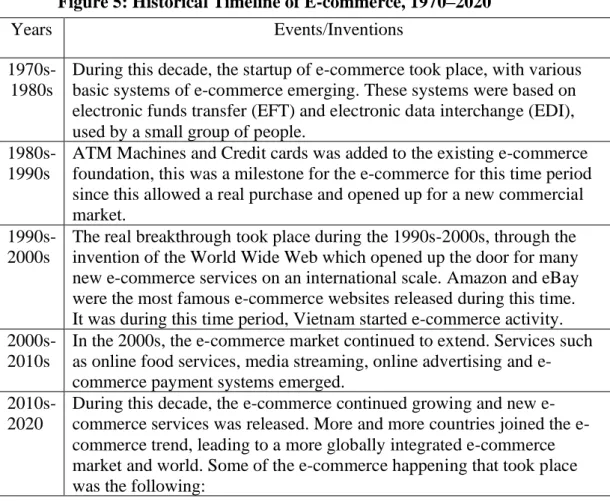
Since the introduction of the Internet a lot of inventions has taken place, which have resulted in an e-commerce market, see figure 5 (Wikipedia 2020b; Hoang Linh 2020). The arrival of the Internet in Vietnam can be traced back to 1997. Even though e-commerce became
globally popular during the 1990’s it still did not experience a breakthrough in Vietnam until 2000, due to their government regulations creating a restriction for e-commerce usage (Wikipedia, 2019). However, the year of 2000 marked a new phase for Vietnams IT sector, a new regulation came into force, allowing for an e-commerce market to emerge (USA
International Publications, 2008). Between the years of 2001 and 2005, an e-commerce market was established in Vietnam (Sriratanaviriyakul, et al., 2013). This is strengthened by looking at figure 6 (The World Bank, 2019b), where one can see that between the years 2000-2005, Vietnam experienced a sudden increase in internet usage. In 2020, 37% of the
Vietnamese population used e-commerce, nevertheless, this number is expected to increase greatly in the next coming years (Statista, 2020).
Figure 5: Historical Timeline of E-commerce, 1970–2020
Years Events/Inventions
1970s-1980s
During this decade, the startup of e-commerce took place, with various basic systems of e-commerce emerging. These systems were based on electronic funds transfer (EFT) and electronic data interchange (EDI), used by a small group of people.
1980s-1990s
ATM Machines and Credit cards was added to the existing e-commerce foundation, this was a milestone for the e-commerce for this time period since this allowed a real purchase and opened up for a new commercial market.
1990s-2000s
The real breakthrough took place during the 1990s-2000s, through the invention of the World Wide Web which opened up the door for many new e-commerce services on an international scale. Amazon and eBay were the most famous e-commerce websites released during this time. It was during this time period, Vietnam started e-commerce activity.
2000s-2010s
In the 2000s, the e-commerce market continued to extend. Services such as online food services, media streaming, online advertising and e-commerce payment systems emerged.
2010s-2020
During this decade, the commerce continued growing and new commerce services was released. More and more countries joined the e-commerce trend, leading to a more globally integrated e-e-commerce market and world. Some of the e-commerce happening that took place was the following:
EKHK18: 15 credit bachelor thesis Supervisor: Kamaruddin Abdulsomad Examiner: Prince Aboyage
Word count: 11 725
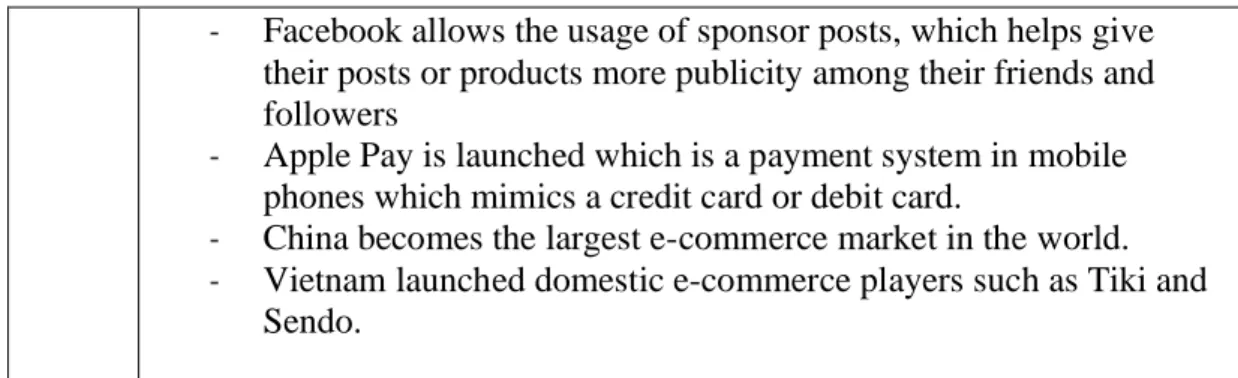
32 - Facebook allows the usage of sponsor posts, which helps give
their posts or products more publicity among their friends and followers
- Apple Pay is launched which is a payment system in mobile phones which mimics a credit card or debit card.
- China becomes the largest e-commerce market in the world. - Vietnam launched domestic e-commerce players such as Tiki and
Sendo.
Sources: Wikipedia (2020b) and Hoang Linh (2020b)
The ASEAN countries has recently taken the lead for highest mobile penetration for internet usage in the world, leading to the countries internet economy continuing to exceed all growth expectations. In comparison to already developed countries where in the beginning of the Internet’s arrival the majority of the people used computers to gain online access. More than 90% of the population in Southeast Asia enters the Internet through their mobile devices. This shows that developing countries can catch up developed countries by imitating the
e-commerce structure already implemented in these areas and leapfrog directly to the next step in the e-commerce process. This rise of e-commerce in ASEAN can spur a more even
distribution of economic benefits (Nguyen, 2019).
Figure 6: People using the internet (% of total population), ASEAN countries, 1990-2019
EKHK18: 15 credit bachelor thesis Supervisor: Kamaruddin Abdulsomad Examiner: Prince Aboyage
Word count: 11 725
33 The graph above shows the ASEAN competitors, Vietnam lags behind Singapore and
Malaysia. However, Vietnam is on the rise, the e-commerce market in Vietnam is still at an early stage but shows a promising potential (Asean Up, 2019). During the past few years, Vietnam has experienced a large e-commerce growth (Hoang Linh, 2020b). In 2016 the internet usage in Vietnam exceeded 50% of the population. Simultaneously the adoption of smart phones in Vietnam largely increased, accounting for 72% in the urban areas and 53% in rural areas. Leading to Vietnam having one of the fastest growing smartphone adoptions for ASEAN countries (Investique Consulting, 2018). It is considered by many, the most
promising country to have a dynamic e-commerce market. Consequently, providing new business opportunities and attracting foreign direct investments (FDI) (Hoang Linh, 2020b). Therefore, it is relevant to analyze the case of Vietnam, to see how the development of e-commerce will evolve.
6.2 Consumer goods sector
As mentioned in the background, the new trading market; e-commerce is a huge market, consisting of many different submarkets and sectors. This paper looks at the B2C market, after some research, one can conclude that the most dominant sector in the business-to-consumer e-commerce market in Vietnam is the business-to-consumer goods sector. Naturally, making it the most relevant sector to analyze (Kemp & Moey, 2019). This is a representative case, by applying the consumer goods sector to the analytical framework one can see how e-commerce can have an impact on economic growth and finally on economic development. By looking at the direction of the trend.
EKHK18: 15 credit bachelor thesis Supervisor: Kamaruddin Abdulsomad Examiner: Prince Aboyage
Word count: 11 725
34 Figure 7: Population of Vietnam (in millions), 1990–2020
Sources: The World Bank (2019c) and DataReportal (2020)
In 2018, approximately 50 million people bought consumer goods online. In 2018, the population in Vietnam was 95 595 540, looking at figure 7 (The World Bank, 2019c; DataReportal, 2020), this means that 52% of the population bought consumer goods online. Out of the 59 million Vietnamese internet users, 85% of them bought consumer goods. This is a without a doubt a large portion of the population, indicating that e-commerce is available to the majority of the population in Vietnam (Kemp & Moey, 2019).
The overall steady economic growth and increased income experienced in Vietnam, has spurred the population to consume more goods. Driving the consumer goods sector to grow both online and in the traditional sense (Mirae Asset Lens, 2019). The consumer goods sector saw a strong growth in purchases online, with the value of purchases increasing by around 30 percent in 2018 compared to 2017. In 2018, the consumer goods sector generated 38% of the country’s e-commerce value; accumulating more than 2.2 billion USD. This trend strongly indicates that it is an increasing market. A rise in this sector may kickstart the increase of other sectors (Kemp & Moey, 2019).
An obstacle of the e-commerce market in Vietnam is the lack of trust between consumers and companies, due to the lacking experience many Vietnamese have with the concept of e-commerce. However, seeing an increase in one sector may lead to an increase of e-commerce
0 20 40 60 80 100 120 1990 1995 2000 2005 2010 2015 2020
EKHK18: 15 credit bachelor thesis Supervisor: Kamaruddin Abdulsomad Examiner: Prince Aboyage
Word count: 11 725
35 usage across all categories since shoppers are become increasingly familiar with online shopping and gains trust in the forum, making them feel safer to use it (Barbour-Lacey & Zaca, 2014).
All of these findings indicate that there is a growing interest in using e-commerce as a new market forum. However, it is still at an early stage, the interest has not been converted into substantial sales value yet (Kemp & Moey, 2019).
6.2.1 Increased productivity
This growing trend may accumulate increased productivity along with other linkages. The consumer goods sector can pave the way to an expanded and developed e-commerce market in Vietnam. A country like Vietnam, would benefit from encouraging growth in sectors that are already expanding quickly such as the consumer goods sector. By expanding their e-commerce market, the country will experience an increased productivity. As it would enable them to meet the domestic demands and therefore shift focus to increase exports (McKinsey & Company, 2012, pp. 5-6). Furthermore, it will lead to reduction in transaction costs which can promote the increase of division of labor and economical structural changes (Wen, 2004, p. 187).
In the analytical framework, one of the key elements is increased productivity. It has a direct effect on economic development. E-commerce leads to increased productivity as it heavily reduces various costs such as transactions costs (Woodruff, 2019). Vietnam is
struggling to some extent in this regard. Logistics costs are high in Vietnam; it is estimated to take 30 % of the revenue for e-companies companies in Vietnam. This is due to the
EKHK18: 15 credit bachelor thesis Supervisor: Kamaruddin Abdulsomad Examiner: Prince Aboyage
Word count: 11 725
36 Figure 8: Online Purchases of Consumer Goods in Vietnam, 2019
Source: DataReportal (2019)
As seen in the graph above the share of the online consumer goods sector to the country’s GDP is only 2,1%. This is not a large portion of the country’s economic assets. However, this will have an impact on Vietnam’s economic development in the long run. Looking at the positive trend of the market, the portion of online goods consumer to the country’s GDP will have a larger effect in the coming years (Kemp & Moey, 2019).
The mobile economy of Vietnam accounted for 21 billion USD in 2018, which corresponds to 8,8% of the country’s GDP. This number is expected to have a large increase by the year 2023 where the mobile economy will contribute with 29 billion USD (GSMA, 2019).
Figure 9: Vietnam's GDP (in USD billions), 1990–2019
Sources: The World Bank (2019b), Trading Economics (2020)
6.472 20.736 31.173 57.633 115.932 193.241 255 0 50 100 150 200 250 300 1990 1995 2000 2005 2010 2015 2019
EKHK18: 15 credit bachelor thesis Supervisor: Kamaruddin Abdulsomad Examiner: Prince Aboyage
Word count: 11 725
37 6.3 Consumer patterns
In order to draw predictions on how e-commerce can promote economic development it is relevant to analyze the change of consumer patterns brought by the shift towards an
e-commerce market from a traditional market. The aim of this sub-section is to understand who benefits from the e-commerce market. For a sustained economic development, it underpins that everyone in society should be a part of the development, in order to not further increase inequalities of income and wealth and social divisions (McKeever, 2017).
6.3.1 Who benefits?
Vietnam is currently undergoing a rapid demographic change. The current population on 97 million is expected to increase to 120 million by the year 2050. Out of these 97 million, 70% of the population are under 35 years resulting in a median age on 32,5 years (The World Bank 2020; Worldometer 2020). By looking at the report from DataReportal, there is a striking majority of the Vietnamese population that takes part in this market. The largest consumer base of Vietnam consists of the young middle class (Kemp & Moey, 2019).
In 2017, the consumers under the age of 35 years accounted for approximately 73% of the consumer base. Out of these 73%, millennials represent 30% and are currently the largest group of online shoppers in Vietnam. This young group is known for their willingness to pay more for goods. Furthermore, they are expected to boost the economy through e-commerce. This generation are used to online activities and are used to a world consisting the Internet. Indicating that there will be an increased economic development on a long-term perspective (Hoang Linh, 2020b).
Looking at the structure of the chosen e-commerce sector and the market as a whole, one can conclude, that there is currently a lack of accessibility to everyone of society. The data shows that the e-commerce market is dominant in supplying the middle class with consumer goods. On the upside, Vietnam has a fast-growing middle class, with cities expanding at a rapid pace (Breu, et al., 2010). In comparison to the rest of the South-east Asian countries, Vietnam has witnessed the fastest-growing middle class during the last years. By the year 2026, it is