FISCAL FORECAST ERRORS:
GOVERNMENTS VS INDEPENDENT
AGENCIES?
Rossana Merola and Javier J. Pérez
Documentos de Trabajo
N.º 1233
FISCAL FORECAST ERRORS: GOVERNMENTS VS INDEPENDENT AGENCIES?
(*) The views expressed in this paper are the authors’ and do not necessarily reflect those of the Banco de España, the Eurosystem or the OECD. Merola contributed to this paper mainly while she was a European Central Bank staff member. We thank Marta Botella and Laura Fernández-Caballero for excellent research assistance. We also thank participants at the International Symposium on Forecasting (San Diego), the ESCB-Working Group on Public Finance meeting (Cyprus), the Banco de España seminar, the CESiFO Workshop on Political Economy (Dresden), the European Commission, the Workshop on International Economics (Granada) and the Economod2012 Conference (Seville), in particular Michael Berlemann, Enrique Moral, Lucio Pench, Jan-Christoph Rülke, and Ernesto Villanueva, for helpful comments. Correspondence to: Javier J. Pérez ([email protected]), Servicio de Estudios, Banco de España, c/ Alcalá 48, 28014 Madrid, Spain.
Rossana Merola
OECD
Javier J. Pérez
BANCO DE ESPAÑA
FISCAL FORECAST ERRORS: GOVERNMENTS
The Working Paper Series seeks to disseminate original research in economics and fi nance. All papers have been anonymously refereed. By publishing these papers, the Banco de España aims to contribute to economic analysis and, in particular, to knowledge of the Spanish economy and its international environment.
The opinions and analyses in the Working Paper Series are the responsibility of the authors and, therefore, do not necessarily coincide with those of the Banco de España or the Eurosystem.
The Banco de España disseminates its main reports and most of its publications via the INTERNET at the following website: http://www.bde.es.
Reproduction for educational and non-commercial purposes is permitted provided that the source is acknowledged.
Abstract
The fact that the literature tends to fi nd optimistic biases in national fi scal projections has led to a growing recognition in the academic and policy arenas of the need for independent forecasts in the fi scal domain, prepared by independent agencies, such as the European Commission in the case of Europe. Against this background the aim of this paper is to test: (i) whether the forecasting performance of governments is indeed worse than that of international organizations, and (ii) whether fi scal projections prepared by international organizations are free from political economy distortions. The answer to these both questions is no: our results, based on real-time data for 15 European countries over the period 1999-2007, point to the rejection of the two hypotheses under scrutiny. We motivate the empirical analysis on the basis of a model in which an independent agency tries to minimize the distance to the government forecast. Starting from the assumption that the government’s information set includes private information not available to outside forecasters, we show how such a framework can help in understanding the observed empirical evidence.
Keywords: forecast errors, fi scal policies, fi scal forecasting, political economy.
Resumen
Las previsiones presupuestarias que preparan las autoridades nacionales tienden a presentar, en promedio, una visión optimista de la senda futura de las fi nanzas públicas. Este hecho ha sido probado en numerosos trabajos; en particular, en el caso de Europa, en la última década. Por ello, se escuchan voces que piden que otras instituciones, independientes de los Gobiernos nacionales, asuman un papel más relevante en el proceso de planifi cación presupuestaria. En particular, en el caso de Europa, se menciona a la Comisión Europea. En este marco, el objetivo del presente documento es contrastar dos cuestiones muy concretas con respecto a las previsiones presupuestarias preparadas por las instituciones internacionales: i) ¿es la exactitud de dichas proyecciones mucho mejor que la de las preparadas por las autoridades nacionales?, y ii) ¿están libres dichas previsiones de distorsiones derivadas de factores tales como los ciclos electorales? Nuestros resultados, basados en una muestra de datos (previsiones) obtenidos de informes publicados en tiempo real para 15 países europeos en el período 1999-2007, señalan que la respuesta a las dos preguntas es negativa. Además de la evidencia empírica, en el documento se desarrolla un modelo teórico muy estilizado con el que se proporciona una posible explicación de los resultados empíricos. Dicha explicación se basa en la idea de que las autoridades nacionales disponen de más información que los analistas externos en todas las etapas de elaboración y seguimiento de los planes presupuestarios. Así pues, la institución independiente, al tratar de aproximarse lo más posible a la previsión del Gobierno (para reducir el défi cit de acceso a la información), puede acabar incorporando en su propia previsión parte del sesgo político habitual en las proyecciones ofi ciales.
Palabras clave: errores de previsión, política fi scal, predicción presupuestaria, economía política.
1
Introduction
Should the role of preparing budgetary projections be delegated to an independent agency? This debate has been recently spurred in Europe by many voices, given the high public deficit and debt levels currently held by many European Union (EU) countries. In fact, planned government deficits turned out to exceed recurrently budgetary plans by a significant magnitude in recent years. For example, as late as October 2008 the public deficits estimated for 2008 by many European governments missed by some 2 percentage points of GDP the afterwards released figures for 2008. A similar situation occurred in 2009, 2010 and 2011, leading many countries to register record high government deficits. Explanatory factors for this misalignments include large GDP shocks and fiscal stimulus packages adopted on the run, but beyond this, also lack of both transparency and a realistic account of facts. As short-run budgetary targets were missed by far, medium run plans were revised quickly and resulted in a fast decline of the credibility of Europe’s fiscal framework, namely the Stability and Growth Pact (SGP). As a consequence, right now, many European countries are embarking in widespread medium-term fiscal consolidation packages, that require adherence to strict budgetary targets for long periods of time. In parallel, there is an ongoing policy debate on the need to strengthen economic governance in the EU that has already been materialized in a number of reform proposals.1
The recent deterioration of public deficits and the lack of accuracy of fiscal projections are not issues confined to the current juncture or only to EU countries’ governments. Indeed, a great deal of the literature has analyzed in the recent past the potential bias the political and institutional process might have on government revenue and spending forecasts,2 and
the nature and properties of forecast errors within national states.3 For the case of EU
governments, this literature tends to find evidence in favor of the existence of systematic
po-1On the importance of the design of fiscal rules and forms of governance in EU countries see
Hallerberg et al. (2007). For the discussion on EU’s fiscal framework weaknesses and needs for re-form see, for example, Larch, van den Noord and Jonung (2010). For the most recent approved and ongoing reforms and/or agreements, see EC’s webpage dedicated to EU economic governance (“http://ec.europa.eu/economy finance/economic governance/index en.htm”).
2See for example Br¨uck and Stephan (2006), Jonung and Larch (2006), Pina and Venes (2011), Boylan
(2008), Beetsma et al. (2009), or von Hagen (2010), and the references quoted therein.
litical and institutional biases in revenue forecasting, while the evidence for the US is mixed, depending on the institutional coverage of the analysis (Federal government or States).4
One particular aspect under evaluation in the policy fora linked to the previous discussion is the proposal to introduce independent forecasts in the fiscal domain (Debrun et al. 2009; Leeper 2009; Wyplosz 2008; Jonung and Larch 2006; European Commission 2006) prepared by independent agencies. These independent agencies could be for example national councils or intergovernmental agencies. As regards the latter option, in the case of EU countries, some authors have advocated that the European Commission (EC) should have some role as the “independent agency” preparing budgetary and/or macroeconomic projections, given that fiscal forecasts by national authorities are scrutinized by the EC in application of EU’s fiscal rules framework (the SGP)5.
Against this framework, in order to be in a position to judge the appropriateness of such proposals, the relevant question to answer would be: has the track record of international agencies’ forecasts been better than the one of national governments? In this particular respect the literature is almost silent. There are almost no studies that compare the accu-racy of government forecasts and fiscal forecast error’s determinants with those produced by international organizations for a given country. The fact that some international organiza-tions like the EC, the OECD or the IMF do publish fiscal forecasts and have been doing so for long periods of time provides a natural laboratory to analyze their track record against that of national governments. From a theoretical point of view, once accounting for errors in macroeconomic forecasts, independent agencies’ fiscal forecasts should not be expected to display the biases typically found in government’s fiscal projections. Nevertheless, one may also claim that information matters when preparing budgetary projections, and as a
4As Auerbach (1999) argues, if the costs of forecast errors were symmetric (i.e. if positive errors were as
bad as negative errors), the forecasts should present no systematic bias (i.e. on average the forecast error should not differ significantly from zero). There are, however, reasons to presume that the loss function of governments may not be symmetric. Thus a kind of bias in fiscal forecasts could be optimal. For instance, a government would tend to favor a deficit when the loss of an underestimation is greater (for example, a conservative, stability oriented government, see Bretschneider et al. 1989). Public authorities may have an interest in presenting a pessimistic forecast to build in a safety margin that would allow them to meet budgetary targets, also in case of revenue or expenditure slippages. The literature in question finds mixed evidence for political economy-based explanations of this sort. See Leal et al. (2008) for a broad survey of the issues discussed here.
consequence outside forecasts (from independent organizations) could turn out to be less accurate than inside forecasts (from staff of the relevant organizations, like for example the Ministry of Finance or the Treasury), as found by Grizzle and Klay (1994) for the US states. In our paper we provide homogeneous and comprehensive empirical evidence pointing to the fact that international agencies’ track record of budgetary forecasts for EU countries do present bias and correlation with electoral cycles. To unveil those results, we use a common methodology (same econometric method, same empirical specification) to look at alternative datasets, over the same sample period. We build up a large real-time dataset covering fiscal forecasts: (i) that are prepared by national governments (GOV), the EC and the OECD; (ii) for 15 European countries; (iii) for two forecast origins per year, spring and autumn of each year; (iv) for two forecast horizons (current year and one year ahead). We focus on the sample 1999-2007 to eliminate three potential sources of distortions: (i) the changes in statistical standards that did occur in the preceding period (ESA79-ESA95 changeover); (ii) the EMU convergence process; (iii) the great recession that started in 2008. Thus, we analyze a period with a common monetary policy regime (Eurosystem), and a common fiscal policy regime (SGP).
We try to illustrate the empirical analysis in the framework of a model in which the independent (international) agency tries to minimize the distance to government forecasts. We exploit the idea that government’s information set includes private information (better access to the relevant data, information on policy measures, etc) not available to outside forecasters (like the EC). When preparing their fiscal projections, EC staff tries to grasp as much private information as possible from government’s, while at the same time face a “signal extraction problem” when trying to disentangle “political biases” from genuine “private information”.
The rest of the paper is organized as follows. In Section 2 we present some political economy arguments to frame the subsequent empirical analysis, pose the hypotheses to be tested, and discuss the related literature. Then, in Section 3, we describe the data and variables used in the empirical analysis. This is done in Section 4, where we discuss the empirical methodology and the main results. Finally, in Section 5 we present some conclusions.
2
Some political economy considerations
2.1
Political economy arguments and literature review
Why could fiscal forecasts prepared by governmental agencies differ from those of inter-national organizations? First, fiscal forecasts can display differences because governments usually have access to more information than outside forecasters. For example, govern-ments have advanced information on short-term tax developgovern-ments, the design and impact of planned tax measures or information on the implementation of spending plans. Indeed, in many cases some levels of government for which few published short-term fiscal information is available to outsiders within a reasonable time lag, like regional and local governments, do account for a substantial share of general government spending.
Second, the methods used by government officials and independent agencies’ Staff for revenue and spending estimation and forecasting, can be different. Government forecasts are prepared for all budgetary items and thus the approach typically followed is a bottom-up one, with an extremely high level of disaggregation, while fiscal forecasts by international organizations are prepared for fewer, more aggregated budgetary items (see Leal et al. 2008). At the same time, it is typically the case that the forecasting methods used by international agencies to forecast those more aggregated items tend to be more sophisticated.
Third, governments can influence forecasts prepared by international organizations, as national countries are shareholders of these organizations and thus have the possibility to know those forecasts in advance and discuss them with the Staff of the relevant organization; for example, IMF Article IV reports (country reviews) acknowledge the discussions with government officials and signal discrepancies in assessment.6
Finally, given the latter point, the fact that governments do have access to private infor-mation, and given also that international organizations tend to be shorter of specialized Staff than national organizations, intergovernmental agencies’ reports usually have to broadly ex-plain the reasons for any departure from national government’s forecasts. Along these lines,
6Artis and Marcellino (2001) argue that the OECD is freer from the political pressures of EU governments
than the EC. Poplawski-Ribeiro and R¨ulke (2010), though, do not find the data supporting the latter hypothesis. Christodoulakis and Mamatzakis (2009) note that even though year-ahead government balance forecasts are symmetric for most EU-15 countries, there seemed to be some leeway against breaching the 3% threshold value, especially for higher debt countries.
one could also argue that international organizations do not have the resources to make their own forecasts for each individual member state and, therefore, must rely heavily on the information conveyed to them by the member states.7
The evidence on the track record of international organizations as regards fiscal pro-jections is scarce, and mainly descriptive.8 This should be clear when inspecting Table 1,
where we list the main papers dealing with the analysis of government balance’s forecast errors in Europe. Most papers analyze budgetary forecasts prepared by the governments and typically try to explain fiscal forecast errors (or only forecasts) by means of explana-tory variables labeled as economic (like actual/forecast GDP growth or the output gap) and political/institutional (like election year or fiscal governance structure). These papers typ-ically focus on one vintage of projections.9 The papers that analyze projections prepared by international organizations tend to look at the properties of the whole vintage of fore-casts errors10 but following a descriptive approach (i.e. size and sign of errors, presence of
biases, rationality), and do not provide comparisons with budgetary forecasts prepared by the national governments.
2.2
A stylized model to frame the discussion
With all these considerations in mind, it is fair to conceive the preparation of fiscal forecasts by independent agencies, from a conceptual point of view, as an exercise that tries to min-imize a certain loss function of the distance to government’s projections. Auerbach (1999) develops a model for a different problem than ours, whose main elements can be adapted in such a way that it is suitable for the discussion of the issues at hand here. Let Ω be the information set commonly observed by all fiscal forecasters, be them government officials or
7This argument is taken from von Hagen (2010), that applies it to fiscal forecasts prepared by the
European Commission.
8As regards their GDP and inflation forecasts track records, these seem to have been reasonable in terms
of size and directional accuracy, as can be inferred from Marinheiro (2010), Dreher et al. (2008), Melender et al. (2007), Aldenhoff (2007), Timmermann (2007), Artis and Marcellino (1998, 2001), Pons (2000) or Keereman (1999). Nevertheless, some works point to a worse accuracy record than that of private sector analysts (see Batchelor, 2001, Blix et al., 2001, or Poplawski-Ribeiro and R¨ulke, 2010). Also, Aldenhoff (2007) reveals significant correlation with election dates in the case of IMF GDP forecasts for the US.
9By a vintage of projection we mean a forecast prepared at a given point in time for a given forecast
horizon like, for example, forecasts published in Autumn of year t for year t+1.
10Typically forecasts are published in Spring and Autumn of each year and provide projections for the
international agencies’ Staff. Let x be the variable to be forecast, say government budget balance, revenue or expenditure. Then, the best prediction that could be done on the basis of Ω using a commonly understood forecast methodology would be:
¯
xΩ =E(x|Ω) (1)
where E(x|Ω) denotes the conditional expectation of x given the information set Ω. Now, let Π be the information set comprising some private information known only by the government, where Ω⊂Π. The best forecast prepared by the government would then be:
¯
xΠ =E(x|Π) (2)
while the associated forecast error would bex−x¯Π =ε, where εis a stochastic, possibly
zero mean, error. If Π were the true information set,εwould have zero mean. Given that the international agency (call it EC) only has partial access to government’s private information, its forecast error would be such that x−x¯Ω =ν+ε, whereν is orthogonal toεand it denotes
the additional error that the EC would commit because of its lack of access to government’s private information set.11
The government has two options. First, it can prepare the best possible forecast given its information set, ¯xΠ, as in (2), in which case it would minimize a loss function of the
sort Λ1= E[¯xΠ−x|Π]2. Nevertheless, as signalled by the literature on politically-motivated
fiscal forecast biases, the government has a second option. It can aim at minimizing a loss function of this sort: Λ2 = E[(¯xΠ−x−θ)|Π]2, whereθ is a bias included in the forecasting
process for political reasons. In this case, the best (constrained) forecast prepared by the government would be ¯xθ
Π = ¯xΠ+θ so that the associated forecast error would be:
x−x¯θΠ= ε+θ (3)
where θ is a negative parameter if xdoes refer to the government balance.
The independent agency, in turn, has also two options. First, it can prepare a fully independent forecast that can be compared ex-post with government’s forecast. In this case,
11Under the assumption that the technical forecast errorεis the same for the two institutions. In practice,
two different ε-type error could be considered, due to differences in forecasting methods. This is immaterial for the discussion at hand and thus it is left aside at this point.
though, the independent agency would loose any access to government’s private information. Then, the second option would be to try to minimize the distance to the forecast of the government, so that the error termνis minimized; in actual situations, the second alternative tends to be the preferred one, not only because of the existence of private information on the side of governments, but also due to institutional and policy constraints, as discussed above. Thus, in this latter case the independent agency when minimizing its loss function (distance to government’s forecast) knows that its forecast error would be:
x−x¯Ω =ν +θ+ε (4)
and as a consequence knows that it has to disentangle the contribution of each of the three components of the error term: (i) ε, the technical error (model error); (ii) θ, the political– bias–induced error; (iii) ν, the part of the overall error due to access to limited information. Thus, the cost for the EC of trying grasp as much private information as possible – aiming at reducing the termν – is that it will inherit to some extent government’s political–bias,θ. In the latter respect, one particular device to ex-ante reduce the size of θ would be the following. Suppose that the EC were in a position to impose sanctions on the government depending on how far their fiscal forecasts had been from the final outcome. In this case, it could influence the extent to which the government bases its forecast on Ω rather that Π. This can be done by imposing a penalty on the government if it deviates from a forecast based on the common information set, ¯xΩ. This idea is developed in Appendix A, where we
show how the EC could choose the value of the relative penalty that minimizes its expected loss function in order to force the government to use its superior information. In general, nonetheless, the EC will try to minimize the distance to biased government projections, by minimizing a loss function of the kind LEC = E[(x− {x¯
Π+θ})| Ω]2. Thus, the EC knows
that it will incur in an error given by (4).
In order to separate, ex-post, the different sources of error, the EC has to form beliefs about θ, ν, and ε. In this respect, the EC knows that, in general, (x−x¯Ω) would be a
function of the errors, call it Φ(θ, ν, ε). In order to isolate ν (good) from θ (bad) from (technical) it has to form a belief on the form of Φ(θ, ν, ε). For example, Φ(θ, ν, ε) can adopt the form of a linear projection on a constant and a function of some of the likely fundamentals
of the political bias, like Φ(θ, ν, )≈c(ν, θ) + Θ(s, ELEC) +ξ, wheresis a variable linked to the state of the business cycle andELEC a variable that captures the electoral cycle, and ξ is a normally distributed zero-mean random disturbance term. The constant c would proxy the systematic part of the information bias, but also part of the political bias,12 while the
function Θ(s, ELEC) would proxy the part of the political bias determined by fundamentals. From the empirical point of view the EC could run a standard linear regression on the series of its forecast errors (as it is customary in the extant literature):
x−x¯Ω=δ0+δ1 ELEC+δ2 s+ξ (5)
where time subindexes have been dropped for simplicity and s could be proxied by the forecast errors committed by the EC when forecasting real GDP. In this way, it will get estimates of the coefficients in the regression: ˆδ0, ˆδ1 and ˆδ3. Even if the constant, ˆδ0, can
be partly interpreted as reflecting the lack-of-access-to-the-private-information-bias, it will also reflect part of the political bias if we assume that the EC is minimizing the distance to government’s projections; if EC forecasts were produced independently, the constant would just capture the first factor. Now, it is feasible within our framework that ˆδ1 turns
out to be statistically different from zero, given that it would capture also part of the ”inherited” political bias. In fact, even though ˆδ2 should capture the genuine impact of
errors in forecasting GDP on fiscal forecast errors (most notably in revenue estimation), it could also be the case that it is affected by political biases, to the extent that political cycles are linked to the state of the business cycle.
A similar regression of the type of (5) run on government’s projection errors would pro-duce a set of coefficients, ˆδGOV
0 , ˆδ1GOV and ˆδ2GOV, that can be compared with ˆδ0, ˆδ1 and ˆδ2.
The difference of constant terms ˆδ0−δˆGOV0 would be difficult to interpret, as it will mix-up
all the sources of bias discussed above, even though the coefficient for the government would have a clean interpretation as political bias, as it is usually interpreted in the literature. As regards ˆδ1−δˆGOV1 , one might expect it to be negative as assumedly EC projections should
only be affected by political cycles in an indirect way, i.e. through government projections, as discussed above. Finally, as to ˆδ2−ˆδ2GOV, the expected sign would be positive as government
12It could also be the case that ε had non-zero mean, associated to non-optimal forecasts’ production
processes and the use of non-optimal forecasting methods, in which case the constant would also partially reflect this.
projections tend to be more judgemental than the ones of international organizations, beign thus less sensitive to changes in macro fundamentals.
2.3
Hypotheses to be tested
The theoretical discussion in the previous subsections do have implications for the empirical part that follows and constitutes the main body of our paper, in particular as regards the interpretation of the results. Against the previous discussion, we are interested in testing the following hypotheses:
H1: The forecast performance of governments as regards budgetary projections is worse
than that of international organizations (like the EC and the OECD).
H2: Fiscal projections prepared by international organizations are not subject to political
economy distortions.
Given the stated political economy arguments, ex-ante it is far from obvious what to expect from the empirical results. On the one hand, one may expect that neither H1 not
H2 are rejected, given the vast available empirical literature on politically-motivated fiscal
projections by governments and under the assumption that international organizations pre-pare truly independent forecasts. On the other hand, though, if international organizations were to face some type of “signal extraction problem” of the kind discussed above, one may expect that bothH1 and H2 are rejected.
In the subsequent sections we will aim at shedding some light on these issues. Quite importantly, it has to be mentioned up-front that to answer these questions we use a common methodology, i.e. the same econometric method and the same empirical specification, to look at several alternative datasets (by institution, by vintage), over the same sample period.
3
Data description
3.1
The real-time database of fiscal forecast errors
Let us denote by dt+1 the government balance observed in year t+ 1. International agencies
typically prepare forecasts for dt+1 at different moments in time within a year. In order
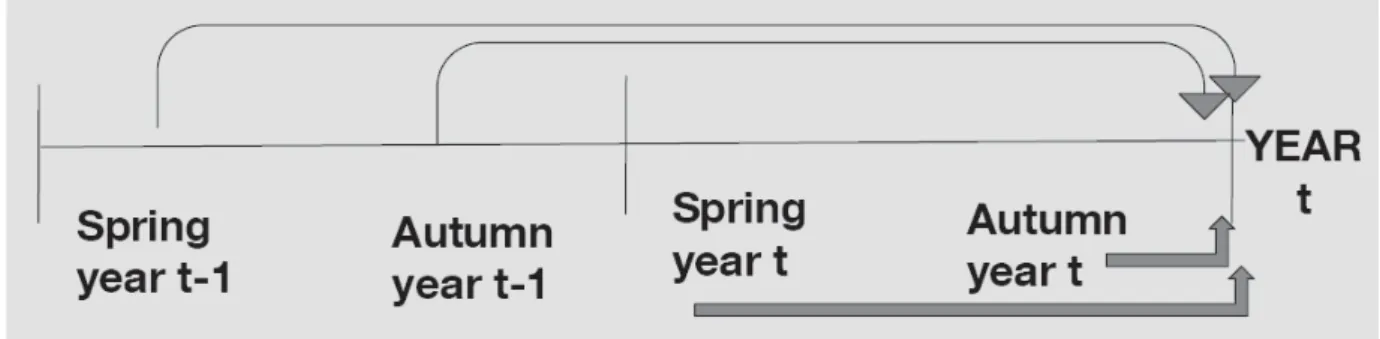
of year t (Spring one-year-ahead forecast), and then it is updated in Autumn of year t (Autumn one-year-ahead forecast), and further in year t + 1 in Spring (Spring current-year forecast) and Autumn (Autumn current-current-year forecast). Notice that the four described forecasts for dt+1 differ in the information set available at the time of preparation of the
projection. Each forecast, ex-post, has an associated forecast error. If we denote Spring one-year-ahead forecasts, Autumn one-year-ahead forecasts, Spring current-year forecasts and Autumn current-year forecasts respectively as Et[dt+1|St], Et[dt+1|At], Et+1[dt+1|St+1]
and Et+1[dt+1|At+1], then the associated forecast errors in each case can be written as:
St t+1 ≡ dt+1−Et[dt+1|St] At t+1 ≡ dt+1−Et[dt+1|At] (6) St+1t+1 ≡ dt+1−Et+1[dt+1|St+1] At+1t+1 ≡ dt+1−Et+1[dt+1|At+1]
The vintage structure of the database is explained further in Figure 1. Following this structure, we build up a database of forecasts for the government balance-to-GDP ratio and real GDP growth, as published by the EC, the OECD and European governments in real-time. In particular, EC projections have been taken from the different issues of the publication European Economy (Supplement A, Economic Trends). For the OECD, the source is the OECD Economic Outlook. Both the EC and the OECD publish projections for Et[dt+1|St], Et[dt+1|At], Et+1[dt+1|St+1] and Et+1[dt+1|At+1]. As regards governments’
projections, the data have been compiled from two sources. On the one hand, data on
Et+1[dt+1|St+1] and Et+1[dt+1|At+1] have been taken from the EDP Notifications, submitted
twice a year (in Spring and Autumn) by European governments to the European Commission in the framework of the so-called Excessive Deficit Procedure. On the other hand, data on
Et[dt+1|At] have been compiled from the Stability and Convergence Programmes submitted
by European governments to the European Commission.13 No figures are available for the vintage Et[dt+1|St].
13EU countries send updated fiscal projections to the European Commission at least three time a year.
Firstly, at the end of a given year (November/December) or the beginning of the next year (January) national fiscal authorities submit to the EC Stability and Convergence Programmes. These Programmes include multi-annual fiscal projections covering three to four years ahead. Secondly, national governments send to the EC in Spring of each year t the initial release of data for year t-1, and also take the opportunity to report updated projections for year t. Finally, the latter release of past data and estimates for the current year is updated in Autumn of each year.
The time period covered by our database is 1999-2007, and includes the 15 countries members of the EU prior to the 2004 EU enlargement, namely Belgium, Germany, Greece, Ireland, Spain, France, Italy, Luxembourg, Netherlands, Austria, Portugal, Finland, Den-mark, Sweden, and the United Kingdom. All in all, taking into account certain missing figures, the number of available observations for the four consecutive vintages [Et[dt+1|St],
Et[dt+1|At], Et+1[dt+1|St+1] and Et+1[dt+1|At+1]] is respectively [0,120,128,135] for
govern-ment’s projections, [120,120,135,135] for EC projections and [117,118,132,133] for OECD projections.14
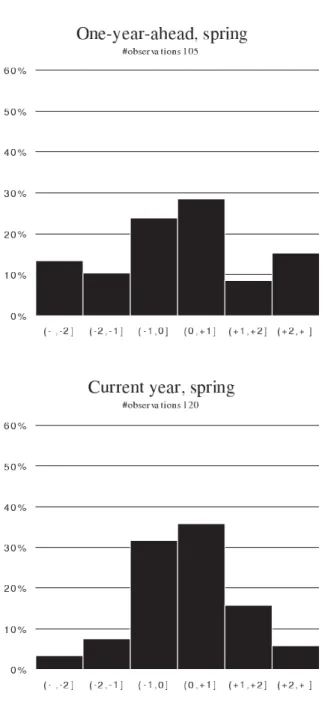
As an example of the reflection of the vintage structure in the data, Figure 2 shows the distribution of government public deficit forecast errors computed from EC projections, for the pool made of the 15 analyzed countries. It displays four projections for year t+1 public balance, that differ in the selected forecast origin, the first one being the projection prepared in spring of t for year t+1 (Et[dt+1|St]). The figure presents the statistical distribution of
projections errors and its evolution by vintage. The distribution of projection errors appears to be slightly twisted to under-prediction of budget balances, which might be evidence for the presence of bias in the pool. This seems to be particularly true for current year autumn projections. In addition, there seems to be some evidence for increased accuracy across consecutive vintages.
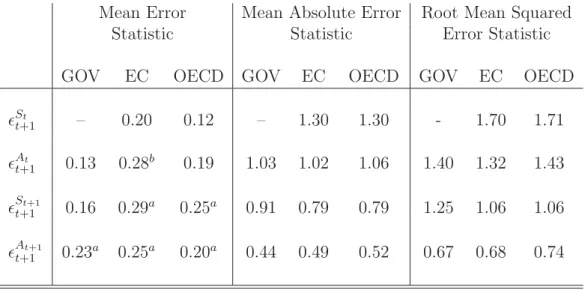
Table 2, in turn, shows some descriptive statistics of the real-time data set. Mean errors over the whole sample were positive for GOV, EC and OECD projections, thus presenting a small pessimistic positive bias (under-prediction of budget balances) over the years 1999 to 2007. Nevertheless, when accounting for variability, only the Autumn current year vintage turned out to be statistically significant from zero in the case of the three institutions. The optimistic bias was higher in size and statistically significant for the last three vintages in the case of the EC and in the current-year vintages in the case of the OECD. Given that the sample includes two upswing periods but only one downswing, this can be an indication of a more prudent approach to government balance projections on the side of international agencies. As regards the Mean Absolute Error and the RMSE statistics, also presented in Table 2, two facts can be highlighted. First, accuracy improves with the information set, as expected, given that both statistics get reduced as the information set gets closer to Autumn
of the current year. Second, the size of forecast errors by the EC and OECD is commensurate or lower than that of governments when looking at Autumn one-year-ahead forecasts and Spring current-year ones; the estimates at the end of the current year (Autumn current-year forecast), though, improve significantly in the case of GOV when compared with EC and OECD estimates. This latter fact may reflect again the conservative bias on the side of international agencies mentioned before, but also the existence of private information on the side of GOV, most likely on current-year budgetary execution (and in particular as regards expenditures).
3.2
Other variables
Along with the real-time database of government deficit forecasts, we also compile a parallel real-time database of real GDP forecasts for the same organizations, taken from the same publications in each case as with the budget balance projections. Errors committed when forecasting macroeconomic variables are responsible for an important part of fiscal forecast errors (see for example Leal et al., 2008) and thus it is natural to include GDP errors in the analysis. For example, optimistic revenue forecasts tend to be associated to optimistic GDP forecasts (Jonung and Larch, 2006).
As with political budget cycles – see for example Mink and de Haan (2005) – there may be electoral, partisan or institutional forecast cycles. In the case of political forecast cycles, policy makers deceive the public and the EC on their true budgetary position in order to exploit the Phillips curve in the short-run. In an electoral forecast cycle, a given election date determines government’s spending and taxation plans and the corresponding information policy (see Alesina et al., 1998, and the references quoted therein). For example, a government may increase spending prior to an election and hide the emerging budget deficit, exploiting temporary information asymmetries. We aim at capturing these effects by including country dummy variables that display a value of 1 in an election year and a zero otherwise. We took the data from Armingeon et al. (2008) for the period 1999-2005, and extended the variables by ourselves for 2006 and 2007.
The extant literature has shown that institutional variables are important determinants of governments’ fiscal forecasting procedures and outcomes – see von Hagen (2010) or Beetsma
et al. (2012) and the references quoted therein. Nevertheless, during the time period chosen for our analysis (1999-2007) the fiscal framework was basically the same for all countries included in the study, namely the SGP (and its reformed version in place since 2005). At the same time, political institutions changed very little in the period 1999-2007 in the 15 EU countries considered. For these reasons the effect of fiscal rule indexes in extant studies tend to be concealed by country fixed effects15. Given that the issue of fiscal institutions
is not core to our analysis and given also that country fixed effects are not rejected by our empirical specifications, we decided to let the fixed effects of the models capture differences in institutions across countries
4
Empirical strategy and results
4.1
Empirical strategy
Along the lines of the stylized equation discussed in (5), the baseline empirical equation we estimate is as follows:
ht,i,j = δ0+δ1 ELECt,i+δ2 GDPt,i,j,h+δ3 Dt,i,j,hGOV + P
p=4
{δpDtp}+ξt,i,j,h (7)
where h
t,i,j is defined as in (6). {t, i, j, h} represent the four relevant sub-indexes: time,
country, institution and vintage of projection. iis the country index;j the institution index,
j = (GOV, EC, OECD); ELEC is a dummy for electoral periods, that is composed of 0’s (no election in year t in country i) and 1’s (every time year t is an election year in country i); GDP do refer to errors in forecasting real GDP of country i in year t incurred
by institution j at vintage h; DGOV is a dummy for government forecasts, that takes the
value of 1 if j = GOV; h refers to the vintage of projections h = {St, At, St+1, At+1}. Dtp
represents additional dummy variables needed in the analysis, that will be detailed in due time. Country-level fixed effects are also included in all regressions and control for differences in budgetary procedures among countries, as discussed above.
15von Hagen (2010) analyzes the influence of fiscal institutions on budgetary deviations from governments’
plans over the period 1999-2004 and decides to leave out country fixed-effects throughout his empirical study. The justification for this is that country fixed-effects would absorb, if introduced, the effect of institutional dummies as institutions did not changed over the sample period.
To correct for groupwise heteroskedasticity of error variances and cluster cross-correlation, all regressions use estimators with cross-sectional, panel-corrected standard errors. Given also that GDP might likely be endogenous and thus correlated with the error term of the
regression, we decided to use a two-stages instrumental variable method (IV) henceforth.16
Given the characteristics of our dataset, controlling carefully for cross-correlation is crucial. This is the case because in some regressions we include forecasts of different institutions for the same country, and/or forecasts prepared by the same institution for different vintages. Thus due account of clustering is implemented. As regards heteroskedasticity, some govern-ments/international institutions may display more volatile deficit forecasts and more/less accuracy.
4.2
Empirical results
We show a first set of results for the pool of all countries, all institutions and all vintages. These results are presented in Table 3 and constitute the most important set of results in the paper. Column [1] of the table presents the results for the most comprehensive pool. There, the dummy for government forecasts does not show up as statistically significant; this means that, within the pool, the estimation method cannot distinguish forecast errors by governments from those by the two international organizations in the sample. GDP errors are significant and the average estimated point elasticity is 0.48, along the lines of related studies; the positive sign says that a negative GDP growth shock produces ex-post opti-mistic government revenue and budget balance forecasts. The dummy for elections years is significantly different from zero and negative: it contributed to optimistic budget balance forecasts. On average over all the dimensions considered, projections underestimated by 0.44 % of GDP actual government balances, i.e. public deficits turned out to be larger than fore-seen. The regression also included two additional, control dummies. On the one hand, the
16Regressions are run using the ivreg2 command in STATA version 11. Using Weighted Least Squares
provided similar results to those obtained by IV in some cases, and are thus presented in some tables for comparability with related studies.
dummy for governments of countries subject to an EDP procedure17 is negative and
signifi-cant, indicating that on average forecasts for EDP countries prepared more optimistic deficit forecasts than non-EDP countries. On the other hand, a “good-times dummy” turned out to be positive and significant, showing that forecasts tend to be on average more pessimistic when the economic situation is buoyant than otherwise. Finally, it is worth mentioning that if the estimation is conducted without fixed-effects and without the EDP dummy, a significant and negative constant gets unveiled, a fact that makes explicit the presence of an average optimistic bias in government balance projections.
As regards Column [2] of Table 3, it breaks down the impact of the election dummy by institutions. Standard tests show that the coefficient of the interaction term “elections × GOV” is significantly higher than the ones corresponding to the EC and the OECD. This can be interpreted as a sign of more independent fiscal forecasts by international organizations. Overall, WLS estimations shown in columns [7] and [8] display similar qualitative results to those obtained by IV in columns [1] and [2].18
Still in Table 3, columns [3] to [6] present the same analysis as before but split into good times and bad times. In bad times the peer and EU-wide institutional pressure might be stronger and thus θ might be smaller than in good times, and also its variance σ2
θ might be
smaller. On different grounds, in good times it might be easier for international organizations to get governments to disclose their private information, so that ν should be smaller than in bad times and thus international organizations might find it easier to differentiate their forecasts from those of the governments. On the contrary, in bad times governments may have more incentives to use it in a confidential way and thus EC and OECD projections should be more difficult to be differentiated from those of the governments. In bad times, thus, it should be more difficult to disentangle θ from ν, and then EC and OECD forecasts
17I.e. those countries within the sample that were subject to an Excessive Deficit Procedure, i.e. countries
that exceeded the 3% of GDP public deficit dictated by EU fiscal rules at any timetwithin the sample 1999-2007. These countries are Germany, France, United Kingdom, Greece, Italy, Netherlands and Portugal. These countries might exhibit a differentiated behavior within the analyzed sample as they have been less disciplined while at the same time subject to peer pressure by the other EU countries and the EC.
18As regards all models estimated by IV, excluded instruments are lagged GDP errors and time dummies.
It is worth noting that the underidentification tests show that all models are identified, i.e that the excluded instruments are adequately correlated with the endogenous regressor. In addition, the weak instruments tests show that the instruments are relevant.
would tend to be closer to government’s ones. The most salient features of the empirical estimations are, in this case, the following. First, fiscal forecasts turned out to be more judgemental, i.e. less responsive to GDP errors, in bad times than in good times. This is consistent with the usual approach to conduct discretionary policies more actively in times of distress, typically by implementing expansionary measures at the beginning of a downturn and implementing fiscal adjustment measures when public debt build-ups beyond certain, sustainable limits. Second, governments display a distinct optimistic deficit bias in good times (the “dummy government” is negative and significant), while in bad times they seem to be more line with the other institutions. Third, bad times exert a kind of discipline over EDP countries, as the relevant dummy is not significant in those periods. Fourth, the negative influence of electoral cycles, even though being significant in both types of periods, is more muted in bad times than in good times, and only in the latter periods are international organizations clearly different from governments in this respect. Finally, with all the caveats in interpretation, the constant term (when fixed-effects and EDP dummies are excluded from the regressions) is negative in bad times (optimistic bias) and positive in good times (conservative bias).
Table 4 shows results by organization (i.e. GOV, EC, and OECD). The most interesting piece of additional evidence is related to the explanatory power of GDP forecast errors in each case. Indeed, the coefficient associated to GOV is 0.26 (even though not significant at the usual significance levels), below those estimated for the EC, 0.41, and OECD, 0.58. This result indicates that, overall, governments’ fiscal balance projections are more judgemental than those produced by international organizations, i.e. they tend to rely less on their macroeconomic projections. Among the EC and the OECD, in the later case GDP forecast errors account for a larger fraction of deficit forecast errors. In this table, though, one has to consider that the weak instruments test shows evidence of weak identification in the case of the GOV regression, and it is borderline in the case of OECD. WLS results, in turn, would broadly confirm IV findings.
Finally, Table 5 disaggregate the information presented above by vintage of projections. Some interesting insights can be highlighted: (i) the importance of errors in GDP as a ex-planatory factor of public deficit errors decreases, in general, with the vintage, i.e. the closer
the projection to the forecast year, revealing an increased GDP accuracy as the information set gets increased, but also more weight on pure fiscal factors vs macro fundamentals in the forecast process (like for example short-term data on budgetary execution); nevertheless, the Spring current-year vintage is the one with the least weight on GDP errors, because it benefits less from the first factor and at that point of the year still not enough from the second; (ii) the dummy for electoral dates is negative for all vintages but it is only signif-icant for the vintages with forecast origin within the year of the election; (iii) in the case of the Spring current year vintage the dummy for government projections turns out to be significant, showing an optimistic bias in Spring-current-year projections, that vanishes for Autumn-current-year projections, the time of budget preparation; it is worth noticing that it is in current year vintages in which the availability of private information is more rel-evant, in particular as regards data on budgetary execution by sub-national governments; (iv) the fixed effects country dummies (and the constant from the regression without fixed effects) display a conservative bias for farther-from-the-forecast-origin vintages the forecast year, with the size of the bias decreasing monotonically with the vintage. Overall, the Spring current year vintage seems to be the one more judgemental and subject to political biases, and this is precisely the vintage of projections published at the time of the year that is most relevant from the point of view of implementing corrective fiscal measures in order to guarantee that budgetary targets are met.
5
Conclusions
We provide empirical evidence on the existence of political economy determinants of inter-national organizations’ (EC and OECD) fiscal forecasts for EU countries over the period 1999-2007. This evidence is based on a broad real-time database over a homogeneous time period. We present evidence pointing to the fact that international agencies’ track record of fiscal forecasts do present bias and correlation with electoral cycles in EU countries, even though the latter is more mitigated than in the case of the governments, also in view of the less judgemental projections of EC and OECD forecasts when compared with official ones. More specifically, our main empirical results are as follows. First, we find that the influence of electoral cycles on fiscal forecasts is significant in the case of governments (GOV), the
European Commission (EC) and the OECD. Electoral cycles contribute to optimistic public deficit forecasts. At the same time we find that the order of political independence is such that: OECD and EC GOV. Second, GDP errors influence significantly government deficit errors, in such a way that a negative growth shock produces ex-post optimistic revenue and deficit forecasts. GOV projections are found to be less reactive to the economic cycle (more judgemental) than EC and OECD fiscal forecasts. Third, a dummy for government fiscal projections in the pool of all datasets does not show up significantly different from zero, but it does show up as significant and negative (i.e. consistent with a higher deficit bias) in good times. Fourth, when the sample is spilt into good and bad times we find that elections influence public deficit forecast errors more strongly in good than in bad times, and that EC/OECD deficit projections become “more independent” in good times than in bad times. We shed some light on the possible rationale of our empirical results by looking at a simple, stylized model in which an independent agency tries to minimize the distance to government’s forecast, given that that government’s information set includes private infor-mation not available to the independent agency. When preparing their fiscal projections, independent agency’s staff tries to grasp as much private information as possible from the government, while at the same time have to disentangle ”political biases” from genuine ”pri-vate information”. Thus, the presence of an inherited bias in international agencies’ fiscal forecasts stems naturally in this set up.
The analysis and results of this paper do have important implications for the current policy debate, specially in Europe. Institutional changes have to be implemented in the procedures of elaboration of fiscal projections by international organizations if they are to qualify as agencies in charge of the preparation of fiscal forecasts that could frame or tie government’s fiscal forecasts, as international agencies’ fiscal forecasts have not been better in the past than governmental ones. Possible institutional improvements include, on the one hand, those aiming at improving transparency on fiscal data reporting (to minimize ex-ante the ”private information bias”ν) and accountability (to minimize ex-ante the ”political bias”
θ) and, on the other hand, those increasing ex-ante pressure on misbehaving governments, like the imposition of sanctions, given that a penalty on government’s fiscal forecast errors may be helpful to minimize the ”private information” bias in government’s forecasts.
References
Aldenhoff, F. O. (2007), “Are economic forecasts of the International Monetary Fund po-litically biased? A public choice analysis”, Review of International Organizations, 2, 239-260.
Annett, A. (2006), “Enforcement and the Stability and Growth Pact: How Fiscal Policy Did and Did Not Change Under Europe’s Fiscal Framework”, IMF Working Paper 2006/116.
Armingeon, K., Gerber, M., Leimgruber, P., Beyeler, M. and Menegale, S. (2008), “Code-book: Comparative political data set I, 1960-2005”. Institute of Political Science, University of Berne.
Artis, M. and Marcellino, M. (2001), “Fiscal forecasting: the track record of the IMF, the OECD and the EC”, The Econometrics Journal, 4, S20-S36.
Artis, M. and Marcellino, M. (1998), “Fiscal solvency and fiscal forecasting in Europe”, Centre for Economic Policy Research (CEPR), Discussion Paper no. 1836.
Auerbach, A.J. (1999), “On the Performance and Use of Government Revenue Forecasts”, National Tax Journal, 52, 765-782.
Batchelor, R. (2001), “How useful are the forecasts of intergovernmental agencies? The IMF and OECD versus the consensus”, Applied Economics, 33, 225-235.
Beetsma, R., B. Bluhm, M. Giuliodori and P. Wierts (2012), “From budgetary forecasts to ex-post fiscal data: exploring the evolution of fiscal forecast errors in the EU”, Contemporary Economic Policy, forthcoming.
Beetsma, R., M. Giuliodori and P. Wierts (2009), “Planning to Cheat: EU Fiscal Policy in Real Time”, Economic Policy, 24, 753-804.
Blix, M., Wadefjord, J., Wienecke, U. and ˚Adahl, M. (2001), “How good is the forecasting performance of major institutions”, Economic Review No 3, Sveriges Risksbank.
Boylan, R. T. (2008), “Political distortions in state forecasts”, Public Choice, 136, 41127. Bretschneider, S.I., Gorr, W.L., Grizzle, G., and Klay, E. (1989), “Political and
organiza-tional influences on the accuracy of forecasting state government revenues”, Interna-tional Journal of Forecasting, 5, 307-319.
Br¨uck, T., Stephan A. (2006), “Do Eurozone Countries Cheat with their Budget Deficit Forecasts”, Kyklos, 59, 3-15.
Buti, M. and P. van den Noord (2004), “Fiscal policy in EMU: Rules, discretion and political incentives”, European Economy - Economic Papers 206.
Christodoulakis, G. A. and E. C. Mamatzakis (2009), “Assessing the prudence of economic forecasts in the EU”, Journal of Applied Econometrics, 24, 583-606.
Debrun, X., Hauner, D. and Kumar, M. S. (2009), “Independent fiscal agencies”, Journal of Economic Surveys, 23, 44-81.
Dreher, A., Marchesi, S., Vreeland, J. R. (2008), “The political economy of IMF forecasts”, Public Choice, 137, 145-171.
European Commission (2006), “Part III: National numerical fiscal rules and institutions for sound public finances”, pp. 135-195 in ”Public finances in EMU”, European Economy, No 3.
Frankel, J. A. (2011), “Over-optimism in forecasts by official budget agencies and its im-plications”, NBER Working Papers 17239, July.
Grizzle, G. A. and W. E. Klay (1994), “Forecasting State Sales Tax revenues: comparing the accuracy of different methods”, State and Local Government Review, 26, 142-152. Hallerberg, M., Strauch, R. and von Hagen, J. (2007), “The design of fiscal rules and forms of governance in European Union countries”, European Journal of Political Economy, 23, 338-359.
Jonung, L., and Larch, M. (2006), “Fiscal policy in the EU: are official output forecasts biased?”, Economic Policy, July, 491-534.
Keereman, F. (1999), “The track record of Commission Forecasts”, European Commission Economic Papers, n. 137.
Larch, M., P. Van den Noord, and L. Jonung (2010), “The stability and growth pact: lessons from the great recession”, MPRA Paper No. 27900.
Leal, T., P´erez, J. J., Tujula, M. and Vidal, J.-P. (2008) “Fiscal forecasting: lessons from the literature and challenges”, Fiscal Studies, 29, 347-386.
Leeper, E. M. (2009), “Anchoring Fiscal Expectations”, NBER Working Papers 15269. Marinheiro, C. F. (2010), “Fiscal sustainability and the accuracy of macroeconomic
fore-casts: do supranational forecasts rather than government forecasts make a difference?”, GEMF Working Papers 2010, 7, Faculty of Economics, University of Coimbra.
Melander, A., Sismanidis, G. and Grenouilleau, D. (2007), “The track record of the Commis-sion’s forecasts - an update”, European Economy Economic Papers, No 291, October. Mink, M., and J. de Haan (2005), “Has the Stability and Growth Pact Impeded Political
Budget Cycles in the European Union?”, CESifo Working Paper Series, 1532.
Moulin, L., and Wierts, P. (2006), “How Credible are Multiannual Budgetary Plans in the EU?”, in Fiscal Indicators, pp. 983-1005, Banca d’Italia.
Pina, A. and N. Venes (2011), “The political economy of EDP fiscal forecasts: an empirical assessment”, European Journal of Political Economy, 27, 534-546.
Pons, J. (2000), “The accuracy of IMF and OECD forecasts for G-7 countries”, Journal of Forecasting, 19, 53-63.
Poplawski-Ribeiro, M. and R¨ulke, J.-C. (2010), “Fiscal expectations and the Stability and Growth Pact: evidence from survey data”, CEPII Working Paper No 2010-05, March. Strauch, R., Hallerberg, M., von Hagen, J. (2004), “Budgetary Forecasts in Europe - The Track Record of Stability and Covergence Programmes”, European Central Bank WP 307.
Timmermann, A. (2007), “An evaluation of the World Economic Outlook forecasts”, IMF Staff Papers, 54, 1-33.
von Hagen, J. (2010), “Sticking to fiscal plans: the role of institutions”, Public Choice, 144, 487-503.
Wyplosz, C. (2008), “Fiscal policy councils: Unlovable or just unloved”, Swedish Economic Policy Review, 15, 173-192.
Appendix: a simple illustration of the potential role of
sanctions in forcing better fiscal forecasts
As briefly discussed in the main text, suppose that the EC could impose sanctions on the government depending on how far its fiscal forecasts are from the final outcome. In this case, it could influence the extent to which a government bases its forecast on Ω rather that Π. This can be done by imposing a penalty on the government if it deviates from a forecast based on the common information set, ¯xΩ. Let this penalty be forcing the government to
choose a ˆx given that there is a penalty P given by P = β(ˆx−x¯Ω). Setting β = 0 will
lead the government to use Π to minimize its own loss function, Λ1, while setting β = ∞
will cause the government simply to report the common forecast ¯xΩ. More generally, the
government would choose a ˆx to minimize a weighted average of its own loss function Λ2
and the additional penalty, P, with weight β, and given by βx¯Ω+ (1−β)(¯xΠ+θ). In this
case, a weightβ = β/(β+γ) ranges from 0 to 1 asβ ranges from 0 to∞. The independent agency’s loss function would be in this case:
LEC = E[x− {βx¯Ω+ (1−β)(¯xΠ+θ)}|Ω]2
= E[x− {β(x+ν+) + (1−β)(x++θ)}| Ω]2
The EC would choose the value of the relative penalty, β that minimizes its expected loss function. It is easy to find that such a value is:
β = σ 2 θ σ2 ν+σθ2 whereσ2
νandσθ2stand for the variance of the private information error and the
politically-motivated error, respectively. From this expression it is clear that the EC has to force the government to use its superior information the larger σ2
ν, i.e. the greater the informational
advantage is, and the smaller σ2
Figure 1: Structure of the database: Spring and Autumn vintages, current year and one-year-ahead forecasts.
Figure 2: Distribution of budget balance projection errors, % of GDP. EC projections, 1999-2006.
Table 1: Some related literature analyzing public deficit forecast errors in EU countries.
Main papers and Information Type of Forecasts of organization: time periods covered source analysisf EC OECD Governments
Strauch et al. (2004) National a Econometric – – Autumn j-period-ahead
1991-2002 forecasts,j= 0,1,2
Br¨uck & Stephan (2006) EC b Econometric – – Autumn j-period-ahead
1995-2003 forecasts,j= 1
von Hagen (2010) Nationala Econometric – – Autumn j-period-ahead
1999-2004 forecasts,j= 0,1,2
Pina & Venes (2011) National Econometric – – Spring and Autumn
1994-2006 EDP c current year forecasts
Annet (2006) National a Econometric – – Autumn j-period-ahead
1980-2004 forecasts,j= 1
Moulin & Wierts (2006) National a Econometric – – Autumn j-period-ahead
1998-2005 forecasts,j= 1
Beetsma et al. (2012) National a Econometric – – Autumn j-period-ahead
1998-2008 forecasts,j= 0,1,2
Artis & Marcellino (2001) EC b, Descriptive All All –
1975-1995e OECDd vintages vintages
Keereman (1999) EC b Descriptive All – –
1970-1997 vintages
Melander et al. (2007) EC b Descriptive All – –
1970-2005 vintages
Marinheiro (2010) EC b Descriptive All – –
1999-2007 vintages
Notes:aNational sources: Stability and Convergence Programmes by EU Member States.
bEuropean Commission, several vintages of the publication ”European Economy- Economic Forecasts”. cEDP reports: Excessive Deficit Procedure reports.
dOECD Economic Outlook.
eTheir analysis also covers IMF projections (World Economic Outlook).
f“Descriptive” refers to the implementation of standard measures of forecast accuracy, including directional accuracy, plus
traditional bias and efficiency tests. ”Econometric” refers to the inclusion of economic, political and/or institutional variables as explanatory variables. “All vintages” refers to Spring and Autumn current year and year-ahead forecasts.
Table 2: Some descriptive statistics of the sample of government balances’ forecast errors. Mean Error Mean Absolute Error Root Mean Squared
Statistic Statistic Error Statistic
GOV EC OECD GOV EC OECD GOV EC OECD
St t+1 – 0.20 0.12 – 1.30 1.30 - 1.70 1.71 At t+1 0.13 0.28b 0.19 1.03 1.02 1.06 1.40 1.32 1.43 St+1t+1 0.16 0.29a 0.25a 0.91 0.79 0.79 1.25 1.06 1.06 At+1t+1 0.23a 0.25a 0.20a 0.44 0.49 0.52 0.67 0.68 0.74 Notes: aSignificant at 1%;bSignificant at 5%;cSignificant at 10%.
St+1t ≡dt+1−Et[dt+1/St] are Spring one-year-ahead forecast errors;At+1t ≡dt+1−Et[dt+1/At] are
Autumn one-year-ahead forecast errors;St+1t+1≡dt+1−Et[dt+1/St+1] are Spring current-year forecast errors;At+1t+1≡dt+1−Et[dt+1/At+1] are Autumn current-year forecast errors.
Table 3: Explaining the public deficit forecast errors: results for the pool of all countries, all organizations (governments, EC, OECD) and all vintages (St
t+1,At+1t ,tS+1t+1 andAt+1t+1).
[1] [2] [3] [4] [5] [6] [7] [8] Pool Pool Pool IV Pool IV Pool Pool
IV IV Good times Bad times WLS WLS GDP forecast error 0.48 a 0.48 a 0.84 a 0.84 a 0.18 c 0.18 c 0.34 a 0.34 a (0.09) (0.09) (0.14) (0.14) (0.11) (0.11) (0.04) (0.04) Dummy government -0.14 -0.22c -0.08 -0.08c (0.09) (0.13) (0.12) (0.04) Elections -0.44 a -0.49a -0.35a -0.42 a (0.08) (0.11) (0.11) (0.09) Elections x GOV -0.67a -0.76 a -0.44b -0.52a (0.15) (0.22) (0.18) (0.08) Elections x EC -0.37a -0.45 a -0.26c -0.36a (0.11) (0.15) (0.15) (0.14) Elections x OECD -0.40a -0.37b -0.39a -0.40a (0.11) (0.16) (0.15) (0.14) EDP country -0.79 a -0.96a -1.58a -1.58 a -0.03 -0.08 -0.79 a -0.81a (0.29) (0.21) (0.28) (0.28) (0.38) (0.29) (0.08) (0.09) Good times dummy 1.11 a 1.12 a 1.11 a 1.11 a
(0.10) (0.10) (0.10) (0.10) Country fixed effects Yes Yes Yes Yes Yes Yes Yes Yes Number of observations 1132 1132 684 684 448 448 1327 1327 R-squared 0.43 0.43 0.36 0.36 0.49 0.49 0.41 0.41 Underidentification test 1 142.6 142.9 79.0 79.3 74.3 74.5
(p-value) 0.00 0.00 0.00 0.00 0.00 0.00 Weak identification test2 21.8 21.8 16.9 17.0 23.5 23.4
Crit.val. 5% max. bias 20.3 20.3 19.3 19.3 13.9 13.9 Crit.val. 10% max. bias 11.4 11.4 11.1 11.1 9.1 9.1
Pro memoria:
- Constant from regression -0.03 -0.06 1.05 a 1.00 a -0.24 b -0.25b -0.07 -0.07
without fixed effects (0.10) (0.09) (0.09) (0.09) (0.11) (0.10) (0.07) (0.07) - Constant reg. w/o fixed -0.36 a -0.39a 0.77 a 0.72 a -0.66a -0.68a -0.40 a -0.42a
effects, w/o EDP dummy (0.11) (0.10) (0.06) (0.06) (0.13) (0.12) (0.13) (0.11)
Notes: The dependent variable is the public deficit forecast error (actual minus forecast). Standard deviations of coefficient’s estimates are reported in parentheses.aSignificant at 1%;bSignificant at 5%; cSignificant at 10%.1Kleibergen-Paap rk LM statistic: the null hypothesis is that the equation is underidentified. 2Cragg-Donald Wald F statistic: the null hypothesis is that the instruments are weak; Stock-Yogo weak ID test critical values: “max. bias” stands for maximal IV relative bias.
Table 4: Explaining the public deficit forecast errors: results for each organization (pool of vintages and countries).
IV WLS
GOV EC OECD GOV EC OECD GDP forecast error 0.26 0.41a 0.58 a 0.21 a 0.38 a 0.40 a (0.16) (0.12) (0.15) (0.06) (0.08) (0.06) Elections -0.51 a -0.40a -0.41a -0.44a -0.40b -0.41b (0.17) (0.12) (0.13) (0.11) (0.17) (0.16) EDP country -1.47 a -0.86 b -0.82 b -0.92a -0.70a -1.78a (0.47) (0.41) (0.34) (0.09) (0.13) (0.11) Good times dummy 1.24 a 1.13a 1.12 a 0.91 a 1.13 a 1.23 a
(0.19) (0.15) (0.17) (0.14) (0.19) (0.19) Country fixed effects Yes Yes Yes Yes Yes Yes Number of observations 238 450 444 373 480 474 R-squared 0.48 0.44 0.42 0.41 0.44 0.43 Underidentification test 1 22.7 75.5 71.9
(p-value) 0.00 0.00 0.00 Weak identification test 2 2.6 13.7 9.7
Crit.val. 5% max. bias 20.3 20.3 20.3 Crit.val. 10% max. bias 11.4 11.4 11.4
Pro memoria:
- Constant from regression -0.01 -0.06 -0.10 without fixed effects (0.19) (0.14) (0.15) - Constant reg. w/o fixed -0.48b -0.35 b -0.40 b
effects, w/o EDP dummy (0.23) (0.16) (0.16)
Notes: The dependent variable is the public deficit forecast error (actual minus forecast). Standard deviations of coefficient’s estimates are reported in parentheses.aSignificant at 1%;bSignificant at 5%; cSignificant at 10%.1Kleibergen-Paap rk LM statistic: the null hypothesis is that the equation is
underidentified. 2Cragg-Donald Wald F statistic: the null hypothesis is that the instruments are weak; Stock-Yogo weak ID test critical values: “max. bias” stands for maximal IV relative bias.