DISCUSSION PAPER PI-1202
The Design of Supplementary Pension
Schemes in Poland and Longevity Risk:
Current Situation and Proposed Changes
Marek Szczepański
January 2012
ISSN 1367-580X
The Pensions Institute
Cass Business School
City University London
106 Bunhill Row
London EC1Y 8TZ
UNITED KINGDOM
1
THE DESIGN OF SUPPLEMENTARY PENSION SCHEMES IN POLAND AND LONGEVITY RISK: CURRENT SITUATION AND PROPOSED CHANGES
Marek Szczepański Chair of Economic Sciences
Poznań Univesity of Technology
Strzelecka Street 11 60-965 Poznań,
2 ABSTRACT
The paper investigates the influence of the design of voluntary, supplementary pension schemes in Poland (occupational pension schemes, retirement savings accounts and the new individual pension protection accounts) on longevity risk. The author formulates the general conclusion that none of the analyzed supplementary pension schemes provides future pensioners with compulsory life annuities or other hedging instruments that could effectively mitigate longevity risk.
New capital market solutions are needed in Poland to deal with the longevity risk. The text includes some proposals of mortality-linked financial products for Polish market.
1. Introduction
Polish citizens – as populations in other countries around the world – face increasing longevity risk (individual longevity risk - the risk of outliving one’s accumulated wealth and the aggregate longevity risk - the risk that average member of birth cohort will live longer than expected)1
As the starting point for the analysis, the author briefly presents the current construction of the Polish pension system, including the latest changes introduced on May 1st, 2011. The conclusions of the analysis should enable the formulation of recommendations of proposed changes and improvements in Polish pension schemes’ design and in mortality-linked financial instruments on the Polish capital market.
. The sensitivity to longevity risk is strictly connected with pension schemes’ design. Especially the regulations of pay-out (decumulation) phase of the schemes have significant impact on the longevity risk and are relevant to longevity risk management. The paper investigates the influence of the design of supplementary pension schemes in Poland on longevity risk.
2. Institutional architecture of Polish pension system
In spite of a radical and comprehensive reform of public pension system that took place in 1999, an adequate and sustainable retirement income for Polish citizens remains a major challenge. The latest simulations show that the replacement rate2 provided by the state pension system in Poland will decrease dramatically: from about 60% in 2001 to only about 30-35% (!) in 20503
1 See MacMinn, Brockett, and Blake (2006), p. 551.
.
2 Replacement rate - the ratio of monthly income of a pensioner to his/her latest wages.
3 Voluntary additional or supplementary pension schemes could mitigate the probable cuts in social security benefits. The problem is that additional pension schemes cover only a small part of the economically active population. Only about 2% of the working population participates in occupational pension schemes and only about 6% in individual pension schemes. The new individual pension protection accounts, which will be introduced on January 1st, 2012, offer more attractive tax incentives.
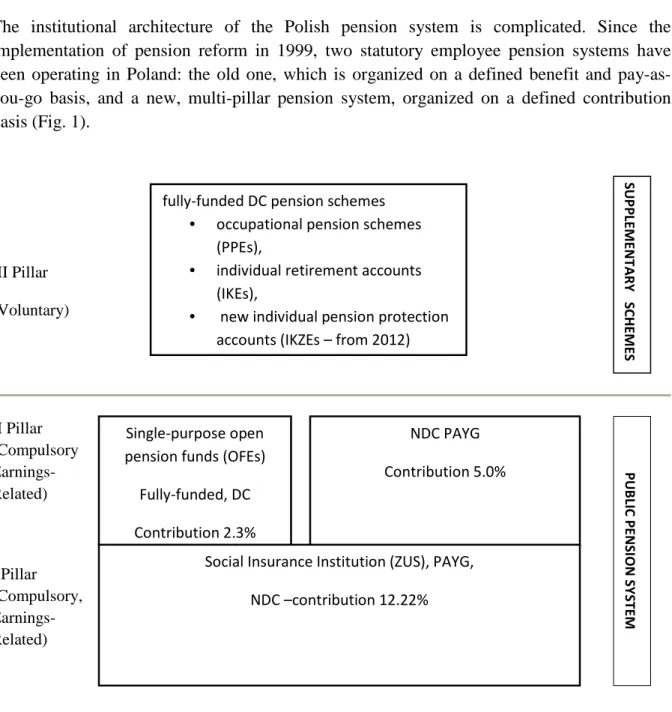
The institutional architecture of the Polish pension system is complicated. Since the implementation of pension reform in 1999, two statutory employee pension systems have been operating in Poland: the old one, which is organized on a defined benefit and pay-as-you-go basis, and a new, multi-pillar pension system, organized on a defined contribution basis (Fig. 1). III Pillar (Voluntary) II Pillar (Compulsory Earnings- Related) I Pillar (Compulsory, Earnings- Related)
Figure 1.The institutional architecture of the new Polish pension system (implemented since 1999, modified in 2011).
The new multi-pillar pension system consists of (1) a state-run pay-as-you-go Notional Defined Contribution (NDC) first pillar, (2) a fully funded second pillar (single-purpose open pension funds, or OFEs, managed by private, commercial institutions) with a financial defined contribution formula and NDC PAYG part (since May 1st, 2011), and (3) a voluntary third
fully-funded DC pension schemes • occupational pension schemes
(PPEs),
• individual retirement accounts (IKEs),
• new individual pension protection accounts (IKZEs – from 2012)
Single-purpose open pension funds (OFEs)
Fully-funded, DC Contribution 2.3%
NDC PAYG Contribution 5.0%
Social Insurance Institution (ZUS), PAYG, NDC –contribution 12.22% PUB LIC PE N SIO N S YS TE M SU PP LEMEN TA RY S CH EM ES
4 pillar (employee pension plans - PPEs, personal pension accounts - IKEs, and new individual pension protection accounts IKZEs; the last ones (IKZEs) will start to operate from January 1st, 2012).
The new pension system is based entirely on individual accounts, with annuitization of account values at retirement. The total contribution is 19.52 per cent of wages, with 12.22 percentage points to the NDC scheme. Until the end of April 2011, 7.3 percentage points of the pension contribution were going to the fully-funded second pillar. Since May 1st, 2011 – only 2.3 percentage points are going to the funded part of the scheme and 5 percentage points to the NDC scheme (formally it is still the second pillar, but practically this part of the second pillar is designed like the first pillar, with slightly differences in indexation methods). Benefits from both the first and second pillars are payable in form of life time annuities the values of which are computed of contributions. The benefits from the new multi-pillar system in Poland should be fully actuarial4
The retirement age in both the old and new public pension systems is 65 for men and 60 for women. For the minimum pensions, 25 and 20 years’ contributions are required for men and women, respectively.
. But the sustainability of the new pension system in Poland will be achieved on rather low levels of future benefits.
The old, traditional, not actuarially balanced, public pension system (PAYG, without individual pension accounts, with Defined Benefit formula) will cease to exist in 20345
Life expectancy at birth
.
6
– an important parameter for longevity risk analysis – is 71.3 for men and 79.8 for women. It is expected that life expectancy in the future will increase7. The old-age dependency ratio in 2010 was about 19. The projected old-age dependency ratio in 2050 is 558
3. Design of supplementary pension schemes and longevity risk
.
The occupational pension schemes (so called employee pension plans – PPEs) in Poland have existed since the beginning of implementation of pension system reform in 1999. Many factors of an economic and non-economic nature have contributed to the failure of these employer-sponsored pension plans (Szczepański 2010), which cover – as already mentioned –
4 Person’s benefit is fully actuarial when the expected present value of all future monthly pension benefits is
equal to pension accumulation at the time the pension starts – see Barr, Diamond (2010), p. 20.
5 The old pay-as-you-go pension plan applies to people older than 50 on the first day of the enforcement of the
reform (January 1,1999), and the new one applies to those who were 50 or younger as that date. Participants in the new pension system are subdivided into two groups: (1) people below age 30, who have compulsory coverage in both public and private plans and (2) people age 30–50, who can choose whether to remain in the NDC plan only or to take part in both tiers.
6 Medium variant 2005-2010.
7 See OECD 2008, p. 37 and OECD 2011, p. 1.
8 Ratio of the population aged 65 or over to the population aged 15-64; expressed as a number of dependants
5 only a small fraction of working population (only 1,113 occupational pension schemes in relation to over 3 mln Polish companies in 2010)9.
Table 1. Characteristics of the voluntary occupational pension schemes (PPEs)
______________________________________________________________________________________
Coverage Vesting period Retirement Tax advantages Contribution tax deductive Pay-out age to participantsa by employersa
in retire- methods ment ______________________________________________________________________________________
Workers None 60 lump sum/ 18 years income
Or older drawdown
______________________________________________________________________________________ a Participants are provided with tax relief up to 300 percent of average wage.
Employers are exempted from paying social security contributions to the first pillar up to 7 percent contributions they pay to the voluntary pillar.
Source: Holzmann, Gueven (2009) and own elaboration.
Individual retirement accounts (IKEs) have been available since September 2004. The number of IKEs by the end of 2010 was 792,466 (about 6% of population of age 16 to 64), with total assets of 2.7 bln PLN (0.7 bln EUR)10.
Table 2. Characteristics of the voluntary individual retirement accounts (IKEs)
Coverage Payment age Tax advantages Lump sum to participants payments*/ (Exemption income from capital drawdown* gains tax)
18 years 60 Yes Yes or older/
16 years * tax exemption
(workers) (from the capital gains tax) IKEs available as:
• mutual investment fund • life insurance
• brokerage account • (special ) bank account
___________________________________________________________________________
9 KNF 2011a. 10 KNF, 2011b.
6 Source: own elaboration.
In spite of optimistic government expectations formulated in 2004, this form of additional savings for the old-age has not become popular.
Very limited tax incentives (the exception from capital gains tax at the end of accumulation phase) are not attractive for most of the future pensioners. The construction of the decumulation phase is analogous to the employee’ pension schemes (see table 2).
The new additional pension scheme in Poland – the individual pension protection accounts (IKZEs) – will be put into operation on January 1st, 2012. They offer more attractive tax incentives (exemption from personal income tax up to 4% of annual wages). Taxes will be paid in decumulation phase (with lump sum payments or temporary annuities – see table 3).
Table 3. Characteristics of the voluntary individual pension protection accounts (IKZEs)
Coverage Payment age Tax advantages Lump sum to participants payments/*
(exemption temporaty annuities* from personal (at least 10 years) income tax)
____________________________________________________________________________________ 18 or older/ 65 Male Yes * tax exemption
16 (worker) 60 Female from personal income
IKZEs available as: tax (PIT), no tax exemption • mutual investment fund on payment • brokerage account
• life insurance • bank
• voluntary pension fund
___________________________________________________________________________ Source: own elaboration.
The current opinion polls show that most Polish citizens are not aware of this new form of pension protection (79% of responders did not hear at all about the IKZE, only 7% declared interest in this form of retirement savings)11
Generally, the design of all three supplementary pensions schemes (occupational pension schemes – PPEs, individual retirement accounts – IKEs and individual protection accounts – IKZEs) does not make them immune to longevity risk. From four pay-out methods (lump-sum
.
11 Polacy o indywidualnych kontach zabezpieczenia emerytalnego i innych formach dobrowolnego oszczędzania
na emeryturę [Polish citizens about individual pension protection accounts (IKZE) and other forms of voluntary pension schemes] (2011), p. 3.
7 payments, income withdrawals, temporary annuities and life annuities)12 the lump sum payments play major role.
It is quite possible that most of the members of the voluntary occupational and individual pension schemes will choose lump sum payments in retirement and spend at least some part of that income on purposes other than additional retirement income. It is worth remembering that the average wages in Poland are about 35 percent of the EU-27 average13.
Annuities, which are still the most popular pay-out methods in DC plans in other European countries (except post-socialist countries)14, play a minor role in the decumulation phase of the additional/supplementary pension schemes in Poland. Only IKZEs will offer this pay-out method (as temporary annuities). And temporary annuities – as well as lump sum payments and income drawdown – do not protect from longevity risk. The only pay-out method which could provide an effective protection against longevity risk: life annuities, has been im- plemented only in the compulsory public pension system. But life annuities paid-out of the public pension system, as already mentioned, will be paid at very low levels. As a result, for low and average-earners both public and existiting supplementary pension schemes will not be able to provide an adequate pension provision and decent living standard at retirement. Even people who will additionally save for their retirement in occupational or individual pension schemes (most Polish citizens do not save money for this purpose) will be exposed to longevity risk, and low-earners and people with atypical working careers and generally women who work shorter periods and stop working at least five years sooner than men15 - to poverty risk in old-age.
According to N.Barr and P.Diamond (2010), the primary objective of pension scheme design
is „to optimize old age security, including the cost of providing it”16. Neither of the voluntary pension schemes in Poland has optimal design, because they are not able to protect sufficiently against longevity risk.
4. Mortality-linked financial instruments on Polish capital market
The Polish capital market has one of the best developed financial markets in post-socialist countries. With 61 commercial banks and 525 co-operative banks, over 100 mutual investment funds, and 37 life-insurance companies, Polish citizens have access to hundreds of financial products. Nevertheless, mortality-linked products, such as life annuities and similar hedging instruments, are not sufficiently developed. The public pension system offers life
12 See EFRP 2011, p. 2. 13 See Eurostat 2010, p. 304. 14 Ibidem, p.7.
15 Minimum pension age in Poland for men is 65 and for women 60. 16Barr, diamond 2010, p. 27.
8 annuities for pensioners and survivors pensions (for widows and children). Life insurance companies offer typical life insurance. But there is an absence of sustainable market solutions for future pensioners who face increasing longevity risk. Less than 10 life insurance companies provide individuals with life annuities. Besides, these financial products are very expensive and difficult to access. There is no typical life annuity as a compulsory or optional form of payment connected with supplementary pension schemes. Sustainable and robust capital market solutions to the aggregate longevity risk are inaccessible. Life annuities and survivors pensions offered by the public pension system, because of the expected decline in benefit levels paid from the state pension system, will not fully mitigate the longevity risk and poverty risk of low-earners. Polish citizens are forced to bear the longevity risk themselves. Most of them respond to that risk by cutting consumption.
5. Conclusions and recommendations
The conclusions about the impact of the design of supplementary pensions on longevity risk: 1) None of the existing or projected supplementary pension schemes provides future
pensioners with compulsory life annuities or other hedging instruments that could mitigate longevity risk.
2) Neither government nor companies are interested or engaged in reducing aggregate longevity risk.
3) Polish citizens are forced to bear the longevity risk themselves and most of them respond to this risk by cutting consumption.
4) Very few individuals can afford to buy life annuities provided by private insurers. The current market of life annuities in Poland is very limited.
5) Because of increasing life expectancy, the longevity risk problem in Poland will become more serious during the next decades.
New capital market solutions are needed in Poland to deal with the longevity risk. The members of voluntary pension schemes should be able to choose financial instruments with more attractive tax incentives and that better address longevity risk. For example the new individual pension protection accounts (IKZEs) could receive tax exemption from personal income tax in both the accumulation and decumulation phases. But tax exemptions in the pay-out phase should be limited only to individuals who choose life annuities as the pay-pay-out method. To make the scheme more flexible and more attractive, some small amount could be paid-out (for example up to 10-15% of the gathered pension capital), the rest (85-90%) of the pension accumulation at retirement would be transferred into life annuities. Such a capital market solution could mitigate the individual longevity risk.
Also occupational pension schemes should receive full tax exemption for participants who decide to exchange his/her pension accumulation at retirement for regular payments for the rest of her/his life. Such regulatory changes in the design of voluntary pension schemes could stimulate the market for life annuities. These products could be available also for average- and
9 low-earners, who will be able to accumulate enough pension capital during their working activity period. It would stimulate the development of life annuities and the market for them. Of course changes in pension schemes’ design should be correlated with better pension education of Polish citizens. They should be better informed about longevity risk and other risks connected with the old-age and better motivated to choose proper capital market solutions (mortality-linked financial products). To change the pension awareness of Polish citizens and motivate them to reduce current consumption for additional retirement savings will not be an easy task. But nothing is easy nowadays and will not be easy in the future as far as provision of retirement income is concerned…
REFERENCES
Holzmann, R., U. Guven, 2009, Adequacy of retirement income after pension reforms in Central, Eastern, and Southern Europe, World Bank Publications, Washington, D.C.
EFRP, 211, DC Decumulation Seminar, European Federation for Retirement Income, Brussels. Eurostat, 2010, Europe in figures. Eurostat Yearbook 2010, Luxembourg: Publications Office of the
European Union, 2010, available in Internet:
[access: 15.07.2011].
KNF, 2011a, Pracownicze programy emerytalne w 2010 roku [Occupational pension schemes in 2010], Komisja Nadzoru Finansowego [Polish Financial Supervision Authority] available in Internet,
[access: 14.07.2011].
KNF, 2011b, Indywidualne konta emerytalne w 2010 roku [Individual retirement accounts in 2010], Komisja Nadzoru Finansowego [Polish Financial Supervision Authority] available in Internet,
MacMinn, R. Brockett, P., and D.Blake, 2006, Longevity Risk and Capital Markets,
Discussion Paper PI-0624, available in Internet, http: [access: 15.07.2011].
OECD, 2008, Complementary and Private Pensions through the World 2008, OECD, ISSA and IOPS, Paris.
10 OECD, 2011, Pensions at a Glance 2001: Retirement Income Systems in OECD Countries,
available in Internet, http:[access: 15.07.2011].
Podsumowanie rezultatów reformy emerytalnej [The summary of results of pension reform], 2011, Economic Council, The Chancellery of the Prime Minister.
Polacy o indywidualnych kontach zabezpieczenia emerytalnego i innych formach dobrowolnego
oszczędzania na emeryturę [Polish citizens about individual pension protection accounts (IKZE) and other forms of voluntary pension schemes], 2011, Centrum Badania Opinii Publicznej, Warsaw, available in Internet, http:[access: 15.07.2011].
Szczepański, M., Stymulatory i bariery rozwoju zakladowych systemów emerytalnych na
przykładzie Polski [Occupational Pensnion Scheme Development Barriers and Drivers.
The Example of Poland], 2010, Wydawnictwo Politechniki Poznańskiej [Publishing House of Poznań University of Technology], Poznań.