A Thesis
Submitted to the Faculty of
Drexel University by Yuan Ling
in partial fulfillment of the requirements for the degree
of
Doctor of Philosophy February 2017
Dedications
This thesis is dedicated to my family whose love and support made this work possible
Acknowledgments
I have received many support and encouragement from many people in the past five years.
First and foremost, I want to thank my supervisor Dr. Yuan An, whose generous guidance and support made it possible for me to complete my thesis. Dr. An devoted his precious time and effort to help me improve paper writing, research presentation, and critical thinking. His insight and vision in healthcare lead me to pursue a career in the healthcare industry. I am grateful to be his student.
I would like to thank my co-supervisor Dr. Tony Xiaohua Hu. Dr. Hu provided a flexible environment for me to explore different areas of research, and always support me with valuable resources and professional suggestions. He inspired me to work harder in pursuing a Ph.D. degree. I am grateful to be his student.
I would like to thank my dissertation committee of Dr. Weimao Ke, Dr. Ali Shokoufandeh, Dr. Jeffrey Headd for their support and insight throughout my research. They gave me many suggestions on my research work. I also want to thank Dr. Sadid Hasan and Dr. Oladimeji Farri from Philips Research North America for their help in my research.
I would like to thank my fellow graduate students and friends: Mengwen Liu, Wanying Ding, Yue Shang, Shi Ye, Xuelian Pan, Yetian Fan and other friends for all the help and support they provided.
Table of Contents
List of Tables . . . viii
List of Figures . . . ix Abstract . . . x 1. Introduction . . . 1 1.1 Background . . . 1 1.2 Motivation . . . 2 1.3 Research Questions . . . 4 1.4 Contributions . . . 5 1.5 Thesis Organization . . . 6 2. Related Work . . . 8
2.1 Clinical Concept Extraction . . . 8
2.1.1 Clinical Notes . . . 8
2.1.2 Clinical Concept Types . . . 9
2.1.3 Clinical Concept Extraction . . . 10
2.2 Clinical Document Clustering . . . 12
2.3 Clinical Relation Extraction . . . 12
2.3.1 Clinical Relations . . . 13
2.3.2 Symptom/Medication Relation Extraction . . . 13
2.4 Word Embedding Models . . . 15
2.4.1 Embedding Representation . . . 15
2.4.2 CBOW and Skip-gram Models . . . 16
2.4.3 KB Enhanced Word Embedding Models . . . 17
2.5 Clinical Diagnosis Inference . . . 19
2.6.1 Knowledge Bases (KBs) . . . 20
2.6.2 Shared Tasks and Datasets . . . 21
2.6.3 Open Access Text Sources . . . 22
3. Clinical Document Clustering . . . 24
3.1 Motivation . . . 24
3.2 Clincal Notes Analysis . . . 25
3.3 Concepts Extraction Framework . . . 26
3.4 Document Clustering Methods . . . 28
3.4.1 Nonnegative Matrix Factorization (NMF) . . . 28
3.4.2 Multi-View NMF . . . 29
3.5 Clinical Concepts Enhanced Document Clustering . . . 30
3.5.1 Datasets . . . 30
3.5.2 Evaluation Metrics . . . 32
3.5.3 Experimental Results . . . 32
3.5.4 Discussion . . . 35
3.6 Visualization of Risk Factors for Heart Disease . . . 36
3.6.1 Motivation . . . 36
3.6.2 Data Preparation and Analysis . . . 38
3.6.3 Results Analysis and Visualization . . . 41
3.6.4 Discussion . . . 44 3.7 Conclusion . . . 45 4. Symptom/Medication Relation . . . 47 4.1 Motivation . . . 47 4.2 Symp-Med Framework . . . 48 4.2.1 Symp-Med Graph . . . 49
4.2.2 Weight Matrix Definition . . . 49
4.3.1 Symp-Med Matching Problem Formulation . . . 50
4.3.2 Symp-Med Matching Algorithm . . . 52
4.4 Experiments . . . 54
4.4.1 Dataset Description and Evaluation Methodology . . . 54
4.4.2 Symp-Med Matching Analysis . . . 55
4.5 Conclusion . . . 56
5. Word Embedding Models for Clinical NLP . . . 59
5.1 Introduction . . . 59
5.2 Word Embedding Models . . . 61
5.3 Graph Regularized Embedding Models . . . 63
5.3.1 Knowledge Graph Representation . . . 63
5.3.2 Graph Regularization Framework . . . 64
5.3.3 Parameters Updating . . . 65
5.4 Intrinsic evaluation . . . 66
5.4.1 Training Data . . . 67
5.4.2 TOEFL Synonym Selection Task . . . 67
5.4.3 WS203, RG65 and SimLex-999 Datasets . . . 68
5.4.4 Qualitative Analysis . . . 69
5.5 Extrinsic evaluation . . . 70
5.5.1 Training Data . . . 70
5.5.2 Biomedical Concepts Similarity and Relatedness . . . 71
5.5.3 Concept Weighting for Biomedical IR . . . 71
5.6 Conclusions . . . 73
6. Clinical Diagnostic Inferencing . . . 74
6.1 Introduction . . . 74
6.2 Overview of the Approach . . . 75
6.4 Methodology . . . 78
6.4.1 Building Weighted Concept Graph . . . 78
6.4.2 Representing Clinical Case . . . 79
6.4.3 Inferring Concepts for Diagnosis . . . 80
6.4.4 Word Embedding Models . . . 80
6.5 Experiments . . . 81
6.5.1 Datasets for Clinical Diagnosis Inference . . . 81
6.5.2 Training Data for Word Embeddings . . . 81
6.5.3 Evaluation Metrics . . . 82
6.5.4 Results . . . 82
6.5.5 Discussion . . . 82
6.6 Conclusion . . . 83
7. Conclusion and Future Work . . . 84
7.1 Conclusion . . . 84
7.2 Future Work . . . 85
Bibliography . . . 87
List of Tables
3.1 Most Frequent Clinical Notes Sections with Medication/Symptom Names . . . 26
3.2 Sample-Feature Matrices Size . . . 32
3.3 2009 DATASET RESULTS (NMF) . . . 33
3.4 2009 DATASET RESULTS (MULTI-VIEW NMF) . . . 33
3.5 2014 DATASET RESULTS (K= 3) . . . 34
3.6 2014 DATASET RESULTS (K= 2) . . . 34
3.7 Risk factors and attributes. . . 39
3.8 Accuracy of our results. . . 42
3.9 The frequency of risk factor being annotated in medical documents for two patients. . 45
3.10 The dominating features in each patient class (k=4). . . 46
4.1 AVERAGE PERFORMANCE RESULTS OF Alg. 1 . . . 55
4.2 AVERAGE PERFORMANCE RESULTS OF Alg. 2 . . . 56
5.1 Performance (Precision, %) on TOEFL Synonym Dataset with D2 Distance. . . 67
5.2 Performance (Precision, %) on TOEFL Synonym Dataset with Different Window Sizes. 68 5.3 Performance (Precision, %) on TOEFL Synonym Dataset with D1 andD2 Distance. . 68
5.4 Performance (Spearman’sρscores). . . 69
5.5 Performance (Spearman’sρscores) for Biomedical Concepts Datasets. . . 71
5.6 Performance (P@5) for Biomedical IR. . . 72
6.1 Selected Relation Types from UMLS MRREL. . . 77
6.2 Selected Freebase Relation Types. . . 78
List of Figures
1.1 Percent of non-federal acute care hospitals with adoption of EHR systems by level of
functionality: 2008 - 2015 (Statistics from Henry et al [1]). . . 2
1.2 A Work Flow for Clinical Text Understanding . . . 3
2.1 An Example of Clinical Notes (Data from Sun et al [2]). . . 9
2.2 Subtasks in Clinical Concept Extraction. . . 11
2.3 The Emerald [3]. . . 14
2.4 The CBOW Architecture and Skip-gram Architecture. . . 16
3.1 A Clinical Note Example with Several Selected Sections. . . 25
3.2 An overview of symptom/medical term extraction from Clinical Notes. . . 27
3.3 The Framework of Applying Multi-view NMF. . . 31
3.4 Accuracy from Multi-view NMF and NMF. . . 35
3.5 An illustration of NMF and results (k= 2). . . 40
3.6 Consensus clustering matrices atk= 2,3,4,5,6,7. . . 41
3.7 Cophenetic correlation result atk= 2,3,4,5,6,7. . . 42
3.8 Patients Clustering Result atk= 2. . . 43
3.9 Feature Analysis for Patients Clustering Result atk= 2. . . 44
4.1 Comparison in ROC and PR Curves. . . 58
5.1 Word Embedding Models with Graph Regularization . . . 63
Abstract
Methods and Techniques for Clinical Text Modeling and Analytics Yuan Ling
-Nowadays, a large portion of clinical data only exists in free text. The wide adoption of Electronic Health Records (EHRs) has enabled the increases in accessing to clinical documents, which provide challenges and opportunities for clinical Natural Language Processing (NLP) researchers. Given free-text clinical notes as input, an ideal system for clinical text understanding should have the ability to support clinical decisions. At corpus level, the system should recommend similar notes based on disease or patient types, and provide medication recommendation, or any other type of recommendations, based on patients’ symptoms and other similar medical cases. At document level, it should return a list of important clinical concepts. Moreover, the system should be able to make diagnostic inferences over clinical concepts and output diagnosis. Unfortunately, current work has not systematically studied this system.
This study focuses on developing and applying methods/techniques in different aspects of the system for clinical text understanding, at both corpus and document level. We deal with two major research questions:
First, we explore the question of How to model the underlying relationships from clinical notes at corpus level?
Documents clustering methods can group clinical notes into meaningful clusters, which can assist physicians and patients to understand medical conditions and diseases from clinical notes. We use Nonnegative Matrix Factorization (NMF) and Multi-view NMF to cluster clinical notes based on extracted medical concepts. The clustering results display latent patterns existed among clinical notes. Our method provides a feasible way to visualize a corpus of clinical documents. Based on extracted concepts, we further build a symptom-medication (Med) graph to model the Symp-Med relations in clinical notes corpus. We develop two Symp-Symp-Med matching algorithms to predict
and recommend medications for patients based on their symptoms.
Second, we want to solve the question ofHow to integrate structured knowledge with unstructured text to improve results for Clinical NLP tasks?
On the one hand, the unstructured clinical text contains lots of information about medical conditions. On the other hand, structured Knowledge Bases (KBs) are frequently used for supporting clinical NLP tasks. We propose graph-regularized word embedding models to integrate knowledge from both KBs and free text. We evaluate our models on standard datasets and biomedical NLP tasks, and results showed encouraging improvements on both datasets. We further apply the graph-regularized word embedding models and present a novel approach to automatically infer the most probable diagnosis from a given clinical narrative.
Chapter 1: Introduction
1.1
Background
A great deal of effort has been put into improving health care in different aspects [4]. The adoption of Electronic Health Records (EHRs) is one of the ways to improve Healthcare. For example, clinical NLP tools [5, 6] are built based on EHR data to automatically trigger alerts and reminders for situations that require actions from physicians. EHRs1are the electronic version of patients’ medical history, that are maintained by healthcare providers over time. Nowadays, EHRs are widely adopted by hospitals in the United States. Statistics from Figure 1.1 display the increasing percentage of non-federal acute care hospitals with the adoption of EHR systems over the years 2008 - 20152. In addition to the increasing EHR adoption rate, the trends also show that there is an increasing use of advanced functionality for EHR systems. More and more hospitals are using EHRs with Clinical Notes and comprehensive EHRs with extra advanced functionality, such as decision support based on clinical guidelines, drug-drug interactions, drug allergy results, and etc3.
EHRs make clinical notes digitalized and facilitate the way of sharing unstructured clinical notes with patients, which brings lots of benefits for both patients and physicians4. With access to clinical notes, patients will be able to take ownership of their own health, get more communication with healthcare providers, and understand their medical conditions better. For physicians and hospitals, digitalized clinical notes can be used as tools for them to find evidence for their decision-making process. Clinical notes can also be utilized by researchers to conduct research on clinical decision support. Researchers usually have limited access to EHR data due to the patient privacy protection. As the development of de-identification techniques for EHRs [7, 8] and the guidance issued for
1https://www.cms.gov/Medicare/E-Health/EHealthRecords/index.html?redirect=/EhealthRecords/ 2 https://dashboard.healthit.gov/evaluations/data-briefs/non-federal-acute-care-hospital-ehr-adoption-2008-2015.php#figure5 3 https://dashboard.healthit.gov/evaluations/data-briefs/non-federal-acute-care-hospital-ehr-adoption-2008-2015.php#appendix 4 http://health.usnews.com/health-news/best-hospitals/articles/2015/10/15/hospitals-are-moving-slowly-to-electronic-medical-records
Figure 1.1 Percent of non-federal acute care hospitals with adoption of EHR systems by level of functionality: 2008 - 2015 (Statistics from Henry et al [1]).
the Health Insurance Portability and Accountability Act (HIPAA) Privacy Rule5, de-identified EHR data become more available to researchers. The lack of reproducibility problem [9] existed in related research will be allevaited since researchers can conduct experiments on same datasets.
There are two common ways for researchers to get unstructured clinical notes from EHR system. The first one is to obtain data through collaborations with hospitals [4]; and the second one is to get datasets through clinical NLP shared tasks for research purpose. For example, the i2b2 project (informatics for integration of biology and the bedside)6 is an NIH-funded National Center for Biomedical Computing based at Partners HealthCare System. It creates shared tasks enable researchers to use existing clinical data for discovery research. Shared tasks provide annotated datasets and common evaluation metrics for participants [10].
1.2
Motivation
The increasing access to unstructured clinical notes brings chanllenges and opportunities [11] for research in Natural Language Processing (NLP) [12] and Information Retrieval (IR) areas to provide advanced techniques and tools for better understanding of clinical text. NLP and IR techniques
5https://www.hhs.gov/hipaa/for-professionals/privacy/special-topics/de-identification/ 6
Figure 1.2 A Work Flow for Clinical Text Understanding
are applied to clinical text understanding for different type of tasks [13], such as clinical notes de-identification [14], clinical concept extraction [15, 16, 17], clinical relation extraction [18], biomedical literature retrieval [19], clinical question answering [20], and etc.
Such NLP and IR based systems build the foundation for clinical text analysis, which would satisfy the needs coming from both physicians and patients. Patients usually want to figure out their medical conditions from clinical notes, some general questions they want to get answers from clinical notes would bewhat are my symptoms? how to treat the symptoms? what’s the diagnosis for me? What are the conditions for other people with similar symptoms as me? and all other related questions. Physicians can use patients’ clinical notes for other purposes. For example, finding related medical cases or biomedical literature as evidence to support their decision-making process. They will ask questions such as what’s the drug choice for these symptoms? what’re the causes for this symptom? How common is the disease? and etc.
In this thesis, we study the problem of modeling and analyzing clinical notes. We develop novel methods and techniques for better understanding clinical text, in order to answer partial of these questions raised by physicians or patients. As displayed in Figure 1.2, different modules are included: clinical concept extraction, clinical notes analysis, clinical relation extraction, and clinical diagnosis inference.
Concept extraction from clinical notes is the foundation for clinical text understanding. Over the last decades, different methods and tools are developed for biomedical concept extraction [21, 16, 22, 23]. Extracting clinical concepts requires different types of systems designed for different types of clinical text. Clinical concepts, such asfinding,treatment,test,disease, genetic names, and etc., from clinical text can be used for answering the aforementioned questionswhat are my symptoms?
what’s the diagnosis for me?
Clinical notes clustering at corpus level provides solutions for questions like What are the con-ditions for other people with similar symptoms as me? How common is the disease? Clinical notes clustering requires different types of features from documents, such as word features, clinical con-cepts, risk factors of diseases, and etc. We explore to build clinical concepts enhanced document clustering methods for clinical notes clustering.
Clinical relation extraction refers as the classification of relationships between clinical concepts. For example, modeling symptom and medication relationships from clinical corpus [24] can help answering the questions ofhow to treat the symptoms? and what’s the drug choice for these symp-toms?
Clinical diagnosis inference is the problem of automatically inferring the most probable diagnosis from a given clinical narrative. Clinical diagnosis inference is the research work to answer the question as what’s the diagnosis?
The motivation to answer aforementioned questions makes it desirable to develop NLP/IR meth-ods and build tools for clinical text understanding.
1.3
Research Questions
Motivated by the general questions raised by patients and physicians’ needs, we systematically study methods and techniques to achieve better clinical text understanding.
At corpus level, we want to explore the questions of What kinds of relationships we can infer from a corpus of clinical notes? and How to model the relationships at corpus level?
First, we want to explore the intrinsic relationships among clinical notes. Compared with gen-eral document clustering method, we incorporate extracted clinical concepts for clinical document clustering. We also want to use concept enhanced clinical document clustering to analyze and vi-sualize the risk factors for heart disease in the diabetic population. We need to integrate multiple risk factors with various attributes into uniform feature representations, and clusters patients’ data from multiple aspects. Second, we want to explore the symptoms/medications relationships exist in clinical notes corpus. Taking symptoms as input, we want to predict and recommend medications
for symptoms.
At document level, we want to answer the question ofHow to integrate structured knowledge with unstructured text to improve results for Clinical NLP tasks?
Word embedding in the NLP area has attracted increasing attention in recent years. The con-tinuous bag-of-words model (CBOW) and the concon-tinuous Skip-gram model (Skip-gram) have been developed to learn distributed representations of words from a large amount of unlabeled text data. Besides, Knowledge Bases (KBs) are useful resources for supporting clinical NLP tasks. We explore the idea of integrating KBs with unstructured text and addressing the limitations of word embedding models when applied to clinical NLP tasks. There is a growing number of studies on applying word embedding models to biomedical NLP tasks. Overall, they focus on evaluating word embedding features and parameters trained on the biomedical corpus. There is little work on integrating KBs with word embedding models for biomedical NLP tasks.
1.4
Contributions
Given free-text notes as input, an ideal system for clinical text understanding should have the ability to support clinical decisions. At corpus level, the system should recommend similar notes based on disease or patient types, and provide medication recommendation, or any other types of recommendation, based on patients’ symptoms and other similar medical cases. At document level, it should return a list of important clinical concepts. Moreover, the system should be able to make diagnostic inferences over clinical concepts and output diagnosis. Unfortunately, current work has not systematically studied this system. In our thesis, we develop and apply methods/techniques in different aspects for clinical text understanding.
To answer the research questions discussed in Section 1.3, we propose concepts enhanced clinical document clustering, symptom/medication matching algorithms, graph regularized word embedding models, and their applications to clinical text understanding. The following is a summary of our contributions in the methods:
(1) Concept Enhanced Clinical Document Clustering Method.
and clinical concepts, for clinical document clustering. This provides a feasible way for us to visu-alize clinical documents at corpus level. Compared with general document clustering method, we discovered that extracted clinical concepts play an important role for clinical document clustering. We also use the method to analyze and visualize the risk factors for heart disease in the diabetic population. Our method integrates multiple risk factors with various attributes into uniform feature representations, and clusters patients’ data from multiple aspects. This study explores new ways of visually interpreting risk factors for patients and assisting decision making for physicians.
(2) Symptom/Medication Relation Modeling and Recommendation.
Based on clinical concepts extracted from clinical notes, we build a symptom-medication (Symp-Med) graph to model symptom and medication relations in a corpus level. We develop two Symp-Med matching algorithms to predict and recommend medications for symptoms.
(3) Graph Regularized Word Embedding Models.
First, we propose graph-regularized word embedding models enhanced by KBs. Experiments on both general domain datasets and biomedical NLP tasks proof that Integrating extra knowledge can improve the performance of word embedding models.
Second, we apply the graph-regularized word embedding model and present a novel approach to automatically infer the most probable diagnosis from a given clinical narrative. Previous work on diagnosis inference from clinical narrative either formulating it as a medical literature retrieval task [25, 26] or solving it with multiclass algorithms in a supervised way [27]. We innovatively work on diagnoses inference from clinical narratives in an unsupervised way. Thus, we build baselines for this novel task.
1.5
Thesis Organization
The rest of this thesis is organized as following parts. Chapter 2 introduces the previous related work to our study. Chapter 3 and Chapter 4 address the question ofHow to model the relationships from clinical notes at corpus level. Chapter 3 presents our work on concept enhanced clinical document clustering for patient analytics. Chapter 4 presents our work on symptom/medication relation modeling from clinical notes. Chapter 5 and Chapter 6 address the question of How to integrate
structured knowledge with unstructured text to improve results for Clinical NLP tasks? Chapter 5 discusses our work of applying word embedding models to clinical NLP tasks. Chapter 6 explores the problem of diagnosis inference from clinical text. Finally, we conclude this thesis and introduce future directions in Chapter 7.
Chapter 2: Related Work
2.1
Clinical Concept Extraction
2.1.1
Clinical Notes
A clinical note provides details about patient encounters and it’s prepared by healthcare professional in unstructured text format. There are different types of clinical notes/reports generated for various purposes and from different patient visiting occasions, such as physician visit note, admission note, discharge summary, nursing progress notes, cardiac catheterization report, ECG report, radiology report, and echo reports1. In general, clinical note can be organized into four SOAP2 sections [28] as follows:
• Subjective: patients verbally express symptoms and observations. Also details about medica-tion history, family history, and etc.
• Objective: Observations include symptoms that can be measured in different ways, such as physical examination, test result, blood pressure, height, weight, and other vital signs.
• Assessment: a list of diagnoses regarding a patient’s condition.
• Plan: follow-up directions for the patient, such as medications, treatment plan, and etc.
Even clinical notes have such loosely organized structure in general, important clinical concepts are distributed embedded in unstructured or semi-structured free text. Figure 2.1 is an example of clinical note. In this clinical note, patient’s treatment history and plan are expressed in the free text of “He was initially treated with antibiotic therapy. . . . He was discharged home on Neupogen.” Sophisticated clinical NLP tools are required to understand the narratives. “antibiotic therapy” needs to be identified as a “treatment” clinical concepts type, while “Neupogen” should be identified as a “medication”.
1https://physionet.org/mimic2/mimic2 clinical overview.shtml 2http://www.physiciansoapnotes.com/
Figure 2.1 An Example of Clinical Notes (Data from Sun et al [2]).
2.1.2
Clinical Concept Types
Lots of efforts have been made in recent years to classify semantic types for clinical concepts. Termi-nology and ontology are built to describe concepts in the biomedic domain. For example, The Unified Medical System (UMLS) Metathesaurus [29] contains millions of biomedical and health related con-cepts. They are maintained by The National Library of Medicine (NLM). UMLS Metathesaurus defines clinical concept types in a very detailed level3, such as:
• Finding
Laboratory or Test Result Sign or Symptom
• Organism Attribute Clinical Attribute
• . . .
There are other ontologies and classification systems developed for defining clinical concepts. For example, SNOMED CT [30] is a database contains terms and concepts for the coding of diagnosis and problem lists by clinicians. LOINC [31] is a database provides a universal code system for reporting laboratory and other clinical observations. RxNorm [32] provides clinical drug names and links its names to many of the drug vocabularies. ICD-10 (the 10th revision of the International Statistical Classification of Disease and Related Health Problem) [33] is a medical classification, which contains codes for diseases, signs and symptoms, abnormal findings, complaints, social circumstances, and external causes of injury or diseases4. These ontologies and classification systems are widely used to assist information extraction from biomedical text.
Most of clinical concept extraction tools do not focus in a very detailed level as described in the ontology and classification system. They refer clinical concepts in a more general level. Clinical concepts refer to names offindings,treatment,test,disease,anatomy,substance,demographics, and etc. For example, following clinical concepts can be extracted from example in Figure 2.1:
• demographics: 73-year-old, man, ... • test: chest x-ray
• findings: fever, neutropenia, feeling well, ... • substance: Neupogen, ...
• others: ...
2.1.3
Clinical Concept Extraction
Compared to concept extraction from free text in general domain, clinical concepts extraction needs to overcome the barriers of lack of annotated data, limited access to data, the variation of clinical text, and limited extra knowledge sources.
There are some existing systems and tools [16, 22, 23] for clinical concept extraction. MetaMap [34] is developed by NLM to extract Metathesaurus concepts from texts. It returns different seman-tic types presented in the text. Lots of clinical concept extraction tools are built based on MetaMap
Figure 2.2 Subtasks in Clinical Concept Extraction.
[35]. cTAKES (Mayo clinic’s clinical Text Analysis and Knowledge Extraction System [16]) is an open source NLP system for clinical concept extraction. HITEx (Health Information Text Extrac-tion [36]) is an open-source NLP system for extracting clinical concepts like diagnosis, discharge medications, smoking status, and etc. MedEx [15, 37] is an open source system processing clini-cal text and extracting medication names and signature information, such as drug dose, frequency, route, and duration. It designed for medication information extraction and reported a 93.2% F-measure on identifying drug names. Reference [38] proposes a method to identify medical concepts from the SNOMED Clinical Terminology in free texts. Another linguistic approach for identification of medication names and related information in clinical narratives uses negation maker to exclude negation medication information [39]. NegEx [40] is a tool for determining findings and diseases from the clinical text are negated or not. More details about existing clinical concept extraction systems can refer to systematic reviews in [41, 42].
These systems usually contain basic NLP modules for clinical text processing, such as sentence splitting, tokenization, part-of-speech (POS) tagging, Name Entity Recognition(NER), and etc, as displayed in Figure 2.2. These clinical concept extraction systems are highly dependent on ontologies and dictionaries (discussed in section 2.1.2) from biomedical domain. These domain ontologies include UMLS Metathesaurus [29], ICD-10 classification [43], RxNorm [32], SNOMED-CT [30], and etc.
2.2
Clinical Document Clustering
Document clustering techniques provide an efficient way of navigating and summarizing documents into a small number of meaningful clusters. They have received lots of attentions in recent years [44, 45]. Nonnegative Matrix Factorization (NMF) is a clustering algorithm to factorize a matrixV
into two matrices W and H, all three matrices have no negative elements. NMF has been widely applied to document clustering [46, 47]. Akata et al [48] extended NMF towards joint NMF, which can jointly analyze different types of features for multi-view learning. Instead of fixing a common clustering solution for each view, Liu et al [49] further formulated the process by finding the nearest consensus for each view. Multi-view NMF can integrate various sources of data and yield a better clustering result [50]. In our study (described in 3.5), we apply multi-view NMF to integrate features of symptom concept, medication concept, and word from the clinical document for clustering.
For clinical document clustering [51], Saad et al [52] investigated clinical documents clustering for grouping clinical documents into meaningful clusters and discovering patterns and important features. Patterson et al [53] clustered a data set consisting of 17 clinical note types using an unsupervised clustering algorithm and demonstrated different clinical domains use different lexical and semantic patterns. Doing-Harris et al [54] identified medical specialty across institution by comparing linguistic features of clinical notes from different institutions using document clustering techniques. Han et al [55] employed latent semantic indexing to cluster clinical notes and found that latent semantic indexing was an effective method for measuring the similarity of clinical notes. Zhang et al [56] evaluated nine semantic similarity measures of ontology-based terms for medical document clustering. Documents clustering provides an efficient way for physicians and patients to understand patterns inside and among clinical documents.
2.3
Clinical Relation Extraction
For a given pair of entities, relation extraction is defined as classifying the relation between this pair of entities into one of the predefined relation types or no relation [57]. General relation extraction methods and models can be classified as unsupervised, semi-supervised, distant-supervised, open IE,
and etc. The commonly used features for relation extraction include lexical, syntactic, semantic, contextual, and etc. Some recent work [58] learned relation extraction model jointly from KBs and text. Embedding representation for words and entities/relations in KBs are explored to facilitate the relation extraction tasks [59, 60].
2.3.1
Clinical Relations
Relation extraction can facilitate clinical decision making. The UMLS [61] Metathesaurus contains a large amount of manually extracted relations for UMLS concepts. However, these relations stored in such KBs is far from complete, and the knowledge is changing extremely fast. Thus, lots of research work explore to automatically extract clinical relations from text corpus for complementing existing manually created relational KBs. Wang and Fan [62] presented a manifold model to extract medical relations from sentences corpus. Hassan et al [63] focused on methods to automatically extract disease-symptom relationships from text. Disease-symptom relationship is an important type of relationship. Rosario and Hearst [64] focused on extracting relationship between the entities “treatment” and “disease” from bioscience text. Most of the current clinical relation extraction research work focused on one particular type of relation and evaluated based on a limited number of manually created datasets. Lally et al [3] created an Emerald model to systematic summarizing different types of relationships in the medical domain, as shown in Figure 2.3.
The Emerald model provide a comprehensive overview of clinical relationship types. Some com-monly used clinical relations are “findingOf” relation type between clinical types “finding” and “disease”, “treats, prevents” relation type between “disease” and “treatment”, “diagnoses” relation type between “test” and “disease”, and etc.
2.3.2
Symptom/Medication Relation Extraction
Clinical symptoms are important for patients to control the exacerbation of diseases [65]. Reference [28] proposes a framework for modeling and mining symptom relationships from clinical notes. The relationships between symptoms and medication for one particular disease (such as asthma [66, 67], cancer [68]) have been studied with case study methods and statistical methods. A
symptom-Figure 2.3 The Emerald [3].
medication score is used as an instrument to evaluate the disease severity by recording symptoms and rescue medication [69]. Currently, there is little research work on extracting symptom and medication concepts from clinical notes for medication error detection and surveillance. In our study (in Section 4), We propose a Symptom-Medication matching framework to model symptom and medication relationships from clinical notes. After extracting symptom and medication concepts, we construct a weighted bipartite graph to represent the relationships between the two groups of concepts. The key is to efficiently answer user’s symptom-medication queries using the graph.
Bipartite graph is a commonly used to represent relationships among concepts extracted from texts. SympGraph [28] uses the bipartite graph to represent symptom information from clinical notes. A bipartite graph contains two groups of vertices connected between groups and no edge among the vertices in the same group. Maximum matching is an important problem for bipartite
graph [70]. Reference [71] develops neighborhood formation and anomaly detection algorithms for the bipartite graph. The neighborhood formation algorithm is to find similar vertices inside a group, which can be used for symptom expansion and medication expansion.
2.4
Word Embedding Models
There is a growing trend of applying embedding representation to improve feature representations for information extraction tasks in the biomedical domain [72, 73]. Prior work indicated that using word embedding can significantly improve the performance of concept extraction tasks [74, 75]. For relation extraction, a recent work [76] evaluated word embedding on medical corpora, it showed there are necessities to have more in-depth work on applying word embedding in the medical domain.
2.4.1
Embedding Representation
One basic feature representation method has been applied to a vast majority of NLP tasks is called one-hot representation [77]. The one-hot representation preserves the original form of the feature in a vector. For example, for given a set of word features{cat, dog, sheep, cow, . . .}, a single wordcat
can be represented in the feature vector space with one 1 and a lot of zeros:[1,0,0,0, . . .]. The one-hot representation has two limitations: First, the similarity between features cannot be captured. For example, a single word cat is represented as [1,0,0,0, . . .], and word dog is represented as [0,1,0,0, . . .]. The similarity between these two feature vectors is 0. But in reality, there is some level of semantic similarity between these two words, the one-hot representation fails to capture such similarity. Second, when the features set is large, the feature vector has a high dimension, the computation cost will be expensive.
To address the limitations of one-hot representation, distributed representation [78] has been studied for a long time. Distributed word representations were introduced by [78], and have been successfully applied to many NLP problems through neural network based language models [79, 80, 81, 82, 83, 84]. Later, Mikolov et al [85, 86] proposed two-word embedding methods: the continuous bag-of-words model (CBOW) and the continuous skip-gram model. The word embedding model is to learn distributed representations of words from a large amount of unlabeled text data, a word is
Figure 2.4 The CBOW Architecture and Skip-gram Architecture.
represented as a dense and low-dimensional vector. The semantically similar words will be transferred into similar vector representations. They developed two training methods, hierarchical softmax and negative sampling, to train both CBOW and Skip-gram models. Experimental results showed that vectors learned from these two models yielded state-of-the-art performance on word similarity tasks. Examples of further illustrations of the CBOW and Skip-gram models can be found in [87, 88, 89].
2.4.2
CBOW and Skip-gram Models
Word embedding models learn distributed representations of words from a large amount of unlabeled text data. Each word is represented as a dense and low-dimensional vector, and semantically similar words are transformed into similar vector representations.
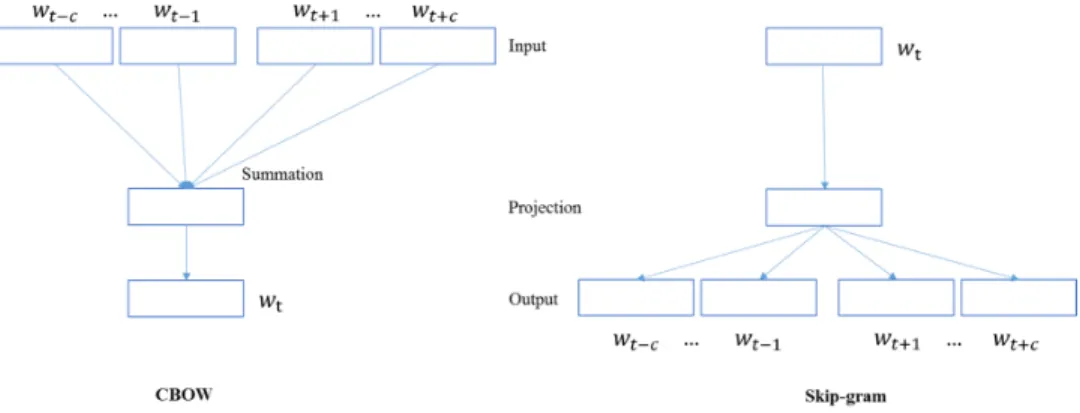
Both CBOW and Skip-gram models are three-layer neural networks, containing input, projection, and output layers, as displayed in Figure 2.4. The CBOW model learns word embedding by using context words to predict the center word wt, where the context words refer to the neighbouring words within a window sizecnear the centre word in a sentence. Given a sequence of training words
w1, w2, . . . , wT, the CBOW model has the following objective function:
J1= max 1 T T X t=1 logp(wt|wt−c, ..., wt−1, wt+1, ..., wt+c) (2.1)
centre wordwt. This model has the following objective function: J2= max 1 T T X t=1 X −c≤j≤c,j6=0 logp(wt+j|wt) (2.2)
The probability p(wt|wt+j) is calculated using a softmax function:
p(wt|wt+j) = exp(vt0Tvt+j) PN n=1exp (v 0T n vt+j) (2.3) vn and v 0
n are the input and the output representation vectors of word wn. N is the total vocabulary size. The representation vectors vn are between the input layer and projection layer, andvn0 are between projection layer and the output layer.
In the CBOW model, the projection layerhis the average value of input representation of context words. h= 1 2c X −c≤j≤c,j6=0 vt+j (2.4)
In the Skip-gram model, the projection layer his the same as the input representation of word
wt, which isvt.
2.4.3
KB Enhanced Word Embedding Models
Since word embedding models are trained through an unsupervised manner, the learned distributed representations may contain some noises. Therefore, recent studies start to explore incorporating different types of resources as auxiliary supervision to improve the performances of distributed representations [90, 91, 92, 93, 94, 95, 96]. For example, Zhou et al. [97] proposed to apply metadata of category information from community question answering to enhance learning word embedding representation. Experimental results showed that extra knowledge can improve Skip-gram model on question retrieval task.
Of all types of resources, KBs have attracted a lot of attentions and have proven valuable for improving the performances of word embedding models. Bian et al. (2014) [98] explored three
types of knowledge as additional input information to serve as auxiliary supervision in CBOW model. The three types of knowledge include semantic knowledge, morphological knowledge, and syntactic knowledge. The knowledge is acquired from four resources: Morfessor [99], Longman Dictionaries5, WordNet [100], and Freebase [101]. Experimental results on analogical reasoning task, word similarity task, and word completion task demonstrated that these extra knowledge resources can enhance the performances of the CBOW model. Xu et al. (2014) [102] introduced a new RC-NET framework to leverage both relational and categorical knowledge by integrating them as two separate regularization functions into the original optimization problem in order to enhance Skip-gram model. They applied knowledge from WordRep (Gao et al., 2014) and Freebase. Experimental results on analogical reasoning task, word similarity task, and topic prediction task showed that the quality of distributed representations is improved. Wang et al.(2014) [103] examined the relations between entities from large-scale knowledge graph and proposed a method that jointly embeds entities and words into the same continuous vector space. They used Freebase as their knowledge source and compared their method with Skip-gram model on the analogical reasoning task. Liu et al.(2015) [104] proposed to incorporate semantic knowledge into Skip-gram model. Semantic knowledge is presented as ordinal ranking inequalities to formulate the word embedding learning problem as a constrained optimization problem. They obtained semantic knowledge from WordNet. Experimental results on word similarity task, sentence completion task, name entity recognition task, and TOEFL synonym selection showed that distributed representations can be improved by incorporating semantic knowledge.
In our study (in section 5), we leverage structured KBs to enhance state-of-the-art word embed-ding models. In contrast to the aforementioned studies on enhancing word embedembed-ding representation with extra knowledge from KBs, we design a graph regularized framework to improve both CBOW model and Skip-gram model. Compared with Xu et al.(2014) [102], we have different regulariza-tion framework and have it tested on both CBOW and Skip-gram. Our work is motivated by the research work of using graph regularization to improve data representation [105]. Ordinary
negative Matrix Factorization (NMF) only considered the Euclidean structure of data, but ignores their semantic relationships. Instead, with a graph regularized NMF (GNMF), which can uncover the hidden semantics and respect the intrinsic geometric structure. GNMF achieved better results. Compared to other extra knowledge resources, a structured KB can assist to encode semantic infor-mation with the graph structures. Thus, our work is to take advantage of such structure to improve word embedding models performance, in both CBOW and Skip-gram.
2.5
Clinical Diagnosis Inference
Clinical diagnostic inferencing is a challenging task. For example, given a clinical case (past medical history, signs and symptoms etc.), the clinician administers appropriate medical tests or procedures, infers the accurate diagnosis, and prescribes the best possible treatment plan based on his/her expe-rience or up-to-date knowledge/evidence obtained through substantial research on relevant external resources. Recent works on diagnostic inferencing mostly use recurrent neural networks (RNNs) by utilizing structured clinical data e.g. physiological signals, vital signs, lab tests, and other variables [106, 107]. Clinical diagnostic inferencing can be regarded as one type of clinical questions, that is “what is the patient’s diagnosis?” Related research [108] become more and more popular due to the increasing availability of clinical datasets for public recently.
For general Question Answering (QA), there are two major parts: first, question interpretation. Understanding the question correctly is critical to QA. Semantic parsing [109, 110] has been applied to question interpretation. The second part is question-answer matching [111]. Question interpre-tation will convert the question to the database query. Some large-scale structured KBs (such as Freebase) are frequently used to match question to answers [112, 113]. One recent research trend [97, 114, 115, 116] is to apply word embedding for question-answer matching.
Regardless the rapid development in general QA domain, clinical QA, especially scenario-based question analysis [117, 3], still requires lots of input from the domain expert and a variety of sources (such as knowledge encyclopedia and domain-specific knowledge bases), and some of these resources are not easily accessed by researchers. A recent work [118] proposed a subgraph embedding model to Question answering. The subgraph embedding model learns low-dimensional embedding for words
and knowledge base constituents and uses the representations to score question against candidate answers. The subgraph embedding makes the assumption that all potential answers are entities in the KB and question word sequence contain one identified KB entity. There are two limitations when applied to CQA: (1) The potential answers may not be an entity in KB; (2) The keywords extracted from clinical question narratives could be more than one, and they may not find the identified form in KB.
The Text Retrieval Conference (TREC 2014 [119], TREC 2015 [120], and TREC 20166) released a Clinical Decision Support (CDS) task. The task requires to retrieval relevant biomedical articles for clinical reports to answer three types of generic clinical questions: Diagnosis (“what is the patient’s diagnosis?”), Tests (“what tests should the patient receive?”), and Treatment (“How should the patient be treated?”). The accurate identification of diagnosis is proved to be helpful to biomedical articles retrieving and the other two types of questions answering [121]. The development of large-scale structured KB in medical domain (such as UMLS [29]) and a lot of available data sources (such as MIMICII database [122], EMR, and etc.) promote the research work on clinical diagnosis inference. However, due to the difficult to interpret clinical narratives and the lack of complete domain knowledge, the clinical diagnosis inference is still a challenging problem.
2.6
Available Sources for Clinical Text Research
In this section, we summarize different types of available data sources for clinical text research.
2.6.1
Knowledge Bases (KBs)
One frequently mentioned knowledge resource for clinical NLP tasks is structured Knowledge Base (KB). We have witnessed a quick development of KBs in past years. KBs store structured information about entity types and relation triples. A triple is represented ashsubject, predicate, objecti. Many large-scale KBs of general or specific domains have been constructed, such as WordNet [100], Yago [123], Freebase[101], DBpedia [124], and NELL [125], UMLS [29]. KBs are useful resources and powerful tools for supporting NLP tasks such as relation extraction [126, 127] and question answering [118].
For structured KBs, UMLS Metathesaurus and Freebase provide information about semantic relation triples that are related with biomedical related concepts. The UMLS MRREL table defines the relationships between UMLS concepts. One example relation triple in the table is hconcept :
Giardiasis;relation:may be treated by;concept:F urazolidonei.
Freebase: Freebase [3] is a knowledge base contain many triples, such as h subject; predicate; objecti. There are triples from freebase that are related with medicine relation types. One example relation triple in freebase ishGiardiasis;medicine.disease.symptoms;F latulencei.
2.6.2
Shared Tasks and Datasets
Shared tasks in the biomedical domain have existed for over two decades [128]. There are differ-ent types of shared tasks in clinical NLP area [129]. They provide de-iddiffer-entified clinical notes for participants, which is one most common way for researchers to get access to clinical data.
i2b2 (Informatics for Integrating Biology and the Bedside)7 is an NIH-funded national center for biomedical computing based at partner healthcare system. They provide clinical data for re-searchers through the i2b2 NLP shared tasks. The i2b2 NLP shared tasks started from 2006. The first challenges is de-identification [130] and smoking status classification [131]. The smoking sta-tus classification provided a corpus of 502 discharge summaries [13]. Other i2b2 challenges are summarized as follows:
• 2008 obesity challenge [132]. The challenge consisted of 1237 discharge summaries of patients who were overweight or diabetic and had been hospitalized for obesity or diabetes. The task targeted on identifying obesity and its comorbidities.
• 2009 Medication Challenge [133, 17]. This medication challenge contained a total of 1243 deidentified discharge summaries, which were used for extracting medications and associated information.
• 2010 Relations Challenge [129]. The challenge contained a total of 394 training reports, 477 test reports, and 877 unannotated reports of discharge summaries, which were used for
identifying concepts, assertions, and relations.
• 2011 Coreference Challenge [134]. The challenge provided training set and the test set from four hospitals. The training set includes 492 labeled discharge summaries. The test set consists of 322 discharge summaries [135].
• 2012 Temporal Relations Challenge [136, 2]. This challenge provided 310 de-identified discharge summaries, with annotations of clinical events, temporal expressions, and temporal relations.
• 2014 De-identification and Heart Disease Risk Factors Challenge [137, 137]. The challenge provided a set of 1304 longitudinal de-identified medical records describing 296 pa-tients.
Each of these shared tasks included a corpus of clinical narratives, and these corpora are available from http://i2b2.org/NLP/DataSets with a data use agreement.
THYME corpus [138] is a collection of over 1,200 de-identified notes from the Mayo Clinic, representing patients from the oncology department, specifically those with brain or colon cancer. The corpus was used for SemEval 2015 task [139]. Deleger et al., [140] created a corpus of 3,503 de-identified medical records of 22 different types, including discharge summaries, progress notes, and referrals. Text REtrieval Conference (TREC) also provides medical records corpus. TREC 2012 Medical Records Track [141] contained 93,551 reports mapped into 17,264 visits.
TREC CDS (Clinical Decision Support) track8investigated techniques for linking medical records to information relevant to patient care. TREC CDS 2014 [19], 2015 [120], and 20169all provided ac-tual medical records, which are well-formed narratives summarizing the portions of patients’ medical record that are pertinent to the case.
2.6.3
Open Access Text Sources
For unstructured text sources, there are different types of resources can be used:
8http://trec-cds.appspot.com/
MIMIC-III [142] (Medical Information Mart for Intensive Care) is a large database comprising information relating to patients admitted to critical care units at a large tertiary care hospital. MIMIC-III contains data associated with 53,423 distinct hospital admissions for adult patients (aged 16 years or above) admitted to critical care units between 2001 and 2012. MIMIC-III is one of the most widely-used collections of clinical notes.
PMC10 (PubMed Central) is an online digital database of freely available full-text biomedical literature. It has been broadly applied to clinical NLP tasks [143, 144].
Wikipedia11 has a large collection of pages. It has clinical diseases and medicine related pages under clinical medicine category12.
DailyMed13 contains documents describing drugs.
WebMD14contains documents describing drugs. Each document contains the same 7 sections, such as Uses, Side Effects, Precautions, etc.
MayoClinic15 pages include Symptoms, Causes, Risk Factors, Treatments and Drugs, Preven-tion, etc.
These open access text sources are widely utilized for supporting clinical NLP tasks [145, 146, 147]. 10https://www.ncbi.nlm.nih.gov/pmc/ 11https://www.wikipedia.org/ 12https://en.wikipedia.org/wiki/Category:Clinical medicine 13dailymed.nlm.nih.gov 14www.webmd.com 15www.mayoclinic.org
Chapter 3: Clinical Document Clustering
Clinical documents are rich free-text containing valuable information. In this chapter, we explore to use document clustering methods to analyze the intrinsic patterns in clinical documents corpus. Concept extraction is the very first step for clinical text understanding, thus we build an integrating system for extracting medication names and symptom names from clinical notes. Based on concept extraction, we further explore different ways of using document clustering techniques to cluster clinical documents into meaningful clusters and analyze latent patterns from clinical documents [148].
3.1
Motivation
Clinical notes contain valuable information about patients, such as medication conditions (diseases, injuries, medical symptoms, and etc.) and responses (diagnoses, procedures, and drugs) [149]. These underutilized resources have a huge potential to improve health care. Different types of valuable information extracted from clinical notes can be used to build profiles for individual patients [150], discover disease correlations [151] enhance patient care [152], and etc.
Symptoms and medications are two important types of information that can be obtained from clinical notes. Symptom-related information such as diseases, syndromes, signs, diagnose etc., can be used to analyze diseases for patients. In addition, valuable medication information is commonly embedded in unstructured text narratives spanning multiple sections in clinical documents [153]. Medication information from clinical notes is often expressed with medication names and other signature information about drug administration, such as dosage, route, frequency, and duration. Thus symptom information and medication information extraction for clinical notes usually need sophisticated clinical language processing methods [10]. We want to explore efficient ways to extract symptoms and medications names from clinical notes.
Figure 3.1 A Clinical Note Example with Several Selected Sections.
[154, 155]. Different types of clinical notes are generated for various of purposes and from different occasions. For example, patient admission note, discharge note, laboratory report, and etc. Among them, physician’s visit notes are one of the most important notes for patients. They are generally organized into four SOAP sections [28]. SOAP1standards for subjective, Objective, Assessment and Plan. Even these clinical notes have such loosely organized structure, important medical concepts still exist in the unstructured or semi-structured text. Due to the individual diversity of clinical narratives, it is a challenging problem to discover the underlying patterns from a corpus of clinical documents.
3.2
Clincal Notes Analysis
Clinical notes are an important format of patient records, and most of the clinical notes are in unstructured free-text format. An example of clinical note with a few selected sections is displayed in Figure 3.1. There are three sections included in this clinical note example: Principal Diagnosis, List of Problems/Diagnoses, andMedicines.
Symptom and medication names are mentioned in this clinical note example. As shown in Fig-ure 3.1, these highlighted names are embedded in multiple sections of unstructFig-ured/semi-structFig-ured text. The symptom and medication names are important concepts delivering information about pa-tients, disease progression. They are critical for physicians and patients to understand this clinical
note.
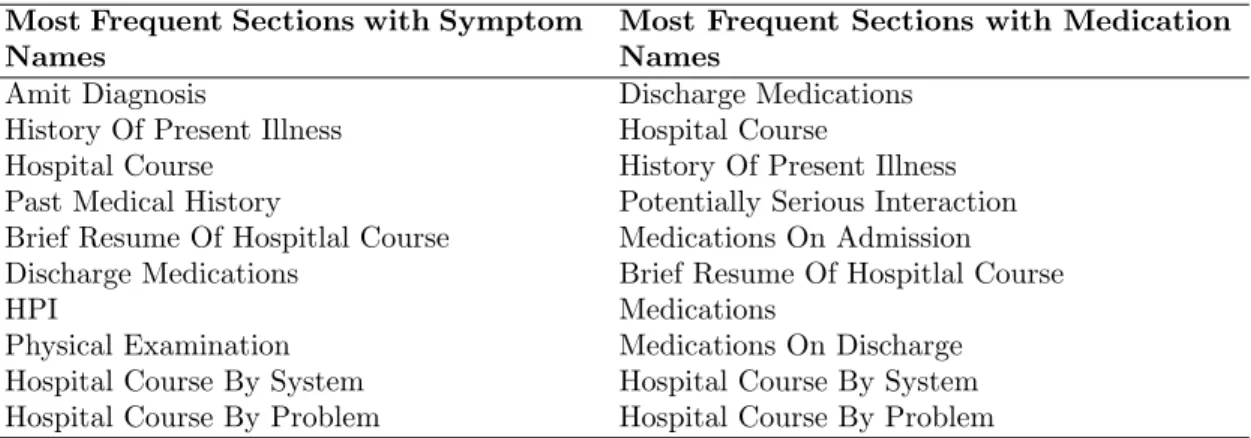
We conduct statistical analysis on one of our experiment dataset (Details in Section 3.5.1). The most frequent sections in clinical notes contain medication/symptom names are displayed in Table 3.1. Discharge Medications, History of Present Illness, Hospital Course, Brief Resume of Hospital Course,Hospital Course By System, andHospital Course By Problem are six most frequent sections contain both symptom names and medication names.
Table 3.1 Most Frequent Clinical Notes Sections with Medication/Symptom Names Most Frequent Sections with Symptom
Names
Most Frequent Sections with Medication Names
Amit Diagnosis Discharge Medications
History Of Present Illness Hospital Course
Hospital Course History Of Present Illness
Past Medical History Potentially Serious Interaction Brief Resume Of Hospitlal Course Medications On Admission Discharge Medications Brief Resume Of Hospitlal Course
HPI Medications
Physical Examination Medications On Discharge Hospital Course By System Hospital Course By System Hospital Course By Problem Hospital Course By Problem
3.3
Concepts Extraction Framework
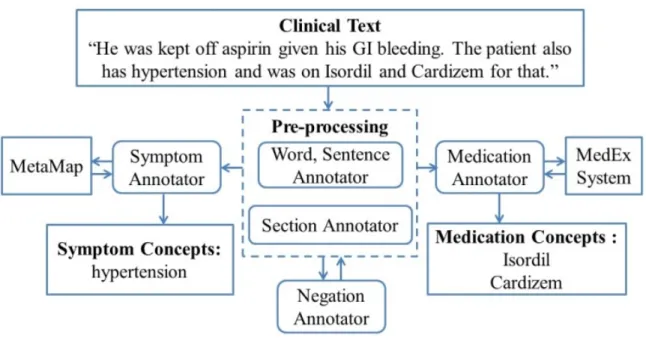
In this section, we present a clinical concepts extraction framework. An overview of extracting symptoms and medications from clinical notes is showed in Figure 3.2. We build the framework to extract the symptom names such as “hypertension” and medication names such as “Isordil, Cardizem” from the clinical texts “He was kept off aspirin given his GI bleeding. The patient also has hypertension and was on Isordil and Cardizem for that.” The overall system contains five parts: word/sentence annotator; section annotator; negation annotator; symptom name annotator; and medication name annotator.
First, we process clinical notes to identify words and sentences from clinical notes using Stanford CoreNLP Tool2. During the pre-processing, we use section annotator to identify different sections for each clinical note. The section annotator depends on the section header information from clinical
Figure 3.2 An overview of symptom/medical term extraction from Clinical Notes.
notes. Negation sections, such as “ALLERGIES” or “Family History”, are excluded. For example, “She is allergic to MORPHINE” from the section “ALLERGIES”, the medication name “MOR-PHINE” is a negation medication name, so we exclude it.
We also use negation annotator to remove negation symptom and medication names. An example is that “The patient was told to avoid taking aspirin or any other NSAIDs given his GI bleed”, we remove “aspirin” and “NSAIDs” because of the pre-negation words avoid. Pre-negation and post-negation are defined in Negation maker (i.g. NegEx3). Pre-negation is negation words like avoid, deny, cannot, without, and so on. Post-negation is negation words like free, was ruled out, and so on.
After pre-process, we use symptom annotator based on the MetaMap [21] to extract symptom names from clinical notes. Meanwhile, we use medication annotator based on MedEx System [15] to extract medication names from clinical notes.
We use MetaMap to extract symptom names from clinical notes. MetaMap4 is a program that maps biomedical texts to concepts in the UMLS Meta-thesaurus [21, 34]. Since Metamap returns all
3http://www.dbmi.pitt.edu/chapman/NegEx.html 4http://nls3.nlm.nih.gov
types of concepts, we only keep these concepts related to symptom names, such as concept labeled as “sosy”, which represents “sign and symptom”. The related types of concepts include: {sosy,dsyn, neop,fngs,bact,virs,cgab,acab,lbtr,inpo,mobd,comd,anab}, see [28] in detail.
We use MedEx system to extract medication names from clinical notes. The MedEx system is a natural language processing system to extract medication information from clinical notes [15].
In clinical notes, medication data are often expressed in medication names and signature in-formation about drug administration. The MedEx system extracts multiple semantic categories of medication findings from clinical notes, such as DrugName, Strength, Route, Frequency, Form, Dose Amount, IntakeTime, Duration, Dispense Amount, Refill, and Necessity. Here we use the DrugName as medication name.
3.4
Document Clustering Methods
3.4.1
Nonnegative Matrix Factorization (NMF)
Nonnegative Matrix Factorization (NMF) is a useful tool for the decomposition of multivariate data [156, 157]. The basic idea for NMF is to factorize an×mmatrixAinto a nonnegativen×kmatrix
W and a nonnegativek×mmatrixH to approximate:
A≈W×H (3.1)
W andH are two lower dimensional non-negative matrices. The value kin NMF can be explained as a number of “meaningful” clusters. The choice of kvalue is important. In reference [158], they developed approach to decidekbased on a consensus matrix and cophenetic correlation coefficient. As discussed in [105], there are two commonly used cost functions can be applied to the approx-imation. The first one is using the square of Euclidean distance:
C1=kA−W Hk 2
The cost function can be minimized by applying the update rules as follows: Hαµ←Hαµ (WTA) αµ (WTW H)αµ (3.3) Wia←Wia (AHT)ia (W HHT) ia (3.4)
The second one is using the “divergence”:
C2=D(A||W H) (3.5)
The cost function can be minimized by applying the update rules as follows:
Hαµ←Hαµ P iWiaAiµ/(W H)iµ P kWka (3.6) Wia←Wia P
µHaµAiµ/(W H)iµ P
vHav
(3.7)
3.4.2
Multi-View NMF
NMF has been extended to multi-view learning. Multi-view learning aims to identify latent compo-nents in different sub-matrices in a simultaneous manner. These sub-matrices can represent different features spaces. Akata et al [48] extends the basic NMF to a convex combination ofpdifferent views as following optimization problem:
min Wi,H≥0 p X i=1 λi Ai−WiH 2 , (3.8) p X i=1 λi= 1, λi≥0 (3.9)
Due to constraint that matrix H is fixed among multiple views, Liu et al [49] further extend to solving the following optimization problem:
min Wi,Hi,H∗≥0 p X i=1 Ai−WiHi 2 + p X i=1 λi Hi−H∗ 2 (3.10)
This problem attempts to optimize Ai ≈WiHi for each viewi, and keep constraining eachHi will be similar.
3.5
Clinical Concepts Enhanced Document Clustering
In this section, we apply NMF and multi-view NMF to cluster clinical notes into meaningful clus-ters based on sample-feature matrices. Our experimental results show that multi-view NMF is a preferable method for clinical document clustering. Moreover, we find that using extracted medica-tion/symptom names to cluster clinical documents outperforms just using words.
3.5.1
Datasets
We conduct experiments on two datasets, the two datasets are acquired from i2b2 workshop on NLP challenges 5 at two different years: 2009 clinical notes dataset [17] and 2014 clinical notes dataset [159, 137].
Datasets Description
2009 dataset contains 1249 clinical notes in total. After pre-processing, 1239 clinical notes remain. One clinical note example is displayed in Figure 3.1.
2014 clinical notes dataset contains 1304 records from 296 patients. Each patient has about 3-5 records. Compared with 2009 clinical notes dataset, this dataset was applied for the risk factor identification for heart disease track. All the risk factors are annotated in these records. We classify these risk factors into symptom names or medication names. The original records have standard to indicate three types of patients. The first type is patients who develop Coronary Artery Disease (CAD), the second type is patients who have CAD in their first records, and the third type is patients
Figure 3.3 The Framework of Applying Multi-view NMF.
never develop CAD. We use this as standard to evaluate the cluster performance from multi-view NMF.
Preprocessing
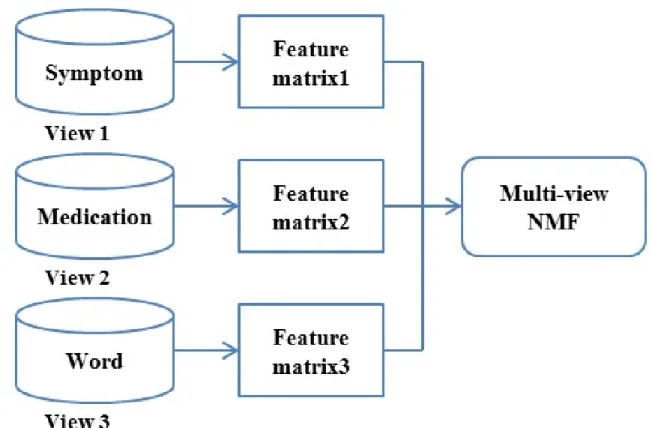
We preprocess the dataset to generate the sample-feature matrices as shown in Figure 3.3. For 2009 dataset, we process each clinical record as a sample. While for 2014 dataset, each patient is processed as a sample. Each sample can be represented from three views: symptom names, medication names, and words. For the words set, we remove common stop words and clean the data. We generate features from these three views using word count or Term Frequency-Inverse Document Frequency (TF-IDF).
After preprocessing, we get these sample-feature matrices. The matrices’ attributes are presented in Table 3.2.
Table 3.2 Sample-Feature Matrices Size
#Size 2009 Clinical Notes Dataset 2014 Clinical Notes Dataset
Samples 1239 296
Symptom Features 2294 21
Medication Features 1029 18
Unique Words - 17492
are 1029 correspondingly. For 2014 clinical notes dataset, medication features are 21, medication features are 18, and words feature are 17492.
3.5.2
Evaluation Metrics
For 2009 clinical notes dataset, since we don’t have standard to evaluate the clustering result. We present and analyze the major features standout from each component factorized.
For 2014 clinical notes dataset, we use accuracy and normalized mutual information (NMI) as evaluation metrics [160].
Accuracy represents the number of correctly classified compared with known class labels. The higher accuracy means better performance.
NMI measures the clustering performance, the higher the better.
N M I = P h,lnh,llog nh,l nh,nl q Q i=h,inilog ni n (3.11)
Wheren represents the total number of documents,nh is the number of document in standard classh,nl is the number of documents in predicted cluster l, and nh,l is the number of documents in both clustershand l.
3.5.3
Experimental Results
2009 Clinical Notes Dataset Results
We choosek= 5 to cluster documents into 5 groups. For each document clusters, the top 10 features with the highest weight are listed in Table 3.3 (NMF results) and Table 3.4(Multi-view NMF results).
Table 3.3 2009 DATASET RESULTS (NMF)
# Symptom Medication
1 Pain; meds (microcephaly, epilepsy, and diabetes syndrome); infections
Fluvastatin; nicardipine; methyldopa; am-photericin; thera; ammonia; hydroxyzine hcl
2 Congestive heart failure; coronary artery disease; secondaries (neoplasm metasta-sis); diabetes
Emtricitabine; potassium citrate; bicalu-tamide; mcp; dipyridamole
3 Ischaemia; nausea; congestive heart fail-ure; symptoms
Procaine; hydroxyzine hcl; menthol; dex-tran 40; linezolid; clopidogrel bisulfate 4 Hypertension; obesity; asthmatics;
pul-monary failure; gout; apnea, sleep apnea syndromes; mental depression; hepatitis b; diabetes mellitus; depressive disorder
-5 Erythema; diarrhea; abdominal pain; haematocrit; obesity; wound; place (ocular myopathy with hypogonadism); vomiting
Beta blockers; emtricitabine
Table 3.4 2009 DATASET RESULTS (MULTI-VIEW NMF)
# Symptom Medication
1 Hyperlipidaemia; hypercholesterolaemia; polycythaemia; gerd; hypertensive disease
Aspirin; Lisinopril; furosemide; phencycli-dine; metoprolol
2 Chest pain; constipation; facial hemiatro-phy; pain; food-drug interactions
Heparin, porcine; digoxin; amiodarone; furosemide; warfarin
3 Place (ocular myopathy with hypogo-nadism); haematocrit; secondaries (neo-plasm metastasis); pain; chest pain
Dextrose; insulin; metoprolol; aspirin; cre-atinine
4 Diabetes mellitus; glaucoma; hepatitis c; hepatitis c virus; congestive heart failure
Prednisone; insulin, aspart, human/rdna; acetaminophen; vancomycin; levofloxacin 5 Diabetes mellitus; depression; diabetes;
sleep apnea, obstructive; asthma
Insulin glargine; albuterol; Lisinopril; digoxin; furosemide
In Table 3.3, all the major features in component 4 are symptom names. While Multi-NMF can get uniform symptom names and medication names for each cluster. The solution provides a way to observe intrinsic patterns between symptom names and medication names in each cluster. 2014 Clinical Notes Dataset Results
We choosek= 3 and k= 2. k= 3 represents clustering patients into three groups: the first type is patients who develop Coronary Artery Disease (CAD); the second type is patients who have CAD in their first records; and the third type is patients never develop CAD. The result is shown in Table 3.5.
Table 3.5 2014 DATASET RESULTS (K= 3) Feature
Type
Views Accuracy(%) NMI
Count Words 40.54 0.0228 Symptom/Medication 52.03 0.1273 All 3 views 53.38 0.1459 TF-IDF Words 35.47 0.0020 Symptom/Medication 52.36 0.1606 All 3 views 52.36 0.1711
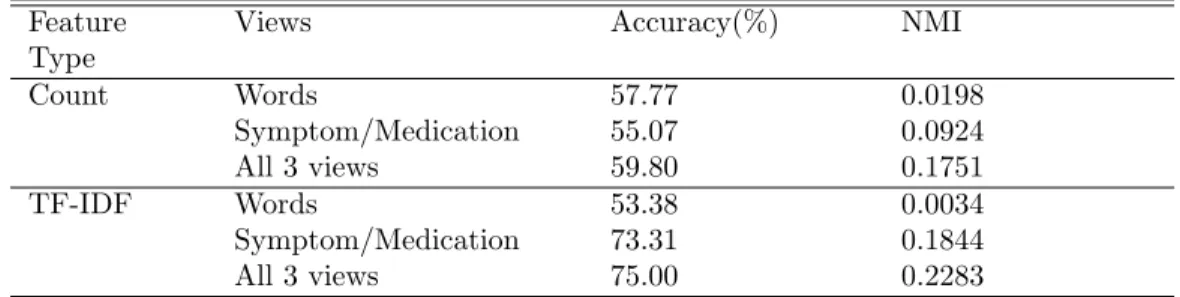
k = 2 represents clustering patients into two groups: The first type is patients who develop Coronary Artery Disease (CAD) or have CAD in their records, and the second type is patients never develop CAD. The result is shown in Table 3.6.
Table 3.6 2014 DATASET RESULTS (K= 2) Feature
Type
Views Accuracy(%) NMI
Count Words 57.77 0.0198 Symptom/Medication 55.07 0.0924 All 3 views 59.80 0.1751 TF-IDF Words 53.38 0.0034 Symptom/Medication 73.31 0.1844 All 3 views 75.00 0.2283
In both Table 3.5 and Table 3.6, we use word counts and TF-IDF as features to generate the feature matrices. Using symptom names and medication names have better accuracy and NMI than just using words. Using all 3 views (words, symptom names, and medication names) together can achieve the highest performance.
The results of using all three views are compared between NMF and multi-view NMF are shown in Figure 3.4.
When k = 3, using word count as feature shows that multi-NMF achieves about 12% higher accuracy than NMF. It has 14% higher accuracy when using TF-IDF as features. Whenk= 2, using word count as the feature, multi-view NMF has the same accuracy as NMF. While using TF-IDF as features, multi-view NMF has 24% higher accuracy. Multi-view NMF has better performances
Figure 3.4 Accuracy from Multi-view NMF and NMF.
than NMF.
3.5.4
Discussion
In this section, we use extracted symptom/medication names combined with words as three-views from clinical notes and then apply multi-view NMF for documents clustering. Two different datasets are used to compare multi-view NMF with NMF. The 2009 clinical notes dataset presents major features contained in each cluster. For 2014 clinical notes dataset, we use accuracy and NMI as evaluation metrics to compare results. It showed that by using symptom names and medication names, the clustering performance can be improved. It also indicates that multi-view NMF can achieve better results than NMF.
In the future work, we may consider using other information, such as patients age/gender/demographical information, to improve clustering performance; and also explore intrinsic relationships among dif-ferent views. We also plan to use the document clustering results to improve medication recommen-dation as discussed in this work [24].
![Figure 1.1 Percent of non-federal acute care hospitals with adoption of EHR systems by level of functionality: 2008 - 2015 (Statistics from Henry et al [1]).](https://thumb-us.123doks.com/thumbv2/123dok_us/9899016.2483384/15.918.167.809.110.425/figure-percent-federal-hospitals-adoption-systems-functionality-statistics.webp)

![Figure 2.1 An Example of Clinical Notes (Data from Sun et al [2]).](https://thumb-us.123doks.com/thumbv2/123dok_us/9899016.2483384/22.918.158.805.109.475/figure-example-clinical-notes-data-sun-et-al.webp)
![Figure 2.3 The Emerald [3].](https://thumb-us.123doks.com/thumbv2/123dok_us/9899016.2483384/27.918.170.806.104.599/figure-the-emerald.webp)