Durham Research Online
Deposited in DRO: 16 April 2020
Version of attached le: Accepted Version
Peer-review status of attached le: Peer-reviewed
Citation for published item:
He, G. and Marginson, D. (2020) 'The impact of insider trading on analyst coverage and forecasts.', Accounting research journal. .
Further information on publisher's website:
https://doi.org/10.1108/ARJ-08-2019-0148
Publisher's copyright statement:
This article is made available under a Creative Commons Attribution Non-commercial International Licence 4.0 (CC BY-NC 4.0) and any reuse must be in accordance with the terms outlined by the licence.
Additional information:
Use policy
The full-text may be used and/or reproduced, and given to third parties in any format or medium, without prior permission or charge, for personal research or study, educational, or not-for-prot purposes provided that:
• a full bibliographic reference is made to the original source • alinkis made to the metadata record in DRO
• the full-text is not changed in any way
The full-text must not be sold in any format or medium without the formal permission of the copyright holders. Please consult thefull DRO policyfor further details.
Durham University Library, Stockton Road, Durham DH1 3LY, United Kingdom Tel : +44 (0)191 334 3042 | Fax : +44 (0)191 334 2971
1
The impact of insider trading on analyst coverage and forecasts
Guanming He*
Durham University Business School, Durham University David Marginson
Warwick Business School, University of Warwick
* Corresponding author. Email: [email protected]. This paper has benefited from the helpful
comments and suggestions of anonymous reviewer, together with Shivaram Rajgopal (discussant), Ken Peasnell (discussant), Mark Bradshaw, Steven Huddard, Carole Comerton-Forde, and workshop participants at the Global Emerging Scholars Research workshop, American Accounting Association annual meeting, and 28th EBES conference. We also thank Peggy Zhu for her research assistance to the earlier version of this
2
The impact of insider trading on analyst coverage and forecasts
Abstract: We examine the effect of insider trading on analyst coverage and on the properties of analyst forecasts. We find that the level of analyst coverage is positively related to the intensity of insider trades and that analyst coverage is more strongly associated with insider purchases than with insider sales. We also find that the positive association between analyst coverage and insider trades is less pronounced after the passage of Regulation Fair Disclosure. Further investigations reveal that: (i) analysts revise their earnings forecasts upwards following insider purchases, (ii) the informativeness of analyst forecast revisions significantly increases following insider purchases, and (iii) optimistic bias in analyst forecast revisions is reduced as a result of insider purchases; we do not find similar evidence for insider sales. Our study contributes to understanding the role that insider trading may play in shaping analyst behaviour.
Keywords: insider sales; insider purchases; analyst following; Regulation Fair Disclosure; analyst forecast properties
3
1. Introduction
Financial analysts, either as information intermediaries or information providers, play an important role in financial markets; crucially, they provide forecasts of firms’ future earnings prospects (Marcus and Wallace, 1991). In making earnings forecasts, financial analysts rely on a variety of information sources, including financial statements, voluntary disclosures, and management-provided information. Firms’ management is known to engage in insider trades, and such activities may offer analysts a further potentially useful source of information for making forecasts. Despite this, relatively little attention has been paid to understanding the role insider trading may play in analyst research activities. The objective of our study is to examine whether and to what extent financial analysts refer to insider trading information in their decision-making processes. In particular, we look at the impact of insider trading on analyst coverage, and at how such impact may vary in response to the implementation of Regulation Fair Disclosure (hereafter, Reg FD). We also examine how insider trades affect the properties of analyst earnings forecasts, including forecast revisions, forecast informativeness, and forecast errors.
Insider trades refer to stock trades executed by company officers, directors, and shareholders who hold 10%, or more, of equity securities of a firm (SEA, 2011). Such trades are widespread and are required to be filed with SEC and released to the public. Empirical studies (e.g., Ke et al., 2003; Piotroski and Roulstone, 2005; Seyhun and Bradley, 1997; John and Lang, 1991; Lee et al., 1992) provide evidence that insider trades convey private information about future firm performance. Given this, insider trades should increase the amount of relevant information available to analysts, helping them reach more accurate and consistent forecasts at lower information gathering and/or processing costs. Put differently, in the absence of insider trading information, analysts may have to exert greater effort and incur more costs to maintain forecast accuracy; this reduces the net benefits to analysts of providing earnings forecasts. Moreover, to the extent that investors perceive themselves less capable than analysts to process insider trading information promptly and to infer its implications for future earnings, investors would be more reliant on analyst reports, thereby inducing more analyst following.
4
As such, we expect that the level of analyst coverage will increase with the intensity of insider trades. We also examine the separate effects of insider purchasing vis-à-vis insider selling on analyst coverage. Prior studies (Frankel and Li, 2004; Lustgarten and Mande, 1995; Carpenter and Remmers, 2001; Seyhun, 1990) show that insider sales might be driven by insiders’ liquidity needs or investment diversification rather than by insiders’ pessimistic expectations about future firm performance; whereas insider purchases usually occur when insiders foresee positive prospects for their firms. On this basis, insider sales are relatively less informative about a firm’s future prospect than are insider purchases.1 Thus, we expect that, compared to insider selling, insider purchasing has a greater impact
on analyst coverage.
Our empirical analysis is based on a sample of U.S. firms listed on the NYSE, AMEX, or NASDAQ. Sample period is 1995-2012. After taking steps to control for endogeneity, we find that analyst coverage increases with increasing intensity of insider trades. We also find that the positive impact of insider purchases on analyst coverage is larger than that of insider sales, suggesting that insider purchases are regarded by analysts as being more informative about a firm’s future prospect than insider sales.
To supplement our research, we examine how the impact of insider trading on analyst coverage varies in response to the implementation of Reg FD. In August 2000, the U.S. Securities and Exchange Commission (SEC) adopted Reg FD with an aim to establish a level playing field for all investors (SEC, 2000). Reg FD proscribes insiders from disclosing private information to analysts without simultaneously disclosing it to the public. If this leads to a decline in corporate disclosures (i.e., the situation in which insiders convert their selective disclosure strategies to fewer- or
1 The underlying reasons are threefold. First, insider sales, once perceived to be informationally driven, would
expose a firm to higher litigation risk than would informed insider purchases (e.g., Cheng and Lo, 2006). As such, managers might have a relatively stronger incentive to engage in informed insider purchases vis-a-vis informed insider sales. Second, compared to insider sales, insider purchases are less likely to be made for portfolio rebalancing reasons (Frankel and Li, 2004). Third, insiders would incur opportunity costs for purchasing shares of their firms (e.g., Cheng and Lo, 2006), and are prevented by short-swing profit rule from purchasing (selling) and selling (purchasing) their companies’ shares within a given six-month period. Thus, it is less likely that insider purchases are made based on contrarian beliefs. Rather, insiders buy shares only when they believe that their companies will perform well in the long term. For the above three reasons, compared with insider selling, insider purchasing is relatively more likely to be driven by insiders’ superior information about future firm performance.
5
disclosure strategies due to the concern of proprietary costs of disclosures), then analysts’ demand for, and reliance on, insider trading information would likely increase. In this context, we predict that the positive association between insider trading and analyst coverage is more pronounced in the post-Reg-FD period. However, if Reg FD increases the quantity and quality of information disclosed to the market (i.e., the situation in which insiders actively convert their selective disclosure strategies to fair public disclosures), outside investors’ demand for analyst services may be reduced, and consequently, the benefits of providing such services will decrease. In this case, analysts have a weaker incentive to seek to integrate insider trading information into their research.2 We therefore
expect that the impact of insider trading on analyst coverage is weaker in the post-Reg-FD period. Consistent with the second expectation, we find evidence that Reg FD weakens the positive association between insider trading and analyst coverage, which suggests that Reg FD improves firms’ information environments.
Pre-Reg-FD, analysts are likely to have had frequent communications with insiders about their private information. As such, our main evidence that more frequent insider trades lead to high analyst coverage might be subject to an alternative explanation. This is that managers alert analysts to the insider trades, and explain the rationale behind such trades, via private communications, rather than analysts themselves referring to, and learning from, insider trades. To negate or minimize such a possibility, we restrict our sample period to the post-Reg-FD era, in which the communications between insiders and outsiders about private information are significantly more restricted (see, e.g., Koch et al., 2013; Dong et al., 2017; Hu et al., 2018). We obtain qualitatively the same results.
We conduct three additional tests aimed at offering insight into how insider trades may affect analyst earnings forecasts. First, we examine the impact of insider trades on analyst forecast revisions. We expect that analysts would revise their forecasts in the direction of insider trades. To the extent
2 Integration of any value-relevant information, including insider trades, into valuation research for making trading
decision would entail costs, which are termed integration costs. Hodge et al. (2014) and Blankespoor et al. (2019) define such costs as including “costs necessary to evaluate, combine, and incorporate information into valuation models and trading decisions”.
6
that insider purchases are more informative than insider sales, the upwards revision analysts make in response to insider purchases should be larger than the downwards revisions made in response to insider sales. Our results confirm this prediction.
Second, we investigate the impact of insider trading on the informativeness of analyst forecast revisions. Following Frankel et al. (2006), we measure the informativeness of analyst forecast revisions by reference to stock market reactions to the forecast revisions. We find that insider purchases significantly increase the informativeness of analysts’ revised forecasts, whereas insider sales do not. This result is in line with our previous evidence that, compared to insider sales, insider purchases have a larger impact on analyst coverage and forecast revisions. This result also lends support to the view that insider purchases are more informative and help increase the value of analyst services to a larger degree than do insider sales.
For the third additional test, we examine whether errors in analysts’ revised forecasts are related to insider trades. In line with prior research (e.g., Duru and Reeb, 2002), forecast error is measured based on the deviation of analyst revised forecast of EPS from actual EPS. We find that analysts’ revised forecasts following insider purchases are less optimistically biased. This result, combined with our early finding regarding analyst forecast revisions made in response to insider purchases, suggests that analysts appear to integrate insider purchases in an appropriate manner into their forecasts. Unlike the case of insider purchases that are predominantly information-driven, analysts might not be able to discern information-motivated sales from liquidity- or diversification- motivated sales, especially absent access to private corporate information post Reg FD. Consistent with this notion, we find no evidence that analyst revised forecasts are less pessimistically biased as a result of insider sales, but rather, find results, albeit marginally significant, that insider sales drive analysts’ revised forecasts to be pessimistically biased for the post-Reg-FD era.
To assure that our foregoing regression results for the impact of insider trading on analyst coverage and forecast properties are, as far as possible, free from correlated-omitted-variables bias, we follow Larcker and Rusticus (2010) to perform the impact threshold for a confounding variable
7
(ITCV) test. We find that the absolute value of ITCV estimated for each of our regressions is higher than the absolute value of the impact factor for all the control variables used in the regression. This suggests that our results are robust to potential correlated omitted variables.
The key contribution of our study is as follows. A large body of insider trading literature (e.g., Johnson et al. 2009; Badertscher et al. 2011; Thevenot 2012; Skaife et al. 2013; Billings and Cedergren 2015; Dechow et al., 2016) provides evidence that insiders actively trade on their private information, such as their foreknowledge of price-relevant corporate events. This literature suggests that insider trades are potentially value-relevant and are informative about a firm’s future prospect. However, less research attention has been paid to investigating how insider trades might affect market participants’ (especially sophisticated participants’) behavior. Our study contributes to this line of literature by examining whether and how insider trades influence analyst behavior. Given the central role of analysts for information diffusion in stock markets, advancing understanding of the role insider trades may play in analyst coverage and forecasts, especially in the context of a changed legal environment (e.g., the implementation of Reg FD), should be a worthy goal. To the best of our knowledge, our study is the first to provide evidence of a positive association between insider trades and analyst coverage. By accounting for the post-Reg-FD regime, our paper is also the first to offer evidence on how analysts, in the absence of access to management’s private information due to the regime change by Reg FD, react to insider trades.
Our study also contributes to the insider trading literature in the following two ways. First, there is an ongoing debate about the benefits and drawbacks of insider trading. Opponents of insider trading view insider trades as inequitable and immoral and assert that restricting insider trades reduces resource misallocation and benefits the whole society. Proponents contend that insider trading accelerates price discovery process, increases market efficiency (e.g., Leland, 1992; Bernhardt et al., 1995; Choi et al., 2016), and may even play a role in rewarding and motivating executives (e.g., Roulstone, 2003; Denis and Xu, 2013). Our research documents that insider trading increases the amount of information valuable to analyst research activities and helps enhance analyst services.
8
Second, prior research (e.g., Frankel and Li, 2004; Lustgarten and Mande, 1995; Carpenter and Remmers, 2001) maintains that insider sales are less informative about a firm’s future prospect than are insider purchases, since insider sales might take place for the liquidity and diversification purposes. By probing the stock price responses to insider selling activities, Lakonishok and Lee (2001), Jeng et al. (2003), and Fidrmuc et al. (2006) infer that insider selling is not informative about future firm performance. However, for such an inference, we cannot rule out the possibility that insider sales do
convey value-relevant information, but the stock market does not react correctly to such trading information (e.g., Beneish and Vargus, 2002). Because we focus on examining analysts’ responses to insider sales, and analysts are supposed to be sophisticated in information processing, our study adds more compelling evidence for the notion that insider sales convey less information about a firm’s future prospect than do insider purchases.
The paper proceeds as follows. Section 2 describes the data. Section 3 presents our research design. Section 4 discusses our empirical results. Section 5 carries out the additional tests. Section 6 concludes.
2. Data
Our empirical analysis is based on data gathered primarily from I/B/E/S, CRSP, Compustat, Factset, and Thomson Financial. Our sample covers U.S. listed firms, as Reg FD enforced by the American Securities Exchange Commission provides a good setting to examine how insider trades shape analyst behavior. Financial analyst data are taken from I/B/E/S. In the years before 1995, analyst coverage is sparse, and the “estimate date” in the I/B/E/S detail file often does not accurately represent the release dates of analyst forecasts (Frankel et al., 2006; Clement et al., 2011). Therefore, our sample period is from 1995 to 2012.
Insider trading data are obtained from Thomson Financial Insider Research Services Historical Files. Consistent with Huddart and Ke (2007) and Huddart et al. (2007), insider trading transactions used in the empirical tests are limited to open market stock purchases and open market stock sales.
9
Non-open-market transactions, such as dividend reinvestments, stock transfers among family members, and pension transactions, are excluded. We further restrict insider trading transactions to those executed by officers and directors only, excluding those executed by non-officer employees who are unlikely to influence major corporate decisions.3 Data on institutional holdings are obtained
from Factset. Other data are from CRSP and Compustat. We require that firms have necessary data available on CRSP, Compustat, I/B/E/S, Factset, and Thomson Financial to construct the variables of interest. The final sample for our analysis comprises 45,195 firm-year observations for 8,923 unique firms.
3. Research design
We employ the following firm-fixed effects regression models to test the impact of insider trades on analyst coverage:4
0 1 2 3 4 5 6
7 8 9 10 11 12
+ 13
14 15
loganalyst logtrade fd tradingvol beta retvol price
size btm insti rd qtrret roa + α litigation+
α year - fixed effects+α firm - fixed effects+
(1) 0 1 2 3 4 5 6 7 8 9 10 11 12 13 + 13 14 15
loganalyst lognetsale lognetbuy fd tradingvol beta
retvol price size btm insti rd qtrret roa +
α litigation+α year - fixed effects+ α firm - fixed effects+
(2)
The dependent variable for models (1-2) is loganalyst, whichequals the natural logarithm of one plus the number of analysts making at least one earnings forecast for a given firm for a given fiscal year after the beginning of the third fiscal quarter.5 loganalyst equals 0 if no analyst forecasts
3 Our results hold if we use insider trades made by CEOs, CFOs, and chairmen of boards (namely, senior insiders)
only.
4 As with some prior studies (e.g., Kim et al., 2011), we use a firm-fixed-effects regression model to mitigate
potential endogeneity problem. The firm-fixed-effects model is widely used in archival research to mitigate endogeneity problems (Wooldridge, 2000; He, 2015; Swanquist and Whited, 2018). Our results are qualitatively identical if we apply OLS regression model for the empirical tests.
5 In this paper, analyst coverage and the properties of analyst forecasts are measured based on the period starting
from the beginning of the third fiscal quarter, because analysts are reluctant to issue/revise their annual earnings forecasts in the first two fiscal quarters (e.g., Stickel, 1989). Accordingly, our insider trading measures are constructed based on the period of the first two fiscal quarters. Our results for the hypothesis tests remain qualitatively unchanged if we alternatively use the third (fourth) fiscal quarter as the measurement period for insider
10
earnings for a firm. logtrade in model (1) equals the natural logarithm of one plus the number of shares traded by all the directors and officers of a given firm over the first two fiscal quarters.6 As
with prior research (e.g., Cheng et al., 2013), we use two treatment variables, lognetbuy and
lognetsale, in model (2) to separate insider sales from insider purchases. lognetbuy is the natural logarithm of one plus the volume amount of net insider purchases (i.e., insider purchases minus insider sales) made by the directors and officers of a given firm over the first two fiscal quarters, if that firm has a positive volume amount of net insider purchases, and equals 0 if the firm has a negative/zero volume amount of net insider purchases. lognetsale equals the natural logarithm of one plus the volume amount of net insider sales (i.e., insider sales minus insider purchases) made by the directors and officers of a firm over the first two fiscal quarters, if the firm has a positive volume amount of net insider sales, and equals 0 if the firm has a non-positive volume amount of net insider sales.7 logtrade, lognetbuy, and lognetsale are all constructed based on daily trading data; we
aggregate daily inside trades to obtain overall trading volume over the first two fiscal quarters. Following prior research on the determinants of analyst coverage (e.g., Hayes, 1998; Mohanram and Sunder, 2006; He et al., 2019a, b), we include the following control variables in our regression models: research and development expenditures (rd), book-to-market ratio (btm), size (size), firm beta (beta), stock return variance (retvol), stock price (price), stock returns (qtrret), trading volume (tradingvol), institutional stock ownership (insti), return on assets (roa), litigation risk (litigation), and an indicator variable for the post-Reg-FD period (fd). All control variables are defined in the Appendix.
To test how Reg FD moderates the association between insider trading and analyst coverage, we
trades (analyst coverage/forecast properties). Our results are also amenable to estimating analyst coverage to be one-year lagged by insider trades.
6 Insiders would bear legal and reputational risks for trading on private information. Therefore, insiders might opt
to reduce detection risk, and associated reputational losses and threat of litigation for informed insider trades, by making routine trades in place of non-routine trades. As such, routine insider trades might still be informative. Therefore, we do not separate routine insider trades from non-routine insider trades in our main analysis. Our results still hold for restricting the measures of insider trades to non-routine trades only.
7 All our results remain qualitatively unchanged if the dollar value of shares traded by insiders is used to define
11
augment model (2) with two interaction terms, fd*lognetsale and fd* lognetbuy, and derive the following regression model:
6 7 8 9 10
0 1 2 3 4
5 11 12 13
14 15 16 17 18
loganalyst = α + α fd * lognetsale + α fd * lognetbuy + α lognetsale + α lognetbuy +α fd + α tradingvol + α beta + α retvol + α price + α size + α btm + α insti + α rd +α qtrret + α roa + α litigation + α year - fixed effects + α firm - fixed effects +
(3)
fd*lognetsale and fd*lognetbuy reflect the incremental impact of insider trading on analyst coverage in the post-Reg-FD period relative to the pre-Reg-FD period.
4. Empirical results
4.1 Univariate results
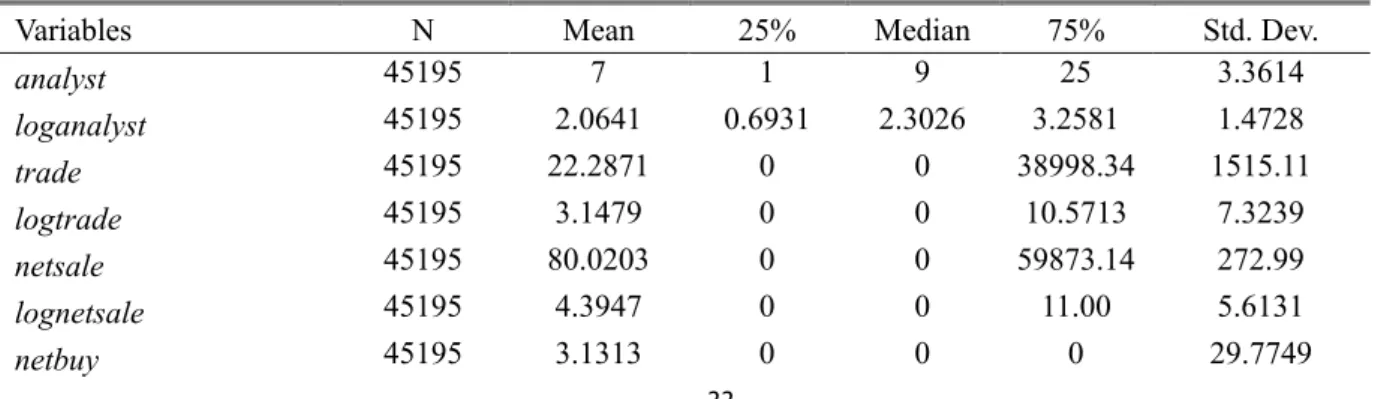
Table 1 reports summary statistics for the variables used in our hypothesis tests. Since the number of analysts following a firm is highly skewed, and given that it is possible that a firm is not covered by any analyst, we use the logarithm transformation of one plus the number of analyst following for our empirical analysis. The mean of loganalyst is 2.0641. This signifies that, on average,
each firm is followed by approximately 7 analysts over the last two fiscal quarters of a year. We logarithmically transform the insider trading variables because insider trading data also tend to be highly skewed. The mean of lognetsale (4.3947) is larger than that of lognetbuy (1.4186), suggesting that insider trades are predominantly sales-based over the first two fiscal quarters of a year. Our un-tabulated results reveal that the Spearman correlation between lognetsell and lognetbuy is -0.3286, indicating no multicollinearity issue arising should both lognetsale and lognetbuy be included in the same regression. In addition, our results for variance inflation factors (VIF) tests reveal that none of our continuous independent variables has a VIF value higher than 5, indicating no multicollinearity issue for our regression analysis.
4.2 Multivariate results
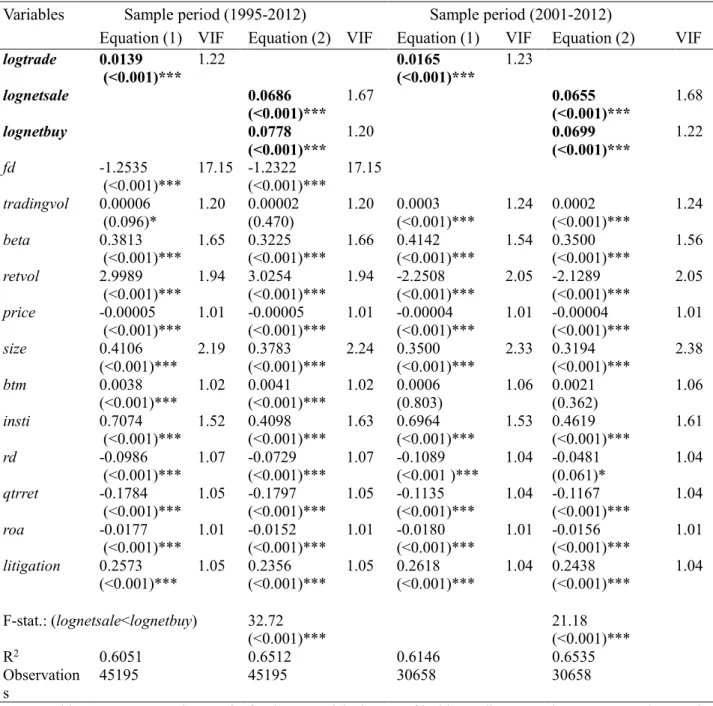
Table 2 presents the regression results for the impact of insider trading on analyst coverage. Columns (1-2) reports the firm-fixed-effects regression results for the whole sample period of 1995-2012; Columns (3-4) reports the firm-fixed-effects regression results for the post-Reg-FD period (i.e.,
12
2001-2012) only.8 For both sets of results, we find significantly positive coefficients on logtrade,
indicating that insider trades increase analyst coverage.9 A one-standard-deviation increase in
logtrade for the period of 1995-2012 (2001-2012) is associated with an increase in loganalyst by 0.1018 (0.1208), which is equivalent to around 5% (6%) of the sample mean of loganalyst and is economically significant. While both lognetbuy and lognetsale show positive coefficients that are also statistically and economically significant, the coefficient for lognetbuy is significantly larger in magnitude than that for lognetsale (F-stat.=50.64 (21.26)). This suggests that the association between insider purchases and analyst coverage is stronger than that between insider sales and analyst coverage.
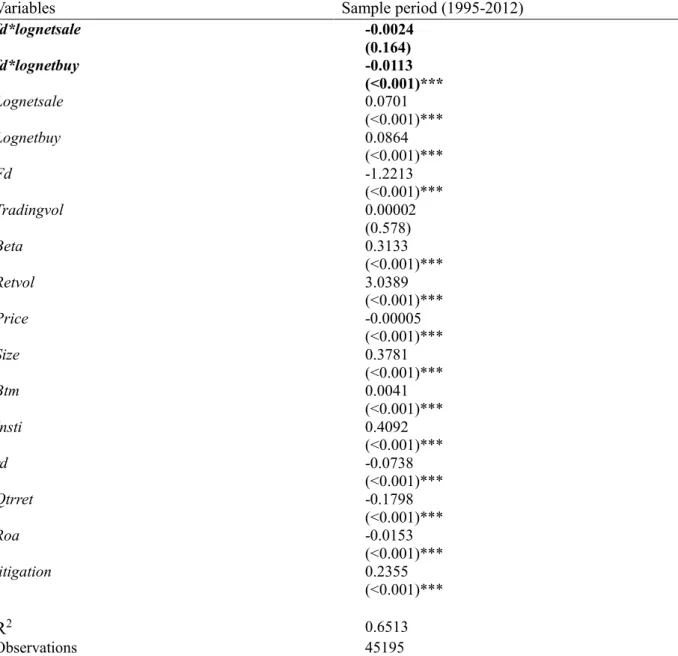
Table 3 reports regression results for model (3). The coefficient on fd*lognetbuy is negative and statistically significant at the 1% level. This suggests that the impact of insider trading on analyst coverage becomes weaker after Reg FD. We interpret this as evidence supporting the notion that Reg FD improves firms’ information environments, because the improved information environment can reduce investor demand for analyst services and thus dis-incentivize analysts from exerting effort to integrate insider trading information into their research and forecasts. Hence, it can be inferred that the regulatory prohibition of selective disclosures results in potentially fairer disclosures, rather than in fewer disclosures.
8 The communication of private information between firm management and analysts is unlikely to be fully
prevented by Reg FD. Nonetheless, it is plausible to suggest that given potential legal and/or reputational penalties for non-compliance with Reg FD, private information communications between analysts and insiders would be limited, as suggested in a large body of the Reg FD literature (e.g., Koch et al., 2013; Dong et al., 2017; Hu et al., 2018). This is also evident in the dearth of legal cases regarding breaches of Reg FD, and is in line with the prior view that managers tend to be careful and ‘correct’ in what they say to analysts, especially when the litigation risks associated with private communications are significantly heightened post Reg FD (Koch et al., 2013). Hence, in accounting for the post-Reg-FD period, we reduce the endogeneity concern that insider trading and analyst coverage are simultaneously determined by factors relating to private information.
9 One may argue that insiders’ plausible anticipation of future analyst coverage may curb their incentives to engage
in insider trades, thereby raising the possibility of reverse causality. However, it is questionable that corporate insiders are able to anticipate the number of future analyst followings. Even if insiders were able to do so, the impact that the insiders’ anticipation of future analyst coverage has on insider trades is negative, which is unlikely to explain the positive association between insider trading and analyst coverage. Therefore, reverse causality is unlikely to be an issue in our study. Furthermore, as private-information communications between insiders and analysts are disallowed by Reg FD, insiders’ ability to anticipate future analyst coverage would be constrained as a result of lack of private information. By restricting our sample period to the post Reg FD period, the reverse causality possibility is minimized.
13
5. Additional tests
5.1 The impact of insider trading on analyst forecast revisions
Given our evidence of the positive link between insider trading and analyst coverage, we further look at whether and how insider trades influence analyst forecast revisions. If insider trades convey information about future firm performance, analysts should revise their earnings forecasts in the direction of insider trades. Given that insider purchases are more informative about a firm’s future prospect than insider sales, insider purchases should have a larger impact on analyst forecast revisions than insider sales. To test this prediction, we use the following firm-fixed-effects regression model:
9 10
+
0 1 2 3 4 5
6 7 8 11 12
13 14 15 16
forecast = α + α lognetsale + α lognetbuy(+α fd)+ α horizon + α retvol +α size + α btm + α rd + α anasurprise + α abtradvol + α insti + α qtrret +α roa α litigation + α year - fixed effects + α firm - fixed effects +
(4)
The analyst forecast revision variable, forecast, is defined as analysts’ first earnings forecast issued for a firm for a fiscal year after the beginning of the third fiscal quarter, minus the median consensus analyst annual earnings forecast for the first two fiscal quarters; this is divided by the stock price at the beginning of the fiscal year. We control for analyst forecast horizon (horizon), return volatility (retvol), firm size (size), book-to-market ratio (btm), R&D expenditures (rd), expected earnings news (anasurprise), institutional ownership (insti), return on assets (roa), litigation risk (litigation), abnormal trading volume (abtradvol), and abnormal stock returns (qtrret). All these variables are defined in the Appendix, and are identified by prior literature as influencing analyst forecast revisions in at least some circumstances (e.g., Kross and Suk, 2012; Clement et al., 2011; Hahn and Song, 2013; Sivakumar and Vijayakumar, 2001). The inclusion of abtradvol and qtrret
controls for the impact of potential fundamental-related events that might drive both insider trades and analyst forecast revisions.
Panel B of Table 4 reports the regression results. The coefficients for lognetbuy in Columns (1) and (2) are both positive and statistically significant, suggesting that analysts tend to revise their earnings forecasts upwards following insider purchases. A one-standard-deviation increase in
14
lognetbuy is associated with an increase in forecast by 0.0052 (0.0410) for the whole sample (post-Reg-FD) period, which accounts for 27% (39%) of the sample mean of forecast and is economically significant. The coefficients on lognetsale, albeit negative, are not statistically significant at the conventional 5% level. Hence, there is no significant impact of insider sales on analyst forecast revisions. This is because insider selling might occur for non-informational reasons such as liquidity needs and portfolio diversifications and is thus less informative about firm prospects.
5.2 The effect of insider trades on the informativeness of analyst forecast revisions
Since insider trades impact analyst forecast revisions, we further investigate how insider trading affects the informativeness of analyst forecast revisions. If insider trades convey value-relevant corporate information (e.g., Lakonishok and Lee, 2001; Fidrmuc et al., 2006; Veenman, 2012; He et al., 2019a, b), analysts’ incorporation of insider trading information into their earnings forecast revisions should make the revised forecasts more informative. If insider purchases are indeed more informative than insider sales, analyst forecast revisions made in response to insider purchases should be more informative than that made in response to insider sales. To test this, we use the following firm-fixed-effects regression model:
0 1 2 3 4 5
6 7 8 9 10 11 12 13
14 15 16 17
+
car = α + α lognetsale + α lognetbuy(+α fd)+ α forecast α tradingvol +α beta + α retvol + α price + α size + α btm + α insti + α rd + α qtrret +α roa + α litigation + α year - fixed effects + α firm - fixed effects +
(5)
The dependent variable, car, is the three-day [-1, 1] cumulative abnormal stock returns around analysts’ first earnings forecast issued for a firm for a fiscal year after the beginning of the third fiscal quarter. Abnormal stock returns are calculated using a market model with an estimation period of [-181, -2] relative to the forecast date. We control for the magnitude of analyst forecast revisions (forecast) which likely affect car. We further control for trading volume (tradingvol), firm beta (beta), return volatility (retvol), stock price (price), firm size (size), litigation risk (litigation), book-to-market ratio (btm), return on assets (roa), institutional ownership (insti), R&D expenditures (rd), and abnormal stock returns (qtrret). Extant research finds that these variables are associated with the
15
informativeness of analyst earnings forecasts.
Table 5 reports the regression results. lognetbuy in Columns (1) and (2) has a positive, statistically significant coefficient. This suggests that insider purchases significantly increase the informativeness of analysts’ revised forecasts. The coefficients for lognetsale, however, are not statistically significant, suggesting that insider sales do not render analyst forecast revisions more informative. The results for model (5) reconcile with our early evidence that insider purchases have a greater impact on analyst coverage and forecast revisions than insider sales. The results also support the notion that insider purchases are more informative and help increase the value of analyst services to a larger degree, compared with insider sales. More importantly, because as in Frankel et al. (2006), the analyst earnings forecast informativeness is measured by stock market reactions to the analyst forecasts, our results support our earlier view that insider trades increase investor demand for analyst forecasts.
5.3 The impact of insider trading on the errors in analyst revised earnings forecasts
Given the impact of insider trades on analyst forecast revisions, we examine whether analysts’ revised forecasts would be less biased as a result of insider trades. We employ the following two firm-fixed-effects regression models:
0 1 2 3 4 5 6 7 8
9 10 11 12 13 14 15
optimism = α +α lognetbuy(+α fd)+α horizon+α retvol +α size+α btm+α rd +α anasurprise+
α abtradvol +α insti+α qtrret +α roa+α litigation+α year - fixed effects+α firm - fixed effects+(6)
0 1 2 3 4 5 6 7 8
9 10 11 12 13 14 15
pessimism = α + α lognetsale(+α fd)+ α horizon+ α retvol +α size+ α btm+ α rd +α anasurprise+
α abtradvol +α insti+α qtrret +α roa+α litigation+α year - fixed effects+α firm - fixed effects+(7)
optimism (pessimism) in model (6) ((7)) measures the degree of optimistic (pessimistic) error in an analyst forecast revision. optimism equals analysts’ first earnings forecast issued for a firm for a fiscal year at the beginning of the third fiscal quarter, minus actual earnings, divided by the stock price at the end of the fiscal year; optimism equals 0 if actual earnings are higher than the analysts’ first earnings forecast. pessimism equals actual earnings minus analysts’ first earnings forecast that is
16
issued for a firm for a fiscal year at the beginning of the third fiscal quarter, divided by the stock price at the end of the fiscal year; pessimism equals 0 if actual earnings are lower than the analysts’ first earnings forecast. We maintain the same control variables as per model (5). These control variables, as documented in prior literature (e.g., Lim, 2001; Huberts and Fuller, 1995; Das et al., 1998; He et al., 2019a, b), may affect analyst forecast errors.
Table 6 reports the regression results. The coefficients on lognetbuy, reported in Columns (1) and (3), are negative and statistically significant, indicating that analysts’ revised forecasts following insider purchases are less optimistically biased. This result, in conjunction with our early findings, suggests that analysts appear to incorporate appropriately the insider purchasing information into their forecasts. The lognetsale in Column (2), which reveals the impact of insider sales on analyst forecast pessimism for the period of 1995-2012, does not take on a statistically significant coefficient. These asymmetric results for insider purchases vis-à-vis insider sales are consistent with the notion that the former is substantively more informative about future firm prospect than the latter. Noticeably, the coefficient on lognetsale for the post-Reg-FD period, shown in Column (4), is even marginally significant at the 10% level; this could be taken as weak evidence suggesting that insider sales lead analysts to make pessimistically biased forecasts post Reg FD. Insider sales could be driven by insiders’ liquidity needs or for portfolio diversification purposes; given this, absent access to private corporate information in the post-Reg-FD era, analysts might misinterpret all insider sales (including uninformed sales) as signaling insiders’ pessimistic views on firm prospects and thus issue pessimistic forecasts. This helps explain the result in Column (4).
5.4 Impact threshold for a confounding variable in the regression analysis
To check that our regression results are not driven by correlated omitted variables, we follow Larcker and Rusticus (2010) and carry out an analysis of the impact threshold for a confounding variable (ITCV) for our previous multivariate tests. ITCV refers to the threshold of an omitted, confounding variable’s impact beyond which our results and inferences would be overturned if such
17
a confounding variable were controlled in the regression model (Frank, 2000). Should the value of ITCV be larger, our regression results would have been less susceptible to potential omitted-variables bias.
We first conduct the ITCV test for our previous regressions, in which we find statistically significant results for the main variables of interest, and that are run for our whole sample period of 1995-2012. Our results (not tabulated) reveal that each estimated ITCV value is higher than the absolute value of the impact factor for all the control variables used in the associated model. The result provides assurance that our significant results for the impact of insider trades on analyst coverage and forecast properties are robust to potential correlated omitted variables. For the regressions run for the post-Reg-FD period only, we repeat our ITCV analysis, and are again able to conclude that our significant results for the main variables of interest are insensitive to potential omitted-variables bias. Finally, we repeat our ITCV evaluation procedure for our statistically insignificant results for lognetsale. The same conclusion arises.
6. Conclusion
We examine whether and to what extent the information inherent in insider trades affects analyst behavior. We find evidence that the number of analysts following a given firm is positively correlated with the intensity of insider trades, and that analyst coverage is more strongly associated with insider purchases than with insider sales. We also find that the positive association between analyst coverage and insider trades is weaker after the passage of Reg FD. In offering insights into how insider trades affect analyst forecasts, we further provide evidence on the following: (i) that analysts revise their earnings forecasts upwards and significantly following insider purchases, (ii) that the informativeness of analysts’ revised forecasts significantly increases following insider purchases, and (iii) optimistic bias in analyst forecast revisions is reduced as a result of insider purchases. However, we do not find similar evidence for insider selling. This is likely due to its less informativeness compared with insider
18
purchases. Overall, our study contributes to understanding the role played by insider trades in financial analysts’ decisions.
References
Beneish, M.D., and Vargus, M.E. (2002). “Insider trading, earnings quality, and accrual mispricing”,
The Accounting Review, Vol. 77 No.4, pp.755-91.
Bernhardt, D., Hollifield, B. and Hughson, E. (1995). “Investment and Insider trading”, Review of Financial Studies, Vol.8 No.2, pp.501-543.
Billings, M.B., and Cedergren, M.C. (2015). “Strategic silence, insider selling and litigation risk”,
Journal of Accounting and Economics, Vol.59 No.2-3, pp.119-142.
19
accounting information? The roles of information awareness and acquisition costs”, Journal of Accounting Research, Vol.57 No.1, pp.53-84.
Carpenter, J.N., and Remmers, B. (2001). “Executive stock option exercises and inside information”,
Journal of Business, Vol.74 No.4, pp.513-534.
Cheng, Q., and Lo, K. (2006). “Insider trading and voluntary disclosures”, Journal of Accounting Research, Vol.44 No.5, pp.815-848.
Cheng, Q., Luo, T. and Yue, H. (2013). “Managerial incentive and management forecasts precision”,
The Accounting Review, No.88 No.5, pp.1575-1602.
Choi, L., Faurel, L. and Hillegeist, S.A. (2016). “Insider trading and PEAD”, Working paper, Arizona State University.
Clement, M.B., Hales, J. and Xue, Y. (2011). “Understanding analysts’ use of stock returns and other analysts’ revisions when forecasting earnings”, Journal of Accounting and Economics, Vol.51 No.3, pp.279-299.
Das, S., Levine, C. and Sivaramakrishnan, K. (1998). “Earnings predictability and bias in analysts’ earnings forecasts”, The Accounting Review, Vol.73 No.2, pp.2277-2294.
Dechow, P.M., Lawrence, A. and Ryans, J.P. (2016). “SEC comment letters and insider sales”, The Accounting Review, Vol.91 No.2, pp.401-439.
Denis, D.J., and Xu, J. (2013). “Insider trading restrictions and top executive compensation.” Journal of Accounting and Economics, Vol.56 No.1, pp.91-112.
Dong, Y., Hu, N. Li, X. and Liu, L. (2017). “Analyst firm coverage and forecast accuracy: The effect of Regulation Fair Disclosure”, Abacus, Vol.53 No.4, pp.450-484.
Duru, A., and Reeb, D.M. (2002). “International diversification and analysts’ forecast accuracy and bias”, The Accounting Review, Vol.77 No.2, pp.415-33.
Frank, K.A. (2000). “Impact of a confounding variable on a regression coefficient”, Sociological Methods & Research, Vol.29 No.2, pp.147-194.
Frankel, R., and Li, X. (2004). “Characteristics of a firm’s information environment and the information asymmetry between insiders and outsiders”, Journal of Accounting and Economics, Vol.37 No.2, pp.229-259.
Frankel, R., Kothari, S.P. and Weber, J. (2006). “Determinants of the informativeness of analyst research”, Journal of Accounting and Economics, Vol.41 No.1-2, pp.29-54.
Fidrmuc, J., Goergen, M. and Renneboog, L. (2006). “Insider trading, news releases and ownership concentration”, Journal of Finance, Vol.61 No.6, pp.2931-2973.
Hahn, T.H., and Song, M. (2013). “Regulation Fair Disclosure and analysts’ reliance on earnings announcements”, Journal of Accounting and Public Policy, Vol.32 No.1, pp.26-43.
Hayes, R. (1998). “The impact of trading commission incentives on analysts’ stock coverage decisions and earnings forecasts”, Journal of Accounting Research, Vol.36 No.2, pp.299-320.
20
He, G. (2015). “The effect of CEO inside debt holdings on financial reporting quality”, Review of Accounting Studies, Vol.20 No.1, pp.501-536.
He, G., Marginson, D. and Dai, X. (2019a). “Do voluntary disclosures of product and business expansion plans impact analyst coverage and forecasts?” Accounting and Business Research, forthcoming.
He, G., Ren, M. and Taffler, R. (2019b). “The impact of corporate tax avoidance on analyst coverage and forecasts”, Review of Quantitative Finance and Accounting, forthcoming.
Hu, G., Ke, B. and Yu, Y. (2018). “Can transient institutions correctly interpret small negative earnings surprises in the absence of access to management’s private information?”, Journal of Accounting, Auditing, and Finance, Vol.33 No.1, pp.3-33.
Huberts, L., and Fuller, R. (1995). “Predictability bias in the U.S. equity market”, Financial Analyst Journal, Vol.51 No.2, pp.12-28.
Huddart, S.J., and Ke, B. (2007). “Information asymmetry and cross-sectional variation in insider trading”, Contemporary Accounting Research, Vol.24 No.1, pp.195-232.
Huddart, S., Ke, B. and Shi, C. (2007). “Jeopardy, non-public information, and insider trading around SEC 10-K and 10-Q filings”, Journal of Accounting and Economics, Vol.43 No.1, 3-36.
Jeng, L.A., Metrick, A. and Zeckhauser, R. (2003). “Estimating the returns to insider trading: a performance-evaluation perspective”, Review of Economics and Statistics, Vol.85 No.2, pp.453- 471.
John, K., and Lang, L.H.P. (1991). “Strategic insider trading around dividend announcements: Theory and evidence”, Journal of Finance, Vol.46 No.4, 1361-1389.
Johnson, S.A., Ryan, H.E., and Tian, Y.S. (2009). “Managerial incentives and corporate fraud: The sources of incentives matter”, Review of Finance, Vol.13 No.1, pp.115-145.
Ke, B., Huddart, S. and Petroni, K. (2003). “What insiders know about future earnings and how they use it: Evidence from insider trades.” Journal of Accounting and Economics, Vol.35 No.3, pp.315-346.
Ke, B., and Yu, Y. (2006). “The effect of issuing biased earnings forecasts on analysts’ access to management and survival”, Journal of Accounting Research, Vol.44 No.5, pp.965-999.
Kim, J.B., Li, Y. and Zhang, L. (2011). “Corporate tax avoidance and stock price crash risk: Firm-level analysis”, Journal of Financial Economics, Vol.100 No.3, pp.639-662.
Koch, A.S., Lefanowicz, C.E. and Robinson, J.R. (2013). “Regulation FD: A review and synthesis of the academic literature”, Accounting Horizon, Vol.27 No.3, pp.619-646.
Kross, W.J., and Suk, I. (2012). “Does Reg FD work? Evidence from analysts’ reliance on public disclosure”, Journal of Accounting and Economics, Vol.53 No.1-2, pp.225-248.
Lakonishok, J., and Lee, I. (2001). “Are insider trades informative?” Review of Financial Studies
21
Larcker, D.F., and Rusticus, T.O. (2010). “On the use of instrumental variables in accounting research”, Journal of Accounting and Economics, Vol.49 No.3, pp.186-205.
Lang, M.H., and Lundholm, R.J. (1996). “Corporate disclosure policy and analyst behavior”, The Accounting Review, Vol.71 No.4, pp.467-492.
Lee, D.S., Mikkelson, W.H., and Partch, M.M. (1992). “Managers’ trading around stock repurchases”,
Journal of Finance, Vol.47 No.5, pp.1947-1962.
Leland, H.E. (1992). “Insider trading: Should it be prohibited?”, Journal of Political Economy, Vol.100 No.4, pp.859-887.
Lim, T. (2001). “Rationality and analysts’ forecast bias”, Journal of Finance, Vol.56 No.1, pp.369-385.
Lustgarten, S., and Mande, V. (1995). “Financial analysts’ earnings forecasts and insider trading”,
Journal of Accounting and Public Policy, Vol.14 No.3, pp.233-61.
Marcus, B., and Wallace, S. (1991) Competing in the New Capital Markets: Investor Relations Strategies for the 1990s. New York, NY: Harper Business.
Mohanram, P.S., and Sunder, S.V. (2006). “How has Reg FD affected the operations of financial analysts?”, Contemporary Accounting Research, Vol.23 No.2, pp.491-525.
Piotroski, J.D., and Roulstone, D.T. (2005). “Do insider trades reflect both contrarian beliefs and superior knowledge about future cash flow realizations?” Journal of Accounting and Economics, Vol.39 No.1, pp.55-81.
Richardson, S., Teoh, S.H. and Wysocki, P. (2004). “The walk-down to beatable analyst forecasts: the roles of equity issuance and insider trading incentives”, Contemporary Accounting Research, Vol.21 No.4, pp.885-924.
Roulstone, D.T. (2003). “The relationship between insider trading restrictions and executive compensation”, Journal of Accounting Research, Vol.41 No.3, pp.525-551.
Securities and Exchange Commission (SEC). 2000. Selective disclosure and insider trading, Free release (Washington, D.C.: SEC), 7833-81. www.sec.gov/rules/final/33- 7881.htm.
Securities Exchange Act of 1934 (SEA). 2011. http://www.sec.gov/about/laws/ sea34.pdf.
Seyhun, H.N. (1990). “Overreaction or fundamentals: some lessons from insiders' response to the market crash of 1987”, Journal of Finance, Vol.45 No.5, pp.1363-1388.
Seyhun, H.N., and Bradley, M. (1997). “Corporate bankruptcy and insider trading”, Journal of Business, Vol.70 No.2, pp.189-216.
Skaife, H.A., Veenman, D.V., and Wangerin, D. (2013). Internal control over financial reporting and managerial rent extraction: Evidence from the profitability of insider trading. Journal of Accounting and Economics, Vol.55 No.1, pp.91-110.
22
announcements”, Journal of Accounting and Economics, Vol.11 No.2-3, pp.275-292.
Swanquist, Q.T., and Whited, R.L. (2018). “Out of control: The (over)use of controls in accounting research”, Working paper, University of Alabama.
Thevenot, M. (2012). “The factors affecting illegal insider trading in firms with violations of GAAP”,
Journal of Accounting and Economics, Vol.53 No.1-2, pp.375-390.
Veenman, D. (2012). “Disclosures of insider purchases and the valuation implications of past earnings signals”, The Accounting Review, Vol.68 No.2, pp.346-366.
Wooldridge, J. (2000). “Introduction econometrics: a modern approach (1st edition)”, New York:
South-Western College Publishing.
Table 1 Summary statistics
Variables N Mean 25% Median 75% Std. Dev.
analyst 45195 7 1 9 25 3.3614 loganalyst 45195 2.0641 0.6931 2.3026 3.2581 1.4728 trade 45195 22.2871 0 0 38998.34 1515.11 logtrade 45195 3.1479 0 0 10.5713 7.3239 netsale 45195 80.0203 0 0 59873.14 272.99 lognetsale 45195 4.3947 0 0 11.00 5.6131 netbuy 45195 3.1313 0 0 0 29.7749
23
Notes: Table 1 presents summary statistics for the variables used in the hypothesis tests. The sample consists of 45,195 firm-year observations, inclusive of those with or without analyst coverage over the period of 1995-2012. All variables are defined in the Appendix.
lognetbuy 45195 1.4186 0 0 0 3.4267 fd 45195 0.6783 0 1 1 0.4671 tradingvol 45195 25.5347 0.2493 2.1020 12.4533 122.6161 beta 45195 0.8552 0.3850 0.8004 1.2450 0.6192 retvol 45195 0.0309 0.0170 0.0247 0.0373 0.0218 price 45195 41.0152 7.95 18.00 31.90 1224.934 size 45195 6.1045 4.66 6.15 7.49 2.0923 btm 45195 0.8941 0.4000 0.5757 0.9204 5.0332 insti 45195 0.4391 0.0796 0.4282 0.7433 0.3531 rd 45195 0.0751 0 0 0 0.2635 qtrret 45195 0.0187 -0.1739 -0.0222 0.1415 0.4269 roa 45195 0.0013 -0.0016 0.0242 0.0633 1.3899 litigation 45195 0.1712 0 0 0 0.3767
24
Table 2 Multivariate tests of the impact of insider trading on analyst coverage
0 1 2 3 4 5 6 7 8
9 10 11 12
+
13 14 15
loganalyst logtrade fd tradingvol beta retvol price size btm
insti rd qtrret roa + α litigation+ α year - fixed effects + α firm - fixed effects +
(1) 0 1 2 3 4 5 6 7 8 9 10 11 12 13 + 13 14 15
loganalyst lognetsale lognetbuy fd tradingvol beta retvol price size
btm insti rd qtrret roa + α litigation+ α year - fixed effects +α firm - fixed effects +
(2)
Variables Sample period (1995-2012) Sample period (2001-2012)
Equation (1) VIF Equation (2) VIF Equation (1) VIF Equation (2) VIF
logtrade 0.0139 (<0.001)*** 1.22 0.0165 (<0.001)*** 1.23 lognetsale 0.0686 (<0.001)*** 1.67 0.0655 (<0.001)*** 1.68 lognetbuy 0.0778 (<0.001)*** 1.20 0.0699 (<0.001)*** 1.22 fd -1.2535 (<0.001)*** 17.15 -1.2322 (<0.001)*** 17.15 tradingvol 0.00006 (0.096)* 1.20 0.00002 (0.470) 1.20 0.0003 (<0.001)*** 1.24 0.0002 (<0.001)*** 1.24 beta 0.3813 (<0.001)*** 1.65 0.3225 (<0.001)*** 1.66 0.4142 (<0.001)*** 1.54 0.3500 (<0.001)*** 1.56 retvol 2.9989 (<0.001)*** 1.94 3.0254 (<0.001)*** 1.94 -2.2508 (<0.001)*** 2.05 -2.1289 (<0.001)*** 2.05 price -0.00005 (<0.001)*** 1.01 -0.00005 (<0.001)*** 1.01 -0.00004 (<0.001)*** 1.01 -0.00004 (<0.001)*** 1.01 size 0.4106 (<0.001)*** 2.19 0.3783 (<0.001)*** 2.24 0.3500 (<0.001)*** 2.33 0.3194 (<0.001)*** 2.38 btm 0.0038 (<0.001)*** 1.02 0.0041 (<0.001)*** 1.02 0.0006 (0.803) 1.06 0.0021 (0.362) 1.06 insti 0.7074 (<0.001)*** 1.52 0.4098 (<0.001)*** 1.63 0.6964 (<0.001)*** 1.53 0.4619 (<0.001)*** 1.61 rd -0.0986 (<0.001)*** 1.07 -0.0729 (<0.001)*** 1.07 -0.1089 (<0.001 )*** 1.04 -0.0481 (0.061)* 1.04 qtrret -0.1784 (<0.001)*** 1.05 -0.1797 (<0.001)*** 1.05 -0.1135 (<0.001)*** 1.04 -0.1167 (<0.001)*** 1.04 roa -0.0177 (<0.001)*** 1.01 -0.0152 (<0.001)*** 1.01 -0.0180 (<0.001)*** 1.01 -0.0156 (<0.001)*** 1.01 litigation 0.2573 (<0.001)*** 1.05 0.2356 (<0.001)*** 1.05 0.2618 (<0.001)*** 1.04 0.2438 (<0.001)*** 1.04 F-stat.: (lognetsale<lognetbuy) 32.72
(<0.001)*** 21.18 (<0.001)***
R2 0.6051 0.6512 0.6146 0.6535
Observation
s 45195 45195 30658 30658
Notes: Table 3 reports regression results for the tests of the impact of insider trading on analyst coverage. The sample period ranges from 1995 to 2012. Both firm-fixed effects and year-fixed effects are included in the regressions. All variables are defined in the Appendix. VIF refers to variance inflation factors for the regression covariates. p-values are in parentheses. ***, **, * denote the two-tailed statistical significance at 1%, 5%, and 10% levels, respectively.
25
Table 3 Multivariate test of the moderating effect of Reg FD on the association between insider trading and analyst coverage
6 7 8 9 10
0 1 2 3 4
5 11 12 13
14 15 16 17 18
loganalyst = α + α fd * lognetsale + α fd * lognetbuy + α lognetsale + α lognetbuy +α fd + α tradingvol + α beta + α retvol + α price + α size + α btm + α insti + α rd +α qtrret + α roa + α litigation + α year - fixed effects + α firm - fixed effects +
Variables Sample period (1995-2012)
fd*lognetsale -0.0024 (0.164) fd*lognetbuy -0.0113 (<0.001)*** Lognetsale 0.0701 (<0.001)*** Lognetbuy 0.0864 (<0.001)*** Fd -1.2213 (<0.001)*** Tradingvol 0.00002 (0.578) Beta 0.3133 (<0.001)*** Retvol 3.0389 (<0.001)*** Price -0.00005 (<0.001)*** Size 0.3781 (<0.001)*** Btm 0.0041 (<0.001)*** Insti 0.4092 (<0.001)*** rd -0.0738 (<0.001)*** Qtrret -0.1798 (<0.001)*** Roa -0.0153 (<0.001)*** litigation 0.2355 (<0.001)*** R2 0.6513 Observations 45195
Notes: Table 4 reports regression results for the test of the moderating effect of Reg FD on the association between insider trading and analyst coverage. The sample period ranges from 1995 to 2012. Both firm-fixed effects and year-fixed effects are included in the regressions. All variables are defined in the Appendix. p-values are in parentheses. ***, **, * denote the two-tailed statistical significance at 1%, 5%, and 10% levels, respectively.
26
Table 4 Additional test: the impact of insider trading on analyst forecast revisions
Table 5 Additional test: the impact of insider trading on the informativeness of analyst Panel A: Descriptive statistics
Variables N Mean 25% Median 75% Std. Dev
forecast 27698 -0.0194 -0.0006 -0.0001 0.0002 0.4207
lognetsale 27698 6.1415 0 8.42 11.6 5.8269
lognetbuy 27698 1.6895 0 0 0 3.6924
Panel B: Regression results
9
10 +
0 1 2 3 4 5 6 7 8
11 12 13 14 15 16
forecast = α +α lognetsale + α lognetbuy(+α fd)+α horizon+α retvol + α size+ α btm+ α rd + α anasurprise +α abtradvol +α insti +α qtrret +α roa α litigation+ α year - fixed effects + α firm - fixed effects +
Variables Sample period (1995-2012) Sample period (2001-2012)
lognetsale -0.0003 (0.646) -0.0013 (0.065)* lognetbuy 0.0031 (<0.001)*** 0.0023 (0.029)** fd 0.0145 (0.855) horizon -0.0124 (-0.86) -0.0492 (0.029)** retvol -1.6120 (<0.001)*** -1.4715 (<0.001)*** size 0.0075 (<0.001)*** 0.0100 (<0.001)*** btm -0.0157 (<0.001)*** -0.0183 (<0.001)*** rd -0.0117 (0.214) -0.0101 (0.535) anasurprise -8.59E-7 (0.045)** -8.53E-7 (0.068)* abtradvol 2.59E-6 (0.966) 3.42E-7 (0.996) insti 0.0437 (<0.001)*** 0.0561 (<0.001)*** qtrret 0.0771 (<0.001)*** 0.0898 (<0.001)*** roa 0.0083 (0.133) 0.0332 (<0.001)*** litigation 0.0159 (0.012)** 0.0244 (0.002)*** R2 0.0160 0.0172 Observations 27218 19707
Notes: Panel A reports summary statistics for the key variables used for the multivariate tests of the impact of insider trading on analyst forecast revisions. The sample is confined to firm-year observations that have analyst forecast revisions after the end of the second fiscal quarter over the period of 1995-2012. Panel B reports the regression results. Both firm-fixed effects and year-fixed effects are included in the regressions. All variables are defined in the Appendix. p-values are in parentheses. ***, **, * denote the two-tailed statistical significance at 1%, 5%, and 10% levels, respectively.
27
forecast revisions
Panel A: Descriptive statistics
Variables N Mean 25% Median 75% Std. Dev
Car 31892 -0.0009 -0.0260 -0.0001 0.0263 0.0662
Lognetsale 31892 5.9759 0 8.0067 11.4761 5.7845
Lognetbuy 31892 1.8389 0 0 0 3.7992
Panel B: Regression results
0 1 2 3 4 5 6 7 8 9
10 11 12 13 14 15 16 17
+
car = α + α lognetsale+ α lognetbuy(+α fd)+ α forecast α tradingvol + α beta + α retvol + α price+ α size+ α btm+α insti+α rd +α qtrret +α roa +α litigation +α year - fixed effects+α firm - fixed effects+
Variables Sample period (1995-2012) Sample period (2001-2012)
Lognetsale -0.00005 (0.560) 0.00007 (0.472) Lognetbuy 0.0003 (0.012)** 0.0003 (0.026)** Forecast 0.0050 (<0.001)*** 0.0048 (<0.001)*** Fd -0.0240 (<0.001)*** Fc -0.0279 (<0.001)*** Tradingvol -0.00001 (<0.001)*** -0.00001 (<0.001)*** Beta -0.0052 (<0.001)*** -0.0047 (<0.001)*** Retvol 0.1818 (<0.001)*** 0.2769 (<0.001)*** Price -0.00003 (0.031)** -0.00001 (0.460) Size 0.0036 (<0.001)*** 0.0040 (<0.001)*** Btm -0.0013 (<0.001)*** -0.0011 (0.003)*** Insti -0.0015 (0.229) -0.0024 (0.121) Rd -0.0006 (0.662) -0.0023 (0.332) Qtrret 0.0067 (<0.001)*** 0.0060 (<0.001)*** Roa 0.0041 (<0.001)*** 0.0039 (<0.001)*** litigation -0.0002 (0.849) -0.0007 (0.530) R2 0.0131 0.0132 Observations 31892 22705
Notes: Panel A reports summary statistics for the key variables used for the multivariate tests of the impact of insider trading on the informativeness of analyst forecast revisions. The sample is confined to firm-year observations that have analyst forecast revisions after the end of the second fiscal quarter over the period of 1995-2012. Panel B reports the regression results. Both firm-fixed effects and year-fixed effects are included in the regressions. All variables are defined in the Appendix. p-values are in parentheses. ***, **, * denote the two-tailed statistical significance at 1%, 5%, and 10% levels, respectively.
28
Appendix Summary of variable definitions Panel A: Descriptive statistics
Variables N Mean 25% Median 75% Std. Dev
Optimism 27052 0.0585 0 0 0.0099 0.7607
Pessimism 27218 0.0145 0 0 0.0038 0.2155
Lognetbuy 27052 1.6824 0 0 0 3.6830
Lognetsale 27218 6.1447 0 8.4412 11.6083 5.8239
Panel B: Regression results
0 1 2 3 4 5 6 7 8
9 10 11 12 13 14 15
optimism = α + α lognetbuy(+α fd)+ α horizon + α retvol + α size + α btm + α rd + α anasurprise +
α abtradvol + α insti + α qtrret + α roa + α litigation+ α year - fixed effects + α firm - fixed effects + (1)
0 1 2 3 4 5 6 7 8
9 10 11 12 13 14 15
pessimism = α + α lognetsale(+α fd)+ α horizon + α retvol + α size + α btm + α rd + α anasurprise +
α abtradvol + α insti + α qtrret + α roa + α litigation+ α year - fixed effects + α firm - fixed effects + (2)
Sample period (1995-2012) Sample period (2001-2012)
Variables Equation (1) Equation (2) Equation (1) Equation (2)
lognetsale 0.0004 (0.102) 0.0005 (0.063)* lognetbuy -0.0025 (0.044)** -0.0033 (0.032)** fd -0.5377 (<0.001)*** -0.1319 (0.001)*** horizon 0.1087 (<0.001)*** 0.0332 (<0.001)*** 0.0980 (0.007)*** (0.002)*** 0.0293 retvol 3.7212 (<0.001)*** 0.8572 (<0.001)*** 3.6466 (<0.001)*** (<0.001)*** 1.0954 size -0.0151 (<0.001)*** -0.0052 (<0.001)*** -0.0128 (<0.001)*** -0.0039 (<0.001)*** btm 0.0898 (<0.001)*** 0.0026 (0.016)** 0.0985 (<0.001)*** 0.0025 (0.041)** rd 0.0278 (0.092)* 0.0041 (0.386) 0.0176 (0.68) 0.0017 (0.804) anasurprise -8.88E-7
(0.238) 2.30E-6 (<0.001)*** -7.33E-7 (0.367) 2.29E-6 (<0.001)*** abtradvol 2.40E-5
(0.823) 1.35E-5 (0.662) 1.02E-6 (0.993) 1.07E-5 (0.719)
insti -0.0759 (<0.001)*** -0.0355 (<0.001)*** -0.0881 (<0.001)*** -0.0411 (<0.001)*** qtrret -0.1171 (<0.001)*** -0.0337 (<0.001)*** -0.1107 (<0.001)*** (<0.001)*** -0.0334 roa -0.1585 (<0.001)*** -0.0231 (<0.001)*** -0.0665 (<0.001)*** (<0.001)*** -0.0149 litigation -0.0343 (0.002)*** 0.0091 (0.005)*** -0.0286 (0.024)** (0.001)*** 0.0109 R2 0.0591 0.0267 0.0517 0.0344 Observations 27052 27218 19152 19306
Notes: Panel A reports summary statistics for the key variables used for the multivariate tests of the impact of insider trading on the errors in analyst forecast revisions. The sample is confined to firm-year observations that have analyst forecast revisions after the end of the second fiscal quarter over the period of 1995-2012. Panel B reports the regression results. Both firm-fixed effects and year-fixed effects are included in the regressions. All variables are defined in the Appendix. p-values are in parentheses. ***, **, * denote the two-tailed statistical significance at 1%, 5%, and 10% levels, respectively.