EXPLORING TEACHER BELIEF OF TEACHING
AND LEARNING AND ITS INFLUENCE ON
LEARNER PERFORMANCE
MBONGISENI PHENIUS MHLONGO
Thesis submitted in fulfilment of the academic requirements for the degree of
Doctor of Philosophy
School of Education
College of Humanities
University of KwaZulu-Natal
SOUTH AFRICA
AUGUST 2019
i
ABSTRACT
Teaching and learning is a prominent component of schooling system with divergent planes, inclusive of belief system of teachers, teacher knowledge, nature of curriculum, school context and teacher self-efficacy. The South African schooling system puts more emphasis on teaching and learning which is directed at producing good quality learner performance, making learner performance the main concern for education departments, parents and other relevant stakeholders in education. However, very little increase in learner performance has been recorded in the education system in spite of many intervention strategies implemented to improve teaching, learning and learner performance. Literature, suggests that teaching and learning in any subject is influenced by teachers’ belief systems, knowledge base of teachers, curriculum reforms and availability of resources, to mention but a few.
The focus of this study was to explore teacher belief of teaching and learning and its influence on learner performance in six schools ranked quintiles one to five. The purpose of this study was to explore teacher beliefs as a phenomenon on teaching and learning and the influence on learner performance by exploring beliefs that inform teachers to teach in a particular way. Furthermore, the study explored teachers’ beliefs on schooling, teaching, learning and learner performance to ascertain how the said factors are aligned with their teaching practices.
Data was generated from semi-structured interviews, lessons observations and by studying various documents. Eleven teachers were purposively selected for this study on the basis that they were teaching critical or gateway subjects, with varying teaching experience. The data was analysed utilising content analysis within specific themes formulated. This study used Bandura’s Self-efficacy theoretical framework as well as Naicker’s conceptual framework of inspirited and dispirited teachers as the focus on teacher beliefs on teaching and learning and their influence on learner performance.
The findings in this study revealed that teacher knowledge and teacher belief should always be taken into consideration if schools were to improve learner performance. The results revealed that teachers had different beliefs about schooling and beliefs on how learner performance can be improved. The study further highlighted the influence of teachers’ beliefs on teaching and learning
ii
and learner performance as a result thereof. In this study, I argue that there are various factors and beliefs teachers have that influence teaching, learning and teaching practices which should be adhered to in order to improve learner performance. Teacher passion was also a finding that was prominent in this study. The findings revealed that if teachers are passionate then teaching and learning occur with few hitches. Thus, taking into cognisance teachers’ beliefs, teachers’ knowledge, teachers’ self-efficacy, teachers’ professionalism and school context are paramount in order to improve teaching and learning and to produce quality results and improved learner performance in schools.
iii
Supervisor’s authorisation
As the candidate’s supervisor, this thesis is submitted with my approval. Signed:
_____________________________________________ Professor Labby Ramrathan
iv
DEDICATION
I dedicated this piece of writing to my father Mafika ‘Imfikamfikane eyafika kuhlatshiwe’ and my mother Duduzile ‘uMasgiliva’ who gave birth to me. Both of them have been called to eternal life, may their souls rest in peace. This project is also in memory of my younger father Joseph Mhlongo who unbridled my academic potential by funding my first academic degree but did not live to reap the fruits of his effort. May his soul also rest in peace.
v
ACKNOWLEDGEMENTS
I would like to thank God the Almighty for Omni-presence and for giving me strength to proceed with this thesis against all odds. I was derailed when the thieves broke the window of my car and stole my laptop, USB and other important documents. I thought it was the end of everything but God gave me courage to overcome the impediment.
My heartfelt appreciation and gratefulness is extended to the following individuals, and institutions:
My supervisor, Professor Labby Ramrathan who offered me his immeasurable support, mentorship, courage, patience, inspiration and a will to make this major milestone an achievable reality. He planted in me confidence and that perseverance and self-efficacy are cornerstones of fruitful endeavour.
To my PhD cohort for enormous support and contributions they made when we were meeting as a group. My special thanks go to my brother Dr Jeff Mkhize who used to sit down with me and showed me the way when I got confused.
To the KZNDOE and the principals of schools for granting me permission to their schools and access to teachers.
My participants, teachers of Secondary schools for providing me with volumes of data I generated were as a consequence of their inclination to participate in this study. Each one of them contributed a significant fraction to the Doctor of Philosophy degree I have attained.
To Dr. Saths Govender, for meticulously editing my thesis to meet the required standard of language proficiency for the UKZN Doctor of Philosophy degree.
To my loving and caring wife Sibongile for her emotional support and encouragement when I felt demotivated. She was also there at home taking care of the children and their immediate needs
vi
when I was so occupied with this project. Her sense of responsibility and understanding has contributed tremendously towards attainment of my dreams.
A special gratitude to my three daughters Phiwokuhle, Mandisa and Nqobile as well as two sons, Isiphile and Sandile and lastly my granddaughter Amahle for their understanding, encouragement and patience when I was not with them in the interest of this degree. I present to them this Doctor of Philosophy as a source of inspiration to them.
My special appreciation is for my friend Zakes Khuzwayo for his encouragement and support as we used to work until the early hours of the morning.
vii
DECLARATION
I, Mbongiseni Phenius Mhlongo, declare that this thesis is my own work.
1. The research reported in this thesis, except where otherwise indicated, is my original research. 2. This thesis has not been submitted for any degree or examination at any other university. 3. This thesis does not contain other persons’ data, pictures, graphs or other information, unless specifically acknowledged as being sourced from other persons.
4. This thesis does not contain other persons' writing, unless specifically acknowledged as being sourced from other researchers. Where other written sources have been quoted, then:
(a) Their words have been re-written but the general information attributed to them has been referenced.
(b) Where their exact words have been used, then their writing has been placed in italics and inside quotation marks, and referenced.
5. This thesis does not contain text, graphics or tables copied and pasted from the Internet, unless specifically acknowledged, and the source being detailed in the thesis and in the References sections.
M.P. Mhlongo (Student’s signature) Date
viii
LIST OF ACRONYMS
ACE Advance Certificate in Education
ANA Annual National Assessments
B.ED Bachelor of Education
B. Sc Bachelor of Science
BA Bachelor of Arts
C2005 Curriculum 2005
CAPS Curriculum and Assessment Policy Statements
CK Content Knowledge
COLT Culture of Teaching and Learning
CPI Consumer Price Index
CPTD Continuing Professional Teacher Development
DBE Department of Basic Education
DHE Department of Higher Education
DHs Departmental Heads
DOE Department of Education
EMS Economic and Management Sciences
FET Further Education and Training
HDE Higher Diploma in Education
HOD Head of Department
JIT Just In Time
LO Life Orientation
LOLT Language of Teaching and Learning
MST Mathematics, Science and Technology
MUT Mangosuthu University of Technology
NSE National Senior Examinations
ix
NNSSF National Norms and Standards for Schools Funding
NRF National Research Foundation
NSC National Senior Certificate
OBE Outcome Based Education
OHP Overhead Projector
PCK Pedagogical Content Knowledge
PD Professional Development
PGCE Post Graduate Certificate in Education
PHD Doctor of Philosophy
PIRLS Progress in International Reading Literacy Study
PPN Post Provisioning Norm
RNCS Revised National Curriculum Statements
SA South Africa
SACMEQ Southern and Eastern African Consortium for Monitoring Education Quality
SASA South African Schools Act
SE Systemic Evaluation
SGB School Governing Bodies
SMT School Management Team
STD Secondary Teachers Diploma
TIMSS Trends in International Mathematics and Science Study
UDW University of Durban-Westville
UKZN University of KwaZulu-Natal
x
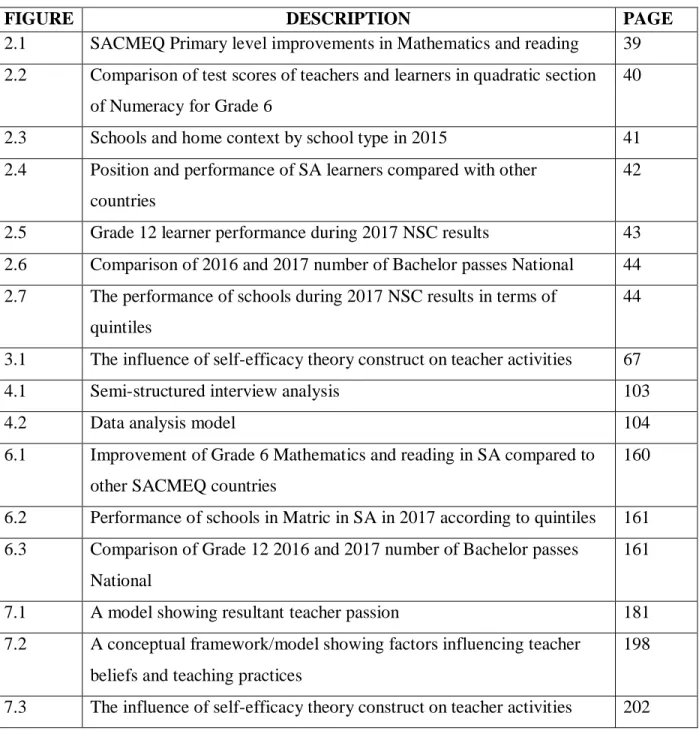
LIST OF FIGURES
FIGURE DESCRIPTION PAGE
2.1 SACMEQ Primary level improvements in Mathematics and reading 39
2.2 Comparison of test scores of teachers and learners in quadratic section
of Numeracy for Grade 6
40
2.3 Schools and home context by school type in 2015 41
2.4 Position and performance of SA learners compared with other
countries
42
2.5 Grade 12 learner performance during 2017 NSC results 43
2.6 Comparison of 2016 and 2017 number of Bachelor passes National 44
2.7 The performance of schools during 2017 NSC results in terms of
quintiles
44
3.1 The influence of self-efficacy theory construct on teacher activities 67
4.1 Semi-structured interview analysis 103
4.2 Data analysis model 104
6.1 Improvement of Grade 6 Mathematics and reading in SA compared to
other SACMEQ countries
160
6.2 Performance of schools in Matric in SA in 2017 according to quintiles 161
6.3 Comparison of Grade 12 2016 and 2017 number of Bachelor passes
National
161
7.1 A model showing resultant teacher passion 181
7.2 A conceptual framework/model showing factors influencing teacher
beliefs and teaching practices
198
xi
LIST OF TABLES
TABLE DESCRIPTION PAGE
1.1 Allocation of funds per quintile ranking 7
2.1 The impact of beliefs about the discipline of Mathematics and
Mathematics practice
32
2.2 Allocation of funds per quintile ranking 49-50
4.1 Illustration of total sample used to gather information from research
sites
87
4.2 Participants biographical information 94
6.1 Illustration of total sample used to gather information from research
sites
143-144
6.2 Allocation of funds per quintile ranking 156
xii
TABLE OF CONTENTS
ABSTRACT………..i-ii SUPERVISOR’S AUTHORISATION ... iii DEDICATION ... iv ACKNOWLEDGEMENTS... v-vi DECLARATION ... vii LIST OF ACRONYMS ... viii- ix LIST OF FIGURES ...x LIST OF TABLES ...x TABLE OF CONTENTS ... xii-xx CHAPTER ONE ...1 1.1 Introduction ... 1-2 1.2 Understanding teacher beliefs as a concept ... 2-4 1.3 The following themes informed my literature review ...4
1.3.1 Teacher belief about teaching………..4-5 1.3.2 Teacher belief about learning………..5 1.3.3 Teacher belief about student learning………..5-6 1.3.4 Teacher belief about teachers themselves………...6 1.3.5 Teacher belief about quintile ranking………. 6-7 1.4 Learner perfomance ... 8-10 1.5 Theoretical framework ... 10-11 1.6 Problem statement ... 11-13 1.7 Purpose statement ... 13 1.8 Objectives ... 13 1.9 Research questions………..13-14 1.10 The rationale for the study………... 14-15
xiii
1.11 Significance of the study………..15-16 1.12 The research design and methodology……….16-17 1.13 Data production method ………..17-18
1.14 Location of the study……….18
1.15 Limitations of the study………18-19 1.16 Sequencing and delineation of chapters……… 19-21 CHAPTER TWO……….. 22
LITERATURE REVIEW ... 22
2.1 Introduction ... 22
2.2 Understanding teacher belief as a concept... 22
2.2.1 Beliefs………. 22-23 2.2.2 Defining teacher beliefs……….. 23-26 2.2.3 Suppositions about teacher beliefs………..………..…..26-27 2.3 Teacher beliefs about teaching ... 27-29 2.4 Teacher beliefs about teaching and learning in general ... 29-31 2.5 Domain specific teacher belief (Subject related PCK) ... 31-33 2.6 Teacher belief and teacher knowledge ... 33-35 2.7. Teacher belief about student learning………...……….35-36 2.8. Teacher belief about teachers themselves………...37
2.9 Teacher belief about learner performance ... 37
2.9.1 Understanding learner performance ... 37
2.9 2 Constructing sense of learner performance in SA context compared to world rankings 38- 43 2.9.3 South Africa's Grade 12 NSC learner performance………43-44 2.9.4 Teacher beliefs about factors influencing learner performance………..44-48 2.10 Teacher beliefs about the context in which they teach………..48 2.10.1 Understanding the environment/ context of the school……….48-49
xiv
2.10.2 Understanding quintile ranking system………...49-50 2.10.3 The relationship between belief about teaching and belief about learning……….50-51
2.11 Conclusion………..51
CHAPTER THREE ... 52
THEORETICAL FRAMEWORK……….52
3.1 Introduction ... 52
3.2 Theoretical framework……….……52
3.3. The origin of self-efficacy………..53-57 3.4 Teacher self efficacy ... 57-60 3.5 Constructs of self efiicacy belief ... 60
3.5.1 Enactive mastery experiences/ Performance compliments ... 60-62 3.5.2 Vacarious experiences/ Social modelling ... 62-63 3.5.3 Verbal persuasion/ Social persuasion...63-65 3.5.4 Physiological and affective states ... 65-67 3.6 General teaching efficacy ... 67-69 3.7 Personal teaching efficacy ... 69
3.8 Comparative studies on self efficacy... 70-72 3.9 Inspirited and dispirited teachers: The effect on teacher beliefs... 72
3.9.1 Understanding ‘enablers’that boost teacher resilience ... 72
3.9.2 Engaging in social support ... 72-73 3.9.3 Moral duty and a sense of vocation ... 73
3.9.4 Exercising agency through self efficacy beliefs ... 73-74 3.9.5 Positive emotions and positive school culture ... 74
3.9.6 ‘Dis-enablers’that corroded teacher resilience ... 74
3.9.7 The inabilitty of teachers to fulfill their personal goals and ideals ... 75 3.9.8 Ineffective school leadership... 75-76
xv
3.10 The inspirited and dispirited teachers ... 76-77 3.11 Conclusion ... 77
CHAPTER FOUR
RESEARCH DESIGN AND METHODOLOGY... ... 78 4.1 Introduction ... 78 4.2. SECTION ONE:- THE RESEARCH DESIGN………..78 4.2.1 Qualitative approach to the study on teacher beliefs………79-80 4.2.2 Research paradigm ... 80 4.2.3 Interpretive research paradigm………..81 4.2.4 Using the case study approach……….81-83 4.2.5 Advantages of using case study approach………....83-84 4.2.6 Epistemology, ontology and methodology as philosophies of interpretive paradigm…..84 4.2.6.1 Epistemological beliefs about beliefs of teachers on teaching and learning………….. knowledge ………..……….84-85 4.2.6.2 Ontology……… 85 4.2.6.3 Methodology as a philosophy………... 85-86 4.3 SECTION TWO: - DATA COLLECTION ... .86
4.3.1 Research methodology ... 86 4.3.2 The description of the research sites... ………86-87
4.3.2.1 Ngosa Secondary School………88 4.3.2.2 Seaview Combined School………...…88-89 4.3.2.3 Siminza Secondary School………...…89-90 4.3.2.4 Shakeville Secondary School……….90 4.3.2.5 Qoqa Secondary School………... 91 4.3.2.6 Hlonga Secondary School……….91-92 4.3.3 Selection of the participants ... 92-93
4.3.4 Teachers’biographical information ... 94-96 4.4 Data production methods ... 97
xvi
4.4.1 The semi-structured interviews as data production method ... 97-99 4.4.2 Lesson observations as data production method ...99-100 4.4.3 The observation process………..……...100 4.4.4 Documents analysis as data production method……….100-101 4.5 Data analysis ... 101
4.5.1 Defining Data analysis………102-104 4.6 Maintaining quality in qualitative research………104
4.6.1 Trustworthiness ... 104-105 4.6.2 Credibility………....105-106 4.6.3 Transferability……….106 4.6.4 Dependability………..107 4.6.5 Confirmability………...107 4.7 Ethical considerations ... 107-109 4.8 Limitations of the qualitative research design ... 109-110 4.9 Conclusion ... 110
CHAPTER FIVE ... 111 DATA PRESENTATION AND ANALYSIS: TEACHER BELIEFS ABOUT TEACHING AND. LEARNING ... 111 5.1.Introduction ... 111 5.2.The origins of teacher belief ... 111-115 5.3 Teacher beliefs about teaching ... 115-116 5.3.1 Teachers’ understanding of teaching as a process ... 116-121 5.3.2 Teachers as support providers ... 121-124 5.3.3 Teachers views about learners and hard work ... 124-125 5.3.4 Resource provisioning and large classes on teaching ... 126-127 5.3.5 Learners lack of basics that influences teaching ... 127-128
xvii
5.3.6 Concluding comments on teachers' belief about teaching ………..128 5.4 Teacher belief about learning... 129 5.4.1 Teachers’belief on the supportive and interest aspects of learning ... 129-131 5.4.2 Teachers' belief based on the activities leading to learning ... 131-133 5.4.3 Constraining factors that teachers believe impact on learning... 134 5.4.4 Concluding comments on teacher belief about learning. ... 134 5.5 Teacher belief about the school curriculum ... 134-137 5.6 Teacher belief about themselves ... 137-138 5.7 Teachers' beliefs about being qualified teachers and about their experience of being teacher ... 138-141 5.8 Conclusion ... 142
CHAPTER SIX ... 143 DATA PRESENTATION AND ANALYSIS: TEACHER BELIEFS ABOUT CONTEXT, QUINTILE RANKING AND LEARNER PERFORMANCE ... 143 6.1 Introduction ... 143-144 6.2 Teacher belief about the context in which they teach ... 144 6.2.1 Discipline as a contributory factor in learner performance ... 144-148 6.2.2 School environment as a contributory factor in learner performance ... 148-152 6.3 Resources implication ... 152-155 6.4 Quintile ranking of schools and its influence on teacher belief ... 155-158 6.5 Understanding the relationship between teacher beliefs, the context, quintile ranking and their influence on learner performance ... 159-161 6.6 Techers’belief and rationality for learner performance ... 162-168 6.7 Teachers’belief about the means to improve learner performance ... 168-172 6.8 Conclusion ... 172-173
xviii
CHAPTER SEVEN: KEY FINDINGS AND DISCUSSION ... 174 7.1 Introduction ... 174 7.2 Understanding the origins of teacher beliefs ... 174-178 7.3 Understanding teacher beliefs about teaching ... 178 7.3.1 Passion as a crucial element of becoming a teacher ... 178-181 7.3.2 Teachers as knowledgeable individuals ... 181-187 7.3.3 Teachers as source of support to disadvantaged learners ... 187-189 7.3.4 The impact of language of teaching and learning ... 189-190 7.4 Teacher beliefs based on qualification levels, personal beliefs and teaching experience
... ….190-191 7.5 Making sense of teacher belief about the factors influencing learner performance ... 191 7.5.1 The resources as contributory factor for learner performance ... 192-194 7.5.2 Understanding the context, quintile ranking and their influence on learner performance ... 194-195 7.6. Teachers' rationality and means to improve learner performance ... 195-196 7.7 Construction and design of conceptual framework of teacher belief influencing teaching practices. ... 196-199 7.7.1 Internal teacher professionalism and external teacher professionalism ... 199-201 7.7.2 Teacher sense of self-efficacy ... 201-202 7.7.3 Teacher knowledge as a component ot teacher belief ... 202-204
7.7.4 The influence of teacher passion on teacher belief ... 204 7.7.5 Teacher belief about school context ... 204-205 7.7.6 Teacher belief about learners’learning and collegiality... 205 7.7.7 Inspirited and dispirited teachers as factors of teacher belief ... 206-207 7.8 Conclusion ... 207
xix
CHAPTER EIGHT ... 208
CONCLUSION AND FUTURE TRAJECTORIES ... 208
8.1 Introduction ... 208
8.2 Putting pieecs of the puzzle together ... 208
8.3 Findings related to the key questions in this study ... 209
8.3.1 First research question: What are teachers'beliefs about teaching? ... 209-211 8.3.2 The second research question: What are teachers beliefs about learning? ... 2011-212 8.3.3 The third research question: Is there a relationship between the belief about teaching and belief about learning?……… …...………...213
8.3.4 Fourth research question: How have teachers come to acquire their beliefs? ... 213-214 8.3.5 Fifth research question: How do the teachers’ beliefs influence teaching and learning as manifested through learner performance? ... 214
8.4 The significance of the study ... 214-215 8.5 Conclusion ... 215-216 REFERENCES ... 217-243 Appendix A: Ethical Clearance Certificate ... 244
Appendix B: KZN DOE Permission Letter ... 245
Appendix C: Permission to conduct research - Principal ... 246-248 Appendix D: Informed consent letter to teachers ... 249-251 Appendix E: Interview schedule for teachers ... 252-253 Appendix F: Observation schedule for teachers ... 254-256 Appendix G1: Lesson Plan ... 257-259 Appendix G2: Teachers’worksheets/Tasks ... 260
xx
Appendix H: Teachers’Biographical Information ... 261-262 Appendix I: Turnitin originality report ... 263 Appendix J: Language clearance report ... .264
i
CHAPTER ONE
BACKGROUND OF THE STUDY
1.1 Introduction
Learner performance in South African schools has been a subject of major debates over the last decade, largely related to conflicting evidence through the increasing matric pass rates on one side and extremely low performances in Annual National Assessment testing and world rankings on the other side. Heightened focus on teaching and learning has thus been the process to address these debates. Teaching and learning as a major component of school education has various facets, including the nature of the curriculum, the expertise of the teachers and the context of schooling. Learner performance in South African schools has been a major concern for Government, parents, institutions of higher learning and other stakeholders in education. These concerns have arisen in spite of many intervention programmes and strategies that have been put in place to overcome poor learner performance and even though the largest slice of South Africa’s budget is allocated to education. The interventions include, employing appropriately qualified teachers, workshops and other in-service training activities. The latter have been conducted as part of continuing professional teacher development (CPTD) to improve teaching and learning in schools. Further interventions focused on school infrastructure development like building of new schools as well as upgrading older school structures and renovating dilapidated schools. One other key intervention has been the introduction of the school nutrition programmes. Despite all these interventions, learner performance has not improved significantly. Moreover, learner performance has in recent times, been reported according to the school quintile types.
There is correlation between school learner performance and teacher beliefs across the school quintiles. Spaull’s (2013) idea of two school worlds was used to get insight into understanding the said correlation. According to Spaull (2013) schools in South Africa are divided into good performing while others have poor learner performance. Part of my argument is to responds to
2
the two worlds that have been noted and are emerging in South Africa. In an attempt to advance the two school worlds debate, in this study I explore teacher belief as a lens to contribute to this emerging discourse.
My study is located within the broader National Research Foundation (NRF) funded research project on school categorisations focusing on learner performance. In this study I delimit my focus of teaching and learning to that of teachers’ belief and its influence on teaching and learning that accounts for the resultant learner performance. The South African Department of Basic Education (DBE) places great emphasis on teaching and learning that is aimed at yielding good learner performance. In view of the existing challenges that emerge from various school contextual factors, one could argue that indeed teachers are expected to miraculously excel in their teaching. The KZN DBE slogan of (Time on Task and Task on Time) is one example that highlights the expectations that DBE has on teacher performance in order to achieve high student results. However, there are many factors that affect these envisaged endeavours.
The literature I have perused has highlighted that teaching of any subject is influenced by number of factors such as knowledge base, belief systems of teachers, curriculum changes, lack of teaching resources and reluctance of teachers to teach. I have also noticed that literature points out that teachers have different beliefs about teaching and learning. Also, teachers are influenced by beliefs about themselves, subjects taught, about learners and about the school as a whole. It then became necessary to explore teacher beliefs and how teacher beliefs influence teaching and learning. The outcome of this research could contribute to the interventions aimed at improving learner performance in schools. For the purpose of this study I will be looking at the literature that focuses on teachers’ beliefs and the influence they have in teaching and learning.
1.2 Understanding teacher beliefs as a concept
Teacher beliefs are defined differently by many authors. Khader (2012) defines teacher beliefs as the perceptions and values teachers have about teaching learners, and the education practice brought to classrooms. Teacher beliefs are understood as the thoughts possessed by the teacher in connection with teaching and learning procedure, which influence their classroom activities. Kagan (1992) delineates teacher beliefs as tacit, frequently instinctively held suppositions about learners, classrooms, and educational material to be imparted. According to Uibu, Salo,
3
Ugaste, Rasku-Puttonen (2017) and Rubie-Davis, Flint, and McDonald (2012) teacher belief is what molds thoughts and subsequent instructional behaviours which can impact on learner outcomes; it is the belief that teachers hold and influence their thoughts and their instructional pronouncements. Most held beliefs are shaped through experience in a given time (Hart, 2002). Phipps and Borg (2009) assert that teacher beliefs occur as a system by which some beliefs are fundamental and others marginal. For them, fundamental beliefs are constant and employ a more dominant influence on behaviour compared to marginal beliefs.
Tondeur, van Braak, Ertmer, Ottenbreit-Leftwich, (2017) and Pajares (1992) describe teacher pedagogical beliefs as a “broad and encompassing” construct referring to specific understanding or propositions about teaching and learning and those pedagogical beliefs include numerous sub-constructs like epistemological beliefs, one’s own perceptions , and beliefs about precise subjects or courses (e.g., Mathematics Life Sciences, History, etc.). For Calderhead (2006), teacher beliefs, teacher knowledge and as well as teacher thinking,
comprise of the wider concept of teacher intellect. Nicholas and Williams, 2009; Griffin &
Ohlsson, 2001; Kagan, 1992; Pajares, 1992 have defined the beliefs as further influential compared to knowledge in defining how individuals consolidate and delineate responsibilities and glitches. This, then, causes them to be robust predictors of behaviour. Richardson (2004) explained that teacher’s beliefs emanate from three foundations which include personal experiences of the educator in broad-spectrum and precisely teaching, educator’s experience as a pupil and the educator’s knowledge of the school progressions. Fang (1996) on the other hand concentrates on a cluster of dissimilar factors associated with school in the construction of teachers’ beliefs, which include the administrative provision, attitude of contemporaries, school ethos, learners’ capabilities and backgrounds on top of the procedures and protocols that are pragmatic in a particular school. In contrast, teacher beliefs are more peripheral and more recently formed amongst teachers who are currently teaching, more dynamic and thus more open to current changes ( Tondeur, et al. 2017; Five & Gill, 2015).
My understanding of teacher beliefs is based on Tondeur, et al. (2017); Five and Gill, 2015; Khader (2012), Richardson (2004), Pares (1992) and Kagan’s (1992) notion which defines teacher belief as attitudes, thoughts, values, tacit and unconsciously held assumptions teachers have about teaching students which teachers bring into classrooms and influence their classroom activities. Teacher beliefs originate from own experiences in common and teaching
4
in particular, teacher’s experience as learner and educator’s knowledge of learners’ abilities and the school ethos. My line of argument is based on the above conception of teacher belief.
1.3 The following themes informed my literature review:
1. Teacher beliefs about teaching, (pedagogy – teacher knowledge, teacher beliefs)
2. Teacher beliefs about learning
3. Teacher beliefs about student learning 4. Teacher beliefs about teachers themselves
These themes are briefly engaged with in this chapter and will be expanded in the literature review chapter.
1.3.1 Teacher beliefs about teaching
Ideas about the nature of knowledge and teaching and learning are moulded through several years of exposure to scholastic practices. Biggs (2012) and Cheng, Chan, Tang, Cheng (2009) argue that the traditional and the constructivist are the dual foremost conceptions of teaching and learning. These two views afford a divergence of conceptions of teaching and learning that could also be perceived as either ends of a range with changing conceptual indulgences in between. Cohorts of the traditional notion trust that the classroom learning background in which the educator plays the paramount role in knowledge transmission supports and harvests the supreme efficient and effective learning process and outcomes (Cheng et al., 2009). Constructivism as it is originated from Piagetian theory regards belief as people enthusiastically hypothesise their perceptions by inferring their experiences (Kegan, 1994). Believers of constructivism advocate that knowledge is generated from the communication between learners and teachers. Admiraal, Louws, Lockhorst, Paas, Buynsters, Cyko and van Der Ven (2017); Orlando (2013); Biggs and Tangs (2011) classified formations of teaching in relation to two angles - ‘teacher-centred’ which deals with the communication of distinct forms of content knowledge. In contrast, ‘student-centred’ perceives learners’ learning as a progressive methodology towards learners and their formations of knowledge other than concentrating on educators. The traditional origin of teaching is frequently denoted to utilising teacher-centred teaching approaches since knowledge attainment is implicated and transpire utilising one-way transmission procedure from the educator to learners, with inadequate collaborative progressions between learners and educators; student-centred teaching
5
approaches that accentuate the learner’s self-motivation, self-reflection and the fact that learning is a contemplative and collaborative procedure where the teacher takes the role of being the facilitator. Studies (Entwistle & Peterson, 2004; Entwistle et al., 2000) express that if an educator embraces a more student-centred method to teaching, the learners will be further enabled to accept a deep method to learning that pursues profounder meanings and contemplations of what they are learning. The South African school education system has adopted this student-centred slant to teaching and learning. This study hopes to explore what beliefs teachers have of their teaching practices and how these beliefs may influence learner performance in their classes.
1.3.2 Teacher beliefs about learning
Researchers, (Khader, 2012; Faour, 2003) have alluded that the intricacies of classroom life can limit teachers' abilities to enhance their beliefs and afford instruction which is in line with their beliefs. This recommends that contextual elements can have prevailing influences on teachers' beliefs and impact their classroom activities (Khader 2012). Khader further stated that teachers' beliefs and other classroom activities considerably diverge dependent on schools' socio-economic position, class size, and grade level teachers teach in. Teachers' level of broad-spectrum education, remuneration, training, age, and principal's sustenance were also
correlated to beliefs and practices of educators. The study conducted by Milner, Sondergeld,
Demir, Johnson, & Czerniak (2012) exhibited that there were no substantial differences between the teachers’ beliefs and their classroom activities.
In view of the above, one may assert that teachers possess particular beliefs about the schools they teach in and those beliefs affect the way they teach, behave, react and respond within the schooling environment.
1.3.3. Teacher beliefs about student learning
The success of learners in schools is dependent on the social background of the learners. TALIS, (2009) asserts that the social background of the students such as level of education of parents and teachers’ approximation of the typical ability of a student equated with a learner of the identical age at school level, impact on learner performance. Thus teachers see relations
6
between learners and teachers as enhanced when the learners at their schools have greater ability (TALIS, 2009). Teachers in schools with learners from a destitute social background and with learners of low mediocre ability have to manage with a remarkably less favourable working and learning situation which poses challenges and stress to teachers and hinder effective schooling, thereby broadening the gap in students’ performance.
1.3.4 Teacher beliefs about teachers themselves
Teachers have a particular belief about themselves. Scholars (Nicholas and Williams 2009; Pajares 1992) confirm that individuals own belief systems that comprise of all their beliefs about the corporeal world, the social world, and the world where self is recognised. This system has a fundamental purpose in empowering people to define and comprehend the world and themselves. Some teachers perceive themselves as good and effective teachers based on the academic element (content knowledge) of teaching, being compassionate, sympathetic, considerate, amicable, engaging and friendly ( Nicholas and Williams, 2009). According to Kuzborska (2011), teachers’ beliefs affect their goals, processes, provisions, classroom interaction arrangements, their roles, their learners, and the schools they teach in.
1.3.5 Teacher beliefs about quintile ranking
Teachers had particular beliefs about quintile ranking of schools. It is imperative to comprehend what quintile ranking is before I could engage into beliefs about it. Every public school in South Africa has been classified or categorised into five quintiles for the purposes of funding, post provisioning, potential performance accolades for schools and further programmes inclusive of school nutrition and learner transportation (DBE, 2013). Oxford Dictionary defined quintile as any five equivalent groups into which a populace can be separated according to the dissemination of values of a precise variable. This quintile system was part of National Norms and Standards for funding public schools presented in 1998 to advance equity in education (Department of Basic Education, 2013). The quintile, in which the school was based, was on the basis of infra-structure of the school, rates of income of the population around the school, unemployment and illiteracy in school’s catchment area. Schools in quintile 1, 2 and 3 have been declared as ‘no fee’ school whereas quintile 4 and 5 schools are ‘fee paying’ schools (Media Release, Western Cape Department of Education, 2013). The funding of the schools is based on these quintiles. Learners in quintile 1, 2 and 3 received a
7
much larger funding from the government as compared with the learners from quintiles 4 and 5. Schools falling in quintiles 4 and five were expected to supplement their allocation with extra school fees that they charged learners (Media Release, Western Cape Department of Education, 2013).
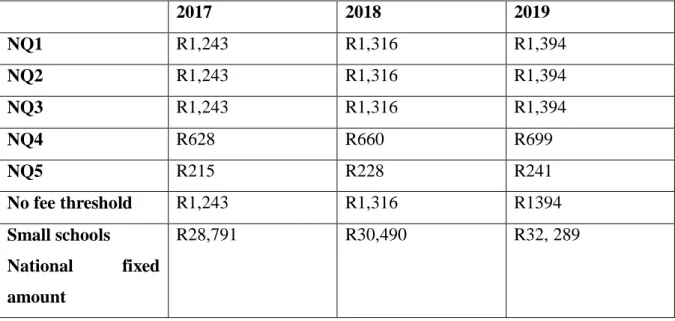
The following table shows the distribution of funds per learner to schools across all five quintiles.
Table 1.1 The table showing the allocation of funds per quintile
If looking at paragraph 110 of the NNSSF, the National Targets Table published in
Government Notice No. 718, Government Gazette No. 40065 of 10 June 2016 is hereby updated to comprise 2019 target amounts. The no fee threshold was R1, 243 in 2017:
2017 2018 2019 NQ1 R1,243 R1,316 R1,394 NQ2 R1,243 R1,316 R1,394 NQ3 R1,243 R1,316 R1,394 NQ4 R628 R660 R699 NQ5 R215 R228 R241 No fee threshold R1,243 R1,316 R1394 Small schools National fixed amount R28,791 R30,490 R32, 289
Illustration of 2018 and 2019 figures of inflation adjusted CPI predictable inflation rate attuned Adapted from: Government gazette No 40065, 10 June 2016
It had become pivotal for me to give the above background before looking into the beliefs of teachers with regards to quintile ranking. This section focuses on beliefs teachers had about the quintiles assigned to their school
8
1.4 Learner performance
Learner performance in South Africa has been viewed as poor according to international rating stands as well as Matric results in the past years. The report by the DBE revealed that learners perform poorly in higher grades than in lower grades. I concur with Sevnarayan (2015) when saying that “South Africa has the worst education system of all middle –income countries that participate in cross-national assessments of educational achievement. What is more, we perform worse than many low-income African countries?” Sevnarayan, 2015, p. 2).
The studies revealed that the gap between the former white schools and former black schools is huge and had an impact on learner performance. For Sevnarayan (2015) studies reveal that 50% of White learners who wrote Matric examinations in South Africa qualified for university entrance requirements as opposed to their Black counterparts where only 10% of Black learners qualified for university admissions. It is a fact that historically Black disadvantaged schools constitute up to 80% of the countries matric population of schools, however only 20% of the learners coming from these schools qualify for university entrance (Sevnarayan, 2015; Pocock, 2012). These findings are in line with my study as they speak of the beliefs people have about learners’ learning and the resultant learner performance.
Research was conducted in South Africa (SA) to interrogate the reciprocal causativeness of poor academic performance of learners in South Africa with regards Literacy and Numeracy and which also include their reading illiteracy as compared to international communities (Moloi & Strauss, 2005; Pretorius & Mampuru, 2007; Sailors, Hoffman & Matthee, 2007; Fleish, 2008; Moloi & Chetty, 2010; Makhathini, 2015, Howie, Combrinck, Roux, Tshele, Mokoena, & Mcleod Palane, 2017). South Africa’s partaking in various international studies such as SACMEQ, PIRLS, and TIMSS, as well as other resident studies, for example, Systemic Evaluation(SE)and the Annual National Assessments (ANA, although ANA is no longer used as an assessment yardstick for learner performance since 2016), National Senior Certificate (NSC) Matric examinations which track learner performance in Literacy and Numeracy Intermediate and Senior Phase bands and FET band in respect of Matric results, have assisted South African education system in yielding data to assist brightening these unbecoming trails.
The research conducted internationally about South African education system showed very little progress as far as learner performance is concerned in Southern and Eastern African
9
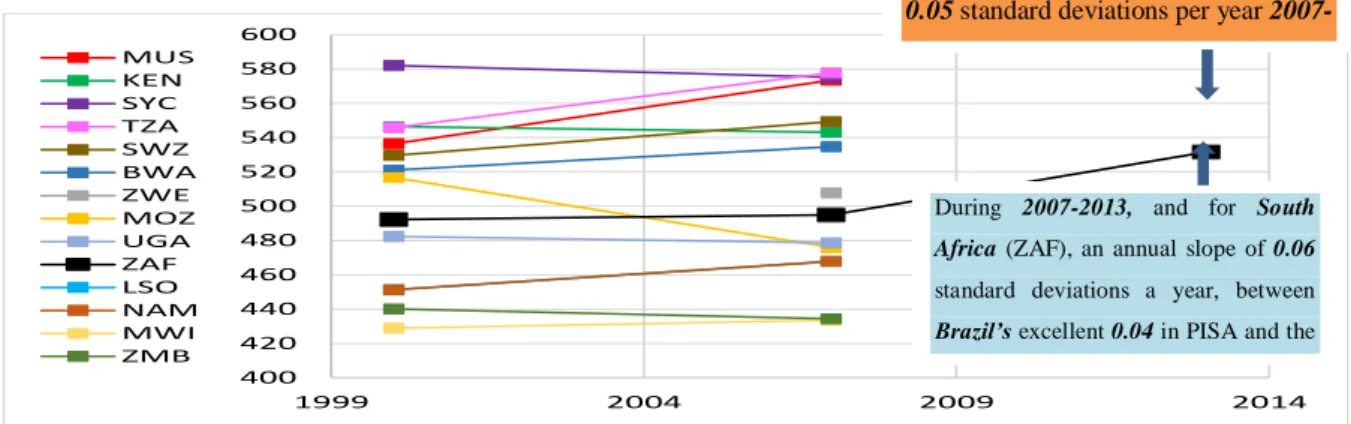
Consortium for Monitoring Education Quality (SACMEQ). SACMEQ is an international quality ranking system which focuses on primary schools’ Literacy and Numeracy in 15 countries it researches. The results in SACMEQ II (2000), SACMEQ III (2007), SACMEQ IV (2013) revealed poor performance of SA learners in numeracy and literacy results. The results exposed that South Africa had not recorded any improvements in Grade 6 Literacy and
Numeracy over a seven year period. In the SACMEQ III, South Africa was ranked 10th out of
14 Education Systems in Grade 6 Mathematics, (and was even behind the much smaller countries such as Swaziland, Kenya and Tanzania) with an average percentage of 36.7%. SACMEQ results also established that learners in SA’s Grades 1 to 6 could only read at two levels below their own grade in English and in their Home Language (Makhathini, 2015).
The Trends in International Mathematics and Science Study (TIMSS), which is a system of international benchmarking assessments which are conducted at 4-year intervals to all participating countries, demonstrated that South Africa did not show any significant progress on the assessments in Grade 8 Mathematics and Science as from 1995, 1999, 2002, 2007, 2011 and 2015. Makhathini, (2015, p. 3) alludes that “in the 2007 version of TIMSS the Grade 8 tests had to be given to Grade 9 learners because it was said to be ‘too difficult’ for the Grade 8 learners.” In the 2011 TIMSS, there was little level of improvement recorded in Grade 9 results. However Spaull (2013, p.4) has different view about the improvement as the report alludes:
Part of the reason for the improvement is the fact that South Africa’s post improvement level of performance is still the lowest of all participating countries, with the average South African Grade Nine child performing between two and three grade levels lower than the average Grade Eight child from other middle income countries.
Therefore, looking at the corncerns raised by Spaull (2013), there is no reason for South Africa to celebrate this achievement given the status of affairs above.
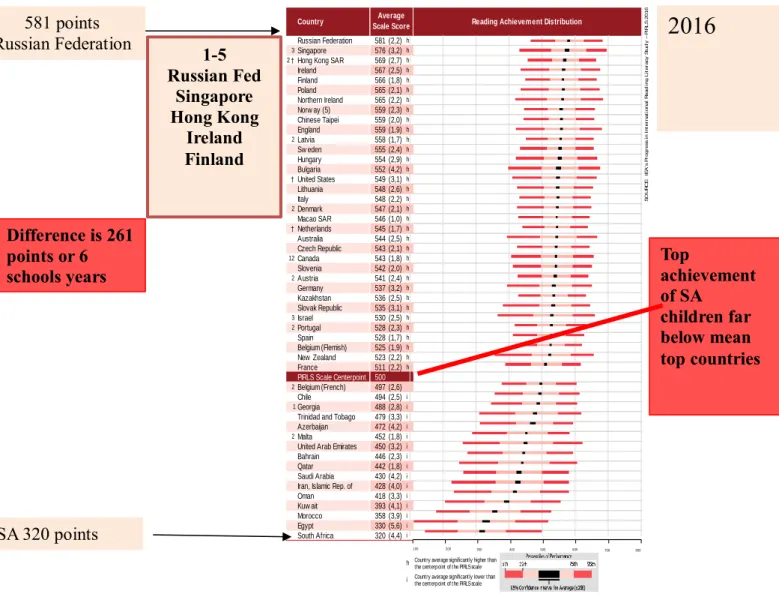
The Progress in International Reading Literacy Study (PIRLS), an international assessment standard that evaluates reading comprehension and monitors trends in reading literacy at five year interludes, assessed Grade 4 and 5 learners in eleven official languages. In 2006, 2011, 2016 PIRLS recorded an underperformance by SA learners with South Africa occupying the bottom last position with a score of 320 out of 1000 for Grade 4 and grade 5 Afrikaans, English and IsiZulu (scoring 406 points out of 1000) in the achievement of PIRLS 2016 out of 50
10
countries. The top achievement of SA children was far below mean top countries. Only trends in grade 5 PIRLS IsiZulu that has shown significant improvement equivalent of more than two years of schooling from 263 in 2006 to 358 in 2016 (Howie, Combrinck, Roux,Tshele, Mokoena, & Mcleod Palane, 2017).
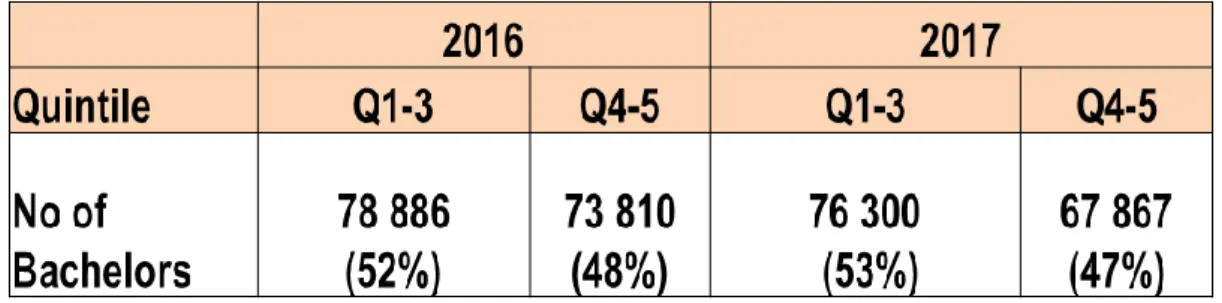
National Senior Certificate (NSC) Matric examinations also serves as the yardstick to measure learner performance nationally. The overall pass percentage Matric class of 2017 was 75.1 % compared to 72.5% in 2016 and 70.7% in 2015 respectively (DBE, 2017). A slight increase of 2.6 % and 28.4 % of bachelor passes are observed in these results.
Much of the above information and statistics will be dealt with in chapter two of this thesis. It is imperative to highlight the fact that teacher beliefs about teaching and learning are linked to learner performance as they relate and impact on learner performance this section discussed. It is believed that if teachers teach effectively and learners learn successfully and education system is conducive for effective teaching and learning, then the increase in performance of South African learners in the above-mentioned international testing standards will be discerned.
1.5Theoretical framework
This study was informed by Bandura’s (1997) theoretical framework on self-efficacy as I looked at teacher beliefs and the influence they had on teaching and learning. Bandura (1997) defined self-efficacy as “beliefs in one’s capabilities to organize and execute the courses of action required to produce given attainments” (p.3). Experimental and other theoretical work has demonstrated that teachers’ beliefs occur as a system (Fives & Buehl, 2012) and self-efficacy beliefs are a significant constituent of this system (Pajares, 1992). Bandura (1997) has identified four sources of efficacy beliefs which are: mastery experiences, vicarious experiences, verbal persuasion, and physiological arousal. Many theorists I have studied agree with Bandura’s notion of self-efficacy as they argue that teachers with greater self-efficacy beliefs are more likely to advance challenging lessons in class and teach with a diversity of methods to promote learner learning and they are resistant to challenges and they persevere when faced with obstacles (Miller, Ramirez & Murdock, 2017; Guo, Dynia, Pelatti, Justice, 2014; Holzberger, Philipp, Kunter, 2013; Woolfolk-Hoy & Burke-Spero, 2005; Deemer,
11
2004). This theory was useful in explaining how teacher beliefs impacted on the self-efficacy of the educators in schools.
Bandura’s efficacy theory has its limitations as it does not explain behaviour change of teachers which is also a factor in teacher beliefs. In this study I also made use of Naicker’s (2014) conceptual framework of ‘spirited’ and ‘dispirited’ in order to understand teacher beliefs about teaching and learning. In trying to understand teacher resilience in her study on critical incidents of teachers, Naicker (2014) had coined the following two concepts inspirited and dispirited. The idea of inspirited and dispirited came from the notion of spirit which was drawn from Scott (1994) as well as the perspectives on spirituality and spirituality in the workplace were derived from the work of Fry (2003), Giacalone and Jurkiewicz (2003), Karakas (2010), Lips-Wiersma (2002), Mitrolf and Denton (1999), Neck and Milliman (1994). Naicker (2014) studied the incidents that demoralized teachers causing them to be dispirited. She further argued that if teachers experience deep connection with colleagues, learners, parents, SMT and school community at large, they felt validated and affirmed and they had sense of belonging thus they were said to be spirited. Drawing on Naicker’s concepts of teacher being to levels of ‘inspiritedness’ and ‘dispiritedness’ that have been developed in the foundations of enablers and dis-enablers; I have explored the issue of teacher belief. If the teacher is inspired, he or she will inspire others. The teachers in Naicker’s study were experiencing different critical incidents that were supposed to pull them down but instead the zeal they had, made them to cope and being inspired. Naicker argued that her participants were ‘inspirited’ as she said, “It was these ‘enablers’ that contributed to teachers being inspirited by the critical incident,” (Naicker 2014, p.222). The findings of this study therefore include the understanding of the above concepts by Naicker.
1.6Problem statement
Teachers had limited experience of teaching effectively critical subjects such as Mathematics, Science, Accounting, Life Sciences, to mention but few. Many teachers lacked adequate knowledge for teaching these subjects. Research has shown that teachers’ knowledge of the specific subjects and the beliefs they have about teaching and learning influence their teaching approaches (Preethlall, 2015; Hogan, 2000; van Driel, Beijaard, Verloop, 2001) and thus impacting on learner performance. The efforts of previous researchers and this study in particular were dedicated to enhance learner achievement through value-added teacher
12
practice. According to Borko (2004), the teachers are the ones who play a vital role in terms of entire formal instructional systems in the classroom. Teachers are therefore regarded as the “cornerstone” or “the most prominent factor” in educational changes and improvements (Van Driel, Beijaard, & Verloop, 2001; Fishman & Davis, 2006, Preethlall, 2015). Given the imperative role of the teachers in the execution of the curriculum alterations, the focus of this study was to comprehend the beliefs teachers have about their own teaching and about how learning occurs in such a way that will influence and impact on learner performance if there is any relationship between teacher beliefs about teaching as well as teachers’ knowledge. Teacher knowledge is part of teachers’ belief about teaching as teaching involves teacher knowledge such as content knowledge, knowledge needed to deal with teaching and learning, comprising knowledge of the curriculum, general pedagogical knowledge, as well as pedagogical content knowledge and pedagogical knowledge of context (Preethlall, 2015).
The intentions of this study are to apprehend teachers’ belief about teaching and learning and the influence they have in terms of learner performance. The major concerns were in three aspects which were teacher belief about teaching and learning, quintile rankings of schools and learner performance. Several interventions have been made in terms of addressing the quality of school education from curriculum transformations to putting up the quality of teachers through teacher development programmes and other policies put in place to ensure effective educational leadership and management and so forth, but we are still having difficulties in comprehending why learners are not performing to the expected standards (Spaull, 2013 and Makhathini, 2015). Inspite of that, the world benchmarks in most of the rankings are still quite low. This study is focusing on the relationship between school context, teacher beliefs around teaching and learning and how these two influence learner performance.
Teacher belief has been concerned with and has influenced the way in which teachers teach and facilitate learning in schools (Uibu, et al., 2017; Borko, 2004). There has been substantive amount of work done in the field of teaching (Tondeur, et al., 2017), however, we have been looking at on how contextually those beliefs manifest themselves in different school contexts and to understand teacher beliefs in the context in which teachers manifest these beliefs in the teaching process.
In terms of school context, the policies that are in place in terms of teaching and learning and in terms of supporting schools are guided by ‘one size fits all’ policy. However, in South Africa
13
there are schools that are differentiated in terms of resources, financial capacities, quintile rankings, rural and urban etcetera and what this study is trying to do is to begin to question how these variations influence the way teacher beliefs about teaching and learning occur and ultimately improved learner performance.
1.7The purpose statement
The reason for exploration of the phenomenon of teacher beliefs on teaching and learning and the impact they have on learner performance was that teachers have beliefs that inform them as to why they teach the way they do and what were the obstacles they experienced when teaching and learning occurred. The units of analysis are teachers who are teaching in Secondary schools from Grade eight to Grade twelve. This study focuses on teacher belief by exploring what belief teachers have of schooling, teaching, learning and learners. More specifically, the purpose of this study was to explore teachers’ beliefs on teaching, learning and learners and to establish how these factors linked to their teaching practices. The study also explored teachers’ belief across school contexts, which I delimit to school quintile rankings.
1.8 Objectives
In exploring what teacher beliefs about teaching and learning entailed, in Ilembe and Pinetown schools, the objectives of this study were:
1. To explore the beliefs teachers have about teaching.
2. To explore teachers beliefs about learning.
3. To understand the relationship, if any, between belief of teaching and belief of learning.
4. To explore, if any, the relationship between teacher belief and learner performance.
1.9 Research Questions
Bassey (1999) describes a research question and compares it to the engine which propels a train of investigation and should be enunciated in such a way which targets at setting a clear program for the research conducted. It is envisaged that the research questions are framed and replaced as the research proceeds (Preethlal, 2015) and “without them the journey will be slow or chaotic” (Bassey, 1999, p. 67). In trying to explore teacher beliefs about teaching and learning, the research questions this study specifically set out to answer were:
14
1. What are teachers’ beliefs about teaching?
2. What are teachers’ beliefs about learning?
3. Is there a relationship between the belief about teaching and the belief about learning?
4. How have teachers come to acquire their beliefs?
5. How do the teacher’s beliefs influence the teaching and learning as manifested through
the learner performance?
1.10 The rationale for the study
My main interest to pursue this study emerged from my roles as PhD scholar and as a principal of the Secondary school and as post level one teacher who is expected to teach learners and produce good results. The issue of results always remained the ‘pain in the neck’ because learners were not achieving to the level that is expected by the Department of Education. It became worse when I became a Principal because all the results and improvement in learner performance were expected and demanded from me as an accounting officer at the school. As principal of the school, your school is influenced by the number of factors such as the place where your learners come from and from other contextual realities such as home environments, school environments, prescriptions of CAPS, teachers’ issues, etcetera, and ultimately as school principal you need to account for the learner performance in the school. This study gives me an insight into how teacher beliefs about teaching, learning, curriculum and the context such as my school, influence the way in which learners perform at school. So doing this study has enabled me to manage and lead the school in a substantive way and helped me in addressing some of the contextual variations of beliefs so that I can improve the school as a whole.
Secondly, from a kind of a research base scholarship, learner performance has been a major concern in the country since the emergence of democracy and the opening up of the opportunities of learners to be in schools. Also there has been several interventions to try and bring the quality of school education but all in vain. All of those interventions in themselves could not lead to potentially increased learner performance and quality level of education. As stated earlier on above that national reports on international standards and world rankings such as TIMSS, PERLS, SACMEQ (Howie et al. 2017; Makhathini, 2015) studies as well as National Senior Certificate Examinations conducted in South Africa, suggested that South
15
African learners are still performing badly and there is a lot to be understood in terms of why these interventions are not yielding and manifesting the results they were intended to. So in this study, I have taken a more contextual vantage point in trying to understand learner performance and I have identified teacher beliefs as teachers being the main instrument to facilitate teaching and learning as the way of addressing or looking on learner performance. This study therefore contributed towards the discourse on learner performance through contextually sensitive advantage point that interfaces teaching, learning and context through the lens of teacher and teacher belief.
1.11 Significance of the study
It was found in this study that teachers’ beliefs of teaching and learning differ according to their quintile rankings. These beliefs had been influenced by their teaching practices over a period of time in their respective schools. This study contributed towards further understanding of factors that influenced learner performance.
Although teacher belief as a phenomenon has been studied intensively, little has been researched on the impact of teacher belief on teaching and learning on learner performance. This study will contribute to the literature and body on knowledge and endeavors to enlighten a broader professional forum, which include the school principal, the decision-makers in the Department of Education, subjects advisors, supervisors and other relevant stakeholders about the beliefs teachers have on how teaching and learning is affected and learner performance is impacted in the long run. It should offer insight on decisions to be taken by decision makers with regards to issues raised here such as revision of quintile ranking policy, teacher development, resource provisioning and so on. I believe that this study will make a significant contribution to the current debate on teacher beliefs about a number of factors affecting teaching and learning and eventually learner performance which in essence is why schools exist, that is to open up prospects learner attainment across different school categories.
In the literature that has been studied, there is inadequate indication of the connection between teachers’ levels of comprehensibility or competency with regards to their knowledge and to their beliefs they possess about teaching and learning. In a nutshell, though research evidence about learners’ learning and different formations in knowledge is far-reaching and virtually universally agreed upon, inadequate knowledge exists about the manner teachers’ knowledge
16
and beliefs disturb the manner in which teachers teach and believe in general. Saad and Boujaoude, (2012) postulated that, “Studies about teachers’ knowledge, teacher beliefs and their classroom practices are still few and scattered” (p. 114). Moreover, Fischler (1998) and Preethall, (2015) concede that little evidence of teachers’ belief, teachers’ knowledge regarding their perceived roles, teaching purposes, and their influence on learners’ learning. Moreover, the study shows possible way of studying different affiliations such as, between teachers’ knowledge, their activities and learner achievement; between their beliefs, their practices and learner accomplishment; and between their knowledge and beliefs. The findings of this study elucidate consistencies and inconsistencies that might have existed between what teachers identify, utter, what was really perceived in their practice. Therefore the findings makes available prospects for further research.
1.12 The research design and methodology
It was imperative for me to ensure that the aims and intentions of this study were attained by carefully deciding on the appropriate research design and methodology that suited the study. Being aware of the necessity of consulting different relevant literature such as books, journals and other theses as the initial strategy to critique the position of the subject to be studied (Preethlall, 2015, McMillan and Schumacher, 2001), I collected, as a strategy, data in respect of the teacher beliefs about teaching and learning and in the influence they had on learner performance. This study was situated within the multiple case studies methodology. Rule and John (2011) define case study as a systematic and profound investigation of a specific instance in its context in order to produce knowledge. A case study, according to Yin (2003) cited in Rule and John (2011 p 4), “is an empirical inquiry that investigates a contemporary phenomenon within its real life context, especially when the boundaries between phenomenon and context are not clearly evident.” Creswell (2009) defines case study as a one occasion of a bounded system, such as a child, a clique, a class, a school and or a community. My aim here was to understand what beliefs teachers have with regard to teaching and learning and to explore any influence these beliefs have on teaching and learning.
The study was a qualitative research methodology, which Marshall, and Rossman (2006) define as being multi-method in emphasis and concerning an interpretive naturalistic approach to its subject matter. Qualitative research approach permitted me to probe the issue highlighted by questioning the respondent to acquire clarity or to challenge the particular expectations in
17
which their first ideas or rejoinders are made. Marshall, and Rossman (2006) state that qualitative researchers endeavour to comprehend thoughts, feelings and sensations by getting to know people’s values, beliefs, and symbols. This is in line with my study because teachers’ beliefs, thoughts, feelings and emotions of teaching learners were scrutinised using a variety of qualitative methods.
This study was situated within the interpretive paradigm. The researcher believed that the reality to be studied consisted of the subjects’ subjective experiences of the world and adopted an interactional stance towards reality. Cohen, Manion, and Morrison (2011) explain that the interpretive paradigm helps to comprehend the subjective world of human experience. They further elaborate that “interpretive researchers begin with individuals and set to understand their interpretation of the world around them” (Cohen, .et al., 2011, p.17). The aim of this approach is to comprehend how individuals in everyday situations construct meaning and elucidate their occasions, actions and proficiencies of their world (Cresswell, 2009). This is true of the study I conducted, the beliefs teachers have on various things including the teaching of particular subject was explained and their experiences of the world were understood.
1.13 Data production methods
I have used more than one data production method to obtain an understanding of teacher beliefs and their influence on teaching and learning. Semi-structured interviews were the main data source whilst lesson observations and document analysis were used as supporting evidence. Audio recorders were used to record interviews and lessons during observations.
In addition to the semi-structured interviews, observation of lessons took place over a week. The lessons were audio recorded. The audio-recordings were used for two purposes. The first was to focus on eliciting notions of teacher belief as noted through the recorded lessons and guided by literature review. The second was to use these identified notions of teacher belief as part of the interview process to delve deeper into teacher belief as it related to their teaching and learning.
The third method of data collection was document analysis. Learner performance records of the selected teachers were reviewed over a period of five years to explore trends and or patterns. Also, lesson plans were analysed to compare what was taught against what was planned. This
18
data set allowed me to do two things. First it attempted to link teacher beliefs to learner performance and secondly it explored how the teacher explained his/her learners’ performance in relation to teaching and learning. The use of three data collection methods which were interviews, observation, and document analysis allowed for methodological mix and data triangulation.
Data was analysed using content and discourse analysis as well as apriori frame analysis. Here data was analysed using themes that were developed before data production. Units of analysis were established to indicate similarities and differences by ascribing codes or key words to identify data (Cohen, et al 2011).
1.14 Location of the Study
This study took place in Secondary schools situated in rural and urban areas so as to ensure the representativeness of different school contexts. Six schools from Ilembe and Pinetown Districts in KwaZulu-Natal Province were the cases in this study; three from each category. Also different quintile rankings 1-5, rural or urban and religious inclinations of schools were considered in order to explore whether they had any influence on the teacher’ beliefs and teaching as well as learner performance in general. The choice of six schools allowed me to include the range of schools as categorized by the school quintile system, in the purposive sampling of research sites. More details on sampling are discussed in chapter four.
1.15 Limitations of the study
This study had a number of limitations. The first one was that some teachers were unable to articulate what their beliefs were.
The second limitation of my study was that most of the teachers I interviewed did not understand the quintile concept. I had to explain to them what quintile was and further told them the quintile of their own schools because they did not know to which quintile their schools belong to.
The limitation was that this study only focused on only six schools and eleven participants in only two Districts which make the findings very limited in terms of representativeness of the population of teachers in South Africa. Therefore the generalizability of the findings would be
19
restricted as may be the case with more quantitative approaches. However, some other readers and researchers would accept this investigation that explored case studies that had a strategic relevance to general problems in education (Govender, 2015; Jon & Greene, 2003). The problem in this study was that of poor performance of learners in schools in spite of teaching and learning being done in schools, therefore it was imperative that I explored teacher beliefs about teaching and learning and their manifestation in learner performance.
1.16 Sequencing and delineation of chapters
This section of the thesis signposts the route I have taken to compile this report. The thesis is therefore divided into eight chapters and is delineated as follows:
Chapter One: Background of the study
Chapter one provides a synopsis of the study. It sets the scene and the tone by providing a background to the study and insight into the intentions of the research. Chapter one further describes the focus of the study which is focusing into teacher beliefs and teaching and learning. Subsequent sections deal with the statement of the problem, the rationale, the research questions, and the significance of the study. The chapter then provides a conceptual underpinning of beliefs, teacher beliefs and learner performance as concepts that are in the hub of the study. I conclude this chapter by offering a brief synopsis of the research design and methodology exploited in this study and lastly limitations of the study.
Chapter Two: Literature Review
This chapter begins by unpacking key concepts of belief and teacher belief as they are defined by different researchers who were interested in this area. The above concepts form the net that engulf and synchronise the chapters as so as to comprehend teacher beliefs. It then discusses teacher beliefs about teaching, teacher belief about learning, about student learning as well as teacher beliefs about learner performance. Furthermore, the chapter deliberates on schools context in which teachers find themselves teaching in and their beliefs about such contexts. The chapter concludes by reviewing studies conducted by different researchers in the field of teacher beliefs and the findings that emanated from such studies.
Chapter Three: Theoretical and Conceptual Frameworks
In this chapter I present the review of theoretical framework of this study. Bandura’s self-efficacy theory (1997) is unpacked and its relevance to this study is explained. The conceptual