Modern Information Technology to Support Interrupted
Work Environments
This short paper has been presented at the Doctoral Consortium organized in parallel with the seventh European Conference on Information Systems, Copenhagen,
Denmark, 23-25 June 1999
Franck TETARD
Institute for Advanced Management Systems Research Turku Centre for Computer Science
Lemminkäinenkatu 14 20520 TURKU - FINLAND e-mail: [email protected]
Abstract:
Managerial work has been defined as an activity characterized by brevity, fragmentation and occurring at an unrelenting pace. In today's workplaces, fragmented work environments are commonplace for people involved in managerial work, and even for knowledge workers. It seems that support technology is partly to blame in this context: we have created more powerful tools which partly hinder productivity. The purpose of our research is (i) to understand the cause and sources of fragmentation of working time, (ii) provide solutions to reduce interruptions and their effects, (iii) propose guidelines to develop information systems suited for the purposes of the work of knowledge workers.
Keywords: Fragmentation of working time, knowledge work, information systems.
Introduction
It is a fact that business activities have become international and that the business world is facing rapid changes. As a consequence, managers are required to respond quickly to these changes in order to keep up with the competition. Despite the availability of large data sources, information technology (IT) support and better management methods and tools, it seems that managers are not as effective and efficient as we would expect them to be. This fall-off in effectiveness and efficiency influences personal productivity as well as corporate performance. A number of studies point out that IT investments have rarely been contributing to an improvement in productivity.
Altogether, we identify three main reasons which influence the productivity of managers: (i) fragmentation of working time, (ii) information technology and (iii) the
organisation of business processes. Our concern is to see how we can make the managers' work more effective with modern information technology, and also prove that it has become more effective.
In this paper, we shall start with a review of relevant themes to our problem area, these include: managerial work characteristics and state of research, the problematique of fragmentation of working time and interruptions at work, and recent technology developments that could help us to reduce fragmentation of working time. Finally, we shall formulate our research problem and the research approach that we intend to use.
On the Nature of Managerial Work
Research directions on managerial work.
There has been many studies done about the nature of managerial work (Carlson, 1951; Stewart, 1967; Sayles, 1964, Mintzberg, 1973, and others…), and these studies are still relevant in the actual world (” managerial work does not really change over time”, Mintzberg, in Carlson, 1991). What is striking about the field of study is that we have now a broad understanding of what managers do (leading authors have identified several categories of managerial activities), but no theory. On the contrary, we find different schools of thought (the classical school, the great man school, the entrepreneurship school, the decision theory school, the leader effectiveness school, the leader behavior, the leader power shool, the work activity school).
The predominant school of thought has been the classical one, introduced by Fayol in 1916, also known as POSDCORB (Planning, Organising, Staffing, Directing, Coordinating, Reporting, Budgeting). POSDCORB has been the starting point for many studies trying to classify managers’ activities in different categories.
Mintzberg (1973) introduced a new perspective in the field by identifying 10 managerial roles (interpersonal, informational and decisional roles), but still little effort has been done in this research direction (Martinko & Gardner, 1985). According to Mintzberg (1991), progress in the field has been constrained because we are still thinking according to the POSDCORB framework. The framework is largely criticised because it focuses on what managers do and not what they want to achieve (the dichotomy between doing and achieving has been a misleading research factor). Also, assuming that there is - in some sense - a most efficient behaviour which can be adopted to perform a particular task, Carlson (1951) suggests that we should identify and study the reasons and the sources which cause deviations from this ” most efficient behaviour”.
Stewart (1991) formulates 2 research directions:
- Attention to effectiveness: identify relations between what managers do and what they actually achieve, and how to measure their performance
- Formulate an understanding of how the managerial function is constituted within the overall work process of an organisation.
A definition of managerial work
- quantity and pace of work - pattern in activities
- relationship between action and reflection - use of different media
- relationship to variety of contacts - interplay between rights and duties
Most of the studies refer to managerial work as an activity characterised by brevity, variety and fragmentation. (depending on the position in the organisation, fragmentation can be interpreted as the 50 seconds or 8 minutes rule, which is the frequency of interruptions in the work), as opposed to the carefully planned work activities of specialists (according to the Tayloristic model). Also interesting is that fragmentation has always existed and remains a fundamental characteristic of managerial work (little is done to reduce it, whatsoever).
An unusual phenomenon is that fragmentation has been expanding to traditionally non-managerial professions (including knowledge workers): organisational pressures (reduction of middle-management, streamlining of processes) has moved managerial responsibilities to other organisational layers, so that people in organisations (even specialists) are managing anywhere, anytime and anyhow. Here, as we have mentionned knowledge workers, we would point out that the focus of our research is on people involved in managerial activities, therefore without making any distinction between "pure" managers and knowledge workers, for example.
Fragmentation of Working Time
Fragmentation of working time can certainly be certainly explained as a result of a paradox: for years, workers' efficiency (front-line workers, managers and even top management) has been limited by lack of information (qualitative and up-to-date information); then, thanks to IT developments, we have removed information barriers and allowed the organiastion’s information flows to grow: nowadays, we are in such a position that we receive more information than we can process. Especially, key people are getting involved in so many activities that they are not able to focus long enough on any task. We have built tools for improving productivity, but we are becoming less and less productive.
Furthermore, small and medium-sized firms are subject to strong competitive pressures which lead them to look for cost-effectiveness and trim their organisation. Combined with the emergence of new organisational models (network and lean organisations), it has the effect of involving people in too many activities. Especially, the working time of key people of the organisation is consumed by daily routines, and they hardly find the necessary time to focus on their core activities, which they are good at, and to use their skills at their full potential. Also, involving people in many teams (which is good, in a sense, since it promotes teamwork) has the vicious effect to increase the need for information and knowledge. Fragmentation of working time is in itself a symptom which reveals that the allocation of competences, resources and capabilities in the organisation is wrong.
Other observed effects, related to organisation of work, are: - restricted freedom in organising working time
- work processes are badly organised (related routines badly organised)
- increased availability to others without priorities - deficient teamwork planning - fragmented communication
- unclear individual work plan
Furthermore, we find many works providing guidance and advice for better management of working time.
Interruptions at work
There is a large body of theory on interruptions and their effects in the field of cognitive psychology. The literature on distraction theory has defined an interruption as an “externally-generated, randomly occurring, discrete event that breaks continuity of cognitive focus on a primary task” (Coraggio, 1990). Cognitive studies on interruptions have showed that an interruption requires immediate attention and action; and that the timing of an interruption is often out of control.
We are also gaining an understanding of effects of interruptions: if the interrupted task is complex, it is likely that an interruption will have a greater effect. These effect will vary depending on the nature of the interruption (in terms of numbers of processes that the interruption will generate) (Speier et al., 1997).
Modern Information Technology for Management
In an increasingly complex world, people involved in managerial activities must use computers to support decision-making and collect information necessary to perform their work. They must learn how to use new tools and techniques which are developed in the field of management (Turban, 1998). These tools and techniques include applications designed for problem analysis and decision support.
Modern Information Technology has also been expanding for several reasons: speed of computation, processing and storage capacity, cost effectiveness, quality support, … This technology has evolved towards many forms: Decision Support Systems (DSS), Executive Information Systems (EIS), Expert Systems (ES), …. Recent developments in technology are expected to provide better support to management activities. These technologies are: intelligent agents, neural networks, fuzzy logic, data mining and data warehousing. Recent support technology has appeared under the name Intelligent Systems. In our research, we want to see if modern information technology can bring remedies to fragmentation of working time.
Problem Formulation and Research Approach
”If we do not understand what constitutes the top manager’s jobs, how can we measure the impact of computer on his work? In fact, how can we design useful management information systems or planning systems for him?” (Mintzberg, 1973).
These issues raised by Mintzberg in the introduction of his book on managerial work have remained mainly unanswered. Many generations of information systems have
been designed for managers with the purpose of improving their ability to manage (MIS, EIS, DSS, and others). These systems represent huge efforts to put in practice the lessons learned from managerial studies but they have also been heavily criticised (Ackoff, 1967).
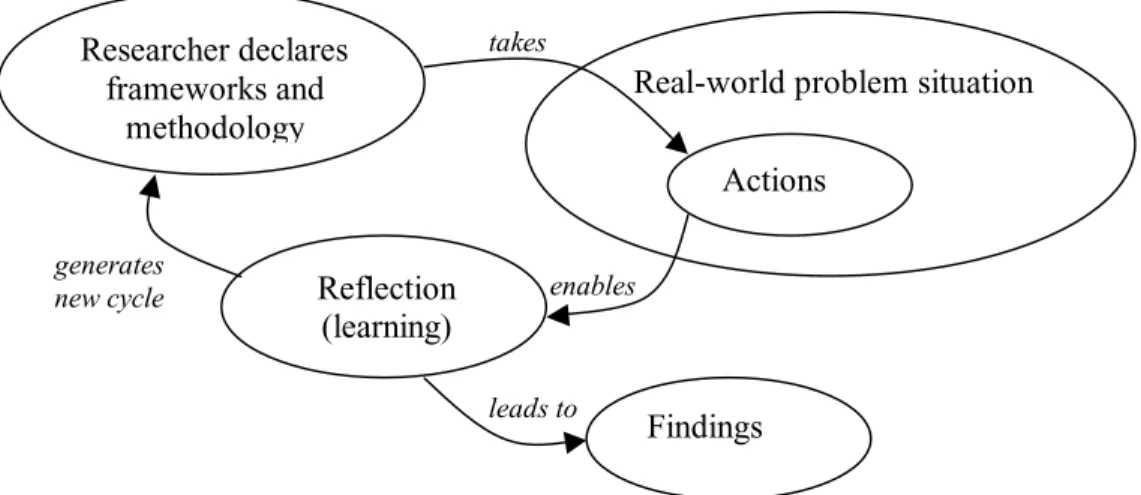
Our key research questions are: (i) what are the implications of fragmentation of working time for the work of people involved in managerial activities? (ii) can we come up with remedies to these problems, especially with Information Systems? (iii) what can we learn from our actions, in respect with our problem area and IS design? As the problem that we are trying to tackle deals very much with qualitative information, we will use action research as a research approach. Action research has been early defined as the planning, action and evaluation of the result of action, with practitioners from the real world involved in the phases of inquiry from the problem area. In the Information Systems sciences, we propose to use action research, as defined by Checkland (1998), where researchers, after having declared frameworks of ideas and methodology, and practitioners collaborate in the problem situation, take actions and learn and make findings which have to be rigorous and generalised as scientific results (Hindle et al, 1995), as in figure 1 (adpated from Checkland, 1998). The approach is cyclic, as the social system evolves and learning promotes the emergence of new frameworks and ideas.
Figure 1: the Action Research Framework
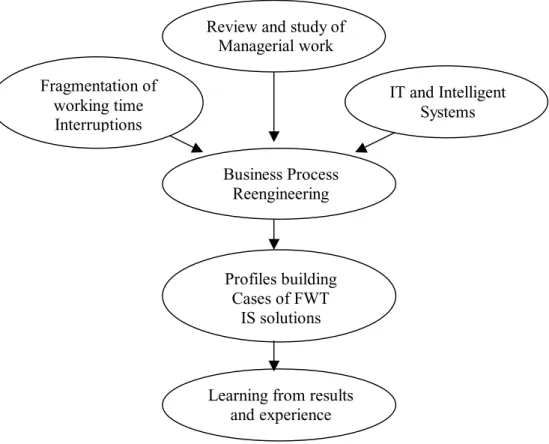
The problem area is closely related to managerial work, and therefore we think that it is very important as a first step to make a sufficiently extensive review of work made on the nature of managerial work and of the existing theories (or schools of thought) in the field. It is also important to reach a good understanding of the concept of fragmentation of working time, interruptions at work (Distraction/Conflict theory) and the possibilities that modern information technology offers to tackle these problems. We will look closely at the possible contributions that IT and Intelligent Systems can bring to act in our problem area (see figure 2 for themes relevant to the problem area). We propose to apply a different approach to understand managerial work and the effects of interruptions by creating various categories of behaviour among workers involved in managerial activities. From what we have learned of interruptions'
generates new cycle leads to enables takes Researcher declares frameworks and methodology
Real-world problem situation Actions
Reflection (learning)
characteristics (time distribution and nature), we are facing a phenomenon which is globally non-linear and unpredictable, and we could therefore use the complexity paradigm in this context. This means that we are not striving to reduce fragmentation of working time through a set of control methods, but we intend to formulate, based on experience, a set of behaviours to adopt in order to avoid negative effects of interruptions on the working time. Reducing fragmentation of working time is not per se an objective, and may not even be desirable, provided that the knowledge workers' output increase. Based on the result of our research, we shall formulate principles for designing information systems which enhance managerial productivity.
Collection of material and evidence will also be made through 6 case studies. These case studies will be written on the basis of IS developement work done within the SMARTER research project, which is coordinated by the IAMSR (Institute for Advanced Management Systems Research, Åbo Akademi University, Finland). This project involves 6 high-technology small and medium-sized companies based in the South-West region of Finland. We will work closely with each company for a period of 2 years, looking for solutions for specific management problems using Business Process Reengineering (BPR) as a methodology. We believe that BPR will serve our purposes in the sense that redesigning better processes with smoother information flows will help to reduce fragmentation of working time. Material collection will be made through questionnaires, interviews with managers in each company, and through follow-up studies of the solutions brought in each case company (including measures). A third year will be devoted to generalisation of results, theory building and writing of the thesis.
Figure 2: Themes Relevant to our Research
Review and study of Managerial work Fragmentation of working time Interruptions IT and Intelligent Systems
Learning from results and experience Profiles building Cases of FWT IS solutions Business Process Reengineering
Conclusion
In this paper, we propose to study the effects of fragmentation of working time on organisations. There is not much literature on Fragmentation of working time as a concept, but we have found that this is a multidisciplinary subject which benefits from contributions in management, psychology and information science disciplines. We use action research as a research approach, and we work closely with 6 companies to understand and bring solutions to the problem using the BPR method. Ultimately, we want to learn from our experience how we could design better mangement information systems.
References:
1. Ackoff R., "Management Misinformation Systems", Management Science, Vol. 14, No. 4, pp. B-147-156, 1967
2. Carlson S., "Executive Behaviour", Stockholm: Strömbergs, 1951
3. Checkland P. and Holwell S., "Information, Systems and Information Systems - Making Sense of the Field", John Wiley & Sons, 1998
4. Corragio L., "Deleterious Effect of Intermittent Interruptions on the Task Performance on Knowledge Workers: a Laboratory Investigation", Tucson, Arizona: University of Arizona, 1990 5. Davenport , "Improving Knowledge Work Processes", Sloan Management Review, Summer 1996,
pp 53-65
6. Fayol H., "Administration industrielle et générale", Paris: Dunod, 1925
7. Hindle T. et al, "Developing a Methodology for Multidisciplinary Action Research: A Case Study", Journal of the Operational Research Society, vol 46, pp. 453-464, 1995
8. Martinko & Gardner, "Beyond Structured Observation: Methodological Issues and New Directions", Academy of Management Review, 10, No. 4, pp. 676-695, 1985
9. Mintzberg H., "The Nature of Managerial Work", New York: Harper & Row, 1973
10. Mintzberg H., "Managerial Work: Forty Years Later", in Executive Behaviour, Textgruppen i Uppsala Ab, 1991
11. Sayles L., "Managerial Behaviour: Administration in Complex Organizations", New York: McGraw-Hill, 1964
12. Speier C.et al., "The Effects of Task Interruption and Information Presentation on Individual Decision Making", Proceedings of the International Conference on Information Systems, 1997 13. Stewart R., "Managers and Their Jobs", Maidenhead: McGraw-Hill, 1967
14. Stewart R., "Studies of Managerial Jobs and Behaviour: The Ways Forward", in Executive Behaviour, Textgruppen i Uppsala Ab, 1991
15. Taylor F., The Principles of Scientific Management", Bulletin of the Taylor Society, December 1916