approaches
著者
Hirano Hokuto, Takemoto Kazuhiro
journal or
publication title
BMC Bioinformatics
volume
20
page range
329-1-329-14
year
2019-06-13
URL
http://hdl.handle.net/10228/00007268
doi: info:doi/10.1186/s12859-019-2915-1R E S E A R C H A R T I C L E
Open Access
Difficulty in inferring microbial community
structure based on co-occurrence network
approaches
Hokuto Hirano and Kazuhiro Takemoto
*Abstract
Background:Co-occurrence networks—ecological associations between sampled populations of microbial
communities inferred from taxonomic composition data obtained from high-throughput sequencing techniques— are widely used in microbial ecology. Several co-occurrence network methods have been proposed. Co-occurrence network methods only infer ecological associations and are often used to discuss species interactions. However, validity of this application of co-occurrence network methods is currently debated. In particular, they simply evaluate using parametric statistical models, even though microbial compositions are determined through population dynamics.
Results:We comprehensively evaluated the validity of common methods for inferring microbial ecological
networks through realistic simulations. We evaluated how correctly nine widely used methods describe interaction patterns in ecological communities. Contrary to previous studies, the performance of the co-occurrence network methods on compositional data was almost equal to or less than that of classical methods (e.g., Pearson’s correlation). The methods described the interaction patterns in dense and/or heterogeneous networks rather inadequately. Co-occurrence network performance also depended upon interaction types; specifically, the interaction patterns in competitive communities were relatively accurately predicted while those in predator–prey (parasitic) communities were relatively inadequately predicted.
Conclusions:Our findings indicated that co-occurrence network approaches may be insufficient in interpreting species interactions in microbiome studies. However, the results do not diminish the importance of these approaches. Rather, they highlight the need for further careful evaluation of the validity of these much-used methods and the development of more suitable methods for inferring microbial ecological networks.
Keywords:Microbiome, Correlation network analysis, Microbial ecology, Complex networks
Background
Many microbes engage with one another through inter-specific interactions (e.g., mutualistic and competitive in-teractions) to compose ecological communities and interrelate with their surrounding environments (e.g., their hosts) [1]. Investigating such communities is important not only in the context of basic scientific research [2, 3], but also in applied biological research fields, such as in medical [4] and environmental sciences [5]. Remarkable development of high-throughput sequencing techniques—
e.g., 16S ribosomal RNA gene sequencing and metage-nomics as well as computational pipelines—have provided snapshots of taxonomic compositions in microbial com-munities across diverse ecosystems [6] and revealed that microbial compositions are associated with human health and ecological environments. For example, microbial composition in the human gut is interrelated with by nu-merous diseases—such as diabetes and cardiovascular dis-ease—age, diet, and antibiotic use [7,8]. The composition of soil microbial communities is related to climate, aridity, pH, and plant productivity [9]. However, previous studies have been limited to the context of species composition, and the effect of the structure of microbial communities (microbial ecological networks) on such associations is
© The Author(s). 2019Open AccessThis article is distributed under the terms of the Creative Commons Attribution 4.0 International License (http://creativecommons.org/licenses/by/4.0/), which permits unrestricted use, distribution, and reproduction in any medium, provided you give appropriate credit to the original author(s) and the source, provide a link to the Creative Commons license, and indicate if changes were made. The Creative Commons Public Domain Dedication waiver (http://creativecommons.org/publicdomain/zero/1.0/) applies to the data made available in this article, unless otherwise stated.
* Correspondence:[email protected]
Department of Bioscience and Bioinformatics, Kyushu Institute of Technology, Iizuka, Fukuoka 820-8502, Japan
unclear due to a lack of reliable methods through which real interaction networks can be captured. Thus, co-occurrence networks, which infer ecological associations between sampled populations of microbial communities obtained from high-throughput sequencing techniques, have been attracting attention [10]. Co-occurrence net-work approaches are also related to weighted correlation network analyses [11–13] for inferring molecular net-works from high-throughput experimental data, such as gene expression data. A number of methods for inferring microbial association have been proposed.
As a simple metric, Pearson’s correlation coefficient is considered. Additionally, Spearman’s correlation coeffi-cient and maximal information coefficoeffi-cient (MIC) [14] are useful for accurately detecting non-linear associa-tions. However, these metrics may not be applicable to compositional data because the assumption of independ-ent variables may not be satisfied due to the constant sum constraint [15]. Particularly, spurious correlations may be observed when directly applying these metrics to compos-itional data. To avoid this limitation, Sparse Correlations for Compositional data (SparCC) [16] has been developed. SparCC is an iterative approximation approach and esti-mates the correlations between the underlying absolute abundances using the log-ratio transformation of compos-itional data under the assumptions that real-world micro-bial networks are large-scale and sparse. However, SparCC is not efficient due to its high computational complexity. Thus, regularized estimation of the basis covariance based on compositional data (REBACCA) [17] and correlation in-ference for compositional data through Lasso (CCLasso) [18] have been proposed. These methods are considerably faster than SparCC by using thel1-norm shrinkage method
(i.e., least absolute shrinkage and selection operator; Lasso). SparCC has further limitations, as it does not consider errors in compositional data and the inferred covariance matrix may be not positive definite. To avoid these limitations, CCLasso considers a loss function inspired by the lasso pe-nalizedD-trace loss.
However, correlation-based approaches such as those men-tioned above may detect indirect associations. To differentiate direct and indirect interactions in correlation inference, other methods have been developed. In this context, inverse covari-ance matrix-based approaches are often used because they es-timate an underlying graphical model, employing the concept of conditional independence. Typically, Pearson’s and Spear-man’s partial correlation coefficients are used [19]; however, they may be not applicable to compositional data because stat-istical artifacts may occur due to the constant sum constraint. Thus, SParse InversE Covariance Estimation for Ecological ASsociation Inference (SPIEC-EASI) was proposed [20]. It in-fers an ecological network (inverse covariance matrix) from compositional data using the log-ratio transformation and sparse neighborhood selection.
These inference methods have been implemented as software packages and applied in several micro-bial ecology studies, such as investigations of hu-man [21–24] and soil microbiomes [25–27]. While these methods only infer ecological associations, they are often used for discussing biological insights into interspecies interactions (i.e., microbial eco-logical networks [28]).
Nevertheless, further careful examination may be re-quired to determine the importance of co-occurrence network approaches. The validity of these inference methods is still debatable [29] because they simply employ parametric statistical models, although micro-bial abundances are determined through population
dynamics [2, 3]. Berry and Widder [30] used a
math-ematical model to determine population dynamics, generating (relative) abundance data based on popula-tion dynamics on an interacpopula-tion pattern (network structure), and evaluated how correctly correlation-based methods reproduce the original interaction pat-tern. In particular, detecting interactions was harder for larger and/or more heterogeneous networks. How-ever, they only compared earlier methods (e.g.,
Pear-son’s correlation and SparCC) and not later methods
(e.g., CCLasso) and the graphical model-based
methods. In addition, whether further examination and comparison of performance is required remains debatable, since arbitrary thresholds were used to cal-culate sensitivity and specificity. Moreover, the effects of interaction type, such as mutualism or competition, on co-occurrence network performance were poorly considered, even though pairs of species exhibit well-defined interactions in natural systems [31]. Weiss et al. [10] considered interaction types and evaluated correlation-based methods using a population dynam-ics model; however, they only examined small-scale (up to six species) networks due to system complexity, although compositional-data methods (e.g., SparCC) assume large-scale networks. Furthermore, graphical model-based methods were not evaluated.
We comprehensively evaluated the validity of both correlation-based and graphical model-based methods for inferring microbial ecological networks. In particular, we focused on nine widely used
methods. Following previous studies [10, 30], we
generated relative abundance (compositional) data using a dynamical model with network structure and evaluated how accurately these methods recap-itulate the network structure. We show that the performance of later methods was almost equal to or less than that of classical methods, contrary to previous studies. Moreover, we also demonstrate that co-occurrence network performance depends upon interaction types.
Methods
Generation of relative abundance data using a dynamical model
Following [30], we used the n-species generalized
Lotka–Volterra (GLV) equation to generate abundance data: d dtNið Þ ¼t Nið Þt riþ Xn j¼1 MijNjð Þt ! ;
where Ni(t) andri correspond to the abundance of
spe-ciesiat timetand the growth rate of speciesi, respect-ively. Mij is an interaction matrix and indicates the
contribution of species j to the growth of species i. In particular, Mij was determined by considering network
structure and interaction types; the diagonal elementsMii
in the interaction matrices, representing self-regulation, were set to−1. Unlike a similar model used in a previous study [30], the carrying capacity of each species is set to be equivalent to its growth rate for simplicity.
To generateMij, we first produce undirected networks withnnodes and average degree 〈k〉= 2m/n, wheren
in-dicate the number of species and m is the number of
edges. This is done by generating adjacency matricesAij using models for generating networks. Following Laye-ghifard et al. [28], three types of network structure were considered: random networks, small-world networks, and scale-free networks. In all casesAij= 1 if node (spe-cies) i interacts with node (species) jand Aij= 0, other-wise, andAij=Ajito have undirected networks.
The Erdős–Rényi model [32] was used to generate ran-dom networks in which the node degree follows a Poisson distribution where the mean is〈k〉. The model networks are generated by drawing edges betweenm(=n〈k〉/2) node pairs that were randomly selected from the set of all pos-sible node pairs. Specifically, we usederdos.renyi.gamein
the igraph package (version 1.2.2) of R (version 3.5.1;
www.r-project.org), with the argumenttype =“gnm”. However, real-world networks, including microbial eco-logical networks, are not random; instead, they are clustered (compartmentalized) and heterogeneous [28,32–34].
The Watts–Strogatz model [35] was used to generate small-world networks whose clustering coefficients are higher than expected and random. The model networks are generated by randomly rewiring ⌊pWSm+ 0.5⌋edges
in a one-dimensional lattice where pWS corresponds to
the rewiring probability (ratio) ranging within [0,1]. Spe-cifically, we used the sample_smallworldfunction in the
igraphpackage;pWSwas set to 0.05.
The Chung–Lu model [36] was used to generate scale-free networks in which the degree distributions are het-erogeneous. In the model, m (=n〈k〉/2) edges are drawn between randomly selected nodes according to node weight (i+i0−1)ξwhereξ∈[0, 1] andidenotes the node
index (i.e.,i= 1,…,n) and the constant i0is considered
to eliminate the finite-size effects [37]. A generated net-work shows that P(k)∝k−γ, where γ= 1 + 1/ξ [36, 37] and P(k) is the degree distribution. Specifically, we used
thestatic.power.law.gamefunction in theigraphpackage
with the argument finite.size.correction = TRUE. In this study, we avoided the emergence of self-loops and
mul-tiple edges. γ was set to 2.2 because γ in many
real-world networks is between 2 and 2.5 [38].
Following the work of Allesina and Tang [31], we con-sidered five types of interaction matrices: random, mu-tualistic, competitive, predator–prey (parasitic), and a mixture of competition and mutualism interaction matrices. Following simulation-based studies using GLV equations [39–41], the (absolute) weights of interactions
(i.e., the elements in interaction matrices Mij) were
drawn from uniform distributions.
In the random interaction matrices,Mijwas drawn from a uniform distribution of [−smax,smax] ifAij= 1, andMij= 0 otherwise, wheresmaxis the upper (lower) limit for
inter-action strength. Given the definitions of mutualistic, com-petitive, and predator–prey (parasitic) interactions (see below for details), the random interaction matrices gener-ated contain a mixture of these interaction types. For large
n, in particular, mutualistic, competitive, and predator–
prey interactions occur in the ratio of 1:1:2.
A mutualistic interaction between speciesiand j indi-cates that Mij> 0 and Mji> 0 because the species
posi-tively affect each other’s growth. In mutualistic
interaction matrices,Mijwas drawn from a uniform dis-tribution of (0, smax] if Aij= 1, and Mij= 0 otherwise. It should be noted thatMjiis also positive ifAij= 1 because
Aij=Aji, butAijis independent fromMij.
A competitive interaction between speciesiandj indi-cates that Mij< 0 and Mji< 0 because the species
nega-tively affect each other’s growth. In competitive
interaction matrices,Mijwas drawn from a uniform dis-tribution of [−smax, 0) ifAij= 1, andMij= 0 otherwise. It should be noted that Mji is also negative if Aij= 1 be-causeAij=Aji, butAijis independent fromMij.
Following a previous study [31], we generated inter-action matrices consisting of a mixture of mutualistic and competitive interactions. For each species pair (i,j)i<j, we
obtained a random value p1from a uniform distribution
of [0, 1] if Aij= 1. After,Mij and Mji were independently drawn from a uniform distribution of (0, smax] ifp1≤pC from a uniform distribution of [−smax, 0) otherwise where
pCcorresponds to the ratio of competitive interactions to all interactions. It should be noted thatMij= 0 ifAij= 0.
A predator–prey (parasitic) interaction between spe-ciesiandjindicates thatMijandMjihave opposite signs (e.g., wheneverMij> 0, thenMji< 0) because speciesi (j) positively contributes to the growth of species j (i), but
species j (i). The predator–prey interaction matrices
were generated as follows: for each species pair (i, j)i<j,
we obtained a random valuep2from a uniform
distribu-tion of [0, 1] if Aij= 1. Ifp2≤0.5, Mijwas drawn from a uniform distribution of [−smax, 0) and Mji was drawn from a uniform distribution of (0, smax], while if p2> 0.5
we did the opposite: Mij and Mji were independently
drawn from uniform distributions (0, smax] and [−smax,
0), respectively. It should be noted thatMij= 0 ifAij= 0. To investigate the effect of predator–prey interactions on co-occurrence network performance, we also consid-ered interaction matrices consisting of a mixture of com-petitive and predator–prey interactions. For each species pair (i,j)i<j, we obtained a random value p3from a
uni-form distribution of [0, 1] ifAij= 1; then,MijandMjiwere determined based on to the above definition of competi-tive interactions if p3≤pC, otherwise they were
deter-mined based on the above definition of predator–prey interactions. It should be noted thatMij= 0 ifAij= 0.
To obtain species abundances using the n-species
GLV equations, we used the generateDataSet
func-tion in the R package seqtime (version 0.1.1) [40];
environmental perturbance was excluded for simpli-city. Following Faust et al. [40], the GLV equations were numerically solved with initial species abun-dances that were independently drawn from a Pois-son distribution with mean of 100 (i.e., the total
number of individuals is 100n). Following previous
studies [40, 41], the growth rates of species (ri) were independently drawn from a uniform distribution of
(0,1]. Following the default options of the
generate-DataSet function, species abundances were obtained
at the 1000-time step. We empirically confirmed that species abundances reached a steady state before the
1000-time step (Additional file 1: Figure S1). The
ab-solute abundances were converted into relative
values. The relative abundance Pi of species i was
calculated as Ni=
Pn
j¼1Nj where Ni is the absolute
abundance of species i at the time step. The
result-ing absolute and relative abundances were recorded. This process was repeated until the desired number of samples was obtained. The source codes for
data-set generation are available in Additional file 2.
Co-occurrence network methods
We evaluated the extent to which the nine co-occurrence network methods decipher original inter-action patterns (i.e., adjacency matrixAij) from the gen-erated relative abundance (compositional) dataset based on associations between species abundances (see Add-itional file 1: Figure S2). In particular, six correlation-based methods were investigated: Pearson’s correlation (PEA), Spearman’s correlation (SPE), MIC [14], SparCC
[16], REBACCA [17], and CCLasso [18]. Moreover, three graphical model-based methods were also investigated: Pearson’s partial correlation (PPEA), Spearman’s partial correlation (PSPE), and SPIEC-EASI [20].
The pair-wise Pearson’s and Spearman’s correlation matrices were calculated using thecorfunction in R with the arguments method =“pearson” and method =“ spear-man”, respectively. The pair-wise MICs were determined
using the mine function in the R packageminerva
(ver-sion 1.5). We also estimated the ecological microbial networks using the SparCC, REBACCA, and CCLasso algorithms. The SparCC program was downloaded from bitbucket.org/yonatanf/sparccon November 11, 2018, and it ran under the Python environment (version 2.7.15; www.py-thon.org). The REBACCA program was obtained from fac-ulty.wcas.northwestern.edu/~hji403/REBACCA.htm on November 16, 2018. The CCLasso program was obtained from github.com/huayingfang/CCLasso on November 13, 2018. REBACCA and CCLasso ran under the R environ-ment. We used SparCC, REBACCA, and CCLasso with the default options, but we provided the optionpseudo = 1when using CCLasso for convergence.
The Pearson’s and Spearman’s partial correlation coef-ficients were calculated using thepcor function in the R
package ppcor (version 1.1) with the arguments
method =“pearson” and method =“spearman”,
respect-ively. We also obtained the co-occurrence networks using the SPIEC-EASI algorithm with neighborhood se-lection. The SPIEC-EASI program was downloaded from github.com/zdk123/SpiecEasi on November 13, 2018. We used SPIEC-EASI in the R environment with the de-fault options.
Evaluating co-occurrence network performance
Following previous studies [20], to evaluate
co-occurrence network performance (i.e., how well the esti-mated co-occurrence network describes the original interaction pattern Aij), we obtained the precision–recall
(PR) curve based on confidence scores of interactions for each inference result, comparing the lower triangular
parts of confidence score matrices and Aij because the
matrices were symmetric. It should be noted that the lower triangular parts were vectorized after excluding the diagonal terms. The precision and recall were calcu-lated by binarizing the confidence scores at a threshold. The PR curve was obtained as the relationship between precision and recall for different threshold. We used the absolute correlation coefficients for the Pearson’s correl-ation, Spearman’s correlcorrel-ation, MIC, Pearson’s partial cor-relation, Spearman’s partial corcor-relation, SparCC, and CCLasso for the confidence scores. Following previous studies [17, 20], edge-wise stability scores were used for REBACCA and SPIEC-EASI. Furthermore, we summa-rized the PR curve with the area under the PR curve
(AUPR). The AUPR values were averaged over 50 itera-tions of dataset generation and performance evaluation with randomly assigned parameters for each iteration. The PR curves and AUPR values were obtained using
the pr.curve function in the R package PRROC (version
1.3.1). We also computed the baseline-corrected AUPR values because positive and negative ratios affect PR curves. The baseline-corrected AUPR value was defined
as (AUPRobs – AUPRrand) / (1 – AUPRrand), where
AUPRobs and AUPRrand correspond to the observed
AUPR value and the AUPR value obtained from random prediction (i.e., 2m/[n(n−1)] =〈k〉/(n−1)), respectively. The source codes for evaluating co-occurrence network performance are available in Additional file2.
It is important to mention that the problem of false-negative interactions may occur when we do perform-ance analysis based on adjacency matricesAij: negligible interactions (i.e., when both |Mij| and |Mji| have very small values) have negligible effects on population dy-namics and act as no interaction. It may happen even if the corresponding nodes are connected (i.e.,Aij=Aji= 1) . However, this problem hardly affects co-occurrence net-work performance. Supposing such false-negative interac-tions occur if |Mij| <sc and |Mji| <sc when Aij=Aji= 1 where sc is a small value, the expected ratio of false-negative interactions to all interacting pairs (edges) is de-scribed as (sc / smax)2 because |Mij| and |Mji| are
inde-pendently drawn from the uniform distribution of (0,
smax]. Assuming that smax= 0.5 andsc= 0.01, for example, 0.04% ofmedges indicate false-negative interactions. Results
Compositional-data co-occurrence network methods performance did not exceed that of classical methods
We generated relative abundance datasets through popu-lation dynamics. In particular, we used the GLV equations with an interaction matrixMijconstructed from an inter-action patternAij(random, small-world, or scale-free net-work structure) by considering types of interaction matrices (random, mutualistic, competitive, predator–prey (parasitic), or mixture of competition and mutualism interaction matrices). We investigated how well co-occurrence network methods decipher interaction pat-terns from relative abundance data by evaluating the consistency between the confidence score matrices ob-tained from the methods and Aij based on the (baseline-corrected) AUPR values.
We investigated the case of random interaction matri-ces constructed based on random network structures
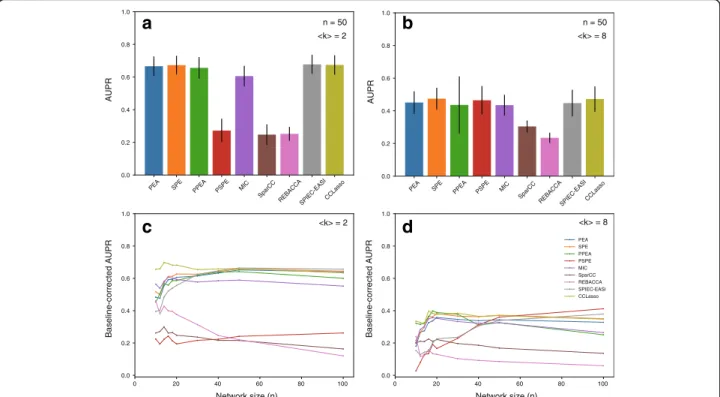
(Fig. 1). We found that co-occurrence network
perform-ance (AUPR value) was moderate. For example, the AUPR value was at most ~ 0.65 when network size (the
number of species) n= 50 and average degree 〈k〉= 2
(Fig. 1a), and it was at most ~ 0.45 when n= 50 and
〈k〉= 8 (Fig.1b). As expected from limitations due to the constant sum constraint, the performance of the clas-sical co-occurrence network methods (e.g., Pearson’s correlation) generally decreased when using compos-itional data (Addcompos-itional file 1: Figure S3), and the per-formance of the partial correlation-based methods declined largely.
More importantly, we found that the performance of the compositional-data co-occurrence network methods were almost equal to or less than that of classical methods, excluding Spearman’s partial correlation-based method; in particular, the performance of some compositional-data methods was lower than that of the classical methods. Specifically, the AUPR values of SparCC, an earlier compositional-data method, were lower than those of Pearson’s correlation [p< 2.2e–16 usingt-test whenn= 50 and〈k〉= 2 (Fig.1a) andp< 2.2e–16 usingt-test whenn= 50 and 〈k〉= 8 (Fig. 1b)]. Moreover, The AUPR values of REBACCA, a later compositional-data method, were also lower than those of Pearson’s correlation [p< 2.2e–16 usingt-test whenn= 50 and〈k〉= 2 (Fig.1a) andp< 2.2e–
16 usingt-test whenn= 50 and 〈k〉= 8 (Fig.1b)]. For 50-node networks, the performance of CCLasso and SPIEC-EASI was similar to that of classical methods when〈k〉= 2 (Fig.1a) and〈k〉= 8 (Fig.1b). However, the performance of later compositional-data methods (e.g., CCLasso) was higher than that of the earlier compositional-data method (i.e., SparCC). Specifically, the AUPR values of CCLasso were lower than those of SparCC [p< 2.2e–16 usingt-test whenn= 50 and 〈k〉= 2 (Fig. 1a) andp= 3.2e–7 using t -test whenn= 50 and〈k〉= 8 (Fig.1b)].
The graphical model-based methods were not more effi-cient than the correlation-based methods. Spearman’s partial correlation-based method was inferior to Pearson’s correl-ation-based method (p< 2.2e–16 using t-test) and Spear-man’s correlation-based method (p< 2.2e–16 using t-test) whenn= 50 and〈k〉= 2 (Fig.1a); however, the AUPR value of Spearman’s partial correlation-based method was similar
to that of Pearson’s and Spearman’s correlation-based
methods when n= 50 and 〈k〉= 8 (Fig. 1b). Both Pearson’s partial correlation-based method and Pearson’s correlation-based method exhibited similar performance. The perform-ance of the graphical model-based method for compositional data (SPIEC-EASI) was similar to that of other correlation-based methods (e.g., Pearson’s correlation), although it was higher than that of the correlation-based methods for com-positional data. Specifically, the AUPR values of SPIEC-EASI were higher than those of SparCC [p< 2.2e–16 usingt-test whenn= 50 and〈k〉= 2 (Fig.1a) andp< 2.2e–16 usingt-test whenn= 50 and〈k〉= 8 (Fig.1b)].
Co-occurrence network performance was evaluated
when the average degree (Fig. 1a and b) and number of
nodes (network size; Fig. 1c and d) varied; moreover, it was also examined for other types of network structure:
small-world networks (Additional file 1: Figure S4) and scale-free networks (Additional file1: Figure S5).
Interaction patterns in more complex networks are harder to predict
It is noteworthy that network size, average degree, and network type affected co-occurrence network perform-ance. The co-occurrence network performance (baseline-corrected AUPR values) varied with network size in some methods (Fig.1c and d). In particular, the performance of Spearman’s partial correlation-based method increased with network size in dense networks, while the perform-ance of REBACCA decreased with network size in sparse networks. However, co-occurrence network performance was nearly independent of network size when n> 20 in most methods. The interaction patterns in small networks
were poorly predicted; the co-occurrence network
methods are not suitable for capturing interaction pat-terns in small networks. The differences in the perform-ance between the co-occurrence network methods and random predictions were not remarkable because the de-gree of freedom was low in small networks.
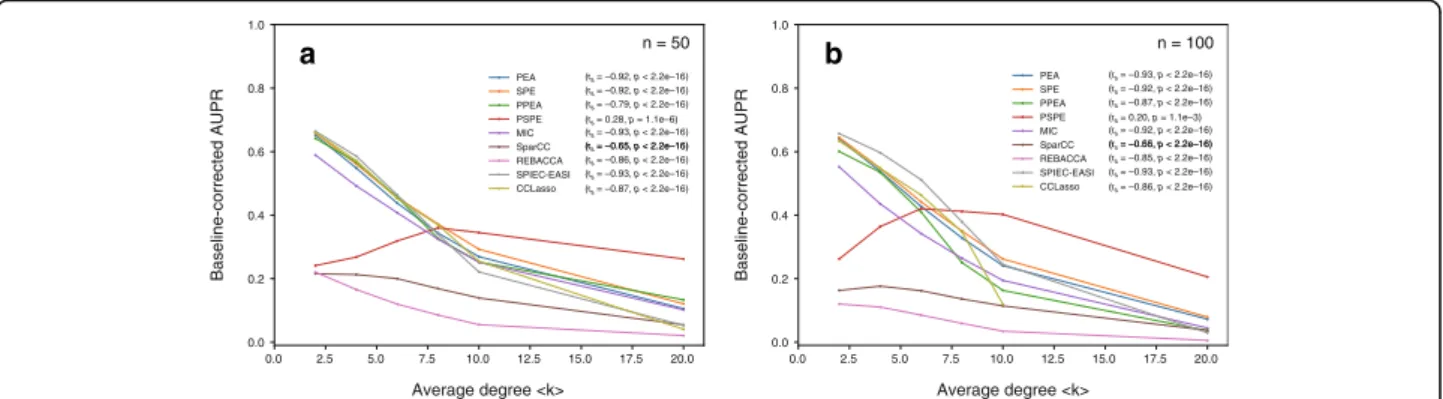
More importantly, the interaction patterns in denser networks generally were more difficult to predict; in par-ticular, we observed general negative correlations be-tween the performance (baseline-corrected AUPR value)
and average degree when n= 50 (Fig. 2a) and n= 100
(Fig. 2b). However, the performance of Spearman’s
par-tial correlation-based method (PSPE) increased for 〈k〉< ~8 and decreased for〈k〉≥~8 whenn= 50 and 100. This method exhibited the highest performance for dense networks while it exhibited relatively low performance for sparse networks; nonetheless, it should be noted that this method poorly predicted interactions patterns (the baseline-corrected AUPR value was at most ~ 0.4 when
〈k〉≥~8). The co-occurrence network performance
slightly increased when using more samples (Additional file 1: Figure S6); in particular, we investigated cases in
which network size (n= 50 and 100) and average degree
(〈k〉 = 2 and 8) differed and found that co-occurrence network performance was almost independent of sample number when it exceeds 200 in most methods.
The correlations between the baseline-corrected AUPR values and average degree were also investigated in
small-world networks (Additional file 1: Figure S4 and
S7) and scale-free networks (Additional file1: Figures S5 and S8), and the negative correlations between the baseline-corrected AUPR values and average degree were specifically observed. However, co-occurrence network performance moderately varied according to network type in large and dense networks when focusing on each inference method (Fig. 3). In particular, we investigated PEA SPE PPEA PSPE MIC
SparCC REBACCASPIEC-EASICCLasso 0.0 0.2 0.4 0.6 0.8 1.0
PEA SPE PPEA PSPE MIC SparCC REBACCASPIEC-EASICCLasso 0.0 0.2 0.4 0.6 0.8 1.0 0 20 40 60 80 100 0.0 0.2 0.4 0.6 0.8 1.0 R P U A R P U A d et c er r o c-e nil e s a B AUPR Baseline-corrected AUPR 0 20 40 60 80 100 Network size (n) Network size (n) 0.0 0.2 0.4 0.6 0.8 1.0 n = 50 <k> = 2 n = 50 <k> = 8 <k> = 2 <k> = 8
a
c
b
d
PEA SPE PPEA PSPE MIC SparCC REBACCA SPIEC-EASI CCLassoFig. 1Differences in the co-occurrence network performance between methods. AUPR values for 50-node networks with average degree〈k〉= 2 (a) and〈k〉= 8 (b). Error bars indicate standard deviations. Relationships between the baseline-corrected AUPR value and network sizenfor〈k〉= 2 (c) and〈k〉= 8 (d). Random interaction matrices and random network structure were considered.smaxwas set to 0.5. The number of samples was
Pearson’s correlation-based method (a classical correl-ation-based method; Fig.3a and b), Pearson’s partial cor-relation-based method (a classical graphical model-based
method; Fig. 3c and d), CCLasso (a correlation-based
method for compositional data; Fig. 3e and f ), and
SPEIC-EASI (a graphical model-based method for com-positional data; Fig.3g and h). In general, the lowest per-formance was observed for scale-free networks, while the highest performance was observed for small-world networks (Fig.3). Specifically, the baseline-corrected AUPR values for scale-free networks were lower than those for small world networks whenn= 100 and〈k〉= 8 (p< 2.2e–16
using t-test for Pearson’s correlation-based method; p= 7.7e–5 using t-test for Pearson’s partial correlation-based
method; p= 0.027 using t-test for CCLasso; p= 1.9e–13
using t-test for SPEIC-EASI). Moreover, the
baseline-corrected AUPR values for scale-free networks were lower than those for random networks when n= 100 and 〈k〉= 8 for Pearson’s correlation-based method (p= 2.9e–3 using t -test) and SPEIC-EASI (p= 7.4e–3 usingt-test).
The results indicating that compositional-data co-occurrence network methods were not more efficient than classical methods and that interaction patterns in more complex networks are more difficult to predict
(Figs. 1, 2 and 3) were also generally confirmed in the
other types of interactions matrices: competitive (Add-itional file 1: Figures S9–S11), mutualistic (Additional file 1: Figures S12 and S13), predator–prey (Additional
0.0 2.5 5.0 7.5 10.0 12.5 15.0 17.5 20.0 0.0 0.2 0.4 0.6 0.8 1.0 0.0 2.5 5.0 7.5 10.0 12.5 15.0 17.5 20.0 0.0 0.2 0.4 0.6 0.8 1.0
Baseline-corrected AUPR Baseline-corrected AUPR
> k < e e r g e d e g a r e v A > k < e e r g e d e g a r e v A 0 0 1 = n 0 5 = n b a PEA SPE PPEA PSPE MIC SparCC REBACCA SPIEC-EASI CCLasso (r = –0.92, p < 2.2e–16)s (r = –0.92, p < 2.2e–16)s (r = –0.79, p < 2.2e–16)s (r = –0.93, p < 2.2e–16)s (r = –0.65, p < 2.2e–16) (r = –0.65, p < 2.2e–16)s (r = –0.86, p < 2.2e–16)s (r = –0.93, p < 2.2e–16)s (r = –0.87, p < 2.2e–16)s (r = 0.28, p = 1.1e–6)s PEA SPE PPEA PSPE MIC SparCC REBACCA SPIEC-EASI CCLasso (r = –0.93, p < 2.2e–16)s (r = –0.92, p < 2.2e–16)s (r = –0.87, p < 2.2e–16)s (r = –0.92, p < 2.2e–16)s (r = –0.65, p < 2.2e–16) (r = –0.56, p < 2.2e–16)s (r = –0.85, p < 2.2e–16)s (r = –0.93, p < 2.2e–16)s (r = –0.86, p < 2.2e–16)s (r = 0.20, p = 1.1e–3)s
Fig. 2Relationships between co-occurrence network performance (baseline-corrected AUPR value) and average degree when network sizen= 50 (a) andn= 100 (b). Random interaction matrices and random network structure were considered.smaxwas set to 0.5. The number of samples
was set to 300. The baseline-corrected AUPR values of CCLasso were not calculated when〈k〉> 10 in 100-node networks because of high computational costs.rsandpindicate the Spearman’s rank correlation coefficient and the associatedp-value. The raw values (i.e., the values before averaging) were used for calculatingrs
a
b
c
d
e
f
g
h
Fig. 3Relationships between co-occurrence network performance (AUPR value) and network sizenaccording to the network types: random networks (random), scale-free networks (sf), and small-world networks (sw). Random interaction matrices were considered. The cases of sparse networks (〈k〉= 2; top panels) and dense networks (〈k〉= 8; bottom panels) are shown. As representative examples, Pearson’s correlation-based method (a classical correlation-based method;aandb), Pearson’s partial correlation-based method (a classical graphical model-based method;c
andd), CCLasso (a correlation-based method for compositional data;eandf), and SPEIC-EASI (a graphical model-based method for compositional data;gandh) are shown.smaxwas set to 0.5. The number of samples was set to 300
file 1: Figures S14–S16), and mutualism-competition mixture interaction matrices (Additional file 1: Figures S17–S19).
Predator-prey (parasitic) interactions decrease co-occurrence network performance
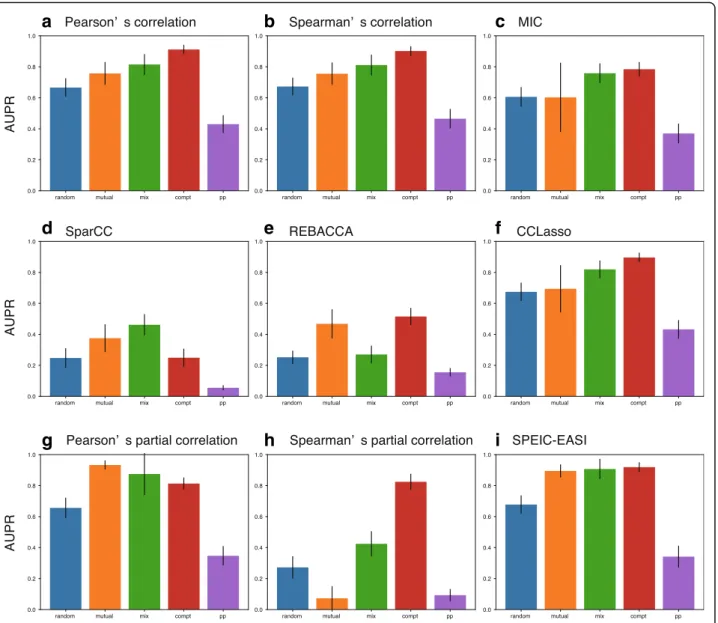
The types of interaction matrices notably affected co-occurrence network performance (Fig.4). Specifically, in most methods, the interaction patterns in predator–prey (parasitic) communities (interaction matrices) were the most difficult to predict, while those in competitive communities were the easiest to predict. Specifically, the AUPR values for predator–prey communities were sig-nificantly lower than those for competitive communities
for Pearson’s correlation-based method (p< 2.2e–16
using t-test; Fig. 4a), Spearman’s correlation-based
method (p< 2.2e–16 using t-test; Fig. 4b), MIC-based method (p< 2.2e–16 using t-test; Fig. 4c), SparCC (p< 2.2e–16 using t-test; Fig. 4d), REBACCA (p< 2.2e–16
using t-test; Fig. 4e), CCLasso (p< 2.2e–16 using t-test; Fig.4f ), Pearson’s partial correlation-based method (p<
2.2e–16 using t-test; Fig. 4g), Spearman’s partial
correlation-based method (p< 2.2e–16 using t-test; Fig. 4h), and SPEIC-EASI (p< 2.2e–16 using t-test; Fig. 4i). Additionally, co-occurrence network methods relatively accurately predicted interactions patterns in mutual communities and competition–mutualism mixture com-munities; however, they described the interaction pat-terns in random communities poorly. Specifically, the AUPR values for random communities also were signifi-cantly lower than those for competitive communities for Pearson’s correlation-based method (p< 2.2e–16 usingt -test; Fig. 4a), Spearman’s correlation-based method (p< 2.2e–16 using t-test; Fig. 4b), MIC-based method (p< 2.2e–16 using t-test; Fig. 4c), REBACCA (p< 2.2e–16
using t-test; Fig. 4e), CCLasso (p< 2.2e–16 using t-test; Fig.4f ), Pearson’s partial correlation-based method (p<
2.2e–16 using t-test; Fig. 4g), Spearman’s partial
correlation-based method (p< 2.2e–16 using t-test; Fig. 4h), and SPEIC-EASI (p< 2.2e–16 using t-test; Fig. 4i). Similar tendencies of the effect of interaction types on co-occurrence network performance were observed in varying network sizes (i.e.,n= 20 and 100; Additional file 1: Figure S20), average degrees (i.e., 〈k〉= 4 and 8; Add-itional file 1: Figure S21), and network structures (i.e., small-world and scale-free network structures; Add-itional file1: Figure S22).
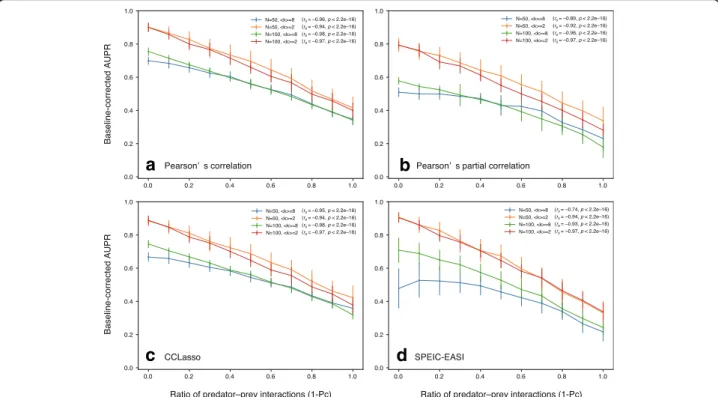
We hypothesized that co-occurrence network per-formance decreases as the ratio of predator–prey
(para-sitic) interactions increases because the worst
performance and second worst performance were ob-served for predator–prey and random communities, re-spectively. Note that almost half of the interactions are spontaneously set to predator–prey interactions in
random communities (see “Generation of relative
abun-dance data using a dynamical model” section). To test
this hypothesis, we considered interaction matrices con-sisting of a mixture of competitive and predator–prey interactions because co-occurrence network perform-ance was best and worst in competitive and predator– prey (parasitic) communities, respectively. In particular, we considered competition–parasitism mixture commu-nities with the ratiopCof competitive interactions to all interactions and investigated the relationship between the ratio of predator–prey interactions (i.e., 1−pC) and AUPR values. As representative examples, we investigated Pearson’s based method (a classical correlation-based method; Fig.5a), Pearson’s partial correlation method (a classical graphical model-based method; Fig.5b), CCLasso (a correlation-based method for compositional data; Fig.5c), and SPIEC-EASI (a graphical model-based for compositional data; Fig. 5d). As expected, we found negative correlations between co-occurrence network performance (AUPR value) and the ratio of predator–prey interactions (Fig. 5). Such negative correlations were also observed in cases with
differ-ent network sizes (n= 50 and 100) and average degrees
(〈k〉= 2 and 8). Discussion
Inspired by previous studies [30], we evaluated how well co-occurrence network methods recapitulate microbial ecological networks using a population dynamics model; co-occurrence network methods are often used for dis-cussing species interactions although they only infer
eco-logical associations. We compared wide-ranging
methods using realistic simulations. Our results provide
additional and complementary insights into
co-occurrence network approaches in microbiome studies. The results indicate that compositional-data methods, such as SparCC and SPIEC-EASI, are less useful in infer-ring microbial ecological networks than previously
thought. As shown in Fig. 1, the performance (AUPR
values) of the compositional-data methods was moder-ate; furthermore, these compositional-data methods were not more efficient than the classical methods, such as Pearson’s correlation-based method. This result is in-consistent with previous studies [17, 18, 20]. This dis-crepancy was mainly due to differences in co-occurrence network method validation between this and previous studies. Specifically, previous studies generated abun-dance data from a multivariable distribution with a given mean and covariance matrix and examined how accur-ately co-occurrence network methods describe the ori-ginal covariance matrix structure. However, this study considered species abundances determined through population dynamics (GLV equations) and examined how accurately the methods reproduced interaction pat-terns in ecological communities [30].
Population dynamics may lead to more complex asso-ciations between species abundances than parametric statistical models due to the nonlinearity of GLV equa-tions. In compositional data co-occurrence network methods, such complex associations were likely difficult to detect because they assumed linear relationships be-tween species abundances. The performance of Spear-man’s correlation-based and MIC-based methods was almost equal to or higher than those of compositional-data methods because they can consider nonlinear asso-ciations, although such classical methods did not con-sider the effects of the constant sum constraint in
compositional data. However, Pearson’s
correlation-based method also exhibited a similar or higher per-formance than that of the compositional-data methods (Fig.1), although it assumes linear relationships between species abundances in addition to the constant sum con-straint. This may be due to approximation in the compositional-data methods, which estimate covariance matrices of the underlying absolute abundances from relative abundances using iterative approximation ap-proaches. Thus, compositional-data methods may fail to correctly estimate the covariance structure of absolute abundance. According to a previous study [18], such a
a
b
c
d
e
f
g
h
i
Fig. 4Effects of the community type on co-occurrence network performance (AUPR value) in the cases of Pearson’s correlation-based method (a), Spearman’s correlation-based method (b), MIC-based method (c), SparCC (d), REBACCA(e), CCLasso (f), Pearson’s partial correlation-based method (g), Spearman’s partial correlation-based method (h), and SPEIC-EASI (i). Vertical-axis labels correspond to the community types: random community (random; blue), mutualistic community (mutual; orange), competition–mutualism mixture community (mix; green), competitive community (compt; red), and predator–prey (parasitic) community (pp; purple). Network sizen= 50 and average degree〈k〉= 2. Random network structure was considered.smaxwas set to 0.5. The number of samples was set to 300. Error bars indicate standard deviations
limitation is present in SparCC. REBACCA is similarly limited because its formalism is comparable to SparCC, al-though sparse methods are different between SparCC and
REBACCA; thus, the performance of SparCC and
REBACCA may have been low for similar reasons. On the other hand, CCLasso avoids these limitations [18], perform-ing better than SparCC and REBACCA. However, more im-provements may be required for CCLasso. It performed similarly to Pearson’s correlation-based method, which ex-hibited a higher performance using absolute abundances (particularly in sparse networks; Additional file1: Figure S3). This indicates that CCLasso did not sufficiently infer the co-variance structure of absolute abundances.
The graphical model-based methods were not more effi-cient than the correlation-based methods, although they do not consistently detect indirect associations (Fig.1). In par-ticular, Pearson’s and Spearman’s partial correlation-based (classical graphical model-based) methods were not more useful for inferring interaction patterns in ecological com-munities than Pearson’s and Spearman’s correlation-based (classical correlation-based) methods, and Spearman’s par-tial correlation-based method predicted interaction patterns in ecological communities poorly. This may have occurred due to the effects of the constant sum constraint in com-positional data; specifically, these classical graphical
model-based methods exhibited high performance with absolute abundances (Additional file1: Figure S3). The effects of the constant sum constraint in partial correlation-based may be more significant than those in correlation-based methods, and errors due to the constant sum constraint in pairwise correlations (zero th-order partial correlations) may be amplified when calculating higher-order partial correlations. Thus, classical graphical-based models may be less useful than classical correlation-based models. The graphical model-based method for compositional data SPIEC-EASI has a similar problem. Similar to other correlation-based methods for compositional data (e.g., SparCC), SPIEC-EASI estimates absolute abundances from relative abun-dances. The estimated absolute abundances are not entirely accurate, which may be amplified in partial correlation (or regression) coefficients because SPIEC-EASI calculates co-efficients based on the estimated values with the errors as classical partial correlation-based methods. CCLasso con-siders such errors through a loss function. Thus, CCLasso exhibited performance similar to SPIEC-EASI, although it did not directly consider avoiding indirect associations.
Interaction patterns in dense networks were difficult to predict (Fig.2). This is generally because more indirect as-sociations are observed; however, this may be because the assumption of sparsity in addition to errors due to
a
b
c
d
Fig. 5Relationship between co-occurrence network performance (baseline-corrected AUPR value) and the ratio of predator–prey (parasitic) interactions (1–pC). As representative examples, Pearson’s correlation-based method (a), Pearson’s partial correlation method (b), CCLasso (c), and SPIEC-EASI (d) are shown. For each method, the following cases are shown: network sizen= 50 and average degree〈k〉= 2;n= 100 and〈k〉= 2; n= 50 and〈k〉= 8; andn= 100 and〈k〉= 8. Random interaction matrices and random network structure were considered.smaxwas set to 0.5. The
number of samples was set to 300.rsandpindicate the Spearman’s rank correlation coefficient and the associatedp-value. The raw values (i.e., the values before averaging) were used for calculatingrs
absolute abundance approximation from relative abun-dances for compositional-data methods. This assumption is based on observations that real-world networks are very large and sparse [42], and sparsity is achieved through Lasso in the compositional-data methods. However, these Lasso-based methods might have overlooked important associations due to shrinkage and selection; Lasso may pick only one or a few strongly correlated variable pairs and shrink the rest to 0, i.e., no association [43]. To avoid this limitation, for example, we may need to consider the elastic-net and relaxed Lasso to estimate ecological associ-ations under the sparsity assumption.
Additionally, interaction patterns in heterogeneous networks were the most difficult to detect while those in small-world networks, which are homogenous, were the easiest (Fig. 3). This result indicates that heterogeneity in degree distribution diminishes the performance of co-occurrence networks. This is consistent with the results of a previous study [30] in which it was observed that networks suffer from local hot spots of spurious correl-ation (indirect associcorrel-ation) in the neighborhood of hub species that engage in many interactions. We expected that the graphical-based co-occurrence network method SPIEC-EASI avoided this limitation; however, the per-formance of SPIEC-EASI was similar to that of the other methods, as mentioned above. This may be due to the nonlinearity of species abundances and errors resulting from absolute abundance approximation from relative abundances. SPIEC-EASI may need to be improved.
Co-occurrence network performance increased with more samples (Additional file 1: Figure S6). More than 200 sam-ples were required until plateaued performance was ob-tained. However, experimental studies may be able to consider fewer samples, down to 30 samples or less. Co-occurrence network methods that exhibit high performance with small samples must be developed.
More importantly, we found that interaction types affect
co-occurrence network performance (Fig. 4). A previous
study [10] also investigated the effects of interaction types. However, it used time-series data generated from GLV equations and is limited to small-scale networks to avoid
system complexity. The behavior of the Lotka–Volterra
systems is less understood for systems larger than two species, and small variations in the interaction matrix lead to significantly different abundance patterns. To investi-gate large-scale networks, we used steady-state species abundances generated from GLV equations, inspired by a previous study [30]. The data generation method per-formed by Berry and Widder [30] and in this study differs from the other previous study [10] although both studies considered GLV equations. Generated datasets are consid-ered as a collection of steady-state snapshots (i.e., cross-sectional data) rather than time-series (longitudinal) data.
Moreover, it is reasonable that observed species
abundances are considered as cross-sectional data rather than longitudinal data in many microbiome studies. Des-pite the importance of time-series microbiome analysis [40,44], time resolutions are still low due to technical lim-itations. As a result, we found that predator–prey
(para-sitic) interactions decrease co-occurrence network
performance (AUPR values; Fig. 5). This result indicates detecting predator–prey interactions is more difficult than detecting other types of interactions, such as competitive and mutualistic interactions. This may be due to the
be-havioral complexity of predator–prey systems. The
dy-namics of predator–prey systems are known to be more
complex than those of the other types of systems, even if the systems consist of only two species; in particular,
predator–prey systems tend to oscillate [31]. Complex
nonlinear associations are observed between the resulting species abundances obtained from predator–prey communi-ties; thus, co-occurrence network methods failed to predict interaction patterns in these communities. This limitation may be important because predator–prey (parasitic) interac-tions play important roles in microbe–microbe interacinterac-tions and human–microbiome interactions [45]. To avoid this issue, a compositional-data version of co-occurrence network methods based on maximal information-based nonparamet-ric exploration, such as MIC, must be developed as MIC can detect such complex nonlinear associations [14].
However, further careful examination may be required. For example, more realistic dynamical models must be considered. For simplicity, we used classical GLV equa-tions, and the conclusions we reached are limited to the species abundances generated from this classical model. The GLV equations may not reflect real-world microbial ecosystems. Ideally, we should have compared the gener-ated data with real-world data; however, such compari-sons were impossible because of a lack of compiled real-world data. The data on species (relative) abundances are available in several databases (e.g., Human Micro-biome Project [4] and Earth MicroMicro-biome Project [5]); however, the model parameters (growth rateriand
inter-action matrix Mij) can be adjusted to nearly fit
real-world abundance data using optimization methods. Thus, ri and Mij in real-world microbial ecosystems are needed to evaluate the validity of the generated abundance data; these real-world data are poorly investigated. How-ever, this limitation does pose a significant problem be-cause the main result is the difficulty in inferring microbial ecological networks using co-occurrence net-work methods. Real-world ecosystems are likely more complex. For example, species abundances, growth rates, and interaction matrices are temporally changed due to environmental perturbations. In this case, inferring eco-logical associations and interactions may be more difficult. Thus, it is believed that the main result also holds in more realistic ecosystems.
To more accurately detect ecological associations and directly detect species–species interactions, how-ever, alternative methods are also needed. For ex-ample, a method grounded in maximum entropy models of statistical physics has been proposed to dif-ferentiate direct and indirect associations [46]. The difficulty of interpreting species–species interactions from co-occurrence data has been pointed out in community ecology [47]. To overcome this difficulty, Markov networks (Markov random fields) have been used for inferring species–species interactions from co-occurrence data in community ecology [48]. Dynamics (time series)-based methods are also useful. For example, convergent cross mapping [49] may be useful. This method is based on nonlinear state-space reconstruction and can distinguish causality in complex systems from correlation. The sparse S-map method [50] is a data-oriented equation-free modeling approach for multispecies ecological dynamics whose action topology is unknown, and it generates a sparse inter-action network from a multivariate ecological time series without presuming any mathematical formulation for the underlying microbial processes. Another method, proposed by Xiao et al. [51], is based on Jacobian (community) matri-ces and can infer network topology and inter-taxa interaction types without assuming any particular population dynamics model from steady-state abundance data. Randomly distrib-uted embedding [52] is a model-free framework that achieves accurate future-state prediction based on short-term high-dimensional data. However, these methods are not applicable to compositional data and must be improved. Thus, we did not consider these methods in this study. Conclusions
Our findings indicate that co-occurrence network methods are not efficient in interpreting interspe-cies interactions in microbiome studies because these methods only infer ecological associations. However, these results do not diminish the import-ance of co-occurrence network approaches. Co-occurrence network approaches remain a challen-ging research topic in the post-genomic era due to the importance of human [4] and ecological micro-biomes [5]. Our findings highlight the need for fur-ther careful investigation of the validity of these widely used methods and development of more suitable approaches for inferring microbial eco-logical networks.
Additional files
Additional file 1:Supplementary figures. (PDF 3162 kb)
Additional file 2:R source codes for generating datasets and for evaluating co-occurrence network performance. (ZIP 5 kb)
Abbreviations
AUPR:area under the precision–recall curve; CCLasso: correlation inference for compositional data through Lasso; GLV: generalized Lotka–Volterra; Lasso: least absolute shrinkage and selection operator; MIC: maximal information coefficient; PEA: Pearson’s correlation; PPEA: Pearson’s partial correlation; PR: precision–recall; PSPE: Spearman’s partial correlation; REBACCA: regularized estimation of the basis covariance based on compositional data; SparCC: sparse correlations for compositional data; SPE: Spearman’s correlation; SPIEC-EASI: sparse inverse covariance estimation for ecological association inference
Acknowledgments
We would like to thank Editage (www.editage.jp) for English language editing.
Authors’contributions
HH and KT conceived and designed the study. HH and KT prepared the source codes for numerical simulations. HH performed numerical simulations. HH and KT interpreted the results. HH and KT drafted the manuscript. All authors read and approved the final manuscript.
Funding
This study was supported by JSPS KAKENHI Grant Number JP17H04703. The funding body had no role in the design, collection, analysis, or interpretation of this study.
Availability of data and materials
All data generated and analyzed during this study are included in this published article and its supplementary information files.
Ethics approval and consent to participate
Not applicable.
Consent for publication
Not applicable.
Competing interests
The authors declare that they have no competing interests.
Received: 15 March 2019 Accepted: 27 May 2019
References
1. Faust K, Sathirapongsasuti JF, Izard J, Segata N, Gevers D, Raes J, et al. Microbial co-occurrence relationships in the human microbiome. Ouzounis CA, editor. PLoS Comput Biol [Internet] 2012;8:e1002606. Available from:
http://dx.plos.org/10.1371/journal.pcbi.1002606
2. Butler S, O’Dwyer JP. Stability criteria for complex microbial communities. Nat Commun [Internet] Springer US; 2018;9:2970. Available from:http:// www.nature.com/articles/s41467-018-05308-z
3. Coyte KZ, Schluter J, Foster KR. The ecology of the microbiome: networks, competition, and stability. Science [Internet]. 2015;350:663–6. Available from:
http://www.sciencemag.org/cgi/doi/10.1126/science.aad2602
4. Cho I, Blaser MJ. The human microbiome: at the interface of health and disease. Nat Rev Genet [Internet]. 2012;13:260–70. Available from:http:// www.nature.com/doifinder/10.1038/nrg3182
5. Gilbert JA, Jansson JK, Knight R. The earth microbiome project: successes and aspirations. BMC Biol [Internet] 2014;12:69. Available from:http:// bmcbiol.biomedcentral.com/articles/10.1186/s12915-014-0069-1
6. Quince C, Walker AW, Simpson JT, Loman NJ, Segata N. Shotgun metagenomics, from sampling to analysis. Nat Biotechnol [Internet]. 2017;35: 833–44. Available from:http://www.nature.com/doifinder/10.1038/nbt.3935
7. Gentile CL, Weir TL. The gut microbiota at the intersection of diet and human health. Science [Internet]. 2018;362:776–80. Available from:
http://science.sciencemag.org/cgi/content/short/362/6416/776
8. Duvallet C, Gibbons SM, Gurry T, Irizarry RA, Alm EJ. Meta-analysis of gut microbiome studies identifies disease-specific and shared responses. Nat Commun [Internet]. 2017;8:1784. Available from:https://www.nature.com/ articles/s41467-017-01973-8.pdf
9. Delgado-Baquerizo M, Oliverio AM, Brewer TE, Benavent-González A, Eldridge DJ, Bardgett RD, et al. A global atlas of the dominant bacteria
found in soil. Science [Internet]. 2018;359:320–5. Available from:http://www. sciencemag.org/lookup/doi/10.1126/science.aap9516
10. Weiss S, Van Treuren W, Lozupone C, Faust K, Friedman J, Deng Y, et al. Correlation detection strategies in microbial data sets vary widely in sensitivity and precision. ISME J. [Internet]. Nat Publ Group; 2016;10:1669–81. Available from:https://doi.org/10.1038/ismej.2015.235
11. Langfelder P, Horvath S. WGCNA: an R package for weighted correlation network analysis. BMC Bioinformatics [Internet] 2008;9: 559. Available from:https:// bmcbioinformatics.biomedcentral.com/articles/10.1186/1471-2105-9-559
12. Zhou J, Deng Y, Luo F, He Z, Tu Q, Zhi X. Functional molecular ecological networks. MBio [Internet]. 2010 [cited 2013 May 29];1. Available from:http:// www.pubmedcentral.nih.gov/articlerender.fcgi?artid=2953006&tool= pmcentrez&rendertype=abstract
13. Obayashi T, Aoki Y, Tadaka S, Kagaya Y, Kinoshita K. ATTED-II in 2018: a plant Coexpression database based on investigation of the statistical property of the mutual rank index. Plant Cell Physiol [Internet]. 2018;59:e3–e3. Available from:https://academic.oup.com/pcp/article/59/1/e3/4690683
14. Reshef DN, Reshef YA, Finucane HK, Grossman SR, Mc Vean G, Turnbaugh PJ, et al. Detecting novel associations in large data sets. Science [Internet]. 2011 [cited 2013 Feb 27]; 334:1518–24. Available from:http://www.pubmedcentral.nih.gov/ articlerender.fcgi?artid=3325791&tool=pmcentrez&rendertype=abstract
15. Aitchison J. A new approach to null correlations of proportions. J Int Assoc Math Geol [Internet] 1981;13:175–89. Available from:http://link.springer. com/10.1007/BF01031393
16. Friedman J, Alm EJ. Inferring Correlation Networks from Genomic Survey Data. von Mering C, editor. PLoS Comput. Biol. [Internet]. 2012 [cited 2012 Sep 21];8: e1002687. Available from:http://dx.plos.org/10.1371/journal.pcbi.1002687
17. Ban Y, An L, Jiang H. Investigating microbial co-occurrence patterns based on metagenomic compositional data. Bioinformatics. 2015;31:3322–9. 18. Fang H, Huang C, Zhao H, Deng M. CCLasso: correlation inference for compositional data through lasso. Bioinformatics. 2015;31:3172–80. 19. Johansson Å, Løset M, Mundal SB, Johnson MP, Freed KA, Fenstad MH, et al.
Partial correlation network analyses to detect altered gene interactions in human disease: using preeclampsia as a model. Hum Genet [Internet] 2011; 129:25–34. Available from:http://link.springer.com/10.1007/s00439-010-0893-5
20. Kurtz ZD, Mueller CL, Miraldi ER, Littman DR, Blaser MJ, Bonneau RA, et al. Sparse and compositionally robust inference of microbial ecological networks. von Mering C, editor. PLOS Comput. Biol. [Internet]. 2014;11: e1004226. Available from:http://dx.plos.org/10.1371/journal.pcbi.1004226
21. Ramanan D, Bowcutt R, Lee SC, Tang MS, Kurtz ZD, Ding Y, et al. Helminth infection promotes colonization resistance via type 2 immunity. Science [Internet]. 2016;352:608–12. Available from:http://www.sciencemag.org/ lookup/doi/10.1126/science.aaf3229
22. Coelho LP, Kultima JR, Costea PI, Fournier C, Pan Y, Czarnecki-Maulden G, et al. Similarity of the dog and human gut microbiomes in gene content and response to diet. Microbiome [Internet]. 2018;6:72. Available from:https:// microbiomejournal.biomedcentral.com/articles/10.1186/s40168-018-0450-3. 23. Flemer B, Warren RD, Barrett MP, Cisek K, Das A, Jeffery IB, et al. The oral microbiota
in colorectal cancer is distinctive and predictive. Gut [Internet]. 2018;67:1454–63. Available from:http://gut.bmj.com/lookup/doi/10.1136/gutjnl-2017-314814
24. Burns MB, Montassier E, Abrahante J, Priya S, Niccum DE, Khoruts A, et al. Colorectal cancer mutational profiles correlate with defined microbial communities in the tumor microenvironment. Fearon ER, editor. PLOS Genet [Internet] 2018;14: e1007376. Available from:https://dx.plos.org/10.1371/journal.pgen.1007376
25. Toju H, Yamamoto S, Tanabe AS, Hayakawa T, Ishii HS. Network modules and hubs in plant-root fungal biomes. J R Soc Interface [Internet]. 2016;13:20151097. Available from:http://rsif.royalsocietypublishing.org/lookup/doi/10.1098/rsif.2015.1097
26. Shen C, Shi Y, Fan K, He J-S, Adams JM, Ge Y, et al. Soil pH dominates elevational diversity pattern for bacteria in high elevation alkaline soils on the Tibetan plateau. FEMS Microbiol Ecol [Internet]. 2019;95. Available from:https:// academic.oup.com/femsec/article/doi/10.1093/femsec/fiz003/5281419
27. Goss-Souza D, Mendes LW, Borges CD, Baretta D, Tsai SM, Rodrigues JLM. Soil microbial community dynamics and assembly under long-term land use change. FEMS Microbiol Ecol [Internet]. 2017;93. Available from:https:// academic.oup.com/femsec/article/doi/10.1093/femsec/fix109/4102335
28. Layeghifard M, Hwang DM, Guttman DS. Disentangling interactions in the microbiome: a network perspective. Trends Microbiol. [internet]. Elsevier Ltd; 2017;25:217–28. Available from:https://doi.org/10.1016/j.tim.2016.11.008
29. Faust K, Raes J. Microbial interactions: from networks to models. Nat Rev Microbiol [Internet]. 2012;10:538–50. Available from:http://www.nature.com/ articles/nrmicro2832
30. Berry D, Widder S. Deciphering microbial interactions and detecting keystone species with co-occurrence networks. Front Microbiol [Internet] 2014 [cited 2014 Jul 9];5:219. Available from:http://www. pubmedcentral.nih.gov/articlerender.fcgi?artid=4033041&tool= pmcentrez&rendertype=abstract
31. Allesina S, Tang S. Stability criteria for complex ecosystems. Nature [Internet]. Nature Publishing Group; 2012 [cited 2014 Jan 20];483:205–8. Available from:http://www.ncbi.nlm.nih.gov/pubmed/22343894
32. Takemoto K, Oosawa C. Introduction to complex networks: measures, statistical properties, and models. Stat Mach Learn Approaches Netw Anal. 2012:45–75.
33. Takemoto K, Iida M. Ecological networks. Encycl. Bioinforma. Comput. Biol. [internet]. Elsevier; 2019. p. 1131–41. Available from:https://linkinghub. elsevier.com/retrieve/pii/B9780128096338202033
34. Takemoto K, Kajihara K. Human impacts and climate change influence nestedness and modularity in food-web and mutualistic networks. PLoS One [Internet]. 2016;11:e0157929. Available from:http://dx.plos.org/10.1371/ journal.pone.0157929
35. Watts DJ, Strogatz SH. Collective dynamics of“small-world”networks. Nature [Internet]. 1998;393:440–2. Available from:http://www.ncbi.nlm.nih. gov/pubmed/9623998
36. Chung F, Lu L. Connected components in random graphs with given expected degree sequences. Ann Comb. 2002:125–45.
37. Cho YS, Kim JS, Park J, Kahng B, Kim D. Percolation transitions in scale-free networks under the achlioptas process. Phys. Rev. Lett. [Internet]. 2009 [cited 2011 Nov 17];103:135702. Available from:http://link.aps.org/doi/10. 1103/PhysRevLett.103.135702
38. Albert R, Barabási A-L. Statistical mechanics of complex networks. Rev Mod Phys [Internet]. 2002 [cited 2012 Mar 7];74:47–97. Available from:http://link. aps.org/doi/10.1103/RevModPhys.74.47
39. Venturelli OS, Carr AC, Fisher G, Hsu RH, Lau R, Bowen BP, et al. Deciphering microbial interactions in synthetic human gut microbiome communities. Mol Syst Biol [Internet]. 2018;14:e8157. Available from:http://msb. embopress.org/lookup/doi/10.15252/msb.20178157
40. Faust K, Bauchinger F, Laroche B, de Buyl S, Lahti L, Washburne AD, et al. Signatures of ecological processes in microbial community time series. Microbiome [Internet] 2018;6:120. Available from:https://microbiomejournal. biomedcentral.com/articles/10.1186/s40168-018-0496-2
41. Mougi A, Kondoh M. Diversity of interaction types and ecological community stability. Science [Internet]. 2012 [cited 2013 Nov 7];337: 349–51. Available from:http://www.ncbi.nlm.nih.gov/pubmed/22822151
42. Cimini G, Squartini T, Saracco F, Garlaschelli D, Gabrielli A, Caldarelli G. The statistical physics of real-world networks. Nat. Rev. Phys. [internet]. Springer US; 2018;1. Available from:http://arxiv.org/abs/1810.05095%0A,https://doi. org/10.1038/s42254-018-0002-6
43. Wang S, Nan B, Rosset S, Zhu J. Random lasso. Ann Appl Stat [Internet]. 2011;5:468–85. Available from:http://projecteuclid.org/euclid.aoas/ 1300715199
44. Faust K, Lahti L, Gonze D, de Vos WM, Raes J. Metagenomics meets time series analysis: unraveling microbial community dynamics. Curr. Opin. Microbiol. [internet]. Elsevier Ltd; 2015;25:56–66. Available from:
https://doi.org/10.1016/j.mib.2015.04.004
45. Feichtmayer J, Deng L, Griebler C. Antagonistic microbial interactions: contributions and potential applications for controlling pathogens in the aquatic systems. Front Microbiol [Internet]. 2017;8:2192. Available from:
http://journal.frontiersin.org/article/10.3389/fmicb.2017.02192/full
46. Menon R, Ramanan V, Korolev KS. Interactions between species introduce spurious associations in microbiome studies. Allesina S, editor. PLOS Comput Biol [Internet] 2018;14:e1005939. Available from:https://dx.plos.org/ 10.1371/journal.pcbi.1005939
47. Cazelles K, Araújo MB, Mouquet N, Gravel D. A theory for species co-occurrence in interaction networks. Theor Ecol. 2016;9:39–48.
48. Harris DJ. Inferring species interactions from co-occurrence data with Markov networks. Ecology [Internet] 2016;97:3308–14. Available from:
http://doi.wiley.com/10.1002/ecy.1605
49. Sugihara G, May R, Ye H, Hsieh C, Deyle E, Fogarty M, et al. Detecting causality in complex ecosystems. Science [Internet]. 2012;338:496–500. Available from:http://www.ncbi.nlm.nih.gov/pubmed/22997134
50. Suzuki K, Yoshida K, Nakanishi Y, Fukuda S. An equation-free method reveals the ecological interaction networks within complex microbial ecosystems. Methods Ecol Evol. 2017;2017:1–12.
51. Xiao Y, Angulo MT, Friedman J, Waldor MK, Weiss ST, Liu YY. Mapping the ecological networks of microbial communities. Nat. Commun. [Internet]. Springer US; 2017;8:2042. Available from:https://doi.org/10.1038/s41467-017-02090-2
52. Ma H, Leng S, Aihara K, Lin W, Chen L. Randomly distributed embedding making short-term high-dimensional data predictable. Proc. Natl. Acad. Sci. [Internet]. 2018;201802987. Available from:
http://www.pnas.org/lookup/doi/10.1073/pnas.1802987115
Publisher’s Note
Springer Nature remains neutral with regard to jurisdictional claims in published maps and institutional affiliations.