Source: Maaten-Theunissen M, Spiecker H, Gärtner H, Helle G, Heinrich I (Eds.) (2011): TRACE - Tree Rings in Archaeology, Climatology and Ecology, Vol. 9. GFZ Potsdam, Scientific Technical Report STR 11/07, Potsdam, p. 126 - 131.
Archaeological quality of dendrochronological data
Th. TischendorfHeilemannstr. 3, 04277 Leipzig E-mail: [email protected]
This article is a methodical extract of my M.A. thesis, that will be published in „Leipziger Forschungen zur Ur- und Frühgeschichtlichen Archäologie“ soon.
Dendrochronology is the best way for chronometric dating in archaeology. Notably for specific archaeological periods, like the Iron Age, dendrochronological data have a special relevance, because, the method of C14- dating cannot be used here. On the one hand the data could be imprecise concerning the so called “Hallstattplateau” and on the other hand the span of these dates is too wide in order to correlate them with the defined archaeological periods
.
Recently in my M.A. thesis I did not only discuss the current research of the late iron age, but also the general question how archaeologists should handle dendrochronological data. Like excavation results the data depends on interpretation and has to be observed critically. Data acquisition as well as information of Dendrochronologists about uncertainties concerning the results cannot be ignored. Unfortunately this is often impossible, because in archaeological publications the information about the dendrochronological results are mostly reduced to the date itself. Additional information like the number of year rings, tree species or the existence of the waney edge, are necessary to gain an understanding of the process of data acquisition and most important to get information about the exactness of the results. The question is how to use dendrochronological data wisely for archaeological contexts when it’s hard to distinguish facts from interpretation. Archaeological models can collapse, if they don’t have a solid database.
Preliminary remarks
I analysed dendrochronological data published in archaeological journals. As a first step a model was developed to evaluate the quality of the publication which based on the dendrochronological information of the articles.
Secondly dendrochronological data were selected to analyse the quality of the sampled object itself. The aim was to show how far a dendrochronological date is useable for archaeological purposes. As a third step the archaeological relevance of dendrochronological dates was questioned. In a case study the relation between the quality of the dendrochronological date and the archaeological significance were tested.
The late Iron Age or more precisely the Latène-Culture (approx. 475-15 BC) provides the temporal frame of the study. The Latène-Culture spread between France and Hungary, but in my thesis I had to limit my research to the German federal states of Bavaria, Baden-Württemberg and Rhineland-Palatinate and some parts of Austria and Switzerland (Fig. 1).
The primary source of the study are dendrochronological data from archaeological journals of these federal states and countries as well as supraregional periodicals, published between 1960 and 2007 (Tab. 1). Thirty-six dendrochronlogical dates from twenty-four archaeological sites were collected. These sites are structured in a data catalogue.
The structure of this catalogue consists of the following categories: the dendrochronological date, the archaeological site, information about the archaeological context, information about finds, dendrochronological laboratory, literature and quality of publication.
Figure 1: Archaeological sites: 1 Fellbach-Schmiden. 2 Mengen. 3 Kupferschmied. 4 Nordheim-Bruchhöhe. 5 Riedlingen. 6 Germering. 7 Greding. 8 Langquaid. 9 Manching. 10 Otzing. 11 Pankofen. 12 Hartkirchen. 13 Schierling. 14 Bundenbach. 15 Kirnsulzbach. 16 Wederath. 17 Dürrnberg-Hallersbichl. 18 Basel. 19 Genf. 20 Bevaix. 21 Cornaux. 22 La Tène. 23 Yverdon. 24 Oberwinterthur.
Table 1: List of archaeological journals used, sorted by regions.
Region Archaeological Journals
South-Germany - Archäologische Ausgrabungen in Baden-Württemberg
- Fundberichte aus Baden-Württemberg - Das Archäologische Jahr in Bayern - Archäologie im Rheinland
Austria - Archaeologia Austriaca
- Archäologie Österreichs - Fundberichte aus Österreich
Switzerland - Archäologie der Schweiz
- Jahrbuch Archäologie Schweiz
- Zeitschrift für Schweizerische Archäologie und Kunstgeschichte
Supraregional - Archäologisches Korrespondenzblatt
- Germania
- Nachrichtenblatt Arbeitskreis Unterwasserarchäologie - Prähistorische Zeitschrift
Quality of Publications
Based on the information from of the articles five criteria for evaluation were developed:
1. Thetree species: here information about the wood used for producing the object is provided. 2. The type of year ring: this criterion gives information about the preservation of heartwood,
heartwood and sapwood or additionally the waney edge.
3. The number of year rings: this category provides information about the measured number of the preserved year rings and accordingly how many years the tree-ring-curve consists of, if more than one object was used for dating.
4. The number of samples: the criterion shows, how many samples are taken from the object or feature. The number of recovered objects differs from the number of samples, because not every object has to be sampled, but an object can be sampled more than one time.
Tischendorf (TRACE Vol. 9) 128
5. The classification of the excavation: this fact can give information about the circumstances of the excavation. The differentiation between a rescue or research excavation could be useful as it can have positive or negative influence on the quality of the dendrochronological results (recovery-information).
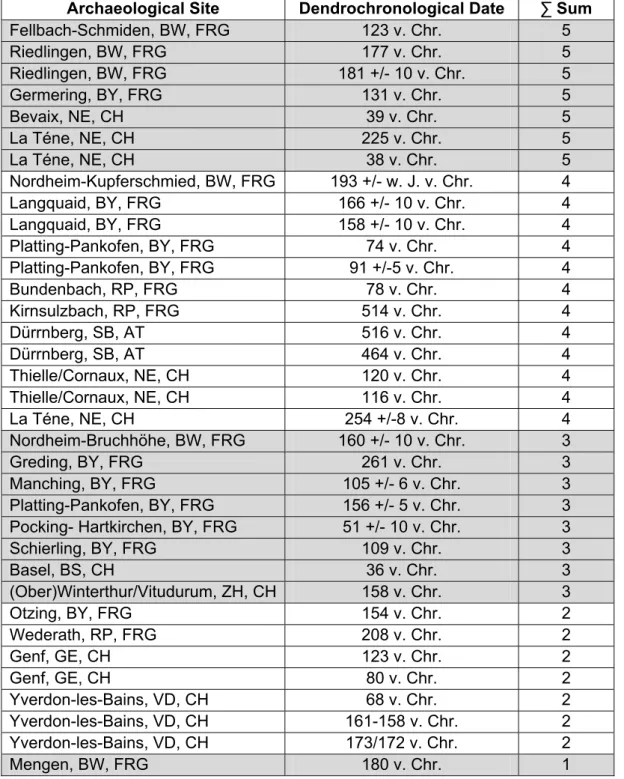
For every criterion the articles were screened, if there are corresponding information. The points are divided in a binary way: „1 = present“ and „0 = non present “.Based on this model of evaluation five ranking groups arose. In the first group (one point) are all dates from articles with information about only one of the criteria. In the fifth group (five points) are all dates from articles with information about all of the criteria. An overview of the distribution of all five ranking groups is given in table 2.
Table 2: Ranking groups 1-5.The Sum column equals the group rank.
Archaeological Site Dendrochronological Date ∑ Sum
Fellbach-Schmiden, BW, FRG 123 v. Chr. 5 Riedlingen, BW, FRG 177 v. Chr. 5 Riedlingen, BW, FRG 181 +/- 10 v. Chr. 5 Germering, BY, FRG 131 v. Chr. 5 Bevaix, NE, CH 39 v. Chr. 5 La Téne, NE, CH 225 v. Chr. 5 La Téne, NE, CH 38 v. Chr. 5 Nordheim-Kupferschmied, BW, FRG 193 +/- w. J. v. Chr. 4 Langquaid, BY, FRG 166 +/- 10 v. Chr. 4 Langquaid, BY, FRG 158 +/- 10 v. Chr. 4 Platting-Pankofen, BY, FRG 74 v. Chr. 4 Platting-Pankofen, BY, FRG 91 +/-5 v. Chr. 4 Bundenbach, RP, FRG 78 v. Chr. 4 Kirnsulzbach, RP, FRG 514 v. Chr. 4 Dürrnberg, SB, AT 516 v. Chr. 4 Dürrnberg, SB, AT 464 v. Chr. 4 Thielle/Cornaux, NE, CH 120 v. Chr. 4 Thielle/Cornaux, NE, CH 116 v. Chr. 4 La Téne, NE, CH 254 +/-8 v. Chr. 4 Nordheim-Bruchhöhe, BW, FRG 160 +/- 10 v. Chr. 3 Greding, BY, FRG 261 v. Chr. 3 Manching, BY, FRG 105 +/- 6 v. Chr. 3 Platting-Pankofen, BY, FRG 156 +/- 5 v. Chr. 3
Pocking- Hartkirchen, BY, FRG 51 +/- 10 v. Chr. 3
Schierling, BY, FRG 109 v. Chr. 3 Basel, BS, CH 36 v. Chr. 3 (Ober)Winterthur/Vitudurum, ZH, CH 158 v. Chr. 3 Otzing, BY, FRG 154 v. Chr. 2 Wederath, RP, FRG 208 v. Chr. 2 Genf, GE, CH 123 v. Chr. 2 Genf, GE, CH 80 v. Chr. 2 Yverdon-les-Bains, VD, CH 68 v. Chr. 2 Yverdon-les-Bains, VD, CH 161-158 v. Chr. 2 Yverdon-les-Bains, VD, CH 173/172 v. Chr. 2 Mengen, BW, FRG 180 v. Chr. 1
Dendrochronological Quality
The quality of publication clarifies an important point: The ranking of the quality of publications is not the same as the archaeological quality of a dendrochronological date. That means, important archaeological dates could also be located in lower groups. The ranking of quality of publications just shows, how much information about the matrix of a dendrochronological date is available for archaeologists.
The analysis of the dendrochronological quality was continued with group 5. Only in this group all necessary information are available, which allows the archaeologist to make his own opinion about a date.
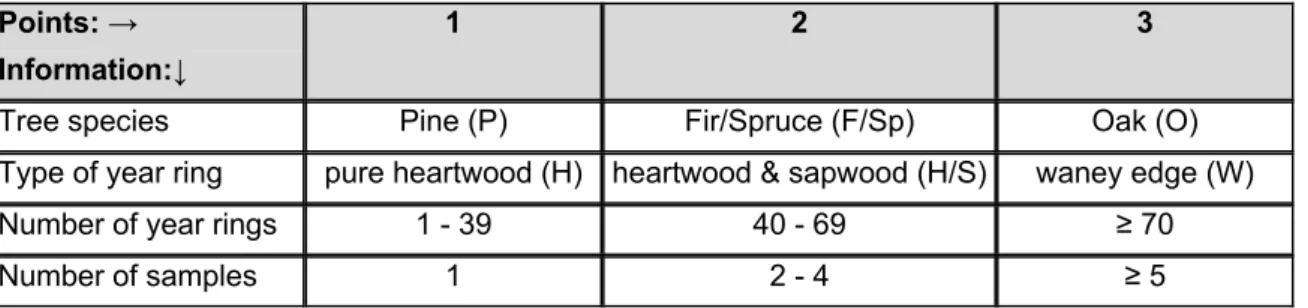
This second model of evaluation was directed at the characteristics of the wooden object itself. The definitions of each criteria were taken from current literature (e.g. Eckstein/Wrobel 2008). Table 3 shows the different distribution of points.
Table 3: Distribution of points per information to determinate the dendrochronological quality. Points: →
Information:↓
1 2 3
Tree species Pine (P) Fir/Spruce (F/Sp) Oak (O) Type of year ring pure heartwood (H) heartwood & sapwood (H/S) waney edge (W) Number of year rings 1 - 39 40 - 69 ≥ 70
Number of samples 1 2 - 4 ≥ 5
The points are divided in three parts, whose subitems are explained as follows:
1. The tree species was evaluated in an ascending order in correlation to availability of the tree-ring-curve and accordingly the dendrochronological comparative material.
2. Points for the type of year rings were assigned depending on the preservation of the pure heartwood, heartwood and sapwood or the preservation of waney edge. Only in this case exact information about the time when the tree was felled are available.
3. The number of year rings was divided in three parts, which were taken from the current literature (e.g. Cichocki 1998/99, Consciense/Gross 2001). The more year rings are available the better is the chance to match a year ring curve in a master curve.
4. The number of samples was included, because you can get additional information, if an object or a feature is sampled more than one time.
Table 4 illustrates the result of this evaluation. It shows the different distributions of points in a down ward order. The sum column shows clearly that all dates are closed to each other, but there are differences between the dendrochronological qualities.
Table 4 illustrates the distribution of points of these criteria in group 5.
Archaeological Site Dendro-chronological Date Tree species O/F/Sp/P Type of year ring: H/S/W Number of year rings Number of Samples ∑ Sum Fellbach-Schmiden, BW, FRG 123 BC 3 3 3 3 12 Germering, BY, FRG 131 BC 3 3 2 3 11 Bevaix, NE, CH 39 BC 3 3 3 2 11 Riedlingen, BW, FRG 177 BC 3 1 3 3 10 Riedlingen, BW, FRG 181 ± 10 BC 3 2 3 2 10 La Tène, NE, CH 225 BC 3 2 3 2 10 La Tène, NE, CH 38 BC 3 3 3 1 10
Tischendorf (TRACE Vol. 9) 130
Archaeological Relevance
The date with the best dendrochronological quality is from a well of the square ditched enclosure of Fellbach-Schmiden in Baden-Württemberg (Fig. 2 (Nr. 2)).
The date of 123 BC is one of the most famous dates in the Late Iron Age and the whole archaeology. Therewith a lot of archaeological types of finds were dated after that and actually a complete archaeological period. That’s why this case study was chosen to discuss the archaeological relevance.
Every archaeological context was checked, where this date was used. Thereby the dendrochronological date was related to the stratigraphy of the corpus of finds as well as to the arguments about the construction and destruction of the square ditched enclosure.
It became apparent, that the archaeological benefit of this famous date is extremely limited if nonexistent. The only definite conclusion from the Fellbach-Schmiden-date is the year, the oak was felled and thus the year the well was constructed. This date is just a “terminus post quem” for the archaeological objects, which were found in the well shaft; and therefor the moment they fell into or were deposited in the well. All objects could have been in use for decades at this moment, or they could have been made decades after the well sinking.
This shows clearly, that the ranking of the dendrochronological quality is not the same as the archaeological quality of a dendrochronological date, and the archaeological information content rises not proportional to the dendrochronological quality.
Figure 2: Excavation plan of the square ditched enclosure of Fellbach-Schmiden. Nr. 2 marks the well (Wieland 1999, 15).
Result
It was pointed out, that most of the analysed dates miss important information about their dendrochronological examination; information, which are necessary to guarantee transparency. It would be very useful, if archaeologists would keep to a special guideline when publishing dendrochronological data. Guidelines, for example like presented here.
Also became obvious, that it is essential to verify the quality of dendrochronological data. On the one hand the information of the object itself have to be checked to evaluate, how reliable a date is and weather it can be used for further archaeological questions. On the other hand the archaeological relevance has to be observed critically as well. The case study of Fellbach-Schmiden clarified, that archaeologists often use dendrochronological data for dating objects within features, for which they are clearly unsuitable.
List of abbreviations AT - Austria O - Oak BS - Basel P - Pine BW - Baden-Württemberg RP - Rhineland-Palatinate BY - Bavaria S - Sapwood CH - Switzerland SB - Salzburg F - Fir Sp - Spruce
FRG - Federal Republic of Germany VD - Vaud
GE - Geneva W - Waney edge
H - Heartwood ZH - Zürich
NE - Neuchâtel Acknowledgements
The author thanks Prof. Dr. Sabine Rieckhoff (Institut für Ur -und Frühgeschichte, Universität Leipzig) for her helpful suggestions and her support. I am also indebted to Dr. Thomas Frank (Universität zu Köln) for his interest, encouragement and intercession to the TRACE-Organisation. References
Cichocki, O. (1998/99): Xylotomische Untersuchungen an Holzresten aus den urnenfelderzeitlichen und frühmittelalterlichen Wallanlagen von Thunau am Kamp, MG Gars am Kamp, Niederösterreich. Teil 1. Dendrochronologische Datierung der Walleinbauten auf der Oberen Holzwiese. Arch. Austriaca 82/83, 47-56.
Conscience, A., Gross, E. (2001): Frühbronzezeitliche Uferdörfer aus Zürich-Mozartstrasse – eine erfolgreiche Neudatierung. Jahrb. SGUF 84, 147-157.
Eckstein, D., Wrobel, S. (2008): Dendrochronologie. In: Hauptmann, A., Pingel, V. (ed.): Archäometrie. Methoden und Anwendungsbeispiele. 154-170.
Wieland, G. (1999): Die keltischen Viereckschanzen von Fellbach-Schmiden und Ehningen. Forsch. u. Ber. zur Vor- u. Frühgesch. in Baden-Württemberg 80.