ROBUST PARSING FOR UNGRAMMATICAL SENTENCES
by
Homa Baradaran Hashemi
B.Sc. in Software Engineering, Iran University of Science and Technology, 2007
M.Sc. in Software Engineering, University of Tehran, 2011
M.Sc. in Intelligent Systems Program, University of Pittsburgh, 2014
Submitted to the Graduate Faculty of
the Kenneth P. Dietrich School of
Arts and Sciences in partial fulfillment
of the requirements for the degree of
Doctor of Philosophy
University of Pittsburgh
2017
UNIVERSITY OF PITTSBURGH
KENNETH P. DIETRICH SCHOOL OF ARTS AND SCIENCES
This dissertation was presented by
Homa Baradaran Hashemi
It was defended on October 17th 2017 and approved by
Dr. Rebecca Hwa, Department of Computer Science Dr. Diane Litman, Department of Computer Science Dr. Christian Schunn, Department of Psychology
Dr. Na-Rae Han, Department of Linguistics
Copyright c
by Homa Baradaran Hashemi 2017
ROBUST PARSING FOR UNGRAMMATICAL SENTENCES Homa Baradaran Hashemi, PhD
University of Pittsburgh, 2017
Natural Language Processing (NLP) is a research area that specializes in studying computational approaches to human language. However, not all of the natural language sentences are grammati-cally correct. Sentences that are ungrammatical, awkward, or too casual/colloquial tend to appear in a variety of NLP applications, from product reviews and social media analysis to intelligent language tutors or multilingual processing. In this thesis, we focus on syntactic parsing, an essen-tial component of many NLP applications. We investigate the impact of ungrammatical sentences on statistical parsers. We also hypothesize that breaking up parse trees from problematic parts prevents NLP applications from degrading due to incorrect syntactic analysis.
A parser isrobustif it can overlook problems such as grammar mistakes and produce a parse tree that closely resembles the correct analysis for the intended sentence. We develop a robustness evaluation metric and conduct a series of experiments to compare the performances of state-of-the-art parsers on the ungrammatical sentences. The evaluation results show that ungrammatical sentences present challenges for statistical parsers, because the well-formed syntactic trees they produce may not be appropriate for ungrammatical sentences. We also define a new framework for reviewing the parses of ungrammatical sentences and extracting the coherent parts whose syntactic analyses make sense. We call this taskparse tree fragmentation. The experimental results suggest that the proposed overall fragmentation framework is a promising way to handle syntactically unusual sentences; they also validate the utility of parse tree fragmentation methods in two external tasks of sentential grammaticality judgment and semantic role labeling.
TABLE OF CONTENTS ACKNOWLEDGEMENT . . . xvi 1.0 INTRODUCTION . . . 1 1.1 Motivation . . . 1 1.2 Research Questions . . . 2 1.3 Thesis Statement . . . 3 1.4 Thesis Overview . . . 3 1.4.1 Ungrammatical Sentences . . . 3
1.4.2 Impact of Ungrammatical Sentences on Parsers . . . 4
1.4.3 Parse Tree Fragmentation Framework . . . 4
1.4.4 Applications of Parse Tree Fragmentation . . . 6
1.5 Thesis Contributions . . . 6
2.0 PRELIMINARIES AND BACKGROUND . . . 8
2.1 Introduction . . . 8
2.2 Ungrammatical Sentences. . . 8
2.2.1 English-as-a-Second Language (ESL) . . . 9
2.2.1.1 ESL Corpora . . . 9 2.2.1.2 NLP Research on ESL . . . 10 2.2.2 Machine Translation (MT) . . . 11 2.2.2.1 MT Corpora . . . 11 2.2.2.2 NLP Research on MT Outputs . . . 12 2.2.3 Twitter . . . 13 2.2.3.1 Twitter Properties . . . 13
2.2.3.2 NLP Research on Tweets . . . 13
2.2.4 Transcribed Conversation . . . 14
2.2.4.1 Transcribed Conversation Corpora . . . 14
2.2.4.2 NLP Research on Transcribed Conversation . . . 14
2.2.5 Comparison of Ungrammatical Domains . . . 15
2.3 Syntactic Parsing . . . 16
2.3.1 Full Parsing . . . 16
2.3.1.1 Constituency Parse Tree . . . 17
2.3.1.2 Dependency Parse Tree . . . 17
2.3.2 Partial Parsing . . . 19 2.3.2.1 Chunking . . . 19 2.3.2.2 Hedge Parsing . . . 20 2.3.2.3 Vine Parsing . . . 20 2.3.3 Parsing Evaluation . . . 21 2.3.3.1 Intrinsic Evaluation . . . 22 2.3.3.2 Extrinsic Evaluation . . . 23
2.4 Syntactic Parsing Applications . . . 24
2.4.1 Sentence-Level Fluency Judgment . . . 24
2.4.1.1 Fluency Judgment Task . . . 24
2.4.1.2 Fleuncy Judgment Related Work . . . 25
2.4.2 Semantic Role Labeling (SRL) . . . 26
2.4.2.1 SRL Task . . . 26
2.4.2.2 Relation of Syntactic and Semantic Analyses . . . 27
2.4.2.3 SRL Related Work . . . 29
3.0 IMPACT OF UNGRAMMATICAL SENTENCES ON PARSING . . . 30
3.1 Introduction . . . 30
3.2 Assessing the Impact of Ungrammatical Sentences on Parsers . . . 31
3.3 Proposed Gold-Standard Free Methodology . . . 32
3.3.1 Creating Pseudo Gold Parse Trees . . . 32
3.4 Experimental Setup . . . 35
3.4.1 Parsers . . . 35
3.4.2 Data . . . 36
3.4.2.1 Parser Training Data . . . 36
3.4.2.2 Robustness Test Data . . . 37
3.4.3 Experimental Settings . . . 40
3.5 Experiments . . . 40
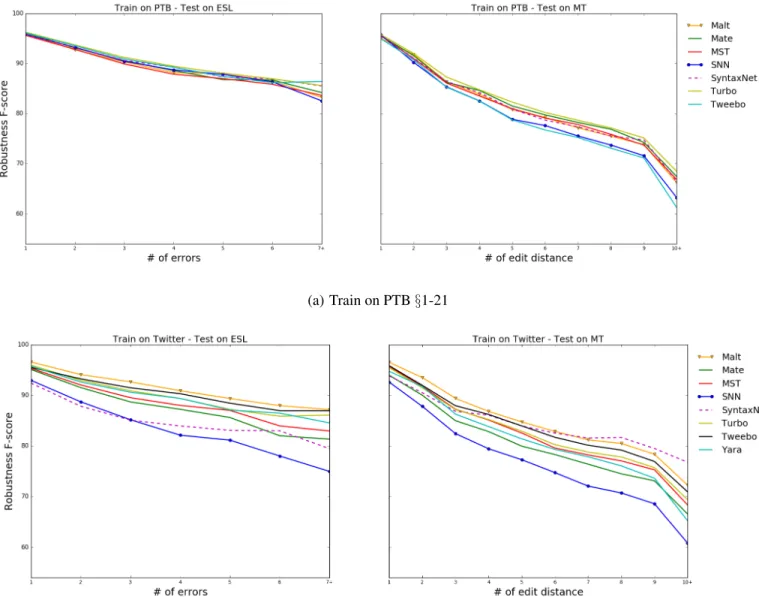
3.5.1 Overall Accuracy and Robustness . . . 41
3.5.2 Parser Robustness by Number of Errors . . . 41
3.5.3 Impact of Error Distances . . . 43
3.5.4 Impact of Error Types . . . 46
3.5.4.1 Impact of grammatical error types . . . 46
3.5.4.2 Impact of error word category . . . 46
3.5.4.3 Impact of error semantic role . . . 48
3.6 Chapter Summary . . . 48
4.0 PARSE TREE FRAGMENTATION OF UNGRAMMATICAL SENTENCES . . . 52
4.1 Introduction . . . 52
4.2 A Framework for Parse Tree Fragmentation . . . 53
4.2.1 Ideal Fragmentation . . . 54
4.2.2 Dependency Tree Fragmentation . . . 55
4.3 Developing a Fragmentation Corpus . . . 55
4.3.1 Pseudo Gold Fragmentation (PGold) . . . 57
4.3.2 Reference Fragmentation (Reference) . . . 60
4.3.3 Comparing PGold and Reference . . . 60
4.4 Chapter Summary . . . 61
5.0 AUTOMATIC METHODS OF PARSE TREE FRAGMENTATION. . . 63
5.1 Introduction . . . 63
5.2 Fragmentation Methods . . . 63
5.2.1 Classification-based Parse Tree Fragmentation (Classification) . . . 64
5.2.2.1 Parser Domain Adaptation . . . 65
5.2.2.2 Creating a Treebank of Tree Fragments . . . 67
5.2.3 Sequence-to-Sequence Parse Tree Fragmentation (seq2seq). . . 68
5.2.3.1 Seq2Seq Using Deep Neural Nets . . . 69
5.2.3.2 Sequence Representation of a Fragmented Dependency Tree . . . 70
5.3 Comparison of Fragmentation Methods . . . 73
5.4 Chapter Summary . . . 73
6.0 EMPIRICAL EVALUATION OF PARSE TREE FRAGMENTATION . . . 75
6.1 Introduction . . . 75
6.2 Evaluation of Parse Tree Fragmentation . . . 75
6.3 Experimental Setup . . . 76
6.3.1 Data . . . 76
6.3.1.1 English as a Second Language corpus (ESL) . . . 76
6.3.1.2 Machine Translation corpus (MT) . . . 79
6.3.2 Experimental Tools . . . 83
6.3.2.1 Reference Settings . . . 83
6.3.2.2 Classification Settings . . . 83
6.3.2.3 Parser Retraining Settings . . . 83
6.3.2.4 seq2seq Settings . . . 84
6.3.3 Evaluation Metrics . . . 84
6.3.3.1 Unlabeled Attachment Score (UAS) . . . 84
6.3.3.2 Accuracy of Cut Arcs . . . 85
6.3.3.3 Set-2-Set F-score. . . 85
6.4 Evaluation . . . 86
6.4.1 Performance of Each Fragmentation Method . . . 86
6.4.2 Performance of the Classification Method . . . 88
6.4.3 Evaluation of Tree Fragmentation Methods . . . 88
6.4.4 Relationships between Fragments Statistics . . . 91
6.5 Chapter Summary . . . 92
7.1 Introduction . . . 94
7.2 Extrinsic Evaluation: Fluency Judgment . . . 95
7.2.1 Fluency Judgment Tasks . . . 95
7.2.1.1 Binary Task . . . 96
7.2.1.2 Regression Task . . . 96
7.2.2 Feature Sets . . . 96
7.2.2.1 Our feature set . . . 96
7.2.2.2 Contrastive feature sets . . . 96
7.2.3 Experimental Setup . . . 97
7.2.4 Results . . . 98
7.3 Extrinsic Evaluation: Semantic Role Labeling . . . 100
7.3.1 Semantic Role Labeling of Ungrammatical Sentences. . . 102
7.3.2 Creating Pseudo Gold Semantic Dependencies for Ungrammatical Sentences 104 7.3.3 Applying Fragmentation to Automatic SRL Annotations . . . 105
7.3.3.1 Approach 1: Rule-based . . . 106
7.3.3.2 Approach 2: Machine-Learning-based (ML) . . . 106
7.3.4 Evaluating Automatic SRL Annotations of Ungrammatical Sentences . . . . 108
7.3.5 Experimental Setup . . . 110
7.3.6 Results . . . 111
7.3.6.1 Overall Performances . . . 112
7.3.6.2 Impact of Number of Errors . . . 117
7.3.6.3 Impact of Error Distances . . . 117
7.3.6.4 Impact of Error Types . . . 119
7.3.6.5 Discussion . . . 124
7.4 Chapter Summary . . . 127
8.0 CONCLUSION AND FUTURE WORK . . . 128
8.1 Summary of Contributions and Results . . . 128
8.2 Future Work . . . 130
APPENDIX. SEMANTIC ROLE LABELS . . . 133
LIST OF TABLES
1 Comparison of the ungrammatical domains.. . . 16
2 Parsers performance in terms of accuracy and robustness. The best result in each
column is given in bold, and the worst result is in italics. . . 42
3 Parser performance on test sentences with 3 near and 3 far errors. Each box
rep-resents one train/test configuration for all parsers and error types. The bars within indicate the level of robustness scaled to the lowest score (empty bar) and highest
score (filled bar) of the group. . . 45
4 Parser robustness on sentences with one grammatical error, each can be categorized
as a replacement word error, a missing word error or an unnecessary word error. . . 47
5 Parser robustness on sentences with one error, where the error either occurs on an
open-class (lexical) word or a closed-class (functional) word. . . 49
6 Parser robustness on sentences with one error where the error occurs on a word
taking on a verb role, an argument role, or a word with no semantic role. . . 50
7 An example of the transition sequence of the arc-standard actions for the
depen-dency tree of Figure 21. The last column shows the generated output sequence with annotated fragmented arcs. We use this linear form of arc pruned dependency trees
to train the seq2seq model. . . 72
8 Comparison of the proposed automatic fragmentation methods. . . 74
9 Performance of automatic fragmentation methods by comparing their resulting
de-pendency trees against Reference fragmented trees as their training data. The No
cutmethod serves as a baseline and does not break any tree. . . 87
11 Relationship of fragmentation methods with Reference fragments over the number
and size of fragments. . . 93
12 Fluency judgment results over two datasets containing ungrammatical sentences
us-ing binary classification and regression. Accuracy and AUC measures are reported
for binary classification, and RMSE and Pearson’s r are reported for regression.
PGold and Reference as the upper bounds are given in italics, and the best result
among automatic fragmentation methods is given in bold. . . 99
13 Correlation between the extracted features from each fragmentation method with
the fluency of the sentence in the regression task. Reference as the upper bound is
given in italics, and the best result in each column is given in bold. . . 101
14 Overall performance of fragmentation methods in detecting incorrect semantic
de-pendencies in terms of False Discovery Rates (FDR). The “0+” columns indicate the experiments over the sentences with zero or more errors, and the “1+” columns reports the results on the sentences with at least one error. Reference as the upper bound is given in italics, and the best result among automatic arc pruning methods
is given in bold. . . 113
15 Overall False Negative Rates (FNR) of fragmentation methods. Reference as the
upper bound of fragmentation methods is given in italics, and the best result among
automatic arc pruning methods is given in bold.. . . 115
16 Performance of binary classification models of machine-Learning-based approach
(Section 7.3.3.2) using fragmentation features to detect incorrect semantic
depen-dencies. . . 116
17 False Discovery Rates on test sentences with two near and two far errors. Each bar
indicates the level of FDR scaled to the lowest score (empty bar) and highest score
(filled bar) of a group. . . 120
18 False Discovery Rates on test sentences with one error where the error occurs on a
word taking on a verb role, an argument role, or a word with no semantic role. . . . 122
19 False Discovery Rates on sentences with one error, where the error occurs on a word
20 False Discovery Rates on sentences with one grammatical error, each can be cate-gorized as a replacement word error, a missing word error or an unnecessary word
error. . . 125
21 False Discovery Rates on sentences with one error, where the error either occurs on
an open-class (lexical) word or a closed-class (functional) word. . . 126
LIST OF FIGURES
1 An ungrammatical sentence gets a well-formed but inappropriate parse tree. . . 2
2 The red dotted dependencies show a set of implausible syntactic relations which results in four fragments. . . 6
3 Example of a full constituency parse tree. . . 17
4 Example of a full dependency parse tree. . . 18
5 Chunking analysis of a sentence. . . 19
6 Example of Hedge parsing with maximum constituent span of 6.. . . 20
7 Example of Vine parsing retaining only tree dependencies of length less than 6. The root of the resulting parse fragments are now connected only by their dotted arcs “vine dependencies” to $. . . 21
8 Example of semantic role labeling. . . 26
9 Syntactic (inner) and semantic (outer) analyses of an ungrammatical sentence (bot-tom) and its corrected version (top). The dotted arcs show mismatched dependen-cies of the ungrammatical sentence with the grammatical sentence. . . 28
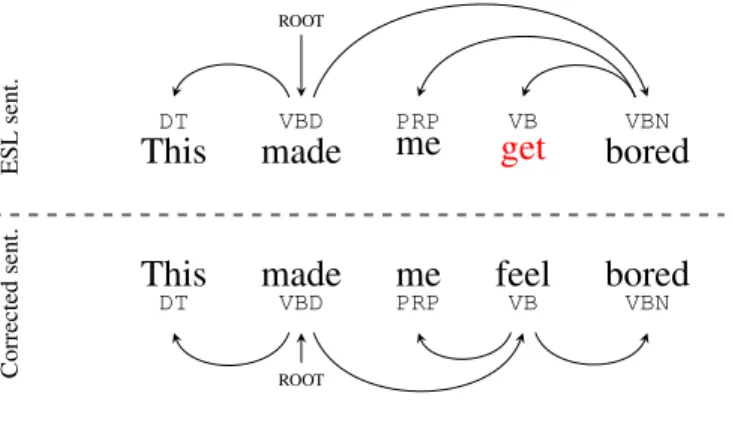
10 Parse trees of an ESL sentence and its corrected counterpart. . . 31
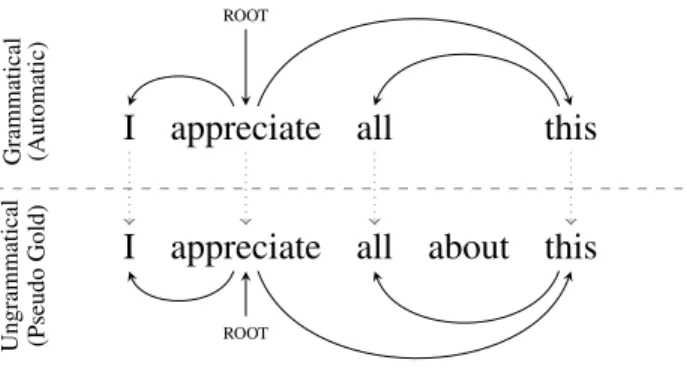
11 Projecting parse tree of the Grammatical sentence (top) to the Ungrammatical sen-tence (bottom) to create “gold standard” tree of the ungrammatical sensen-tence. . . 34
12 Example of evaluating robustness of an automatic parse tree (bottom) with the gold standard tree (top) of the Ungrammatical sentence. The dotted red arcs show error-related dependencies. The robustness F1 is66%. . . 35
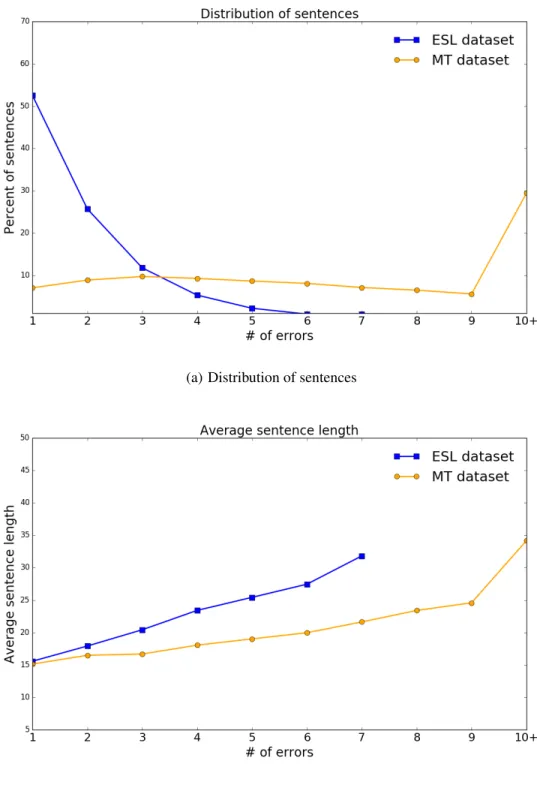
13 Some statistics of sampled ESL and MT datasets by number of errors. . . 39
15 Example of an ungrammatical sentence that gets a complete well-formed but inap-propriate parse trees in two syntactic representations (right), and a set of coherent
tree fragments that might be extracted from the full parse tree (left). . . 56
16 Creating pseudo gold fragments. The upper parts of figure are parse tree of
gram-matical sentences and the lower parts are their transformation after applying errors. . 58
17 Example of PGold fragmentation of an ungrammatical sentence. There are two
er-rors in the sentence: a missing comma and a replacement word error. Starting from the grammatical sentence and its parse tree, PGold reconstructs the ungrammatical
sentence and its fragments. . . 59
18 Example of Reference fragmentation of an ungrammatical sentence. The dotted red
arcs are cut dependencies based on the two word error. It results four fragments. . . 61
19 Depth and height features for the dependency arc of “known→for”. . . 65
20 Word N-gram features for the dotted arc. Rectangles are words. Word bigrams
associated to the dotted arc are:whwm,wm−1wmandwmwm+1. . . 66
21 Example of a fragmented dependency tree. The dotted red arcs are cut dependencies
based on the mistakes in the sentence. . . 67
22 Schematic view of seq2seq model for parse tree fragmentation. The input words are
first mapped to word vectors and then fed into a recurrent neural network (RNN).
The final time step initializes an output RNN, upon seeing the<eos>symbol. . . . 69
23 Some statistics of sampled ESL datasets by number of errors. . . 78
24 Some statistics of sampled MT datasets by HTER score. . . 81
25 Some statistics of sampled MT datasets by number of edits. . . 82
26 Automatically produced semantic dependency graph of an ungrammatical sentence.
The red dotted relations show incorrect semantic dependencies. . . 102
27 Projecting semantic dependencies of the Grammatical sentence (top) to the
Un-grammatical sentence (bottom) to create “gold standard” semantic dependencies of
the ungrammatical sentence. . . 105
28 Applying fragmentation to automatic semantic dependencies of an ungrammatical
29 Evaluating theautomaticsemantic dependencies (bottom) with the gold standard/projected semantic dependencies (top) of the Ungrammatical sentence. The dotted red
rela-tions show produced false positive relarela-tions by the automatic SRL. The False
Dis-covery Rate (FDR) is2/6≈33%. . . 111
30 Variation in False Discovery Rates as the number of errors in the test sentences
ACKNOWLEDGEMENT
I am immensely grateful to my advisor, Rebecca Hwa, for teaching me the range of things one can possibly learn in graduate school, from doing great research to writing papers. I am thankful for her for occasionally having more faith in me than I had myself (especially we got four rejections in a row). Needless to say, without her guidance and encouragement this work would not be completed. I would like to express my sincere gratitude to the other members of my dissertation commit-tee, Diane Litman, Na-Rae Han and Christian Schunn for their invaluable advice, especially their thoughtful comment on unifying our ideas on one syntactic representation which vastly improved the quality of this dissertation. I am also grateful to Jan Wiebe for discussions and comments at earlier stages of this research. I thank Azadeh Shakery, my Masters advisor at University of Tehran, under whose guidance I first started doing research in information retrieval and natural language processing. I am also thankful to my mentors during my internships, Silke Witt, Reiner Kraft and Thomas Polzin who helped me to achieve a better view of real world NLP challenges.
I was lucky to be part of ISP, a small and diverse program which presented me with so many perspectives on artificial intelligence. Thanks so much Michele Thomas for being such a won-derful administrator and for making the ISP seminars interesting and fun. I cannot forget Wendy Bergstein, whose warm presence made ISP enjoyable in the first years of our PhD when I was new to the country and culture. My PhD research was supported in part by the National Science Foundation awards IIS-0745914, #1550635 and #1735752, and the University of Pittsburgh Center for Research Computing through the resources provided. I specifically acknowledge the assistance of Ketan Maheshwari.
I am grateful to my friends at ISP, CS and NLP group for making the last six years at Pittsburgh such a memorable experience. Thanks to Huichao Xue, Fan Zhang, Fattaneh Jabbari, ChangSheng Liu, Lingjia Deng, Yoonjung Choi, Huy Nguyen, Wencan Luo, Omid Kashefi, Roya Hosseini,
Tazin Afrin and Mahbaneh Eshaghzadeh. Many special thanks to Zahra Rahimi, who has been influential in pretty much every aspect of my graduate life since the first time we spoke at the University of Tehran in 2008. I spent almost the last year of my PhD in Cambridge, MA; a special thanks to Yevgeni Berzak from MIT for introducing the EFCAMDAT dataset and Allen Schmaltz from Harvard for helping in running seq2seq experiments which saved me much time and effort.
My deepest gratitude goes to my parents Narges and Ahmed for their love and unquestioning support throughout. It was through talking to them during my lunch time/their dinner time, that my battery was recharged everyday. I am grateful to my sister Sima and her husband Nima for all the joy they have added to our life by driving to Pittsburgh even for a weekend. I thank my brother Ali for being a role model for me (I followed his path without knowing it myself) and most importantly for introducing Mahdi to our family. I also thank Mahdi’s parents Fatemeh and Nemat for their patience and continuous encouragements.
Last, but certainly not least, I would like to thank my dearest Mahdi, my best friend and husband. It was through his selfless friendship and love that shaped my life during this long journey for the last thirteen years.
1.0 INTRODUCTION
1.1 MOTIVATION
Natural Language Processing (NLP) is a research area that focuses on studying computational methods that analyze human languages. The ultimate goal of NLP is to construct systems that understand and produce natural languages as humans do. To advance this goal, various NLP tasks are established, from name entity recognition (e.g. identifying people in a sentence) and part-of-speech tagging (e.g. detecting verbs in a sentence) to more complicated tasks such as question answering and automatic summarization.
The input of NLP applications could come from different domains (note that by domain we mean a collection of texts from certain genres, topics, and styles of expressions); not all of these domains are necessarily grammatically correct. The input text can come from heavily edited do-mains by humans, such as news, or from unedited dodo-mains, such as microblogs, consumer reviews, forums, etc.
Knowing the relationship between individual words in a natural language sentence is essential for an application that attempts to process the input text in some way, such as extracting the infor-mation or translating the text to another language. It is the role of the syntactic parsing to produce this kind of analysis. A computational analyzer that assigns syntactic structures to sentences is a parser. Current state-of-the-art parsers employ supervised methods to learn models from annotated training data (treebanks). These treebanks include a collection of sentences with their manually annotated syntactic analysis.
A statistical parser trained on a standard treebank, however, often produces full, syntactically well-formed trees for all the input sentences that might not even be appropriate for the sentences. For example, Figure 1 shows incorrect syntactic analyses for an output of a machine translation
The members of the vote opposes any him
det prep pobjdet
nsubj
dobj det
Figure 1: An ungrammatical sentence gets a well-formed but inappropriate parse tree.
system; even though the sentence has several problems such as unusual phrases members of the voteand any him, the parser still groups them into clauses to serve as the subject and the object of the main verb, respectively. These incorrect analyses may later impact the performances of the downstream NLP applications.
Moreover, as shown in the past, current state-of-the-art statistical parsers perform well on standard (newswire) benchmarks with accuracies above 90%; however, these high accuracies are limited to heavily edited domains, and their analyses for sentences from different domains are less reliable (Gildea,2001;McClosky et al.,2010;Foster,2010;Petrov et al., 2010;Foster et al.,
2011a). Ungrammatical sentences (or even awkward sentences that are technically grammatical)
can be seen as special kinds of out-of-domain sentences; in some cases, it is not even clear whether a complete parse should be given to the sentence.
In this thesis, we study parsing ungrammatical sentences and introduce a framework to gener-ate meaningful syntactic analyses for these sentences based on their grammatical mistakes.
1.2 RESEARCH QUESTIONS
The primary goal of this research is to investigate the impact of ungrammatical sentences on parsers by addressing the following questions:
• In what ways does a parser’s performance degrade when dealing with ungrammatical sen-tences?
the phrases they cover?
• Do the resulting parse tree fragments provide some useful information for downstream NLP applications?
1.3 THESIS STATEMENT
While parsers have trouble when sentences contain certain types of mistakes (e.g., extra word errors or multiple errors that are close to each other), there are still reliable parts in the parse tree unaffected by the errors. The thesis of this dissertation is that we can identify the unaffected areas of the parse tree and prune the problematic parts, resulting in a set of tree fragments. These tree fragments will contain useful syntactic information that can help downstream applications such as fluency judgment and semantic role labeling.
1.4 THESIS OVERVIEW
In the following, we present a general overview of the key concepts and the steps that we take to address the research questions.
1.4.1 Ungrammatical Sentences
A sentence is considered ungrammatical if all its words are valid in the language, but it still contains grammatical or usage errors (Foster,2007). As a rule of thumb, ungrammatical sentences require a set of corrections in order to sound “natural” to a native-speaker (Pinker,2015). In this thesis, we study two written data sources in which the sentences may contain grammatical mistakes: writings of English-as-a-Second language (ESL) students and automatic machine translation (MT) outputs. We primarily focus on written domains that their major goal is to generate fluent and grammatical sentences; in addition, these domains have a wider range of error types, such as missing phrases, insertion of unnecessary phrases, and incorrect phrasal ordering, than spoken domains.
1.4.2 Impact of Ungrammatical Sentences on Parsers
For the purpose of analyzing the impact of ungrammatical sentences on parsers, we need to eval-uate their generated parse trees for these problematic sentences. However, previous works on parser evaluation have primarily focused on accuracy and speed of parsers (Choi et al., 2015;
Kummerfeld et al.,2012;McDonald and Nivre,2011;Kong and Smith,2014), and have not taken
ungrammatical sentences into consideration. The main reason is that typically parser evaluation requires manually annotated gold standards (treebanks); while, there does not exist large-scale an-notated corpus for ungrammatical sentences. Therefore, to evaluate the parsers for ungrammatical sentences, rather than creating a treebank or adapting the annotation schema for ungrammatical sentences (which may not always be valid (Cahill, 2015;Ragheb and Dickinson, 2012)), we pro-pose an alternative approach to consider the automatically produced parse trees of well-formed sentences as gold standards and compare the parser output for the corresponding problematic sen-tences against them. We say that a parser isrobustfor ungrammatical sentences, if it can overlook problems such as grammar mistakes and produce a parse tree that closely resembles the correct analysis for the intended sentence.
Evaluating robustness of parsers, however, presents another challenge; since the words of the ungrammatical sentence and its grammatical counterpart do not necessarily match (there might be missing or extra words). Hence, we introduce a modified evaluation metric to compare parse trees of ungrammatical sentences against parse trees for their corresponding grammatical sentences. In the first part of this thesis, we present our proposed robustness evaluation methodology, and we compare state-of-the-art dependency parsers to see how much and in what ways they are robust when applied to ungrammatical sentences.
1.4.3 Parse Tree Fragmentation Framework
Our parser robustness analyses show that ungrammatical sentences present challenges for statis-tical parsers; however, when ignoring the erroneous parts of the sentences, a typical parser does reasonably well on recognizing the syntactic structures of the remaining grammatical parts of the sentences. Therefore, a reasonable approach to parse ungrammatical sentences would be to identify well-formed syntactic structures of those parts of the sentences that do make sense. We establish
this idea by proposing a new framework to parse ungrammatical sentences. We call this framework
parse tree fragmentation, since it re-interprets the parse trees by pruning the implausible syntactic relations. Pruning syntactic relations results a set of tree fragments that are linguistically appro-priate for the phrases they cover. Figure 2 shows a set of implausible syntactic relations for the ungrammatical sentence which results in four fragments.
To automatically fragment the parse trees of ungrammatical sentences, we need a sizable tree fragmentation gold standard corpus. Ideally, this corpus would be a collection of trees of un-grammatical sentences and their corresponding sets of tree fragments extracted by knowledgeable annotators who agree with each other. However, such a corpus does not exist. Annotating a cor-pus of ungrammatical sentences with tree fragments is not also suitable for a large scale human annotation. Because people may not agree on the best set of fragments, and furthermore, the frag-mentation decisions may depends on the downstream application that uses the parse trees. Instead, detecting parse tree fragments is significantly easier if a grammatical version of the sentence is also given. Therefore, in this thesis, we propose methods to collect annotations leveraging existing NLP corpora that have ungrammatical sentences and their corrected versions. An example data source of this type is a machine translation evaluation corpus, which consists of machine trans-lated sentences and their corresponding references. Since the intended meaning is known, people can make fragmentation decisions with high inter-annotator agreement. In the most informative case, the fluent paraphrases also come with an explanation for each replacement. An example data source of this type is an English-as-a-Second language learner’s corpus, which consists of student sentences and their detailed corrections. Constrained by the location and type of each error, the fragmentation decisions may be made deterministically without a human annotator. Therefore, in this thesis, we create a gold standard corpus by extracting tree fragments from the more informative data sources such as an MT evaluation corpus and an ESL learner’s corpus.
By assuming the existence of a gold standard training corpus, we propose three fragmentation strategies to automatically produce parse tree fragments for ungrammatical sentences. In one, we propose a post-hoc process on the outputs of off-the-shelf parsers for the ungrammatical sentences. In the other two, we only make use of the training data to jointly learn to parse and fragment the ungrammatical sentences. The two joint methods are based on a parser retraining method and a sequence-to-sequence labeling method.
The members of the vote opposes any him
det pobj
det
Figure 2: The red dotted dependencies show a set of implausible syntactic relations which results in four fragments.
1.4.4 Applications of Parse Tree Fragmentation
To validate the utility of the parse tree fragmentation, we use it in two downstream NLP tasks which benefit from syntactic parsing:
• Sentential fluency judgmenttask which predicts how “natural” a sentence might sound to a native-speaker human. These predictions can be useful, for instance, to help grading stu-dents’ writings. An automatic fluency judge uses syntactic analysis to make predictions on the sentence-level.
• Semantic role labeling (SRL)task which identifies semantic relations of groups of words with respect to a particular verb in a sentence. The obtained semantic relations can be useful for other NLP tasks such as question answering. The semantic relations are typically extracted on the word-level.
Because the two applications process the sentences at different levels, we would be able to investigate the usefulness of parse tree fragmentation in two distinct applications. We hypothesize the parse tree fragmentation can provide informative signals to help downstream NLP applications. Through a set of empirical studies, we show that our hypothesis holds.
1.5 THESIS CONTRIBUTIONS
• We have designed a metric and methodology for evaluating the impact of ungrammatical sen-tences on statistical parsers.
– We have conducted a quantitative comparison of parser accuracy of leading dependency parsers on ungrammatical sentences; this may help practitioners to select an appropriate parser for their applications.
– We have conducted a suite of robustness analyses for the parsers on specific kinds of problems in the ungrammatical sentences; this may help developers to improve parser robustness in the future.
• We have proposed parse tree fragmentation framework as a way to address the mismatch be-tween ungrammatical sentences and statistical parsers that are not trained to handle them.
– We have devised methods for extracting gold standard tree fragments using evaluative corpora available for other NLP applications.
– We have proposed three practical fragmentation methods based on availability of resources for each ungrammatical domain.
– We have verified utility of extracted tree fragments for two downstream NLP applications of fluency detection and semantic role labeling.
2.0 PRELIMINARIES AND BACKGROUND
2.1 INTRODUCTION
In this chapter we give an overview of the terminology and the concepts that are discussed through-out this dissertation. In doing so, we start through-out with reviewing several domains that contain ungram-matical sentences. We then turn to syntactic parsing with the special focus on partial parsing ap-proaches, which have similar concept as our parse tree fragmentation framework. Next, we provide an overview of evaluating parse trees, especially on downstream NLP applications that leverage parsing as a component. We discuss two specific applications that we explore in this thesis, by defining the tasks and giving an overview of the related work.
2.2 UNGRAMMATICAL SENTENCES
Different domains of ungrammatical sentences might have unique properties that introduce vari-ous challenges for the NLP applications. In this section, we review several natural data sources in which the sentences may contain grammatical mistakes: writings of ESL students, automatic machine translation outputs, Twitter data, and Automatic Speech Recognition (ASR) transcripts. For each data source, we first present its main characteristics and available corpora; then we in-troduce some common NLP approaches used to process its sentences. Finally, we compare these ungrammatical domains from the parsing perspective. In this thesis, we focus on written domain of ESL and MT, since their major goal is to generate fluent and grammatical sentences.
2.2.1 English-as-a-Second Language (ESL)
2.2.1.1 ESL Corpora
Because English-as-a-Second Language (ESL) learners tend to make mistakes when learning En-glish, they often create ungrammatical sentences. To further study ESL mistakes, researchers have created learner corpora where English experts mark and correct errors. These learner corpora have different annotation standards and different error categories. Despite their differences, they all include basically the same general types of errors. They all consider missing, unnecessary and replacing word errors based on the part of speech tag of the involved word. By knowing the expert corrections of the sentences that show the location and type of the errors, one can easily reconstruct the corrected version of each ungrammatical ESL sentence. The following is an example of the given information in an ESL corpus:
ESL Sentence: We live in changeable world. Corrections: (Missing determiner “a” at position 3)
(An adjective needs replacing with “changing” between positions 3 and 4) Given this information, the corrected version of the ESL sentence can be reconstructed:
Corrected ESL Sentence:We live in a changing world. In this thesis, we use three available ESL corpora:
• First Certificate in English (FCE) (Yannakoudakis et al., 2011). This is a commonly used corpus in the grammar error correction community and has around 31,500 sentences written by students taking Cambridge English exams. 21,000 of the sentences have at least one grammar mistake. These sentences are corrected by English teachers with the detailed list of corrections (containing the type and the position of errors).
• National University of Singapore Corpus of Learner English (NUCLE) (Dahlmeier
et al., 2013). This corpus is used in the grammar error correction shared tasks of
CoNLL-2013 (Ng et al., 2013) and CoNLL-2014 (Ng et al., 2014). It contains 60,800 sentences written by Singaporean college students; among which 21,500 sentences have at least one mistake. The erroneous sentences are corrected by English teachers with the detailed list of corrections (containing the type and the position of errors).
• EF-Cambridge Open Language Database (EFCAMDAT)(Geertzen et al.,2013)1. This corpus has a considerable size of sentences submitted to Englishtwon, the online school of EF that is accessed by thousands of learners each day. This corpus will continue to grow as new data come it. The version of corpus that we used has more than 1,200,000 sentences with at least one grammar mistakes.2 These sentences are corrected by teachers or correc-tors to provide feedback to learners. Even though these errors are annotated with some error codes (e.g. article or verb tense error types), the corrections are not as detailed and accurate as FCE and NUCLE corpora. Since, the corrections are not reliable enough, we only used them to reconstruct the grammatical sentences from the ungrammatical sentences. Thus, we use this huge parallel sentences (ungrammatical/grammatical) as a resource to train our automatic fragmentation methods that require a large amount of data.
2.2.1.2 NLP Research on ESL
NLP techniques are used to automatically assess learners’ writings, detect any errors, and suggest possible corrections for these errors. In the following, we focus on the area of grammar error detection and correction, and its connection with parsing ESL writings.
Grammar Error Correction (GEC)
The ultimate goal of GEC is to build a system to automatically provides feedback to writers, whether they are second language learners or native speakers of a language. Spellcheckers and grammar checking tools (e.g. Microsoft word’s grammar checker) are the most visible fruits of GEC research. In this thesis, our focus is on processing writings of English learners.
In the past few years, the interest in GEC systems has grown considerably. The recent shared tasks of Helping Our Own (HOO) (Dale and Kilgarriff,2011;Dale et al.,2012) and Conference on Natural Language Learning (CoNLL) (Ng et al.,2013,2014) played an important role in progress on GEC research. Three leading state-of-the-art approaches of correcting grammatical errors are: 1) building specific classifiers for different error types (Rozovskaya and Roth, 2014), 2) using statistical machine translation to correct whole sentences (Rozovskaya and Roth, 2016;Yuan and
1https://corpus.mml.cam.ac.uk/efcamdat1/EFCamDat_UserManual_v02.pdf
2We filter out the annotated sentences that have only capitalization errors, or merging two sentences together. Because these error types does not make any difference for our parsing strategies or are not in the sentence-level.
Briscoe, 2016), and 3) using sequence-to-sequence approaches to generate the correct sentences
(Schmaltz et al.,2016,2017).
Parsing ESL Writings
The typical approach to parse domain specific sentences is to train a parser using manually an-notated gold parse trees for the sentences of that domain. However, there are a few small semi-manually constructed treebanks on learner text (Geertzen et al., 2013;Ott and Ziai,2010;Berzak
et al., 2016), their size makes them unsuitable for training a parser. Moreover, some researchers
also raise valid questions over the merit of creating a treebank for ESL writings or adapting the annotation schema (Cahill,2015;Ragheb and Dickinson,2012).
An alternative approach to parse ESL sentences is to use GEC systems to first correct erroneous sentences, and then parse the corrected versions in a pipeline manner. However, fixing problematic sentences may not always be possible, specially when they are very jumbled. Moreover, GEC sys-tems are not perfect and even have mediocre performance on standard ESL corpora. The precision, recall and F-measure of leading GEC systems on the standard ESL corpora are around 0.60, 0.25, 0.50 respectively (Rozovskaya and Roth,2014,2016).
2.2.2 Machine Translation (MT)
2.2.2.1 MT Corpora
Machine translation outputs are another source of problematic data that contain grammatical er-rors. Unlike the ESL corpora, the MT corpora do not have detailed error corrections. The MT corpora often contain the machine translation outputs and human translations against which MT systems are evaluated. The human translation sentences are calledreferencesentences in the MT community. In some cases, the machine translation outputs are manually revised with the goal of performing minimal necessary operations. This set of refined translations is calledhuman post-editions. A good source of MT corpora is the annual conference on statistical machine translation which is built on a series of annual Workshops on Machine Translation (WMT)3. The released datasets contain machine translation outputs submitted to various shared tasks along with the ref-erence translations and occasionally human post-editions. The following exemplifies an MT output
and its accompanied resources:
MT Output:For almost 18 years ago the Sunda space “Ulysses” flies in the area.
Reference Sentence: For almost 18 years, the probe “Ulysses” has been flying through space. Post-edited Sentence:For almost 18 years the “Ulysses” space probe has been flying in space. In this thesis, we use the following machine translation corpora that contain machine transla-tions and their human post-editransla-tions:
• LIG corpus (Potet et al., 2012)4. This corpus contains 10,881 French-English machine translation outputs and their human post-editions.
• LISMI’s TRACE corpus (Wisniewski et al., 2013)5. This corpus has 6,693 French-to-English machine translation outputs and their human post-editions.
2.2.2.2 NLP Research on MT Outputs
The NLP research on the machine translation outputs is mainly on evaluating the translations. Existing automatic MT evaluation metrics, such as BLEU (Papineni et al., 2002), METEOR
(Denkowski and Lavie,2011), TER (Snover et al.,2006) and MEANT (Lo and Wu,2011),
primar-ily provide a single-value evaluation of the quality of the translation. But the task of improving a translation system needs more detailed information about identifying source of errors in a given system. One of the early works on error analysis of MT outputs is done byVilar et al.(2006). They introduced a general MT error typology that has been widely used in the literature (Fishel et al.,
2011;Berka et al., 2012; Popovi´c and Ney, 2011). Although these error types have a significant
overlap with ESL error categories, the MT systems do not make spelling errors; instead they are not able to translate some words and keep them untranslated.
In our own research, we have previously analyzed MT errors in terms of ESL mistake cate-gories (Hashemi and Hwa,2014). We assumed that an automatic translate-to-English system might be seen as an English as a Second Language (ESL) writer whose native language is the source lan-guage. The results suggested that MT systems have fairly similar distributions regardless of their source languages, and the high-performing MT systems have error distributions that are more
sim-4http://www-clips.imag.fr/geod/User/marion.potet/index.php?page=download 5
ilar to those of the low-performing MT systems than to those of ESL learners with the same L1. This may be due to the common English language model component that all the MT systems use.
2.2.3 Twitter
2.2.3.1 Twitter Properties
Twitter is a new domain of noisy data for NLP. One property of tweets is that users are free to send any short message up to 140 characters. The messages are often informal written texts that do not follow the standard rules of writing. Tweets contain different forms of non-standard language: using special character (e.g. # hashtags and emoticons), lengthening words (e.g. coooollll!!!!!), shortening words (e.g. uor2moro), and abbreviating phrases (e.g. lol) (Eisenstein, 2013). Aside from these specific properties of tweets, tweets might also be ungrammatical and contain uninten-tional spelling errors.
2.2.3.2 NLP Research on Tweets
Tweets differ from standard language, such as news reports, both in style and vocabulary. The problem is that the traditional NLP tools (trained on edited text) work poorly on them (Kong et al.,
2014;Ritter et al.,2011;Foster et al.,2011a). The NLP researches have followed two approaches
to deal with the informal language of tweets: normalization and domain adaptation (Eisenstein,
2013). Normalization is the process of replacing non-standard words with “the contextually appro-priate word or sequence of words” (Foster et al.,2011a). For example, transformingcoooollll!!!!!
tocool!. Although normalization is a challenging task (because it is sometimes impossible to keep the meaning of the sentences), some normalization labeled corpora have been created and accuracy of automatic methods are climbing (Han and Baldwin,2011;Han et al.,2012).
Another approach is to adapt NLP tools with the properties of tweets. Some NLP tools are specially created for Twitter, such as a part-of-speech tagger (Gimpel et al.,2011), a named entity recognizer (Ritter et al., 2011), and a dependency parser (Kong et al., 2014). Kong et al.(2014) have also annotated a small set of tweets with their parse trees to train and test the Twitter depen-dency parser,Tweebo. One property of Tweebo is that it is designed to ignore some tokens when parsing the input text, but simultaneously use the ignored tokens as features. We hypothesize that
this property would be helpful for ungrammatical sentences specially when they have redundant words. To investigate our hypothesis, we evaluate the robustness of Tweebo parser on two domains of ungrammatical sentences in the next chapter.
2.2.4 Transcribed Conversation
2.2.4.1 Transcribed Conversation Corpora
Automatic Speech Recognition (ASR) transcripts of conversational speech offer another natural source of problematic data; however, annotated disfluency in spoken utterances tend to focus on removing extra fillers and repeated phrases (Rasooli and Tetreault, 2013;Honnibal and Johnson,
2014;Ferguson et al.,2015). These sentences are also typically shorter and simpler in their
syntac-tic structures. An example of annotated disfluent utterance is Switchboard corpus (Godfrey et al.,
1992), which contains transcribed conversation and parse trees annotated with edited nodes. The annotated edited nodes help to reconstruct the fluent version of the utterances, indicating what the speaker meant to say. The following is an example of observed utterance and its “cleaned” fluent version:
Disfluent Utterance:I want a flight to Boston, uh, I mean Denver Fluent Version: I want a flight to Denver
A listener can often subconsciously filter out spoken disfluencies. However, these disfluencies negatively impact the accuracy of automated analysis performed on spoken utterances.
In this thesis, we primarily focus on written domains because ungrammatical sentences in these domains have a wider range of error types, such as missing phrases, insertion of unnecessary phrases, and incorrect phrasal ordering, than spoken domains.
2.2.4.2 NLP Research on Transcribed Conversation
Most of the NLP research on the speech utterances is to detect disfluencies (Georgila, 2009;Qian
and Liu, 2013). It is then possible to use a pipeline system and give the fluent version of the
utterances to the available NLP tools. Some approaches treat disfluency detection and parsing jointly (Rasooli and Tetreault,2013;Honnibal and Johnson,2014). They show that a joint system can improve the both disfluency detection and parsing of speech utterances.
2.2.5 Comparison of Ungrammatical Domains
We compare the four domains of ungrammatical sentences with the focus of syntactic parsing. We specifically address the following questions:
• Do the ungrammatical sentences have various error types, i.e. missing, unnecessary, and replacement word errors?
ESL and MT sentences might have various grammatical mistakes. While Twitter data and ASR transcripts do not necessarily have missing terms or replacement word errors; but, they might contain redundant terms that need to be ignored while parsing them.
• Is it possible to collect the corrected version of ungrammatical sentences to obtain a parallel corpus of ungrammatical/grammatical sentences?
It is often possible to reconstruct corrected version of ungrammatical sentences for ESL, MT, and ASR transcripts using the existing corpora for these domains. However, tweets represent the informal language which often might not be possible to build unique versions for them in the standard language of writing.
• Do the ungrammatical sentences have detailed correction annotations?
The ESL and ASR transcripts are usually annotated with the detailed corrections showing the exact location and type of errors.
• Is there a manually created treebank for them?
There are small dependency treebanks manually annotated for a subset of ESL and Twit-ter data. The Switchboard corpus is also a sizable constituency treebank for the spoken language.
• Is there a specialized parser designed for them?
Tweebo parser is an adapted parser to handle parsing tweets. Researchers have also pro-posed to adapt parsers to jointly parse and detect disfluency in spoken utterances.
Table 1summarizes the comparison of the ungrammatical domains. In this thesis, we focus on investigating parsing ESL and MT ungrammatical domains. Because, 1) the ultimate goal of these domains is often to make fluent and grammatical sentences, 2) they have a wide range of grammatical mistakes, and 3) no parser is designed for them. Furthermore, they have parallel
Property ESL MT Twitter ASR transcripts
Various error type 3 3 -
-Parallel data 3 3 - 3
Detailed error annotation 3 - - 3
Treebank 3 (∼5000sent.) -3 (∼900sent.) 3 (∼110,500sent.) Specialized parser - - 3 (Tweebo) 3 (Joint systems)
Table 1: Comparison of the ungrammatical domains.
corpora of ungrammatical sentences with their corrections that we can use for studying parsing in these domains.
2.3 SYNTACTIC PARSING
Syntactic parsing is the task of assigning a syntactic structure to a sentence. The syntactic structure characterizes the possible relations and orderings of words within the sentence. In this section, we give conceptual view on the various kinds of structures assign to sentences by categorizing them into two groups of fully-connected and locally-connected structures.
2.3.1 Full Parsing
There are two major syntactic representations: a constituency (phrase-based) and a dependency. Each representation produces a fully-connected structure for a sentence that encodes relationships between words, but the form of the structures varies considerably. We review the general proper-ties of both representations to indicate that our proposed approaches can be generalized for both representations. For the purposes of this thesis, we focus on dependency representation.
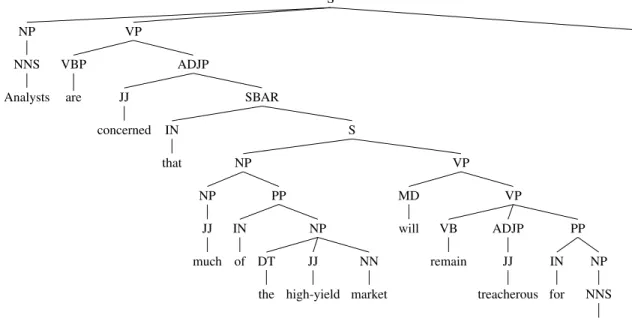
S . . VP ADJP SBAR S VP VP PP NP NNS investors IN for ADJP JJ treacherous VB remain MD will NP PP NP NN market JJ high-yield DT the IN of NP JJ much IN that JJ concerned VBP are NP NNS Analysts
Figure 3: Example of a full constituency parse tree.
2.3.1.1 Constituency Parse Tree
A constituency (phrase-based) parse tree breaks a sentence into sub-phrases (Jurafsky and Martin,
2009). The interior nodes of the tree are types of phrases (e.g. noun phrase (NP) or verb phrase (VP)), while the leaf nodes are the words in the sentence. Figure3shows the constituency parse for the sentenceAnalysts are concerned that much of the high-yield market will remain treacherous for investors. In general, a phrase structure representation may be found more suitable for languages with rather clear constituency structures and fixed word order patterns.
Constituency representation is used as the syntactic formalism when annotating sentences with their parse trees in several large scale human annotation treebanks, such as Penn Treebank project
(Marcus et al.,1993). These treebanks contain a collection of sentences with their manually
anno-tated parse trees which can then be used to train and evaluate statistical parsers.
2.3.1.2 Dependency Parse Tree
A dependency parse tree connects words in a sentence. Each node in the tree represents a word, and each edge indicates the relationships between two words. The edges (or arcs) are calleddependency
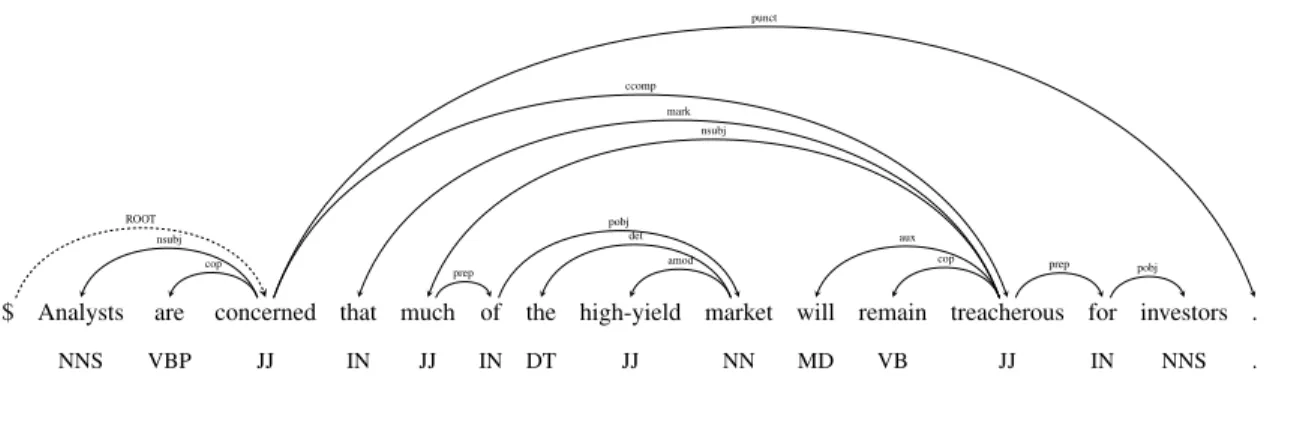
$ Analysts are concerned that much of the high-yield market will remain treacherous for investors . NNS VBP JJ IN JJ IN DT JJ NN MD VB JJ IN NNS . ROOT nsubj cop ccomp punct mark nsubj aux cop prep pobj amod det prep pobj
Figure 4: Example of a full dependency parse tree.
relations and are labeled by the type of the dependency (Jurafsky and Martin, 2009). Figure 4
shows an example of the dependency tree. The direction of the arrow is from the head/parent word to the dependent (modifier)/child word6. For instance, “Analysis” is the subject (nsubj) dependent of the head word “concerned”. Often an artificial ROOT token ($ in our example) is added to the dependency tree to ensure that every word in the sentence has one associated head word.
Dependency parse trees contain fewer nodes than constituency parse trees; instead of focusing on phrase-structure rules and constituents (as in the constituency trees before), dependency struc-ture of a sentence is only described in terms of binary relations between words, so they contain fewer nodes. Another characteristics of dependency trees that make them more common in the recent years is that they are more suitable for languages with free word order, such as Czech and Turkish.
To be able to utilize the constituency treebanks in dependency representation, various work has been done to convert constituency trees to dependency forms. These conversions leverage linguistic phenomena and are mostly deterministic (rule-based) transformations. In Section3.4.2.1, we have used one of these methods to convert Wall Street Journal part of the Penn Treebank to dependency parse trees.
6Note that the direction we follow is a convention in graph theory, and this is the reverse of the convention in linguistics.
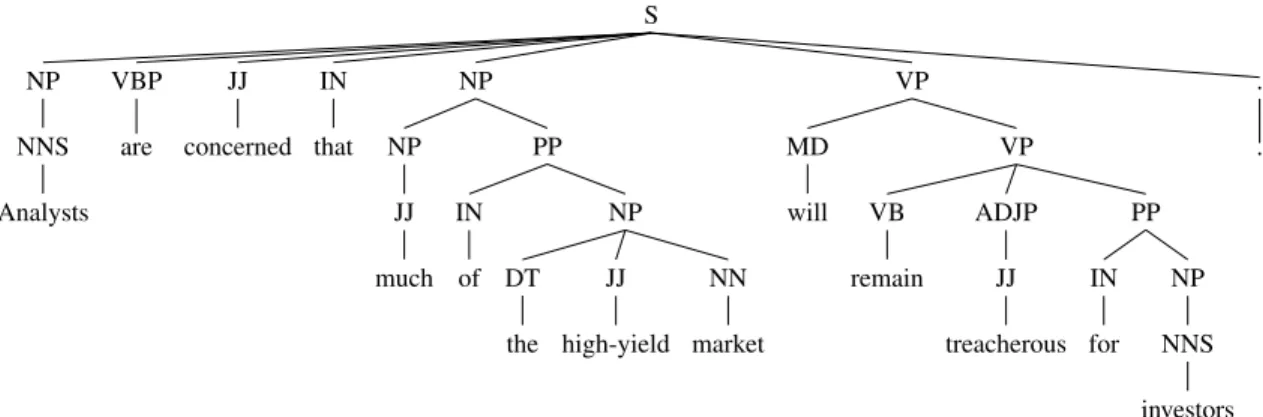
S O . . NP NNS investors PP IN for ADJP JJ treacherous VP VB remain MD will NP NN market JJ high-yield DT the PP IN of NP JJ much SBAR IN that ADJP JJ concerned VP VBP are NP NNS Analysts
Figure 5: Chunking analysis of a sentence.
2.3.2 Partial Parsing
Many NLP applications may not require fully connected, complex parse trees. Partial parsing (or shallow parsing) is used in these situations to render a superficial syntactic analysis of a sentence. For example, consider a systems that deals with tweets and needs to process them in a short amount of time. Such text is problematic for either constituency or dependency parsers; the generated complete parse trees might not match the tweet and most importantly they are costly. While partial parsing is fast and still may give useful nuggets of information by omitting all but the most basic syntactic segments.
In this section, we provide an overview of three existing approaches that partially parse sen-tences: chunking, hedge parsing and vine parsing. Our proposed parse tree fragmentation frame-work is similar to these existing partial parsing methods in the sense that they all tend to break up parse trees to identify recognizable phrases. But the difference is that we break up the trees with regard to grammar mistakes to handle mismatches between the ungrammatical sentences and their syntactic structures. In the remaining of the section, we review the partial parsing methods to demonstrate their differences with our work.
2.3.2.1 Chunking
Chunking is an alternative style of partial parsing. It processes the text to identify and classify the flat non-overlapping segments. These segments correspond to the content-bearing parts of the sentence and typically include noun, verb, adjective and prepositional phrases. The identified con-stituents do not specify their internal structures or relations with other concon-stituents in the sentence.
S . . VP VP PP NP NNS investors IN for ADJP JJ treacherous VB remain MD will NP PP NP NN market JJ high-yield DT the IN of NP JJ much IN that JJ concerned VBP are NP NNS Analysts
Figure 6: Example of Hedge parsing with maximum constituent span of 6.
Figure5shows an example of a chunk parse tree.
2.3.2.2 Hedge Parsing
Hedge parsing (Yarmohammadi et al.,2014) provides local internal hierarchical structure of phrases without requiring fully connected parses. Its goal is to find a less computationally demanding syntactic parser than a full parser but more expressive than a chunker. Hedge parsing discovers constituents of length up to some maximum span, i.e, the constituent nodes that cover more than some words are recursively elided. Then the hedges are sequentially connected to the top most nonterminal in the tree. Figure 6shows an example of hedge parse tree for the full parse tree of Figure3. The hedge parse tree keeps only full hierarchical annotations of structures within a local window and ignores global constituents outside that window. In the example, the constituents that cover less than 6 words are kept.
2.3.2.3 Vine Parsing
Similar pruning approaches have been used in dependency parsing known as vine parsing (Eisner
and Smith, 2005; Dreyer et al., 2006). Vine parsing behaves like hedge parsing and has a set of
constraints on arc lengths that considers only close words as modifiers. The assumption behind these constraints is that a word’s dependents tend to fall near it in the sentence. Eisner and Smith
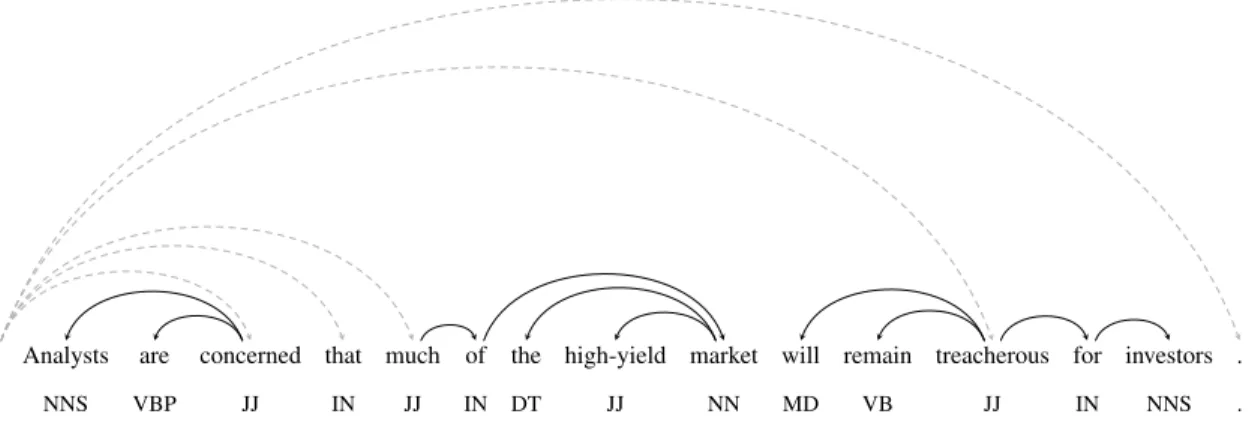
$ Analysts are concerned that much of the high-yield market will remain treacherous for investors .
NNS VBP JJ IN JJ IN DT JJ NN MD VB JJ IN NNS .
Figure 7: Example of Vine parsing retaining only tree dependencies of length less than 6. The root of the resulting parse fragments are now connected only by their dotted arcs “vine dependencies” to $.
which is the string distance between the child and its parent. This set of hard constraints completely ignores long dependencies in the parser. Figure7shows an example of a vine dependency tree for the full parse tree in Figure 4. The vine parser keeps only dependencies of length less than 6; thus five of the dependency relations are broken due to this length constraint. The modifiers of the broken arcs are then connected to the root of the tree.
2.3.3 Parsing Evaluation
A good syntactic parser is expected to produce an accurate parse tree for a sentence. This parse tree is typically used in a downstream NLP application. It is also to be expected that the performance of an NLP system degrades if the generated parse tree is incorrect. Thus, the generated parse trees can be evaluated in two main criteria (Resnik and Lin, 2010): Intrinsicevaluation and Extrinsic
evaluation. Intrinsic evaluation would analyze the accuracy of the produced parse trees as a stand-alone system, whereas extrinsic evaluation would analyze the performance of the parse trees within downstream NLP applications.
2.3.3.1 Intrinsic Evaluation
The intrinsic evaluation of parsers proceeds by comparing the output of a parser against gold standard parse trees provided by human annotators. Depending on the representation of the parse tree whether constituency or dependency, the standard evaluation metrics are defined differently. Constituency parse tree
The most widely used constituency evaluation techniques are called the PARSEVAL measures
(Black et al.,1991). The PARSEVAL evaluates how much the constituents in the generated parse
tree look like the constituents in a gold standard parse tree. The gold standard parse trees are generally drawn from a treebank such as the Penn Treebank.
A constituent in the output of parser is correct if there is a constituent in the gold standard parse with the same span of words and same non-terminal symbol. The labeled precision and recall are then calculated as:
Precision= # of correct constituents in generated parse
Total number of constituents in output generated parse
Recall= # of correct constituents in generated parse
Total number of constituents in gold standard parse Often F-score is reported as the harmonic mean of precision and recall:
F-score= 2× Precision×Recall
Precision+Recall
These metrics are used to evaluate the accuracy of various constituency parsing approaches such as chunking and hedge parsing.
Dependency parse tree
The standard metrics for evaluating dependency parsing are labeled and unlabeled attachment ac-curacy. Given a generated parse tree and a corresponding gold standard tree, labeled and unlabeled attachment accuracy are simply the percentage of correct assignments:
Labeled Attachment Score (LAS)= # of words with correct head and correct dependency label
Unlabeled Attachment Score (UAS)= # of words with correct head (ignoring dependency label)
Total number of words
These metric are used to evaluate the performance of dependency parsing approaches such as vine parsing.
2.3.3.2 Extrinsic Evaluation
It is important to know not only the accuracy of a parser but also the impact of the parser in a real NLP application. This is the goal of the extrinsic evaluation, where the parser is evaluated as an embedded component of an application. It is only with extrinsic evaluation that researchers can tell if a parsing technique is working in the sense of actually improving performance of a system.
On the other hand, while extrinsic evaluation gives a better sense of the impact of parsers, it requires integrating parsers into a complete working application which making it to be much more difficult and time-consuming to implement. Furthermore, an extrinsic evaluation analysis on one application may not generalize to other applications.
The parser’s output is used in several downstream NLP taks, such as machine translation (Quirk
and Corston-Oliver,2006), information extraction (Miyao et al.,2008), and semantic dependencies
(Dridan and Oepen,2011). Just recently, a new shared task of Extrinsic Parser Evaluation (EPE)7
is introduced. This shared task focuses on providing better estimates for different dependency representations on a variety of downstream applications that rely on the syntactic structure of sentences. The downstream applications that EPE supported are: biological event extraction (to recognize bio-molecular events that are mentioned in biomedical literature), fine-grained opinion analysis (to extract MPQA-style (Wiebe et al.,2005) opinion expressions from text), and negation resolution (to find scope of negated cue). In the next section, we discuss the NLP applications that we explore in this thesis to evaluate the fragmentation framework over the ungrammatical sentences.
7
2.4 SYNTACTIC PARSING APPLICATIONS
As we saw in the extrinsic evaluation section (Section 2.3.3.2), there is a wide range of NLP applications that leverage parsing as a component. In this section, we discuss the two applications that we explore in this thesis: 1) sentence-level fluency judgment as the task of predicting how much grammatical a sentence is, and 2) semantic role labeling (SRL) as the task of identifying semantic dependencies between words in a sentence. We choose fluency judgment application because it is the direct application of parsing that deals with ungrammatical sentences; we also choose SRL application because it is one of the basic tasks in semantic analysis and studying the behaviour of SRL systems on ungrammatical sentences could shed some light on this problem.
2.4.1 Sentence-Level Fluency Judgment
An automatic fluency judgment system detects whether a sentence is hard to read. It can be useful in various applications; for example it can be used in grammar checking systems to help both native and L2 speakers to improve their written communication; it can also be used to decide whether an MT output needs to be post-processed by a professional translator.
2.4.1.1 Fluency Judgment Task
Judging fluency of a sentence is a basic task that typically has to be performed before further analyzing the errors in the sentence. Gamon and Leacock(2010) describes fluency judgment as “a baseline task that any error detection and correction system needs to address.” Fluency judgment could be either a binary task, i.e. to decide whether the sentence contains errors, or a finer-grained predication, i.e. to predict the degree of grammaticality of the sentence. Note that we use the terms fluency and grammaticality interchangeably; in some previous work this task is referred as grammaticality judgment (Wagner et al.,2009;Post,2011).
One measure of grammaticality is to directly use the language model perplexities of sentences. However, they are not sufficient because they do not capture long distance dependencies. In addi-tion, since grammaticality is a matter of syntax of a language, syntax-based features can be used to measure it. Therefore, various parse tree features have been incorporated to help grammaticality
judgment task (Post,2011;Post and Bergsma,2013;Mutton et al.,2007).
2.4.1.2 Fleuncy Judgment Related Work
Fluency judgment has been studied vastly in two domains of human generated text and machine generated text. A recent resource in human generated text is introduced in Automated Evaluation of Scientific Writing (AESW)-20168shared task (Daudaravicius et al.,2016). The task is to predict whether a given sentence requires editing to improve it. Thus the task evaluated as a binary clas-sification. The machine generated text is studied more broadly in different NLP applications, such as summarization and machine translation. In the machine translation domain, there is a series of Quality Estimation (QE)9shared tasks organized by the WMT conference (Bojar et al.,2016). The QE task is to estimate the quality of machine translation output on real time given the input sen-tence in the source language. The scores produced by a QE system can be used to decide whether the machine translation output is good enough to be published or it needs further post-editing; the scores can also be used to choose between translations e.g. in translation reranking.
Automatic fluency judgment can be made in various ways. The basic approach is to estimate the grammaticality of a sentence using a language model. The simplest language models, n-grams, have been productive throughout natural language processing applications on both human and machine outputs; for instance, in automatic essay grading or in picking the best translation of a machine translation system. Although n-gram models are long-studies and easy to train, they are insufficient as models of language since they are unable to (easily) capture long distance linguistic phenomena. As a result, they are not able to detect grammatical issues in the sentences.
Since grammaticality judgment is a matter of syntax of a language, another approach for mod-eling grammaticality is to leverage syntactic features. The parse score and context-free grammars (CFGs) are used as features in fluency judgment classifiers and shown improvement upon n-gram baselines (Cherry and Quirk, 2008; Wagner et al., 2009; Wong and Dras, 2010; Heilman et al.,
2014). A further successful approach in grammaticality task is to use Tree Substitution Grammars (TSGs) (Joshi and Schabes,1997) which are generalized form of context-free grammars that allow nonterminals to rewrite as tree fragments of arbitrary size. Post (2011) demonstrated that larger
8http://textmining.lt/aesw/index.html 9
I left my pearls to my daughter in my will . A0
A1
A2
AM-LOC
Figure 8: Example of semantic role labeling.
tree fragments of TSG are more natural units in grammatical sentences; thus they are less likely to fit into ungrammatical sentences. They learned TSGs automatically from a Treebank with a Bayesian model, then used TSG derivations as features for grammaticality classification. We use this model as one of our baselines in Section7.2.
2.4.2 Semantic Role Labeling (SRL)
Semantic role labeling (SRL) is crucial to natural language understanding as it identifies the seman-tic relations in text. These relations provide a more stable semanseman-tic analysis across syntacseman-tically different sentences; as a result, they can be used in a range of NLP tasks such as information extraction and question answering (Shen and Lapata,2007;Maqsud et al.,2014).
2.4.2.1 SRL Task
The goal of semantic role labeling task is to identify the roles of groups of words with respect to a particular verb in a sentence. Recognizing these roles is a key task for answering “what”, “when”, “who”, “why”, etc. questions in all NLP applications in which some kind of semantic interpretations is required, such as information extraction, question answering and summarization. For example, given a sentence“I left my pearls to my daughter in my will.”, the goal is to detect arguments of the verb “left” and produce the semantic dependencies as in Figure8. Here “I” is the leaver, “my pearls” is the thing left, “to my daughter” represents the beneficiary, and “in my will” indicates the location of the action. The semantic roles are commonly divided into core arguments (A0-A5) and additional common classes such as location, time, etc. These roles have different