Spring 2019
Feature-Rich Models and Feature Reduction for Malicious URLs
Feature-Rich Models and Feature Reduction for Malicious URLs
Classification and Prediction
Classification and Prediction
Shivika Garg
Follow this and additional works at: https://lib.dr.iastate.edu/creativecomponents
Part of the Other Computer Engineering Commons
Recommended Citation Recommended Citation
Garg, Shivika, "Feature-Rich Models and Feature Reduction for Malicious URLs Classification and Prediction" (2019). Creative Components. 179.
https://lib.dr.iastate.edu/creativecomponents/179
This Creative Component is brought to you for free and open access by the Iowa State University Capstones, Theses and Dissertations at Iowa State University Digital Repository. It has been accepted for inclusion in Creative Components by an authorized administrator of Iowa State University Digital Repository. For more information, please contact [email protected].
Shivika Garg
A Creative Component submitted to the graduate faculty in partial fulfillment of the requirements for the degree of
MASTER OF SCIENCE
Major: Information Assurance
Program of Study Committee: Guan Yong, Major Professor
Iowa State University Ames, Iowa
2019
DEDICATION
Firstly, I would like to dedicate this creative component to my husband Amulya Gupta who was my constant motivation and without whom I would not have been able to complete this project. Additionally, I would love to extend my gratitude towards my family and friends for their continual guidance and emotional support throughout out my journey. Lastly, I want to highlight a special mention to my nephew Atharv Mittal and niece Sanshi Mittal for their endless affection towards me.
TABLE OF CONTENTS LIST OF TABLES . . . v LIST OF FIGURES . . . vi ACKNOWLEDGEMENTS . . . vii ABSTRACT . . . viii CHAPTER 1. OVERVIEW . . . 1 1.1 Motivation . . . 1 1.2 Problem Definition . . . 3
1.3 Organization of the Manuscript . . . 4
CHAPTER 2. BACKGROUND . . . 5
2.1 Introduction . . . 5
2.2 URL . . . 5
2.2.1 Malicious URL . . . 6
2.3 Decision Tree . . . 6
2.3.1 Gini Impurity (gini) . . . 8
2.3.2 Information Gain (IG) . . . 9
2.4 Random Forest (RF) . . . 11
CHAPTER 3. RELATED WORK . . . 14
CHAPTER 4. PROPOSED WORK . . . 16
4.1 Overview . . . 16
4.2.1 URL-based features . . . 17 4.2.2 HTML-based features . . . 21 4.2.3 JavaScript features . . . 26 4.2.4 Host-based features . . . 29 4.2.5 Certificate-based features . . . 30 4.2.6 Summary of features . . . 31 CHAPTER 5. METHODOLOGY . . . 32 5.1 Feature Extraction . . . 32
5.2 Python Libraries used in Feature Extraction . . . 34
5.2.1 URLparse . . . 34 5.2.2 Beautifulsoup . . . 36 5.2.3 Esprima . . . 36 5.2.4 WHOIS . . . 37 5.2.5 OpenSSL . . . 37 5.3 Data Pre-Processing . . . 38
CHAPTER 6. EXPERIMENTAL EVALUATION . . . 43
6.1 Data . . . 43
6.2 Experiments . . . 43
6.2.1 Improve URL parsing . . . 43
6.2.2 Random Forest . . . 44
6.3 Results Analysis . . . 44
CHAPTER 7. SUMMARY AND FUTURE WORK . . . 46
LIST OF TABLES
Table 4.1 List of URL-based features utilized in this work . . . 20
Table 4.2 List of HTML-based features utilized in this work . . . 25
Table 4.3 List of JavaScript features utilized in this work . . . 28
Table 4.4 List of Host-based features utilized in this work . . . 30
Table 4.5 List of Certificate-based features utilized in this work . . . 31
Table 6.1 Results on test set . . . 44
LIST OF FIGURES
Figure 2.1 Example of Decision Tree . . . 7
Figure 2.2 Example of Forest . . . 11
Figure 4.1 Project Overview . . . 16
Figure 4.2 Example of a URL . . . 17
Figure 4.4 Example of HTML content . . . 21
Figure 4.5 Example of HTML source code for a URL . . . 21
Figure 4.6 Example of a JavaScript code . . . 24
Figure 5.1 Example of raw data collected for a URL . . . 33
Figure 5.2 Example of data after pre-processing for a URL . . . 39
Figure 5.4 Create Age Distribution . . . 40
Figure 5.5 Expiry Age Distribution . . . 40
Figure 5.7 Update Age Distribution . . . 41
I would like to take this opportunity to express my obligation towards those who helped me with various aspects of current creative component. First and foremost, Dr. Guan Yong for his guidance, patience and support throughout this project. His insights and words of encouragement have often inspired me and renewed my hopes for completing my graduate education. I would also like to thank my friends, colleagues and the department faculty staff for providing me a wonderful and meaningful time at Iowa State University. Finally, I acknowledge the role of my family for their encouragement and support.
ABSTRACT
Malicious web site is a foundation of criminal activities on Internet. This links enables partial or full machine control to the attackers. This results in victim systems, which get easily infected allowing attackers to utilize systems for quite a number of cyber-crimes such as stealing credentials, spamming, phishing, denial-of-service and many extra such attacks. Therefore, the methodology and technique to detect such crimes should be fast and precise with the additional capability to detect new malicious websites or content. This paper in-troduces an automatic tool to extract 110 significant features for a URL. Additionally, this paper also propose various aspects associated with the URL (Uniform Resource Locator) classification process which recognizes whether the target website is a malicious or benign. Standard datasets are utilized for training purpose from diverse sources. The rising issue related to spamming, phishing and malware, has created a requirement for solid framework solution which can analyze the extracted features, classify and further recognize the mali-cious URL.
CHAPTER 1. OVERVIEW
In this project, we present a new feature based tool with the capability of extracting, ranking and detecting malicious URLs. In our prototype, we have integrated the tool with the widely used Random Forest algorithm for the purpose of classification. This algorithm will help to predict the URLs as Malicious or Benign. During the last few months, we have used this system to extract 110 features from a single URL, based on different categories such as Lexical, Host-based, JavaScript-based etc. This automatic tool aims to fulfill the following purposes: Firstly, it will extract relevant features from URL based on five different categories. Secondly, the extracted features are ranked and reduced according to their importance. Finally, the whole data is injected to the very famous Random Forest classifier to predict the nature of URL.
1.1 Motivation
Cyber-attacks hit businesses every day. According to the Cisco Annual Cyber-security Report (1), the total volume of events has increased almost fourfold between January 2016 and October 2017. A Malicious URL or a malicious web site hosts a variety of spontaneous content within the shape of spam, phishing, or drive-by-exploits in order to dispatch attacks. Unsuspecting users visit such web destinations and end up in casualties of various types of scams, including financial misfortune, burglary of private information (character, credit-cards, etc.), and malware establishment.
Almost all cyber threats commence on the internet. Attackers on the web put up hyperlinks to malicious content that will harm their victims in one way or another. They
may also choose customers to download their malware, phish their credentials, steal sessions, or do some thing less damaging like accumulate their contact records which could be bought to spammers. Spammers may additionally just choose ad revenue, but they should very well carry out comparable attacks through sending customers different malicious URL.
Symantec has recently recognized thousands of websites that have been compromised with malicious code, which is used to divert clients to a compromised site. Of the com-promised websites, 75 percent were found within the U.S. An injection attack depends on injecting data into an online site in arrange to execute malicious code. It is then activated when a client browses to the compromised website. These malicious websites can be of any type and target a variety of organizations, including the business websites, .edu websites or the government websites. Therefore, once the compromised page content has loaded in the in the users browser, the script waits 10 seconds and then runs code, which in turn runs additional scripts.
Malicious URLs may want to be delivered in a variety of ways. Online social networks are common method. Websites like Twitter and Facebook permit customers to put up comments which include hyperlinks which can without difficulty be clicked on by using every person who sees it. Other websites like YouTube and Instagram are a bit smarter about this. On YouTube links will only exhibit up in remarks that are approved by means of the owner of the video on which the comment used to be posted. On Instagram, neither posts or feedback can encompass links, they only permit them on profile pages. While it is annoying for users who just want to link to a YouTube video, it prevents users from clicking malevolent links.
Using machine learning to detect malicious web pages is objectively a better solution. If a URL is not contained in a blacklist, then a machine learning model can analyze it and classify it as either malicious or benign. However, creating a machine learning model for performing this classification is much more difficult than simply maintaining a blacklist. The machine learning model needs to see thousands, if not millions, of examples and researchers
This project intends to create a feature-rich automatic tool (or model) to extract and rank various important features for a URL which can finally be used to classify it as Benign or Malicious. Specifically, we created an automatic tool which, firstly, examines each URL and extract 110 features for each URL from the following categories.
1. URL-based or Lexical features : Lexical features are features obtained based on the properties of the URL name (or the URL string). Main motivation to employ these features is that Malign URLs try to imitate Benign URLs. This presents a need to analyze statistical properties of a URL.
2. HTML-based features: This category of features is based on the actual content of webpage related to URL. These are relatively easy to extract, however, are very time consuming to analyze.
3. JavaScript-based feature: Research has shown that< script >tags on webpage source code are the most vulnerable places to inject malware. Therefore, it is crucial to identify a subset of prominent JavaScript functions that are often utilized in cross-site scripting and web-based malware distribution. These include: escape(), eval(), link(), unescape(), exec(), and search() functions.
4. Host-based features : These features are obtained from the URLs’ host-name proper-ties. Specifically, they enable us to know the location of malicious hosts, identity of malicious hosts, and hosts’ management style and properties.
5. Certificate-based features: When a URL is registered, a digital certificate is issued by a Certificate Authority (CA) for that URL. Therefore, these features are used to verify and validate the presence of certificate at server side to ensure the safe connection.
After extracting the data, the tool performs required data pre-processing steps to (1) clean the extracted data; (2) reduce number of features to 95. Finally, we utilize a famous classification algorithm, Random Forest, to rank features according to their importance. As a by-product we get the classification of URLs into malicious and benign.
1.3 Organization of the Manuscript
The rest of this article is organized in the following way. We describe the background of malicious URL and random forest algorithm in Chapter 2 to provide an in-depth un-derstanding and description. Chapter 3 provides the related and relevant research done in this area. Chapter 4 presents our proposed model with detailed description of all fea-tures which are utilized in the tool. Chapter 5 describes the holistic methodology used in this project with brief about the python parser used in the feature-extractor tool. Chap-ter 6 describes several experiments and corresponding analysis regarding the investigative approaches. Finally, we conclude the report and suggest future directions in Chapter 7.
CHAPTER 2. BACKGROUND
2.1 Introduction
Many users unwittingly click malicious domains every day and every hour. The attackers are targeting both the users and the companies. According to the 3rd Microsoft Computing Safer Index Report, released in February 2014, the annual worldwide impact of phishing could be very high as $5 billion. The author tested 10 security toolbars, and found that most (12) security toolbars do not work as expected, only identifying 50 percent of malicious websites in that study.
Malicious websites play a critical role in today’s attacks and scams in the multitude of cyber threats out there. You can deliver malicious URLs to users via email, text message, pop - ups, or shady advertisements.Malware, spyware, ransomware, compromised accounts, and all the headaches these threats entail can often download the end result. Knowing what a malicious URL is, and how it can do damage, should be evident, is key to your email security.
2.2 URL
URL is the shortened form of Uniform Resource Locator, which is the also known as web address of machine and other resources on the World Wide Web. As shown in Figure 4.2, URL has two fundamental components: (1) convention identifier, it shows what convention to utilize, (2) resource title, it indicates the IP address or the space name or the path where the asset is found. The convention identifier (also known as scheme name) and the resource title are isolated by a colon and two forward slashes. Compromised URLs that are utilized
for cyber attacks are termed as malicious URLs while others are known as Benign URLs. In reality, it was noted that near to one-third of all websites are possibly malicious in nature, demonstrating uncontrolled utilize of malicious URLs to perpetrate cyber-crimes.
2.2.1 Malicious URL
Malicious URLs are a large part of most of today’s cyber-security threats. In fact, nearly one - third of all websites are potentially malicious in nature(11), demonstrating the widespread use of malicious URLs to commit cyber-crimes. They are a tool used by cyber criminals to: i. start phishing campaigns aimed at stealing your personal information, ii. getting you to install malware, viruses or trojans, whether by downloading a file (without knowing it’s malicious) or as simple as drive-by-download prompted by something as simple as a mouse-over iii. start a spam campaign that may involve phishing, malicious advertising, scams or other cyber - assisted fraud.
Malicious URLs host unsolicited content (spam, phishing, drive - by exploits, etc.) and lure unsuspecting users to fall victim to scams (monetary loss, theft of private information, and installation of malware) and cause annual losses of billions of dollars.
2.3 Decision Tree
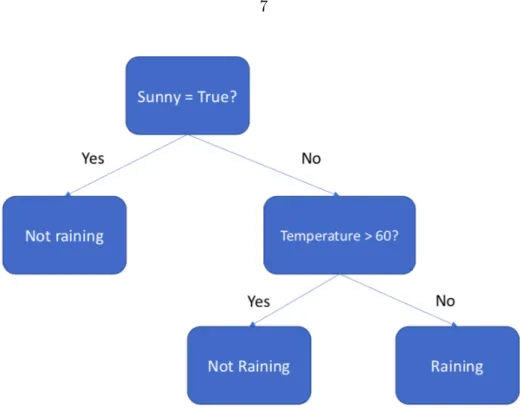
Decision tree is a core component of Random Forest model which aligns with natural intuition. Specifically, humans ask a sequence of questions for available data to arrive at a conclusion. Similarly, decision tree operates by considering binary question (yes/no) at every node to make a prediction.
Decision tree is also referred as Classification and Regression Tree (CART) algorithm where a model is a binary tree where nodes represent split points. Specifically, every root node represents an input variable (assuming the variable is numeric) and a decision on that variable. Furthermore, the leaf nodes of the tree represents the dependent variable (y) which is used to make a prediction. For instance, let’s consider a dataset where two inputs:
Figure 2.1: Example of Decision Tree
Sunny (Binary) and Temperature (Numeric) are provided for an output of Raining or Not Raining. Figure2.1represents alearned tree based on the whole dataset. After receiving a new datapoint, it traverses through the whole tree and a prediction is made. Specifically, if a new data-point has: Sunny = False and Temperature < 60 degree Fahrenheit, then node: Sunny = T rue? outputs a No. Next, the node: T emperature ≥ 60? is visited which finally makes the prediction ofRaining. Intuitively, a learned binary tree is making partitions of the input space. We can imagine each input variable as a single dimension on a n-dimensional space. The decision tree splits this space into rectangles, when n=2 input variables, or more hyper-rectangles, whenn >2 input variables.
At this point a legitimate question to consider is: How to build a decision tree? As mentioned earlier, each root node is a split point in the tree. At every node, the model attempts to detect single input feature which leads to greatest reduction in Gini impurity or largest increase inInformation Gain. Intuitively, this means that decision tree attempts to form nodes which cleanly segregate a large proportion of data points by searching for
values in features. Furthermore, each node contains 5 components after the tree is learnt. 1. question: A feature value based question. The question evaluates to either Yes or No
which splits the node. A data point moves down the tree based on the answer. 2. gini or IG: Represents the value of metric used at the node during training time. If
Gini Impurity (gini) is utilized then it is decreased whereas Information Gain (IG) is maximized at every node. Therefore, average gini decreases and mean IG increases while moving down the tree.
3. samples: Represents number of observations contained in the node. 4. value: Represents number of samples in each class.
5. class: Represents majority label in classification for instances in the node. For leaf nodes, this suggests the prediction for all samples in the node.
2.3.1 Gini Impurity (gini)
As mentioned previously, Gini impurity is one of the metrics used to split the nodes in a decision tree. Specifically,gini measures probability of labelling a randomly chosen element from node if it was labeled by the distribution of samples in the node. Formally,
IG(n) = 1− J X i=1 (pi)2 (2.1) where:
1. J represents the number of classes. In binary classification the value is 2. For example, at the root node in 2.1, let’s assume the following 5 components:
• question: Sunny = True?
• gini: 0.444
Gini value is calculated as below. IG(root) = 1−(( 2 6) 2+ (4 6) 2) = 0.444 (2.2)
Using the above criteria, decision tree finds a feature which results in the greatest decrease in Gini impurity on splitting. The algorithm then recursively repeats the above process until it reaches a maximum depth or leaf nodes contains samples from one class. At subsequent levels of the tree, the total weighted Gini Impurity is calculated. Specifically,
IsecondLayer = slef t sparent ∗Ilef tN ode+ sright sparent ∗IrightN ode (2.3) where:
• slef t: Represents number of samples in the parent node for left node
• sright: Represents number of samples in the parent node for right node
• sparent: Represents number of samples in the parent node
2.3.2 Information Gain (IG)
Another measure that can be used in Decision Tree is Information Gain (IG). Infor-mation Gain utilizes entropy and inforInfor-mation content from inforInfor-mation theory. Formally, entropy can be defined as below.
H(T) =− J X 1 pilog2pi (2.4) where:
1. H(T) represents the entropy 2. J represents number of classes
3. pi represents the percentage of each class in the child node resulting from split at parent node
Hence, Information Gain is calculated as follow.
IG(T, a) =H(T)−H(T|a) (2.5)
where:
1. H(T) represents entropy at parent node
2. H(T|a) represents the weighted sum of entropy of children
Intuitively, IG is used to find a feature to split on at each step while building the tree. Additionally, the depth of the tree is required to be as small as possible. To achieve both the conditions, the algorithm attempts to choose a split which results in maximum information gain. For each node of the tree, the information value represents the expected amount of information that would be needed to specify whether a new instance should be classified yes or no, given that the example reached that node.
Despite of all the above advantages, Decision Tree algorithm has some limitations. 1. Not-Robust: They are perfect classifiers in only training data. If there is a small
change in training data, then it can result in large changes in tree. Consequently, final predictions will be completely different. Hence, Decision Trees are not robust. 2. NP-Complete: It is very hard to find an optimal Decision Tree. Practically, Decision
Tree is implemented by heuristics such as in greedy search algorithm where local optimal decision are made.
3. Over-fitting: Decision Tree algorithm can result in very complex trees which do not generalize from training data. If we do not limit the maximum depth of the tree, it can result in a very flexible Decision Tree model. Specifically, the model will completely learn the training data. Not only training data, but the model will also learn any
2.4 Random Forest (RF) Sunny = True? Not raining Temperature > 60? Raining Not Raining Yes No No Yes Temperature > 60? Not
raining Sunny = True?
Raining Not Raining Yes No No Yes
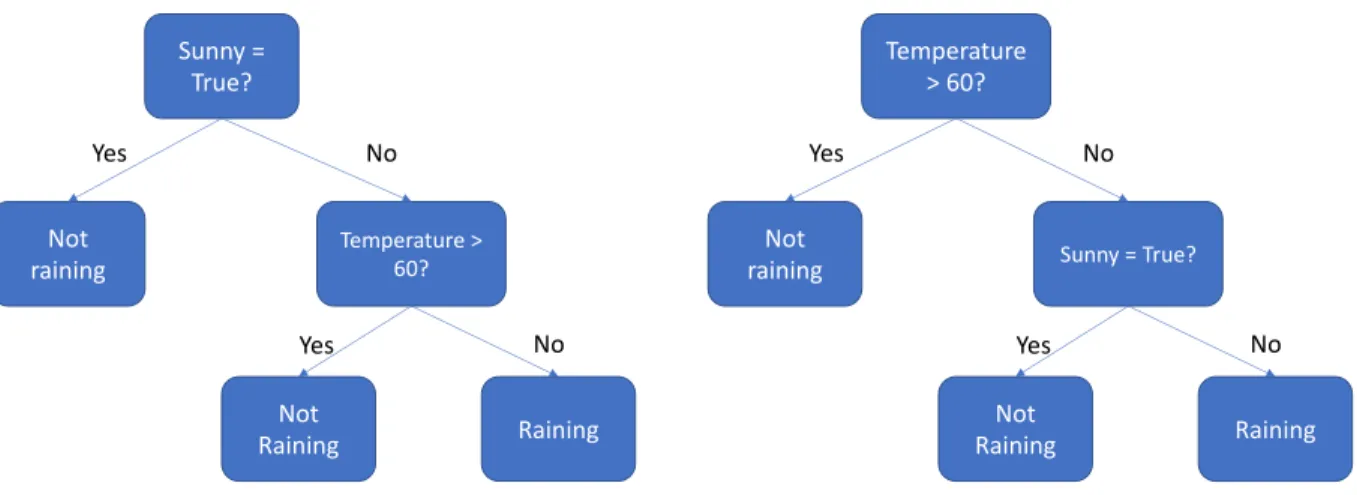
Figure 2.2: Example of Forest
To mitigate limitations of a single Decision Tree, multiple (Figure 2.2) Decision Trees are utilized as Forest. (7) introduced Random forests as an ensembled machine learning method for classification and regression. The algorithm is dependent on the predictions of many decision trees rather than guess of a single tree. As mentioned in section 2.3, there is not an optimal tree, it is possible that another tree could be built for the same dataset. For example, in Figure 2.2, we can see two distinct individual trees can predict whether it is Raining or not for the same set of two features. For final predictions, the algorithm outputs a label which is the mode of the classes in classification whereas for regression it
predicts themeanof the predicted scores. Later, (3) extended RF by incorporating his idea of bagging in the algorithm. Moreover, authors included following key features which are now basis of modified RF algorithm.
1. Evaluating variable significance by utilizing permutation 2. Estimating generalization error by employing out-of-bag error
Specifically, for each tree during training, random samples of data points are drawn with replacement. This is called bootstrapping and tree learns from the random samples. It is possible that same sample is used multiple times within a single tree. Basically, each tree can have high variance individually, however, an entire forest will have a lower variance without increased bias.
Furthermore, final predictions are made by taking mean of the predictions (regression) or by taking majority classified labels (classification) of all decision trees in the forest which is called bagging.
In order to understand why random forest supersedes decision tree, we consider a real world scenario: A company needs to launch a new product and has access to multiple market analysts. Now, company’s objective is to decide on the success of new product. These analysts have very low bias because they don’t know about the actual product and their opinions will be completely based on the provided data.
Above scenario seems an ideal situation, however, the issue is that each analyst will add noise in addition to his/her opinion. Every analyst has an opinion which is completely based on the data and has high flexibility in their opinions. If the training reports will change for analysts, their predictions will differ from their previous opinions. Consequently, each analyst has high variance individually and training model is not general enough to accommodate a new data point.
A simple solution is to consider votes of all the analysts rather than sticking to single opinion. Additionally, similar to random forest, provide each analyst random sample of reports as an input in the hope to negate the effects of noisy information.
considered for splitting.
Lastly, random forest provides the importance of features as a by-product. Importance of features can be utilized as a measure to reduce dimensionality of feature space. In this work, we narrow down to 95 features after employing data pre-processing techniques. However, 95 features are still a lot. Therefore, to reduce number of features and considering above mentioned favorable properties, we select Random Forest as our classification algorithm
CHAPTER 3. RELATED WORK
According to the 2019 Webroot Threat Report, 40 percent of malicious URLs were found on good domains. Legitimate websites are frequently compromised to host malicious content. To protect users, cyber-security solutions need URL-level visibility or, when un-available, domain-level metrics, that accurately represent the dangers. The blacklist method is the most common method used by several antivirus groups to detect malicious URLs. Black lists are basically a URL database that was confirmed to be malicious in the past. Due to a simple query overhead, such a technique is extremely fast and therefore very easy to implement. However, maintaining an exhaustive list of malicious URLs is almost impossible, especially as new URLs are generated daily. Attackers use creative techniques to evade blacklists and fool users by modifying the URL through obfuscation to ”appear” legitimate. (6) identified four types of obfuscation: Obfuscating an IP host, Obfuscating a host with a different domain, Obfuscating a host with large host names, and misspelling.
The most commonly used lexical features include statistical properties of the URL , like the length of the URL, length of Top Level Domain, the number of special characters, etc. were one of the first to suggest extracting words from the URL string. (12) also used similar lexical features, but the tokens belonging to the hostname, the path, the top - level domain and the primary domain name were distinguished. (13) studied the impact of a few host-based features on the maliciousness of URLs. (12) borrowed ideas from (13) and proposed to use several host - based features including: IP Address, WHOIS, Location, Domain Name Properties, and Connection Speed. IP address features may be more stable as new IP addresses for malicious URLs are difficult to obtain continuously. They serve
a line, number of NULL characters, use of string concatenation, unsymmetric HTML tags, link to remote script source, and invisible objects. Recently,(20) applied profound learning techniques to learn from JavaScript code feature representations.
URL shortening has recently become a new and widespread obfuscation technique (hid-ing the malicious URL behind a short URL) with the grow(hid-ing popularity of URL shorten(hid-ing services (5; 15). Furthermore, attackers can often launch more than one attack simulta-neously, which changes the attack signature, making it undetectable by tools focusing on specific signatures. Blacklisting methods therefore have severe limitations, and bypassing them seems almost trivial, especially as blacklists are useless to make predictions on new URLs. To overcome these issues, in the last decade, researchers have applied machine learning techniques for Malicious URL Detection (16; 2; 17; 9; 14; 10).
Machine learning approaches, use a set of URLs as training data, and learn to classify a URL as malicious or benign based on statistical properties. This allows them to generalize new URLs unlike methods for blacklisting. The presence of training data is the primary requirement for the training of a machine learning model. This would correspond to a set of large numbers of URLs in the context of malicious detection of URLs. Machine learning can be broadly classified as supervised, unsupervised, and semi-supervised, corresponding to having the training data labels, not having the labels, and labels for a limited fraction of training data. Labels match the knowledge that a URL is malicious or benign.
CHAPTER 4. PROPOSED WORK
4.1 Overview
The aim of this project is to simplify the feature extraction method for classification and prediction of malicious URLs. Figure 4.1, provides the overall view of this project. When a URL is appended into this model, the first step is to read the URL and parse through it. Once the URL is parsed, next step is to extract relevant features from the URLs. Therefore, to simplify and extract as many features as possible, we have created a Feature-Extractor Tool. This tool helps to extract 110 features from a single URL. Features are retrieved from different categories like URL-based, HTML-based etc. which are further discussed in next section of this chapter. In this tool, we have used Python in-built libraries to parse and extract features. These libraries are further explained in detailed in Chapter 5.
missing values and then calculate the percentage of missing values, convert the string data into categorical data and finally perform normalization. Once pre-processing has been performed on this raw data, then Random Forest algorithm is used to rank the features according to importance (see Chapter 2).
4.2 Features Definitions and Types 4.2.1 URL-based features
Figure 4.2: Example of a URL
Every URL exhibits certain string based properties which lexical features can capture. The main motivation of utilizing URL-based features comes from the fact that a malicious URL can have a resembling name when compared to a benign URL. Since a textual name cannot be directly utilized in models, lexical features focus on extracting the statistical prop-erties such as length, number of sub-domains and many more from a URL. (6) categorizes URL-based features as below:
1. URL-related features such as length of URL and number of dots(.) in the URL, 2. Domain features like number of domain tokens and average length of domain token, 3. Directory related features such as average length of path token,
4. File name features such as length of filename, and 5. Argument Features like number of query parameters.
Apart from above five categories, (4) and (19) introduced important binary URL-based features such as whether IP and port number are present in URL or not. Moreover, the authors suggest to count the number of redirects from the given initial URL to final desti-nation URL. Since malicious URL tends to have a long chain of connected URLs, counting number of re-directions may serve as an important feature for classification. Motivated by earlier works, we extracted the following URL-based features.
• url len: Counts the number of characters in the URL after removing protocol
• url numbr hyphens dom: Counts number of hyphens(-) in domain
• url numbr dom tokens: Counts number of domain tokens
• url path length: Counts number of characters in path of URL
• url f ilename length: Counts number of characters in filename of URL
• url longest domain token len: Counts number of characters in longest token of do-main
• url average domain token len:Provides average number of characters in any token of domain
• url longest path token len: Counts number of characters in longest token of path
• url average path token len: Provides average number of characters in any token of path
• url tld: Provides Top Level Domain of URL
• url hostname len: Counts number of characters in the hostname
• url numbr dots: Counts number of dots(.) in the URL
• url numbr underscores: Counts number of underscores( ) in the URL
• url numbr equals: Counts number of equals(=) in the URL
• url numbr slashes: Counts number of slashes in the URL
• query len: Counts number of characters in the query
• numbr query para: Counts number of parameters in the query
• ip present: Provides 1 or 0 based on whether IP is present in URL or not
• port present: Provides 1 or 0 based on whether port is present in URL or not
• absolute: Provides 1 or 0 based on whether URL is absolute or not
• subdomain present: Provides 1 or 0 based on whether sub-domain is present in URL or not
• url suspicious word: Provides 1 or 0 based on whether there is any suspicious word in the URL
• url suspicious tld: Provides 1 or 0 based on whether there is any suspicious word in the Top Level Domain of URL
• url count redirect: Counts number of re-directs for a URL
• url domain contains word server client: Provides whether 1 or 0 based on whether domain contains words ’server’ or ’client’.
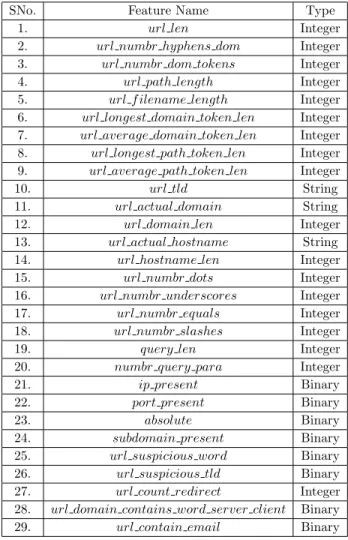
Table 4.1: List of URL-based features utilized in this work
SNo. Feature Name Type
1. url len Integer
2. url numbr hyphens dom Integer 3. url numbr dom tokens Integer
4. url path length Integer
5. url f ilename length Integer 6. url longest domain token len Integer 7. url average domain token len Integer 8. url longest path token len Integer 9. url average path token len Integer
10. url tld String
11. url actual domain String
12. url domain len Integer
13. url actual hostname String
14. url hostname len Integer
15. url numbr dots Integer
16. url numbr underscores Integer
17. url numbr equals Integer
18. url numbr slashes Integer
19. query len Integer
20. numbr query para Integer
21. ip present Binary
22. port present Binary
23. absolute Binary
24. subdomain present Binary
25. url suspicious word Binary
26. url suspicious tld Binary
27. url count redirect Integer
28. url domain contains word server client Binary
29. url contain email Binary
• url contain email: Provides whether 1 or 0 based on whether web-page of URL contains valid email or not
In Table 4.1, we present a comprehensive list of above features with their datatypes. Utilizing URL-based features in isolation within the model provides a weaker performance. Therefore, other relevant features (described in subsequent sections) have been exploited to classify a URL as malicious or not.
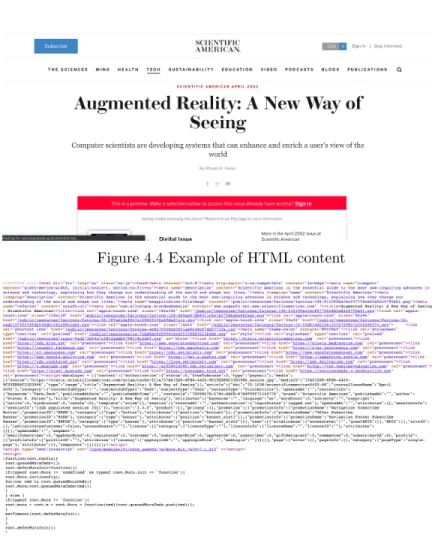
Figure 4.4 Example of HTML content
Figure 4.5 Example of HTML source code for a URL
4.2.2 HTML-based features
(18) described HTML features as ”heavy weight” because these features depend on the actual web-page content. It can be seen from Figure 4.5, a lot of information can be extracted from the website which can augment models’ accuracy in distinguishing malicious URLs from benign ones. The idea is to capture the URLs which bypass the lexical features. Since most of the website content is textual, lexical and statistical properties of a page such as length of document, number of unique words, average length of any word, number of each of the special characters(.,-, ,=,#,@,$) etc. are utilized.
be extracted from a web-page. 1. Number of iFrames, 2. Number of small elements, 3. Number of Javascript elements,
4. Number of scripts having wrong extensions, 5. Number of double documents and many more.
We foundNumber of small elements to be a unique HTML feature. A legitimate question to consider is: How to decide that an HTML element is small or not? In this work, we focused on the following elements: div,iframe,object whose area was considered as size for this feature. We extracted the height and width of these elements to calculate the area. Finally, we employed a conditional rule to count the number of small elements in a website page.
Another exclusive HTML feature, we consider is: webtraffic. Alexa1tracks the incoming traffic on website in terms of number of visitors. For each URL, we made a request to Alexa and retrieved the corresponding rank of the website. Finally, we utilized the fetched rank to convert this numerical feature into a categorical one by employing a conditional rule. In summary, we utilize the following HTML-based features.
• html numbr if rame: Counts number of iFrame tags
• html numbr small elements: Counts number of small area elements
• html nmbr scripts elements: Counts number of script tags
• html nmbr wrong extensions: Counts number of script tags having incorrect file extension
• html script len: Counts number of characters in script 1
• htmlnmbrembedandobject: Counts number of object and embed tags
• html nmbr ext domain: Counts number of elements whose source is on external do-main
• html nmbr included elements: Counts number of included tags
• html nmbr double documents: Counts number of double documents
• html nmbrcharacters: Counts number of characters in body of HTML
• html link in script: Counts number of links in the script
• html link in link: Counts number of links in the HTML document
• html web traf f: Provides 1 or 0 based on whether number of visitors are more than 100,000
• html document len: Counts number of total words in the document
• html nmbr uniuqe words: Counts number of unique words in the document
• html numbr lines: Counts number of unique lines in the document
• html average word len: Provides average number of characters in any word
• html content suspicious word: Provides 1 or 0 whether body of HTML contains suspicious words
• html content numbr dots: Counts number of dots(.) in the body of HTML
Figure 4.6: Example of a JavaScript code
• html content nmbr underscores: Counts number of underscores( ) in the body of HTML
• html content nmbr equal: Counts number of equals(=) in the URL
• html content nmbr slashes: Counts number of slashes in the body of HTML
• html content nmbr hashes: Counts number of hashes(#) in the body of HTML
• html content nmbr at: Counts number of at(@) in the body of HTML
• html content nmbr dollar: Counts number of dollar sign($) in the body of HTML
• html srvr f ile handler: Provides Server File Handler
• html ste: Provides 1 or 0 based on submitting to email
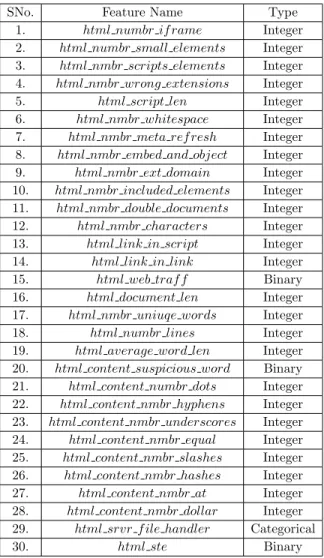
Table4.2provides all HTML-based features with their datatypes that have been used in this work. An important thing to note is that if we do not receive a web-page content due to failure of getting a response in time or unable to extract any feature, then the default value is -1.
Table 4.2: List of HTML-based features utilized in this work
SNo. Feature Name Type 1. html numbr if rame Integer 2. html numbr small elements Integer 3. html nmbr scripts elements Integer 4. html nmbr wrong extensions Integer
5. html script len Integer
6. html nmbr whitespace Integer 7. html nmbr meta ref resh Integer 8. html nmbr embed and object Integer 9. html nmbr ext domain Integer 10. html nmbr included elements Integer 11. html nmbr double documents Integer 12. html nmbr characters Integer 13. html link in script Integer 14. html link in link Integer
15. html web traf f Binary
16. html document len Integer 17. html nmbr uniuqe words Integer 18. html numbr lines Integer 19. html average word len Integer 20. html content suspicious word Binary 21. html content numbr dots Integer 22. html content nmbr hyphens Integer 23. html content nmbr underscores Integer 24. html content nmbr equal Integer 25. html content nmbr slashes Integer 26. html content nmbr hashes Integer 27. html content nmbr at Integer 28. html content nmbr dollar Integer 29. html srvr f ile handler Categorical
4.2.3 JavaScript features
According to (4), JavaScript (JS) features can be extracted either from JS files(.js) (mentioned as content type oftext/javascript, example can be seen in Figure4.6) or from the actual script embedded inside< script >tag in the HTML code of any website. Researchers claim that JS code is a rich source of malware activity where hackers try to exploit functions such as eval(), escape(), unescape() etc. . Similar to HTML features, JS features can be categorized as: lexical and statistical. We extract 28 JavaScript features in total as provided below.
• js count eval: Counts number of eval() functions
• js count setT imeout: Counts number of setTimeout() functions
• js count unescape: Counts number of unescape() functions
• js count escape: Counts number of escape() functions
• js count parseInt: Counts number of parseInt() functions
• js count f romCharCode: Counts number of fromCharCode() functions
• js count ActiveXObject: Counts number of ActiveXObject() functions
• js count concat: Counts number of concat() functions
• js count indexOf: Counts number of indexOf() functions
• js count substring: Counts number of substring() functions
• js count replace: Counts number of replace() functions
• js count documentaddEventListener: Counts number of documentaddEventListener() functions
• js count documentwrite: Counts number of documentwrite() functions
• js document len: Counts number of characters in the script
• js nmbr unique words: Counts number of unique words in the script
• js numbr lines: Counts number of lines in the script
• js average word len: Provides average word length in the script
• js numbr dots: Counts number of dots(.) in the script
• js nmbr hyphens: Counts number of hyphens (-) in the script
• js nmbr underscores: Counts number of underscores( ) in the script
• js nmbr equal: Counts number of equals(=) in the script
• js nmbr slashes: Counts number of slashes in the script
• js nmbr hashes: Counts number of hashes(#) in the script
• js nmbr at: Counts number of at(@) in the script
• js nmbr dollar: Counts number of dollar sign($) in the script
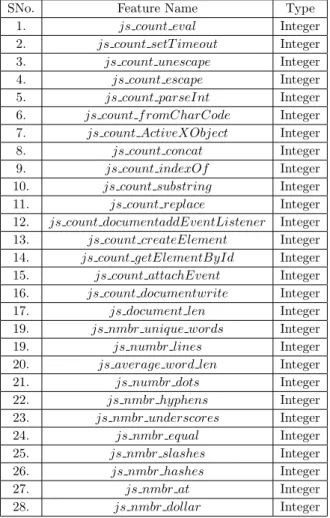
From Table 4.3, it can be inferred that all the features are numerical type, however, while extracting the data if the ping request fails or we are unable to fetch any feature then default value is -1.
Table 4.3: List of JavaScript features utilized in this work
SNo. Feature Name Type
1. js count eval Integer
2. js count setT imeout Integer
3. js count unescape Integer
4. js count escape Integer
5. js count parseInt Integer
6. js count f romCharCode Integer 7. js count ActiveXObject Integer
8. js count concat Integer
9. js count indexOf Integer
10. js count substring Integer
11. js count replace Integer
12. js count documentaddEventListener Integer 13. js count createElement Integer 14. js count getElementById Integer 15. js count attachEvent Integer 16. js count documentwrite Integer
17. js document len Integer
19. js nmbr unique words Integer
19. js numbr lines Integer
20. js average word len Integer
21. js numbr dots Integer
22. js nmbr hyphens Integer 23. js nmbr underscores Integer 24. js nmbr equal Integer 25. js nmbr slashes Integer 26. js nmbr hashes Integer 27. js nmbr at Integer 28. js nmbr dollar Integer
domain or we are unable to extract a feature, then we set the default value as -1. In this work, we extract the Host-based features using the WHOIS information of the domain. Specifically, we utilize geographical, creation, expiration, updation date and many more as features for the classification purpose. In total, we fetch 15 Host-based features as listed below.
• host age create mon: Counts number of months since domain was created
• host age exp mon: Counts number of months since domain was expired
• host age update days: Counts number of days since domain was last updated
• update date: Provides 1 or 0 based on whether update date of domain is available.
• create date: Provides 1 or 0 based on whether create date of domain is available.
• expiry date: Provides 1 or 0 whether expiry date of domain is available
• zipcode: Provides 1 or 0 whether zipcode of domain is available
• status: Returns status of domain
• org name: Provides 1 or 0 based on whether organization name for domain is available
• dnssec: Returns dnssec of domain
• city: Provides 1 or 0 based on whether city for domain is available
• state: Provides 1 or 0 based on whether state for domain is available
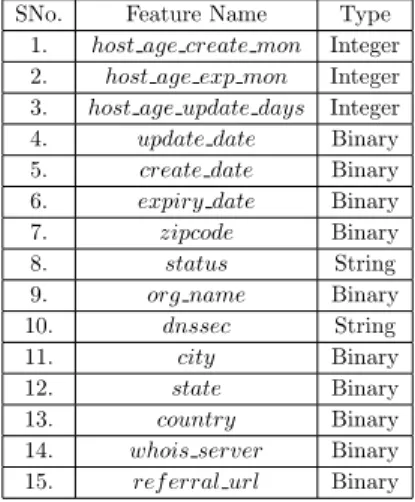
Table 4.4: List of Host-based features utilized in this work
SNo. Feature Name Type 1. host age create mon Integer 2. host age exp mon Integer 3. host age update days Integer 4. update date Binary 5. create date Binary 6. expiry date Binary
7. zipcode Binary
8. status String
9. org name Binary
10. dnssec String
11. city Binary
12. state Binary
13. country Binary
14. whois server Binary 15. ref erral url Binary
• whois server: Provides 1 or 0 based on whether whoisserver information for domain is available
• ref erral url: Provides 1 or 0 based on whether referral url information for domain
In Table4.4, we present a comprehensive list of all Host-based features with their data-types.
4.2.5 Certificate-based features
When a URL is registered, a digital certificate is issued by a certificate authority (CA). These trusted certificates can be used to establish a secure connection which validate and verify any website. In addition to above mentioned features, we extract the certificate based features which we provides certificate related information attached to a URL. Specifically, we fetch 5 certificate-based features as listed below.
• common name: The registered name of the Certificate
• SAN: (Subject Alternative Name) This Field helps to specify additional sites, IP addresses to be protected by a single certificate
3. issuer String 4. cert not valid bef ore Binary 5. cert not valid af ter Binary
• cert not valid bef ore: Certificate issued date
• cert not valid af ter: Certificate expiry date
In Table 4.5, we present a comprehensive list of all certificate-based features with their data-types.
4.2.6 Summary of features
As can be inferred from tables 4.1,4.2,4.3 and 4.4, we extract a total of 104 features. Additionally, it is possible that more features for a URL can be fetched, however, it will be more resource intensive.
After crawling and processing all the categories of features, we realize that lexical based features are comparatively easier to obtain since they are based on the short string and simple manipulation of a URL. On the other hand, HTML-based and JavaScript features are content rich. Although, straightforward techniques of string manipulation are applied, however, volume of content increases the extraction time of these features. Lastly, Host-based features are the most time consuming to gather.
CHAPTER 5. METHODOLOGY
5.1 Feature Extraction
Rather than creating a labeled dataset from scratch, we utilized a pre-labeled dataset. 1 According to the provider, two sources: Dmoz Open Directory 2 and Phishtank3 are used to fetch benign and malicious URLs, respectively. In total, the dataset contains 7504 URLs labeled as malicious (class=1,≈53%) or not-malicious (class=0,≈ 47%).
For each URL, we extracted all the features listed in Tables 4.1, 4.2, 4.3 , 4.4 and
4.5using our customized FeatureExtractor script. Specifically, we employed tldextract and urlparse Python libraries to extract some URL-based features. Moreover, we created a regular expression to check whether URL contains an IP address or not. In order to validate whether URL contains a suspicious word, we utilized the following list of words: secure, account, update, banking, login, click, confirm, password, verify, signin, ebayisapi, lucky, bonus.
Similarly, we resorted to the following suspicious list of domains: zip, cricket, link, work, party, gq, kim, country, science, tk to verify that Top Level Domain is not suspicious. Lastly, to calculate number of redirects, we utilizedrequestsPython library to get a response within 3 seconds. This particular library gives access to the chain of links visited between initial URL and final landing URL, and also return the websites’ HTML source code.
Moving on, HTML-based features were extracted using BeautifulSoup Python library. For counting small number of elements, we employed a conditional rule as mentioned in
1https://github.com/Anmol−Sharma/U RL CLASSIF ICAT ION SY ST EM 2
https://www.dmoz.org/ 3https://www.phishtank.com/
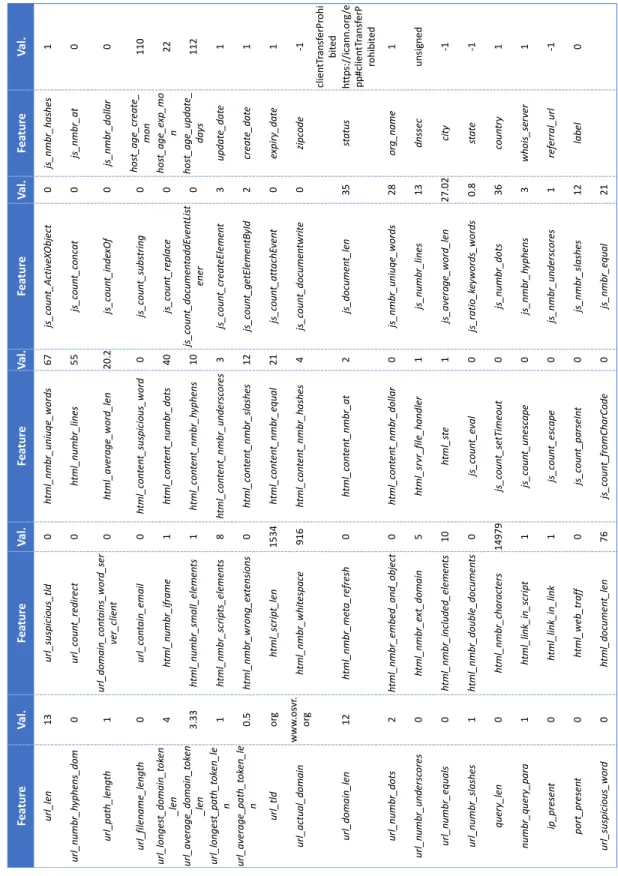
Fe at ur e Va l. Fe at ur e Va l. Fe at ur e Va l. Fe at ur e Va l. Fe at ur e ur l_ le n 13 ur l_ suspi ci ous_ tld 0 ht m l_ nm br _u ni uq e_ w or ds 67 js _c ou nt _A ct iv eX O bje ct 0 js _n mb r_ ha sh es ur l_ num br _h yphe ns_ do m 0 ur l_ co un t_ re di re ct 0 ht m l_ nu m br _l in es 55 js _c ou nt _c on ca t 0 js _n mb r_ at ur l_ pat h_ le ngt h 1 ur l_ do m ai n_ co nt ai ns_ w or d_ se r ve r_c lie nt 0 ht m l_ av er ag e_ w or d_ le n 20. 2 js _c ou nt _in de xO f 0 js _n mb r_ do lla r ur l_ fil enam e_ le ngt h 0 ur l_ co nt ai n_ em ai l 0 ht m l_ co nt ent _s us pi ci ou s_ w or d 0 js _c ou nt _s ub st rin g 0 ho st _age _c re at e_ mo n ur l_ lo nge st _do m ai n_ to ke n _le n 4 ht m l_ nu m br _i fr am e 1 ht m l_ co nt ent _n um br _d ot s 40 js _c ou nt _re pla ce 0 ho st _age _e xp_ m n ur l_ av er age _do m ai n_ to ke n _le n 3. 33 ht m l_ nu m br _s m al l_ el em ent s 1 ht m l_ co nt ent _n m br _h yp he ns 10 js _c ou nt _d ocu me nt ad dE ve nt Lis t en er 0 ho st _age _updat day s ur l_ lo nge st _pat h_ to ke n_ le n 1 ht m l_ nm br _s cr ip ts _e le m ent s 8 ht m l_ co nt ent _n m br _u nd er sc or es 3 js _c ou nt _cre at eE le me nt 3 updat e_ dat e ur l_ av er age _pat h_ to ke n_ le n 0. 5 ht m l_ nm br _w ro ng _e xt en si on s 0 ht m l_ co nt ent _n m br _s la sh es 12 js _c ou nt _g et Ele me nt ByI d 2 cre at e_ da te ur l_ tld or g ht m l_ sc rip t_ le n 1534 ht m l_ co nt ent _n m br _e qu al 21 js _c ou nt _a tt ach Ev en t 0 ex pi ry _d at e ur l_ ac tual _do m ai n www .o sv r. or g ht m l_ nm br _w hi te sp ac e 916 ht m l_ co nt ent _n m br _h as he s 4 js _c ou nt _d ocu me nt w rit e 0 zi pc od e ur l_ do m ai n_ le n 12 ht m l_ nm br _m et a_ re fr es h 0 ht m l_ co nt ent _n m br _a t 2 js _d ocu me nt _le n 35 st at us ur l_ num br _do ts 2 ht m l_ nm br _e m be d_ an d_ ob je ct 0 ht m l_ co nt ent _n m br _d ol la r 0 js _n mb r_ un iu qe _w ord s 28 or g_ na m e ur l_ num br _unde rsc or es 0 ht m l_ nm br _e xt _d om ai n 5 ht m l_ sr vr _f ile _h an dl er 1 js _n umb r_ lin es 13 dnsse c ur l_ num br _e qual s 0 ht m l_ nm br _i nc lu de d_ el em ent s 10 ht m l_ st e 1 js _a ve ra ge _w ord _le n 27. 02 cit y ur l_ num br _sl ashe s 1 ht m l_ nm br _d ou bl e_ do cu m ent s 0 js _c ou nt _e va l 0 js _ra tio _k ey w ord s_ w ord s 0. 8 st at e que ry _l en 0 ht m l_ nm br _c ha ra ct er s 14979 js _c ou nt _s et Time ou t 0 js _n umb r_ do ts 36 co un tr y num br _que ry _par a 1 ht m l_ lin k_ in _s cr ip t 1 js _c ou nt _u ne sc ap e 0 js _n mb r_ hyp he ns 3 wh oi s_ se rv er ip _p re se nt 0 ht m l_ lin k_ in _l in k 1 js _c ou nt _e sc ap e 0 js _n mb r_ un de rs co re s 1 re ferra l_ url po rt _pr ese nt 0 ht m l_ w eb _t ra ff 0 js _c ou nt _p ars eI nt 0 js _n mb r_ sla sh es 12 la be l ur l_ suspi ci ous_ w or d 0 ht m l_ do cu m ent _l en 76 js _c ou nt _f ro mC ha rC od e 0 js _n mb r_ eq ua l 21 URL : h ttp :/ /w w w .s ci en tif ic am er ic an .c om /a rt ic le .c fm ?i d=a ug m en te d-re al ity -a -ne w -w
section 4.2.2. Specifically, if the area of an element is ≤ 30, then we consider the element as small. Similarly, for feature html web traf f, if the fetched rank of website is≤100,000 then the value is set to 1 else 0. Finally, we utilize the same suspicious list as used for URL-based features to check whether HTML content contains any frugal words or not.
We use esprima built in Python library to extract JavaScript features. In specific, we search for all< script > tags from HTML page source code. For each < script > tag, we parse and tokenize the JavaScript code and search for all the prudent functions listed in Table4.3.
Furthermore, we employ whois Python library to retrieve the WHOIS of a domain. Initially, some of the Host-based features are returned as strings which cannot be exploited as they are in the machine learning model. Hence, we converted the string features into binary by considering whether the requested information is being retrieved or not for a domain. For clarification, if the city is retrieved correctly for a domain then we set the value of this feature to 1 else -1. We can refer to Figure 5.1 which displays a snapshot of raw data collected for a URL.
5.2 Python Libraries used in Feature Extraction 5.2.1 URLparse
This in-built library helps to divide the URL string into 6 components (addressing scheme, network location, path etc.). It also aims to combine the different component back onto the URL string. In addition to this, it convert a relative URL to an absolute URL given a base URL.
The module was designed on Relative Uniform Resource Locators to match the Internet RFC. Due to which it supports various addressing schemes like: file, ftp, gopher, hdl, http, https, imap, mailto, mms, news, nntp, prospero, rsync, rtsp, rtspu, sftp, shttp, sip, ssh etc. Some of the important functions that are utilized in Urlparse library are describe below:
For example : If the URLparse takes the following URL as input.
urlparse(’http://www.cwi.nl:80/%7Eguido/Python.html’)
Following is the result after parsing:
ParseResult(scheme=’http’, netloc=’www.cwi.nl:80’,
path=’/%7Eguido/Python.html’ ,params=’’, query=’’, fragment=’’)
• urlparse.urlunparse(parts) : It construct the URL from the 6 tuple provided by the above function urlparse(). The resulted URL can be slightly different from original, but it will always be an equivalent URL if it contain any unnecessary delimiters.
• urlparse.urlsplit(urlstring[, scheme[, allow f ragments]]) : This is similar to url-parse(), but the parameters from the URL are not split. Therefore to obtain this, a separate function is used to break the path segments and parameters.This func-tion returns a 5-tuple: (addressing scheme, network locafunc-tion, path, query, fragment identifier)
• urlparse.urljoin(base, url[, allowfragments]): It combines a ”base URL” (base) with another URL (url) to create a full (”absolute”) URL. Informally, this uses components of the base URL, in particular the addressing scheme, the network location and (part of) the path, to provide missing components in the relative URL.
For example : If the given function takes the URL as input.
urljoin(’http://www.cwi.nl/%7Eguido/Python.html’, ’FAQ.html’)
http://www.cwi.nl/%7Eguido/FAQ.html
5.2.2 Beautifulsoup
It is a python library that is used to extract data from HTML and XML files. It works with your favorite parser to provide idiomatic ways to browse, search, and modify the parser tree. It is usually defined as time saving library, as it saves time of programmers.
The transformation of HTML document into the tree of Python objects involves four kinds of objects: Tag, NavigableString, BeautifulSoup, and Comment.
• T ag: A Tag object corresponds to an XML or HTML tag in the original document. A Tag consists of name and attributes where every name can be accessible as .name. Additionally, a tag may have any number of attributes which can be easily accessed by treating the tag as dictionary.
• N avigableString: A NavigableString is just like a Python Unicode string, except it also supports some of the characteristics described in tree navigation and tree search. However, it can use unicode() to convert a NavigableString to a Unicode string.
• Beautif ulSoup: As Beautifulsoup represents the whole library, it can be also treated as a tag object. Therefore, it will support every method that helps in navigating and searching the tree.
• Comment: The Comment object is just a special type of NavigableString, but when it appears as part of an HTML document, a Comment is displayed with special for-matting.
5.2.3 Esprima
It is a high performance, standard-compliant ECMAScript parser written in ECMAScript (also popularly known as JavaScript). It is used to perform lexical analysis (tokenization)
1. Sensible syntax tree format as standardized by ESTree project 2. Experimental support for JSX, a syntax extension for React
3. Optional tracking of syntax node location (index-based and line-column) 4. Heavily tested ( 1500 unit tests with full code coverage)
5.2.4 WHOIS
It is a python module which retrieves the WHOIS information by parsing the domain of URL. It queries the domain and the TLD like com, org , edu etc. and returns the relevant information about the respective domain. The response time of this module is very less as it queries the WHOIS server directly instead of going through intermediate web services.
5.2.5 OpenSSL
This module provides a class, ssl.SSLSocket, which is derived from the socket.socket type, and provides a socket-like wrapper that also encrypts and decrypts the data going over the socket with SSL. It supports additional methods such as getpeercert(), which retrieves the certificate of the other side of the connection, and cipher(),which retrieves the cipher being used for the secure connection.
Given the addressaddr of an SSL-protected server, as a (hostname, port-number) pair, fetches the servers certificate, and returns it as a PEM-encoded string. If ssl version is specified, uses that version of the SSL protocol to attempt to connect to the server. If ca certs is specified, it should be a file containing a list of root certificates, the same format as used for the same parameter in SSLContext.wrap socket(). The call will attempt to
validate the server certificate against that set of root certificates, and will fail if the validation attempt fails.
5.3 Data Pre-Processing
Data pre-processing is a collection of necessary steps which ensures that raw data is converted to a digestible form of input for the model. Specifically, we implement following steps to pre-process the collected raw data.
1. Ignore features having constant value: A feature having same value across all the URLs will not help in classification of malicious vs benign URLs. Hence, based on this criteria, we remove: url numbr dom tokens ,url numbr path tokens,absolute,
subdomain present,js count documentwrite and
js count documentaddEventListener.
2. Fill missing values: Missing values create difficulty in absorbing the data for a machine learning model. Therefore, we set all the blank values as -1.
3. Categorical Data: In section 5.1, we converted some string Host-based features to categories based on the correct-fetch of a feature. We apply the same strategy across all the string features where categories can be formed. Specifically, we retain the features for which limited number of categories can be created else we ignore the feature. For example, we converted Host-based featurestate to binary by considering whether the feature value has been retrieved correctly. On the other hand, we ignore feature url tld because we got 131 unique Top Level Domains. Similarly, we ignore string features: dnssec,url actual domainand status.
4. %age of missing values: After step 2, we represent missing values as -1. In this criteria, we reject features which have more than 90% missing values. To be more specific, we ignore the following features: zipcode,ref erral url and org name.
Fe at ur e Va l. Fe at ur e Va l. Fe at ur e Va l. Fe at ur e Va l. Fe at ur e ur l_ le n 0. 0638 ur l_ do m ai n_ co nt ai ns _w or d_ se r ve r_ cl ie nt 0 ht m l_ ave ra ge _w or d_ le n 0. 00 83 js _c ou nt _in de xO f 0 ho st _a ge _e xp_ m n ur l_ num br _h yphe ns _do m 0 ur l_ co nt ai n_ em ai l 0 ht m l_ co nt ent _s us pi ci ou s_ w or d 0 js _c ou nt _s ub st rin g 0 ho st _a ge _upda te da ys ur l_ pa th_ le ng th 0. 0132 ht m l_ nu m br _i fr am e 0. 031 3 ht m l_ co nt ent _n um br _d ot s 0. 00 18 js _c ou nt _r ep lac e 0 upda te _da te ur l_ fil ena m e_ le ng th 0 ht m l_ nu m br _s m al l_ el em ent s 0. 25 ht m l_ co nt ent _n m br _h yp he ns 0. 00 05 js _c ou nt _c re at eE le m en t 0. 012 cr ea te _d at e ur l_ lo ng es t_ do m ai n_ to ke n _le n 0. 0339 ht m l_ nm br _s cr ip ts _e le m ent s 0. 030 1 ht m l_ co nt ent _n m br _u nd er sc or es 0. 00 01 js _c ou nt _g et Ele m en tB yI d 0. 035 ex piry _d at e ur l_ av er ag e_ do m ai n_ to ke n _le n 0. 1186 ht m l_ nm br _w ro ng _ex te ns io ns 0 ht m l_ co nt ent _n m br _s la sh es 0. 00 04 js _c ou nt _a tt ac hE ve nt 0 ci ty ur l_ lo ng es t_ pa th_ to ke n_ le n 0. 0179 ht m l_ sc rip t_ le n 0. 000 7 ht m l_ co nt ent _n m br _e qu al 0. 00 28 js _d oc um en t_ le n 0. 000 st at e ur l_ av er ag e_ pa th_ to ke n_ le n 0. 0133 ht m l_ nm br _w hi te sp ac e 0. 001 8 ht m l_ co nt ent _n m br _h as he s 0. 00 18 js _n m br _u niu qe _w or ds 0. 002 co un tr y ur l_ do m ai n_ le n 0. 1186 ht m l_ nm br _m et a_ re fr es h 0 ht m l_ co nt ent _n m br _a t 0. 00 19 js _n um br _lin es 0. 001 wh oi s_ se rv er ur l_ num br _do ts 0. 0667 ht m l_ nm br _e m be d_ an d_ ob je ct 0 ht m l_ co nt ent _n m br _d ol la r 0 js _a ve rag e_ w or d_ le n 0. 015 lab el ur l_ num br _unde rs co re s 0 ht m l_ nm br _ex t_ do m ai n 0. 027 6 ht m l_ sr vr _f ile _h an dl er 1 js _r at io _k ey w or ds _w or ds 0. 794 ur l_ num br _e qua ls 0 ht m l_ nm br _i nc lu de d_ el em ent s 0. 037 3 ht m l_ st e 1 js _n um br _d ot s 0. 001 ur l_ num br _s la she s 0. 1111 ht m l_ nm br _d ou bl e_ do cu m ent s 0 js _c ou nt _e val 0 js _n m br _h yp he ns 0. 000 que ry _l en 0 ht m l_ nm br _c ha ra ct er s 0. 006 5 js _c ou nt _s et Tim eo ut 0 js _n m br _u nd er sc or es 0. 000 num br _que ry _pa ra 0 ht m l_ lin k_ in _s cr ip t 1 js _c ou nt _u ne sc ap e 0 js _n m br _s las he s 0. 000 ip _p re se nt 0 ht m l_ lin k_ in _l in k 1 js _c ou nt _e sc ap e 0 js _n m br _e qu al 0. 001 po rt _pr es en t 0 ht m l_ w eb _t ra ff 0 js _c ou nt _p ar se In t 0 js _n m br _h as he s 0. 01 ur l_ sus pi ci ous _w or d 0 ht m l_ do cu m ent _l en 0. 000 8 js _c ou nt _f ro m Ch ar Co de 0 js _n m br _a t 0 ur l_ sus pi ci ous _t ld 0 ht m l_ nm br _u ni uq e_ w or ds 0. 004 6 js _c ou nt _A ct iv eX O bje ct 0 js _n m br _d ollar 0 ur l_ co un t_ re di re ct 0 ht m l_ nu m br _l in es 0. 004 8 js _c ou nt _c on ca t 0 ho st _a ge _c re at e_ m on 0. 277 8 URL : h ttp :/ /w w w .s ci en tif ic ame ric an .c om/ ar tic le .c fm? id =a ug me nt ed -re al ity -a -ne w -w
Figure 5.4 Create Age Distribution
Figure 5.7 Update Age Distribution
5. Features having same values: Based on this criteria, we do not consider features:
url actual hostnameandurl hostname len, because these features contain same val-ues as features: url actual domain andurl domain len, respectively.
6. Normalization: This is one of the most crucial step in pre-processing. Basically, we project real-valued and integer-valued features to a range of [0,1]. This is done to ensure that these features do not dominate the binary features available in the data. There are many techniques to normalize the data, however, we resort to employ the following formula.
xnorm=
x−min(x)
max(x)−min(x) (5.1)
After employing the above steps, we get a pre-processed data for every URL as shown in Figure 5.2. In Figures 5.4,5.5, 5.7and 5.8we can see distributions for features url len,
CHAPTER 6. EXPERIMENTAL EVALUATION
6.1 Data
Rather than creating a labeled dataset from scratch, we utilized a pre-labeled dataset. 1 According to the provider, two sources: Dmoz Open Directory 2 and Phishtank3 are used to fetch benign and malicious URLs, respectively. In total, the dataset contains 7504 URLs labeled as malicious (class=1,≈53%) or not-malicious (class=0,≈ 47%).
6.2 Experiments 6.2.1 Improve URL parsing
As we mentioned in section4.2.1, we utilized URL-parse library from Python to extract some features. We tried to enhance the library by analyzing the gaps and looking for ways to either extract more features or add some additional methods to extract URL features which are not currently part of URL parse library. As of now, the URL parse library returns the following 6 items as a tuple:
1. scheme 2. netloc 3. path 4. params 1
https://github.com/Anmol−Sharma/U RL CLASSIF ICAT ION SY ST EM 2https://www.dmoz.org/
3