Protein complex scaffolding predicted as a prevalent
function of long non-coding RNAs
Diogo M. Ribeiro
1, Andreas Zanzoni
1, Andrea Cipriano
2, Riccardo Delli Ponti
3,4,
Lionel Spinelli
1, Monica Ballarino
2, Irene Bozzoni
2, Gian Gaetano Tartaglia
3,4,5,*and
Christine Brun
1,6,*1Aix-Marseille Universit ´e, Inserm, TAGC UMR S1090, Marseille, France,2Dept. of Biology and Biotechnology Charles Darwin, Sapienza University, Rome, Italy,3Centre for Genomic Regulation (CRG), The Barcelona Institute of Science and Technology, Dr Aiguader 88, 08003 Barcelona, Spain,4Universitat Pompeu Fabra (UPF), 08003
Barcelona, Spain,5Institucio Catalana de Recerca i Estudis Avanc¸ats (ICREA), 23 Passeig Lluıs Companys, 08010 Barcelona, Spain and6CNRS, Marseille, France
Received October 06, 2017; Revised November 03, 2017; Editorial Decision November 07, 2017; Accepted November 07, 2017
ABSTRACT
The human transcriptome contains thousands of long non-coding RNAs (lncRNAs). Characterizing their function is a current challenge. An emerging concept is that lncRNAs serve as protein scaffolds, forming ribonucleoproteins and bringing proteins in proximity. However, only few scaffolding lncRNAs have been characterized and the prevalence of this function is unknown. Here, we propose the first com-putational approach aimed at predicting scaffolding lncRNAs at large scale. We predicted the largest hu-man lncRNA–protein interaction network to date us-ing the catRAPID omics algorithm. In combination with tissue expression and statistical approaches, we identified 847 lncRNAs (∼5% of the long non-coding transcriptome) predicted to scaffold half of the known protein complexes and network modules. Lastly, we show that the association of certain lncR-NAs to disease may involve their scaffolding abil-ity. Overall, our results suggest for the first time that RNA-mediated scaffolding of protein complexes and modules may be a common mechanism in human cells.
INTRODUCTION
More than 60% of the human genome is transcribed into tens of thousands of RNAs with low coding potential (1). Long non-coding RNAs (lncRNAs) are a subset of those transcripts longer than 200 nt, transcribed by RNA poly-merase II, often capped, spliced and polyadenylated (2). The possible function of most of the>26 000 GENCODE annotated lncRNAs is yet to be addressed (3), and many are
thought to be transcription errors or noise. However, thou-sands of lncRNAs have been found to be differentially ex-pressed in distinct cell types, with dozens shown to be impli-cated in transcription regulation (4), stress responses (5) and disease (6). Indeed, lncRNAs are versatile molecules able to perform numerous tasks in the cell through binding of pro-teins, DNA or other RNA molecules (2).
All cellular functions are performed by interactions be-tween molecules, such as interaction bebe-tween proteins and RNAs. These interactions can be stable, leading to ribonu-cleoprotein (RNP) complexes such as the ribosome, the spliceosome or the telomerase complex, or transient such as those involved in transport and degradation of nuclear tran-scripts. Similarly, components of complexes or pathways need to be physically close to each other (either transiently or permanently) in order to perform their function. One way to achieve this, while attaining selectivity in a crowded cell, is to employ platform or scaffold molecules that piece together components of a complex or a pathway (7). Al-though proteins can and do serve as scaffolds for other pro-teins (8), the use of RNA scaffolds would present several advantages, since ‘one protein comprising 100 amino acids can capture only one or two proteins, whereas one RNA molecule comprising 100 nt can capture around 5–20 pro-teins’, simultaneously (9). Moreover, lncRNAs can act im-mediately after transcription, while protein scaffolds require at least the step of translation before being functional (2).
Several ncRNAs have been found to function as scaf-folds for RNP complexes such as TERC (Telomerase RNA Component), SRP (Signal Recognition Particle RNA) and LINP1 (LncRNA In Nonhomologous End Joining Path-way 1) (2,10,11) or found to transiently assemble groups of proteins as in the case of XIST (X-inactive specific transcript) and both the granule-forming NEAT1 (Nu-clear Paraspeckle Assembly Transcript 1) and MALAT1
*To whom correspondence should be addressed. Tel: +33 491828712; Email: [email protected]
Correspondence may also be addressed to Gian Gaetano Tartaglia. Tel: +34 933160116; Email: [email protected]
C
The Author(s) 2017. Published by Oxford University Press on behalf of Nucleic Acids Research.
This is an Open Access article distributed under the terms of the Creative Commons Attribution License (http://creativecommons.org/licenses/by-nc/4.0/), which permits non-commercial re-use, distribution, and reproduction in any medium, provided the original work is properly cited. For commercial re-use, please contact [email protected]
(Metastasis Associated Lung Adenocarcinoma Transcript 1) (5,12). Although known scaffolding lncRNAs carry out important cellular functions, only a few dozen cases have been uncovered so far (7), many while studying the protein complexes rather than the lncRNAs. We therefore hypoth-esize that other yet uncharacterized lncRNAs may act as scaffolds.
Recently, with the development of RNA interactome cap-ture methodologies, the repertoire of RNA-binding pro-teins (RBPs) has greatly expanded (13), leading to the discovery of hundreds of novel RNA-interacting proteins, many of which contain no known RNA-binding domain (RBD). In addition, studies using high-throughput meth-ods to detect RNAs bound by RBPs including iCLIP, PAR-CLIP and recently eCLIP (14), demonstrate that most RBPs bind thousands of different RNA molecules depend-ing on the cell line. However, these investigations have been limited to a set of ∼140 RBPs containing known RBDs (14,15) and do not cover the full extent of the protein– RNA interaction space. Furthermore, only one fraction of the RNAs targeted by the RBPs are found in common by independent replicate experiments, suggesting that the interaction maps of the studied RBPs are far from com-plete (14). Computational prediction of protein–RNA in-teractions can therefore help fill the gap in our knowledge of protein–RNA interactions and be applied to large-scale analyses.
In this paper, we study for the first time the prevalence of protein complex scaffolding as a function of lncRNAs. By exploiting a computed protein–RNA interaction net-work, we developed and applied an original large-scale ap-proach to identify candidate lncRNAs possibly acting as scaffolding molecules for protein complexes and network functional modules. We discovered hundreds of scaffolding lncRNA candidates, suggesting that RNA scaffolding is a prevalent and widespread mechanism in the cell. In addi-tion, we found that more than half of the protein complexes and network modules in the cell may be scaffolded by lncR-NAs, reinforcing the widespread nature of their action.
MATERIALS AND METHODS
LncRNA–protein interaction predictions
ThecatRAPID omicsprotein–RNA interaction predictor (16) was used to predict interactions between the human long non-coding RNA transcriptome (Ensembl v82) and the human canonical proteome, leading to ∼243 million predictions. Predictions with interaction propensity score
≥50 were kept for further analyses (∼30.8 million interac-tions). See Supplementary Material for details.
Tissue expression filtering
To create a set of high confidence protein–RNA interaction predictions, we restricted the analysis to pairs of lncRNA– proteins that are likely to be found together in at least one tissue. Human tissue expression data from the GTEx v6.0 project (17) was used. We downloaded RPKM (Reads Per Kilobase of transcript per Million mapped reads) informa-tion from 8555 samples across 53 tissues, already mapped to human transcripts (GENCODE v19). RPKM values of
samples coming from the same tissue were averaged af-ter a step of removing outlier values (below or above 1.5-times the interquartile range). Protein expression was de-rived from their coding mRNA expression, by selecting the highest RPKM value among the protein’s mRNAs for each tissue. Only protein–RNA interactions where both the RNA and the protein have a minimum RPKM value of 1.58 in at least one of the 53 tissues, were retained. This cutoff was determined as the optimal expression cutoff (maximiz-ing the sum of specificity and sensitivity) in a ROC curve experiment between the pre-filtering lncRNA–protein inter-action prediction dataset (∼243 million interaction predic-tions) and a set of 2438 experimentally detected CLIP in-teractions taken from StarBase v2.0 (18) with at least 100 mapped reads (area under the ROC=0.71). The expression metric used (‘paired expression’) was calculated for each protein–RNA pair as the lowest RPKM expression between the protein and RNA for each tissue, to which the maximum RPKM value among tissues for that protein–RNA pair is then withdrawn, i.e.
E(Protein,RNA)= max
t∈tissues(min (Et(Protein), Et(RNA)))
whereE(Protein, RNA) denotes the ‘paired expression’ for each protein–RNA pair andEtdenotes the RPKM
expres-sion in tissuet(RPKM values were log10-transformed).
Protein complex and network module datasets
We collected protein complex information from the (i) Bio-Plex publication (19) Supplementary Table S3, which in-cludes 354 complexes; (ii) list of conserved protein com-plexes from Wanet al.(20), Supplementary Table S4, which includes 981 complexes; (iii) list of non-redundant CORUM (21) complexes from Havugimanaet al. (22), Supplemen-tary Table S3, which includes 324 complexes, referred to as ‘non-redundant CORUM complexes’. Protein network modules were extracted from a human interactome as de-scribed in (23). See Supplementary Material for details.
LncRNA–protein complex enrichment analysis
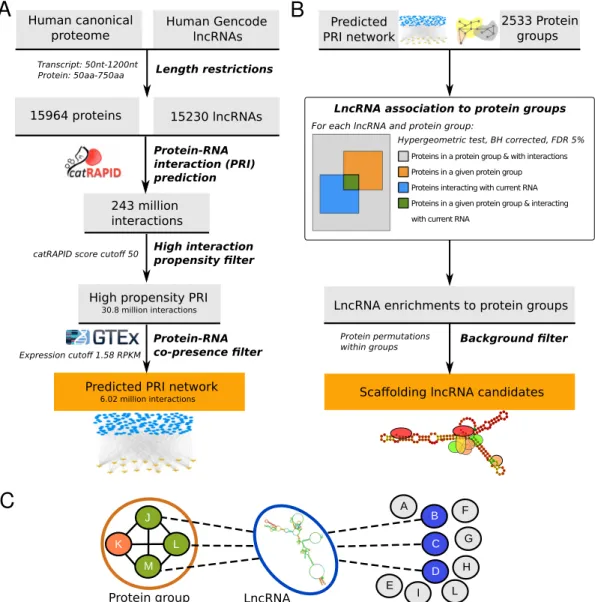
Using the set of predicted interactions between lncRNA and proteins filtered by (i) interaction propensity and (ii) minimum RPKM expression, we performed the following enrichment analysis: for each lncRNA and protein group, we assessed the enrichment of the lncRNA’s interacting-proteins among the interacting-proteins in the group using a hyper-geometric test (one-tailed test; FDR =5%, multiple test corrected with the Benjamini–Hochberg procedure; Figure
1B), using as background the set of proteins in complexes or modules retaining at least one interaction after interac-tion filters. We considered only enrichments where: (i) the lncRNA is interacting with at least two proteins of the pro-tein group and (ii) all the propro-teins in the complex or the module are expressed in a same tissue as the lncRNA with at least 1.58 RPKM. To exclude lncRNAs with high back-ground levels of enrichments, we built a null hypothesis dis-tribution by performing 10 000 hypergeometric tests for each lncRNA, each time randomly shuffling the proteins labels between the protein groups. We excluded lncRNAs
Figure 1. Data production and analysis workflows. (A) Predictions of protein-lncRNA interactions (PRI) usingcatRAPIDomicsfor the human proteome and long non-coding transcriptome. Interactions are further filtered by co-presence in the same GTEx tissue. The produced PRI network contains 6.02 million interactions. (B) Protein groups and lncRNAs are tested for enrichment in lncRNA protein’s targets among groups of proteins. After noise filtering, a final list of scaffolding lncRNA candidates is produced. (C) Principle of the enrichment in lncRNA protein’s targets among groups of proteins. Colors of nodes correspond to the ones used on the lncRNA association to protein groups box on (B).
with (i) enrichments not significant in respect to the null hy-pothesis (empiricalP-value>0.01); (ii) an enrichment ratio lower than 2-fold.
RESULTS
A predicted human interaction network between the non-coding transcriptome and the proteome
Aiming to extensively identify lncRNA molecules interact-ing with protein complexes and potentially actinteract-ing as pro-tein scaffolds, we first computed the propro-tein–RNA interac-tion potential between most of the human proteome and the long non-coding transcriptome (79% and 81%, respec-tively; Supplementary Material) using thecatRAPIDomics
algorithm (16) (Figure 1A). The catRAPID algorithm is a protein–RNA interaction predictor based on the physic-ochemical features of the molecules that has been
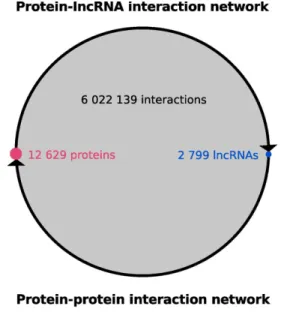
exten-sively used and tested on lncRNAs with good performances (16,24,25). With this method we produced 243 million pre-dicted interactions, of which 30.8 million display high in-teraction propensity scores (catRAPID score≥50). Since many lncRNAs have only been found to be expressed at very low levels and often in a tissue-specific manner (26), we only retained 6.02 million protein–lncRNA interactions between molecules co-present in at least one out of the 53 human tis-sues from the GTEx RNA-seq dataset (17) (see Materials and Methods). Globally, the 6.02 million predicted inter-actions occur between 12629 proteins and 2799 lncRNAs (Figure2), i.e. between 80% of the tested proteins and 18% of our initial set of lncRNAs. Individual proteins are pre-dicted to interact with up to 2.5% of the lncRNAs on av-erage (Supplementary Figure S1). When considering only RBPs (Supplementary Material), we predict them to inter-act with 4.14% of the lncRNAs on average, in the same
Figure 2.A global lncRNA–protein interaction network. Predicted protein-lncRNA interaction network composed by more than 6 millions interactions (grey circle) between 12629 proteins (pink circle) and 2799 lncRNAs (blue circle). The size of the network is compared to the human binary protein-protein interaction network (see Supplementary Methods). All circles are proportional to their components.
range as eCLIP results on 82 RBPs (14), which interact with 7.98% of the lncRNAs from the same dataset. On the lncRNA side, their median number of protein interactions is 1267 (Supplementary Figure S1), a higher number than suggested by current RNA pull-down studies that report be-tween 126 and 852 interacting proteins per lncRNA (27,28). As evident in recent high-throughput screenings, the complexity of biological systems challenges interpretation of experimental results due to the specific interactions oc-curring in different contexts (12,14). Yet our predictions, based on molecular physicochemical properties, represent a set of possible interactions between co-expressed proteins and RNA, independent of the cellular sub-localization and the cellular states. Our predictions therefore cover a larger spectrum of conditions in which protein–RNA interactions may occur, compared to the ones assessed in specificin vivo
studies. This allows us to detect, for example, lncRNAs act-ing exclusively upon DNA damage and other stress condi-tions, or interactions restricted to a few cell types. Despite all this, 9414 of our predicted interactions are found in the relatively small set of eCLIP experiments, a highly signif-icant overlap considering the 82 proteins and 7381 tran-scripts present in both eCLIP andcatRAPID datasets (P -value<2.2e-271, OR=1.85, two-tailed Fisher’s exact test), therefore increasing our confidence in the predicted net-work.
Overall, to the best of our knowledge, we have predicted the largest human lncRNA–protein interaction network to date.
Interactions between lncRNAs and protein complexes or net-work modules
To assess our capacity to computationally predict lncRNA interactions with protein complexes, we studied the possible association between a recently discovered evolutionarily-conserved and muscle-restricted lncRNA,lnc-405(29), and the Pur␣–Pur–YBX1 protein complex, implicated in gene regulation of muscle cells (30). ThecatRAPIDomics algo-rithm predicts the interaction of humanlnc-405with Pur␣, Purand YBX1 with moderate to high scores (38.56, 44.05, 67.84, respectively).
To determine ifcatRAPID correctly predicted the inter-actions of the lncRNA to the protein complex in a cellular context, we performed endogenouslnc-405RNA pull-down from nuclear extracts of C2C12 mouse myotubes followed by a mass spectrometry (MS) analysis. Murine cells were used since lnc-405is highly conserved in mouse and very abundant in differentiated C2C12 cells, allowing the easy production of the large amounts of nuclear extracts which are required for the pull-down. Efficient enrichment of lnc-405 was detected in both odd and even RNA pull-down samples, while no recovery was observed with lacZ control (Supplementary Figure S2A).
Notably, MS analysis applied on the odd, even and lacZ (control) samples allowed the identification of 19lnc-405
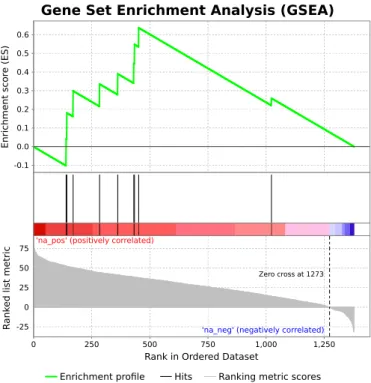
interactors, including two components of the Pur␣-Pur -YBX1 complex (Supplementary Table S1; Supplementary Material). RIP assays performed in mouse and human my-otubes, using an antibody against Pur, allowed to validate the specificity of the interaction withlnc-405 and to con-firm the evolutionary conservation of such interaction (Sup-plementary Figure S2B and C). Moreover, a GSEA exper-iment shows that the top interactors of lnc-405predicted bycatRAPID are enriched in proteins identified in the MS experiment (Figure3,P-value =0.017). These results re-markably show thatcatRAPID is able to correctly predict interactions between lncRNAs and proteins (whether in a complex or not), in line with goodcatRAPID performances observed for other ncRNAs and reported in previous arti-cles (24,25,31).
We thus proceeded with the exploration of our
catRAPID predicted lncRNA–protein interaction net-work, aiming to test the hypothesis that lncRNAs frequently scaffold known protein complexes through protein–RNA interaction. For this, we investigated three public datasets of human macromolecular complexes. Briefly, we used the (i) non-redundant dataset of 326 CORUM complexes (21) collected by Havugimana et al.
(22) (hereafter referred to as ‘non-redundant CORUM’), (ii) a set of 981 metazoan-conserved complexes produced by Wanet al.(20) through biochemical fractionation with quantitative MS (hereafter referred to as ‘Wan 2015’), as well as (iii) the BioPlex dataset (19) of 354 complexes detected through affinity purification, MS experiments and interaction network analysis. Moreover, the human cell contains groups of functionally-related proteins that in-teract more transiently but may nevertheless be assembled or gathered together by lncRNA scaffolds to participate in metabolic or signaling pathways. For these reasons, we also used a dataset of 874 functional modules identified
Figure 3. Experimentally-determinedlnc-405-interacting proteins are en-riched as top catRAPID predictions. Gene Set Enrichment Analysis (GSEA) (69) ofcatRAPID predictions betweenlnc-405lncRNA and 1459 human RBPs (Supplementary Material), using the RBPs identified as in-teractors in the MS experiment as a gene set. Note that only RBPs with catRAPID predictions (within size restrictions) were considered.P-value
=0.017 (10 000 simulations), normalized enrichment score=1.59).
in the human interactome using OCG, an algorithm that decomposes a network into overlapping modules, based on modularity optimization (32). These modules (hereafter referred to as ‘Network modules’) are groups of highly interacting proteins, which tend to be involved in the same cellular processes, metabolic or signalling pathways (33) (Supplementary Table S2).
Using these datasets of protein groups and our protein-lncRNA interaction predictions, we identified protein-lncRNAs that may scaffold complexes or modules by assessing first, for each lncRNA, the enrichment of the lncRNA’s interact-ing proteins among those proteins composinteract-ing each com-plex or network module (hypergeometric test, Benjamini-Hochberg corrected FDR 5%) (Figure 1B). Second, be-cause some lncRNAs are predicted to bind a large number of proteins, we estimated the number of protein groups we would expect to find enriched by chance for each lncRNA, as a control, by shuffling the protein labels between pro-tein groups (10 000 times). Only lncRNAs predicted to bind significantly more (empiricalP-value<0.01), and at least twice as many, protein groups than expected by chance were considered candidates for scaffolding function.
After filtering using the randomised control, we obtained a total of 27 090 statistically significant enrichments be-tween 1517 protein groups and 847 distinct lncRNA tran-scripts, encoded by 820 lncRNA genes (Supplementary Ta-ble S3). These 847 lncRNAs, ∼5% of our 15 230 tested transcripts, are hereafter referred to as ‘scaffolding lncRNA candidates’ and constitute a set of lncRNAs predicted to
be involved in a scaffolding function (Supplementary Table S4). Remarkably, we also predict that∼56% of the known protein complexes and 66% of the network modules are scaffolded by at least one lncRNA (Supplementary Table S3). These results suggest that lncRNAs scaffolding com-plexes and modules are highly prevalent. Moreover, as the set of predicted complexes and modules found to be scaf-folded by lncRNAs are involved in most cellular biological processes (Supplementary Figure S3), the scaffolding func-tion of lncRNAs appears therefore to be a general feature and not restricted to specific cellular processes.
Although current experimental protein-lncRNA inter-action datasets are largely incomplete and limited to 148 RBPs (14,15,18), we find that 832 out of 6186 lncRNA– protein-group interactions including at least one of the 148 RBPs contain one or more known experimental interac-tions (Supplementary Table S4). Importantly, as a control, when restricting our scaffolding lncRNA candidate detec-tion method to protein–RNA interacdetec-tions involving only RNA-binding proteins (1459 RBPs; Supplementary Mate-rial), instead of the whole proteome, we identify 788 scaf-folding lncRNA candidates among which 572 (72.5%) were also found by our proteome-wide approach. This highly sig-nificant overlap (P-value<2.2e–16, OR=158, Fisher’s ex-act test; Supplementary Figure S4) reinforces the confidence of our predictions.
Overall, our large-scale approach predicted tens of thou-sands of lncRNA–protein-group interactions between hun-dreds of lncRNAs and protein groups, many of which con-taining experimentally determined interactions, suggesting an abundant presence of lncRNA scaffolds.
Global analysis of scaffolded complexes and modules
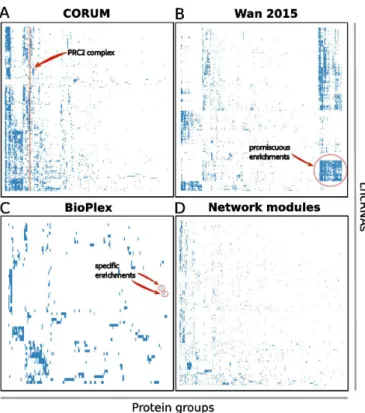
In order to analyse the patterns of predicted interactions between lncRNAs and protein groups, we represent them as a clustered matrix (Figure4). Clusters of protein groups with similar enrichment profiles often share proteins, while clusters of lncRNAs with similar enrichment profiles are largely composed of transcript isoforms from the same or paralog genes. While some protein groups and lncR-NAs interact specifically, others––protein groups as well as lncRNAs––do so more promiscuously, and this occurs for each of the four protein group datasets used. Indeed, we ob-serve that some lncRNAs are predicted to interact with 1 to 98 protein groups, according to the dataset, i.e. at most 54 (16.7% of total) non-redundant CORUM complexes, 35 (9.9%) in BioPlex, 98 (10.0%) in Wan 2015, 68 (7.8%) in network modules (Figure4; Supplementary Figure S5A). Likewise, protein complexes are predicted to interact with 1 to 401 lncRNAs i.e. at most 401 lncRNAs (2.6% of total tested) in non-redundant CORUM, 17 (0.1%) in BioPlex, 248 (1.6%) in Wan 2015, 115 (0.7%) in network modules (Figure4; Supplementary Figure S5B).
Interestingly, some of our predictions corroborate and further extend the current knowledge of protein–RNA complexes. For instance, the polycomb repressive complex 2 (PRC2 complex), previously found associated with lncR-NAs (4), is predicted to be scaffolded by 101 different lncR-NAs in our analysis. Indeed, the PRC2 complex and some of its constituent proteins have previously been found to bind
Figure 4. Interactions between lncRNAs and protein groups. Boolean ma-trix representing enrichment between lncRNAs and protein groups on (A) non-redundant CORUM, (B) Wan 2015, (C) BioPlex and (D) Network modules. Blue color represents significant enrichments, white color rep-resents non-significant enrichments. Only lncRNAs/protein groups with at least one significant enrichment are displayed. Matrix was clustered by hierarchical clustering with euclidean distance, dendrograms are not dis-played due to the very high number of rows and columns. The PRC2 com-plex, as well as examples of promiscuous and specific enrichments are high-lighted.
hundreds of lncRNAs, presumably as a part of its targeted gene repression mechanism or its regulation by decoy lncR-NAs (4,34).
Overall, we find that some lncRNA candidates may act as general scaffolds for several protein groups, while others are specific to one or a few protein groups. Likewise, some protein groups are predicted to interact with many different lncRNAs, perhaps reflecting their function, exemplified by the PRC2 complex.
Scaffolding lncRNA candidates display functional features
To determine if our scaffolding lncRNA candidates are likely to be functional, we gathered several orthogonal datasets of lncRNAs displaying functional features. To-gether these include lncRNAs (i) displaying a metabolism profile characteristic of functional transcripts (35), (ii) over-lapping eQTLs (36); (iii) that alter cell-growth when sub-jected to inactivation by CRISPRi (37); (iv) involved in dis-ease (38,39), as well as lncRNAs (v) conserved in tetrapods (40) or (vi) possessing structurally conserved elements (41). Strikingly, even though these functional lncRNAs have been found to act not only through protein-binding but also RNA- and DNA-binding, many were successfully identified by our protein–RNA interaction-based approach (Figure
5A). Indeed, we observe a significant (P-value<0.05, one-tailed Fisher’s exact test) and often strong overlap (OR> 2) between our scaffolding lncRNA candidate dataset and every functional or conserved lncRNA dataset analysed ex-cept therian-conserved lncRNAs. This latter result suggests that most human scaffolding lncRNAs may have appeared later in evolution or may be highly species-specific.
Additionally, when considering the different sets of scaf-folding lncRNA candidates identified using our four dif-ferent protein group datasets separately, they are all found significantly enriched in functional or conserved lncRNAs from all tested orthogonal datasets (P-value < 0.05, OR from 1.73 to 1.96, one-tailed Fisher’s exact test; Supplemen-tary Figure S6A). Different pertinent lncRNA candidates can therefore be detected from each protein group dataset, consistent with the relatively low overlap observed between lncRNAs candidates found from each dataset (Supplemen-tary Figure S6B).
In agreement with our findings, we observe that muta-tions in exons of scaffolding long non-coding intergenic RNA (lincRNAs) candidates have a higher predicted con-sequence on fitness than mutations in other lincRNAs, by measuring their fitCons scores (Figure5B; Supplementary Material), a metric that takes into account sequence poly-morphisms in human and sequence divergence in primates (42).
Altogether, these results suggest that our candidates gen-erally possess the features of functional transcripts, there-fore lending further weight to our predictions.
LncRNA-associated disease mechanisms could involve lncRNA scaffolding function
Hundreds of lncRNA genes have been associated with sev-eral human diseases and conditions including cancer, dia-betes and neurodegenerative diseases. As most of these as-sociations were identified through the analysis of lncRNA differential expression in disease states (38,39), knowledge on the molecular role of these lncRNAs in disease is lack-ing.
We have found 30 scaffolding lncRNA candidate genes associated with disease in lnc2cancer (38) and LncRNADis-ease (39) databases (Figure5A; Supplementary Material). We then assessed whether these lncRNA-disease associa-tions could occur through the predicted protein group scaf-folding functions of the lncRNAs. For this, we mapped pro-teins involved in disease from the OMIM database (43) to protein groups and found that 15 out of 30 scaffolding lncRNA candidate genes associated with disease are pos-sibly interacting with a protein group that includes at least one protein associated with the same or similar disease (Fig-ure6; Supplementary Table S5).
In several cases (e.g. lncRNA genes SNHG1, SOX2-CT and RP11–356I2.4), lncRNAs and diseases are linked through different protein complexes, and involving different proteins, which provides further evidence of the association. For instance, the SNHG15 lncRNA gene has been asso-ciated to Hereditary Haemorrhagic Telangiectasia (HHT) (44), a disease known to be caused by mutations in genes that modulate the TGF- superfamily (45). Here, we find that two of its transcripts possibly interact with a
com-Figure 5. Scaffolding lncRNA candidates display functional features. (A) Overlap between scaffolding lncRNA candidate gene (820 genes, 847 transcripts) and the following groups of functional or conserved lncRNA genes characterized in other studies: Hon2017 (36): lncRNAs displaying four features of func-tionality; Liu2016 (37): lncRNAs affecting cell growth according to CRISPRi experiments; Lnc2cancer (38): lncRNAs involved in cancer; LncRNADB (70): compendium of known functional lncRNAs; LncRNADisease (39): lncRNAs involved in human diseases; Mukherjee2017 (35): lncRNAs with a metabolic profile characteristic of functional transcripts; Necsulea2014 (40): lncRNAs conserved in therians; Smith2013 (41): lncRNAs containing at least one exonic conserved structural element (see Supplementary Material). Enrichment was tested with one-tailed Fisher’s exact tests, background included all genes (12233 lncRNA genes, 15230 transcripts) analysed in this study. AllP-values for the ‘Yes’ category are significant (P-value<0.05), except for Necsulea2014. (B) Proportion of sequence covered with fitCons score above the threshold (x-axis), for different gene features (3UTR, 5UTR), lincRNA exons on scaffolding lincRNAs candidates and all other lincRNAs accessed in this study. Error bars: standard deviation of 100 subsampling experiments (with replacement) of 50 genes per category. ‘Scaffolding lincRNAs’ have a higher proportion of sequence covered above the threshold than ‘Other lincR-NAs’ (one-tailed Kolmogorov–Smirnov testP-value=0.008). As observed in other studies (35,42), lincRNA fitCons scores are lower than UTR regions of protein-coding genes.
plex containing 11 components and regulators of the
TGF- pathway out of 23 proteins (ENST00000585030, non-redundant CORUM complex 81), and with a module composed of signalling proteins and transcription factors (ENST00000578968, network module 686, Supplementary Table S5). Notably, whereas these SNHG15-interacting protein groups are largely composed of different sets of pro-teins, both contain the SMAD4 protein, a TGF-pathway component mutated in HHT (46). Overall, further credibil-ity is given to an involvement of SNHG15 in this disease through its predicted scaffolding function.
Moreover, the MEG3 lncRNA gene has been linked to colorectal cancer (47), and has been shown to bind chromatin-remodeling complexes (4). Interest-ingly, we detected a short MEG3 lncRNA isoform (ENST00000524131, 721 nucleotides) possibly interacting with a complex containing DNA polymerase epsilon subunits as well as chromatin-remodeling proteins (Wan 2015 complex 79), including POLE1, also associated to colorectal cancer.
Finally, the SNHG1 gene is associated to hepatocellular carcinoma (HCC) (48) and non-small cell lung cancer (49). Here we find one of its transcripts (ENST00000539975) in-teracting with 18 different protein groups associated with one or both of those diseases. Moreover, the interaction of SNHG1 lncRNA with 6 of those protein groups is cor-roborated by experimental interactions (14,15,18) through five distinct RBPs. Several pathway components of the
TNF␣/NF-B signaling pathway have been associated with both lung cancer and HCC, as well as other cancers (50,51). The SNHG1 lncRNA is predicted to interact with the TNF␣/NF-B signaling complex (non-redundant CO-RUM complex 10) through PAPOLA (poly(A) polymerase
␣) and CHUK (inhibitor of nuclear factor-B kinase sub-unit ␣). Notably, the lncRNA interaction with the pro-tein complex is further corroborated by two experimen-tal interactions with two RBPs of the complex, DDX3X and AKAP8L (Supplementary Table S5). Additionally, the SNHG1 lncRNA has been associated with HCC through suppression of miR-195 (52), a microRNA known to tar-get the TNF␣/NF-B pathway by repressing the CHUK protein, and thus suppressing HCC (53) (Figure7). Given our predictions, we can thus propose that beyond its known effect through miR-195, SNHG1 may regulate elements of the TNF␣/NF-B pathway and therefore directly affect HCC through its possible protein group scaffolding func-tion.
Globally, we propose that the association of 15 lncRNA genes to 22 diseases is due to protein-lncRNA interaction-based mechanisms, notably through the scaffolding of pro-tein complexes and modules by lncRNAs.
DISCUSSION
The current scarcity of experimentally determined lncRNA–protein interaction data hinders the inves-tigation of lncRNA function at large-scale. We thus
Figure 6.Disease-associated lncRNA network. Network representation of disease-associated lncRNAs (hexagonal nodes in yellow) potentially scaffolding protein groups (square colored nodes) containing at least one protein known to be involved in the same disease. Colors correspond to different diseases. Node size reflects the number of proteins in the group. Edges represent lncRNA–protein-group interactions. Edge width reflects the number of proteins interacting with the lncRNA. LncRNA transcripts were mapped to genes. Some disease names have been abbreviated for simplicity.
computationally predicted a comprehensive lncRNA– protein interaction network in order to better cover the lncRNA–protein interaction space. For this, we used
catRAPID, a protein–RNA interaction predictor based on the physicochemical features of the molecules, which can be used large-scale and has been initially validated on a large collection of protein associations with lncRNA (24). Indeed, catRAPID performed well against the NPInter database (area under the receiver operating characteristic (ROC) of 0.88), as well as on the non-nucleic-acid-binding
database (area under the ROC curve of 0.92) (31). In addi-tion, we showed herein thatcatRAPID predictions provide relevant information about lncRNA–protein-complex interactions by experimentally validating that part of the Pur␣-Pur-YBX1 complex –– predicted here to interact with thelnc-405lncRNA –– effectively binds the lncRNA
in vivo.
Noticeably, as thecatRAPID predicted interaction net-work contains the set of biophysically possible interactions between co-expressed molecules, which may differ from
in-Figure 7. SNHG1 lncRNA gene association to hepatocellular carcinoma through interaction with the TNF␣/NF-B signaling complex. Red nodes represent protein components of the TNF␣/NF-B signaling complex (non-redundant CORUM complex 10). Pink edges correspond to the iden-tified protein-protein interactions between those proteins, downloaded from IntAct (71) on 22 May 2017. Interactions predicted in this study are represented by green dashed edges, experimentally determined ones (see Supplementary Material) by blue dashed edges. Negative regulatory inter-actions are shown in red and are taken from (53) and (52). ViennaRNA web services were used to predict the secondary structure of SNHG1 and miR-195 (72).
teractions occurring in particular biological contexts, exper-imentally assessing the quality of the predicted interactions in our network is a desirable goal. However, issues relative to the fraction of interactions to be tested, the sensitivity of the chosen experimental assay, the fraction of interactions identifiable by the chosen assay, and its precision have to be solved beforehand as proposed in the case of the assess-ment of large-scale binary protein interactomes (54). More-over, validating the predicted protein complex scaffolding function of lncRNAs is yet another challenge that should involve a wealth of experimental work –– e.g., knocking-down of the lncRNA, determination of the localization of
the predicted associated complex, its effect on the cell, as well as analysis of binding sites involved in the binding of each protein by the lncRNA (55) –– which is beyond the scope of our analysis. Overall, these reasons justify our in-tegration of several orthologous functional datasets to val-idate our interaction predictions and the possibility of the lncRNA to be indeed functional in the cell.
A growing body of evidence suggests that a significant fraction of lncRNAs has a function (36,37). Large-scale ef-forts to determine or predict lncRNA function have used their metabolic properties (35,36), sequence or structural conservation (40,41), differential expression in disease (56), lncRNA and protein-coding gene co-expression profiles (57), variant analysis (58), as well as combinations thereof (59). Methods to understand the function of individual lncRNAs through direct interaction with proteins have been exploited to a lesser extent, and are generally restricted to the limited number of known RBPs assessed to date. Hence, there is a clear need for novel large-scale methods to investi-gate the functions of ncRNAs acting through protein–RNA interactions, such as their ability to scaffold protein groups. Although protein–RNA interactions are usually per-ceived as a protein-centric mechanism, they are now also envisioned as a RNA-centric question, where the interac-tions are driven by the RNA (13). However, even for RNA-centric experiments where the RNA is precipitated and its interacting proteins are identified with MS, each experiment seems to underestimate the number of proteins interacting with lncRNAs. This was observed for the XIST lncRNA, where five independent studies found>600 proteins in total associated with XIST, of which only one is in common be-tween the five studies (12). Hence, we used a method based on proteome-wide and transcriptome-wide interaction pre-dictions combined with tissue-expression information, and predict the presence of millions of protein–RNA interac-tions in human cells.
As our knowledge of proteins with RNA-binding capa-bilities is still incomplete (13), we produced proteome-wide protein–RNA interaction predictions to explore the action of lncRNAs at a wider level, going beyond the current knowledge. Indeed, using thecatRAPID algorithm, we find that many proteins not yet identified as RBPs have a high propensity to interact with several lncRNAs, as RBPs do. However, with increasingly stringent interaction-propensity cutoffs, we observe a significant increase in the proportion of proteins that are annotated as RBPs (e.g. Spearman’s rank correlation coefficient=0.985,P-value<2.2e–16, for proteins with at least five interaction partners; Supplemen-tary Figure S7), even though many RBPs display milder binding propensities (e.g. we retain only 79.3% of RBPs with at least 10 interactions above score=100; 6.6% for score=200). As RBPs are predicted to interact with lncR-NAs with different interaction propensities, we selected an interaction-propensity score cutoff (≥50) that would ensure that we capture biological information, as applied in previ-ous studies (60), while allowing for a large number of pos-sible interactions to be detected.
Due to computational constraints, we have restricted our analysis to lncRNAs of up to 1200 nucleotides, thus exclud-ing well characterized moderately long or very long scaf-folding molecules such as MALAT1, NEAT1 and XIST,
that are known to bind dozens to hundreds of proteins (61,62). In addition, lncRNA identification studies have found from tens- to hundreds-of-thousands of novel lncR-NAs (63) that are shown to vary according to the method-ology used and experimental conditions. This suggests the identification of human lncRNAs is far from complete, but also that lncRNA identification methods are not yet convergent (64). In our study, we therefore restricted our analysis to lncRNAs from the curated dataset of GEN-CODE, widely considered as the human gene annotation reference standard. However, this also means that several re-cently found lncRNA scaffolds such as the LUNAR-1 (65), linc-RAM (66) and PARTICLE (67) lncRNAs are not yet present in the GENCODE dataset.
Importantly, we identified for the first time 847 lncR-NAs, accounting for∼5% of the human long non-coding transcriptome, that potentially act as RNA scaffolding molecules for a total of 1517 protein complexes or mod-ules, roughly half of the human protein complexes known to date. As for protein–RNA interactions, knowledge of the human protein complexome is not yet comprehensive. Therefore, we used several datasets of protein complexes to better cover the protein complex space. Indeed, these datasets are largely non-redundant, with 0 to 12.4% of com-plexes sharing>=50% of their constituent proteins with another complex of the same dataset (Supplementary Table S6). In addition, the three datasets are largely complemen-tary, with at the most 20.4% of complexes sharing≥50% of their proteins between datasets (Supplementary Table S7), and none of the complexes being entirely shared between datasets. A slightly higher inter-dataset overlap (26.2%) is found for network modules, mostly due to the higher mod-ule size compared to the protein complexes. As expected, we found that each protein group dataset used allows iden-tifying a different set of scaffolding lncRNA candidates and the majority of the candidates (57%) are detected exclusively with one dataset of protein groups (Supplementary Figure S6B). Overall, this reveals the necessity of considering sev-eral datasets for a global analysis of human cellular com-plexes, as performed in this study.
Notably, our study indicates that RNA scaffolding may be an important regulatory mechanism, not limited to the few well-known cases. We indeed greatly expand the cur-rent knowledge on RNA-mediated scaffolding, by propos-ing that scaffoldpropos-ing occurs with a high prevalence and for most cellular processes. Even though major cellular func-tions such as telomere repair, signal peptide recognition and translation are known to closely involve RNA components, usual methods to identify cellular macromolecular com-plexes routinely use an RNA nuclease step before protein purification (2), thereby hindering the possible detection of RNA components in protein complexes. It is therefore likely that many ribonucleoprotein (RNP) complexes have previously been overlooked. These can possibly be retraced with a computational approach, as suggested by our results. Moreover, cellular functions are not only performed via sta-ble macromolecular complexes, but also through stepwise reactions performed by molecules whose temporal and spa-tial proximity may be mediated by other molecules, as exem-plified by the MAYA lncRNA, which links two pathways re-lated to cancer metastasis through protein interaction (68).
Such situations are also taken into account by our analy-ses when investigating interaction enrichment of lncRNAs to functional network modules. Indeed, our data revealed hundreds of modules which may be organized by RNA scaf-folding.
Several lncRNAs have been shown to bind protein com-plexes by interacting with a single protein of the complex. Examples include HOTAIR, MEG3 and Linc-RAM which have been shown to regulate gene expression through their binding to only one component of chromatin-remodeling complexes (PRC2 (4), LSD1 (10), and MyoD–Baf60c–Brg1 complexes (66)). As our enrichment-based approach only allows identification of lncRNAs that bind at least two pro-teins of the same complex or module, single-protein-binding lncRNAs are beyond the scope of our approach. However, we report a short isoform of the MEG3 gene predicted to interact with several proteins of a chromatin-remodeling-related complex, suggesting that here again, some func-tional protein–RNA interactions may have been missed by experimental approaches, therefore emphasizing the power of predictive computational analyses.
Overall, our findings suggest the widespread prevalence of scaffolding function for lncRNAs. By proposing that lncRNAs perform such a scaffolding function for a large fraction of protein complexes and functional modules, we further characterize their function and open new questions regarding the importance and essential nature of RNA-mediated scaffolding in the cell.
AVAILABILITY
The filtered protein-lncRNA interaction network produced and analysed in this study is provided at: http://tagc.univ-mrs.fr/MoonDB/protein lncrna interaction network.tsv.gz
[38 Mbytes]. Source code used for data processing and analyses can be found at:https://github.com/TAGC-Brun/
RAINET-RNA.
SUPPLEMENTARY DATA
Supplementary Data are available at NAR Online.
ACKNOWLEDGEMENTS
We are indebted to Charles E. Chapple for helpful sugges-tions and careful editing of the manuscript. We thank Ana¨ıs Baudot, Alberto Valdeolivas, Nieves Lorenzo, Davide Cir-illo and Alexandros Armaos for fruitful discussions.
FUNDING
Work in IB’s lab was partially supported by grants from ERC-2013 [AdG 340172–MUNCODD]; Telethon [GGP16213]; Human Frontiers Science Program Award [RGP0009/2014]; Parent Project Italia, AFM-Telethon [17835]; Epigen-Epigenomics Flagship Project and AriSLA full grant 2014 ‘ARCI’. Work in GGT’s lab was sup-ported by the European Research Council [RIBOMY-LOME 309545]; Spanish Ministry of Economy and Com-petitiveness [BFU2014-55054-P]. The RAINET project leading to this publication has received funding from Excel-lence Initiative of Aix-Marseille University––A*MIDEX,
a French ‘Investissements d’Avenir’ programme (to C.B.). Funding for open access charge: Excellence Initiative of Aix-Marseille University––A*MIDEX [RAINET].
Conflict of interest statement.None declared.
REFERENCES
1. Djebali,S., Davis,C.A., Merkel,A., Dobin,A., Lassmann,T., Mortazavi,A., Tanzer,A., Lagarde,J., Lin,W., Schlesinger,F.et al. (2012) Landscape of transcription in human cells.Nature,489, 101–108.
2. Geisler,S. and Coller,J. (2013) RNA in unexpected places: long non-coding RNA functions in diverse cellular contexts.Nat. Rev. Mol. Cell Biol.,14, 699–712.
3. Harrow,J., Frankish,A., Gonzalez,J.M., Tapanari,E., Diekhans,M., Kokocinski,F., Aken,B.L., Barrell,D., Zadissa,A., Searle,S.et al. (2012) GENCODE: the reference human genome annotation for the ENCODE project.Genome Res.,22, 1760–1774.
4. Mondal,T., Subhash,S., Vaid,R., Enroth,S., Uday,S., Reinius,B., Mitra,S., Mohammed,A., James,A.R., Hoberg,E.et al.(2015) MEG3 long noncoding RNA regulates the TGF-pathway genes through formation of RNA–DNA triplex structures.Nat. Commun.,6, 7743. 5. Clemson,C.M., Hutchinson,J.N., Sara,S.A., Ensminger,A.W.,
Fox,A.H., Chess,A. and Lawrence,J.B. (2009) An architectural role for a nuclear noncoding RNA: NEAT1 RNA is essential for the structure of paraspeckles.Mol. Cell,33, 717–726.
6. Wapinski,O. and Chang,H.Y. (2011) Long noncoding RNAs and human disease.Trends Cell Biol.,21, 354–361.
7. Spitale,R.C., Tsai,M.C. and Chang,H.Y. (2011) RNA templating the epigenome: Long noncoding RNAs as molecular scaffolds. Epigenetics,6, 539–543.
8. Good,M.C., Zalatan,J.G. and Lim,W.A. (2011) Scaffold proteins: hubs for controlling the flow of cellular information.Science,332, 680–686.
9. Chujo,T., Yamazaki,T. and Hirose,T. (2015) Architectural RNAs (arcRNAs): A class of long noncoding RNAs that function as the scaffold of nuclear bodies.Biochim. Biophys. Acta,1859, 139–146. 10. Tsai,M.-C., Manor,O., Wan,Y., Mosammaparast,N., Wang,J.K.,
Lan,F., Shi,Y., Segal,E. and Chang,H.Y. (2010) Long noncoding RNA as modular scaffold of histone modification complexes. Science,329, 689–693.
11. Zhang,Y., He,Q., Hu,Z., Feng,Y., Fan,L., Tang,Z., Yuan,J., Shan,W., Li,C., Hu,X.et al.(2016) Long noncoding RNA LINP1 regulates repair of DNA double-strand breaks in triple-negative breast cancer. Nat. Struct. Mol. Biol.,23, 1–12.
12. Cirillo,D., Blanco,M., Armaos,A., Buness,A., Avner,P., Guttman,M., Cerase,A. and Tartaglia,G.G. (2016) Quantitative predictions of protein interactions with long noncoding RNAs.Nat. methods,14, 5–6.
13. Beckmann,B.M., Castello,A. and Medenbach,J. (2016) The expanding universe of ribonucleoproteins: of novel RNA-binding proteins and unconventional interactions.Pfl¨ugers Arch. - Eur. J. Physiol.,468, 1029–1040.
14. Van Nostrand,E.L., Pratt,G.A., Shishkin,A.A., Gelboin-Burkhart,C., Fang,M.Y., Sundararaman,B., Blue,S.M., Nguyen,T.B., Surka,C., Elkins,K.et al.(2016) Robust transcriptome-wide discovery of RNA-binding protein binding sites with enhanced CLIP (eCLIP). Nat. methods,13, 1–9.
15. Hao,Y., Wu,W., Li,H., Yuan,J., Luo,J., Zhao,Y. and Chen,R. (2016) NPInter v3.0: an upgraded database of noncoding RNA-associated interactions.Database: J. Biol. databases Curation,2016, baw057. 16. Agostini,F., Zanzoni,A., Klus,P., Marchese,D., Cirillo,D. and
Tartaglia,G.G. (2013) CatRAPID omics: a web server for large-scale prediction of protein–RNA interactions.Bioinformatics,29, 2928–2930.
17. GTEx Consortium (2015) Human genomics. The Genotype-Tissue Expression (GTEx) pilot analysis: multitissue gene regulation in humans.Science,348, 648–660.
18. Li,J.H., Liu,S., Zhou,H., Qu,L.H. and Yang,J.H. (2014) StarBase v2.0: Decoding miRNA-ceRNA, miRNA-ncRNA and protein–RNA interaction networks from large-scale CLIP-Seq data.Nucleic Acids Res.,42, 92–97.
19. Huttlin,E.L., Ting,L., Bruckner,R.J., Gebreab,F., Gygi,M.P., Szpyt,J., Tam,S., Zarraga,G., Colby,G., Baltier,K.et al.(2015) The BioPlex Network: a systematic exploration of the human interactome.Cell,
162, 425–440.
20. Wan,C., Borgeson,B., Phanse,S., Tu,F., Drew,K., Clark,G., Xiong,X., Kagan,O., Kwan,J., Bezginov,A.et al.(2015) Panorama of ancient metazoan macromolecular complexes.Nature,525, 339–344. 21. Ruepp,A., Waegele,B., Lechner,M., Brauner,B.,
Dunger-Kaltenbach,I., Fobo,G., Frishman,G., Montrone,C. and Mewes,H.W. (2009) CORUM: the comprehensive resource of mammalian protein complexes-2009.Nucleic Acids Res.,38, 497–501. 22. Havugimana,P.C., Hart,G.T., Nepusz,T., Yang,H., Turinsky,A.L.,
Li,Z., Wang,P.I., Boutz,D.R., Fong,V., Phanse,S.et al.(2012) A census of human soluble protein complexes.Cell,150, 1068–1081. 23. Chapple,C.E., Robisson,B., Spinelli,L., Guien,C., Becker,E. and
Brun,C. (2015) Extreme multifunctional proteins identified from a human protein interaction network.Nat. Commun.,6, 7412. 24. Bellucci,M., Agostini,F., Masin,M. and Tartaglia,G.G. (2011)
Predicting protein associations with long noncoding RNAs.Nat. Methods,8, 444–445.
25. Agostini,F., Cirillo,D., Bolognesi,B. and Tartaglia,G.G. (2013) X-inactivation: quantitative predictions of protein interactions in the Xist network.Nucleic Acids Res.,41, 1–9.
26. Kornienko,A.E., Dotter,C.P., Guenzl,P.M., Gisslinger,H.,
Gisslinger,B., Cleary,C., Kralovics,R., Pauler,F.M. and Barlow,D.P. (2016) Long non-coding RNAs display higher natural expression variation than protein-coding genes in healthy humans.Genome Biol.,
17, 14.
27. Lee,S., Kopp,F., Chang,T.C., Sataluri,A., Chen,B., Sivakumar,S., Yu,H., Xie,Y. and Mendell,J.T. (2015) Noncoding RNA NORAD regulates genomic stability by sequestering PUMILIO proteins.Cell,
164, 69–80.
28. Minajigi,A., Froberg,J.E., Wei,C., Sunwoo,H., Kesner,B., Colognori,D., Lessing,D., Payer,B., Boukhali,M., Haas,W.et al. (2015) Chromosomes. A comprehensive Xist interactome reveals cohesin repulsion and an RNA-directed chromosome conformation. Science,349, aab2276.
29. Ballarino,M., Cazzella,V., D’Andrea,D., Grassi,L., Bisceglie,L., Cipriano,A., Santini,T., Pinnar `o,C., Morlando,M., Tramontano,A. et al.(2015) Novel long noncoding RNAs (lncRNAs) in myogenesis: a miR-31 overlapping lncRNA transcript controls myoblast differentiation.Mol. Cell. Biol.,35, 728–736.
30. Kelm,R.J., Cogan,J.G., Elder,P.K., Strauch,A.R. and Getz,M.J. (1999) Molecular interactions between single-stranded DNA-binding proteins associated with an essential MCAT element in the mouse smooth muscle alpha-actin promoter.J. Biol. Chem.,274, 14238–14245.
31. Cirillo,D., Agostini,F. and Tartaglia,G.G. (2013) Predictions of protein–RNA interactions.WIRES Comput. Mol. Sci.,3, 161-175. 32. Becker,E., Robisson,B., Chapple,C.E., Gu´enoche,A. and Brun,C.
(2012) Multifunctional proteins revealed by overlapping clustering in protein interaction network.Bioinforma.,28, 84–90.
33. Brun,C., Chevenet,F., Martin,D., Wojcik,J., Gu´enoche,A. and Jacq,B. (2003) Functional classification of proteins for the prediction of cellular function from a protein-protein interaction network.Genome Biol.,5, R6.
34. Davidovich,C., Zheng,L., Goodrich,K.J. and Cech,T.R. (2013) Promiscuous RNA binding by Polycomb repressive complex 2.Nat. Struct. Mol. Biol.,20, 1250–1257.
35. Mukherjee,N., Calviello,L., Hirsekorn,A., de Pretis,S., Pelizzola,M. and Ohler,U. (2017) Integrative classification of human coding and noncoding genes through RNA metabolism profiles.Nat. Struct. Mol. Biol.,24, 86–96.
36. Hon,C., Ramilowski,J., Harshbarger,J., Bertin,N., Rackham,O., Gough,J., Denisenko,E., Schmeier,S., Poulsen,T., Severin,J.et al. (2017) An atlas of human long non-coding RNAs with accurate 5 ends.Nature,543, 199-204.
37. Liu,S.J., Liu,S.J., Horlbeck,M.A., Cho,S.W., Birk,H.S., Malatesta,M., Attenello,F.J., Villalta,J.E., Cho,M.Y., Chen,Y.et al.(2017)
CRISPRi-based genome-scale identification of functional long noncoding RNA loci in human cells.Science,355, aah7111. 38. Ning,S., Zhang,J., Wang,P., Zhi,H., Wang,J., Liu,Y., Gao,Y., Guo,M.,
database of experimentally supported lncRNAs associated with various human cancers.Nucleic Acids Res.,44, D980–D985. 39. Chen,G., Wang,Z., Wang,D., Qiu,C., Liu,M., Chen,X., Zhang,Q.,
Yan,G. and Cui,Q. (2013) LncRNADisease: a database for long-non-coding RNA-associated diseases.Nucleic Acids Res.,41, 983–986.
40. Necsulea,A., Soumillon,M., Warnefors,M., Liechti,A., Daish,T., Zeller,U., Baker,J.C., Gr ¨utzner,F. and Kaessmann,H. (2014) The evolution of lncRNA repertoires and expression patterns in tetrapods.Nature,505, 635–640.
41. Smith,M.A., Gesell,T., Stadler,P.F. and Mattick,J.S. (2013) Widespread purifying selection on RNA structure in mammals. Nucleic Acids Res.,41, 8220–8236.
42. Gulko,B., Hubisz,M.J., Gronau,I. and Siepel,A. (2015) A method for calculating probabilities of fitness consequences for point mutations across the human genome.Nat. Publ. Group,47, 276–283. 43. Hamosh,A., Scott,A.F., Amberger,J.S., Bocchini,C.A. and
McKusick,V.A. (2005) Online Mendelian Inheritance in Man (OMIM), a knowledgebase of human genes and genetic disorders. Nucleic Acids Res.,33, D514–D517.
44. Tørring,P.M., Larsen,M.J., Kjeldsen,A.D., Ousager,L.B., Tan,Q. and Brusgaard,K. (2014) Long non-coding RNA expression profiles in hereditary haemorrhagic telangiectasia.PLoS One,9, e90272. 45. Dupuis-Girod,S., Bailly,S. and Plauchu,H. (2010) Hereditary
hemorrhagic telangiectasia: from molecular biology to patient care.J. Thromb. Haemostasis: JTH,8, 1447–1456.
46. Gallione,C.J., Repetto,G.M., Legius,E., Rustgi,A.K., Schelley,S.L., Tejpar,S., Mitchell,G., Drouin,E., Westermann,C.J.J. and
Marchuk,D.A. (2004) A combined syndrome of juvenile polyposis and hereditary haemorrhagic telangiectasia associated with mutations in MADH4 (SMAD4).Lancet,363, 852–859. 47. Yin,D.-D., Liu,Z.-J., Zhang,E., Kong,R., Zhang,Z.-H. and
Guo,R.-H. (2015) Decreased expression of long noncoding RNA MEG3 affects cell proliferation and predicts a poor prognosis in patients with colorectal cancer.Tumour Biol. J. Int. Soc. Oncodev. Biol. Med.,36, 4851–4859.
48. Zhang,M., Wang,W., Li,T., Yu,X., Zhu,Y., Ding,F., Li,D. and Yang,T. (2016) Long noncoding RNA SNHG1 predicts a poor prognosis and promotes hepatocellular carcinoma tumorigenesis. Biomed. Pharmacother.,80, 73–79.
49. You,J., Fang,N., Gu,J., Zhang,Y., Li,X., Zu,L. and Zhou,Q. (2014) Noncoding RNA small nucleolar RNA host gene 1 promote cell proliferation in nonsmall cell lung cancer.Indian J. Cancer,51, e99–e102.
50. Luedde,T. and Schwabe,R.F. (2011) NF-B in the liver–linking injury, fibrosis and hepatocellular carcinoma.Nat. Rev. Gastroenterol. Hepatol.,8, 108–118.
51. Wu,Y. and Zhou,B.P. (2010) TNF-alpha/NF-kappaB/Snail pathway in cancer cell migration and invasion.Br. J. Cancer,102, 639–644. 52. Zhang,H., Zhou,D., Ying,M., Chen,M., Chen,P., Chen,Z. and
Zhang,F. (2016) Expression of long non-coding RNA (lncRNA) small nucleolar RNA host gene 1 (SNHG1) exacerbates
hepatocellular carcinoma through suppressing miR-195.Med. Sci. Monit. Int. Med. J. Exp. Clin. Res.,22, 4820–4829.
53. Ding,J., Huang,S., Wang,Y., Tian,Q., Zha,R., Shi,H., Wang,Q., Ge,C., Chen,T., Zhao,Y.et al.(2013) Genome-wide screening reveals that miR-195 targets the TNF-␣/NF-B pathway by down-regulating IB kinase alpha and TAB3 in hepatocellular carcinoma.Hepatol.,
58, 654–666.
54. Venkatesan,K., Rual,J.-F., Vazquez,A., Stelzl,U., Lemmens,I., Hirozane-Kishikawa,T., Hao,T., Zenkner,M., Xin,X., Goh,K.-I. et al.(2009) An empirical framework for binary interactome mapping.Nat. Methods,6, 83–90.
55. Wang,K.C. and Chang,H.Y. (2012) Molecular mechanisms of long noncoding RNAs.Mol. Cell,43, 904–914.
56. Li,J., Han,L., Roebuck,P., Diao,L., Liu,L., Yuan,Y., Weinstein,J.N. and Liang,H. (2015) TANRIC: an interactive open platform to explore the function of lncRNAs in cancer.Cancer Res.,75, 3728–3737.
57. Zhao,Z., Bai,J., Wu,A., Wang,Y., Zhang,J., Wang,Z., Li,Y., Xu,J. and Li,X. (2015) Co-LncRNA: investigating the lncRNA combinatorial effects in GO annotations and KEGG pathways based on human RNA-Seq data.Database: J. Biol. databases Curation,2015, 1–7. 58. Chen,X., Hao,Y., Cui,Y., Fan,Z., He,S., Luo,J. and Chen,R. (2017)
LncVar: a database of genetic variation associated with long non-coding genes.Bioinformatics,33, 112–118.
59. Park,C., Yu,N., Choi,I., Kim,W. and Lee,S. (2014) LncRNAtor: a comprehensive resource for functional investigation of long non-coding RNAs.Bioinformatics,30, 2480–2485.
60. Zanzoni,A., Marchese,D., Agostini,F., Bolognesi,B., Cirillo,D., Botta-Orfila,M., Livi,C.M., Rodriguez-Mulero,S. and Tartaglia,G.G. (2013) Principles of self-organization in biological pathways: a hypothesis on the autogenous association of alpha-synuclein.Nucleic Acids Res.,41, 9987–9998.
61. West,J., Davis,C., Sunwoo,H., Simon,M., Sadreyev,R., Wang,P., Tolstorukov,M. and Kingston,R. (2014) The long noncoding RNAs NEAT1 and MALAT1 bind active chromatin sites.Mol. Cell,55, 791–802.
62. Cerase,A., Pintacuda,G., Tattermusch,A. and Avner,P. (2015) Xist localization and function: new insights from multiple levels.Genome Biol.,16, 166.
63. Zhao,Y., Li,H., Fang,S., Kang,Y., Hao,Y., Li,Z., Bu,D., Sun,N., Zhang,M.Q. and Chen,R. (2016) NONCODE 2016: an informative and valuable data source of long non-coding RNAs.44, D203–D208. 64. Kashi,K., Henderson,L., Bonetti,A. and Carninci,P. (2015) Discovery and functional analysis of lncRNAs: methodologies to investigate an uncharacterized transcriptome.Biochim. Biophys. Acta,1859, 3–15. 65. Trimarchi,T., Bilal,E., Ntziachristos,P., Fabbri,G., Dalla-Favera,R.,
Tsirigos,A. and Aifantis,I. (2014) Genome-wide mapping and characterization of Notch-regulated long noncoding RNAs in acute leukemia.Cell,158, 593–606.
66. Yu,X., Zhang,Y., Li,T., Ma,Z., Jia,H., Chen,Q., Zhao,Y., Zhai,L., Zhong,R., Li,C.et al.(2017) Long non-coding RNA Linc-RAM enhances myogenic differentiation by interacting with MyoD.Nat. Commun.,8, 14016.
67. O’Leary,V.B., Hain,S., Maugg,D., Smida,J., Azimzadeh,O., Tapio,S., Ovsepian,S.V. and Atkinson,M.J. (2017) Long non-coding RNA PARTICLE bridges histone and DNA methylation.Sci. Rep.,7, 1790. 68. Li,C., Wang,S., Xing,Z., Lin,A., Liang,K., Song,J., Hu,Q., Yao,J.,
Chen,Z., Park,P.K.et al.(2017) A ROR1-HER3-lncRNA signalling axis modulates the Hippo – YAP pathway to regulate bone metastasis.Nat. Cell Biol.,19, 106–119.
69. Subramanian,A., Tamayo,P., Mootha,V.K., Mukherjee,S., Ebert,B.L., Gillette,M.A., Paulovich,A., Pomeroy,S.L., Golub,T.R., Lander,E.S.et al.(2005) Gene set enrichment analysis: a
knowledge-based approach for interpreting genome-wide expression profiles: a knowledge-based approach for interpreting genome-wide expression profiles.Proc. Natl. Acad. Sci. U.S.A.,102, 15545–15550. 70. Quek,X.C., Thomson,D.W., Maag,J.L.V., Bartonicek,N., Signal,B.,
Clark,M.B., Gloss,B.S. and Dinger,M.E. (2015) lncRNAdb v2.0: Expanding the reference database for functional long noncoding RNAs.Nucleic Acids Res.,43, D168–D173.
71. Orchard,S., Ammari,M., Aranda,B., Breuza,L., Briganti,L., Broackes-Carter,F., Campbell,N.H., Chavali,G., Chen,C., del-Toro,N.et al.(2014) The MIntAct project–IntAct as a common curation platform for 11 molecular interaction databases.Nucleic acids Res.,42, D358–D363.
72. Lorenz,R., Bernhart,S.H., H ¨oner Zu Siederdissen,C., Tafer,H., Flamm,C., Stadler,P.F. and Hofacker,I.L. (2011) ViennaRNA Package 2.0.Algorithms Mol. Biol. AMB,6, 26.