University of Lethbridge Research Repository
OPUS http://opus.uleth.ca
Theses Arts and Science, Faculty of
2013
Complex question answering :
minimizing the gaps and beyond
Hasan, Sheikh Sadid Al
Lethbridge, Alta. : University of Lethbridge, Dept. of Mathematics and Computer Science
http://hdl.handle.net/10133/3436
COMPLEX QUESTION ANSWERING: MINIMIZING THE GAPS AND BEYOND
SHEIKH SADID AL HASAN Master of Science University of Lethbridge, 2010
A Thesis
Submitted to the School of Graduate Studies of the University of Lethbridge
in Partial Fulfillment of the Requirements for the Degree
DOCTOR OF PHILOSOPHY
Department of Mathematics and Computer Science University of Lethbridge
LETHBRIDGE, ALBERTA, CANADA
c
Abstract
Current Question Answering (QA) systems have been significantly advanced in demon-strating finer abilities to answer simple factoid and list questions. Such questions are eas-ier to process as they require small snippets of texts as the answers. However, there is a category of questions that represents a more complex information need, which cannot be satisfied easily by simply extracting a single entity or a single sentence. For example, the question: “How was Japan affected by the earthquake?” suggests that the inquirer is looking for information in the context of a wider perspective. We call these“complex ques-tions”and focus on the task of answering them with the intention to minimize the existing gaps in the literature.
The major limitation of the available search and QA systems is that they lack a way of measuring whether a user is satisfied with the information provided. This was our moti-vation to propose a reinforcement learning formulation to the complex question answering problem. Next, we presented an integer linear programming formulation where sentence compression models were applied for the query-focused multi-document summarization task in order to investigate if sentence compression improves the overall performance. Both compression and summarization were considered as global optimization problems. We also investigated the impact of syntactic and semantic information in a graph-based random walk method for answering complex questions. Decomposing a complex question into a series of simple questions and then reusing the techniques developed for answering simple questions is an effective means of answering complex questions. We proposed a supervised approach for automatically learning good decompositions of complex questions in this work. A complex question often asks about a topic of user’s interest. Therefore, the problem of complex question decomposition closely relates to the problem of topic to ques-tion generaques-tion. We addressed this challenge and proposed a topic to quesques-tion generaques-tion approach to enhance the scope of our problem domain.
Acknowledgments
All praise be to the Almighty who gave me the opportunity to survive in this world. With-out his wish nothing is made possible. Other than that, I believe that I am able to finish this work just because of continuous encouragement from my beloved mother and father, although they were more than seven thousand miles away from me. I find no words to thank them for that.
I am very much grateful to my supervisor, Dr. Yllias Chali, who always inspired me to work hard and be in the right track. I cordially thank him for that.
I also thank my doctoral committee members Dr. Kevin Grant, Dr. Dragomir Radev, Dr. Sajjad Zahir, Dr. Guy Lapalme, and Dr. Howard Cheng for their valuable suggestions and guidance.
I received many helpful comments and suggestions from the anonymous reviewers dur-ing the submission process at different conferences and journals: COLING-2012, CIKM-2012, NLDB-CIKM-2012, IUI-2011, CAI-2011, AIRS-2011, IJCNLP-2011, JNLE, and IPM. I owe my sincere gratitude to them.
I am also thankful to my dearest wife, Tanzila. I met her at the very start of this journey, and it was she who became my sole inspiration since then and was by my side through all the difficult times. I feel very lucky for that.
Lastly, I thank NSERC and the University of Lethbridge for their financial assistance, without which it would not have been possible for me to carry out the whole work.
Contents
Dedication iii Abstract iv Acknowledgments v Table of Contents vi List of Tables ix List of Figures xi 1 Introduction 1 1.1 Focus . . . 1 1.2 Background . . . 3 1.3 Contribution . . . 16 1.4 Thesis Outline . . . 19 1.5 Published Work . . . 202 Complex Question Answering using Reinforcement Learning 21 2.1 Introduction . . . 21
2.2 Related Work . . . 23
2.3 Problem Formulation . . . 27
2.3.1 Environment, State & Actions . . . 28
2.3.2 Reward Function . . . 29
2.3.3 Function Approximation . . . 29
2.3.4 Markov Decision Process (MDP) . . . 30
2.4 Reinforcement Learning . . . 31
2.5 Modeling User Interaction . . . 32
2.6 Feature Space . . . 34
2.6.1 Static Features: Importance . . . 35
2.6.2 Static Features: Query-related . . . 36
2.6.3 Dynamic Feature . . . 41
2.7 Evaluation Framework and Results . . . 42
2.7.1 Task Overview . . . 42
2.7.2 Corpus for Training and Testing . . . 43
2.7.3 Systems for Comparisons . . . 43
2.7.4 Evaluation and Analysis . . . 45
3 Complex Question Answering using Integer Linear Programming 57
3.1 Introduction . . . 57
3.2 ILP-based Sentence Compression Models . . . 60
3.2.1 Bigram Language Model . . . 61
3.2.2 Topic Signature Model . . . 63
3.2.3 Bigram Language Model with Semantic Constraints . . . 64
3.3 ILP for Query-focused Multi-document Summarization . . . 65
3.3.1 Rel(i)Function . . . 66
3.3.2 Sim(i,j)Function . . . 67
3.4 Experiments . . . 71
3.4.1 Task Description . . . 71
3.4.2 Solving the ILPs . . . 71
3.4.3 Evaluation Results and Discussion . . . 72
3.5 Conclusion . . . 76
4 Complex Question Answering using Graph-based Random Walk Model 78 4.1 Introduction . . . 78
4.2 Related Work . . . 80
4.3 Graph-based Methods for Summarization . . . 83
4.3.1 Relevance to the question . . . 84
4.3.2 Mixture Model . . . 85
4.4 Improvement over Cosine-based Methods . . . 87
4.4.1 Encoding Syntactic and Shallow Semantic Structures . . . 87
4.4.2 Syntactic and Semantic Kernels for Text . . . 89
4.4.3 Extended String Subsequence Kernel (ESSK) . . . 95
4.4.4 Redundancy Checking and Summary Generation . . . 95
4.4.5 Experiments . . . 96
4.4.6 Evaluation Results . . . 97
4.5 Aspect-driven Random Walk Model . . . 102
4.5.1 Models . . . 103
4.5.2 Experiments . . . 110
4.6 Conclusion . . . 114
5 Learning Good Decompositions of Complex Questions 115 5.1 Introduction . . . 115
5.2 Motivation and Related Work . . . 116
5.3 Overview of Our Approach . . . 118
5.4 Training Data Generation . . . 119
5.4.1 Filtering Important Sentences . . . 119
5.4.2 Simplifying the Sentences . . . 121
5.4.3 Sentence-to-Question Generation . . . 121
5.5.1 Feature Space . . . 123
5.5.2 Learning and Testing . . . 124
5.6 Evaluation and Analysis . . . 125
5.6.1 Corpus . . . 125 5.6.2 Cross-validation . . . 125 5.6.3 Intrinsic Evaluation . . . 126 5.6.4 Extrinsic Evaluation . . . 128 5.6.5 Feature Engineering . . . 130 5.7 Conclusion . . . 131
6 Topic to Question Generation 132 6.1 Introduction . . . 132
6.2 Related Work . . . 134
6.3 Topic to Question Generation . . . 138
6.3.1 Sentence Simplification . . . 139
6.3.2 Named Entity (NE) Information and Semantic Role Labeling (SRL) for QG . . . 139
6.3.3 Importance of Generated Questions . . . 141
6.3.4 Judging Syntactic Correctness . . . 143
6.4 Experiments . . . 144 6.4.1 System Description . . . 144 6.4.2 Corpus . . . 144 6.4.3 Evaluation Setup . . . 145 6.5 Conclusion . . . 150 7 Conclusion 151 Bibliography 160
Appendix A: Reference Cue Words and Stop Words 175 Appendix B: Example of User Interaction Experiment 180
List of Tables
2.1 Description of the datasets . . . 43
2.2 ROUGE measures: Precision . . . 47
2.3 ROUGE measures: Recall . . . 47
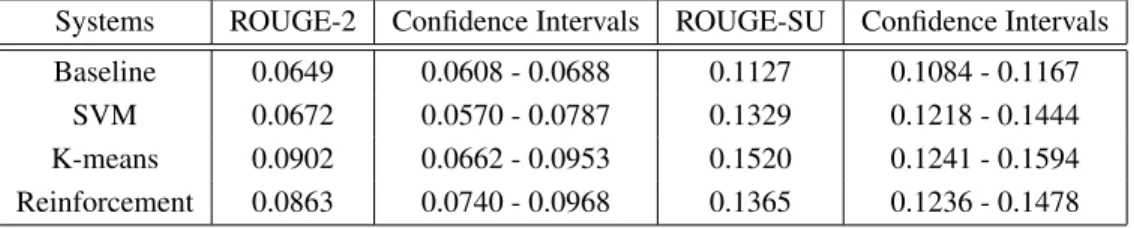
2.4 Performance comparison: F-Score with confidence intervals . . . 48
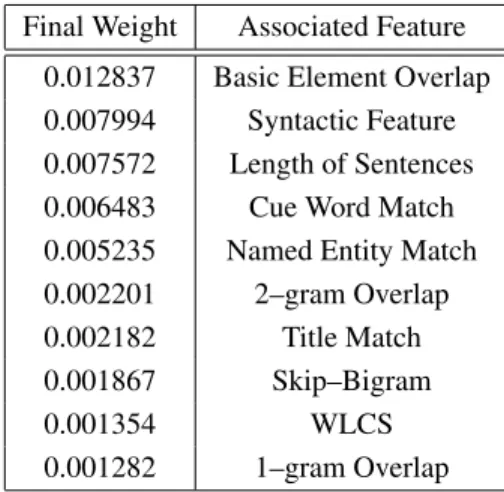
2.5 Average linguistic quality and overall responsiveness scores for all systems 49 2.6 Effective features . . . 50
2.7 Performance comparison: F-Scores . . . 52
2.8 95% confidence intervals for different systems . . . 52
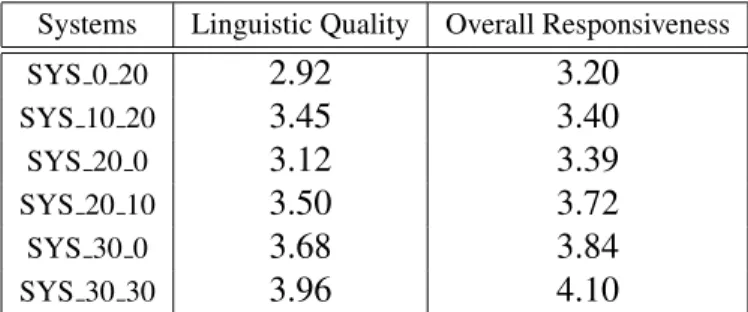
2.9 Linguistic quality and responsiveness scores . . . 53
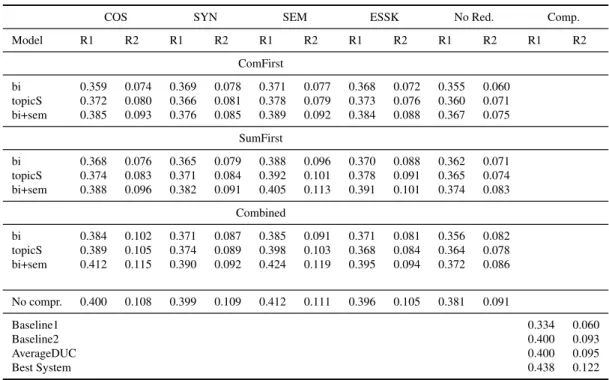
3.1 Automatic Evaluation Results: Average ROUGE F-scores . . . 73
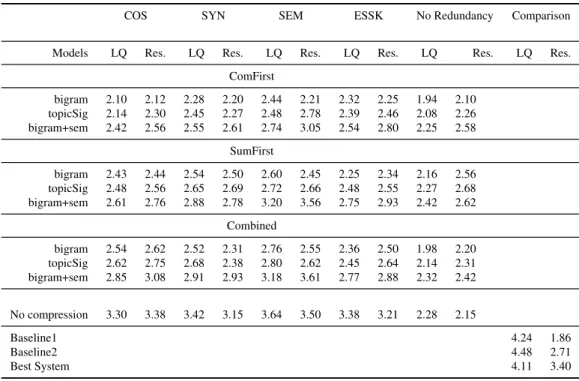
3.2 Average linguistic quality (LQ) and responsiveness scores (Res.) . . . 75
4.1 ROUGE measures for TF*IDF system . . . 98
4.2 ROUGE measures for SYN system . . . 98
4.3 ROUGE measures for SEM system . . . 98
4.4 ROUGE measures for SYNSEM . . . 99
4.5 ROUGE measures for ESSK system . . . 99
4.6 ROUGE F-scores for systems . . . 100
4.7 95% confidence intervals for different systems . . . 100
4.8 Modified pyramid scores for all systems . . . 101
4.9 Linguistic quality and responsive scores for all systems . . . 102
4.10 ROUGE-1 measures . . . 111
4.11 ROUGE-2 measures . . . 111
4.12 ROUGE-SU measures . . . 111
4.13 ROUGE F-scores for different systems . . . 112
4.14 95% confidence intervals for different systems . . . 112
4.15 Comparison with DUC-2006 systems . . . 113
4.16 Linguistic quality and responsiveness scores (TAC-2010 data) . . . 113
4.17 Linguistic quality and responsiveness scores (DUC-2006 data) . . . 114
5.1 Linguistic quality and responsiveness scores (average) for SVM . . . 127
5.2 Examples of good and bad decompositions . . . 128
5.3 ROUGE measures for SVM . . . 129
5.4 Comparison of different systems . . . 129
6.1 Example basic question rules . . . 140
6.2 Semantic roles with possible question words . . . 141
6.3 Topic relevance and syntactic correctness scores . . . 147
6.4 Acceptability of the questions (in %) . . . 148
6.5 Topic relevance and syntactic correctness scores (narrowed focus) . . . 148
List of Figures
2.1 Reinforcement learning framework . . . 28
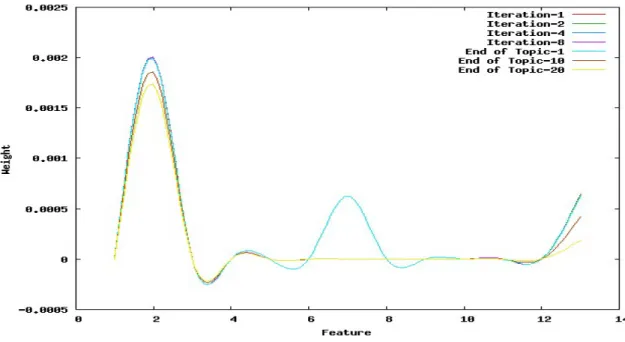
2.2 Effect of user feedback on feature weights . . . 54
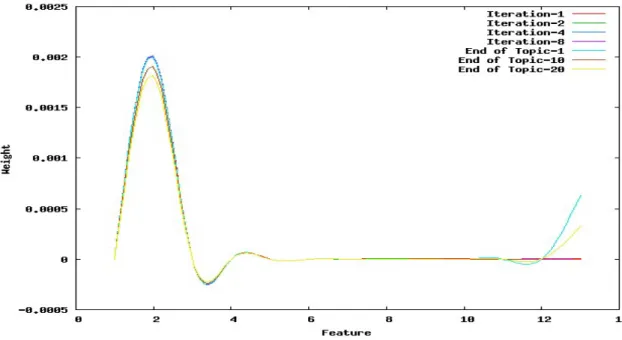
2.3 Effect of fully automatic learning on feature weights . . . 55
4.1 LexRank similarity . . . 84
4.2 Example of semantic trees . . . 89
4.3 Two STs composing a STN . . . 90
4.4 (a) An example tree (b) The sub-trees of the NP covering “the press”. . . . 90
4.5 Semantic tree with some of its fragments . . . 93
4.6 The overall architecture of our approaches . . . 104
4.7 Important aspects with random walk model . . . 109
5.1 Overview of our work . . . 120
5.2 Effect ofCon SVM’s testing accuracy . . . 126
Chapter 1
Introduction
1.1
Focus
This thesis is concerned with automatic answering of complex questions. Specifically, we focus on answering such complex questions that are essentially broader information requests about a certain topic. These are the questions whose answers need to be obtained from pieces of information scattered in multiple documents. For example, consider the following question:
Describe steps taken and worldwide reaction prior to the introduction of the Euro on January 1, 1999. Include predictions and expectations reported in the press.
This question is clearly requesting an elaboration about the topic “Introduction of the Euro”, which can be answered by inferencing and synthesizing information from multiple documents. For example, an ideal expected answer (human-generated) to this question is as follows:
Most predictions prior to introduction of the euro on Jan. 1, 1999 were positive. By early 1996 a majority of Europeans accepted the idea and France’s Prime Minister was strongly supportive. By 1997 most British commentary was favorable. In Germany the Bundesbank predicted that private investors would profit. Bank officials as far away as Zambia saw benefits. By 1998 the Chinese government had officially welcomed coming of the euro and the European Central Bank President predicted that the euro would eventu-ally rival the dollar. Design of the euro note began in 1996. In 1998 the test printing of banknotes began and Germany minted some euro coins. By the end of the year Germany was still experimenting with euro coins but France was in full production followed by Fin-land, Belgium and Spain. In May 1998 two major banks began quoting prices in euros. In
October Bulgaria linked its currency, the lev, to the German mark, followed in December by fixing the value of the lev to the euro. In September key euro indicators were offered daily on the internet and in October Thailand announced that it was considering use of the euro in its foreign reserves. In November the Reserve Bank of India permitted bank transactions in euros followed in December by Romania’s posting the euro in its rates of exchange. Small independent countries such as Monaco still faced some currency problems as Jan. 1, 1999 approached, but special arrangements were in process by European Union authorities.
From this example, it is clearly visible that the kind of complex questions we are deal-ing with in this thesis certainly cannot be answered by a sdeal-ingle entity or a sdeal-ingle sentence rather a query-focused summary of the source documents can essentially serve the purpose (Chali, Joty, and Hasan, 2009). This means that in contrast to complex questions there is obviously another category of questions, that can be termed assimplequestions. For exam-ple, the question:“Who is the president of Bangladesh?” asks for a person’s name. Again, the question: “Which countries has Pope John Paul II visited?” is a sample of a list ques-tion asking only for a list of small snippets of text. These quesques-tions are easier to answer as they require a single entity or a single sentence or small snippets of texts as the answers. On the other hand, as noted before, complex questions (such as for example, “How was Japan affected by the earthquake?”) suggest that the inquirer is looking for information in the context of a wider perspective and hence, answering such questions requires selecting important snippets of information from different parts of the document collection and syn-thesizing them. It is important to note that there are other possible ways of being acomplex
question apart from our definition of complex questions. For instance, double-questions
(e.g. “How old was Mozart when he died?”, “Who was the US president during the first World War?”, “How high is the highest US mountain?”) are a completely different type of complex questions that also need complex analysis of the document to answer them.
These questions fall outside the scope of this thesis and should be an attractive subject for exploration in the future.
The experiments and evaluations conducted in this thesis are mainly influenced by the specific scenario proposed by the Document Understanding Conference (DUC1) (2005-2007) tasks. DUC has been conducted by the National Institute of Standards and Technol-ogy (NIST) since 2001. Although its vision was to progress in automatic text summariza-tion, the query-focused summarization task proposed in DUC (2005-2007) was appropriate to simulate our complex question answering experiments. The query-focused summariza-tion task was proposed to model a real-world complex quessummariza-tion answering problem, in which a question cannot be answered by simply stating a name, date, quantity, etc. The task provided a simplification of real tasks with the assumption that a set of relevant docu-ments containing the answer to the complex question are already given. It would be of our future interest to see how our proposed methods work on a document pool of lower quality. The DUC corpus is used for most of our experiments, which is comprised of newswire articles collected from several notable news agencies (e.g. the Associated Press, New York Times, Xinhua News Agency etc.). Specific descriptions of the corpora used in different experiments are presented in the later chapters of the thesis.
1.2
Background
We live in an information age now, where all kinds of information is easily accessible through the Internet. The increasing demand for access to different types of information available online have actually led researchers to an interest in a broad range of Informa-tion Retrieval (IR) related areas such as quesInforma-tion answering, topic detecInforma-tion and tracking, summarization, multimedia retrieval, chemical and biological informatics, text structuring,
and text mining. The traditional document retrieval systems cannot satisfy the end-users’ information need to have more direct access into relevant documents. Question Answering (QA) systems can address this challenge effectively (Strzalkowski and Harabagiu, 2008) and for this reason, QA has received immense attention from the information retrieval, in-formation extraction, machine learning, and natural language processing communities in the last 15 years (Hirschman and Gaizauskas, 2001).
The main goal of QA systems is to retrieve relevant answers to natural language ques-tions from a collection of documents rather than employing keyword matching techniques to extract documents. A popular QA system in Korea, the Korean Naver’s Knowledge iN search2, allows users to ask almost any question and get answers from other users (Chali, Joty, and Hasan, 2009). Another widely known QA service is Yahoo! Answers3 which is a community-driven knowledge market website launched by Yahoo!. As of December 2009, Yahoo! Answers had 200 million users worldwide and more than 1 billion answers4. Furthermore, Google launched a QA system5 in April 2002 that was based on paid edi-tors. However, the system was closed in December 2006. The main limitation of these QA systems is that they rely on human expertise to help provide the answers.
Automated QA research focuses on how to respond with exact answers to a wide va-riety of questions including: factoid, list, definition, how, why, hypothetical, semantically-constrained, and cross-lingual questions. Current QA systems have been significantly ad-vanced in demonstrating finer abilities to answer simple factoid and list questions (Moldovan, Clark, and Bowden, 2007). For example, START6, the world’s first Web-based question an-swering system, can effectively answer millions of English questions about places, movies,
2http://kin.naver.com/ 3http://answers.yahoo.com/ 4 http://yanswersblog.com/index.php/archives/2009/12/14/yahoo-answers-hits-200-million-visitors-worldwide/ 5http://answers.google.com/ 6http://start.csail.mit.edu/
people etc. Another well-known intelligent QA system is IBM’s Watson7, which is capable of answering natural language questions and is specifically developed to answer questions on the popular quiz showJeopardy!.
Researchers’ interest in developing natural language QA systems is not new. Simmons (1965) have surveyed a considerable number of English language QA systems developed between 1960 and 1965. A substantial amount of research has been conducted between the period of 1970 and 1990 in order to develop different types of QA systems that could be categorized as natural language database systems, dialogue systems, and reading compre-hension systems (Greenwood, 2005). After that, researchers focused on answering simple factoid questions (e.g. When was Barack Obama born?,In what year did Canada become an independent country?) (Hirschman and Gaizauskas, 2001). One of the pioneer sys-tems designed for open-domain factoid question answering was MURAX (Kupiec, 1993), which was built to draw answers to factoid questions from an on-line encyclopedia. There is a shift in research trend from answering simple factoid questions towards more com-plex type of questions such as definitional (e.g. What is an adjective?), list (e.g. List the provinces of Canada), scenario-based (i.e. extracting answers from a given scenario de-scription to questions based on the scenario), and why-type questions (e.g. Why is the sky blue?) (Wang, 2006). In 1999, an annual QA evaluation track8was introduced at the Text Retrieval Conference (TREC), which caused a huge acceleration in QA research (Voorhees, 1999). The success of the TREC QA track led to the introduction of multilingual and cross-lingual QA tracks in the Conference and Labs of the Evaluation Forum (CLEF9) and NII Test Collection for IR Systems (NTCIR10) workshops.
The main goal of the TREC QA track was to promote research on systems that can retrieve exact answers rather than documents corresponding to a question. Initially, the
7http://www-03.ibm.com/innovation/us/watson/ 8http://trec.nist.gov/data/qamain.html
9http://www.clef-initiative.eu
TREC-8 (1999) and TREC-9 (2000) QA tracks solely focused on simple factoid question answering (e.g. Who is the author of the book, “The Iron Lady: A Biography of Margaret Thatcher”?, What was the name of the first Russian astronaut to do a spacewalk?). Along with the main task (i.e., factoid question answering), the TREC-2001 QA track introduced an additional task called the list task. In the list task11, the questions asked for a certain number of instances to extract and the answers to the questions included an unordered list of those items (e.g. Name 20 countries that produce coffee.). The TREC-2002 QA track continued the same tasks as TREC-2001 wheres the main task of the TREC-2003 QA track included factoid, definitional and list type questions with the introduction of a new task called thepassages task. The TREC-2004 QA track provided a target text and a series of factoid, list and other question types were asked about the target. The TREC-2005 QA track consisted of three tasks: 1) main task (same as 2004), 2) document ranking task (to return a ranked list of at most 1000 documents in response to a selected set of questions from the main task), and 3) relationship task12 (same as the 2004 AQUAINT Relationship QA Pilot13where TREC-like topic statements (e.g. The analyst is looking for links between Colombian businessmen and paramilitary forces. Specifically, the analyst would like to know of evidence that business interests in Colombia are still funding the AUC paramilitary organization.) were given to establish a context, and then, the task was to respond with a set of information nuggets as evidence for the answer). The main task of the TREC-2006 QA track was the same as 2005 with an additionally proposed task called thecomplex interactive QA task14to address more complex information needs in an interactive manner. Here, the termcomplexin thecomplex interactive QA taskdenoted an information need called “topic” that consisted of a template (to provide the question in a canonical form) and a narrative (to provide additional context). An example topic is shown
11http://trec.nist.gov/data/qa/2001 qadata/list task.html 12http://trec.nist.gov/data/qa/2005 qadata/qa.05.guidelines.html
13http://trec.nist.gov/data/qa/add QAresources/README.relationship.txt 14http://www.umiacs.umd.edu/˜jimmylin/ciqa/
below:
<topic num="26"> <template id="1">
What evidence is there for transport of [smuggled VCDs] from [Hong Kong] to [China]? </template>
<narrative>
The analyst is particularly interested in knowing the volume of smuggled VCDs and also the ruses used by smugglers to hide their efforts. </narrative>
</topic>
Given the topic, the QA system was supposed to respond with a set of information nuggets that provides evidence for the answer (similar to the TREC-2005 relationship QA task). The terminteractive provided an opportunity that for each topic in consideration, a human assessor could interact with the system for five minutes. The TREC-2007 QA track continued the same tasks as TREC-2006 with a difference that in the complex interactive QA (ciQA) task, questions were asked over both blog documents and newswire articles15. For a deeper survey of other related question answering systems, interested readers should consider the articles by Simmons (1965), Greenwood (2005), Wang (2006), and Hirschman and Gaizauskas (2001).
From the above discussion, we can see how the research in question answering moved beyond simple factoid question answering towards addressing more complex information needs. As noted before, complex type of questions (specially those that are addressed in this thesis) typically focus on an issue that often relates to multiple entities, events and their complex relations. In fact, a complex question might ask about events, biographies, defini-tions, descripdefini-tions, or reasons (Chali, Joty, and Hasan, 2009). Researchers have shown that
multi-document summarization techniques can be applied to treat these questions success-fully (Chali, Hasan, and Joty, 2011; Chali, Joty, and Hasan, 2009; Harabagiu, Lacatusu, and Hickl, 2006), where the goal is to form a summary of the given document collection in response to the complex information request.
Multi-document summarization is a technique to describe the information of a doc-ument collection in a concise manner (Wan, Yang, and Xiao, 2007a). Some web-based systems are already utilizing the potential of this technology. For example, Google News16 and the Newsblaster17 system automatically collect, cluster, categorize, and summarize news from several sites on the web, and help users find news of their interest. In the last decade, complex questions have received much attention from both the Question Answer-ing (QA) and Multi-document Summarization (MDS) communities (Carbonell et al., 2000) as there is a significant synergy between text summarization and question answering sys-tems. Summarization is a process of condensing multiple source texts into one shorter version in response to complex questions, while Question Answering provides a means for focus in query-oriented summarization. As complex questions cannot be answered us-ing the same techniques that have successfully been applied to the answerus-ing of “factoid” questions, multi-document summarization techniques are applied to accomplish this task. Thus we focus more on the summarization aspects. The Information Retrieval phase for Question Answering falls outside the scope of this work. Therefore, in order to provide a simplification of real tasks we assume the given set of documents as relevant for the given complex questions.
Complex questions are in reality broader information requests about a topic of user’s interest. Such requests could be addressed by traditional, TREC-style information retrieval techniques (e.g. by trying to retrieve only the sentence or a block of the target document that seems important). Typically, complex QA evaluation systems including the
TREC-16http://news.google.com
2004 AQUAINT Relationship QA Pilot, the TREC-2005 Relationship QA Task, and the TREC definition return unstructured lists of candidate answers in response to a complex question. However, such an approach would not necessarily provide an exact answer to the complex question as the user would have desired. To address this challenge, the DUC (2005-2007) MDS evaluations task systems with returning paragraph-length answers to complex questions that are responsive, relevant, and coherent. This way of complex ques-tion answering in the form of a query-focused multi-document summarizaques-tion task is useful in the domain of document management and search systems. For example, it can provide personalized news services for different users according to the users’ unique information need (Wan and Xiao, 2009). Moreover, users can obtain the news about a single event from different sources in the form of a summary containing multiple perspectives at the same time.
Research in the domain of automatic summarization has been carried out over the years. According to Mani (2001), automatic text summarization takes a partially-structured source text from multiple texts written about the same topic, extracts information content from it, and presents the most important content to the user in a manner sensitive to the user’s needs. Although search engines do a remarkable job in searching through a heap of information, they have certain limitations like the TREC-style document retrieval systems. For example, if we ask for the impact of the current global financial crisis in different parts of the world, we can expect to sift through thousands of results for the answer. The process of getting a desired answer to a complex question would speed up considerably when the summary of the given documents is also available. Hence, the technology of automatic summarization is critical in dealing with this kind of problems.
The automatic text summarization task can be categorized into three types: Generic vs. Query-Oriented, Abstractive vs. Extractive, and Single vs. Multi-Document. A generic summary must contain the core information present in the document. The most notable
approaches to generic summarization have been introduced by Hovy and Lin (1998), Zha (2002), Gong and Liu (2001), and Lee et al. (2009). While a generic summary includes information which is central to the source documents, a query-oriented summary should formulate an answer to the query. In recent years, the attention of the researchers has shifted from generic summarization toward query-based summarization (Nastase, 2008; Daum´e III and Marcu, 2006; Wan, Yang, and Xiao, 2007b; Wan and Xiao, 2009; Conroy, Schlesinger, and O’Leary, 2006; Chali, Joty, and Hasan, 2009; Chali, Hasan, and Imam, 2012a).
An extract summary consists of sentences extracted from the document while an ab-stract summary may employ words and phrases that do not appear in the original document (Mani and Maybury, 1999). Abstract summarization involves understanding an article and then selecting the key points. Existing research has tried to emulate the human approach to the task with little success as several complicated factors such as word sense and gram-matical structure have to be taken into consideration. The abstract summary that has all the characteristics of a good summary is the ultimate goal of automatic text summarization (Genest and Lapalme, 2012). On the other hand, extract summarization involves assigning scores to the original source sentences using some method and then picking the top-ranked sentences for the summary. Although this kind of summary may not be necessarily smooth or fluent, extractive summarization is currently a general practice among the automatic text summarization researchers for its simplicity (Edmundson, 1969; Kupiec, Pedersen, and Chen, 1995; Carbonell and Goldstein, 1998; Lin, 2003; Martins and Smith, 2009; Berg-Kirkpatrick, Gillick, and Klein, 2011).
The process of summarizing one document is termed as single document summariza-tion whereas in multi-document summarizasummariza-tion, multiple documents related to one main topic are used as sources. Single document summarization is useful in many situations such as summarizing e-mails, news articles or creating abstract of scientific research
pa-pers (Das and Martins, 2007; Kupiec, Pedersen, and Chen, 1995; Lin and Hovy, 1997; Lin, 1999; Conroy and O’Leary, 2001; Osborne, 2002; Hirao et al., 2002a; Hirao et al., 2002c). Currently, multi-document summarization is of greater interest since the amount of information present in the web is becoming huge (Hirao et al., 2003; Wan and Xiao, 2009; Chali, Joty, and Hasan, 2009; Chali, Hasan, and Imam, 2012a).
The automatic text summarization area has gone through several changes with the de-velopment of techniques and requirements since the year 1950. Typically, summariza-tion approaches can be divided into three categories: Knowledge-based Methods, Classical Methods, and Modern Methods.
It is always desirable to emulate the process of summarization as humans do it. To ac-complish the summarization task automatically the machine needs to understand the source texts, pick out the important points and generate sentences from these points. The whole approach relies on both natural language understanding and generation. These methods are termed as knowledge-based methods (Ferrier, 2001). McKeown and Radev (1995) have proposed such a system for summarizing multiple news articles on the same event. Their system works on sets of templates, which is built on the inherent important facts of the input text. The system is comprised of two major units: a content planner and a linguistic component. The content planner’s function is to generate a conceptual representation of the input whereas the linguistic component organizes a selection of words to refer to the concepts using the lexical knowledge of English. This type of summarization is pretty hard for the machine to perform because they have to characterize a source text as a whole, and capture its important content. Hence, other methods have also been investigated in order to produce automatic summaries.
The methods that started the automatic text summarization research can be termed as the classical methods. Being motivated by the need to deal with the information over-load problem, one of the first to perform such research was Luhn (1958). He used simple
statistical techniques to determine the most significant sentences of a document. These sentences were then extracted from the text and printed out together to form the summary. Methods to find features of the input text have been developed since Luhn’s work. Ed-mundson (1969) weighted sentences based on four different methods: cue phrase, keyword (i.e., term frequency based), location, and title. These early ground-breaking systems acted as the pioneers to the modern summarization systems.
The field of automatic text summarization has received immense attention from the researchers in the recent years. The vast increase of information in the web has acted as a fuel for this. The most notable modern methods of automatic summarization are as follows. The graph-based methods, such as LexRank (Erkan and Radev, 2004) and TextRank (Mihalcea and Tarau, 2004), are applied successfully to generic, multi-document summa-rization. Erkan and Radev (2004) used the concept of graph-based centrality to rank a set of sentences for producing generic multi-document summaries. A similarity graph is produced for the sentences in the document collection. In the graph each node represents a sentence. An edge between two nodes measures the cosine similarity between the re-spective pair of sentences. The degree of a given node is an indication of how important the sentence is. A topic-sensitive LexRank is proposed in Otterbacher, Erkan, and Radev (2005). In this method, a sentence is mapped to a vector in which each element repre-sents the occurrence frequency (TF*IDF) of a word. However, the major limitation of the TF*IDF approach is that it only retains the frequency of the words and does not take into account the sequence, syntactic and semantic structure, thus cannot distinguish between “The hero killed the villain” and “The villain killed the hero”.
Latent Semantic Analysis (LSA) (Deerwester et al., 1990) based summarization meth-ods were introduced in the 90s. LSA is a fully automatic statistical technique to extract and infer relations of expected contextual usage of words in passages of discourse. The first step towards the application of LSA is to represent a document as a document-term matrix
A, such that each row of matrix stands for a unique word present in the document and each column stands for a sentence. Each entryAi jrepresents the frequency of termiin document j. Gong and Liu (2001) have proposed a scheme for automatic text summarization using LSA. Their approach classifies the document into different topics and picks the dominant sentence from each dominant topic sequentially until the summary length is reached.
Summarization models based on lexical chains were proposed in the late 90s. A lexical chain is a sequence of related words in the text, spanning short (adjacent words or sen-tences) or long distances (entire text). A chain is independent of the grammatical structure of the text and in effect it is a list of words that captures a portion of the cohesive structure of the text. Computing the lexical chains in a document is one technique that can be used to identify the central theme of a document. This in turn leads to the identification of the key section(s) of the document which can then be used for summarization purposes. The summarization systems based on lexical chains first extract the nouns, compound nouns and named entities as candidate words (Barzilay and Elhadad, 1997; Kolla, 2004; Li et al., 2007). The systems rank sentences using a formula that involves a) the lexical chains, b) keywords from query and c) named entities. For example, Li et al. (2007) used the following formula:
Score=αP(chain) +βP(query) +γP(namedEntity)
whereP(chain)is the sum of the scores of the chains whose words come from the candi-date sentence,P(query) is the sum of the co-occurrences of key words in a topic and the sentence, and P(namedEntity) is the number of named entities existing in both the topic and the sentence. The three coefficientsα,βandγare set empirically. Then the top ranked
sentences are selected to form the summary.
QA based summarization received huge attention from the researchers in the last decade. Typically, in a summarization system that is based on a question answering system (Molla and Wan, 2006), the topic sentences are converted to a sequence of questions as the
un-derlined QA system is designed to answer only simple (i.e. factoid, list) questions. The QA system normalizes and classifies the questions, and finds the candidate answers along with the sentences in which the answers appeared. Instead of extracting the exact terms as answers, the systems extract the sentences for each of the questions in the topic to form the summary.
The idea of discourse-based summarization was first presented by Mann and Thomp-son (1988). They have argued that discourse structures of texts can be used effectively in summarization. Marcu (1998b) has proved this hypothesis by showing the role of text structures in selecting the most important sentences for the summary. He has proposed a discourse-based summarization approach that uses rhetorical parsing to derive the inherent text structure. Based on this structure, an importance score is assigned to each sentence in the text and the top p% sentences are selected to form a summary of the given text.
Machine Learning (ML) can be applied successfully for the task of summarization. The main goal of ML research is to design and develop algorithms and techniques such that computers can learn from data automatically. For the task of summarization, it is nec-essary to learn which part of the given source documents are the most relevant to be con-sidered as the summary. In the 1990s, researchers have focused on employing statistical techniques for extractive single document summarization (Das and Martins, 2007). Most of these systems assumed feature independence while relying on the naive-Bayes methods (Kupiec, Pedersen, and Chen, 1995). Some other approaches were based on the choice of appropriate features while learning algorithms that make no independence assumptions (Lin and Hovy, 1997; Lin, 1999). Other significant approaches involved hidden Markov models and log-linear models to improve extractive summarization (Conroy and O’Leary, 2001; Osborne, 2002). Single document summarization systems using Support Vector Ma-chines (SVMs) demonstrated good performance for both Japanese (Hirao et al., 2002a) and English documents (Hirao et al., 2002c). Hirao et al. (2003) showed the effectiveness of
their multiple document summarization system employing SVMs for sentence extraction. Conroy and O’Leary (2001) used two kinds of states, where one kind corresponds to the summary states and the other corresponds to non-summary states. The motivation of ap-plying CRF in text summarization came from observations on how humans summarize a document by posing the problem as a sequence labeling problem (Shen et al., 2007). The statistical technique such as Maximum Entropy (MaxEnt) works in a way that assumes nothing about the information of which it has no prior knowledge (Ferrier, 2001). Joty (2008) experimented with both empirical and unsupervised machine learning approaches (K-means and Expectation Maximization (EM) algorithms) to summarize texts. Hasan (2010) focused on query-oriented, extractive, multi-document summarization in order to combat the complex question answering problem by applying supervised machine learning techniques: Support Vector Machines (SVM), Hidden Markov Models (HMM), Condi-tional Random Fields (CRF), and Maximum Entropy (MaxEnt). As supervised systems rely on learning from a vast amount of labeled data, five automatic annotation techniques have been proposed using different textual similarity measurement techniques: ROUGE similarity measure (Lin, 2004), Basic Element (BE) overlap (Hovy et al., 2006), syntactic similarity measure (Moschitti and Basili, 2006), semantic similarity measure (Moschitti et al., 2007), and Extended String Subsequence Kernel (ESSK) (Hirao et al., 2003).
The other notable summarization systems are based on optimization techniques that perform integer linear programming formulations to the summarization task (McDonald, 2007; Gillick and Favre, 2009; Martins and Smith, 2009; Galanis, Lampouras, and An-droutsopoulos, 2012). There are also some approaches that use the potential of sentence compression technology for the task of summarization (Madnani et al., 2007; Martins and Smith, 2009; Berg-Kirkpatrick, Gillick, and Klein, 2011).
All these researches described above have motivated us to focus on the task of answer-ing complex questions with the intention to minimize several existanswer-ing gaps in the literature.
1.3
Contribution
This thesis contributes to the domain of complex question answering in the following ways:
Reinforcement Learning Formulation: As the major limitation of the available search systems is that they lack a way of measuring whether a user is satisfied with the infor-mation provided, this has motivated us to propose a reinforcement learning formulation to the complex question answering problem. Given a set of complex questions, a list of relevant documents per question, and the corresponding human generated summaries (i.e. answers to the questions) as training data, our reinforcement learning module iteratively learns a number of feature weights in order to facilitate the automatic generation of sum-maries i.e. answers to previously unseen complex questions. A reward function is used to measure the similarities between the candidate (machine generated) summary sentences and the abstract summaries. In the training stage, the learner iteratively selects the im-portant document sentences to be included in the candidate summary, analyzes the reward function and updates the related feature weights accordingly. The final weights are used to generate summaries as answers to unseen complex questions in the testing stage (Chali, Hasan, and Imam, 2011a). We have also effectively incorporated user interaction into the reinforcement learner to guide the candidate summary sentence selection process (Chali, Hasan, and Imam, 2012a).
Integer Linear Programming Formulation: The answer to the complex question must satisfy the requesting user the most. There might be several answers to the same ques-tion. It is desirable to identify an effective way in which one can tell which combination of the document sentences can fully satisfy the quest of the user. The use of optimization techniques can essentially serve this purpose. Therefore, we have formulated the com-plex question answering task using Integer Linear Programming (ILP) in a query-focused multi-document summarization setting. Sentence compression is a useful technique to
dis-card redundant information in a sentence while keeping the most important information. Hence, we have applied sentence compression models for the task of query-focused multi-document summarization in order to investigate if sentence compression improves the over-all summarization performance. Both compression and summarization are considered as global optimization problems and solved using ILP. Sentence compression models include lexical, syntactic and semantic constraints while summarization models include relevance, redundancy and length constraints. A comprehensive set of query-related and importance-oriented measures are used to define the relevance constraint whereas four alternative re-dundancy constraints are employed based on different sentence similarity measures using a) cosine similarity, b) syntactic similarity, c) semantic similarity, and d) extended string subsequence kernel (ESSK) (Chali and Hasan, 2012a).
Graph-based Random Walk Model with Syntactic and Semantic Information: In our previous two contributions, we have considered a document sentence as important by computing a measure of relevance with respect to the complex question and in terms of its characteristics in the document where it is present. However, there might be a case where a document sentence is not related to the question rather it has a strong inherent similarity with other important sentences in the document. This assumption can be effectively in-corporated into a graph-based random walk model for summarization (Erkan, 2007). The traditional graph-based random walk models use basic similarity functions such as cosine measure in order to assess similarity between the sentences, which cannot capture the syn-tactic and semantic aspects of the sentence pair in consideration. This has motivated us to analyze the impact of syntactic and semantic information in a graph-based random walk method for answering complex questions. Initially, we apply tree kernel functions to per-form the similarity measures between sentences in the random walk framework. Then, we extend our work further to incorporate the Extended String Subsequence Kernel (ESSK) to perform the task in a similar manner. Experimental results show the effectiveness of the use
of kernels to include the syntactic and semantic information for this task (Chali, Hasan, and Joty, 2011; Chali, Hasan, and Imam, 2011c). In another experiment, we have successfully exploited a deeper semantic analysis of the source documents to select important concepts by using a predefined list of important aspects that act as a guide for selecting the most relevant sentences into the summaries (Chali, Hasan, and Imam, 2011b).
Learning Good Decompositions of Complex Questions: Previous works have demon-strated that decomposing a complex question into a series of simple questions and then reusing the techniques developed for answering simple questions is an effective means of answering complex questions. However, no study has developed any method to judge the significance of the decomposed questions by disregarding the fact that good decomposi-tions are the prerequisites for more accurate answers. It is also not feasible to generate a list of good decompositions manually for all possible complex questions in order to guide the sentence selection step. In this thesis, we have addressed this challenge and proposed a supervised approach for automatically learning good decompositions of complex ques-tions (Chali, Hasan, and Imam, 2012b). The training data generation phase mainly builds on three steps to produce a list of simple questions corresponding to a complex question: i) the extraction of the most important sentences from a given set of relevant documents (which contains the answer to a complex question), ii) the simplification of the extracted sentences, and iii) their transformation into questions containing candidate answer terms. Such questions, considered as candidate decompositions, are manually annotated (as good or bad candidates) and used to train a Support Vector Machine (SVM) classifier.
Topic to Question Generation: A complex question often asks about a topic of user’s interest. Therefore, the problem of complex question decomposition closely relates to the problem of topic to question generation. We have addressed the challenge of automatically generating questions from topics (Chali and Hasan, 2012c) in order to enhance the scope of our problem domain. For example, given the topic“Apple Inc. Logos”, we generated
questions such as“What is Apple Inc.?”,“Where is Apple Inc. located?”,“Who designed Apple’s Logo?” etc. To simplify our task, we consider that each topic is associated with a body of texts containing useful information about the topic. Questions are generated by exploiting the named entity information and the predicate argument structures of the sen-tences present in the body of texts. To measure the importance of the generated questions, we use Latent Dirichlet Allocation (LDA) to identify the sub-topics (which are closely related to the original topic) in the given body of texts and apply the Extended String Sub-sequence Kernel (ESSK) to calculate their similarity with the questions. We use syntactic tree kernels for computing the syntactic correctness of the questions. The questions are ranked by considering their importance (in the context of the given body of texts) and syn-tactic correctness.
1.4
Thesis Outline
We give a chapter-by-chapter outline of the remainder of this thesis in this section.
Chapter 2: We give a detailed description of our reinforcement learning formulation for the complex question answering task.
Chapter 3: We provide a general review of the works performed previously with sen-tence compression for summarization. Then we present our ILP-based sensen-tence compres-sion models for the query-focused multi-document summarization task, and discuss our experiments and results.
Chapter 4: We take a closer look at the graph-based random walk model that was suc-cessful for the complex question answering task and then describe our improvements to the model by incorporating syntactic and semantic information.
Chapter 5: We discuss our approach for learning good decompositions of complex ques-tions and present the evaluation results.
Chapter 6: We present our topic to question generation approach, and show the experi-mental results.
Chapter 7: We conclude the thesis by identifying some future directions of our research.
1.5
Published Work
Most of the materials presented in this thesis has been previously published. Chapter 2 to Chapter 6 expands on the materials published in Chali and Hasan (2012a, 2012b, 2012c), Chali, Hasan, and Imam (2012a, 2012b, 2011a, 2011b, 2011c), Chali, Hasan, and Joty (2011), and Ali, Chali and Hasan (2010) .
Chapter 2
Complex Question Answering using Reinforcement
Learning
2.1
Introduction
The major limitation of the available search systems is that they lack a way of measuring whether a user is satisfied with the information provided. Measurement of user satisfaction in real time is a crucial component of the search systems since it can provide a direction to-wards improvement of the search policy dynamically. User satisfaction can be observed by monitoring user actions (e.g., clicking, copy-pasting, printing, saving, emailing) after the search results are presented. A user study can reveal the relationship between user satisfac-tion and retrieval effectiveness (Al-Maskari, Sanderson, and Clough, 2007). For example, Zaragoza, Cambazoglu, and Baeza-Yates (2010) performed a quantitative analysis about what fraction of the web search queries (posed to the current search engines) can lead to satisfactory results.
Computation of user satisfaction, as well as improvement to the search policy, is a dif-ficult task to perform in real time. This motivates us to propose a reinforcement learning formulation to the complex question answering task so that the system can learn from user interaction to improve its accuracy according to user’s information need. Formally, the complex question answering problem can be mapped to a reinforcement learning frame-work as follows: given a set of complex questions, a collection of relevant documents per question, and the corresponding human-generated summaries (i.e. answers to the ques-tions), a reinforcement learning model can be trained to extract the most important sen-tences to form summaries (Chali, Hasan, and Imam, 2011a). During the learning stage, for simplicity, we assume that initially there is no actual user interaction provided to the
system rather the importance of a candidate document sentence can be verified by measur-ing its similarity with the given human-made abstract summary sentences usmeasur-ing a reward function. This assumption relies on the intuition that the users are fully satisfied with the abstract summaries. The original document sentences that are mostly similar to the abstract summary sentences are assigned good reward values. Using an appropriate reward function is essential in reinforcement learning since the learner is not actually aware of which ac-tions (sentence selectionin our case) to take, rather it must discover which actions deliver the most reward value by trying them (Sutton and Barto, 1998).
As noted before, real-time user interaction can help QA systems evolve by improving their policy automatically as time passes. Toward this end, we treat the complex question answering task as an interactive problem. Supervised learning techniques are alone not ad-equate for learning from interaction (Sutton and Barto, 1998). These techniques require a huge amount of human-annotated training data and it is often impossible to collect training examples of all desired kinds in which the agent has to act. Instead, a reinforcement learn-ing approach can be used to sense the state of the environment and take suitable actions that affect the state. This is why, we believe that a reinforcement learning methodology is appropriate for the complex question answering task. We assume that a small amount of supervision is provided in the form of a reward function that defines the quality of the executed actions. In the training stage, the reinforcement learner repeatedly defines ac-tion sequences, performs the acac-tions, and observes the resulting reward. In this phase, the learner’s main goal is to estimate a policy that maximizes the expected future reward (Branavan et al., 2009).
In this thesis, we present a reinforcement learning framework for answering complex questions. In our initial experiments, we simplify the formulation by considering no real time user interaction as we assume that the human-generated abstract summaries are the gold-standard and the users (if they were involved) are satisfied with them. The proposed
system tries to produce automatic summaries that are close to the abstract summaries. The relationship between these two types of summaries is learned and the final weights are used to output the machine generated summaries for the unseen data. We employ a modi-fied linear, gradient-descent version of Watkins’sQ(λ)algorithm (Sutton and Barto, 1998)
to estimate the parameters of our model. Experiments on the DUC benchmark datasets demonstrate the appropriateness and the effectiveness of the reinforcement learning ap-proach. We also extend this work by proposing a model that incorporates user interaction into the reinforcement learner to guide the candidate summary sentence selection process. Evaluation results indicate that the user interaction component further improves the per-formance of the reinforcement learning framework. In the following sections, we discuss related work, our reinforcement learning formulation, feature space, user interaction mod-eling, and the experiments with results.
2.2
Related Work
We perform the complex question answering task using an extractive multi-document sum-marization approach within a reinforcement learning setting. Extractive sumsum-marization is simpler than abstract summarization as the process involves assigning scores to the given document sentences using some method and then picking the top-ranked sentences for the summary. Although this kind of summary may not be necessarily smooth or fluent, extractive summarization is currently a general practice due to its simplicity (Jezek and Steinberger, 2008). Over the years, various extraction-based techniques have been pro-posed for generic multi-document summarization. In recent years, researchers have be-come more interested in query-focused (i.e. topic-biased) summarization. The leading sys-tems in the DUC1and TAC2tracks focus on the complex question answering task through
1http://duc.nist.gov/pubs.html
multi-document summarization.
Other notable extraction-based summarization systems are as follows. Nastase (2008) expands a query by using the encyclopedic knowledge in Wikipedia and introduce a graph to generate the summary. Daum´e III and Marcu (2006) present BAYESUM (“Bayesian summarization”), a sentence extraction model for query-focused summarization. On the other hand, Wan, Yang, and Xiao (2007b) propose a manifold-ranking method to make uniform use of sentence-to-sentence and sentence-to-topic relationships whereas the use of multi-modality manifold-ranking algorithm is shown in Wan and Xiao (2009). Other than these, topic-focused multi-document summarization using an approximate oracle score has been proposed in Conroy, Schlesinger, and O’Leary (2006) based on the probability dis-tribution of unigrams in human summaries. In our proposed approach, we represent each sentence of a document as a vector of feature-values. We incorporate query-related in-formation into our model by measuring the similarity between each sentence and the user query (i.e. the given complex question). We exploit some features such as title match, length, cue word match, named entity match, and sentence position to measure the im-portance of a sentence. We use a number of features to measure the query-relatedness of a sentence considering n–gram overlap, LCS, WLCS, skip-bigram, exact-word, synonym, hypernym/hyponym, gloss and Basic Element (BE) overlap, and syntactic information (See details in Section 2.6). These features have been adopted from several related works in the problem domain (Chali, Joty, and Hasan, 2009; Edmundson, 1969; Sekine and Nobata, 2001; Litvak, Last, and Friedman, 2010; Schilder and Kondadadi, 2008). We also consid-ered a dynamic feature to lower the redundancy in the extract summary using the Maximal Marginal Relevance (MMR) model (Carbonell and Goldstein, 1998). This feature helps the learner to understand which document sentence is less similar to the sentences that are already present in the candidate answer space (i.e. the current summary pool). We use the relevant novelty metric that was previously shown in Goldstein et al. (2000). This metric
measures relevance and novelty independently and provides a linear combination of them. A document sentence has a higher chance to be selected if it is both relevant to the given query and useful for a summary, while having minimal similarity to the previously selected sentences.
In the field of natural language processing, reinforcement learning has been extensively applied to the problem of dialogue management where the systems converse with a human user by taking actions that emit natural language utterances (Scheffler and Young, 2002; Roy, Pineau, and Thrun, 2000; Litman et al., 2000; Singh et al., 1999; Dethlefs et al., 2012). The state space defined in these systems encodes information about the goals of the user and what they say at each time step. The learning problem is to find an optimal policy that maps states to actions through a trial-and-error process of repeated interaction with the user. Branavan et al. (2009) presented a reinforcement learning approach for mapping natural language instructions to sequences of executable actions.
Our work was the first to propose a reinforcement learning formulation to the prob-lem of complex question answering (Chali, Hasan, and Imam, 2011a). Recently, a related problem of automatic text summarization has been modeled using a reinforcement learning framework by Ryang and Abekawa (2012). Our approach is significantly different from their approach in a number of ways. Their formulation is applicable to generic summariza-tion while our system considers a problem that is a kind of query-focused multi-document summarization. Moreover, the reward function of their model is not designed to take user feedback into account whereas the reward function of our reinforcement learning frame-work is specially designed for considering user feedback as the principle way of improving the search policy in real time.
As noted before, in our first experiment, we do not directly interact with a user making the cost of interaction lower. However, experiments in the complex interactive Question
Answering (ciQA) task3at TREC-2007 demonstrate the significance of user interaction in this domain. The technique of user modeling in an interactive QA system is not new (Hickl and Harabagiu, 2006; Webb and Strzalkowski, 2006; Dethlefs et al., 2012). An adaptive, open-domain, personalized, interactive QA system called YourQA4 is an example of a deployed system where a QA module interacts with a user model and a dialogue interface (Quarteroni and Manandhar, 2009). Motivated by the effect of user interaction shown in the previous studies (Wang et al., 2003; Lin, Madnani, and Dorr, 2010; Sakai and Masuyama, 2004; Yan, Nie, and Li, 2011; Wu, Scholer, and Turpin, 2008; Harabagiu et al., 2005), we propose an extension to our reinforcement learning model by incorporating user interaction into the learner and argue that the user interaction component can provide a positive impact in the candidate summary sentence selection process (Chali, Hasan, and Imam, 2012a).
We compare our system with a SVM-based model. In the field of natural language processing, SVMs are applied to text categorization and syntactic dependency structure analysis. These approaches are reported to have achieved higher accuracy than previous approaches (Joachims, 1998). SVMs were also successfully applied to part–of–speech tagging (Gim´enez and M`arquez, 2003). Single document summarization systems using SVMs demonstrated good performance for both Japanese (Hirao et al., 2002b) and English documents (Hirao et al., 2002d). In (Hirao et al., 2003), they showed effectiveness of their multiple document summarization system employing SVMs for sentence extraction. A fast query-based multi-document summarizer calledFastSum used SVM regression5 to rank the summary sentences where the goal was to estimate the score of a sentence based on a given feature set (Schilder and Kondadadi, 2008). However, our SVM model treats the task as a classification problem where the classifier is trained on data pairs, defined by feature vectors and corresponding class labels. The need for a large amount of data to
3http://www.umiacs.umd.edu/˜jimmylin/ciqa/ 4http://www.cs.york.ac.uk/aig/projects/yourqa/
5Regression tasks tend to estimate the functional dependence of a dependent variable on a set of
train a SVM-based system often makes it harder to use in practice. For this reason, we use an unsupervised summarization model to evaluate our proposed reinforcement system. A k-means clustering algorithm is used to build the unsupervised system (Chali, Joty, and Hasan, 2009).
2.3
Problem Formulation
We formulate the complex question answering problem by estimating an action-value func-tion (Sutton and Barto, 1998). We define the value of taking acfunc-tion a in state s under a policyπ(denotedQπ(s,a)) as the expected return starting froms, taking the actiona, and
thereafter following policyπ:
Qπ(s,a) = E π{Rt|st=s,at =a} = Eπ ( ∞
∑
k=0 γkrt+k+1|st=s,at =a ) (2.1)Here, Eπ denotes the expected value given that the agent follows policy π, Rt is the expected returnthat is defined as a function of the reward sequence,rt+1,rt+2,· · ·, wherert
is the numerical reward that the agent receives at time step,t. We callQπ the action-value function for policy π. γ stands for the discount factor that determines the importance of
future rewards. We try to find out the optimal policy through policy iteration. Once we get the optimal policy (π∗) the agent chooses the actions using the Maximum Expected Utility
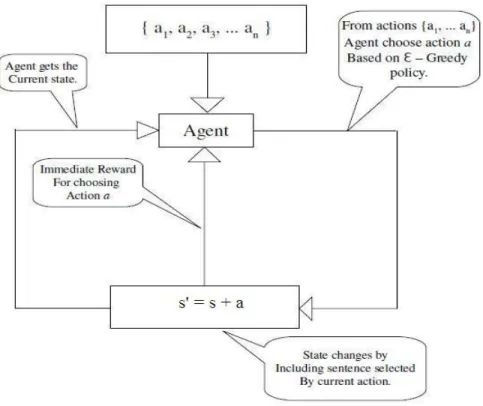
Principle (Russell and Norvig, 2003). We show our reinforcement learning framework in Figure 2.1.
Figure 2.1: Reinforcement learning framework
2.3.1
Environment, State & Actions
Given a complex questionqand a collection of relevant documentsD={d1,d2,d3, . . . ,dn},
the task is to find an answer (extract summary). The stateis defined by the current status of the answer pool. Initially, there is no sentence in the answer pool, i.e., the initial state
s0 is empty. In each iteration, a sentence from the given document collection is selected and added to the answer pool that in turn changes the current state. The environment is described by the state space. In each state, there is a possible set of actions that could be operated on the environment where a certainactiondenotesselecting a particular sentence
(using the policy function of equation 2.1) from the remaining document sentences that are not yet included in the answer pool (i.e. candidate extract summary).
2.3.2
Reward Function
In the training stage of the reinforcement learning framework, for each complex question we are given a relevant document collection along with a set of human generated abstract summaries (see details in Section 2.7.2) as answers to the question. We consider these summaries (i.e. answers) as the gold-standard and assume that the users are satisfied with them. We utilize these summaries to calculate the immediate rewards. In a certain state, after taking an action a (i.e. selecting a sentence), we compute the immediate reward, r
using the following formula:
r=w×relevance(a)−(1−w)×redundancy(a) (2.2)
whererelevance(a)is the textual similarity measure between the selected sentence and the abstract summaries,redundancy(a)is the similarity measure between the selected sen-tence and the current state (that includes the already chosen set of sentences) of the an-swer pool, and w is the weight parameter that denotes the importance of relevance and redundancy. By including redundancy in the immediate reward calculation we discourage redundancy in the final extract summary. In our experiments, the value ofwis kept to 0.5 to provide equal importance to both relevance and redundancy. We measure the textual similarity using ROUGE (Recall-Oriented Understudy for Gisting Evaluation) (Lin, 2004).
2.3.3
Function Approximation
In many tasks such as the one to which we apply reinforcement learning, most of the states encountered will never have been experienced before. This occurs when the state or action spaces include continuous variables. As in our case the number of states and
actions are infinite, the approximate action-value function is represented as a parameterized functional form with parameter vector,~θt. Our approximate action-value function is a linear
function of the parameter vector,~θt. Corresponding to every state-action pair(s,a), there
is a column vector of features, ~ϕs= (ϕs(1),ϕs(2), . . . ,ϕs(n))T with the same number of
components as~θt. The approximate action-value function is given by:
Qt(s,a) =~θtT~ϕs= n
∑
i=1θt(i)ϕs(i) (2.3)
2.3.4
Markov Decision Process (MDP)
Our environment has the Markov property, that is, given the current state and action we can predict the next state and expected reward. For our problem formulation, given the current statesif we take an actiona, the next state will bes0=s+a, since our action is to choose a sentence from the given document collection and adding it into the extract summary pool. Given any state and action,sanda, the transition model is defined by:
ρass0 =Pr n st+1=s 0 |st=s,at =a o (2.4) ρa ss0 will be 1 whens 0
=s+a. For all other states, the transition probability will be 0. Similarly, given any current state and action, sanda, together with any next state, s0, the expected value of the next reward is:
Ra ss0 =E n rt+1|st =s,at=a,st+1=s 0o (2.5)
2.4
Reinforcement Learning
We consider our task as an infinite horizon sequential decision making problem that finds a parameter vector~θto maximizeQ(s,a)from equation 2.3. Policy gradient algorithms tend
to estimate the parameters θ by performing a stochastic gradient ascent. The gradient is
approximated by interacting with the environment, and the resulting reward is used to up-date the estimate ofθ. Policy gradient algorithms optimize a non-convex objective and are
only guaranteed to find a local optimum (Branavan et al., 2009). We use a modified linear, gradient-descent version of Watkins’sQ(λ)algorithm withε-greedy policy to determine the
best possible action i.e. to select the most important sentences. We use theε-greedy policy
(meaning that most of the time this policy chooses an action that has maximal estimated action value, but with probability ε an action is selected at random) to balance between
exploration and exploitation during the training phase. We empirically set the value of
ε=0.1 during our experiments. We note that, 90% of the time our algorithm chooses an
action with the best action-value and 10% of the time it chooses an action randomly. The steps of our reinforcement learning algorithm are shown in Algorithm 1. Here,
ϕ is a vector of feature-values (See details in Section 2.6) that is used to represent each
document sentence and~θis the vector of weights for the feature vector that the system will
learn. γis the discount factor that is used to calculate the reward of a state-action pair. The
discount factor determines the importance of future rewards. We kept the initial value of
γ as 0.1. The value of γ decreases by a factor of iteration counts. As long as the initial
policy selects greedy actions, the algorithm keeps learning the action-value function for the greedy policy. However, when an exploratory action is selected by the behaviour policy, the eligibility traces6for all state-action pairs are set to zero. The eligibility traces are updated in two steps. In the first step, if an exploratory action is taken, they are set to 0 for all state-6An eligibility trace is a temporary record of the occurrence of an event, such as the visiting of a state or
action pairs. Otherwise, the eligibility traces for all state-action pairs are decayed byγλ. In
the second step, the eligibility trace value for the current state-action pair is incremented by 1 while accumulating traces. The original version of the Watkins’sQ(λ)algorithm uses
a linear, gradient-descent function approximation with binary features. However, since we deal with a mixture of real-valued and boolean features (See Section 2.6), we modified the algorithm to induce a different update for the eligibility traces. In the second step of eligibility trace update, we increment the value by the corresponding feature score. The addition of a random jump step avoids the local maximums in our algorithm. The parameter
λdefines how much credit we give to the earlier states. αis the step size parameter for the
gradient descent method that is reduced by a factor of 0.99 as learning converges towards the goal.
To the best of our knowledge, the proposed formulation with the modified version of the Watkins’s Q(λ)algorithm is unique in how it represents the complex question answering
task in the reinforcement learning framework.
2.5
Modeling User Interaction
In the basic reinforcement learning model for answering complex questions (discussed in the previous section), we have a set of possible actions in each state. Note thatstaterefers to the current status (content) of the answer space whileactionrefers tochoosing a candidate sentence. Initially, there is no sentence in the answer pool. So, the initial state is empty. In each iteration, a new sentence is selected7from the document and added to the answer pool that in turn changes the state. We propose an extension to this model and add user interaction in the reinforcement learning loop in order to facilitate the candidate selection process. For a certain number of iterations during the training stage, the user is presented
ALGORITHM 1: Modified Watkins’sQ(λ)algorithm
Input: α,~θ,~e,λ,γ,δ,ϕ,ε, num of