
(will be inserted by the editor)
Evolving spiking neural network – A survey
Received: date / Accepted: date
Abstract This paper provides a comprehensive literature survey on the evolving Spiking Neural Network (eSNN) ar-chitecture since its introduction in 2006 as a further exten-sion of the ECoS paradigm introduced by Kasabov in 1998. We summarize the functioning of the method, discuss sev-eral of its extensions and present a number of applications in which the eSNN method was employed. We focus especially on some proposed extensions that allow the processing of spatio-temporal data and for feature and parameter optimi-sation of eSNN models to achieve better accuracy on clas-sification/prediction problems and to facilitate new knowl-edge discovery. Finally, some open problems are discussed and future directions highlighted.
Keywords Evolving Spiking Neural Network·Evolving Connectionist Systems·spatio-temporal pattern recognition
1 Introduction
Evolving connectionist systems (ECoS) are modular con-nectionist-based systems that evolve their structure and functionality in a continuous, self-organised, on-line, adap-tive, interactive way from incoming information [30–34, 36, 43, 53, 54]. ECoS can learn both data and knowledge in a supervised and/or unsupervised way. They can learn incre-mentally single data items or chunks of data and also in-crementally change their input features [53, 54]. Elements of ECoS have been proposed as part of the classical Neu-ral Network (NN) models [20], such as SOM [45], RBF [3], Fuzzy ARTMap [7], Growing neural gas [16], neuro-fuzzy systems [48], and RAN [56]. Other ECoS models, along with their applications, have been reported in [36, 1, 2, 24, 72, 82]. Here we will briefly illustrate the concepts of ECoS on
two implementations, EFuNN [32] and DENFIS [43] (see also [30, 31, 33, 34, 36, 53, 54].
ECoS learn local models from data through clustering of the data and associating a local output function for each clus-ter represented in a connectionist structure. Clusclus-ters of data are created based on similarity between data samples either in the input space or in both the input and output space. the first case is implemented in some of the ECoS models, e.g., the dynamic evolving neuro-fuzzy inference system DEN-FIS [34, 36, 43], while the second case is part of the EFuNN models [32–34, 36]. Samples that have a distance to an exist-ing node (cluster centre, rule node) less than a certain thresh-old are allocated to the same cluster. Samples that do not fit into existing clusters, form new clusters. Cluster centres are continuously adjusted according to new data samples, and new clusters are created incrementally.
ECoS learn from data and automatically create or up-date a local output function for each cluster, the function being represented in the connection weights, thus creating local models. Different functionalities of ECoS have been introduced and studied in [32–34, 36, 43] such as: on-line or off-line neuron aggregation and pruning; “sleep”-learning; fuzzy rule extraction and rule adaptation (see also [35]); us-ing SVM as local models [46]; evolutionary optimisation of features and parameters of ECoS [35]; and others. Ap-plications of ECoS span across domain areas [34, 36], e.g. bioinformatics (see also [37]); speech and image processing; multimodal audio-visual information processing; ecological modelling; robot control (see also [25]); personalised mod-elling [71, 42]; neuroinformatics and brain study. Software environment Neucom has been developed to include some of the ECoS methods1. A detailed survey on ECoS can be found in [82].
While the classical ECoS uses a simple sigmoid model of a neuron, the further developed evolving spiking neural network (eSNN) architecture uses a spiking neuron model for which similar ECoS principles and applications are ap-plicable. The aim of this paper is to present the current state-of-the-art of the eSNN method first introduced in [90]. In the next section, we present the working principle of eSNN along with all its components. Then, we highlight numerous extensions of the original method, followed by a discussion of notable applications. Finally, we conclude this survey by addressing future research directions of eSNN.
2 Evolving Spiking Neural Network
The desire to better understand the remarkable information processing capabilities of the mammalian brain has recently led to the development of more complex and biologically plausible connectionist models, namely spiking neural net-works (SNN). See e.g. [18] for a comprehensive standard text on the material. These models use trains of spikes as internal information representation rather than continuous variables. Nowadays, many studies attempt to use SNN for practical applications, some of them demonstrating very promis-ing results in solvpromis-ing complex real world problems.
Based on the ECoS methodology, an evolving spiking neural network architecture (eSNN) was proposed in [90, 36] that was initially designed as a visual pattern recogni-tion system. Other studies have utilised eSNN as a general classification method, e.g. in the context of classifying wa-ter and wine samples [70]. The first eSNNs were based on the Thorpe’s neural model [78], in which the importance of early spikes (after the onset of a certain stimulus) is boosted called rank-order coding and learning. Synaptic plasticity is employed by a fast supervised one-pass learning algorithm that is explained as part of this section. Following eSNN architectures used both rank-order and time-based learning methods to account for spatio-temporal data [41, 52].
In the next sections, Thorpe’s neural model and the spike encoding principle used in eSNN are presented, followed by the description of the one-pass learning method and the overall functioning of the eSNN method. Finally, a variety of applications based on the eSNN architecture is surveyed and summarized.
2.1 Neural model
A simplified Leaky Integrate-and-Fire (LIF) model was for-mally proposed in [78]. However, the general idea of the model can be traced back to publications as early as 1990 [73]. This model lacks the post-synaptic potential leakage. The spike response of a neuron depends only on the arrival time of pre-synaptic spikes. The importance of early spikes is
boosted and affects the post-synaptic potential more strongly than later spikes. This concept is very interesting due to the fact that the brain is able to compute even complex tasks quickly and reliably. For example, the human brain requires for the processing of visual data only approximately 150ms [74, 76], see also a similar study on rapid visual categorisation of natural and artificial objects [81]. Since it is known that this type of computation is partly sequential and several parts of the brain involving millions of neurons participate in the computation, it has been argued in [77] and [74] that each neuron has time and energy to emit only very few spikes that can actually contribute to the processing of the input. As a consequence, few spikes per neuron are biologically sufficient to solve a highly complex recognition task in real-time.
Similar to other models, the dynamics of the Thorpe model are described by the dynamics of the post-synaptic potentialui(t)of a neuroni: ui(t) = 0 if fired X j|f(j)<t
wjimorderi (j) otherwise (1)
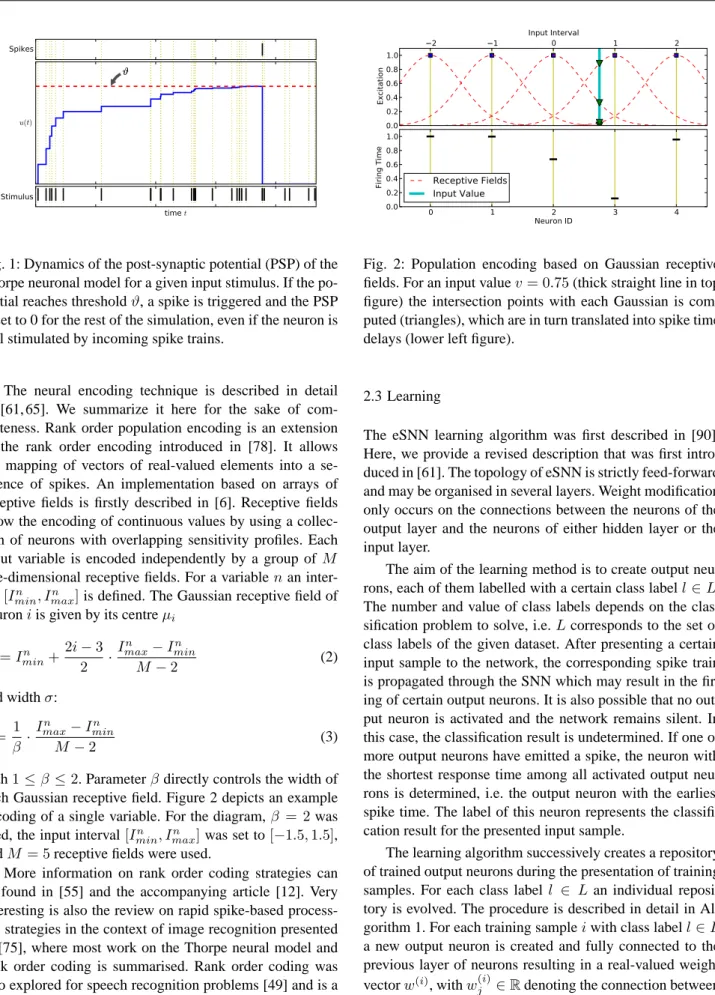
where wji is the weight of a pre-synaptic neuron j,f(j) is the firing time ofj, and0 < mi < 1is a parameter of the model, namely the modulation factor. Functionorder(j) represents the rank of the spike emitted by neuronj. For ex-ample, a rankorder(j) = 0would be assigned if neuron jis the first among all pre-synaptic neurons ofithat emits a spike. In a similar fashion, the spikes of all pre-synaptic neurons are ranked and then used in the computation ofui. A neuroni fires a spike when its potential reaches a cer-tain thresholdϑ. After emitting a spike, the potential resets toui = 0. Each neuron is allowed to emit only a single spike at most. The thresholdϑ=c umaxis set to a fraction 0 < c < 1of the maximum potentialumaxreachable for a neuron. Figure 1 presents the change of the post-synaptic potential for the Thorpe neural model if a series of input spikes stimulates the neuron through different synapses.
These simplifications allow a very fast real-time simula-tion of large networks. Due to its low computasimula-tional costs this model was mainly used for studying image and speech recognition methods involving thousands of connected neu-rons (e.g. [14] and [79]). Many studies have investigated the Thorpe model, e.g. for face recognition [80] and [12].
2.2 Neural encoding
In order to classify real-valued datasets, each data sample, i.e. a vector of real-valued elements, is mapped into a se-quence of spikes using a certain neural encoding technique. In the context of eSNN, the so-called rank order population encoding is employed, but other encoding may be suitable as well.
Spikes
time t
Stimulus
u(t)
Fig. 1: Dynamics of the post-synaptic potential (PSP) of the Thorpe neuronal model for a given input stimulus. If the po-tential reaches thresholdϑ, a spike is triggered and the PSP is set to 0 for the rest of the simulation, even if the neuron is still stimulated by incoming spike trains.
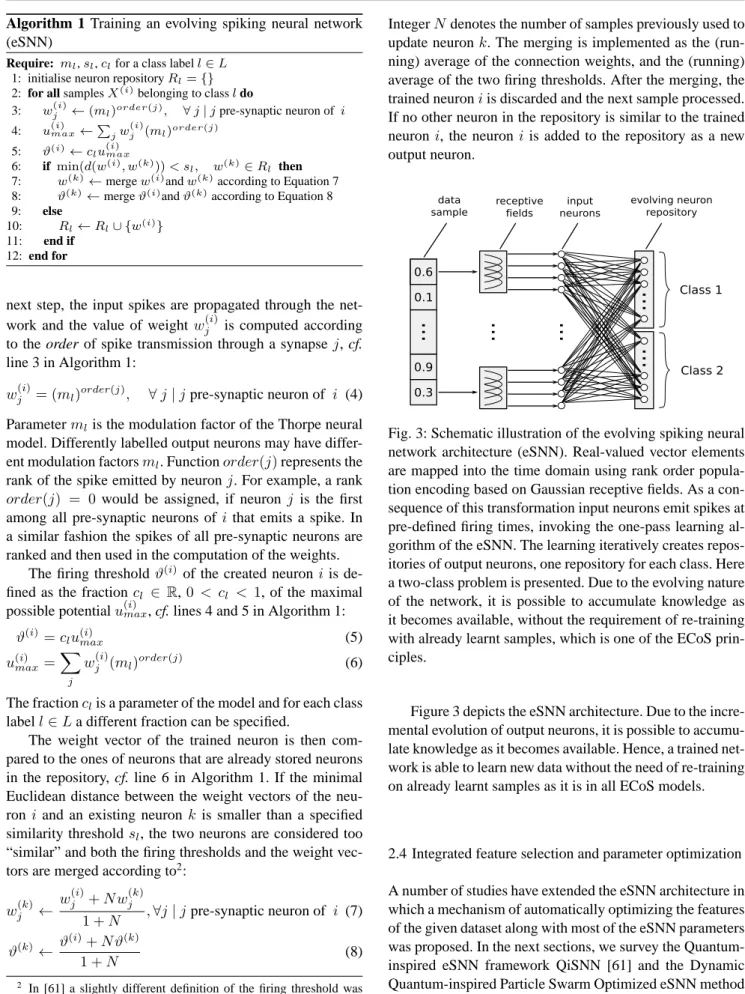
The neural encoding technique is described in detail in [61, 65]. We summarize it here for the sake of com-pleteness. Rank order population encoding is an extension of the rank order encoding introduced in [78]. It allows the mapping of vectors of real-valued elements into a se-quence of spikes. An implementation based on arrays of receptive fields is firstly described in [6]. Receptive fields allow the encoding of continuous values by using a collec-tion of neurons with overlapping sensitivity profiles. Each input variable is encoded independently by a group ofM one-dimensional receptive fields. For a variablenan inter-val[Iminn , I
n
max]is defined. The Gaussian receptive field of neuroniis given by its centreµi
µi=Iminn + 2i−3 2 · In max−Iminn M−2 (2) and widthσ: σ= 1 β · In max−Iminn M −2 (3)
with1≤β ≤2. Parameterβ directly controls the width of each Gaussian receptive field. Figure 2 depicts an example encoding of a single variable. For the diagram,β = 2was used, the input interval[In
min, Imaxn ]was set to[−1.5,1.5], andM = 5receptive fields were used.
More information on rank order coding strategies can be found in [55] and the accompanying article [12]. Very interesting is also the review on rapid spike-based process-ing strategies in the context of image recognition presented in [75], where most work on the Thorpe neural model and rank order coding is summarised. Rank order coding was also explored for speech recognition problems [49] and is a core part of the eSNN architecture.
2 1 0 1 2 Input Interval 0.00.2 0.4 0.60.8 1.0 Excitation 0 1 2 3 4 Neuron ID 0.00.2 0.4 0.60.8 1.0
Firing Time Receptive FieldsInput Value
Fig. 2: Population encoding based on Gaussian receptive fields. For an input valuev= 0.75(thick straight line in top figure) the intersection points with each Gaussian is com-puted (triangles), which are in turn translated into spike time delays (lower left figure).
2.3 Learning
The eSNN learning algorithm was first described in [90]. Here, we provide a revised description that was first intro-duced in [61]. The topology of eSNN is strictly feed-forward and may be organised in several layers. Weight modification only occurs on the connections between the neurons of the output layer and the neurons of either hidden layer or the input layer.
The aim of the learning method is to create output neu-rons, each of them labelled with a certain class labell∈L. The number and value of class labels depends on the clas-sification problem to solve, i.e.Lcorresponds to the set of class labels of the given dataset. After presenting a certain input sample to the network, the corresponding spike train is propagated through the SNN which may result in the fir-ing of certain output neurons. It is also possible that no out-put neuron is activated and the network remains silent. In this case, the classification result is undetermined. If one or more output neurons have emitted a spike, the neuron with the shortest response time among all activated output neu-rons is determined, i.e. the output neuron with the earliest spike time. The label of this neuron represents the classifi-cation result for the presented input sample.
The learning algorithm successively creates a repository of trained output neurons during the presentation of training samples. For each class labell ∈ L an individual reposi-tory is evolved. The procedure is described in detail in Al-gorithm 1. For each training sampleiwith class labell∈L a new output neuron is created and fully connected to the previous layer of neurons resulting in a real-valued weight vectorw(i), withw(i)
j ∈Rdenoting the connection between the pre-synaptic neuronj and the created neuron i. In the
Algorithm 1 Training an evolving spiking neural network (eSNN)
Require: ml,sl,clfor a class labell∈L
1: initialise neuron repositoryRl={}
2: for all samplesX(i)belonging to classldo
3: wj(i)←(ml)order(j), ∀j|jpre-synaptic neuron of i
4: u(maxi) ←Pjwj(i)(ml)order(j) 5: ϑ(i)←c lu( i) max 6: if min(d(w(i), w(k)))< s l, w(k)∈Rl then
7: w(k)←mergew(i)andw(k)according to Equation 7
8: ϑ(k)←mergeϑ(i)andϑ(k)according to Equation 8
9: else
10: Rl←Rl∪ {w(i)}
11: end if 12: end for
next step, the input spikes are propagated through the net-work and the value of weight w(ji) is computed according to the order of spike transmission through a synapsej, cf. line 3 in Algorithm 1:
w(ji)= (ml) order(j)
, ∀j|jpre-synaptic neuron of i (4) Parametermlis the modulation factor of the Thorpe neural model. Differently labelled output neurons may have differ-ent modulation factorsml. Functionorder(j)represents the rank of the spike emitted by neuronj. For example, a rank order(j) = 0 would be assigned, if neuron j is the first among all pre-synaptic neurons ofi that emits a spike. In a similar fashion the spikes of all pre-synaptic neurons are ranked and then used in the computation of the weights.
The firing thresholdϑ(i)of the created neuroniis
de-fined as the fractioncl ∈ R,0 < cl < 1, of the maximal possible potentialu(max, cf. lines 4 and 5 in Algorithm 1:i)
ϑ(i)=clu(maxi) (5) u(maxi) = X j w(ji)(ml) order(j) (6)
The fractionclis a parameter of the model and for each class labell∈La different fraction can be specified.
The weight vector of the trained neuron is then com-pared to the ones of neurons that are already stored neurons in the repository, cf. line 6 in Algorithm 1. If the minimal Euclidean distance between the weight vectors of the neu-ron iand an existing neuronk is smaller than a specified similarity thresholdsl, the two neurons are considered too “similar” and both the firing thresholds and the weight vec-tors are merged according to2:
w(jk)← wj(i)+N w (k) j 1 +N ,∀j|jpre-synaptic neuron of i (7) ϑ(k)← ϑ (i)+N ϑ(k) 1 +N (8)
2 In [61] a slightly different definition of the firing threshold was introduced that deviates from the original description presented in [90].
IntegerNdenotes the number of samples previously used to update neuronk. The merging is implemented as the (run-ning) average of the connection weights, and the (run(run-ning) average of the two firing thresholds. After the merging, the trained neuroniis discarded and the next sample processed. If no other neuron in the repository is similar to the trained neuroni, the neuroniis added to the repository as a new output neuron.
Fig. 3: Schematic illustration of the evolving spiking neural network architecture (eSNN). Real-valued vector elements are mapped into the time domain using rank order popula-tion encoding based on Gaussian receptive fields. As a con-sequence of this transformation input neurons emit spikes at pre-defined firing times, invoking the one-pass learning al-gorithm of the eSNN. The learning iteratively creates repos-itories of output neurons, one repository for each class. Here a two-class problem is presented. Due to the evolving nature of the network, it is possible to accumulate knowledge as it becomes available, without the requirement of re-training with already learnt samples, which is one of the ECoS prin-ciples.
Figure 3 depicts the eSNN architecture. Due to the incre-mental evolution of output neurons, it is possible to accumu-late knowledge as it becomes available. Hence, a trained net-work is able to learn new data without the need of re-training on already learnt samples as it is in all ECoS models.
2.4 Integrated feature selection and parameter optimization A number of studies have extended the eSNN architecture in which a mechanism of automatically optimizing the features of the given dataset along with most of the eSNN parameters was proposed. In the next sections, we survey the Quantum-inspired eSNN framework QiSNN [61] and the Dynamic Quantum-inspired Particle Swarm Optimized eSNN method eSNN-DQiPSO [22].
2.4.1 QiSNN
The successful application of eSNN to a specific classifica-tion problem requires the identificaclassifica-tion of a suitable parame-ter set for the neural model and the learning method. In [61], an evolutionary algorithm was suggested to automatically optimize the network parameters. Simultaneously, the algo-rithm was also used to identify feature subsets that maximize the classification accuracy of eSNN. In this section, we sum-marize the findings of this work along with some notable extensions and applications.
The eSNN extension presented in [61] combines a bi-nary optimization algorithm, namely the Versatile Quantum-inspired Evolutionary Algorithm (vQEA) [9], with an eSNN. vQEA is a probabilistic approach in which a num-ber of independent probability vectors is evolved in paral-lel. These vectors may interact at certain intervals with each other forming a multi-model Estimation of Distribution Al-gorithm (EDA) [10]. Following the wrapper approach [44], vQEA identifies relevant feature subsets and simultaneously evolves an optimal eSNN parameter setting. Due to the quantum metaphor employed in vQEA, the architecture was named Quantum-inspired SNN (QiSNN) framework. Ap-plied to benchmark data, the QiSNN-based feature selection reported excellent classification results and an accurate de-tection of relevant information in the dataset [61–65].
Fig. 4: The QiSNN [61] framework of eSNN with tightly coupled feature selection and parameter optimization, inte-grated with the data.
The QiSNN framework is shown in Figure 4. The up-per part of the diagram represents the eSNN classification method. Note the binary mask in the second step of the pro-cess. This mask along with a specific configuration of neural and learning parameters is passed to eSNN from the opti-mization method depicted in the lower part of the figure. The binary mask describes the features to be selected from a real-valued input data vector. Then, the selected features
are transformed into a train of spikes using the rank order population encoding technique, see Section 2.2 for details. Following the one-pass learning procedure, the connection weights of eSNN are trained according to the given param-eter set. The learning process includes the presentation of all training samples. After the learning, the classification ac-curacy is determined on a set of test samples. This acac-curacy provides a quality measure of the feature subset and the used parameter configuration. This quality feedback is passed to the employed optimization algorithm. Based on the qual-ity, the optimizer adapts the search strategy and passes new feature subsets and configurations to eSNN for evaluation. The whole process iterates until a termination criterion is met, i.e. a satisfying classification accuracy is reached or the maximum number of iterations is exhausted.
The automatic parameter adaptation of QiSNN is a highly desirable feature since it promotes the straightforward appli-cation of the method to other problem domains. In section 4, we will present some of the applications in which QiSNN was employed for knowledge discovery.
For the simultaneous optimization of the network pa-rameters and the feature subset, a heterogeneous search space has to be explored. A binary search space encodes the selec-tion of specific features and a continuous search space rep-resents the parameter space of eSNN. Therefore, the binary nature of vQEA requires the conversion of bit strings into real values which are then mapped into eSNN parameters. The use of a binary optimiser for a real-valued search space appears inappropriate for a number of reasons.
First, for the mapping of bit strings into a real value addi-tional computaaddi-tional resources are necessary. Furthermore, a granularity is introduced into a continuous search inter-val. Even worse, neighbouring solutions in the continuous domain might not be neighbours in their binary represen-tation. Thus, exploring the local neighbourhood of a real-valued solution may require the optimiser to flip many bits in the solution’s binary representation encouraging premature convergence and promoting the well-known phenomenon of hitch-hiking [59]. For these reasons vQEA was extended to-wards continuous search spaces in [63] resulting in a novel Estimation of Distribution Algorithm (EDA) called the hier-archical multi-model EDA (hMM-EDA). hMM-EDA uses a continuous representation based on Gaussian distributions to optimize the parameter space of eSNN. The study presented in [65] describes the algorithm in detail and compares its performance and its characteristics to related methods.
Similar to QiSNN, the combination of hMM-EDA and eSNN forms an integrated feature and parameter optimiza-tion framework based on the eSNN classificaoptimiza-tion method. The continuous representation in hMM-EDA is used to op-timize the parameter space of eSNN, while the binary rep-resentation explores the feature space of the given dataset. The enhanced QiSNN was shown to converge faster, more
consistently and more reliably than the original QiSNN [63, 65, 60].
In [62] a detailed experimental analysis of the behav-ior and functioning of QiSNN was presented by the authors. The analysis focused on the process of the simultaneous optimization of features subsets and eSNN parameters and their interaction and mutual influences. The study also in-vestigated the role of the neural encoding and its impact on the classification characteristics of QiSNN. Recommenda-tions for configuring eSNN parameters that are not included in the evolutionary optimization process were given.
2.4.2 eSNN-DQiPSO
An approach very similar to QiSNN was presented in [21]. Instead of using hMM-EDA as employed in QiSNN, a Quantum-inspired Particle Swarm Optimizer (QiPSO) was investigated to perform both feature selection and parameter optimization of eSNN. Since QiPSO was designed as a bi-nary optimization method, the algorithm reported optimiza-tion results comparable to the ones obtained by the original QiSNN that employed the binary optimizer vQEA. A fu-ture study should attempt a formal comparison of these two QiSNN variants.
Later a heterogeneous version of QiPSO was proposed in [22, 23], namely the Dynamic QiPSO, that was able to explore both continuous and binary search spaces simulta-neously. The method essentially combined QiPSO with a traditional PSO to explore the two search spaces in parallel. Additionally, some specialized particles were introduced in order to increase the diversity of the particle population thus counteracting premature convergence of the algorithm.
The same study also proposed another interesting vari-ation of the eSNN classifier. Following ideas of a proba-bilistic neural model introduced in [38], the probability of presence and absence of connections between input and out-put neurons of eSNN were also subjected to the evolution-ary optimization process. The resulting probabilistic eSNN-DQiPSO was studied on the two-spiral problem and reported superior classification performance compared to the deter-ministic eSNN.
2.5 Rule extraction from eSNN
In ECoS models each cluster of training data is represented by a cluster centre captured in a (hidden) neuron called rule node, and a local function to approximate the data in the cluster. The cluster information and the local function are represented as fuzzy rules of the form:
IF xiis HIGH, i.e. data is in clusterCi THEN the function isFi
where xi are input variables. Similarly, fuzzy rules can be
extracted from a trained eSNN as suggested in [69], where the output function is a class label.
3 Spatio-temporal pattern recognition
In this section, we describe a significant extension of the eSNN approach to allow the processing of spatio-temporal information. Many of today’s data volumes are continuously updated adding an additional time dimension to the datasets. The classification of spatio-temporal patterns is a great chal-lenge for data mining methods. Many data vectors are se-quentially presented to a classification algorithm which in turn learns the mapping of this sequence to a given class la-bel. In its original form, the eSNN model does not allow the classification of spatio-temporal data.
3.1 eSNN with dynamic synapses (deSNN)
Several new models of eSNN have been recently proposed to deal with spatio and spectro-temporal pattern recognition (SSTPR), from a single neuron layer model, to reservoir-based models. In [41, 52] dynamic synapses are added to the LIF model, where in addition to the rank-order learning based on the order of incoming spikes, the synaptic weights change in an unsupervised mode based on the time of the following incoming spikes to the post-synaptic neuron [17]. This model is called dynamic eSNN (deSNN). It is efficient in both address event representation (AER) and frame-based representation. In the former, only changes in the input in-formation are presented as incoming spikes, asynchronously (e.g. [41]). In the latter whole frames of input data are trans-ferred into spikes one by one as a temporal sequence (e.g. [52]).
When the temporal input patterns are longer (e.g. last-ing for seconds) a slast-ingle neuron layer structure may not be efficient in learning these sequences. In this case larger neu-ronal “reservoirs” would be needed.
3.2 Reservoir-based eSNN (reSNN)
A reservoir extension of the standard LIF eSNN was pro-posed in [68] that enables the method to process spatio-temporal information. The general idea is to add an addi-tional layer to the network architecture that transforms the spatio-temporal input pattern into a single high-dimensional network state. The mapping of this intermediate state into a desired class label can then be learned by the one-pass learning algorithm of eSNN. The study presented an initial experimental analysis demonstrating the feasibility of this extension in principle and left a more comprehensive analy-sis for future studies. The idea was further developed and in-vestigated in [67][50] resulting in the reservoir based eSNN
Fig. 5: Architecture of the reservoir-based eSNN [67] capable of processing spatio-temporal data. The colored (dashed) boxes indicate novel parts in the original eSNN architecture.
(reSNN) illustrated in Figure 5. Compared to the original eSNN, the novel parts in the architecture are indicated by the highlighted boxes.
We outline the working of the method by explaining the diagram from left to right. Spatio-temporal data patterns are presented to the reSNN system in form of an ordered se-quence of real-valued data vectors. In the first step, each real-value of a data vector is transformed into a spike train using a population encoding already described in section 2.2. As a result of the encoding, input neurons spike at prede-fined times according to the presented data vectors. The in-put spike trains are then fed into a spatio-temporal filter which accumulates the temporal information of all input sig-nals into a single high-dimensional intermediate liquid state. The filter is implemented in the form of a liquid or a reser-voir [50], i.e. a recurrent SNN, for which the eSNN acts as a readout function. Since the intermediate liquid state has no temporal dimension, the one-pass learning algorithm of eSNN is able to learn the mapping of this state into a desired class label.
The study in [67] investigated the classification perfor-mance of reSNN on the real-world sign-language dataset LI-BRAS. For the simulation of the reservoir the SNN simu-lator Brian [19] was used. reSNN reported very promising classification accuracies which were at least comparable to results obtained by traditional neural network approaches.
4 Applications
The eSNN architectures described above have been used in a variety of applications that are briefly summarised here.
4.1 Visual pattern recognition
Among the earliest application of the eSNN is the visual pat-tern recognition system presented in [90] which extends the
work of [11, 13] by including the on-line learning technique described above. In [90] and [85] the method was studied on an image dataset consisting of 400 faces of 40 different persons. The task here was to predict the class labels of pre-sented images correctly. The system was trained on a subset of the data and then tested on the remaining samples of the data. Classification results were similar to [11, 13] with the additional advantages of the novel on-line learning method. The main principle of this image recognition method is briefly outlined here. The neural network is composed of four layers of Thorpe neurons, each of them grouping a set of neurons into several two-dimensional maps, so-called neural maps. Information in this network is propagated in a feed-forward manner, i.e. no recurrent connections exist. An input frame in form of a grey-scale image is fed into the first neural layer (L1), each pixel of the image corresponding to
one neuron in a neural map ofL1. Several neural maps may
exist in this layer. The map consists of “On” and “Off” neu-rons that are responsible for the enhancement of the high contrast parts of the image. Each map is configured differ-ently and thus is sensitive to different grey scales in the im-age. The output of this layer is transformed into the spike domain using rank order encoding as described in [78]. As a consequence of this encoding, pixels with higher contrast are prioritised in the neural processing.
The second layer, denoted L2, consists of orientation
maps. Each map is selective for different directions, i.e. 0◦,45◦, . . . ,315◦, and is implemented by appropriately parametrised Gabor functions. It is noted that the first two layers are passive filters that are not subject to any learn-ing process. In the third layer,L3, the learning occurs using
the one-pass learning method described in section 2.3. Here neural maps are created and merged according to the rules of the learning algorithm. Finally, the fourth layer,L4, consists
of a single neuron for each output class, which accumulates opinions about the class label of a certain sequence of
in-put frames. The weights betweenL3 andL4 are fixed to a
constant value, usually 1, and are not subject to learning. The firstL4neuron that is activated by the presented stimuli
determines the classification result for the input. After the activation of anL4neuron the system stops.
Experimental evidence about the suitability of this pat-tern recognition system is provided in [88] along with a comparison to other typical classification methods.
In a later study another processing layer was added to the system which allows efficient multi-view visual pattern recognition [88]. The additional layer accumulates informa-tion over several different views of an image in order to reach a final decision about the associated class label of the frames. Thus, it is possible to perform an efficient on-line person authentication through the presentation of a short video clip to the system, although the audio information was ignored in this study.
4.2 Auditory pattern recognition
A similar network, but in an entirely different context, was investigated in [86], where a text-independent speaker au-thentication system is presented. The classification task in this work consisted of the correct labelling of audio streams presented to the system.
Speech signals are split into temporal frames, each con-taining a signal segment over a short time period. The frames are first pre-processed using the Mel Frequency Cep-strum Coefficients (MFCC) [57] and then used to invoke the eSNN. The MFCC frame is transformed into the spike do-main using rank order encoding [78] and the resulting stim-ulus is propagated to the first layer of neurons. This layer, denotedL1, contains two neural ensembles representing the
speaker and the background model, respectively. While the former model is trained on the voice of a certain speaker, the latter one is trained on the background noise of the audio stream. This system also collects opinions about the class label of the presented sequence of input frames, which is implemented by the second layer of the network. LayerL2
consists of only two neurons, each of which accumulates information about whether a given frame corresponds to a certain speaker or to the background noise. Whenever anL2
neuron is activated, the simulation of the network stops and the classification output is presented.
4.3 Audio-visual pattern recognition
The two recognition systems presented above were success-fully combined, forming an audio-visual pattern recognition method. Both systems are trained individually, but their out-put is propagated to an additional supra-modal layer. The supra-modal layer integrates incoming sensory information
from individual modalities and cross-modal connections en-able the influence of one modality upon the other. A detailed discussion of this system along with experimental evidence is given in [87] and in the PhD dissertation of Simei Wysoski in [84]. A later study suggests that this system might be suit-able not only for audio and visual pattern recognition prob-lems, but also for more general brain-like multimodal infor-mation processing tasks [83, 89].
4.4 Taste recognition
Another application of eSNN being discussed here investi-gates the use of a SNN for taste recognition in a gustatory model. The classification performance of eSNN was experi-mentally explored [70, 69] based on water and wine samples collected from [8] and [58]. The topology of the model con-sists of two layers. The first layer receives an input stimu-lus obtained from the mapping of a real-valued sensory data sample into spike trains using a rank order population en-coding, cf. section 2.2. The weights from the first neural layer are subject to training according to the already dis-cussed one-pass learning method. Finally, the output of the second neural layer determines the class label of the pre-sented input stimulus.
The method was investigated in a number of scenarios, where the size of the datasets and the number of class labels was varied. Generally, eSNN reported promising results on both large and small datasets, which has motivated an FPGA hardware implementation of the system [91].
4.5 Ecological modeling
The QiSNN framework as presented in section 2.4 was used in a case study on ecological modeling [64]. Meteorolog-ical data, such as monthly and seasonal temperature, rain fall and soil moisture recordings for different geographi-cal sites, were compiled from published results, and each global site was labelled according to the presence or ab-sence of the Mediterranean fruit-fly (a serious fruit pest). The study aimed towards the identification of important fea-tures relevant for predicting the presence/absence of this in-sect species. From 68 features, QiSNN identified 14 features to be of particular importance. These features were analyzed by an ecological expert and they compared well to results found in related studies. The clear potential for further im-provement of classification accuracy with model refinement, as well as automatic optimisation of parameters, suggested QiSNN as an useful approach for the analysis and modelling of complex, noisy ecological data.
The same data was later revisited [63] and the experi-ments were repeated using the enhanced version of QiSNN (see section 2.4 for details). Compared to the original study,
the number of features could be further decreased (down to nine relevant features) without affecting the overall classi-fication accuracy. Related wrapper-based feature selection methods employing the same optimizer, i.e. vQEA, but a different classification algorithm, e.g. the Na¨ıve Bayesian Classifier, identified significantly more features to be rele-vant on the same dataset.
4.6 Sign language recognition
The reSNN method discussed in section 3 is suitable to ad-dress spatio-temporal pattern recognition problems. In [67], this method was investigated using a real-world dataset called LIBRAS [15]. LIBRAS is the acronym for LIngua BRAsileira de Sinais, which is the official Brazilian sign language. The data contains 15 hand movements (signs) to be learned and classified. The movements were obtained from recorded video of four different people performing the movements in two sessions. In total 360 videos have been recorded, each video showing one movement lasting for about seven seconds. From the videos 45 frames uniformly distributed over the seven seconds have then been extracted. In each frame, the centroid pixels of the hand are used to determine the movement. All samples have been organized in ten sub-datasets, each representing a different classifica-tion scenario. More comprehensive details about the dataset can be found in [15]. The data can be obtained from the UCI machine learning repository.
As shown in [67], the classification performance of reSNN depends strongly on the employed readout method extracting the reservoir or liquid state at pre-defined time in-tervals. Using an analog readout technique, a good overall testing classification accuracy of around 82% was reported on this dataset. Additional optimization of the eSNN param-eters and the features of the data using the DQiPSO algo-rithm further increased this accuracy to around 89% which compares very favourably to the results reported in [15] where a traditional Multilayer Perceptron was used.
4.7 Object movement recognition
In [41], the deSNN model was applied for moving object recognition using AER taken from a silicon retina cam-era [47]. The case study data created aimed at investigating the efficiency of the method for collision avoidance predic-tion when fast objects are moving towards the observer.
4.8 EEG spatio/spectro temporal pattern recognition In [52], several eSNN architectures were investigated for the recognition of four EEG patterns, recorded when a subject
is listening a sound, seeing an image, both, or no stimulus is presented. The best accuracy was obtained with the use of the deSNN when compared with the reSNN.
5 Summary and future directions
In this paper, we have surveyed the recent developments on the eSNN classification method. We reviewed algorithmic details on the learning algorithm, on the neural model and on the neural encoding. Numerous models were discussed and many applications and case studies in which the eSNN was successfully employed were presented.
The two models deSNN and reSNN, designed towards the processing of spatio-temporal real world data, appear es-pecially interesting. Future studies will focus on the tighter integration of reservoir based techniques with the “evolv-ing philosophy” of eSNN. Especially the automatic config-uration of the reservoir represents a highly desirable goal. The large number of parameters in the reservoir is clearly a drawback of the presented reSNN despite the promising re-sults that have been obtained with this method. Initial stud-ies aiming for a better controlled reservoir have suggested some simple mechanisms adjusting the overall neural ac-tivity of recurrent SNN based on the strength of the input stimuli [66]. Some significantly improved separation capa-bilities of these adaptive reservoirs were reported based on synthetic datasets. Future studies are planned in which these findings are applied to the EEG based prediction of epileptic seizures.
Other directions involve the neurogenetic modeling ap-proaches firstly introduced in [40, 4, 5]. The idea is to adapt the parameters of a SNN using an additional gene regulatory network which has to be optimized itself in order to achieve a desired network behavior of the SNN. Other studies have recently investigated this direction in the context of robotic controllers [51], cognitive systems [36] and Alzheimer dis-ease models [28]. A 3D eSNN computational neurogenetic model called NeuCube to map, learn and mine brain data, was proposed [29]. This model, if further developed, can facilitate efficient real time applications such as: EEG pat-tern recognition for BCI; fMRI patpat-tern recognition; neuro-rehabilitation robotics; neuro-prosthetics; cognitive robots; personalized modeling for the prognosis of fatal events such as stroke and degenerative progression of brain disease, such as AD. A combination of the fast evolving one-pass learning of eSNN with the automatic parameter adaptation of a ge-netically controlled recurrent SNN could open the path for numerous relevant real-world applications including neuro-morphic computation systems [26, 27, 39].
References
1. Angelov, P., Filev, D., Kasabov, N.: Guest editorial evolving fuzzy systems – preface to the special section. Fuzzy Systems, IEEE Transactions on 16(6), 1390–1392 (2008). DOI 10.1109/TFUZZ. 2008.2006743
2. Angelov, P., Filev, D., Kasabov, N. (eds.): Evolving intelligent sys-tems: methodology and applications. Wiley (2010)
3. Arbib, M. (ed.): The Handbook of Brain Theory and Neural Net-works, 2nd edn. MIT Press, Cambridge, MA (2003)
4. Benuskova, L., Jain, V., Wysoski, S.G., Kasabov, N.: Computa-tional neurogenetic modeling: a pathway to new discoveries in ge-netic neuroscience. Intl. Journal of Neural Systems 16(3), 215– 227 (2006)
5. Benuskova, L., Kasabov, N.: Computational Neurogenetic Mod-elling. Springer, NY (2007)
6. Bohte, S.M., Kok, J.N., Poutr´e, J.A.L.: Error-backpropagation in temporally encoded networks of spiking neurons. Neurocomput-ing 48(1-4), 17–37 (2002)
7. Carpenter, G., Grossberg, S., Markuzon, N., Reynolds, J., Rosen, D.: Fuzzy ARTMAP: A neural network architecture for incremen-tal supervised learning of analogue multi-dimensional maps. IEEE Trans. of Neural Networks 3(5), 698–713 (1991)
8. de Sousa, H.C., Riul Jr., A.: Using MLP networks to classify red wines and water readings of an electronic tongue. Neu-ral Networks, Brazilian Symposium on 0, 13 (2002). DOI 10.1109/SBRN.2002.1181428
9. Defoin-Platel, M., Schliebs, S., Kasabov, N.: A versatile quantum-inspired evolutionary algorithm. In: IEEE Congress on Evolution-ary Computation, CEC’07, pp. 423–430. IEEE Press, Singapore (2007)
10. Defoin-Platel, M., Schliebs, S., Kasabov, N.: Quantum-inspired evolutionary algorithm: A multimodel EDA. Evolutionary Com-putation, IEEE Transactions on 13(6), 1218–1232 (2009). DOI 10.1109/TEVC.2008.2003010
11. Delorme, A., Gautrais, J., VanRullen, R., Thorpe, S.: SpikeNET: A simulator for modeling large networks of integrate and fire neurons (1999). URL citeseer.ist.psu.edu/ delorme99spikenet.html
12. Delorme, A., Perrinet, L., Thorpe, S.J.: Networks of integrate-and-fire neurons using rank order coding B: Spike timing dependent plasticity and emergence of orientation selectivity. Neurocomput-ing 38-40, 539–545 (2001)
13. Delorme, A., Thorpe, S.J.: Face identification using one spike per neuron: resistance to image degradations. Neural Networks 14(6-7), 795–803 (2001)
14. Delorme, A., Thorpe, S.J.: SpikeNET: an event-driven simulation package for modelling large networks of spiking neurons. Net-work: Computation in Neural Systems 14, 613–627 (2003). DOI 10.1088/0954-898X/14/4/301
15. Dias, D., Madeo, R., Rocha, T., Biscaro, H., Peres, S.: Hand movement recognition for brazilian sign language: A study us-ing distance-based neural networks. In: Neural Networks, 2009. IJCNN 2009. International Joint Conference on, pp. 697–704 (2009). DOI 10.1109/IJCNN.2009.5178917
16. Fritzke, B.: A growing neural gas network learns topologies. In: G. Tesauro, D.S. Touretzky, T.K. Leen (eds.) Advances in Neu-ral Information Processing Systems 7, pp. 625–632. MIT Press, Cambridge MA (1995)
17. Fusi, S., Annunziato, M., Badoni, D., Salamon, A., Amit, D.J.: Spike-driven synaptic plasticity: Theory, simulation, vlsi imple-mentation. Neural Computation 12(10), 2227–2258 (2000) 18. Gerstner, W., Kistler, W.M.: Spiking Neuron Models: Single
Neu-rons, Populations, Plasticity. Cambridge University Press, Cam-bridge, MA (2002)
19. Goodman, D., Brette, R.: Brian: a simulator for spiking neural networks in python. BMC Neuroscience 9(Suppl 1), P92 (2008). DOI 10.1186/1471-2202-9-S1-P92
20. Grossberg, S.: Studies of the mind and brain. Reidel, Boston, USA (1982)
21. Hamed, H., Kasabov, N., Shamsuddin, S.: Integrated feature selec-tion and parameter optimisaselec-tion for evolving spiking neural net-works using quantum inspired particle swarm optimisation. In: International Conference on Soft Computing and Pattern Recog-nition, pp. 695–698. IEEE Press (2009)
22. Hamed, H., Kasabov, N., Shamsuddin, S.: Probabilistic evolv-ing spikevolv-ing neural network optimization usevolv-ing dynamic quantum-inspired particle swarm optimization. Australian Journal of Intel-ligent Information Processing Systems 11(1), 23–28 (2010) 23. Hamed, H.N.A., Shamsuddin, S.M., Kasabov, N.:
Quantum-inspired particle swarm optimization for feature selection and pa-rameter optimization in evolving spiking neural networks for clas-sification tasks. In: Numerical Analysis and Scientific Computing, pp. 133–148. InTech, AUT (2011)
24. Hisada, M., Ozawa, S., Zhang, K., Kasabov, N.: Incremental lin-ear discriminant analysis for evolving feature spaces in multitask pattern recognition problems. Evolving Systems 1, 17–27 (2010). DOI 10.1007/s12530-010-9000-3
25. Huang, L., Song, Q., Kasabov, N.: Evolving connectionist system based role allocation for robotic soccer. International Journal of Advanced Robotic Systems 5, 59–62 (2008)
26. Indiveri, G., Linares-Barranco, B., Julia Hamilton, T., Van Schaik, A., Etienne-Cummings, R., Delbruck, T., Liu, S.C., Dudek, P., H¨afliger, P., Renaud, S., Schemmel, J., Cauwenberghs, G., Arthur, J., Hynna, K., Folowosele, F., Saighi, S., Serrano-Gotarredona, T., Wijekoon, J., Wang, Y., Boahen, K.: Neuromorphic silicon neu-ron circuits. Fneu-rontiers in neuroscience pp. 1–23 (2011). DOI 10.3389/fnins.2011.00073
27. Johnston, S.P., Prasad, G., Maguire, L., McGinnity, T.M.: An fpga hardware/software co-design towards evolvable spiking neu-ral networks for robotics applications. International Journal of Neural Systems 20(6), 447–461 (2010)
28. Kasabov, K., Schliebs, R., Kojima, H.: Probabilistic computational neurogenetic modeling: From cognitive systems to alzheimer’s disease. Autonomous Mental Development, IEEE Transactions on 3(4), 300–311 (2011). DOI 10.1109/TAMD.2011.2159839 29. Kasabov, N.: Neucube evospike architecture for spatio-temporal
modelling and pattern recognition of brain signals. In: Mana, Schwenker, Trentin (eds.) ANNPR
30. Kasabov, N.: ECOS: Evolving connectionist systems and the ECO learning paradigm. In: S. Usui, T. Omori (eds.) The Fifth Interna-tional Conference on Neural Information Processing, ICONIP’98, pp. 1232–1235. IOA Press, Kitakyushu, Japan (1998)
31. Kasabov, N.: Evolving fuzzy neural networks-algorithms, appli-cations and biological motivation. In: T. Yamakawa, G. Mat-sumoto (eds.) Methodologies for the Conception Design and Ap-plication of Soft Computing, pp. 271–274. World Scientific, Sin-gapore (1998)
32. Kasabov, N.: Evolving fuzzy neural networks for super-vised/unsupervised online knowledge-based learning. Systems, Man, and Cybernetics, Part B: Cybernetics, IEEE Transactions on 31(6), 902 –918 (2001). DOI 10.1109/3477.969494
33. Kasabov, N.: On-line learning, reasoning, rule extraction and aggregation in locally optimized evolving fuzzy neural net-works. Neurocomputing 41(14), 25 – 45 (2001). DOI 10.1016/ S0925-2312(00)00346-5
34. Kasabov, N.: Evolving Connectionist Systems. Methods and Ap-plications in Bioinformatics, Brain Study and Intelligent Ma-chines. Perspectives in Neural Computing. Springer-Verlag, Lon-don (2002)
35. Kasabov, N.: Adaptation and interaction in dynamical systems: Modelling and rule discovery through evolving connectionist sys-tems. Applied Soft Computing 6(3), 307–322 (2006). DOI 10.1016/j.asoc.2005.01.006
36. Kasabov, N.: Evolving Connectionist Systems: The Knowledge Engineering Approach, second edn. Springer-Verlag New York, Inc., Secaucus, NJ, USA (2007)
37. Kasabov, N.: Adaptive modeling and discovery in bioinformatics: The evolving connectionist approach. International Journal of In-telligent Systems 23(5), 545–555 (2008). DOI 10.1002/int.20282 38. Kasabov, N.: To spike or not to spike: A probabilistic spiking neuron model. Neural Networks 23(1), 16–19 (2010). DOI http://dx.doi.org/10.1016/j.neunet.2009.08.010
39. Kasabov, N.: Evolving, probabilistic spiking neural networks and neurogenetic systems for spatio-and spectro-temporal data mod-elling and pattern recognition. Natural Intelligence: The INNS Magazine 1(2), pp.23–37 (2012)
40. Kasabov, N., Benuskova, L., Wysoski, S.: A computational neu-rogenetic model of a spiking neuron. In: Neural Networks, 2005. IJCNN ’05. Proceedings. 2005 IEEE International Joint Confer-ence on, vol. 1, pp. 446–451 (2005). DOI 10.1109/IJCNN.2005. 1555872
41. Kasabov, N., Dhoble, K., Nuntalid, N., Indiveri, G.: On-line spatio- and spectro-temporal pattern recognition with evolving spiking neural networks utilising integrated rank oder- and spike-time learning. Neural Networks (2012). Under review
42. Kasabov, N., Hu, Y.: Integrated optimisation method for per-sonalised modelling and case studies for medical decision sup-port. International Journal of Functional Informatics and Per-sonalised Medicine 3(3), 236–256 (2010). DOI 10.1504/IJFIPM. 2010.039123
43. Kasabov, N., Song, Q.: DENFIS: dynamic evolving neural-fuzzy inference system and its application for time-series prediction. IEEE Transactions on Fuzzy Systems 10(2), 144–154 (2002). DOI 10.1109/91.995117
44. Kohavi, R., John, G.H.: Wrappers for feature subset selection. Artificial Intelligence 97(1-2), 273 – 324 (1997). DOI DOI: 10.1016/S0004-3702(97)00043-X
45. Kohonen, T.: Self-Organizing Maps, second edn. Springer, Verlag (1997)
46. Komijani, M., Lucas, C., Araabi, B., Kalhor, A.: Introducing evolving takagisugeno method based on local least squares sup-port vector machine models. Evolving Systems 3, 81–93 (2012). DOI 10.1007/s12530-011-9043-0
47. Lichtsteiner, P., Delbruck, T.: A 64x64 aer logarithmic temporal derivative silicon retina. In: Research in Microelectronics and Electronics, vol. 2, pp. 202–205 (2005). DOI 10.1109/RME.2005. 1542972
48. Lin, C.T., Lee, C.S.G.: Neuro Fuzzy Systems. Prentice Hall (1996) 49. Loiselle, S., Rouat, J., Pressnitzer, D., Thorpe, S.: Exploration of rank order coding with spiking neural networks for speech recognition. In: IEEE International Joint Conference on Neu-ral Networks, IJCNN ’05, vol. 4, pp. 2076–2080 (2005). DOI 10.1109/IJCNN.2005.1556220
50. Maass, W., Natschl¨ager, T., Markram, H.: Real-time computing without stable states: A new framework for neural computation based on perturbations. Neural Computation 14(11), 2531–2560 (2002). DOI 10.1162/089976602760407955
51. Meng, Y., Jin, Y., Yin, J., Conforth, M.: Human activity detec-tion using spiking neural networks regulated by a gene regulatory network. In: The 2010 International Joint Conference on Neural Networks (IJCNN), pp. 1–6 (2010). DOI 10.1109/IJCNN.2010. 5596340
52. Nuntalid, N., Kasabov, N.: EEG spatio/spectro temporal pattern recognition with evolving probabilistic spiking neural networks. IEEE Trans. Neural Networks (2012). Under review
53. Ozawa, S., Pang, S., Kasabov, N.: Incremental learning of chunk data for online pattern classification systems. Neural Networks, IEEE Transactions on 19(6), 1061 –1074 (2008). DOI 10.1109/ TNN.2007.2000059
54. Ozawa, S., Toh, S.L., Abe, S., Pang, S., Kasabov, N.: Incremental learning of feature space and classifier for face recognition. Neural Networks 18(56), 575 – 584 (2005). DOI 10.1016/j.neunet.2005. 06.016
55. Perrinet, L., Delorme, A., Samuelides, M., Thorpe, S.J.: Networks of integrate-and-fire neuron using rank order coding A: How to implement spike time dependent Hebbian plasticity. Neurocom-puting 38-40, 817–822 (2001)
56. Platt, J.: A resource-allocating network for function interpolation. Neural Comput. 3(2), 213–225 (1991). DOI 10.1162/neco.1991. 3.2.213
57. Rabiner, L., Juang, B.H.: Fundamentals of speech recognition. Prentice-Hall, Inc., Upper Saddle River, NJ, USA (1993) 58. Riul, A., de Sousa, H.C., Malmegrim, R.R., dos Santos, D.S.,
Car-valho, A.C.P.L.F., Fonseca, F.J., Oliveira, O.N., Mattoso, L.H.C.: Wine classification by taste sensors made from ultra-thin films and using neural networks. Sensors and Actuators B: Chemical 98(1), 77 – 82 (2004). DOI DOI:10.1016/j.snb.2003.09.025
59. Schaffer, J.D., Eshelman, L., Offutt, D.: Foundations of Genetic Algorithms, chap. Spurious Correlations and Premature Conver-gence in Genetic Algorithms, pp. 102–112. Morgan Kaufmann, San Mateo, CA (1991)
60. Schliebs, S.: Heterogeneous probabilistic models for optimi-sation and modelling of evolving spiking neural networks. Ph.D. thesis, Auckland University of Technology (2010). http://hdl.handle.net/10292/963
61. Schliebs, S., Defoin-Platel, M., Kasabov, N.: Integrated feature and parameter optimization for an evolving spiking neural net-work. In: M. K¨oppen, N.K. Kasabov, G.G. Coghill (eds.) Ad-vances in Neuro-Information Processing, 15th International Con-ference, Lecture Notes in Computer Science, vol. 5506, pp. 1229– 1236. Springer, Heidelberg, Germany (2009). DOI 10.1007/ 978-3-642-02490-0\149
62. Schliebs, S., Defoin-Platel, M., Kasabov, N.: Analyzing the dy-namics of the simultaneous feature and parameter optimization of an evolving spiking neural network. In: The 2010 International Joint Conference on Neural Networks (IJCNN), pp. 1–8 (2010). DOI 10.1109/IJCNN.2010.5596548
63. Schliebs, S., Defoin-Platel, M., Worner, S., Kasabov, N.: Inte-grated feature and parameter optimization for an evolving spik-ing neural network: Explorspik-ing heterogeneous probabilistic mod-els. Neural Networks 22(5-6), 623 – 632 (2009). DOI 10.1016/j. neunet.2009.06.038
64. Schliebs, S., Defoin-Platel, M., Worner, S., Kasabov, N.: Quantum-inspired feature and parameter optimisation of evolving spiking neural networks with a case study from ecological model-ing. In: International Joint Conference on Neural Networks, IEEE - INNS - ENNS, vol. 0, pp. 2833–2840. IEEE Computer Soci-ety, Los Alamitos, CA, USA (2009). DOI 10.1109/IJCNN.2009. 5179049
65. Schliebs, S., Defoin-Platel, M.D., Kasabov, N.: On the probabilis-tic optimization of spiking neural networks. International Journal of Neural Systems 20(6), 481–500 (2010)
66. Schliebs, S., Fiasch´e, M., Kasabov, N.: Constructing robust liquid state machines to process highly variable data streams. In: Inter-national Conference on Neural Networks (ICANN’12), LNCS, pp. 1–8. Springer, Heidelberg, Lausanne, Switzerland (2012). Under review
67. Schliebs, S., Hamed, H.N.A., Kasabov, N.: A reservoir-based evolving spiking neural network for on-line spatio-temporal pat-tern learning and recognition. In: 18th Inpat-ternational Conference on Neural Information Processing, no. 7063 in LNCS, pp. 160– 168. Springer, Heidelberg, Shanghai, China (2011)
68. Schliebs, S., Nuntalid, N., Kasabov, N.: Towards spatio-temporal pattern recognition using evolving spiking neural networks. In: K. Wong, B. Mendis, A. Bouzerdoum (eds.) Neural Information Processing. Theory and Algorithms, Lecture Notes in Computer
Science, vol. 6443, pp. 163–170. Springer Berlin / Heidelberg
(2010). DOI 10.1007/978-3-642-17537-4\21
69. Soltic, S., Kasabov, N.: Knowledge extraction from evolving spik-ing neural networks with rank order population codspik-ing. Interna-tional Journal of Neural Systems 20(6), 437–445 (2010). DOI 10.1142/S012906571000253X
70. Soltic, S., Wysoski, S., Kasabov, N.: Evolving spiking neural net-works for taste recognition. In: IEEE World Congress on Compu-tational Intelligence (WCCI), Hong Kong, pp. 2091–2097 (2008). DOI 10.1109/IJCNN.2008.4634085
71. Song, Q., Kasabov, N.: TWNFI – a transductive neuro-fuzzy in-ference system with weighted data normalization for personalized modeling. Neural Networks 19(10), 1591–1596 (2006). DOI 10.1016/j.neunet.2006.05.028
72. Swope, J.: Artdecos, adaptive evolving connectionist model and application to heart rate variability. Evolving Systems 3, 95–109 (2012). DOI 10.1007/s12530-012-9049-2
73. Thorpe, S.J.: Spike arrival times: A highly efficient coding scheme for neural networks. In: R. Eckmiller, G. Hartmann, G. Hauske (eds.) Parallel Processing in Neural Systems, International Con-ference on, pp. 91–94. North-Holland: Elsevier (1990)
74. Thorpe, S.J.: How can the human visual system process a natural scene in under 150ms? On the role of asynchronous spike propa-gation. In: ESANN. D-Facto public (1997)
75. Thorpe, S.J., Delorme, A., van Rullen, R.: Spike-based strategies for rapid processing. Neural Networks 14(6-7), 715–725 (2001) 76. Thorpe, S.J., Fize, D., Marlot, C.: Speed of processing in the
human visual system. Nature 381, 520–522 (1996). DOI 10.1038/381520a0
77. Thorpe, S.J., Gautrais, J.: Rapid visual processing using spike asynchrony. In: Advances in Neural Information Processing Sys-tems 9, NIPS, pp. 901–907. MIT Press, Denver, CO, USA (1996) 78. Thorpe, S.J., Gautrais, J.: Rank order coding. In: CNS ’97: Pro-ceedings of the 6th annual conference on Computational neuro-science: trends in research, 1998, pp. 113–118. Plenum Press, New York, NY, USA (1998)
79. Thorpe, S.J., Guyonneau, R., Guilbaud, N., Allegraud, J.M., Van-Rullen, R.: SpikeNet: real-time visual processing with one spike per neuron. Neurocomputing 58-60, 857 – 864 (2004). DOI 10.1016/j.neucom.2004.01.138
80. Van Rullen, R., Gautrais, J., Delorme, A., Thorpe, S.: Face pro-cessing using one spike per neurone. Biosystems 48(1-3), 229– 239 (1998)
81. Van Rullen, R., Thorpe, S.J.: Rate coding versus temporal or-der coding: What the retinal ganglion cells tell the visual cor-tex. Neural Comput. 13(6), 1255–1283 (2001). DOI 10.1162/ 08997660152002852
82. Watts, M.: A decade of Kasabov’s evolving connectionist systems: A review. Systems, Man, and Cybernetics, Part C: Applications and Reviews, IEEE Transactions on 39(3), 253–269 (2009). DOI 10.1109/TSMCC.2008.2012254
83. Wysoski, S., Benuskova, L., Kasabov, N.: Brain-like evolving spiking neural networks for multimodal information processing. In: A. Hanazawa, T. Miki, K. Horio (eds.) Brain-Inspired Infor-mation Technology, Studies in Computational Intelligence, vol. 266, pp. 15–27. Springer Berlin / Heidelberg (2010). DOI 10.1007/978-3-642-04025-2\3
84. Wysoski, S.G.: Evolving spiking neural networks for adaptive au-diovisual pattern recognition. Ph.D. thesis, Auckland University of Technology (2008). Http://hdl.handle.net/10292/390
85. Wysoski, S.G., Benuskova, L., Kasabov, N.: On-line learning with structural adaptation in a network of spiking neurons for visual pattern recognition. In: Artificial Neural Networks ICANN 2006, pp. 61–70. Springer, Berlin / Heidelberg (2006). DOI 10.1007/ 11840817\7
86. Wysoski, S.G., Benuskova, L., Kasabov, N.: Text-independent speaker authentication with spiking neural networks. In: ICANN
(2), vol. 4669/2007, pp. 758–767. Springer, Berlin / Heidelberg (2007). DOI 10.1007/978-3-540-74695-9\78
87. Wysoski, S.G., Benuskova, L., Kasabov, N.: Adaptive spiking neu-ral networks for audiovisual pattern recognition. In: Neuneu-ral Infor-mation Processing: 14th International Conference, ICONIP 2007, pp. 406–415. Springer-Verlag, Berlin, Heidelberg (2008). DOI 10.1007/978-3-540-69162-4\42
88. Wysoski, S.G., Benuskova, L., Kasabov, N.: Fast and adaptive network of spiking neurons for multi-view visual pattern recog-nition. Neurocomputing 71(13-15), 2563 – 2575 (2008). DOI 10.1016/j.neucom.2007.12.038
89. Wysoski, S.G., Benuskova, L., Kasabov, N.: Evolving spiking neu-ral networks for audiovisual information processing. Neuneu-ral Net-works 23(7), 819–835 (2010). DOI 10.1016/j.neunet.2010.04.009 90. Wysoski, S.G., Benuskova, L., Kasabov, N.K.: Adaptive learning procedure for a network of spiking neurons and visual pattern recognition. In: Advanced Concepts for Intelligent Vision Sys-tems, pp. 1133–1142. Springer, Berlin / Heidelberg (2006). DOI 10.1007/11864349\103
91. Zuppicich, A., Soltic, S.: FPGA implementation of an evolving spiking neural network. In: M. K¨oppen, N.K. Kasabov, G.G. Coghill (eds.) Advances in Neuro-Information Processing, 15th International Conference, Lecture Notes in Computer Science, vol. 5506, pp. 1129–1136. Springer, Heidelberg, Germany (2009). DOI 10.1007/978-3-642-02490-0\137
![Fig. 4: The QiSNN [61] framework of eSNN with tightly coupled feature selection and parameter optimization, inte-grated with the data.](https://thumb-us.123doks.com/thumbv2/123dok_us/807422.2602098/5.892.65.419.651.877/qisnn-framework-tightly-coupled-feature-selection-parameter-optimization.webp)
![Fig. 5: Architecture of the reservoir-based eSNN [67] capable of processing spatio-temporal data](https://thumb-us.123doks.com/thumbv2/123dok_us/807422.2602098/7.892.180.699.129.356/fig-architecture-reservoir-based-capable-processing-spatio-temporal.webp)