ADEMU WORKING PAPER SERIES
Sovereign Debt and Structural Reforms
Andreas Müller
ŦKjetil Storesletten
ŧFabrizio Zilibotti
Ɨ September 2016 WP 2016/056 www.ademu-project.eu/publications/working-papersAbstract
We construct a dynamic theory of sovereign debt and structural reforms with three interacting frictions: limited enforcement, limited commitment, and incomplete markets. A sovereign country in recession issues debt to smooth consumption and makes reforms to speed up recovery. The sovereign can renege on debt by suffering a stochastic cost, in which case debt is renegotiated. The competitive Markov equilibrium features large fluctuations in consumption and reform effort. We contrast the equilibrium with an optimal contract with one-sided commitment. A calibrated model can match several salient facts about debt crises. We quantify the welfare effect of relaxing different frictions.
JEL Codes: E62, F33, F34, F53, H12, H63
Keywords: Austerity, Commitment, Debt Overhang, Default, European Debt Crisis, Markov Equilibrium, Moral hazard, Renegotiation, Risk premia, Risk Sharing, Sovereign Debt, Structural Reforms.
____________________
ŦUniversity of Oslo, Department of Economics, [email protected] ŧUniversity of Oslo, Department of Economics, [email protected] ƗUniversity of Zurich, Department of Economics, [email protected]
Acknowledgments
We would like to thank Manuel Amador, George-Marios Angeletos, Cristina Arellano, Marco Bassetto, Tobias Broer, Fernando Broner, Alessandro Dovis, Jonathan Eaton, Patrick Kehoe, Enrique Mendoza, Juan-Pablo Nicolini, Ugo Panizza, Aleh Tsyvinski, Jaume Ventura, Christopher Winter, Tim Worrall, and seminar participants at Annual Meeting of the Swiss Society of Economics and Statistics, Barcelona GSE Summer Forum, Brown University, CEMFI, Columbia University, CREi, EIEF Political Economy Workshop, ESSIM 2016, European University Institute, Goethe University Frankfurt, Graduate Institute of Geneva, Humboldt University, Istanbul School of Central Banking, NOR-MAC, Oxford, Royal Holloway, Swiss National Bank, Università Cà Foscari, Universitat Autonoma Barcelona, University College London, University of Cambridge, University of Konstanz, University of Oslo, University of Oxford, University of Pennsylvania, University of Padua, University of Toronto, University of Zurich, and Yale University. We acknowledge support from the European Research Council (ERC Advanced Grant IPCDP-324085).
This project is related to the research agenda of the ADEMU project, “A Dynamic Economic and Monetary Union." ADEMU is funded by the European Union's Horizon 2020 Program under grant agreement N°649396 (ADEMU).
_________________________
The ADEMU Working Paper Series is being supported by the European Commission Horizon 2020 European Union funding for Research & Innovation, grant agreement No 649396.
This is an Open Access article distributed under the terms of the Creative Commons Attribution License Creative Commons Attribution 4.0 International, which permits unrestricted use, distribution and reproduction in any medium provided that the original work is properly attributed.
1
Introduction
Sovereign debt crises and economic reforms have been salient intertwined policy issues throughout the Great Recession, especially in Europe. Economic theory o¤ers two simple policy prescriptions for countries su¤ering a temporary decline in output. First, they should borrow on international markets to smooth consumption. Second, they should undertake reforms – possibly painful ones in the short run –to speed up economic recovery. However, these prescriptions run into di¢ culties in the presence of limited enforcement issues. On the one hand, risk sharing is hampered by rising default premia. On the other hand, a large outstanding debt can reduce the borrower’s incentive to undertake economic reforms to boost economic growth since some of the gains from growth would accrue to the lenders.
To cast light on these trade-o¤s and to derive positive and normative predictions, this paper proposes a dynamic theory of sovereign debt that rests on four building blocks. The …rst is that sovereign debt is subject to limited enforcement, and that countries can renege on their obligations subject to real costs as in, e.g., Aguiar and Gopinath (2006), Arellano (2008) and Yue (2010). The second building block is that whenever creditors face a credible default threat, they can make a renegotiation o¤er to the indebted country. This approach conforms with the empirical observations that unordered defaults are rare events, and that there is great heterogeneity in the terms at which debt is renegotiated, as documented by Tomz and Wright (2007) and Sturzenegger and Zettelmeyer (2008). The third building block is the possibility for the government of the indebted country to make
structural policy reforms that speed up recovery from an existing recession.1 The fourth building block is that reform e¤ort is not contractible nor can markets commit to punish the past bad behavior of sovereign governments. This idea is captured by the notion of a Markov-perfect equilibrium, which excludes reputational mechanisms. The interaction between limited enforcement of sovereign debt and lack of commitment to discipline the structural reform e¤ort is the focal point of our paper.
More formally, we construct a dynamic model of an endowment economy subject to income shocks
following a two-state Markov process. A benevolent local government (henceforth, thesovereign) can
issue debt to smooth consumption. The country starts in a recession of an unknown duration. The probability that the recession ends is endogenous, and hinges on its reform e¤ort. Debt issuance is
subject to a limited enforcement problem: the sovereign can, ex-post, repudiate its debt, based on
the publicly observable realization of a stochastic default cost. When this realization is su¢ ciently
low relative to the outstanding debt, the default threat is credible. In this case, a syndicate of
creditors makes a take-it-or-leave-it debt haircut o¤er, as in Bulow and Rogo¤ (1989). In equilibrium, there is no outright default, but recurrent debt renegotiations. Haircuts are more frequent during recessions, and more frequent the larger is the outstanding sovereign debt. Consumption increases after a renegotiation, in line with the empirical evidence that economic conditions improve in the aftermath of debt relief, as documented in Reinhart and Trebesch (2016). Thereafter, debt growth
resumes, as long as the recession continues.2
We …rst characterize the competitive (Markov) equilibrium. During recessions, the sovereign issues debt in order to smooth consumption. As debt accumulates, the probability of renegotiation increases,
1
Examples of such reforms include labor and product market deregulation, and the establishment of …scal capacity that allows the government to raise tax revenue e¢ ciently (see, e.g., Ilzkovitz and Dierx 2011). While these reforms are bene…cial in the long run, they entail short-run costs for citizens at large, governments or special-interest groups (see, e.g., Blanchard and Giavazzi 2003, and Boeri 2005).
2These debt dynamics are in line with the evidence for Greece, the hardest-hit country in the Europen debt crises. The Greek debt-GDP ratio soared from 107% in 2008 to 170% in 2011. At that point creditors had to agree to a debt haircut implying a 53% loss on its face value. Thereafter debt started increasing again until a new crisis erupted in the summer of 2015, culminating in the Greek government’s request of a new renegotiation.
implying a rising risk premium and consumption volatility. The reform e¤ort exhibits a non-monotonic pattern: it is increasing with debt at low levels of debt because of the disciplining e¤ect of recession. However, for su¢ ciently high debt levels the relationship is ‡ipped: higher debt levels deter reforms because most of the gains accrue to foreign lenders in the form of capital gains on the outstanding debt. The debt overhang exacerbates the country’s inability to achieve consumption smoothing: at high debt levels, creditors expect little reform e¤ort, are pessimistic about the economic outlook, and request an even higher risk premium. The main results carry over to an economy in which the sovereign can issue GDP-linked debt, i.e., securities whose payments are contingent on the stochastic realization of the endowment.
Next, we characterize the optimal dynamic contract when the planner, contrary to investors in the competitive equilibrium, can commit to punish the sovereign for deviations from the optimal contract. The extent of the punishment is limited: out of equilibrium, the sovereign su¤ers the default cost and is excluded from future contractual relations, but can resort to market …nancing at the competitive equilibrium terms. We consider two alternative cases. If the planner can observe (as do investors in the competitive equilibrium) the reform e¤ort, the optimal contract with observable e¤ort is qualitatively di¤erent from the Markov equilibrium: it features non-decreasing consumption and non-increasing reform e¤ort during the recession, and overall less ‡uctuations. Consumption and e¤ort remain constant whenever the country’s participation and incentive constraints are not binding. When either constraint is binding the planner increases the country’s promised utility and reduces the required reform e¤ort. In contrast, if the planner cannot observe the reform e¤ort, the optimal contract attains the same allocation as the market equilibrium with GDP-linked debt.
We interpret the optimal contract as the intervention of an external institution (e.g., the IMF) that provides assistance to the economy in recession, with the commitment to quit if the country does not implement the required reforms. During the recession, the optimal program entails a persistent budget support through extending loans on favorable terms. When the recession ends, the sovereign is settled with a (large) debt on market terms. A common objection to schemes implying deferred repayment is that the country may refuse to repay when the economy recovers. In our theory, this risks is factored in as part of the contract. Interestingly, whenever the country can credibly threaten to default, the international institution improves the terms of the agreement for the debtor by granting her higher consumption and a lower reform e¤ort.
To evaluate the theory quantitatively, we extend the model to a world in which deep recessions are rare but recurrent events. In this case, for a range of low interest rates the competitive equilibrium and the planning solution feature a stationary long-run distribution of debt. We calibrate the model economy to match salient moments of observed debt-to-GDP ratios and default premia. The model can match realistic debt-to-GDP ratios, as well as default premia, renegotiation frequencies, and recovery rates. We regard this as a contribution in itself as the existing quantitative literature has di¢ culties
to sustain high debt levels in equilibrium.3
We use the calibrated model to assess the quantitative welfare e¤ects of policy interventions aimed at mitigating frictions. The e¤ects are generally large: for instance, the assistance program outlined above is more valuable than the outright cancellation of a debt for an economy starting from a 100% debt-GDP ratio. On the contrary, the commitment to not renegotiate debt, with or without the imposition of …scal austerity –an approach that is often portrayed in the policy debate as conducive to better incentives –is ine¢ cient as it generates costly crises along the equilibrium path.
3
For example, a recent study by Collard, Habib, and Rochet (2015) estimates that OECD countries can sustain debt-GDP ratios even in excess of 200%
1.1 Literature review
Our paper relates to several streams of the literature on sovereign debt. By focusing on Markov equilibria, we abstract from reputational mechanisms, being close in the spirit to the direct-punishment
approach proposed by Bulow and Rogo¤ (1989).4 Our work is related to the more recent quantitative
models of sovereign default such as Aguiar and Gopinath (2006), Arellano (2008), and Chatterjee and
Eyigungor (2012).5 This literature does not consider the e¢ cient allocation nor economic reforms.
Moreover, we pursue an analytical characterization of the properties of the model.
In terms of the moral hazard in reform e¤ort, our paper is related to Krugman (1988), Atkeson (1991) and Jeanne (2009). Krugman (1988) constructs a static model with exogenous debt showing that when a borrower has a large debt, productive investments might not be undertaken (the “debt overhang”). Atkeson (1991) studies the optimal contract in an environment in which an in…nitely-lived borrower faces a sequence of two-period in…nitely-lived lenders. The borrower can use funds to invest in productive future capacity or to consume the funds. However, the lenders cannot observe the allocation to investment or consumption. Our paper di¤ers from Atkeson’s in various aspects. First, in our model we focus on Markov equilibria where the borrower cannot commit the reform e¤ort, but the lender can observe it. This seems a plausible abstraction in the context of, for example, the European debt crisis. Second, in the constrained optimum the planner can observe the e¤ort, but its power to punish deviations is limited by the ability of the sovereign to revert to the competitive (Markov) equilibrium. Third, in our theory structural reforms a¤ect the future stochastic process of income, while his model investments only a¤ect next period’s income. Finally, in our model all agents have an in…nite horizon. The results are di¤erent. Atkeson (1991) shows that the optimal contract involves capital out‡ow from the borrower during the worst aggregate state. Our model predicts instead that in a recession the borrower keeps accumulating debt and renegotiates it periodically. Moreover, in our model the constrained optimal allocation (though not necessarily the competitive equilibrium) has non-decreasing consumption when reform e¤ort is observable. Jeanne (2009) studies an economy where the government takes a policy action that a¤ects the return to foreign investors (e.g., the enforcement of creditor’s right) but this can be reversed within a time horizon that is shorter than that at which investors must commit their resources.
Dovis (2016) studies the e¢ cient risk-sharing arrangement between international lenders and a sovereign borrower with limited commitment and private information about domestic productivity. In his model the constrained e¢ cient allocation can be implemented as a competitive equilibrium with
non-contingent defaultable bonds of short and long maturity. Default episodes are ex post ine¢ cient
but occur nevertheless along the (ex ante e¢ cient) equilibrium path. We focus instead on the
in-teraction between structural reforms and limited commitment in a decentralized Markov equilibrium
where international markets lack the commitment to coordinate on ex post ine¢ cient punishments.
Consequently, market outcomes are ine¢ cient relative to the allocation of a planner who can observe (or has some information about) past reforms.
Hopenhayn and Werning (2008) study the optimal corporate debt contract between a bank and a risk-neutral borrowing …rm. As we do, they assume that the borrower has a stochastic default cost. 4The distinction between the reputation approach and the punishment approach as the two main conceptual frame-works in the literature on sovereign debt crisis has been introduced recently by Bulow and Rogo¤ (2015).
Pioneer contributions to the analysis of debt repudiation based on reputational mechanisms such as the threat of future exclusion from credit markets include Eaton and Gersovitz (1981), Grossman and Van Huyck (1988), and Fernandez and Rosenthal (1989).
5Other papers studying restructuring of sovereign debt include Asonuma and Trebesch (2016), Benjamin and Wright (2009), Bolton and Jeanne (2007), Dovis (2016), Hatchondo et al. (2014), Mendoza and Yue (2012), and Yue (2010).
Di¤erent from us, they focus on the case when this outside option is not observable to the lender and show that this implies that default can occur in equilibrium. They do not study reform e¤ort nor do they analyze the case of sovereign debt issued by a country in recession.
Conesa and Kehoe (2015) construct a theory predicting that the government of the borrowing country may opt to “gamble for redemption.”Namely, it runs an irresponsible …scal policy that sends the economy into the default zone if the recovery does not happen soon enough. The source and the mechanism of the crisis are di¤erent from ours. Their model is based on the framework of Cole and Kehoe (2000) featuring multiple equilibria and sunspots.
Our paper is related also to the literature on endogenous incomplete markets due to limited en-forcement or limited commitment. This includes Alvarez and Jermann (2000) and Kehoe and Perri (2002). The analysis of constrained e¢ ciency is related to the literature on competitive risk sharing contracts with limited commitment, including Thomas and Worrall (1988), Kocherlakota (1996), and Krueger and Uhlig (2006). An application of this methodology to the optimal design of a Financial Stability Fund is provided by Abraham, Carceles-Poveda, and Marimon (2014). In our model all debt is held by foreign lenders. Recent papers by Broner, Martin, and Ventura (2010), Broner and Ventura (2011), and Brutti and Sauré (2016) study the implications for the incentives to default of having
part of the government debt held by domestic residents. Song et al. (2012) and Müller et al. (2016)
focus, as we do, on Markov equilibria to study the politico-economic determination of debt in open economies where governments are committed to honor their debt. An excellent review of the sovereign debt literature is provided by Aguiar and Amador (2014).
From an empirical perspective, our paper is related to the …ndings of Tomz and Wright (2007). Using a dataset for the period 1820–2004, they …nd a negative but weak relationship between economic output in the borrowing country and default on loans from private foreign creditors. While countries default more often during recessions, there are many cases of default in good times and many instances in which countries have maintained debt service during times of very bad macroeconomic conditions. They argue that these …ndings are at odds with the existing theories of international debt. Our theory is consistent with the pattern they document. In our model, due to the stochastic default cost, countries may default during booms (though this is less likely, consistent with the data) and can conversely fail to renegotiate their debt during very bad times. Their …ndings are reinforced by Sturzenegger and Zettelmeyer (2008) who document that even within a relatively short period (1998-2005) there are very large di¤erences between average investor losses across di¤erent episodes of debt restructuring. The observation of such a large variability in outcomes is in line with our theory, insofar as the bargaining outcome hinges on an outside option that is subject to stochastic shocks. In particular, our calibrated economy matches the cross-sectional variance of realized haircuts, as well as the frequency of debt restructuring. Borensztein and Panizza (2009) evaluate empirically the costs that may result from an international sovereign default, including reputation costs, international trade exclusion, costs to the domestic economy through the …nancial system, and political costs to the authorities. They …nd that the economic costs are generally short-lived. Finally, the relationship between consumption and renegotiations is in line with the evidence documented by Reinhart and
Trebesch (2016), as discussed above. For a thorough review of the evidence, see also Panizza et al.
(2009).
The rest of the paper is organized as follows. Section 2 describes the model environment. Section 3 characterizes the competitive Markov equilibrium. Section 4 solves for the optimal dynamic contract under the assumption that the principal (e.g., a syndicate of creditors) has full commitment, whereas the agent (i.e., the sovereign) is subject to limited commitment. A decentralized interpretation of the optimal contract is provided. Section 5 presents quantitative positive and normative implications of
the theory with the aid of a calibrated economy. Section 6 concludes. Two online appendixes contain, respectively, the proofs of the main propositions and lemmas (Appendix A) and additional technical material referred in the text (Appendix B).
2
The model environment
The model economy is a small open endowment economy populated by an in…nitely-lived representative
agent. The endowments follow a two-state Markov switching process, with realizations w 2 fw; wg,
where 0 < w < w. We label the two endowment states, respectively, recession and normal times.
Normal times is assumed to be an absorbing state. If the economy starts in a recession, it switches to
normal times with probability p and remains in the recession with probability 1 p. The sovereign
can implement a costly reform policy to increase the probability of a recovery. In our notation, p is
both thereform e¤ ort and the probability that the recession ends. The assumption that normal times
is an absorbing state aids tractability and enables us to obtain sharp analytical results. In Section 5, we generalize the model to the case of recurrent recessions.
The preferences of the representative agent are described by the following expected utility function:
E0
X t
u(ct) tIfdefault intg X(pt) :
The utility function u is twice continuously di¤erentiable and satis…es limc!0u(c) = 1,u0(c)>0,
andu00(c)<0. I 2 f0;1gis an indicator switching on when the economy is in a default state and is
a stochastic default cost assumed to be i.i.d. over time and to be drawn from the p.d.f. f( ) with an
associated c.d.f. F( ):We assume that F( ) is continuously di¤erentiable everywhere, and denote
its support by@ [0; max] R+, where max<1. The assumption that shocks are independent is
inessential, but aids tractability. X is the cost of reform, assumed to be an increasing convex function
of the probability of exiting recession, p 2 [p; p] [0;1]. X is assumed to be twice continuously
di¤erentiable, with the properties that X p = 0; X0(p) > 0 and X00(p) > 0. In normal times,
X= 0.
To establish a benchmark, we characterize the optimal allocation under full insurance and full
enforcement (labelled the …rst-best allocation). The economy is assumed to start in a recession with
an outstanding obligation b given an implicit gross rate of return of R = 1. The …rst-best
allo-cation entails perfect insurance: the country enjoys a constant stream of consumption and exerts a
constant reform e¤ort during recession (during normal times, there is no e¤ort). The level ofblowers
consumption and increases reform e¤ort in recession.
Proposition 1 Let WF B(b; w); cF B(b; w) and pF B(b) denote, respectively, the discounted utility, consumption and e¤ ort as a function of the outstanding obligation b, with w 2 fw; wg denoting the initial state of productivity. Then, for an economy starting in recession:
cF B(b; w) = (1 )w+ p F B(b)w 1 (1 pF B(b)) (1 )b; WF B(b; w) = u c F B(b; w) 1 X pF B(b) 1 (1 pF B(b))
unique solution for pF B satisfying the following condition: 1 (1 pF B) 0 B @ (w w) u0 cF B(b; w) | {z }
increase in output if econ. recovers
+ X pF B
| {z }
saved e¤ ort cost if econ. recovers
1 C
A=X0 pF B : (1)
Moreover, when e¤ ort is interior, cF B(b; w) and pF B(b) are, respectively, decreasing and increasing functions of b.
3
Competitive equilibrium
In the competitive equilibrium, the sovereign can issue a one-period discount bond to smooth
con-sumption. The bond,b, is a claim to one unit of the next-period consumption good, which sells today
at the price Q(b; w). Bonds are purchased by a representative risk-neutral foreign creditor who has
access to an international risk-free portfolio paying the world interest rateR. For simplicity, we focus
on the case in which R= 1, although our main insights carry over to the case in which R <1(see
Section 5). After issuing debt, the country decides its reform e¤ort.
The key assumptions are that (i) the country cannot commit to repay its sovereign debt, and (ii) the reform e¤ort is not contractible. At the beginning of each period, the sovereign observes
the realization of the default cost ; and decides whether to repay the debt that reaches maturity
or to announce default on all its debt. The cost is publicly observed, and captures in a reduced
form a variety of shocks including both taste shocks (e.g., the sentiments of the public opinion about defaulting on foreign debt) and institutional shocks (e.g., the election of a new prime minister, a new
central bank governor taking o¢ ce, the attitude of foreign governments, etc.).6 If a country defaults,
no debt is reimbursed.7
When the sovereign announces its intention to default, a syndicate of creditors can make a take-it-or-leave-it renegotiation o¤er that we assume to be binding for all creditors. By accepting the renegotiation o¤er, the sovereign averts the default cost. In equilibrium, a haircut is o¤ered only
if the default threat is credible, i.e., if the realization of is su¢ ciently low to make the country
prefer default to full repayment. When they o¤er renegotiation, creditors make the debtor indi¤erent between an outright default and the proposed haircut.
In summary, the timing is as follows: The sovereign enters the period with the pledged debt b,
observes the realization of w and , and then decides whether to announce default. If the threat is
credible, the creditors o¤er a haircut. Next, the country decides whether to accept or decline the o¤er.
Then, the sovereign issues new debt subject to the period budget constraintQ b0 =B(b; ; w)+c w,
whereB(b; ; w) bdenotes the debt level after the renegotiation stage. For technical reasons we also
impose that debt is bounded,b2[b;~b]whereb2( 1;0]and~b=w=(R 1)is the natural borrowing
constraint in normal times. In equilibrium, these bounds will never be binding. If the country could 6Alternatively, could be given a politico-economic interpretation, as re‡ecting special interests of the groups in power. For instance, the government may care about the cost of default to its constituency rather than to the population at large. In the welfare analysis, we stick to the interpretation of a benevolent government and abstract from politico-economic factors, although the model could be extended in this direction.
7
For simplicity, we assume that captures all costs associated with default. In an earlier version of this paper, we assumed that the government could not issue new debt in the default period, but were allowed to start issuing bonds already in the following period. The results are unchanged. One could even consider richer post-default dynamics, such as prolonged or stochastic exclusion from debt markets. Since outright default does not occur in equilibrium, the details of the post-default dynamics are immaterial.
commit to honor its debt, it would sell bonds at the price Q = 1=R. However, due to the risk of
default or renegotiation, it sells at a discount, Q 1=R. Next, consumption is realized, and …nally
the sovereign decides its reform e¤ort.
3.1 De…nition of Markov equilibrium
In the characterization of the competitive equilibrium, we restrict attention to Markov-perfect
equi-libria where the set of equilibrium functions only depend on the pay-o¤ relevant state variables, b,
, and w. This rules out that the sovereign’s decisions can be a¤ected by the desire to establish or
maintain a reputation.
De…nition 1 A Markov-perfect equilibrium is a set of value functions fV; Wg, a threshold renegoti-ation function , an equilibrium debt price function Q, a set of optimal decision rules fB; B; C; g, such that, conditional on the state vector (b; ; w) 2 [b;~b] [0; max] fw; wg , the sovereign and the international creditors maximize utility, and markets clear. More formally:
The value function V satis…es
V (b; ; w) = maxfW(b; w); W(0; w) g; (2)
where W (b; w) is the value function conditional on the debt levelb being honored,
W(b; w) = max
b02[b;~b]
u Q b0; w b0+w b +Z b0; w ;
and where Z is de…ned as
Z b0; w = max
p2[p;p] X(p) + p E V b
0; 0; w + (1 p) E V b0; 0; w ; (3)
Z b0; w = E V b0; 0; w ; (4)
and E V x; 0; w =R@V (x; ; w) dF( ).
The threshold renegotiation function satis…es
(b; w) =W(0; w) W(b; w): (5)
The debt price function satis…es the following arbitrage conditions:
Q(b; w) = ^Q(b; w) (6)
Q(b; w) = (b) Q^(b; w) + [1 (b)] Q^(b; w) (7)
where Q^(b; w) is the bond price conditional on next period being in statew,
^ Q(b; w) 1 R(1 F( (b; w))) + 1 R 1 b Z (b;w) 0 ^b( ; w) f( ) d ; (8)
and where ^b( ; w) is the new debt after a renegotiation given a realization . ^b is implicitly de…ned by the condition W ^b( ; w); w =W(0; w) :
The set of optimal decision rules comprises: 1. A take-it-or-leave-it debt renegotiation o¤ er:
B(b; ; w) = ^b( ; w) if (b; w);
b if > (b; w): (9)
2. An optimal debt accumulation and an associated consumption decision rule:
B(B(b; ; w); w) = arg max
b02[b;~b]
u Q b0; w b0+w B(b; ; w) +Z b0; w ; (10)
C(B(b; ; w); w) =Q(B(B(b; ; w); w); w) B(B(b; ; w); w) +w B(b; ; w): (11)
3. An optimal e¤ ort decision rule:
b0 = arg max
p2[p;p] X(p) + p E V b
0; 0; w + (1 p) E V b0; 0; w : (12)
The equilibrium law of motion of debt is b0=B(B(b; ; w); w): The probability that the recession ends is p= (b0).
V andW denote the sovereign’s value functions. Equation (2) implies that there is renegotiation if
and only if < (b; w):Since,ex-post, creditors have all the bargaining power, the discounted utility
accruing to the sovereign equals the value that she would get under outright default. Thus,
V (b; ; w) = W (b; w) if b ^b( ; w);
W(0; w) if b >^b( ; w):
Consider, next, the equilibrium debt price function. Since creditors are risk neutral, the expected rate of return on the sovereign debt must equal the risk-free rate of return. Then, the arbitrage conditions (6)–(7) ensure market clearing in the bond market and pin down the equilibrium bond
price in normal times and recession, respectively. The function Q^ de…ned in Equation (8) yields the
bond price after the statewhas realized but before knowing :With probability1 F( (b; w))debt
is honored, where (b; w) denotes the threshold default shock realization such that, conditional on
the debt b; the sovereign cannot credibly threaten to default for all (b; w). With probability
F( (b; w)), debt is renegotiated to a level that depends on the realization of :This level is given by
^b( ; w) which, recall, denotes the renegotiated debt level that keeps the sovereign indi¤erent between
accepting the creditors’ o¤er and defaulting. In the rest of the paper, we use the more compact
notationEV (b; w) E[V (b; ; w)] and EV (b0; w) E V b0; 0; w :
Consider, …nally, the set of decision rules. (9) stipulates that creditors always extract the entire surplus at the renegotiation stage. Equations (10)-(11) yield the optimal consumption-saving decisions subject to a resource constraint. Equation (12) yields the optimal e¤ort decision. Note that the e¤ort
3.2 Existence of a Markov equilibrium
We start by establishing an intuitive property linking^b and :
Lemma 1 Suppose a value functionW(b; w)exists and is strictly decreasing inb. Then,^b( (b; w); w) = b:Moreover, (b; w)is strictly increasing inb, hence,^b( ; w) = 1( )and^b( ; w) = 1( ), where
(b) (b; w);and (b) (b; w):
The lemma follows from the de…nitions of^band . On the one hand,^b( ; w)is the debt level that,
conditional on , makes the debtor indi¤erent between honoring and defaulting. On the other hand,
(b; w) is the realization of that, conditional onb, makes the debtor indi¤erent between honoring
and defaulting.
The next proposition establishes the existence of a Markov equilibrium. The crux of the proof lies
in establishing the existence of the value functionW. This is done by showing that the value function
W is a …xed-point of a monotone mapping following Theorem 17.7 in Stokey and Lucas (1989). Once
the existence ofW is established, all the equilibrium functions (V; ;^b; Q; Z;B; B; C; ) can be derived
from the set of de…nitions above.
Proposition 2 A Markov equilibrium exists, i.e., there exists a set of equilibrium functions
(V; W; ;^b; Q; Z;B; B; C; ) satisfying De…nition 1. The value functionsV andW are continuous and
non-increasing inb. The equilibrium functions ; Qand are also continuous inb:The bond revenue,
Q(b; w)b, is non-decreasing in b: The policy function B(b; w) is non-decreasing in b.
Proposition 2 establishes the existence but not the uniqueness of the Markov equilibrium. The corollary of Theorem 17.7 in Stokey and Lucas (1989) provides a strategy to verify numerically whether an equilibrium is unique. We state this as Corollary 1 in Appendix A.
The next proposition establishes local di¤erentiability properties of the value functionW, and that
the …rst-order conditions are necessary. Due to the possibility that debt is renegotiated, the value functions are not necessarily concave. In spite of this, we can establish that the equilibrium functions are di¤erentiable at all debt levels that can be the result of an optimal choice given some initial debt
level. We de…ne formally the set of such debt levels as B(w) = fx2[b;~b]jB(B(b; ; w); w) = x;for
b2[b;~b]g.8
Proposition 3 The equilibrium functions W(b; w), Z(b; w); (b; w), Q(b; w), (b) are di¤ erentiable for allb2 B(w). Moreover, for anyb0 2 B(w);the …rst-order condition(@=@b0)u(Q(b0; w)b0+w b)+
(@=@b0)Z(b0; w) = 0 and the envelope condition @W(b0; w)=@b0 = u0(C(b0; w)) holds true.
The proof follows from the envelope theorem of Clausen and Strub (2013) that applies to problems
including endogenous functions such as default probabilities and interest rates (see also Arellano et
al. 2014).
Hereafter, for simplicity, we refer to the competitive Markov equilibrium as the competitive
equi-librium.
8We prove later that during normal times the equilibrium functions are di¤erentiable everywhere. However, this is not true in recession. In this case Proposition 3 shows that di¤erentiability still holds for allbthat can be attained as an optimal choice.
3.3 Competitive equilibrium in normal times
In this section, we characterize the equilibrium when the economy is in normal times. The next lemma establishes properties of the debt revenue function at the optimal interior debt choice.
Lemma 2 The debt revenue function Q(b0; w)b0 is concave in b0 2 [b;~b] and di¤ erentiable for all
b0 2 B(w) where @(Q(b0; w)b0)=@b0 =R 1(1 F( (b0; w))).
An immediate implication of the lemma is that if we de…ne b to be the lowest debt inducing
renegotiation almost surely (i.e., such that limb0!bF( (b0; w)) = 1), then, b is also the top of the
La¤er curve, i.e., the endogenous debt limit. More formally,b min
n
arg maxb2[b;~b]fQ(b; w)bg
o
<~b:
Although the borrower could issue debt exceeding b, the marginal debt revenue would be zero for
b0 > b since this debt would never be honored.
We now characterize the consumption and debt dynamics. We introduce a de…nition that will be useful throughout the paper.
De…nition 2 A Conditional Euler Equation (CEE) describes the (expected) marginal rate of
substi-tution between current and next-period consumption in all states of nature 0 that induce the sovereign to honor its debt next period.
Next, we characterize formally the CEE. The sovereign solves the consumption-saving problem given by (10). The …rst-order condition and the envelope theorem yield the following result.
Proposition 4 If the realization of 0 induces no renegotiation, then the following CEE holds true:
Ru
0(c0j
H;w)
u0(c) = 1; (13)
where c=C(B(b; ; w); w) is current consumption and c0jH;w =C(b0; w) = C(B(B(b; ; w); w); w)
is next-period consumption conditional on no renegotiation. Since R = 1; then b0 = B(b; w) = b, and consumption remains constant. Moreover, for all b < b, the value function W (b; w) is strictly decreasing, strictly concave and twice continuously di¤ erentiable in b, and consumption C(b; w) is strictly falling in b.
Although the CEE (13) resembles a standard Euler Equation under full commitment, the similarity
is deceiving: R is not the realized interest rate when debt is fully honored; this in fact higher due to
the default premium.
When debt is renegotiated, consumption increases discretely, hence u0(ct)=u0(ct+1)> R. This is
not surprising, since the country bene…ts from a reduction in debt repayment.9 Thus, consumption
and debt are, respectively, increasing and decreasing step functions over time: they remain constant 9
The prediction that whenever debt is renegotiated consumption increases permanently is extreme, and hinges on the assumptions that R= 1and that is i.i.d. with a known distribution. In Section B.3 of Appendix B we extend the model to a setting where there is uncertainty about the true distribution of and the market learns about this distribution by observing the sequence of ’s. In this case, a low realization of has two opposing e¤ects on consumption: on the one hand, a low triggers debt renegotiation which on its own would increase consumption; on the other hand, a low a¤ects the beliefs about the distribution of , inducing the market to regard the country as less creditworthy (namely, the country draws from a distribution where low is more likely). This tends to increase the default premium on bonds and to lower consumption.
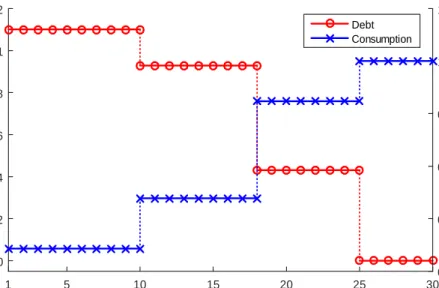
Time 1 5 10 15 20 25 30 Debt 0 0.2 0.4 0.6 0.8 1 1.2 Cons ump tion 0.92 0.94 0.96 0.98 1 1.02 Debt Consumption
Figure 1: Simulation of debt and consumption for a particular sequence of ’s during normal times.
in every period in which the country honors its debt, while changing discretely upon every episode of renegotiation. Figure 1 illustrates a simulation of the consumption and debt dynamics. Note that the sequence of renegotiations eventually brings the debt to a su¢ ciently low level where the risk of renegotiation vanishes. This consumption path is di¤erent from the …rst-best allocation where consumption and debt are constant for ever. Interestingly, in the long run, consumption is higher in the competitive equilibrium with the risk of repudiation than in the …rst best allocation.
It is straightforward to generalize the results to the case of R < 1 under the assumption that
utility features constant relative risk aversion. In this case, when the debt is honored debt would increase and consumption would fall. After each episode of renegotiation the economy would start
again accumulating debt. In a world comprising economies with di¤erent ; e.g., some with R = 1
and some with R <1;economies with low would experience recurrent debt crises.
3.4 Equilibrium under recession
When the economy is in recession the sovereign chooses, sequentially, whether to honor the current debt, how much new debt to issue, and how much reform e¤ort to exert. In this section, we assume that the sovereign cannot issue GDP-linked debt, i.e., securities whose payment is contingent on the stochastic realization of the endowment. In Section 3.5 below we relax this restriction.
A natural property of the competitive equilibrium is that C(b; w) < C(b; w) for all b b:
con-ditional on honoring a giving debt level, consumption is higher in normal times than in a recession. Although we could …nd no numerical counterexample to this property, it is di¢ cult to prove it in general because the equilibrium functions for consumption, e¤ort and debt price are determined si-multaneously. However, we can provide a su¢ cient condition.
Proposition 5 The following conditions are su¢ cient to ensure that C(b; w) < C(b; w) for all b 2
0; b :(i) w w > 1 w; and (ii) F[(u(w) u((1 ) (w w)))=(1 )] = 0.
^b( ; w) < ^b( ; w), Q(b; w) < Q(b; w) and W(b; w) < W(b; w): Note, in particular, that the price of the bond increases if the recession ends because of the associated reduction in the probability of
renegotiation. The property that (b; w)> (b; w)implies that one can partition the state space into
three regions:
- if b < b ; the country honors the debt with a positive probability, irrespective of the aggregate
state (the probability of renegotiation being higher if the recession continues than if it ends);10
- if b 2 b ; b ; the country renegotiates with probability one if the recession continues, while it
honors the debt with a positive probability if the recession ends;
- if b > b; the country renegotiates its debt with probability one, irrespective of the aggregate
state.
Note that the risk of repudiation introduces some state contingency, since debt is repaid with di¤erent probabilities under recession and normal times.
3.4.1 Reform e¤ort in equilibrium
We denote by (b0) the equilibrium policy function for e¤ort, i.e., the probability that the recession
ends next period, as a function of the newly-issued debt. More formally, the …rst-order condition from (12) yields:11 X0 b0 = Z 1 0 V b0; 0; w dF( ) Z 1 0 V b0; 0; w dF( ) : (14)
The sovereign’s incentive to exert reform e¤ort hinges on the increase in expected utility associated with the end of the recession. However, e¤ort is not provided e¢ ciently. To see why, recall that the bond price increases upon economic recovery. Thus, the creditors reap part of the welfare gain from economic recovery, whereas the country bears the full burden of the e¤ort cost.
We can prove that e¤ort is ine¢ ciently provided with the aid of a simple one-period deviation argument. Consider an equilibrium e¤ort choice path consistent with (14) –corresponding to the case of non-contractible e¤ort. Next, suppose that, only in the initial period, the country could contract e¤ort before issuing new debt. The following lemma shows that, in this case, the country would choose a higher reform e¤ort than in the competitive equilibrium.
Lemma 3 Suppose that b0 > 0 and that the borrower can, in the initial period, commit to an e¤ ort level upon issuing new debt. Then, the reform e¤ ort would be strictly larger than in the case in which e¤ ort is never contractible.
If the sovereign could commit to reform, its e¤ort would be monotonically increasing in the debt level, since a high debt increases the hardship of a recession. However, in equilibrium reform e¤ort
exhibits a non-monotonic behavior. More precisely, (b) is increasing at low levels of debt, and
decreasing in a range of high debt levels, including the entire region b ; b . Proposition 6 establishes
this result more formally.
1 0b is implicitly determined by the equationW b ; w =W(0; w) max. 1 1
Nota that the continuity and monotonicity ofX;together with the continuity of the value functions ensure that is a continuous function.
Proposition 6 There exist three ranges, [0; b1] [0; b ]; [b2; b] [b ; b];and b;1 such that: 1. If b2[0; b1); 0(b)>0;
2. If b2 b2; b ; 0(b)<0; 3. If b2 b;1 ; 0(b) = 0.
The following argument establishes the result. Consider a low (possibly negative) debt range where the probability of renegotiation is zero. In this range, there is no moral hazard. Thus, a higher debt level has a disciplining e¤ect, i.e., it strengthens the incentive for economic reforms: due to the concavity of the utility function, the discounted gain of leaving the recession is an increasing function of debt.
As one moves to a larger initial debt, however, moral hazard becomes more severe, since the reform e¤ort decreases the probability of default, and shifts some of the gains to the creditors. The e¤ect of debt overhang (cf. Krugman 1988) dominates over the disciplining e¤ect in the region [b ; b]. In this range, debt has a stark state contingency. If the economy remains in recession, it is renegotiated
for sure, rendering the continuation utility independent of b. If the recession ends, the continuation
utility is decreasing inb. Therefore, in this region the value of reform e¤ort necessarily decreases inb.
By continuity, the same argument applies to a range of debt below b .12
The debt-overhang e¤ect hinges on the presence of some renegotiation risk and an associated premium on debt. If the borrower instead could commit to repay the debt, the price of debt would
be 1=R, so an economic recovery would not yield any bene…ts to the lenders and the e¤ort function
would be monotone increasing in debt.
3.4.2 Debt issuance and consumption dynamics
In this section, we characterize the equilibrium dynamics of consumption and debt. We proceed in two steps. First, we derive the properties of the CEE. Then, we summarize its characterization in a formal proposition.
The …rst-order condition of (10) together with the envelope theorem yields the following CEE:
E M Ut+1 M Ut j debt is honored att+ 1 (15) = 1 + 0(bt+1) Pr (debt is honored att+ 1)R h Q(bt+1; w) Q^(bt+1; w) i bt+1:
Equation (15) di¤ers from (13) in two terms. First, the left-hand side has the expected ratio
between the marginal utilities, due to the uncertainty about the future aggregate state. Second, there is a new term on the right-hand side capturing the e¤ect of debt on reform e¤ort.
For expositional purposes, consider …rst the case in which the probability that the recession ends is
exogenous, i.e., 0 = 0. In this case, the CEE requires that the expected marginal utility be constant.
For this to be true, consumption growth must be positive if the recession ends and negative if it continues. The lack of consumption insurance stems from the incompleteness of …nancial markets,
1 2
In a variety of numerical simulations, we have always found to be hump-shaped with a unique peak (see Figure 3), although in general this depends on the distributionF( ).
and would disappear if the sovereign could issue GDP-linked debt. In Section 3.5 below, we show that this conclusion does not carry over to the economy with moral hazard.
Consider, next, the general case. Moral hazard introduces a new strategic motive since the level of
newly-issued debt a¤ects the sovereign’sex-post incentive to make reforms. The sign of this strategic
e¤ect hinges on the sign of 0 (see Proposition 6). When the outstanding debt is low, 0 >0:Then,
more debt strengthens the ex-post incentive to reform, thereby increasing the price of the
newly-issued debt. The right-hand side of (15) is in this case larger than unity, and the CEE implies a lower consumption fall (hence, higher debt accumulation) than in the absence of moral hazard. In contrast,
in the region of high initial debt, 0<0. In this case, the sovereign issues less debt than in the absence
of moral hazard in order to mitigate the fall in debt price associated with moral hazard. Thus, when the recession continues, a highly indebted country will obtain less consumption insurance when the
reform is endogenous than whenp is exogenous.
We summarize the results in a formal proposition.
Proposition 7 If the economy starts in a recession and the realization of 0 induces no
renegotia-tion, the optimal debt level, b0 =B(B(b; ; w); w); induces a consumption sequence that satis…es the following CEE: R 0 B B B B B B B B B B B B @ 1 b0 1 F b0 | {z }
prob. of repaym en t an d con tin u in g recession
Pr Hjb0 | {z }
u n con dition al prob. of repa ym en t
u0 c0jH;w u(c) | {z } MRS if rec. cont. + b0 1 F b0 | {z }
prob. of repaym en t an d en d of recession
Pr Hjb0 | {z }
u n con dition al prob. of repaym en t
u0(c0jH;w) u(c) | {z } MRS if rec. ends 1 C C C C C C C C C C C C A = 1+ 0(b0) Pr (Hjb0) R Q b 0; w Q b^ 0; w b0 | {z }
gain to lenders if recession ends
(16)
where c = C(B(b; ; w); w) is current consumption, c0jH;w = C(b0; w) = C(B(B(b; ; w); w); w) is next-period consumption conditional on w and no renegotiation, and Pr (Hjb0) is the unconditional probability that the debt b0 be honored, i.e., Pr (Hjb0) = [1 (b0)] 1 F (b0) + (b0)
(1 F( (b0))):
We end this section by noting that the top of the La¤er curve of debt corresponds to a lower debt level in recession than during normal times.
Lemma 4 Letb= minnarg maxb2[b;~b]fQ(b; w)bg
o
andbR= minnarg max
b2[b;~b]fQ(b; w)bg
o
. Then,
bR b; with equality holding only if (b) = p (i.e., if the probability of staying in a recession is exogenous).
The reason why the top of the La¤er curve under recession is located strictly to the left of b is
that the reform e¤ort is decreasing in debt (i.e., 0 <0) forbclose tob, as established in Proposition
6. This implies that for b close to but smaller than b, bond revenue is strictly decreasing in b. By
reducing the newly-issued debt, the borrower increases the subsequent reform e¤ort, which in turn increases the current bond price and debt revenue.
3.4.3 Contracting on e¤ort
In equilibrium, there is no contracting on e¤ort, even though this is not ruled out at the outset. The reason is that in a Markov equilibrium the market has no commitment power to dispense retrospective punishment. To see why, consider the possibility for a syndicate of creditors to write a contract specifying a reform e¤ort. In the spirit of the limited commitment approach of our paper, assume that the maximum feasible punishment is to treat any deviation from the agreed e¤ort level as equivalent to a default in the bond market. Namely, a sovereign who deviates from the agreed reform e¤ort would be forced to default on the outstanding debt and pay the stochastic default cost . For simplicity, we
assume that a deviation att triggers punishment in periodt+1when debt is defaulted (although this
timing assumption is not essential).
This threat could discipline, ex-ante, the sovereign’s e¤ort. However, it would not be optimal for the syndicate of creditors to carry out the punishment ex-post, since this would induce a loss for creditors (the country would not repay its debt). More generally, once the sovereign has failed to deliver the e¢ cient e¤ort level, it is never time-consistent to punish her. Therefore, the lack of commitment embedded in the Markov equilibrium implies that e¤ort is not contractible.
3.4.4 Taking stock
The previous sections have established the main properties of the competitive equilibrium. The …rst property is that moral hazard induces an ine¢ cient provision of reform e¤ort in equilibrium, especially
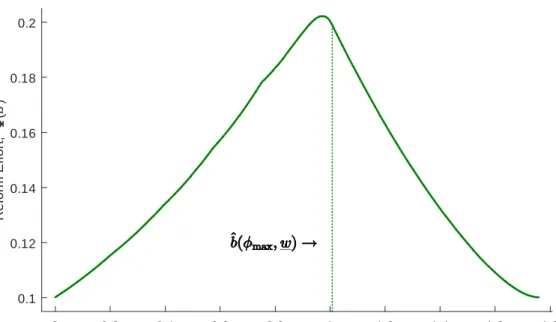
for high debt levels. Figure 2 shows the e¤ort function (b) in a calibrated economy. Note that the
reform e¤ort plunges for high debt levels.13 The hump-shaped e¤ort function contrasts sharply with
the optimum e¤ort in Proposition 1. In the …rst best, reform e¤ort is monotone increasing in the initial debt level, and remains constant over time. The second property is that the possibility of
renegotiating debt may improve risk sharing. This is per se welfare-enhancing but it exacerbates the
moral hazard in reform e¤ort.
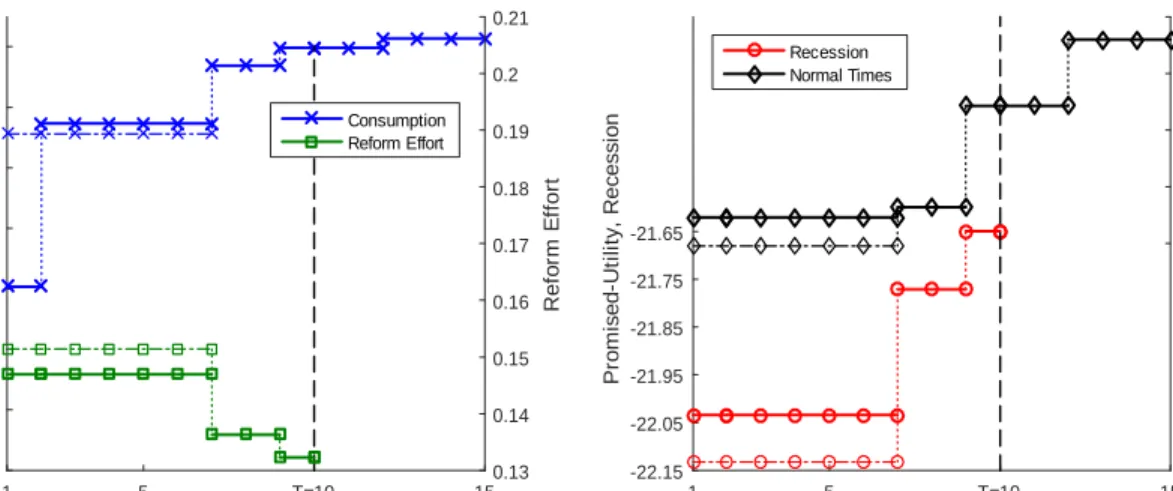
The third property is that in periods when debt is fully honored, the equilibrium features positive debt accumulation if the economy remains in recession, and constant debt when the economy returns to normal times. An implication of the …rst and third property is that, as the recession persists, the reform e¤ort initially increases, but then, for high debt levels, it declines over time. Figure 3 illustrates a time path for debt and consumption (left panel) and of the corresponding reform e¤ort (right panel)
for a particular simulated sequence of ’s. The volatility in consumption and e¤ort contrast sharply
with the optimal allocation of Proposition 1 where consumption and reform e¤ort are constant over time.
The fourth property concerns post-renegotiation debt dynamics. Debt accumulation resumes im-mediately after the haircut, while consumption increases upon debt relief and starts falling again thereafter. This prediction is broadly consistent with the empirical evidence that economic conditions of debtors improve following a debt relief, as documented in Reinhart and Trebesch (2016). It is also consistent with the recent debt dynamics of Greece – after the 2011 debt relief, the debt-GDP ratio fell from 171% to 157%, but subsequently it increased back to 177%. Interestingly, the theory predicts that for highly indebted countries a large haircut may enhance the reform e¤ort, contrary to the common view that pardoning debt would have perverse e¤ects on incentives.
1 3
This prediction is consistent with the casual observation that in the recent European debt crisis structural reforms have met stronger opposition in highly indebted countries. Countries with moderate initial debt levels, such as for instance Spain, have arguably been more prone to enact structural reforms than has Greece.
Debt issued, b' 0 0.2 0.4 0.6 0.8 1 1.2 1.4 1.6 1.8 Refor m Effor t, (b') 0.1 0.12 0.14 0.16 0.18 0.2
Figure 2: Reform e¤ort function (b) resulting from the benchmark calibration in Section 5.2.
Time 1 5 T=10 15 De bt 0.4 0.6 0.8 1 1.2 Co nsumpt io n 0.5 0.6 0.7 0.8 0.9 1 Debt Consumption Time 1 5 T=10 Reform Eff ort 0.13 0.14 0.15 0.16 0.17 0.18
Figure 3: Simulation of debt, consumption and e¤ort for a particular sequence of ’s in the competitive
For simplicity we have assumed that the sovereign can only issue one-period debt. Issuing debt at multiple maturities could in principle allow the borrower to obtain some additional insurance. In a world without moral hazard, this could complete the markets (cf. Angeletos 2002, Dovis 2016). However, as we show in Section 3.5 below, in our model even an economy with GDP-linked debt would fail to overcome the moral hazard problem associated with structural reforms. This mitigates the concern about the loss of generality associated with the assumption that there is only one-period debt. Moreover, we conjecture that if the borrower could issue debt at multiple maturities, it would
only issue one-period debt in steady state in order to limit the moral hazard problem.14
Finally, our focus on Markov equilibrium yields the extreme implication that renegotiations do not a¤ect the terms at which the country can borrow in future. In particular, conditional on the debt level, the risk premium is independent of the country’s credit history. This implies that renegotiations entail no cost for the sovereign. In Appendix B (Section B.3), we present a simple extension where sovereigns can be of di¤erent types, and the frequency of renegotiations induces learning thereby a¤ecting bond prices. In this extension, renegotiations are less benign as they ruin the borrower’s reputation.
3.5 Competitive equilibrium with GDP-linked debt
The analysis of the competitive equilibrium was carried out thus far under the assumption that the sovereign can issue only a non-contingent asset. In this section, we extend the analysis and allow for GDP-linked debt. We continue to focus on Markov equilibria.
Letbw andbw denote two securities paying one unit of output if the economy is in a recession or in
normal times, respectively. We label these securitiesrecession-contingent debt andrecovery-contingent
debt, respectively, and denote byQw b0w; b0w andQw b0w; b0w their corresponding prices. The budget
constraint in a recession is given by:
Qw b0w; b0w b0w+Qw b0w; b0w b0w =B(b; ; w) +c w: (17)
Under limited commitment, the price of each security depends on the two outstanding debt levels,
as both a¤ect the reform e¤ort and the probability of renegotiation.15 The sovereign’s value function
can be written as:
V (b; ; w) = max
fb0
w;b0wg2([b;~b] [b;~b])
u Qw b0w; b0w b0w+Qw b0w; b0w b0w+w B(b; ; w) (18)
X b0w; b0w + 1 b0w; b0w EV b0w; w + b0w; b0w EV b0w; w :
Mirroring the analysis in the case of non-state-contingent debt, we proceed in two steps. First, we characterize the optimal reform e¤ort. This is determined by the di¤erence between the discounted utility conditional on the recession ending and continuing, respectively (cf. Equation (14)):
X0 b0w; b0w = Z 1 0 V b0w; 0; w dF( ) Z 1 0 V b0w; 0; w dF( ) : (19)
Note that the incentive to reform would vanish under full insurance. 1 4
Aguiar and Amador (2013) reach a similar conclusion in a di¤erent model. From an empirical standpoint, Broner, Lorenzoni, and Schmukler (2013) document that in emerging markets governments issue mostly short term debt.
1 5
Note that these assets are not Arrow-Debreu assets since their payo¤s are not conditional on the realization of . An alternative approach would have been to follow Alvarez and Jermann (2000) and issue an Arrow-Debreu asset for each state(w; )and let the default-driven participation constraint serve as an endogenous borrowing constraint.
Next, we characterize consumption and debt issuance. To this aim, consider …rst the equilibrium asset prices. The prices of the recession- and recovery-contingent debt are given by, respectively:
Qw b0w; b0w = 1 b0 w; b0w R 1 F b 0 w + 1 b0 w Z (b0 w) 0 1( ) dF( ) ! ; (20) Qw b0w; b0w = b0w; b0w R 1 F b 0 w + 1 b0w Z (b0 w) 0 1( ) dF( ) ! : (21)
The next proposition characterizes the CEE with GDP-linked debt.
Proposition 8 Assume that there exist markets for two securities delivering one unit of output if the economy is in recession and in normal times, respectively, and subject to the risk of renegotiation. Suppose that the economy is initially in recession. The following CEEs are satis…ed in the competitive equilibrium:
(I) If the recession continues,
u0 c0jH;w u0(c) | {z } MRS if rec. continues = 1 + @ @b0w b 0 w; b0w | {z } >0 R b0w; b0w 1 F b0 w 1 b0w; b0w | {z } >0 : (22)
(II) If the recession ends,
u0(c0jH;w) u0(c) | {z } MRS if rec. ends = 1 + @ @b0 w b0w; b0w | {z } <0 R b0w; b0w 1 F (b0 w) b0w; b0w | {z } ; >0 (23) where b0w; b0w Qw b 0 w; b0w b0w b0w; b0 w Qw b0w; b0w b0w 1 b0w; b0 w 0: (24) Moreover, c = Qw b0w; b0w b0w+Qw b0w; b0w b0w+w B(b; ; w); c0jH;w = Qw Bw bw0 ; Bw b0w Bw b0w +Qw Bw b0w ; Bw b0w Bw b0w +w b0w; c0jH;w = Q B b0w; w ; w B b0w; w +w b0w;
whereBw b0w andBw b0w denote the optimal level of newly-issued recession- and recovery-contingent
debt when the recession continues, and debt is honored.
If the probability that the recession ends were exogenous, 0 = 0, consumption would be
inde-pendent of the realization of the aggregate state. In this case, the CEEs imply constant consumption
c0jH;w =c0jH;w =cwhere, recall, c0jH;w is consumption conditional on debt being honored in the next
period. However, in the general case with moral hazard, consumption falls (and recession-contingent debt increases) whenever the economy remains in recession and debt is honored, as shown by Equa-tion (22). When the recession ends, consumpEqua-tion increases as shown by EquaEqua-tion (23). Therefore, the competitive equilibrium features imperfect insurance, even conditional on honoring the debt.
The intuition is as follows. By issuing more recession-contingent debt, the country strengthens
its incentive to make reforms, since @ =@b0w >0. This induces the sovereign to issue more
recession-contingent debt than in the absence of moral hazard. This e¤ect is stronger the larger is b0w; b0w
which can be interpreted as the net expected gain accruing to the lenders from a marginal increase in the probability that the recession ends. On the contrary, issuing more recovery-contingent debt weakens the incentives to do reform. As a result, consumption increases if the recession ends and falls if the recession continues (and debt is honored). This result highlights the trade-o¤ between insurance and incentives: the country must give up insurance in order to gain credibility about its willingness to do reforms. In addition, debt in‡uences the reform e¤ort: this is increasing in the newly-issued recession-contingent debt and decreasing in the newly-issued recovery-contingent debt. In summary, the moral hazard problem in reform limits the possibility for the equilibrium with GDP-linked debt to smooth consumption and reform e¤ort.
4
Optimal contract with one-sided commitment
In the competitive equilibrium of the previous section, the sovereign cannot commit to the e¢ cient reform e¤ort and creditors cannot commit to punishments that are ex-post suboptimal. In this section, we characterize the allocation chosen by a benevolent social planner who can commit to enforce a contract even by dispensing punishments that are not ex-post optimal. However, the borrower continues to be subject to limited commitment. This limits the planner’s ability to punish deviations from the optimal contract. In particular, the maximum punishment the planner can impose is to terminate the contract and let the sovereign resort to the competitive equilibrium. In the next section, we interpret this allocation as the result of an assistance program managed by an international agency (e.g., the IMF) that can commit to terminate its program in case of non-compliance. We consider two scenarios. In the …rst, the reform e¤ort is observable, while in the second it is not. We continue to
assume, as in the competitive equilibrium, that the realization of is publicly observable.
The problem is formulated as a one-sided commitment program, following Ljungqvist and Sargent (2012) and based on a promised-utility approach in the vein of Spear and Srivastava (1987), Thomas and Worrall (1988 and 1990) and Kocherlakota (1996).
We denote by the utility promised to the risk-averse agent in the beginning of the period, before
the realization of . is the key state variable of the problem. We denote by! and ! the promised
continuation utilities conditional on the realization and on the aggregate statewandw, respectively.
P( )and P( )denote the expected present value of pro…ts accruing to the principal conditional on
delivering the promised utility in the most cost-e¤ective way in recession and in normal times,
respectively. The planning problem is evaluated after the uncertainty about the aggregate state has been resolved (i.e., the economy is either in recession or in normal times in the current period), but
before the realization of is known. In Appendix B (Proposition 16), we prove, following the strategy
in Thomas and Worrall (1990), that the functional equations de…ned in Equations (25) and (30) below
are contraction mappings, that the pro…t functions P( ) and P( ) are decreasing, strictly concave
4.1 Normal times
In normal times, the optimal value P( )satis…es the following functional equation:
P( ) = max fc ;! g 2@ Z @ w c + 1 RP(! ) dF( ); (25)
where the maximization is subject to the constraints Z
@
[u(c ) + ! ]dF( ) ; (26)
u(c ) + ! W(0; w) ; 2 @; (27)
c 2[0; w]; ; ! 2 [W (0; w) E[ ]; W(0; w)]:
The inequality (26) is a promise-keeping constraint, whereas (27) is a participation constraint (PC). Note that the outside option for the agent is equivalent to the value of default in the competitive equilibrium.
The application of recursive methods allows us to establish the following proposition.
Proposition 9 Assume the economy is in normal times. (I) For all realizations such that the PC
of the agent, (27), is binding, ! > and the solution for (c ; ! ) is determined by the following conditions:
u0(c ) = 1
P0(! ); (28)
u(c ) + ! =W (0; w) : (29)
The solution is not history-dependent, i.e., the initial promise, ; does not matter. (II) For all real-izations such that the PC of the agent, (27), is not binding, ! = and c =c( ), where c( ) is determined by (28). The solution is history-dependent.
The constrained optimal allocation (COA) has standard properties. Whenever the agent’s PC is not binding, consumption and promised utility remain constant over time. Whenever the PC binds, the planner increases the agent’s consumption and promised utility in order to meet her PC.
4.2 Recession
When the economy is in recession, the contract speci…es also an e¤ort level. We consider …rst the case in which the reform e¤ort is observable. In this case, the planner terminates the contract whenever
the agent deviates from the e¢ cient e¤ort level. We assume that when the agent deviates at timet,
she is settled with the default cost at t+ 1. Note that this allocation is equivalent to a decentralized
equilibrium in which the sovereign can issue debt contingent both on the aggregate level and on the borrower’s e¤ort.
The reform e¤ort associated with a deviation is given by
pdev = arg max
p2[p;p] X(p) + ((1 p)W(0; w) +pW(0; w))
Then, the continuation utility from a deviation is given by
dev X(pdev) + (1 pdev)W (0; w) +pdevW(0; w) E 0 ;
whereE 0 denotes the expected value of 0:
We can now characterize the optimal contract under recession
P( ) = max fc ;p ;! ;! g 2@ Z @ w c + 1 R (1 p )P ! +p P(! ) dF( ); (30)
where the maximization is subject to the constraints Z @ u c X(p ) + (1 p )! +p ! dF( ) ; (31) u c X(p ) + (1 p )! +p ! W (0; w) ; 2 @; (32) X(p ) + (1 p )! +p ! dev (33) c 2[0; w]; p 2[p; p]; ; ! 2[W(0; w) E[ ]; W(0; w)]; ! 2 [W(0; w) E[ ]; W(0; w)]:
We prove in Appendix B (Proposition 16) that the program is concave, and that the FOCs are
necessary and su¢ cient. The FOCs with respect to ! ; ! ; and p (see Equations (63)–(66) in
Appendix A) yield:16
P0(! ) = P0 ! (34)
X0(p ) = ! ! R
1
P0 ! P(! ) P ! : (35)
Equation (34) establishes that the planner equates the marginal pro…t loss associated with promised utilities in the two aggregate states. (35) establishes that e¤ort is set at the constrained e¢ cient level. The two terms on the right hand-side are the bene…ts accruing to the agent and to the principal, respectively. Note that in the competitive equilibrium the sovereign only takes into consideration the private gain of exerting e¤ort, so the second term is missing.
The IC constraint may or may not be binding. When it is binding, (34), (35) and the IC constraint pin down a unique (constant) level of promised utilities and e¤ort. We state this formally in the following Lemma.
Lemma 5 When the IC is binding, e¤ ort and promised utilities are constant at the levels ! =! ;
! = ! and p =p , where the triplet (p ; ! ; ! ) is uniquely determined by the IC constraint (33) holding with equality, (34), and (35).
When the IC constraint is not binding, consumption is pinned down by the following standard FOC (see Equations (63) and (64) in Appendix A):
u0 c = 1
P0 ! : (36)
1 6
To see why the solution to (34)–(35) is unique, note that the strict concavity and monotonicity ofP and P imply that Equation (34) determines a strictly positive relationship between! and! . Thus, Equation (35) yields an implicit strictly decreasing relationship betweenp and! and an implicit strictly increasing relationship betweenp and! .
This condition does not hold when the IC constraint is binding, since the planner must in this case distort the consumption margin.
We characterize the optimal contract by distinguishing two cases. Proposition 10 covers the case in which the initial promised utility is high and the IC constraint is not binding irrespective of the realization of . Proposition 11 covers the case in which the initial promised utility is low and the IC
constraint is binding for a non-empty range of realizations of .
It is useful to de…ne ~( )as the threshold realization of such that the participation constraint is
binding for a given . In particular, ~( )is implicitly de…ned by the promise-keeping constraint (31),
=W (0; w) "Z ~(v) 0 dF( ) + ~( )h1 F(~(v))i # ; (37) where ~( )is decreasing in .
Proposition 10 Suppose that the economy starts in a recession with promised utility ! : Then,
the IC constraint (33) is never binding (irrespective of ), and the optimal contract is characterized as follows:
1. If <~( ), the PC is binding, and the solution for c ; p ; ! ; ! is determined by (34), (35), (36) and by (32) holding with equality. Moreover, ! > .
2. If ~( ), the PC is slack, and the solution for c ; p ; ! ; ! is given by ! = ; c =c( ); ! =!( );and p =p( ), where the functions c( ); !( ) and p( ) are determined by (36), (34), (35), respectively. The solution is history-dependent. The reform e¤ ort is decreasing and consumption and future promised utility are increasing in .
When < ! , the solution of Proposition 10 would violate the IC constraint in some states. Thus,
the planner must either reduce the demands on e¤ort or increase the promise utilities so that the IC constraint holds. The following proposition characterizes the optimal contract in this case.
Proposition 11 Suppose that the economy starts in a recession with promised utility < ! . Then,
the IC constraint (33) is binding in some states, and the optimal contract is characterized as follows: 1. If <~(! ), the PC is binding while the IC is not binding. The solution is not history-dependent
and is determined as in Proposition 10, part 1 (in particular, ! > ! andp < p ).
2. If 2[~(! );~( )], both the PC and the IC are binding. E¤ ort and promised utilities are equal
to(p ; ! ; ! )as given by Lemma 5. Consumption is determined by (32) and (33) jointly, which
yield:
c =u 1(W(0; w) dev): (38)
Consumption and e¤ ort are lower and promised utilities are higher than in the absence of an IC constraint.
3. If > ~( ), the IC is binding, while the PC is not binding. E¤ ort and promised utilities are equal to (p ; ! ; ! ): Consumption is constant across and is determined by (31) and (33), which yield:
c =u 1 W (0; w) ~( ) dev : (39)
Consumption and e¤ ort are lower and promised utilities are higher than in the absence of an IC constraint.