
PYTHON FOR
GAMMA-RAY ASTRONOMY
Christoph Deil (MPIK Heidelberg)
March 21, 2016
GAMMA-RAY
ASTRONOMY
Space and ground telescopes
2
➤ Brief introduction to gamma-ray
telescopes and data (will go very quickly over slides in this section)
➤ No time to cover astrophysics, if
you’re interested, here’s a good
recent review: 2015arXiv150805190F
Space- and Ground-Based Gamma-Ray Astrophysics Stefan Funk 1, 2
1Erlangen Centre for Astroparticle Physics, Friedrich-Alexander-Universit¨at
Erlangen-N¨urnberg, Erwin-Rommel-Str. 1, D-91058 Erlangen, Germany
2Kavli Institute for Particle Astrophysics and Cosmology, Department of Physics
and SLAC National Accelerator Laboratory, Stanford University, Stanford, CA 94305, USA
Xxxx. Xxx. Xxx. Xxx. 2015. 00:1–47 This article’s doi:
10.1146/((please add article doi)) Copyright c 2015 by Annual Reviews. All rights reserved
Keywords
Dark Matter Cosmic rays Gamma-ray Astronomy Fermi-LAT Imaging atmospheric Cherenkov Telescopes Galactic Center
Abstract
In recent years, observational -ray astronomy has seen a remarkable range of exciting new results in the high-energy and very-high en-ergy regimes. Coupled with extensive theoretical and phenomenological studies of non-thermal processes in the Universe these observations have provided a deep insight into a number of fundamental problems of high energy astrophysics and astroparticle physics. Although the main moti-vations of -ray astronomy remain unchanged, recent observational re-sults have contributed significantly towards our understanding of many related phenomena. This article aims to review the most important
ELECTROMAGNETIC SPECTRUM
FERMI-LAT PAIR PRODUCTION TELESCOPE
Tracker
— Event direction
Calorimeter — Energy
Anti-coincidence shield
— Particle type (proton,
electron, photon, …)
Needed to distinguish small fraction (1 in 10k) of
photons among charged cosmic ray background.
High-level data is basically an event list table (TIME, ENERGY, RA, DEC)
FERMI-LAT OBSERVATIONS
➤ Start: 2008. Continuousall-sky survey for past 7+ years
➤ Large field of view — observe
good fraction of the whole sky at any given time
➤ Earth orbit + rocking pattern
— observe every source every few hours
Vela pulsar location in Fermi-LAT
field of view as a function of time
FERMI-LAT — FIRST GOOD VIEW OF THE GEV GAMMA-RAY SKY
Energy range: 100 MeV — 1 TeV
Resolution: 10 deg — 0.1 deg !
Galactic diffuse emission, 3000 sources detected (e.g blazars, pulsars, SNRs, …)
PHOTON STATISTICS
➤ The Fermi-LAT is an awesome
gamma-ray telescope.
➤ But at ~ 1 TeV it runs out of
statistics, because gamma-ray spectra are steep power-laws.
➤ Brightest sources observed for
10 years with a 1 m^2
detector yield a few photons.
➤ For very-high-energy
gamma-ray astronomy (> 1 TeV), other telescopes are needed!
1 m
x
1 m
Gamma-ray
photon
“Air shower”Cherenkov light
Cherenkov telescope arrays
on the ground Shower image
1 km^2
1 m^2
Camera with nano-second
IMAGING ATMOSPHERIC CHERENKOV TELESCOPE ARRAY (IACT)
Several shower images:
- Particle ID (cosmic ray, photon)
- Event direction (~ 0.1 deg)
- Event energy
EXISTING IACTS
➤ Energy range roughly
100 GeV — 100 TeV
➤ Pointed observations with field
of view of a few degrees.
➤ Each array has a few
telescopes, total cost ~ 10 M$
➤ Built by collaborations of
~100 astronomers
➤ Data and software from current
IACTs not publicly available.
➤ (Fermi-LAT is a NASA mission
with ~ 600 M$. All data and software is publicly available!)
MAGIC, La Palma
VERITAS, Arizona
TEV GAMMA-RAY SOURCES
➤ First ground-based gamma-raysource detection:
Crab nebula in 1989
➤ Already ~ 150 detected now!
:-)
➤ Only a few % of the sky have
been surveyed so far.
H.E.S.S. Galactic plane survey
H.E.S.S.
CHERENKOV TELESCOPE ARRAY (CTA)
CHERENKOV TELESCOPE ARRAY
➤ 100 telescopes in Chile
20 telescopes on La Palma
(site negotiations still ongoing)
➤ International consortium with
already 30 countries and 1000 astronomer members
➤ Cost ~ 300 M$
➤ Open observatory with guest
observers and archive, as is common in other wavelengths.
➤ Prototype telescopes taking data.
LMC now LMC with CTA
CTA — BIG AND SMALL DATA
➤ Raw data consists of images or little
movies of air showers
➤ Raw data rate is ~ 10 GB / s Big data!
➤ Data center: low-level CTA pipeline
for calibration, event reconstruction, gamma-hadron separation.
➤ Results in much-reduced dataset:
event list with just a few parameters per event (time, energy, RA, DEC)
Small data!
➤ Astronomers, on their laptop with
downloaded FITS data (like Fermi-LAT today): high-level CTA science
tools for source detection as well as
time, spatial and spectral analysis.
O(100) Telescopes On the Ground O(1000) Pixels, O(1) channels
telescope position (m)
O(10) Time slices
O(10) are triggered per event
One of the first observed events from a CTA prototype telescope (~ ns time resolution)
CODES
C++
PYTHON
how do we use python to help implement these algorithms?
C++ & ROOT
➤ For the past decades, gamma-ray
astronomy was mostly done by people from high-energy physics.
➤ For the past ~ 20 years until very
recently , this meant C++ & ROOT
➤ ROOT provides everything! ➤ Scientific computing library ➤ I/O (auto C++ object
serialisation)
➤ GUI framework
➤ Interactive REPL and scripting
(ACliC, now Cling)
➤ Python interface PyROOT (fancy
auto wrapper generator, using ROOT introspection, not SWIG).
STATUS
➤ Ground-based gamma-ray
telescopes have proprietary software (C++ & ROOT, no Python) and data formats
(serialised ROOT objects).
➤ Space-based gamma-ray
telescopes (at least Fermi-LAT) have C++ & ROOT-based low-level pipeline, but the astronomer gets:
CTA SOFTWARE
➤ Very active development ongoing
for low-level and high-level software.
➤ Many ideas and prototypes by
different groups.
➤ Making decisions and going toward
production codes is hard because so far no strong central management (CTA is not an ESO project).
➤ It looks like most CTA software will
be C, C++ or Python.
(Also Java used for array control.) Somewhat surprisingly: not ROOT!
A MAJOR QUESTION FOR CTA
C/C++
BUILDING A FRAMEWORK
Bottom-Up approach Top-Down approach
Python Python
C/C++ Numba,
Cython
Most current frameworks did
it this way (if they use with python and high-level Our approach: start early
start here
start here
CTAPIPE
➤ CTA offline analysis Python
pipeline prototype.
➤ Python package, built on
Scientific Python stack and
Astropy, started from Astropy affiliated package template.
➤ Open-source and on Github as
cta-observatory/ctapipe.
➤ Chosen over many C and C++
based proposals and prototypes.
Still a bit controversial if Python is efficient enough.
CORE DEPENDENCIES pyhessio (access to simtelarray datasets) C/C++
BUILDING A FRAMEWORK
Bottom-Up approach Top-Down approach
13 Python Python C/C++ Numba, Cython
Most current frameworks did it this way (if they use
python at all)
Our approach: start early with python and high-level
API
start here
start here
GAMMALIB & CTOOLS
➤ C++ with SWIG Python wrapper
➤ Gammalib
➤ generic library for gamma-ray
event data, with instrument
modules for CTA, Fermi-LAT, …
➤ No dependencies (except CFITSIO)
for easy long-term maintenance.
➤ 120k SLOC ➤ ctools
➤ software tools (like FTOOLS) for
IACT analysis implemented using Gammalib
➤ is being proposed as a prototype
for the official CTA science tools
C/C++
BUILDING A FRAMEWORK
Bottom-Up approach Top-Down approach
13 Python Python C/C++ Numba, Cython
Most current frameworks did it this way (if they use
python at all)
Our approach: start early with python and high-level
API
start here
start here
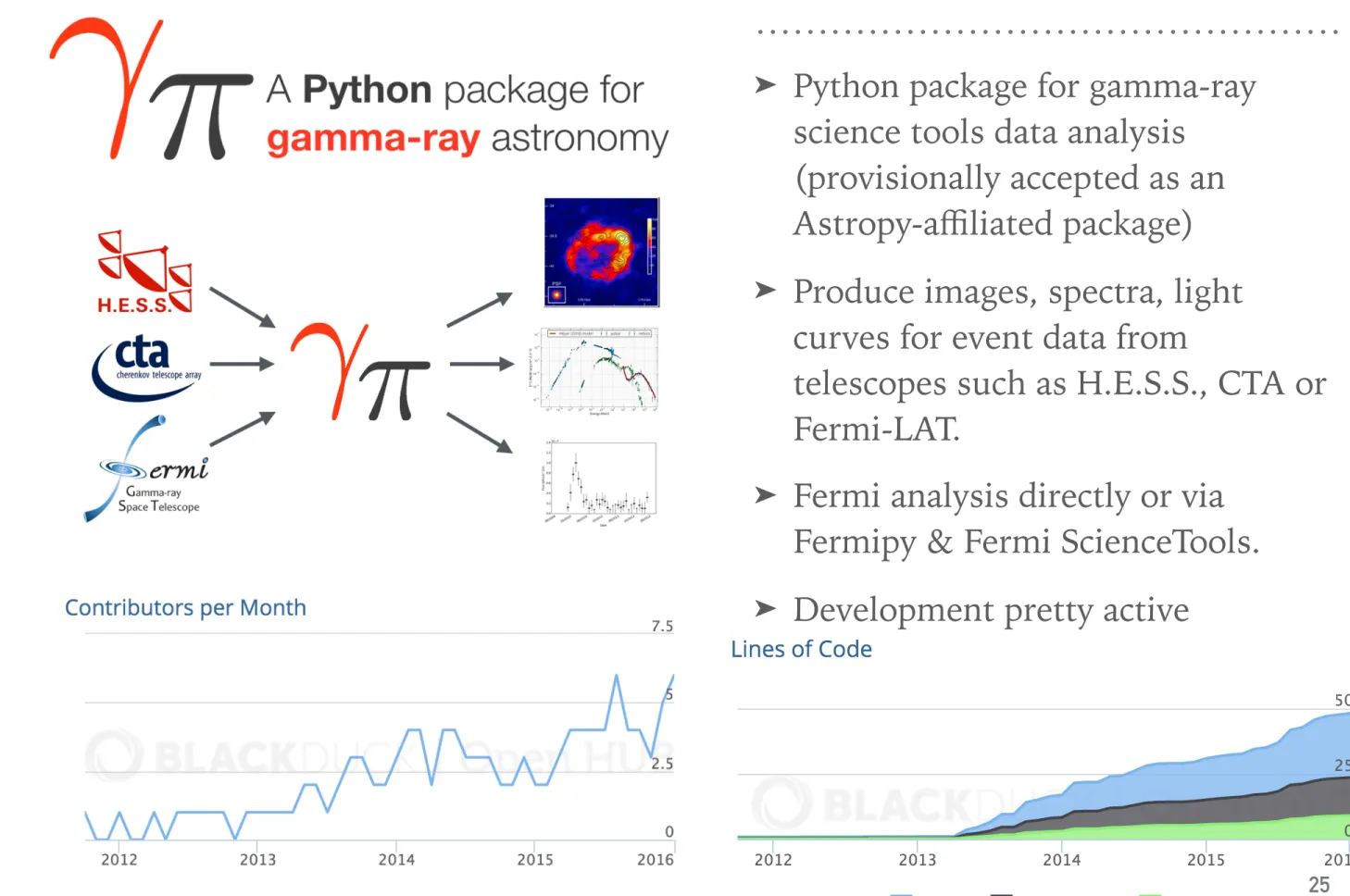
GAMMAPY
➤ Python package for gamma-ray
science tools data analysis (provisionally accepted as an Astropy-affiliated package)
➤ Produce images, spectra, light
curves for event data from
telescopes such as H.E.S.S., CTA or Fermi-LAT.
➤ Fermi analysis directly or via
Fermipy & Fermi ScienceTools.
➤ Development pretty active
Gammapy – A Python package forg-ray astronomy Axel Donath
Figure 1: Gammapy is a Python package for high-level g-ray data analysis. Using event lists, exposures and point spread functions as input you can use it to generate science results such as images, spectra, light curves or source catalogs. So far it has been used to simulate and analyse H.E.S.S., CTA andFermi-LAT data, hopefully it will also be applied to e.g. VERITAS, MAGIC or HAWC data in the future.
1. Introduction
1.1 What isGammapy ?
Gammapyis an open-source Python package forg-ray astronomy. OriginallyGammapystarted as a place to share morphology fitting Python scripts for the work on the H.E.S.S. Galactic plane survey [1] two years ago. Since that time Gammapy has grown steadily: functionality as well as development infrastructure has been improved and it has been accepted as an in-development Astropy-affiliated package. Now, in this proceeding, we would like to introduce Gammapy to the community and present our vision ofGammapy as a future community-developed, general purpose analysis toolbox forg-ray astronomers.
The general concept of Gammapy is illustrated in Figure 1. Based on pre-processed input data (e.g. event lists) provided by instruments such as H.E.S.S., Fermi or CTA, Gammapy offers the high-level analysis tools to generate science results such as images, spectra, light curves and source catalogs. By using common data structures and restriction to binned analysis techniques, all input data can be treated the same way, independent of the instrument. Research already making use ofGammapy is presented in [1, 2, 3].
1.2 How to getGammapy
GAMMAPY
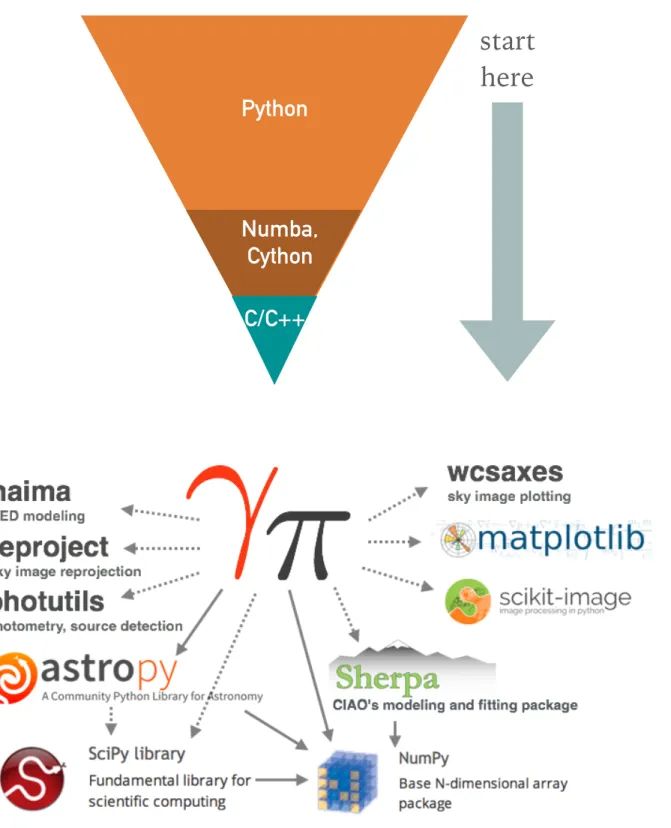
➤ Python first and use dependencies: ➤ Builds on Astropy and Sherpa,
as well as Naima, Fermipy and a few other packages like
reproject or photutils.
➤ Similar to ctapipe approach,
different from Gammalib / ctools
➤ So far mainly used for research with
H.E.S.S. data exported to FITS.
➤ Could propose as prototype for
official CTA science tools.
➤ Plan: 1.0 release this summer,
a paper in summer or fall.
Gammapy – A Python package forg-ray astronomy Axel Donath
Figure 2: The Gammapy stack. Required dependencies Numpy and Astropy are illustrated with solid arrows, optional dependencies (the rest) with dashed arrows.
3.3 or later. Further details on requirements and installation are available online 2. The latest
documentation is available on Read the Docs 3, including tutorials, code and analysis examples.
We have also set up a mailing list for user support and discussion4.
2. TheGammapystack
Gammapyis primarily built on the scientific Python stack. We employ Numpy and Astropy [4] as main dependencies and integrate other packages as optional dependencies where necessary. The current dependency structure is illustrated in Figure 2. Numpy provides the low level data struc-tures and the framework for numerical/array computations. Astropy is used for higher level data structures like tables (Table) and n-dimensional data objects (NDData), for I/O, coordinates and WCS transformations, and handling of physical quantities with units. Scipy is used for advanced numerical and data processing algorithms. For specific image processing routines we additionally use scikit-image.
To allow morphology and spectral fitting of TeV sources withGammapywe use the established X-ray modelling and fitting package Sherpa [5]. Sherpa allows interactive and scripted fitting of data sets with various spectral, light curve and morphology models taking instrument response functions into account. Additionally, it is possible to determine confidence levels on best-fit model parameters, compute likelihood profiles and goodness of fit measures. Sherpa recently also became an open-source project which makes it possible for users and external developers to contribute missing functionality or fix issues themselves in future.
2https://gammapy.readthedocs.org/en/latest/install.html
3https://gammapy.readthedocs.org/en/latest
C/C++
BUILDING A FRAMEWORK
Bottom-Up approach Top-Down approach
13 Python Python C/C++ Numba, Cython
Most current frameworks did it this way (if they use
python at all)
Our approach: start early with python and high-level
API start here start here 26
GAMMAPY DEVELOPMENT
Version control, issue tracker,
contributions via pull requests & code review
Tests automatically run on Linux & Mac
on each pull request and master branch
Python testing framework
(makes it easy to write and run tests)
Python documentation generator
API and narrative docs pages
cross-linked, full-text search
We use the awesome and free tools and infrastructure like Astropy
SHERPA
➤ Awesome general modeling and
fitting package (similar, but
different from astropy.modeling)
NAIMA
➤ Astropy-affiliated package for
non-thermal SED modeling. Fitting using emcee or Sherpa
FERMIPY
➤ Fermi-LAT data analysis for humans
(using Fermi ScienceTools SWIG Python interface in the background)
naima: inference of relativistic particle energy distributions V. Zabalza
Figure 3: H.E.S.S. spectrum of RX J1713–3946 [13], computed spectrum from a hadronic model, and
residuals of the maximum likelihood model (bottom panel). The thick black line indicates the maximum likelihood spectrum, and the gray lines are 100 samplings of the posterior distribution of the model parameter vector. The inset shows the energy distribution of the proton population in erg versus the proton energy in TeV.
uncorrelated, gaussian errors. Even though this may be incorrect for many spectra, mostly when considering fine structure, it is often the only approach possible when simultaneously fitting pub-lished spectra from radio to VHE gamma-rays. When instrument response functions are available, a way to avoid this assumption is to use thesherpamodels innaima.sherpa_models.
Future development of the package will focus on the addition of simple particle cooling func-tions (more complex physics, such as time-dependent particle evolution, should be done on a case-by-case basis), and use of naima radiative models in gammapy [15], a Python package for gamma-ray data analysis.
Acknowledgments
The author would like to thank F. Aharonian, for providing the motivation to develop a package such as naimaand make it public for general use; D. Khangulyan, E. Kafexhiu, and G. Vila for their discussions on radiative model implementation; and C. Deil for his contributions to the source code that have helped makenaimamore robust and user friendly. naimamakes use of Astropy, a
GAMMAPY APPLICATION EXAMPLE
With very little Python code, go from an event list
WRAP-UP
Python in gamma-ray
astronomy
SUMMARY
➤ Space- and ground-based gamma-ray observations are used to
study cosmic particle accelerators and the non-thermal universe.
➤ Ground-based gamma-ray astronomy is so far done with C++ / ROOT
based codes in collaborations (no public data or software access).
➤ The Cherenkov Telescope Array (CTA) is coming
➤ Open observatory and data, open-source software.
➤ Competing concepts on C / C++ / Python software and
dependency stack are being prototyped and proposed.
➤ Open-source codes using scientific Python stack and Astropy:
THANK YOU!
➤ For organising PyAstro16!
➤ For the opportunity to give this
presentation.
➤ For building the Astropy
package and community!
➤ For providing and maintaining
important infrastructure for Python and astronomy
➤ Astropy core
➤ package template ➤ ci-helpers
Comments?
SIDE COMMENT: OPEN IACT DATA EFFORT
➤
“Python in gamma-ray astronomy” workshop,
November 16 — 20, 2015, MPIK Heidelberg
http://gammapy.github.io/PyGamma15/
➤
Agreed to start an open gamma-ray astronomy e
ff
ort:
https://lists.nasa.gov/mailman/listinfo/open-gamma-ray-astro
https://github.com/open-gamma-ray-astro
➤
Open IACT DL3 specifications (Github & Readthedocs)
➤
IACT DL3 meeting in Meudon in April 2016
GAMMAPY SOFTWARE CHALLENGES
➤
Decide how to do modeling / fitting?
Sherpa, or astropy.modeling, or roll our own?
➤
How to structure the functionality into sub-packages so that it
makes sense and circular imports are avoided.
➤
Which patterns to use to implement analysis workflows?
➤
Where to use functions? classes? config objects? results
objects?
➤
How to expose this both as a Python API and as command line
tools?
➤
Software distribution (e.g. no conda package for Fermi
![Figure 3: H.E.S.S. spectrum of RX J1713–3946 [13], computed spectrum from a hadronic model, and residuals of the maximum likelihood model (bottom panel)](https://thumb-us.123doks.com/thumbv2/123dok_us/774745.2597981/28.1536.70.1081.66.1076/figure-spectrum-computed-spectrum-hadronic-residuals-maximum-likelihood.webp)
