Peng, Jie (2010) Learning to select for information retrieval. PhD thesis.
http://theses.gla.ac.uk/1897/
Copyright and moral rights for this thesis are retained by the author
A copy can be downloaded for personal non-commercial research or
study, without prior permission or charge
This thesis cannot be reproduced or quoted extensively from without first
obtaining permission in writing from the Author
The content must not be changed in any way or sold commercially in any
format or medium without the formal permission of the Author
When referring to this work, full bibliographic details including the
author, title, awarding institution and date of the thesis must be given.
Learning to Select for
Information Retrieval
Jie Peng
Department of Computing Science
Faculty of Information and Mathematical Sciences
University of Glasgow
A thesis submitted for the degree of
Doctor of Philosophy
June 2010
c
Abstract
The effective ranking of documents in search engines is based on var-ious document features, such as the frequency of the query terms in each document, the length, or the authoritativeness of each document. In order to obtain a better retrieval performance, instead of using a single or a few features, there is a growing trend to create a rank-ing function by applyrank-ing a learnrank-ing to rank technique on a large set of features. Learning to rank techniques aim to generate an effective document ranking function by combining a large number of document features. Different ranking functions can be generated by using differ-ent learning to rank techniques or on differdiffer-ent documdiffer-ent feature sets. While the generated ranking function may be uniformly applied to all queries, several studies have shown that different ranking functions favour different queries, and that the retrieval performance can be significantly enhanced if an appropriate ranking function is selected for each individual query.
This thesis proposes Learning to Select (LTS), a novel framework that selectively applies an appropriate ranking function on a per-query ba-sis, regardless of the given query’s type and the number of candidate ranking functions. In the learning to select framework, the effective-ness of a ranking function for an unseen query is estimated from the available neighbouring training queries. The proposed framework em-ploys a classification technique (e.g. k-nearest neighbour) to identify neighbouring training queries for an unseen query by using a query feature. In particular, a divergence measure (e.g. Jensen-Shannon), which determines the extent to which a document ranking function alters the scores of an initial ranking of documents for a given query,
is proposed for use as a query feature. The ranking function which performs the best on the identified training query set is then chosen for the unseen query.
The proposed framework is thoroughly evaluated on two different TREC retrieval tasks (namely, Web search and adhoc search tasks) and on two large standard LETOR feature sets, which contain as many as 64 document features, deriving conclusions concerning the key components of LTS, namely the query feature and the identifi-cation of neighbouring queries components. Two different types of experiments are conducted. The first one is to select an appropriate ranking function from a number of candidate ranking functions. The second one is to select multiple appropriate document features from a number of candidate document features, for building a ranking func-tion. Experimental results show that our proposed LTS framework is effective in both selecting an appropriate ranking function and se-lecting multiple appropriate document features, on a per-query basis. In addition, the retrieval performance is further enhanced when in-creasing the number of candidates, suggesting the robustness of the learning to select framework.
This thesis also demonstrates how the LTS framework can be de-ployed to other search applications. These applications include the selective integration of a query independent feature into a document weighting scheme (e.g. BM25), the selective estimation of the rela-tive importance of different query aspects in a search diversification task (the goal of the task is to retrieve a ranked list of documents that provides a maximum coverage for a given query, while avoiding excessive redundancy), and the selective application of an appropri-ate resource for expanding and enriching a given query for document search within an enterprise. The effectiveness of the LTS framework is observed across these search applications, and on different collections, including a large scale Web collection that contains over 50 million
documents. This suggests the generality of the proposed learning to select framework.
The main contributions of this thesis are the introduction of the LTS framework and the proposed use of divergence measures as query fea-tures for identifying similar queries. In addition, this thesis draws insights from a large set of experiments, involving four different stan-dard collections, four different search tasks and large document fea-ture sets. This illustrates the effectiveness, robustness and generality of the LTS framework in tackling various retrieval applications.
Acknowledgements
I owe my deepest gratitude to all those who gave the immense support through the journey of my PhD.
Firstly, I am heartily thankful to my supervisor, Iadh Ounis. His wide knowledge and his logical way of thinking have been of great value for me. His help, stimulating suggestions and encouragement helped me throughout my research and the writing up of this thesis
My warm thanks are due to Craig Macdonald and Rodrygo L. T. Santos for reading parts of this thesis, and for their comments on various drafts of this thesis.
I would also like to thank those with whom I had a wonderful time in the past and at present. These include Vassilis Plachouras, Ben He, Christina Lioma, Alasdair Gray, Stuart Chalmers, and Richard Mccreadie.
Finally, I would like to thank my family, especially my wife Ming Chen. Their care and love made it possible for me to complete this work. They have always encouraged me to follow my dreams.
Contents
1 Introduction 1 1.1 Introduction . . . 1 1.2 Motivation . . . 3 1.3 Thesis Statement . . . 4 1.4 Contributions . . . 51.5 Origins of the Material . . . 6
1.6 Thesis Outline . . . 7
2 Information Retrieval 10 2.1 Introduction . . . 10
2.2 Indexing . . . 11
2.2.1 Tokenisation . . . 11
2.2.2 Stop Words Removal . . . 12
2.2.3 Stemming . . . 12
2.2.4 Index Data Structures . . . 13
2.3 Matching . . . 14
2.3.1 Best Match Weighting Models . . . 16
2.3.2 Language Modelling . . . 18
2.3.3 Divergence From Randomness . . . 20
2.4 Query Expansion and Collection Enrichment . . . 24
2.4.1 Query Expansion . . . 24
2.4.2 Collection Enrichment . . . 27
2.4.3 Query Performance Predictors . . . 28
2.5 Term Dependency . . . 36
CONTENTS
2.5.2 Term Dependency in DFR . . . 42
2.6 Query Independent Features . . . 44
2.6.1 Link-based Query Independent Features . . . 45
2.6.2 URL-based Query Independent Features . . . 46
2.6.3 Other Query Independent Features . . . 48
2.6.4 The Integration of Query Independent Feature . . . 49
2.7 Evaluation . . . 50
2.8 Summary . . . 53
3 Learning to Rank and Selective Retrieval Approaches 54 3.1 Introduction . . . 54
3.2 Learning to Rank . . . 55
3.2.1 The Pointwise Approach . . . 55
3.2.2 The Pairwise Approach . . . 58
3.2.3 The Listwise Approach . . . 63
3.2.4 Summary . . . 70
3.3 Query Dependent Ranking . . . 70
3.3.1 The KNN Online Algorithm . . . 71
3.3.2 The KNN Offline-1 Algorithm . . . 72
3.3.3 The KNN Offline-2 Algorithm . . . 73
3.4 Selective Collection Enrichment . . . 75
3.5 Selective Web Information Retrieval . . . 76
3.6 Query Type Prediction . . . 78
3.7 Summary . . . 79
4 Learning to Select 81 4.1 Introduction . . . 81
4.2 The Learning to Select Framework . . . 82
4.3 Selecting Multiple Document Features . . . 84
4.4 The Components of Learning to Select . . . 85
4.4.1 Query Features . . . 85
4.4.2 Identifying Neighbouring Queries . . . 91
CONTENTS
4.5 Example of Learning to Select . . . 96
4.6 Discussion . . . 98
4.7 Summary . . . 100
5 Experiments using Learning to Select 102 5.1 Introduction . . . 102
5.2 Research Questions . . . 103
5.3 Experimental Settings . . . 103
5.3.1 Retrieval Tasks . . . 104
5.3.2 Collections and Topics . . . 104
5.3.3 Retrieval Baselines . . . 106
5.3.4 Training Procedure . . . 106
5.4 The Importance of Selective Application . . . 108
5.5 Selecting A Single Ranking Function . . . 108
5.5.1 The Effectiveness of Learning to Select . . . 108
5.5.2 The Robustness of Learning to Select . . . 112
5.6 Selecting Multiple Document Features . . . 114
5.7 Summary . . . 122
6 Learning to Select in Other Search Applications 123 6.1 Introduction . . . 123
6.2 Selective Application of Query Independent Features . . . 124
6.2.1 Research Questions . . . 124
6.2.2 Experimental Settings . . . 125
6.2.3 Experimental Results . . . 127
6.2.4 Summary . . . 132
6.3 Web Search Diversification . . . 135
6.3.1 The xQuAD Framework . . . 136
6.3.2 Research Questions . . . 137
6.3.3 Experimental Settings . . . 138
6.3.4 Experimental Results . . . 139
6.3.5 Summary . . . 144
CONTENTS 6.4.1 Research Questions . . . 146 6.4.2 Experimental Settings . . . 147 6.4.3 Experimental Results . . . 149 6.4.4 Summary . . . 162 6.5 Summary . . . 163
7 Conclusions and Future Work 164 7.1 Contributions and Conclusions . . . 164
7.1.1 Contributions . . . 164
7.1.2 Conclusions . . . 167
7.2 Directions for Future Work . . . 169
A Additional Tables 172
List of Figures
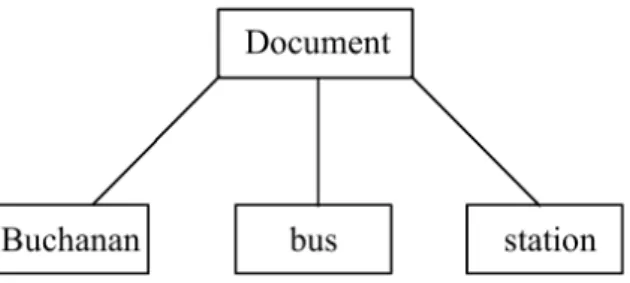
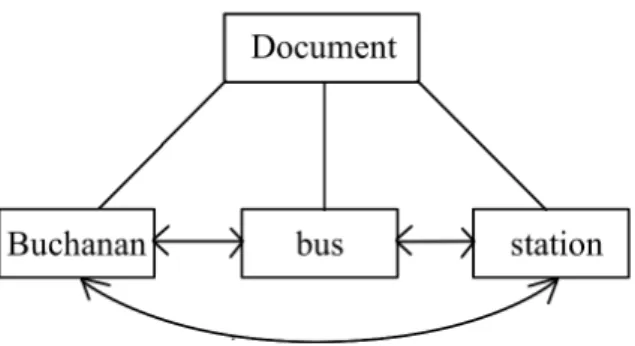
2.1 An example of the linkage between terms in a sentence, where stop
words are bracketed. . . 38
2.2 An example of the Markov random fields model with a full inde-pendence assumption. . . 39
2.3 An example of the Markov random fields model with a sequential dependence assumption. . . 40
2.4 An example of the Markov random fields model with a full depen-dence assumption. . . 41
2.5 An illustration of the link structure of documents. . . 46
2.6 An illustration of the click distance feature. . . 49
3.1 An illustration of the SVM classifier. . . 58
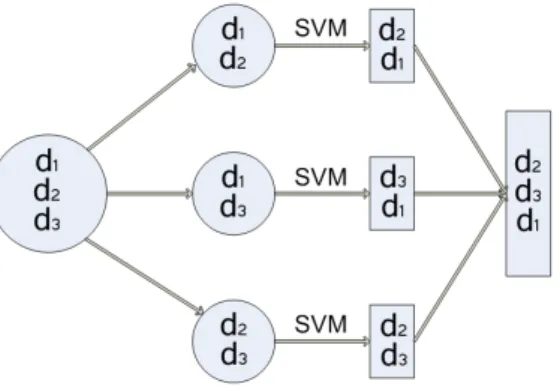
3.2 An illustration of the procedure of the Ranking SVM approach during the training process. . . 62
3.3 An illustrative example of the ranking of four objects by adjusting the weight vector. . . 63
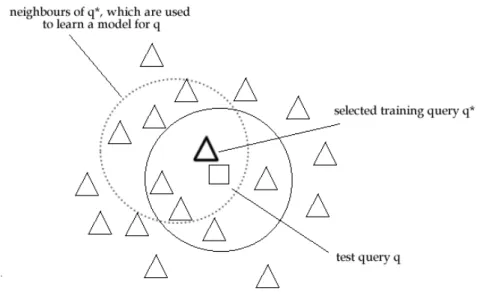
3.4 An illustration of the KNN Online algorithm for building a docu-ment ranking function. . . 72
3.5 An illustration of the KNN Offline-1 algorithm for building a doc-ument ranking function. . . 73
3.6 An illustration of the KNN Offline-2 algorithm for building a doc-ument ranking function. . . 74
LIST OF FIGURES
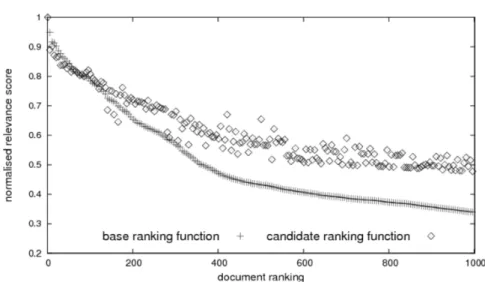
4.1 Score distributions of the top 1000 retrieved documents, which are ranked according to their relevance scores in the base ranking function. . . 86 4.2 The distribution of the relative retrieval performance in MAP, with
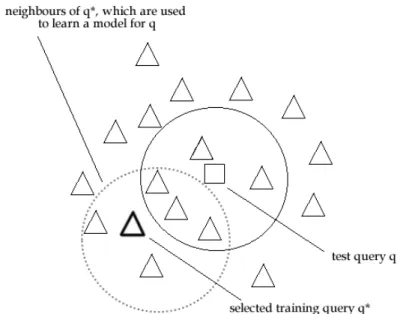
standard error bars, versus the estimated divergence score. . . 87 4.3 An illustration of the KNN algorithm for classifying objects. . . . 92 4.4 An illustration of the k-means algorithm for classifying objects. . 94 5.1 MAP versus the number of candidate ranking functions on the
TREC 2003 dataset. . . 115 5.2 MAP versus the number of candidate ranking functions on the
TREC 2004 dataset. . . 116 5.3 MAP versus the number of candidate ranking functions on the
TREC 2007 dataset. . . 117 5.4 MAP versus the number of candidate ranking functions on the
TREC 2008 dataset. . . 118 6.1 Comparison between different selective application techniques by
plotting ROC space based on different external resources for TREC 2007 enterprise document search using the PL2F weighting scheme. 158 6.2 Comparison between different selective application techniques by
plotting ROC space based on different external resources for TREC 2007 enterprise document search using the BM25F weighting scheme.159 6.3 Comparison between different selective application techniques by
plotting ROC space based on different external resources for TREC 2008 enterprise document search using the PL2F weighting scheme. 160 6.4 Comparison between different selective application techniques by
plotting ROC space based on different external resources for TREC 2008 enterprise document search using the BM25F weighting scheme.161
List of Tables
2.1 An example of the inverted index structure. We assume that a cor-pus only contains one document, which only has a single sentence, which is the same as our example sentence. . . 14 2.2 An illustrative example of the query expansion and collection
en-richment algorithms. . . 28 2.3 Overview of the techniques employed by the predictors. Columns
Single andCo-occur refer to the use of the statistics of single query terms and the co-occurrence of multiple query terms, respectively. 29 2.4 The proposed features for phrase identification. . . 37 3.1 The highest score in each column is highlighted in bold and scores
that are statistically better than RankingSV M, AdaRank, and
AF Sare marked with?,∗, and†, respectively (Wilcoxon matched-pairs signed-ranks test, p < 0.05). . . 70 3.2 The decision mechanism for the selective application of CE.scoreL
and scoreE denote the predicted performance of a given query on
the local and external resources, respectively. local, external and
disabled in the column Decision indicate expanding the initial query on the local resource, external resource and disabling the expansion, respectively. . . 76 3.3 The description of the query features used in the classification
pro-cess for query type detection. . . 78 4.1 An example of query feature scores and MAP evaluations for 10
LIST OF TABLES
4.2 The distance between each training query qφ and the given test
queryq0, which is an absolute value of the subtraction between the two queries’ feature scores. . . 97 4.3 The ranking of training queries according to the computed query
distance scores. . . 98 5.1 Salient properties of the .GOV corpus . . . 104 5.2 The number of queries for the TREC 2003 & 2004 Web Track and
TREC 2007 & 2008 Million Query Track. . . 105 5.3 For each dataset, the highest score in each column is highlighted in
bold and scores that are statistically better than RankingSV M,
AdaRank, and AF S are marked with ?, ∗, and †, respectively (Wilcoxon matched-pairs signed-ranks test,p < 0.05). . . 107 5.4 Comparison between LTS and state-of-the-art LTR techniques
us-ing different evaluation measures on the LETOR 3.0 TREC 2004 dataset. Results are the mean over 5 folds. . . 109 5.5 Comparison between LTS and state-of-the-art LTR techniques
us-ing different evaluation measures on the LETOR 3.0 TREC 2004 dataset. Results are the mean over 5 folds. . . 110 5.6 Comparison between LTS and state-of-the-art LTR techniques
us-ing different evaluation measures on the LETOR 4.0 TREC 2007 dataset. Results are the mean over 5 folds. . . 111 5.7 Comparison between LTS and state-of-the-art LTR techniques
us-ing different evaluation measures on the LETOR 4.0 TREC 2008 dataset. Results are the mean over 5 folds. . . 112 5.8 The evaluation of the LTS framework for selectively applying
mul-tiple document features on the TREC 2003 dataset with different numbers of candidate document features. Results are the mean over 5 folds. . . 120 5.9 The evaluation of the LTS framework for selectively applying
mul-tiple document features on the TREC 2004 dataset with different numbers of candidate document features. Results are the mean over 5 folds. . . 121
LIST OF TABLES
5.10 The evaluation of the LTS framework for selectively applying mul-tiple document features on the TREC 2007 dataset with different numbers of candidate document features. Results are the mean over 5 folds. . . 121 5.11 The evaluation of the LTS framework for selectively applying
mul-tiple document features on the TREC 2008 dataset with different numbers of candidate document features. Results are the mean over 5 folds. . . 121 6.1 Details of the number and percentage of topics associated to each
topic type for TREC 2003 and TREC 2004 Web tracks. . . 125 6.2 The MAP upper bounds, highlighted in bold, which are achieved
by the manual selective application of a query independent feature on the TREC 2003 and TREC 2004 datasets. . . 128 6.3 Evaluation of the learning to selective framework for selectively
applying a query independent feature between PageRank (PR) and URL depth (UD). . . 130 6.4 Evaluation of the learning to selective framework for selectively
applying a query independent feature between PageRank (PR) and click distance (CD). . . 130 6.5 Evaluation of the learning to selective framework for selectively
applying a query independent feature between URL depth (UD) and click distance (CD). . . 131 6.6 Evaluation of the learning to selective framework for selectively
applying a query independent feature among PageRank (PR), URL depth (UD), and click distance (CD). . . 133 6.7 Comparison between the best performing variant of learning to
select and the oracle QTP method for the selective application of a query independent feature among PageRank, URL depth, and click distance. . . 133
LIST OF TABLES
6.8 The highest score based on each weighting scheme is highlighted in bold and scores that are statistically better than the corresponding xQuADU, xQuADW, and xQuADC are marked with ∗, , and ?,
respectively (Wilcoxon matched-pairs signed-ranks test, p < 0.05). 140 6.9 Evaluation of the selective application of the sub-query importance
estimator on the TREC Web diversity task using the DPH weight-ing scheme. . . 141 6.10 Evaluation of the selective application of the sub-query importance
estimator on the TREC Web diversity task using the BM25 weight-ing scheme. . . 142 6.11 Evaluation of the selective application of the sub-query importance
estimator on the TREC Web diversity task using the language modelling weighting scheme. . . 143 6.12 Overview of the test collections for expanding a given query. . . . 148 6.13 The MAP and nDCG results for applying QE and CE
system-atically using the PL2F document weighting model, and Upper Bound highlighted in bold, which is achieved by the optimal selec-tive application of CE. . . 150 6.14 The MAP and nDCG results for applying QE and CE
system-atically using the BM25F document weighting model, and Upper Bound highlighted in bold, which is achieved by the optimal selec-tive application of CE. . . 151 6.15 Evaluation of the selective application of collection enrichment on
the TREC 2007 enterprise document search task using the PL2F weighting scheme. . . 152 6.16 Evaluation of the selective application of collection enrichment on
the TREC 2007 enterprise document search task using the BM25F weighting scheme. . . 153 6.17 Evaluation of the selective application of collection enrichment on
the TREC 2008 enterprise document search task using the PL2F weighting scheme. . . 155
LIST OF TABLES
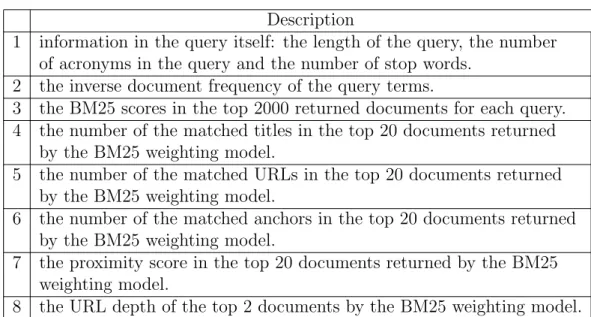
6.18 Evaluation of the selective application of collection enrichment on the TREC 2008 enterprise document search task using the BM25F weighting scheme. . . 156 A.1 Document features included in the LETOR 3.0 dataset. . . 174 A.2 Document features included in the LETOR 4.0 dataset. . . 175
Chapter 1
Introduction
1.1
Introduction
The effective ranking of documents in information retrieval (IR) systems is based on various document features, such as the frequency of query terms in each doc-ument and the length or authority score of each docdoc-ument. In general, docdoc-ument features can be categorised into two groups: query dependent and query inde-pendent. Query dependent document features are mainly based on the statistics of query terms in a document (Upstill et al., 2003), such as the frequency of query terms in the document or can be computed by more sophisticated models, e.g., BM25 document weighting model (Robertson et al., 1994). These query dependent features are computed for each issued query. The query independent document features, also known as document priors, relating perhaps to document content, linkage or usage, are computed before retrieval time and regardless of the query. They can be transformed into a static, per-document relevance weight for use in ranking (Craswell et al., 2005), e.g., PageRank (Brin & Page, 1998).
Broder (2002) identified that current Web search users’ information needs, which are represented as queries, can be classified into three types: informa-tional, whose intent is to acquire some information assumed to be present on one or more web pages; navigational, whose intent is to reach a particular site; and transactional, whose intent is to perform some web-mediated activity, such as online shopping. Different types of queries benefit differently from different document features. For example, Kraaij et al. (2002) showed that URL type is
1.1 Introduction
a very effective document feature for finding the homepage of an organisation and Peng et al. (2007) showed that informational queries usually benefit from the modelling of term dependency, or term co-occurrence.
In order to obtain a better retrieval performance, instead of using a single or a few document features, there is a growing trend to create a ranking function based on a large set of various document features (Geng et al., 2008; Metzler, 2007; Xu & Li, 2007). This is illustrated by the emergence of the learning to rank field in information retrieval, where a ranking function is usually generated based on a large number of document features. Learning to rank techniques generate a ranking function by assigning a weight to each document feature, then use this generated ranking function to estimate the relevance score for each document. Several different learning to rank techniques have been proposed in the literature (Burges et al., 2005; Cao et al., 2007; Herbrich et al., 2000; Nallapati, 2004; Xu & Li, 2007). They mainly differ in terms of the loss function used to guide the learning process (Liu, 2009).
By using different learning to rank techniques, different ranking functions can be generated based on different document feature sets. Most of the current approaches usually use a single ranking function to assign a relevance score to each document for all given queries, i.e., they systematically apply the same ranking function to all queries. In contrast, the process of selecting an appropriate ranking function from a number ofcandidate ranking functions and applying it to a given query is called the selective application of ranking functions.
Several studies have shown that retrieval performance can be significantly en-hanced if an appropriate ranking function is applied for each individual query (Kamps et al., 2004; Peng & Ounis, 2009; Peng et al., 2009; Plachouras, 2006; Plachouras & Ounis, 2004). In this thesis, we propose to selectively apply an appropriate ranking function from a large number of candidate ranking functions for each given query, regardless of the given query’s type. In addition, in the context of the learning to rank paradigm, we also propose to selectively apply multiple appropriate document features for building a ranking function, on a per-query basis.
The remainder of the introduction describes the motivation for the work in this thesis (Section 1.2). We present the thesis statement (Section 1.3) and its
1.2 Motivation
contributions (Section 1.4). We also list the origins of the material (Section 1.5), and close this chapter with an overview of the structure for the remainder of the thesis (Section 1.6).
1.2
Motivation
To build an effective information retrieval system that satisfies all types of users’ information needs, most of the current approaches tend to build a ranking func-tion on a large number of different document features. Several learning to rank techniques have been proposed to build such a ranking function, and different ranking functions can be generated by using different learning to rank techniques on different document feature sets. These generated ranking functions are usu-ally systematicusu-ally applied to all queries. However, many studies have shown that different queries benefit differently from each ranking function (Kamps et al., 2004; Peng & Ounis, 2009; Peng et al., 2009; Plachouras, 2006; Plachouras & Ounis, 2004) and that the retrieval performance can be significantly enhanced if an appropriate ranking function is used for each individual query. Several se-lective retrieval approaches have been proposed in the literature (Geng et al., 2008; Peng et al., 2009; Plachouras & Ounis, 2004; Song et al., 2004; Yang et al., 2004), which aim to enhance the retrieval performance by applying different retrieval strategies to different queries. However, these approaches have various limitations and shortcomings, as described below.
Geng et al. (2008) proposed to apply a specific ranking function for each given query. This specific ranking function is generated by applying a learning to rank technique on a set of neighbouring training queries. However, this approach is only investigated using a single learning to rank technique and using a fixed set of document features. Its effectiveness is not clear when several different learning to rank techniques are used and when the number of document features is varied. Peng et al. (2009) proposed a decision mechanism to decide whether a given query should be expanded using an internal or an external resource, on a per-query basis. The decision mechanism is based on the performance (e.g. “good” or “bad”) of a given query on the internal and external resources. Such performance is obtained by using a query performance predictor, e.g., query scope (He & Ounis,
1.3 Thesis Statement
2006). However, this approach may not be applicable to the selective application of a ranking function. Indeed, the predictors mainly rely on the statistics of the collection, which are invariant to changes in the ranking function.
Plachouras (2006) proposed a method to selectively apply an appropriate re-trieval approach for a given query, which is based on a Bayesian decision mecha-nism. Features such as the occurrence of query terms in the documents were used to determine the applicability of the retrieval approaches. The retrieval perfor-mance obtained using this approach only improved slightly over the systematic application of a retrieval approach and actually decreased when more than two candidate retrieval approaches are used.
Song et al. (2004) and Yang et al. (2004) tried to apply different retrieval approaches for different query types (named page, homepage, and topic distilla-tion). To achieve this, they proposed several different techniques (e.g. the use of a linguistic classifier) to detect the query type. However, the obtained accu-racy of the query type prediction is not high (Craswell & Hawking, 2004) and queries of the same type may benefit from having different retrieval approaches applied (Peng & Ounis, 2009).
This thesis investigates a novel framework, which is effective in selecting an appropriate ranking function from a number of candidate ranking functions for a given query, regardless of the given query’s type as well as the number of candidate ranking functions/document features. In particular, this framework should not only be able to select an appropriate ranking function, but should also be able to select multiple appropriate document features for building a ranking function, on a per-query basis.
1.3
Thesis Statement
The statement of this thesis is that an appropriate ranking function can be suc-cessfully selected from a number of candidate ranking functions for each given query, regardless of the given query’s type and the number of candidate ranking functions/document features. This is investigated in the context of a framework, called Learning to Select (LTS), where the effectiveness of a ranking function for a
1.4 Contributions
given query is estimated based on its performance on the already seen neighbour-ing queries. In the learnneighbour-ing to select framework, if the neighbourneighbour-ing queries of a given query are successfully identified, then the ranking function that performs the best on the identified neighbouring queries is selected for the given query. The learning to select framework comprises two components: a component for
identifying the neighbouring queries and a component called query feature. The identifying neighbouring queries component employs a classification technique (e.g. k-nearest neighbour (Cover & Hart, 1967)) to identify a certain number of neighbouring queries for a given query, by using a query feature which is a rep-resentative of the characteristics of a given query. The query feature component is used to build such a query feature. In particular, two divergence measures (i.e. Kullback-Leibler (Kullback, 1997) and Jensen-Shannon (Lin, 1991)), used to determine the extent to which a document ranking function alters the scores of an initial ranking of documents, are proposed as query features in the thesis.
1.4
Contributions
The main contributions of this thesis are the following. A novel framework, called learning to select (LTS), is introduced for selectively applying an appropriate ranking function on a per-query basis, and regardless of the given query’s type and the number of candidate ranking functions/document features. In this framework, the effectiveness of a ranking function for an unseen query is estimated based on its retrieval performance on the query’s already seen neighbouring queries. In addition, we identify the main components of the learning to select framework: identifying neighbouring queries and query feature. In particular, we propose to use divergence measures as query features for identifying neighbouring queries.
Moreover, the differences between the learning to select framework and the previously proposed selective retrieval approaches (described in Section 1.2) are discussed. In the course of the thesis, two key research questions concerning the learning to select framework are addressed, namely how to effectively select an appropriate ranking function, and how to effectively select a set of appropriate document features for building a ranking function, on a per-query basis.
1.5 Origins of the Material
Furthermore, we thoroughly evaluate the effectiveness and robustness of the learning to select (LTS) framework on two different retrieval tasks, namely Web search and ad hoc search, and on two large standard document feature sets, which contain as many as 64 document features. Moreover, we study in detail how each component of the learning to select framework affects retrieval performance.
Finally, to show the generality of the LTS framework, in Chapter 6, we inves-tigate how the LTS framework can be used in other search applications. These applications include the selective application of a query independent feature. This allows the effective integration of an appropriate query independent document feature into a document weighting scheme on a per-query basis. Therefore, dif-ferent document features are applied to the queries that are more likely to benefit from these features; the selective estimation of the relative importance of differ-ent query aspects in a search diversification task. This allows the ranked list of documents to provide a complete coverage of different interpretations for an ambiguous query. In particular, a Web collection that contains over 50 million documents is used in this evaluation; and the selective application of an appro-priate resource for expanding a given query, called selective query expansion, for document search within an enterprise. This alleviates the mismatch problem be-tween query terms and the intranet documents. The mismatch problem is severe in an enterprise, because usually only a small number of people tend to create documents according to autocratic guidelines, reflecting the enterprise policies.
1.5
Origins of the Material
The material that form parts of this thesis have found their origins in various papers that I have published during the course of my PhD research. In particular:
• The learning to select framework as defined in Chapter 4 is based on work published in (Peng & Ounis, 2009) (ECIR 2009). The outline of the ex-periments in Chapter 5 is somewhat similar to those published in ECIR 2010 (Peng et al., 2010).
• The use of divergence measures as query features, as defined in Section 4.4.1, are based on work initially published in SIGIR 2008 (Peng et al., 2008).
1.6 Thesis Outline
• The use of bins to identify neighbouring queries, as defined in Section 4.4.2, is based on work published in (Peng et al., 2007) (RIAO 2007) and (Peng & Ounis, 2007) (ECIR 2007).
• The use of query performance predictors to conduct a selective external query expansion (Section 3.4) is based on work initially published in IC-TIR 2009 (Peng et al., 2009). The experiments on choosing an appropriate resource for expanding a given query (Section 6.4) are based on work pub-lished in (Peng et al., 2009) (CIKM 2009).
• The modelling of term dependency introduced in Section 2.5.2 and used in Section 6.2 is based on work published in SIGIR 2007 (Peng et al., 2007).
1.6
Thesis Outline
The remainder of this thesis is organised as follows:
• Chapter 2 presents various document features on which this thesis relies, including both query dependent and query independent document features. The query dependent document features described in this chapter are de-rived from various document weighting models (BM25, language modelling and Divergence From Randomness), query expansion approaches, and the modelling of the term dependency. In addition, various query independent features (including PageRank, URL type and click distance) are described.
• Chapter 3 provides an overview of several different learning to rank tech-niques, which are used to generate a ranking function by assigning a weight to each document feature. These generated ranking functions are usu-ally systematicusu-ally applied to all queries, and ignore the fact that different queries benefit differently from each ranking function. Based on a literature survey, we introduce several existing selective retrieval approaches. How-ever, these approaches are either not applicable to the selective application of a ranking function, or are not able to effectively select an appropriate ranking function from a large number of candidate ranking functions, or are totally dependent on the identified query type which ignores the fact
1.6 Thesis Outline
that the same type of queries may benefit differently from the same ranking function.
• Chapter 4 introduces the learning to select framework for selectively apply-ing an appropriate rankapply-ing function on a per-query basis. First, it presents the general idea and the detailed algorithm of the proposed learning to select framework. Next, it explains how to use the learning to select frame-work to select multiple document features for building a ranking function. Following this, the chapter provides the description of each component of the learning to select framework and presents an example illustrating how the learning to select framework operates. Finally, the chapter closes with a detailed discussion on the learning to select framework in comparison with the existing approaches in the literature.
• Chapter 5 presents the evaluation of the proposed learning to select frame-work. The evaluation is conducted on two different retrieval tasks (i.e. Web search and ad hoc search tasks) and on two different standard document feature sets (i.e. LETOR 3.0 and LETOR 4.0). The document feature sets used contain as many as 64 different document features, including query independent and query independent features. Two different evaluations of the learning to select framework are conducted in this chapter, including selecting an appropriate ranking function from a number of candidate rank-ing functions and selectrank-ing a set of appropriate document features from a number of candidate document features for building a ranking function. Moreover, each component of the LTS framework is thoroughly studied.
• Chapter 6 explores the deployment of the learning to select framework in other search applications. In particular, we describe an experiment to de-termine if the learning to select framework can be effectively applied to inte-grate an appropriate query independent feature into a document weighting scheme. Moreover, we examine the effectiveness of our proposed learning to select framework in choosing an appropriate resource (i.e. document collection) for expanding an initial query. Lastly, we test how effective the learning to select framework is, by applying it to the xQuAD search
1.6 Thesis Outline
diversification framework, in which an appropriate sub-query importance estimator is selectively applied.
• Chapter 7 closes this thesis with the contributions and the conclusions drawn from this work, as well as possible directions of future work across the investigated search tasks.
Chapter 2
Information Retrieval
2.1
Introduction
Information Retrieval (IR) aims at modelling, designing, and implementing sys-tems able to provide fast and effective content-based access to large amounts of information (Baeza-Yates, 2003). The aim of an IR system is to estimate the relevance of information items, such as text documents, images and video, to a user’s information need. Such information need is represented in the form of a
query, which usually corresponds to a bag of words. Users are only interested in the information items that are relevant to their information need. The primary goal of an IR system is to retrieve all the information items that are relevant to a user query while retrieving as few non-relevant items as possible (Baeza-Yates & Ribeiro-Neto, 1999). Furthermore, the retrieved information items should be ranked from the most relevant to the least relevant.
In contrast to data retrieval, which aims to retrieve all objects that satisfy a clearly defined condition (van Rijsbergen, 1979), information retrieval usually deals with natural language text which is not always well structured and could be semantically ambiguous (Baeza-Yates & Ribeiro-Neto, 1999). Therefore, there tend to be non-relevant items(s) which could be ignored in IR. The information retrieval field has been evolving quickly in recent years but some core techniques are still widely used in most IR systems, such as the indexing process, which will be described in Section 2.2.
This chapter mainly provides an overview of various document features that this thesis relies on, including both query dependent and query independent
docu-2.2 Indexing
ment features. The query dependent document features described in this chapter include: IR models for matching information items with queries (Section 2.3), the query expansion and collection enrichment techniques which are used to reformu-late users’ information need (Section 2.4), and the term dependency technique, which aims to model the dependency between terms (Section 2.5). Apart from these query dependent document features, we also introduce various query inde-pendent document features, also called as document priors, such as PageRank, in Section 2.6. At last, the evaluation of IR systems is described in Section 2.7.
2.2
Indexing
For IR systems, in order to efficiently judge whether the documents from a corpus match a given query, a pre-process called indexing is usually applied. In general, the objective of indexing is to extract representatives (e.g. terms) for each doc-ument and to store them in a specific data structure (e.g. inverted file), which provides an efficient access to these document representatives.
To better explain the indexing process, we use the following sentence as an example, taken from (Austen, 1813):
“It is a truth universally acknowledged, that a single man in possession of a good fortune, must be in want of a wife.”
The indexing process includes several steps, which are described in the fol-lowing of this section.
2.2.1
Tokenisation
The first stage of the indexing process is typically known as tokenisation (Manning et al., 2008), which is the task of chopping documents into tokens based on the boundary between document tokens, such as whitespaces. In addition, at this stage, all characters contained in the tokens are often lower-cased and all punctuations are removed. After tokenisation, the above example sentence can be viewed as:
it is a truth universally acknowledged that a single man in possession of a good fortune must be in want of a wife
2.2 Indexing
2.2.2
Stop Words Removal
Luhn (1957) pointed out that the frequency of a term within a document can be a good discriminator of its significance in the document. In addition, there are many extremely frequent terms (e.g. “the”) that appear in almost all documents of a corpus. These terms are called stop words, which bring little value for the purpose of representing the content of documents and are normally filtered out from the list of potential indexing terms during the indexing process (Baeza-Yates & Ribeiro-Neto, 1999). Removing the stop words allows also the reduction of the size of the generated document index.
Articles, prepositions, and conjunctions are natural candidates for building such a list of stop words. Moreover, the stop words list can be extended by determining the most frequent or least informative terms in the document col-lection (Lo et al., 2005). As an example, a list of 425 stop words is illustrated in (Frakes & Baeza-Yates, 1992). However, the general trend of IR systems over time moved from the standard use of a large list of stop words (200 - 300 terms) towards the use of a smaller list of stop words (7 - 12 terms), by exploiting the statistics of language (Manning et al., 2008). After applying stop words removal to our example sentence, the text is reduced to the following:
truth universally acknowledged single man possession for-tune want wife
2.2.3
Stemming
Often, a user specifies a term (e.g. democracy) in a query when only a variant of this term (e.g. democratic) is contained in a relevant document. Hence, it would be beneficial for retrieval if documents containing variants of the query term were also considered. Plurals, gerund forms, and past tense suffixes are examples of syntactical variations which prevent a perfect match between a query term and a respective document term (Baeza-Yates & Ribeiro-Neto, 1999). This problem can be alleviated by applying stemming, which replaces a term with its stem, so that different grammatical forms of terms are represented in a common base form. A stem is the portion of a word which is obtained after chopping off its affixes.
2.2 Indexing
An example of a stem is the word employ, which is the stem of employment,
employer, employee, employed and employable.
There are several different suffix removal algorithms for the English language, such as the one-pass Lovins stemmer (Lovins, 1968) which is the first stemming algorithm, the best known Porter’s stemmer (Porter, 1980) and the newer tech-nique - the Paice/Husk stemmer (Paice, 1990). Among these stemming algo-rithms, Porter’s stemmer is the most widely used because of its simplicity and elegance. In general, Porter’s stemmer consists of five phases of suffix removal. Within each phase, there are various conventions to select rules, such as select-ing the rule from each rule group that applies to the longest suffix (Mannselect-ing et al., 2008). By applying Porter’s stemming algorithm, our example sentence is transformed as follows:
truth univers acknowledg singl man possess fortun want wife
It is easy to note that some words are unchanged (e.g. “truth” and “wife”), some are chopped to their root (e.g. “possess”) while some are transformed into non-English words (e.g. “univers” and “singl”).
2.2.4
Index Data Structures
To enable efficient access to document representatives, a suitable data structure is necessary. The most widely used data structure is the inverted index (Frakes & Baeza-Yates, 1992), which is a word-oriented mechanism. In general, the in-verted index structure contains two components: the vocabulary and the occur-rences (Baeza-Yates & Ribeiro-Neto, 1999). The vocabulary is a set of all different terms extracted from the corpus by the above steps. The occurrences store each vocabulary term’s statistics in each document, such as term frequency and term position (see Table 2.1 for an example).
The size of the inverted index can be very large. This can be reduced by applying appropriate compression techniques, through the way of encoding the integers, which are normally used to represent document identifiers and term fre-quencies, with fewer bits or bytes. The bit-wise Elias-Gamma and Elias-Unary encodings (Elias, 1975) are commonly used for compressing document identi-fiers and term frequencies, respectively (Witten et al., 1999). Both of them are
2.3 Matching
vocabulary occurrences
term frequency term position truth <1,1> <1,1> univers <1,1> <1,2> acknowledg <1,1> <1,3> singl <1,1> <1,4> man <1,1> <1,5> possess <1,1> <1,6> fortun <1,1> <1,7> want <1,1> <1,8> wife <1,1> <1,9>
Table 2.1: An example of the inverted index structure. We assume that a corpus only contains one document, which only has a single sentence, which is the same as our example sentence.
parameter-free and achieve an acceptable compression and fast decoding. In ad-dition, it is possible to obtain a higher compression rate and a faster decoding by applying parameterised techniques, such as Golomb codes (Golomb, 1966). However, the choice of an appropriate parameter has a significant impact on the compression rate when using a parameterised model. Some other compression techniques operate on bytes instead of bits, with the aim of exploiting the opti-mised capability of hardware to handle bytes (Williams & Zobel, 1999). Apart from saving disk space usage, deploying a compressed index brings an additional benefit to the retrieval speed for an IR system (Scholer et al., 2002).
2.3
Matching
With a given query, an ideal IR system should only return relevant documents and rank these documents in decreasing order of relevance. The relevance of a document to a given query can be estimated by various IR models, such as the Boolean model, which is one of the oldest IR models. It is based on set theory and Boolean algebra (Sp¨arck Jones & Willett, 1997). Queries in the Boolean model are formulated as Boolean expressions. As an example, with a given Boolean query birthday AND cake (NOT card), the Boolean model would
re-2.3 Matching
trieve all documents that contain both the termsbirthdayandcake but not the term card. In addition, due to its binary decision criterion (i.e., when using the Boolean model, a document is predicted to be either relevant or non-relevant), the retrieved documents are returned to the user as a set without any ranking. The lack of a ranking of the result set has been one of the major drawbacks of the Boolean model (Salton et al., 1983a).
In contrast to the Boolean model, several other IR models have been pro-posed to estimate the relevance of a document. One such model is the vector space model (Salton & McGill, 1986a), where both queries and documents are represented as vectors in the same space. Each vector dimension corresponds to a separate term and the number of dimensions of the vector space corresponds to the number of distinct terms in the corpus. In particular, the term occurrences are usually weighted by the TF-IDF weighting scheme, given as follows:
score(d, Q) =X t∈Q tf ·log2 N Nt (2.1) where tf is the number of occurrences of the term t from query Q in document
d. N is the total number of documents in the collection, and Nt is the number
of documents in whicht occurs. The TF component is motivated by the premise that the more frequently a term occurs in a document, the more important the term is for this document (Salton & McGill, 1986b). The component log2NNt is
called the inverse document frequency (IDF). The IDF component is used to diminish the importance of terms have very high frequency and to increase the importance of terms have a rare occurrence in the collection, which is also called
term specificity (Sp¨arck Jones, 1972). A term with high IDF (namely low Nt)
is more useful than a term with low IDF. Moreover, Robertson & Sp¨arck Jones (1988) proposed several methods for measuring a term’s specificity. Furthermore, the retrieved documents are ranked according to their similarity to the query, which can be computed by various measures, such as the cosine similarity.
Another classical retrieval model is the probabilistic model (Robertson & Sp¨arck Jones, 1988), which is popular due to its effectiveness and strong the-oretical foundations. Robertson (1977) assumed that the probability of relevance of a document to a query is independent of other documents, then posed the probability ranking principle (PRP), which states that:
2.3 Matching
“If a reference retrieval system’s response to each request is a ranking of the documents in the collection in order of decreasing probability of relevance to the user who submitted the request, where the probabil-ities are estimated as accurately as possible on the basis of whatever data have been made available to the system for this purpose, the overall effectiveness of the system to its user will be the best that is obtainable on the basis of those data.”
The remainder of the current section describes particular families of the prob-abilistic models. Section 2.3.1 describes the family of Best Match (BM) mod-els. The language modelling approach for IR is presented in Section 2.3.2. Sec-tion 2.3.3 discusses the Divergence From Randomness (DFR) framework of infor-mation retrieval models.
2.3.1
Best Match Weighting Models
Starting from a basic probabilistic model (Robertson & Sp¨arck Jones, 1988), the weight of a term t in a document is computed as follows:
w(1) =log (r+ 0.5)/(R−r+ 0.5))
(Nt−r+ 0.5)/(N −Nt−R+r+ 0.5)
(2.2) where R is the number of relevant documents, r is the number of relevant doc-uments containing the term t, Nt is the number of documents where the term t
appears and N is the number of documents contained in the collection. In addi-tion, the above equation can be simplified when the relevance information is not available (Croft & Harper, 1997):
w(1) =logN −Nt+ 0.5 Nt+ 0.5
(2.3)
w(1) is similar to the inverse document frequency (idf): logNN
t.
However, the above equations only contain the IDF concept but not TF. Robert-son et al. (1980) approached this problem by combining the probabilistic model with the 2-Poisson model. Harter (1975) extended the original 2-Poisson work with the hypothesis that a set of specialty terms occur randomly across the doc-ument collection while they occur relatively more densely in an elite set of docu-ments. The elite set of documents would be the answer to a query that contains
2.3 Matching
the specialty terms. However, this approach involves several parameters that cannot be set in a straight-forward manner. For this reason, Robertson & Walker (1994) approximated the 2-Poisson model of term frequencies with a simpler for-mula but with similar shapes and properties, given as follows:
w= tf n
k1 +tf n
w(1) (2.4)
where k1 is a parameter that controls the saturation of tf n, which is computed
as follows:
tf n = tf (1−b) +b· l
avg l
(2.5) wherel is the length of document in tokens,avg lis the average length of all doc-uments in the corpus, andbis the term frequency normalisation hyper-parameter. Robertson et al. (1994) proposed the Best Match 25 (BM25) model, which is used in our experiments (Chapter 6), given as follows:
score(d, Q) = P t∈Q ( (k1+ 1)tf n k1+tf n · (k3+ 1)qtf k3+qtf ·w(1)) (2.6) where k3 is a parameter that controls the saturation of the term frequency in the
query and qtf is the frequency of a term in the query.
Document structure (or fields), such as the title and the anchor text of incom-ing hyperlinks, have been shown to be effective in Web IR (Craswell & Hawkincom-ing, 2004). Robertson et al. (2004) proposed the idea of normalising term frequency on a per-field basis and Zaragoza et al. (2004) introduced a field-based version of BM25, called BM25F (used in Chapter 6), which applies length normalisation and weighting of the fields independently.
score(d, Q) = P t∈Q ( (k1+ 1)tf n k1+tf n · (k3+ 1)qtf k3+qtf ·w(1)) (2.7) The above BM25F’ weighting function is the same as Equation (2.6). However, BM25F applies a per-field normalisation method to assign the normalised term frequency tf n: tf n=X f wf ·tf nf = X f wf · tff (1−bf) +bf · lf avg lf (2.8)
2.3 Matching
where wf is the weight of a field f, which reflects the relative contribution of a
field to the document ranking. tf nf is the normalised term frequency on fieldf.
tff is the frequency of the query term in the field f. lf is the number of tokens
in the field f. avg f is the average length of field f in the collection.
2.3.2
Language Modelling
The aforementioned 2-Poisson indexing based retrieval models have two assump-tions: the first assumption is that the within-document term frequencies (i.e. tf) follow a mixture of two Poisson distributions; the second assumption is that the elite set of documents would be the answer to a query that contains the spe-cialty terms. Ponte & Croft (1998) suggested that it is not necessary to make any parametric assumption when the actual data is available and proposed the application of a language modelling approach in information retrieval. The in-tuition is that users have a reasonable idea of which terms are likely to occur in documents of interest and these terms (query) can be used to distinguish the relevant documents from others in the collection.
In the language modelling approach, documents and queries are considered as a sequence of words and the probability of a document d being relevant to a given query Q can be formulated after applying Bayes’ rule:
P(d|Q) = P(Q|d)·P(d)
P(Q) (2.9)
where P(Q) can be safely ignored as it does not affect the ranking of documents,
P(d) is the prior probability of relevance of the documentd. P(Q|d) is the prob-ability of generating the query Q given the document d. There are various ways to estimate this probability. In (Ponte & Croft, 1998), the probability of generat-ing a query from a document language model is equivalent to the product of the probability of generating each of the query terms multiplied by the product of the probability of not generating the terms that do not appear in the query. How-ever, in (Hiemstra, 1998), the probability of generating a query from a document language model is only based on the product of the probability of generating the query terms from the document language model, which is simpler, as it ignores
2.3 Matching
the terms that do not occur in the query:
P(Q|d) =Y
t∈Q
P(t|d) (2.10)
where P(t|d) can be estimated with various models, such as:
P(t|d) = tf
l (2.11)
where tf is the number of occurrences of the query term t in document d and l
is the document length in tokens.
However,P(t|d) could be zero if the term t does not appear in the document
d. Ponte & Croft (1998) suggested that it is harsh to assign a zero probabil-ity to these terms as documents that do not contain a query term will not be retrieved. Instead, they proposed to supplement the document model with a col-lection model, which is the probability of a query term t occurring in the entire collection. This solution is also known assmoothing. Zhai & Lafferty (2004) stud-ied the effectiveness of various smoothing techniques for language modelling in IR, such as Jelinek-Mercer, Dirichlet and Absolute discount. The experimental results show that not only is the retrieval performance generally sensitive to the smoothing parameters, but also the sensitivity pattern is affected by the query length, with performance being more sensitive to smoothing for long queries than for short queries.
In (Hiemstra, 2001), a language modelling approach with Jelinek-Mercer smooth-ing for ranksmooth-ing documents, which will be used in our experiments (Chapter 6), is given as follows: score(d, Q) = Y t∈Q P(t|d) ≈ X t∈Q log(1 + λ·tf ·#(token) (1−λ)·T F ·l ) (2.12)
whereλis the hyper-parameter of the Jelinek-Mercer smoothing, which is between 0 and 1. tf is the number of occurrences of the query term t in the document d
and #(token) is the number of tokens in the entire collection. T F is the number of occurrences of the query term t in the whole collection and l is the document length in tokens.
2.3 Matching
2.3.3
Divergence From Randomness
Amati (2003) proposed the Divergence From Randomness (DFR) framework for building probabilistic IR weighting models, which is a generalisation of Harter’s 2-Poisson indexing model and based on the following idea:
“The more the divergence of the within-document term-frequency from its frequency within the collection, the more the information carried by the word t in the document d.”
In the DFR framework, the weight of a term t in a document d is a function of two probabilities:
w(t, d) = (1−P rob2(tf|Et))·(−log2P rob1(tf|Collection)) (2.13)
where −log2P rob1(tf|Collection) is the probability that the termt appears with
frequencytf in a document by chance, according to a given model of randomness, also know as the randomness model component; 1−P rob2(tf|Et) corresponds
to the information gain obtained by considering a term to be informative for a document, also known as theaftereffect of sampling component. Etstands for the
elite set of documents, which is already defined in Section 2.3.1. In addition, the term frequencytf can be normalised with respect to the length of the document, so that all documents are treated equally (Singhal et al., 1996). This is called the document length normalisation component. The three components will be detailed in the rest of this section.
2.3.3.1 Randomness model
In the randomness model component, −log2P rob1(tf|Collection) is higher if the
probability that a term t occurs tf times is lower. A term is considered to be more informative when −log2P rob1(tf|D) is higher. If the occurrences of a term
are distributed according to a binomial model, then the probability of observing
tf occurrences of a term in a document is given by the probability oftf successes in a sequence of T F Bernoulli trials withN possible outcomes:
P rob1(tf|Collection) = T F tf ·ptf ·qT F−tf (2.14)
2.3 Matching
where T F is the frequency of a term in a collection of N documents,p= N1 and
q = 1−p.
There are various models that can be used as an approximation of the Bernoulli model, such as the Poisson model (denoted as P in the DFR framework). Assum-ing that the maximum likelihood estimator λ= T F
N of the frequency of a term in
this collection is low, or, in other words, T F N, the Poisson distribution can be used to approximate the binomial model described above. In this case, the informative content of P rob1 is given as follows:
−log2P rob1(tf|Collection) = tf·log2
tf
λ +(λ−tf)·log2e+0.5·log2(2π·tf) (2.15)
2.3.3.2 Aftereffect of sampling
In the DFR framework, (1−P rob2(tf|Et)) takes into account the notion of
after-effect (Feller, 1968) of observingtf occurrences of t in a document. It corresponds to the information gain obtained by considering a term to be informative for the weighted document. If a term appears with a high frequency in a document, then it is almost certain that this term is informative for this document. Amati (2003) noted that the informative terms are rare in the collections but, in compensation, when they occur, their frequency is very high, which indicates the importance of these terms in the corresponding documents. In other words, it may happen that a sudden repetition of success of a rare event increases our expectation of a further success to almost certainty. Laplace’s law of succession (denoted as L in the DFR framework) is one of the possible estimates of such an expectation.
1−P rob2(tf|Et) = 1−
tf
1 +tf =
1
1 +tf (2.16)
An alternative model for computing P rob2(tf|Et) is the Bernoulli model
(de-noted as B in the DFR framework), which is defined as the ratio of two binomial distributions:
1−P rob2(tf|Et) =
T F
n·(tf + 1) (2.17)
2.3 Matching
2.3.3.3 Document length normalisation
The length of the document simply corresponds to the number of indexed tokens and different documents usually have different document lengths. Before using Equation (2.13) to estimate the weight of a term in a document, the term fre-quency tf is usually normalised with repsect to the document length, so that all documents are treated equally. Amati (2003) assumed a decreasing density function of the normalised term frequency with respect to the document length and derived the following formula, which is called normalisation 2:
tf n=tf ·log2(1 +c·
avg l
l ) (2.18)
where tf n is the normalised term frequency, l is the document length, avg l is the average document length in the whole collection and c (c > 0) is a hyper-parameter that controls the normalisation applied to the term frequency with respect to the document length. If c= 1, then Equation (2.18) becomes:
tf n=tf ·log2(1 +
avg l
l ) (2.19)
which is called normalisation 1 in the DFR framework (Amati, 2003).
2.3.3.4 Divergence From Randomness Weighting Models
A DFR document weighting model is generated from a combination of a random-ness model for computing −log2P rob1(tf|Collection), an aftereffect model for
computing 1−P rob2(tf|Et), and a term frequency normalisation model. Take
the PL2 weighting model as an example, which will be used in Chapter 6, the randomness model is the Poisson distribution (Equation (2.15)), the information gain is computed with the Laplace model (Equation (2.16)), and the term fre-quencies are adjusted using normalisation 2 (Equation (2.18)), given as follows:
score(d, Q) =X t∈Q 1 1 +tf n(tf n·log2 tf n λ + (λ−tf n)·log2e+ 0.5·log2(2π·tf n)) (2.20)
2.3 Matching
DFR also generates a series of hyper-geometric models. The hyper-geometric distribution is a discrete probability distribution that describes the number of suc-cesses in a sequence of draws from a finite population without replacement. Amati et al. (2007) proposed a hyper-geometric model, called DPH (used in Section 6.3), which assigns the relevance score of a document d for a query Q as follows:
score(d, Q) =X t∈Q (1−F)2 tf + 1 · tf ·log2(tf · avg l l N T F) + 0.5·log2(2π·tf ·(1−F)) (2.21) where F is given by tf /l, tf is the within-document frequency, and l is the document length in tokens. avg lis the average document length in the collection,
N is the number of documents in the collection, and T F is the term frequency in the collection. Note that DPH is a parameter-free model, and therefore requires no particular tuning. qtw is the query term weight and is given by qtf /qtfmax,
where qtf is the query term frequency and qtfmax is the maximum query term
frequency among all query terms.
Macdonald et al. (2005) introducedNormalisation 2F in the DFR framework for performing independent term frequency normalisation and weighting of fields, and proposed the PL2F model, which assigns the relevance score of a document
d for a query Qas follows:
score(d, Q) = X t∈Q 1 tf n+ 1 tf n·log2 tf n λ (2.22) +(λ−tf n)·log2e+ 0.5·log2(2π·tf n)
whereλis the mean and variance of a Poisson distribution, given byλ =F/N;F
is the frequency of the query term tin the whole collection, and N is the number of documents in the whole collection. qtf is the query term frequency; qtfmax is
the maximum query term frequency among the query terms.
The above PL2F’ weighting function is the same as Equation (2.20). However, in PL2F,tf ncorresponds to the weighted sum of the normalised term frequencies
tff for each used field f, known as Normalisation 2F (Macdonald et al., 2005):
tf n=X f wf ·tff ·log2(1 +cf · avg lf lf ) ,(cf >0) (2.23)
2.4 Query Expansion and Collection Enrichment
where tff is the frequency of term t in field f of document d; lf is the length
in tokens of field f in document d, and avg lf is the average length of the field
across all documents; cf is a hyper-parameter for each field, which controls the
term frequency normalisation; the importance of the term occurring in field f is controlled by the weight wf.
2.4
Query Expansion and Collection Enrichment
Queries composed by the users are not always well structured and may be inad-equate or incomplete representations of user’s information need, as most queries are quite short and only contain 2 to 3 terms (Jansen et al., 1998; Silverstein et al., 1999). This could result in word mismatch between query and docu-ments (Carpineto & Romano, 2004). The problem of word mismatch is funda-mental to IR. The most commonly used approach to solve this problem is query expansion, which is the process of expanding the original query with additional terms with a similar meaning or some other statistical relationships.
2.4.1
Query Expansion
Voorhees (1994) investigated the expansion of short queries based on the lexical-semantic relations between terms. In her investigation, a lexical database, called WordNet (Miller et al., 1990), was employed. However, little evidence that the retrieval effectiveness could be enhanced by expanding the original query with the selected terms was shown. The selected terms were obtained based on their lexical relation with the original query terms.
Sp¨arck Jones (1971) proposed to cluster terms based on their term co-occurrence in the documents and used the obtained clusters to expand the given queries. Following this idea, a number of similar approaches have been proposed and are either based on global analysis or local analysis. For the global analysis approaches, the term co-occurrence in documents is investigated in the whole corpus (Sch¨utze & Pedersen, 1997; Xu & Croft, 1996). As for the local analysis approaches, only the top retrieved documents are involved with the term co-occurrence investigation (Attar & Fraenkel, 1977; Xu & Croft, 1996). Compared
2.4 Query Expansion and Collection Enrichment
to the local analysis, the global analysis is more computationally expensive and less effective in retrieval performance (Xu & Croft, 1996).
Most of the current query expansion algorithms (Carpineto et al., 2001; Robert-son, 1990; Rocchio, 1971a) follow a similar outline to Sp¨arck Jones’ original work in (Sp¨arck Jones, 1971). In general, these algorithms contain the following three steps to conduct query expansion:
Step 1 For a given query, use an IR system to obtain a list of documents, which is also called as relevant feedback.
Step 2 Rank the terms that are contained in the relevant feedback using a spe-cific term weighting model.
Step 3 The top ranked terms are added to the original query, and documents are retrieved by using the expanded query.
For the first and third steps, there are many document weighting models that can be used to obtain the relevant feedback and rank documents with the expanded query, such as language modelling (Equation (2.12)), BM25 (Equa-tion (2.6)) and PL2 (Equa(Equa-tion (2.20)). In particular, in the first step, there are three types of relevant feedback: explicit feedback, implicit feedback and pseudo-relevant feedback. Explicit feedback is obtained through user interaction (White et al., 2001). For a given query, the corresponding top retrieved documents are judged by the users using a binary (i.e. “relevant” or “irrelevant”) or graded (e.g. “not relevant”, “somewhat relevant”, “relevant”, or “highly relevant”) relevance scale; Implicit feedback is obtained from users’ behaviour instead of their explicit judgement (Kelly & Belkin, 2001). Such behaviour includes the duration of time spent reading a document, page browsing and scrolling actions. Lastly, pseudo-relevant feedback is obtained by assuming that the top retrieved documents are relevant. It has the advantage that no user interaction is required.
2.4.1.1 Term Weighting Models
As for the second step, several term weighting models have been proposed for ranking the terms contained in the relevant feedback (Amati, 2003; Lavrenko & Croft, 2001; Robertson, 1990). Here, we introduce two different term weighting
2.4 Query Expansion and Collection Enrichment
models: the Bo1 term weighting model and the KL-based term weighting model, which have shown their effectiveness in several retrieval tasks (Amati, 2003; Han-nah et al., 2007; McCreadie et al., 2009). The Bo1 and KL-based term weighting models are based on the Bose-Einstein statistics and the KL divergence measure, respectively. The basic idea of the two term weighting models is to measure the divergence of a term’s distribution in a relevant feedback from its distribution in the whole collection. The higher this divergence is, the more likely the term is related to the topic of the query.
By using Pseudo-relevant feedback, for the Bo1 term weighting model, the weight w(t) of a term t in the top T ranked documents is given by:
w(t) =tfx·log2
1 +Pn
Pn
+ log2(1 +Pn) (2.24)
whereT is usually ranges from 3 to 10 (Amati, 2003),T F is the frequency of the term t in the collection, N is the number of documents in the collection, Pn is
T F
N , and tfx is the frequency of the query term in the top T ranked documents
The terms with highest w(t) scores from the top T ranked documents are extracted. The number of extracted terms #(term) is another parameter involved in the query expansion mechanism and is usually larger than T (Amati, 2003).
After expanding the original query with new query terms, a parameter-free function is used to determine the query term weight qtw for each query term, given as follows: qtw = qtf qtfmax + w(t) limT F→tfxw(t) (2.25) = T Fmaxlog2 1 +Pn,max Pn,max + log2(1 +Pn,max)
where limT F→tfxw(t) is the upper bound of w(t), Pn,max is given by T Fmax/N,
and T Fmax is the T F of the term with the maximum w(t) in the top ranked
documents. If a query term does not appear in the most informative terms from the top-ranked documents, its query term weight remains unchanged.
Another term weighting model which has been introduced is based on the KL divergence measure. Using the KL model, the weight of a term t in the feedback
2.4 Query Expansion and Collection Enrichment
document set D is given by (Amati, 2003):
w(t) =p(t|D)·log2 p(t|D)
p(t|Coll) (2.26)
wherep(t|D) =tfx/c(D) is the probability of observing the termtin the feedback
document setD,tfxis the frequency of the termtin the setD,c(D) is the number
of tokens in this set,p(t|Coll) =T F/#(token) is the probability of observing the term t in the whole collection, T F is the frequency of t in the collection, and #(