E
XECUTIVES
UMMARYContinuous improvement efforts developed for manufacturing environments, such as Six Sigma and Lean, can be effectively applied in a shared services envi-ronment if the organization chooses an approach that fits within its unique culture. Marriott Business Services (MBS), the global shared services center for Marriott International, took several months to assess its needs and identify a methodology that would allow the resulting continuous improvement effort to meet goals for internal client satisfaction, process speed, accuracy, people devel-opment and sustainability.
To achieve these goals, MBS adapted a Lean Sigma methodology that relied on the DMAIC (Define, Measure, Analyze, Improve, Control) road map. A proj-ect team, culled from MBS and Marriott International employees, developed a staged strategy that included training teams within the organization and develop-ing a pilot project that focused first on internal issues, which, when improved, would build momentum for future programs outside MBS. Ultimately, the cen-ter expects its methodology for continuous improvement to pervade the encen-ter- enter-prise through processes that maximize efficiency and cost savings.
T
HES
TAGESOFC
ONTINUOUSI
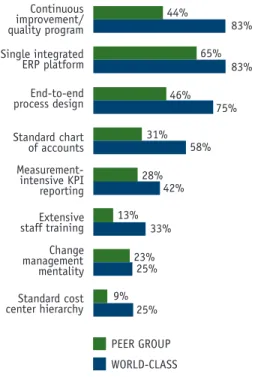
MPROVEMENTIn The Hackett Group’s 2007 Finance Shared Services Performance Study, continuous improvement is tied with a single ERP as being a top tool for
optimizing the performance of shared services (Fig. 1). The implementation
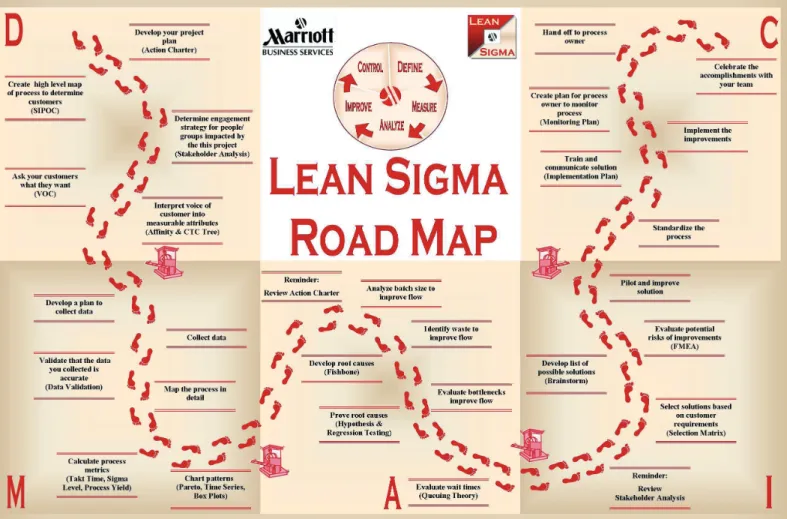
of a continuous improvement program is considered a best practice. Marriott Business Services’ (MBS) leadership recognized that, in light of company cul-ture, its continuous improvement efforts had to be evolutionary to be effective. The company brought in Nathaniel Ford, director, Performance Optimization, and Matthew Webb, manager, Process Improvement, and gave the pair sev-eral months to assess the organization’s needs and identify a course of action. Using a Lean Sigma methodology centered on the DMAIC (Define, Measure,
Analyze, Improve, Control) road map (Fig. 2), the organization managed its
evolution by introducing continuous improvement in stages that build upon each other.
Adapted by Penny Weller and Roy Barden from a webcast by Nathaniel Ford, Director, Performance Optimization, and Matthew Webb, Manager, Process Improvement, Marriott Business Services, October 2007
Marriott Business Services is a subsid-iary of Marriott International. MBS provides services that include credit card processing, customer service, general accounting, and fixed asset and capital expense management to the hotelier’s more than 2,900 properties and 151,000 employees worldwide. Overall, MBS, with 425 employees, handles $6 million in accounts payable invoices, 93,000 vendor inquiries, and more than $5.6 billion in credit card payments annually. NATHANIEL FORD
Director, Performance Optimization Marriott Business Services
Mr. Ford is responsible for the Performance Optimization team including the Lean Sigma program at Marriott Business Services. A certified Six Sigma Black Belt, he is also certified in Lean for Manufacturing and Transactional Processes. Before joining MBS in 2006, he led improvement projects at ALSTOM, a French engineering conglomerate.
FSS PROCESS PERSPECTIVE
June 23, 2008Case Study For Current Members of Process Advisory Programs
MARRIOTT BUSINESS SERVICES: HOW IMPLEMENTING A CUSTOMIZED LEAN
SIGMA METHODOLOGY DRIVES CONTINUOUS IMPROVEMENT
MATTHEW WEBB Manager, Process Improvement Marriott Business Services
Mr. Webb is responsible for co-facilitating all Lean Sigma training, as well as provid-ing coachprovid-ing for Green Belt projects and project management of Black Belt projects. Prior to joining MBS in 2006, he worked for the Eastman Chemical Company as a process improvement representative.
Stage one: Focus on internal issues
Like many organizations, MBS began its continuous improvement efforts by focusing on internal issues. By tackling recognized and often longstanding prob-lems, the leadership looked to build momentum for future endeavors through
quantifiable cost savings and internal client satisfaction.1
Stage two: Expand outside the organization
Once the program has taken hold inside, MBS plans to have the next wave of changes and improvements come from outside the organization, particularly improvements to upstream and downstream touch points and hand-offs related to those relationships and processes. At the same time, the company will continue its internal transformation to ensure that the culture of continuous improvement becomes ingrained and people gain the skills necessary to fully participate in con-tinuous improvement activities.
Stage three: Contribute to the full value stream
Eventually, MBS expects its efforts to mature to the point where they are taking place throughout the company’s entire value stream and that individuals through-out the enterprise become more proactive when it comes to continuous improve-ment. For example, rather than just addressing existing problems, continuous improvement at this stage would also include changes to processes that are fully functional to maximize their efficiency and cost savings.
Throughout each of these stages, MBS is focusing on building its culture of con-tinuous improvement so that it underlies everyday work and problem solving. “Individuals throughout the organization should know what tools are available and how to use them to become better problem solvers,” says Ford.
That means individuals must adopt data-driven mindsets and know when to use certain tools. Although a shared services environment tends to be awash in data, the challenge in continuous improvement is to make sure the available data is the right data. “You can’t just rely on your key performance indicators (KPIs), you have to understand the data,” says Ford. As the methodology takes hold within the organization, individuals at all levels will begin to ask questions and to dig into the data to find ways to remove waste from processes. Therefore, “it’s very important to make sure you have engagement at all levels,” he says.
Since MBS began using Lean Sigma, it has launched many projects that have reduced costs, increased internal client satisfaction and improved controls. Projects focused on cost savings include improving the payment cycle and bill collections. Client sat-isfaction is the main goal for projects that involve accuracy and timeliness. A control improvement project is one focused on reducing false positives in the duplicate pay-ment process and generally strengthening controls to ease the audit process. Although MBS’s initial Lean Sigma project (i.e., Stage 1) took seven months to complete, the time frames for projects continue to evolve as the organization becomes more fluid and experienced with the Lean Sigma methodology and tools.
0.0 12.5 25.0 37.5 50.0 62.5 75.0 87.5 100.0
44% 65% 83% 83% 75% 46% 58% 31% 42% 28% 33% 13% 25% 23% 25% 9% Single integrated ERP platform Continuous improvement/ quality program End-to-end process design Standard chart of accounts Measurement-intensive KPI reportingFIG. 1 Tools with the highest optimization effect, 2008 Change management mentality Extensive staff training Standard cost center hierarchy
Source: The Hackett Group, 2008
WORLD-CLASS PEER GROUP
P
REPARING FORC
HANGE: E
NLISTING THEL
EADERSHIPWhen MBS began implementing its Lean Sigma program in January 2007, Ford and Webb held two half-day training sessions to prepare the MBS leadership to act as champions of the effort. The workshop focused on explaining the Lean Sigma methodology and identifying the first projects and opportunities the pro-gram would address and using prioritization metrics exercises to identify the most important initiatives for the first wave of activity. The workshops also covered what training would be available for the rest of the MBS organization.
Next, the team conducted “green belt” training among employees. In Six Sigma initiatives, “green belts” are employees who are trained to implement Six Sigma changes. At MBS, this training program provided three two-and-a-half-day ses-sions over several months that focused on both hard Lean Sigma skills and softer proficiencies, like presentation skills and project management. The training was spread over several months so that green-belt employees could undergo some training, work on their projects, and return for more training to analyze the work they had done and improve for future efforts.
FIG. 2 The DMAIC road map used by Marriott Business Services
Another group of employees who are on project teams or are process owners engaged in Lean Sigma received two one-day sessions of “orange belt” training on the basics of Lean Sigma, including terminology, available tools and ways to identify waste. (In Six Sigma, this would be a “yellow belt,” but MBS renamed it “orange belt” in honor of the University of Tennessee Volunteers team colors in MBS’s hometown of Knoxville.) These training sessions allowed employees (which included two from out-side MBS) to use Lean Sigma tools during training. For example, one group used an
affinity diagram to develop its mission statement during training.
W
ORKB
EGINS: S
ETTING THEF
IRSTG
OALAs a shared services center, MBS supports about 180 full-service hotel properties and deals with a variety of customer (or guest) issues, including billing discrepancies and adjustments related to customer stays and events. MBS’s Business Exception Tracking (BET) system was designed to handle any changes, adjustment requests or other special situations that occur once a hotel guest has checked out. However, over time, the BET system was being used to handle more and more routine transactions until it had become the usual way to manage the 123,000 transactions MBS handled annu-ally for its hotel clients. As such, the BET system was a prime candidate for the first Lean Sigma project to identify the root causes of the situation, identify process defects and understand what MBS’s clients value in the process.
The overall goal was to reduce exceptions by 50%, with a primary goal of improv-ing satisfaction among hotel clients. Although it wasn’t the drivimprov-ing force, the team also expected to realize some soft-dollar cost savings by reducing employees’ and the hotels clients’ time involved in the process. To achieve these goals, the Lean Sigma team relied on the classic DMAIC (Define, Measure, Analyze, Improve, Control) road map. Setting expectations between MBS and the clients it serves is an important part of this process.
Define
When defining a problem, it is critical to engage clients (in this case, employees at hotel properties) to find out what they value in the process and what they view as a defect, rather than simply making assumptions about what those defects are. Conversations with hotel clients revealed inconsistencies in the clarity of communication that ham-pered the hotel’s ability to respond to questions from MBS employees. Hotel clients also noted that they rely on MBS to make certain decisions for them (such as adjustments to bills on behalf of hotel guests), but that this was not always happening. The last defect clients identified was the time allotted to respond to BETs.
Measure
Measurement focuses on data collection, but for this project, the team looked beyond data already collected on the MBS systems. For example, it looked for all data that compares decisions made by MBS employees with the decisions made by hotel cli-ents, which revealed that those decisions were the same 90% of the time. “It was a good lesson for us to understand that we were all on the same page,” says Webb.
Analyze
With this data in hand, the next step was to use it to understand and analyze the root causes of problems in the system. MBS used a fishbone diagram, which is a problem-analysis tool, to identify those root causes and processes that lead to defects and create waste. The MBS analysis showed that the consistency of time-outs (e.g., system breakdowns, etc.) inconsistent communication between shared services personnel and client hotels, and multiple classifications for problems were confusing to both internal clients and hotel guests.
Improve
The Lean Sigma methodology focuses on addressing the root cause to eliminate a problem by using an array of tools. One tool, 5S, focuses on standardizing, sorting, stabilizing, shining (cleaning) and sustaining. Although 5S is used frequently in manu-facturing, it was also applicable in MBS’s shared services environment. MBS identified 130 types of issues and used 5S to reduce that number to 30 to create a cleaner and more user-friendly process for internal clients. MBS also enlisted a quality specialist to monitor calls and draft communication for consistency and quality, and empowered employees to make more decisions on their own. Moreover, MBS now had data to sup-port these changes. For example, it used data culled from the project to show that its decisions regarding billing resolution were consistently aligned with the types of deci-sions its internal clients made.
Control
Once these improvements were made, MBS put controls in place to make sure it sus-tained those changes. For example, MBS used a control chart for its BET project to show the volume and impact of billing. Before the project started, MBS averaged 95 excep-tions per 1,000 aging items. Once the improvements took hold, that number dropped to about 60 and is expected to decline further over time as more are implemented.
L
ESSONSL
EARNEDFrom deciding on a strategy to implementing a pilot project, MBS’s Lean Sigma team learned some important lessons.
• Gain leadership support: MBS is fortunate to have a leadership team that loves process improvement, but the project team still had to keep them en-gaged and updated.
• Select the right tools: Not all available Lean Sigma tools fit MBS’s needs, including some of the statistical tools. For example, while some companies start their continuous improvement program with an enterprise-wide initia-tive, Marriott’s FSS organization started a quality initiative to make changes in its own organization. As a result of its success, other parts of the enterprise are looking to MBS for help with their own quality improvement projects.
• Implement methodically: Rather than training all employees in a big bang approach, MBS moved forward with the first wave of green belts and made adjustments to the training and structure prior to training the second wave.
• Understand timing: Adopting the Lean Sigma culture is critical and cannot be rushed. MBS began with several strong projects with which to build suc-cess that would breed more sucsuc-cess.
• Don’t overlook soft skills: Strong project management skills are essential. One of the weak points of MBS’s initial push toward Lean Sigma was that most of its new green belts didn’t have experience leading projects and, therefore, didn’t have experience in developing project plans, resource al-location and delegation.
• Involve middle management and process owners: “We overlooked that, so we’re now educating and getting them engaged in the process of selecting projects and in the projects themselves,” says Ford.
• Choose a methodology that meets the organization’s needs: It is im-portant to spend time thinking about this choice with input from others. Implementing the wrong methodology can hinder one’s ability to improve the business.
• Learn and adjust: By learning as they go, organizations can change and im-prove things as they are doing process imim-provement.
• Build a strong image throughout the enterprise: Organizations can look for ways to market successes and look for ways to brand the program and build excitement among employees and company leaders.
• Define and measure success: MBS measures success in a number of ways – through client satisfaction scores, in terms of employee development as more people ask for and receive green belt training, and whether associ-ates are rotating and getting promoted as a result of their experiences us-ing the Lean Sigma methodology. Of course, a critical measure of success will also be total cost savings that are large enough to justify training and other project costs.
S
TRATEGICI
MPLICATIONSMBS developed a continuous improvement approach that best suited its business requirements. While Ford and Webb refer to it as Lean Sigma, the chosen meth-odology is a version customized for MBS’ shared services environment. The effort combined the approaches and reflected the intense focus on customer satisfaction required by Lean and Six Sigma initiatives. Lean initiatives focus on speed and delivering what the customer values and Six Sigma initiatives focus on eliminating defects and exceeding customer requirements.
Structure was a key issue. “There didn’t seem to be an adoptable structure or sug-gestive structure in Lean,” says Ford. “I think Six Sigma has been around so long and has been successful because it has that organizational structure.” For example, MBS has leveraged several Six Sigma tools, including the DMAIC road map, which is a Six Sigma methodology for problem solving and uses the organizational structure of Six Sigma.
“We tend to shy away from using the term, but that’s what you use to build the culture,” says Ford. “You need that structure – the gate checks, the toll gates, and the project reviews to build that culture piece and to ensure that people understand the methodol-ogy and how to apply the tools, not just in formal projects but in their everyday work.”
Marketing value and branding the effort
MBS’s Lean Sigma program in itself was not enough to build a culture of con-tinuous improvement. The team had to market and brand the effort to ensure its success. “We needed to build a culture and generate excitement for the program among associates and our hotel clients,” says Webb.
One way to do this was to make those employees undergoing training as green or orange belts feel special about their accomplishment so that they would share that excitement with their peers after training was complete.
The team also developed a Lean Sigma brand to build excitement and help employees identify with the program. This branding effort involved the use of a Lean Sigma logo and tailored communication to tell the Lean Sigma story using email, newsletters, websites and bulletin boards. The team also distributed a Lean Sigma Road Map, which shows the tools available for problem solving.
“However, the best marketing push came from strong program results that helped to build momentum for more Lean Sigma change throughout the company,” says Webb.
R
ELATEDR
ESEARCH“DIY: How to Create a Localized Continuous Improvement Program,” March 2008 “Real-World Approaches to Continuous Improvement in Shared Services Organi-zations,” February 2008
“Study Confirms that Continuous Improvement Programs Yield Major Cost, Performance Benefits When Applied to SG&A Processes,” November 2007 “Creating Customer Satisfaction Surveys: A Methodology for Effective Measure-ments,” September 2007
A
BOUT THEA
DVISORS Penny Weller, PhD, CMAProgram Leader, Finance Shared Services Advisory Program, The Hackett Group
A Six Sigma Black Belt and certified master trainer, Dr. Weller has a wealth of experience in shared services, accounting and finance. In her capacity as leader of Hackett’s Finance Shared Services Advisory Program, she responds to client inquiries, researches topical shared services issues, and coordinates conference and client networking events. Before joining The Hackett Group, Dr. Weller was a senior executive in shared services at Pfizer Inc. (formerly Pharmacia and Upjohn) for over 30 years. There, her management responsibilities included general ledger, inter-company, accounts receivable, property, consolidations, reporting, accounts payable, travel and
expense, cost and inventory. In addition to her shared services expertise – including accounting and finance integrity and controls – Dr. Weller has managed multiple large-scale merger and system transitions, as well as initiatives in process improvement, activity-based management, and balanced scorecard design and implementation.
Roy Barden
Senior Advisor, European Finance, Shared Services and Customer-to-Cash Advisory Programs, The Hackett Group
Before joining The Hackett Group, Mr. Barden spent over 10 years working as a director in management consulting firms, where he specialized in leading change within the support functions of global organizations, helping clients deliver both in-house and outsourced shared services. Previously, Mr. Barden spent 13 years in the finance functions of multinational firms based in the UK in the paper and chemical industries before becoming CFO of a multinational specialty chemical firm located in the Netherlands.
ABOUT THE
HACKETT GROUP
The Hackett Group, a global strate-gic advisory firm, is a leader in best practice advisory, benchmarking, and transformation consulting services, including shared services, offshoring and outsourcing advice. Utilizing best practices and implementation insights from more than 4,000 benchmarking engagements, executives use Hackett’s empirically based approach to quickly define and prioritize initiatives to enable world-class performance. Through its REL brand, Hackett offers working capital solutions focused on delivering significant cash flow improvements. Through its Hackett Technology Solu-tions group, Hackett offers business application consulting services that helps maximize returns on IT invest-ments. Hackett has worked with 2,700 major corporations and government agencies, including 97% of the Dow Jones Industrials, 73% of the Fortune 100, 73% of the DAX 30 and 45% of the FTSE 100.
Founded in 1991, The Hackett Group was acquired by Answerthink, which was renamed The Hackett Group in 2008. The Hackett Group has global offices in the United States, Europe and India and is publicly traded on the NASDAQ as HCKT.
THE HACKETT GROUP
Email: [email protected] Toll-free: 866-442-2538 www.thehackettgroup.com Atlanta • London • Frankfurt am Main
• Paris • Amsterdam • Zurich • Hyderabad