
Copyright © Future Technology Devices International Limited 1 FT4232H QUAD HIGH SPEED USB TO MULTIPURPOSE UART/MPSSE IC
Datasheet Version 2.4 Document No.: FT_000060 Clearance No.: FTDI#78
Future Technology
Devices International Ltd
FT4232H
Quad High Speed
USB to Multipurpose
UART/MPSSE IC
The FT4232H is FTDI’s 5th generation of USB devices.
The FT4232H is a USB 2.0 High Speed (480Mb/s) to UART/MPSSE ICs. The device features 4 UARTs. Two of these have an option to independently configure an MPSSE engine. This allows the FT4232H to operate as two UART/Bit-Bang ports plus two MPSSE engines used to emulate JTAG, SPI, I2C, Bit-bang or
other synchronous serial modes. The FT4232H has the following advanced features:
Single chip USB to quad serial ports with a variety of configurations.
Entire USB protocol handled on the chip. No USB specific firmware programming required.
USB 2.0 High Speed (480Mbits/Second) and Full Speed (12Mbits/Second) compatible.
Two Multi-Protocol Synchronous Serial Engine (MPSSE) on channel A and channel B, to simplify synchronous serial protocol (USB to JTAG, I2C,
SPI or bit-bang) design.
Independent Baud rate generators.
RS232/RS422/RS485 UART Transfer Data Rate up to 12Mbaud. (RS232 Data Rate limited by external level shifter).
FTDI’s royalty-free Virtual Com Port (VCP) and Direct (D2XX) drivers eliminate the requirement for USB driver development in most cases.
Optional traffic TX/RX indicators can be added with LEDs and an external 74HC595 shift register.
Adjustable receive buffer timeout.
Support for USB suspend and resume conditions via PWREN#, SUSPEND# and RI# pins.
Highly integrated design includes +1.8V LDO regulator for VCORE, integrated POR function and on chip clock multiplier PLL (12MHz – 480MHz).
FTDI FT232B style, asynchronous serial UART interface option with full hardware handshaking and modem interface signals.
Fully assisted hardware or X-On / X-Off software handshaking.
UART Interface supports 7/8 bit data, 1/2 stop bits, and Odd/Even/Mark/Space/No Parity.
Auto-transmit enable control for RS485 serial applications using TXDEN pin.
Operational configuration mode and USB Description strings configurable in external EEPROM over the USB interface.
Low operating and USB suspend current.
Configurable I/O drive strength (4, 8, 12 or 16mA) and slew rate.
Supports bus powered, self-powered and high-power bus high-powered USB configurations.
UHCI/OHCI/EHCI host controller compatible.
USB Bulk data transfer mode (512 byte packets in High Speed mode).
Dedicated Windows DLLs available for USB to JTAG, USB to SPI, and USB to I2C applications.
+1.8V (chip core) and +3.3V I/O interfacing (+5V Tolerant).
Extended -40°C to 85°C industrial operating temperature range.
Compact 64-LD Lead Free LQFP or QFN package
Available in compact Pb-free 56 Pin VQFN packages (RoHS compliant)
+3.3V single supply operating voltage range.
ESD protection for FT4232H IO’s:
Human Body Model (HBM) ±2kV, Machine Mode (MM) ±200V,
Charge Device Model (CDM) ±500V, Latch-up free.
Neither the whole nor any part of the information contained in, or the product described in this manual, may be adapted or reproduced in any material or electronic form without the prior written consent of the copyright holder. This product and its documentation are supplied on an as-is basis and no warranty as to their suitability for any particular purpose is either made or implied. Future Technology Devices International Ltd will not accept any claim for damages howsoever arising as a result of use or failure of this product. Your statutory rights are not affected. This product or any variant of it is not intended for use in any medical appliance, device or system in which the failure of the product might reasonably be expected to result in personal injury. This document provides preliminary information that may be subject to change without notice. No freedom to use patents or other intellectual property rights is implied by the publication of this document. Future Technology Devices International Ltd, Unit 1, 2 Seaward Place, Centurion Business Park, Glasgow, G41 1HH, United Kingdom. Scotland Registered Number: SC136640
Copyright © Future Technology Devices International Limited 2 FT4232H QUAD HIGH SPEED USB TO MULTIPURPOSE UART/MPSSE IC
Datasheet Version 2.4 Document No.: FT_000060 Clearance No.: FTDI#78
1
Typical Applications
Single chip USB to four channels UART (RS232, RS422 or RS485) or Bit-Bang interfaces.
Single chip USB to 2 JTAG channels plus 2 UARTS.
Single chip USB to 1 JTAG channel plus 3 UARTS.
Single chip USB to 1 SPI channel plus 3 UARTS.
Single chip USB to 2 SPI channels plus 2 UARTS.
Single chip USB to 2 Bit-Bang channels plus 2 UARTS.
Single chip USB to 1 SPI channel, plus 1 JTAG channel plus 2 UARTS.
Single chip USB to 2 I2C channels plus 2
UARTS.
Numerous combinations of 4 channels.
Upgrading Legacy Peripheral Designs to USB
Field Upgradable USB Products
Cellular and cordless phone USB data transfer cables and interfaces.
Interfacing MCU / PLD / FPGA based designs to USB
PDA to USB data transfer
USB Smart Card Readers
USB Instrumentation
USB Industrial Control
USB MP3 Player Interface
USB FLASH Card Reader / Writers
Set Top Box PC - USB interface
USB Digital Camera Interface
USB Bar Code Readers
1.1
Driver Support
The FT4232H requires USB drivers (listed below), available free from http://www.ftdichip.com, which are used to make the FT4232H appear as a virtual COM port (VCP). This allows the user to communicate with the USB interface via a standard PC serial emulation port (for example TTY). Another FTDI USB driver, the D2XX driver, can also be used with application software to directly access the FT4232H through a DLL.
Royalty free VIRTUAL COM PORT (VCP) DRIVERS for...
Windows 10 32,64-bit
Windows 8/8.1 32,64-bit
Windows 7 32,64-bit
Windows Vista and Vista 64-bit
Windows XP and XP 64-bit
Windows 98, 98SE, ME, 2000, Server 2003, XP, Server 2008 and server 2012 R2
Windows XP Embedded
Windows CE 4.2, 5.0 and 6.0
Mac OS 8/9, OS-X
Linux 2.4 and greater
Royalty free D2XX Direct Drivers (USB Drivers + DLL S/W Interface)
Windows 10 32,64-bit
Windows 8/8.1 32,64-bit
Windows 7 32,64-bit
Windows Vista and Vista 64-bit
Windows XP and XP 64-bit
Windows 98, 98SE, ME, 2000, Server 2003, XP, Server 2008 and server 2012 R2
Windows XP Embedded
Windows CE 4.2, 5.0 and 6.0
Linux 2.4 and greater
Android(J2xx)
For driver installation, please refer to the installation guides on our website:
http://www.ftdichip.com/Support/Documents/InstallGuides.htm
The following additional installation guides application notes and technical notes are also available:
AN_113, “Interfacing FT2232H Hi-Speed Devices To I2C Bus”.
AN_109 – “Programming Guide for High Speed FTCI2C DLL”
AN_110 – “Programming Guide for High Speed FTCJTAG DLL”
Copyright © Future Technology Devices International Limited 3 FT4232H QUAD HIGH SPEED USB TO MULTIPURPOSE UART/MPSSE IC
Datasheet Version 2.4 Document No.: FT_000060 Clearance No.: FTDI#78
AN 113 – “Interfacing FT2232H Hi-Speed Devices To I2C Bus”
AN114 – “Interfacing FT2232H Hi-Speed Devices To SPI Bus”
AN135 – MPSSE Basics
AN108 - Command Processor For MPSSE and MCU Host Bus Emulation Modes
TN_104, “Guide to Debugging Customers Failed Driver Installation”
1.2
Part Numbers
Part Number Package
FT4232HL-XXXX 64 Pin LQFP
FT4232HQ-XXXX 64 Pin QFN
FT4232H-56Q-XXXX 56 Pin VQFN
Note: Packaging codes for xxxx is:
- Reel: Taped and Reel (LQFP =1000 pcs per reel, QFN-64 =4000 pcs per reel, QFN-56 = 3000 pcs per reel)
- Tray: Tray packing, (LQFP =160 pcs per tray, QFN-64 =260 pcs per tray, QFN-56 = 260 pcs per tray)
Please refer to section 8 for all package mechanical parameters.
1.3
USB Compliant
The FT4232H is fully compliant with the USB 2.0 specification and has been given the USB-IF Test-ID (TID) 40720024.
The timing of the rise/fall time of the USB signals is not only dependant on the USB signal drivers, it is also dependant system and is affected by factors such as PCB layout, external components and any transient protection present on the USB signals. For USB compliance these may require a slight adjustment. This timing can be modified through a programmable setting stored in the same external EEPROM that is used for the USB descriptors. Timing can also be changed by adding appropriate passive components to the USB signals.
Copyright © Future Technology Devices International Limited 4 FT4232H QUAD HIGH SPEED USB TO MULTIPURPOSE UART/MPSSE IC
Datasheet Version 2.4 Document No.: FT_000060 Clearance No.: FTDI#78
2
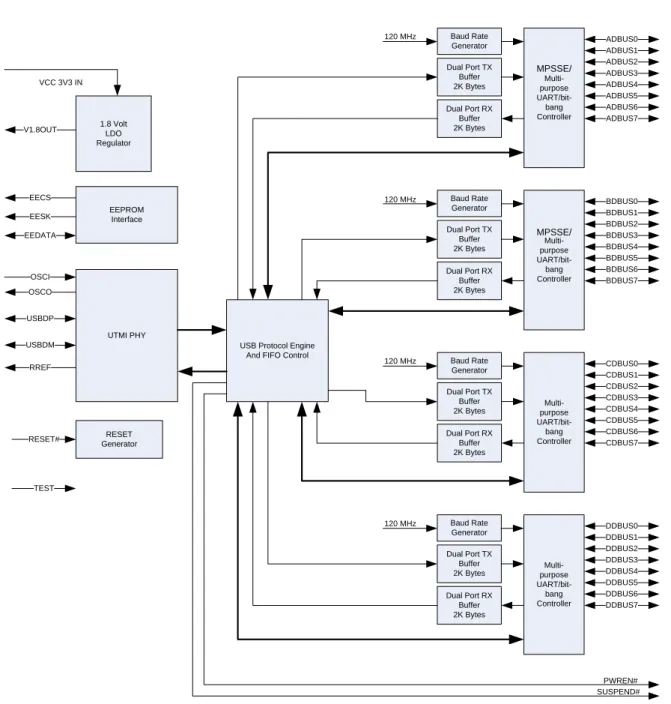
FT4232H Block Diagram
120 MHz Dual Port TX Buffer 2K Bytes Dual Port RX Buffer 2K Bytes Baud Rate Generator Multi- purpose UART/bit-bang Controller ADBUS0 ADBUS1 ADBUS2 ADBUS3 ADBUS4 ADBUS5 ADBUS6 ADBUS7 120 MHz Dual Port TX Buffer 2K Bytes Dual Port RX Buffer 2K Bytes Baud Rate Generator Multi- purpose UART/bit-bang Controller BDBUS0 BDBUS1 BDBUS2 BDBUS3 BDBUS4 BDBUS5 BDBUS6 BDBUS7 120 MHz Dual Port TX Buffer 2K Bytes Dual Port RX Buffer 2K Bytes Baud Rate Generator Multi- purpose UART/bit-bang Controller CDBUS0 CDBUS1 CDBUS2 CDBUS3 CDBUS4 CDBUS5 CDBUS6 CDBUS7 120 MHz Dual Port TX Buffer 2K Bytes Dual Port RX Buffer 2K Bytes Baud Rate Generator Multi- purpose UART/bit-bang Controller DDBUS0 DDBUS1 DDBUS2 DDBUS3 DDBUS4 DDBUS5 DDBUS6 DDBUS7 120 MHz 120 MHz 120 MHz 120 MHz USB Protocol EngineAnd FIFO Control UTMI PHY USBDM USBDP RREF RESET Generator RESET# TEST OSCI OSCO 1.8 Volt LDO Regulator VCC 3V3 IN V1.8OUT EEPROM Interface EECS EESK EEDATA PWREN# SUSPEND# MPSSE/ MPSSE/
Figure 2.1 FT4232H Block Diagram
Copyright © Future Technology Devices International Limited 5 FT4232H QUAD HIGH SPEED USB TO MULTIPURPOSE UART/MPSSE IC
Datasheet Version 2.4 Document No.: FT_000060 Clearance No.: FTDI#78
Table of Contents
1
Typical Applications ... 2
1.1
Driver Support ... 2
1.2
Part Numbers ... 3
1.3
USB Compliant ... 3
2
FT4232H Block Diagram ... 4
3
Device Pin Out and Signal Description ... 7
3.1
64-pin LQFP and QFN Package ... 7
3.1.1
Schematic Symbol ... 7
3.1.2
Pin Descriptions ... 8
3.1.3
Common Pins ... 9
3.1.4
Configured Pins ... 11
3.1.4.1 FT4232H pins used as an asynchronous serial interface... 11
3.1.4.2 FT4232H pins used in a Synchronous or Asynchronous Bit-Bang Interface ... 12
3.1.4.3 FT4232H pins used in an MPSSE ... 13
3.2
56-pin VQFN Package ... 14
3.2.1
Schematic Symbol for FT4232H-56Q ... 14
3.2.2
Pin Descriptions for FT4232H-56Q ... 15
3.2.3
Common Pins for FT4232H-56Q ... 16
3.2.4
Configured Pins for FT4232H-56Q ... 17
3.2.4.1 FT4232H-56Q pins used as an asynchronous serial interface ... 17
3.2.4.2 FT4232H-56Q pins used in a Synchronous or Asynchronous Bit-Bang Interface ... 18
3.2.4.3 FT4232H-56Q pins used in an MPSSE ... 19
4
Function Description ... 20
4.1
Key Features ... 20
4.2
Functional Block Descriptions ... 20
4.3
FT232 UART Interface Mode Description ... 22
4.3.1
RS232 Configuration ... 22
4.3.2
RS422 Configuration ... 23
4.3.3
RS485 Configuration ... 24
4.4
MPSSE Interface Mode Description ... 25
4.4.1
MPSSE Adaptive Clocking ... 27
4.5
Synchronous & Asynchronous Bit-Bang Interface Mode Desc. ... 28
Copyright © Future Technology Devices International Limited 6 FT4232H QUAD HIGH SPEED USB TO MULTIPURPOSE UART/MPSSE IC
Datasheet Version 2.4 Document No.: FT_000060 Clearance No.: FTDI#78
4.5.2
Synchronous Bit-Bang Mode ... 28
4.6
FT4232H Mode Selection ... 30
5
Devices Characteristics and Ratings ... 31
5.1
Absolute Maximum Ratings ... 31
5.2
DC Characteristics ... 32
5.3
ESD Tolerance ... 34
6
FT4232H Configurations ... 35
6.1
USB Bus Powered Configuration ... 35
6.2
USB Self Powered Configuration ... 37
6.3
Oscillator Configuration ... 39
6.4
4 Channel Transmit and Receiver LED Indication Example ... 40
7
EEPROM Configuration ... 41
8
Package Parameters ... 43
8.1
FT4232HQ, QFN-64 Package Dimensions ... 43
8.2
FT4232HL, LQFP-64 Package Dimensions ... 44
8.3
FT4232H-56Q, VQFN-56 Package Dimensions ... 46
8.4
Solder Reflow Profile ... 47
9
Contact Information ... 49
Appendix A – References ... 50
Document References ... 50
Acronyms and Abbreviations ... 50
Appendix B - List of Figures and Tables ... 52
List of Tables ... 52
List of Figures ... 52
Copyright © Future Technology Devices International Limited 7 FT4232H QUAD HIGH SPEED USB TO MULTIPURPOSE UART/MPSSE IC
Datasheet Version 2.4 Document No.: FT_000060 Clearance No.: FTDI#78
3
Device Pin Out and Signal Description
3.1
64-pin LQFP and QFN Package
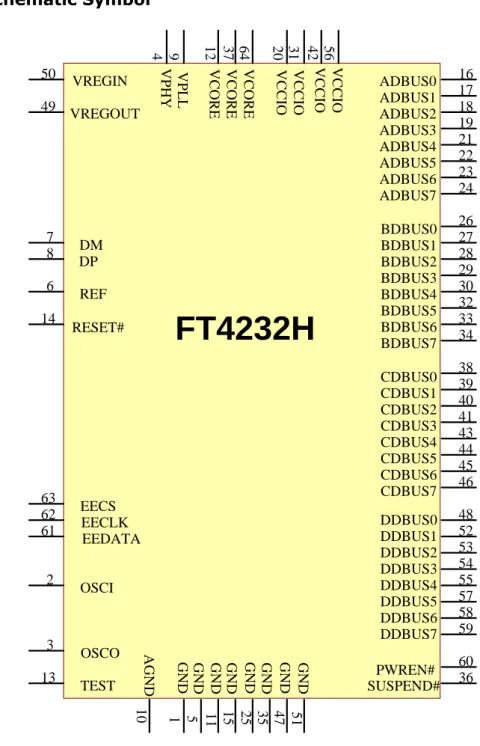
The 64-pin LQFP and 64-pin QFN have the same pin numbering for specific functions. This pin numbering is illustrated in the schematic symbol shown in Figure 3.1.
3.1.1
Schematic Symbol
G N D 1 OSCI 2 OSCO 3 V P H Y 4 G N D 5 REF 6 DM 7 DP 8 V P L L 9 A G N D 1 0 G N D 1 1 V C O R E 1 2 TEST 13 RESET# 14 G N D 1 5 ADBUS0 16 ADBUS1 17 ADBUS2 18 ADBUS3 19 V C C IO 2 0 ADBUS4 21 ADBUS5 22 ADBUS6 23 ADBUS7 24 G N D 2 5 26 27 28 29 30 V C C IO 3 1 32 33 34 G N D 3 5 SUSPEND# 36 V C O R E 3 7 BDBUS0 38 BDBUS1 39 BDBUS2 40 BDBUS3 41 V C C IO 4 2 BDBUS4 43 BDBUS5 44 BDBUS6 45 BDBUS7 46 G N D 4 7 48 VREGOUT 49 VREGIN 50 G N D 5 1 52 53 54 V C C IO 5 6 55 57 58 59 PWREN# 60 EECLK 62 EEDATA 61 EECS 63 V C O R E 6 4FT4232H
CDBUS0 CDBUS1 CDBUS2 CDBUS3 CDBUS4 CDBUS5 CDBUS6 CDBUS7 DDBUS0 DDBUS1 DDBUS2 DDBUS3 DDBUS4 DDBUS5 DDBUS6 DDBUS7Copyright © Future Technology Devices International Limited 8 FT4232H QUAD HIGH SPEED USB TO MULTIPURPOSE UART/MPSSE IC
Datasheet Version 2.4 Document No.: FT_000060 Clearance No.: FTDI#78
3.1.2
Pin Descriptions
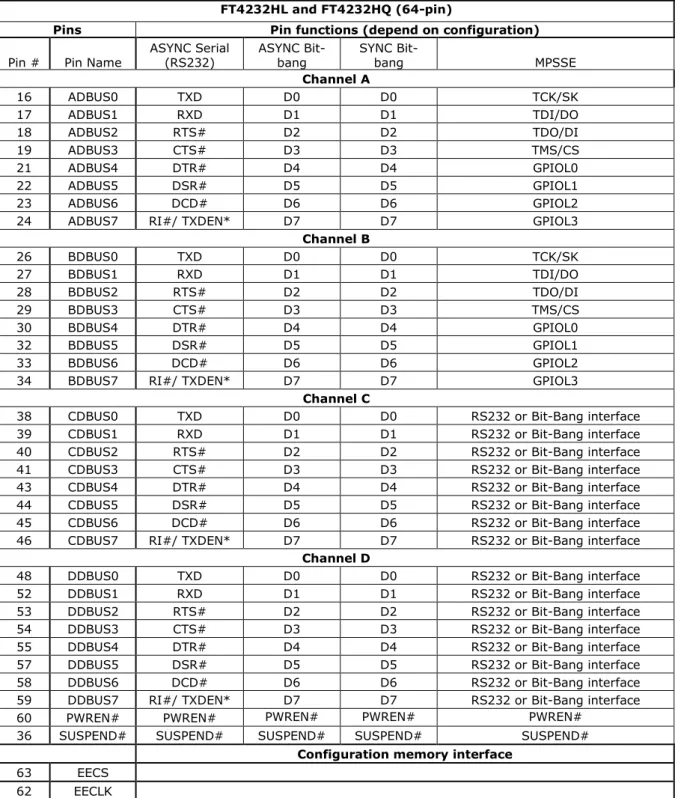
This section describes the operation of the FT4232H pins for 64-pin LQFP and 64-pin QFN. Both the 64-pin QFN and LQFP packages have the same function on each pin. The function of many pins is determined by the configuration of the FT4232H. The following table details the function of each pin dependent on the configuration of the interface. Each of the functions are described in Table 3.1.
(Note: The convention used throughout this document for active low signals is the signal name followed by #)
Table 3.1 FT4232H Pin Configurations for 64-pin QFN and LQFP package * RI#/ or TXDEN is selectable in the EEPROM. Default is RI#.
FT4232HL and FT4232HQ (64-pin)
Pins Pin functions (depend on configuration)
Pin # Pin Name ASYNC Serial (RS232) ASYNC Bit-bang SYNC Bit-bang MPSSE Channel A 16 ADBUS0 TXD D0 D0 TCK/SK 17 ADBUS1 RXD D1 D1 TDI/DO 18 ADBUS2 RTS# D2 D2 TDO/DI 19 ADBUS3 CTS# D3 D3 TMS/CS 21 ADBUS4 DTR# D4 D4 GPIOL0 22 ADBUS5 DSR# D5 D5 GPIOL1 23 ADBUS6 DCD# D6 D6 GPIOL2
24 ADBUS7 RI#/ TXDEN* D7 D7 GPIOL3
Channel B 26 BDBUS0 TXD D0 D0 TCK/SK 27 BDBUS1 RXD D1 D1 TDI/DO 28 BDBUS2 RTS# D2 D2 TDO/DI 29 BDBUS3 CTS# D3 D3 TMS/CS 30 BDBUS4 DTR# D4 D4 GPIOL0 32 BDBUS5 DSR# D5 D5 GPIOL1 33 BDBUS6 DCD# D6 D6 GPIOL2
34 BDBUS7 RI#/ TXDEN* D7 D7 GPIOL3
Channel C
38 CDBUS0 TXD D0 D0 RS232 or Bit-Bang interface
39 CDBUS1 RXD D1 D1 RS232 or Bit-Bang interface
40 CDBUS2 RTS# D2 D2 RS232 or Bit-Bang interface
41 CDBUS3 CTS# D3 D3 RS232 or Bit-Bang interface
43 CDBUS4 DTR# D4 D4 RS232 or Bit-Bang interface
44 CDBUS5 DSR# D5 D5 RS232 or Bit-Bang interface
45 CDBUS6 DCD# D6 D6 RS232 or Bit-Bang interface
46 CDBUS7 RI#/ TXDEN* D7 D7 RS232 or Bit-Bang interface Channel D
48 DDBUS0 TXD D0 D0 RS232 or Bit-Bang interface
52 DDBUS1 RXD D1 D1 RS232 or Bit-Bang interface
53 DDBUS2 RTS# D2 D2 RS232 or Bit-Bang interface
54 DDBUS3 CTS# D3 D3 RS232 or Bit-Bang interface
55 DDBUS4 DTR# D4 D4 RS232 or Bit-Bang interface
57 DDBUS5 DSR# D5 D5 RS232 or Bit-Bang interface
58 DDBUS6 DCD# D6 D6 RS232 or Bit-Bang interface
59 DDBUS7 RI#/ TXDEN* D7 D7 RS232 or Bit-Bang interface
60 PWREN# PWREN# PWREN# PWREN# PWREN#
36 SUSPEND# SUSPEND# SUSPEND# SUSPEND# SUSPEND#
Configuration memory interface 63 EECS
62 EECLK 61 EEDATA
Copyright © Future Technology Devices International Limited 9 FT4232H QUAD HIGH SPEED USB TO MULTIPURPOSE UART/MPSSE IC
Datasheet Version 2.4 Document No.: FT_000060 Clearance No.: FTDI#78
3.1.3
Common Pins
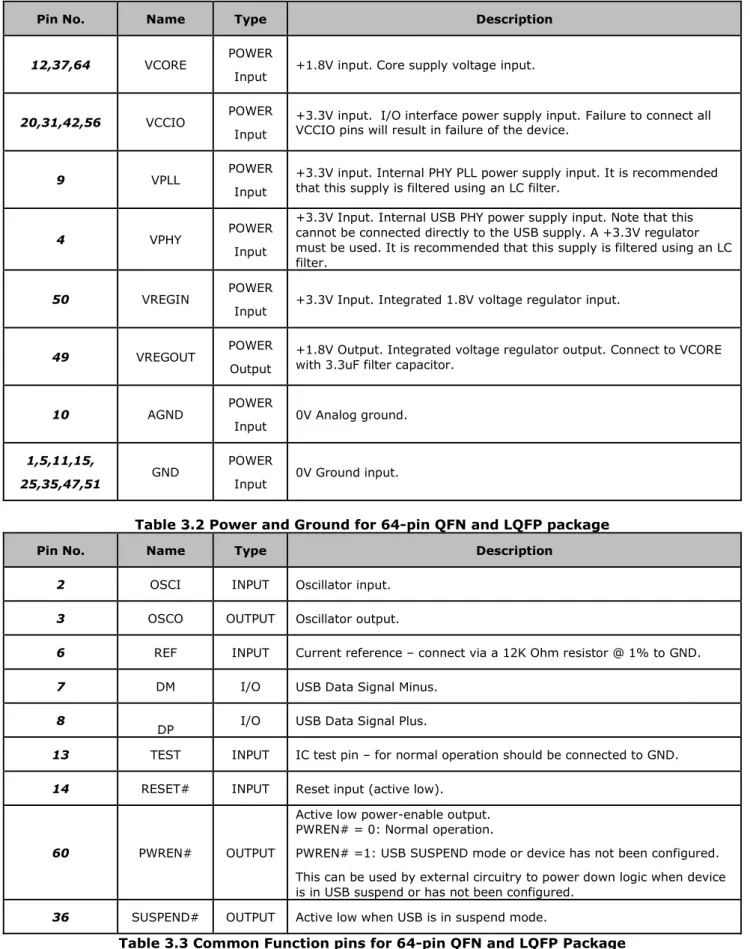
The operation of the following FT4232H pins are the same regardless of the configured mode:-
Pin No. Name Type Description
12,37,64 VCORE POWER
Input +1.8V input. Core supply voltage input.
20,31,42,56 VCCIO POWER Input
+3.3V input. I/O interface power supply input. Failure to connect all VCCIO pins will result in failure of the device.
9 VPLL POWER
Input
+3.3V input. Internal PHY PLL power supply input. It is recommended that this supply is filtered using an LC filter.
4 VPHY POWER
Input
+3.3V Input. Internal USB PHY power supply input. Note that this cannot be connected directly to the USB supply. A +3.3V regulator must be used. It is recommended that this supply is filtered using an LC filter.
50 VREGIN POWER
Input +3.3V Input. Integrated 1.8V voltage regulator input.
49 VREGOUT POWER
Output
+1.8V Output. Integrated voltage regulator output. Connect to VCORE with 3.3uF filter capacitor.
10 AGND POWER
Input 0V Analog ground.
1,5,11,15,
25,35,47,51 GND
POWER
Input 0V Ground input.
Table 3.2 Power and Ground for 64-pin QFN and LQFP package
Pin No. Name Type Description
2 OSCI INPUT Oscillator input.
3 OSCO OUTPUT Oscillator output.
6 REF INPUT Current reference – connect via a 12K Ohm resistor @ 1% to GND.
7 DM I/O USB Data Signal Minus.
8
DP I/O USB Data Signal Plus.
13 TEST INPUT IC test pin – for normal operation should be connected to GND.
14 RESET# INPUT Reset input (active low).
60 PWREN# OUTPUT
Active low power-enable output. PWREN# = 0: Normal operation.
PWREN# =1: USB SUSPEND mode or device has not been configured. This can be used by external circuitry to power down logic when device is in USB suspend or has not been configured.
36 SUSPEND# OUTPUT Active low when USB is in suspend mode.
Copyright © Future Technology Devices International Limited 10 FT4232H QUAD HIGH SPEED USB TO MULTIPURPOSE UART/MPSSE IC
Datasheet Version 2.4 Document No.: FT_000060 Clearance No.: FTDI#78
Pin No. Name Type Description
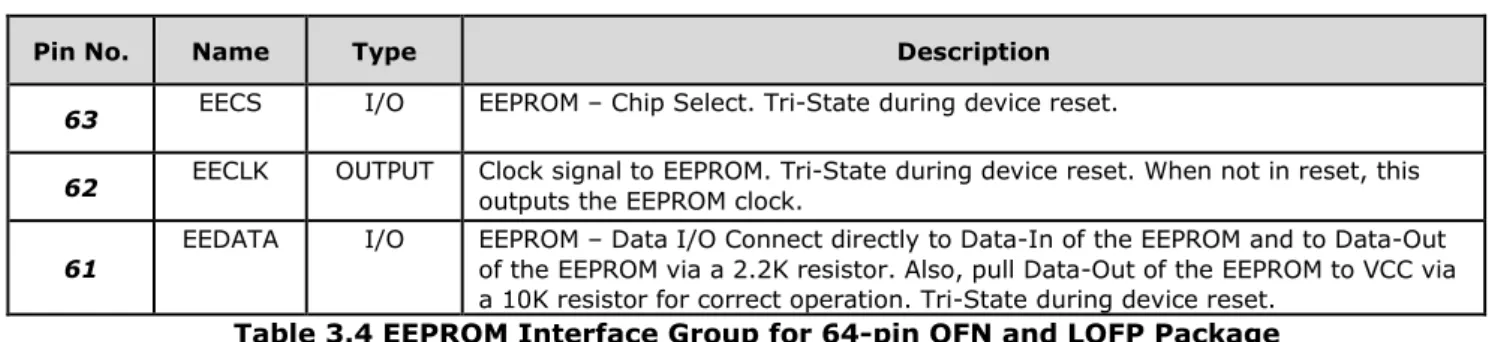
63 EECS I/O EEPROM – Chip Select. Tri-State during device reset.
62 EECLK OUTPUT Clock signal to EEPROM. Tri-State during device reset. When not in reset, this outputs the EEPROM clock.
61 EEDATA I/O EEPROM – Data I/O Connect directly to Data-In of the EEPROM and to Data-Out of the EEPROM via a 2.2K resistor. Also, pull Data-Out of the EEPROM to VCC via a 10K resistor for correct operation. Tri-State during device reset.
Copyright © Future Technology Devices International Limited 11 FT4232H QUAD HIGH SPEED USB TO MULTIPURPOSE UART/MPSSE IC
Datasheet Version 2.4 Document No.: FT_000060 Clearance No.: FTDI#78
3.1.4
Configured Pins
The following sections describe the function of the configurable pins referred to in Table 3.1 which is determined by how the FT4232H is configured.
3.1.4.1 FT4232H pins used as an asynchronous serial interface
Any of the 4 channels of the FT4232H can be configured as an asynchronous serial UART interface (RS232/422/485). When configured in this mode, the pins used and the descriptions of the signals are shown in Table 3.5. Channel A Pin No. Channel B Pin No. Channel C Pin No. Channel D Pin No.
Name Type RS232 Configuration Description
16 26 38 48 TXD OUTPUT TXD = transmitter output
17 27 39 52 RXD INPUT RXD = receiver input
18 28 40 53 RTS# OUTPUT RTS# = Ready To send handshake output
19 29 41 54 CTS# INPUT CTS# = Clear To Send handshake input
21 30 43 55 DTR# OUTPUT DTR# = Data Transmit Ready modem signaling line
22 32 44 57 DSR# INPUT DSR# = Data Set Ready modem signaling line
23 33 45 58 DCD# INPUT DCD# = Data Carrier Detect modem signaling line
24 34 46 59 TXDEN RI#/ INPUT/OUTPUT
RI# = Ring Indicator Control Input. When the Remote Wake up option is enabled in the EEPROM, taking RI# low can be used to resume the PC USB Host controller from suspend.
(see note 1, 2 and 3)
TXDEN = (TTL level). For use with RS485 level converters.
Table 3.5 Channel A,B,C and D Asynchronous Serial Interface Configured Pin Descriptions
Notes
1. When using remote wake-up, ensure the resistors are pulled-up in suspend. Also ensure peripheral designs do not allow any current sink paths that may partially power the peripheral. 2. If remote wake-up is enabled, a peripheral is allowed to draw up to 2.5mA in suspend. If remote
wake-up is disabled, the peripheral must draw no more than 500uA in suspend. 3. If a Pull-down is enabled, the FT4232H will not wake up from suspend.
Copyright © Future Technology Devices International Limited 12 FT4232H QUAD HIGH SPEED USB TO MULTIPURPOSE UART/MPSSE IC
Datasheet Version 2.4 Document No.: FT_000060 Clearance No.: FTDI#78
3.1.4.2
FT4232H pins used in a Synchronous or Asynchronous Bit-Bang InterfaceThe FT4232H channel A, B, C or channel D can be configured as a bit-bang interface. There are two types of bit-bang modes: synchronous and asynchronous.
When configured in any bit-bang mode (synchronous or asynchronous), the pins used and the descriptions of the signals are shown in Table 3.6
Channel
Number Pin Nos. Name Type Synchronous or Asynchronous Bit-Bang Configuration Description
A 24,23,22,21 , 19,18,17,16
ADBUS[7:0] I/O Channel A, D7 to D0 bidirectional bit-bang data
B 34,33,32,30 , 29,28,27,26
BDBUS[7:0] I/O Channel B, D7 to D0 bidirectional bit-bang data
C 46,45,44,43 , 41,40,39,38
CDBUS[7:0] I/O Channel C, D7 to D0 bidirectional bit-bang data
D 59,58,57,55
54,53,52,48 DDBUS[7:0] I/O Channel D, D7 to D0 bidirectional bit-bang data
Table 3.6 Channel A,B,C and D Synchronous or Asynchronous Bit-Bang Configured Pin Descriptions
For a functional description of this mode, please refer to section 4.5 Synchronous & Asynchronous Bit-Bang Interface Mode Desc
.
.Copyright © Future Technology Devices International Limited 13 FT4232H QUAD HIGH SPEED USB TO MULTIPURPOSE UART/MPSSE IC
Datasheet Version 2.4 Document No.: FT_000060 Clearance No.: FTDI#78
3.1.4.3
FT4232H pins used in an MPSSEThe FT4232H channel A and channel B, each have a Multi-Protocol Synchronous Serial Engine (MPSSE). Each MPSSE can be independently configured to a number of industry standard serial interface protocols such as JTAG, I2C or SPI, or it can be used to implement a proprietary bus protocol. For example, it is
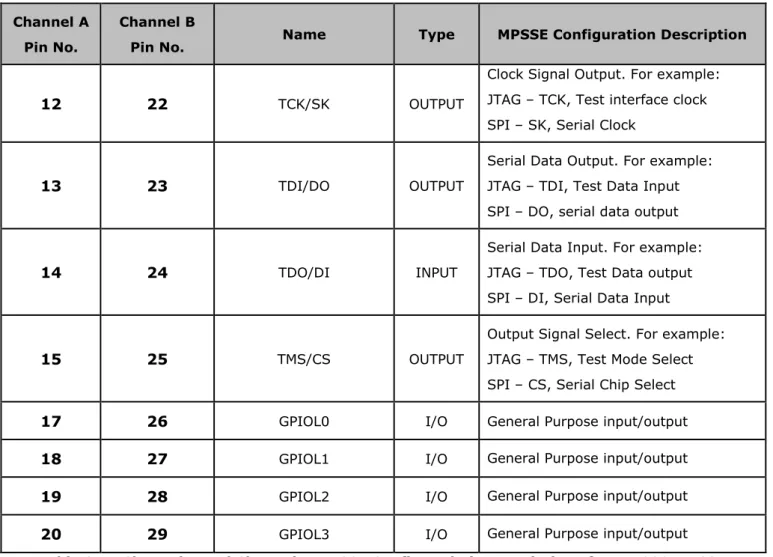
possible to use one of the FT4232H’s channels (e.g. channel A) to connect to an SRAM configurable FPGA such as supplied by Altera or Xilinx. The FPGA device would normally be un-configured (i.e. have no defined function) at power-up. Application software on the PC could use the MPSSE to download configuration data to the FPGA over USB. This data would define the hardware function on power up. The other MPSSE channel (e.g. channel B) would be available for another serial interface function while channel C and channel D can be configured as UART or bit-bang mode. Alternatively each MPSSE can be used to control a number of GPIO pins. When configured in this mode, the pins used and the descriptions of the signals are shown in Table 3.7
Channel A Pin No.
Channel B
Pin No. Name Type MPSSE Configuration Description
16 26 TCK/SK OUTPUT
Clock Signal Output. For example: JTAG – TCK, Test interface clock SPI – SK, Serial Clock
17 27 TDI/DO OUTPUT
Serial Data Output. For example: JTAG – TDI, Test Data Input SPI – DO, serial data output
18 28 TDO/DI INPUT
Serial Data Input. For example: JTAG – TDO, Test Data output SPI – DI, Serial Data Input
19 29 TMS/CS OUTPUT
Output Signal Select. For example: JTAG – TMS, Test Mode Select SPI – CS, Serial Chip Select
21 30 GPIOL0 I/O General Purpose input/output
22 32 GPIOL1 I/O General Purpose input/output
23 33 GPIOL2 I/O General Purpose input/output
24 34 GPIOL3 I/O General Purpose input/output
Table 3.7 Channel A and Channel B MPSSE Configured Pin Descriptions
For a functional description of this mode, please refer to section 4.4.
When either Channel A or Channel B or both channels are used in MPSSE mode, Channel C and Channel D can be configured as asynchronous serial interface (RS232/422/485) or Bit-Bang mode or a combination of both.
Copyright © Future Technology Devices International Limited 14 FT4232H QUAD HIGH SPEED USB TO MULTIPURPOSE UART/MPSSE IC
Datasheet Version 2.4 Document No.: FT_000060 Clearance No.: FTDI#78
3.2
56-pin VQFN Package
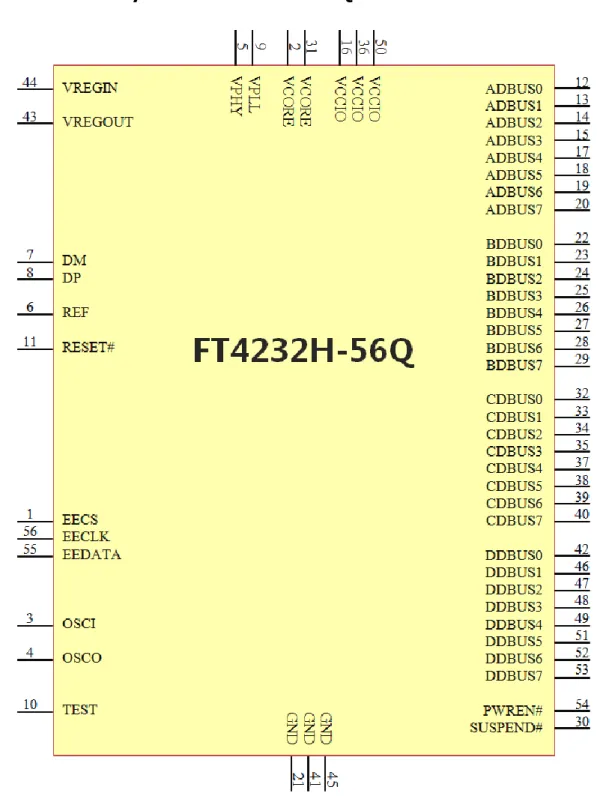
The 56-pin VQFN with lower pin count and small size package is also available for the FT4232H. The differences exist on power/ground and pin number for each pin. The part number is FT4232H-56Q to distinguish it from the 64-pin package type. All the functions are supported in the 56-pin VQFN package. The pin numbering is illustrated in the schematic symbol shown in Error! Reference source not found.
3.2.1
Schematic Symbol for FT4232H-56Q
Copyright © Future Technology Devices International Limited 15 FT4232H QUAD HIGH SPEED USB TO MULTIPURPOSE UART/MPSSE IC
Datasheet Version 2.4 Document No.: FT_000060 Clearance No.: FTDI#78
3.2.2
Pin Descriptions for FT4232H-56Q
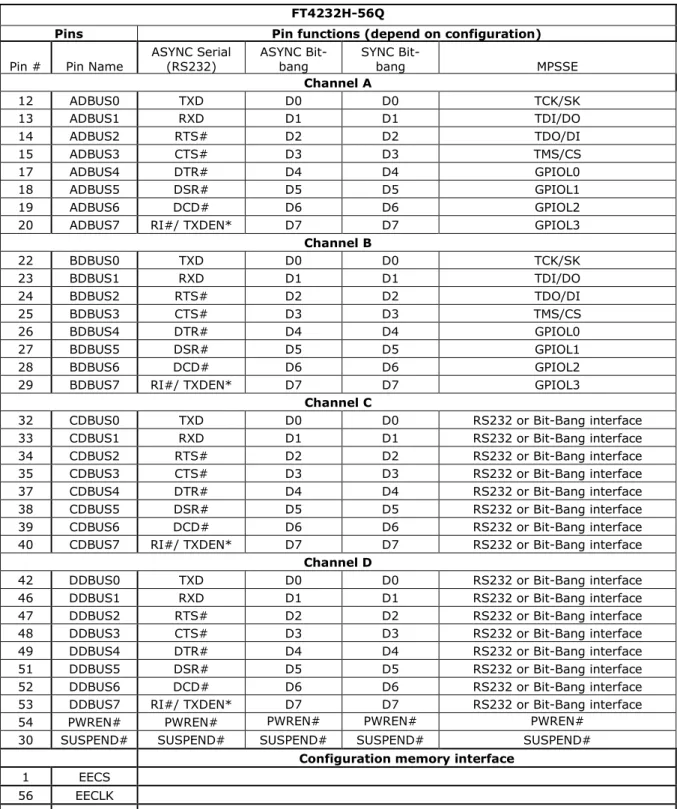
This section describes the operation of the FT4232H-56Q pins for 56-pin VQFN package. The function of many pins is determined by the configuration of the FT4232H-56Q. The following table details the function of each pin dependent on the configuration of the interface. Each of the functions is described in Table 3.8. (Note: The convention used throughout this document for active low signals is the signal name followed by #)
Table 3.8 FT4232H Pin Configurations for 56-Pin VQFN Package * RI#/ or TXDEN is selectable in the EEPROM. Default is RI#.
FT4232H-56Q
Pins Pin functions (depend on configuration)
Pin # Pin Name ASYNC Serial (RS232) ASYNC Bit-bang SYNC Bit-bang MPSSE Channel A 12 ADBUS0 TXD D0 D0 TCK/SK 13 ADBUS1 RXD D1 D1 TDI/DO 14 ADBUS2 RTS# D2 D2 TDO/DI 15 ADBUS3 CTS# D3 D3 TMS/CS 17 ADBUS4 DTR# D4 D4 GPIOL0 18 ADBUS5 DSR# D5 D5 GPIOL1 19 ADBUS6 DCD# D6 D6 GPIOL2
20 ADBUS7 RI#/ TXDEN* D7 D7 GPIOL3
Channel B 22 BDBUS0 TXD D0 D0 TCK/SK 23 BDBUS1 RXD D1 D1 TDI/DO 24 BDBUS2 RTS# D2 D2 TDO/DI 25 BDBUS3 CTS# D3 D3 TMS/CS 26 BDBUS4 DTR# D4 D4 GPIOL0 27 BDBUS5 DSR# D5 D5 GPIOL1 28 BDBUS6 DCD# D6 D6 GPIOL2
29 BDBUS7 RI#/ TXDEN* D7 D7 GPIOL3
Channel C
32 CDBUS0 TXD D0 D0 RS232 or Bit-Bang interface
33 CDBUS1 RXD D1 D1 RS232 or Bit-Bang interface
34 CDBUS2 RTS# D2 D2 RS232 or Bit-Bang interface
35 CDBUS3 CTS# D3 D3 RS232 or Bit-Bang interface
37 CDBUS4 DTR# D4 D4 RS232 or Bit-Bang interface
38 CDBUS5 DSR# D5 D5 RS232 or Bit-Bang interface
39 CDBUS6 DCD# D6 D6 RS232 or Bit-Bang interface
40 CDBUS7 RI#/ TXDEN* D7 D7 RS232 or Bit-Bang interface Channel D
42 DDBUS0 TXD D0 D0 RS232 or Bit-Bang interface
46 DDBUS1 RXD D1 D1 RS232 or Bit-Bang interface
47 DDBUS2 RTS# D2 D2 RS232 or Bit-Bang interface
48 DDBUS3 CTS# D3 D3 RS232 or Bit-Bang interface
49 DDBUS4 DTR# D4 D4 RS232 or Bit-Bang interface
51 DDBUS5 DSR# D5 D5 RS232 or Bit-Bang interface
52 DDBUS6 DCD# D6 D6 RS232 or Bit-Bang interface
53 DDBUS7 RI#/ TXDEN* D7 D7 RS232 or Bit-Bang interface
54 PWREN# PWREN# PWREN# PWREN# PWREN#
30 SUSPEND# SUSPEND# SUSPEND# SUSPEND# SUSPEND#
Configuration memory interface
1 EECS
56 EECLK 55 EEDATA
Copyright © Future Technology Devices International Limited 16 FT4232H QUAD HIGH SPEED USB TO MULTIPURPOSE UART/MPSSE IC
Datasheet Version 2.4 Document No.: FT_000060 Clearance No.: FTDI#78
3.2.3
Common Pins for FT4232H-56Q
The operation of the following FT4232H-56Q pins are the same regardless of the configured mode:-
Pin No. Name Type Description
2,31 VCORE POWER Input
+1.8V input. Core supply voltage input.
16,36,50 VCCIO POWER Input
+3.3V input. I/O interface power supply input. Failure to connect all VCCIO pins will result in failure of the device.
9 VPLL POWER
Input
+3.3V input. Internal PHY PLL power supply input. It is recommended that this supply is filtered using an LC filter.
5 VPHY POWER
Input
+3.3V Input. Internal USB PHY power supply input. Note that this cannot be connected directly to the USB supply. A +3.3V regulator must be used. It is recommended that this supply is filtered using an LC filter.
44 VREGIN POWER
Input
+3.3V Input. Integrated 1.8V voltage regulator input.
43 VREGOUT POWER Output
+1.8V Output. Integrated voltage regulator output. Connect to VCORE with 3.3uF filter capacitor.
21,41,45 GND POWER Input
0V Ground input.
Table 3.9 Power and Ground for 56-pin VQFN package
Pin No. Name Type Description
3 OSCI INPUT Oscillator input.
4 OSCO OUTPUT Oscillator output.
6 REF INPUT Current reference – connect via a 12K Ohm resistor @ 1% to GND.
7 DM INPUT USB Data Signal Minus.
8 DP INPUT USB Data Signal Plus.
10 TEST INPUT IC test pin – for normal operation should be connected to GND.
11 RESET# INPUT Reset input (active low).
54 PWREN# OUTPUT
Active low power-enable output. PWREN# = 0: Normal operation.
PWREN# =1: USB SUSPEND mode or device has not been configured. This can be used by external circuitry to power down logic when device is in USB suspend or has not been configured.
30 SUSPEND# OUTPUT Active low when USB is in suspend mode.
Copyright © Future Technology Devices International Limited 17 FT4232H QUAD HIGH SPEED USB TO MULTIPURPOSE UART/MPSSE IC
Datasheet Version 2.4 Document No.: FT_000060 Clearance No.: FTDI#78
Pin No. Name Type Description
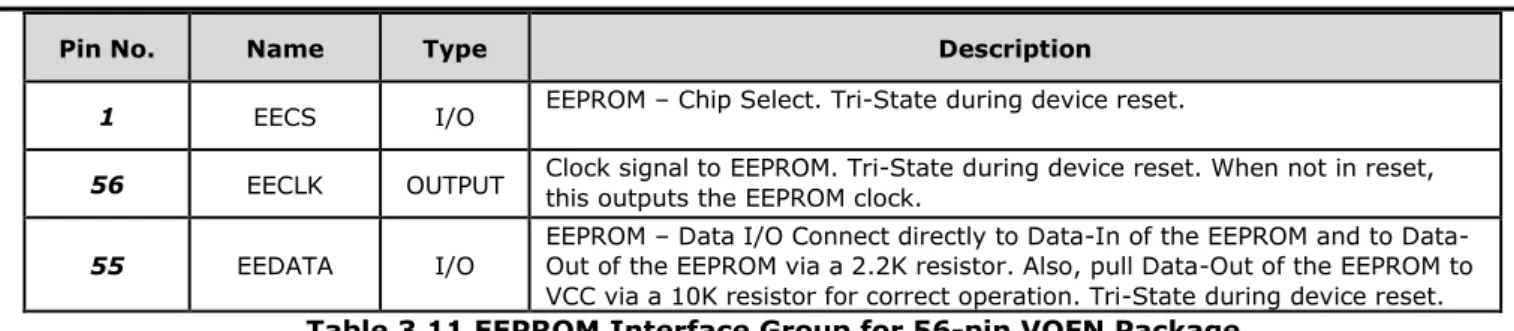
1 EECS I/O EEPROM – Chip Select. Tri-State during device reset.
56 EECLK OUTPUT Clock signal to EEPROM. Tri-State during device reset. When not in reset, this outputs the EEPROM clock.
55 EEDATA I/O EEPROM – Data I/O Connect directly to Data-In of the EEPROM and to Data-Out of the EEPROM via a 2.2K resistor. Also, pull Data-Out of the EEPROM to VCC via a 10K resistor for correct operation. Tri-State during device reset. Table 3.11 EEPROM Interface Group for 56-pin VQFN Package
3.2.4
Configured Pins for FT4232H-56Q
The following sections describe the function of the configurable pins referred to in Table 3.8 which is determined by how the FT4232H-56Q is configured.
3.2.4.1 FT4232H-56Q pins used as an asynchronous serial interface
Any of the 4 channels of the FT4232H-56Q can be configured as an asynchronous serial UART interface (RS232/422/485). When configured in this mode, the pins used and the descriptions of the signals are shown in Table 3.12. Channel A Pin No. Channel B Pin No. Channel C Pin No. Channel D Pin No.
Name Type RS232 Configuration Description
12 22 32 42 TXD OUTPUT TXD = transmitter output
13 23 33 46 RXD INPUT RXD = receiver input
14 24 34 47 RTS# OUTPUT RTS# = Ready To send handshake output
15 25 35 48 CTS# INPUT CTS# = Clear To Send handshake input
17 26 37 49 DTR# OUTPUT DTR# = Data Transmit Ready modem signaling line
18 27 38 51 DSR# INPUT DSR# = Data Set Ready modem signaling line
19 28 39 52 DCD# INPUT DCD# = Data Carrier Detect modem signaling line
20 29 40 53 TXDEN RI#/ INPUT/OUTPUT
RI# = Ring Indicator Control Input. When the Remote Wake up option is enabled in the EEPROM, taking RI# low can be used to resume the PC USB Host controller from suspend.
(see note 1, 2 and 3)
TXDEN = (TTL level). For use with RS485 level converters.
Table 3.12 Channel A, B, C and D Asynchronous Serial Interface Configured Pin Descriptions for FT4232H-56Q
Notes
1. When using remote wake-up, ensure the resistors are pulled-up in suspend. Also ensure peripheral designs do not allow any current sink paths that may partially power the peripheral. 2. If remote wake-up is enabled, a peripheral is allowed to draw up to 2.5mA in suspend. If remote
wake-up is disabled, the peripheral must draw no more than 500uA in suspend. 3. If a Pull-down is enabled, the FT4232H will not wake up from suspend.
Copyright © Future Technology Devices International Limited 18 FT4232H QUAD HIGH SPEED USB TO MULTIPURPOSE UART/MPSSE IC
Datasheet Version 2.4 Document No.: FT_000060 Clearance No.: FTDI#78
3.2.4.2
FT4232H-56Q pins used in a Synchronous or Asynchronous Bit-BangInterface
The FT4232H channel A, B, C or channel D can be configured as a bit-bang interface. There are two types of bit-bang modes: synchronous and asynchronous.
When configured in any bit-bang mode (synchronous or asynchronous), the pins used and the descriptions of the signals are shown in Table 3.13
Channel
Number Pin Nos. Name Type Synchronous or Asynchronous Bit-Bang Configuration Description
A 20,19,18,17 , 15,14,13,12
ADBUS[7:0] I/O Channel A, D7 to D0 bidirectional bit-bang data
B 29,28,27,26 , 25,24,23,22
BDBUS[7:0] I/O Channel B, D7 to D0 bidirectional bit-bang data
C 40,39,38,37 , 35,34,33,32
CDBUS[7:0] I/O Channel C, D7 to D0 bidirectional bit-bang data
D 53,52,51,49
48,47,46,42 DDBUS[7:0] I/O Channel D, D7 to D0 bidirectional bit-bang data
Table 3.13 Channel A, B, C and D Synchronous or Asynchronous Bit-Bang Configured Pin Descriptions for FT4232H-56Q
For a functional description of this mode, please refer to section 4.5 Synchronous & Asynchronous Bit-Bang Interface Mode Desc
.
.Copyright © Future Technology Devices International Limited 19 FT4232H QUAD HIGH SPEED USB TO MULTIPURPOSE UART/MPSSE IC
Datasheet Version 2.4 Document No.: FT_000060 Clearance No.: FTDI#78
3.2.4.3
FT4232H-56Q pins used in an MPSSEThe FT4232H channel A and channel B, each have a Multi-Protocol Synchronous Serial Engine (MPSSE). Each MPSSE can be independently configured to a number of industry standard serial interface protocols such as JTAG, I2C or SPI, or it can be used to implement a proprietary bus protocol. For example, it is possible to use one of the FT4232H’s channels (e.g. channel A) to connect to an SRAM configurable FPGA such as supplied by Altera or Xilinx. The FPGA device would normally be un-configured (i.e. have no defined function) at power-up. Application software on the PC could use the MPSSE to download configuration data to the FPGA over USB. This data would define the hardware function on power up. The other MPSSE channel (e.g. channel B) would be available for another serial interface function while channel C and channel D can be configured as UART or bit-bang mode. Alternatively each MPSSE can be used to control a number of GPIO pins. When configured in this mode, the pins used and the descriptions of the signals are shown in Table 3.14
Channel A Pin No.
Channel B
Pin No. Name Type MPSSE Configuration Description
12 22 TCK/SK OUTPUT
Clock Signal Output. For example: JTAG – TCK, Test interface clock SPI – SK, Serial Clock
13 23 TDI/DO OUTPUT
Serial Data Output. For example: JTAG – TDI, Test Data Input SPI – DO, serial data output
14 24 TDO/DI INPUT
Serial Data Input. For example: JTAG – TDO, Test Data output SPI – DI, Serial Data Input
15 25 TMS/CS OUTPUT
Output Signal Select. For example: JTAG – TMS, Test Mode Select SPI – CS, Serial Chip Select
17 26 GPIOL0 I/O General Purpose input/output
18 27 GPIOL1 I/O General Purpose input/output
19 28 GPIOL2 I/O General Purpose input/output
20 29 GPIOL3 I/O General Purpose input/output
Table 3.14 Channel A and Channel B MPSSE Configured Pin Descriptions for FT4232H-56Q
For a functional description of this mode, please refer to section 4.4.
When either Channel A or Channel B or both channels are used in MPSSE mode, Channel C and Channel D can be configured as asynchronous serial interface (RS232/422/485) or Bit-Bang mode or a combination of both.
Copyright © Future Technology Devices International Limited 20 FT4232H QUAD HIGH SPEED USB TO MULTIPURPOSE UART/MPSSE IC
Datasheet Version 2.4 Document No.: FT_000060 Clearance No.: FTDI#78
4
Function Description
The FT4232H is FTDI’s 5th generation of USB devices. The FT4232H is a USB 2.0 High Speed (480Mb/s) to
UART/MPSSE ICs. It has the capability of being configured in a variety of industry standard serial interfaces.
The FT4232H has four independent configurable interfaces. Two of these interfaces can be configured as UART, JTAG, SPI, I2C or bit-bang mode, using an MPSSE, with independent baud rate generators. The
remaining two interfaces can be configured as UART or bit-bang.
4.1
Key Features
USB High Speed to Quad Interface. The FT4232H is a USB 2.0 High Speed (480Mbits/s) to four independent flexible/configurable serial interfaces.
Functional Integration. The FT4232H integrates a USB protocol engine which controls the physical Universal Transceiver Macrocell Interface (UTMI) and handles all aspects of the USB 2.0 High Speed interface. The FT4232H includes an integrated +1.8V Low Drop-Out (LDO) regulator and 12MHz to 480MHz PLL. It also includes 2kbytes Tx and Rx data buffers per channel. The FT4232H effectively integrates the entire USB protocol on a chip.
MPSSE. Multi-Purpose Synchronous Serial Engines (MPSSE), capable of speeds up to 30 Mbits/s, provides flexible synchronous interface configurations.
Data Transfer rate. The FT4232H supports a data transfer rate up to 12 Mbit/s when configured as an RS232/RS422/RS485 UART interface. Please note the FT4232H does not support the baud rates of 7 Mbaud 9 Mbaud, 10 Mbaud and 11 Mbaud.
Latency Timer. This is really a feature of the driver and is used to as a timeout to flush short packets of data back to the PC. The default is 16ms, but it can be altered between 0ms and 256ms. At 0ms latency you get a packet transfer on every high speed micro frame.
4.2
Functional Block Descriptions
Quad Multi-Purpose UART/MPSSE Controllers. The FT4232H has four independent UART/MPSSE Controllers. These blocks control the UART data or control the Bit-Bang mode if selected by the SETUP command. The blocks used on channel A and channel B also contain a MPSSE (Multi-Protocol Synchronous Serial Engine) in each of them which can be used independently of each other and the remaining UART channels. Using this it can be configured under software command to have 1 MPSSE + 3 UARTS (each UART can be set to Bit Bang mode to gain extra I/O if required) or 2 MPSSE + 2 UARTS.
USB Protocol Engine and FIFO control. The USB Protocol Engine controls and manages the interface between the UTMI PHY and the FIFOs of the chip. It also handles power management and the USB protocol specification.
Dual Port FIFO TX Buffer (2Kbytes per channel). Data from the Host PC is stored in these buffers to be used by the Multi-purpose UART/FIFO controllers. This is controlled by the USB Protocol Engine and FIFO control block.
Copyright © Future Technology Devices International Limited 21 FT4232H QUAD HIGH SPEED USB TO MULTIPURPOSE UART/MPSSE IC
Datasheet Version 2.4 Document No.: FT_000060 Clearance No.: FTDI#78 Dual Port FIFO RX Buffer (2Kbytes per channel). Data from the Multi-purpose UART/FIFO controllers is stored in these blocks to be sent back to the Host PC when requested. This is controlled by the USB Protocol Engine and FIFO control block.
RESET Generator - The integrated Reset Generator Cell provides a reliable power-on reset to the device internal circuitry at power up. The RESET# input pin allows an external device to reset the FT4232H. RESET# should be tied to VCCIO (+3.3v) if not being used.
Independent Baud Rate Generators - The Baud Rate Generators provides an x16 or an x10 clock input to the UART’s from a 120MHz reference clock and consists of a 14 bit pre-scaler and 4 register bits which provide fine tuning of the baud rate (used to divide by a number plus a fraction). This determines the Baud Rate of the UART which is programmable from 183 baud to 12 million baud. The FT2232H does not support the baud rates of 7 Mbaud 9 Mbaud, 10 Mbaud and 11 Mbaud.
See FTDI application note AN232B-05 on the FTDI website (www.ftdichip.com) for more details.
+1.8V LDO Regulator. The +1.8V LDO regulator generates the +1.8 volts for the core and the USB transceiver cell. Its input (VREGIN) must be connected to a +3.3V external power source. It is also recommended to add an external filtering capacitor to the VREGIN. There is no direct connection from the +1.8V output (VREGOUT) and the internal functions of the FT4232H. The PCB must be routed to connect VREGOUT to the pins that require the +1.8V including VREGIN.
UTMI PHY. The Universal Transceiver Macrocell Interface (UTMI) physical interface cell. This block handles the Full speed / High Speed SERDES (serialise – de-serialise) function for the USB TX/RX data. It also provides the clocks for the rest of the chip. A 12 MHz crystal should be connected to the OSCI and OSCO pins. A 12K Ohm resistor should be connected between REF and GND on the PCB.
The UTMI PHY functions include:
Supports 480 Mbit/s "High Speed" (HS)/ 12 Mbit/s “Full Speed” (FS), FS Only and "Low Speed" (LS).
SYNC/EOP generation and checking.
Data and clock recovery from serial stream on the USB.
Bit-stuffing/unstuffing; bit stuff error detection.
Manages USB Resume, Wake Up and Suspend functions.
Single parallel data clock output with on-chip PLL to generate higher speed serial data clocks. EEPROM Interface. When used without an external EEPROM the FT4232H defaults to a quad USB to an asynchronous serial port device. Adding an external 93C46 (93C56 or 93C66) EEPROM allows customization of USB VID, PID, Serial Number, Product Description Strings and Power Descriptor value of the FT4232H for OEM applications. Other parameters controlled by the EEPROM include Remote Wake Up, Soft Pull Down on Power-Off and I/O pin drive strength.
The EEPROM must be a 16 bit wide configuration such as a Microchip 93LC46B or equivalent capable of a 1Mbit/s clock rate at VCC = +3.00V to 3.6V. The EEPROM is programmable in-circuit over USB using a utility program called FT_PROG available from FTDI’s web site (www.ftdichip.com). This allows a blank part to be soldered onto the PCB and programmed as part of the manufacturing and test process.
If no EEPROM is connected (or the EEPROM is blank), the FT4232H will default to serial ports. The device uses its built-in default VID (0403), PID (6011) Product Description and Power Descriptor Value. In this case, the device will not have a serial number as part of the USB descriptor.
Copyright © Future Technology Devices International Limited 22 FT4232H QUAD HIGH SPEED USB TO MULTIPURPOSE UART/MPSSE IC
Datasheet Version 2.4 Document No.: FT_000060 Clearance No.: FTDI#78
4.3
FT232 UART Interface Mode Description
The FT4232H can be configured in similar UART modes as the FTDI FT232 devices (an asynchronous serial interface). The following examples illustrate how to configure the FT4232H with an RS232, RS422 or RS485 interfaces. The FT4232 can be configured as a mixture of these interfaces.
4.3.1
RS232 Configuration
Figure 4.1 illustrates how the FT4232H channel A can be configured with an RS232 UART interface. This can be repeated for channels B, C and D to provide a quad RS232, but has been omitted for clarity.
Copyright © Future Technology Devices International Limited 23 FT4232H QUAD HIGH SPEED USB TO MULTIPURPOSE UART/MPSSE IC
Datasheet Version 2.4 Document No.: FT_000060 Clearance No.: FTDI#78
4.3.2
RS422 Configuration
Figure 4.2 illustrates how the FT4232H can be configured as a dual RS422 interface. The FT4232H can have all 4 channels connected as RS422, but only channel A and channel C are shown for clarity.
Copyright © Future Technology Devices International Limited 24 FT4232H QUAD HIGH SPEED USB TO MULTIPURPOSE UART/MPSSE IC
Datasheet Version 2.4 Document No.: FT_000060 Clearance No.: FTDI#78
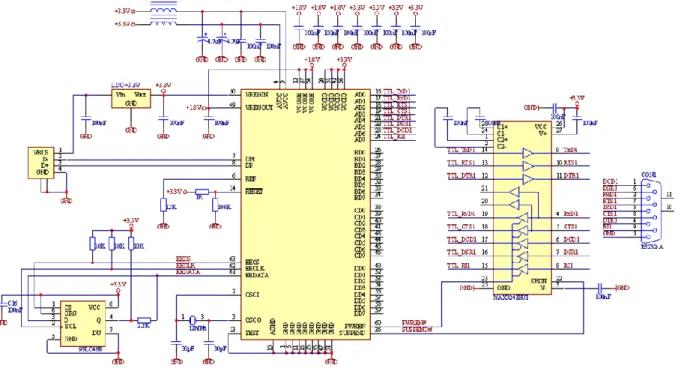
In this case both channel A and channel C are configured as UART operating at TTL levels and a level converter device (full duplex RS485 transceiver) is used to convert the TTL level signals from the FT4232H to RS422 levels. The PWREN# signal is used to power down the level shifters such that they operate in a low quiescent current when the USB interface is in suspend mode.
4.3.3
RS485 Configuration
Figure 4.3 illustrates how the FT4232H can be configured as a dual RS485 interface. The FT4232H can have all 4 channels connected as RS485, but only channel A and channel C are shown for clarity.
Figure 4.3 Dual RS485 Configuration
In this case both channel A and channel C are configured as RS485 operating at TTL levels and a level converter device (half duplex RS485 transceiver) is used to convert the TTL level signals from the FT232H to RS485 levels. It has separate enables on both the transmitter and receiver. With RS485, the transmitter is only enabled when a character is being transmitted from the UART. The TXDEN pins on the FT4232H are provided for exactly that purpose, and so the transmitter enables are wired to the TXDEN‟s. The receiver enable is active low, so it is wired to the PWREN# pin to disable the receiver when in USB suspend mode.
Copyright © Future Technology Devices International Limited 25 FT4232H QUAD HIGH SPEED USB TO MULTIPURPOSE UART/MPSSE IC
Datasheet Version 2.4 Document No.: FT_000060 Clearance No.: FTDI#78
RS485 is a multi-drop network – i.e. many devices can communicate with each other over a single two wire cable connection. The RS485 cable requires to be terminated at each end of the cable. Links are provided to allow the cable to be terminated if the device is physically positioned at either end of the cable.
In this example the data transmitted by the FT4232H is also received by the device that is transmitting. This is a common feature of RS485 and requires the application software to remove the transmitted data from the received data stream. With the FT4232H it is possible to do this entirely in hardware – simply modify the schematic so that RXD of the FT4232H is the logical OR of the level converter device receiver output with TXDEN using an HC32 or similar logic gate.
4.4
MPSSE Interface Mode Description
MPSSE Mode is designed to allow the FT4232H to interface efficiently with synchronous serial protocols such as JTAG, I2C and SPI Bus. It can also be used to program SRAM based FPGA’s over USB. The MPSSE interface is designed to be flexible so that it can be configured to allow any synchronous serial protocol (industry standard or proprietary) to be implemented using the FT4232H. MPSSE is only available on channel A and channel B.
MPSSE is fully configurable, and is programmed by sending commands down the data stream. These can be sent individually or more efficiently in packets. MPSSE is capable of a maximum sustained data rate of 30 Mbits/s.
When a channel is configured in MPSSE mode, the IO timing and signals used are shown in Figure 4.4 and Table 4.1. These show timings for CLKOUT=30MHz. CLKOUT can be divided internally to be provide a slower clock.
Copyright © Future Technology Devices International Limited 26 FT4232H QUAD HIGH SPEED USB TO MULTIPURPOSE UART/MPSSE IC
Datasheet Version 2.4 Document No.: FT_000060 Clearance No.: FTDI#78
NAME
MIN
NOM
MAX
Units
COMMENT
t1
33.33
ns
CLKOUT period
t2
15
16.67
ns
CLKOUT high period
t3
15
16.67
ns
CLKOUT low period
t4
1
7.15
ns
CLKOUT to TDI/DO delay
t5
0
ns
TDO/DI hold time
t6
11
TDO/DI setup time
Table 4.1 MPSSE Signal Timings
MPSSE mode is enabled using Set Bit Bang Mode driver command. A hex value of 2 will enable it, and a hex value of 0 will reset the device. See application note AN2232-02, “Bit Mode Functions for the FT2232” for more details and examples.
The MPSSE command set is fully described in application note AN_108 – “Command Processor for MPSSE and MCU Host Bus Emulation Modes”.
The following additional application notes are available for configuring the MPSSE:
AN_109 – “Programming Guide for High Speed FTCI2C DLL”
AN_110 – “Programming Guide for High Speed FTCJTAG DLL”
Copyright © Future Technology Devices International Limited 27 FT4232H QUAD HIGH SPEED USB TO MULTIPURPOSE UART/MPSSE IC
Datasheet Version 2.4 Document No.: FT_000060 Clearance No.: FTDI#78
4.4.1
MPSSE Adaptive Clocking
Adaptive clocking is a new MPSSE feature added to the FT24232H MPSSE engine.
The mode is effectively handshaking the CLK signal with a return clock RTCK. This is a technique used by ARM processors.
The FT4232H will assert the CLK line and wait for the RTCK to be returned from the target device to GPIOL3 line before changing the TDO (data out line).
FT4232H ARM CPU
RTCK TCK
TDO
GPIOL3
Figure 4.5 Adaptive Clocking Interconnect
TDO
TCK
RTCK
TDO changes on falling edge of TCK
Figure 4.6: Adaptive Clocking waveform
Adaptive clocking is not enabled by default.
Copyright © Future Technology Devices International Limited 28 FT4232H QUAD HIGH SPEED USB TO MULTIPURPOSE UART/MPSSE IC
Datasheet Version 2.4 Document No.: FT_000060 Clearance No.: FTDI#78
4.5
Synchronous & Asynchronous Bit-Bang Interface Mode Desc.
The FT4232H channel A, B, C or channel D can be configured as a bit-bang interface. There are two types of bit-bang modes: synchronous and asynchronous.
4.5.1
Asynchronous Bit-Bang Mode
Asynchronous Bit-Bang mode is the same as BM-style Bit-Bang mode. On any channel configured in asynchronous bit-bang mode, data written to the device in the normal manner will be self-clocked onto the parallel I/O data pins (those which have been configured as outputs). Each I/O pin can be independently set as an input or an output. The rate that the data is clocked out at is controlled by the baud rate generator.
For the data to change there has to be new data written, and the baud rate clock has to tick. If no new data is written to the channel, the pins will hold the last value written.
4.5.2
Synchronous Bit-Bang Mode
The synchronous Bit-Bang mode will only update the output parallel I/O port pins whenever data is sent from the USB interface to the parallel interface. When this is done, data is read from the USB Rx FIFO buffer and written out on the pins. Data can only be received from the parallel pins (to the USB Tx FIFO interface) when the parallel interface has been written to.
With Synchronous Bit-Bang mode, data will only be sent out by the FT4232H if there is space in the FT4232H USB TXFIFO for data to be read from the parallel interface pins. This Synchronous Bit-Bang mode will read the data bus parallel I/O pins first, before it transmits data from the USB RxFIFO. It is therefore 1 byte behind the output, and so to read the inputs for the byte that you have just sent, another byte must be sent.
For example:- (1) Pins start at 0xFF Send 0x55,0xAA
Pins go to 0x55 and then to 0xAA Data read = 0xFF,0x55
(2) Pins start at 0xFF Send 0x55,0xAA,0xAA (repeat the last byte sent) Pins go to 0x55 and then to 0xAA
Data read = 0xFF,0x55,0xAA
Synchronous Bit-Bang Mode differs from Asynchronous Bit-Bang mode in that the device parallel output is only read when the parallel output is written to by the USB interface. This makes it easier for the controlling program to measure the response to a USB output stimulus as the data returned to the USB interface is synchronous to the output data.
Asynchronous Bit-Bang mode is enabled using Set Bit Bang Mode driver command. A hex value of 1 will enable Asynchronous Bit-Bang mode.
Synchronous Bit-Bang mode is enabled using Set Bit Bang Mode driver command. A hex value of 4 will enable Synchronous Bit-Bang mode.
See application note AN2232-02, “Bit Mode Functions for the FT2232” for more details and examples of using the bit-bang modes.
Copyright © Future Technology Devices International Limited 29 FT4232H QUAD HIGH SPEED USB TO MULTIPURPOSE UART/MPSSE IC
Datasheet Version 2.4 Document No.: FT_000060 Clearance No.: FTDI#78
An example of the synchronous bi-bang mode timing is shown in Figure 4.7 and Table 4.2.
WRSTB#
RDSTB#
Figure 4.7 Synchronous Bit-Bang Mode Timing Interface Example
It should be noted that the FT4232H does not output the WRSTB# or RDSTB# signals when configured in bit-bang mode. Figure 4.7 and Table 4.2 show these signals for illustration purposes only.
NAME
Description
t1
Current pin state is readt2
RDSTB# is set inactive and data on the paralle I/O pins is read and sent to the USB host.t3
RDSTB# is set active again, and any pins that are output will change to their new datat4
1 clock cycle to allow for data setupt5
WRSTB# goes active. This indicates that the host PC has written new data to the I/O parallel datapins
t6
WRSTB# goes inactiveTable 4.2 Synchronous Bit-Bang Mode Timing Interface Example Timings
WRSTB# = this output indicates when new data has been written to the I/O pins from the Host PC (via the USB interface).
RDSTB# = this output rising edge indicates when data has been read from the I/O pins and sent to the Host PC (via the USB interface).
Copyright © Future Technology Devices International Limited 30 FT4232H QUAD HIGH SPEED USB TO MULTIPURPOSE UART/MPSSE IC
Datasheet Version 2.4 Document No.: FT_000060 Clearance No.: FTDI#78
4.6
FT4232H Mode Selection
The 4 channels of the FT4232H reset to 4 asynchronous serial UART interfaces. Following a reset, the required mode can be configured by sending the FT_SetBitMode command (refer to D2XX_Programmers_Guide) to the USB driver software.
The EEPROM contents have no effect on the selected mode with the exception of selecting the TXDEN for RS485 mode when asynchronous serial interface has been selected in software. If the device is reset, then the 4 channels must be reconfigured into the required mode.
Note that the mode of each of the 4 channels is independent of the other channels.
The MPSSE can be configured directly using the D2XX commands. The D2XX_Programmers_Guide is available from the FTDI website at
http://www.ftdichip.com/Documents/ProgramGuides/D2XX_Programmer's_Guide(FT_000071).pdf
Also the MPSSE command set is fully described in application note AN108 - Command Processor For MPSSE and MCU Host Bus Emulation Modes
Copyright © Future Technology Devices International Limited 31 FT4232H QUAD HIGH SPEED USB TO MULTIPURPOSE UART/MPSSE IC
Datasheet Version 2.4 Document No.: FT_000060 Clearance No.: FTDI#78
5
Devices Characteristics and Ratings
5.1
Absolute Maximum Ratings
The absolute maximum ratings for the FT4232H devices are as follows. These are in accordance with the Absolute Maximum Rating System (IEC 60134). Exceeding these values may cause permanent damage to the device.
Parameter Value Unit
Storage Temperature -65°C to 150°C Degrees C
Floor Life (Out of Bag) At Factory Ambient (30°C / 60% Relative Humidity)
168 Hours
(IPC/JEDEC J-STD-033A MSL Level 3 Compliant)*
Hours
Ambient Operating Temperature (Power
Applied) -40°C to 85°C Degrees C
MTTF FT4232HL TBD hours
MTTF FT4232HQ TBD hours
VCORE Supply Voltage -0.3 to +2.0 V
VCCIO IO Voltage -0.3 to +4.0 V
DC Input Voltage – USBDP and USBDM -0.5 to +3.63 V
DC Input Voltage – High Impedance
Bi-directional (powered from VCCIO) -0.3 to +5.8 V
DC Input Voltage – All Other Inputs -0.5 to + (VCCIO +0.5) V
DC Output Current – Outputs 16 mA
Table 5.1 Absolute Maximum Ratings
* If devices are stored out of the packaging beyond this time limit the devices should be baked before use. The devices should be ramped up to a temperature of +125°C and baked for up to 17 hours.
Copyright © Future Technology Devices International Limited 32 FT4232H QUAD HIGH SPEED USB TO MULTIPURPOSE UART/MPSSE IC
Datasheet Version 2.4 Document No.: FT_000060 Clearance No.: FTDI#78
5.2
DC Characteristics
DC Characteristics (Ambient Temperature = -40°C to +85°C)
Parameter Description Minimum Typical Maximum Units Conditions
VCORE VCC Core Operating Supply Voltage 1.62 1.80 1.98 V
VCCIO* VCCIO Operating Supply Voltage 2.97 3.30 3.63 V Cells are 5V tolerant
VREGIN VREGIN Voltage regulator Input 3.00 3.30 3.60 V VREGOUT Voltage regulator Output 1.71 1.80 1.89 V
Ireg Regulator Current 150 mA VREGIN +3.3V
Icc1 Core Operating Supply Current --- 70 --- mA VCORE = +1.8V Normal Operation Icc1r Core Reset Supply Current --- 5 --- mA VCORE = +1.8V
Device in reset state.
Icc1s Core Suspend Supply Current 500 µA VCORE = +1.8V
USB Suspend Table 5.2 Operating Voltage and Current
Copyright © Future Technology Devices International Limited 33 FT4232H QUAD HIGH SPEED USB TO MULTIPURPOSE UART/MPSSE IC
Datasheet Version 2.4 Document No.: FT_000060 Clearance No.: FTDI#78
The I/O pins are +3.3v cells, which are +5V tolerant (except the USB PHY pins).
Parameter Description Minimum Typical Maximum Units Conditions
Voh Output Voltage High
2.40 3.14
V Ioh = +/-2mA I/O Drive strength*
= 4mA 3.20 V I/O Drive strength* = 8mA 3.22 V I/O Drive strength* = 12mA
3.22 V I/O Drive strength* = 16mA
Vol Output Voltage Low
0.18 0.40
V Iol = +/-2mA I/O Drive strength*
= 4mA 0.12 V I/O Drive strength* = 8mA
0.08 V I/O Drive strength* = 12mA 0.07 V I/O Drive strength* = 16mA
Vil Input low Switching Threshold - 0.80 V LVTTL
Vih Input High Switching Threshold 2.0 - V LVTTL
Vt Switching Threshold 1.50 V LVTTL
Vt- Schmitt trigger negative going threshold voltage 0.80 1.10 - V Vt+ Schmitt trigger positive going threshold voltage 1.60 2.0 V
Rpu Input pull-up resistance 40 75 190 KΩ Vin = 0
Rpd Input pull-down resistance 40 75 190 KΩ Vin =VCCIO
Iin Input Leakage Current 15 45 85 μA Vin = 0
Ioz Tri-state output leakage current +/-10 μA Vin = 5.5V or 0 Table 5.3 I/O Pin Characteristics (except USB PHY pins)
Copyright © Future Technology Devices International Limited 34 FT4232H QUAD HIGH SPEED USB TO MULTIPURPOSE UART/MPSSE IC
Datasheet Version 2.4 Document No.: FT_000060 Clearance No.: FTDI#78
DC Characteristics (Ambient Temperature = -40°C to +85°C)
Parameter Description Minimum Typical Maximum Units Conditions
VPHY, VPLL
PHY Operating Supply
Voltage 3.0 3.3 3.6 V 3.3V I/O
Iccphy PHY Operating Supply Current --- 30 60 mA High-speed operation at 480 MHz Iccphy
(susp)
PHY Operating Supply
Current --- 10 50 μA USB Suspend
Table 5.4 PHY Operating Voltage and Current
Parameter Description Minimum Typical Maximum Units Conditions
Voh Output Voltage High VCORE-0.2 V
Vol Output Voltage Low 0.2 V
Vil Input low Switching Threshold - 0.8 V
Vih Input High Switching Threshold 2.0 - V
Table 5.5 PHY I/O Pin Characteristics
5.3
ESD Tolerance
ESD protection for FT4232H IO’s
Parameter Reference Minimum Typical Maximum Units
Human Body Model
(HBM) JEDEC EIA/JESD22-A114-B, Class 2 ±2kV kV Machine Mode (MM) JEDEC EIA/JESD22-A115-A, Class B ±200V V
Charge Device Model
(CDM) JEDEC EIA/
JESD22-C101-D, Class-III ±500V V
Latch-up JESD78, Trigger Class-II ±200mA mA
Copyright © Future Technology Devices International Limited 35 FT4232H QUAD HIGH SPEED USB TO MULTIPURPOSE UART/MPSSE IC
Datasheet Version 2.4 Document No.: FT_000060 Clearance No.: FTDI#78
6
FT4232H Configurations
The following sections illustrate possible USB power configurations for the FT4232H.
All USB power configurations illustrated apply to both package options for the FT4232H device.
6.1
USB Bus Powered Configuration
Bus Powered Application example 1: Bus powered configuration
Figure 6.1 Bus Powered Configuration Example 1
Figure 6.1 illustrates the FT4232H in a typical USB bus powered design configuration. A USB bus powered device gets its power from the USB bus. In this application, the FT4232H requires that the VBUS (USB +5V) is regulated down to +3.3V (using an LDO) to supply the VCCIO, VPLL, VPHY and VREGIN.
VREGIN is the +3.3V input to the on chip +1.8V regulator. The output of the on chip LDO regulator (+1.8V) drives the FT4232H core supply (VCORE). This requires a minimum of a 3.3uF filter capacitor.
G N D 1 OSCI 2 OSCO 3 4 G N D 5 REF 6 DM 7 DP 8 9 A G N D 1 0 G N D 1 1 V C O R E 1 2 TEST 13 RESET# 14 G N D 1 5 ADBUS0 1617 18 19 V C C IO 2 0 21 22 23 24 G N D 2 5 26 27 28 29 30 V C C IO 3 1 32 33 34 G N D 3 5 SUSPEND# 36 V C O R E 3 7 38 39 40 41 V C C IO 4 2 43 44 45 46 G N D 4 7 48 VREGOUT 49 VREGIN 50 G N D 5 1 52 53 54 V C C IO 5 6 55 57 58 59 PWREN# 60 EECLK 62 EEDATA 61 EECS 63 V C O R E 6 4 Vin Vout GND LDO +3.3V GND VBUS 1 D- 2 D+ 3 GND 4 100nF 100nF 100nF 100nF GND GND GND GND GND 4.7uF 4.7uF GND GND +1.8V +3.3V +1.8V +3.3V 100nF 100nF 100nF 100nF 100nF 100nF 100nF +1.8V +1.8V +1.8V +3.3V +3.3V +3.3V +3.3V GND GND GND GND GND GND GND +3.3V +3.3V 12K 1K GND +3.3V 27pF 27pF CS 1 SCL 2 D 3 Q 4 GND 5 ORG 6 DU 7 VCC 8 93C46 GND GND GND +3.3V +3.3V 2.2K 10K 10K 10K 1 3 12MHz EECLK EEDATA GND ADBUS1 ADBUS2 ADBUS3 ADBUS4 ADBUS5 ADBUS6 ADBUS7 BDBUS0 BDBUS1 BDBUS2 BDBUS3 BDBUS4 BDBUS5 BDBUS6 BDBUS7 CDBUS0 CDBUS1 CDBUS2 CDBUS3 CDBUS4 CDBUS5 CDBUS6 CDBUS7 DDBUS0 DDBUS1 DDBUS2 DDBUS3 DDBUS4 DDBUS5 DDBUS6 DDBUS7 V P H Y V P L L 0? GND 3.3uF
Figure
Outline
Related documents