The Influence of Beauty Vlog on Perceived Source Credibility
and Purchase Intention
Yaumul Rahmi, Laras Sekarasih, Bertina Sjabadhyni
Faculty of Psychology, Universitas Indonesia, 16424, Depok, Indonesia1 *E-mail: [email protected]
Abstract
This study examined the influence of beauty vlog on consumers’ purchase intention through consumers’ perceptions of source credibility and expertise, with consumers’ previous experience in using the product as a moderator. An experiments was conducted by exposing participants (n = 98) to a beauty vlog clip and a traditional advertising as a source of information on YouTube platform. Wardah lip cream products were used as a product in experiments. The results showed that the source of information had no effect on purchasing intention or consumer perception on the credibility and expertise of information sources. However, an interaction between information source and previous experience in using the product in influencing consumers’ purchase intention was found. Specifically, compared to traditional advertising, beauty vlog had a positive effect on the intention of purchase among individuals who had had used Wardah lip cream products.
Pengaruh Beauty Vlog Terhadap Persepsi Akan Kredibilitas
Narasumber dan Niat Beli Konsumen
Abstrak
Penelitian ini bertujuan untuk menguji pengaruh sumber informasi pada platform digital terhadap niat beli konsumen melalui persepsi konsumen akan kredibilitas dan keahlian sumber sebagai mediator, serta pengalaman menggunakan produk sebagai moderator. Eksperimen dilakukan dengan memberi partisipan (n=98) paparan terhadap klip beauty vlog
dan iklan tradisional sebagai sumber informasi yang terdapat di platform YouTube. Produk lip cream Wardah digunakan sebagai produk dalam eksperimen. Hasil penelitian menunjukkan sumber informasi tidak memiliki pengaruh terhadap niat beli maupun persepsi konsumen terhadap kredibilitas dan keahlian sumber informasi, namun terdapat interaksi antara sumber informasi dan pengalaman individu sebelumnya dengan produk dalam mempengaruhi niat beli. Secara spesifik, dibandingkan iklan tradisional, beauty vlog memiliki pengaruh positif terhadap niat beli individu yang sudah pernah menggunakan produk lip cream Wardah sebelumnya.
Keywords: beauty vlog, credibility, purchase intention
Citation:
Rahmi, Y., & Sekarasih, L. (2017). The influence of beauty vlog on perceived source credibility and purchase intention.
Makara Hubs-Asia, 21(1): 13–23, DOI: 10.7454/mssh.v21i1.3496
1.
Introduction
Indonesia’s cosmetics and make up industry has been enjoying a steady growth in the past few years. Data from the Indonesian Ministry of Trade and Industry showed that Indonesia’s market volume of the cosmetic industry was estimated at IDR 9.76 billion (approximately USD 727,409) in 2013, which was a 14-percent increase from the 2012 market volume
(www.kemenperin.go.id). In 2014, the Ministry has forecasted a market volume of IDR 11.22 billion (approximately USD 836,222), 15% higher than it is of 2013. However, despite such increase, the market share of local cosmetic products is trailing behind its imported counterparts. In 2016, for example, more than 70% of all cosmetic products distributed in Indonesian market were imported (www.kemenperin.go.id), which suggests that Indonesian cosmetic brands are less
attractive than imported products for the consumers. In other words, Indonesian local products still need be more competitive in the Indonesian cosmetic market. One of the psychological constructs that may explain the relatively small market share of the Indonesian cosmetic product is consumers’ purchase intention. Purchase intention, "the willingness of the consumer to buy a product at a particular time or situation," (Lu, Chang & Chang, 2014, p.261), is an important predictor for successful marketing, since it precedes an actual purchase behavior. Among various factors that influence consumers' purchase intentions, the role digital media as a marketing avenue is among one that has been receiving growing attention in scholarly research, which is consistent with the increasing penetration of the Internet, including in Indonesia (APJII, 2016). Currently, the use digital media has gone beyond a means of communication and information sharing. Digital platform has played a vital role in marketing, distributing, and delivering consumer goods and services. For instance, producers have been using Facebook, Blog, and YouTube to promote their products and communicate directly with consumers (Mangold & Fauld, 2009). Digital media also allows consumers to write product review and interact with fellow users (Mangold & Fauld, 2009), which has the potential to generate positive word of mouth that may influence consumers’ purchase decision. From the consumers’ perspective, the presence of digital forums can be a resource to share and find more honest and reliable information that help consumers in making purchase decisions (O'Connor, 2015). In sum, it is important to further investigate digital platform as an environmental component that may contribute to consumer behavior.
Previous research suggests that product-related information on digital media influences consumers’ purchase intentions. Goh, Heng, and Lin (2013) found that the consumers’ review of a product on social media such as Facebook has more influence on consumers’ purchase intention than the review created by marketers, since consumers’ review was perceived as more informative and persuasive. Bickart and Schindler (2001) also found that the information obtained through online consumers forums generate more the interest in the product rather than the information obtained from the marketer. Furthermore, Wang, Yu and Wei (2012) found that peer communicationon social media related to a product or service also influence consumers’ purchase intentions through generating more positive consumers’ attitudes and involvement towards product. Based on the aforementioned studies, one can infer that consumers-generated communications and messages, including product reviews on digital media may have stronger influence on consumers’ purchase intention
compared to the marketer-created promotional messages, for example online advertising. However, existing research on user-generated content in general focused on the written consumer goods reviews, such as word of mouth on the online consumer forums, while consumers-generated product is no longer limited to written product reviews (Hautz, Fuller, Hutter, & Thurridl, 2014). The advancement and affordability of audiovisual technology have now enabled consumers able to post photos or videos to create product reviews. A content that has been growing on the digital platform in Indonesia the proliferation of consumers-generated videos on YouTube, including those related to beauty products or “beauty vlog” (detik.com). The content of beauty vlogs range from tutorial, product recommendation, product reviews, or a combination of those, featuring one or more consumer products such as makeup, hair, nails, and skincare, and perfume (Pixability, 2014, 2015). “Beauty vloggers” are YouTube users who produce and publish videos related to beauty or cosmetics to their personal YouTube account and are not affiliated with a brand (Pixability, 2014). In other words, beauty vloggers are ordinary consumers who create YouTube videos about beauty products.
Consumer-generated beauty vlogs on YouTube in general attract more viewers and subscribers compared to the clips uploaded on the brand official accounts or channels (Pixability, 2014). Recent research also suggests that reviews on consumer goods or services delivered by well-known vloggers or bloggers were seen as more powerful and more credible than product-related information from traditional celebrities (e.g., musicians, athletes, or actors) (Camahort, 2016; Djafarova & Rushworth, 2017; Wiley, 2014). In addition, beauty vlogger were perceived more trustworthy and knowledgeable compared to traditional celebrities (Bianchi; 2016; Djafarova & Rushworth, 2017; Fred, 2015). However, despite its popularity, empirical evidence on the influence of vlogs on consumer behavior is still limited.
This study focused on the influence of beauty vlogs (Chahal, 2016) on consumers’ purchase intention through consumers’ perception of source trustworthiness and expertise. Specifically, this study compared the influence of beauty vlog versus official online advertising YouTube video on consumers’ purchase intentions on cosmetic product (lipstick) through the source perceived trustworthiness and expertise. In addition, the researchers also investigated the role of consumers’ previous experience in using the product in moderate the influence of beauty vlog (versus online ads) on purchase intention. In reality, individuals might come across vlogs that feature cosmetic products they have previously used; however, unlike new or prospective consumers, experienced consumers might
already have a set of expectations about the product that would also affect the potential for reusing or repurchasing the product or services (Martı'nez, Vadell, & Ruiz, 2010).
Thus, drawing from previous studies, the researchers propose the following research questions: First, does beauty vlog influence consumers’ purchase intention of cosmetic product? Second, does consumers’ perception of beauty vloggers’ trustworthiness and expertise mediate the influence of beauty vlog on purchase intention? Third, does consumers’ previous experience in using the product moderate the influence of beauty vlog on purchase intention?
Influence of information resources on digital platform. In general, digital platforms such as YouTube provide consumers with two types of source of information about a product: marketer and fellow consumers (Hautz et al., 2014). Marketer-generated information usually involve traditional celebrities as a brand ambassador or spokesperson (Ohanian, 1990). An example of marketer-generated content is online commercial, including the commercial clips that are uploaded on the brand’s official account or channel In contrast, user-generated content appear as videos on users’ personal account (Pixability, 2014). An example of consumers or user-generated content is product review videos created by of beauty vloggers. Both sources of this information can be a reference for consumers in making decisions when buying a product (Schiffman, Hansen, & Kanuk, 2012). However, existing literature suggests that the user-generated content has a stronger influence on purchase intentions compared to marketer-generated commercials (Bickart & Schindler, 2001; Goh Heng, & Lin, 2013; Hautz et al., 2014), perhaps because consumers perceive themselves as more similar to fellow users than to celebrities (Ansager et al., 2006).
If the context is associated with ads delivered by traditional celebrity or reviews submitted by beauty vloggers on YouTube platform. The message conveyed by the beauty vlogger on YouTube tend to have similarity with consumers because they are fellow user who do not have a commercial element related to product, in contrast to ads on YouTube produced by the
marketers who use celebrity traditional in delivering
marketing messages, which are the source of marketers
tend not similar with consumers. This indicates that the message of beauty vlog, will have more influence on consumer purchase intentions than the message conveyed by celebrities (marketer) on the YouTube platform. Briefly studies have also found that the reviews related to the products or services delivered by celebrities digital(blogger/vlogger selebgram) on social media have greater influence on consumers’ purchase intention than the information conveyed by celebrities
traditional social media (Djafarova & Rushworth, 2017 ; Camahort, 2016; Wiley, 2014).Thus the researcher formulates the following hypothesis:
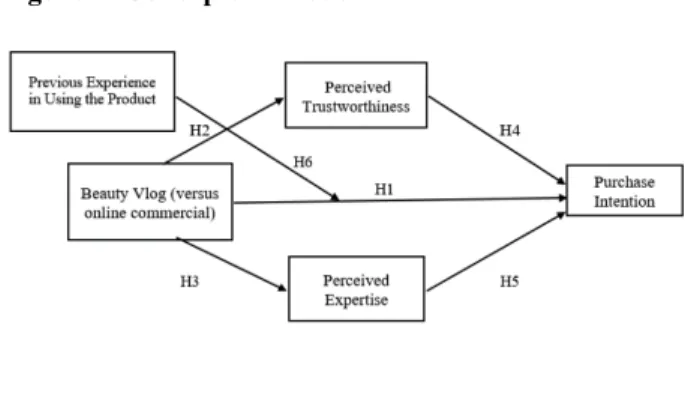
H1: Beauty vlogger has stronger influence than traditional celebrity on consumers’ purchase intention.
The Role of Perceived Credibility as a Possible Underlying Mechanism of the Influence of Vlog on Purchase Intention. Credibility refers to the positive characteristics of a communicator that can affect the acceptability of a message (Ohanian, 1990). Previous studies have found that perceived source credibility can increase the persuasive power of a message, which leads to the change of attitude (Ohanian, 1990; Wilson & Sherrel, 1993). Among the multiple dimensions of perceived credibility that have been proposed in various scholarly works, trustworthiness and expertise are the facets that most commonly appear(Ferle & Choi, 2005; Hautz et al., 2014; Ohanian, 1990; Pornpitakpan, 2003). Trustworthiness is the how much a source provides honest, fair, and sincere information (Ohanian, 1991),. When a source is perceived as trustworthy and knowledgeable, the message will be more effective in changing individuals’ attitudes than when the source is deemed less trustworthy (Ohanian, 1990; Pornpitakpan, 2003). In general, audience perceive digital celebrities, including vloggers, more credible than traditional celebrity (Bianchi, 2016; Djafarova & Rusworth, 2017), perhaps because they are considered more honest and transparent in delivering information (Wiley, 2014). Furthermore, consumers might be more likely to identify themselves with vloggers as fellow ordinary consumers than celebrities (Ansager et al., 2006). On the contrary, traditional celebrities, particularly those who receive product endorsements, tend to be perceived as less trustworthy because consumers assume that they gain benefit from the information they provide to the audience, usually through commercial messages (Bianchi, 2016).
Expertise refers to how much a communicator is capable of providing valid information (Pornpitakpan, 2003). An individual is considered an expert when the person is seen as having substantial experience and knowledge about a product (Luthie, 2004). The more an individual uses the product, the more likely the person learns about that product, which would enable him/her to be considered an expert (Hock & Deighton, 1989). Beauty vloggers usually feature or demonstrate their direct experience with the product. Therefore, one may argue that compared to celebrities who are recruited to be the official brand ambassadors or spokespersons, beauty vloggers would look more knowledgeable since they usually feature how they use the product through product reviews or tutorial videos. Notably, consumers tend to trust vloggers who are not sponsored
by corporations more strongly than vloggers who receive corporate sponsorship (Fred, 2015). Drawing from research on consumers’ perception of credibility, this study hypothesized that:
H2: Beauty vlogger will be perceived more trustworthy than traditional celebrity.
H3: Beauty vlogger will be perceived more knowledgeable than traditional celebrity.
Several studies suggest that consumer perceptions of trustworthiness and expertise of the source of information about a product influence their purchase intention. For instance, Ananda and Wandebori (2016) found that vloggers’ credibility positively predicted consumers’ positive attitude and purchase intention. Djafarova and Rusworth (2017) found that both digital (e.g., blogger and vlogger) and traditional (e.g., actors, musicians) celebrities have equal influence on consumers’ purchase intention; however, consumers tend to perceive the former as more credible than the latter. Thus, the researchers formulated the following hypotheses:
H4: Consumers’perception of vlogger’s trustworthiness mediates the influence of vlog on consumers’ purchase intention.
H5: Consumers’perception of vlogger’s expertise mediates the influence of vlog on consumers’ purchase intention.
The role of experience using the product as a moderator. A number of studies have examined the interaction between consumers’ previous experience in using the product and the source of information on consumer behavior (Schiffman & Wisenblit, 2015). Levin and Gaeth (1988) found that advertising was less influential among experienced consumers than among those with little or no experience with the product. On the contrary, other studies reported that individuals’ previous experience with products reinforced the persuasiveness of commercial messages, which in turn affected their intention to repurchase the product (Deighton & Schindler, 1988; Martinez et al., 2010; Petrick, 2002).
In this study, individuals’ previous experience in using the product was tested as a factor that may influence the effect of beauty vlog on consumers’ purchase intention. Product information that came from a beauty vlogger would have a stronger influence than the commercial message from a traditional celebrity on the intention to purchase among individuals who had had previously used the product. Therefore, this study also tested the following hypothesis:
H6: Consumers’ previous experience in using the product moderates the influence of beauty vlog on consumers’ intention to purchase: Vlog has stronger influence on the intention to purchase among experienced consumers.
The conceptual model that was tested in this study is illustrated in Figure 1.
Figure 1. Conceptual Model
2.
Methods
Research Participants. Participants in the study were convenience sample, recruited by distributing announcement at student organizations’ social media and text message (WhatsApp) groups. A total of 98 women, aged 18-34, and had experience using the YouTube (accessing YouTube videos). Women in that age bracket was selected because they make up the majority of consumers who seek information about beauty products on social media as well as beauty vlogs on YouTube (Pixability, 2015; Sutanto & Apriningsih, 2015) This age group is also targeted by the cosmetics industry to market their products (Nielsen, 2014). Participants were recruited through the researchers’ social network and the social media of Universitas Indonesia student organizations. All participants in this study were women aged in the 18-34 year (M = 21.61, SD = 2.80). The majority of the participants were college students (84.7%).
Research Approach and Design. This study is a pilot study of a larger research project on the influence of digital media content on consumer behavior. The experiment was conducted at a computer lab at Universitas Indonesia in May 2017. Prior to the data collection, the research protocol of this study was approved by the faculty-level institutional Human Subject Research Review board. Written active informed consent was obtained prior to the start of the experiment.
This study employed two-group between-subject pretest-posttest experimental design. The focal product in this study is Wardah matte lip cream (liquid lipstick). Wardah
Lip cream was used as a featured beauty product, since videos about makeup, including lipsticks, comprise more than half of all vlogs on YouTube (Pixability, 2015). The
brand Wardah was chosen since it was the most popular Indonesian cosmetic brand in 2016 (Asia Personal Care & Cosmetics Market Guide, 2016). Furthermore, the makeup products with lip cream type (lipstick) is a makeup items are most popular among Indonesian young women (Republika, 2016). Additionally, both vlog and online commercials Wardah matte lip cream were available on YouTube, whereas some other popular Indonesian brands did not have official online advertising on YouTube.
Participants were randomly assigned to one of two groups. Participants in the first group watched a beauty vlog review of a lip cream (liquid lipstick) product. The length of the clip was 5 minutes and 24 seconds. The beauty vlogger in the clip was Andra Alodita, one of the most popular Indonesian vloggers. This vlog is publicly available on Andra Alodita’s YouTube channel (https://www.youtube.com/watch?v=TR03CWr-zHQ). Participants in the second group watched a 46-second clip of an online advertising video featuring two Indonesian celebrities Dewi Sandra and Raline Shah, who are the current brand ambassadors of Wardah. The online commercial clip is publicly accessible on the official
Wardah’s YouTube channel (https://www.youtube.com /watch?v=kp1AAQ9v5rI).
At the beginning of the experiment the participants were asked to fill out the pretest. Upon completing the pretest, participants watched a YouTube clip (beauty vlog or online commercial of Wardah) according to the group in which they were randomly assigned. After watching the clip, participants filled out a posttest. Subsequently, the researcher conducted a manipulation check by asking the participant if they knew if the speaker or cast in the clip was a vlogger or a celebrity. Only one participant mistaken the vlogger as a celebrity. The remaining participants who were exposed to the beauty vlogger knew that the vlogger was not a celebrity, even though only 11 individuals specifically recognized the vlogger by her name (Andra Alodita). Similarly, the participants in the online advertising condition were also able to recognize that the casts in the video were celebrities. Lastly, the researcher debriefed the participants by informing them the true purpose of the study. Upon the completion of the study, all participants received a small token of cell phone prepaid credits to appreciate their participation in this study.
Measures. Purchase Intention. Purchase intention was measured using a 6-item scale which was adapted from the indices developed by Taylor & Baker (1994) and Putrevu & Lord (1994), respectively. An example of the item was "I would consider buying this product". Participants responses were measured using 6 points Likert scale (1 = strongly disagree up to 6 = strongly agree). Higher the score indicated stronger
purchase intention. Reliability analysis revealed a Cronbach’s Alpha coefficient of .95.
Perceived Trustworthiness. Perceived trustworthiness was measured using a scale adopted from Ohanian (1990). The scale consisted of 5 items with 6-point semantic scale. Examples of items is “the speaker/cast in the clip was dependable” (“1” = not dependable, “6” = dependable). Psychometric assessment showed a reliability Cronbach’s Alpha coefficient of .90.
Perceived Expertise. Similar to perceived trustworthiness, Perceived expertise was measured using a scale adopted from Ohanian (1990) which consisted of 5 items with 6 point semantic scale as participants’ response categories. An example of the items in the scale is “the speaker/cast in the clip was an expert (“1” = not an expert, “6” = an expert). This scale has a Cronbach’s Alpha coefficient of .94.
Previous Experience in Using the Product. The moderating variables in this study is individuals’ previous experience in using the product, which was measured by asking the participants whether she had ever owned
Wardah matte lip cream. Participants’ responses were coded into two categories: “1” corresponded to those who had had experience in using the product, and “0” for those who had never used the lip cream. Of 98 participants, 30 individuals or 30.61% had previous experience with Wardah lip cream, while the remaining 68 individuals or 69.39% had never used the product.
Data analysis technique. Hypotheses were tested using Model 5 of PROCESS version 2.16 for IBM SPSS with 5000 bootstraps (Hayes, 2013). The scores that were used in the data analysis was the gain score, which is the difference between the posttest and pretest scores for the mediating, moderating, and outcome variables in the model. For example, the score for purchase intention was calculated by subtracting the pretest score from the posttest score for each participant.
3.
Results
Data analysis showed no direct influence of beauty vlog on consumers’ purchase intention (H1) (b = -.14, SE = .71, p = .84). This suggests that the influence of video sources is not significantly predicting consumers’ purchase intentions. Similarly, consumer perceptions of trustworthiness and expertise also did not affect purchase intention (H2: b = .12, SE = .08, p = .14, H3: b = .04, SE = .08, p = .60). This suggests that beauty vlog did not influence consumers’ purchase intention, nor did it affect consumers’ perceptions of source credibility and expertise. Therefore, H1, H2, and H3 were not supported.
Table 1 shows that the consumers' perception of expertise and trustworthiness of source are not significantly mediated the relationship between source of information (beauty vloggers and traditional celebrities) and consumers’ purchase intentions. This suggests that consumers' perceptions on expertise and trustworthiness do not affect the relationship of information sources and consumer’ purchase intention. So it can be concluded that hypothesis 4 and hypothesis 5 were also not supported.
Table 2 showed that the source of information (beauty vloggers and traditional celebrities), trustworthiness and expertise does not significantly affect the purchase intention. However, consumers’ previous experience in using the product significantly predicted lesser purchase intention among consumers. Specifically, participants who had used Wardah lip cream reported lower intention to purchase compared to those who had never tried the product before the experiment. Consumers’ previous experience was also found to moderate the relationship between exposure to beauty vlog and
intention to purchase. Further examination of the interaction suggests that compared to online commercials, beauty vlog was more effective in increasing the intention to purchase among individuals who had used the product prior to the experiment. In contrast, no difference on the intention to purchase was found those who had never tried the product regardless of whether they saw beauty vlog or online advertising. Therefore, H6 is supported (b = .2.76, SE = 1.29, p = .03). Further probing suggests that consumers who saw the beauty vlog reported stronger purchase intention than those who saw the online advertising if they had had previous experience with the product (b = .2.61, SE = 1.07, p = .01). In contrast, no difference on purchase intention between seeing vlog and online advertising was found among individuals who had never tried the lip cream (b = -.14, SE = .71, p = .83). The interaction between consumers’ previous experience in using the product and their intention to purchase is illustrated in Table 3 and Figure 3.
Table 1. Indirect Effect of Sources (beauty vloggers and traditional celebrities) on Consumers’ Purchase Intention through Perceived Source Credibility
Mediator Effect size Boot SE Boot LLCI Boot ULCI
Total indirect effect -.0096 .1933 -.4387 .3487
Perceived expertise -.0081 .0965 -.2826 .1385
Perceived
trustworthiness -.0014 .1604 -.3741 .3327
Table 2. Effect of Source, Expertise and Trustworthiness, and Experience of Using the Product On consumers’ purchase intentions
Variables b se t p LLCI ULCI
Constant 2.05 .52 3.90 00 1.00 3.09 Perceived Expertise .04 .08 .51 .60 -.13 .22 Perceived Trustworthiness .12 .08 1.47 .14 -.04 .29 Vlog -.14 .71 -.20 .83 -1.56 1.27 Experience -3.11 .89 -3.47 .00 -4.98 -1.33 Interaction 2.76 1.29 2.13 .03 .19 5.33
Table 3. Conditional Direct Effect on Source of Information (beauty vloggers and traditional celebrities) on Purchase Intention Moderated by the Experience of Using the Product
Conditional direct effect (s) of X on Y at value of the moderator (s):
Users Effect se t p LLCI ULCI
Non-users -.14 .71 -.20 .83 -1.56 1.27
Figure 2. Results
Figure 3.Conditional Direct Effect of the Source of Information (beauty vloggers and traditional Celebrities) through Perceived Source Credibility as a Mediation and Experience Using the Product as a Moderation.
4.
Discussion
This study showed no significant effect of beauty vlog on consumers’ intention to purchase. In other words, beauty vlog was not more effective than online commercials in increasing consumers’ intention to purchase. This results is inconsistent with Djafarova dan Rushworth (2017) which suggests that information from
traditional celebrities dan beauty vlog (digital celebrities) equally influences consumers’ purchasing intention, where information from beauty vlog (digital celebrities) more powerful than traditional celebrities. Moreover, participants also did not perceive beauty vlogger as more trustworthy or expert than the official brand ambassadors, which is inconsistent with existing literature on consumers’ perception and attitudes
towards “digital celebrities” (e.g., well-known vloggers or bloggers) (Bianchi, 2016; Djafarova & Rushworth, 2017; Fred, 2015; Wiley, 2014).
A plausible explanation of this result is that participants might still see brand ambassadors, who were carefully selected by the marketer as a credible source of information. Pornpitakpan (2004) argued that consumers in countries with collectivistic cultural orientation are more likely than those who live in the countries with more individualistic cultural orientation to perceive traditional celebrities as a more reliable source of information. Furthermore, participants in this study might also rely more on information from friends and family members. In their response to the researchers’ question on their makeup consumption habit "from whom you usually get information related to cosmetic products" participants included family and friends in their answer. According to Schiffman and Wisenblit (2015) family is still consumers’ strongest reference group from whom consumers obtain product knowledge or vicarious experience. Secondly, the result might also relate to participants’ familiarity with the vloggers. Of 50 participants who was exposed to beauty vlog, only 11 participant were familiar with the vlogger Andra Alodita, which might have contributed to participants’ perception of the vlogger’s trustworthiness and expertise. Future research should consider participants’ familiarity with beauty vloggers in designing the study.
The results also showed that consumers’ perception of vlogger’s trustworthiness and expertise did not significantly mediate the relationship between the source of information and consumers; purchase intention. This result is inconsistent with previous research from who found that audience perceptions about trustworthiness and expertise mediated the relationship between information source and behavioral intentions (Hautz et al., 2014; Ohanian, 1990; Pornpitakpan, 2004). This insignificant result are also likely to be caused by factors consumers’ perceptions of the quality of Wardah lip cream. The result showed that those who had used Wardah lip cream expressed lesser intention to purchase, which indicates that consumers’ perception of the product quality might contribute in affecting the influence information source (beauty vlog) on purchase intention (Chang & Wildt,1994 ).
However, consumers’ experience in using the product was found to moderate the influence of beauty vlog on consumers’ intention to purchase. Specifically, consumers who have used the product expressed stronger intention to purchase when they were exposed to beauty vlog than when they saw online advertising. This difference did not appear among consumers who had never used Wardah lip cream: no difference in consumers’ purchase intentions among these individuals
regardless of whether they were exposed to beauty vlog or online commercials. This implies that the beauty vlog might play role in increasing repeat purchase intention among consumers who had used the product. This result was consistent with Deighton & Schindler (1988), who found an interaction between source of information (advertisement/review) and previous individual experience related to the product can lead to persuasion, which may affect consumer purchase intentions (see also Martinez et al., 2010; Petrick, 2002). Therefore, it can be concluded that the product reviews by beauty vloggers are important in increasing consumer purchasing intentions among those who had previous experience with the product. Additionally, one might also speculate that beauty vlog might serve as an instrument to “repair” consumers’ disappointment in the product quality.
In the context of Indonesian local cosmetic industry, the results of this study suggest that the local cosmetic marketers can utilize both online advertising and vlogs for different purposes. Both online advertising and vlog can be equally effective for recruiting new consumers. However, vlogs might be more useful for retaining experienced consumers, especially those who did not have a positive experience with the product. In other words, vlogs are useful in persuading the unsatisfied consumers to give the product another chance by repurchasing it.
5.
Conclusion
The results showed that there was no significant effect of beauty vlog on consumers’ purchase intention. This indicates that the influence of vlogger might not exceed it is of traditional celebrities on consumer purchase intentions. Furthermore, consumer perceptions of trust and expertise of resources does not mediate the effect of beauty vlog on consumers' purchase intentions. This shows that consumers 'perceptions of the trustworthy and expertise of information sources do not play a role in influencing consumers' purchasing intentions. Consumers’ previous experience in using the product on the relationship moderated the relationship between exposure to beauty vlog and consumers’ purchase intentions: vlog was found to be more effective in increasing purchase intention for individuals who have previous or existing experience with the product.
References
Ananda, A. F., & Wandebori, H. (2016, September). The Impact Of Drugstore Makeup Product Reviews By Beauty Vlogger On Youtube Towards Purchase Intention By Undergraduate Students In Indonesia. In International Conference on Ethics of Business, Economics, and Social Science (pp. 255-263). Faculty of Economics YSU.
Andsager, J.L., Bemker, V., Choi, H.-L. & Torwel, V. (2006) Perceived similarity of exemplar traits and behavior. Communication Research, 33(1), pp. 3–18. Asosiasi Penyelenggara Internet Indonesia (2016) Infografis Penetrasi dan Perilaku Pengguna Internet Indonesia. Apjii.or.id. Accessed on 01/02/17 from http://apjii.or.id/survei.
Bianchi, Sophie (2016) Why Bloggers are more influential than celebrities in the beauty Industry.
Buzzstream.com. Accessed on April, 19, 2017 from http://www.buzzstream.com/blog/why-bloggers-are- more-influential-than-celebrities-in-the-beauty-industry.html.
Bickart, B., & Schindler, R. M. (2001). Internet forums as influential sources of consumer information. Journal of interactive marketing, 15(3), 31-40
Camahort, E. (2016). The 2011 Social Media Matters Study: Everyone is an early adopter are you? [Blog]
blogger.com. Accessed on February, 13, 2017 from: http://www.blogher.com/2011-social-media-matter-study-everyone-early-adopterare-you?from¼bhspinner. Chahal, M. (2016). Four trends that will shape media in 2016. [online] Marketing Week. Accessed on April, 20, 2017 from http://www.marketingweek.com/2016/01/08 /fourtrends- that-will-shape-media-in-2016.
Chang, T. Z., & Wildt, A. R. (1994). Price, product information, and purchase intention: An empirical study. Journal of the Academy of Marketing science, 22(1), 16-27.
Campo-Martínez, S., Garau-Vadell, J. B., & Martínez-Ruiz, M. P. (2010). Factors influencing repeat visits to a destination: The influence of group composition.
Tourism Management, 31(6), 862-870.
Detik.com (2016). Ini Konten Vlog dan Video YouTube yang Populer di Indonesia. Wolipop.detik.com.
https://wolipop.detik.com/read/2016/05/13/170521/3209 992/1133/ini-konten-vlog-dan-video-youtube-yang-populer-di-indonesia-2016
Deighton, J., & Schindler, R. M. (1988). Can advertising influence experience?.Psychology & Marketing, 5(2), 103-115.
Djafarova, E., & Rushworth, C. (2017). Exploring the credibility of online celebrities' Instagram profiles in influencing the purchase decisions of young female users. Computers in Human Behavior, 68, 1-7
Fred, S. (2015). Examining Endorsement and Viewership Effects on the Source Credibility of
YouTubers. Master’s Thesis, University of South Florida, USA.
Gerstle, Tracy (2016) Asia Personal Care & Cosmetics Market Guide 2016. Accessed on February, 13, 2017 from http://www.trade.gov/industry/materials. Master’s Thesis, Program Pascasarjana University of South Florida
Goh, K. Y., Heng, C. S., & Lin, Z. (2013). Social media brand community and consumer behavior: Quantifying the relative impact of user-and marketer-generated content. Information Systems Research, 24(1), 88-107. Hautz, J., Füller, J., Hutter, K., & Thürridl, C. (2014). Let users generate your video ads? The impact of video source and quality on consumers' perceptions and intended behaviors. Journal of Interactive Marketing,
28(1), 1-15.
Hayes, A. F. (2013). Introduction to mediation, moderation, and conditional process analysis: A regression-based approach. Guilford Press.
Horai, J., Naccari, N., & Fatoullah, E. (1974). The effects of expertise and physical attractiveness upon opinion agreement and liking. Sociometry, 601-606. Hoch, S. J., Deighton, J. 1989. Managing what consumer learn from experience. Journal of Marketing, 53, 1-20.
Hsu, C. L., Chuan-Chuan Lin, J., & Chiang, H. S. (2013). The effects of blogger recommendations on customers’ online shopping intentions. Internet Research, 23(1), 69-88.
Jiménez, F. R., & Mendoza, N. A. (2013). Too popular to ignore: The influence of online reviews on purchase intentions of search and experience products. Journal of Interactive Marketing, 27(3), 226-235.
Kelman, H.C. (1961) Processes of opinion change.
Public Opinion Quarterly, 25,pp. 57–78.
Kemenperin.go.id. (2013) Industri kosmetik diprediksi tumbuh 15 %. Kemenperin.go.id. Accessed on
February, 12, 2017 from
kemenperin.go.id/artikel/7279/Industri-Kosmetik-Diprediksi-Tumbuh-15.
Kemenperin.go.id (2016) Industri Kosmetik Lokal Kesal Selalu Dianaktirikan. Kemenperin.go.id. Accsessed on July, 24, 2017 from
http://www.kemenperin.go.id/artikel/14329 /Industri - Kosmetik-Lokal-Kesal-Selalu-Dianaktirikan.
La Ferle, C., & Choi, S. M. (2005). The importance of perceived endorser credibility in South Korean advertising. Journal of current issues & research in advertising, 27(2), 67-81.
Levin, I. P., & Gaeth, G. J. (1988). How consumers are affected by the framing of attribute information before and after consuming the product. Journal of consumer research, 15(3), 374-378.
Luthje, Christian (2004), “Characteristics of Innovating Users in a Consumer Goods Field: An Empirical Study of Sport-Related Product Consumers, Technovation, 24, 9, 683–95.
Lu, L. C., Chang, W. P., & Chang, H. H. (2014). Consumer attitudes toward blogger’s sponsored recommendations and purchase intention: The effect of sponsorship type, product type, and brand awareness.
Computers in Human Behavior, 34, 258-266
Mangold, W. G., & Faulds, D. J. (2009). Social media: The new hybrid element of the promotion mix. Business horizons, 52(4), 357-365.
McCracken, Grant (1989), “Who Is the Celebrity Endorser? Cultural Foundations of the Endorsement Process,” Journal of Consumer Research, 16, 310–21 Nielsen (2014) Global e-commerce report. Neilsen.com. Accessed on February, 10, 2017 from www.nielsen.com /us/en/insight/reports/2014/e-commerce-evolution-or- reevolution-inthe-fast-moving-consumer-goods-word.html.
Park, D. H., Lee, J., & Han, I. (2007). The effect of on-line consumer reviews on consumer purchasing intention: The moderating role of involvement.
International journal of electronic commerce, 11(4), 125-148.
O'Connor, F. (2016). 'Millenials & Youtube': An investigation into the influence of user-generated video content on the consumer decision making process. Doctoral dissertation. Dublin, National College of Ireland.
Ohanian, R. (1990). Construction and validation of a scale to measure celebrity endorsers' perceived expertise, trustworthiness, and attractiveness. Journal of advertising, 19(3), 39-52.
Ohanian, R. (1991). The impact of celebrity spokespersons' perceived image on consumers' intention to purchase. Journal of advertising Research
Petrick, J. F. (2002). Experience use history as a segmentation tool to examine golf travellers'
satisfaction, perceived value and repurchase intentions. Journal of Vacation Marketing, 8(4), 332-342.
Pixability (2014). How YouTube is Radically Transforming the Beauty Industry and What That Meansfor Brands. Pixability.com. Accessed on April, 27, 2017 from http://www.pixability.com.
Pixability (2015) Beauty on YouTube: How YouTube is Radically Transforming the Beauty Industry and What That Means for Brands. Pixability.com. Accessed on February, 10, 2017 from http://www.pixability.com. Pornpitakpan, C. (2003). Validation of the celebrity endorsers’ credibility scale: Evidence from Asians.
Journal of Marketing Management, 19(1-2), 179-195. Pornpitakpan, C. (2004). The persuasiveness of source credibility: A critical review of five decades' evidence.
Journal of Applied Social Psychology, 34(2), 243-281. Putrevu, S., & Lord, K. R. (1994). Comparative and noncomparative advertising: Attitudinal effects under cognitive and affective involvement conditions. Journal of Advertising, 23(2), 77-91.
Schiffman, L., Kanuk, L., & Hansen, H. (2012).
Consumer Behaviour: A European Outlook, International Edition.
Sutanto, M. A., & Aprianingsih, A. (2016, September). The Effect Of Online Consumer Review Toward Purchase Intention: A Study in Premium Cosmetic in Indonesia. In International Conference on Ethics of Business, Economics, and Social Science (pp. 218-230). Faculty of Economics Universitas Negeri Yogyakarta. Republika.co.id. (2016) Pasar kosmetik di Indonesia sangat menjanjikan. Republika.co.id. Accessed on February, 08, 2017 from https://www.google.com/amp /m.republika.co.id/amp_version/mtmbg0
Stevens, J. A., Lathrop, A. H., & Bradish, C. L. (2003). "Who is Your Hero?" Implications for Athlete Endorsement Strategies. Sport Marketing Quarterly, 12(2).
Taylor, S. A., & Baker, T. L. (1994). An assessment of the relationship between service quality and customer satisfaction in the formation of consumers' purchase intentions. Journal of retailing, 70(2), 163-178.
Wang, X., Yu, C., & Wei, Y. (2012). Social media peer communication and impacts on purchase intentions: A consumer socialization framework. Journal of Interactive Marketing, 26(4), 198-208.
Widhiarso, W. (2010). Pengembangan Skala Psikologi: Lima Kategori Respons ataukah Empat Kategori Respons. Fakultas Psikologi UGMse. Yogyakarta. Wiley, D. (2014). Why brands should turn to bloggers instead of celebrity spokespeople.
Wilson, E. J., & Sherrell, D. L. (1993). Source effects in communication and persuasion research: A meta-analysis of effect size. Journal of the academy of marketing science, 21(2), 101-112.