Shared Services
Feasibility Study:
Dispatch, Records, Prisoner Processing
Neptune Township, Belmar,
Neptune City, Bradley Beach,
Avon-by-the-Sea and Lake Como
Prepared by:
I
NTERTECH
A
SSOCIATES
7 7 - 5 5 S c h a n c k R o a d , S u i t e A - 1 4 , F r e e h o l d , N J 0 7 7 2 8 7 3 2 . 4 3 1 . 4 2 3 6 w w w . i n t e r t e c h a s s o c i a t e s . c o mApril 12, 2010
INTERTECH ASSOCIATES,INC. TECHNOLOGY &SECURITY CONSULTANTS AND ENGINEERS
Table of Contents
EXECUTIVE SUMMARY... 1
VOLUME I: CURRENT SITUATION ... 11
I. Introduction: Background and Project Objectives... 12
II. Methodology and Procedural Approach ... 13
III. History of Public Safety Shared Services ... 15
A. New Jersey Public Safety Shared Services ...15
1. 2006 Initiatives ... 15
2. 2007 Initiatives ... 16
3. 2008 Initiatives ... 16
4. Impact of Public Safety Initiatives and Standards ... 16
B. Local Public Safety Shared Services...17
1. Avon-by-the-Sea and Neptune City Studies ... 17
2. Belmar, Bradley Beach, Lake Como Studies ... 17
3. Other Local Studies / Efforts ... 18
IV. Existing Public Safety Communications / Current Environment... 19
A. Neptune Township ...20
1. The Neptune Township Community... 20
1.1 Demographics and Environment ... 20
1.2 Police, Fire, First Aid ... 21
2. Neptune Twp. Public Safety Communications Operations... 21
2.1 Dispatch Center Facilities and Configuration ... 22
2.2 Dispatcher Tasks... 23
2.3 Staffing and Work Schedule Analysis... 25
2.4 Call Volume Summary... 26
2.5 Prisoner Handling Operations ... 29
2.6 Records Management Operations... 30
2.7 Observations and Findings: Operations ... 31
3. Neptune Township Communications Center Technology... 31
3.1 Radio System and Frequencies ... 31
3.2 Radio Control System/Dispatch Consoles... 32
3.3 CAD/RMS and Mapping Systems ... 33
3.4 E-911 Communications System ... 33
3.5 Administrative Communications System ... 33
3.6 Video Surveillance and Other Related Technologies ... 33
3.7 Back-Up Center ... 34
B. Belmar ...36
1. The Belmar Community... 36
1.1 Demographics and Environment ... 36
1.2 Police, Fire, First Aid ... 36
2. Belmar Public Safety Communications Operations... 37
2.1 Dispatch Center Facilities and Configuration ... 38
2.2 Dispatcher Tasks... 38
2.3 Staffing and Work Schedule Analysis... 39
2.4 Call Volume Summary... 40
2.5 Prisoner Handling Operations ... 45
2.6 Records Management Operations... 46
3. Belmar Communications Center Technology... 46
3.1 Radio System and Frequencies ... 46
3.2 Radio Control System/Dispatch Consoles... 47
3.3 CAD/RMS and Mapping Systems ... 48
3.4 E-911 Communications System ... 48
3.5 Administrative Communications System ... 49
3.6 Video Surveillance and Other Related Technologies ... 49
4. Belmar Communications Center Cost Profile... 49
C. Neptune City ...51
1. The Neptune City Community... 51
1.1 Demographics and Environment ... 51
1.2 Police, Fire, First Aid ... 51
2. Neptune City Dispatch Operations... 51
2.1 Dispatch Center Facilities and Configuration ... 52
2.2 Dispatcher Tasks... 52
2.3 Staffing and Work Schedule Analysis... 53
2.4 Call Volume Summary... 54
2.5 Prisoner Handling Operations ... 58
2.6 Records Management Operations... 59
2.7 Observations and Findings: Operations ... 59
3. Neptune City Dispatch Technology... 59
3.1 Radio System and Frequencies ... 59
3.2 Radio Control System/Dispatch Consoles... 60
3.3 CAD/RMS and Mapping Systems ... 60
3.4 Administrative Communications System ... 60
3.5 Video Surveillance and Other Related Technologies ... 60
INTERTECH ASSOCIATES,INC. TECHNOLOGY &SECURITY CONSULTANTS AND ENGINEERS
D. Bradley Beach ...62
1. The Bradley Beach Community... 62
1.1 Demographics and Environment ... 62
1.2 Police, Fire, First Aid ... 63
2. Bradley Beach Dispatch Operations... 63
2.1 Dispatch Center Facilities and Configuration ... 64
2.2 Dispatcher Tasks... 64
2.3 Staffing and Work Schedule Analysis... 65
2.4 Call Volume Summary... 66
2.5 Prisoner Handling Operations ... 69
2.6 Records Management Operations... 70
2.7 Observations and Findings: Operations ... 71
3. Bradley Beach Dispatch Technology... 71
3.1 Radio System and Frequencies ... 71
3.2 Radio Control System/Dispatch Consoles... 71
3.3 CAD/RMS and Mapping Systems ... 71
3.4 Administrative Communications System ... 72
3.5 Video Surveillance and Other Related Technologies ... 72
4. Bradley Beach Dispatch Cost Profile... 72
E. Avon-by-the-Sea ...74
1. The Avon-by-the-Sea Community... 74
1.1 Demographics and Environment ... 74
1.2 Police, Fire, First Aid ... 74
2. Avon-by-the-Sea Dispatch Operations... 74
2.1 Dispatch Center Facilities and Configuration ... 75
2.2 Dispatcher Tasks... 75
2.3 Staffing and Work Schedule Analysis... 77
2.4 Call Volume Summary... 77
2.5 Prisoner Handling Operations ... 80
2.6 Records Management Operations... 80
3. Avon-by-the-Sea Dispatch Technology... 80
3.1 Radio System and Frequencies ... 80
3.2 Radio Control System/Dispatch Consoles... 81
3.3 CAD/RMS and Mapping Systems ... 81
3.4 Administrative Communications System ... 81
F. Lake Como ...83
1. The Lake Como Community... 83
1.1 Demographics and Environment ... 83
1.2 Police, Fire, First Aid ... 84
2. Lake Como Public Safety Communications... 84
2.1 Staffing and Work Schedule Analysis... 85
2.2 Call Volume Summary... 85
2.3 Prisoner Handling Operations ... 85
2.4 Records Management Operations... 85
3. Lake Como Public Safety Technology... 85
4. Lake Como Public Safety Communications Cost Profile... 86
G. Summary of All Six Communities ...87
1. Comparison of Demographic Data ... 87
2. Comparison of Call Volume Data and Assumptions... 88
INTERTECH ASSOCIATES,INC. TECHNOLOGY &SECURITY CONSULTANTS AND ENGINEERS
VOLUME II: SHARED SERVICES ANALYSES & RECOMMENDATION 90
V. Shared Services Scenarios and Analysis ... 91
A. Types of Shared Service Models ...91
B Dispatch Shared Services Alternatives Evaluated ...91
1. CONTINUE EXISTING OPERATIONS ...92
1.1. Description of Scenario 1: Continue Existing Operations... 92
1.2 Advantages of Existing Dispatch Operations ... 92
1.3 Challenges of Existing Dispatch Operations ... 92
1.4 Call Volumes in Scenario 1: Existing Operations ... 93
1.5 Staffing Analysis in Scenario 1: Existing Operations... 93
1.6 Technology Requirements in Scenario 1: Existing Operations ... 93
1.7 Projected Costs (2010 Budget) of Existing Dispatch Operations ... 93
2. CENTRALIZED CENTER AT NEPTUNE TOWNSHIP ...95
2.1. Description of Scenario 2: Centralized Center at Neptune Township ... 95
2.2 Advantages of Centralized Center at Neptune Township ... 95
2.3 Challenges of Centralized Center at Neptune Township ... 96
2.4 Call Volume Projections: Centralized Center at Neptune Township ... 100
2.5 Staffing Analysis: Centralized Center at Neptune Township... 102
2.6 Technology Requirements: Centralized Center at Neptune Township ... 103
Radio System and Frequencies ... 104
Radio Control System/Dispatch Consoles... 105
Tower-to-Tower Backhaul ... 105
CAD/Records Management and Mapping Systems ... 108
Administrative Telephone ... 108
Other Technologies ... 109
2.7 Prisoner Holding/Processing with Centralized Dispatch at Neptune Twp. ... 109
2.8 Projected Costs of One Dispatch Center at Neptune Township ... 110
3. TWO CENTERS: BELMAR AND NEPTUNE TOWNSHIP ... 116
3.1. Description of Scenario 3: Two Dispatch Centers, Belmar and Neptune... 116
3.2 Advantages of Two Dispatch Centers ... 116
3.3 Challenges of Two Dispatch Centers ... 117
3.4 Call Volume Projections for Two Dispatch Centers ... 117
3.5 Staffing Analysis for Two Dispatch Centers ... 118
3.6 Technology Requirements for Two Dispatch Centers... 120
3.7 Prisoner Processing/Holding with Two Dispatch Centers ... 120
4. MONMOUTH COUNTY REGIONAL SERVICE ... 122
4.1. Description of Scenario: Monmouth County Regional Dispatch... 122
4.2 Advantages of Monmouth County Regional Dispatch... 123
4.3 Challenges of Monmouth County Regional Dispatch... 123
4.4 Call Volume Projections for Monmouth County Regional Dispatch ... 124
4.5 Staffing Analysis with Monmouth County Regional Dispatch... 125
4.6 Future Technology Plans of Monmouth County Regional Dispatch... 125
4.7 Prisoner Processing/Holding with Monmouth County Regional Dispatch ... 126
4.8 Project Costs of Monmouth County Regional Dispatch ... 126
VI. Recommendation: Centralized Dispatch at Neptune Township .. 128
VII. Implementation Planning... 130
1.1. Leadership Team for Multi-Community Dispatch Shared Services... 131
1.2 Governance Structure of Consolidated Communications Center... 131
1.3 Operational Planning Team (Working Level Committee) ... 132
1.4 Staffing and Training ... 133
1.5 Additional Considerations ... 133
1.6 Schedule and Commitment to Success ... 134
1.7 Proposed Cost Sharing ... 135
VIII. Appendices ... 138
A. PSAP/PSDP Center Job Descriptions ... 139
B. Additional Scenarios Considered ... 141
C. Breakdown of 2008 CFS Data (from CAD Systems) ... 143
D. Summary of UCR Crime Statistics/Arrests by Community ... 152
E. Radio Call Log Data: Neptune Township, Belmar, Bradley... 153
F. Radio Call Log – Comparison Charts: Dispatch vs. Administrative ... 162
G. Technology Diagram of Centralized Center Operations ... 168
INTERTECH ASSOCIATES,INC. TECHNOLOGY &SECURITY CONSULTANTS AND ENGINEERS
EXECUTIVE SUMMARY
Executive Summary
This report contains a detailed analysis of the feasibility of sharing public safety 911 call taking and dispatching services among six Monmouth County communities along or near the New Jersey coast: Neptune Township, Belmar, Neptune City, Bradley Beach, Avon-by-the-Sea, and Lake Como. This report is organized into three primary sections:
Volume I: Assessment of existing Dispatch Centers’ configurations, communications operations and supporting technology in each community.
Volume II: Analysis of shared service scenarios and recommendations/conclusions on the feasibility of consolidation of public safety communications among the six communities.
Appendices: Supporting data used in the assessment and development of recommendations. Based on this analysis, the consultant sees opportunities for these six communities to come together in consolidation/shared dispatch services combined with an equitable governance model that can provide a positive impact on 911 call answering and dispatch operations in each community.
A. Project Objectives
These six communities retained the services of Intertech Associates, an independent Professional Engineering firm, to define, explore and research alternative solutions for shared dispatch
communications services among the six communities. The scope of the study was to determine if
consolidation of dispatch services is feasible and in the best interest of the six communities’ citizens and, if so, to recommend the functional and operational changes necessary to achieve such a consolidation. At the outset of this assessment, it is critical for stakeholders to acknowledge that the process of shared services design, implementation, and operations requires desire, discipline, and the ability to execute to a plan. A shared services environment is more than the effort of simply moving people together into one location and giving them a common system. It involves a change of mindset: a focus on the core services required by each community, a focus on the service level anticipated from the shared service as a
reflection of the communities, and the achievement of functional, business, and financial objectives. We have researched public sector shared services models that have been successfully implemented in other communities to examine correlations between organizational structures and differences in size, scope, call volume, and staffing. These models reveal that the success of shared services among any given communities relies on several factors:
Cooperation of the participating parties
Clear and practical vision of what is achievable immediately and what needs to be part of a longer-term strategy
Willingness for compromise to achieve a shared service solution that improves services over what could be accomplished individually.
Intertech Associates does not have a vested interest in any of these communities. Our objective was to review the facts and, from an analytical and technological approach, determine whether or not
consolidation of dispatch communications would be feasible and beneficial. If it proved to be so, we were further tasked to show how a consolidated communications center could work and outline a process for
INTERTECH ASSOCIATES,INC. TECHNOLOGY &SECURITY CONSULTANTS AND ENGINEERS
B. Project Methodology
This report was prepared following an in-depth, six-month study of the issues relative to the possible sharing of 911 call-answering and dispatch services, as well as related issues pertaining to records management and prisoner holding. This analysis was conducted using a combination of interviews, site visits, and research, including reviewing documents, reports, dispatch call log surveys, CAD reports, contracts, budgets, financial records, organization charts, schedules, policies and procedures, and other items necessary to this assessment. Interviews were conducted separately with the Police Chief (or designated representative) and identified police staff from each community, with the business
administrator and an elected official from each community, and with Monmouth County Under Sheriff Shaun Golden and other consultants supporting shared services efforts across Monmouth County. In the process of gathering and analyzing this data, a great degree of diligence was performed to verify each fact and assumption made during the study. Any data, estimates, or assumptions that may be some degree off actual practice will, in the consultant’s professional opinion, not impact the ultimate direction, conclusions, and recommendations presented in this report.
C. Master Analysis of Existing 911 and Dispatch Environments
Volume I of this report includes details and analysis of each of the six communities in the study – Neptune Township, Belmar, Neptune City, Bradley Beach, Avon-by-the-Sea, and Lake Como – and summarizes the data shared during interviews and from reports provided by each community. The following aspects of the 911 and dispatch environment are addressed for each community:
1. The Community
Demographics and environment Police, Fire, and First Aid services 2. Public Safety Communications Operations
Dispatch center facility and configuration Dispatcher tasks
Staffing and work schedule analysis Call volume summary
Prisoner handling operations (as performed by dispatchers) Records management operations
3. Communications Center Technology Radio system and frequencies
Radio control system / dispatch consoles CAD/RMS and mapping systems
E-911 communications system
Administrative communications system Video surveillance and other technologies 4. Communications Center Cost Profile
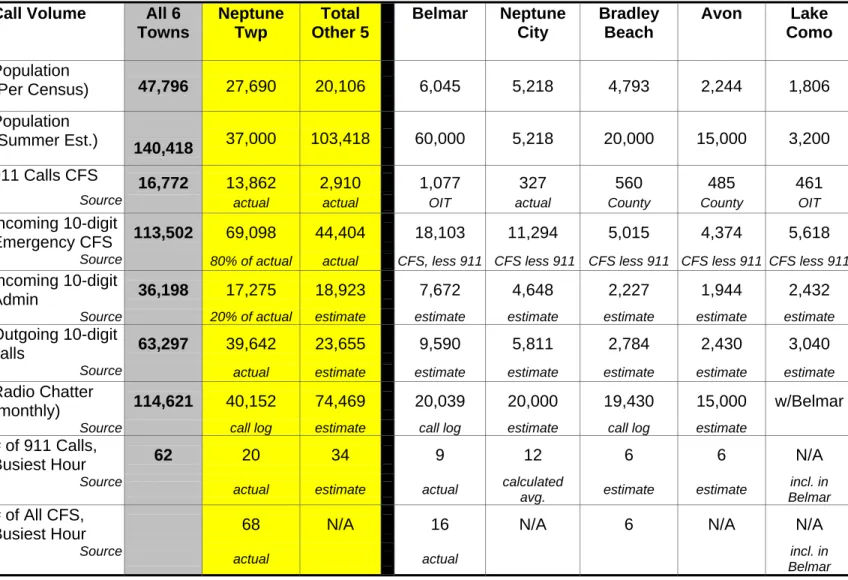
In summary, and as shown in the table on the next page, the combined volume of 911 and ten-digit emergency calls received at Neptune Township is approximately two-thirds more than the combined emergency calls received at the other five communities combined.
Table 1. Summary Data for Population and Call Volume,
Call Volume All 6
Towns Neptune Twp Total Other 5 Belmar Neptune City Bradley Beach Avon Lake Como Population (Per Census) 47,796 27,690 20,106 6,045 5,218 4,793 2,244 1,806 Population (Summer Est.) 140,418 37,000 103,418 60,000 5,218 20,000 15,000 3,200 911 Calls CFS 16,772 13,862 2,910 1,077 327 560 485 461
Source actual actual OIT actual County County OIT
Incoming 10-digit
Emergency CFS 113,502 69,098 44,404 18,103 11,294 5,015 4,374 5,618 Source 80% of actual actual CFS, less 911 CFS less 911 CFS less 911 CFS less 911 CFS less 911 Incoming 10-digit
Admin 36,198 17,275 18,923 7,672 4,648 2,227 1,944 2,432 Source 20% of actual estimate estimate estimate estimate estimate estimate Outgoing 10-digit
calls 63,297 39,642 23,655 9,590 5,811 2,784 2,430 3,040 Source actual estimate estimate estimate estimate estimate estimate Radio Chatter
(monthly) 114,621 40,152 74,469 20,039 20,000 19,430 15,000 w/Belmar Source call log estimate call log estimate call log estimate
# of 911 Calls,
Busiest Hour 62 20 34 9 12 6 6 N/A
Source
actual estimate actual calculated
avg. estimate estimate incl. in Belmar # of All CFS,
Busiest Hour 68 N/A 16 N/A 6 N/A N/A
Source
actual actual incl. in
Belmar
Neptune Township schedules from two to three dispatchers per shift to handle its call volume. The other five communities schedule one dispatcher per shift (during high-volume summer periods, Belmar will occasionally have two dispatchers together at the desk, but does not consistently schedule two per shift). The communities regularly rely on Special Law Enforcement Officers and sworn officers brought in on overtime to work the dispatch desk. In the five smaller communities, the dispatcher is often the only person in the building during certain hours of the night/midnight shift, as patrol officers are out in the field. Dispatchers provide a variety of non-emergency, administrative, and police-related functions to the communities that are not defined as emergency communications. These include greeting visitors, serving walk-ins, answering incoming calls to the Police Department, maintaining police logs, serving as records clerk, assisting with accident reports, verifying warrants and collecting fines, and giving information to the public. Dispatchers estimate that from approximately 40% to 60% of their time is spent on dispatch-related communications, with the remainder spent on administrative or police functions.
The communities have similar radio systems and five of them operate at VHF frequencies; Lake Como transmits at UHF frequencies. Belmar provides 911 call answering and dispatch services to Lake Como
INTERTECH ASSOCIATES,INC. TECHNOLOGY &SECURITY CONSULTANTS AND ENGINEERS provides 911 call answering services to Bradley Beach and Avon, with calls transferred back to the respective Police Departments for dispatch to Police, Fire and First Aid.
Three of the communities use New World CAD systems (Neptune Township, Belmar, and Bradley Beach), which is the same system used by Monmouth County during the period of the study. Two of the communities (Neptune City and Avon) fairly recently switched from New World CAD to IMC CAD
systems. During the course of the study, Monmouth County has been evaluating multiple CAD vendors for an upgrade to its CAD system. Given the level of support and interoperability between Monmouth County and the local Agencies, detailed evaluation of CAD systems or records interoperability has not been provided, pending the County’s decision regarding a County-wide CAD system.
D. Shared Services Alternatives and Recommendations
Volume II of this report includes the details of the feasibility analysis of sharing public safety 911 call taking and dispatch services. As a result of the data gathered and analyzed in Volume I, the consultant identified four scenarios that best represent the potential alternatives for shared public safety
communications services within these six communities1:
Scenario 1: Maintain the existing, independent dispatch centers with no change to current operations
Scenario 2: One centralized Communications Center located in Neptune Township
Scenario 3: Two centralized Communications Centers: one in Neptune Township to serve the two “Neptunes” and one in Belmar to serve the four “shore resort communities”
Scenario 4: Centralized call answering and dispatch services provided regionally by Monmouth County Communications Division
For each of these four scenarios, this report defines 911 call taking and dispatch operations in that scenario and provides an analysis of that scenario’s benefits, challenges, estimated call volumes, estimated staffing requirements, technology requirements, impact on prisoner handling operations, and projected operating costs for the first year of implementation.
E. Recommendations
As a result of this Feasibility Study, the consultant is recommending that these six communities develop a mutually agreed upon transition plan to centralize emergency call answering and dispatch operations at Neptune Township.
Based on analysis of the four scenarios, call taking and dispatch operations consolidated at Neptune Township is estimated to require a total dispatch staff of 17 full-time telecommunicators, two part-time, and one civilian director, which is significantly less than the current staffing in the six communities of 20 full-time dispatchers, 9 part-time, 9 SLEOs and regularly scheduled sworn officers on overtime.
Based on projected call volumes and radio chatter, we estimate that during the summer peak season (June, July, August), the centralized Communications Center will need to be staffed with four dispatchers per 8-hour shift, plus a civilian Center Director who will be available to support the dispatchers as
1
In addition to these scenarios, other ideas were put forth through a conceptual brainstorming process, but not viewed as feasible enough to warrant further exploration. These are listed in Appendix B.
needed. We estimate that during the off-season (September-May), three dispatchers per shift will be adequate to handle the projected call volume.
The Police Departments do not have to obtain any new frequencies to achieve the recommended consolidated dispatch environment. Four frequencies may require reconfiguration to enable existing simplex frequencies to transmit and receive as duplex frequencies.
We recommend adding five Consolettes to the console system at Neptune Township with antennas capable of receiving radio transmission from handhelds and portables in the respective communities. These would be configured using a frequency plan to allocate Police, Fire, First Aid, and other
frequencies across the Consolettes to increase redundancy. Dispatchers will be able to communicate directly via radio with Police, Fire, and First Aid over existing frequencies.
A backhaul infrastructure must also be put in place to connect the existing radio towers to the Neptune Township tower. This will serve as a redundant network to the Consolettes. The local towers will continue to receive radio transmissions from First Responders’ handhelds and portables, and then transmit this via the backhaul link to the Neptune Township Tower, ensuring radio coverage at the same level as exists today. Three methods of providing backhaul (connecting the towers) were considered: reconfiguring leased T-1 lines, a WiMAX licensed 4.9 GHz network, and licensed microwave links. The consultant recommends the six communities initially begin shared services dispatch by reconfiguring leased T-1s that currently connect each community to Monmouth County Sheriff but could be redirected to Neptune Township as a hub. This alternative could serve as the only backhaul infrastructure. For additional redundancy, the consultant also recommends a WiMAX 4.9 GHz network with communication links from the primary tower at Neptune Township to each tower in the five communities. Alternatively, this back-up network could be achieved with more conventional microwave links, although microwave is nearly double the cost of WiMAX. An audio comparator in the Neptune Township Communications Center will evaluate each incoming audio signal and select the stronger signal to be handed off to the dispatch console. The capital budget of the full technological solution (further described in Volume II) is estimated to be $372,250, allocated to each community based on the equipment it would require to participate in the centralized Communications Center.
We further recommend that each Police Department maintains its current radio configurations,
subscriber units (mobiles and portables), and frequencies. We also recommend that each local Police Department keeps a dispatch position as a back-up in the event that radio or dispatch capability from Neptune Township becomes compromised during the initial transition period.
Each municipality will remain responsible for its own purchasing costs for radios (handhelds and portables), although the participating communities may want to begin purchasing radio units in bulk to attain the most competitive pricing. Budget estimates do not include radio replacement costs that may be required for municipalities to upgrade their radio units to be narrowband compatible by 2013; these costs will be incurred independent of the results of this study and, therefore, have not been included.
The greatest impact on current Police operations of a centralized Communications Center involves prisoner detention at the local Police buildings. Since a dispatcher will not be in the building, there will be periods of time, especially during the late evening and midnight shifts, when the building may be vacant. Therefore, prisoners cannot be held in the local facilities, due to State Department of Corrections
INTERTECH ASSOCIATES,INC. TECHNOLOGY &SECURITY CONSULTANTS AND ENGINEERS among the communities based on annual arrest rates. The other Police Departments would make an arrest and immediately transport the individual to Neptune Township to be processed and held. The detainee would become the responsibility of Neptune Township Police until the person’s release or transfer to Monmouth County Jail.
The projected operational cost (salaries/wages, benefits, and equipment/maintenance) of a consolidated center at Neptune Township is estimated at $1.6 million, which is nearly 30% less than the aggregate $2.2 million budget of the six communities for 2010, and less than the estimated operational budgets in the other alternatives considered.
We propose the six communities share the costs of a consolidated Communications Center based on an average of each community’s existing percentage of total population, modified Call For Service incidents (without administrative calls), and 2010 budgets. This analysis does not include the cost of a dedicated jailor or the cost some communities may incur if they need supplemental clerical services for functions now provided by dispatchers.
Table 2. Budgetary Projections and Cost Sharing of Consolidated Communications Center
Community Current
Budget 2010
Proposed Cost Share
Calculated
Cost Share $ Savings % Savings
Five-Year Savings Neptune Twp. $982,665 48% $790,314 $192,351 20% $961,757 Neptune City $393,872 15% $240,530 $153,342 39% $766,709 Belmar $390,974 17% $284,709 $106,265 27% $531,324 Lake Como $56,898 3% $55,633 $1,265 2% $6,326 Bradley Beach $258,368 10% $155,445 $102,923 40% $514,617 Avon $194,348 7% $109,629 $84,719 44% $423,593 Total $2,277,125 100% $1,636,260 $640,865 $3,204,325
F. Benefits and Challenges of a Consolidated Communications Center
As consultant on this project, our task was to develop a study and plan for an incremental approach that considers the feasibility of shared services among participating municipalities for dispatch, records, and prisoner processing/detention together with the development of a plan of action to achieve that goal. Our analyses indicates that, with call taking and dispatch communications centralized at one location, the six communities will realize savings, both immediately and over the long-term, while improving service delivery to their citizens.
The following are factors in support of consolidation at one centralized Communications Center located in Neptune Township:
Improved Citizen/Officer Safety. Service will improve as a result of having multiple
telecommunicators working on all shifts. With multiple telecommunicators, there will be less risk of incoming calls or radio requests being placed on hold. When a major incident occurs, fully 911-trained staff will be available to assist with the calls, rather than requiring sworn officers or other staff to help out at the dispatch desk. This will minimize response times and increase the overall efficiency of response.
Increased Police Presence within the Community. Several of the communities currently rely on sworn officers or Special Law Enforcement Officers to work the dispatch desk. By centralizing all dispatch at Neptune Township with fully staffed telecommunicators, the local Police Departments can better utilize sworn officers and SLEO staff, which will increase the number of officers available for patrol and improve the Police Departments’ visibility to citizens. Neptune Township also has a mobile communications unit, available for immediate response, which could be used to enhance
communications for special events or large scale emergencies by placing additional radios, dispatchers, and computers on scene.
Minimized 911 Call Transfers. All 911 calls would be answered and dispatched by a common group of telecommunicators in a centralized operation. This would eliminate the existing transfers (and their associated delays) of 911 calls that roll over from other PSAPs to be locally dispatched.
Enhanced Quality of Service. We believe service will improve as a result of a dedicated Communications Center Director and a larger staff of telecommunicators, which will provide
consistent and professional training and development, and to share experiences and learn from each other. Telecommunicators will also have a career path and enhanced career opportunities as a result of working in a larger Communications Center.
Support of State Initiatives. There are hard realities facing smaller communities with the funding constraints established by recent legislation in the State of New Jersey. All agree that, given the current economic climate in the State, sharing services will eventually become a State mandate rather than a municipal choice. We believe these six communities will benefit in the future by having chosen their shared service partners proactively and demonstrating their willingness to share services and help reduce municipal budgets.
Cost Reductions. Consolidation will reduce the required number of call taking and dispatch
personnel as compared to current staffing levels, thus saving taxpayers in telecommunicator salaries and benefits.
Our research, discussions, and strategy sessionshave notidentified any significant constraints toward developing strategic plans for sharing dispatch communications between the six communities involved in this study. Based upon our review of each community’s emergency call taking and dispatching
operations, staffing, call volume, employment contracts, and dispatch procedures, we found no staffing, operational, or technology conditions that would prevent any one of these communities from pursuing a consolidated dispatch environment.
The two most significant challenges to be addressed upon transition to a consolidated Communications Center will be the need for some of the communities to hire or reassign staff to provide many of the administrative functions currently handled by dispatchers, and the need to centralize prisoner detention at the Neptune Township Police Department. Other issues to be addressed during the transition planning period include access to historical CAD records, establishment of consistent dispatch protocols across the six communities, the governance structure of the consolidated Communications Center to ensure each community has an equal voice in its management, and the cost-sharing details to be agreed upon in the Inter-Local Agreement.
The consultant believes consolidation of call answering and dispatch services will ultimately result in improved levels of service to the six communities and their public safety agencies, a more efficient use of
INTERTECH ASSOCIATES,INC. TECHNOLOGY &SECURITY CONSULTANTS AND ENGINEERS
G. Summary of Transition Planning
Implementation planning is critical to ensure a successful consolidated Communications Center to serve these six communities. Elected and appointed officials and police staffs must continue to remain actively involved in the process to eliminate barriers, address public concerns, identify and communicate funding opportunities, and participate in planning and operational issues. Successful dispatch consolidations follow several key steps toward the desired goal:
Develop a vision for the Center Define goals and objectives
Identify transition challenges that will need to be resolved
Identify key stakeholders and partners from each agency; define roles and staffing requirements
Propose a detailed budget and timeline
Outline a public education and marketing strategy
Provide an operational plan that addresses how the project will be funded now and in the future
Provide on-going direction through equal participation and representation.
Nationwide public safety agencies have struggled with establishing the ‘best’ model for consolidation. Agencies that have attempted consolidation and failed cite similar reasons for the lack of success, which have been documented in countless public articles:
“Home rule” and institutional hurdles that arise when mandated without buy-in from respective agencies
Lack of planning or understanding of goals Trying to be “all things to all Agencies” Absence of political will/commitment
Fear of decreased service level (usually for non-emergency ancillary responsibilities) Consolidation of “understaffed” centers still results in “understaffing”
Loss of local touch specialization/service Local distrust of government
Poor communication with stakeholders Political/institutional pressures
Inadequate project management
To mitigate these issues it is critical to develop an operational and organizational structure that best reflects the unique needs of each of the constituent organizations involved in the consolidation effort. Industry sources cite several next steps to help prepare for consolidation: employ a steering committee with executive participation, establish a formal governance structure, create and use working-level subgroups, and hire or assign a dedicated project manager.
The following issues will need to be addressed during transition and are discussed, with specific suggestions offered, in Volume II of this report:
Management philosophy and Management Advisory Committee to serve as joint leadership team
Governance structure of consolidated Communications Center
Operational working team to address issues such as multi-community dispatch protocols, historical CAD record management, and performance parameters Staffing plan and training requirements
Administrative call answering
Prisoner transport and processing procedures
Inter-local agreement and decisions on shared services cost basis
The consultant estimates at least six months will be required for the technology and the operational changes to be ready for transition to the consolidated Communications Center. We strongly recommend planning for the transition to begin immediately and for the cut-over to occur in the off-season, possibly targeting October 2010 (or later) as the cut-over month. We suggest an incremental transition, starting on the midnight shift, then after adequate “prove in” time, adding the evening shift, and finally moving all dispatch shifts to the consolidated Communications Center located in Neptune Township.
We encourage the communities to make a commitment to success and agree to continue in a shared services environment for at least three years to give ample time for the new operations to “prove in.” Radio base stations and dispatch consoles will remain in the local Police Departments as back-up and, if for some reason a community wants out of the agreement after the initial three-year period, they could return to local dispatch, although we also suggest a “back out” penalty clause should be addressed in the Inter-Local Agreement. We suggest the original Inter-Local Agreement should give the option for cost sharing allocations to be reviewed and, if the Management Advisory Committee concurs, modified as necessary after the first year in operation, based on actual costs and call volumes per town, but with a cap on the maximum percentage increase that can be applied to any single community.
INTERTECH ASSOCIATES,INC. TECHNOLOGY &SECURITY CONSULTANTS AND ENGINEERS
VOLUME I:
I. Introduction: Background and Project Objectives
In 2006, the State of New Jersey commissioned the Edward J. Bloustein School of Planning and Public PolicyJohn J. Heldrich Center for Workforce Development to develop a report on the state of E-911 services in the State of New Jersey and the determination of where, if any, there are cost savings and/or efficiencies that can be gained from sharing emergency communications across communities. Results of that study suggest that there can be significant efficiencies and cost savings for both large and smaller communities.
One of the conclusions in the Study states that, “Centers that receive a relatively low number of incoming calls and that tend to have one person on duty at any time have substantially higher costs per call, compared with larger centers….. “
Larger Centers tend to benefit as well since “Consolidated call centers are likely to have more qualified, trained staff on duty and to provide more training opportunities for staff. Larger operations will likely benefit from efficiencies in the long term because local jurisdictions can share operating and capital costs. Combining local operations may also improve the capacity of local emergency services to share information and respond to incidents.”
Six communities at the Jersey Shore in Monmouth County – Belmar, Bradley Beach, Avon-by-the-Sea, Lake Como, Neptune City, and Neptune Township – have determined that it is in their respective communities’ best interest to commission the services of Intertech Associates, Technology and Consulting Engineers, to define, explore and research alternative solutions for shared emergency communications services between the six communities.
At the outset of this assessment, it is critical for stakeholders to acknowledge that the process of shared services design, implementation, and operations requires desire, discipline, and the ability to execute to a plan. A shared services environment is more than the effort of simply moving people together into one location and giving them a common system. It involves a change of mindset: a focus on the core services required by each community; a focus on the service level anticipated from the shared service as a
reflection of the communities; and the achievement of functional, business, and financial objectives. We have researched public sector shared services models to understand the variables that impact a ‘successful’ consolidation. These models reveal that success relies on several factors:
Cooperation of the participating parties
Clear and practical vision of what is achievable immediately and what needs to be part of a longer-term strategy
Willingness for compromise to achieve a shared service solution that improves services over what could be accomplished individually.
The stakeholders on the planning committee from the six communities initially identified the following issues as critical to the success of a shared services model:
None of the existing full-time police force can be laid off
All municipalities must receive the same level of service or better All municipalities must be able to provide service at a reduced cost
INTERTECH ASSOCIATES,INC. TECHNOLOGY &SECURITY CONSULTANTS AND ENGINEERS
II. Methodology and Procedural Approach
Although the focus of this study is on dispatching services, a broad overview of the Police, Fire, First Aid, and Emergency Management Services in the six communities was necessary to determine the overall communication needs. This overview included a general review of each community, as well as the organizational structure, workload, facilities, equipment, personnel, and budget of public safety services. The consultants had the opportunity to meet with various municipal officials in the six communities. Those interviewed included elected officials, administrative staff, police, and emergency management officials. All those interviewed were open and frank during these conversations and provided valuable insight. The consultants inspected the Dispatch Centers in Belmar, Bradley Beach, Neptune City, and Avon-by-the Sea Police Departments, as well as Neptune Township’s temporary and backup centers, floor plans of the New Communications Center, and the construction site to determine the extent of dispatch services that each department provides and the nature of the technology needed to effectively service a larger consolidated Communications Center.
Intertech Associates takes note of the impending relocation of Neptune Township’s Police Department, including telecommunications operators, into new quarters in 2010. We inspected the equipment currently used in its temporary location as well as the plans and layout for the new equipment being installed in 2010.
Intertech Associates does not have a vested interest in any of the communities, nor in this report’s recommendations. Our objective is to review the facts and, from an analytical and technological approach, determine to what extent, if any, dispatch consolidation is feasible and beneficial. These tasks were accomplished through:
Meetings with selected dispatchers and police personnel from the six communities
Identification of functional, operational, and technical drivers that impact dispatch services Review of data provided by the six municipalities
Benchmarking and research of other communities that have adopted shared services model for dispatch
Development of recommendations geared to dispatch consolidation options.
Appropriate documents relative to the goals of this study were reviewed including CAD reports of call volume and statistical data, general job descriptions of dispatch personnel, policies and procedures relative to communications, prisoner management procedures, public access to police departments and records, budgeting and expense reports, dispatcher work schedules, statistical records, labor
agreements, and other documents of pertinent nature. Specifically, Intertech Associates received and reviewed the following data as a primary data source in the observations that follow:
Table of Organization for each town, Police Department and dispatch staff Police department’s yearly reports for the past two years
2008 and 2009 expense reports for dispatchers and sworn officers working dispatch desk, maintenance/operations, equipment procurement, and service
2010 budget projections (prepared as of December 2009) CAD reports for the past three years
Prior shared services studies Union contracts
Various scenarios were evaluated in which joint or shared dispatching services may be accomplished. A number of benefits and drawbacks of each of these possibilities are discussed and recommendations are made regarding the feasibility of implementation.
The Intertech Associates’ team conducted interviews and discussions with the following personnel in the course of this study:
Neptune Township: Police Chief Howard O’Neil, Deputy Chief Robert Adams, Captain Bailey, Lieutenant William Monroe, Administrator Phil Huhn, CFO Michael Bascom, Councilman Randy Bishop, selected dispatchers
Belmar: Captain Tom Palmisano (Acting Chief), Larry Hahn (dispatch manager/radio support), Administrator Robbin Kirk, Mayor Ken Pringle, records clerk, selected dispatchers
Avon: Chief Terry Mahon, Administrator Tim Gallagher, Councilman/Police Commissioner Frank Gorman, Councilman Dan McGovern, selected dispatchers
Bradley Beach: Chief Len Guida, Lieutenant Neil Scully, Lieutenant Steve Fahnholz, Administrator Gail O’Reilly, Mayor Julie Schreck, selected dispatchers
Lake Como: Chief Rosman Cash, Captain Fred Hope, Mayor Michael Ryan, Administrator Louise Mekosh
Neptune City: Chief William Geschke, Public Safety Director Ed Kirschenbaum, Lieutenant Louis Trocchio, Administrator Mary Sapp, Mayor Tom Arnone, selected dispatchers
Monmouth County: Sheriff Shawn Golden, Stephen Callas, Monmouth County Shared Services Coordinator, Roger Staib, shared services consultant to Monmouth County from Government Strategy Group
In the process of gathering and analyzing this data, a great degree of diligence was performed to verify each fact and assumptions made during the conducting of this study. Any data or assumptions that may be some degree off actual practice will most likely not impact the ultimate direction, conclusions, and recommendations presented within this report.
INTERTECH ASSOCIATES,INC. TECHNOLOGY &SECURITY CONSULTANTS AND ENGINEERS
III. History of Public Safety Shared Services
A. New Jersey Public Safety Shared Services
In recent years, the State of New Jersey has commissioned several reports regarding the public safety aspect of shared services, consolidation, mergers and regionalization. These reports, commissioned separately by the New Jersey State Association of Chief’s Of Police (NJSACOP) and the State of New Jersey Office of Emergency Telecommunications (OETS),have focused on the benefits and potential challenges of the various aspects of shared services facing public safety agencies in New Jersey.
Of particular interest to the communities involved in this study are the findings of the report prepared by the John J. Heldrich Center for Workforce Development at Rutgers, The State University of New Jersey, for the Office of Emergency Telecommunications. This report has ultimately resulted in the State taking steps towards the development of a policy of emergency services consolidation throughout the State. Summarized, these steps include:
Commit to a policy favoring combined operations for call taking and dispatch.
Establish a program of incentives to pay a portion or all of the costs associated with PSAP consolidation.
Support ongoing education of call center staff in the form of training assistance grants. Develop a set of standards defining high quality E-911 emergency services, institute data
submission requirements for all E-911 grants, and explore opportunities to collect more detailed budget information.
Institute a public education and technical assistance program to promote and support consolidation.
Limit eligibility for E-911 grants to those communication centers that can demonstrate a minimum staffing level of two certified telecommunicators 24 hours per day, seven days per week.
The findings and recommendations were made public in the October 2006 report. Now, over three years later, the State has taken several significant steps toward the recommendations expressed in the 2006 report by establishing programs and corresponding incentives for agencies that share emergency communications over agencies that don’t.
1. 2006 Initiatives
− Establishing a Joint Legislative Committee on Government Consolidation and Shared Services to address the sharing of services and regionalization of functions at all levels of government. The result of that committee determined that the 911 Commission be given the authority to effect the consolidation of PSAPs on an as-needed basis and that the use of sworn officers to provide dispatch services be limited, as would the receipt of State funding for those agencies using sworn officers to provide dispatch services.
− Development of S-45, which implements the Joint Legislative Committee on Government Consolidation and Shared Services recommendations. S-45 provides that:
The State plan shall require the consolidation of PSAPs as appropriate, consistent with revisions in the plan to upgrade the enhanced 911 system and shall condition the allocation of moneys
dedicated for the operation of PSAPs on the merging and sharing of PSAP functions by
municipalities, counties and the State Police, consistent with the revised plan. The Treasurer may establish, by regulation, a 911 call volume minimum that may be utilized as a factor in determining
which PSAP functions are to be consolidated under the State plan. The State plan shall limit the use of sworn law enforcement officers to provide dispatch services and the office shall condition the receipt of monies dedicated for the operation of PSAPs on the limited use of sworn law enforcement officers, except for officers returning to active duty from an injury or other physical disability.
2. 2007 Initiatives
− At the June 2007 911 Commission meeting, the commission adopted a ‘one PSAP per county plus the urban 15 cities (21 plus 15) model should be the target, with some exceptions.’ The Committee also agreed to revise the funding formula from providing grant funding to PSAPs who had previously served a population of 19,000 to the new benchmark which requires PSAPs to serve a population of the smallest New Jersey County, now Salem County at 65,346.
3. 2008 Initiatives
− The FY 2008 Enhanced 911 County Grant criteria has incorporated the minimum criteria established in S-45 into its requirements to be considered for funding through this grant: The PSAP shall serve a population of 65,346 or more, based on the most recent Census
Bureau statistics with the serving population specified on the Grant Applicants resolution by the governing body, and
The PSAP shall be configured with a minimum of two fully equipped call-taker positions as defined in N.J.A.C. 17:24-2.1, and
Maintain a minimum staffing level at the PSAP consisting of two certified call-takers/dispatchers dedicated to PSAP operations at all times.
− Grant availability to determine feasibility of developing a shared services environment is also available through Department of Community Affairs, which provides grant opportunities to implement a consolidated environment.
4. Impact of Public Safety Initiatives and Standards
It is no surprise that in the current economic climate of instability and rising costs, both State and local authorities are seeking every available tool to reduce costs without impacting services to their constituents. To that end, it is not a question of ‘if’ so much as ‘when’ local agencies will be put to the test of determining which agencies and which services they will be sharing with others. It is with the understanding of these developments in the shared service and emergency
communications environment within New Jersey that we have prepared this report. Historically, just the mention of ‘home rule’ would have been sufficient to dissuade municipal leaders from
considering a shared environment. While nothing has changed in the feeling that ‘home rule and local knowledge’ of the community should prevail, it is now a more economic and operational feasibility discussion that needs to be considered rather than one that is based on the subjective concerns used to defend the cry of home rule.
INTERTECH ASSOCIATES,INC. TECHNOLOGY &SECURITY CONSULTANTS AND ENGINEERS These higher standards are clearly not inclusive of the operations in smaller centers and establish a benchmark that creates a greater burden for smaller communities to meet. Very specifically, the grant process requires that a PSAP meet two specific burdens to qualify for the OETS program: ”… Maintain a minimum staffing level at the PSAP consisting of two certified call-takers/dispatchers dedicated to PSAP operations at all times. Such staffing levels must be sufficiently documented to show that the PSAP met this minimum staffing level no less than 95% of the time during the 60-day period prior to the Grant Application date by supplying staffing schedules for that period. Grant recipients may be required validate such staffing levels throughout the grant period, or; …”
“… PSAP staffing shall not utilize regularly scheduled sworn officers as call takers or dispatchers except in instances where the sworn officer is returning to active duty from an injury or other physical disability or other unique situation that precluded that officer from performing law enforcement
duties…”
B. Local Public Safety Shared Service Efforts
1. Avon-by-the-Sea and Neptune City Studies
The boroughs of Avon and Neptune City have been considering shared dispatch operations since 1987. Three times before, the two municipalities have attempted to consolidate dispatch functions.
Over 15 years ago they completed in-house planning for shared dispatch services. The project focused primarily on cost savings and failed primarily due to a lack of direct communications with the residents of both communities, in the opinion of former Police Chief William Geschke.
In 2000, the two municipalities applied for and received a $100,000 REDI Grant for dispatch center consolidation. The towns drafted a 3-year Inter-local Agreement, and Avon was prepared to pay a percentage of the costs Neptune City incurred to provide dispatch services to both towns. They were ready to implement the grant, when Avon citizens became concerned they would no longer be served by local police, and the project never went forward.
In 2006, a similar study was conducted with funds received from a SHARE Grant (Sharing Available Resources Efficiently Program) from the Department of Community Affairs. The results of this study again indicated that there were no reasons (technologically or operationally) why the two communities should not implement shared dispatch services. After release of the study results, the newly elected council voted not to go forward with the study recommendations.
2. Belmar, Bradley Beach, Lake Como Studies
Dispatch shared services have been previously discussed by Belmar, Bradley Beach and Lake Como officials:
In 2005, the boroughs of Belmar, Bradley Beach and Lake Como were recipients of a Grant through the SHARE Program to conduct a feasibility study to determine if dispatch services could be shared to minimize costs while maintaining or improving services. This study found no
significant reasons why the three communities should not implement shared dispatch services.
In previous discussions, former Belmar Police Chief Jack Hill led discussions to merge
communications for police departments throughout Southern Monmouth County, but the plan to merge services for at least seven police departments along the coast never went forward.
Belmar has been serving as the 911 call taker and dispatcher for Lake Como for over a decade, with both communities satisfied with the service and the cost sharing arrangement.
3. Other Local Studies / Efforts
Neptune Township has been serving as the 911 call answering point for Neptune City for nearly a decade, again with both communities satisfied with the arrangement. Many communities across the State have studied (or are studying) the feasibility of shared public safety communications. In almost all cases, the study recommends implementation of shared services for 911 call answering and dispatching, identifying cost efficiencies, improved service, and enhanced career opportunities. In some cases, recommendations have been implemented; locally, Freehold Township recently decided for Monmouth County Sheriff’s Communication Center to provide its call answering and dispatch. Spring Lake/Wall/Manasquan and Point Pleasant/ Point Pleasant Beach are undergoing similar studies. In other cases, although studies
recommended merged communications, the communities did not approve. However, most New Jersey communities acknowledge that sharing public safety communications must become more common,
especially in the current economic climate and the realization that the State will eventually mandate shared services.
INTERTECH ASSOCIATES,INC. TECHNOLOGY &SECURITY CONSULTANTS AND ENGINEERS
IV. Existing Public Safety Communications
Although the communities have some differences, their close proximity and, for the most part, similar community demographics make them very much alike from a public safety perspective. Each community provides its own public safety services, including full time police department, fire departments and first aid squads. The communities also regularly provide mutual aid assistance to each other, largely due to their close geographic proximity.
The purpose of this study is to evaluate each community’s 911 and ten-digit emergency call answering and dispatching procedures to provide local residents with requested services from the local police, fire and first aid. The study does not evaluate any sharing or changes to the traditional police departments, other than any impact that would result from co-locating call takers and dispatchers within a central location.
In this next section, we include details and analysis of each of the six communities in the study – Neptune Township, Belmar, Bradley Beach, Neptune City, Avon-by-the-Sea, and Lake Como – and provide data gathered through interviews and reports provided by each community. Each section includes the following topics for each community:
1) The Community
1.1 Demographics and environment 1.2 Police, Fire, and First Aid services 2) Public Safety Communications Operations
2.1 Dispatch center facility and configuration 2.2 Dispatcher tasks
2.3 Staffing and work schedule analysis 2.4 Call volume summary
2.5 Prisoner handling operations (as performed by dispatchers) 2.6 Records management operations
3) Communications Center Technology 3.1 Radio system and frequencies
3.2 Radio control system / dispatch consoles 3.3 CAD/RMS and mapping systems
3.4 E-911 communications system
3.5 Administrative communications system 3.6 Video surveillance and other technologies 4) Communications Center Cost Profile
A. Neptune Township
1. The Community
1.1. Demographics and Environment
Getting its name from the Roman God of the Sea, Neptune Township was formed in 1879. Neptune Township has a land area of 8 square miles and is situated in the central easternmost part of
Monmouth County. Neptune Township is a community with several diverse neighborhoods including Ocean Grove, Shark River Hills, Mid-Town, Bradley Park, the Gables, Seaview Island and West Neptune. Neptune Township is bounded by Asbury Park and Bradley Beach (to the north/south of Ocean Grove), by Ocean Township and Tinton Falls to the north, Neptune City and Wall to the south, and Howell to the west. The Township has been known as the Crossroads of the Jersey Shore due to the major corridors which cross through and border the Township. Neptune Township is accessible from Garden State Parkway exits 100 and 102, with sections of State Highways 18, 33, 35, 66 and 71 within its borders. Neptune Township is also accessible by New Jersey Transit trains (Bradley Beach/Neptune Station), and major bus routes and local taxi service. Neptune Township is home to Jersey Shore University Medical Center, the Regional Trauma Center for Central Jersey. In the New Jersey State Police Unified Crime Report, Neptune Township is classified as a suburban community, with a 2007 estimated population of 28,394. Neptune Township has significant big box retail establishments within its borders, including Wal-Mart and Home Depot.
Neptune Township is an ethnically diverse community. Neptune Public Schools are classified among the 33 New Jersey State “Abbott Districts,” which are designated based on specific factors including those with the lowest socio-economic status, a large percentage of disadvantaged students, and existence of an “excessive tax for municipal services” in the locality where the district is located. Through State funding overseen by the NJ School Development Authority, Neptune Township has benefited from two new Elementary Schools, a new Early Childhood Center, and major renovations to its High School, Middle School, and four other Elementary Schools over the past decade.
Neptune Township differs from the other communities in this study in that it has a Township Committee Government Structure, with five elected committee members from whom is appointed each year the mayor, deputy mayor, and police commissioner. The Neptune Township Police Department is managed through the Committee structure.
Table A.1. Neptune Township Population and Demographics
Census Data of 2000 Neptune Township
Population (per 2000 census) 27,690 Population (summer peak estimates) 37,000 Population density per square mile 3,367
Housing units 12,217
Average household size 2.46
Median age 39.4
INTERTECH ASSOCIATES,INC. TECHNOLOGY &SECURITY CONSULTANTS AND ENGINEERS
1.2. Police, Fire, First Aid
The Neptune Township Police Department was initially formed following the incorporation of the Township in 1889, and in 1979 the department absorbed the Ocean Grove Police Department following the closing of that agency. Ocean Grove, a resort community along the Atlantic Ocean, is fully served by Neptune Township Police Department. The Department provides police services to the beachfront, but lifeguards are not part of the police department and lifeguard services are provided by the Ocean Grove Camp Meeting Association.
The Neptune Police Department consists of 74 sworn officers and 20 civilians and from 8 to 10 Class I and Class II Special Law Enforcement Officers (SLEOs). The department is administratively organized into the Patrol Division, the Detective Division, and the Operations Division. Neptune Police Department keeps its patrol officers in zones, with sub-stations in Ocean Grove, at the new Midtown Community School, and at Headquarters, located at 25 Neptune Boulevard. The Police Department leadership maintains good relationships with each of the agencies for which the City provides emergency call services.
The Neptune Fire Department is responsible for fire protection and suppression in the area of Neptune Township covered by Neptune Fire District #1. Four volunteer fire companies and a career division respond to fires and emergencies in Fire District #1: Hamilton Fire Company (Station 1), Liberty Fire Company (Station 2), Shark River Hills Fire Company (Station 3), Unexcelled Fire Company (Station 4), and the Career Division (Engine Company 34-74).The Career Division, consisting of a captain and five firefighters, are on duty Monday through Friday from 7:00 am-4:00 pm and are stationed on a rotating schedule each day at one of the firehouses.
The Ocean Grove Fire Department is responsible for fire protection and suppression in the area of Neptune Township covered by Neptune Fire District #2. Three volunteer fire companies respond to fires and emergencies in Fire District #2 (Ocean Grove): E.H. Stokes (Station 54-2), Eagle Hook and Ladder (Station 54-2), and Washington Fire Company (Station 54-3). The volunteer fire companies are supplemented by a career firefighter stationed at the firehouses during regular business hours, Monday through Friday.
Neptune Township is served by four First Aid squads who provide emergency medical services to residents and visitors passing through to various destinations along the shore: Shark River Hills First Aid, Neptune First Aid, Hamilton First Aid, and Ocean Grove First Aid.
2. Neptune Twp. Public Safety Communications Operations
Neptune Township is a Public Safety Answering Point (PSAP #666) and PSDP (Public Safety
Dispatch Point), serving both Neptune Township and Neptune City (for 911 call answering). Neptune Township started answering 911 calls in the mid 1990’s, and the Neptune Township
Communications Center answers all 911 and non-emergency calls for Police, Fire, and EMS service in Neptune Township. All 911 calls from Neptune City are answered at the Neptune Township Communications Center, then transferred to the Neptune City Dispatch Center for dispatch to the appropriate public safety agency.
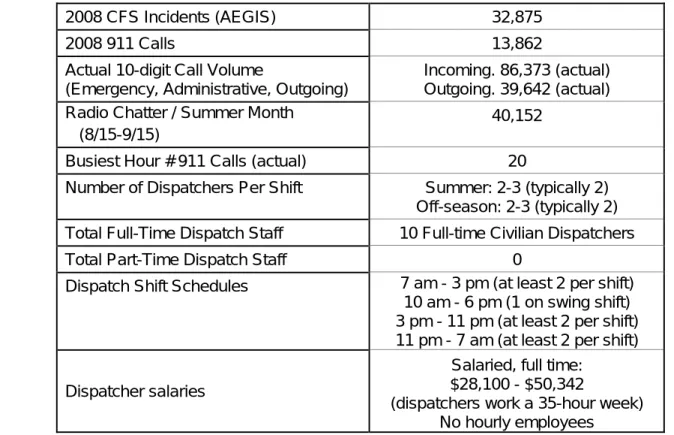
The department provides emergency dispatch services for police, fire, EMS, and Emergency Management, as well as ANSWER, a regional water rescue response agency that serves Avon, Bradley Beach, Neptune City and Neptune Township. The table on the next page highlights Neptune Township’s public safety communications at a glance.
Table A.2. Neptune Township Communications Center - Summary at a Glance
2008 CFS Incidents (AEGIS) 32,875
2008 911 Calls 13,862
Actual 10-digit Call Volume
(Emergency, Administrative, Outgoing)
Incoming. 86,373 (actual) Outgoing. 39,642 (actual) Radio Chatter / Summer Month
(8/15-9/15)
40,152 Busiest Hour # 911 Calls (actual) 20
Number of Dispatchers Per Shift Summer: 2-3 (typically 2) Off-season: 2-3 (typically 2) Total Full-Time Dispatch Staff 10 Full-time Civilian Dispatchers Total Part-Time Dispatch Staff 0
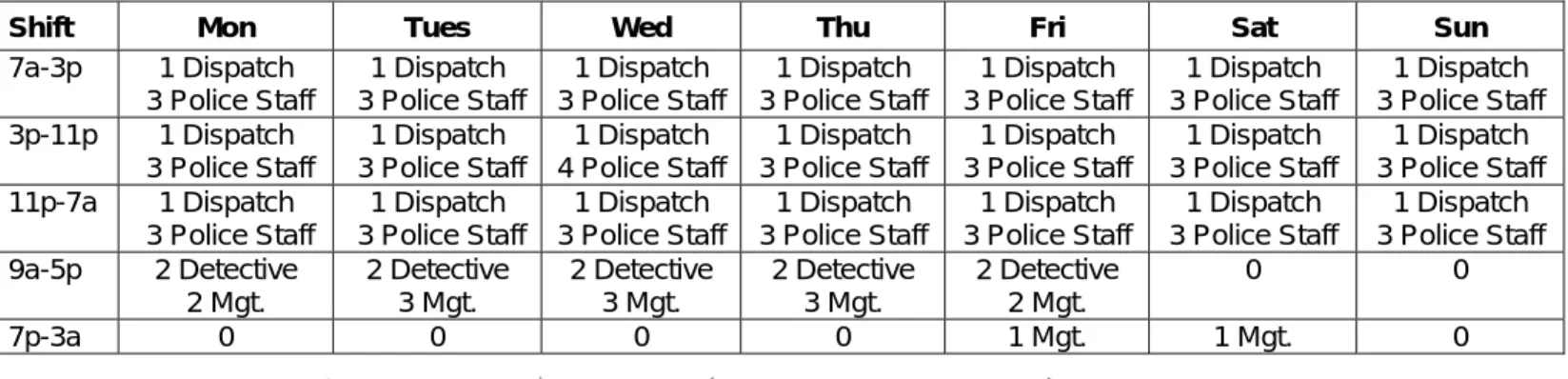
Dispatch Shift Schedules 7 am - 3 pm (at least 2 per shift) 10 am - 6 pm (1 on swing shift) 3 pm - 11 pm (at least 2 per shift) 11 pm - 7 am (at least 2 per shift)
Dispatcher salaries
Salaried, full time: $28,100 - $50,342
(dispatchers work a 35-hour week) No hourly employees
2.1. Dispatch Center Facilities and Configuration
The Neptune Township Police Department is currently under renovations that include a major upgrade project, referred to as the New Emergency Communications Center (NECC). The new center is located in the basement of the Police Building in a separate area that will not be
immediately accessible to the general public. The ribbon cutting of the NECC is planned in the first half of 2010. Neptune Township intentionally designed space into the renovated Police
Headquarters and the Communications Center with the future possibility of expanding communications services to benefit other communities.
The emergency communications operators will require some acclimation time once the new equipment is in place and ready for use. The telecommunicators are excited about the new infrastructure and a facility geared around the communications center.
The NECC includes a new four-position communications center with a fifth position for the shift commander, and a large video display is mounted along one wall of the center. An external site at the Midtown School includes additional dispatch positions to be used as backup or for emergency overflow. In the NECC, the shift commander’s desk is integrated with the telecommunicators; the shift commander controls the center and is able to listen to what’s going on across all radio channels at all times. The shift commander, who is the officer in charge of Police Headquarters, can switch from one screen/position to another from his station, as well as from one camera image to another. If a telecommunicator needs help, they can call out for back up directly to the shift commander or the shift commander can serve as a fifth position in a crises situation.
INTERTECH ASSOCIATES,INC. TECHNOLOGY &SECURITY CONSULTANTS AND ENGINEERS
Five separate computers feed information to the nine monitors, with the following systems integrated into each of the five NECC positions:
County AEGIS/New World CAD System – Neptune Police Department shares its CAD system with the Monmouth County Sheriff’s Department’s New World Systems
Radio Telephone Internet access
Video surveillance images from the cell blocks
Video surveillance images from the school client/server Intranet
CJIS NINC connected to the New Jersey State Police via MCSD Access to Neptune Township Police Records
“I AM RESPONDING” notification system to supplement dispatch of Fire, EMS, OEM, and ANSWER. The system provides an interactive text and email system that volunteers can respond to via telephone to primarily provide their response to emergency calls.
“REVERSE 911” Community Emergency Notification system, which is currently in partnership with Avon, Bradley Beach, and Neptune City.
Critical Reach, an email notification and alert information sharing system (formerly the Trak system)
2.2. Dispatcher Tasks
Each desk position is responsible for answering and dispatching for all types of incoming calls (police, fire, EMS, OEM). The telecommunicators do not specialize by public safety agency. Communications operators answer ten incoming phone lines and six 911 trunks. When necessary, callers are instructed on emergency medical pre-arrival instructions until emergency response units arrive. This includes, but is not limited to, CPR instructions, obstructed airway instructions, bleeding control, burns, seizures, childbirth, and diabetic emergencies.
Telecommunicators provide call receipt and confirm location information, caller’s name, address, phone number, and nature of the call as well as other pertinent information. CAD and mapping systems are used to provide coordinated event support, radio dispatch, and regularly updated information during the course of events in progress. Each dispatch console has a radio system on a separate computer and monitor. The new console system has the capability for the
telecommunicator to monitor up to 48 radio channels and can be used to page out any fire or EMS call. The dispatcher can patch radios together to provide interoperability to multiple agencies. Neptune Township currently serves as the 911 call answering center for Neptune City. Calls for service are transferred via speed dial (hot button) to Neptune City to be dispatched out locally. In addition to 911 and emergency calls, the Neptune Township telecommunicators answer incoming calls into the Police Department, after callers have used prompts on the Auto Attendant system for the Police Department, including calls to the Detective Bureau, Records Bureau, Police Chief, and Deputy Chief. Dispatchers provide limited alarm monitoring of duress alarms from the hospital, the
local court, the schools and Fire Departm