T
HER
OLE OFS
CHEMAS
ALIENCE INA
DP
ROCESSING ANDE
VALUATIONJ
OOSTL
OEF, G
ERRITA
NTONIDES ANDW. F
RED VANR
AAIJERIM REPORT SERIES RESEARCH IN MANAGEMENT
ERIM Report Series reference number ERS-2002-15-MKT Publication January 2002 Number of pages 45
Email address corresponding author [email protected]
Address Erasmus Research Institute of Management (ERIM) Rotterdam School of Management / Faculteit Bedrijfskunde Erasmus Universiteit Rotterdam
P.O. Box 1738
3000 DR Rotterdam, The Netherlands Phone: +31 10 408 1182 Fax: +31 10 408 9640 Email: [email protected] Internet: www.erim.eur.nl
Bibliographic data and classifications of all the ERIM reports are also available on the ERIM website: www.erim.eur.nl
ERASMUS RESEARCH INSTITUTE OF MANAGEMENT
REPORT SERIES
RESEARCH IN MANAGEMENT
B
IBLIOGRAPHIC DATA AND CLASSIFICATIONSAbstract Advertising grids such as the Rossiter-Percy grid (Rossiter & Percy 1991, 1997) propose that brand-matching advertising is more effective than brand-mismatching advertising. However, for the match hypothesis to hold the brand schema needs to be salient in ad processing and evaluation. In this study we test how schema salience affects ad processing and evaluation. Two separate experiments were conducted, employing the same brand descriptions and ad scenarios. In the first experiment, the brand schema was made salient in ad processing, whereas in the second experiment the ad schema was made salient.
In the first experiment brand(ad combinations were evaluated in line with the Rossiter-Percy advertising grid. If the brand schema was salient, consumers evaluated matching combinations of ad type and brand purchase motivation more favorably than mismatching combinations. In the second experiment, brand(ad combinations were evaluated in accordance with the existing ad schema. This implies that when the ad schema was salient, evaluations of brand(ad combinations were not affected by matches or mismatches between ads and purchase motivations for the brands.
The two studies show that evaluation of brand(ad combinations depends on the schema that is salient at the time of information processing. Consequently, brand-matching advertising is effective only if consumers consciously relate ad information to brand knowledge, i.e., if the brand schema is salient in ad processing
5001-6182 Business 5410-5417.5 Marketing Library of Congress
Classification
(LCC) HF 5801+ Advertising
M Business Administration and Business Economics M 31
C 44
Marketing
Statistical Decision Theory Journal of Economic Literature (JEL) M 37 Advertising 85 A Business General 280 G 255 A
Managing the marketing function Decision theory (general) European Business Schools
Library Group (EBSLG)
290 L Advertising
Gemeenschappelijke Onderwerpsontsluiting (GOO)
85.00 Bedrijfskunde, Organisatiekunde: algemeen 85.40
85.03
Marketing
Methoden en technieken, operations research Classification GOO 85.40 Marketing Bedrijfskunde / Bedrijfseconomie Marketing / Besliskunde Keywords GOO Advertenties, Merken
THE ROLE OF SCHEMA SALIENCE IN AD PROCESSING AND EVALUATION
Joost Loef and Gerrit Antonides
Erasmus University Rotterdam
and
W. Fred van Raaij
THE ROLE OF SCHEMA SALIENCE IN AD PROCESSING AND EVALUATION
ABSTRACT
Advertising grids such as the Rossiter-Percy grid (Rossiter & Percy 1991, 1997)
propose that brand-matching advertising is more effective than brand-mismatching
advertising. However, for the match hypothesis to hold the brand schema needs to be
salient in ad processing and evaluation. In this study we test how schema salience
affects ad processing and evaluation. Two separate experiments were conducted,
employing the same brand descriptions and ad scenarios. In the first experiment, the
brand schema was made salient in ad processing, whereas in the second experiment
the ad schema was made salient.
In the first experiment brand-ad combinations were evaluated in line with the Rossiter-Percy advertising grid. If the brand schema was salient, consumers evaluated
matching combinations of ad type and brand purchase motivation more favorably than
mismatching combinations. In the second experiment, brand-ad combinations were evaluated in accordance with the existing ad schema. This implies that when the ad
schema was salient, evaluations of brand-ad combinations were not affected by matches or mismatches between ads and purchase motivations for the brands.
The two studies show that evaluation of brand-ad combinations depends on the schema that is salient at the time of information processing. Consequently,
brand-matching advertising is effective only if consumers consciously relate ad information
INTRODUCTION
Advertising grids, such as the Rossiter-Percy grid (Rossiter, Percy & Donovan 1991,
Rossiter & Percy 1997) and the FCB grid (Vaughn 1980, 1986) have related the type
of brand-ad combination to advertising effectiveness. The normative
recommendation from both grids is that the ad appeal should match the brand attitude
basis. However, Dubé, Chattopadhyay & Letarte (1996) note that the evidence in
support of this recommendation is anecdotal and neither systematically nor
empirically investigated.
Furthermore, research on attitudes and persuasion (Edwards 1990, Millar &
Millar 1990) and schema theory (Mandler 1982, Meyers-Levy & Tybout 1989, Lee &
Mason 1999) has yielded results conflicting with the match hypothesis advanced in
the advertising grids. Together, these studies point to the importance of further
investigating the assumptions regarding the effectiveness of brand-matching
advertising.
In an experimental test of the Rossiter-Percy (RP) grid, Loef, Antonides & Van Raaij (2001) found evidence for a mismatching hypothesis. Contrary to RP grid
predictions, they found higher effectiveness of ads that did not match the purchase
motivation for the brand than mismatching ads. A possible explanation of this result is
that the brand schema was not salient in the processing of the ad. Furthermore,
salience of the ad schema might play a role in ad processing and evaluation (cf.
Goodstein, 1993). For the match hypothesis from advertising grids to hold, it seems
necessary that consumers consciously relate ad information to the brand schema.
In the next section, we discuss the schemas used in ad processing and
evaluation and explain how schema salience affects ad processing and evaluation. We
different schemas that are salient in ad processing and evaluation. Ad-brand combinations were evaluated in agreement with the match hypothesis in the first
experiment when the brand schema was salient. However, in the second experiment,
when the ad schema was salient, brand-ad evaluations were not influenced by matches or mismatches between ad types and brand schemas. We discuss the
implications of our findings in the final section.
THEORY
Two schemas have been proposed in the literature as being relevant for ad processing.
Both the RP grid and the FCB grid assume that ad effectiveness is related to the brand
schema. The brand schema includes knowledge about the brand and its position in the
product category (Krishnan 1996, Park, Jaworski & MacInnis 1986). Alternatively,
Goodstein (1993) assumes that ad effectiveness is related to the ad schema, which
includes knowledge about advertising in the product category. In this section, ad
processing and evaluation based on the brand schema, as specified by the RP grid, is
explained. Next, the moderating role of the ad schema in resolving incongruity
between the brand and its advertising will be discussed. Finally, we will explain ad
processing and evaluation when the ad schema rather than the brand schema is salient.
Salience of the brand schema
The RP grid specifies the relationships between brand-ad combinations and advertising effectiveness. For a detailed discussion of these relationships and the
advertising tactics developed for each of the four quadrants identified in the
advertising grid we refer to Rossiter, Percy & Donovan (1991) and Rossiter & Percy
that the type of advertising should reflect the brand purchase motivation. This
approach acknowledges the perceived differences between brands of the same product
category (Park, Milberg & Lawson 1991, Broniarczyk & Alba 1994).
An important implication of the RP grid concerns the use of informational and
transformational advertising for utilitarian and hedonic brands. Given a functional
purchase motivation for a utilitarian brand, the RP grid recommends advertising that
provides information about the brand. Likewise, given a purchase motivation of
receiving pleasure for hedonic brands, the RP grid recommends transformational
advertising, containing associations with the positive experiences of using the brand.
Thus, the RP grid predicts that informational advertising is more effective than
transformational advertising for utilitarian brands. Likewise, transformational
advertising presumably is more effective than informational advertising for hedonic
brands.
In the shampoo category, for example, widely divergent brand concepts exist
(Drolet & Aaker 2001). Head&Shoulders (H&S) is strongly associated with dandruff
control, and is likely to be bought out of a problem-solving motive (utilitarian brand).
Johnson&Johnson Baby Shampoo (J&J) is associated with softness and mildness and
therefore likely to be purchased because of sensory gratification motives (hedonic
brand). The advertising grid states that advertising should take differences in purchase
motivation into account. According to the tactics in the advertising grid, the H&S
advertisement should use a simple problem-solution format, and include one or two
extremely stated benefits (informational advertising), whereas the J&J ad should
display emotional authenticity associated with the brand (transformational
In the RP grid, brand attitude is considered the main indicator of advertising
effectiveness, given brand awareness. The implicit assumption in the advertising grid
is that consumers relate the information in the ad to their knowledge of the brand,
which is included in the brand schema. However, the results of Loef, Antonides &
Van Raaij (2001) suggest that mere awareness of the brand may not be enough for the
predictions of the advertising grid to hold. Their results are inconsistent with
recommendations of the RP grid, although the participants in their study had full
brand awareness. In addition to brand awareness, it seems that brand schema salience
is required. The notion of brand schema salience differs from brand awareness in that
consumers do not only know whether a particular brand has utilitarian or hedonic
features, but also actively use this knowledge in information processing of the ad
(Fiske & Taylor 1984).
In line with the advertising grid, schema theory suggests that if advertising
information does not match the brand purchase motivation, less favorable evaluations
will result. This is explained by the superiority of relevant over irrelevant information
(Lee & Mason 1999). If the brand schema is salient, consumers have a clear mental
image of the brand and its defining features. If an ad is incongruent with the brand
purchase motivation the ad represents irrelevant information to the brand's positioning
in the product category and will be evaluated negatively. Likewise, if an ad is
congruent with the brand purchase motivation the ad contains relevant brand
information (Heckler & Childer 1992, Lee & Mason 1999) and will be evaluated
positively. This implies that the match hypothesis from the RP grid is likely to hold if
H1: If the brand schema is salient, informational advertising leads to higher brand and
ad evaluations for a utilitarian brand than transformational advertising.
H2: If the brand schema is salient, transformational advertising leads to higher brand
and ad evaluations for a hedonic brand than informational advertising.
The moderating role of the ad schema
When advertising does not match the purchase motivation for the brand,
consumers will try to resolve this incongruity (Mandler 1982, Stayman, Alden &
Smith 1982). Consumers can resolve incongruity by referring to knowledge available
from related schemas. Note that consumers will not refer to knowledge from other
schemas in case of congruity with the salient schema. For example, consumers who
try to categorize a new product that has features incongruent with the relevant existing
category but congruent with a different product category, use the latter type of
knowledge to resolve the incongruity (Meyers-Levy & Tybout 1989, Peracchio &
Tybout 1996, Stayman et al. 1992). Similarly, when the brand schema is salient, ad
schema knowledge may be employed by consumers to resolve incongruity between
the brand and its advertising. So if an advertisement does not match the purchase
motivation for the brand, this incongruity may be resolved by the assertion that the ad
is congruent with other ads in the product category. Consequently, the ad's congruity
with the ad schema diminishes the mismatch between the brand and its advertisement
(Mandler 1982). In the studies on new product evaluation (e.g., Meyers-Levy &
Tybout 1989), resolving incongruity has led to relatively favorable evaluations. This
lead to more favorable evaluations than brand-mismatching advertising that is
incongruent with ad schema knowledge.
A related stream of research arrives at similar predictions. Heckler & Childers
(1992) explicitly identify two dimensions of incongruity. They state that advertising
can be incongruent because the ad presents irrelevant information, unexpected
information or both. In case of brand-mismatching, the ad represents irrelevant
information to the brand's positioning. A match with the ad schema implies that the ad
is not uncommon for the product category itself and hence represents expected
information. However, when the ad does not match the ad schema, the ad will
represent unexpected information in addition to being irrelevant. Lee & Mason (1999)
show that ads containing irrelevant but expected information are less incongruent and
evaluated more favorably than ads containing irrelevant and unexpected information.
In conclusion, schema theory suggests that the ad schema may improve ad evaluations
that do not match the purchase motivation for the brand.
H3: If the brand schema is salient, brand-mismatching advertising that is congruent
with the ad schema leads to more favorable brand-ad evaluations than brand-mismatching advertising that is incongruent with ad schema knowledge.
The moderating role of ad schema in brand-mismatching advertising is
expected only if the ad schema is uniform in nature, i.e., the ad schema contains either
informational or transformational ads but not both. Goodstein (1993) suggests that an
ad schema, i.e., a notion about what to expect from ads in a certain product category,
cannot exist when consumers perceive variety among ads in the product category.
strong ad schemas exist even though consumers perceive variety among ads in the
product category. In those product categories both types of advertising identified in
the RP grid are perceived as typical ads. Consequently, in those product categories the
presence of an ad schema cannot distinguish between brand-mismatching ads in terms
of advertising effectiveness. In our research, the role of ad schema variety will be
explored further.
Ad schema salience
Contrary to advertising grid assumptions, the ad schema rather than the brand
schema may be salient in ad processing and evaluation. The ad schema contains
knowledge about advertising in a particular product category (Goodstein 1993). This
implies that consumers do not necessarily relate ads to brand knowledge but may
primarily judge whether ads match with other ads from the product category. In the
case of ad schema salience, the match hypothesis of the RP grid is not likely to hold,
because the ad's relevancy to the brand is of secondary importance. When an ad
matches the ad schema, the ad presents expected information to the consumer, and
when the ad does not match the ad schema knowledge it is likely to be perceived as
unexpected information (Heckler & Childers 1992). Only if the ad is incongruent with
the ad schema, consumers will consider the ad's relevancy to the brand (Mandler
1982, Meyers-Levy & Tybout 1989). Goodstein's findings (1993) suggest that ads that
are congruent with the ad schema (typical ads) are evaluated more favorably than ads
that are incongruent with the ad schema (a-typical ads). This implies that the pattern
of evaluations formulated in hypothesis 1 and 2 may still occur, but only if the type of
advertising recommended in the RP grid is also typically associated with the product
evaluations is similar to the advertising grid, this will not be caused by the brand ´ ad type interaction that is central to the RP grid.
H4: If the ad schema is salient, brand and ad evaluations will not be affected by the
brand-matching or brand-mismatching nature of advertising as specified in the RP
grid.
Our hypotheses will be examined in two experiments in which the salient
schema for ad processing and evaluation is different. In experiment 1 the brand
schema is made salient and consequently evaluations are expected to follow
predictions from the advertising grid, i.e., brand-matching advertising is more
effective than brand-mismatching advertising (hypotheses 1 and 2). Furthermore, the
moderating role of ad schema in evaluations of brand-mismatching advertising is
investigated (hypothesis 3). In experiment 2, the ad schema is made salient and the
greater effectiveness of brand-matching advertising compared to brand-mismatching
advertising is not expected (hypothesis 4).
EXPERIMENT 1
In the first experiment, we tested the matching hypothesis from the RP grid with
different brands and different ads. The brand schema was made salient and
advertising that matched the brand's purchase motivation was expected to be more
effective than advertising that did not match the purchase motivation for the brand.
Furthermore, the moderating role of the ad schema in the evaluation of
Method
Design. A 2 (brand purchase motivation) ´ 2 (type of advertising)
experimental design was used. Brand and ad perceptions were manipulated by means
of hypothetical brand descriptions and ad scenarios (see appendix 1). This resulted in
four brand-ad combinations that were constructed according to the tactics outlined in the RP grid. In two brand-ad combinations, the ad matched the brand purchase motivation, i.e., an informational ad for a utilitarian brand, and a transformational ad
for a hedonic brand. In the other two brand-ad combinations, the ad did not match the purchase motivation for the brand, i.e., a transformational ad for a utilitarian brand,
and an informational ad for a hedonic brand.
The experiment was conducted for each of two product categories: deodorant
and soft drinks. The ad schema was expected to be different across these categories.
Subjects in the experiment received either two matching or two mismatching brand-ad
combinations from one of the product categories. This means that brand purchase
motivation and type of advertising were within-subject factors, but brand-matching
that resulted from the interaction between brand purchase motivation and type of
advertising was a between-subjects factor.
Subjects and procedure. Data were collected in June 2001. 76 Dutch
undergraduate students were told that they took part in a study on advertising and that
we were interested in their opinions about brands, ads and brand-ad combinations. The questionnaire was constructed as follows. First subjects read two brand
descriptions from the same product category, one for a utilitarian brand and another
for a hedonic brand, before answering questions about their initial brand attitudes and
brand perceptions. Then they read two ad scenarios, an informational and a
attitudes toward the ad and ad perceptions. Next, subjects were asked to choose the ad
that fitted each of the brands best. The choice task served to make the brand schema
salient in ad processing and evaluation for the remainder of the questionnaire.
Collection of the dependent measures in the questionnaire started with the
second part of the choice task, in which participants had to rank all four brand-ad combinations in order of preference. This task will be referred to as the ranking task.
Next, subjects were requested to rate each of two brand-ad combinations, either the two brand-matching combinations or the two brand-mismatching combinations. The
ads in the brand-ad combinations were introduced as if they were selected by the respective manufacturers in their marketing campaigns. This task will be referred to
as the rating task. Subjects provided attitude ratings for the utilitarian and hedonic
brands and their accompanying ads from the marketing campaign on 7-point scales.
Finally, ad schema and incongruity perceptions were measured in this part of the
questionnaire.
Measures. The independent variables in this study were brand purchase
motivation, and type of advertising. Incongruity resulted from the interaction between
brand and ad perceptions, possibly moderated by ad schema perceptions. The
dependent variables in this study were brand and ad evaluation measures (see
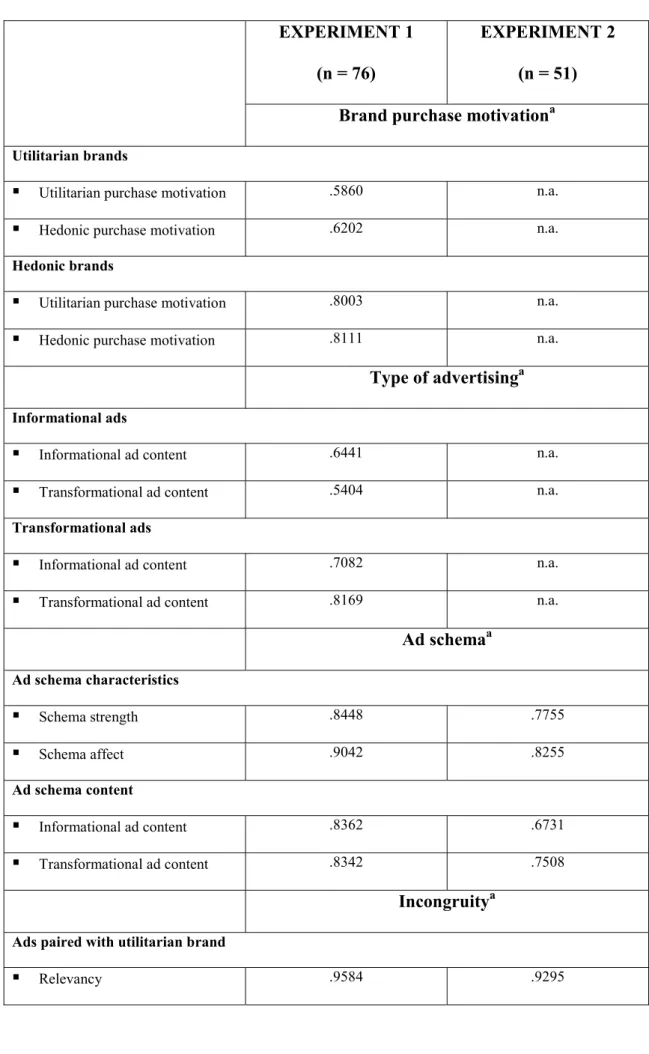
appendix 2). Most Cronbach α's of the constructs were higher than 0.7, and a few
were in the 0.5–0.7 range (see table 1). Although some constructs were not measured
reliably for specific brands or ads, the same scale items were used for reasons of
comparability.
---
Table 1 about here
Results
Manipulation checks
Overall, the manipulation checks were successful and are discussed in detail below.
Brand perceptions. The paired-samples t-tests for brand purchase motivation
showed that the utilitarian and hedonic brand descriptions were perceived as intended
(see table 2). Both for deodorants and soft drinks, the utilitarian brand was more likely
to possess utilitarian product attributes than the hedonic brand, while the reverse was
true for hedonic product attributes. Independent-samples t-tests showed that the
differences between utilitarian and hedonic product attributes were also significant
within each brand for both product categories. Finally, the initial attitude toward the
utilitarian brand was more favorable than toward the hedonic brand in both product
categories. This result is somewhat surprising for the soft drink category, because
consumers predominantly buy soft drinks for hedonic reasons (sensory excitement).
---
Table 2 about here
---
Ad perceptions. The paired-samples t-tests for type of advertising showed that
the ad descriptions were perceived as intended (see table 2). Both for deodorants and
soft drinks, the informational ad was likely to feature more informational ad content
than the transformational ad, while the reverse was true for transformational ad
content. Independent-samples t-tests showed that the differences between
informational and transformational ad content within each type of ad were also
transformational ad was more favorable than for the informational ad in both product
categories. This is not surprising because transformational ads are intended to elicit
positive emotions that enhance the user's brand experience (Aaker & Stayman 1992).
Ad schema. The ad schema for deodorants was different than for soft drinks.
Paired-samples t-tests for ad schema content showed that the ad schema for soft
drinks was more likely to feature transformational ad content than informational ad
content (5.60 vs 2.77, p < .001), whereas the ad schema for deodorant did not differ
significantly in terms of transformational and informational ad content (4.98 vs 4.51,
p < .001). Furthermore, the affect associated with typical soft drink ads was more
positive than the affect associated with typical deodorant ads (independensamples
t-test: 4.30 vs 3.45, p < .01).
Incongruity perceptions. Incongruity perceptions associated with the four
brand–ad combinations were investigated through the relevancy and expectancy
dimensions identified by Heckler & Childers (1992). The relevancy and expectancy
dimensions of incongruity were examined separately for both product categories,
using GLM repeated measures with brand-matching condition (referred to as
“condition” from here on) as between-subjects factor and brand as within-subjects
factor. The estimated marginal means of relevancy and expectancy are displayed in
table 3.
The GLM repeated measures for ad relevancy in the soft drink category
showed a significant main effect of condition (p < .001), indicating that consumers
perceived ads in the brand-matching condition as more relevant to the brand than ads
in the brand-mismatching condition. Furthermore, there was a significant brand ´
condition interaction (p < .001), which showed that the difference in perceived ad
brand than for the hedonic brand. The condition main effect for ad relevancy showed
that the manipulation of the ad's incongruity with brand perceptions was successful.
The GLM repeated measures for ad expectancy in the soft drink category
showed a significant brand ´ condition interaction (p < .001). The estimated marginal means for expectancy (see table 2) showed that the ad in the brand-matching
condition was relatively atypical for the utilitarian brand, while the ad in the mismatch
condition was relatively atypical for the hedonic brand. Both ads were informational
and consequently did not match the transformational ad schema for soft drinks. Thus,
the brand ´ condition interaction effect for ad expectancy showed that the
manipulation of the ad's incongruity with ad schema perceptions was successful.
The GLM repeated measures for ad relevancy in the deodorant category
showed a significant main effect of condition (p < .001), indicating that consumers
perceived ads in the brand-matching condition as more relevant to the brand than ads
in the brand-mismatching condition. Furthermore, there was a significant brand ´
condition interaction (p < .05), which showed that the difference in perceived ad
relevance caused by mismatching brand perceptions was larger for the utilitarian
brand than for the hedonic brand. The condition main effect for ad relevancy showed
that the manipulation of the ad's incongruity to brand perceptions was successful.
The GLM repeated measures for ad expectancy in the deodorant category
showed a significant brand ´ condition interaction (p < .05). The estimated marginal means for expectancy showed that for the hedonic brand, the ad in the
brand-mismatching condition was relatively atypical, while for the utilitarian brand, the ads
were equally typical in both conditions. No brand ´ condition interaction was expected, because both informational and transformational ads were expected to be
incongruity with ad schema perceptions was not successful. Consequently, there may
also be a moderating effect of ad schema for deodorant. In addition to the brand ´
condition interaction, the brand main effect (p < .01) and the condition main effect (p
< .10) for ad expectancy were also significant, but these effects were probably caused
by the unexpected brand ´ condition interaction.
---
Table 3 about here
---
The ad stimuli were also compared directly with the ad schemas in terms of
informational and transformational ad content. The paired-samples t-tests for soft
drinks showed that the informational ad was less transformational (p < .001) and more
informational (p < .001) than the soft drink ad schema, while the transformational ad
was more transformational (p < .001) than the soft drink schema and equally
informational (p > .10). This implies that the transformational ad was congruent with
the ad schema (even more transformational) and the informational ad was incongruent
with the ad schema in terms of perceived ad content. Thus the soft drink ads'
incongruity with the ad schema was perceived as intended.
For deodorant the paired-samples t-tests showed that the informational ad was
less transformational (p < .01) and more informational (p < .001) than the deodorant
ad schema, while the transformational ad was more transformational (p < .001) and
less informational (p < .01) than the deodorant ad schema. This suggests that the
deodorant ads were good examples of the informational and transformational ads that
are both part of the deodorant ad schema.
Hypotheses 1-3 were investigated by means of both the ranking and the rating task. The results showed strong evidence for the match hypothesis in both product
categories. Furthermore, we found evidence for a moderating effect of ad schema, but
only in the ranking task.
Ranking task. The hypotheses for the ranking task were examined with
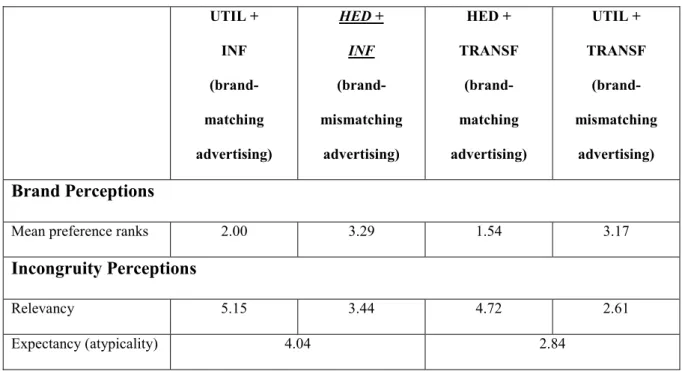
Wilcoxon signed rank tests. The mean ranks for each of the brand-ad combinations are shown in table 4. The Wilcoxon test showed that the utilitarian-informational combination was ranked higher than utilitarian-transformational combination (p < .001), and the hedonic-transformational combination was ranked higher than the hedonic-informational combination (p < .001) for both deodorant and soft drinks, thus confirming hypotheses 1 and 2.
---
Table 4 about here
---
Hypothesis 3 specified that the two mismatching brand-ad combinations would differ in rank as a result of the moderating effect of ad schema. Specifically,
we expected that the mismatching brand-ad combination that was congruent with the ad schema would be ranked higher than the mismatching brand-ad combination that
was incongruent with the ad schema. The Wilcoxon test for soft drinks showed that
the utilitarian-transformational combination was ranked somewhat higher than the utilitarian-informational combination (one-tailed p < .10). This was in accordance with the relatively transformational content of the ad schema for soft drinks, thus
confirming hypothesis 3.
For deodorant, the Wilcoxon test showed that the utilitarian-transformational combination was ranked higher than the hedonic-informational combination
(two-tailed p < .01), although the ad schema for deodorant was not perceived as
predominantly transformational. This is not in agreement with hypothesis 3.
In addition to our hypotheses, we also checked whether the two matching
brand-ad combinations differed in rank, but this was the case for neither of the product categories (two-tailed p > .10). In conclusion, the rankings showed evidence
for the matching hypothesis and, in the case of soft drinks, also for the moderating
role of ad schema.
Rating task. The hypotheses for the rating task were examined for both
product categories through GLM repeated measures with brand-ad match vs mismatch as between-subjects factor and brand as within-subjects factor. The
dependent measures included in the GLM analyses were attitude change scores,
because the manipulation checks showed that there were significant differences in
prior attitudes between brands and ads in both product categories. The attitude change
scores were calculated for both brands and ads by subtracting the prior attitudes from
post-manipulation attitudes. The estimated marginal means for changes in attitudes
are shown in table 4.
The GLM repeated measures for soft drinks showed a significant main effect
of matching for both brand attitude (p < .001) and attitude toward the ad change
scores (p < .001). Both brand attitude and attitude toward the ad change scores were
more favorable in the match condition than in the mismatch condition (see table 4).
This means that the match hypothesis was confirmed for the soft drink category. In
addition, the main effect of brand was marginally significant (p < .10) for brand
attitude change scores, showing that on average the brand attitude change score was
more favorable for the hedonic soft drink brand than for the utilitarian soft drink
The GLM repeated measures for deodorant showed a significant main effect
of matching for both brand attitude (p < .01) and attitude toward the ad change scores
(p < .05). Both brand attitude and attitude toward the ad change scores were more
favorable in the match condition than in the mismatch condition (see table 4). This
means that the match hypothesis was also confirmed for the deodorant category. Thus,
we find strong support for hypothesis 1 and 2 in both categories.
Hypotheses 3 stated that the mismatching brand-ad combination that was congruent with the ad schema would be evaluated more favorably than the
mismatching brand-ad combinations that was not congruent with the ad schema. Neither for soft drinks nor for deodorant the brand ´ matching interaction effect was significant, neither for brand attitude change scores nor for attitude toward the ad
change scores. This means there was no evidence for the moderating role of the soft
drinks and deodorant ad schemas, so hypothesis 3 was not confirmed. Unlike the
ranking task, the subjects did not distinguish between the two mismatching brand-ad combinations in the rating task. In conclusion, the rating task showed evidence for the
matching hypothesis, but not for the moderating role of ad schema.
Discussion of experiment 1
It appeared that matching advertising was more effective than
brand-mismatching advertising when the brand schema was made salient. Consumers
preferred ads matching the brand purchase motivation to mismatching ads in two
different product categories, with two different tasks. Thus strong support was found
for the matching hypothesis from the RP grid.
In an earlier experimental test of the RP grid (Loef et al. 2001), in which
advertising was more effective than brand-matching advertising. This was explained
by suggesting that brand schema salience is required for the matching hypothesis from
the RP grid to apply. Salience of the brand schema was accomplished in the current
experiment by letting the participants fit ad scenarios to particular brand descriptions.
Since deodorant was included in both the current experiment and our previous study,
the difference in results already provided evidence that schema salience played a
crucial role. If schema salience indeed caused the different patterns of evaluations for
deodorant, reducing brand schema salience for soft drinks should also cause a
different pattern of evaluations. This proposition is tested in the second experiment of
this study.
The evidence for a moderating role of ad schema in this experiment was less
pronounced than the evidence for the matching hypothesis. We found that the ad
schema moderated evaluations of the two mismatching brand-ad combinations for soft drinks, but only in the ranking task, not in the rating task. For deodorant, the ad
schema was both informational and transformational. In this case, the evaluations of
mismatching brand-ad combinations indicated preference for the combination including transformational advertising. This result is plausible, given the relatively
favorable attitudes toward transformational advertising.
EXPERIMENT 2
In the second experiment, we tested the proposition that brand schema salience was
responsible for the match hypothesis found in the first experiment. We reduced the
importance of the brand purchase motivation by making the ad schema salient in ad
advertising would lead to more favorable brand and ad evaluations than
brand-mismatching advertising.
Method
Design. A 2 (brand purchase motivation) ´ 2 (type of advertising)
experimental design was used. As explained in the discussion of the first experiment,
only soft drinks were included in experiment 2. Brand and ad perceptions were
manipulated by means of hypothetical brand descriptions and ad scenarios. Exactly
the same ads were used as in the first experiment. However, the brand descriptions
(see appendix 2) were abbreviated to make brand information less salient to the
participants without changing the essential characteristics of the brands. Again, two
brand-ad combinations represented brand-matching advertising and two brand-ad combinations represented brand-mismatching advertising. Because the ad schema was
made salient, no effect of the interaction between brand purchase motivation and type
of advertising on incongruity perceptions were expected. Instead, incongruity was
expected with ads mismatching the ad schema perceptions. For reasons of
comparability, subjects in this experiment received either two matching or two
mismatching ad combinations like they did in the first experiment. Thus
brand-matching was a between-subjects factor.
Subjects and procedure. Data were collected in October 2001 in a sample of
51 Dutch undergraduate students. The students were told that they were part of a
study on advertising and that we were interested in their opinion about brands and
ads. In contrast to experiment 1 we also instructed the participants that they should try
to evaluate brands and ads just like they would do if they watched commercials on
in experiment 1. However, the order of the questions was changed to make the ad
schema salient and some questions were left out to avoid brand schema salience or
because they were redundant.
The questionnaire was constructed as follows. First, subjects answered
questions about their ad schema perceptions to make the ad schema salient in ad
processing and evaluation for the remainder of the questionnaire. Then subjects read
the two ad descriptions, and answered questions about their initial attitudes and the
ads' perceived fit with the ad schema. Next, the dependent measures were collected by
means of a rating task. Just like in the first experiment brand-ad combinations were introduced as the ad that was selected by the manufacturers for use in their marketing
campaigns. However, in this experiment the ad schema was made salient before the
participants read the (abbreviated) brand descriptions. Subjects received either the two
brand-matching or the two brand-mismatching combinations. Finally, subjects were
asked to perform a ranking task in which they had to rank all four brand-ad
combinations in order of preference and subsequently answered questions about the
ads' relevancy to the brands for the two brand-ad combinations they had evaluated. In experiment 1, the ranking task was used for testing hypotheses. In
experiment 2 the ranking task merely served as a manipulation check to verify that the
abbreviation of the brand descriptions did not change consumer brand perceptions.
Therefore, the introduction to the ranking task emphasized the importance of fit
between the brand and the ad as in the first experiment.
Measures. The independent variables in this study were brand purchase
motivation and type of advertising. The dependent variables in this study were brand
Results
Manipulation checks
Overall, the manipulation checks were successful. The manipulation checks for brand,
ad, ad schema and incongruity perceptions are described in detail below.
Brand perceptions. The manipulation checks for brand perceptions were
examined by means of Wilcoxon signed rank tests. The mean ranks for each of the
brand-ad combinations are shown in table 5. In the ranking task, the brand schema was salient, so according to the match hypothesis brand-matching combinations
should be ranked higher than brand-mismatching combinations. The Wilcoxon tests
showed that the utilitarian-informational combination was ranked higher than
utilitarian-transformational combination (p < .001), and the hedonic-transformational combination was ranked higher than the hedonic-informational combination (p < .001). This means that although the brand descriptions were abbreviated for the
purpose of this experiment, participants' rankings were still in accordance with the
match hypothesis when instructions emphasized fit with the brand schema. Therefore,
we can conclude that the brands were perceived as intended. Further evidence for this
conclusion is discussed in the manipulation checks on incongruity.
---
Table 5 about here
---
Ad perceptions. Since the same informational and transformational soft drink
ads were used as in experiment 1, ad content perceptions were not measured in
the experimental ads. The transformational ad was evaluated more favorably than the
informational ad (4.84 vs. 3.04, p < .001), which was in line with the first experiment.
Ad schema perceptions. Paired-samples t-tests for ad schema content showed
that the ad schema for soft drinks was more likely to feature transformational than
informational ad content (5.74 vs. 2.95, p < .001). Consequently, the ad schema for
soft drinks can be qualified as predominantly transformational in nature.
Incongruity perceptions. Incongruity associated with the four brand-ad
combinations was examined through the relevancy and expectancy dimensions
identified by Heckler & Childers (1992). The paired-samples t-tests for ad typicality
showed that the transformational ad was perceived as more typical than the
informational ad (2.84 vs. 4.04, p < .001, larger figures indicating less typical ads).
This means that the manipulation of the ad's incongruity with ad schema perceptions
reflecting the expectancy dimension was successful.
Although, the relevancy dimension of incongruity was not of primary
importance to subjects' evaluations in the second experiment, we included it in our
experiment to examine whether abbreviation of the brand descriptions had changed
the meaning of the brands. Since the brand schema was salient directly after the
ranking task, we expected that ads in the brand-matching condition were more
relevant than ads in the brand-mismatching condition. The GLM repeated measures
for ad relevancy with brand as within-subjects factor and matching as
between-subjects factor showed a significant main effect for matching (p < .001). This is
additional evidence that the abbreviation of the brand description did not alter the
characteristics of the brand. In addition to the main effect of matching, a brand ´
matching interaction was found for ad relevancy (p < .01). This interaction effect
brand purchase motivation, was larger for the utilitarian brand than for the hedonic
brand (see Table 5).
Hypotheses
Hypothesis 4 was investigated by means of a rating task. Similar as in
experiment 1, participants evaluated two of the four brand-ad combinations on 7-point scales. GLM repeated measures was used with brand-matching condition as
between-subjects factor and brand as within-subjects factor. The dependent measures
were attitude change scores for attitude toward the ad and post-manipulation brand
attitude. Attitude toward the ad change scores were used because the manipulation
checks showed that there were significant differences in prior attitudes between the
informational and transformational soft drink ads. Contrary to experiment 1, we could
not use brand attitude change scores, because prior brand attitudes were not measured
in this experiment. Measurement of prior brand attitudes was excluded from
experiment 2 because it was likely to interfere with ad schema salience. The estimated
marginal means for brand attitude and attitude toward the ad change are shown in
table 6.
---
Table 6 about here
---
Hypothesis 4 stated that when the ad schema is salient, brand and ad
evaluations would not be affected by the brand-matching or brand-mismatching
nature of advertising. The GLM repeated measures showed a significant brand ´
matching interaction for both post-manipulation brand attitudes (p < .001) and attitude
matching were not significant in the GLM analyses of experiment 2, supporting
hypothesis 4.
The brand ´ matching interaction for post-manipulation brand attitudes indicated that the brand-mismatching ad was evaluated more favorably than the
brand-matching ad for the utilitarian brand, while the reverse was true for the hedonic
brand. Thus, both the utilitarian and hedonic brands were evaluated more favorably
when they were paired with the transformational ad than when the brands were
presented in combination with the informational ad. The brand ´ matching interaction for attitude toward the ad change scores indicated that the brand-matching ad led to
greater attitude change scores than the brand-mismatching ad for the utilitarian brand,
while the reverse was true for the hedonic brand. Thus, the informational ad led to
greater attitude change scores than the transformational ad.
Comparison between experiments 1 and 2. To investigate hypothesis 4 further,
we also analyzed the soft drink data with GLM repeated measures for both
experiments together. The dependent measures were attitude toward the ad change
scores and post-manipulation brand attitudes. Brand-matching condition and saliency
(either brand schema or ad schema salient) were included as between-subjects factors
and type of brand was included as within-subjects factor. The GLM repeated
measures for attitude toward the ad change showed significant main effects of
salience (p < .001) and matching (p < .001). Furthermore, the brand ´ matching (p < .05) and salience ´ matching (p < .001) interaction effects were significant. The salience ´ matching interaction indicated that ad evaluations differed between the brand-matching and brand-mismatching conditions in line with the match hypothesis
not when the ad schema was salient (estimated marginal means: 0.235 vs. 0.233). This
two-way interaction effect supported hypothesis 4 for ad evaluations.
The GLM repeated measures for post-manipulation brand attitudes showed
significant main effects of salience (p < .10) and matching (p < .001). Furthermore,
the brand ´ matching (p < .001), and brand ´ salience ´ matching interaction (p < .01) effects were significant. The brand ´ salience ´ matching interaction indicated that the brand evaluations showed a brand ´ matching interaction when the ad schema was salient but not when the brand schema was salient. The estimated marginal means for
the ad schema salient condition showed that the utilitarian brand was evaluated more
favorably in the brand-mismatching condition than in the brand-matching condition
(4.08 vs. 4.73), while the reverse was true for the hedonic brand (5.12 vs. 3.72). This
means that when the ad schema was salient both brands were evaluated relatively
favorably when they were paired with a transformational ad. When the brand schema
was salient, both brands were evaluated more favorably when they were paired with
an ad that matched the brand purchase motivation. Thus, both the utilitarian (5.22 vs.
4.46) and hedonic brand (5.08 vs. 4.03) were evaluated more favorably in the
brand-matching condition than in the brand-misbrand-matching condition. This three-way
interaction effect supported hypothesis 4 for brand evaluations.
Discussion of experiment 2
Contrary to experiment 1, the results from the second experiment did not
indicate that brand-matching advertising was more effective than brand-mismatching
advertising. Instead of preferring brand-matching advertising, participants' evaluations
suggested that brand-matching aspects of advertising were not important to subjects
when the ad schema was salient.
GENERAL DISCUSSION
Taken together, these experiments supported the role of schema salience in ad
processing and evaluation. In the first experiment, the brand schema was salient and
consumer evaluations were in accordance with the match hypothesis of the RP grid.
Brand-matching advertising was more effective than brand-mismatching advertising.
This suggested that consumers explicitly related ads to brand knowledge, because the
informational ad provided relevant information about the utilitarian brand, while the
transformational ad contained relevant information about the hedonic brand. In the
second experiment, brands and ads were essentially the same as in the first
experiment, but the relative effectiveness of brand-matching advertising was not
found. Instead, the brand and ad evaluations were in line with prior attitudes toward
the ad. The only difference between the two experiments was ad schema saliency. The
results of the second experiment showed that consumers ignored the brand-matching
aspects of advertising, which means that consumers did not relate the ads to their
brand knowledge. This finding has important implications for both advertising
research and practice.
The main theoretical implication, from this study and our previous study is
that brand awareness, which is a prerequisite in the RP advertising grid, may not be
enough. Instead, brand salience is required for the predictions from the RP grid to
hold. Brand salience differs from brand awareness in that consumers do not only
know the brand and its features but also actively use this knowledge in processing ad
grid, but our study shows the importance of explicitly identifying schema salience as
an additional requirement in the RP grid. Furthermore, the ad schema was identified
as an alternative schema that is used by consumers in ad processing and evaluation.
Although Goodstein (1993) already suggested the importance of the ad schema in ad
processing, the effect of brand schema knowledge is not clear from his research. We
explicitly incorporated brand schema knowledge and found that consumers did not
pay attention to the fact whether ads matched or mismatched with brand perceptions,
when the ad schema was salient.
This also has important implications for advertising practice. When different
ads are tested for a brand, brand schema salience is required. When consumers do not
actively use brand knowledge in judging ads, brand managers may select ads that do
not clearly communicate the brand's positioning for their ad campaigns. Furthermore,
the finding that congruity with existing brand knowledge is not always important to
consumers also indicates that clearly communicating the brand's positioning in
advertising will not always be effective. When consumers predominantly use the ad
schema to process ads, it may also be a good approach for the manufacturer to use an
ad that is moderately incongruent with the ad schema. Schema theory suggests that
APPENDIX 1: Brand descriptions and ad scenarios
Utilitarian soft drink brand (experiment 1): Zest is a new brand of soft drink,
which is expected to be available very soon. This new drink is especially formulated
for sporty people. The carbonated beverage has a slightly sweet taste and tastes best
when it is served at a cold temperature. A 1.5L bottle of Zest contains only 1 calory,
so it keeps you slim and in shape. Furthermore, the beverage contains natural
ingredients that immediately give you a new boost of energy when you are feeling
tired. Zest will be available in supermarkets and sports centres.
Hedonic soft drink brand (experiment 1): Cool'N'Fresh is a new brand of soft
drink, which is expected to be available very soon. This new drink is especially
formulated for young people. The carbonated beverage has a slightly sweet taste and
tastes best when it is served at a cold temperature. A can of Cool'N'Fresh gives you
the ultimate refreshing experiences when the weather is hot. Moreover, the beverage
is fit for all situations, so it tastes great whether you are at home, at a party with
friends or out drinking. Cool'N'Fresh will be available in supermarkets.
Utilitarian soft drink brand (experiment 2): Zest is a new brand of soft drink.
This drink contains 1 calory per bottle and is based on natural ingredients that give
new energy.
Hedonic soft drink brand (experiment 2): Cool'N'Fresh is a new brand of soft
drink. This drink is refreshing, tasty and can be consumed anywhere.
Informational soft drink ad (experiments 1 and 2) – Fitness Club: A young
woman sits in the locker room of a fitness club and looks in the camera. She tells that
it is important to her to keep in shape and be fit. "That's why I go to my fitness club
once a week. First, I am busy on different types of fitness machines and afterwards it
drinking coke then, just because you are thirsty…" Then she smiles in the camera:
"Of course it tastes great, but you immediately gain all calories you just burned. That's
why I drink <ZEST> or <COOL'N'FRESH >. It only contains 1 calory and it
immediately gives you a new boost of energy. The commercial ends with a voice-over
saying <ZEST, fresh and energetic> or <COOL'N'FRESH, fresh and cool>.
Transformational soft drink ad (experiments 1 and 2) - Party: The commercial
shows various, flashy images of young people partying. Alternately you see pictures
of youths from various parts of the world. Footage of a beach party from Brazil.
Images of an audience at a big pop concert in a park somewhere in Europe. Dancing
people in a London disco. Pictures of teenagers relaxing in the sun in Central Park,
New York. Meanwhile, the camera zooms in on various attractive young people
drinking <ZEST> or <COOL'N'FRESH> and cans of <ZEST> or
<COOL'N'FRESH> cooled on ice cubes. The commercial ends with a voice-over
saying <ZEST, fresh and energetic> or <COOL'N'FRESH, fresh and cool>.
Utilitarian deodorant brand (experiment 1): Protect is a new deodorant that
lasts all day long. Now you don't have to worry any more about the unpleasant effects
of perspiration. This deodorant is available in both rollerstick and spray variants. The
brand will be on sale in supermarkets and drug stores.
Hedonic deodorant brand (experiment 1): Seductive is a new deodorant with a
tempting scent. With this deodorant you will feel simply irresistable. This deodorant
is available in both rollerstick and spray variants. The brand will be on sale in
supermarkets and drug stores.
Informational deodorant ad (experiment 1) – Business Woman: A woman in
look good in her job. She says: “I have to trust that I always make a self-assured
impression, no matter how busy I am. Thanks to <PROTECT> or <SEDUCTIVE>
deodorant I feel fresh and secure all day and can concentrate fully on my work.” The
voice-over ends with the claim <PROTECT deodorant protects you all day long> or
<SEDUCTIVE deodorant for an unforgettable impression>.
Transformational deodorant ad (experiment 1) - Disco: The camera shows
images of a crowded disco with young people dancing on steamy R&B music. Then
the camera zooms in on a seductive woman and follows her while she dances to the
center of the floor with sensual movements. She immediately attracts attention and
admiring looks from all the men she passes. The voice-over ends with the claim
<PROTECT deodorant protects you all day long> or <SEDUCTIVE deodorant for an
APPENDIX 2: Overview of independent and dependent measures
All constructs were measured with seven-point scales. Both Likert-type scales and
semantic differentials were used. The reliabilities of the constructs used in both
experiments are displayed in table 2.
1. Brand perceptions. Product belief ratings indicated the extent to which the
brands were associated with utilitarian and hedonic purchase motives. Two product
beliefs represented utilitarian benefits, and two product beliefs were hedonic benefits.
For soft drinks subjects indicated whether the brand was a drink that 1. gives new
energy when feeling tired, 2. you use when you care about your health, (utilitarian
product beliefs), 3. is highly enjoyable, 4. gets you a refreshing taste experience
(hedonic product beliefs). For deodorant subjects indicated whether the brand was a
deodorant that 1. gives long-lasting protection , 2. is highly effective against
perspiration (utilitarian product beliefs), 3. has a pleasant, seductive scent, 4. makes
you feel attractive (hedonic product beliefs). Factor analyses of the four product
beliefs were performed for each experimental brand separately and per type of brand
(the two utilitarian brands and the two hedonic brands together). All factor analyses
showed that the four product beliefs loaded on two factors, with the utilitarian product
beliefs loading on one factor and the hedonic product beliefs on the other. Therefore
the product attribute beliefs were grouped together to represent utilitarian and hedonic
purchase motivation.
2. Ad perceptions. Informational ad content was measured with the following
Likert-type scales: “the commercial is factual and informative”, “the advertisement
suggests the solution to a problem”, “the ad focuses on usage benefits associated with
1987, Olney, Holbrook & Batra 1991). Transformational ad content scales were “the
commercial tries to create a mood”, “the advertisement presents a slice of life”, “an
enjoyment appeal is used in the ad”, and “the ad contains many images showing
positive emotions”. Factor analyses of the eight ad content items were performed for
each experimental ad separately and per type of ad (the two informational ads and the
two transformational ads together). All factor analyses showed a two-factor solution.
Generally, the items intended to measure informational ad content loaded on one
factor, and the items intended to measure transformational ad content loaded on the
other. Thus the ad content items were combined in an informational and a
transformational ad construct.
3. Ad schema perceptions. General ad schema characteristics were measured
by Goodstein's (1993) thirteen-item questionnaire about expectations for product
category ads. Factor analyses of the thirteen ad schema statements were performed for
each product separately and for both products together. All factor analyses showed a
two-factor solution, one factor containing five statements related to ad schema
strength and another factor containing eight statements reflecting ad schema affect.
Consequently, the items were grouped in a schema strength and a schema affect
construct. Furthermore, ad schema content perceptions were measured with the same
eight items that measured ad content perceptions. Again factor analyses of the eight
ad schema content items were performed for each product separately and for both
products together. All factor analyses showed a two-factor solution, one containing
most informational ad content items, and the other containing the four
transformational ad content items. Thus, the ad content items were grouped in an
4. Incongruity perceptions. Relevancy and expectancy represent two
dimensions of incongruity. Four statements about the fit between the brand and its
accompanying ad (adapted from Heckler & Childers 1992) measured the relevancy
dimension of incongruity: “The <AD SCENARIO TITLE> ad fits <BRAND> very
well”, “The commercial clearly presents <BRAND>'s defining characteristics”, “This
type of advertising is very appropriate for <BRAND>”, “The ad for <BRAND>
contains relevant information about the brand”. Four adjectives (adapted from
Goodstein 1993 and Heckler & Childers 1992) measured ad typicality or the
expectancy dimension of incongruity. Consumers indicated to what extent the ad was
“different”, “atypical”, “unique” and “unexpected”, compared to product category ads
in general.
5. Brand evaluation. Prior and post-campaign brand attitudes were measured
by three items “good-bad” “positive-negative” “favorable-unfavorable” (Batra &
Ahtola's 1990 items for overall brand attitude).
6. Ad evaluation. Prior and post-campaign attitudes toward the ad were
measured by four items “good-bad”, “like-dislike”, “irritating-not irritating”,
REFERENCES
Aaker, David A. & Douglas M. Stayman (1992), “Implementing the Concept of
Transformational Advertising,” Psychology & Marketing, 9 (3), 237–253.
Batra, Rajeev & Olli T. Ahtola (1990), “Measuring the Hedonic and Utilitarian
Sources of Consumer Attitudes, ” Marketing Letters, 2 (April), 159–170.
Broniarczyk, Susan M. & Joseph W. Alba (1994), “The Importance of the Brand in
Brand Extension,” Journal of Marketing Research, XXXI (May), 214–228.
Drolet, Aimee & Jennifer L. Aaker (2001), “Off-Target? Changing Cognitive-Based
Attitudes, ” Journal of Consumer Psychology, forthcoming.
Dubé, Laurette, Amitava Chattopadhyay & Anick Letarte (1996), “Should
Advertising Appeals Match the Base of Consumers’ Attitudes? ” Journal of
Advertising Research, 36 (6), 82–89.
Edwards, Kari (1990), “The Interplay of Affect and Cognition in Attitude Formation
and Change, ” Journal of Personality and Social Psychology, 59 (2), 202–216.
Fiske, Susan T. & Shelley E. Taylor (1984), Social Cognition, 1st edition. New York:
McGraw-Hill.
Goodstein, Ronald C. (1993), “Category-based Applications and Extensions in
Advertising: Motivating More Extensive Ad Processing, ” Journal of Consumer
Research, 20 (June), 87–99.
Heckler, Susan E. & Terry L. Childers (1992), “The Role of Expectancy and
Relevancy in Memory for Verbal and Visual Information: What is Incongruency?”
Holbrook, Morris B. & Rajeev Batra (1987), “Assessing the Role of Emotions as
Mediators of Consumer Responses to Advertising,” Journal of Consumer
Research, 14 (December), 404–420.
Krishnan, H.S. (1996), “Characteristics of Memory Associations: A Consumer-Based
Brand Equity Perspective,” International Journal of Research in Marketing,13,
389–405.
Lee, Yih Hwai & Charlotte Mason (1999), “Responses to Information Incongruency
in Advertising: The Role of Expectancy, Relevancy, and Humor,” Journal of
Consumer Research, 26 (September), 156–169.
Loef, Joost, Gerrit Antonides & W. Fred van Raaij (2001), “The Effectiveness of
Advertising Matching Purchase Motivation: An Experimental Test, ” ERIM Report
Series Research in Management, ERS-2001-65-MKT, Erasmus University,
Rotterdam, The Netherlands.
Mandler, George (1982), “The Structure of Value: Accounting for Taste,” in Affect
and Cognition: The Seventeenth Annual Carnegie Symposium on Cognition, ed.
Margaret Sydnor Clark & Susan T. Fiske, Hillsdale, New Jersey: Lawrence
Erlbaum, pp. 3–36.
Meyers-Levy, Joan & Alice M. Tybout (1989), “Schema Congruity as a Base for
Product Evaluation,” Journal of Consumer Research, 16 (June), 39–54.
Millar, Murray G. & Karen U. Millar (1990), “Attitude Change as a Function of
AttitudeType and Argument Type,” Journal of Personality and Social Psychology,
59 (2), 217–228.
Mitchell, Andrew A. & Jerry C. Olson (1981), “Are Product Attribute Beliefs the
Only Mediator of Advertising Effects on Brand Attitude?” Journal of Marketing
Olney, Thomas J., Morris B. Holbrook & Rajeev Batra (1991), “Consumer Responses
to Advertising: The Effects of Ad Content, Emotions, and Attitude toward the Ad
on Viewing Time,” Journal of Consumer Research, 17 (March), 440–453.
Park, C. Whan, Bernard J. Jaworski & Deborah J. MacInnis (1986), “Strategic Brand
Concept-Image Management,” Journal of Marketing, 50 (October), 135–145.
Park, C. Whan, Sandra Milberg & Robert Lawson (1991), “Evaluation of Brand
Extensions: The Role of Product Feature Similarity and Brand Concept
Consistency,” Journal of Consumer Research, 18 (September), 185–193.
Peracchio, Laura A. & Alice M. Tybout (1996), “The Moderating Role of Prior
Knowledge in Schema-Based Product Evaluation,” Journal of Consumer
Research, 23 (December), 177–192.
Rossiter, John R. & Larry Percy (1997), Advertising Communications and Promotion
Management, Boston, MA: McGraw-Hill, second edition.
Rossiter, John R., Larry Percy & Robert J. Donovan (1991), “A Better Advertising
Planning Grid,” Journal of Advertising Research, 31 (5), 11–21.
Stayman, Douglas M., Dana L. Alden & Karen H. Smith (1992), “Some Effects of
Schematic Processing on Consumer Expectations and Disconfirmation
Judgments,” Journal of Consumer Research, 19 (September), 240–255.
Vaugh, Richard (1980), “How Advertising Works: A Planning Model,” Journal of
Advertising Research, 20 (5), 27–33.
Vaughn, Richard (1986), “How Advertising Works: A Planning Model Revisited,”
TABLE 1 – Reliability coefficients (both experiments) EXPERIMENT 1
(n = 76)
EXPERIMENT 2 (n = 51) Brand purchase motivationa
Utilitarian brands
§ Utilitarian purchase motivation .5860 n.a.
§ Hedonic purchase motivation .6202 n.a.
Hedonic brands
§ Utilitarian purchase motivation .8003 n.a.
§ Hedonic purchase motivation .8111 n.a.
Type of advertisinga
Informational ads
§ Informational ad content .6441 n.a.
§ Transformational ad content .5404 n.a.
Transformational ads
§ Informational ad content .7082 n.a.
§ Transformational ad content .8169 n.a.
Ad schemaa Ad schema characteristics § Schema strength .8448 .7755 § Schema affect .9042 .8255 Ad schema content § Informational ad content .8362 .6731 § Transformational ad content .8342 .7508 Incongruitya
Ads paired with utilitarian brand
§ Expectancy (atypicality) .8816 n.a.
Ads paired with hedonic brand
§ Relevancy .8577 .8536
§ Expectancy (atypicality) .9059 n.a.
Informational ad
§ Expectancy (atypicality) n.a. .5805
Transformational ad
§ Expectancy (atypicality) n.a. .7947
Brand attitudeb Utilitarian brands
§ Prior attitude .9469 n.a.
§ Post-manipulation attitude .9177 .9404
Hedonic brands
§ Prior attitude .9395 n.a.
§ Post-manipulation attitude .9613 .9470
Attitude toward the adb Informational ads
§ Prior attitude .7969 .8632
Transformational ads
§ Prior attitude .8606 .8213
Ads paired with utilitarian brand
§ Post-manipulation attitude .7621 .9117
Ads paired with hedonic brand
§ Post-manipulation attitude .9186 .9180 n.a. = not available for this experiment