Game-Theoretic Delay-Sensitive Multirate
Power Control for CDMA Wireless Networks
with Variable Path Loss
Christopher A. St. Jean and Bijan Jabbari
Department of Electrical and Computer EngineeringGeorge Mason University Fairfax, VA 22030–4444 Email:{cstjean, bjabbari}@gmu.edu
Abstract— A stochastic game-theoretic framework for calculat-ing transmit power strategies for nodes in a competitive CDMA wireless network is presented. Unlike traditional game-theoretic power control, delay sensitivity is explicitly included. Stationary Nash equilibria that are a function of congestion and that allow for multirate transmission are determined. In both static path loss and dynamic shadowing path loss environments, the stochastic game equilibria calculated compare very favorably to traditional single-agent and often approach the performance of centralized optimization.
I. INTRODUCTION
Power control for CDMA wireless systems is an imperative, not only to mitigate the near-far problem, but also to improve the capacity of systems with scarce bandwidth. Recently, noncooperative game theory has emerged as the appropriate framework within which to analyze resource allocation prob-lems in competitive wireless networks [1]–[4]. Such networks are presumed to consist of nodes which cannot form binding contracts of behavior and, as such, can be considered selfish utility maximizers. Research following this approach has most often dealt with the static allocation of transmit powers in networks without regard to buffer level variation in time (congestion) or to evolving channel conditions. (A notable exception is [5].) The present effort addresses both of these shortcomings and offers novel solutions.
This work applies stochastic game theory, which models the dynamism of the cellular uplink power-control problem by assigning a vector of buffer states to the nodes and captures the statistics of packet arrivals from higher layers and packet departures via successful transmissions, neither of which is deterministic. By adapting a recently-devised solution technique of Herings and Peeters [6], consistent stationary Nash equilibria of the delay-sensitive power control problem which map congestion level to a transmit power level are de-termined. Such equilibria maximize the expected utility (now and discounted in future slots) at each node. This approach represents a game-theoretic refinement of other congestion-sensitive wireless resource allocation efforts such as [7], [8].
Furthermore, evolving channel conditions can be accommo-dated within the preceding framework heuristically. Specif-ically, approximate Nash equilibria can be determined for
varying channel shadowing conditions by generating and switching between multiple Nash equilibria transmit power profiles according to the observed path loss at each node. By applying this solution, path loss-adaptive game-theoretic power control can be achieved, and performance gains can be realized, without having to incorporate explicit channel transition dynamics.
The remainder of this paper proceeds as follows. Section II presents the system model, and Section III details the stochas-tic game formulation, the equilibrium concept, and the method of solution. Section IV presents and discusses simulation results which compare the performance of the current scheme to traditional optimization methods. Section V concludes and offers some suggestions for future work.
II. SYSTEMMODEL
We consider the uplink of a traditional, n-node CDMA wireless network. Time is divided into equal-length slots of duration Ts, and nodes are assumed to be in adequate syn-chronization. Each node contains a buffer of sizeB bits, and in each slot, information arrives for transmission in packets of length b bits according to a stationary probability mass functionpA(·)with positive support1,2, . . . , amax.
As stationary power control strategies are sought, the trans-mit power of nodeiis assumed to be a function, not of time, but exclusively of the “state” of the system (to be defined precisely in Section III). The feasible set of transmit power levels{P1, . . . , Pm} P, however, is independent of state and is assumed identical for all nodes.
We assume the ability via variable spreading gain to transmit more than one packet per slot, withKtotal bit rates possible. Let R ={R,2R, . . . KR} be the set of available bit rates, where R is the lowest possible rate. If we set Ts = b/R, k packets can be transmitted per slot if rate Rk = kR is chosen.
Given the n-element vector of selected powers p = (p1, . . . , pn) and the bit rate ri and uplink path loss i for node i, the signal-to-interference-plus-noise ratio per bit
(SINR) for node iis given by: γi(p, ri) = Wrs i · pi/i n j=1,j=ipj/j+Nr , (1)
where Ws is the system bandwidth, and Nr is the common receiver noise power.
In addition, given a probability of bit error eb(γi(p, ri)), the probability that all of the transmitted bits in a packet are received correctly is assumed to be:
Pc(p, ri) = (1−eb(γi(p, ri)))b. (2)
We assume that transmitted packets are received independently of each other, and so the number of correctly received packets per slot is a binomial random variable.
In addition, each node is assumed to have a target packet error rate Pe, but due to the nature of the solution method, there is no guarantee that Peis feasible for any node. As will be formulated below, the multirate operation is assumed to be
implicit:givenp, each node determines the bit rate that yields the highest expected throughput, with the constraint thatPeis satisfied. If no bit rate satisfiesPe, then the lowest bit rate R is used.
Path losses and other system parameters not explicitly singled out are assumed to be common knowledge across the nodes. Notably, although it could pose practical problems, it is assumed that buffer levels of the terminals are common knowledge.
III. STOCHASTICGAMEFORMULATIONAND EQUILIBRIUMEXISTENCE
A. Static Path Loss Assumption
1) Game Formulation: A finite, discounted stochastic game Γ—with present simplifications—is given by the following six-tuple [6]:
Γ =N,Ω,P,{ui}i∈N, π, δ. (3)
1) N ={1, . . . , n}is the set of mutually interfering nodes.
2) Ω = {ω1, . . . , ωz} is the state space for the system, here the set of possible buffer levels (in units of b-bit packets) across the n transmitting nodes. We assume that Ωis “vectorized” into substates, i.e., there exists a mapping ψ : Ω → Ω, where Ω is a set of n-tuples with cardinality card(Ω). Specifically, we assume that Ω = ×ni=1W, where W =1,2, . . . , z1/n=B/b is the (identical) substate for each node. W is thus the set of possible buffer levels for each node.1 A typical member ofΩcould thus be written as(ω1, ω2, . . . , ωn), whereωiis the substate for nodei. In the simplified case ofn= 2,ψ(ω)is given by the mapping:
ω 1= 1 + (ω−1)/√z (4a) ω 2= 1 + (ω−1) mod√z (4b)
1It may be noticed that in the present formulation the buffer is assumed to never empty. This is done for convenience, but it is not essential to this method.
for any ω ∈ Ω. Thus for z = 9, ψ(7) = (3,1). An analogous mapping forn >2 is easily derived. 3) P is the aforementioned static feasible set of transmit
powers for all nodes and states.
4) ui:H →Ris the (deterministic) per-slot payoff func-tion of nodei∈N, whereH{(ω,p)|ω∈Ω,p∈P} andP×ni=1P is the joint action space of thennodes. Many utility functions are conceivable, but we prefer to employ a utility function that captures the appropriate incentives while being simple and intuitive. Our starting point is the utility employed in [2], [9] which seeks to express the utility in units of expected number of bits transmitted per Joule of expended transmit power. Ignoring any framing bits, this utility is expressed in the present notation as follows:
ui(p) =koptRPcp(p, Rkopt) i
bits
Joule, (5)
where Pc(·)is given in (2).2 In (5), k
opt is the optimal mode, given by:
kopt= arg max k∈Kf {kPc(p, Rk) :Pc(p, Rk)≥1−Pe}, ifPc(p, R)≥1−Pe; 1, otherwise, (6) where Kf ={1, . . . ,min{ωi, K}}.
Now, in order to make this utility state-dependent and thereby provide an incentive for each node to empty its buffer, we modify (5) so that the utility is the expected
fraction of the buffer emptied per Joule of expended transmit power. We are thus led to the following utility function: ui(ω,p) =ui(ωi,p) =koptRPc(p, Rkopt) b ω ipi % of buffer Joule . (7)
5) π : H → ∆(Ω) are the state transition probabilities, where∆(Ω)is the set of all probability distributions on Ω. A key driving principle in this section is that, since the utility function must be deterministic, the transition function must account for both probabilistic packets arrivals from higher layers and departures due to suc-cessful transmissions. Letω∗be the potential next state. Note that the transition probabilities, conditioned on the current state ω and power vector p, are independent from node to node, and thus, since the state space is vectored, we may decompose the transition probabilities
2In [2], [9], the packet success function was modified slightly to prevent the zero transmit power case from yielding an infinitely high utility. We may ignore this asPis sufficiently bounded. Also of interest is that the authors in [2] assert that that same factor amounted to an implicit delay constraint. In what follows, anexplicitdelay constraint is added.
π(ω∗|ω,p)in the natural way: π(ω∗|ω,p) =n
i=1
πi(ωi∗|ω,p), (8) whereωi∗is theith component of the vectored stateω∗. The transition probability for node i may be in turn decomposed as follows: πi(ω∗i|ω,p) =πi(ωi∗|ωi,p) = amax a=1 ω i τ=1 Pω∗ i|ωi,p, T =τ, A=a ·P{T =τ|ωi,p, A=a} ·P{A=a} = amax a=1 P{A=a} ω i τ=1 P{T =τ|ωi,p} ·Pω∗ i|ωi,p, T =τ, A=a . (9)
We consider each factor of (9) in turn.
a) P{A=a} is simply the static PMF of the packet arrival process, pA(·).
b) Pω∗i|ωi,p, T =τ, A=ais the probability that given the current state, power vector, and number of transmitted and arrival packets, the state ωi∗ is attained. There are three subcases to examine here, but these are omitted for brevity.
c) P{T =τ|ωi,p} is the probability that τ packets are transmitted given the current state and power vector. Since the modal selection is deterministic, this term will either be one or zero. Specifically:
P{T =τ|ωi,p}=
1, if τ=kopt;
0, otherwise, (10) where kopt is determined according to the opti-mization in (6).
Therefore, from (8), we have the final expression for the transition probabilities: π(ω∗|ω,p) =n i=1 amax a=1 pA(a) ω i τ=1 P{T =τ|ωi,p} ·Pω∗ i|ωi,p, T =τ, A=a . (11) 6) δ∈(0,1) is the discount factor for future payoffs and would normally be assumed near unity for nodes whose termination horizons are in the indeterminate future [10].
2) Equilibrium: The objective is to find a consistent equi-librium strategy for all nodes given the game definition in Sec-tion III-A.1. We narrow our consideraSec-tion to strategies which are stationary,i.e., those strategies which are independent of the history of the game and of time and thus depend solely on
the current state of the system. We define a stationary strategy formally as follows [6].
Definition 1: A stationary strategy ρi for node i is given by:
ρi =ρiω1, . . . , ρiωz
(12) where ρiω is a probability measure onP for each ω∈Ω.
Definition 2: A stationary strategy ρi is said to be a pure
strategy if, for each state ω, the optimal transmit power is deterministic. Otherwise,ρi is said to be mixed.
An equilibrium strategy-tuple ρ = (ρ1, . . . , ρn) is a vector of stationary strategies which possesses the Nash equilibrium property that no node has an incentive to unilaterally deviate from its strategy. Such equilibria could thus be said to exhibit competitive stability.
A classical result of game theory is that there exists at least one—possibly mixed—stationary equilibrium to every stochastic game [11], but calculating equilibrium strategies and guaranteeing that all nodes will converge to the same equilibrium are traditionally difficult problems.
In [6], Herings and Peeters present a new algorithm for calculating equilibrium strategy-tuples for discounted stochas-tic games. This algorithm, which employs a stochasstochas-tic tracing procedure that extends seminal work of Harsanyi and Selten [12], offers the following: if a common, pure initial strategy (or
prior) is assumed, the algorithm yields a consistent (possibly mixed) equilibrium across the nodes.3 It is also a globally convergent algorithm, but there is no guarantee of speedy convergence.
B. Dynamic Path Loss
In Section III-A, the system path losses are assumed to be static, but we may extend the formulation to account for a dynamic path loss. Most generally, path loss would be included in the state space, and the dynamics of the path loss would be accounted for in the transition probabilities. Due to inherent complexity, though, this is impractical. However,
approximate equilibrium strategies in a slow, shadow fading environment can be obtained. (In what follows, short-term fading is assumed to be mitigated.)
Let{1, . . . , q} L be the set of (quantized) path loss values realizable by each node due to shadowing. Furthermore, letL=×ni=1Lbe the vector of possible path loss values with typical value L∈L. Define the mappingφ:L→R, where
Ris the set of all equilibrium strategies, byφ(L) =ρL, where ρL is the equilibrium strategy-tuple obtained with static path loss vectorL. As the observed path loss evolves,φdetermines the new strategy to be used by all nodes.
We acknowledge that in this case strategies will not strictly be Nash equilibria because the dynamics of the path loss evolution are not included in the formulation. However, since future payoffs are discounted and the shadowing coherence time is expected to be long compared to the slot time, we may realistically expect that the loss in optimality will not be 3We note that although mixed strategies are possible in this algorithm, our experience has shown that pure strategies are nearly universally realized.
very great. An additional advantage of this approach is that the strategies may be calculated a prioriand switched among during network operation.
IV. SIMULATION ANDDISCUSSION
In order to evaluate the efficacy of the current approach, the game formulations of Section III were simulated in MATLAB, and we examine the simple case of n = 2. The stationary equilibrium strategies themselves, given the common prior strategy and the utilities and transition probabilities accord-ing to (7) and (11), respectively, were generated usaccord-ing the STOCHASTICGAMESOLVERFortran code [13]. For the com-mon prior, a reasonable assumption is for each node to transmit at the highest possible power Pm at the onset. However, we also made use of additional priors: all nodes transmitting at (or approximately at) the lowest power P1, nodes adopting the single-agent strategy (described below), or nodes using a random—but consistent—strategy. Depending on the system parameters, some priors we seen to realize speedier conver-gence to equilibrium than others, and such speedier priors were adopted on a case-by-case basis. The modulation is assumed to be BPSK, and therefore eb(γi) =Q√2γi[14].
For comparison, stationary single-agent and centralized op-timization strategies were also calculated. Traditional single-agent optimization involves evaluating an infinite-horizon, discounted dynamic programming problem by solving the Bellman equation [15]: Vi(ωi) = maxp i∈P ui(ω,p) +δ ω∈W πiωi∗|ωi,p Vi(ωi) , (13) for allωi∈W and for alli∈N. Since there is no strategizing in this case, the transmit powers of the neighboring nodes must be assumed. A reasonable, yet pessimistic, assumption is to assume that neighboring nodes transmit at the highest available power.
The centralized optimization ofnnodes, which is expected to yield the utility-maximizing allocation of transmit powers, is given in like manner to (13), albeit in n dimensions. For both the single-agent and centralized n-node optimization, code from the CompEcon Toolbox [16] was employed for convenience.
A. Static Path Loss
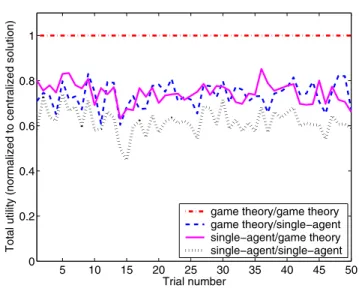
For the static path loss case, an example of the total discounted utilities realized by the nodes over 100 time slots using the game-theoretic, centralized, and single-agent strategies (and combinations thereof) is shown in Fig. 1. The utilities are presented normalized to the centralized solution, and we observe a steady improvement with the employment of the game-theoretic over the single-agent approach. In this particular case, the performance of the game-theoretic strategy matches identically that of the centralized allocation for each trial.
The average total discounted utility over 100 slots for the two nodes is shown in Table I as a function of the nodes’
5 10 15 20 25 30 35 40 45 50 0 0.2 0.4 0.6 0.8 1 Trial number
Total utility (normalized to centralized solution)
game theory/game theory game theory/single−agent single−agent/game theory single−agent/single−agent
Fig. 1. An example of the total utility realized over 100 slots (normalized to the centralized solution) for 50 trials with (1, 2) = (110dB,110dB). The legend indicates the respective approaches used by the two nodes. Parameters used in this and other simulations:m = 4,P1 = −35dBW, Pm =−25dBW,P is uniformly distributed in dB, Pe = 10−3,Ws = 1.25MHz,R= 20kbps,Nr =−143dBW,amax= 5,pA(1) = 0.30, pA(2) = 0.25,pA(3) = 0.20,pA(4) = 0.15,pA(5) = 0.10,δ= 0.95, K= 4,b= 120bits,z= 9,q= 3, andL={100dB,105dB,110dB} with115dB used in some tests.
TABLE I
AVERAGE TOTAL DISCOUNTED UTILITY OVER100SLOTS REALIZED VIA THE VARIOUS POWER CONTROL STRATEGIES(STATIC PATH LOSS). DATA WERE AVERAGED OVER50TRIALS WITH RANDOMIZED INITIAL STATE.
Average total utility (% of buffer perµJ) (1, 2)(dB) Single-agent Game theory Centralized
(100,100) 11.93 20.96 20.96 (100,105) 14.01 17.08 17.08 (100,110) 11.53 14.54 14.54 (105,105) 10.59 20.96 20.96 (105,110) 9.34 14.19 17.07 (105,115) 11.53 14.07 14.07 (110,110) 10.49 16.91 16.91
path loss. We see that in nearly every case, the game-theoretic equilibrium achieves the centralized utility, an atypically effi-cient outcome [17]. The game-theoretic solution also exhibits a 22% to 98% improvement in total utility over the single-agent case. In addition, as expected, we observe a general improvement in utilities with lower path losses; nodes find it comparatively easier to empty the buffer under more favorable channel conditions.
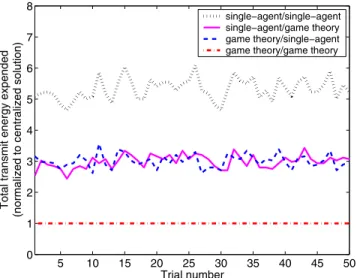
In addition to improving the total utility—as designed—we observe that the game-theoretic equilibria obtained generally require much less total transmit energy over single-agent optimization. Fig. 2 shows the total transmit energy expended over 100 slots relative to that expended by the centralized solution, and Table II presents the average total transmit energy over 100 slots. As with the utility, the game-theoretic equilibria
5 10 15 20 25 30 35 40 45 50 0 1 2 3 4 5 6 7 8 Trial number
Total transmit energy expended
(normalized to centralized solution)
single−agent/single−agent single−agent/game theory game theory/single−agent game theory/game theory
Fig. 2. An example of the total transmit energy expended over 100 slots (normalized to the centralized solution) for 50 trials with (1, 2) = (110dB,110dB).
TABLE II
AVERAGE TOTAL TRANSMIT ENERGY EXPENDED OVER100SLOTS VIA THE VARIOUS POWER CONTROL STRATEGIES(STATIC PATH LOSS). DATA
WERE AVERAGED OVER50TRIALS WITH RANDOMIZED INITIAL STATE. Average total transmit energy (mJ) (1, 2)(dB) Single-agent Game theory Centralized
(100,100) 1.04 0.38 0.38 (100,105) 0.97 0.53 0.53 (100,110) 2.09 1.26 1.26 (105,105) 2.01 0.38 0.38 (105,110) 0.93 0.38 0.53 (105,115) 2.09 1.34 1.34 (110,110) 2.02 0.38 0.38
achieve much improved energy expenditures over the single-agent case and yield equal (and in one case slightly less) total transmit energy than the centralized optimization. Energy savings is thus successfully realized.
Although yielding satisfactory results, the algorithm used to generate the Nash equilibrium strategies above is not without its drawbacks. It was typically quite time-consuming to gener-ate the equilibria, and convergence times were unpredictable. Most restrictive, however, was the “curse of dimensionality”: we were limited to small state and action spaces as large spaces were prohibitively complex.
B. Dynamic Path Loss
For the dynamic path loss case, a shadowing map was generated using the correlated shadowing model of [18] with a smooth interpolation between shadowing values. Nodes were able to switch strategies after each time slot based on new path loss measurements. The mappingφfrom Section III-B is defined in the natural way: the combined strategy
correspond-5 10 15 20 25 30 35 40 45 50 0 0.2 0.4 0.6 0.8 1 Trial number
Total utility (normalized to centralized solution)
game theory/game theory game theory/single−agent single−agent/game theory single−agent/single−agent
Fig. 3. Total utility realized per 100 slots (normalized to the centralized solution) for 50 trials with initial path loss of 105dB for each node. Parameters used in the shadowing map include a cell radius of 600 m, a shadowing correlation distance of 100 m, a shadowing standard deviation of 6dB, and node speed of 4.17 m/s. A constant starting point for each node was assigned, and the direction of travel for each node was chosen randomly from the four cardinal directions at the onset and held constant. The discounting of future payoffs was “reset” after 100 time slots.
TABLE III
AVERAGE TOTAL DISCOUNTED UTILITY PER100SLOTS REALIZED VIA THE VARIOUS POWER CONTROL STRATEGIES(DYNAMIC PATH LOSS). DATA
WERE AVERAGED OVER50TRIALS WITH RANDOMIZED INITIAL STATE. Average total utility (% of buffer perµJ)
Single-agent Game theory Centralized
10.87 17.17 17.09
ing to the path loss pair closest (in an absolute-value sense) to the most recently observed path loss values is chosen.
The initial path loss for each node was 105 dB and the system was evolved for 400 time slots. Fig. 3 demonstrates the total discounted utility relative to the centralized solution for the various strategies, and Table III shows the average total discounted utility per 100 slots. In this case, we observe that although there is an expected reduction in utility for the game-theoretic and centralized solutions (due to path loss tracking error), we see that the game-theoretic approach is generally as effective as (or even at times slightly more effective than) the centralized strategy. The game-theoretic solution also exhibits a58%improvement in total utility over the single-agent case.
V. CONCLUSIONS ANDFUTUREWORK
A stochastic game-theoretic approach to calculating transmit power strategies for nodes in a delay-sensitive CDMA wireless network was presented. Simulation has shown that in both static path loss and dynamic shadowing path loss cases, the game-theoretic equilibria determined compare favorably to tra-ditional single-agent and centralized optimization techniques in terms of realized utility and transmit energy expended, albeit
at the cost of increased system and computational complexity. Future work could entail refinements to the utility function, perhaps by including pricing terms for transmit power [2]. More importantly, attempts at reducing the complexity of this general framework would be effort well spent. By simplifying or coarsening the state space, or by investigating alternative and approximate equilibrium concepts, this approach may be profitably applied to richer networks. It is by employing such approximations that game-theoretic power control solutions may have their greatest practical impact.
ACKNOWLEDGMENT
The first author would like to thank the anonymous review-ers for providing such helpful comments and suggestions. The quality of this paper has been greatly improved as a result.
REFERENCES
[1] H. Ji and C.-Y. Huang, “Non-cooperative uplink power control in cellular radio systems,”Wireless Networks, vol. 4, no. 3, pp. 233–240, May 1998. [2] C. U. Saraydar, N. B. Mandayam, and D. J. Goodman, “Efficient power control via pricing in wireless data networks,”IEEE Trans. Commun., vol. 50, no. 2, pp. 291–303, Feb. 2002.
[3] T. Alpcan, T. Bas¸ar, R. Srikant, and E. Altman, “CDMA uplink power control as a noncooperative game,”Wireless Networks, vol. 8, no. 6, pp. 659–670, Nov. 2002.
[4] C. A. St. Jean and B. Jabbari, “Bayesian game-theoretic modeling of transmit power determination in a self-organizing CDMA wireless network,” inProc. of the 60th IEEE Vehicular Technology Conference (VTC Fall 2004), vol. 5, Sept. 2004, pp. 3496–3500.
[5] D. Vengerov, N. Bambos, and H. R. Berenji, “Adaptive learning scheme for power control in wireless transmitters,” inProc. of the 56th IEEE Vehicular Technology Conference (VTC Fall 2002), vol. 4, Sept. 2002, pp. 2390–2394.
[6] P. J.-J. Herings and R. J. A. P. Peeters, “Stationary equilibria in stochastic games: Structure, selection, and computation,” Journal of Economic Theory, vol. 118, no. 1, pp. 32–60, Sept. 2004.
[7] S. Kandukuri and N. Bambos, “Multimodal dynamic multiple access (MDMA) in wireless packet networks,” inProc. of the Twentieth Annual Joint Conference of the IEEE Computer and Communications Societies (INFOCOM 2001), vol. 1, Apr. 2001, pp. 199–208.
[8] C. A. St. Jean, A. N. Zadeh, and B. Jabbari, “Combined routing, channel scheduling, and power control in packet radio ad hoc networks with cellular overlay,” inProc. of the 55th IEEE Vehicular Technology Conference (VTC Spring 2002), vol. 4, May 2002, pp. 1960–1964. [9] D. Goodman and N. Mandayam, “Power control for wireless data,”IEEE
Personal Commun. Mag., vol. 7, no. 2, pp. 48–54, Apr. 2000. [10] A. B. MacKenzie and S. B. Wicker, “Game theory and the design of
self-configuring, adaptive wireless networks,”IEEE Commun. Mag., vol. 39, no. 11, pp. 126–131, Nov. 2001.
[11] A. M. Fink, “Equilibrium in a stochastic n-person game,” J. Sci. Hiroshima Univ., no. 28, pp. 89–93, 1964.
[12] J. C. Harsanyi and R. Selten,A General Theory of Equilibrium Selection in Games. Cambridge, MA: The MIT Press, 1988.
[13] R. J. A. P. Peeters and P. J.-J. Herings, “STOCHASTICGAMESOLVER: Computing Nash equilibria for stochastic games,” Sept. 2003. [Online]. Available: http://www.fdewb.unimaas.nl/algec/staff/framespages/peeters/ StochasticGameSolver/StochasticGameManual.pdf
[14] J. G. Proakis,Digital Communications, 4th ed. Boston: McGraw-Hill, 2001.
[15] M. J. Miranda and P. L. Fackler,Applied Computational Economics and Finance. Cambridge, MA: The MIT Press, 2002.
[16] ——. CompEcon Toolbox for MATLAB. [Online]. Available: http: //www4.ncsu.edu/∼pfackler/compecon/toolbox.html
[17] P. Dubey, “Inefficiency of Nash equilibria,”Mathematics of Operations Research, vol. 11, no. 1, pp. 1–8, Feb. 1986.
[18] I. Forkel, M. Schinnenburg, and M. Ang, “Generation of two-dimensional correlated shadowing for mobile radio network simulation,” inProceedings of the 7th International Symposium on Wireless Personal Multimedia Communications (WPMC 2004), Sept. 2004.