Cloud Computing Adoption Framework – a security framework for business clouds
Victor Chang1, Yen-Hung Kuo2, Muthu Ramachandran11. School of Computing, Creative Technologies and Engineering, Leeds Beckett University, Leeds, UK.
2. Data Analytics Technology & Applications, Institute for Information Industry, Taiwan, R.O.C. Corresponding authors: [email protected] ; [email protected]
Abstract
This paper presents a Cloud Computing Adoption Framework (CCAF) security suitable for business clouds. CCAF multi-layered security is based on the development and integration of three major security technologies: firewall, identity management and encryption based on the development of Enterprise File Sync and Share technologies. This paper presents our motivation, related work and our views on security framework. Core technologies have been explained in details and experiments were designed to demonstrate the robustness of the CCAF multi-layered security. In penetration testing, CCAF multi-layered security could detect and block 99.95% viruses and trojans and could maintain 85% and above of blocking for 100 hours of continuous attacks. Detection and blocking took less than 0.012 second per trojan and viruses. A full CCAF multi-layered security protection could block all SQL injection providing real protection to data. CCAF multi-layered security had 100% rate of not reporting false alarm. All F-measures for CCAF test results were 99.75% and above. How CCAF multi-layered security can blend with policy, real services and blend with business activities have been illustrated. Research contributions have been justified and CCAF multi-layered security can offer added value for volume, velocity and veracity for Big Data services operated in the Cloud.
Keywords: Cloud Computing Adoption Framework (CCAF); OpenStack; CCAF multi-layered security; security for business clouds
1. Introduction
Security, trust and privacy always remain challenges for organizations that adopt Cloud Computing and Big Data. While there are demands for businesses to move their data in the Cloud and centralize management for data centers, services and applications are designed to achieve cost savings and operational efficiencies. At the same time, system design and deployment based on current security practices should be enforced to ensure all data and services are security compliant with up-to-date patches and policies. A risk-based approach to the development of a security program that recognizes (and funds) appropriate controls will ensure that all users can be protected, and that data can be confidential, have integrity and be available.
Some researchers have adopted a framework approach to allow organizations to follow guidelines, policies and standards. For example, Zhang et al. [1] propose their Usage-Based Security Framework (UBSF) which can consolidate guidelines and policies with their framework, architecture and digital certificates. Takabi et al. [2] describe their comprehensive security framework by presenting a model to explain how to work with different service integrators and service providers. Zia and Zomaya [3] present their wireless sensor networks model with their algorithms and a software engineering approach. All these frameworks have
provided recommendations on how they should be used. However, there are no details on how to actually use these proposals, and there are no clear evidence that these proposals can be adopted for Business Clouds, whereby the requirements include the ease of use, adaptability, best practice compliant and supported by large scale experiments such as penetration testing to validate robustness of such proposals [4-5]. Indeed, without such a clear “line on sight” between conception and implementation, such frameworks are unlikely to achieve operational status.
In order to meet requirements for Business Clouds, the Cloud Computing Adoption Framework (CCAF) has been developed to ensure that all implementations and service deliveries can meet all the technical challenges. There are real-life case studies to show how different Cloud Computing design, development and service delivery can meet both technical and organizational challenges. In the first example, CCAF was the framework used to develop Cloud storage and bioinformatics solutions for biomedical scientists based at Guy’s Hospital and King’s College London, UK [6]. The use of the framework ensured that the deliveries of storage services to back up thousands of medical data with terabytes of size. Bioinformatics services can simulate DNAs, proteins, genes, tumor and organs related to human bodies. The use of their security is limited to authentication, encryption and users with authorized access. In the second example, CCAF is used to provide guidelines for financial modeling, so that the best put and call prices can be computed in regard to the change of risks. Advanced computational techniques have been used to calculate risks and market volatility [7]. Security is limited to password authentication and users with authorized access and biometrics checks to the financial simulations. In the third example, investigations of hacking methods have been studied and made as part of prototype requirements. As a result of a user requirement and literature review, factors for successful implementations have been identified. All the collected and synthesized information have been instrumental in the development of CCAF Version 1.1, which emphasizes on the security policies, recommendations, techniques and technologies to be updated in our framework [8]. In these three examples, a more comprehensive Cloud security solution is required to ensure that services are robust and can be resistant to attack, hacking and unauthorized attempts to gain access. More experiments and simulations are required to validate the robustness and effectiveness of our security framework. This motivates us to consolidate our CCAF framework by providing a holistic approach involved with service integration, OpenStack security and multi-layered security to enhance security for business clouds. We propose an integrated security framework for business clouds to have the multi-layered security in place and have the large scale penetration testing and experiments to validate the robustness and effectiveness of our approach. All these proofs-of-concepts and lessons learned are important to Big Data in the Cloud as follows. First, it ensures that all the cloud services are safe and secure, including data coming in and out of the organizational data centers hosted on hundreds and thousands of virtual machines (VMs). Second, it ensures that large amount of data and large datasets can be processed and analyzed safely in the Cloud, which also explains why large scale penetration testing is necessary to validate the framework. The breakdown of this paper is as follows. Section 2 presents the literature for security. Section 3 describes our core security technology for Enterprise File Sync and Share, including the architecture and layered components. Section 4 explains our multi-layered approach with core technologies and results from large scale experiments for penetration testing, SQL injection and data scanning. Section 5 illustrates topics of discussion and Section 6 sums up Conclusion and Future Work.
2. Literature
Different types of security frameworks are introduced as follows. First, Zhang et al. [1] propose their Usage-Based Security Framework (UBSF) for Collaborative Computing Systems. They explain their motivation, techniques behind, architecture and conditions for experiments. Usage decision of the USFB is based on subjects, objects, authorization, obligations and conditions. They explain how their model can work in collaborative ways supported by their literature and hypotheses. The usage-based authorization architecture uses sensors, directory service, policy decision point (PDP) and usage monitor (UM) to functions. Steps have been described to justify how the USFB can function effectively. To assist USFB, Zhang et al. [1]
have a prototype system architecture. They use OpenLDAP and OpenSSL to enforce security. They have three types of digital certificates: User, Attribute Repository (AR) and Resource Provider (RP) certificate. They explain how these certificates work in their workflow-type of security processes. They also adopt extensible access control markup language (XACML) to enforce policy specification which aligns with the UBSF approach for security. Ko et al [9] investigate trust for Cloud computing and propose a TrustCloud Framework focused on accountability. They have three layers: (1) System layer, which covers all the underlying hardware and platform; (2) Data layer, which contains the data for the work and (3) Workflow layer, which uses workflow to execute all the services and requests. There are two non-functional layers attached throughout the three layers. The first layer is Laws and Regulations, which can ensure all services follow the legal requirements in the country that the service is delivered. The second layer is Policies, which are the consolidated service level agreements and the best practice approach. This framework is considered a conceptual framework focused on the recommendations and best practice, since they do not have quantitative analyses, computational demonstrations and case studies. Pal et al. [10] present their proposed Cloud security that has emphasized on the architecture and steps of interactions between different services. They explain the role in each major user, their agents and all the fifteen steps involved. They use UML diagram to justify their approach and use architecture to explain relationship between the user, provider, proxy server, user agent and provider agent. They present their two algorithms and their experimental results. Using “Trust Value Updation”, they validate their approach. However, their assumption is based on the probability of having a trusted user is 0.8 and a non-trusted user is 0.2. There are no any evidences to support this and they do not use any references or large number of surveys to justify their research. This also depends on their sample size, demographics and the country that the research is conducted. The NIST [11] framework provides a common language for establishing cybersecurity. The core NIST framework provides a set of activities on Identify, Protect, Detect, Respond, and Recover without more specific examples and case studies implementing a full security solution. However, our work on CCAF extends detailed activities and implementation on security for Cloud Computing and Big Data.
All these examples have security framework. However, those proposals do not demonstrate their contributions for business clouds. In other words, when businesses adopt Cloud Computing solution, they should be able to provide architecture, approaches for their framework, steps and experiments to support the robustness and validity of the framework. Our proposal on Cloud Computing Adoption Framework (CCAF) will provide details in core technologies in Section 3, and then the theoretical framework mapping to core technologies with experimental results to validate our framework will be shown in Section 4. Following that, key topics including security policy, business and security alignment, framework and core technology integration, relation of the big data in cloud, overall contributions with limitation are discussed in Section 5. Finally, research conclusion and future work will be in Section 6.
3. Core technologies
Prior to introduce the Cloud Computing Adoption Framework (CCAF), this section uses a concrete instance of the CCAF to be an example to explain CCAF core technologies and implementations. To hit the needs of moving big data in a public business cloud, an enterprise cloud storage application - the semi-public Enterprise File Sync and Share (EFSS) service is chosen to be the CCAF instance to explain how CCAF protect enormous enterprise files (a kind of unstructured big data) in a business cloud environment. To provide enterprises with the convenient cloud file sync and share service while taking enterprise concerns such as security, compliance, and regulation concerns into consideration, the cloud file sync and share service was been deployed by either on-premise or hybrid cloud model to target high value Enterprise File Sync and Share market [12-14]. Existing EFSS systems focus on system security and manageability, which encrypt data on transfer and at rest and also support system audit trail. As part of the core technologies of the CCAF framework, important EFSS security issues should be well addressed, particularly for businesses with critical data services. Following items describe the opened EFSS security issues.
(1) Employee Privacy: To prevent data leak, enterprise data are usually encrypted in existing EFSS systems. However, most existing EFSS systems only uses single master key to encrypt entire data space, which can prevent enterprise data leaks from outside but not from inside. For example, an EFSS system administrator (IT or MIS in enterprise) can spy enterprise sensitive data by self-granted authority.
(2) Share Link: The share link is widely adopted to share data to business partners who do not have an
EFSS system account. From enterprise's perspective, the share link is convenient but not secure since it introduced new security loophole and might be used to leak data to unauthorized domain without leaving enough audit trail [15].
(3) Cloud File Synchronization: The natural of the cloud file synchronization is a security loophole to
enterprises. It synchronizes shared and collaborative enterprise data from a managed EFSS service to employees' endpoint devices, and enterprises then have less/no control to the synchronized enterprise data. The synchronized enterprise data can then be distributed from the endpoint devices to other unauthorized domains by email, USB disk, and other communication interfaces available on the endpoint devices.
(4) Enterprise Directory Integration: To enable SSO (Single Sign On) in enterprise, most existing EFSS
systems via direct network connection to integrate its authentication with existing enterprise directory, e.g., AD (Active Directory) and LDAP (Lightweight Directory Authentication Protocol). It also introduces two new security issues. Firstly, the EFSS system is able to access employees' profiles available in enterprise directories. Secondly, the EFSS system can log employees' credential information when authentication since every employee's username and password are pass through EFSS system to enterprise directory to conduct the actual authentication. Both cases provide EFSS system with chances to get authorized information.
An integrated security approach is introduced in follow sections, which implements several key components to form a scalable Secure EFSS system to address the enterprises' concerns by leveraging the on-premise OpenStack infrastructure [16]. EFSS has been integrated with our CCAF framework as an overarching model for cloud security for businesses.
Architecture and Design of the Integrated Security Approach
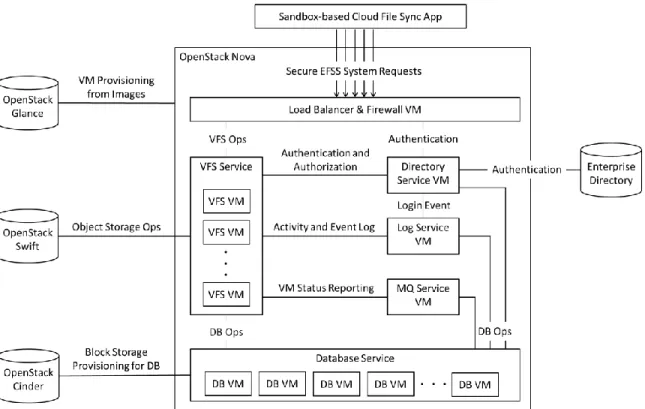
The key components of the Secure EFSS system are virtual appliances which can be provisioned and ran on the OpenStack compute service – Nova, and the data (e.g., metadata in database and uploaded enterprise files in user storage space) generated by the key components are stored in the OpenStack storage services – Cinder for block storage and Swift for object storage in which the OpenStack storage services are managed storage system controlled by the enterprise. The separation of the compute and storage makes the Secure EFSS system is scalable and more secure than existing EFSS systems.
All key components/virtual appliances including Load Balancer, Firewall, VFS (Virtual File System) Service, Directory Service, Log Service, MQ (Message Queue) Service, and the Database Service are provisioned from an all-in-one image stored in the OpenStack VM image management service – Glance to form the Secure EFSS system as shown in Figure 1. The VFS service of the proposed Secure EFSS system provides clients with a REST API set to manipulate a directory structure and files of a virtual file system. The backend of the virtual file system is the Database Service, which stores metadata to represent the directory structure and the nodes' attributes of the directory structure. Enterprise files uploaded by clients are leaf nodes of the directory structure, and they have a node attribute to point to encrypted objects in the Swift. Since there is no knowledge kept in the VFS service, the VFS service can dynamically provision more VFS VM to satisfy growing EFSS system usage in a scalable and distributed manner.
In Figure 1, rest key components’ interactions and how they benefit to security and scalability are shown below. The Load Balancer is deployed in the DMZ (Demilitarized Zone), which dynamically distributes
every request made by the Sandbox-based Cloud File Sync App to one of VFS VM for handling the requests by according to loads of the VFS VM for maximizing overall VFS Service performance. Moreover, a Firewall is deployed in between the Load Balancer and the VFS Service to form a secure deployment scheme which defends external direct network attacks for internal services. Once the VFS Service receives a request, it firstly sends the authentication information that came with the request to the Directory Service to check the request identity and authority. Subsequently, the VFS Service handles the request and logs related audit trails to the Log Service. When VFS Service is serving, it also reports overall service status including concurrent serving requests, CPU and memory usages, etc. to MQ service which actively calls OpenStack compute service API to provision and de-provision VFS VM to handle Secure EFSS system peak and idle situations.
Figure 1. The Secure EFSS system architecture in the OpenStack.
Designs of key components of the proposed integrated security approach are introduced in following subsections which include User Storage Space Modeling, Distinct Share Link, Zero-knowledge Cloud Scale File Sharing System, Sandbox-based Cloud File Synchronization, Out-of-band Authentication, and a NoSQL adoption consideration.
A. User Storage Space Modeling
To make sure the system is scalable, metadata generated by key components especially by the VFS Service are stored into a MongoDB cluster. The MongoDB is a document based NoSQL database which sacrifices the relationship between documents to increase its scalability [17-18]. Further, we use user accounts as database sharding key to shard entire user storage space into smaller parts to mitigate the MongoDB scalability limitation which impacts database performance when there are too many documents inserted into a data collection. Following that, every user has own directory structure formed by metadata stored in own data collection, which physically isolates users’ metadata, and every user’s metadata then can be protected by owner’s encryption key without worrying sensitive metadata being leaked when Database Service been hacked.
B. Distinct Share Link
A share link provides conveniences for sharing cloud files in enterprise and external business partners, but it is insecure since web crawlers can find it by scanning emails and social network and then download it simply [19]. To address this issue, it introduces a utility named Distinct Share Link to secure sharing cloud files and to build a secure sharing relationship between two user storage spaces which are isolated data collections sharded from entire user storage space [20].
A Distinct Share Link is an additional layer attached with permissions, identities, and access conditions which encapsulates a share link, decreases diffusibility of the share link, adds traceability as well as controllability to the share link, and then be sent to recipients according to the attached identities. Whenever a recipient tries to access a Distinct Share Link, the recipient has to present his/her identities for access condition check. Once the recipient passes all checks, the Distinct Share Link layer then prepares an ephemeral representation to link to the share link for accessing. Since every Distinct Share Link access requires own identity (traceability) and controlled by permissions and access conditions (controllability), the diffusibility and convenience of the Distinct Share Link is decreased accordingly.
Compare to share link, always need to provide different identities when accessing a Distinct Share Link is inconvenient. To address the problem, it provides a recipient-defined identity function which allows a recipient to define own identity (e.g., password, secret, etc.) to each received Distinct Share Link. Hence, the recipient can define easy to remember identities to received Distinct Share Links. It also solves the share link identity management issue, that is, share links with different identities (e.g., passwords) are too much information to be remembered by a single recipient.
In addition to aforementioned benefits, the Distinct Share Link further support sandbox feature for creating a collaborative workspace with external business partners. In the collaborative workspace, every participant has own permission, and any inappropriate operation (e.g., delete all files) is only performed in a specific shared folder but not in entire personal user storage space. Note that with cloud storage capabilities, the performed inappropriate operations are able to be reverted to original, e.g., reverting previous cloud file version from file change history or reverting deleted shared files from the recycle bin.
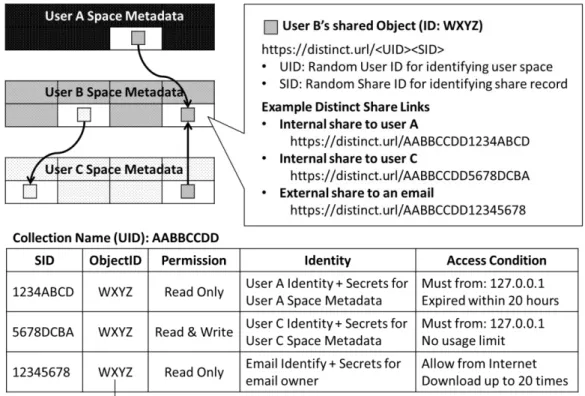
The Distinct Share Link is also used to implement the internal cloud file sharing in the proposed Secure EFSS by building a secure sharing relationship between two isolated user storage spaces (data collections). Figure 2 depicts an example to explain how Distinct Share Link help build the internal cloud file sharing. In the top-left of the Figure 2, it represents two internal cloud file sharing relationships: (1) users A and C receive an object shared from user B and (2) user B receives an object shared from the user C. The callout box shown at the top-right of the Figure 2 further explains sharing relationships associated with the object (ID: WXYZ) in the former sharing relationship. It shows that three Distinct Share Links are used to share the object (ID: WXYZ) to recipients: user A, user B, and an email address. Moreover, all of the three Distinct Share Links are able to be parsed into three parts: (1) the service endpoint (e.g., https://distinct.url/), (2) the UID part for identifying user storage space as known as the location of the data collection, and (3) the SID part for identifying the metadata (as shown in the table of the Figure 2) which contains information about the sharing relationship in the located data collection. After retrieving the metadata, the “ObjectID” can be used to refer to either a shared object or a share link point to a shared object.
Figure 2: Example for explaining distinct share link.
A forementioned external and internal sharing cases have similar Distinct Share Link creation and access processes. The key difference between the two cases is the identity delivery process. In the external sharing case, the identity is firstly defined by the Distinct Share Link creator, subsequently it is delivered by oral or identity itself (e.g., email), and finally it might be re-defined by the recipient. The internal sharing case automatically performs similar process by system with following steps: (1) generate random keys as identities in the sharing source, (2) encrypt generated identities by a recipient’s public key, and (3) deliver the encrypted identities from the sharing source to the sharing destination for further usage.
C. Zero-knowledge Cloud Scale File Sharing System
All Cloud files are stream-encrypted by different random symmetric keys and stored in the Swift object storage when uploading to the proposed Secure EFSS system. This subsection will introduce a Zero-knowledge Cloud Scale File Sharing System which leverages introduced stacks including User Storage Space Modeling technique and Distinct Share Link. The Zero-knowledge Cloud Scale File Sharing System also introduces a new key cascading model [21-22] which uses in this work to manage the random symmetric keys crossing loose coupled domains and further to protect cloud files from internal/external unauthorized access attempts.
To develop a Zero-knowledge Cloud Scale File Sharing System, authors take following key enterprise security concerns and modern cloud system’s scalability and manageability issues into consideration:
(1) Zero-knowledge System: Zero-knowledge means that a system knows nothing about things provided
by users. The user provided things can be contents of cloud files, metadata of user storage spaces, and encryption keys including users’ passwords used to protect cloud files and user storage spaces, and the last and the most important part is that it must apply to entire lifecycle of things starting from its first time appearing in the system to its end, that is, being permanently wiped from the system. To this end, the Zero-knowledge Cloud Scale File Sharing System is formed by stacking multiple distinct
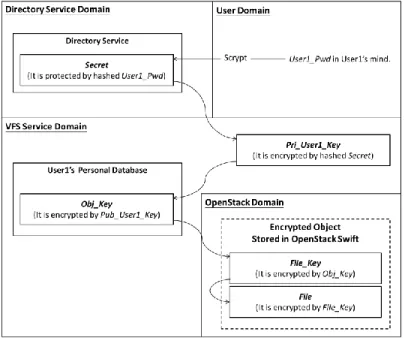
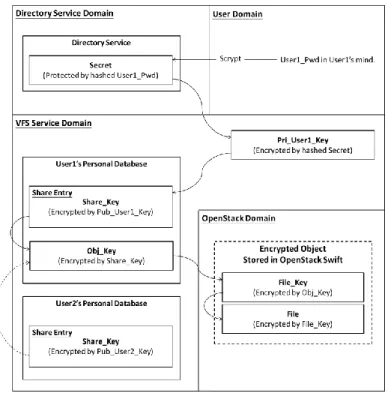
domains with own services, and each of the distinct domain is serving as an additional complementary security layer to its one-level lower domain. As shown in Figure 3 and Figure 4, they represent stacking relationships of personal cloud file and shard cloud file situations respectively. In Figure 3, the lowest OpenStack Domain only provides cloud file storage capability, subsequently the one-level upper VFS Service Domain servers cloud file metadata management functions and adds additional stream cloud file and metadata encryption capabilities, and finally the top-level Directory Service Domain incorporates with User Domain to protect the encryption keys used in cloud file and metadata protections. In aforementioned stacking relationship, the worth to mention part is that the User Domain is not in cyberspace instead it is in users’ brain, only users themselves know their own passwords, and it makes the zero-knowledge system work. Similarly, the Figure 4 further provides a sibling stacking relationship to the Figure 3 to isolate share participants’ personal VFS Service Domains (see User1 and User2’s distinct Personal Databases in Figure 4). It further makes the zero-knowledge system work in a multitenant cloud environment. Users do not need to worry about their cloud files when another user’s storage space was conquered since that the sibling stacking relationship is a one-way relationship, and there is no way for a lower layer using existing knowledge to derive upper layer information. This zero-knowledge design also guarantees users have zero-knowledge with each other.
(2) Security Compliance: In addition to data encryption, enterprise security compliance also requires to
support password history management capability. For example, an employee has to change its password every quarter, and the password cannot be equal to any password used in the last year. The Zero-knowledge Cloud Scale File Sharing System abstracts a Directory Service Domain to deal with the password history management requirement (as shown in the Figure 3 and Figure 4). Every time a user’s password changed, the Directory Service Domain will automatically adjust its internal relationship to keep the stacking relationship be consist without bothering every lower domains. In other words, the Zero-knowledge Cloud Scale File Sharing System is also a security compliance friendly system.
(3) Atomic Objects and Systems: Considering the complex cloud environment, to make everything be
atomic is a good idea. In the Zero-knowledge Cloud Scale File Sharing System, every service in the domains and every encrypted cloud file is an atomic unit which can be managed (e.g., create, update, and delete) without worried about dependencies with other atomic units. To achieve this, authors separate data from computation logic. As mentioned, metadata of a user are aggregated to form a personal database, and because of choosing MongoDB, the personal database is physically a set of manageable files stored in the block storage. In terms of cloud files, a cloud file itself is atomic and can be stored in object storage directly. However, once the cloud file be encrypted, to manage the encrypted cloud file as an atomic unit is difficult since the encryption key of the cloud file has to be managed as well. To keep it be atomic, it encrypts the encryption key of the cloud file, then combines the encrypted encryption key and the encrypted cloud file to form a manageable encrypted object to replace the original plain-text cloud file, and let the encryption key of the cloud file’s encryption key be managed by the VFS Service Domain. As shown in the dot line block in the Figure 3 and Figure 4, the encrypted cloud file (File) and its encryption key (File_Key) is combined as an encrypted object stored in the OpenStack Swift object storage. The encrypted object is then an atomic unit which can then be migrated, backup, and managed by a cloud manner. Following that, rest parts are computation logics which can be categorized by domains (e.g., Directory Service and VFS Service Domains have their own computation logics), and different types of computation logics can be implemented in virtual machine or container images which can be managed by the OpenStack Glance image service as atomic units and be hosted on the OpenStack Nova cloud computing environment.
(4) API Integration: All domains in the Zero-knowledge Cloud Scale File Sharing System are integrated
by REST API, which provides services in domains with flexibility by developing and growing themselves. With such a integration, every domain only need to focus on satisfying contracts and/or
SLA (Service Level Agreement) with other domains, e.g., keep 99.99% service availability or guarantee API calling 300 times per minutes. In addition to inter-domain integration, the VFS Service Domain also uses REST API to implement distinct user storage spaces’ integration. Specifically, it uses Distinct Share Link to securely share one user storage space’s cloud file to other user storage spaces (see the dot line arrow in the Figure 4). It forms a loose coupled sharing relationship which is especially suitable for cloud era.
Detailed designs and implementations of the Zero-knowledge Cloud Scale File Sharing System will be discussed next. The core technology integrates all above key considerations together is a key cascading model. Figure 3 and Figure 4 are used as examples to assist the follow-up explanations.
Figure 3: Personal file encryption key management concept
Figure 3 is the key management concept of the personal storage space, in which the solid line arrows are encryption/decryption directions. To explain the meaning of the encryption/decryption direction, two examples are shown in follow. In the first example (a symmetric key case), the “Secret” pointing to the “Pri_User1_Key” has two meanings: (1) the “Pri_User1_Key” is encrypted by the (hashed) “Secret” and (2) the “Pri_User1_Key” is able to be decrypted by the (hashed) “Secret”. In this example, the “Pri_User1_Key” is the private key of the user1 and the “Secret” could be any information managed by the Directory Service. Note that keys in the key cascading model could like the “Secret” which is hashed before being used to encrypt other keys. In another example (an asymmetric key case), the “Pri_User1_Key” pointing to the “Obj_Key” has only one meaning which means the “Obj_Key” is able to be decrypted by the “Pri_User1_Key” since the “Obj_Key” is originally encrypted by the public key of the user1. Figure 4 is the key management concept of the shared storage space, in which the solid and dot line arrows have the same definition with the solid line arrows in the Figure 3.
Figure 4: Shared file encryption key management concept
The key cascading relationship of the personal storage space as shown in Figure 3 crosses four distinct domains, which starts at the User Domain, passes through the Directory Service and VFS Service Domains, and finally ends in the OpenStack Domain. Starting at the tail of key cascading relationship, to obtain the plaintext “File”, it requires the random symmetric key “File_Key” to decrypt the encrypted “File”. The “File_Key” can be further be decrypted by another random symmetric key “Obj_Key” which is encrypted by user1’s public key in the VFS Service Domain. To prevent the “File_Key” from exposing risk when sharing or changing ownership, the user1’s public key does not directly encrypts the “File_Key”, and instead it encrypts the “Obj_Key” which protects the “File_Key”. Thus, the user1’s public key can protect the “File_Key” indirectly, and the plaintext “File_Key” will be required only when trying to access the “File”. With such a property, we can combine the encrypted “File_Key” and the encrypted “File” to form an encrypted object as known as an atomic unit to be stored in the Swift object storage, which is also beneficial to object migration, replication, and management.
Reconsidering the key cascading relationship, the user1’s private key “Pri_User1_Key” is the entry of the VFS Service Domain which is formed by metadata stored in the user1’s personal data collection. Since the entire VFS Service Domain may be conquered, it has to choose another key which is not available in the VFS Service Domain, to protect the user1’s private key “Pri_User1_Key”. The implementation chooses the “Secret” in the Directory Service Domain to protect the “Pri_User1_Key” because of the nature of authentication and authorization always happen prior to accessing the VFS Service Domain. The best practice of choosing suitable information form the Directory Service Domain to be the “Secret” is to choose the information which changing frequency is conform to enterprise compliances since the user1’s private key “Pri_User1_Key” has to be re-encrypted along with the changing of the “Secret”. Finally, the user1’s password is used to protect the “Secret”. In the key cascading model, the user1’s password is the only information not available in the cyberspace, and the hash of the password has already qualified to be used to protect the “Secret”. However, in our implementation, the password is hashed by the Scrypt [23] which generates different hashed values every time, and it results in that we need to choose another suitable “Secret” which is associated with password.
Contrast to the key management concept of the personal storage space, the key management concept of the shared storage space as shown in Figure 4 adds another key cascading relationship between sharing participants’ private keys and object key of the shared object. To add another key cascading relationship among sharing participants’ data collections, a symmetric key “Share_Key” is inserted in between the participants’ private keys (e.g., the “Pri_User1_Key” and the user2’s private key) and the “Obj_Key”. Through the Distinct Share Link as the dot line arrow shown in Figure 4, the user2 is then able to use the “Share_Key” as part of the identity to access the user1’s shared objects (e.g., the “File”).
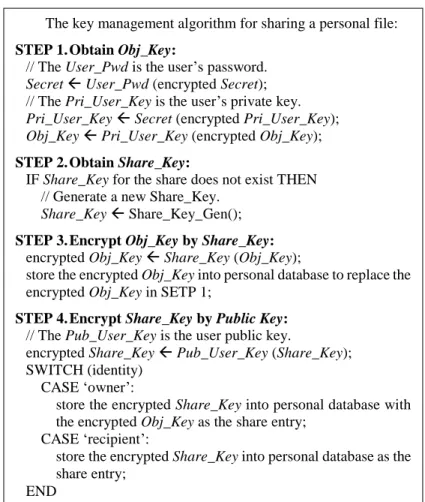
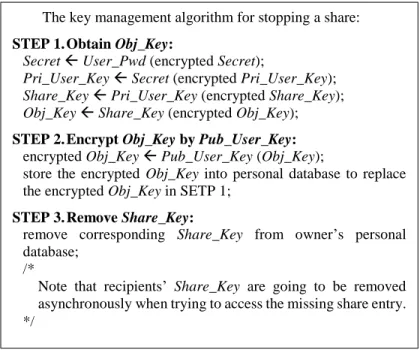
To formally represent aforementioned explanations, the key management algorithms for sharing a personal file and stopping a share are described in Figure 5 and Figure 6 respectively.
Figure 5: Key management algorithm for sharing a personal file
The key management algorithm for sharing a personal file: STEP 1.Obtain Obj_Key:
// The User_Pwd is the user’s password. SecretUser_Pwd (encrypted Secret); // The Pri_User_Key is the user’s private key. Pri_User_KeySecret (encrypted Pri_User_Key); Obj_KeyPri_User_Key (encrypted Obj_Key); STEP 2.Obtain Share_Key:
IF Share_Key for the share does not exist THEN // Generate a new Share_Key.
Share_Key Share_Key_Gen(); STEP 3.Encrypt Obj_Key by Share_Key:
encrypted Obj_KeyShare_Key (Obj_Key);
store the encrypted Obj_Key into personal database to replace the encrypted Obj_Key in SETP 1;
STEP 4.Encrypt Share_Key by Public Key: // The Pub_User_Key is the user public key.
encrypted Share_KeyPub_User_Key (Share_Key); SWITCH (identity)
CASE ‘owner’:
store the encrypted Share_Key into personal database with the encrypted Obj_Key as the share entry;
CASE ‘recipient’:
store the encrypted Share_Key into personal database as the share entry;
Figure 6: Key management algorithm for stopping a share
D. Sandbox-based Cloud File Synchronization
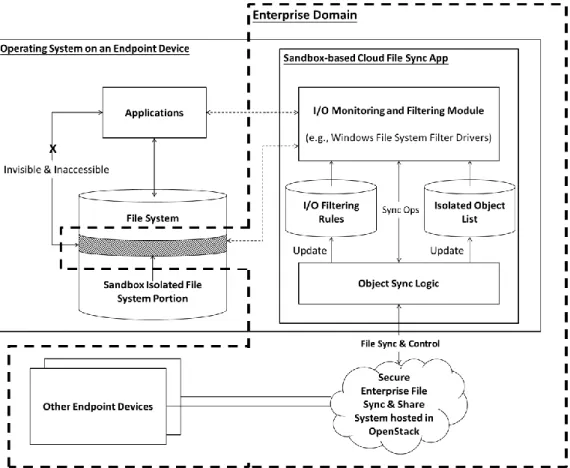
The EFSS service is convenient for collaboration in enterprise. However, most IT and MIS dislike to provide EFSS service in enterprise since that the once a cloud file being shared and synchronized with employee’s client device, the file is no longer under enterprise’s control. To provide an integrated Secure EFSS approach, it proposed a Sandbox-based Cloud File Sync App to solve the issue [24-25]. Differ from traditional cloud file synchronization tool, the Sandbox-based Cloud File Sync App creates a managed sandbox in the operating system’s (O/S) file system and a local sync folder inside the sandbox, and then synchronizes cloud file between the local sync folder and user storage space in the Secure EFSS system. Since only authorized file system operations can be applied to the sandbox, the O/S and applications executed on top of the O/S are unable to read or update the sandbox. Such a property let the Sandbox-based Cloud File Sync App be able to actively prevent cloud files to be leaked from any employee’s client device. The dot line area in the Figure 7 is the Enterprise Domain which is extended from the original Secure EFSS system to every enterprise employee’s client device.
The core of the Sandbox-based Cloud File Sync App is the I/O Monitoring and Filtering Module which is a file system filter as shown in Figure 7. The I/O Monitoring and Filtering Module refer to Isolated Object List and I/O Filtering Rules to monitor and filter file system operations trying to apply to files and folders in the sandbox. There is a list of file and folder paths in the Isolated Object List to form the Sandbox Isolated File System Portion in the file system. Moreover, the list of file and folder paths is dynamically updated whenever the Object Sync Logic syncing files and folders between the local sync folder and the Secure EFSS system. To further make the Sandbox-based Cloud File Sync App an enterprise compliance facilitating tool, the I/O Filtering Rules provides enterprise IT and MIS with a capability to update its I/O filtering rules to control the local synchronized files through controls made by the Secure EFSS system.
The key management algorithm for stopping a share: STEP 1.Obtain Obj_Key:
SecretUser_Pwd (encrypted Secret);
Pri_User_KeySecret (encrypted Pri_User_Key); Share_KeyPri_User_Key (encrypted Share_Key); Obj_KeyShare_Key (encrypted Obj_Key); STEP 2.Encrypt Obj_Key by Pub_User_Key:
encrypted Obj_KeyPub_User_Key (Obj_Key);
store the encrypted Obj_Key into personal database to replace the encrypted Obj_Key in SETP 1;
STEP 3.Remove Share_Key:
remove corresponding Share_Key from owner’s personal database;
/*
Note that recipients’ Share_Key are going to be removed asynchronously when trying to access the missing share entry. */
Figure 7: Sandbox-based cloud file synchronization
E. Out-of-band Authentication
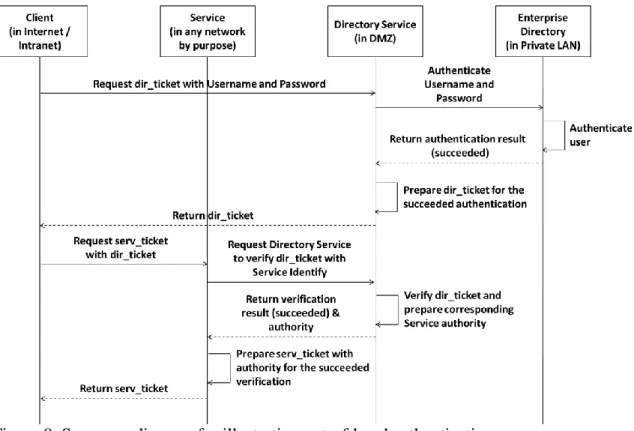
As mentioned, directly integrating EFSS system with enterprise directory for enabling single sign on is insecure since sensitive information may be accessed or logged by the EFSS system. To address the issue, it introduces an out-of-band authentication method as parts of the integrated security approach, and the sequence diagram of the authentication method is shown in Figure 8. To take secure deployment requirement into account, the participants involved in the authentication process are deployed in different networks: (1) the Client can access the Service from either Internet or Intranet, (2) the Service is deployed in either DMZ or enterprise private LAN by according to purpose of the Service, (3) the Directory Service has to be deployed in DMZ for handling authentication requests from both Internet and Intranet, and (4) behind the firewall, the Enterprise Directory (e.g., AD or LDAP) is protected in the enterprise private LAN. The security deployment let the Directory Service act as a directory proxy to receive and then bypass the authentication requests to the Enterprise Directory for actual authentication. To let such a model work, the source of the Directory Service has to be examined and verified by the enterprise to get trust. Once the Directory Service passes the trustworthiness verification, the Service is the only untrustworthy participant in the authentication model, that is, the proposed VFS Service is untrustworthy.
Figure 8: Sequence diagram for illustrating out-of-band authentication.
To access the Service, the Client has to verify its credential (e.g., username and password) with the Enterprise Directory. However, with the secure deployment as shown in Figure 8, the Client has to authenticate with the Directory Service to verify is credential instead. After pass the check, the Directory Service will prepare a directory ticket (dir_ticket) to the Client for further exchanging a service ticket (serv_ticket) with the Service. Following that, the Client can access the Service by the service ticket, and the Service will then serve the Client based on the authority information provided by the Directory Service. To sum up, the proposed out-of-band authentication method has following advantages:
(1) Security: Login information (the username and password) only goes through managed trustworthy
services, e.g., Directory Service and Enterprise Directory. Furthermore, the Enterprise Directory does not connect to any untrustworthy service (e.g., the VFS Service), which also prevents sensitive information stored in the Directory Service to be accessed by untrustworthy services.
(2) Flexibility: The proposed secure deployment is suitable for private and hybrid cloud services. Besides,
services’ proprietary requirements can be implemented in the Directory Service as an extension to the existing Enterprise Directory. For instance, to support additional authentication protocol like OpenID, the OpenID extension modules can be implemented in the Directory Service without bothering the Enterprise Directory.
(3) Single-Sign-On (SSO): The Directory Service can serve multiple services simultaneously. By the
proposed out-of-band authentication method, the Client could have SSO feature among those services.
F. NoSQL Adoption
NoSQL plays important role in our security framework. Business clouds must be robust enough and not resistant to unauthorized attacks such as SQL injection, a commonly used technique to bring down database-driven websites. NoSQL database is less and not vulnerabilities. In order to test robustness, a NoSQL database, MongoDB and MySQL are used and then compared in performance under the penetration testing environments, which will be described in the next section. MongoDB is a document
store database, in which data is stored in documents instead of rows and columns. It is normally stored in Javascript Object Notation (JSON) and Javascript is the language to query data. There are advantages of using MongoDB. First, developers can modify the schema dynamically without causing downtime. In other words, less time can be spent on preparing data for the database and more effort can be spent on making the data to work. Secondly, MongoDB can provide large scalability and allow thousands of transactions to scale up and down with ease.
4. Multi-layered security
This section describes our multi-layered security approach for the CCAF security framework. Our work on software security engineering [7] has motivated to develop a complete framework for cloud security which is known as Cloud Computing Adoption Framework [26]. The CCAF consists of a systematic process for building security, supporting cloud application development life cycle, right from requirements, design, implementation, and testing. The work described in Section 3 has been successfully integrated as the CCAF multi-layered security which has a three layer implementation model for cloud security as shown in Figure 9. This model can be applied to both private and public cloud delivery models. The cloud security layers are:
Access Control and Firewall (L1) which provides support for password protection, access control mechanism and firewall protection
Intrusion detection system (IDS) and intrusion prevention system (IPS) (L2) which aim is to detect attack, intrusion and penetration, and also provide up-to-date technologies to prevent attacks such as DoS, anti-spoofing, port scanning, known vulnerabilities, pattern-based attacks, parameter tampering, cross site scripting, SQL injection and cookie poisoning. Identity
management is enforced to ensure the right users can access confidential data.
Encryption/Decryption Control Layer (L3) which provides support for encryption and decryption of files, messages, and including security controls. This feature monitors and provides early warning as soon as the behavior of the fine-grained entity starts to behave abnormally; and end-to-end continuous assurance which includes the investigation and remediation after an
abnormality is detected.
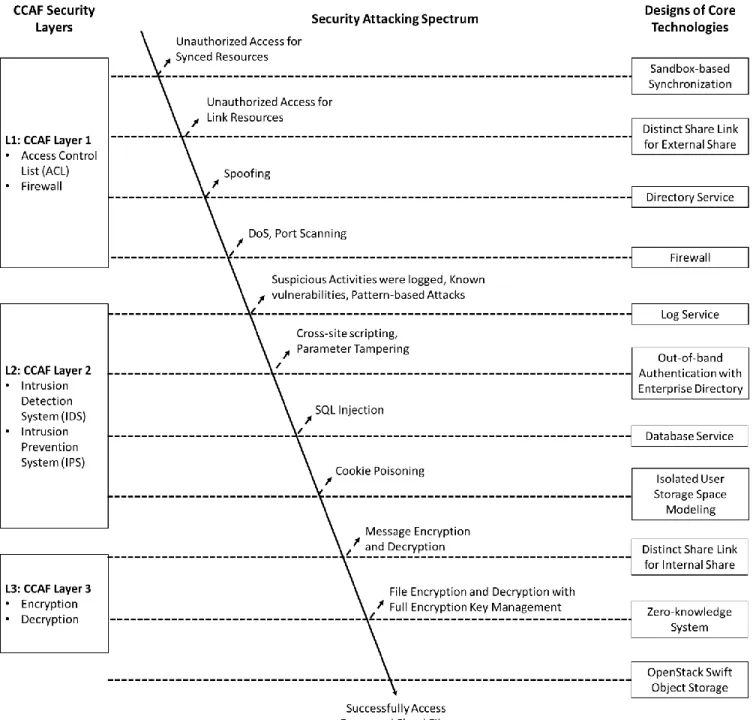
Each layer work in a recursive relationship to pass on security control to each other for extra validity and verification of security techniques that are implemented. This can ensure reduction in the infections by trojans, virus, worms, and unsolicited hacking and denial of service attacks. Each layer has its own protection and is in charge of one or multiple duties in the protection, preventive measurement and quarantine action presented in Figure 9. The left-hand side of Figure 9 shows the CCAF three layers of security and functionality. In layer 1 (L1), it can prevent unauthorized access for synced resources and link resources, spoofing, denial of services (DoS) and port scanning. In layer 2 (L2), it can prevent and counter actions for suspicious activities, known vulnerabilities, patterned-based attacks, cross-site scripting, SQL injection and cookie poisoning. In layer 3 (L3), it offers three types of encryption and decryption services: message, file and full. The right-hand side of Figure 9 explains how designs of core technologies in Section 3 are relevant to the CCAF security. In L1, it includes sandbox-based synchronization, distinct share link for external share, Directory Service and Firewall. In L2, it includes Log Service, Out-of-Band Authentication with Enterprise Security, Database service and isolated user storage space for modeling. In L3, it includes Distinct Share link for Internal Share and Zero-knowledge System. Once a cloud file access request passed all the three security layers, it can reach the managed Openstack Swift object storage, and then get the requested cloud file. How each preventive function of the CCAF security on the left-hand side can be matched to its respective system designs on the right-hand side is illustrated in of Figure 9.
Figure 9: The three-layered CCAF security
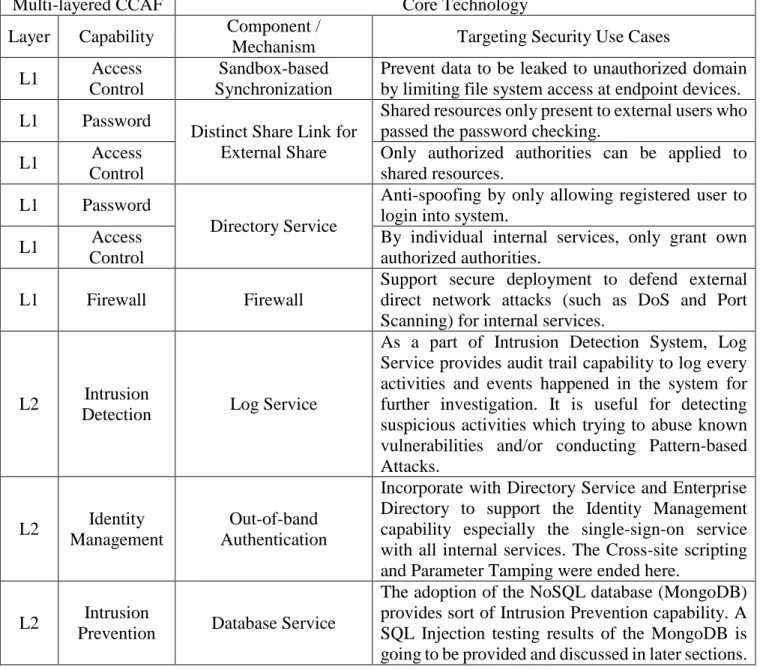
With regard to the technical descriptions in Section 3, the Out-of-Band Authentication belongs to the second layer since it has a single sign on and has the Directory Service and Enterprise Directory and then OpenID. The authentication on the OpenID can double check the right identity of the users. Upon successful verification, single sign on is activated and then all data and all services can undertake encryption as the third layer. The first layer of security is provided by a login feature to a network and IP-based firewall protocols to enforce security. Access control is achieved by providing a list of users and giving them different types of user privilege according to their roles. With regard to the system design, our multi-layered approach consists of listed three items, and the full connections mapping between each CCAF security layer and core technologies used by the system design can further refer to Table 1:
Layer 1: Password protection, network and IP-based firewall and access control Layer 2: Out-of-Band Authentication and OpenID serving for identity management
Layer 3: Encryption and decryption to ensure the true and authenticated files can be archived through encryption. Any files to be accessed will require the algorithms in Figures 5 and 6. Table 1 shows the detailed maps between the CCAF security with its component described in Section 3. In L1, it includes access control, password protection and firewall to minimize data leakage, authorized access, secure deployment for internal users and careful shared resources with external users. In L2, it includes intrusion detection and prevention and then identify management to detect suspicious activities, report vulnerabilities, strengthen identity management, adopt NoSQL databases and isolate the user storage modeling. In L3, it offers file and message encryption and decryption to ensure all data and passwords are safe and well-protected.
Table 1: A mapping between CCAF security layers and corresponding core technologies
Multi-layered CCAF Core Technology
Layer Capability Component /
Mechanism Targeting Security Use Cases L1 Access
Control
Sandbox-based Synchronization
Prevent data to be leaked to unauthorized domain by limiting file system access at endpoint devices. L1 Password
Distinct Share Link for External Share
Shared resources only present to external users who passed the password checking.
L1 Access Control
Only authorized authorities can be applied to shared resources.
L1 Password
Directory Service
Anti-spoofing by only allowing registered user to login into system.
L1 Access Control
By individual internal services, only grant own authorized authorities.
L1 Firewall Firewall
Support secure deployment to defend external direct network attacks (such as DoS and Port Scanning) for internal services.
L2 Intrusion
Detection Log Service
As a part of Intrusion Detection System, Log Service provides audit trail capability to log every activities and events happened in the system for further investigation. It is useful for detecting suspicious activities which trying to abuse known vulnerabilities and/or conducting Pattern-based Attacks.
L2 Identity Management
Out-of-band Authentication
Incorporate with Directory Service and Enterprise Directory to support the Identity Management capability especially the single-sign-on service with all internal services. The Cross-site scripting and Parameter Tamping were ended here.
L2 Intrusion
Prevention Database Service
The adoption of the NoSQL database (MongoDB) provides sort of Intrusion Prevention capability. A SQL Injection testing results of the MongoDB is going to be provided and discussed in later sections.
L2 Intrusion Prevention
Isolated User Storage Space Modeling
Once one of personal user storage space was conquered (by such like the Cookie Poisoning), the Isolated User Storage Space Modeling still guarantees other users’ data privacy since all user storage spaces were modeled in own physical separated MongoDB data collections.
L3
Message Encryption /
Decryption
Distinct Share Link for Internal Share
Messages for accessing internal Distinct Share Link were encrypted by the recipient’s public key before sending, which also prevents network packet inspecting from internal Malware on conquered services. L3 File Encryption / Decryption Zero-knowledge System
Cloud files were encrypted by different random encryption keys, and the encryption keys were managed by the Zero-knowledge System which knows nothing about decrypting the cloud files. Only users with correct Password (L1), right Identity (L2) in the Zero-knowledge System are able to decrypt the original cloud files (L3).
4A Penetration testing
Penetration testing is commonly used in ethical hacking to validate the robustness of the proposed security prototype and test any vulnerabilities. Weakest points and vulnerabilities can be detected by the end of the penetrating testing. Several tools and techniques such as Metasploits were used to enhance penetration testing, upon successful penetration, known 2012 viruses and trojans were used to test the robustness of the multi-layered security upon. All tests were conducted in the VMs. Comparisons with single-layered McAfee anti-viruses software were undertaken to identify any performance issue such as the number of viruses and trojans blocked and the percentage of blockage. The following information was recorded during the experiments:
• The number of viruses and trojans detected and blocked by each layer. • The total numbers of viruses and trojans detected and blocked by the system.
• The number of viruses and trojans detected but unable to be blocked and sent to quarantine. • In the quarantine, the number of viruses and trojans that can be destroyed.
• In the quarantine, the number of viruses and trojans that cannot be destroyed.
Penetration testing for multi-layered CCAF security were conducted. All the trojans and viruses will need to pass the three layers. Each layer can detect and filter out suspected malicious files and then move to the quarantine area waiting for the next action. With the consolidated defense, all the layers should detect and trap as many viruses and trojans as possible. The purpose of the penetration tests is to identify whether that is the case and the number of true vulnerabilities that the multi-layered CCAF security can detect, which are important for business clouds. Two types of experiments were conducted. The first one was focused on penetration tests involved with injecting 10,000 viruses and trojans in one single attempt. The second one was focused on continuous penetration test, such as injecting 10,000 same viruses and trojans every five hours to test that the robustness of the CCAF solution.
Figure 10 shows the number of viruses and trojans detected and blocked by the multi-layered CCAF security. 4,650 viruses and trojans have been detected and blocked by the firewall. Another 4,444 viruses and trojans have been detected and blocked by identity management and intrusion prevention systems.
Finally, 901 were detected and filtered out by encryption, the last step to identify what files in disguise can be detected. Amongst all these figures, there are remaining 5 viruses and trojans sent to quarantine that they could not be removed or destroyed.
Figure 10: The number of viruses and trojans detected and blocked
Figure 11: Percentage of blocking
Results are presented in percentages rather than the number of viruses and trojans blocked. The 10,000 same viruses and trojans are injected every five hours to test how the Data Center can cope with the vulnerabilities. Results in Figure 11 show the percentage that viruses and trojans that have been blocked, which dropped from 100% to 73% in 100 hours. It means that CCAF multi-layered security can withstand regular attacks for up to 5 for 99% blocking and above and up to 10 hours for 90% blocking and above. Performances become degraded after 10 hours of constant attack.
The execution time for detecting viruses and trojans and blocking viruses and trojans at each layer were recorded. This is important for the organizations that adopt Cloud computing since all vulnerabilities should be detected and blocked as soon as possible, or damages can be done to the organizations’ systems and services. Figure 12 shows the execution time to detect and block in each layer. The firewall layer took the shortest time since it was designed to detect and block. Identity layer took the longest for above 200 seconds to detect and 451 seconds to block. The main reason was that a verification process was required in the identity layer to ensure that suspected files are viruses and trojans. As the name implied, identity layer required a verification process to ensure all files were safe and not in the suspected list. That was why it took more time for the verification to complete. Once the trojans and viruses were detected, they were blocked and sent to quarantine area for isolation. The reason why encryption layer had lower execution time was because by the time trojans and viruses came to the third layer, there were only 901 viruses and trojans left.
Figure 12: Execution time to detect and block viruses and trojans
As discussed earlier, 4,650, 4,444 and 901 viruses and trojans had been detected and blocked by the firewall, identity management and encryption respectively. Since the execution time detected and blocked was presented by Figure 12, the next action is to investigate the number of detects/blocks per second, which can be calculated by the total execution time in each layer divided by the number of trojans and viruses detected and blocked. Figure 13 shows the results. Number of blocks/detects are the lowest for the firewall due to its design and emphasis in security. Number of detects/blocks per second is similar between identity and encryption. However, reasons behind are different. The verification process required by the identity layer explains why some extra time is needed. When suspected files came to the third layer, some files had successfully disguised themselves. The encryption security used by CCAF and OpenStack could identity those malicious files in disguised. Key technologies are based on Encryption key management as described in Section 3C. The malicious files went into the encryption layer can be further shared to a VM/Sandbox environment to test. Once the test completed and reported, the VM/Sandbox can be directly destroyed.
Figure 13: Number of detects/blocks per second
Antunes and Vieira [27] use four types of tools for penetration testing, explain the use of precision, recall and F-measure to justify the validity of their results.
Precision is the ratio of correctly detected vulnerabilities to the number of all detected vulnerabilities: 𝑝𝑟𝑒𝑐𝑖𝑠𝑖𝑜𝑛 = 𝑡𝑝
𝑡𝑝 + 𝑓𝑝 (1)
Recall is the ratio of true vulnerabilities detected to the number of known vulnerabilities: 𝑟𝑒𝑐𝑎𝑙𝑙 =𝑡𝑝
𝑡𝑣 (2) where:
True positive (tp) refer to the number of true vulnerabilities detected;
False positives (fp) refer to the number of vulnerabilities detected but do not exist.
True vulnerabilities (tv) refer to the total number of vulnerabilities detected in penetration tests. F-measure can be presented in terms of precision and recall as follows:
F-Measure =2 × 𝑝𝑟𝑒𝑐𝑖𝑠𝑖𝑜𝑛 × 𝑟𝑒𝑐𝑎𝑙𝑙𝑝𝑟𝑒𝑐𝑖𝑠𝑖𝑜𝑛 + 𝑟𝑒𝑐𝑎𝑙𝑙 (3)
Services that can generate a high F-measure mean they are better services [27]. If a service obtains a precision of 0.6 means it can detect vulnerability with 60%. A recall of 0.7 means 70% of the known vulnerabilities is detected. While using formula (3), F-measure is equal to 0.646. The combination of precision, recall and F-measure can determine the quality of the security services. We reproduce the experiments conducted by [27] and then compare results of CCAF multi-layered security with VS1, VS2, VS3 and VS4 tools due to similarities with CCAF technologies except each is single layered security. Results in Table 2 show that the CCAF multi-layered security can provide a much better service since all the true vulnerabilities can be detected with precision as 1. Since only 5 out of 10,000 are missed, the recall is 0.995, resulting in F-measure as 0.9975, which are above all the test results. CCAF multi-layered security has better results than other four tools and has very high precision, recall and F-measure values, indicating there is a high extent of robustness and validity on security. See Table 2.
Table 2: Comparison between CCAF and other single-layered services Services Precision Recall F-Measure
CCAF 1 0.995 0.9975 VS1 0.455 0.323 0.378 VS2 0.388 0.241 0.297 VS3 1 0.019 0.037 VS4 0.567 0.241 0.338 4B SQL injections
Two types of databases were used for multi-layered security. The first type is a MySQL Server 5.5 that stored database information for users, customers, items and text-related information. A NoSQL database – the 64-bit MongoDB 3.0.4 storing the same information. The purpose of this ethical hacking is to test robustness of the two databases. This is useful for business clouds where enterprise security framework such as CCAF should be able to retain vital information and prevent unauthorized access or server outage due to attacks. SQL injections are common in unauthorized attacks and are used to perform ethical hacking. There are two ways to improve on the impacts on SQL injection. First, queries for SQL injection will also create “infinite” loops, in a way to make the database in an erroneous status. Second, 10,000 SQL statements were dumped every second to ensure that SQL injection prevention function cannot be rectified on time. Combining both methods, it makes the SQL injection being able to bring the system down or offline. To follow the SQL injection more effectively, steps were followed and codes were modified based on suggestions of [28], which has clearly indicated how to perform SQL injection successfully, which is still functional on MySQL 5.5. Three types of tests were conducted for MySQL.
The first one was using SQL injection with a standard McAfee 2014 edition protection due to the availability of this product.
The second test was using SQL injection with generic CCAF multi-layered security.
The third test was using SQL injection with full CCAF multi-layered security protection that blocks all ports for MySQL, meaning that each SQL query will require authorization and verification. Tests were undertaken for the first hour followed by the subsequent 24 hours. The first hour was the most important since the information can be leaked and used to hack other part of the systems [29]. The subsequent tests on the following 24 hours were taken. The reason is if a database has been compromised and no remedy actions have been taken within a reasonable time framewortk such as a maximum of 24 hours, it will pose threats to the organizations. Under the laboratory conditions, the first hour test and then the subsequent 24 hours tests have been performed for both MySQL and MongoDB. The 1,000 seconds per a simple response means that the database has been compromised.
4B.1 The first hour tests
Response time to MySQL server was recorded to show the impact of the SQL injection. If no SQL injection was done, the normal response time was 0.20 second per simple query. If the response time was very high, SQL injection was then successful. To study the impact of SQL injection, one test was focused on how happened to the response time in the first hour. It is the most critical period to stop SQL injection hacking and to prevent any ways to make services and servers down. Our rationale is that if the proposed model could not withstand the most critical first hour, there would be little point to rescue data stored in the databases. Figure 14 shows MySQL (with McAfee) response time during SQL injection, whereby 1000 represents the infinity. The service could not withstand SQL injection after 16 minutes, resulting in the downtime and extremely slow response to the MySQL server.
Figure 14: MySQL with McAfee response time during SQL injection
Figure 15: MySQL with generic CCAF response time during SQL injection
Figure 15 shows MySQL (with a generic CCAF) response time, which increased directly proportionally as the time went on to 1 hour. However, all response time was kept 12.8 second and below. Although CCAF multi-layered security can minimize the impacts of SQL injections, it does not provide a full protection to MySQL server. Even so, the response time was delayed to an acceptable extent of 12.8 second instead of 0.2 second per simple query. Figure 16 shows MySQL (with a full CCAF protection) response time, indicating that all the response time always stayed at 0.2 seconds regardless of the time. In other words, SQL injection could not hack its way into MySQL, since all the ports for MySQL had been enforced with security. For all unauthorized queries or queries not from the authorized users, SQL statements would not be accepted. Hence, the full protection could offer a better protection against any unauthorized access or malicious attack.
MySQL with McAfee response time during SQL injection
0 200 400 600 800 1000 1200 1 2 3 4 5 6 7 8 9 10 11 12 13 14 15
Minutes (1 unit = 4 minutes)
R e s p o n s e ti m e (s e c ) MySQL w ith McAfee response time during SQL injection
MySQL with generic CCAF response time during SQL injection
0 2 4 6 8 10 12 14 1 2 3 4 5 6 7 8 9 10 11 12 13 14 15
Minutes (1 unit = 4 m inutes)
R e s po ns e t im e ( s e c )
MySQL w ith generic CCAF response time during SQL injection
Figure 16: MySQL with a full CCAF protection response time during SQL injection
The next test was focused on SQL injection on a NoSQL database such as MongoDB, since it could work in the CCAF core technologies described in Section 3. The same set up and SQL injection approach for MySQL was adopted for the up-to-date version of MongoDB 3.0.4, with three scenarios to be tested. The first test was focused on a MongoDB with McAfee. The second test was focused on a MongoDB with a generic CCAF protection and the third test was focused on a MongoDB with a full CCAF protection. Before the start of all the tests, the same simple query for MySQL SQL injection was used for MongoDB, which could process SQL queries. However, it could take longer since it required more time to translate into a query that MongoDB could understand. This was similar to the development of the 64-bit Windows operating system in 2005, which used an internal emulator to translate 32-bit applications that can be portable and executable on 64-bit operating systems. Each simple query would take 0.40 seconds with repeated experiments. All the experimental results for three tests showed that the response time was unchanged regardless of which security options, as indicated in Figure 17.
Figure 17: All three tests of conducting SQL injection for MongoDB
However, if hackers can gain partial access with MongoDB, then hacking can happen as illustrated by [30]. This means that hackers could use social engineering to trick the users believe the real website. Once
MySQL with full CCAF protection response time during SQL injection
0 0.05 0.1 0.15 0.2 0.25 1 2 3 4 5 6 7 8 9 10 11 12 13 14 15
Minutes (1 unit=4 minutes)
R e s p o n s e ti m e (s e c )
MySQL w ith full CCAF protection response time during SQL injection
All three test results for MongoDB
0 0.05 0.1 0.15 0.2 0.25 0.3 0.35 0.4 0.45 1 2 3 4 5 6 7 8 9 10 11 12 13 14 15
Minutes (1 unit=4 minutes)
R e s p o n s e ti m e (s e c )
All three test results for MongoDB
the passwords were stolen, the hacker could then be broken into the MongoDB system console to change security settings. This does not mean that MongoDB is not vulnerable to security attacks.
4B.2 The subsequent 24 hours tests
This section reports the subsequent 24 hour SQL injection tests followed after the first hour test. The first pair of test was to conduct the SQL injections to MySQL without CCAF protection and MySQL with CCAF protection. Figure 18 shows MySQL SQL injection tests for both Macafee and CCAF generic protection, similar to the repeat of experiments for Figure 14 and Figure 15 for 24 hours. Figure 18 shows that the response time for CCAF generic protection grows to 1,000 seconds at the fourh hour, and remained all the ways to 1,000 seconds per simple response. The SQL injection with McAfee protection had 1,000 seconds per simple response throughout all hours.
Figure 18: MySQL SQL injection tests with McAfee and generic CCAF protection test
Figure 19 shows MySQL and MongoDB SQL injection tests with MacAfee and three CCAF protection tests, similar to the repeat of experiments for Figure 16 and Figure 17 for 24 hours. MySQL with CCAF protection can withstand 24 hours. Similarly, MongoDB tests with McAfee, generic CCAF protection and full CCAF protection can withstand 24 hours. It shows that either the organization adopting business clouds should use MongoDB as database services. During the migration to NoSQL database, the existing MySQL servers should use full protection such as CCAF full security to ensure reliable services.
0 200 400 600 800 1000 1200 1 2 3 4 5 6 7 8 9 10 11 12 Response time (Macafee) Response time (generic CCAF) MySQL SQL injection tests for both Macafee and CCAF generic protection
1 unit = 2 hours R e sp o n se tim e ( sec )