J. Jegorovs
Wave based method: new applicability
areas
© Fraunhofer-Institut für Techno- und Wirtschaftsmathematik ITWM 2009 ISSN 1434-9973
Bericht 178 (2009)
Alle Rechte vorbehalten. Ohne ausdrückliche schriftliche Genehmigung des Herausgebers ist es nicht gestattet, das Buch oder Teile daraus in irgendeiner Form durch Fotokopie, Mikrofilm oder andere Verfahren zu reproduzieren oder in eine für Maschinen, insbesondere Datenverarbei tungsanlagen, ver-wendbare Sprache zu übertragen. Dasselbe gilt für das Recht der öffentlichen Wiedergabe.
Warennamen werden ohne Gewährleistung der freien Verwendbarkeit benutzt. Die Veröffentlichungen in der Berichtsreihe des Fraunhofer ITWM können bezogen werden über:
Fraunhofer-Institut für Techno- und Wirtschaftsmathematik ITWM Fraunhofer-Platz 1 67663 Kaiserslautern Germany Telefon: +49 (0) 6 31/3 16 00-0 Telefax: +49 (0) 6 31/3 16 00-10 99 E-Mail: [email protected] Internet: www.itwm.fraunhofer.de
Vorwort
Das Tätigkeitsfeld des Fraunhofer-Instituts für Techno- und Wirtschaftsmathematik ITWM umfasst anwendungsnahe Grundlagenforschung, angewandte Forschung sowie Beratung und kundenspezifische Lösungen auf allen Gebieten, die für Tech-no- und Wirtschaftsmathematik bedeutsam sind.
In der Reihe »Berichte des Fraunhofer ITWM« soll die Arbeit des Instituts kontinu-ierlich einer interessierten Öffentlichkeit in Industrie, Wirtschaft und Wissenschaft vorgestellt werden. Durch die enge Verzahnung mit dem Fachbereich Mathema-tik der Universität Kaiserslautern sowie durch zahlreiche Kooperationen mit inter-nationalen Institutionen und Hochschulen in den Bereichen Ausbildung und For-schung ist ein großes Potenzial für ForFor-schungsberichte vorhanden. In die Bericht-reihe werden sowohl hervorragende Diplom- und Projektarbeiten und Disserta-tionen als auch Forschungsberichte der Institutsmitarbeiter und Institutsgäste zu aktuellen Fragen der Techno- und Wirtschaftsmathematik aufgenommen. Darüber hinaus bietet die Reihe ein Forum für die Berichterstattung über die zahl-reichen Kooperationsprojekte des Instituts mit Partnern aus Industrie und Wirt-schaft.
Berichterstattung heißt hier Dokumentation des Transfers aktueller Ergebnisse aus mathematischer Forschungs- und Entwicklungsarbeit in industrielle Anwendungen und Softwareprodukte – und umgekehrt, denn Probleme der Praxis generieren neue interessante mathematische Fragestellungen.
Prof. Dr. Dieter Prätzel-Wolters Institutsleiter
Wave Based Method: New Applicability Areas
J. Jegorovs
Fraunhofer Institut f¨ur Techno– Wirtschaftsmathematik (ITWM), Fraunhofer–Platz. 1, D-67663, Kaiserslautern, Germany
e-mail: [email protected]
Abstract
This paper discusses the possibility to use and apply the ideas of the Wave Based Method, which has been de-veloped especially for the steady–state acoustic areas, i.e. to solve the Helmholtz type boundary value prob-lems in a bounded domain, in non–acoustics areas such as steady–state temperature propagation, calculation of the velocity potential function of a liquid flux, calculation of the light irradience in a liver tissue/tumor, etc.
1
Introduction
In the end of 90ies of the twentieth century, a new numerical method has been developed for steady–state acoustic analysis in bounded domains. This novel deterministic numerical technique is based on the indirect Trefftz approach, cf. [18], and has been designed especially for mid–frequency range cases. The reason is simple: neither Finite Element Methods (FEM), cf. [10], nor Statistical Energy Analysis (SEA), cf. [9], cannot be applied exactly in this frequency range, cf. [3], [14], [15], [16], [19], [20], [6], [7]. Some similar ideas have been used in 80ies by Prof. Dr. Willi Freeden et al to solve exterior Dirichlet problems for the homogeneous Helmholtz equations. The main idea was to use an interpolation method using metaharmonic splines to find solution of above mentioned problem in 3D case from given discrete data, [4], [12].
The Finite Element Method usually is applicable in low–frequency cases, where the frequency limit of the FEM is related to the growing number of finite elements required to describe the short wavelength behavior at increasing frequencies. The SEA is a prediction method designed for the high frequency range providing the averaged results which are based on the power balance relations. The classical Wave Based Method (WBM) utilizes complex valued wave functions which have been used to expand the dynamic pressure function and which a priori satisfy the homogeneous Helmholtz equation, [3], [14]. Hence, no discretization of the domain is required and the sizes of appropriate governed matrices are rather small. This, obviously, gives the possibility to touch the mid–frequency range. Moreover, by using the natural basis functions, namely wave functions, we reduce certain ”numerical stress” of the numerical approximation of the problem. This was exactly the ideology of Trefftz, who applied basis functions which a priori exactly solve one or another differential equation, [18].
Nevertheless we would like to emphasize that the same Trefftz ideas can be applied to the Helmholtz, Pois-son, Laplace or even to more general elliptic problems, where the so-called maximum principle can be valid1. Moreover, in classical wave based approach one assumes that the Helmholtz equation is either homogeneous or has point source as the right hand side function. In this paper, we will consider also non–homogeneous elliptic differential equations what allow to apply the wave based technique in a much broad way.
1Let us note that generally in the classical steady–state acoustics maximum principle is not valid, however, this does not play a big role here. We use this property here to separate so–called ”bad” elliptic problems, where so far WBM was used, from ”good” ones.
Main idea of the Wave Based Method
The Wave Based Method, as we mentioned above, has been designed especially for the steady–state acoustic problems. Let us consider some bounded domain Ω ⊂ Rd, d ∈ {2,3}. We assume that the steady– state acoustic pressure function u(x) is defined inside the domainΩand is governed by the homogeneous Helmholtz equation
∆xu+κ2u= 0 inΩ, (1)
whereκ, [1/m], is a given acoustic wave number which corresponds to certain given frequencyf, [Hz]. In order to find unique solution u(x)we have to prescribe the boundary condition on the boundary∂Ωof the domainΩ. We consider the case when the boundary condition, for example, of the Neumann type is given, i.e.
∂u
∂n =v(s), s∈∂Ω, (2)
where, the functionv(s)is defined.
As we already mentioned above, the Wave Based Method is based on the indirect Trefftz approach, cf. [18], i.e. the approximation u˜(x) of the dynamic pressure function u(x) satisfies the differential equation (1) exactly. The solutionu(x)is approximated in 2D case by the following expression
u(x1, x2)≈u˜(x1, x2) = N X j=0 h c(1)j Φ+j(x1, x2) +c(2)j Φ − j (x1, x2) +c (3) j Φ+j(x2, x1) +c (4) j Φ − j(x2, x1) i , (3) whereN ∈N0. The wave functionsΦ±
j (x, y)satisfy the equation (1) exactly and are given by
Φ±j (x, y) = cos jπ Lx xe±i r κ2− “ jπ Lx ”2 y , (4)
where the parameterLx is the size of the smallest box which circumscribes the domainΩinx coordinate direction. The parameters c(1)j , c(2)j , c(3)j and c(4)j are unknown contributions2. The approximation u˜(x) converges towards the exact solutionu(x)forN tending towards infinity under sufficient condition that the computational domain Ω is convex, cf. [3], [14], [15], [16], or if Ω ⊂ R2 satisfies the condition of the proposition presented in [8] whenΩis non–convex.
Obviously, the approximationu˜(x), (3), of the solutionu(x)satisfies the homogeneous Helmholtz equation exactly independent of the constantsc(ji), i∈ {1,2,3,4}. These constants can be determined by the bound-ary condition (2). To find these unknown constants the weak formulation of the boundbound-ary condition (2) has been considered, i.e.
Z ∂Ω φ ∂u ∂n −v dS = 0. (5)
This is so–called residual formulation, where φis a ”test” function. In order to determine the unknowns we insert the expansion (3) into (5) and choose φ alternately equal to one of the wave functions Φ(ji),
i ∈ {1,2,3,4}, j∈N0. Hence, we are able to construct the system of linear equations
Ac=b, (6)
where the components of the matrixAand of the vectorbare equal to appropriate surface integrals
A: Z ∂Ω Φ(ji1)∂Φ (i2) n ∂n dS, b: Z ∂Ω Φ(ji1)v dS, (7) 2
where i1, i2 ∈ {1,2,3,4}, j, n ∈ {0,1, . . . , N} and the vector c consists of unknowns constants. A is symmetric, fully populated, frequency depended, in general, complex matrix, which has rather high condition number whenNincreases. This can affect final results. Usually, the system (6) is solved by simple Gaussian elimination technique, and for largeN values such a strategy can give wrong solution, and no matter how good the integrals (7) have been found. This is, let say, one of the main drawbacks of this methodology. In this paper, we propose to use real valued wave functions only.
2
Classical Wave Based Method applicability extension
Let us assume that the functionu(x)is defined inside the bounded, convex domainΩ⊂Rd, d∈ {2,3}and is governed by more general elliptic equation
Lu+κu=f(x) inΩ, (8)
whereκis some given real number andLu:=a∂
2u
∂x2 +b
∂2u
∂y2 in 2D case andLu:=a
∂2u ∂x2 +b ∂2u ∂y2 +c ∂2u ∂z2 in 3D case, wherea,bandcare some real positive numbers. Additionally, supplying boundary conditions on the boundary∂Ωof the domainΩcan be defined in the following way
α∂u
∂n(s) =βu(s)−v(s), s∈∂Ω. (9)
Here, the functionv(s)is given,nis normal to the boundary∂Ωvector and the constantsαandβhave to be chosen according to the type of the boundary condition.
In order to solve the problem (8), (9), which is linear, using the Wave Based Technique we first of all have to apply superposition principle, i.e. we separate the solutionu(x)into two parts: homogeneous oneuh(x) and particular one up(x). We assume that the particular solution up(x) satisfies the equation (8) and the
homogeneous solutionuh(x)solves the homogeneous equation
Luh+κuh= 0 inΩ, (10)
under modified boundary condition
α∂uh
∂n(s) =βuh(s)−α
∂up
∂n(s) +βup(s)−v(s), s∈∂Ω. (11)
Assume we know the particular up(x) part and would like to find the homogeneous partuh(x). As in the
case of the homogeneous Helmholtz equation (1) we approximate the solutionuh(x)of (10) in 2D case using
the same expression (3). The wave functions are defined as follows
Φ+j (x, y) = cosaLjπ xx cos r a b κ a− j2π2 a2L2 x y, ifκ > j 2π2 aL2 x cosaLjπ xxe s a b „ j2π2 a2L2x −κ a « (y−Ly) , otherwise, (12) Φ− j (x, y) = cosaLjπ xx sin r a b κ a − j2π2 a2L2 x y, ifκ > j 2π2 aL2 x cosaLjπ xxe − s a b „ j2π2 a2L2x −κ a « y , otherwise. (13)
Here, the parameters Lx and Ly are again the sizes of the smallest rectangle circumscribing the domain
Ω in corresponding coordinate directions. As one can see allΦ functions are real valued and satisfy the differential equation (10). Using the boundary condition (11) written in the weak form, i.e.
Z ∂Ω φ α∂uh ∂n +α ∂up ∂n −βuh−βup+v dS = 0, (14)
one is able to construct the system of linear equations in order to find unknown contributions c(1j ,2,3,4) for
∀j ∈ {1,2, . . . , N}, cf. (5) – (7). In this case the matrixAis real valued. The only task we have to carry about is to find particular solutionup(x).
3
Particular Solution
In order to find a particular solutionup(x)one can apply different techniques. For example, if some analytical
function f(x) is given, then one can try to use certain properties of this function to find corresponding particular solutionup(x). On the other hand, in practice some discrete values off(x)are given and in this case an appropriate interpolation can be done. Our aim is to apply a method which finds rather smooth functionup(x). We assume that the right hand side functionf(x)belongs to the spaceL2(Ω). It means that the function is square integrable over the domainΩ, i.e.
Z
Ω
f2(x)dV < ∞. According to the theory of the
elliptic differential equations, [5], the particular solutionup(x)belongs to Sobolev spaceH2(Ω), [5], [1].
3.1 Fourier expansion
We assume that the functionf(x)∈ L2(Ω)in 2D can be expanded into Fourier series
f(x1, x2) = ∞ X j,k=0 fjkaccos πj Lx1 x1cos πk Lx2 x2+fjkassin πj Lx1 x1cos πk Lx2 x2 + fjkbccos πj Lx1 x1sin πk Lx2 x2+fjkbssin πj Lx1 x1sin πk Lx2 x2, (15)
where the coefficients fac
jk, fjkas, fjkbc and fjkbs are 2D Fourier coefficients which can easily be found using appropriate well–known formulae, [17]. On the other hand, we assume that the solutionup ∈ H2(Ω)in 2D
can also be presented in Fourier series form, i.e.
up(x1, x2) = ∞ X j,k=0 acjkcos πj Lx1 x1cos πk Lx2 x2+asjksin πj Lx1 x1cos πk Lx2 x2 + bcjkcos πj Lx1 x1sin πk Lx2 x2+bsjksin πj Lx1 x1sin πk Lx2 x2, (16) whereac
jk,asjk,bcjkandbsjkare unknown coefficients, yet.
Inserting the above given relations (15) and (16) into the equation
Lup+κup=f, (17)
we get relations for unknownsac,sjkandbc,sjk, j, k= 0,1, . . ., i.e.
∞ X j,k=0 " κ−a πj Lx1 2 −b πk Lx2 2! acjk−fjkac # cos πj Lx1 x1cos πk Lx2 x2 + " κ−a πj Lx1 2 −b πk Lx2 2! asjk−fjkas # sin πj Lx1 x1cos πk Lx2 x2 + " κ−a πj Lx1 2 −b πk Lx2 2! bcjk−fjkbc # cos πj Lx1 x1sin πk Lx2 x2 + " κ−a πj Lx1 2 −b πk Lx2 2! bsjk−fjkbs # sin πj Lx1 x1sin πk Lx2 x2 = 0. (18)
Obviously, the relation (18) is true only in the case when all the coefficients vanish. Hence, we find the coefficients ac,sjk = f ac,as jk κ−a πj Lx1 2 −b πk Lx2 2, (19) bc,sjk = f bc,bs jk κ−aLπj x1 2 −bLπk x2 2, (20)
and the solutionup(x)can be found. Actually, such a representation of the right hand side functionf(x), (15), is rather computationally ineffective: to achieve appropriate approximation off(x)one, probably, has to calculate large amount of Fourier coefficients, i.e. do many 2D integrations which are time consuming operations. On the other hand, we can try to apply Discrete Cosine Transform to approximate the right hand side function. This procedure is rather fast. But disadvantage here is that the functionf(x) has to be discretized first and then the particular solution of the equation (8) can be found. Here, one has to assume that appropriate discrete cosine transform of the particular solution up(x) is done and we search then for
corresponding coefficients. Next disadvantage here is the fact that the particular solution is discrete function, hence, probably certain interpolation need to be done. Moreover, some differentiation ofup(x)difficulties
can appear. Therefore, we do not consider any additional details here.
3.2 Uniform B–Spline approximation
From our point of view B–Splines could be an appropriate, elegant approximation of the particular solution
up(x). For the sake of brevity we omit here definitions and long explanations of the elements commonly
used in the theory of B–Splines. All the necessary information our reader can find in [2] or [13]. First of all we assume that the right hand sidef(x)in 2D case can be represented as
f(x(s, t)) = n X i=0 m X j=0 Ni,1(t)Nj,1(s)fij, (21)
whereNi,1(t) andNj,1(s)are thei–th and j–th B-Spline basis functions of degree1, respectively, sand t are real parameters and the coefficientsfij are so–called control points of the surfacef. These functions are defined as follows Ni,0(t) = 1, ifTi ≤t < Ti+1 0, otherwise (22) Ni,p(t) = t−Ti Ti+p−Ti Ni,p−1(t) + Ti+p+1−t Ti+p+1−Ti+1 Ni+1,p−1(t). (23)
Here the vectorT = {T0, T1, . . . , Tn+p+1}is so–called knot vector. The length of the knot vector T one defines taking into account the smoothness order pand the number of the control points n. To construct the surface in 2D case we have to define for two coordinate directions two knot vectorsT andSof lengths
p+n+ 1 and p+m+ 1, respectively. nand mdepend on the discretization level of the object in each coordinate direction, [2], [13]. Moreover, we always assume that both knot vectorsTandSare equidistant. In order to find the particular solutionup(x)of the above presented problem, we assume that this function in
2D has the following representation
up(x(s, t)) = n X i=0 m X j=0 Ni,3(t)Nj,3(s)uij. (24)
Our aim is to find the unknownuij contributions. Taking into account the knot vectorsT andSare equidis-tant, we get the following relations
∂up ∂x =Cx ∂up ∂t = 3Cx dT3 n X i=0 m X j=0 (Ni,2(t)−Ni+1,2(t))Nj,3(s)uij, (25) and ∂up ∂y =Cy ∂up ∂s = 3Cy dS3 n X i=0 m X j=0 (Nj,2(s)−Nj+1,2(s))Ni,3(t)uij, (26)
where dTp = Ti+p −Ti and dSp = Si+p − Si for ∀i and obviously Cx =
∂x ∂t −1 = constx and Cy = ∂y ∂s −1
=consty. Moreover, obviously ∂x
∂s = 0, ∀sand ∂y
∂t = 0, ∀t. Further we find the second
derivatives ∂2up ∂x2 =C 2 x ∂2up ∂t2 = 6Cx2 dT3dT2 n X i=0 m X j=0 (Ni,1(t)−2Ni+1,1(t) +Ni+2,1(t))Nj,3(s)uij, (27) and ∂2up ∂y2 =C 2 y ∂2up ∂s2 = 6Cy2 dS3dS2 n X i=0 m X j=0 (Nj,1(s)−2Nj+1,1(s) +Nj+2,1(s))Ni,3(t)uij. (28)
Using the above presented relations (21), (23), (24) and (27), (28) and substituting them into (17), collecting equal B–Splines we can construct a system of linear equations, where the appropriate matrix is symmetric and in 2D case has 5 diagonal structure. Here, we have to note that the knot vectors T and S for both functions up(x)andf(x)have to have equal number of knots, i.e. n+ 3 + 1andm+ 3 + 1, respectively. This means that in order to find all necessary control pointsuij one has to provide additional control points forf function.
Of course, one can use uniform B–Splines of higher orderp >1to approximate the right hand side function
f. But in this case some additional time and computational effort have to be spend to calculate control points
fij. Other difficulty may appear if the computational domainΩhas non–rectangular shape. This means that the functionf outside the domainΩis not defined and has to be extended until the smallest rectangle which is circumscribingΩ. According to the theory of Sobolev spaces this always is possible3, [1].
4
Numerical examples
To show that our ideas really work we present a couple of simple examples, namely, we consider so–called light diffusion approximation to the transport theory. Assume unknown functionφ∈ H2(Ω)is governed by the equation (29) under boundary condition (30), i.e.
∇(D∇φ)−µaφ = −Q inΩ, (29)
∂φ
∂n = 0 on∂Ω. (30)
Here,φ, [W cm−2], is the light irradiance, µa, [cm
−1
], is the absorption coefficient,Q, [W cm−3], is the source term,Dis the diffusion coefficient defined by(3 (µa+µs(1−g)))
−1
, whereµs, [cm
−1
], andg, [–], are the scattering coefficient and the anisotropy factor, respectively. The above presented relations coupled with the so–called bio–heat equation, which we will not consider here, are used to model the damage of the
tumor tissues in a liver, [11]. The anisotropy factor takes its values for most biological tissues in range0.7
and0.99. The absorption and the scattering coefficients in reality depend on the temperature. We assume that these coefficients are constant, i.e. bothµaand µscoefficients are so–called native, [11]. Let us choose, for
example, parameters of the porcine liver. In the literature the native absorption coefficientµacan be equal to
0.195[cm−1], native scattering coefficientµs= 43.50[cm
−1
] and the anisotropy factorg= 0.9. Moreover, let us assume that the right hand side term
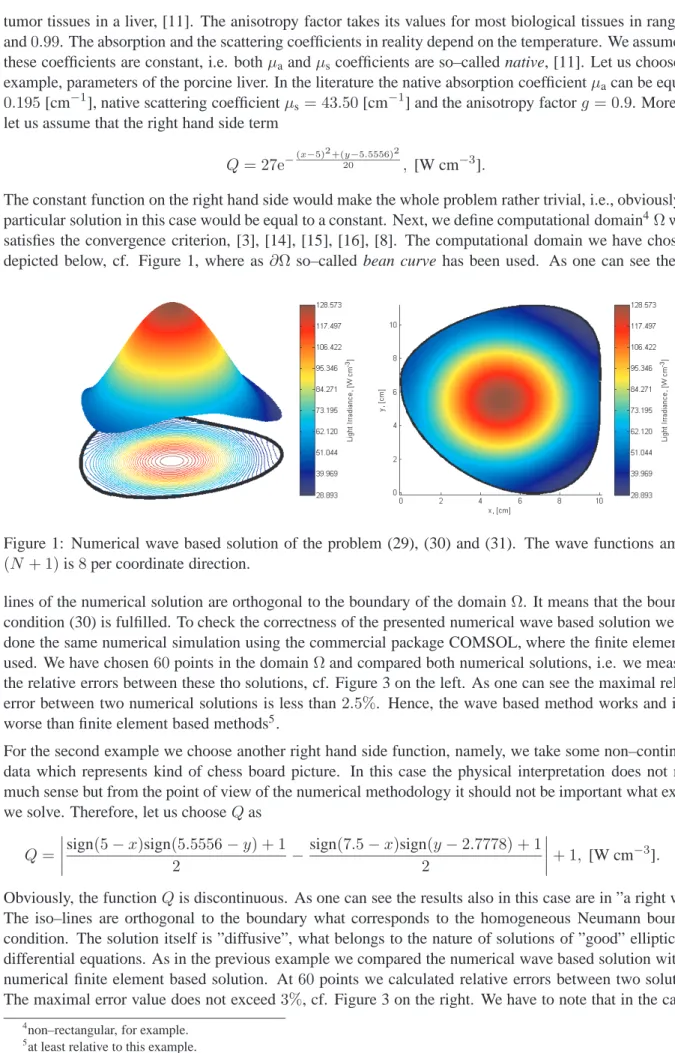
Q= 27e−(x−5)2 +(20y−5.5556)2, [W cm−3]. (31) The constant function on the right hand side would make the whole problem rather trivial, i.e., obviously, the particular solution in this case would be equal to a constant. Next, we define computational domain4Ωwhich satisfies the convergence criterion, [3], [14], [15], [16], [8]. The computational domain we have chosen is depicted below, cf. Figure 1, where as∂Ωso–called bean curve has been used. As one can see the iso–
Figure 1: Numerical wave based solution of the problem (29), (30) and (31). The wave functions amount
(N + 1)is8per coordinate direction.
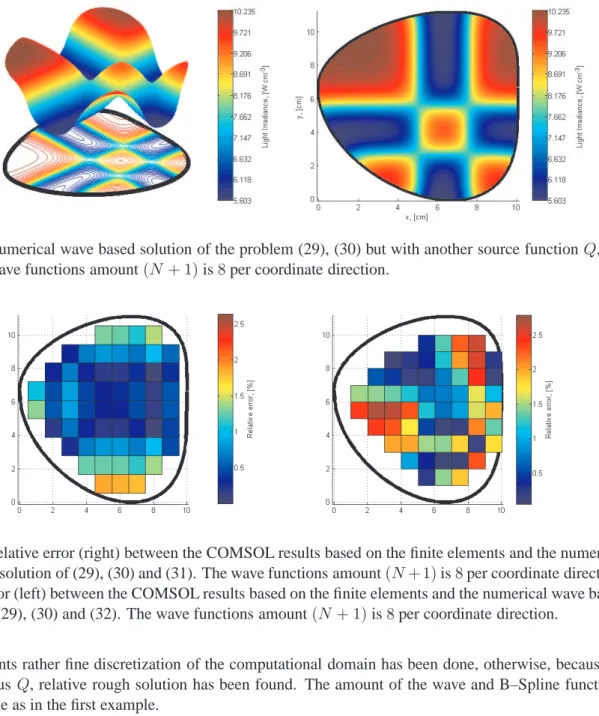
lines of the numerical solution are orthogonal to the boundary of the domainΩ. It means that the boundary condition (30) is fulfilled. To check the correctness of the presented numerical wave based solution we have done the same numerical simulation using the commercial package COMSOL, where the finite element are used. We have chosen60points in the domainΩand compared both numerical solutions, i.e. we measured the relative errors between these tho solutions, cf. Figure 3 on the left. As one can see the maximal relative error between two numerical solutions is less than2.5%. Hence, the wave based method works and is not worse than finite element based methods5.
For the second example we choose another right hand side function, namely, we take some non–continuous data which represents kind of chess board picture. In this case the physical interpretation does not make much sense but from the point of view of the numerical methodology it should not be important what exactly we solve. Therefore, let us chooseQas
Q= sign(5−x)sign(5.5556−y) + 1 2 − sign(7.5−x)sign(y−2.7778) + 1 2 + 1, [W cm−3]. (32) Obviously, the functionQis discontinuous. As one can see the results also in this case are in ”a right way”. The iso–lines are orthogonal to the boundary what corresponds to the homogeneous Neumann boundary condition. The solution itself is ”diffusive”, what belongs to the nature of solutions of ”good” elliptic type differential equations. As in the previous example we compared the numerical wave based solution with the numerical finite element based solution. At60points we calculated relative errors between two solutions. The maximal error value does not exceed3%, cf. Figure 3 on the right. We have to note that in the case of
4
non–rectangular, for example. 5at least relative to this example.
Figure 2: Numerical wave based solution of the problem (29), (30) but with another source functionQ, see (32). The wave functions amount(N + 1)is8per coordinate direction.
Figure 3: Relative error (right) between the COMSOL results based on the finite elements and the numerical wave based solution of (29), (30) and (31). The wave functions amount(N+ 1)is8per coordinate direction. Relative error (left) between the COMSOL results based on the finite elements and the numerical wave based solution of (29), (30) and (32). The wave functions amount(N + 1)is8per coordinate direction.
finite elements rather fine discretization of the computational domain has been done, otherwise, because of discontinuous Q, relative rough solution has been found. The amount of the wave and B–Spline functions was the same as in the first example.
5
Conclusion
In this work we present the possibility to extend the applicability of the wave based method, which has been designed especially for acoustic areas, to more general class of elliptic differential equations for which the maximum principle can be valid. This fact gives the possibility to avoid domain discretization what is rather important in 3D cases. Moreover, the sizes of appropriate governing matrices are relative small and, as presented here, are real valued. Thus, some simple direct solver can be applied to find the numerical solution of a problem. We showed how the inhomogeneity can be evaluated. There are several ways to do this, but from our point of view, the uniform B–Splines approach is more preferred. We presented also two examples with different right hand side functions: one of them was sufficiently smooth and another one was discontinuous function. In both cases we found the numerical solution of the light diffusion equation and compared these wave based solutions with corresponding finite element based solutions calculated with the aid of COMSOL package. 60”control” points have been chosen and at each such a point the relative error
has been calculated. In both examples the maximal relative error among all relative errors did not exceed
2.5%and3%, respectively. Both solutions look diffusive what represent the elliptic nature of the solutions. We considered only the cases when all corresponding coefficients, i.e. a,bandκ, are constants. This fact makes, of course, the whole problem much simpler. Next step of our research to reflect the real nature would be to deal exactly the variable coefficients with. This is, in particular, of big interest in geomathematics, where the waves propagations in rock layers have to be calculated, However, there already exist the theory developed by Prof. Dr. Willi Freeden et al, [4], [12]. Let us also note that the theory of wave based method in 3D case does not differ much from 2D case. One has to modify old and provide additional base functions for third coordinate direction.
The aim of this work was to show that wave based method, developed by Prof. Dr. Wim Desmet et al for acoustics in bounded domains, can be applied also in non–acoustic areas. Finally, we would like to note that this methodology gives numerical solution which exactly satisfies the governed differential equation. Even in cases, if an inhomogeneous right hand side is present, we always get exact particular solution corresponding to the approximation of the source side, because of the natural continuous differentiation of sufficiently smooth B–Spline functions. In other words, we do not change much the differential equation itself, in comparison with the finite element methods, where the numerical solution satisfies the discretized version of the original equation.
Acknowledgements
This research was supported by DFG project (Nr.110264) ”Laser Induced Thermo–Therapy” in Fraunhofer ITWM. The author thank Prof. Dr. Helmut Neunzert, Dr. Raimund Wegener, Dr. Norbert Siedow, Dipl.– Math. Maxim Ilyasov and Dr. Abel Amirbekyan for useful comments and suggestions.
References
[1] Adams, R.A.: Sobolev Spaces, Pure and Applied Mathematics, Academic Press, New York, 1975. [2] de Boor, C.: A Practical Guide to Splines, Revised Edition, Applied Mathematical Sciences, Springer–
Verlag, 1978.
[3] Desmet, W.: A wave based prediction technique for coupled vibro–acoustic analysis, PhD Thesis, K.U. Leuven, division PMA, 1998.
[4] Freeden, W: Metaharmonic splines for solving the exterior Dirichlet problem for the Helmholtz equa-tion, In F. Utreras, C.K. Chui, L.L. Schumaker, editors. Topics in Approximation Theory, pp. 99–110. Academic Press, 1987.
[5] Grisvard, P.: Elliptic problems in non–smooth domains, Monographs and Studies in Mathematics 24, 1985.
[6] Hepberger, A., Pluymers B., Jalics K., Priebsch H.-H., Desmet W.: Validation of a Wave Based Technique for the analysis of a multi-domain 3D acoustic cavity with interior damping and loudspeaker excitation, CD–ROM proceedings of the 33rd International Congress and Exposition on Noise Control Engineering (Internoise2004), Prague, Czech Republic, 2004.
[7] Hepberger, A., Priebsch H.–H., Desmet W., Van Hal B., Pluymers B., Sas P.: Application of the Wave Based Method for the Steady–state Acoustic Response Prediction of a Car Cavity in the Mid–frequency Range, Proceedings of the International Conference on Noise and Vibration Engineering ISMA2002, Leuven, Belgium, 2002.
[8] Jegorovs, J.: On the convergence of the WBM solution in certain non-convex domains, Proceedings of the International Conference on Noise and Vibration Engineering ISMA 2006, Leuven, Belgium, 2006, ID183.
[9] Keane, A. J., Price, W. G.: Statistical Energy Analysis: An Overview, with Applications in Structural Dynamics, Cambridge University Press, 2005.
[10] Meissner, U., Menzel, A.: Die Methode der finiten Elemente. Eine Einfhrung in die Grundlagen, Springer, Berlin, 2000.
[11] Mohammed, Y., Verhey, J.F.: A finite element method to simulate laser interstitial thermo ther-apy in anatomical inhomogeneous regions, BioMedical Engineering OnLine, http://www.biomedical-engineering-online.com/content/4/1/2, 2005.
[12] Mueller, Cl., Kersten, H.: Zwei Klassen vollstaendiger Funktionensysteme zur Behandlung der Randw-ertaufgaben der Schwingungsgleichung ∆xU +k2U = 0, Math. Meth. in the Appl.Sci. 2 (1980), pp. 48–67.
[13] Piegl, L., Tiller, W.: The NURBS Book, 2nd Edition, Springer–Verlag, 1997.
[14] Pluymers, B., Van Hal, B., Vandepitte, D., Desmet, W.: Trefftz-based methods for time–harmonic acoustics, Archives of Computational Methods in Engineering (ARCME), DOI: 10.1007/s11831-007-9010-x, 2007, pp. 343-381.
[15] Pluymers, B., Desmet, W., Vandepitte, D., Sas, P.: On the use of a wave based prediction technique for steady–state structural–acoustic radiation analysis, Journal of Computer Modeling in Engineering & Sciences (CMES), 7(2), 2005, 173-184.
[16] Pluymers, B., Desmet, W., Vandepitte, D., Sas, P.: Application of an efficient wave based prediction technique for the analysis of vibro-acoustic radiation problems, Journal of Computational and Applied Mathematics (JCAM), 168, 2004, pp. 353-364.
[17] Stein, E.M., Shakarchi, R.: Fourier Analysis: An Introduction, Princeton University Press, Princeton, 2003.
[18] Trefftz, E.: Ein Gegenst¨uck zum Ritzschen Verfahren, in Proc. of2ndInt. Congress on Applied Mechan-ics, Zuerich, 1926, pp. 131-137.
[19] Vanmaele, C., Vandepitte, D., Desmet, W.: An efficient wave based prediction technique for dynamic plate bending problems with corner stress singularities, Computer Methods in Applied Mechanics and Engineering, Volume 198, Issues 30-32, 1 June 2009, pp. 2227-2245.
[20] Vanmaele, C., Vandepitte, D., Desmet, W.: An efficient wave based prediction technique for plate bending vibrations, Computer Methods in Applied Mechanics and Engineering, Volume 196, Issues 33-34, 1 July 2007, pp. 3178-3189.
Published reports of the
Fraunhofer ITWM
The PDF-files of the following reports are available under:
www.itwm.fraunhofer.de/de/ zentral__berichte/berichte
1. D. Hietel, K. Steiner, J. Struckmeier
A Finite - Volume Particle Method for Compressible Flows
(19 pages, 1998)
2. M. Feldmann, S. Seibold
Damage Diagnosis of Rotors: Application of Hilbert Transform and Multi-Hypothe-sis Testing
Keywords: Hilbert transform, damage diagnosis, Kalman filtering, non-linear dynamics
(23 pages, 1998)
3. Y. Ben-Haim, S. Seibold
Robust Reliability of Diagnostic Multi- Hypothesis Algorithms: Application to Rotating Machinery
Keywords: Robust reliability, convex models, Kalman fil-tering, multi-hypothesis diagnosis, rotating machinery, crack diagnosis
(24 pages, 1998)
4. F.-Th. Lentes, N. Siedow
Three-dimensional Radiative Heat Transfer in Glass Cooling Processes
(23 pages, 1998)
5. A. Klar, R. Wegener
A hierarchy of models for multilane vehicu-lar traffic
Part I: Modeling (23 pages, 1998)
Part II: Numerical and stochastic investigations (17 pages, 1998)
6. A. Klar, N. Siedow
Boundary Layers and Domain Decomposi-tion for Radiative Heat Transfer and Diffu-sion Equations: Applications to Glass Manu-facturing Processes
(24 pages, 1998)
7. I. Choquet
Heterogeneous catalysis modelling and numerical simulation in rarified gas flows Part I: Coverage locally at equilibrium (24 pages, 1998)
8. J. Ohser, B. Steinbach, C. Lang
Efficient Texture Analysis of Binary Images (17 pages, 1998)
9. J. Orlik
Homogenization for viscoelasticity of the integral type with aging and shrinkage (20 pages, 1998)
10. J. Mohring
Helmholtz Resonators with Large Aperture (21 pages, 1998)
11. H. W. Hamacher, A. Schöbel
On Center Cycles in Grid Graphs (15 pages, 1998)
12. H. W. Hamacher, K.-H. Küfer
Inverse radiation therapy planning - a multiple objective optimisation approach (14 pages, 1999)
13. C. Lang, J. Ohser, R. Hilfer
On the Analysis of Spatial Binary Images (20 pages, 1999)
14. M. Junk
On the Construction of Discrete Equilibrium Distributions for Kinetic Schemes
(24 pages, 1999)
15. M. Junk, S. V. Raghurame Rao
A new discrete velocity method for Navier-Stokes equations
(20 pages, 1999)
16. H. Neunzert
Mathematics as a Key to Key Technologies (39 pages (4 PDF-Files), 1999)
17. J. Ohser, K. Sandau
Considerations about the Estimation of the Size Distribution in Wicksell’s Corpuscle Problem
(18 pages, 1999)
18. E. Carrizosa, H. W. Hamacher, R. Klein, S. Nickel
Solving nonconvex planar location prob-lems by finite dominating sets
Keywords: Continuous Location, Polyhedral Gauges, Finite Dominating Sets, Approximation, Sandwich Algo-rithm, Greedy Algorithm
(19 pages, 2000)
19. A. Becker
A Review on Image Distortion Measures
Keywords: Distortion measure, human visual system
(26 pages, 2000)
20. H. W. Hamacher, M. Labbé, S. Nickel, T. Sonneborn
Polyhedral Properties of the Uncapacitated Multiple Allocation Hub Location Problem
Keywords: integer programming, hub location, facility location, valid inequalities, facets, branch and cut
(21 pages, 2000)
21. H. W. Hamacher, A. Schöbel
Design of Zone Tariff Systems in Public Transportation
(30 pages, 2001)
22. D. Hietel, M. Junk, R. Keck, D. Teleaga
The Finite-Volume-Particle Method for Conservation Laws
(16 pages, 2001)
23. T. Bender, H. Hennes, J. Kalcsics, M. T. Melo, S. Nickel
Location Software and Interface with GIS and Supply Chain Management
Keywords: facility location, software development, geographical information systems, supply chain man-agement
(48 pages, 2001)
24. H. W. Hamacher, S. A. Tjandra
Mathematical Modelling of Evacuation Problems: A State of Art
(44 pages, 2001)
25. J. Kuhnert, S. Tiwari
Grid free method for solving the Poisson equation
Keywords: Poisson equation, Least squares method, Grid free method
(19 pages, 2001)
26. T. Götz, H. Rave, D. Reinel-Bitzer, K. Steiner, H. Tiemeier
Simulation of the fiber spinning process
Keywords: Melt spinning, fiber model, Lattice Boltz-mann, CFD
(19 pages, 2001)
27. A. Zemitis
On interaction of a liquid film with an obstacle
Keywords: impinging jets, liquid film, models, numeri-cal solution, shape
(22 pages, 2001)
28. I. Ginzburg, K. Steiner
Free surface lattice-Boltzmann method to model the filling of expanding cavities by Bingham Fluids
Keywords: Generalized LBE, free-surface phenomena, interface boundary conditions, filling processes, Bing-ham viscoplastic model, regularized models
(22 pages, 2001)
29. H. Neunzert
»Denn nichts ist für den Menschen als Men-schen etwas wert, was er nicht mit Leiden-schaft tun kann«
Vortrag anlässlich der Verleihung des Akademie preises des Landes Rheinland-Pfalz am 21.11.2001
Keywords: Lehre, Forschung, angewandte Mathematik, Mehrskalenanalyse, Strömungsmechanik
(18 pages, 2001)
30. J. Kuhnert, S. Tiwari
Finite pointset method based on the projec-tion method for simulaprojec-tions of the incom-pressible Navier-Stokes equations
Keywords: Incompressible Navier-Stokes equations, Meshfree method, Projection method, Particle scheme, Least squares approximation
AMS subject classification: 76D05, 76M28
(25 pages, 2001)
31. R. Korn, M. Krekel
Optimal Portfolios with Fixed Consumption or Income Streams
Keywords: Portfolio optimisation, stochastic control, HJB equation, discretisation of control problems
(23 pages, 2002)
32. M. Krekel
Optimal portfolios with a loan dependent credit spread
Keywords: Portfolio optimisation, stochastic control, HJB equation, credit spread, log utility, power utility, non-linear wealth dynamics
(25 pages, 2002)
33. J. Ohser, W. Nagel, K. Schladitz
The Euler number of discretized sets – on the choice of adjacency in homogeneous lattices
Keywords: image analysis, Euler number, neighborhod relationships, cuboidal lattice
34. I. Ginzburg, K. Steiner
Lattice Boltzmann Model for Free-Surface flow and Its Application to Filling Process in Casting
Keywords: Lattice Boltzmann models; free-surface phe-nomena; interface boundary conditions; filling pro-cesses; injection molding; volume of fluid method; in-terface boundary conditions; advection-schemes; up-wind-schemes
(54 pages, 2002)
35. M. Günther, A. Klar, T. Materne, R. Wegener
Multivalued fundamental diagrams and stop and go waves for continuum traffic equations
Keywords: traffic flow, macroscopic equations, kinetic derivation, multivalued fundamental diagram, stop and go waves, phase transitions
(25 pages, 2002)
36. S. Feldmann, P. Lang, D. Prätzel-Wolters
Parameter influence on the zeros of net-work determinants
Keywords: Networks, Equicofactor matrix polynomials, Realization theory, Matrix perturbation theory
(30 pages, 2002)
37. K. Koch, J. Ohser, K. Schladitz
Spectral theory for random closed sets and es timating the covariance via frequency space
Keywords: Random set, Bartlett spectrum, fast Fourier transform, power spectrum
(28 pages, 2002)
38. D. d’Humières, I. Ginzburg
Multi-reflection boundary conditions for lattice Boltzmann models
Keywords: lattice Boltzmann equation, boudary condis-tions, bounce-back rule, Navier-Stokes equation
(72 pages, 2002)
39. R. Korn
Elementare Finanzmathematik
Keywords: Finanzmathematik, Aktien, Optionen, Port-folio-Optimierung, Börse, Lehrerweiterbildung, Mathe-matikunterricht
(98 pages, 2002)
40. J. Kallrath, M. C. Müller, S. Nickel
Batch Presorting Problems: Models and Complexity Results
Keywords: Complexity theory, Integer programming, Assigment, Logistics
(19 pages, 2002)
41. J. Linn
On the frame-invariant description of the phase space of the Folgar-Tucker equation
Key words: fiber orientation, Folgar-Tucker equation, in-jection molding
(5 pages, 2003)
42. T. Hanne, S. Nickel
A Multi-Objective Evolutionary Algorithm for Scheduling and Inspection Planning in Software Development Projects
Key words: multiple objective programming, project management and scheduling, software development, evolutionary algorithms, efficient set
(29 pages, 2003)
43. T. Bortfeld , K.-H. Küfer, M. Monz, A. Scherrer, C. Thieke, H. Trinkaus
Intensity-Modulated Radiotherapy - A Large Scale Multi-Criteria Programming Problem
Keywords: multiple criteria optimization, representa-tive systems of Pareto solutions, adaprepresenta-tive triangulation, clustering and disaggregation techniques, visualization of Pareto solutions, medical physics, external beam ra-diotherapy planning, intensity modulated rara-diotherapy
(31 pages, 2003)
44. T. Halfmann, T. Wichmann
Overview of Symbolic Methods in Industrial Analog Circuit Design
Keywords: CAD, automated analog circuit design, sym-bolic analysis, computer algebra, behavioral modeling, system simulation, circuit sizing, macro modeling, dif-ferential-algebraic equations, index
(17 pages, 2003)
45. S. E. Mikhailov, J. Orlik
Asymptotic Homogenisation in Strength and Fatigue Durability Analysis of Compos-ites
Keywords: multiscale structures, asymptotic homoge-nization, strength, fatigue, singularity, non-local con-ditions
(14 pages, 2003)
46. P. Domínguez-Marín, P. Hansen, N. Mladenovi ´c , S. Nickel
Heuristic Procedures for Solving the Discrete Ordered Median Problem
Keywords: genetic algorithms, variable neighborhood search, discrete facility location
(31 pages, 2003)
47. N. Boland, P. Domínguez-Marín, S. Nickel, J. Puerto
Exact Procedures for Solving the Discrete Ordered Median Problem
Keywords: discrete location, Integer programming
(41 pages, 2003)
48. S. Feldmann, P. Lang
Padé-like reduction of stable discrete linear systems preserving their stability
Keywords: Discrete linear systems, model reduction, stability, Hankel matrix, Stein equation
(16 pages, 2003)
49. J. Kallrath, S. Nickel
A Polynomial Case of the Batch Presorting Problem
Keywords: batch presorting problem, online optimization, competetive analysis, polynomial algorithms, logistics
(17 pages, 2003)
50. T. Hanne, H. L. Trinkaus
knowCube for MCDM –
Visual and Interactive Support for Multicriteria Decision Making
Key words: Multicriteria decision making, knowledge management, decision support systems, visual interfac-es, interactive navigation, real-life applications.
(26 pages, 2003)
51. O. Iliev, V. Laptev
On Numerical Simulation of Flow Through Oil Filters
Keywords: oil filters, coupled flow in plain and porous media, Navier-Stokes, Brinkman, numerical simulation
(8 pages, 2003)
52. W. Dörfler, O. Iliev, D. Stoyanov, D. Vassileva
On a Multigrid Adaptive Refinement Solver for Saturated Non-Newtonian Flow in Porous Media
Keywords: Nonlinear multigrid, adaptive refinement, non-Newtonian flow in porous media
(17 pages, 2003)
53. S. Kruse
On the Pricing of Forward Starting Options under Stochastic Volatility
Keywords: Option pricing, forward starting options, Heston model, stochastic volatility, cliquet options
(11 pages, 2003)
54. O. Iliev, D. Stoyanov
Multigrid – adaptive local refinement solver for incompressible flows
Keywords: Navier-Stokes equations, incompressible flow, projection-type splitting, SIMPLE, multigrid methods, adaptive local refinement, lid-driven flow in a cavity
(37 pages, 2003)
55. V. Starikovicius
The multiphase flow and heat transfer in porous media
Keywords: Two-phase flow in porous media, various formulations, global pressure, multiphase mixture mod-el, numerical simulation
(30 pages, 2003)
56. P. Lang, A. Sarishvili, A. Wirsen
Blocked neural networks for knowledge ex-traction in the software development process
Keywords: Blocked Neural Networks, Nonlinear Regres-sion, Knowledge Extraction, Code Inspection
(21 pages, 2003)
57. H. Knaf, P. Lang, S. Zeiser
Diagnosis aiding in Regulation Thermography using Fuzzy Logic
Keywords: fuzzy logic,knowledge representation, expert system
(22 pages, 2003)
58. M. T. Melo, S. Nickel, F. Saldanha da Gama
Large scale models for dynamic multi-commodity capacitated facility location
Keywords: supply chain management, strategic planning, dynamic location, modeling
(40 pages, 2003)
59. J. Orlik
Homogenization for contact problems with periodically rough surfaces
Keywords: asymptotic homogenization, contact problems
(28 pages, 2004)
60. A. Scherrer, K.-H. Küfer, M. Monz, F. Alonso, T. Bortfeld
IMRT planning on adaptive volume struc-tures – a significant advance of computa-tional complexity
Keywords: Intensity-modulated radiation therapy (IMRT), inverse treatment planning, adaptive volume structures, hierarchical clustering, local refinement, adaptive clustering, convex programming, mesh gener-ation, multi-grid methods
(24 pages, 2004)
61. D. Kehrwald
Parallel lattice Boltzmann simulation of complex flows
Keywords: Lattice Boltzmann methods, parallel com-puting, microstructure simulation, virtual material de-sign, pseudo-plastic fluids, liquid composite moulding
(12 pages, 2004)
62. O. Iliev, J. Linn, M. Moog, D. Niedziela, V. Starikovicius
On the Performance of Certain Iterative Solvers for Coupled Systems Arising in Dis-cretization of Non-Newtonian Flow Equa-tions
Keywords: Performance of iterative solvers, Precondi-tioners, Non-Newtonian flow
(17 pages, 2004)
63. R. Ciegis, O. Iliev, S. Rief, K. Steiner
On Modelling and Simulation of Different Regimes for Liquid Polymer Moulding
Keywords: Liquid Polymer Moulding, Modelling, Simu-lation, Infiltration, Front Propagation, non-Newtonian flow in porous media
(43 pages, 2004)
64. T. Hanne, H. Neu
Simulating Human Resources in Software Development Processes
Keywords: Human resource modeling, software process, productivity, human factors, learning curve
(14 pages, 2004)
65. O. Iliev, A. Mikelic, P. Popov
Fluid structure interaction problems in de-formable porous media: Toward permeabil-ity of deformable porous media
Keywords: fluid-structure interaction, deformable po-rous media, upscaling, linear elasticity, stokes, finite el-ements
(28 pages, 2004)
66. F. Gaspar, O. Iliev, F. Lisbona, A. Naumovich, P. Vabishchevich
On numerical solution of 1-D poroelasticity equations in a multilayered domain
Keywords: poroelasticity, multilayered material, finite volume discretization, MAC type grid
(41 pages, 2004)
67. J. Ohser, K. Schladitz, K. Koch, M. Nöthe
Diffraction by image processing and its ap-plication in materials science
Keywords: porous microstructure, image analysis, ran-dom set, fast Fourier transform, power spectrum, Bar-tlett spectrum
(13 pages, 2004)
68. H. Neunzert
Mathematics as a Technology: Challenges for the next 10 Years
Keywords: applied mathematics, technology, modelling, simulation, visualization, optimization, glass processing, spinning processes, fiber-fluid interaction, trubulence effects, topological optimization, multicriteria optimiza-tion, Uncertainty and Risk, financial mathematics, Mal-liavin calculus, Monte-Carlo methods, virtual material design, filtration, bio-informatics, system biology
(29 pages, 2004)
69. R. Ewing, O. Iliev, R. Lazarov, A. Naumovich
On convergence of certain finite difference discretizations for 1 D poroelasticity inter-face problems
Keywords: poroelasticity, multilayered material, finite volume discretizations, MAC type grid, error estimates
(26 pages,2004)
70. W. Dörfler, O. Iliev, D. Stoyanov, D. Vassileva
On Efficient Simulation of Non-Newto-nian Flow in Saturated Porous Media with a Multigrid Adaptive Refinement Solver
Keywords: Nonlinear multigrid, adaptive renement, non-Newtonian in porous media
(25 pages, 2004)
71. J. Kalcsics, S. Nickel, M. Schröder
Towards a Unified Territory Design Approach – Applications, Algorithms and GIS Integration
Keywords: territory desgin, political districting, sales territory alignment, optimization algorithms, Geo-graphical Information Systems
(40 pages, 2005)
72. K. Schladitz, S. Peters, D. Reinel-Bitzer, A. Wiegmann, J. Ohser
Design of acoustic trim based on geometric modeling and flow simulation for non-woven
Keywords: random system of fibers, Poisson line process, flow resistivity, acoustic absorption, Lattice-Boltzmann method, non-woven
(21 pages, 2005)
73. V. Rutka, A. Wiegmann
Explicit Jump Immersed Interface Method for virtual material design of the effective elastic moduli of composite materials
Keywords: virtual material design, explicit jump im-mersed interface method, effective elastic moduli, composite materials
(22 pages, 2005)
74. T. Hanne
Eine Übersicht zum Scheduling von Baustellen
Keywords: Projektplanung, Scheduling, Bauplanung, Bauindustrie
(32 pages, 2005)
75. J. Linn
The Folgar-Tucker Model as a Differetial Algebraic System for Fiber Orientation Calculation
Keywords: fiber orientation, Folgar–Tucker model, in-variants, algebraic constraints, phase space, trace sta-bility
(15 pages, 2005)
76. M. Speckert, K. Dreßler, H. Mauch, A. Lion, G. J. Wierda
Simulation eines neuartigen Prüf systems für Achserprobungen durch MKS-Model-lierung einschließlich Regelung
Keywords: virtual test rig, suspension testing, multibody simulation, modeling hexapod test rig, opti-mization of test rig configuration
(20 pages, 2005)
77. K.-H. Küfer, M. Monz, A. Scherrer, P. Süss, F. Alonso, A. S. A. Sultan, Th. Bortfeld, D. Craft, Chr. Thieke
Multicriteria optimization in intensity modulated radiotherapy planning
Keywords: multicriteria optimization, extreme solu-tions, real-time decision making, adaptive approxima-tion schemes, clustering methods, IMRT planning, re-verse engineering
(51 pages, 2005)
78. S. Amstutz, H. Andrä
A new algorithm for topology optimization using a level-set method
Keywords: shape optimization, topology optimization, topological sensitivity, level-set
(22 pages, 2005)
79. N. Ettrich
Generation of surface elevation models for urban drainage simulation
Keywords: Flooding, simulation, urban elevation models, laser scanning
(22 pages, 2005)
80. H. Andrä, J. Linn, I. Matei, I. Shklyar, K. Steiner, E. Teichmann
OPTCAST – Entwicklung adäquater Struk-turoptimierungsverfahren für Gießereien Technischer Bericht (KURZFASSUNG)
Keywords: Topologieoptimierung, Level-Set-Methode, Gießprozesssimulation, Gießtechnische Restriktionen, CAE-Kette zur Strukturoptimierung
(77 pages, 2005)
81. N. Marheineke, R. Wegener
Fiber Dynamics in Turbulent Flows Part I: General Modeling Framework
Keywords: fiber-fluid interaction; Cosserat rod; turbu-lence modeling; Kolmogorov’s energy spectrum; dou-ble-velocity correlations; differentiable Gaussian fields
(20 pages, 2005)
Part II: Specific Taylor Drag
Keywords: flexible fibers; k-e turbulence model; fi-ber-turbulence interaction scales; air drag; random Gaussian aerodynamic force; white noise; stochastic differential equations; ARMA process
(18 pages, 2005)
82. C. H. Lampert, O. Wirjadi
An Optimal Non-Orthogonal Separation of the Anisotropic Gaussian Convolution Filter
Keywords: Anisotropic Gaussian filter, linear filtering, ori-entation space, nD image processing, separable filters
(25 pages, 2005)
83. H. Andrä, D. Stoyanov
Error indicators in the parallel finite ele-ment solver for linear elasticity DDFEM
Keywords: linear elasticity, finite element method, hier-archical shape functions, domain decom-position, par-allel implementation, a posteriori error estimates
(21 pages, 2006)
84. M. Schröder, I. Solchenbach
Optimization of Transfer Quality in Regional Public Transit
Keywords: public transit, transfer quality, quadratic assignment problem
(16 pages, 2006)
85. A. Naumovich, F. J. Gaspar
On a multigrid solver for the three-dimen-sional Biot poroelasticity system in multi-layered domains
Keywords: poroelasticity, interface problem, multigrid, operator-dependent prolongation
(11 pages, 2006)
86. S. Panda, R. Wegener, N. Marheineke
Slender Body Theory for the Dynamics of Curved Viscous Fibers
Keywords: curved viscous fibers; fluid dynamics; Navier-Stokes equations; free boundary value problem; asymp-totic expansions; slender body theory
(14 pages, 2006)
87. E. Ivanov, H. Andrä, A. Kudryavtsev
Domain Decomposition Approach for Auto-matic Parallel Generation of Tetrahedral Grids
Key words: Grid Generation, Unstructured Grid, Delau-nay Triangulation, Parallel Programming, Domain De-composition, Load Balancing
(18 pages, 2006)
88. S. Tiwari, S. Antonov, D. Hietel, J. Kuhnert, R. Wegener
A Meshfree Method for Simulations of In-teractions between Fluids and Flexible Structures
Key words: Meshfree Method, FPM, Fluid Structure Interaction, Sheet of Paper, Dynamical Coupling
(16 pages, 2006)
89. R. Ciegis , O. Iliev, V. Starikovicius, K. Steiner
Numerical Algorithms for Solving Problems of Multiphase Flows in Porous Media
Keywords: nonlinear algorithms, finite-volume method, software tools, porous media, flows
90. D. Niedziela, O. Iliev, A. Latz
On 3D Numerical Simulations of Viscoelastic Fluids
Keywords: non-Newtonian fluids, anisotropic viscosity, integral constitutive equation
(18 pages, 2006)
91. A. Winterfeld
Application of general semi-infinite Pro-gramming to Lapidary Cutting Problems
Keywords: large scale optimization, nonlinear program-ming, general semi-infinite optimization, design center-ing, clustering
(26 pages, 2006)
92. J. Orlik, A. Ostrovska
Space-Time Finite Element Approximation and Numerical Solution of Hereditary Linear Viscoelasticity Problems
Keywords: hereditary viscoelasticity; kern approxima-tion by interpolaapproxima-tion; space-time finite element approxi-mation, stability and a priori estimate
(24 pages, 2006)
93. V. Rutka, A. Wiegmann, H. Andrä
EJIIM for Calculation of effective Elastic Moduli in 3D Linear Elasticity
Keywords: Elliptic PDE, linear elasticity, irregular do-main, finite differences, fast solvers, effective elas-tic moduli
(24 pages, 2006)
94. A. Wiegmann, A. Zemitis
EJ-HEAT: A Fast Explicit Jump Harmonic Averaging Solver for the Effective Heat Conductivity of Composite Materials
Keywords: Stationary heat equation, effective ther-mal conductivity, explicit jump, discontinuous coeffi-cients, virtual material design, microstructure simula-tion, EJ-HEAT
(21 pages, 2006)
95. A. Naumovich
On a finite volume discretization of the three-dimensional Biot poroelasticity sys-tem in multilayered domains
Keywords: Biot poroelasticity system, interface problems, finite volume discretization, finite difference method
(21 pages, 2006)
96. M. Krekel, J. Wenzel
A unified approach to Credit Default Swap-tion and Constant Maturity Credit Default Swap valuation
Keywords: LIBOR market model, credit risk, Credit De-fault Swaption, Constant Maturity Credit DeDe-fault Swap-method
(43 pages, 2006)
97. A. Dreyer
Interval Methods for Analog Circiuts
Keywords: interval arithmetic, analog circuits, tolerance analysis, parametric linear systems, frequency response, symbolic analysis, CAD, computer algebra
(36 pages, 2006)
98. N. Weigel, S. Weihe, G. Bitsch, K. Dreßler
Usage of Simulation for Design and Optimi-zation of Testing
Keywords: Vehicle test rigs, MBS, control, hydraulics, testing philosophy
(14 pages, 2006)
99. H. Lang, G. Bitsch, K. Dreßler, M. Speckert
Comparison of the solutions of the elastic and elastoplastic boundary value problems
Keywords: Elastic BVP, elastoplastic BVP, variational inequalities, rate-independency, hysteresis, linear kine-matic hardening, stop- and play-operator
(21 pages, 2006)
100. M. Speckert, K. Dreßler, H. Mauch
MBS Simulation of a hexapod based sus-pension test rig
Keywords: Test rig, MBS simulation, suspension, hydraulics, controlling, design optimization
(12 pages, 2006)
101. S. Azizi Sultan, K.-H. Küfer
A dynamic algorithm for beam orientations in multicriteria IMRT planning
Keywords: radiotherapy planning, beam orientation optimization, dynamic approach, evolutionary algo-rithm, global optimization
(14 pages, 2006)
102. T. Götz, A. Klar, N. Marheineke, R. Wegener
A Stochastic Model for the Fiber Lay-down Process in the Nonwoven Production
Keywords: fiber dynamics, stochastic Hamiltonian sys-tem, stochastic averaging
(17 pages, 2006)
103. Ph. Süss, K.-H. Küfer
Balancing control and simplicity: a variable aggregation method in intensity modulated radiation therapy planning
Keywords: IMRT planning, variable aggregation, clus-tering methods
(22 pages, 2006)
104. A. Beaudry, G. Laporte, T. Melo, S. Nickel
Dynamic transportation of patients in hos-pitals
Keywords: in-house hospital transportation, dial-a-ride, dynamic mode, tabu search
(37 pages, 2006)
105. Th. Hanne
Applying multiobjective evolutionary algo-rithms in industrial projects
Keywords: multiobjective evolutionary algorithms, dis-crete optimization, continuous optimization, electronic circuit design, semi-infinite programming, scheduling
(18 pages, 2006)
106. J. Franke, S. Halim
Wild bootstrap tests for comparing signals and images
Keywords: wild bootstrap test, texture classification, textile quality control, defect detection, kernel estimate, nonparametric regression
(13 pages, 2007)
107. Z. Drezner, S. Nickel
Solving the ordered one-median problem in the plane
Keywords: planar location, global optimization, ordered median, big triangle small triangle method, bounds, numerical experiments
(21 pages, 2007)
108. Th. Götz, A. Klar, A. Unterreiter, R. Wegener
Numerical evidance for the non- existing of solutions of the equations desribing rota-tional fiber spinning
Keywords: rotational fiber spinning, viscous fibers, boundary value problem, existence of solutions
(11 pages, 2007)
109. Ph. Süss, K.-H. Küfer
Smooth intensity maps and the Bortfeld-Boyer sequencer
Keywords: probabilistic analysis, intensity modulated radiotherapy treatment (IMRT), IMRT plan application, step-and-shoot sequencing
(8 pages, 2007)
110. E. Ivanov, O. Gluchshenko, H. Andrä, A. Kudryavtsev
Parallel software tool for decomposing and meshing of 3d structures
Keywords: a-priori domain decomposition, unstruc-tured grid, Delaunay mesh generation
(14 pages, 2007)
111. O. Iliev, R. Lazarov, J. Willems
Numerical study of two-grid precondition-ers for 1d elliptic problems with highly oscillating discontinuous coefficients
Keywords: two-grid algorithm, oscillating coefficients, preconditioner
(20 pages, 2007)
112. L. Bonilla, T. Götz, A. Klar, N. Marheineke, R. Wegener
Hydrodynamic limit of the Fokker-Planck-equation describing fiber lay-down pro-cesses
Keywords: stochastic dierential equations, Fokker-Planck equation, asymptotic expansion, Ornstein-Uhlenbeck process
(17 pages, 2007)
113. S. Rief
Modeling and simulation of the pressing section of a paper machine
Keywords: paper machine, computational fluid dynam-ics, porous media
(41 pages, 2007)
114. R. Ciegis, O. Iliev, Z. Lakdawala
On parallel numerical algorithms for simu-lating industrial filtration problems
Keywords: Navier-Stokes-Brinkmann equations, finite volume discretization method, SIMPLE, parallel comput-ing, data decomposition method
(24 pages, 2007)
115. N. Marheineke, R. Wegener
Dynamics of curved viscous fibers with sur-face tension
Keywords: Slender body theory, curved viscous bers with surface tension, free boundary value problem
(25 pages, 2007)
116. S. Feth, J. Franke, M. Speckert
Resampling-Methoden zur mse-Korrektur und Anwendungen in der Betriebsfestigkeit
Keywords: Weibull, Bootstrap, Maximum-Likelihood, Betriebsfestigkeit
(16 pages, 2007)
117. H. Knaf
Kernel Fisher discriminant functions – a con-cise and rigorous introduction
Keywords: wild bootstrap test, texture classification, textile quality control, defect detection, kernel estimate, nonparametric regression
(30 pages, 2007)
118. O. Iliev, I. Rybak
On numerical upscaling for flows in hetero-geneous porous media