FA-118/November 1992
FIRE & EMERGENCY
SERVICE
Hearing Conservation Program Manual
Federal Emergency Management Agency
United States Fire Administration
This document was scanned from hard copy to portable document format (PDF)
and edited to 99.5% accuracy. Some formatting errors not detected during the
optical character recognition process may appear.
Federal Emergency Management Agency
United States Fire Administration
International Standard Book Number: 0-942920-13-9
Any opinions, findings, conclusions or recommendations expressed in this publication do not necesarily reflect the views of the Federal Emergency Management Agency or the United States
FIRE & EMERGENCY
SERVICE
Hearing Conservation Program Manual
Federal Emergency Management Agency
United States Fire Administration
Federal Emergency Management Agency
United States Fire Administration
Emmitsburg, Maryland 21727
September 1992
Dear Colleague:
Since its inception, the United States Fire Administration (USFA) has been committed to
enhancing the health and safety of emergency response personnel. Fire, rescue, emergency
medical service (EMS), and other emergency response agencies across the country rely on the
USFA for state-of-the-art information on critical emergency management issues. Thus, some
of our most aggressive initiatives in recent years have focused on the very real and serious
occupational health hazards of emergency responders.
Noise is probably the most underrated health hazard affecting fire and EMS personnel. The
siren required to warn the public that emergency vehicles are approaching is just one example
of the overlooked noise hazard for individuals riding the engine, truck, rescue, ambulance or
other emergency vehicle.
The dangers of excessive noise exposure to emergency service personnel is finally being
addressed. There have been a number of evaluations of fire departments that have substantiated
the fact that firefighters and EMS personnel are being exposed to high noise levels with resultant
hearing loss. These studies have also found a substantial increase in high frequency hearing loss
related to the amount of time spent in the emergency services.
The cases of hearing loss are irreversible and incurable. They are also preventable! This
manual will be an important resource in the development of programs to control the emergency
responder’s noise exposure problem.
Sincerely,
Olin L. Greene
Federal Emergency Management Agency
United States Fire Administration
Emmitsburg, Maryland 21727
APR 02 1990
Mr. Richard M. Duffy
Director
Department of Occupational
Safety and Health
International Association
of Fire Fighters
1750 New York Avenue, N.W.
Washington, D.C.
20006
Dear Mr. Duffy:
I have reviewed An Evaluation of Current Hearing Conservation
Programs which the International Association of Fire Fighters
(IAFF) performed under contract (EMW-88-R-2896) with the
United States Fire Administration. The report content meets
the requirements of the contract, and I believe that, based
upon a reading of this report,
fire departments will be able
to recognize the value of a Hearing Conservation Program (HCP)
to the members and to the department. I do not believe that
any changes, additions,
or deletions are necessary, and I look
forward to receiving camera ready when they become available.
Tom Smith
Acting Assistant Administrator
Office of Firefighter Health
and Safety
TABLE OF CONTENTS
Introduction ... 1
The Hearing Process ... 5
Occupational Health Loss ... 9
The Extra Auditory Effects of Noise ... 13
Standards for Noise Exposure ... 17
The Measurement of Sound ... .23
Noise Control Practices ... .29
Fire Fighter Noise Exposure ... 33
Elements of a Hearing Conservation Program ... .41
Workers’ Compensation and Hearing Loss ... 47
Evaluation Fire Department Hearing Conservation Program ... 51
A Step-By-Step Approach Fire Fighter Hearing Cons ... 59
Glossary... 63
Bibliography ... 67
Appendix A: Sample Questionnaires and Forms ... A-l
LIST OF FIGURES
Figure 1 Illustration of the Human Ear . . . 7Figure 2 Audiogram Showing Hearing Loss . . . 27
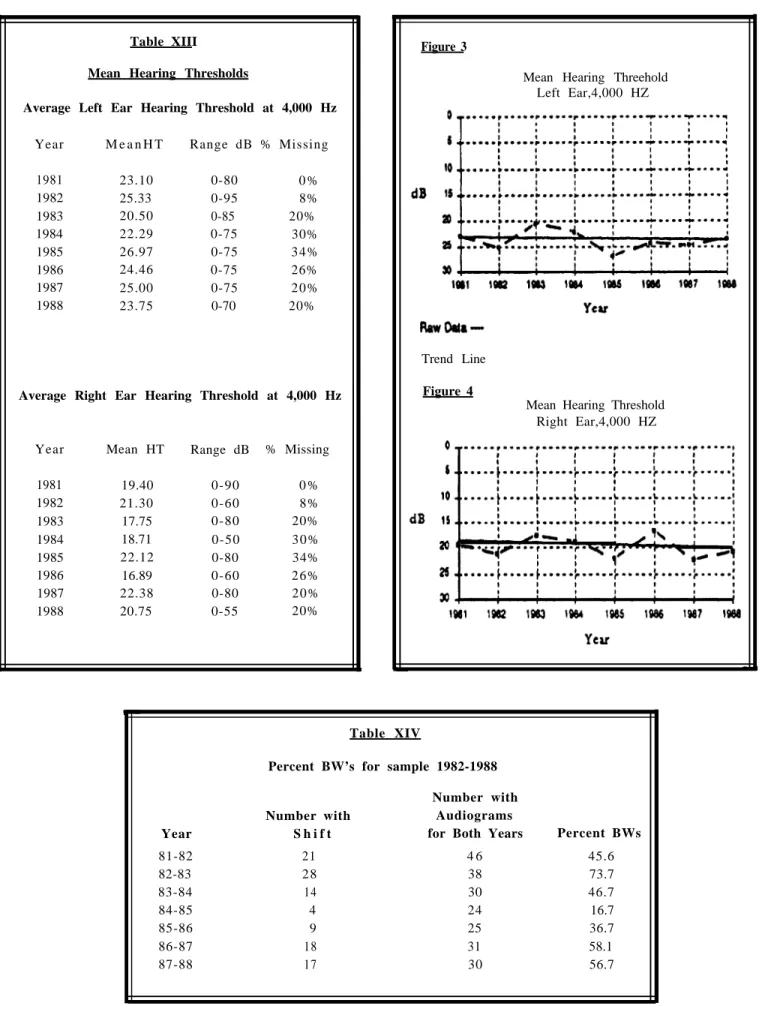
Figure 3 Mean Hearing Threshold, Left Ear . . . 55
Figure 4 Mean Hearing Threshold, Bight Ear . . . .55
LIST OF TABLES
Table 1
Estimate of Population at Risk of Experiencing Hearing Loss . . . . . . 11
Table 2
Warning Signs of Hearing Loss ... 12
Table 3
Permissible Exposure Durations . . . .19
Table 4
Examples of Common Noises . . . . . . 25
Table 5
Illustrating the Decibel Scale . . . . . . 25
Table 6
Comparison of Ear Plugs and Ear Muffs . . . .31
Table 7
NIOSH Vehicle/Equipment Noise Survey . . . . . . 35
Table 8
University of California Vehicle Noise Survey . . . .. . . .36
Table 9
Noise Dosimetry Measurements During Emergency Response . . . 37
Table 10
8-Hour TWA Calculations for Eight Fire Fighter Positions . . . .. . . 37
Table 11
Sound Level Reduction as a Function of Siren Location and Operating Conditions . . . 38
Table 12
Phoenix Fire Department . . . 54
Table 13
Mean Hearing Thresholds . . . .55
Table 14
Percent BW’s for Sample 1982-1988 . . . 5 5
Table 15
Percent of Anaheim Fire Fighters without Hearing Impairment . . . 56
Table 16
States With OSHA Plans . . . 6 2
INTRODUCTION
Although sight is commonly considered our most valued sense, some people who are totally deaf claim that if they had their choice they would rather be blind. This is because the deaf person has lost an extremely important and basic process of communication for which there are only poor substitutes. Sound can provide a basic source of information and pleasure. However, excessive noise can be a menace.
Of all the hazards faced by workers , noise may be one of the most serious. While noise-induced hearing loss (NIHL) is one of the most common occupational diseases, it has frequently been overlooked or underrated because it is neither visible nor painful. The effects of noise are cumulative and often take a long time to be come permanent. Often, the permanent effects of noise are not noticed by an individual until it is too late.
Noise is often defined as sound bearing no information and whose intensity varies over time. Noise is usually unwanted. It frequently interferes with wanted sound and evidence shows that it can be physiologically harmful. However, noise does not have specific characteristics that distinguish it from wanted sound except how it is perceived by the human ear. Harmful noise can be generated in two ways. First, there is continuous noise. This is the type of noise that may be generated by an engine or by equipment such as an exhaust fan or cutting tool. The second type is called intermittent noise, that is noise generated by a siren or the blowing of an air horn.
Noise is one of the few occupational health hazards com-mon to all industries. It not only causes “auditory” effects (hearing loss), but can also be accompanied by “extra-audi-tory” effects (psycho-logical problems, or long or short term physiological effects). The physiological effects of noise may be enhanced when accompanied by other stressors that are common to the nature of emergency services, such as shift work and trauma related stress. An individual’s encounter with high occupational noise levels over time may cause the
degradation of hearing, mask reception of desired sounds, interfere with speech communication, heighten emotions and physiologic activity, disrupt concentration and cause other actions that may hinder job efficiency or induce accidents at the workplace.
The hazards of noise have been known for centuries. In the early 1700’s. Ramazzini described the effect of hearing loss on coppersmiths. In the 19th century, blacksmiths were identi-fied as an occupational group that would routinely experience hearing loss. The dawning of the industrial revolution brought on noise as we know it today-acommon part of our everyday lives. In every urban and suburban area, the sounds of traffic, pneumatic and electric tools, sirens and horns, and even aircraft flying overhead can be heard.
Noise Induced Hearing Loss is recognized as a significant occupational health hazard throughout the fire service. Emer-gency Medical Service (EMS) personnel face many of the same hazards of excessive noise exposure. Sirens, air horns, motors, power tools, and radio speakers create noise hazards for fire and EMS personnel in emergency apparatus, during emergency operations, and during training evolutions.
To assist fire and EMS departments and emergency re-sponse personnel in understanding the hazards of excessive occupational noise exposure, this manual discusses (a) the hearing process, (b) occupational hearing loss, (c) the extra-auditory effects of excessive noise exposure, (d) standards for noise exposure, (e) the measurement of sound, (f) fire fighter noise exposure, (g) noise control practices, (h) workers’ com-pensation and hearing loss, (i) the elements of a hearing conservation program, (j) the evaluations of the Phoenix and Anaheim fire departments’ hearing conservation programs, and (k) a step-by-step approach to reduce excessive noise exposure for fire fighters and EMS personnel.
THE HEARING PROCESS
Although many people think of the ear only as an organ for hearing, it basically serves three functions. The ear provides the function of hearing, the ear also sends impulses to the brain to inform us of our spatial orientation and of our body’s movements in the three dimensions of space. The focus of our attention will be the auditory system, since that is the primary function of the ear that can be damaged by excessive long-term occupational noise exposure.
Sound can be defined as a variation in pressure through any elastic medium (gas, solid or liquid) that the human ear can detect. Sound is caused by vibration, which causes air particles to expand and compress against each other (for example, the vibration of your vocal cords when you speak or guitar strings when you pluck them). These movements then spread as “waves” through the air.
The auditory system of the ear has three basic components: the outer ear directs sound into the ear;
the middle ear mechanically transmits the sound waves from the air to the fluid-filled inner ear; and
the inner ear changes sound waves from mechanical to neural energy.
In the hearing process, the outer ear flap or pinna collects sound waves and channels them into the auditory canal to the eardrum. In humans, this outer ear flap is immobile, however, many animals (e.g., dogs and cats) can direct their ears to face the direction of the sound. (See Figure 1)
The eardrum or tympanic membrane, which separates the outer and middle ear sections, vibrates in a manner similar to that of the original sound sources. These vibrations are passed onto the ossicles, three tiny bones in the middle ear (the hammer, anvil and the stirrup). The distal end of the ossicles attach at the tympanic membrane. The ossicles act as a series
of levers to transfer the sound waves into mechanical move-ments. They do this by reacting to the inward and outward movements of the tympanic membrane caused by sound waves. The proximal end of the ossicles attach to the oval window of the inner ear. The sound waves travel through the fluid contained in the cochlea. The cochlea is a snail-shaped organ in the inner ear and contains thousands of microscopic hairs, collectively called cilia, that are connected to the auditory nerves. Each hair has its own nerve attached to it. These tiny hair cells along with their supporting cells comprise the audi-tory sense organ known as the Organ of Corti. The fluid in the cochlea vibrates in time with the eardrum which causes the cilia to move back and forth in rhythm with the wave motion of the fluid. This action results in the stimulation of the attached nerve sending impulses to the brain for interpretation. There are several theories that attempt to explain what happens to the inner ear when it is exposed to intense levels of noise. One belief is that the vigorous stimulation of the hair cell structures by high levels of noise subjects them to shearing forces or other types of mechanical stresses that cause the hair break or be damaged in some other way. Another theory states that when the hair cells are exposed to constant intense sound stimulation it causes the metabolic processes essential for cellular life to become exhausted or poisoned which in turn leads to the death of the hair cells.
According to a report by the Environmental Protection Agency, industrial chemicals may play a role in increasing the effect of high noise levels in the ear. For example, carbon monoxide, carbon disulfide and trichloroethylene are known to damage the nervous system and the inner ear. It has been suggested that further research may reveal other chemicals, particularly solvents, that may have a similar damaging effect on the ear.
OCCUPATIONAL HEARING LOSS
The primary factors that determine if noise can inflict hearing loss are intensity, frequency, exposure pattern and duration. The risk of damage to the ear increases with greater intensity and exposures of longer duration. Noise levels in the frequencies above 1000 Hz are also more damaging than those in the frequencies below l000 Hz.
In addition to these noise exposure factors, there are other components that could contribute to hearing loss:
Individual susceptibility Age
Diseases of the ear
Type of surrounding in which the noise exposure occur
Distance from source of noise Type of noise (impact, continuous)
It is estimated that 25% of the newly employed adult population already experience some degree of hearing loss caused by physical blockage of the auditory canals, trauma, disease, hereditary, prenatal damage or drug-induced damage. While the outer and middle parts of the ear are usually not damaged by exposure to high levels of noise, explosive sounds or blasts can rupture the eardrum. This type of damage can impair or prevent the normal passage of sound from the outer to the inner ear. However, the most common form of damage is of the neural type whereby the hair cells are worn out or damaged.
It is estimated that 20% of all workers between the ages of 50 and 59 years will develop hearing loss regardless of any occupational exposure to noise. When hearing loss develops as a natural occurrence of age (presbycusis), it will not nor-mally cause significant impairment unless the individual lives to be very old. However, when occupational noise-induced hearing loss is added to presbycusis, then substantial hearing impairment does occur.
The American Medical Association recommends that the criterion for hearing impairment is when the average hearing loss across the frequencies of 500, 1000, 2000 and 3000 Hz exceeds 25 dB. NIOSH uses a similar criterion, except they eliminate 500 Hz. When hearing loss is noise related, the audiogram will show a dip at approximately 4000 Hz. A 4000 Hz frequency hearing loss is not normally noticeable to the individual, The hearing loss will become apparent as it spreads into the speech range (500-2000 Hz). Certain frequencies above 2000 Hz are also extremely important for speech discrimination. Hearing losses in this range can cause functional impairments, particularly for understanding con-versation in a noisy environment.
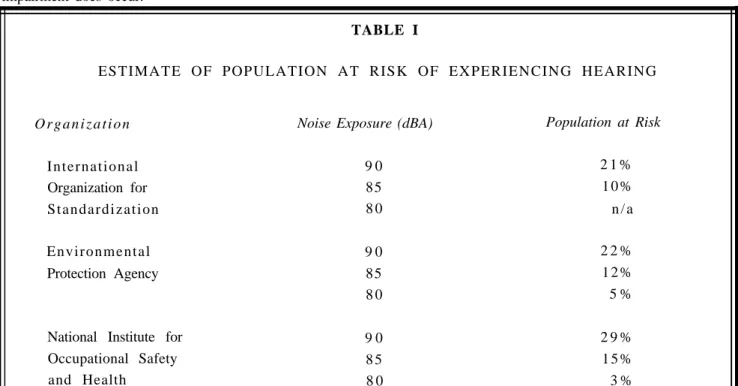
When fire fighters are exposed to high levels of noise, a temporary and/or permanent hearing loss can be expected. Table I shows significant scientific evidence collected by various organizations which indicates that exposure to noise levels above 90 dBA over an extended period of time will cause hearing loss.
There are two types of hearing loss that may result from exposure to intense levels of noise: temporary threshold shift (TTS) and permanent threshold shift (PTS). A temporary decrease in hearing ability is known as ‘ITS. TTS is based on the individual’s threshold of hearing. The degree of TTS or PTS may be dependent upon the susceptibility of an individual’s ears. However, such susceptibility may vary according to the frequency of the noise.
The degree of ‘ITS depends upon the intensity and duration of the noise exposure. The greatest amount of temporary hearing loss usually takes place within the first few hours of the exposure. After a short period of time, a person may feel that they have gotten use to the noise. This occurs because the cilia in the cochlea have become fatigued and cannot perform their function in the required manner. Generally, sound levels
TABLE I E S T I M A T E O F P O P U L A T I O N A T R I S K O F E X P E R I E N C I N G H E A R I N G O r g a n i z a t i o n International Organization for S t a n d a r d i z a t i o n Environmental Protection Agency
National Institute for Occupational Safety and Health
Noise Exposure (dBA) Population at Risk
9 0 2 1 % 85 1 0 % 8 0 n / a 9 0 2 2 % 85 1 2 % 8 0 5 % 9 0 2 9 % 8 5 1 5 % 8 0 3 % 11
must exceed at least 80 dBA before the average person will experience TX. The greater the intensity above the 80 dBA level, the greater the potential for TTS to occur.
As might be expected, the louder the noise and/or the longer the exposure, the more time it will take for temporary hearing loss to subside. Tbe length of time it takes TTS to disappear will vary from a few minutes to possibly weeks. Hearing loss of a temporary nature is usually restored in about 24 hours with the majority of recovery in the first few hours.
It should also be remembered that many of us live in areas where highway and aircraft noise as well as noise from nearby industrial plants are prevalent. Thus, some individuals maybe exposed to noise close to 24 hours per day without adequate opportunity to recover either physiologically or psychologi-cally. Although it is sometimes difficult to differentiate be-tween noise from non-work and occupational exposures, stud-ies have shown that industrial noises are generally much louder than those encountered in our non-work lives.
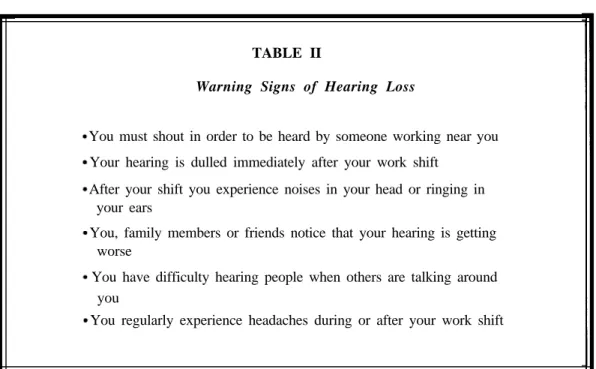
Any person who regularly experiences a temporary thresh-old shift (TTS) will eventually suffer permanent hearing loss. TTS indicates that an individual has been affected by noise. If that individual continues to be exposed to these same noise levels, the end result will be a noise-induced permanent thresh-old shift (PTS). Studies have suggested that after approxi-mately ten years of noise exposure, temporary hearing loss tends to become permanent. Table II provides some of the common warning signs of hearing loss.
Permanent hearing loss occurs when excessive noise
expo-sure causes the hair cells in the cochlea to become damaged. Hearing loss due to damage of the cochlea or of the auditory nerve is called sensory-neural hearing loss. This type of damage can affect the perception of sound intensity. Thus, even if sounds are amplified, they will still seem indistinguish-able from each other. Sensory-neural hearing loss usually occurs first and is most severe for the 4000 Hz frequency (sounds like those from the letter ‘S”). If exposure to high noise levels continue, then the hearing loss will expand across the 2000 or 3000 through 6000 Hz band.
Sensory-neural hearing loss is irreversible. Although hear-ing aids assist in amplifyhear-ing sound, they can not make it clearer or less distorted. There are no ways to correct sensor-neural hearing loss.
Persons experiencing noise-induced high-frequency hear-ing loss will usually have difficulty hearhear-ing consonant sounds and will have difficulty understanding speech. These people may feel that they are at a loss when attempting to communi-cate in a group or on a noisy street.
Another result of occupational noise exposure is a compli-cation known as tinnitus. It is often associated with hearing loss at specific frequencies. This ringing in the ears can become so loud as to disturb one’s ability to sleep. Persons experiencing tinnitis are often more relaxed at work because the noise of the work environment will drown out the tinnitis. Tinnitis may be remedied by a simple procedure like removing excess wax from the ear although usually it can not be cured. Aspirin, quinine and alcohol may also cause or contribute to tinnitis.
TABLE II
Warning Signs of Hearing Loss
You must shout in order to be heard by someone working near you Your hearing is dulled immediately after your work shift
After your shift you experience noises in your head or ringing in your ears
You, family members or friends notice that your hearing is getting worse
You have difficulty hearing people when others are talking around you
You regularly experience headaches during or after your work shift
Excessive noise exposure may result in adverse health effects other than hearing loss. These extra-auditory effects of noise are complex and difficult to document. However, there is increasing evidence that noise may have adverse effects on physiological and psychological aspects of a person’s general health. Studies have found noise to be a causative factor in stress related illnesses such as hypertension, ulcers, allergies and neurological disorders. Excessive noise exposure may also have psychological effects. Noise has been shown to cause nervousness, fear and psychosomatic illnesses as well as disturb sleep. Evidence to date shows that noise does effect the visual sense. Noise will cause slight impairment of the ability to detect lights in the periphery. Noise will also create elevated thresholds of flicker fusion and slow adaptation to darkness.
One theory indicates that noise, like other stressors, triggers a startle response which induces a widespread change in the bodies activities. These changes may include a rise in blood pressure, a rise in pressure inside the head and increased sweating. Normally, these physiological changes are brought about by intense sounds of sudden onset, much as if a fire fighter would experience going from a relaxed state in the fire station to an alarm response.
The startle response starts with the brain sending out nerve impulses to other parts of the body. Then the various glands that produce hormones such as adrenaline are stimulated. When the body receives constant levels of excessive noise, it causes the body to "tense up” and release adrenaline. When the body is in danger this “alert” reaction may be lifesaving, However, when the body must remain in this state of “alert-ness” for a long period of time, it begins to fatigue and deteriorate. Blood vessels may constrict forcing the heart to work harder to pump the same amount of blood through the body. This can lead to hypertension (increased blood pressure levels).
These physiological effects of excessive noise exposure have been found in both animal and human studies. In one study, the exposure of guinea pigs to a siren-like noise for fairly long periods of time eventually caused the onset of endocrine and metabolic deficits that decreased their ability to deal with the noise stress. These deficits will reduce the ability to respond to another “startle response” situation. Additional siren exposure to the guinea pigs brought about gastrointesti-nal ailments, cardiovascular disease and even tissue damage in the kidney and liver. Although the results of this and other similar studies with animals have been criticized, they do demonstrate the existence of extra-auditory effects.
Studies of fire fighters’ reaction to the alarm signal indicate that the onset of both physiological and psychological stress induces measurable biological effects. Although the physical activity necessary to get into a truck following an alarm signal should not increase the heart rate to more than around 100 beats
per minute; studies have found that heart beats, particularly among younger fire fighters, increased to as much as 130- 150 beats per minute. Several studies have shown increases in pulse rate after the alarm signals from between 47-61 beats per minute. It has been theorized that such excited responses to the alarm signal could cause an excessive discharge of catechola-mines, which have been shown to disrupt the integrity of the arteries’ endothelial lining in animals. A disruption in the integrity of the endothelial lining is believed to cause prema-ture atherosclerosis and could be a contributory factor in the higher incidence of cardiovascular disease among fire fighters. A study performed in Germany found that steelworkers in noisy jobs had a higher incidence of circulatory and neurologic irregularities than their coworkers in less noisy areas of the plant. In Italy, neurological examination of weavers exposed daily to intense noise levels found them to have hyperactive reflexes. In Russian studies, there is a finding that workers in noisy ball-bearing and steel plants have a relatively greater incidence of cardiovascular irregularities. Several of these studies also mentioned that workers complained of fatigue, irritability and conflicts in social settings.
Further evidence is found in the United States through a NIOSH-sponsored study conducted by the Raytheon Service Company. In this study, the medical records of factory workers routinely exposed to noise levels at or above 95 dBA were compared to those of a population exposed to noise levels at or below 80 dBA. The findings showed statistically significant increases in the number of cardiovascular and circulatory disorders as well as other complaints among the factory work-ers exposed at the higher levels. This study concluded that exposure to high levels of noise over a prolonged period of time did seem to result in increased incidence of various medical, accident and attendance problems.
Deafness has social implications as well as medical effects. Hearing is a vital instrument for learning, communications, safety and pleasure. Obviously, a loss of hearing will have an impact on the effected person’s life. Other people will talk around him and he will miss out on the conversation. He may answer questions incorrectly. He may be accused of not listening. Social relationships may begin to be marked by depression and suspicion. A person experiencing hearing loss may withdraw to avoid embarrassment.
In addition, hearing loss could have adverse implications at work leading to injury or even death if a tire fighter can not hear their fellow fire fighters’ warning or distress cry or other signals indicating danger. High noise levels may also increase stress making fire fighters more irritable. When combined with other stress factors associated with the job, such as shift work, noise may result in damage to both physical and mental health.
STANDARDS FOR NOISE EXPOSURE
The OSHA Standard
Federal regulations pertaining to the control of noisebegan with the Walsh-Healey Public Contracts Act. However, these regulations were only enforceable to those contracts issued under the Walsh-Healey Public Contracts Act and the Mc-Namara-O’Hara Service Contracts Act. With the passage of the Occupational Safety and Health Act of 1970 new progress was made in developing occupational noise exposure stan-dards.
The original standard (29 CFR 1910.95) under the newly adopted law was promulgated in 1971 and duplicated the standard established under the Walsh-Healey Public Con-tracts Act. As the primary research agency under the OSHAct, the National Institute for Occupational Safety and Health (NIOSI-I) issued recommendations for a revised noise stan-dard in 1972 with the document, Criteria for a Recommended Standard: Occupational Exposure to Noise. NIOSH passed these recommendations onto the rule making and enforcement arm of the Department of Labor (DOL), the Occupational Safety and Health Administration (OSHA). The NIOSH recommendation was for an 85 dB limit insteadof the standard’s 90 dB permissible limit.
The controversy surrounding the permissible limit of noise exposure has continued. Modifications to the OSHA standard to date were made in 1981,1982 and 1983 when final amend-ments were promulgated which set forth new requireamend-ments for a hearing conservation program. In 1984, the amendment was stayed in its entirety by the Fourth Circuit US. Court of Appeals. However, the full court reversed this decision the following year. The original standard required a hearing conservation program. However, it did not specify what constituted such a program. These amendments were an outgrowth of a proposed revision to the standard that was released in 1974.
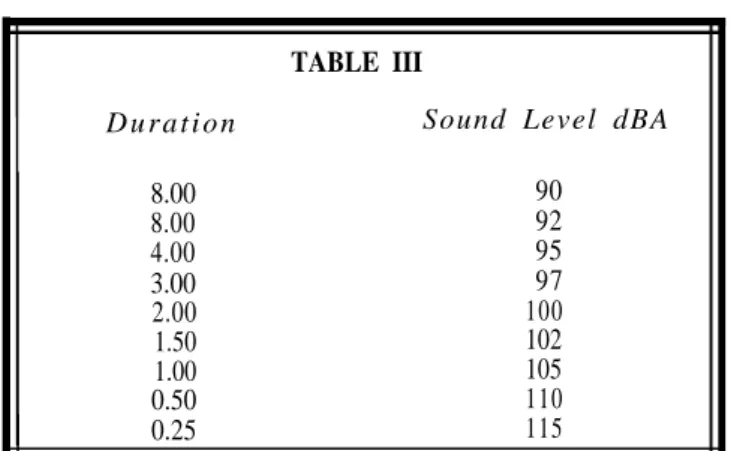
The current OSHA noise standard specifies a maximum permissible noise exposure level (PEL) of 90 dBA for an 8 hour duration, with higher levels allowed for shorter dura-tions. This level is known as a time weighted average sound level, abbreviated TWA. Typically, for an increase of five dBA the permissible exposure time is halved. This permis-sible noise level is contained in 29 CFR 1910.95, Table G-16 (Table III). It is based on what was believed to be the upper
TABLE III
D u r a t i o n Sound Level dBA
8.00 90 8.00 92 4.00 95 3.00 97 2.00 100 1.50 102 1.00 105 0.50 110 0.25 115
limit of a daily dose of noise that will not produce a disabling loss of hearing of more than 20% after a working lifetime of 35 years.
When one is exposed to different types of noise exposures, such as fire fighters, the TWA must be calculated. This combined effect is the sum of the fractions, at all levels, of the actual time (hours) divided by the permissible time. The sum of these fractions must be equal to or less than 1.0 for a permitted daily noise dose. For example, if an individual was exposed to 100 dBA for 1 hour, 65 dBA for 5 hours, and 92 dBA for 2 hours during an 8-hour workday, the times of exposure are Cl = 1 hour; C, = 5 hours; and C3 = 2 hours. The corresponding OSHA limits from 29 CFR 1910.95, Table G-16 are T1=2; T2=infinity;andTs=6. The combined exposure dose for this individual would be C1/T1 + C2/T2 + C3/T3 or 1/ 2 + 5/infinity + 2/6 = 5/6, which is below the specified limit of 1.0.
When workers are exposed to sound levels that exceed the OSHA permissible exposure limit, feasible engineering or administrative controls, or combinations of both, must be implemented to reduce levels to permissible limits.
The OSHA maximum permissible noise TWA level is 90 dBA. Hearing conservation program implementation is re-quired by employers for employees who are exposed to a TWA of 85 dB or greater. This is called the Action Level (AL). The program must include exposure monitoring, audiometric testing, and training for employees on effects of noise and attenuation practices.
The hearing conservation program allows employers to select the method best suited for their individual situation to monitor all levels of noise exposure between TWA’s of 80 dB to 130 dB. Area monitoring is difficult with workers who are mobile or are exposed to fluctuating noise, such as when fire fighters respond to an emergency. Personal noise dosimetry is a more appropriate method to measure this kind of exposure. Area monitoring in the fire station would be allowed under the OSHA standard. Each employee must be notified of monitor-ing results when exposed at or above a TWA of 85 dBA. The method of informing the employee is left to the discretion of the employer. Employees or their representatives are entitled to observe monitoring procedures.
Audiograms must be pure tone air conduction hearing threshold examinations with test frequencies including as a minimum 5OOHz, 1OOOHz, 2OOOHz, 3OOOHz, 4OOOHz, and 6OOOHz. Tests shall be taken separately for each ear. The employee must not have been exposed to workplace noise for at least 14 hours prior to the audiogram. The audiometric testing program includes baseline audiograms and annual audiograms. Audiometric testing must be made available, at no cost, to all employees who have average exposure levels of 85 dB and above. Exposure is determined by the measurement of the noise environment with out hearing protection.
A professional (audiologist, otolaryngologist or phy-sician) must be in charge of the program. The professional
does not have to be present if a qualified technician is assigned to perform the actual tests. The professional must be respon-sible for overseeing the testing and the work of the technicians, reviewing problem audiograms and determining whether re-ferral is necessary. Baseline audiograms are what future audiograms will be compared with to determine if noise induced hearing loss (NIHL) exists. Base line audiograms must be conducted within six months of an employee’s first exposure at or above a TWA of 85 dB. If mobile vans are used to obtain audiograms, then baselines do not have to be com-pleted for one year provided that hearing protectors are pro vided and used after six months. Baseline audiograms which were taken before the effective date of the hearing conserva-tion amendments are acceptable if the professional supervisor determines that the audiogram is valid. The baseline audio metric tests required by OSHA were to becompleted by March 1, 1984. The annual audiogram must be conducted within one year of the baseline. Annual audiograms must be routinely compared to baseline audiograms to determine whether an employee has lost any hearing ability. The employer may retest the employee within 30days if the audiogram shows the employee has suffered a standard threshold shift. The retest is considered to be the annual audiogram. Hearing protectors may be worn prior to audiometric testing.
NFPA 1500
OSHA uses the term standard threshold shift instead of significant threshold shift. OSHA defines a standard threshold shift (STS) as an average shift in either ear of 10 dB or more at 2000, 3OOO and 4000 Hz. When a STS is identified the employee must be fitted or refitted with adequate hearing protectors, he must be trained in how to use them and informed that he is required to wear them. Employees must be notified within 21 days when a determination has been made that a STS occurred. When a professional determines that the test results are questionable or if he/she believes that the employee has an ear problem that is caused or aggravated by wearing hearing protection, then the employee can be referred for further tests. When subsequent audiometric tests show that the STS on previous audiograms is not persistent, then employees who are exposed to a TWA of less than 90 dB have the option of wearing hearing protection.
Employers are required to provide, at their cost, hearing protection to all workers exposed to a TWA of 85 dB. This hearing protection must be capable of reducing noise levels to at least a TWA of 90 dB for everyone and 85 dB for employees who have experienced a STS. Employees are allowed to decide, with the help of a person who is trained in fitting hearing protectors, which size and type is most suitable for their working environment. Employers are responsible for ensuring that employees wear hearing protectors correctly.
Employees exposed to a TWA of 85 dB must be trained at least annually on the effects of noise, the purpose of personal hearing protective devices (PHPDs), advantages and disad-vantages of different PHPDs and noise attenuation character-istics of various types of hearing protectors. The selection, fitting and care of protectors and the purpose and procedures
of audiometric testing must be addressed in the training as a minimum. The training may be structured in any format at the discretion of the employer. Noise exposure measurement records must be kept for two years and audiometric test results for the duration of a worker’s employment. Audiometric test records must include the name and job classification of the employee, the date and time, the examiner’s name, the date of acoustic or exhaustive calibration measurements of the back-ground sound pressure levels in audiometric test rooms, the serial number of the audiometer, and the employee’s most recent noise exposure measurement. All records shall be provided by the employer at the request of the employee, former employee, or representative designated by the em-ployee.
The National Fire Protection Association (NFPA) revised avoluntary consensus standard entitled NFPA 1500, Standard
on Fire Department Occupational Safety and Health
Pro-gram, in August, 1992. This comprehensive standard, which sets minimum requirements for fire service related occupa-tional safety and health programs, includes hearing protection requirements.
To comply with the requirements of NFPA 1500, a fire department must provide hearing protection for all fire fight-ers riding on apparatus who are subjected to noise levels above 90 dBA. NFPA 1500 considers the use of hearing protection as an interim measure only until engineering controls can be instituted to reduce the noise levels produced by vehicles, warning devices and radios. Purchasing or retrofitting appa-ratus to a maximum limit of 85 dBA without audible warning devices and 90 dBA with warning devices in operation is recommended by NFPA as the permanent measure for riding on apparatus without the use of hearing protection. When hearing protective devices are utilized as an interim measure, protective ear muffs are recommended since ear plugs can be difficult to fit and insert. For those fire lighters that must listen to the radio, NFPA 1500 recommends the use of ear muffs with built-in speakers and volume controls for radio and intercom communications.
Hearing protection is required by NFPA 1500. Fire fighters are often exposed to noise levels above 90 dBA while using power tools or equipment. NFPA 1500 requires the use of hearing protection in these environments except when such hearing protection could create an additional hazard to the user. NFPA 1500 recognizes that ear muffs may not ad-equately interface with helmets and foam plastic ear plugs could melt in the fire environment. However, NFPA 1500 recommends that hearing protection be utilized whenever possible, such as during non-emergency operations. Further-more, fire departments are urged to seek alternative proce-dures to reduce noise exposure in emergency situations that make the use of available hearing protection impractical or hazardous.
Finally, NFPA 1500 requires a fire department to establish a hearing conservation program that identifies potential sources of harmful noise and seeks to reduce or eliminate them. NFPA recommends that the requirements set forth in the OSHA standard be used as a basic minimum approach forest establishing a hearing conservation program. A hearing conservation program should address as a minimum, monitoring noise sources, audiometric testing (to be administered in the annual physical and included in the data base as described in the standard), noise reduction engineering controls, noise reduc-tion techniques and hearing protecreduc-tion devices.
THE MEASUREMENT OF SOUND
There are three major factors that need to be considered when evaluating sound. They are intensity, frequency, and duration (sound exposure over time).
Intensity
Intensity is the loudness or softness of noise and is ex-pressed in decibels (dB). While we frequently talk about noise readings in decibels, actually what we are referring to with respect to hearing protection programs is decibels on the A weighted scale (dBA). This is a scale that weights the noise level to duplicate how the human ear perceives the noise. The weakest sound that can be heard by a person in an extremely quiet location is assigned a value of 0 dBA. A person’s threshold of pain is reached around 140 dBA. Table IV provides examples of common noise sources and their corre-sponding loudness levels. The decibel scale was selected
TABLE V
TABLE IV
EXAMPLES OF COMMON NOISE
Source dBA Saturn Rocket Ram Jet Turbo Jet Threshold of Pain Pipe Organ
Propeller Plane, Auto Horn Pneumatic Drills
Siren
Passing Truck
Subway, Machine Shop Noisy Restaurant
Inside Car W/Closed Windows Office Average Home Quiet Office Recording Studio Whisper Rustling Leaves Threshold of Hearing 194 160 150 140 130 120 110 105 100 90 80 70 60 50 40 30 20 10 0 Frequency
because of the unique problems associated with sound. Sound pressures have a tremendous range that must be accounted for in the measurement of them. For this reason the decibel is used to measure them because they progress linearly through a logarithmic scale rather than exponentially as sound pressure levels do. That is, we can measure a wide range of sound using only a small range of numbers. Thus, the range of sound from 0 to 140 dBA covers a sound intensity range of 1 to 100,000,000
N/m² (Pascal). Obviously a small change in decibel value can mean a tremendous difference in the intensity of the sound. Apparently small declines in decibel level will result in signifi-cant reduction in sound pressure levels.
Table V shows that an increase of 20 dBA means that noise intensity is increased 10 times. This rule generally applies for any increase of 20 dBA. Thus, the noise intensity at 62 dBA is 10 times as great as that at 42 dBA. It should also be noted that each increase of 20 dBA means that the sound intensity
ILLUSTRATING THE DECIBEL SCALE
Sound Pressure (Pascals)
Sound Level in dBA
100000000 140 10000000 120 1000000 100 100000 80 10000 60 1000 40 100 20 10 1
becomes 10 times as great. Thus, an increase from 10 dBA to 50 dBA or a total change of 40 dB A would mean that the sound intensity would be 100 times greater (10 x 10). Likewise a reduction of 20 dBA would mean that the noise intensity is 10 times less.
Another general rule about noise intensity is that an in-crease of 6 dBA will double the intensity of the sound. Thus, 66 dBA is twice as intense as 60 dBA.
Hearing damage is related to noise intensity, not the loud-ness of sound. An increase or decrease of 3 dBA could be significant in protecting the ear from noise related damage even though the human ear may not be able to “tell the difference.” Therefore, it is important to pay more attention to the decibel readings than how loud the noise sounds to the ear.
The frequency of sound is related to the pitch or tone of the sound. It is expressed in cycles per second (cps) or Hertz (Hz). The higher the Hz value, the higher the frequency, and the higher the pitch.
The human ear is more sensitive to middle frequencies than the very low or very high ones. The lowest audible frequency level is usually about 20 Hz. For a young adult, the normal upper limit is usually between 16,000 and 20,000 Hz. Hearing loss caused by exposure to excessive noise is usually first
detected in the middle frequencies, especially above 3000 Hz. It is important to remember that as a person ages, they will normally lose hearing sensitivity in the higher frequency levels. This aging effect is called presbycusis.
Duration
The length of time a sound is heard can vary from microsec-onds to hours. Occupational noise exposure is categorized as either continuous, fluctuating, intermittent or impulsive. Con-tinuous noise is one that remains relatively constant for a long period of time. Fluctuating noise rises and falls in intensity over a period of time. Intermittent noise ceases or falls to low levels between “on times” or periods of much higher levels. Impulse noise is distinguished by a sharp rise in sound pressure level to a high peak followed by rapid decay. These peaks must occur less than one per second, otherwise the noise is consid-ered continuous.
Sound Measuring Instruments
There are various instruments that can measure the intensity and frequency of sound. When noise is being measured to determine compliance with a standard, the different frequency measurements are automatically lumped together by the in-strumentation to obtain one average reading. Several different scales have been devised to do this averaging and are labeled “A,” “B” and “C”.
The A-weighting network is the scale most frequently utilized in the measurement of industrial and environmental noise. The “A-weighted” network discriminates against low frequency sound. It is used primarily because low frequency sounds are not readily perceived by the human ear. As a result, the A-weighting network is believed to be an adequate predic-tor of human response to noise. The least common measuring scale is the B-weighting network. The B-weighting scale discriminates against low frequency sounds to a lesser extent than the A scale. The C-weighting network is another measur-ing scale used primarily to attenuate the noise level. The C scale reflects sound as it actually occurs in the environment without a bias for human response. This scale can be useful in measuring the effectiveness of hearing protectors because it does not discriminate against the presence of low frequency
sounds.
The noise level (sound intensity) can be measured using a sound level meter. Sound level meters register the level of noise that occurs at a particular instant. It is a useful instrument for measuring the noise level of a given industrial process or piece of equipment. This method uses a microphone to pick up on sound pressure waves. The sound waves are converted into electrical signals that are enlarged by an amplifier and trans-mitted to an analog display (e.g., a meter). The sound level meter then displays the amount of noise measured in decibels. Sound level meters usually contain both the “A” and “C” scale
options. One limitation of a sound level meter is that it can not distinguish between a pleasant sound and an unpleasant noise. It can only measure the sound pressure level. However, the perceived loudness of a sound is not judged solely on its sound pressure level. A sound at a constant pressure can appear to be quieter or louder depending upon the frequency of the sound. A sound level meter can provide a rough estimate of the intensity of noise. Often, more specific information is re-quired. To perform this analysis of exactly where the noise lies in the frequency spectrum, an octave-band analyzer is usually attached to the sound level meter. The frequency spectrum can be divided into octave bands that are identified by its center frequency(e.g.,125,250,500,1fKKl,2000,4000and8000Hz). This type of analysis is particularly useful for planning engi-neering controls, since industrial noise is usually made up of various frequencies at various intensities. It is also useful for selecting a room to perform audiometric tests. By completing an octave band analysis, engineering controls may be em-ployed to reduce the intensity of problem frequencies and reduce the overall intensity of the noise environment by attenuating the problem frequencies.
Another &vice, the dosimeter is utilized to measure the amount of noise exposure received by an individual worker. Dosimeters measure noise dose by integrating various sound levels over an entire work shift. Fluctuating, intermittent and impulse noises can be most easily measured using a dosimeter. This device and microphone can be attached to an article of clothing and worn throughout the work shift. The microphone picks up sound energy and converts it to electrical energy. This energy is sent to a storage cell where it is measured to determine the amount of noise energy the worker has been exposed to. The results of the monitoring are then given in terms of a percentage of allowable exposure concerning a specific regulation or standard.
The audiometer is an instrument utilized to test hearing. Audiometers produce pure tones at specific frequencies (e.g., 250, 500, 1000, 2000, 3000, 4000, 6000 and 8000 Hz) and specific intensity levels. The ability of individuals to hear pure tones is directly related to their ability to hear speech. OSHA requires that employees’ hearing be tested between 500 and 600 Hz. This range is most vital for understanding speech and determining the extent of the hearing loss.
An audiometric test is designed to measure the amount of hearing loss an individual has accrued. This simple test procedure requires the individual to sit in a soundproof room while wearing headphones. Each ear is tested separately by delivering a series of faint-sounding beeps or tones at several different frequencies to the individual being tested. The individuals are instructed to respond that they have heard the sound by pressing a button or raising a hand. The intensity level between the point where the person last responded and where they didn’t hear the sound is labeled the threshold level. This procedure is repeated two or three times at each frequency to insure that the person is reporting his true threshold level. It is extremely difficult to falsify an audiometric test because of
the fact that different tones are repeated and an individual’s response can hardly be the same if they really cannot hear the particular frequency.
The record of an individual’s results from the audiometer is known as an audiogram. (See Figure 2). An audiogram graphically illustrates the hearing threshold level measured in decibels as a function of frequency in Hertz. The audiogram visually shows how loud a sound must be before it isheard by allowing the audiologist toevaluate the. status of an individual’s hearing. The audiogram is an important component in identi-fying the early stages of NIHL (Noise Induced Hearing Loss), When hearing loss is related to noise exposure, a dip will appear on the graph at about 4000 Hz. The bigger the dip, the more severe the hearing loss. If results are worse than 20 dB , especially between 3000 and 4000 Hz, there is reason for concern (see audiogram). Further medical attention and or preventive measures may be mandated.
Audiometric testing using beeps or tones has been criti-cized because it does not equate to the reality of hearing. Speech is heard against background noise and not in the sanitized soundproof setting of the audiometric booth. To counter these criticisms, another test known as speech audi-ometry has been developed. This test is similar to the one described previously, except that actual words instead of pure tones are presented at different levels of loudness. The degree of hearing loss is determined on the basis of the number of words that the subject can not understand. This method appears to be a more realistic test. An individual with hearing damage in the 3000 to 4000 Hz range may be able to hear the
pure tone sound, yet may not be able to understand speech or words.
Hearing threshold levels are measured in decibels when recorded by an audiometer. However, audiometric zero is not always the same as 0 dB sound pressure level. Audiometric zero represents the median hearing threshold level for a young person with normal hearing. Similar to eyesight, some people have exceptionally good hearing sensitivity (as acute as -10 dB) while others may have hearing thresholds at 10 or 15 dB and still be considered to have hearing in the normal range. Thus, audiometric zero represents normal baseline hearing. The American National Standards Institute’s specification for audiometers S3.6-1969 outlines the standard for audiometric zero in the US. population.
Before performing audiometric testing, there are several important considerations that should be addressed:
The data should be obtained by a qualified and objective individual to avoid potential for bias.
The instruments and measurements procedures utilized should conform fully with applicable American National Standards and/or Occupational Safety and Health Administration regulations.
Such instruments should be calibrated before and after each significant set of readings. If the calibration is out of tolerance all readings back to the previous calibration must be repeated.
Figure 2
AN AUDIOGRAM SHOWING HEARING LOSS
NOISE CONTROL PRACTICES
There are three primary noise control strategies: adminis-trative, engineering and personal protection. The most effec-tive and desirable of the noise control strategies is engineering controls. Engineering controls address the problem at its source rather than trying to rely on the cooperation and partici-pation of people. The control of noise is best obtained by getting as close to the source as possible, since once the sound is airborne, it becomes more and more difficult to control. However, there may be times when engineering controls are not feasible because of economic or technical reasons. In such cases, it may be necessary to utilize other noise control mecha-nisms and devices to achieve the required level of noise reduction.
Engineering controls are most effective when they are applied at the design stage of equipment development. While technology is readily available to reduce equipment noise levels, it has not been applied to its full advantage because of the lack of demand for such controls in products. Even on older, noisier equipment, the use of noise-absorbing materials, enclosures or barriers, vibration absorbing materials, and mufflers to reduce specific noise sources can be extremely successful in reducing noise exposures.
As might be expected, riding on a fire apparatus is one of the major sources of occupational noise exposure for the fire fighter. The primary source of noise on a truck is the engine. Other major sources of truck noise are from the warning devices (sirens and horns), exhaust system, the engine cooling fan and tire noise. The noise from each of these sources can be reduced through engineering controls. For example, the
en-gine noise can be controlled through the installation of spe-cially treated oil pans, valve covers and air intake manifolds to isolate these parts from the vibrating engine. The placement of warning devices on the front bumper or running board as well as the use of broader band, lower frequency devices can reduce both the degrees and type of noise exposures experienced by fire lighters. The exhaust noise problem can usually be solved by installing the correct muffler. Fan noise can be reduced through the installation of a thermostatically controlled or modulated fan drive, which will limit the amount of operating time for the fan. Tire noise can be solved by selecting tires with a tread design that minimizes noise while supplying the best possible traction and wear resistance. For example, urban response vehicles typically do not need rough terrain treads on their tires. Proper maintenance and replacement is another critical factor in eliminating vehicle noise.
Administrativecontrols in industrial settings are commonly aimed at reducing the amount of time workers are exposed to excessive noise levels. This means arranging work schedules to avoid continuous noise exposure at levels exceeding the OSHA permissible exposure limit (PEL). Administrative con-trols for fire fighters have limited use since their occupational noise exposure is uncertain and intermittent and based upon when an emergency response occurs.
The use of personal hearing protective devices (PHPD) such as earplugs or earmuffs, can assist in reducing exposure to noise. Table VI compares various features of earplugs and earmuffs. An effective PHPD will act as a barrier between the
Table VI Feature Noise Protection c o s t Size Fit Monitoring Use In Hot Environment Head Movement Wearability
COMPARISON OF EAR PLUGS AND EAR MUFFS
Earplugs Earmuffs
Varies Greater, less variable
Less Expensive More Expensive
Small, convenient Not easily carried or stored May be difficult One size fits most
Can’t be seen Easily seen
Comfortable Uncomfortable
No restriction Restrictive in close quarters Only in healthy ear Can be worn even with minor
ear infection. Can interfere with glasses, head gear and hair.
noise and the inner ear. However, it must be remembered that ear protection does not remove the noise hazard. Such protec-tion has many limitaprotec-tions when used in place of engineering controls on a permanent basis. A person wearing a PHPD can still be exposed to excessive noise levels as sound can pass through the bone and tissues, bypassing the PHPD and reach-ing the inner ear. This can occur if the sound causes the protector to vibrate, if there are leaks in the protector or if there are leaks around the protector. Ear protection does not keep out all the noise. A properly fitted earplug can produce up to 40 decibels of attenuation at higher frequencies (4000 Hz).
Earplugs or inserts are generally inexpensive, however, the service life is limited. They are made from materials that are soft and pliable, thus there is little danger of injury if the plug is pushed against the tender lining of the ear canal. An examination by a qualified medical physician should be per-formed prior to the earplugs being fitted because the shape of some people’s ear canals may limit the use and type of PHPD that may be used. In addition, some ears may be allergic to certain types of materials. There are three general classifica-tions of earplugs: formable, custom-molded and premolded.
Formable protective devices can provide good noise attenu-ation and fit for all ears. Generally, these disposable plugs (most are designed for one-time use only) are made from fine glass fiber (Swedish wool), wax-impregnated cotton and ex-pandable plastic. They are generally rolled into a conical shape before insertion into the ear. All employees must be trained on insertion of this type of PHPD. Special care must be taken when inserting these types of PHPD into the ear canal as not to insert them so far that they will not be easily removed. In addition, the employee must be made aware of the importance of having clean hands when inserting these devices. Dirty hands may transfer dirt, grease, or other foreign material into the ear canal and possibly lead to an infection within the ear canal.
Custom-molded protective devices are exactly that, they are specifically molded for the individual ear. Generally, two or more separately packaged materials are mixed together to form a compound that resembles soft rubber. To apply, the material is carefully placed in the outer ear with some portion placed in the inner canal according to the manufacturer’s instructions. The material takes on the shape of the external ear canal as it sets.
Premolded protective devices come in two different ver-sions. The universal fit type is a plug that is designed to fit a wide variety of ear canal shapes and sixes. The other type comes in a variety of sixes to assure a good fit. These devices are usually made of a soft silicone or rubber. This type of hearing protection should be regularly cleaned with soap and water to maintain its service life and to avoid infection. Most manufacturers also provide storing cases that will keep them clean and free of contamination. There are many limitations to this type of protection. Since many ear canals have irregular
shapes, even between the left and right canals on an individual, the incorrect plug size may be chosen. A good fit can be obtained by proper insertion and fitting. Fitting of pre molded devices should be performed by properly trained personnel. This type of plug must fit tightly into the ear canal to form a seal between the plug and ear canal. Because many people have irregular ear canal shapes, the wrong size plug may be chosen for reasons of comfort and will not provide a proper seal. Some types of premolded plugs may become hard and possibly shrink over time. This is caused by the build up of ear wax on the plug. The personal hygiene of the user and the proper maintenance of the plug, i.e. proper and regular cleaning, will help to extend the life of the device as well as allow the device to provide the maximum level of attenuation over that lifetime. Finally, wearers of earplugs must be made aware that earplugs have a tendency to work themselves loose over time. It is important to pay close attention to the placement of the plug and regular lit checks may be necessary.
Ear muffs consist of two cup or dome-shaped devices that fit over the entire external ear, including the lobe. The muffs seal against the head with a suitable cushion or pad. Generally, the cups are made of a molded rigid plastic and then lined with an open cell foam material. The shape, size and degree of attenuation of earmuffs will vary from one manufacturer to another.
Typically, ear plugs are preferred for low frequency expo-sures and ear muffs are preferred for high frequency expoexpo-sures. All noise attenuating devices (PHPDs) are given a noise reduction rating (NRR) by their manufacturer. This number represents an average attenuation across the frequency range of 125 Hz to 8,000 Hz. Ear muffs will provide a NRR of 23 to 30. Different types of ear plugs offer different ranges of NRRs. Some representative values for NRRs follow: for moldable foam ear plugs the NRRs typically fall between 29 and 37: for single flange type the values range from 23 to 33: for triple flange type the values range from 26 to 37. For custom molded devices the NRR range is between 20 and 26. Again, it is important to remember that the amount of protec-tion offered by an ear plug is solely dependent upon the insertion into the ear canal. Training is required for all types of PHPDs.
Personal protective devices for healthy workers will affect speech communication in a relatively quiet environment. However, when noise levels exceed 90 dB PHPDs will not hinder speech communication and may actually improve speech intelligibility. This is a difficult concept to comprehend and many workers feel that they should not use PHPDs because of anticipated problems in communication. This is especially true when the worker tries on the personal protective device in a quiet environment. Workers with a preexisting hearing loss will have poorer speech communication when wearing per-sonal protective devices.
FIRE FIGHTER NOISE EXPOSURE
There have been several noise exposure studies specifically involving fire fighters. Probably the most significant of these studies was conducted by the National Institute for Occupa-tional Safety and Health (NIOSH) following requests made by the International Association of Fire Fighters (IAFF) Depart-ment of Occupational Health and Safety.
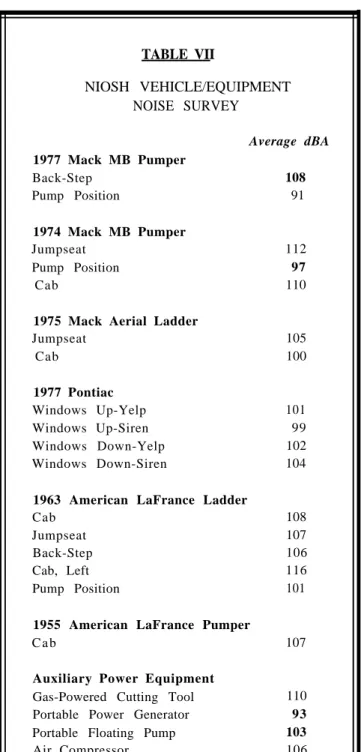
TABLE VII
NlOSH’s investigation of noise levels and the associated losses of hearing among fire fighters in Newburgh. New York was initiated after a private audiologist found significant high frequency hearing losses in 45% of the fire fighters tested. Based on this information, the audiologist recommended that an extensive noise survey be conducted to examine vehicle noise and auxiliary power equipment exposure.
After a thorough examination of the private audiologist’s report, NIOSH found deficiencies in the manner in which the evaluation wasconducted. This led NIOSH to carry out its own comprehensive tests that included a vehicle/equipment noise survey, dosimeter noise exposure sampling for selected fire fighters and hearing examinations for all fire fighters in the Newburgh Fire Department.
The apparatus noise survey, conducted at 30-second sam-pling periods during simulated response runs, found that fire fighters are exposed to high noise intensity levels for each piece of apparatus at each position. The noise levels at the various riding positions on the apparatus are depicted in Table VII. Exposures ranging from 99 dBA to 116 dBA in the vehicle’s cab, 105 dBA to 112 dBA in the jumpseat, 106 dBA to 108 dBA on the back riding step, and 91 dBA to 101 dBA at the vehicle’s pump panel were found. NlOSH’s survey of fire fighting equipment also discovered noise levels in the range from 93 dBA to 110 dBA.
NlOSH’s survey utilizing a dosimeter on nine selected fire fighters found that the 8-hr time weighted average (TWA) noise exposure ranged from 62.8 dBA to 85.3 dBA. All the readings were below the maximum OSHA standard of 90 dBA for an 8-hour TWA exposure and only one fire lighter ex-ceeded the NIOSH criteria of 85 dBA for an 8-hour TWA. In addition, NIOSH found that only one of the simulated runs exceeded the OSHA ceiling exposure value of 115 dBA.
The hearing examinations conducted by NIOSH of 54 fire fighters involved a group with an average age of 37.7 years with an average length of fire department serviceof 13.2 years. Based on a statistical analysis of the data, NIOSH concluded that the fire fighters surveyed all began their careers at nearly the same age and have not left the fire service. Because hearing loss is cumulative over time,NIOSH placed the 54 fire fighters into groups based on age. The groupings were as follows:
less than 30 years 30-34 years 35-39 years 40-44 years 45-49 years 50 years and older.
NIOSH VEHICLE/EQUIPMENT NOISE SURVEY 1977 Mack MB Pumper Back-Step Pump Position Average dBA 108 91 1974 Mack MB Pumper Jumpseat Pump Position Cab
1975 Mack Aerial Ladder
Jumpseat Cab 1977 Pontiac Windows Up-Yelp Windows Up-Siren Windows Down-Yelp Windows Down-Siren
1963 American LaFrance Ladder
Cab Jumpseat Back-Step Cab, Left Pump Position
1955 American LaFrance Pumper
C a b
Auxiliary Power Equipment
Gas-Powered Cutting Tool Portable Power Generator Portable Floating Pump Air Compressor 112 97 110 105 100 101 99 102 104 108 107 106 116 101 107 110 93 103 106
NIOSH found that the group 50 years and older exceeded both the American Medical Association (1979) and the NIOSH 25 dBA criteria for hearing impairment. NIOSH then compared their data with a 1960- 1962 National Health Survey (NHS) and found that while the fire fighters had better hearing than the national norm in the early age grouping, they were consistently poorer at the oldest age grouping.
While NIOSH found definite high frequency hearing loss, the results of the noise survey did not show enough noise exposure to account for the observed hearing losses. Based on an average of 9 to 10 responses per week for each squad in the Newburgh Fire Department, NIOSH estimated that fire fight-ers were exposed to noise exposures ranging from 99 to 116
dBA for only 1.5 hours out of a 40 hour work week. However, NIOSH pointed out that the trends found in the audiograms did point to noise overexposure among the fire fighters. NIOSH concluded that fire fighters must “‘assume that the noise asso-ciated with these response runs could be damaging and should be reduced as much as possible.”
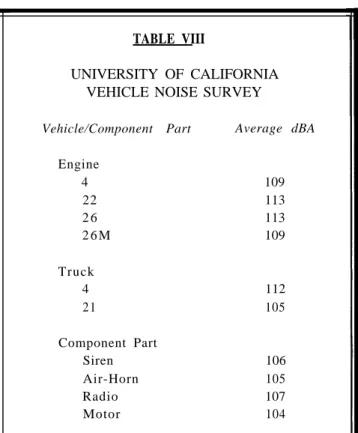
The analysis of the individual components during simu-lated emergency runs (Table VIII) found that the primary contributors to the noise problem are the motor, radio speaker, air-horn and siren, Unlike the other components, which
con-TABLE VIII
NIOSH did offer some possible explanations for the appar-ently contradictory findings. One possible explanation pro-posed for the occurrence of hearing loss may be due to the interaction of noise with other agents confronted by fire fighters in the environment. In other words, exposures to toxic materials may act to change the physiology of the ear such that it may not be able to tolerate as much noise exposure as a normal ear. The disruption of auditory function by asphyxia-tion has been shown repeatedly. Recent studies of rats con-ducted by the Johns Hopkins School of Public Health and Hygiene found that exposure to carbon monoxide preceding and concurrent with exposure to a 110 dBA broad-band noise level produced high-frequency threshold shifts of greater mag-nitude than those produced by exposure to the noise source alone.
UNIVERSITY OF CALIFORNIA VEHICLE NOISE SURVEY
Vehicle/Component Part Engine 4 22 2 6 2 6 M Average dBA 109 113 113 109
Since there were no fires during the study, NIOSH also left open the possibility that the noise exposure levels may be intense enough at the fire scene to have an impact on fire fighters’ hearing. This explanation still needs to be docu-mented.
Finally, NIOSH indicated that the type of noise to which fire fighters areexposed may be leading to the hearing loss. Citing the Committee on Hearing, Bioacoustics and Biomechanics (CHABA) recommendation of a maximum exposure to pure tones or narrow band noises of 105 dBA for 15 minutes, NIOSH did find a narrow band component to the noise created by the siren and air horn. However, further investigation would need to be conducted to determine if the narrow component is distinct enough to yield the observed hearing loss.
Truck 4 21 Component Part Siren Air-Horn Radio Motor 112 105 106 105 107 104
tribute equally to the sound pressure level though in different frequency distribution. the motor contributes peak sound pressures at much lower frequencies.
Despite the lack of a definite explanation for the observed hearing loss experienced by fire fighters in the NIOSH study, similar findings were found in an earlier study conducted by the University of California at Irvine and the California De-partment of Forestry. The study evaluated eight fire fighter positions on board three types of emergency vehicles during emergency responses. Emergency responses were chosen because they represented the highest level of noise exposure that a fire fighter may experience on a regular basis, that is, riding on a vehicle at relatively high speeds accompanied by a siren and air-horn.
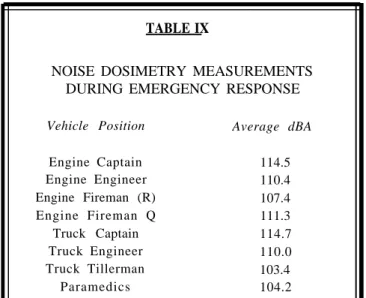
The second segment involved noise dosimeters being placed on eight fire fighters. The Fire Fighters were given instruc-tions to turn the dosimeter on before boarding the emergency vehicle for an emergency run and to turn the dosimeter off when they arrived at the emergency scene or when the emer-gency operation ended. The results of these measurements (Table IX) found that the captain position on both the fire engine and the truck experienced the highest level of noise exposure. The reading from the dosimeters also showed that the truck tiller man and the paramedics received the least amount of noise exposure. Based on the readings, the re-searchers believed that the captain and engineers would prob ably be exposed to noise levels in excess of 115 dBA during a typical emergency response.
Like the NIOSH study, this investigation involved three During the third stage, audiograms were given to 134 fire distinct segments. In the first segment, an analysis of overall fighters in eight separate fire stations located in Orange vehicle noise and individual components during simulated County, California. This was an attempt to correlate hearing runs was undertaken. The vehicles surveyed included four loss with length of employment in the fire service. After 28,000 lb. fire engines, two 5l-foot fire trucks and a 310 screening the fire fighters and eliminating those taking medi-Chevrolet paramedic Fire-Rescue van. The fire engines and cation or those who had previous high level noise exposure fire trucks all contained 350 hp 567.5 cubic inch 8V71 Detroit prior to fire service employment, 89 audiograms remained to Diesel engines with manual transmissions. be analyzed. The data compiled from these 89 audiograms