A continuous-improvement approach
for reducing the number of chemotherapy-related
medication errors
B
ARRYR. G
OLDSPIEL, R
OBERTD
EC
HRISTOFORO,
ANDC
HARLESE. D
ANIELSBARRY R. GOLDSPIEL, PHARM.D., FASHP, is Oncology Clinical Phar-macy Specialist; ROBERT DECHRISTOFORO, M.S., is Deputy Chief; and CHARLES E. DANIELS, PH.D., FASHP, is Chief, Pharmacy Department, National Institutes of Health Clinical Center, Bethesda, MD.
Address reprint requests to Dr. Goldspiel at the National Institutes of Health Clinical Center, Pharmacy Department, Bldg. 10, Room 1N-257, MSC 1196, Bethesda, MD 20892-1196 ([email protected]. gov).
The assistance of members of the Chemotherapy Error Reduction Task Force is acknowledged: Elaine Ferguson, M.S., Laurence Green, Pharm.D., David Kohler, Pharm.D., and Judith Smith, Pharm.D., from the pharmacy department; David Henderson, M.D., and Laura
Lee from the Office of the Director; Laura Chisholm, Priscilla Riv-era, and Barbara Summers, Ph.D., from nursing; Linda Berry, Lil-lian Butler, Greg Hinson, and Thomas Lewis, M.D., Ph.D., from the information systems department; and Frank Balis, M.D., Greg Curt, M.D., and Wyndham Wilson, M.D., Ph.D., from the National Can-cer Institute.
Based on the proceedings of the ASHP Best Practices in Health-System Pharmacy Management Award Symposium held June 6, 2000, during the ASHP Annual Meeting in Philadelphia, PA, and supported by an educational grant from Pfizer Inc. The NIH Clini-cal Center received a monetary award from Pfizer as part of the recognition associated with the Best Practices program.
C
hemotherapy-related medica-tion errors can have serious and sometimes fatal consequences, and news stories about chemothera-py-related medication errors at some hospitals heightened our awareness of that potential.1-3 Thepharmacy department at the Na-tional Institutes of Health (NIH) Clinical Center initiated a perfor-mance-improvement project using an interdisciplinary task force to an-alyze and improve our current mul-tilevel, interdisciplinary system for ordering, checking, processing, and administering cancer chemotherapy agents. Although there was no per-ception that we had a problem with chemotherapy-related medication errors, we initiated a prospective program to determine whether our system could be improved.
This project aligns with our hos-pital’s mission to initiate and sup-port the clinical research sponsored by the individual institutes that make up NIH. It is also consistent
Abstract: A comprehensive, interdiscipli-nary approach for reducing the number of chemotherapy-related medication errors at the National Institutes of Health Clinical Center, where approximately 8500 doses of chemotherapy agents are dispensed annually, is described.
Heightened awareness of the serious-ness of chemotherapy-related medication errors prompted formation of an interdis-ciplinary task force in June 1995 to analyze and improve the hospital’s system for ordering, checking, processing, and ad-ministering cancer chemotherapy agents. Problems were analyzed and rectified in accordance with the hospital’s plan-do-check-act performance-improvement model. Performance monitors for the im-provements included a system to record and categorize all chemotherapy-related prescribing errors and a hospitalwide oc-currence-reporting system. The task force identified seven major categories in which improvements were needed: protocol de-velopment, computer-system enhance-ments, dose verification, information ac-cess, education for health care practition-ers, error follow-up, and infusion pumps. Despite the Clinical Center’s good
safety-net system, 23 modifications were made to the existing system through December 1999. These changes resulted in an overall 23% decrease in prescribing errors and a 53% decrease in serious prescribing errors. The task force membership was recently broadened to include representatives of additional departments where chemo-therapy agents are used, and this group recommended more than 20 additional system changes. The changes are being implemented, and their effect on reducing the number of chemotherapy-related er-rors will be measured.
The continuous-improvement process used prospectively by the task force helps ensure that safe chemotherapy practices are instituted uniformly throughout the hospital.
Index terms: Administration; Antineoplas-tic agents; Costs; Devices; Dosage; Drug in-formation; Education; Errors, medication; Pharmaceutical services; Pharmacy, institu-tional, hospital; Physicians; Prescribing; Quality assurance; Reports; Toxicity Am J Health-Syst Pharm. 2000; 57(Suppl 4):S4-9
S5 Am J Health-Syst Pharm—Vol 57 Dec 15, 2000 Suppl 4
SYMPOSIUM
Chemotherapy-related medication errors
Consultants from Eclipsys helped develop some of the computer en-hancements.
The task force began by mapping the sequence of events from the time the prescriber enters the order until the patient actually receives the che-motherapy agent. We then identi-fied the weak points in our safety net using prospective failure mode and effects analysis.4 Solutions to these
problems and methods for imple-menting the enhancements were de-veloped and designed in accordance with our hospital’s PDCA (plan-do-check-act) performance-improve-ment model. Deadlines for each subproject were established.
The group defined major ele-ments that form the overall “plan” and elements under each of these categories. Individual projects or subplans for each of these major cat-egories were then designed. To ac-complish the “do” aspect of the model, the task force then formed subcommittees to carry out the sub-plans.
Our performance monitors (“check”) include a system to record and categorize all chemotherapy-related prescribing errors, which we call chemo-checks, and a hospital-wide occurrence-reporting system.5
Orders are considered incorrect if they cannot be dispensed exactly as written. Order-entry errors are not routinely reported through the hos-pital occurrence-reporting system; rather, a pharmacist intervenes as appropriate on these orders to cor-rect them before they are prepared by the pharmacy. The incorrect or-ders are classified as class I (serious adverse effects likely to occur), class II (temporary or medically revers-ible effects likely to occur), or class III (adverse effects unlikely) and then subcategorized as to the prob-lem with the order.
This classification system allows us to analyze commonly occurring prescribing errors so that we can suggest system changes to correct with the hospital’s current goals to
provide
• Quality patient care (reduce possi-bility of unexpected adverse effects from toxic chemotherapy and ad-minister correct dose 100% of the time),
• Excellence in clinical research (pro-vide protocol quality assurance and reduce protocol violations), and • Cost-effectiveness and efficiency
(provide patients with an appropri-ate supply of expensive medications and ensure correct drug supply).
Our suggested changes were di-rected at eliminating the possibility of a chemotherapy-related medication error to ensure that the patient will always receive appropriate chemo-therapy as directed by the protocol.
Description of the program
The NIH Clinical Center is the intramural hospital for NIH re-search. Patients are referred to the Clinical Center for assignment to re-search protocols. The hospital com-plex has 325 beds, 15 outpatient units, and 7 extended-care outpa-tient units. Cancer paoutpa-tients’ medica-tions represent approximately 40% of the pharmacy’s workload. We dispense approximately 8500 doses of chemotherapy agents per year and use the Eclipsys Medical Infor-mation System (MIS) for direct pre-scriber order entry. Pharmacy de-partment personnel create protocol-specific ordering screens.
An interdisciplinary task force composed of members from the pharmacy department, nursing de-partment, National Cancer Institute intramural program, information systems department (ISD), and hos-pital administration met in June 1995 to identify and prioritize a list of system problems and possible en-hancements. Personnel resources came from existing full-time-equiv-alent staff within the departments that participated on the task force.
the problem. Each order-entry error (“near miss”) is treated seriously even though the overwhelming ma-jority of these prescribing errors are detected before preparation.
Medication errors that affect pa-tients are reported through an oc-currence-reporting system. These errors are then classified into order entry, preparation or dispensing, and administration errors.
Additional improvements to the system that are identified through-out the process constitute the “act” part of the performance-improve-ment cycle.
Experience with the program
As shown in Table 1, the task force identified seven major catego-ries in which improvements were needed: protocol development, computer-system enhancements, dose verification, information ac-cess, education for health care prac-titioners, error follow-up, and infu-sion pumps. Although the Clinical Center had what we considered a good safety-net system, as of De-cember 1999 23 modifications have been made to the existing system since the task force began meeting in June 1995.
Because we are a research institu-tion, we believed that research pro-tocols are the initial source of pre-scribing errors if the language that describes the dosage regimen is not clear and unambiguous. Therefore, we created standardized language to be used when describing chemo-therapy regimens within protocols and when chemotherapy orders are written. This language has been adopted by the NCI institutional re-view board and subsequently by the NCI extramural program.6
We focused heavily on simplify-ing and improvsimplify-ing the ordersimplify-ing process through our MIS direct pre-scriber order-entry system because a correct order ensures that other sys-tem safeguards, such as an automat-ic nursing care plan with drug
ad-SYMPOSIUM
Chemotherapy-related medication errors
A m J Health-Sy st P har m—V ol 57 Dec 15, 2000 Suppl 4
aNCI = National Cancer Institute. Table 1.
Summary of Task Force Recommendations and Implementation Strategies Protocol development
Computer-system enhancements
Dose preparation and administration verification
Information access
Education for health care practitioners
Error follow-up
Infusion pump issues
Develop standardized nomenclature for chemotherapy prescribing
Automated dose calculation in computer system Route restriction (e.g., vincristine)
Order-entry simplification
Protocol-specific lab parameters automatically added to computer-generated order
Pharmacy preparation-card checklists Pharmacy product checklists Nursing administration checklists Nursing detailed, protocol-specific drug
administration sheets
New standard of practice for administering cytotoxic agents
Provide drug information via intranet “clinical desktop”
Provide drug fact sheets on intranet MIS chemotherapy-ordering specific training Lecture on chemotherapy errors and lecture for
nursing chemo-certification course Lecture on chemotherapy errors for all new
prescribers
Error summaries presented at medical group meetings
Serious prescribing errors reported in full detail to branch chiefs; all other errors summarized for branch chiefs
Errors discussed at branch chief and protocol group meetings
Errors summarized for P&T committee meeting Develop intranet database for occurrence reporting Standardize portable pumps used throughout
hospital
Develop policy and procedure for standardizing overfill for infusion pump preparations
Pharmacy, NCI,a nursing
Pharmacy, ISDc Pharmacy, ISD Pharmacy, ISD Pharmacy, ISD Pharmacy Pharmacy Nursing Nursing, pharmacy Nursing, pharmacy ISD Pharmacy, ISD NCI, ISD, pharmacy Pharmacy, nursing Pharmacy Pharmacy, NCI Pharmacy, NCI Pharmacy, NCI Pharmacy, ODe ISD, pharmacy, nursing Pharmacy, nursing, OD Pharmacy, nursing
Chemo-checks, occurrence reports, pharmacy review at IRBb Chemo-checks, occurrence reports Chemo-checks, occurrence reports Chemo-checks, occurrence reports Chemo-checks, occurrence reports Chemo-checks, occurrence reports Pump-related occurrence reports
Automated dose calculations for pediatric protocols, establish automatic dose limits, automatic date and time generation, chemo “quick peek,”d and automatic dose-modification calculations Computerized preparation-card
processing system
Provide protocol schema on intranet
S7 Am J Health-Syst Pharm—Vol 57 Dec 15, 2000 Suppl 4
SYMPOSIUM
Chemotherapy-related medication errors
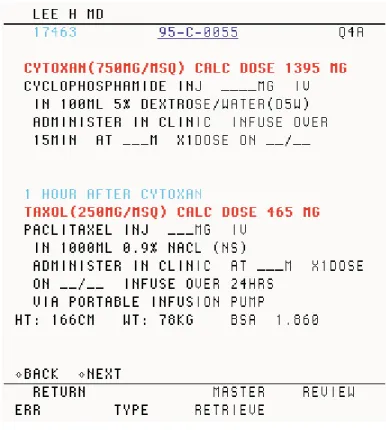
ministration times and automatic stop dates, will function properly. One of the major enhancements to our computer system was to create a method whereby doses were au-tomatically calculated on the basis of height and weight values en-tered into the patient’s record. This calculation is shown directly on the ordering screen (Figure 1). Implementing this change re-quired some creative program-ming efforts within the ISD to use the existing hospital computer system. Other MIS changes in-cluded creating ordering screens that restrict the route by which a drug like vincristine is given, thereby making it virtually impos-sible to order the drug by any oth-er, possibly fatal, route.
Both pharmacy and nursing re-vised their procedures for checking chemotherapy before preparation and administration. In addition to developing a new nursing depart-ment standard of practice for administering cytotoxic agents, checklists were developed to guide individuals through product prepa-ration and the process for checking drug products.7 The concept of these
checklists is similar to that used by the airline industry to ensure safety and quality.
In collaboration with ISD, a clini-cal desktop was created that allows instant access to drug information from any computer terminal throughout the hospital. In addi-tion, investigational drug sheets, which detail how investigational drugs are used in our protocols, are now accessible via the hospital’s in-tranet.
In an effort to provide practition-ers with educational programs, the group recommended that all physi-cians who prescribe chemotherapy complete a chemotherapy-specific training module before obtaining credentials. In addition, to heighten awareness about errors, all hospi-tal personnel who prescribe,
pre-pare, or administer chemotherapy now attend an orientation lecture covering the potentially serious nature of chemotherapy medica-tion errors.
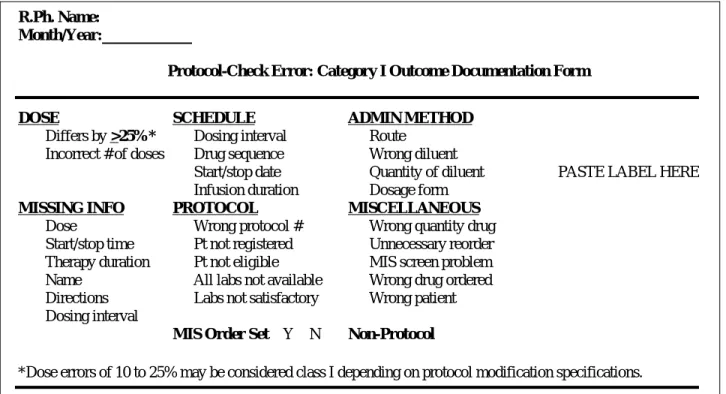
Class I errors are reported to the prescriber’s supervisor, using the form shown in Figure 2, soon after the error is detected. These po-tential errors are taken seriously and often trigger changes in the or-dering screens. Actual administra-tion errors that occur are discussed at multidisciplinary meetings to analyze the error and to determine whether a system change is neces-sary.
Medication errors related to por-table infusion pumps were corrected by standardizing the pumps used within the hospital.
Overall, these changes over the last four and a half years have result-ed in a 23% decrease in prescribing errors and a 53% decrease in serious prescribing errors. Table 2 summa-rizes all elements of our current
sys-tem used to prevent chemotherapy errors.
Discussion
When we compared our current practices against those recommend-ed in articles describing systems for preventing chemotherapy-related medication errors,7-9 we found that
our system met or exceeded all pub-lished benchmarks with few excep-tions. The current system relies heavily on independent dose verifi-cation and eduverifi-cation about the safe-ty process for everyone involved, including prescribers, nurses, phar-macists, technicians, and patients.
We believe that monitoring the overall trends in prescribing errors and actual occurrences before and after implementation of changes recommended by the task force is a valid measure of the success of our efforts. In some cases it was possible to measure the effect of an individu-al change, but we believed it was more important to look at how all
Figure 2. Example of a class I error-reporting form.
Table 2.
Elements of Comprehensive Chemotherapy Error-Reduction Program
Prescribing errors classified by potential error severity
Class I prescribing errors reported with full details to branch chiefs
Quarterly summaries and analysis provided for Class II and III errors Hospital occurrence-reporting system
Hospital occurrence-reporting system
Hospital occurrence-reporting system Prescriber education about error prevention
Patient education about chemotherapy regimen orally and through informed consent
Standardized nomenclature for dosage expression in protocol Standardized nomenclature for order
Protocol-specific, physician direct order entry Automated dose calculations
Pharmacist checks order against protocol
Dose verification independent from prescriber (i.e., dose checked with principal investigator or study chairperson)
Education about error prevention
Product preparation card checked by two pharmacists assisted by a checklist
Technician checks calculations before preparing Pharmacist checks product assisted by a checklist Patient education when dispensing oral chemotherapy
medications
Education about error prevention Computer-generated care plan
Dose verification independent from prescriber (i.e., dose checked with principal investigator or study chairperson)
Nurse checks order against protocol and second nurse verifies Nurse checks product label against order and second nurse
verifies
Two nurses verify infusion pump settings
Patient education about chemotherapy regimen orally and through informed consent
Prescribing
Preparation and dispensing
Administration
System Monitors for Improvement Systems Used To Reduce Number of Errors
Process Level R.Ph. Name:
Month/Year:____________
Protocol-Check Error: Category I Outcome Documentation Form
DOSE SCHEDULE ADMIN METHOD
! Differs by >25%* ! Dosing interval ! Route
! Incorrect # of doses ! Drug sequence ! Wrong diluent
! Start/stop date ! Quantity of diluent PASTE LABEL HERE
! Infusion duration ! Dosage form
MISSING INFO PROTOCOL MISCELLANEOUS
! Dose ! Wrong protocol # ! Wrong quantity drug
! Start/stop time ! Pt not registered ! Unnecessary reorder
! Therapy duration ! Pt not eligible ! MIS screen problem
! Name ! All labs not available ! Wrong drug ordered
! Directions ! Labs not satisfactory ! Wrong patient
! Dosing interval
MIS Order Set !Y !N Non-Protocol !
S9 Am J Health-Syst Pharm—Vol 57 Dec 15, 2000 Suppl 4
SYMPOSIUM
Chemotherapy-related medication errors
these changes worked synergistically toward our overall goal of reducing the number of chemotherapy-relat-ed mchemotherapy-relat-edication errors at our hospital. Overall, these changes have directly resulted in fewer prescribing errors, especially those considered very harmful to patients if they had re-ceived the drugs from the orders as written.
The task force met again in June 2000. The membership of the group was expanded to include representa-tives of additional departments where chemotherapy is used. Our goal is to ensure that all safe chemo-therapy practices are instituted uni-formly throughout the hospital.
The new task force identified over 20 additional recommenda-tions for improvement. For exam-ple, until recently, no prescribing errors were recorded on protocols where dose-calculation screens were available. The new task force rec-ommended that the capability for maximum dose checks be added to the ordering screens. We are cur-rently working with ISD to imple-ment this and several other
recom-mendations related to enhancing the computer system even more. We know, however, that our present computer system has limit-ed capabilities and cannot perform some of the desired functions iden-tified by the task force. For example, we want orders to be linked auto-matically so that if the time is changed on one order, the times are changed on all related orders. For-tunately, we are in the process of procuring a new hospital computer system, and these capabilities will be part of the functional requirements for the new system.
Conclusion
We have developed a compre-hensive, interdisciplinary approach for reducing the number of chemo-therapy-related medication errors at our institution. We expect that the recommendations of the task force, which now includes broader repre-sentation of departments, will result in additional system enhancements that will help ensure that safe che-motherapy practices are instituted uniformly throughout the hospital.
References
1. Knox RA. Doctor’s orders killed cancer patient: Dana-Farber admits drug over-dose caused death of Globe columnist, damage to second woman. Boston Globe. 1995; Mar 23:Metro1.
2. Rousch W. Dana-Farber death sends a warning to research hospitals. Science. 1995; 269:295-6.
3. Cancer patient in Chicago dies after che-motherapy overdose. NY Times. 1995; Jun 18:A17.
4. Fletcher CE. Failure mode and effects analysis: an interdisciplinary way to ana-lyze and reduce medication errors. J Nurs
Adm. 1997; 27(12):19-26.
5. Chapman MM, Goldspiel BR, DeChristoforo RD et al. Reporting and classifying prescribing errors found while checking protocol orders. Abstract pre-sented at the ASHP Midyear Clinical Meeting, New Orleans, LA; 1991 Dec 8-12.
6. Kohler DR, Montello MJ, Green L et al. Standardizing the expression and no-menclature of cancer treatment regi-mens. Am J Health-Syst Pharm. 1998; 55:137-44.
7. Fischer DS, Alfano S, Knopf MT et al. Improving the cancer chemotherapy use process. J Clin Oncol. 1996; 14: 3148-55.
8. Cohen MR, Anderson RW, Attilo RM et al. Preventing medication errors in can-cer chemotherapy. Am J Health-Syst
Pharm. 1996; 53:737-46.
9. Attilo RM. Caring enough to understand: the road to oncology medication error prevention. Hosp Pharm. 1996; 31:17-26.