Lawrence Berkeley National Laboratory
Recent Work
Title
UPC++: A High-Performance Communication Framework for Asynchronous Computation
Permalink
https://escholarship.org/uc/item/1gd059hj
ISBN
9781728112466
Authors
Bachan, John
Baden, Scott B
Hofmeyr, Steven
et al.
Publication Date
2019-05-01
DOI
10.1109/ipdps.2019.00104
Peer reviewed
2019 IEEE International Parallel and Distributed Processing Symposium
UPC++: A High-Performance Communication
Framework for Asynchronous Computation
John Bachan
1Scott B. Baden
1Steven Hofmeyr
1Mathias Jacquelin
1Amir Kamil
1,2Dan Bonachea
1Paul H. Hargrove
1Hadia Ahmed
11 Computational Research Division, Lawrence Berkeley National Laboratory, Berkeley, CA 94720, USA
2 University of Michigan, Ann Arbor, MI 48109, USA
Abstract—UPC++ is a C++ library that supports
high-performance computation via an asynchronous communication framework. This paper describes a new incarnation that differs substantially from its predecessor, and we discuss the reasons for our design decisions. We present new design features, including future-based asynchrony management, distributed objects, and generalized Remote Procedure Call (RPC).
We show microbenchmark performance results demonstrating that one-sided Remote Memory Access (RMA) inUPC++is com-petitive with MPI-3 RMA; on a Cray XC40UPC++delivers up to a 25% improvement in the latency of blocking RMA put, and up to a 33% bandwidth improvement in an RMA throughput test. We showcase the benefits of UPC++ with irregular applications through a pair of application motifs, a distributed hash table and a sparse solver component. Our distributed hash table in UPC++ delivers near-linear weak scaling up to 34816 cores of a Cray XC40. Our UPC++implementation of the sparse solver component shows robust strong scaling up to 2048 cores, where it outperforms variants communicating using MPI by up to 3.1x. UPC++ encourages the use of aggressive asynchrony in low-overhead RMA and RPC, improving programmer productivity and delivering high performance in irregular applications.
Index Terms—Asynchronous, PGAS, RMA, RPC, Exascale.
I. INTRODUCTION
UPC++ [1,2,3] is a C++ library that supports Partitioned Global Address Space (PGAS) programming. An early pre-decessor of UPC++ was released in 2012 as v0.1 [4]. This paper describes a new incarnation ofUPC++(v1.0) with a very different design, which is tailored to meet the needs of exascale applications that require PGAS support1. There are three main principles behind the redesign of UPC++. First, wherever possible,operations are asynchronousby default, to allow the overlap of computation and communication, and to encourage programmers to avoid global synchronization. Second, alldata
motion is explicit, to encourage programmers to consider the
costs of communication. Third, UPC++ encourages the use
of scalable data-structures and avoids non-scalable library
features. All of these principles are intended to provide a programming model that can scale efficiently to potentially millions of processors.
Like other PGAS models, UPC++supports physically dis-tributed global memory, which can be referenced via special global pointers. Using global pointers, processes can copy data
1UPC++is portable beyond HPC systems—it runs on 64-bit Linux and macOS, and can be used on laptops as well as servers.
between their local memory and remote global memory using one-sided Remote Memory Access (RMA) operations. Unlike pointer-to-shared in UPC [5],UPC++ global pointers cannot be directly dereferenced, as this would violate our principle of making all communication syntactically explicit. In addition to RMA,UPC++also supports Remote Procedure Calls (RPCs), whereby the caller can induce a remote process to invoke a user function, including any arguments and generating an optional result for return to the sender.
In this paper, we provide an overview of the UPC++
programming model and describe its implementation over the GASNet-EX communication library [6], which delivers a low-overhead, high-performance runtime. Using microbenchmarks, we demonstrate that the bandwidth and latency achieved by
UPC++RMA operations are competitive with MPI one-sided transfers. Finally, we present results for two application motifs that exemplify the advantages ofUPC++, and more generally, PGAS programming. The first motif is a distributed hash table, where latency is a limiting factor; it benefits from the synergistic interaction of RPC with RMA. The second is an extend-add operation that is a crucial building block of sparse solvers; it relies heavily on RPC and benefits from UPC++ mechanisms for asynchrony.
II. UPC++PROGRAMMINGMODEL
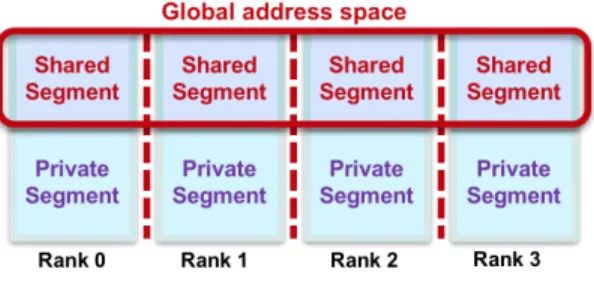
AUPC++program running on a distributed-memory parallel computer can be viewed as a collection of processes, each
withlocal memory (see Fig. 1). UPC++ implements SPMD
parallelism, with a fixed number of processes during program execution. Like other PGAS models,UPC++ providesglobal
memorythat the user program allocates inshared segments
dis-tributed over the processes. Processes have access to remotely allocated global memory via aglobal pointerand can access their respective local memories via conventional C++ pointer. As with threads programming, references made via global pointers may be subject to race conditions, and appropriate synchronization must generally be employed.
A UPC++ global pointer differs from a conventional C-style pointer in several ways. Most importantly, it cannot be dereferenced with the * operator, as this would violate the
explicit data-motion principle. However like conventional C-style pointers,UPC++ supports arithmetic on global pointers and passing global pointers by value. A global pointer can also
Fig. 1: PGAS logical memory model
be converted to and from a conventional pointer to the same object in the shared segment by the owning process.
Global pointers are used to refer to memory in shared segments when transferring data between processes via
one-sided RMA communication operations. Global pointers are
also used to refer to shared-segment memory locations in atomic operations.
All operations that involve communication are non-blocking and are managed through an API that includes futures and
promises. This is a departure from the previous version of
UPC++, which used an event-based model. While both allow the expression of asynchronous operations, futures are a much more powerful and composable abstraction, enabling arbitrary dependency graphs to be constructed. Futures and promises are also more likely to be familiar to C++ programmers, since they were introduced to the C++ standard library in C++11 [7]. Unlike standard C++ futures,UPC++ futures and promises are used to manage asynchronous dependencies within a thread and not for direct communication between threads or processes. A future is the interface through which the status of the operation can be queried and the results retrieved, and multiple future objects may be associated with the same promise. A future thus represents the consumer side of a non-blocking operation. Each non-blocking operation has an associated promise object, which is created either explicitly by the user or implicitly by the runtime when the non-blocking operation is invoked. A promise represents the producer side of the operation, and it is through the promise that the results of the operation are supplied and its dependencies fulfilled. A user can pass a promise to aUPC++communication operation, which registers a dependency on the promise and subsequently fulfills the dependency when the operation completes. The same promise can be passed to multiple communication op-erations, and through a single wait call on the associated future, the user can be notified when all the operations have completed.
Futures are also a mechanism for composing asynchronous operations, allowing the construction of elaborate dependence-driven graphs of asynchronously executed operations. A user
canchainacallbackto a future via the.then()method, and
the callback will be invoked on the values encapsulated by the future when they are available. The callback can be a function or a lambda, and it can initiate asynchronous operations of its own. The .then()method itself produces a new future, representing the results of the callback, and the new future can
then have further callbacks chained on to it. Multiple futures can be conjoined by the when_all() function template, which produces a single future that represents readiness of all the input futures and their values. A callback can then be chained to the resulting future, allowing the callback to depend on the completion of and the values produced by multiple asynchronous operations.
UPC++ provides several types of communication opera-tions: RMA, RPC, remote atomics and collectives; all are asynchronous and support a flexible set of synchronization mechanisms. RMA implements one-sided communication, and RPC ships a user-provided function or lambda with argu-ments to a remote processor for execution. On most high-performance networks, RMA operations use network hardware offload support to deliver low latency and high bandwidth. Remote atomics are useful in implementing lock-free data structures, and on network hardware with appropriate capabil-ities (such as available in Cray Aries) remote atomic updates can also be offloaded, improving latency and scalability [8].
UPC++has several other powerful features that can enhance programmer productivity and improve performance. For ex-ample, UPC++ also supports non-contiguous RMA transfers (vector, indexed and strided), enabling programmers to conve-niently express more complex patterns of data movement, such as those required with the use of multidimensional arrays2.
Unlike UPC,UPC++does not support distributed shared ar-rays, partially because these are difficult to implement scalably in a portable way—in general, every process must store at least one base pointer for every other process’s shared segment. The other reason, a semantic reason, is that symmetric heaps (the implementation approach to distributed arrays used in UPC, OpenSHMEM [9] and other models) require globally collective allocation that does not compose well with subset processor teams. Instead,UPC++providesdistributed objects, which can be used to conveniently represent an object (such as an array) distributed across any subset of processes, without implicitly requiring non-scalable storage anywhere in the software stack to track remote instances of the object.UPC++
RPCs include support to automatically and efficiently translate distributed object arguments between global identifiers and the local representative in each process. Obtaining a global pointer from a remote instance of a distributed object requires explicit communication, in keeping with the principle that there should be no implicit communication inUPC++.
The remainder of this paper will focus on a subset of the
UPC++features: futures, global pointers, RMA and RPC. For a discussion of other features, the reader is referred to the
UPC++Programmer’s Guide[3].
III. IMPLEMENTATION OF THEUPC++RUNTIME
In this section, we give a simplified overview of how the
UPC++runtime handles asynchronous operations.UPC++uses GASNet-EX as the communication layer, which handles the
2UPC++does not directly provide a multidimensional-array abstraction, but is compatible with those provided by other packages.
transfer of data over the network and within shared memory. For the purposes of this discussion, we will focus on two categories of data-movement operations provided by GASNet-EX: RMA (get and put), and Active Messages (AM). RMA copies data between local memory and global memory, and an AM invokes a function with an optional payload on a remote process. These operations execute asynchronously, and GASNet-EX provides interfaces to obtain notification when operations complete.
The UPC++ runtime is responsible for translating UPC++
communication operations into lower-level GASNet-EX op-erations, synchronizing their completion, and progressing
UPC++-level operations. The asynchronous aspects of the op-erations are managed by theProgress Engine, which advances the progress of pending or ongoing communication requests and processes completed requests.UPC++does not use special runtime threads to implement progress. Instead, progress is made either during calls into the library (internal progress), or explicitly when a user program invokes the progressor
wait3 calls (user-level progress).
The design of UPC++ avoids introducing hidden threads inside the runtime in order to improve user-visibility into the resource requirements of UPC++ and to enhance interoper-ability with software packages that have restrictive threading requirements. The consequence, however, is that the user must be aware of the balance between the need to make progress (via explicit library calls) and the application’s need for CPU cycles. This is related to the matter ofattentiveness, which we will discuss shortly.
The Progress Engine employs three unordered queues for user operations:
defQ Operations in thedeferred state, i.e. not yet handed off to GASNet-EX. actQ Operations in theactivestate,
i.e. already handed off to GASNet-EX.
compQ Operations in thecompletestate,
i.e. they have finished.
When a UPC++ RMA injection call is made, the runtime creates a promise for the operation and stores the promise in defQ, indicating the operation is in the deferred state. This promise is used to create the future that is returned by
rget/rput. The Progress Engine pollsdefQand initiates the queued operations. When the RMA is handed off to GASNet-EX, the operation enters the active state, and its associated promise is placed in actQ. The RMA will now complete without initiator attentiveness4, since GASNet-EX has taken over responsibility. When GASNet-EX has finished the RMA, it indicates completion to the UPC++ runtime, and the next call into internal progress (any UPC++ communication call) promotes the operation to the complete state, at which point it will move the promise to the compQ queue. The compQ queue is drained only by explicit user-progress. Hence, this queue can be thought of as the list of “futures to satisfy.”
3Thewaitcall is simply a spin loop aroundprogress.
4No further local CPU resources are required to complete the data transfer.
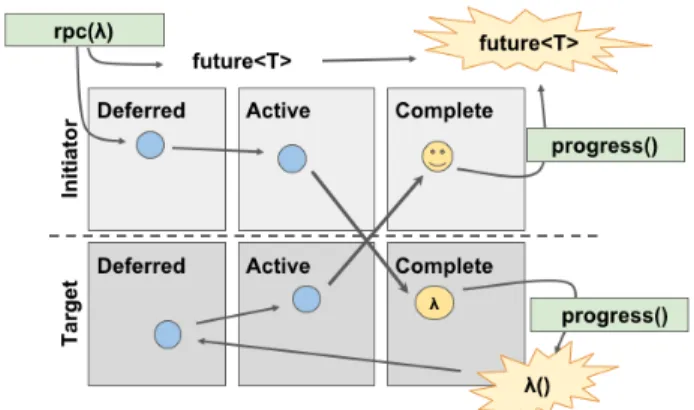
Fig. 2: Progression of RPC through theUPC++runtime. Blue and yellow circles are promises.
RPC operations (Fig.2) progress through both the initiator’s and the target’s queues. Once the RPC is dispatched from the sender, theUPC++runtime places a promise in the initiator’s actQ, and GASNet-EX moves the payload to the target using AM. On the target’s side, the incoming RPC (the lambda or function pointer, plus any arguments) is inserted into the target’s compQ. The target must be attentive to user-level progress to execute this RPC (e.g., if the target enters intensive, protracted computation without calls toprogress, incoming RPCs will stall). Once the RPC executes, its return value will be sent throughdefQandactQback to the initiator side using AM, which updates the corresponding promise and moves it to the initiator’scompQ5.
If a program attaches a callback action to a future (via the
.then() method), that callback is invoked at the initiator after the corresponding future-returning operation completes (this progression is not shown in Fig.2). Each future maintains a queue of callbacks that are waiting on it, and when the promise associated with an operation is moved to thecompQ, the callbacks attached to the corresponding future are also placed there. When user progress executes a callback in
compQ, the promise behind the associated future is satisfied.
IV. EXPERIMENTALRESULTS
In this section, we present microbenchmark results showing that the performance ofUPC++ RMA operations is competi-tive with MPI one-sided RMA. We then describe the code for two application motifs and present performance results. A. Testbed
All the experiments presented in this paper were run on the Cori Cray XC40 system [10] at NERSC [11]. This system has two disjoint partitions, each interconnected using a Cray Aries network in a Dragonfly topology. Cori Haswell has 2,388 compute nodes, each equipped with two 2.3GHz 16-core Intel Xeon E5-2698v3 “Haswell” processors and 128GB of DDR4
5UPC++provides several variants of RPCs, one of which (rpc_ff) does not return anything to the initiator, and hence its progress is more like
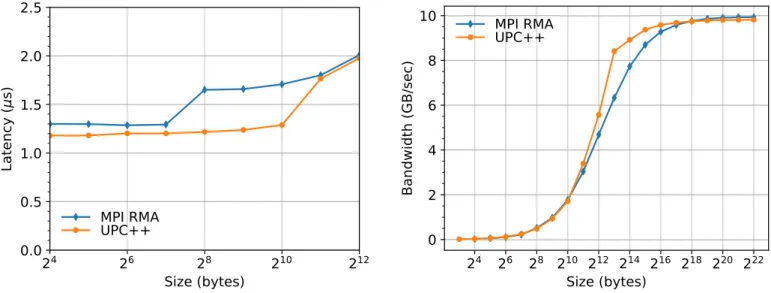
(a) Round-trip Put Latency (lower is better) (b) Flood Put Bandwidth (higher is better)
Fig. 3: RMA microbenchmark performance on Cori Haswell.
DRAM.Cori KNLhas 9688 nodes, and each node has a single 1.4GHz 68-core Intel Xeon Phi 7250 “KNL” processor, 96GB of DDR4 DRAM, and 16GB of on-package high-bandwidth memory. The code used for all experiments was compiled with Cray’s PrgEnv-intel/6.0.4 environment module and version18.0.1 20171018 of the Intel compiler suite. All UPC++ results use release version 2018.9.0 with GASNet-EX v2018.9.0 aries-conduit [8]. All MPI results presented for comparison used Cray’s cray-mpich/7.6.2 environment module. To ensure proper optimizations for the KNL CPU, executables built for Cori KNL used the craype-mic-knl
environment module. Other than selection of the appropriate
craype-* module, all environment modules and settings used the NERSC defaults.
B. Microbenchmarks
To measure bandwidth, we ran a “flood” microbenchmark, which initiates a large number of non-blocking RMA puts of a given size and then waits for them all to complete. The bandwidth metric is then the total volume of data transferred, divided by the total elapsed time. For UPC++, we issue multiplerputoperations in a loop and use promises to track completion, as shown in the following code outline:
u p c x x : : p r o m i s e<> p ; / / f o r t r a c k i n g c o m p l e t i o n w h i l e ( i t e r s−−) { / / one−s i d e d p u t t o r e m o t e memory l o c a t i o n / / d e s t i s a g l o b a l p o i n t e r u p c x x : : r p u t ( s r c , d e s t , s i z e , u p c x x : : o p e r a t i o n c x : : a s p r o m i s e ( p ) ) ; / / o c c a s i o n a l p r o g r e s s i f ( ! ( i t e r s % 1 0 ) ) u p c x x : : p r o g r e s s ( ) ; } / / w a i t f o r a l l r p u t s t o c o m p l e t e p . f i n a l i z e ( ) . w a i t ( ) ;
In the second experiment, we measured latency by issuing a large number of blocking transfers of a given size, i.e. the
microbenchmark waits for eachupcxx::rputoperation to complete (which includes waiting for a network-level acknowl-edgment from the target) before issuing a new one. The latency metric is then the average time taken to transfer a given size. The code outline is simple, using awaiton a future:
w h i l e ( i t e r s−−)
/ / i s s u e o n e r p u t , w a i t f o r c o m p l e t i o n u p c x x : : r p u t ( s r c , d e s t , s i z e ) . w a i t ( ) ;
For comparison, we also ran semantically analogous MPI-3 one-sided benchmarks from the Intel MPI Benchmarks suite [12] (IMB), version v2018.1. The flood bandwidth of the MPI_Put function was measured using the aggre-gatetimings of theUnidir_putmicrobenchmark from the
IMB-RMAtest, whereas the latency microbenchmark used the
non-aggregatetimings. Both tests use a passive-target access
epoch and synchronize usingMPI_Win_flush.
All tests were run between two compute nodes of Cori Haswell6, using a single process per node, i.e. one initiator and one passive target. Each data point shows the best result obtained across 10 different batch jobs for that configuration, with theUPC++and MPI RMA tests run back-to-back within each batch job. It can be seen in Fig. 3 that for sizes less than 256 bytes the latency of UPC++ is better than that of MPI RMA by more than 5% on average, and from 256 to 1024 bytes the improvement averages more than 25%. This latency advantage is present though at least 4MB (the largest we measured). The bandwidths are comparable for small and large sizes, but differ in the range between 1KB and 256KB. This difference is most pronounced at 8KB, whereUPC++is delivering over 33% more bandwidth than MPI RMA.
6The same experiments on Cori KNL reveal a known performance anomaly in Cray MPI RMA on this platform. Since this would imply a non-representative advantage for UPC++, we have omitted those results. However, the remaining benchmarks in this paperdo notuse MPI RMA.
C. Distributed Hash Table
In our first example application motif, we show how to implement a distributed hash table that scales efficiently to large numbers of processes.7 In the simplest implementation, each process has its own local map:
s t d : : u n o r d e r e d m a p<s t r i n g , s t r i n g> l o c a l m a p ; The insert operation uses RPC to update the local map at the target8: u p c x x : : f u t u r e<> i n s e r t (c o n s t s t r i n g &key , c o n s t s t r i n g &v a l ) { r e t u r n u p c x x : : r p c ( g e t t a r g e t ( key ) , [ ] ( s t r i n g key , s t r i n g v a l ) { l o c a l m a p . i n s e r t ({key , v a l}) ; }, key , v a l ) ; }
The target process is determined by a hash function
get_target (not shown) that maps a key to a unique process. The data is inserted using a lambda function, which takes a key and a value as parameters. The insert operation returns the result of the lambda, which in this case is an empty future. An example use of this asynchronous insert operation: u p c x x : : f u t u r e<> f = i n s e r t ( ” Germany ” , ” Bonn ” ) ; f . w a i t ( ) ;
Although an RPC-only distributed hash table will work, we can improve the performance for larger value sizes by taking advantage of the zero-copy RMA provided by UPC++. First, we define a landing zone type, lz_t, comprised of a global pointer and a size for a stored value:
s t r u c t l z t {
u p c x x : : g l o b a l p t r<char> g p t r ; s i z e t l e n ;
};
Then our local_map maps to landing zones, rather than directly to values:
s t d : : u n o r d e r e d m a p<s t r i n g , l z t> l o c a l m a p ; We define a function, make_lz, which takes as input a key and value size, and creates a landing zone using
upcxx::allocateto allocate uninitialized space in global memory. make_lzinserts the key and landing zone pointer into the local map, returning a global pointer suitable for use in RMA: u p c x x : : g l o b a l p t r<char> m a k e l z ( s t r i n g key , s i z e t l e n ) { u p c x x : : g l o b a l p t r<char> d e s t = u p c x x : : a l l o c a t e<char>( l e n ) ; l o c a l m a p . i n s e r t ({key , {d e s t , l e n} }) ; r e t u r n d e s t ; }
7 To facilitate discussion, the example code presented in this section is a simplified version of our actual distributed hash table benchmark, which uses an integer key type and a value type of std::array<uint64_t, N>rather thanstd::string.
8For brevity, we omit the find operation; it can be similarly implemented using RPC.
Finally we show the RMA-enabled hash table insert operation: u p c x x : : f u t u r e<> i n s e r t (c o n s t s t r i n g &key , c o n s t s t r i n g &v a l ) { u p c x x : : f u t u r e<u p c x x : : g l o b a l p t r<char>> f ; f = u p c x x : : r p c ( g e t t a r g e t ( key ) , m a k e l z , key , v a l . s i z e ( ) + 1 ) ; r e t u r n f . t h e n ( [ v a l ] ( u p c x x : : g l o b a l p t r<char> d e s t ) { r e t u r n u p c x x : : r p u t ( v a l . c s t r ( ) , d e s t , v a l . s i z e ( ) + 1 ) ; }) ; }
This function initiates an RPC of make_lz to obtain the remote landing zone pointer, and schedules a callback to transfer the value data to the retrieved location using
upcxx::rput. Note the RPC returns a future containing the global pointer, so therput is injected by a.thencallback that executes when the RPC’s future completes. The .then
operation itself returns a future representing completion of the chain, and is returned by insertto represent the entire asynchronous insertion operation.
We measured the distributed hash table implementation with a simple use case where each process inserts a different set of randomly generated 8-byte keys, with varying sizes of values. For each element size, the same total volume of data was inserted, e.g. a run with an element size of 2KB would execute 4x more iterations than a run with an element size of 8KB. The benchmark blocks after each insertion, so this application is limited by communication latency9.
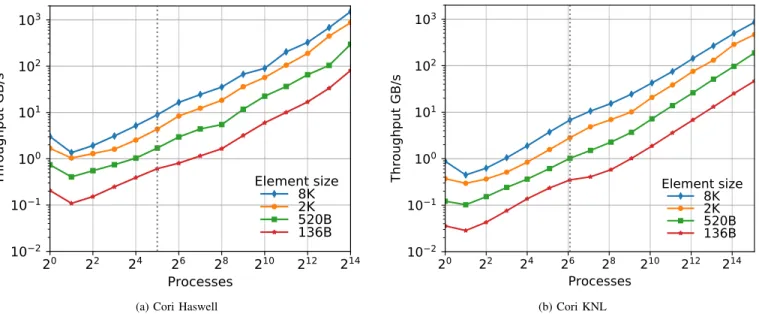
Weak scaling results are shown in Fig.4, running from a sin-gle process up to 512 nodes (16384 processes on Cori Haswell and 34816 processes on Cori KNL). As expected, there is an initial decline in performance from one to two processes, as we move from serial to parallel operation. The serial code omits all calls toUPC++, and thus represents the best we can achieve with the underlying C++ standard library. Beyond two processes, the implementation scales efficiently. Although the communications are fine-grained, they are random and so the network traffic is well-distributed, which aids in the scaling.
As we have shown with this application motif, RPCs can be a useful mechanism for implementing distributed hash tables. They are particularly elegant when we need to update complex entries in the hash table. Suppose we represented a graph as a distributed hash table, where each vertex is a class containing a vector of neighbors, among other properties:
s t r u c t V e r t e x {
. . . / / v a r i o u s p r o p e r t i e s v e c t o r<s t r i n g> n b s ;
};
Now, if we wish to update a vertex (with id v) to add a new neighbor (with idnb), that is easy to do with RPCs (this simplified example assumes the key is always found):
9Latency performance is a key consideration for many distributed hash table applications, such as genome assembly [13].
(a) Cori Haswell (b) Cori KNL
Fig. 4: Weak scaling of distributed hash table insertion. The dotted line represents the processes in one node. u p c x x : : r p c ( g e t t a r g e t ( v ) , [ ] ( s t r i n g key , s t r i n g v a l ) { a u t o i t = l o c a l m a p . f i n d ( key ) ; a u t o v e r t e x = &i t−>s e c o n d ; v e r t e x−>n b s . p u s h b a c k ( v a l ) ; }, v , nb ) ;
By contrast, if we had no support for RPCs and had to use only one-sided puts and gets, this would be more complicated, error-prone, and likely less efficient. We’d have to first lock the entry in the hash table, thenrgetthe Vertex from the remote process, modify it locally,rputit back to the remote process, and then unlock it. The representation of the Vertex class would also have to be modified, because the representation of STL types std::vector and std::string are not amenable to direct access via RMA.
D. Sparse Solvers
1) Background: Our second application motif is a sparse
solver. Sparse matrices contain a significant number of zeros, and by taking advantage of this specific structure, sparse matrix computations employed by sparse solvers are able to drastically reduce storage and computing costs. Here we focus on an operation called extend-add (henceforth denoted
e_add), a key component ofmultifrontal sparse solvers[14]. In multifrontal algorithms, computations comprise a se-quence of parallel operations on dense matrices calledfrontal
matrices that correspond to a part of the entire sparse
ma-trix. Frontal matrices are organized along the elimination tree[15] of the sparse matrix, forming a hierarchy described in terms of a parent/child relationship representing the numerical dependencies among rows/columns during the factorization. Fig.5depicts two levels of such a hierarchy; the three frontal matrices represent a portion of some sparse matrix A.
The e_add operation entails a child updating the parent where each use different local coordinate systems, therefore
indices of the child must be mapped to the parent’s correspond-ing indices. The mappcorrespond-ing between local and global element indices is stored in the metadata of each frontal matrix, namely Ipfor the parent andIlC /IrC for each child. Frontal matrices are processed in parallel: they are mapped onto groups of pro-cesses using the proportional mapping heuristic [16], which assigns subtrees of frontal matrices to groups of processes of varying size depending on their computational cost. Frontal matrices are then distributed in a 2D block-cyclic manner with a fixed block size among processes of each group, as depicted by the colored blocks in Fig. 5.
The numerical factorization of a sparse matrix corresponds to a single bottom-up traversal of the elimination tree, more precisely the frontal matrix tree in the context of the multi-frontal algorithm. At each level of the hierarchy, it is con-venient to partition a frontal matrix F into four component matrices: F = F 11 F12 F21 F22
F11, F12, and F21 are called factors and correspond to the output of the algorithm.F22 is called the contribution block, and contains the values that the child will use to update the parent frontal matrix. This matrix is a temporary, and can be discarded once thee_addhas completed.
At each level of the traversal, thee_addoperation applies the updates from the F22 matrix of each child to the four submatrices of the parent. Element indices of each child are first converted to global indices viaIlC orIrC, and then onto local indices in the parent’s coordinate system via Ip. Fig. 5
depicts these updates on a 2-by-3 process grid. The red arrows show where entries represented by blue dots in the left child are sent to the parent and accumulated. In this example, the parent frontal matrix is distributed over six processes, the left child is distributed over two processes (magenta and yellow),
F11 F11 F11 F21 F21 F21 F12 F12 F12 F22 F22 F22 Ip IlC IrC Parent
Left child Right child
Fig. 5: The e_addoperation on a 2-by-3 process grid.
and the right child is distributed over the remaining four. The number of processes will generally not be the same in the parent and the children.
2) Extend-add Implementation: In many multifrontal
solvers, the update operation is implemented in three steps: (1) processes working on a child compute the locations, in the coordinate system of the parent, where values of their respective chunk of the contribution block need to be accumu-lated in the parent; (2) values are communicated between all processes assigned to the parent; and (3) the received values are accumulated by the owner of local chunks of the parent frontal matrix. The communication step (2) can be performed either using an all-to-all collective communication or a non-blocking point-to-point strategy. State-of-the-art solvers like STRUMPACK [17] implement this step using the former approach while solvers such as MUMPS [18] use the latter.
Our UPC++implementation is similar to the point-to-point strategy. It issues an RPC to every process in the parent, and the input data to these RPCs (i.e. numerical values to accumulate on a given process) are serialized by the UPC++
framework and sent over the network usingUPC++views[2]. A view is a mechanism that enables an RPC to serialize a sequence accessed via a user-provided iterator. After the RPC arrives at the target process, it is executed to accumulate data into the parent frontal matrix. Fig.6depicts the operation. The magenta process in the left child (1) packs the data going to each remote process, (2) issues three RPCs to the red, yellow, and gray processes to transfer the data, and (3) RPCs are executed on the target processes to accumulate received data into the locations indicated by the red arrows. This corresponds to finding the locations of indices i1,i2, i3, and i4 from IlC in the parent index setIp.
We now demonstrate in detail how these three steps can be carried out usingUPC++. The implementation defines a class
FMatthat includes several fields important to this discussion:
• lChildandrChild: pointers to left and right children
• row_indices: a vector containing the global indices of the frontal matrix in the sparse matrix (corresponding toIp, IlC andIrC in Fig5)
• front_team: a upcxx::team object (similar in func-tionality to an MPI communicator) representing the pro-cesses onto which this frontal matrix is mapped
• pack: a utility function that compares row_indicesof the child and the parent, determines which numerical values are to be sent to a given process in the parent, and bins them into appropriate buffers
• e_add_prom: a upcxx::promise initialized with the number of incoming RPCs expected by the current pro-cess; this promise acts as a counter and has an associated
upcxx::futurewhich becomes ready when the counter reaches zero
The top-level code is shown in Fig 7. The e_add func-tion iterates over both children of the process and calls the
eadd_sendhelper function (at lines 7-10), which packs the data to be sent and calls upcxx::make_view to create a serializable upcxx::view object, v, of the data destined for each process of the parent frontal matrix (line 26). The actual serialization is done by the RPC injection call, which eventually results in remote invocation of theaccumfunction. The accum callback (not shown) traverses the data packed in the upcxx::view argument (a non-owning view into the incoming network buffer), accumulates each element into one of the local factor matrices (F11, F21, F12, F22), and calls e_add_prom.fulfill_anonymous(1), signaling the e_add() function that the expected incoming RPC has been processed. The RPC injection returns a future, fut, that is used to track acknowledgment (at line 28). The returned future objects are conjoined into a single future,
f_conj, via the upcxx::when_all function (line 29).
F11 F11 F21 F21 F12 F12 F22 1 2 3 F22 RPC RPC RPC communication i1 i2 i3 i4 i1i2 i3i4 i1 i2 i3 i4 i1 i2 i3 i4
Fig. 6: e_add operation implemented with UPC++ using RPCs on a 2-by-3 process grid.
1v o i d FMat : : e a d d ( ) { 2 v e c t o r<v e c t o r<double> > s b u f s [ 2 ] ; 3 / / e m p t y f u t u r e , t h e s t a r t i n g p o i n t 4 / / o f c o n j o i n e d f u t u r e s 5 u p c x x : : f u t u r e<> f c o n j ; 6 f c o n j = u p c x x : : m a k e f u t u r e ( ) ; 7 e a d d s e n d (t h i s−>l C h i l d , s b u f s [ 0 ] , 8 f c o n j , t h i s−>f r o n t t e a m ) ; 9 e a d d s e n d (t h i s−>r C h i l d , s b u f s [ 1 ] , 10 f c o n j , t h i s−>f r o n t t e a m ) ; 11 / / w a i t u n t i l a l l RPCs i s s u e d by t h i s 12 / / p r o c e s s h a v e c o m p l e t e d 13 u p c x x : : w h e n a l l ( f c o n j , 14 e a d d p r o m . f i n a l i z e ( ) ) . w a i t ( ) ; 15}
16 v o i d FMat : : e a d d s e n d ( FMat∗ ch , v e c t o r<v e c t o r<double> > &s b u f , 17 u p c x x : : f u t u r e<>&f c o n j , u p c x x : : t e a m &f r o n t t e a m ) { 18 i n t myrank = f r o n t t e a m . rank me ( ) , P = f r o n t t e a m . r a n k n ( ) ; 19 i n t m y r a n k c h = ch−>f r o n t t e a m . rank me ( ) ; 20 p a c k ( ch , s b u f ) ; / / b i n o u t g o i n g e n t r i e s i n t o s b u f 21 / / l a u n c h an RPC t o e v e r y p r o c e s s i n f r o n t t e a m 22 f o r (i n t l p = 0 ; l p < P ; l p ++) { 23 p d e s t = ( myrank + 1 + l p ) % P ; 24 i f ( s b u f [ p d e s t ] . s i z e ( ) == 0 ) c o n t i n u e; 25 / / c o n s t r u c t a s e r i a l i z a b l e v i e w o f t h e d a t a 26 a u t o v = u p c x x : : make view ( s b u f [ p d e s t ] ) ; 27 / / a c c u m u l a t e i n t o f a c t o r m a t r i x on t h e r e m o t e p r o c e s s o r 28 a u t o f u t = u p c x x : : r p c ( f r o n t t e a m [ p d e s t ] , accum , myrank ch , v ) ; 29 f c o n j = u p c x x : : w h e n a l l ( f c o n j , f u t ) ; / / c o n j o i n 30 } 31}
Fig. 7: Extend-add code sketch.thisrefers to the parent frontal matrix object. This function is also used to conjoin f_conj to the future
associated with the e_add_prom promise, obtained using
promise::finalize (lines 13-14). This ensures that all the expected RPCs have been executed by the current process.
3) Extend-add Evaluation: We evaluated the performance
of ourUPC++implementation against two MPI variants, one using all-to-all collectives and the other usingMPI_Isend/ Irecv calls. Our use of these two different MPI variants follows the strategy generally employed by state-of-the-art solvers such as STRUMPACK and MUMPS. We use the
audikw_1sparse matrix input from the Suite Sparse matrix collection [19]. The frontal matrix tree and data distribution information are extracted from the STRUMPACK solver. No computation other than the accumulation of numerical values is performed by the benchmark. Each data point corresponds to the mean of 10 runs, and each variant executes the exact same amount of computation and communicates the same amount of data.
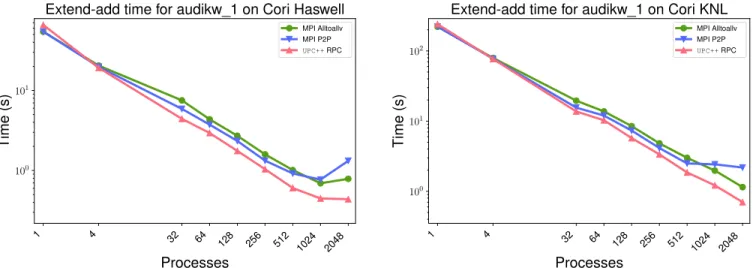
The results are shown in Fig. 8 on both Cori Haswell and KNL, using 32 and 64 processes per node, respectively; the all-to-all variant is labeledMPI Alltoallv, whereas the point-to-point variant is labeled MPI P2P. As can be observed in
the figure, the UPC++implementation maintains a consistent advantage over both MPI implementations, delivering up to a 1.63x speedup relative to MPI Alltoallv and a 3.11x speedup relative to MPI P2P. Similar results were observed for other matrices from the Suite Sparse matrix collection. This demonstrates that the RPC-based approach can be effective for implementing non-blocking asynchronous computations such as those required by the extend-add operation. Furthermore,
UPC++RPCs offer an elegant way to implement this operation from a productivity standpoint.
4) symPACK Comparison Between UPC++ Versions: In
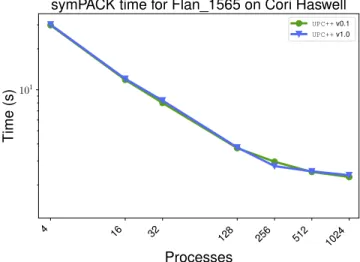
the next experiment, we analyze the performance of a direct linear solver for sparse symmetric matrices named symPACK, which has been shown to be competitive against state-of-the-art solvers [20]. It was originally implemented using the pre-decessorUPC++and has recently been ported toUPC++v1.0. The previous implementation used v0.1 asyncsandevents to schedule the asynchronous communication. These translated naturally to RPCs and futures, respectively, in v1.0. We com-pared the performance of both implementations of symPACK on NERSC Cori Haswell with 32 processes/node, using the
Flan_1565 sparse matrix from the Suite Sparse matrix
1 4 32 64 128 256 512 1024 2048 Processes 100 101 Time (s)
Extend-add time for audikw 1 on Cori Haswell MPI Alltoallv MPI P2P UPC++RPC 1 4 32 64 128 256 512 1024 2048 Processes 100 101 102 Time (s)
Extend-add time for audikw 1 on Cori KNL MPI Alltoallv MPI P2P
UPC++RPC
4 16 32 128 256 512 1024 Processes 101 Time (s)
symPACK time for Flan 1565 on Cori Haswell
UPC++v0.1
UPC++v1.0
Fig. 9: Strong scaling comparison of symPACK usingUPC++
v0.1 and v1.0 on Cori Haswell.
collection and reporting the mean time for 10 runs at each data point. Results depicted in Fig 9 show the performance of the two implementations to be nearly identical; the average difference in performance across all job sizes is 0.7%, with the UPC++ v1.0 variant providing up to a 7.2% advantage at 256 processes. This demonstrates that the new UPC++
framework does not incur any measurable added overheads for this application.
V. RELATEDWORK A. Comparison to Predecessor UPC++ v0.1
The version of UPC++ presented in this paper differs considerably from the predecessor developed by Zheng et al [4]. Both are libraries supporting the PGAS model and use GASNet [21] as the underlying communication layer, but the APIs are quite different. In the current version, the principles of making communication explicit and avoiding non-scalable data structures means that we’ve dropped support for implicit dereference of global pointers, shared scalars and shared arrays. Furthermore, the API for expressing asynchrony in our current version is based on the abstraction of futures and promises, as introduced in C++11 [7], rather than the async/finish interface in the predecessor version and other models such as X10 [22] and Habanero-C [23]. The new model improves composability of asynchronous operations, and it enables additional flexibility in the expression of data movement and synchronization.
Our new version of UPC++ provides substantial new ca-pabilities that are absent from its predecessor. The future abstraction encapsulates both data values as well as readiness information, as opposed to events in the old version that carry readiness information only. This semantic binding enables asynchronous operations that return values; as such, the new version’s RPCs are permitted to return a value, while the old version’s asyncs could not. The future abstraction also frees the programmer from the burden of explicitly managing event-object lifetime, which can be challenging in algorithms with
highly asynchronous and irregular communication patterns. RMA operations in the predecessor UPC++ were also very limited – they did not support events, and there was no mech-anism to attach a local or remote operation to the completion of an RMA. The ability to attach an operation which effectively serves as a completion handler is semantically elegant, and it leads to more compact code. As a result of the limitations of the predecessor, a hash-table insertion operation similar to the one presented in section IV-C requires 50% more lines of code in oldUPC++, and it incurs both a blocking remote allocation and a blocking RMA, which negatively impact latency performance and overlap potential. Our improvements to asynchrony support directly enable the simpler, streamlined, and fully asynchronous implementation of distributed hash table that scales beyond thousands of cores.
In addition to the incomplete support for asynchrony, the old version of UPC++ lacked several important design features introduced by the new version, such as atomics and view-based serialization of RPC arguments. Finally, the new version of UPC++ has a more formal and rigorous specification, compared to the incomplete documentation and specification of its predecessor.
B. Other Programming Models
Several recent and older programming systems support the PGAS model, including UPC [5, 24], Fortran 2008 coar-rays [25], OpenSHMEM [9], and Titanium [26, 27]. While X10 and Chapel [28] both support remote task execution, their execution model is rooted in forking and joining tasks, plac-ing less emphasis on PGAS-style RMA operations. UPC++
supports the SPMD execution model provided by traditional PGAS systems, but augments it with remote procedure calls.
The implementation of UPC++ notably takes a template-metaprogramming approach rather than relying upon a custom compiler, resulting in a lightweight and sustainable implemen-tation that leverages existing C++ compilers and simplifies interoperability with other C++ libraries. There are a number of programming systems that take a compiler-free, C++-library approach toward parallel programming on distributed machines. DASH [29] is a PGAS library implemented over DART [30], which has an MPI-3 RMA backend. LikeUPC++, DASH provides global pointers, but unlike UPC++, it lacks support for RPCs or any form of code shipping and it includes implicit communication via dereference. STAPL [31] is another parallel programming library, based on an Adaptive Remote Method Invocation (ARMI) layer. It does not expose a true PGAS API, but instead abstracts the details of the data distribution and parallelism into elementary patterns (e.g. map, map-reduce, scan, zip). Another PGAS library is Coarray C++ [32], which focuses on distributed data structures such as coarrays. It assumes the existence of a symmetric shared heap, an implementation detail thatUPC++has deliberately avoided because it can result in non-scalable data structures and is incompatible with subset teams. Like UPC++, Coarray C++ provides asynchrony, but in the form of cofutures. There exist
some other libraries (e.g Hierarchically Tiled Arrays [33]) that focus explicitly on distributed data structures.
Other libraries, such as HPX [34], Phalanx [35], and Charm++ [36] provide a more task-based execution model rather than the core SPMD abstraction of UPC++. HPX, Charm++, and HabaneroUPC++ [37] all support task schedul-ing and load balancschedul-ing. By contrast, UPC++ is intended to provide lightweight constructs for communication and remote execution with basic progress guarantees, while supporting interoperation with external scheduling libraries.
VI. DISCUSSION ANDCONCLUSIONS
We have presented UPC++, a C++ PGAS library. UPC++
provides low-overhead, one-sided RMA communication, re-mote procedure call and rere-mote atomics. UPC++’s asyn-chronous communication model is based on futures and promises. Futures capture data readiness state, and they enable the programmer to chain or conjoin operations to execute asyn-chronously as high-latency dependencies become satisfied, via completion handlers. Promises provide another mechanism for tracking completion of multiple operations.
Current work includes adding a rich set of non-blocking collective operations. Future work will enhanceUPC++’s one-sided communication to express transfers to and from other memories (such as that of GPUs) with extensions to the existing abstractions.
Unlike many other PGAS models,UPC++forbids syntacti-cally implicit communication, and all communication is non-blocking by default. These restrictions were made as conscious design decisions in order to encourage the programmer to write code that is performant by carefully considering communi-cation costs. The communicommuni-cation model closely matches the unordered delivery and RMA semantics of modern RDMA network hardware, unlike two-sided message passing. The increased semantic flexibility improves the possibility of over-lapping communication and scheduling it appropriately.
UPC++’s ability to offer low-overhead communication re-lies on the GASNet-EX communication library, which hides incidental details of the communication network while en-gaging any available low-level hardware support. Future work includes benchmarking UPC++ applications on additional su-percomputing networks supported by GASNet-EX.
We demonstrated the benefits of UPC++ on a Cray XC40 via microbenchmarks and two application motifs that perform fine-grained communication. UPC++ delivers up to a 25% improvement in the latency of blocking RMA put, and up to a 33% bandwidth improvement in an RMA throughput test. Our distributed hash table inUPC++delivers near-linear weak scaling up to 34816 cores. Our UPC++ implementation of the sparse solver component shows robust strong scaling up to 2048 cores, where it outperforms variants communicating using MPI by up to 3.1x. In these proxy applications, RPC was vital in realizing high performance—RMA alone was not sufficient.
ACKNOWLEDGMENTS
This research was supported by the Exascale Computing Project (17-SC-20-SC), a collaborative effort of the U.S. Department of Energy Office of Science and the National Nuclear Security Administration.
This research used resources of the National Energy Re-search Scientific Computing Center, a DOE Office of Science User Facility supported by the Office of Science of the U.S. Department of Energy under Contract No. DE-AC02-05CH11231.
REFERENCES
[1] UPC++ home page, http://upcxx.lbl.gov/
[2] J. Bachan, S. B. Baden, D. Bonachea, P. H. Hargrove, S. Hofmeyr, et al.: UPC++ Specification, v1.0 Draft 8. Tech. Rep. LBNL-2001179, Lawrence Berkeley Natl. Lab (September 2018). doi:10.25344/S45P4X
[3] J. Bachan, S. B. Baden, D. Bonachea, P. H. Hargrove, S. Hofmeyr, et al.: UPC++ Programmer’s Guide, v1.0-2018.9.0. Tech. Rep. LBNL-2001180, Lawrence Berke-ley Natl. Lab (September 2018). doi:10.25344/S49G6V
[4] Y. Zheng, A. Kamil, M. B. Driscoll, H. Shan, and K. Yelick: UPC++: A PGAS extension for C++. In: IEEE 28th International Parallel and Distributed Processing Symposium. pp. 1105–1114 (May 2014). doi:10.1109/ IPDPS.2014.115
[5] UPC Consortium: UPC Language and Library Specifica-tions, v1.3. Tech. Rep. LBNL-6623E, Lawrence Berkeley Natl. Lab (November 2013).doi:10.2172/1134233
[6] D. Bonachea and P. H. Hargrove: GASNet-EX: A High-Performance, Portable Communication Library for Ex-ascale. Tech. Rep. LBNL-2001174, Lawrence Berkeley Natl. Lab (October 2018). doi:10.25344/S4QP4W, to appear: Languages and Compilers for Parallel Computing (LCPC’18)
[7] ISO: ISO/IEC 14882:2011(E) Information technology -Programming Languages - C++. Geneva, Switzerland (2012),https://www.iso.org/standard/50372.html
[8] P. H. Hargrove and D. Bonachea: GASNet-EX perfor-mance improvements due to specialization for the Cray Aries network. In: 2018 IEEE/ACM Parallel Applications Workshop, Alternatives To MPI (PAW-ATM). pp. 23–33 (November 2018). doi:10.1109/PAW-ATM.2018.00008
[9] S. Pophale, R. Nanjegowda, T. Curtis, B. Chapman, H. Jin, et al.: OpenSHMEM Performance and Potential: A NPB Experimental Study. In: Proceedings of the 6th Conference on Partitioned Global Address Space Programming Models (PGAS’12). (2012), https://www. osti.gov/biblio/1055092
[10] Cray, Inc.: Cray XC Series. https://www.cray.com/ products/computing/xc-series, accessed 2018-07-17 [11] NERSC: National Energy Research Scientific Computing
Center.http://www.nersc.gov
[12] Intel Corp.: Introducing IntelR MPI Benchmarks.https: //software.intel.com/en-us/articles/intel-mpi-benchmarks
[13] E. Georganas, A. Buluc¸, J. Chapman, S. Hofmeyr, C. Aluru, et al.: HipMer: An Extreme-scale De Novo Genome Assembler. In: Proceedings of the International Conference for High Performance Computing, Network-ing, Storage and Analysis. pp. 14:1–14:11. SC ’15 (2015).doi:10.1145/2807591.2807664
[14] I. S. Duff and J. K. Reid: The multifrontal solution of indefinite sparse symmetric linear. ACM Transactions on Mathematical Software (TOMS) 9(3), 302–325 (1983).
doi:10.1145/356044.356047
[15] J. W.-H. Liu: The role of elimination trees in sparse factorization. SIAM Journal on Matrix Analysis and Applications11, 134–172 (1990). doi:0.1137/0611010
[16] A. Pothen and C. Sun: A mapping algorithm for parallel sparse Cholesky factorization. SIAM Journal on Scien-tific Computing14(5) (1993).doi:10.1137/0914074
[17] P. Ghysels, X. Li, F. Rouet, S. Williams, and A. Napov: An Efficient Multicore Implementation of a Novel HSS-Structured Multifrontal Solver Using Randomized Sam-pling. SIAM Journal on Scientific Computing 38(5), S358–S384 (2016).doi:10.1137/15M1010117
[18] P. Amestoy, I. Duff, J.-Y. L’Excellent, and J. Koster: A fully asynchronous multifrontal solver using distributed dynamic scheduling. SIAM Journal on Matrix Anal-ysis and Applications 23, 15–41 (2001). doi:10.1137/ S0895479899358194
[19] T. A. Davis and Y. Hu: The University of Florida sparse matrix collection. ACM Transactions on Mathematical Software38, 1 (2011).doi:10.1145/2049662.2049663
[20] J. Bachan, D. Bonachea, P. H. Hargrove, S. Hofmeyr, M. Jacquelin, et al.: The UPC++ PGAS library for exascale computing. In: Proceedings of the Second An-nual PGAS Applications Workshop. pp. 7:1–7:4. PAW17 (2017).doi:10.1145/3144779.3169108
[21] D. Bonachea and P. H. Hargrove: GASNet specification, v1.8.1. Tech. Rep. LBNL-2001064, Lawrence Berkeley Natl. Lab (August 2017).doi:10.2172/1398512
[22] P. Charles, C. Grothoff, V. Saraswat, C. Donawa, A. Kiel-stra, et al.: X10: an object-oriented approach to non-uniform cluster computing. In: Proceedings of the 20th Annual ACM SIGPLAN Conference on Object-Oriented Programming, Systems, Languages, and Applications. (OOPSLA’05) (2005).doi:10.1145/1103845.1094852
[23] S. Chatterjee, S. Tasirlar, Z. Budimlic, V. Cave, M. Chabbi, et al.: Integrating asynchronous task paral-lelism with MPI. International Parallel and Distributed Processing Symposium pp. 712–725 (2013).doi:10.1109/ IPDPS.2013.78
[24] UPC consortium home page,http://upc-lang.org/
[25] J. Reid: Coarrays in the Next Fortran Standard. SIG-PLAN Fortran Forum29(2), 10–27 (July 2010). doi:10. 1145/1837137.1837138
[26] P. Hilfinger, D. Bonachea, K. Datta, D. Gay, S. Graham, et al.: Titanium language reference manual. Tech Report UCB/EECS-2005-15.1, University of California, Berke-ley (November 2001).doi:10.25344/S4H59R
[27] K. Yelick, P. Hilfinger, S. Graham, D. Bonachea, J. Su, et al.: Parallel Languages and Compilers: Perspective from the Titanium Experience. International Journal of High Performance Computing Applications 21(3), 266– 290 (2007). doi:10.1177/1094342007078449
[28] D. Callahan, B. L. Chamberlain, and H. P. Zima: The Cascade High Productivity Language. International Workshop on High-Level Parallel Programming Models and Supportive Environments (HIPS) pp. 52–60 (2004).
doi:10.1109/HIPS.2004.10002
[29] K. F¨urlinger, C. Glass, A. Kn¨upfer, J. Tao, D. H¨unich, et al.: DASH: Data Structures and Algorithms with Support for Hierarchical Locality. In: Euro-Par Parallel Processing Workshops (2014). doi:10.1007/978-3-319-14313-2 46
[30] H. Zhou, Y. Mhedheb, K. Idrees, C. W. Glass, J. Gracia, et al.: DART-MPI: An MPI-based Implementation of a PGAS Runtime System. In: Proceedings of the 8th International Conference on Partitioned Global Address Space Programming Models. pp. 3:1–3:11. PGAS ’14 (2014).doi:10.1145/2676870.2676875
[31] P. An, A. Jula, S. Rus, S. Saunders, T. Smith, et al.: STAPL: An Adaptive, Generic Parallel C++ Library. In: Languages and Compilers for Parallel Computing (LCPC 2001). Lecture Notes in Computer Science, vol. 2624. Springer (2001). doi:10.1007/3-540-35767-X 13
[32] T. A. Johnson: Coarray C++. In: Proceedings of the 7th International Conference on PGAS Programming Mod-els. pp. 54–66. PGAS’13 (2013), https://www.research. ed.ac.uk/portal/files/19680805/pgas2013proceedings.pdf
[33] G. Bikshandi, J. Guo, D. Hoeflinger, G. Alm´asi, B. B. Fraguela, et al.: Programming for parallelism and locality with hierarchically tiled arrays. In: Proceedings of the ACM SIGPLAN Symposium on Principles and Practice of Parallel Programming (PPoPP). pp. 48–57 (2006).doi: 10.1145/1122971.1122981
[34] H. Kaiser, T. Heller, B. Adelstein-Lelbach, A. Serio, and D. Fey: HPX: A Task Based Programming Model in a Global Address Space. In: Proceedings of the 8th International Conference on Partitioned Global Address Space Programming Models. pp. 6:1–6:11. PGAS ’14 (2014).doi:10.1145/2676870.2676883
[35] M. Garland, M. Kudlur, and Y. Zheng: Designing a unified programming model for heterogeneous machines. In: Proceedings of the International Conference on High Performance Computing, Networking, Storage and Anal-ysis. SC ’12 (2012). doi:10.1109/SC.2012.48
[36] L. Kal´e and S. Krishnan: CHARM++: A portable concur-rent object oriented system based on C++. In: A. Paepcke (ed.) Proceedings of OOPSLA. pp. 91–108 (September 1993).doi:10.1145/167962.165874
[37] V. Kumar, Y. Zheng, V. Cav´e, Z. Budimli´c, and V. Sarkar: HabaneroUPC++: A Compiler-free PGAS Library. In: Proceedings of the 8th International Conference on Par-titioned Global Address Space Programming Models (PGAS) (2014). doi:10.1145/2676870.2676879