Chapman University
Chapman University
Chapman University Digital Commons
Chapman University Digital Commons
Physical Therapy Faculty Articles and Research
Physical Therapy
7-5-2020
Automatic Detection of Dynamic and Static Activities of the Older
Automatic Detection of Dynamic and Static Activities of the Older
Adults Using a Wearable Sensor and Support Vector Machines
Adults Using a Wearable Sensor and Support Vector Machines
Jian Zhang
Rahul Soangra
Thurmon E. Lockhart
Follow this and additional works at: https://digitalcommons.chapman.edu/pt_articles
Part of the Biomedical Devices and Instrumentation Commons, Other Biomedical Engineering and Bioengineering Commons, Other Rehabilitation and Therapy Commons, and the Physical Therapy Commons
Wearable Sensor and Support Vector Machines
Wearable Sensor and Support Vector Machines
Comments
Comments
This article was originally published in Sci, volume 2, in 2020. https://doi.org/10.3390/sci2030050
Creative Commons License
Creative Commons License
This work is licensed under a Creative Commons Attribution 4.0 License.
Copyright
Article
Automatic Detection of Dynamic and Static Activities
of the Older Adults Using a Wearable Sensor and
Support Vector Machines
Jian Zhang1, Rahul Soangra2,3 and Thurmon E. Lockhart4,*
1 Machine Learning Algorithms Team, Glassdoor, Mill Valley, CA 94941, USA; [email protected]
2 Department of Physical Therapy, Crean College of Health and Behavioral Sciences, Chapman University,
Orange, CA 92866, USA; [email protected]
3 Department of Electrical Engineering and Computer Sciences, Fowler School of Engineering,
Chapman University, Orange, CA 92866, USA
4 School of Biological and Health Systems Engineering, Arizona State University, Tempe, AZ 85281, USA
* Correspondence: [email protected]; Tel.:+1-540-257-3058
Received: 30 March 2020; Accepted: 8 May 2020;
First Version Published: 3 June 2020 (doi:10.3390/sci2020038)
Second Version Published: 5 July 2020 (doi:10.3390/sci2030050)
Abstract:Although Support Vector Machines (SVM) are widely used for classifying human motion patterns, their application in the automatic recognition of dynamic and static activities of daily life in the healthy older adults is limited. Using a body mounted wireless inertial measurement unit (IMU), this paper explores the use of an SVM approach for classifying dynamic (walking) and static (sitting, standing and lying) activities of the older adults. Specifically, data formatting and feature extraction methods associated with IMU signals are discussed. To evaluate the performance of the SVM algorithm, the effects of two parameters involved in SVM algorithm—the soft margin constant
C and the kernel function parameter γ—are investigated. The changes associated with adding
white-noise and pink-noise on these two parameters along with adding different sources of movement variations (i.e., localized muscle fatigue and mixed activities) are further discussed. The results indicate that the SVM algorithm is capable of keeping high overall accuracy by adjusting the two parameters for dynamic as well as static activities, and may be applied as a tool for automatically identifying dynamic and static activities of daily life in the older adults.
Keywords: locomotion; machine learning; support vector machines; activity classification; activity of daily life (ADL)
1. Introduction
Fall accidents are a significant problem for the older adults [1–3], and several studies have shown that fall risks in this population can be identified with motion patterns associated with the activities of daily life [4,5]. While the classification of dynamic and static activities of daily life is a key point for fall prevention research efforts, the greater variability of motion patterns associated with aging [6–10] and its effect on classification performance are not well understood. In this study, we investigate the use of a support vector machine (SVM) classifier to identify dynamic as well as static activities of daily life in the older adults.
Numerous classification algorithms exist to provide human motion classification patterns, such as the wavelet method, the linear discriminant analysis (LDA) method, the ambient assisted living (AAL) systems, the Multi-Classifier Adaptive-Training (MCAT) algorithm, the pervasive neural network algorithm, ambient intelligence, and the SVM algorithm. Specifically, gyroscope data and the wavelet method was used to analyze the “sit-to-stand” transition in relation to fall risk by Najafi et al. [11]. Sci2020,2, 50; doi:10.3390/sci2030050 www.mdpi.com/journal/sci
A linear discriminant analysis method was adopted to classify external load conditions during
walking by Lee et al. [12]. An Evaluating Assisted Ambient Living (EvAAL) workshop aimed to
address the problem of localization and tracking issues for AAL, and provided a novel approach to evaluate and assess AAL systems and services [13]. A Multi-Classifier Adaptive-Training algorithm
(MCAT) was proposed to improve the classifier for activity recognition by Cvetkovi´c et al. [14].
A pervasive neural network algorithm was utilized by Kerdegari et al. on smart phones to monitor older individuals’ activities, and identified the occurrence of falls [15]. Ambient intelligence was used to gather information from an environment to assess patients’ vital signs and locations in the waiting area of a hospital emergency department by Curtis et al. [16]. In addition, the SVM classifier was used
to analyze the minimum foot clearance owing to aging by Begg et al. [17]. The SVM is considered
a powerful technique for general data classification, and has been widely used to classify human motion patterns with good results [18–21]. The advantage of the SVM algorithm is that it can generate a classification result with limited data sets by minimizing both structural and empirical risks [22].
Although numerous studies have been devoted to improving the SVM algorithms, little work has been performed on assessing the robustness of SVM algorithms associated with movement variations (i.e., mixed activities of daily life) of the older adults [23]. In this study, we investigate variations of the optimal parameters involved in the SVM algorithm by taking a closer look into the performance of an SVM classifier for detecting dynamic and static motions of the older adults. Furthermore, step-by-step procedures associated with the SVM classification are elaborated to provide a better understanding of the classification method utilizing an ambulatory inertial measurement unit system for biomedical applications.
2. Methods and Materials 2.1. SVM
Here, some basic concepts applied in SVMs are elaborated in light of the classification schemes.
The SVM is a statistical method introduced by Guyon and Vapnik [24,25] which has been widely
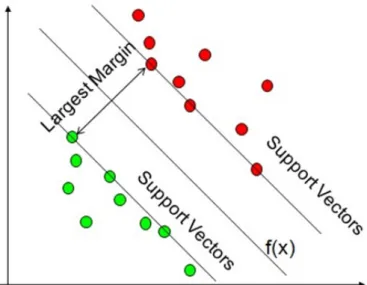
applied to different classification needs [26–28]. The idea of the SVM algorithm is to map the original data to a high-dimensional space using nonlinear mapping by finding an optimum linear separating hyperplane with the maximal margin in this higher dimensional space [24,25].
The SVM is a principled approach to machine learning utilizing concepts from classical statistical learning theory [24,29,30]; it exhibits good generalization of new data with a readily interpretable model. Additionally, learning involves the optimization of a convex function (i.e., one solution). From the perspective of statistical learning theory, the motivation for considering binary classifier SVM comes from the theoretical bounds on the generalization error. These generalization bounds have two important features: the upper bound is independent of the size of the input space, and the bound is minimized by maximizing the margin between the hyperplane separating the two classes and the closest data point to each class—called support vectors. Closest points are called support vectors because they support where the hyperplane should be located, that is, moving the nonsupport vectors will not shift the hyperplane, whereas moving the support vectors will shift the hyperplane (Figure1).
The basis of the SVM algorithm can be stated as follows: training data setΘis given, containing data feature vectorsxiand the corresponding data labelsdi, in the form of
Θ=(
x1, d1), (x2, d2), (x3, d3),. . ., (xn, dn) (1) wherexi∈ <m, m is dimension of the feature (real) vector,di∈ {0, 1}, and n is the number of samples. In our case,dias 1 for dynamic activities and 0 is employed for static activities. We assumeg(x)is some unknown function to classify the feature vectorxi.
Sci2020,2, 50 2 of 19
In the SVM method, optimal margin classification for linearly separable patterns is achieved by finding a hyperplane in m dimensional space. The linear classifier is based on a linear discriminant function of the form
f(x) =X i
wixi+b (3)
where the vectorwiis the weight vector and b is the hyperplane bias. We try to find the maximum
margin hyperplane dividing the points havingdi = 1 from those havingdi = 0. In our case, two
classes from the samples are labeled by f(x)≥0 for dynamic motion class (di=1)andf(x)<0 for static motion class (di = 0), while f(x) = 0 is called the hyperplane which separates the sampled
data linearly.Sci 2020, 3, x FOR PEER REVIEW 3 of 20
Figure 1. Linear support vector machine separation.
The basis of the SVM algorithm can be stated as follows: training data set Θ is given, containing data feature vectors 𝒙𝒙𝒊𝒊 and the corresponding data labels 𝑑𝑑𝑖𝑖, in the form of
𝛩𝛩= {(𝑥𝑥1,𝑑𝑑1), (𝑥𝑥2,𝑑𝑑2), (𝑥𝑥3,𝑑𝑑3), … , (𝑥𝑥𝑛𝑛,𝑑𝑑𝑛𝑛)} (1) where 𝑥𝑥𝑖𝑖∈ ℜ𝑚𝑚, m is dimension of the feature (real) vector, 𝑑𝑑𝑖𝑖∈{0, 1}, and n is the number of samples. In our case, 𝑑𝑑𝑖𝑖 as 1 for dynamic activities and 0 is employed for static activities. We assume 𝑔𝑔(𝑥𝑥) is some unknown function to classify the feature vector 𝑥𝑥𝑖𝑖.
𝑔𝑔(𝑥𝑥):ℜ𝑚𝑚→{0, 1} (2)
In the SVM method, optimal margin classification for linearly separable patterns is achieved by finding a hyperplane in m dimensional space. The linear classifier is based on a linear discriminant function of the form
𝑓𝑓(𝑥𝑥) =� 𝑤𝑤𝑖𝑖𝑥𝑥𝑖𝑖 𝑖𝑖
+𝑏𝑏 (3)
where the vector 𝑤𝑤𝑖𝑖 is the weight vector and b is the hyperplane bias. We try to find the maximum margin hyperplane dividing the points having 𝑑𝑑𝑖𝑖= 1 from those having 𝑑𝑑𝑖𝑖= 0. In our case, two classes from the samples are labeled by 𝑓𝑓(𝑥𝑥)≥0 for dynamic motion class (𝑑𝑑𝑖𝑖= 1) and 𝑓𝑓(𝑥𝑥) < 0 for static motion class (𝑑𝑑𝑖𝑖= 0), while 𝑓𝑓(𝑥𝑥) = 0 is called the hyperplane which separates the sampled data linearly.
In many cases, a linear classifier cannot satisfy the demand of accuracy due to its simplicity; thus, a more sensitive classifier is needed for real-world applications. Correspondingly, kernel theory was introduced by implicitly mapping data from the input space into higher dimensional space, in order to achieve nonlinear transformation and avoid the problem of dimensionality [31]. The kernel function 𝐾𝐾(𝑥𝑥,𝑦𝑦) can be expressed as and is related to 𝜑𝜑 (𝑥𝑥) by
𝐾𝐾(𝑥𝑥,𝑦𝑦) =𝜑𝜑(𝑥𝑥)𝑇𝑇𝜑𝜑(𝑥𝑥) (4) where 𝜑𝜑(𝑥𝑥) represents the nonlinear feature mapping function, 𝑥𝑥 ∈ ℜ𝑚𝑚, 𝜑𝜑(𝑥𝑥)∈ ℜ𝑛𝑛.
The evaluation of a hyperplane in feature space is usually determined by the distance between the hyperplane and the training points lying closest to it, which are named support vectors (Figure 1). Therefore, it is necessary to search for an optimal separating hyperplane to maximize the distance between the support vectors and the hyperplane [31]. The distance from the hyperplane to a support vector is ‖𝑤𝑤‖1 ; thus, we can get the distance between the support vectors of one class to the other class simply by using geometry: ‖𝑤𝑤‖2 .
Figure 1.Linear support vector machine separation.
In many cases, a linear classifier cannot satisfy the demand of accuracy due to its simplicity; thus, a more sensitive classifier is needed for real-world applications. Correspondingly, kernel theory was introduced by implicitly mapping data from the input space into higher dimensional space, in order to achieve nonlinear transformation and avoid the problem of dimensionality [31]. The kernel function K(x,y)can be expressed as and is related toϕ(x)by
K(x,y) =ϕ(x)Tϕ(x) (4)
whereϕ(x)represents the nonlinear feature mapping function,x∈ <m,ϕ(x)∈ <n.
The evaluation of a hyperplane in feature space is usually determined by the distance between the hyperplane and the training points lying closest to it, which are named support vectors (Figure1). Therefore, it is necessary to search for an optimal separating hyperplane to maximize the distance between the support vectors and the hyperplane [31]. The distance from the hyperplane to a support vector is ||w1||; thus, we can get the distance between the support vectors of one class to the other class simply by using geometry: ||w2||.
As real life datasets may contain noise, and an SVM can fit this noise leading to poor generalization, the effects of outliers and noise can be reduced by introducing a soft margin. The soft-margin
minimization problem relaxes the strict discriminant by introducing slack variables, ξi, and is
formulated as minimize=(w) = 1 2 l X i=1 w2i +C l X i=1 ξisubject to ( di(Pli=1wiφ(xi) +b)≥1+ξi ∀i=1. . .l (5)
The Lagrange theory is applied to solve Equation (5), and we can get the solved dual Lagrangian form of minimize =(w) =−1 2 l X i=1 αi+1 2 l X i,j=1 αiαjyiyjK xiyj subject to ( 0≤αi≤C Pl i=1αiyi=0 (6)
whereα1, α2,. . .,αl are the non-negative Lagrangian multipliers, and C is a constant parameter,
called the regularization parameter, which determines the tradeoffbetween the maximum margin and
minimum classification error.
Once we have found the Lagrangian multipliersαi, then the optimalw∗can be obtained: w∗ =
n X
i=1
αiyixi (7)
Correspondingly, the value of optimalb∗can be derived from the constraints
(hw,xii+b)≥1 (8)
Thus, we can obtain the optimalb∗value: b∗ =−maxyi=−1(
hw,xii) +minyi=1(hw,xii)
2 (9)
At this point, we have all of the necessary parameters to write down the decision function needed to predict the classification of a new data pointxnew:
f(xnew) =sgn(hw ∗ ,xnewi+b ∗ ) =sgn n X i=1 αiyihxi,xnewi+b ∗ (10)
In essence, findingαiandb ∗
and applying the choice of kernel to the decision function will classify new data points as either dynamic or static activities. In general, ifαi is nonzero, it is a support vector, while ifαiis zero, it is not a support vector. Intuitively, as illustrated in Figure1, moving the nonsupport vector will result in no shift of the hyperplane (i.e.,αiis zero).
The process of obtaining the quadratic program solution is known as training, and the process of using the trained SVM model to classify new data sets is known as testing. In this paper, two types of human activities are separately presented as input for the training of the SVM model, labeled with the dynamic and static types [1 for dynamic, 0 for static]. Data processing of the raw data and feature extraction methods are discussed next within the empirical paradigm.
The motion patterns associated with activities of daily life (walking, standing, sitting and lying) were captured by the wearable inertial measurement unit (IMU—accelerometer and gyroscope) system. Afterwards, we employed the SVM method to classify dynamic and static activities. The selection of features and formatting of the data into the SVM input file is further elaborated in light of analyzing human movements utilizing IMU signals. Subsequently, we investigated the effects of two parameters pertinent to SVM classifiers: soft margin constant C and the kernel function parameterγ. The motion associated with dynamic (normal walking is assumed here to be dynamic) and static activities (e.g., lying, sitting, standing still with eyes open and closed) of the older adults were investigated.
2.2. Participants and Data Collection
Thirty community dwelling healthy older individuals consisting of 21 females and 9 males
(Height 1.68±0.09 m, Weight 162.09±22.33 lb, Age 76±7 years) from Loudoun County, Virginia
Sci2020,2, 50 4 of 19
provided by the participants who agreed to volunteer in the study. Participants wore three Inertial
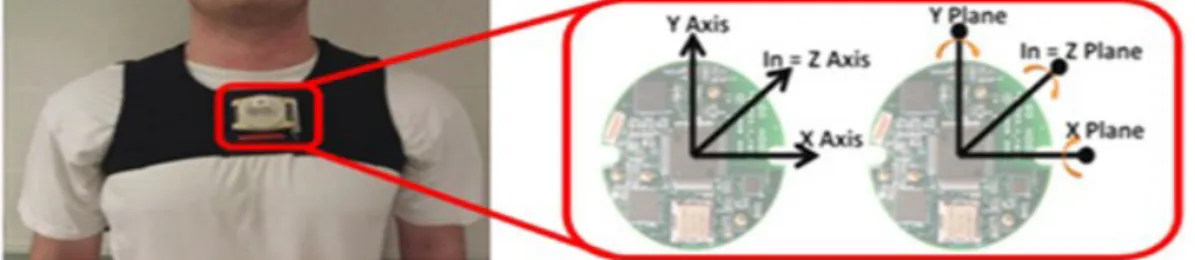
Measurement Unit (IMU) nodes [32]: one at the sternum level and another two on the lateral sides
of the shank. In this manuscript, only the data from the sternum level node is analyzed (Figure2). Participants were instructed to sit comfortably using a backrest for one minute on a 40 cm popliteal height chair. They were then instructed to stand up using the arm-rests. Postural sway data was collected while standing still with eyes open and eyes closed for 90 s. Next, the participants were instructed to lie down on their back (i.e., in supine posture) on a massage bench for a minute, and data were recorded for lying down. Afterwards, participants were asked to walk a distance of 10 m. Participants willingly volunteered for this experiment, and no compensation was provided. All participants signed an informed consent form approved by the Institutional Review Board at Virginia Tech.
Sci 2020, 3, x FOR PEER REVIEW 5 of 20
Thirty community dwelling healthy older individuals consisting of 21 females and 9 males (Height 1.68 ± 0.09 m, Weight 162.09 ± 22.33 lb, Age 76 ± 7 years) from Loudoun County, Virginia participated in this study. The data was collected from the local senior center. Written consent was provided by the participants who agreed to volunteer in the study. Participants wore three Inertial Measurement Unit (IMU) nodes [32]: one at the sternum level and another two on the lateral sides of the shank. In this manuscript, only the data from the sternum level node is analyzed (Figure 2). Participants were instructed to sit comfortably using a backrest for one minute on a 40 cm popliteal height chair. They were then instructed to stand up using the arm-rests. Postural sway data was collected while standing still with eyes open and eyes closed for 90 s. Next, the participants were instructed to lie down on their back (i.e., in supine posture) on a massage bench for a minute, and data were recorded for lying down. Afterwards, participants were asked to walk a distance of 10 m. Participants willingly volunteered for this experiment, and no compensation was provided. All participants signed an informed consent form approved by the Institutional Review Board at Virginia Tech.
Figure 2. Picture of sensor location on a participant. 2.3. Instrumentation
The IMU node consisted of MMA7261QT tri-axial accelerometers (NXP Semiconductor, Netherlands) and IDG-300 (x and y plane gyroscope) (InvenSense, Santa Clara, CA, USA) and an ADXRS300 (Analog Devices, Norwood, MA, USA) z-plane uniaxial gyroscope aggregated in the TEMPO [32] platform (Technology-Enabled Medical Precision Observation which was manufactured in collaboration with the research team of the University of Virginia). Data acquisition was carried out using a Bluetooth adapter and laptop through a custom-built LabView VI(National Instruments, Austin, TX, USA). Data were acquired with a sampling frequency of 128 Hz. This frequency is largely sufficient for human movement analysis in daily activities which occur at low bandwidth [0.8-5 Hz] [33]. The data was processed using custom software written in MATLAB (MathWorks, Natick, MA, USA) and libSVM toolbox [34].
2.4. Data Analysis
Thirty sets of data were used for training, and thirty sets of data were used for testing. Both training data and testing data contained ten dynamic activities and twenty static activities. First, the original IMU data were scaled to conveniently solve large datasets; then, Principle Component Analysis (PCA) [35,36] was employed to decrease the dimensions. Subsequently, the SVM algorithm was utilized to classify the human motion patterns (Figure 3).
Figure 2.Picture of sensor location on a participant.
2.3. Instrumentation
The IMU node consisted of MMA7261QT tri-axial accelerometers (NXP Semiconductor, Eindhoven, The Netherlands) and IDG-300 (x and y plane gyroscope) (InvenSense, Santa Clara, CA, USA) and an ADXRS300 (Analog Devices, Norwood, MA, USA) z-plane uniaxial gyroscope aggregated in the
TEMPO [32] platform (Technology-Enabled Medical Precision Observation which was manufactured
in collaboration with the research team of the University of Virginia). Data acquisition was carried out using a Bluetooth adapter and laptop through a custom-built LabView VI (National Instruments, Austin, TX, USA). Data were acquired with a sampling frequency of 128 Hz. This frequency is largely sufficient for human movement analysis in daily activities which occur at low bandwidth [0.8–5 Hz] [33]. The data was processed using custom software written in MATLAB (MathWorks, Natick, MA, USA) and libSVM toolbox [34].
2.4. Data Analysis
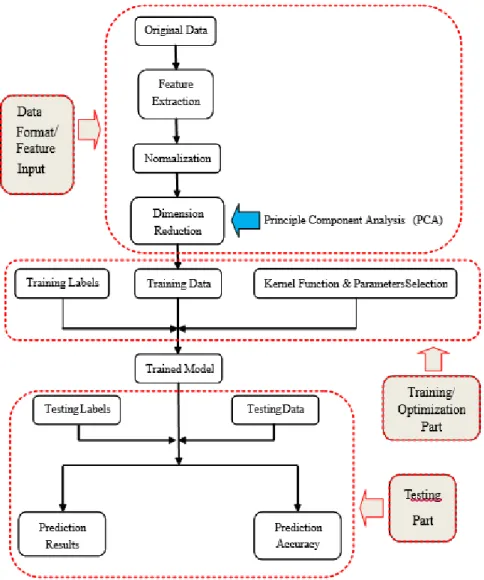
Thirty sets of data were used for training, and thirty sets of data were used for testing. Both training data and testing data contained ten dynamic activities and twenty static activities. First, the original IMU data were scaled to conveniently solve large datasets; then, Principle Component Analysis
(PCA) [35,36] was employed to decrease the dimensions. Subsequently, the SVM algorithm was
utilized to classify the human motion patterns (Figure3).
Step 1 Input of the Original Data
The original data is represented by an IMU at the sternum. The IMU provided three directional accelerations and angular velocities. The format of the original data is 9920×6 matrix with the row representing the time and the column representing 6 channel signals from tri-axial accelerometers and gyroscopes.
A total of 60 datasets (30 participants and 2 trials) containing 20 dynamic physical activities (walking) and 40 static activities were selected for movement classification. Each activity was represented by one two-second data segment. All of the datasets were split into training datasets and test datasets equally. In the first comparison (walking vs. lying), 20 normal walking segments were chosen as the dynamic activity, and 40 lying segments were chosen as the static activity. The datasets were then divided into training and testing sets, each containing 10 dynamic activities and 20 static
activities. In the second comparison (walking vs. standing with eyes closed), 20 normal walking segments were chosen as the dynamic activity, and 40 standing still with eyes closed segments were chosen as the static activity. In the third comparison (walking vs. lying, sitting, standing still with eyes open and closed), 20 normal walking segments were chosen as the dynamic activity, and four different activities, i.e., lying, sitting, standing still with eyes open and closed, were selected as the static activity; each of them was assigned 10 segments, and thus, in total, there were 40 static activities.
Sci 2020, 3, x FOR PEER REVIEW 6 of 20
Figure 3. Data analysis procedure.
Step 1 Input of the Original Data
The original data is represented by an IMU at the sternum. The IMU provided three directional accelerations and angular velocities. The format of the original data is 9920 × 6 matrix with the row representing the time and the column representing 6 channel signals from tri-axial accelerometers and gyroscopes.
A total of 60 datasets (30 participants and 2 trials) containing 20 dynamic physical activities (walking) and 40 static activities were selected for movement classification. Each activity was represented by one two-second data segment. All of the datasets were split into training datasets and test datasets equally. In the first comparison (walking vs. lying), 20 normal walking segments were chosen as the dynamic activity, and 40 lying segments were chosen as the static activity. The datasets were then divided into training and testing sets, each containing 10 dynamic activities and 20 static activities. In the second comparison (walking vs. standing with eyes closed), 20 normal walking segments were chosen as the dynamic activity, and 40 standing still with eyes closed segments were chosen as the static activity. In the third comparison (walking vs. lying, sitting, standing still with eyes open and closed), 20 normal walking segments were chosen as the dynamic activity, and four different activities, i.e., lying, sitting, standing still with eyes open and closed, were selected as the static activity; each of them was assigned 10 segments, and thus, in total, there were 40 static activities.
Step 2 Feature Extraction
Generally speaking, the features can be extracted from the time domain, frequency domain, and other data processing techniques, such as wavelet [37] and empirical mode decomposition [38,39].
Figure 3.Data analysis procedure.
Step 2 Feature Extraction
Generally speaking, the features can be extracted from the time domain, frequency domain, and other data processing techniques, such as wavelet [37] and empirical mode decomposition [38,39]. Based on the criterion of minimizing computational complexity and maximizing the class discrimination, several key features are proposed for SVM classification [40].
(1) Mean Absolute Value—the mean absolute value of the original signal,x, in order to estimate
signal information in time domain:
x= 1 N N X k=1 |xk| (11)
wherexkis the kth sampled point and N represents the total sampled number over the entire signal.
(2) Zero Crossings—the number of times the waveform crosses zero, in order to reflect signal
Sci2020,2, 50 6 of 19
(3) Slope Sign Changes—the number of times the slope of the waveform changes sign, in order to
measure the frequency content of signal.
(4) Waveform Length—the cumulative curve length over the entire signal, in order to provide
information on the waveform complexity.
All of these feature values will give a measure of waveform amplitude, frequency, and duration within a single parameter. And they were extracted from raw signals to create the total feature sets for representing the dynamic or static motion patterns. After feature extraction, the original data were
transformed to the feature data with a 60×24 matrix. The row number 60 means 60 total data sets
to test as described above, and the column number of 24 is obtained from 4 features in each of the 6 channels. Thirty data sets were selected for the training data; thus, the size of the training data was 30×24.
Step 3 Normalization
The above data were then normalized by each column to a range between 0 and 1.
Step 4 Principle Component Analysis (PCA)
The objective of PCA is to perform dimensionality reduction while preserving as much of the randomness in the high-dimensional space as possible. The PCA algorithm can be described as:
(1) Assume X is an m×n matrix, and choose a normalized direction in m-dimensional space along
which the variance in X is maximized, saving this vector asp1.
(2) Find another direction along which variance is maximized; however, the search is restricted to
all directions orthogonal to all previous selected directions due to the orthonormality condition, saving this vector aspi. The procedure is repeated until m vectors are selected. The resulting ordered set of p is called principal components.
The dimension reduction can be described as:
(1) For the m eigenvectors, we reduce from m dimensions tokdimensions by choosing k eigenvectors
related to k largest eigenvaluesλ;
(2) Proportion of Variance (PoV) can be explained as:
PoV= λ1+λ2+· · ·+λk
λ1+λ2+· · ·+λk+· · ·+λm (12) whereλiare sorted in descending order, and the threshold of PoV is typically set as 0.9.
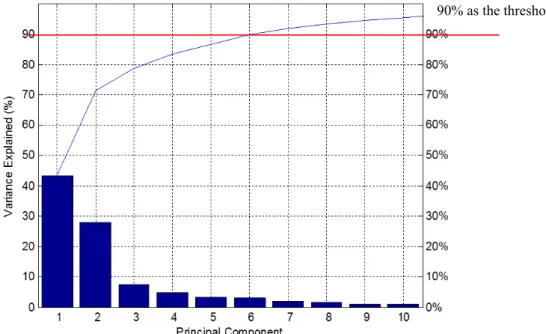
In our case, the m value should be 24. From the figure below (Figure4), it can be found that when k reaches 7, the PoV will be above 0.9. Therefore, the PCA approach reduces the dimension of the original data from 24 to 7. Figure4illustrates the principal components based on the variance values. Additionally, Figure5illustrates three principal components from the model, and it can be readily seen that although “standing” and “walking” can be distinguished easily, other activities may not. After the dimension reduction by PCA, the dataset is reduced as a matrix of 30×7.
Step 5 SVM Classifier Testing
Three criteria were used to assess the performance of the SVM classifier.
Accuracy= TP+TN TP+FP+TN+FN×100% (13) Sensitivity= TP TP+FN×100% (14) Specificity= TN TN+FP×100% (15)
where TP represents the number of true positive; here, it refers to dynamic activities. TN is the number of true negatives, and it labels as static activities. FP is the number of false dynamic activity
identification, and FN is the number of false static activity identification. While accuracy indicates the overall detection accuracy for all the activities, sensitivity is defined as the ability of the SVM classifier to accurately recognize the dynamic activities. Specificity indicates the SVM classifier’s ability to avoid
false detection.Sci 2020, 3, x FOR PEER REVIEW 8 of 20
Figure 4. Proportion of variance (PoV) curve of the principal components.
Figure 5. View of the data and the original variables in the space of the first three principal components.
Step 5 SVM Classifier Testing
Three criteria were used to assess the performance of the SVM classifier.
Accuracy = TP + TN TP + FP + TN + FN × 100% (13) -1 -0.5 0 0.5 1 -1 0 1 -1 -0.8 -0.6 -0.4 -0.2 0 0.2 0.4 0.6 0.8 1 Sitting Lying
Standing with Eyes Open Normal Walking
Standing with Eyes Closed
Component 1 Component 2 C om ponent 3 90% as the threshold
Figure 4.Proportion of variance (PoV) curve of the principal components.
Sci 2020, 3, x FOR PEER REVIEW 8 of 20
Figure 4. Proportion of variance (PoV) curve of the principal components.
Figure 5. View of the data and the original variables in the space of the first three principal components.
Step 5 SVM Classifier Testing
Three criteria were used to assess the performance of the SVM classifier. Accuracy = TP + TN TP + FP + TN + FN × 100% (13) -1 -0.5 0 0.5 1 -1 0 1 -1 -0.8 -0.6 -0.4 -0.2 0 0.2 0.4 0.6 0.8 1 Sitting Lying
Standing with Eyes Open Normal Walking
Standing with Eyes Closed
Component 1 Component 2 C om ponent 3
90% as the threshold
Figure 5.View of the data and the original variables in the space of the first three principal components.
Furthermore, a receiver operating characteristic (ROC) curve was also used to evaluate the SVM classifier’s performance. ROC analysis is generally utilized to select optimal models and to qualify the accuracy of diagnostic tests. The area under the ROC curve (AUC) which is a representation of the classification performance was utilized to assess the effectiveness of the SVM classifier.
Sci2020,2, 50 8 of 19
3. Results
In this section, we first introduce the effects of the Gaussian kernel function on minimizing the upper bound on the expected test error. Afterwards, a selection of the optimal hyperparameters is discussed. The results from the three classification tests are discussed in light of the three criteria discussed earlier (accuracy, sensitivity, selectivity).
3.1. Effect of SVM Key Parameters on Classification
The SVM algorithm has two important parameters called hyperparameters: soft margin constant C, and the other parameter reflecting the kernel function. In this paper, a Gaussian kernel was applied to the SVM classifier; correspondingly, the other parameter,γ, refers to the width of the Gaussian kernel. Parameter C reflects the tradeoffbetween the margin of error. When C is large, the margin of error is small; however, the margin becomes narrow as a penalty. When C is small, those points close to the boundary become the margin of error, but the hyperplane’s orientation will change, providing a much larger margin for the rest of the data.
As forγ, let’s first take a look at the Gaussian kernel:
k(x, x,) =exp−γ||x−x,||2 (16) The Gaussian basis function with center→xiand varianceσ2i can be constructed as
G→x= 1 (2π)d/2σd i exp −|| → x −→xi||2 2σ2 i (17)
wheredis the dimensional number of Gaussian RBF.
If we construct an SVM Gaussian RBF classifier as
f(x) =sgn( l X i=1 yiαi·exp −||x− → xi|| 2 c +b) (18)
whereyi = fw,b(xi);wis known as the weight vector,bis a bias term,αiis Lagrangian multipliers and c is the constant. To optimally choose the centers of→xi, the center points which are critical to the classification task are selected. In other words, if unknown sample x goes away from the known sample centers of→xi, there will be a decay, and we can use this kernel to assign weights (i.e., decision weights). The Support Vector Machine (SVM) algorithm implements this idea. The algorithm automatically
computes the number and location of the above centers, and provides weightswiand the bias b in
virtue of the Gaussian kernel function. Therefore, in the RBF kernel case, the SVM classifier utilizes the Gaussian kernel function to select centers, weights and apply a threshold in order to minimize an upper bound on the expected test error. The advantage of the RBF approach is that it utilizes local approximators to map input to output, so that the system computes rapidly and requires fewer training samples.
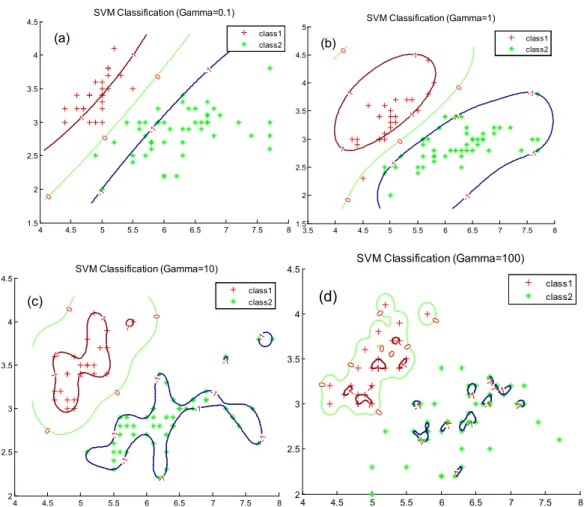
In essence,γreflects the flexibility of the decision boundary. When γis small, it generates a smooth decision boundary, i.e., one that is nearly linear. Whenγis large, it generates a great curvature of the decision boundary. Whenγis too large, it will cause overfitting, as shown in Figure6d. Figures6
Sci2020,2, 50 9 of 19
that it utilizes local approximators to map input to output, so that the system computes rapidly and requires fewer training samples.
In essence, 𝛾𝛾 reflects the flexibility of the decision boundary. When 𝛾𝛾 is small, it generates a smooth decision boundary, i.e., one that is nearly linear. When 𝛾𝛾 is large, it generates a great curvature of the decision boundary. When 𝛾𝛾 is too large, it will cause overfitting, as shown in Figure 6d. Figures 6 and 7 illustrate the effect of these two parameters, 𝛾𝛾 andC, on the decision boundary.
Figure 6. The effect of the parameter 𝜸𝜸, on the decision boundary. (a) When 𝜸𝜸 = 0.1, the decision boundary is nearly linear. (b) When 𝜸𝜸 = 1, the curvature of decision boundary increases. (c) When 𝜸𝜸
= 10, the curvature of decision boundary continues increasing, and causes a little overfitting. (d) When
𝜸𝜸 = 100, overfitting becomes serious in the classification.
Figure 7. The effect of the soft-margin constant, C, on the decision boundary. (a) When C = 2, it increases the margin and ignores the data points close to the decision boundary. (b) When C = 200, it decreases the margin and margin error.
4 4.5 5 5.5 6 6.5 7 7.5 8 1.5 2 2.5 3 3.5 4 4.5 SVM Classification (Gamma=0.1) -1 -1 -1 0 0 0 1 1 class1 class2 (a) 3.5 4 4.5 5 5.5 6 6.5 7 7.5 8 1.5 2 2.5 3 3.5 4 4.5 5 SVM Classification (Gamma=1) -1 -1 -1 -1 -1 0 0 0 0 1 1 1 1 class1 class2 (b) 4 4.5 5 5.5 6 6.5 7 7.5 8 2 2.5 3 3.5 4 4.5 SVM Classification (Gamma=10) -1 -1 -1 -1 -1 -1 -1 -1 -1 0 0 0 0 1 1 1 1 1 class1 class2 (c) 4 4.5 5 5.5 6 6.5 7 7.5 8 2 2.5 3 3.5 4 4.5 SVM Classification (Gamma=100) -1 -1 -1 -1 -1 -1 -1 -1 -1 -1 -1 0 0 0 0 0 0 0 0 1 1 1 1 1 1 class1 class2 (d) 4 4.5 5 5.5 6 6.5 7 7.5 8 1.5 2 2.5 3 3.5 4 4.5 SVM Classification (C=2) -1 -1 -1 0 0 0 1 1 class1 class2 (a) 4 4.5 5 5.5 6 6.5 7 7.5 8 8.5 2 2.5 3 3.5 4 4.5 SVM Classification (C=200) -1 -1 -1 -1 0 0 0 0 1 1 1 class1class2 (b)
Figure 6. The effect of the parameterγ, on the decision boundary. (a) Whenγ=0.1, the decision
boundary is nearly linear. (b) Whenγ=1, the curvature of decision boundary increases. (c) When
γ=10, the curvature of decision boundary continues increasing, and causes a little overfitting. (d) When
γ=100, overfitting becomes serious in the classification.
that it utilizes local approximators to map input to output, so that the system computes rapidly and requires fewer training samples.
In essence, 𝛾𝛾 reflects the flexibility of the decision boundary. When 𝛾𝛾 is small, it generates a smooth decision boundary, i.e., one that is nearly linear. When 𝛾𝛾 is large, it generates a great curvature of the decision boundary. When 𝛾𝛾 is too large, it will cause overfitting, as shown in Figure 6d. Figures 6 and 7 illustrate the effect of these two parameters, 𝛾𝛾 andC, on the decision boundary.
Figure 6. The effect of the parameter 𝜸𝜸, on the decision boundary. (a) When 𝜸𝜸 = 0.1, the decision boundary is nearly linear. (b) When 𝜸𝜸 = 1, the curvature of decision boundary increases. (c) When 𝜸𝜸
= 10, the curvature of decision boundary continues increasing, and causes a little overfitting. (d) When
𝜸𝜸 = 100, overfitting becomes serious in the classification.
Figure 7. The effect of the soft-margin constant, C, on the decision boundary. (a) When C = 2, it increases the margin and ignores the data points close to the decision boundary. (b) When C = 200, it decreases the margin and margin error.
4 4.5 5 5.5 6 6.5 7 7.5 8 1.5 2 2.5 3 3.5 4 4.5 SVM Classification (Gamma=0.1) -1 -1 -1 0 0 0 1 1 class1 class2 (a) 3.5 4 4.5 5 5.5 6 6.5 7 7.5 8 1.5 2 2.5 3 3.5 4 4.5 5 SVM Classification (Gamma=1) -1 -1 -1 -1 -1 0 0 0 0 1 1 1 1 class1 class2 (b) 4 4.5 5 5.5 6 6.5 7 7.5 8 2 2.5 3 3.5 4 4.5 SVM Classification (Gamma=10) -1 -1 -1 -1 -1 -1 -1 -1 -1 0 0 0 0 1 1 1 1 1 class1 class2 (c) 4 4.5 5 5.5 6 6.5 7 7.5 8 2 2.5 3 3.5 4 4.5 SVM Classification (Gamma=100) -1 -1 -1 -1 -1 -1 -1 -1 -1 -1 -1 0 0 0 0 0 0 0 0 1 1 1 1 1 1 class1 class2 (d) 4 4.5 5 5.5 6 6.5 7 7.5 8 1.5 2 2.5 3 3.5 4 4.5 SVM Classification (C=2) -1 -1 -1 0 0 0 1 1 class1 class2 (a) 4 4.5 5 5.5 6 6.5 7 7.5 8 8.5 2 2.5 3 3.5 4 4.5 SVM Classification (C=200) -1 -1 -1 -1 0 0 0 0 1 1 1 class1class2 (b)
Figure 7.The effect of the soft-margin constant,C, on the decision boundary. (a) WhenC=2, it increases
the margin and ignores the data points close to the decision boundary. (b) WhenC=200, it decreases
the margin and margin error.
3.2. Optimization on SVM Key Parameters
To find the optimal values for the two parameters, cross-validation and a grid-search were utilized. In v-fold cross-validation, v means the number of input data splits. The training data is divided into v subsets equally. Any v-1 subset is selected for training the model, and then the remaining subset is predicted based on the constructed model. The same procedure is rotated in all the subsets while
Sci2020,2, 50 10 of 19
keeping the equal chance being predicted for each subset. Therefore, each subset of the input data will be predicted once, so the cross-validation accuracy is the percentage of data which is correctly classified.
An approach combining the grid-search method and cross-validation was proposed for searching for the optimal C andγ. Different pairs of (C,γ) values were used for predicting data, and only the best cross-validation accuracy was selected. There were only two parameters for the search, and thus, it did not require too much computational time, satisfying the demand of SVM classification.
Here is a case of the SVM classification result comparison between the random parameters and optimal parameters. Firstly, 60 sets of data were split into training data and test data evenly, and then LibSVM with random SVM parameters was used to obtain a classification accuracy of 60%. Next, the grid-search and cross validation methods were applied to find the optimal C andγvalues (the effects of selecting the optimal C andγvalue, as compared to selecting the parameters at random, are illustrated in Figure8).
Sci 2020, 3, x FOR PEER REVIEW 11 of 20
3.2. Optimization on SVM Key Parameters
To find the optimal values for the two parameters, cross-validation and a grid-search were utilized. In v-fold cross-validation, v means the number of input data splits. The training data is divided into v subsets equally. Any v-1 subset is selected for training the model, and then the remaining subset is predicted based on the constructed model. The same procedure is rotated in all the subsets while keeping the equal chance being predicted for each subset. Therefore, each subset of the input data will be predicted once, so the cross-validation accuracy is the percentage of data which is correctly classified.
An approach combining the grid-search method and cross-validation was proposed for searching for the optimal C and 𝛾𝛾. Different pairs of (C, 𝛾𝛾) values were used for predicting data, and only the best cross-validation accuracy was selected. There were only two parameters for the search, and thus, it did not require too much computational time, satisfying the demand of SVM classification.
Here is a case of the SVM classification result comparison between the random parameters and optimal parameters. Firstly, 60 sets of data were split into training data and test data evenly, and then LibSVM with random SVM parameters was used to obtain a classification accuracy of 60%. Next, the grid-search and cross validation methods were applied to find the optimal C and 𝛾𝛾 values (the effects of selecting the optimal C and 𝛾𝛾 value, as compared to selecting the parameters at random, are illustrated in Figure 8).
Figure 8. Searching the optimal C and 𝜸𝜸 value in three-dimension coordinates.
It can be easily seen that the validation accuracy increases from 60% to 100%; however, there were several solution-sets of C and 𝛾𝛾 achieving the 100% accuracy. Here, the minimum C value was chosen as the optimal C, and the corresponding 𝛾𝛾 was chosen as the optimal value, since a high C value can improve the validation accuracy; however, it would also cause over-learning, and would affect the final classification prediction accuracy. Therefore, the optimal C was chosen as 0.2500 and 𝛾𝛾 was chosen as 0.0313 in this case.
3.3. Robustness of SVM Algorithm
As the assessment of human motion characteristics are linked to understanding the unwanted (i.e., noises) as well as wanted signals, it is important to understand the capability of the SVM
-10 -5 0 5 10 -10 -5 0 5 10 30 40 50 60 70 80 90 100 log2c Result of Parameters Slection (3D)
log2g A ccu ra cy( % )
Figure 8.Searching the optimalCandγvalue in three-dimension coordinates.
It can be easily seen that the validation accuracy increases from 60% to 100%; however, there were
several solution-sets of C andγachieving the 100% accuracy. Here, the minimum C value was chosen
as the optimal C, and the correspondingγwas chosen as the optimal value, since a high C value can improve the validation accuracy; however, it would also cause over-learning, and would affect the final classification prediction accuracy. Therefore, the optimal C was chosen as 0.2500 andγwas chosen as 0.0313 in this case.
3.3. Robustness of SVM Algorithm
As the assessment of human motion characteristics are linked to understanding the unwanted (i.e., noises) as well as wanted signals, it is important to understand the capability of the SVM classifier to effectively address noisy data. Therefore, the change of the parameters involved in the SVM algorithm, along with the added white and pink noise, was be investigated.
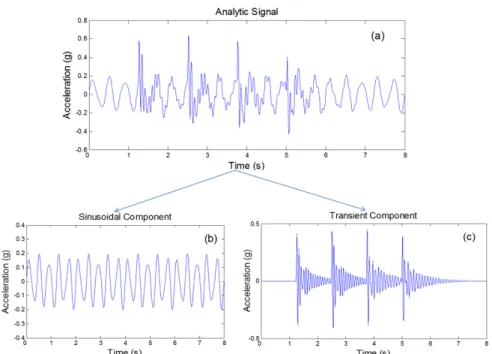
To systematically evaluate the robustness of the SVM algorithm, the signals that mimic realistic dynamic and static signals were considered. For static signals (lying, or sitting, or standing still), the ideal signal remains at zero for the accelerometer and gyroscope for the dynamic signals (normal walking), a nonstationary test signalx(t)was constructed, as shown in Figure9.
Sci2020,2, 50 11 of 19
classifier to effectively address noisy data. Therefore, the change of the parameters involved in the SVM algorithm, along with the added white and pink noise, was be investigated.
To systematically evaluate the robustness of the SVM algorithm, the signals that mimic realistic dynamic and static signals were considered. For static signals (lying, or sitting, or standing still), the ideal signal remains at zero for the accelerometer and gyroscope for the dynamic signals (normal walking), a nonstationary test signal 𝑥𝑥(𝑡𝑡) was constructed, as shown in Figure 9.
Figure 9. Test signal generated based on normal walking. (a) Waveform of the test signal 𝑥𝑥(𝑡𝑡); (b) Periodic component 𝑥𝑥1(𝑡𝑡); (c) Transient component 𝑥𝑥2(𝑡𝑡).
The test signal consists of two components:
𝑥𝑥(𝑡𝑡) =𝑥𝑥1(𝑡𝑡) +𝑥𝑥2(𝑡𝑡) (19) where 𝑥𝑥1(𝑡𝑡) represents the periodic component in the signal, given by:
𝑥𝑥1(𝑡𝑡) =� 𝐴𝐴1(𝑖𝑖)∙ 𝑠𝑠𝑖𝑖𝑚𝑚[2𝜋𝜋 ∙ 𝑓𝑓1(𝑖𝑖) +𝜃𝜃1(𝑖𝑖)] 𝑁𝑁
𝑖𝑖=1
(20) where 𝐴𝐴1(𝑖𝑖), 𝜃𝜃1(𝑖𝑖) and 𝑓𝑓1(𝑖𝑖) represent the amplitude, initial phase and frequency 𝑖𝑖𝑡𝑡ℎ of thesinusoidal element, respectively. Two frequency components, 2.5 and 4 Hz, were chosen to construct the fundamental periodicity of the test signal. In Table 1, the specific values of the used parameter are shown.
Table 1. Parameters related to 𝒙𝒙𝟏𝟏(𝒕𝒕) in the test signal.
Parameter Sinusoidal Element (N) 1 2
𝐴𝐴1(𝑖𝑖) (V) 0.16 0.04 𝑓𝑓1(𝑖𝑖) (Hz) 2.5 4 𝜃𝜃1(𝑖𝑖) (rad) 0 0.32𝜋𝜋
The term 𝑥𝑥2(𝑡𝑡) represents the transient component in the signal, given by: 𝑥𝑥2(𝑡𝑡) =� 𝐴𝐴2(𝑖𝑖)∙ 𝛩𝛩(𝑡𝑡 − 𝑡𝑡𝑖𝑖)∙ 𝑒𝑒−𝐶𝐶𝑖𝑖∙(𝑡𝑡−𝑡𝑡𝑖𝑖)∙ 𝑠𝑠𝑖𝑖𝑚𝑚 [2𝜋𝜋 ∙ 𝑓𝑓2(𝑖𝑖)∙
𝑀𝑀 𝑖𝑖=1
(𝑡𝑡 − 𝑡𝑡𝑖𝑖) +𝜃𝜃2(𝑖𝑖)] (21)
Figure 9. Test signal generated based on normal walking. (a) Waveform of the test signalx(t); (b) Periodic componentx1(t); (c) Transient componentx2(t).
The test signal consists of two components:
x(t) =x1(t) +x2(t) (19)
wherex1(t)represents the periodic component in the signal, given by:
x1(t) =
N X
i=1
A1(i)·sin[2π·f1(i) +θ1(i)] (20)
whereA1(i),θ1(i)and f1(i)represent the amplitude, initial phase and frequency ithof thesinusoidal
element, respectively. Two frequency components, 2.5 and 4 Hz, were chosen to construct the
fundamental periodicity of the test signal. In Table 1, the specific values of the used parameter
are shown.
Table 1.Parameters related tox1(t)in the test signal.
Parameter Sinusoidal Element (N)
1 2
A1(i)(V) 0.16 0.04
f1(i)(Hz) 2.5 4
θ1(i)(rad) 0 0.32π
The termx2(t)represents the transient component in the signal, given by:
x2(t) = M X i=1 A2(i)·Θ(t−ti)·e −Ci·(t−ti) ·sin[2π·f2(i)·(t−ti) +θ2(i)] (21)
where M is the number of motion cycles, andA2(i),Ci,ti,θ2(i), andf2(i)are the amplitude, attenuation
factor, time-delay, initial phase and frequency of the ithhuman activity cycle, respectively. A total of eight elements were used to construct the transient component of the test signal. The specific values of
Sci2020,2, 50 12 of 19
the parameters were determined through the least square error-based curve fitting method, as listed in Table2.
Table 2.Parameters related tox2(t)in the test signal. Transient Component (M)
Group 1 Group 2 Group 3 Group 4
Parameter 1 2 3 4 5 6 7 8 A2(i)(V) 0.06 0.05 0.06 0.05 0.06 0.05 0.06 0.05 Ci 1.73 1.8 1.73 1.8 1.73 1.5 1.73 1.5 ti(s) 1.25 1.25 2.5 2.5 3.75 3.75 5.0 5.0 f2(i)(rad) 0 0.33π 0 0.33π 0 0.33π 0 0.33π θ2(i)(Hz) 15 12 15 12 15 10 15 10
The function itemΘ(t−ti) specified in Equation (22) identifies the point in time at which a transient element occurs, and is defined as:
Θ(t−ti) = (
1 t−ti≥0
0 t−ti<0 (22)
Firstly, the constructed signal was assumed to mimic dynamic activity, and the static activity was represented by zero value from acceleration and angular velocity of all directions. Then, the SVM classifier was utilized to classify the pure simulated dynamic and static activity without any extra noise. We determined that the optimal C value was 0.125 and the optimal G value was 0.5. Subsequently, two different kinds of noise, white and pink noise, were added into the numerically simulated signal with different signal-to-noise ratios (SNRs). The SNR measure in the study was defined as:
SNR=10 log10p1/p2 (23)
where p1is the power of the signal and p2is the power of the noise.
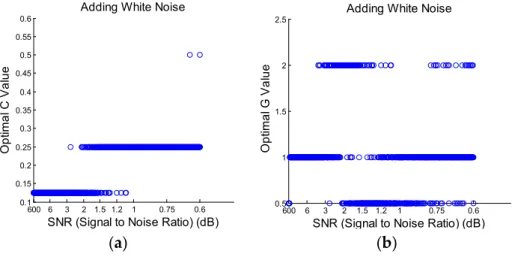
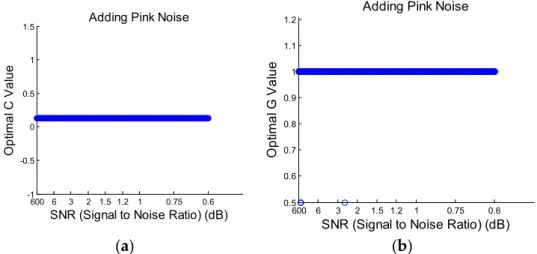
The change of the optimal C and G varied with the change of the SNR level of added white and pink noise, as shown in Figures10and11, respectively. From Figure10, it can be seen that both C and G change among three different values as the power of added white noise varies. As for the pink noise, Figure11shows that C and G almost remain constant, i.e., only a few scattered points are not in the constant line for the optimal G value. The classification accuracy can be maintained at 100% for all these cases, and thus, it shows that the SVM classifier has a good level of capability of processing noisy data due to the adjustment of the optimal parameters.
Sci 2020, 3, x FOR PEER REVIEW 13 of 20
where M is the number of motion cycles, and
𝐴𝐴
2(
𝑖𝑖
),
𝐶𝐶
𝑖𝑖,
𝑡𝑡
𝑖𝑖,
𝜃𝜃
2(
𝑖𝑖
), and
𝑓𝑓
2(
𝑖𝑖
) are the amplitude,
attenuation factor, time-delay, initial phase and frequency of the
𝑖𝑖
𝑡𝑡ℎhuman activity cycle,
respectively. A total of eight elements were used to construct the transient component of the test
signal. The specific values of the parameters were determined through the least square error-based
curve fitting method, as listed in Table 2.
Table 2. Parameters related to 𝒙𝒙𝟐𝟐(𝒕𝒕) in the test signal.
Transient Component (M)
Group 1
Group 2
Group 3
Group 4
Parameter
1
2
3
4
5
6
7
8
𝐴𝐴
2(
𝑖𝑖
)
(V)
0.06
0.05
0.06
0.05
0.06
0.05
0.06
0.05
𝐶𝐶
𝑖𝑖1.73
1.8
1.73
1.8
1.73
1.5
1.73
1.5
𝑡𝑡
𝑖𝑖(s)
1.25
1.25
2.5
2.5
3.75
3.75
5.0
5.0
𝑓𝑓
2(
𝑖𝑖
) (rad)
0
0.33
𝜋𝜋
0
0.33
𝜋𝜋
0
0.33
𝜋𝜋
0
0.33
𝜋𝜋
𝜃𝜃
2(
𝑖𝑖
)
(Hz)
15
12
15
12
15
10
15
10
The function item
𝛩𝛩
(
𝑡𝑡 − 𝑡𝑡
𝑖𝑖)
specified in Equation (22) identifies the point in time at which a
transient element occurs, and is defined as:
𝛩𝛩
(
𝑡𝑡 − 𝑡𝑡
𝑖𝑖) =
�
1
0
𝑡𝑡 − 𝑡𝑡
𝑡𝑡 − 𝑡𝑡
𝑖𝑖≥
0
𝑖𝑖
< 0
(22)
Firstly, the constructed signal was assumed to mimic dynamic activity, and the static activity
was represented by zero value from acceleration and angular velocity of all directions. Then, the SVM
classifier was utilized to classify the pure simulated dynamic and static activity without any extra
noise. We determined that the optimal C value was 0.125 and the optimal G value was 0.5.
Subsequently, two different kinds of noise, white and pink noise, were added into the numerically
simulated signal with different signal-to-noise ratios (SNRs). The SNR measure in the study was
defined as:
SNR = 10 log
10(p
1/p
2)
(23)
where
p
1is the power of the signal and
p
2is the power of the noise.
The change of the optimal C and G varied with the change of the SNR level of added white and
pink noise, as shown in Figures 10 and 11, respectively. From Figure 10, it can be seen that both C
and G change among three different values as the power of added white noise varies. As for the pink
noise, Figure 11 shows that C and G almost remain constant, i.e., only a few scattered points are not
in the constant line for the optimal G value. The classification accuracy can be maintained at 100% for
all these cases, and thus, it shows that the SVM classifier has a good level of capability of processing
noisy data due to the adjustment of the optimal parameters.
(
a
)
(
b
)
Figure 10. (a) Optimal C value for adding white noise; (b) Optimal G value for adding white noise.
600 6 3 2 1.5 1.2 1 0.75 0.6 0.1 0.15 0.2 0.25 0.3 0.35 0.4 0.45 0.5 0.55 0.6
SNR (Signal to Noise Ratio) (dB)
O pt im al C V al ue
Adding White Noise
600 6 3 2 1.5 1.2 1 0.75 0.6
0.5 1 1.5 2
2.5 Adding White Noise
SNR (Signal to Noise Ratio) (dB)
O pt im al G V al ue
(
a
)
(
b
)
Figure 11. (a) Optimal C value for adding pink noise; (b) Optimal G value for adding pink noise.
4. Experimental Results
Classification on Dynamic and Static Activities
As described in the Methodology section, a total of 60 datasets containing 20 dynamic activities
and 40 static activities were selected for movement classification; each activity was represented by
one two-second data segment. All the datasets were split into training datasets and test datasets
equally. Three different trials were performed in the experiment.
(Walking vs. Lying): 20 normal walking segments were chosen as dynamic activities, and 40
lying segments were chosen as static activities. The datasets were then divided into a training and
testing set, each containing 10 dynamic activities and 20 static activities. The 5-fold cross validation
scheme [34] was utilized, and 100% (30/30) overall accuracy was observed (classification results are
illustrated in Figure 12).
Figure 12. Classification of normal walking and lying activities.
(Walking vs. Standing with Eyes Closed): 20 normal walking segments were chosen as dynamic
activities, and 40 standing still with eyes closed segments were chosen as static activities. The same
procedure was conducted as the first trial, and 90% (27/30) overall accuracy was observed (the results
are illustrated in Figure 13).
600 6 3 2 1.5 1.2 1 0.75 0.6 -1 -0.5 0 0.5 1 1.5
SNR (Signal to Noise Ratio) (dB)
O pt im al C V al ue
Adding Pink Noise
600 6 3 2 1.5 1.2 1 0.75 0.6 0.5 0.6 0.7 0.8 0.9 1 1.1 1.2
SNR (Signal to Noise Ratio) (dB)
O pt im al G V al ue
Adding Pink Noise
-1 -0.5 0 0.5 1 1.5 2 -1 -0.5 0 0.5 1
1.5 SVM Classification on Dynamic and Static Activities
-1 -1 0 0 0 1 Static (Lying) Dynamic
Figure 11.(a) Optimal C value for adding pink noise; (b) Optimal G value for adding pink noise.
4. Experimental Results
Classification on Dynamic and Static Activities
As described in the Methodology section, a total of 60 datasets containing 20 dynamic activities and 40 static activities were selected for movement classification; each activity was represented by one two-second data segment. All the datasets were split into training datasets and test datasets equally. Three different trials were performed in the experiment.
(Walking vs. Lying): 20 normal walking segments were chosen as dynamic activities, and 40 lying segments were chosen as static activities. The datasets were then divided into a training and testing set, each containing 10 dynamic activities and 20 static activities. The 5-fold cross validation scheme [34] was utilized, and 100% (30/30) overall accuracy was observed (classification results are illustrated in Figure12).
Sci 2020, 3, x FOR PEER REVIEW 14 of 20
(a) (b)
Figure 11. (a) Optimal C value for adding pink noise; (b) Optimal G value for adding pink noise.
4. Experimental Results
Classification on Dynamic and Static Activities
As described in the Methodology section, a total of 60 datasets containing 20 dynamic activities and 40 static activities were selected for movement classification; each activity was represented by one two-second data segment. All the datasets were split into training datasets and test datasets equally. Three different trials were performed in the experiment.
(Walking vs. Lying): 20 normal walking segments were chosen as dynamic activities, and 40 lying segments were chosen as static activities. The datasets were then divided into a training and testing set, each containing 10 dynamic activities and 20 static activities. The 5-fold cross validation scheme [34] was utilized, and 100% (30/30) overall accuracy was observed (classification results are illustrated in Figure 12).
Figure 12. Classification of normal walking and lying activities.
(Walking vs. Standing with Eyes Closed): 20 normal walking segments were chosen as dynamic activities, and 40 standing still with eyes closed segments were chosen as static activities. The same procedure was conducted as the first trial, and 90% (27/30) overall accuracy was observed (the results are illustrated in Figure 13).
600 6 3 2 1.5 1.2 1 0.75 0.6 -1 -0.5 0 0.5 1 1.5
SNR (Signal to Noise Ratio) (dB)
O pt im al C V al ue
Adding Pink Noise
600 6 3 2 1.5 1.2 1 0.75 0.6 0.5 0.6 0.7 0.8 0.9 1 1.1 1.2
SNR (Signal to Noise Ratio) (dB)
O pt im al G V al ue
Adding Pink Noise
-1 -0.5 0 0.5 1 1.5 2 -1 -0.5 0 0.5 1
1.5 SVM Classification on Dynamic and Static Activities
-1 -1 0 0 0 1 Static (Lying) Dynamic
Figure 12.Classification of normal walking and lying activities.
(Walking vs. Standing with Eyes Closed): 20 normal walking segments were chosen as dynamic activities, and 40 standing still with eyes closed segments were chosen as static activities. The same procedure was conducted as the first trial, and 90% (27/30) overall accuracy was observed (the results are illustrated in Figure13).
Sci2020,2, 50 14 of 19
Sci 2020, 3, x FOR PEER REVIEW 15 of 20
Figure 13. Classification of normal walking and standing still with eyes closed activities.
(Walking vs. Lying, Sitting, Standing with Eyes Open and Closed): 20 normal walking segments were chosen as dynamic activities, and four different activities, i.e., lying, sitting, standing still with eyes open and closed, were selected as static activities. Each of them was assigned 10 segments; thus, in total, there were 40 static activities. In this case, we obtained an overall accuracy of 80% (24/30), as shown in Figure 14. Additionally, the corresponding optimal C and 𝛾𝛾 values, and the overall classification accuracy associated with sensitivity and specificity, are listed in Table 3.
Figure 14. Classification of normal walking and mixed static activities. (Note: Mixed activity in static activities represented by lying, sitting, standing still with eyes open and closed.)
Table 3. Optimal C and 𝜸𝜸 values and overall classification accuracy associated with sensitivity and specificity for classifying dynamic and static activities.
Dynamic Static Optimal C Value Optimal G Value Classification Overall
Accuracy Sensitivity Specificity
-1 -0.5 0 0.5 1 1.5 2 -0.8 -0.6 -0.4 -0.2 0 0.2 0.4 0.6
0.8 SVM Classification on Dynamic and Static Activities
-1 -1 -1 -1 -1 0 0 0 1 1 1
Static (Standing Still with Eyes Closed) Dynamic -1.5 -1 -0.5 0 0.5 1 1.5 2 -1.5 -1 -0.5 0 0.5 1
1.5 SVM Classification on Dynamic and Static Activities
0 0 0 0 0 1 1 1 1 Static (Mixed) Dynamic
Figure 13.Classification of normal walking and standing still with eyes closed activities.
(Walking vs. Lying, Sitting, Standing with Eyes Open and Closed): 20 normal walking segments were chosen as dynamic activities, and four different activities, i.e., lying, sitting, standing still with eyes open and closed, were selected as static activities. Each of them was assigned 10 segments; thus, in total, there were 40 static activities. In this case, we obtained an overall accuracy of 80% (24/30),
as shown in Figure14. Additionally, the corresponding optimal C andγvalues, and the overall
classification accuracy associated with sensitivity and specificity, are listed in Table3.
Sci 2020, 3, x FOR PEER REVIEW 15 of 20
Figure 13. Classification of normal walking and standing still with eyes closed activities.
(Walking vs. Lying, Sitting, Standing with Eyes Open and Closed): 20 normal walking segments were chosen as dynamic activities, and four different activities, i.e., lying, sitting, standing still with eyes open and closed, were selected as static activities. Each of them was assigned 10 segments; thus, in total, there were 40 static activities. In this case, we obtained an overall accuracy of 80% (24/30), as shown in Figure 14. Additionally, the corresponding optimal C and 𝛾𝛾 values, and the overall classification accuracy associated with sensitivity and specificity, are listed in Table 3.
Figure 14. Classification of normal walking and mixed static activities. (Note: Mixed activity in static activities represented by lying, sitting, standing still with eyes open and closed.)
Table 3. Optimal C and 𝜸𝜸 values and overall classification accuracy associated with sensitivity and specificity for classifying dynamic and static activities.
Dynamic Static Optimal C Value Optimal G Value
Overall Classification
Accuracy Sensitivity Specificity
-1 -0.5 0 0.5 1 1.5 2 -0.8 -0.6 -0.4 -0.2 0 0.2 0.4 0.6
0.8 SVM Classification on Dynamic and Static Activities
-1 -1 -1 -1 -1 0 0 0 1 1 1
Static (Standing Still with Eyes Closed) Dynamic -1.5 -1 -0.5 0 0.5 1 1.5 2 -1.5 -1 -0.5 0 0.5 1
1.5 SVM Classification on Dynamic and Static Activities
0 0 0 0 0 1 1 1 1 Static (Mixed) Dynamic
Figure 14.Classification of normal walking and mixed static activities. (Note: Mixed activity in static activities represented by lying, sitting, standing still with eyes open and closed.)
The sensitivity and specificity of the trials are illustrated in the ROC curves (Figures15–17). The results were consistent with the classification accuracy results. The first trial showed the highest sensitivity value among these three trials, and the third trial had the least sensitivity. In these three trials, the SVM classifier’s sensitivity values were 100.0, 90.0 and 50.0, and the specificity values were 100.0, 95.0 and 95.0. The AUC values for SVM classifier were 1.000, 0.875 and 0.725, respectively.
Sci2020,2, 50 15 of 19
Table 3. OptimalCandγvalues and overall classification accuracy associated with sensitivity and specificity for classifying dynamic and static activities.
Dynamic Static OptimalC
Value OptimalG Value Overall Classification Accuracy Sensitivity Specificity Normal walking Lying 0.25 0.1436 100% 100% 100% Normal walking Standing still
with eyes closed 0.25 0.4353 90% 80% 95%
Normal
walking Mixed activity 2.2974 0.25 80% 50% 95%
Sci 2020, 3, x FOR PEER REVIEW 16 of 20
Normal walking Lying 0.25 0.1436 100% 100% 100% Normal walking Standing still with eyes closed 0.25 0.4353 90% 80% 95% Normal
walking activity Mixed 2.2974 0.25 80% 50% 95% The sensitivity and specificity of the trials are illustrated in the ROC curves (Figures 15–17). The results were consistent with the classification accuracy results. The first trial showed the highest sensitivity value among these three trials, and the third trial had the least sensitivity. In these three trials, the SVM classifier’s sensitivity values were 100.0, 90.0 and 50.0, and the specificity values were 100.0, 95.0 and 95.0. The AUC values for SVM classifier were 1.000, 0.875 and 0.725, respectively.
(a) (b)
Figure 15. ROC curve for classification of normal walking and lying activities. (a) ROC curve; (b) Interactive dot diagram.
(a) (b)
Figure 16. ROC curve for classification of normal walking and standing still with eyes closed activities. (a) ROC curve; (b) Interactive dot diagram.
Figure 15. ROC curve for classification of normal walking and lying activities. (a) ROC curve; (b) Interactive dot diagram.
Normal walking Lying 0.25 0.1436 100% 100% 100% Normal walking Standing still with eyes closed 0.25 0.4353 90% 80% 95% Normal
walking activity Mixed 2.2974 0.25 80% 50% 95% The sensitivity and specificity of the trials are illustrated in the ROC curves (Figures 15–17). The results were consistent with the classification accuracy results. The first trial showed the highest sensitivity value among these three trials, and the third trial had the least sensitivity. In these three trials, the SVM classifier’s sensitivity values were 100.0, 90.0 and 50.0, and the specificity values were 100.0, 95.0 and 95.0. The AUC values for SVM classifier were 1.000, 0.875 and 0.725, respectively.
(a) (b)
Figure 15. ROC curve for classification of normal walking and lying activities. (a) ROC curve; (b) Interactive dot diagram.
(a) (b)
Figure 16. ROC curve for classification of normal walking and standing still with eyes closed activities. (a) ROC curve; (b) Interactive dot diagram.
Figure 16.ROC curve for classification of normal walking and standing still with eyes closed activities.
(a) ROC curve; (Sci 2020, 3, x FOR PEER REVIEW b) Interactive dot diagram. 17 of 20
(a) (b)
Figure 17. ROC curve for classification of normal walking and mixed static activities. (a) ROC curve; (b) Interactive dot diagram.
5. Discussion
This paper mainly aimed to introduce a machine learning technique to biomedical engineers to classify two different states, and to investigate variations in the optimal parameters involved in the SVM algorithm, i.e., C and γ, as well as the applicability of SVM as a machine classifier to distinguish dynamic and static activities of the older adults using a wearable sensor. The performance of the SVM classifier was investigated in the environment of movement variations. As the performance of different classifiers could be assessed by modulating the movement/noise conditions [41,42], this paper utilized white and pink noise to create a noisy environment in order to evaluate the classification capability of the SVM classifier. In the numerical simulation, both training and test sets were contaminated by white and pink noise; however, the SVM classifier could still stably maintain high classification accuracy by optimizing parameters C and G. Previous studies have reported that C and G could modulate themselves for noisy data [42] [48], which is in agreement with our analytic results.
Moreover, this paper examined three different movement variations of static and dynamic activities of the older adults. The results indicated that overall accuracy was optimized by modulating C and 𝛾𝛾 for the varied motion patterns, and highest when two activities differed in movement magnitude and direction, such as walking vs. lying still. For example, lying posture is distinguished from other activities by considering the orientation of the accelerometer concerning the direction of gravitational acceleration [43,44] and the intensity of movement [45]. As such, automatic classification of these two motion patterns with a single IMU can be realized with a high level of accuracy using the SVM classifier. Next, comparing walking with standing still, although the direction of the gravitational acceleration remained the same, the activity level may have been different and influenced the boundaries/accuracies. In other words, swaying the whole body center-of-mass during standing as compared to lying down [43] may have influenced the overall classification accuracy. A mixture of movement variants in terms of the static activities (lying, sitting, standing with eyes open and closed) compared to walking was the least accurate among the comparisons. Although these comparisons were somewhat elementary, the SVM classifier’s performance compared favorably with previous results/studies. For example, Aminian et al. utilized two kinematic sensors (attached to the chest and thigh) to achieve an overall classification accuracy of 89.3% [46]. Busser et al. employed a similar system to achieve an overall classification accuracy ranging between 76% and 92% [47]. Limitations: Conclusions based on this study should be considered in the context of its limitations. First, only a small number of participants were tested, and the results may not reflect the general population of the older adults [48-50]. Second, only the steady state motion patterns without transitions were extracted and analyzed. Thus, in order to continuously classify motion patterns using real-time data, the transitional components such as sit-to-stand-walk should be considered
Figure 17.ROC curve for classification of normal walking and mixed static activities. (a) ROC curve; (b) Interactive dot diagram.