Growing a Pattern Language (for Security)
Munawar Hafiz, Paul Adamczyk, Ralph Johnson
September 21, 2011
Abstract
We present a pattern language containing all security patterns that have been published in various venues. We describe the mechanism of growing this pattern language: how we cataloged the security patterns from books, papers and pattern catalogs, how we classified the patterns to help developers find appropriate patterns, and how we identified and described the relationships between patterns in the pattern language. Ours is the first pattern language that covers patterns of an entire problem domain; to our best knowledge, it is also the largest in software. But the most significant contribution of this paper is the story behind how the pattern language is grown, as the mechanism can be adapted to other domains.
1
Introduction
Christopher Alexander was the first to introduce the concept of a pattern language. He has inspired many computer scientists to develop pattern languages for software, but so far we have not produced a result that is as impressive as his. This paper describes our experiences developing a pattern language for security. It describes the process of building a pattern language for security, focusing on the steps, rather than a complete, final result. The paper has the following contributions:
• It evaluates various approaches to organizing a large group of related patterns.
• It uses the pattern language format to organize and connect all documented patterns in the
domain of security.
• It documents and explains the steps and the thought process behind building such a patterns
language.
We did not start out to develop a pattern language, but instead just collected patterns related to security. We found many security pattern documented by various authors, who were targeting different audiences and trying to solve different security problems. One of our first tasks was to eliminate duplication. We also wanted to unify the different collections of patterns without rewriting them. Soon we realized that the only way to make our collection of patterns useful to practitioners was to augment the patterns with guidance for using them in practice.
Our first approach was to categorize all security patterns into distinct categories to make it easier to find the patterns relevant to a specific problem. We tried several different ways to categorize patterns and we documented that process in our earlier paper [14]. However, we realized
that even the most precise categorization does not provide sufficient help to practitioners. A good categorization enables the user toidentify a set of patterns that are applicable to a specific problem. But categorization fails to guide the user in selecting the correct pattern (or sequence of patterns) from the set of related patterns that belong to the same category.
When we tried to organize our catalog, we realized that the organizational properties of a pattern language can also provide guidance. Rather than focusing on categories, a pattern language shows connections between patterns. There are many different types of connections, many of which are only relevant to a few patterns. Pattern languages replace the rigid focus on categories or types by considering individual patterns first, and expressing different connections between them. In particular, we discovered that the very act of trying to draw diagrams of our pattern language helped to design the language.
This paper describes a pattern language for security, which has 96 patterns. It documents the steps we took, the decisions we made and discarded in the process, and other insight we acquired while developing the pattern language. Our lessons can be applied to organize patterns in other domains.
The paper is organized in the following manner. Section 2 discusses related works on pattern languages, section 3 inroduces security patterns and the background of the pattern catalog, and section4considers alternative approaches for organizing security patterns. Section 5describes the steps of building the pattern language in detail. It follows from the our approaches of organizing the security pattern catalog and grows the pattern language by discovering the relationships between related patterns. Sections 6and7 revisits the lessons learned from our research. The remainder of the paper describes our plan for future work and concludes.
2
Pattern Languages
A pattern language is the set of patterns used by a designer or by a group of designers. It corresponds to a design style, or to a design school. Thus, one could talk about the pattern language of Frank Lloyd Wright or Mies van der Rohe. When we refer to a pattern we can either mean an artifact that shows the pattern or a document that describes it. Similarly, when we refer to a pattern language we can either mean the language used by a designer or a community of designers, or we can refer to a document that describes the pattern language. In this paper, we always refer to the document.
Alexander’s book “A Pattern Language” [3] describes a pattern language for making buildings that he thought would achieve “The timeless way of building” [2]. He came up with this pattern language by examining buildings all over the world, by discussing the patterns and writing them with a small group of collaborators, and then by trying them out on a variety of projects. In his opinion, he was not really inventing a pattern language but instead was discovering the pattern language used by people through the ages to create livable spaces.
Alexander has inspired a number of computer scientists to try to describe pattern languages for software design. But Alexander’s pattern language is much larger than anything so far written for software. “A Pattern Language” has 253 patterns ranging from very high level patterns that describe the organization of a country into cities and towns to detailed patterns describing the trim on doors and windows. In contrast, the pattern languages for programming described so far are no more than a tenth this size and focus on narrow topics. For example, the first published patterns language for programming was in “Documenting Frameworks with Patterns” [23], which gives 10 patterns for designing graphical editors using HotDraw. The biggest pattern language we
have found is Hanmer’s [17] patterns for fault tolerant software, with 63 patterns.
Many collections of patterns are larger than this, but they are generally not considered pattern languages. The authors of these collections usually call them catalogs, because they do not have the structure that Alexander associated with pattern languages, and they do not claim to be complete. Alexander said that there was a relationship between patterns, that some patterns lead to others. He organized the patterns in the language in the order that they should be considered. Although Alexander opposed master plans, his pattern language encouraged a kind of top-down design. Thus, there are “top patterns” and “bottom patterns”. In contrast, in a catalog like “Design Patterns” [11], patterns are mostly at the same level, and there is no top or bottom. “Pattern Oriented Software Architecture” [7] described three levels of patterns, with one level clearly the top and another clearly the bottom, but there was no clear relationships between individual patterns. Alexander’s work remains an inspiration to researchers of software patterns, but it is im-portant to remember that building architecture is different from software. Buildings exist in a three-dimensional space, though designers often must take a fourth dimension (time) into account. Alexander’s patterns simplify the problem by either eliminating a dimension or making a dimension smaller, such as by breaking up a house into rooms. The dimensions of software are much less well defined, and there are probably more of them. Most software patterns do not eliminate dimen-sions, but rather redistribute the original problem among different dimensions. Software patterns cover many more dimensions, each with its own pattern language. There is a pattern language for object-oriented design, and a pattern language for security, and another pattern language for performance. There are simply too many patterns to organize and create a single pattern language.
2.1
Diagramming a pattern language
“A Pattern Language” [3] used diagrams to describe the relationship between patterns. In these di-agrams, the patterns are organized in a directed acyclic graph, from most general to most concrete; an arrow from one pattern to another represents a (structural and/or temporal) refinement.
Initially, most pattern papers at PLoP conferences did not have diagrams, even though many described pattern languages or parts of pattern languages. But the papers that did include diagrams would follow the Alexanderian form. One often-cited example describes a pattern language for fault-tolerance patterns [1]. It uses lines (not arrows) to show connections between the 8 patterns in the paper. Another early example is a pattern language for client/server frameworks [38], which includes an Alexandrian-style diagram of 15 related patterns. One interesting aspect of their diagram is that the sequential progression through the patterns culminates in few patterns at the bottom, so the entire diagram looks like a circle rather than a triangle, which is the typical shape of a hierarchy. Moreover, this pattern language includes GoF patterns in addition to new patterns presented in the paper. The Alexandrian diagrams have been used in later patterns as well, e.g., in the C++ idioms pattern language [8] and a pattern language for fault-tolerant software [17].
Most pattern diagrams are similar to the design patterns book and rely on textual annotations rather than plain arrows and hierarchy. The meaning and expressiveness of the annotations varies considerably: they might be verb phrases, noun phrases, or generic terms such as uses orextends. One interesting example of a pattern language diagram is in the book on domain driven design [9], where the pattern language is divided into 3 parts with the two essential patterns (Ubiquitous Language and Model-Driven Design) serving as the only connection points between them. Although the patterns are written using the Alexandrian style, the diagram is not. The arrow connections have textual annotations and some closely-related patterns are bunched together (shown as ovals).
It is one of the most comprehensive diagrams and includes 24 patterns, however not all the patterns from the book are shown.
A more typical approach to presenting larger collection of patterns is to break them into smaller pieces. Schumacher et al. [30] describe 46 security patterns, divided into 8 sections. Some sections have a corresponding diagram. Unfortunately, the diagrams were produced by different authors, following different styles. It is not easy to combine them.
Text-annotated diagrams include significantly more details than Alexandrian diagrams. Heer et al. [19] describes a pattern language containing 21 patterns: some design patterns and some patterns presented in their paper. Typically for this style, almost all the annotations have unique text and although each pattern is only related to few others, the resulting diagram is quite complex. The perfectly rectangular shape of the diagram does not represent any specific quality (such as hierarchy), but rather is designed to minimize the amount of space occupied.
Design patterns are the only patterns that appear consistently in other pattern languages. It is due to their popularity, but also a testament to their ubiquitous nature, proving that they are indeed recurring solutions. But beyond incorporating design patterns, very little work has been done on combining multiple pattern languages. Coplien has pioneered the application of Alexander’s concept of pattern sequences to show examples of combining patterns from multiple pattern languages [26]. He combined C++ idioms with half object plus protocol [25] pattern language and described a procedure for adding other languages, such as fault tolerance patterns. However, we are not aware of any follow up work.
In summary, the state of the art in documenting pattern languages of software has been stable since mid-1990s. Two types of diagrams are used for that purpose. The Alexandrian-style diagrams rely on hierarchy and make it easy for the reader to identify which patterns to consider at any point in the pattern language. The text-annotated diagrams pack more information, giving the reader a much quicker overview, but they don’t have standard meanings or reusable vocabulary for annotations and they trade off the ability to notice and follow patterns in sequence. In the process of deriving our pattern language for security, we attempted to explore all of these variations.
2.2
Growing a Pattern Language
We began the derivation process with the catalog of security patterns described in our earlier publication [14]. In that work, we evaluated several classification schemes that enable breaking up the large catalog into smaller clusters of related patterns. The final classification schema from that paper, STRIDE threat model [33] augmented with hierarchical view, served as the starting point for developing this pattern language.
Following the lessons from the related work on patterns, we considered both the Alexandrian and annotation-based approaches. We quickly noticed that creating an Alexandrian-style diagram meant sacrificing readability—a diagram with over 90 names is difficult to follow. Somewhat surprisingly, adding textual descriptions to arrows made the diagram easier to read by giving some instructions to follow in an otherwise unruly grouping. We decided to draw all arrows pointing down, Alexandrian style, meaning that more general patterns appear higher in the diagram.
Having made those decisions, we proceeded to create small pattern languages, one for each cluster of patterns corresponding to one cell in the STRIDE classification. In each grouping, we ordered the patterns temporally (i.e., in the typical order they would be applied in practice), and annotated each relevant relationship with a short description. Then, we combined the small diagrams into one large diagram, adding more inter-group relationships. Finally, we looked for
missing patterns and connections, and also considered patterns outside of the security domain. The details of this process, along with some interesting lessons learned, are presented in the following sections.
3
Security Pattern Catalog
Security patterns provide a way of collecting and disseminating security knowledge. We have created a comprehensive catalog of all security pattern that have been published in the last fourteen years (the first security pattern paper [39] appeared fourteen years ago). Currently, our catalog has 96 entries. All 96 patterns are summarized in Appendix A.
3.1
Security Pattern Sources
Our security pattern catalog is a union of all security patterns that appear in many books, catalogs and papers on security patterns. It accumulates the experience of the entire security pattern community and is a fair representation of the solution domain of security.
There have been 3 books on security patterns. Markus Schumacher led a working group on security patterns to write a security pattern book [30]. This book had 46 security patterns from the domain of enterprise security and risk management, identification and authentication, access control, accounting, firewall architecture, and secure internet application. This book aggregates many previous works on security patterns, including the first catalog of security patterns [39], Markus Schumacher [31] and Eduardo Fernandez’s [6, 10] work on security patterns, etc. Steel et al. [32] described 23 security patterns for J2EE based applications, Web services and identity management in their book. Microsoft’s Patterns and Practices group published the third book [20] that included 18 patterns.
People have worked on pattern catalogs covering various domains. Bob Blakley and Craig Heath [5] compiled a security pattern catalog with the members of the Open Group forum. It contained 13 patterns: 5 patterns for improving reliability, and 8 for security. Kienzle et al. [24] listed 26 patterns and 3 mini patterns in their security patterns catalog. Sasha Romanosky [27,28] compiled two pattern catalogs containing 12 patterns in total.
We have created two pattern catalogs. The first stems from our study of the evolution of mail transfer agent architecture [15]. This contains 11 security patterns, and 4 reliability patterns. These patterns are not specific to mail transfer agents; they can be used by the designers of other secure systems. Our second catalog compiles a collection of 12 privacy design patterns [13].
3.2
Building the Catalog
The pattern sources describe 174 security patterns, but with many overlaps. We developed our catalog by removing the overlaps. Currently, the catalog has 96 patterns.
For example, patterns for authentication have been listed in a number of pattern catalogs under different names.
• TheAuthenticatorpattern, listed in conjunction with other patterns of operating systems
security [10], was later included in the Wiley security patterns book [30]. The authentication protocol may depend on some user input (i.e., something that the user knows e.g., password, or possesses e.g., a smart card, or has e.g., a biometric characteristic), or the input provided by a trusted third party (i.e., brokered authentication).
• Sasha Romanosky described the same pattern under the name Security Provider [27]. • Kienzle et al. lists it asAuthenticated Session [24] in their catalog.
• The Core Security Patterns book described the Authentication Enforcer pattern [32]
from Java tool-oriented perspective. This pattern creates a centralized authentication en-forcement component that performs authentication of users and encapsulates the details of the authentication mechanism.
• Microsoft security patterns book [20] lists this pattern as Direct Authentication [20].
The authors described authentication mechanism using WSE 3.0 framework.
We have one Authentication Enforcer pattern for authentication, removing language-specific and catalog-language-specific descriptions of this pattern. However, we did not remove the over-lapping patterns in separate application contexts. For example, Authentication Enforcer and Intercepting Web agent [32] are both about authentication: one in a single application context, and the other in single sign on context. These are separate patterns in the catalog.
3.3
Attributes of the Catalog
Cataloging is the first step of growing a pattern language in a domain. We exhaustively covered all the related works in security patterns to build the catalog. Our catalog does not have the bias of one person or a group. It spans the security pattern literature of fourteen years and includes both classic and emerging security solutions. Some of the patterns may not have the most descriptive names; but we retain the names so that they can be easily traced to the sources.
The main criteria of including a security pattern in the catalog was the maturity of its descrip-tion, and the importance of the security problem and solution. Many of the patterns in the catalog are overlapping—they are described in more than one source. For these patterns, we chose the one with the most mature description. The overlapping indicates that these are important patterns; hence they are identified by many people during their independent explorations of patterns.
Our next step was to organize the patterns in the catalog.
4
Organizing Security Patterns
A catalog of 96 patterns is overwhelming. It is hard for developers to find a pattern they need, let alone know when to use it. We attempted to organize the security patterns [14] by grouping them into small, correlated sets. We applied several schemes and found that a hierarchical classification scheme using threat models worked the best. This section summarizes our classification approach. Good organization also facilitates navigation; it cross-references the related patterns and guides a user among them so that the user knows how to use a pattern. The classification scheme facilitates lookup; it is not a guide. But classifying the patterns based on threat models (i.e., the problem domain of patterns) groups related patterns. We derive a pattern language by exploring pattern relationships in small groups, and then unifying these smaller pattern languages. Section
Table 1: Classification of Security Patterns using the Enterprise Architectural Space Organizing Table
4.1
Approaches for Classifying Security Patterns
Recognizing the importance of organizing patterns into small groups, security pattern authors attempted various classification schemes. The Open Group pattern catalog [5] is classified into two broad groups based on applicability: patterns for protected systems and patterns for available systems. Kienzle et al. [24] groups their patterns in two broad classes: structural patterns and procedural patterns. We thought that these partitionings are too broad to be useful.
We first tried to classify the patterns using domain concepts, confidentiality, integrity and availability, but found that they were too general. Also, most of the patterns are about more than one concept. Another attempt was to use the application context, i.e., classifying based on the part of the system that a pattern secures—application core, application perimeter and application exterior. There are fewer overlaps using this scheme. The higher level patterns relate to more than one application context, and they cannot be classified. This outlined the need for a hierarchical classification scheme. We integrated this scheme with threat models to create a hierarchical classification scheme in the section 4.2.
But before that, we applied a classification scheme based on the Zachman framework, which was used by other security pattern authors [30, 21, 18]. Zachman framework [40] was introduced in 1987 as a table. Its 5 rows describe the levels of information model from the perspective of various stakeholders, e.g., the customer or the owner, the designer, the builder etc. The 6 columns describe different ways of describing an artifact: data (what?), function (how?), network (where?), people (who?), time (when?) and motivation (why?).
We have used a classification scheme based on the Zachman framework. Our tabular classi-fication scheme [14] uses the ‘Enterprise Architectural Space Organizing Table’ [35]. Out of the 7 columns of the table, 6 are from the Zachman framework table. The seventh column includes patterns for testing. The rows describe stakeholders similar to the Zachman framework, but they have been specified in roles of finer granularity using the architectural standards description from IEEE 1471 [22] and ‘Enterprise Architecture Framework’ [12].
only relevant rows of the larger table. As an example of classification, consider the Safe Data Structure[16] pattern. This pattern is applied to remove the array bounds checking vulnerability in a programming language with no garbage collection. A system written in C is vulnerable to buffer overflow attacks because of unsafe array operations, e.g., unsafe string handling. Safe Data Structure advocates the inclusion of length and allocated memory information with a data structure. This pattern is considered in the development phase of an application when the safe string processing libraries are written or re-used. Hence this pattern fits into the cell defined by theDeveloper row ofApplication Architecture perspective and the Data column.
Figure 1: Hierarchical Classification Scheme
The tabular scheme can not classify 16 patterns because they fall into multiple cells in the table. For example, the Security Needs Identification for Enterprise Assets [30] pattern is used by various roleplayers in Business Architecture and covers all viewpoints. Thus the pattern straddles many rows and columns.
Another problem of the tabular classification scheme is the skewness, i.e., patterns are concen-trated in a few cells of the table. Table 1 lists 56 out of 80 patterns in the Function column; 16 patterns that are not in the table are also related to the Function column. This is because most software patterns provide a mechanism to achieve some functionality. A pattern classification scheme that considers Function as a viewpoint is skewed.
The tabular classification scheme fails to distinguish low level patterns from high level patterns, that cover multiple perspectives and are used by multiple stakeholders. Its use of perspectives and viewpoints concentrate most of the patterns in a few cells. We improved this by adopting a classification scheme that uses domain knowledge (threat model) and embraces hierarchy.
4.2
Classifying Security Patterns using Threat Model
We used a hierarchical scheme based on threat models in combination with the tabular scheme for classifying security pattern. A hierarchical scheme can classify and distinguish low level patterns from high level patterns; using domain vocabulary (threat models) makes a more intuitive classifi-cation. Furthermore, this classification scheme created small groups of patterns that solve similar security problems. This formed the basis for growing a pattern language in the next section.
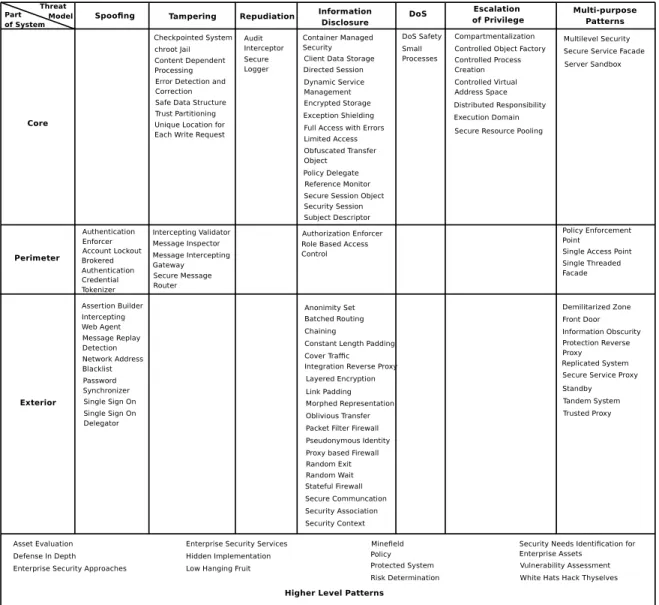
Table 2: Classification of Security Patterns using Hierarchical Scheme with Threat Models Figure1 shows our hierarchical classification scheme and how it classifies the security patterns listed in Table 1. Our tree-based scheme allows us to classify a pattern by placing it on a leaf node (low level patterns) as well as internal nodes (high level patterns), therefore creating the hierarchy. Patterns at the root of the tree are applicable to multiple contexts. The application contexts (core, perimeter and exterior) are in the internal nodes. Each context may have several security problems, categorized by the STRIDE threat model [33]. STRIDE is an acronym of the following concepts.
• Spoofing. Attempt to gain access to a system using a forged identity. A compromised system
would provide an authorized user access to sensitive data.
• Tampering. Corruption of data during communication through the network. Integrity of the
data is under threat.
• Repudiation. Users refusal to acknowledge participation in a transaction.
• Denial of service. Attack on system availability.
• Elevation of privilege. Attempt to raise the privilege level by exploiting some vulnerability.
Confidentiality, integrity and availability of a resource are under threat.
Table 2lists all 96 patterns using the hierarchical classification scheme. Some cells of the table are empty. This may indicate 2 things: 1) not all threats are relevant for all contexts, and 2) not all patterns have been discovered. Perhaps, future pattern miners will look at this table for inspirations.
At the core, application developers are primarily concerned about three threats: tampering, information disclosure, and privilege escalation. Patterns that protect from tampering are about validating user inputs, running processes inside a sandbox, and ensuring that a system can restart gracefully from a compromise. Core patterns that prevent information disclosure describe how to create and manage user sessions, and how to hide information and control access. Core patterns for preventing privilege escalation vulnerabilities are about enforcing least privilege principle [29] in the process level. Table 2 also lists 2 patterns each for preventing repudiation and denial of service. Patterns for preventing repudiation are about collecting and managing logging and auditing information. Monitoring everything that is happening in a running system is important for management and forensics; these two patterns are therefore referenced by many other patterns about security and other domains. Patterns for preventing denial of service attacks are about monitoring and parsimoniously using system resources, so that a resource exhaustion attack cannot happen.
3 patterns are listed on the rightmost column on core context; these are patterns that are in the ‘core’ internal node of the hierarchical classification. Secure Service Fac¸adeis about creating a single point for implementing various types of security checks. The actual policies implemented can target various types of security threats, e.g., tampering and information disclosure. Multilevel Security is about implementing a policy model such as the Bell-LaPadula model [4] to prevent information disclosure, tampering and escalation of privilege.
The higher level patterns in perimeter security context are about minimizing the number of access points in a system and creating a policy enforcement point, where authentication, au-thorization, and input validation policies can be enforced. Consequently, the leaf patterns for perimeter security are about implementing authentication mechanism to prevent spoofing, autho-rization mechanism to prevent information disclosure, and input validation mechanism to prevent tampering.
The external security patterns prevent two types of attacks. By implementing a single sign on mechanism, the patterns prevent identity spoofing, and allow users to reuse their credentials to access multiple services. Patterns for preventing information disclosure groups patterns from two domains. There are 8 patterns for implementing various types of gatekeeper mechanism to prevent external users from entering the system. There are also 12 patterns that are about implementing privacy enhancement technologies (PETs). The higher level patterns in this context are about creating infrastructure for firewalls.
Repudiation and denial of service threats only have patterns in the core context. This is because logging and auditing are activities that are implemented in the core of an application, but are used throughout the application. On the other hand, there are several solutions for preventing external denial of service attacks. However, most of these solutions are not about software applications. We are not aware of patterns that describe these solutions.
13 patterns in the bottom of Table 2 are higher level patterns, classified at the root of the hierarchical scheme. These patterns address many security threats and may necessitate changes in all parts of an application.
5
A Pattern Language for Security
The hierarchical classification scheme groups patterns that target similar problems at an application context. Naturally, these patterns should be related. We developed a pattern language for our pattern catalog by first exploring relationships among the patterns in the small scale. These are then unified to create the larger pattern language.
A pattern language offers the reader a guidance in selecting the next pattern to consider. It shows all the closely related patterns. But how does one determine that there exists a relationship between patterns? In Alexander, the pattern at the head of the connecting arrow is typically men-tioned in the ‘Context’ section of the pattern that appears at the end of the arrow. Alternatively, the pattern at the end of the arrow is mentioned in the ‘Resulting Context’ of the pattern at the head of the arrow. Unfortunately, most of the security patterns were not written in that format, so we had to re-create those relationships by carefully considering the typical order in which they would be applied. We listed them in that temporal order, and then described their relationships. Typically, two related patterns either appear in a sequence, or represent two separate branches, which are related to another, more general pattern.
Appendix A contains snippets of patterns descriptions to make it easier for the reader to follow the diagrams.
5.1
Pattern Language in Core Application Context
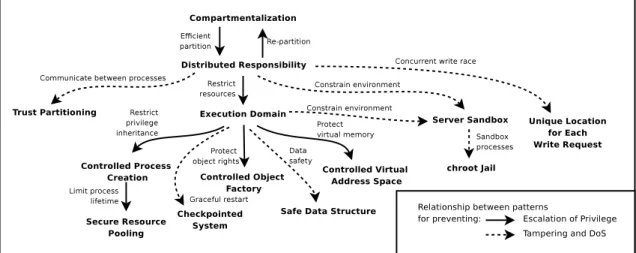
35 core patterns are in 6 out of 7 columns in Table2. We started with the 7 patterns that prevent privilege escalation. The first step of preventing privilege escalation is partitioning an applica-tion, described by two patterns. We related them by an arrow from Compartmentalization toDistributed Responsibility, meaning that the latter follows the former. In practice, these two patterns typically go hand in hand. A user compartmentalizes a system, then checks whether the responsibilities are properly distributed, and may compartmentalize again and so on. So, we added an arrow in the reverse direction. Execution Domainspecializes Distributed Respon-sibility by restricting access to resources available to a process. Applications with a stronger security requirement may need finer control on the execution domain and how privilege is han-dled. It is especially important to check process creation (Controlled Process Creation), object creation (Controlled Object Factory), and memory usage (Controlled Virtual Address Space)—all three follow Execution Domain. Secure Resource Pooling eases process creation by forking a process pool; it also adds control on process lifetime to pre-vent privilege escalation vulnerabilities in long-running processes. Figure2 shows the relationship between patterns.
We found that patterns for preventing tampering are closely related with the first 7 patterns. Trust Partitioning and Unique Location for each Write Request are two different ways to enforceDistributed Responsibility. Execution Domain explicitly indicates all the resources a process can use during its execution. This simplifies the creation of aCheckpointed System, that periodically saves the application state so that a system can restart gracefully. Also, limiting the execution domain makes it easy to reason about the type of data handled by the
system. Especially for user inputs, it is safe to represent them using aSafe Data Structure.
Figure 2: Pattern Language of Core Patterns for Preventing Privilege Escalation and Tampering A chroot Jail pattern follows Execution Domain because it limits resource access. We knew thatchroot Jailis a refinement of Server Sandbox, a multi-purpose pattern. We added Server Sandbox in the relationship. Figure 2 shows the pattern language ensuing from this pass. We could not relate these 13 patterns with 2 remaining patterns for preventing tampering:
Content Dependent Processing and Error Detection and Correction. We later
found that these are related with tampering patterns at a different application context.
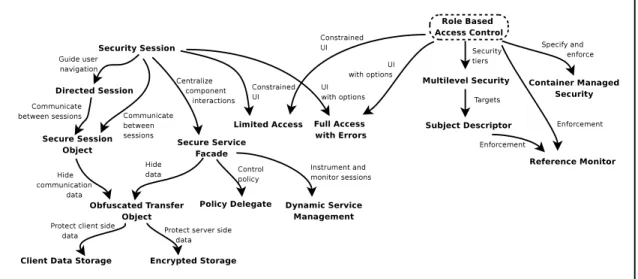
Next, we explored the relationship between 14 patterns to prevent information disclosure. 10 are about managing a session. Naturally, we started with Security Session. A session may guide user activity (Directed Session). Another way of controlling user activity is how a GUI is presented to user, Limited Access and Full Access With Errors being two competing design choices. Obfuscated Transfer Object hides session communication using cryptog-raphy, which can be applied at the client end (Client Data Storage) or at the server end
(Encrypted Storage). Policy Delegateand Dynamic Service Managementare about
implementing a loosely coupled security session. They are not directly related to the session man-agement patterns. Instead, they are directly related to a multi-purpose pattern in core context, Secure Service Fac¸ade, which is a refinement of Security Session.
Among the 4 remaining patterns, Subject Descriptor, Reference Monitor and Con-tainer Managed Security are about access control. A reference monitor enforces access re-quests from a subject. There are no other relationships. However, we found that these patterns are related withRole Based Access Control, which is classified in the perimeter context in Table
2. Although there are various access control mechanisms, role based access control is probably the best and most widely documented option. It influences GUI creation; so, it is related withLimited AccessandFull Access With Errors. We could not relateException Shieldingdirectly with this set of patterns, and omitted it during this pass. Reference Monitorenforces various constraints in execution domain, e.g., process creation constraints (Controlled Process Cre-ation). There are therefore relationships between patterns listed in Figure 2 and 3, but we did not consider them until the final pattern language diagram.
One multi-purpose pattern remained in the core context. Multilevel Security combines role based access control with a security model. It is a refinement of Role Based Access Control because it takes the idea of roles, organizes them in security tiers and imposes a
secu-rity model on the read and write privileges between tiers. Figure 3 shows the pattern language containing 15 patterns: 13 from information disclosure column, and 2 from multi-purpose column.
Figure 3: Pattern Language of Core Patterns for Preventing Information Disclosure
4 patterns for preventing DoS and repudiation based attacks remained. Small Process goes hand in hand with Compartmentalization and act as a partitioning guideline similar to Distributed Responsibilityin Figure2. DoS Safetychecks for resource exhaustion attacks. These checks are enforced by a Reference Monitor, listed in Figure 3. 2 patterns for logging and auditing are connected with many patterns in the entire pattern language, since logging and auditing is a recurrent activity. We omitted these in this pass, and only included them in the final pattern language.
5.2
Pattern Language in Perimeter Context
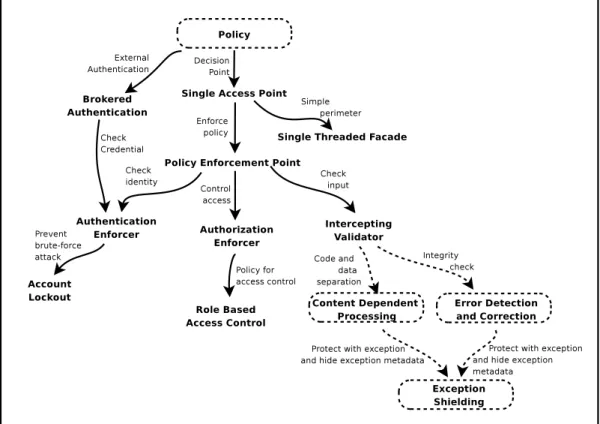
13 perimeter patterns are in 4 columns in Table2. We realized that they were more closely related together by the perimeter context than by the threat-specific responses, so we explored them together. The main concern for perimeter security is to enforce authentication, authorization and input validation policies. Applications typically have separate components for performing these tasks, and a policy enforcement point acts as aMediator[11] between the components. Enforcing policies at multiple points is hard to manage. The Single Access Pointpattern minimizes the number of access points in a system. Policy Enforcement Point follows Single Access Pointin the pattern language. Access points denote the perimeter processes. To make perimeter secure, these processes should be simplified by making them single-threaded (Single-Threaded Fac¸ade).
Authentication, authorization and input validation policies are enforced by the policy enforce-ment point; they are therefore related. Authentication Enforcerintroduces an authentication component. Upon successful authentication, it creates aSecurity Session, a core pattern. Ac-count Lockout pattern is applied to an authentication component to protect the component from brute-force attacks. The Authorization Enforcer pattern creates policies, such as role based access control, which are eventually refined by various core security patterns. Similarly, an interceptor component validates input using core patterns Content Dependent Processing and Error Detection and Correction. Input validation processes often modify user input
Figure 4: Pattern Language of Perimeter Patterns
in order to remove malicious data, but this may have the unfortunate side effect of putting an application in an unsafe state. Input validation routines are therefore protected by exceptions. TheException Shielding pattern also ensures that an exception handling routine do not reveal sensitive internal information to an attacker.
Authentication Enforcer enforces authentication requests by checking a user’s creden-tials. This model works well if a user trusts the authentication component. If there is no trust, a user cannot present his or her credential. Instead, both parties use a mutually-trusted authenti-cation broker. This is Brokered Authentication. It is implemented by the client side, since the client communicates with the broker, and eventually presents the broker-provided credentials to the authentication component. Authentication Enforcer therefore follows this pattern. Brokered Authentication is further related with Policy, a higher level pattern; it enforces an external authentication policy.
We could not relate 3 patterns that prevent tampering, and 1 pattern that prevent spoofing with these patterns. These are related with input validation and credential management, both done at an external component.
Figure 4shows 9 perimeter patterns as well as 3 core patterns.
5.3
Pattern Language in Exterior Context
35 perimeter patterns are in 3 columns in Table 2. We first identified the relationships between 7 patterns that prevent spoofing. 5 out of 7 patterns are related to enabling single sign on. Intercepting Web Agent is an external authentication component, installed in a web server. It is a variant of brokered authentication mechanism described byBrokered Authentication,
a perimeter pattern. However,Intercepting Web Agentdoes not create credentials for clients, it authenticates the client and generates interoperable security tokens.
Figure 5: Pattern Language of Exterior Patterns to Prevent Spoofing
One of the main tasks of Intercepting Web Agent is to provide single sign on capability (Single Sign On). It is typically delegated to a separate Single Sign On Delegator. Single sign on depends on various components, especially for identity and credential management. These patterns are directly related withSingle Sign On Delegator. Assertion Builderprovides a service for managing and distributing SAML assertions. Password Synchronizercreates a hub for synchronizing user credentials across different application systems. Credential tokenizer is a perimeter pattern that encapsulates various types of user credentials as a security token.
2 patterns, Message Replay Detection and Network Address Blacklist, are not
about single sign on. They did not have direct relationships with the other patterns that prevent spoofing. The remaining 5 patterns are shown in Figure5.
Next, we explored the 9 multi-purpose patterns. 4 of these patterns are about implementing firewalls and proxy-based services, 2 are about secure communication, and 3 are about adding redundancy to implement fault-tolerant systems.
The first step of implementing a firewall is to create aDemilitarized zoneand enforce policy at a Front Door. The relationship between these two patterns is similar to the relationship
betweenSingle Access Pointand Policy Enforcement Point. AProtection Reverse
Proxyis the firewall at theFront Door. Alternatively, a third party can be used as aTrusted Proxy. Among the secure communication patterns,Information Obscuritysets the high-level goal. A Secure Service Proxy follows the pattern by creating a secure fa¸cade. 3 patterns for fault-tolerant and available systems are not related. They are instead competing solutions. These three patterns areReplicated System,Standby and Tandem System.
These three cliques of patterns are not related. However, we found 7 patterns in ‘information disclosure’ column that are about firewall creation and secure communication. Protection Re-verse Proxy includes a Packet Filter Firewall and an Integration Reverse Proxy that hides the internal services. Packet Filter Firewall looks at incoming packets at the network layer and filters them. It accesses the services of a Network Address Blacklist, a pattern in the ‘spoofing’ column that was previously omitted. Proxy based Firewall filters
Figure 6: Pattern Language of Exterior Patterns to Prevent Information Disclosure
at the application layer; it exposes a few internal services. Stateful Firewall is a further refinement of a proxy based firewall; it keeps track of requests coming in multiple sessions. In-tegration Reverse Proxy is the policy enforcement point for a Secure Service Proxy. It enforces policies for message replay detection and message validation. Multi-party messaging (Secure Message Router) can also be implemented by aMessage Intercepting Gateway. Secure Communicationpattern lies betweenInformation ObscurityandSecure Ser-vice Proxy, related in the previous pass. Setting up a secure communication involves multiple steps, including exchanging and storingSecurity Associations and keeping track of the Secu-rity Context.
Figure 6 shows the relationship between 18 patterns: 13 patterns for firewall and secure com-munication, and 5 patterns that were omitted in the previous passes.
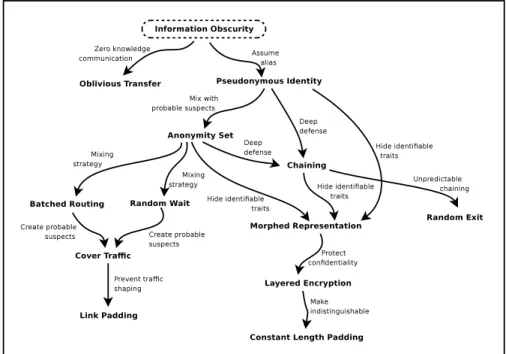
We were left with 12 patterns for information disclosure prevention. These are about imple-menting privacy enhancement technologies (PETs). The privacy patterns are related with the multi-purpose pattern, Information Obscurity; all of them hide information. We explore two goals of information obscurity: providing anonymity in a communication scheme and getting involved in a zero-knowledge secure multiparty transaction.
We started withPseudonymous Identitythat hides anonymity targets behind a pseudonym. The pseudonymous communication is then blended with other communication and anAnonymity Set is created. A mix based network applies Morphed Representation to hide the relation between incoming and outgoing data. In online communication, mix networks adopt Layered Encryption to hide packet content. Constant Length Padding is used in conjunction with encryption to make all the encrypted packets of the same size. The defense in depth principle [37] suggests Chaining anonymity solutions, so that failure of a layer of anonymity does not expose sensitivity information. To prevent attackers from only monitoring exit nodes, a Random Exit strategy is employed with Chaining.
Traf-Figure 7: Pattern Language of Exterior Patterns to Prevent Attacks on Privacy
ficensures proper mixing even in a network with low traffic. Cover Trafficis typically followed by Link Padding to create a continuous flow of dummies between nodes.
Another goal of anonymity is to enable zero-knowledge communication. Oblivious Transfer describes cryptographic operations for secure multi-part computation. Figure 7shows the pattern language.
5.4
Higher Level Pattern Language
Higher level patterns from Table2are mostly about enterprise-wide security and risk management. The scope of patterns includes policies, directives, or constraints that apply to all systems and all operations across the enterprise. As we were identifying their relationships, we noticed two almost-parallel hierarchies of patterns, one for process management (e.g., Asset Evaluation, Risk Determination), the other for software (Low Hanging Fruit, Hidden Implementation, Minefield). But both sets of tasks need to be considered together, so we added relationships between them. Figure 8shows 13 patterns and their relationships.
Security Needs Identification for Enterprise Assetsis the root pattern for all enter-prise security concerns. It assesses the need for security in an organization, which is then explored by understanding the assets and vulnerabilities in an organization. Risk Determination is the final stage of assessment process, when an organization evaluates and prioritizes the risks. A key security principle is Defense In Depth: having multiple security solutions in different layers of an application. This pattern guides the selection of security approaches, and eventually the choice of security services.
A core security goal is to create aProtected System, i.e., an application where the resources at the core are protected by a series of guards at the application perimeter. This leads to identifying the policies to be adopted in an application and applying them at the perimeter. Figure4lists the perimeter security patterns of implementing a policy enforcement point.
Figure 8: Pattern Language of Higher Level Patterns
at all levels, from hiding specification to hiding application status messages. Minefield makes it hard for an attacker to explore internal details, because it suggests varying every instance of an application. Thus a vulnerability that can be found in one application may not be found in another instance of the same system.
A key security activity is testing the security measures that have been adopted, and possibly modifying/upgrading systems to mitigate emerging security threats. White Hats Hack Thy-selves pattern describes this process.
5.5
A Unified Pattern Language for Security
Let us look again at figures2-7. They are relatively self-contained, because they describe solutions for different classes of security problems. But patterns in Figure 8 are fundamentally different. They explain how to approach solving any security problem, but stop short of solving any. In other words, patterns in Figure8 leave off where all the other figures start. In order to produce a single diagram of the full pattern language, we identified the relationships between the higher level patterns in Figure8and the starting points of figures2-7. This step is shown in Figure9. Figures2,
4, and 6are connected directly to the Enterprise Security Services, Protected System, or Policy patterns from Figure 8. The remaining figures represent refinements of patterns in those 3 figures.
Figure 9: Unifying the Smaller Pattern Languages
from the other figures. Then we added some additional relationships and included patterns that were not shown in the previous figures, because they did not fit them. Here are some of the additional connections we made for this diagram.
Compartmentalization prevents privilege escalation attacks. It is a security service to be chosen by enterprise architects, as well as a means to create a protected system, hence con-nected with two patterns. Also related withEnterprise Security Servicesare Information Obscurity pattern, and three patterns for building available systems (Replicated System, Standby, Tandem System).
Protected Systemcontains a gatekeeper component that enforces policies. The gatekeeper component can be at the application perimeter in the form of a Policy Enforcement Point, or implemented by a separate firewall infrastructure. The policies enforced in these two classes have some similarity. Both employ authentication and input validation. But the contexts are very different, e.g., one considers credential based authentication, while the other is about reusing authentication and single sign on.
Authentication Enforcercreates aSecurity Session, that eventually enforces the poli-cies. These core patterns are shown in figure 3.
We show the Audit Inspector and Secure Loggerpatterns at the bottom, being related with Security Session and Reference Monitor. In practice, logging and auditing are as-sociated with many other security solutions; these activities are also not limited to the security domain. Hence, these patterns are typically connected with many other patterns.
6
On the Pattern Language Diagram
Reading pattern language diagrams is hard. Considered in isolation, Figure 10is large and intim-idating. But since its contents were introduced in small chunks, the reader can easily recognize the top-level patterns from smaller diagrams (e.g., Information Obscurity, Demilitarized Zone, or Compartmentalization) and quickly locate other patterns from the
correspond-Figure 10: The Full Pattern Language
ing category. Similar to the small diagrams, most relationships between patterns flow top-down, indicating how to apply patterns sequentially in order to refine the design.
The cliques of related patterns from the smaller pattern languages are preserved in the combined figure. Aside from the added relationships that show how the top-level patterns from each category are related, few arrows connect multiple original pattern language figures (e.g., Message Replay Detection). This indicates that most patterns solve only one specific task, but each can be refined in different ways by patterns that extend it.
There are three general observations about the annotations describing relationships between patterns. First, they are very short, summarizing in a few words the essence of the relationship. The exact phrasing of the relationship is not as important as the indication that a relationship exists. No single-phrase summary can substitute for actually reading the related pattern, but being aware that the relationship exists adds significant knowledge. Second, similarly to other work on pattern languages, the relationship descriptions we defined are unique; they summarize the change to the system that comes from applying the “target” pattern (i.e., the pattern listed at the end of the arrow). The few relationship descriptions thatarerepeated point to the same “target” pattern. Third, the relationships are described as either verb phrases (e.g., “Rank threats”) or noun phrases (e.g., “Threats”). While its not difficult to turn noun phrases into verb phrases, the extra verb often adds little to clarify the description. We opted for brevity over consistency.
Having such a large collection of relationships to analyze, it would be tempting to try to find commonalities and other characteristics that would enable us to define a “language of relationships between patterns”. We observed three classes of relationships: (1) pattern A refines or extends
pattern B, (2) pattern Auses pattern B to achieve a (part of its) goal, and (3) patterns A and B are
alternatives. Most relationships between patterns fall into the first two categories, but replacing the specific relationship descriptions with “extends” or “uses” removes all the information to the point that the phrases “extends” or “uses” become redundant. Both can be easily replaced with a plain arrow in the Alexandrian style without losing any information (alternative patterns are connected by a dashed, doubly-ended arrow). We opted not to pursue the language approach.
7
From Pattern Catalogs to Pattern Languages
The process of creating a Pattern Language for Security has enabled us to better appreciate the difficulties of putting together a large number of patterns into more than merely a collection. It is difficult to grow pattern languages, because adding more patterns to a language means increasing the possible scope (or context) and having to account for many more relevant associations between patterns. This explains, in part, why so few pattern languages for software feature more than 25 patterns. And if they do, as in the case of the Wiley book [30], the authors focus on smaller sections and do not try to piece them together in an all-encompassing diagram. In each individual section, they focus only on specific types of relationships that are relevant to the patterns in that section, and they do not attempt to reconcile the differences. As we have shown in the previous section, combining smaller diagrams into a complete one is very time consuming. If the relationships between the smaller groups of patterns are not well understood, the task becomes nearly impossible.
Large collections of patterns are hierarchical by nature. The larger, architectural, patterns appear at the top of the hierarchy, while smaller patterns that complement and refine them are shown underneath. This hierarchy is easy to spot in Figure 10. It was built bottom up from small hierarchies in the previous figures, which represent specific security contexts. It is possible
to simplify the diagram by replacing all the patterns from each smaller figure with a single label or box, as we did in Figure 9. Such a hierarchical understanding of how the smaller pieces are related, while ignoring the details of the smaller pieces, makes it easier to work with pattern languages; both to write and to read them. But there is a benefit to building larger collections and hierarchies—accumulating more domain knowledge.
Good classification is the key in evolving a pattern collection into a pattern language. It might seem that all our previous work on categorizing patterns had little added value, because we reorganized the patterns while drawing the smaller figures. However, most of that classificationis
retained in the diagrams. Had there been no classification to start with, we would not be able to draw smaller diagrams and we would get bogged down in the details of drawing the full diagram first.
The Pattern Language for Security represents a small portion of software patterns. In order to apply these patterns to a software system, they need to be integrated with the functional domain of the system. In the process of designing such a system, other types of pattern languages become handy. For example, implementing the Exception Shielding pattern requires some knowledge of user interfaces [34], building a Credential Tokenizer or Assertion Builder is likely to benefit from design patterns [11], while the Checkpointed System can only improve with the application of other patterns for fault tolerance [17]. These types of patterns would likely be applied “after” security patterns, in order to refine the solution even further. In contrast, higher level patterns, e.g., for requirements analysis or system engineering, would be applied “before” any security patterns. Even though security patterns in the pattern language range from very generic (and vague) to small and very specific, related patterns in other domains can be both much more generic and much more concrete. A more “complete” pattern language for building secure software systems will likely consist of a cross-section of patterns from all these pattern languages, and others, depending on the actual problem domain. But in the sequence of pattern applications, patterns from different domains are not mixed, but rather applied in order, one domain at a time, because a mature pattern language for a domain has no holes, and patterns from outside of the domain only need to be applied when the resulting context is outside of the domain.
8
Next Steps
This paper describes a work in progress. The security pattern language has not yet been used on a large project, been reviewed by more than a few security experts, or been used to teach students how to make secure systems. Doing these things will undoubtedly point out ways to improve it. However, its current version is already an improvement on the state of the art.
Earlier work consisted of collections of patterns, most of which were not connected to each other. The security pattern language shows how all the patterns are connected. Earlier work had a lot of duplication, and different collections used different notations to describe the relationships of the patterns in those collections. The security pattern language has removed overlap and uses a single diagramming notation for the entire pattern language. We not only have a more complete set of patterns than any of the previous works, we have an approach for developing a pattern language that can be used in other domains. Though we expect that the details of the pattern language will change, we are confident that our overall approach is sound.
There are many reasons to document a pattern language. It will standardize the vocabulary of experts, and help them to communicate with each other. It will serve as a guide to novices, helping them to learn how to design. By describing a particular way of design, it will allow that
way to be criticized and improved. Finally, as a way of design becomes more standardized, it will become possible to automate parts of it.
Does the security pattern language match the vocabulary of experts? Often different authors use different names for the same pattern, so we had to select one. In some cases, none of the names seemed ideal but we did not want to invent a new one. We plan to have the pattern language reviewed by more experts to help refine the choice of names and to clarify their descriptions.
Each use of a pattern language leads to a way to evaluate and improve it. Using a pattern language to design a system shows missing patterns and shows when descriptions of individual patterns are incomplete. Using a pattern language to teach a course makes it clear where it is hard to understand and ways in which people are likely to misinterpret it. Patterns descriptions are informal since they are designed to be read by people, but automating them, whether in a design tool, a checker, or a program transformation system, requires the pattern to be formalized. This forces people to be more explicit about the pattern, and often brings some new insight.
Our next steps are to circulate the pattern language for feedback and review by a larger audi-ence. Then we will start using it and encouraging others to start using it. We expect to continue improving it for years.
We expect more immediate impact from our other main contribution—a detailed description of the process of designing a pattern language. We have shown how to integrate many patterns from several disparate source into a full pattern language. Our approach can be used as a recipe for designing pattern languages in other domains. While the details—pattern names, descriptions of relationships, or the fidelity of relationships are open to debate, our approach is sound. We hope that other researchers will follow our approach.
9
Conclusion
Security is only a small part of software design, yet our pattern language for security is already too big to be easily understood. Areas such as reliability, performance, or usability are just as complicated. This implies that a single unified pattern language is unlikely. Instead, we should work on more specialized pattern languages, like the security pattern language, and then see how they are connected.
The security pattern language is clearly connected to other topics. Some of its patterns are related to reliability patterns, or to user interface design patterns, or even to object-oriented design patterns. We suspect this will be true with any pattern language that focuses on a single aspect of software.
We expect that the lessons we have learned will apply to other areas. It is natural to start with a survey of other patterns, but expect duplication and overlap. Find a way to categorize the patterns that aligns with the domain of the language, like threat modeling did for security patterns. Organize each category, then look for links between patterns in different categories. It takes time, but you will start to see structure.
We look forward to seeing pattern languages for other domains. Only then can we start to work on inter-domain relationships.
Acknowledgement
References
[1] M. Adams, J. Coplien, R. Gamoke, R. Hanmer, F. Keeve, and K. Nicodemus. Pattern Languages of Program Design 2, chapter 33: Fault-Tolerant Telecommunication System Patterns. Addison-Wesley, 1996.
[2] C. Alexander. The Timeless Way of Building. Number 1 in Center for Environmental Structure series. Oxford University Press, New York, 1980.
[3] C. Alexander, S. Ishakawa, and M. Silverstein.A Pattern Language: Towns, Building and Construction. Oxford University Press, New York, 1977.
[4] D. Bell and L. LaPadula. Secure computer systems: Mathematical foundations. Technical Report ESD-TR-73-278, MITRE Corporation, 1973.
[5] B. Blakley and C. Heath. Security design patterns technical guide–Version 1. Technical report, Open Group(OG), 2004. [6] F. L. Brown Jr., J. DiVietri, G. D. Villegas, and E. B. Fernandez. The authenticator pattern. 1999.
[7] F. Buschmann, R. Meunier, H. Rohnert, P. Sommerlad, and M. Stal. Pattern-Oriented Software Architecture: A System of Patterns. Wiley series in Software design patterns. John Wiley & Sons, 1996.
[8] J. Coplien. Advanced C++ Programming Styles and Idioms. Addison-Wesley, 1992.
[9] E. Evans. Domain-Driven Design: Tacking Complexity In the Heart of Software. Addison-Wesley Longman Publishing Co., Inc., Boston, MA, USA, 2003.
[10] E. B. Fernandez and J. C. Sinibaldi. More patterns for operating systems access control. In Proceedings of the European Conference on Patterns Language of Programming (EuroPLoP’03), 2003.
[11] E. Gamma, R. Helm, R. Johnson, and J. Vlissides.Design Patterns. Addison-Wesley, 1995.
[12] M. Goodyear, editor.Enterprise System Architectures: Building Client Server and Web Based Systems. CRC Press, Sep 28 1999. [13] M. Hafiz. A collection of privacy design patterns. In Proceedings of the 13th Conference on Patterns Language of Programming
(PLoP’06), 2006.
[14] M. Hafiz, P. Adamczyk, and R. E. Johnson. Organizing security patterns. IEEE Software, 24(4):52–60, July/August 2007. [15] M. Hafiz and R. Johnson. Evolution of the MTA architecture: The impact of security. Software—Practice and Experience,
38(15):1569–1599, Dec 2008.
[16] M. Hafiz, R. Johnson, and R. Afandi. The security architecture ofqmail. In Proceedings of the 11th Conference on Patterns Language of Programming (PLoP’04)., 2004.
[17] R. Hanmer. Patterns For Fault Tolerant Software. Wiley, 2007.
[18] J. Heaney, D. Hybertson, A. Reedy, S.Chapin, T. Bollinger, D. Williams, and M. Kirwan Jr. Information assurance for enterprise engineering. In Proceedings of the 9th Conference on Patterns Language of Programming (PLoP’02), 2002.
[19] J. Heer and M. Agrawala. Software design patterns for information visualization. IEEE Transactions on Visualization and Computer Graphics, 12:853–860, 2006.
[20] J. Hogg, D. Smith, F. Chong, D. Taylor, L. Wall, and P. Slater. Web Service Security: Scenarios, Patterns, and Implementation Guidance for Web Services Enhancements (WSE) 3.0. Microsoft Press, March 2006.
[21] D. Hybertson, J. Heaney, and A. Reedy. Conceptual aspects of security patterns. 2002.
[22] IEEE Std 1471-2000. IEEE recommended practice for architectural description of software-intensive systems, 2000.
[23] R. E. Johnson. Documenting frameworks using patterns. In A. Paepke, editor,Proceedings of the Conference on Object-Oriented Programming, Systems, Languages and Applications, pages 63–76. ACM Press, Oct. 1992.
[24] D. Kienzle, M. Elder, D. Tyree, and J. Edwards-Hewitt. Security patterns repository version 1.0.
http://www.scrypt.net/~celer/securitypatterns/repository.pdf, 2002.
[25] G. Meszaros. Pattern Languages of Program Design 1, chapter 8: Pattern: Half-object + Protocol (HOPP). Addison-Wesley, 1995.
[26] R. Porter, J. O. Coplien, and T. Winn. Sequences as a basis for pattern language composition.Science of Computer Programming, 56(1-2):231 – 249, 2005.
[27] S. Romanosky. Security design patterns part 1.http://citeseer.ist.psu.edu/575199.html, Nov 2001. [28] S. Romanosky. Enterprise security patterns.
http://citeseer.ist.psu.edu/romanosky02enterprise.html, 2002.
[29] J. Saltzer and M. Schroeder. The protection of information in computer systems. Proceedings of the IEEE, 63(9):1278–1308, Sep 1975.
[30] M. Schumacher, E. Fernandez-Buglioni, D. Hybertson, F. Buschmann, and P. Sommerlad. Security Patterns: Integrating Security and Systems Engineering. John Wiley and Sons, December 2005.
[31] M. Schumacher and U. Roedig. Security engineering with patterns. In Proceedings of the 8th Conference on Patterns Language of Programming (PLoP’01)., 2001.
[32] C. Steel, R. Nagappan, and R. Lai. Core Security Patterns : Best Practices and Strategies for J2EE(TM), Web Services, and Identity Management. Prentice Hall PTR, Oct 2005.
[33] F. Swiderski and W. Snyder. Threat Modeling. Microsoft Press, 2004.
[34] J. Tidwell.Designing interfaces : Patterns for Effective Interaction Design. O’Reilly, 2005.
[35] D. Trowbridge, W. Cunningham, M. Evans, L. Brader, and P. Slater. Describing the enterprise architectural space. MSDN, June 2004.
[36] R. Veryard and A. Ward. Trusting components and services, 2001.
[37] J. Viega and G. McGraw.Building Secure Software: How to Avoid Security Problems The Right Way. Addison-Wesley, 2002. [38] K. Wolf and C. Liu. Pattern Languages of Program Design 1, chapter 4. New Clients with Old Servers: A Pattern Language for
Client/Server Frameworks. Addison-Wesley, 1995.
[39] J. Yoder and J. Barcalow. Architectural patterns for enabling application security. In Proceedings of the 4th Conference on Patterns Language of Programming (PLoP’97)., 1997.
[40] J. A. Zachman. A framework for information systems architecture. IBM Systems Journal, 26(3), 1987.
A. Security Patterns in Our Catalog
• Account Lockout[24]. How can we protect a system’s login mechanism from password guessing attacks?
Limit the number of incorrect password entry attempts. Once a pre-defined threshold value of consecutive failures is reached, lock the account.
• Anonymity Set[13]. How can we retain the anonymity of an entity or a personal information? Mix the private information with other data so that the private information is not distinguishable. Create a set of equally probable data and hide the user information by making it a part of the set. • Assertion Builder[32]. How can we keep the security information about a subject and use it for
single sign on?
Encapsulate the processing control logic in order to create SAML authentication statements, au-thorization decision statements and attribute statements. Expose the assertion builder as a service. • Asset Evaluation[30]. How can an enterprise determine the overall value of its assets?
Systematically determine the overall value of the assets identified in the scope of the risk assessment. Determine the financial value and security value of assets as well as the impact to business.
• Audit Interceptor[32]. How can we easily support additions or changes to the auditing events in an application?
Intercept requests and responses in the business tier. Specify which events to audit outside of the application, so they can be re-configured at run-time.
• Authentication Enforcer[30]. How can we prevent impostors from accessing the system? Create a single point of access where all requests to enter the system are checked and apply an authentication protocol to verify the identity of the agent. On successful authentication, create a proof of identity of the agent.
• Authorization Enforcer[30]. How can we specify access rights to specific resources in a system? For each active entity that can access resources, specify which resources it can access and with what rights.
• Batched Routing[13]. How can the output of a mix node hide timing information?
Collect the input data packets from multiple nodes. When the collection reaches a threshold, output all the data packets together, in a batch.
• Brokered Authentication [20]. How can an application authenticate when a client does not have a direct trust relationship with it?
Use an authentication broker that both parties trust to independently issue a security token to the client. The client can then present credentials, including the security token, to the authenticating application.
• Chaining [13]. How can anonymity solutions be strengthened to have defense in depth?
Adopt multiple instances of an anonymity mechanism in layers. Chain multiple mix nodes instead of one and route traffic through multiple nodes. Adopt multiple pseudonym covers to protect users. • Checkpointed System[5]. How can we recover and restore system state to a known valid state
when its component fails?
When the system is running, save its current state periodically and store this information outside of the running system. When the system fails, restore its current state from the backup.
• chroot jail[15]. How can we design a system so that a security compromise in one process does not affect other processes?
Run the processes under separate, least privilege user ids. Run the programs/processes in a con-trolled environment with limited access to system files.
• Client Data Storage [24]. In case when server data needs to be stored on the client, how can we protect the data from unauthorized access by the client?
Encrypt the data on the server before passing it to the client. Keep a hash value of the data to detect if the content is tampered with. Change the session key often to protect against guessing attacks.
• Compartmentalization[37]. How can we prevent a security failure in one part of a system from being exploited in another part of the system?
Separate the system into unique security domains, e.g., multiple processes that run at different privilege levels.
• Constant Length Padding [13]. How can we prevent attackers from correlating packets that enter a node with packets that exit it?
Make all the sent data packets have the same length. Add dummy padding at the end of the packet, after the payload.