
Examination of efficacy and selectivity of herbicides in ALS-tolerant sugar beets Untersuchungen zur Wirksamkeit und Selektivität von Herbiziden in ALS-toleranten Zuckerrüben
Anja Löbmann*, Jan Petersen
Technische Hochschule Bingen, Fachbereich Life Science and Engineering, Fachrichtung Agrarwirtschaft, Berlinstr. 109, 55411 Bingen, Germany *Korrespondierende Autorin, [email protected]
DOI 10.5073/jka.2018.458.075
Abstract
The development of herbicide-tolerant sugar beet varieties offers the possibility to use only herbicides from the group of the aceto-lactate synthase (ALS) inhibitors. At present, ALS inhibitors are used in many crops of the rotation to a significant extent, in particular in cereals and maize. However, more than 159 weed species with resistance to ALS inhibitors are known. Consequently, this is the mode of action with most cases of herbicide resistances. The advancing spread of ALS-resistant weeds is a major challenge for herbicide management, if herbicide ALS-tolerant crops are used.
The present study was concerned with the question of which herbicide strategies ensure the efficacy of the new herbicide CONVISO® with and without presence of ALS-resistant weeds. Furthermore, the selectivity in ALS-tolerant sugar beet was investigated. Without presence of ALS-resistant weeds one treatment with CONVISO® was sufficient for weed control. With a splitting application and use of an additive the CONVISO® efficacy could be improved. The application of CONVISO® herbicide caused no visual symptoms or yield loss in the sugar beet. ALS-resistant weeds were only partly controlled by CONVISO® herbicide. By using tank mixtures with other modes of action efficacy could be improved, but complete control of ALS-resistant weeds was not possible.
Keywords: ALS-inhibitors, CONVISO®, herbicide tolerance
Zusammenfassung
Die Entwicklung herbizidtoleranter Zuckerrübensorten bietet die Möglichkeit, ausschließlich Herbizide aus der Gruppe der Aceto-Lactat-Synthase (ALS-) Hemmer zu verwenden. Derzeit werden in vielen Kulturen, insbesondere in Getreide und Mais, ALS-Hemmer zu signifikanten Anteilen eingesetzt. Inzwischen sind mehr als 159 Unkrautarten mit Resistenz gegen ALS-Hemmer bekannt, was die größte Resistenzverbreitung bezogen auf die Anzahl betroffener Unkrautarten darstellt. Die voranschreitende Ausbreitung von resistenten Unkräutern ist eine große Herausforderung für das Herbizidmanagement beim Anbau ALS-toleranter Kulturen.
Die vorliegende Arbeit beschäftigte sich mit der Frage, welche Herbizidstrategien die Wirksamkeit von CONVISO® bei Auftreten ALS-resistenter und sensitiver Unkräuter gewährleisten. Weiterhin wurde die Selektivität von Herbizidstrategien in ALS-toleranten Zuckerrüben untersucht. Die Einfachbehandlung mit CONVISO® war für die Unkrautbekämpfung sensitiver Unkräuter ausreichend. Mit einer Splittingbehandlung und der Verwendung eines Additivs konnte die Wirksamkeit von CONVISO® verbessert werden. Die Anwendung von CONVISO® führte zu keinen visuellen Symptomen oder Ertragsverlusten der Zuckerrübe. ALS-resistente Unkräuter wurden teilweise von CONVISO® erfasst. Tankmischungen mit anderen Wirkmechanismen konnten die Effizienz verbessern, aber eine vollständige Kontrolle der ALS-resistenten Unkräuter war nicht möglich.
Stichwörter: ALS-Inhibitoren, CONVISO®, Herbizidtoleranz
Introduction
Sugar beets have a low competitiveness against weeds during the juvenile development. Consequently, without any weed control the loss of yield can be up to 95% (PETERSEN,2003).
was requested with an application rate of 1.0 L ha-1 or 2 x 0.5 L ha-1 in ALS-inhibitor tolerant sugar
beets (BALGHEIM et al.,2016).
However, the intensive use of ALS-inhibitors in crop rotations favored the development of herbicide resistance in numerous weed species. In the last 30 years, resistant populations have spread widely in Western and Central Europe (HEAP,2017). Until now, there are 97 dicot and 62
monocot species known having an ALS-resistance (HEAP,2017).
CONVISO® is supposed to be active against nearly all economically important weeds in sugar beets (BALGHEIM et al.,2016).Consequently, the solo use oftheCONVISO®herbicide as an ALS-inhibitor is
possible in many cases. The risk to select ALS-resistant weeds in this system is high. For the sustainable use of this system it is important to find strategies to reduce that risk. In this study the following hypothesis were tested: (i) It is possible to supplement the application of Conviso® with classical sugar beet herbicides in such a way that even ALS-resistant weeds are safely controlled. (ii) The efficacy of CONVISO® is comparable to classical herbicides. (iii) The use of an adjuvant ensures the effect of CONVISO® under dry conditions. Therefore, an outdoor container test and a field experiment were cultivated in Bingen (Rhein).
Materials und Methods Outdoor container test
The trial was established with 30 containers (0.75 m2) under outdoor conditions. The sowing of 8
herbicide-tolerant sugar beets (experimental hybrid) was done by hand on 24th March 2016 and
16th March 2017. To require a seed stock of ALS-resistant weeds, seeds of Echinochloa crus-galli, Stellaria media, Papaver rhoeas and Matricaria inodora were mixed in the sterilized soil of the containers immediately before sowing (Tab. 1). The seed samples were from the original origin, except MATIN seeds. They were multiplied under selection pressure (tribenuron treatment) in 2015. The germination rate was estimated between 50 to 80% depending on the species.
Tab. 1 Characterization of weeds used in the outdoor container test.
Tab. 1 Charakterisierung der Unkräuter aus dem Gefäßversuch. Weed species EPPO-Code Amount [g
per container] Origin, type of ALS-resistance 2016 2017 Echinochloa crus-galli Matricaria inodora Papaver rhoeas Stellaria media ECHCG MATIN PAPRH STEME 0.5 1.5 0.015 0.03 0.75 0.25 0.02 0.1
Thal (A); EMR; Trp574Leu Freiburg/Elbe; Pro197Gln Volkstedt (SA); Pro197Ser
Selbitz (Bay); Pro197Thr + Trp574Leu
A total of 10 herbicide strategies were tested with three replicates (Tab. 3). The containers were treated with a one wheel plot sprayer (Air mix 110-025 Flat Fan, pressure 2.1 bar, water amount 200 L ha-1, speed 4.5 km h-1). The harvest was done on 29th July 2016 and 13th July 2017.
Tab. 2 Characterization of herbicides.
Tab. 2 Charakterisierung der Herbizide.
Product Ingredients MoA HRAC
Betanal maxxPro 60 g L-1 phenmedipham 27 g L-1 lenacil 47 g L-1 desmedipham 75 g L-1 ethofumesat inhibition of photosynthesis at PS II
inhibition of lipid syhthesis
C 1 N Conviso® 50 g L-1 foramsulfuron
30 g L-1 thiencarbazone-methyl
ALS-inhibitor B
Goltix Gold 700 g L-1 metamitron inhibition of
photosynthesis at PS II C 1
Hasten adjuvant
Lontrel SG 720 720 g kg-1 clopyralid Synthetic auxin O
Mero adjuvant
Para Sommer adjuvant
Select 240 EC 241,9 g L-1 clethodim inhibition of ACCase A
The efficacy of the herbicide applications was evaluated by counting weeds by species two weeks after treatment and by fresh weight determination of weed and sugar beet biomass. The experiences made in the first experimental year led to an adjustment of the seed rates.
Tab. 3 Herbicide treatments to control ALS-resistant weed in sugar beet in outdoor containers in the years 2016 and 2017 (T 2, T 4, T 6 and T 7 were only conducted in 2017).
Tab. 3 Herbizidvarianten zur Kontrolle ALS-resistenter Unkräuter in Zuckerrüben im Freiland-Gefäßversuch in den Jahren 2016 und 2017 (T 2, T 4, T 6 und T 7 wurden nur 2017 angelegt).
Treatment Product Dose [l ha-1 / g ha-1]
Early post- 1* post- 2 post- 3 T 1 no treatment T 2 Conviso® + Mero 1.0 1.0 T 3 Goltix Gold + Betanal maxxPro + Hasten 1.25 1.25 1.25 1.25 0.5 1.25 1.25 T 4 Conviso®
+ Select + Para Sommer + Lontrel 1.0 165 0.75 T 5 Conviso® + Betanal maxxPro + Goltix Gold 0.5 1.25 1.25 0.5 1.25 1.25 T 6 Conviso® + Betanal maxxPro + Goltix Gold 1.25 1.25 0.5 0.5 T 7 Conviso® + Betanal maxxPro + Goltix Gold 1.25 1.25 0.5 1.25 1.25 0.5 T 8 Conviso® + Betanal maxxPro 0.5 1.25 0.5 1.25 T 9 Conviso® + Goltix Gold 0.5 1.25 0.5 1.25 T 10 Conviso® 0.5 0.5
Field trial
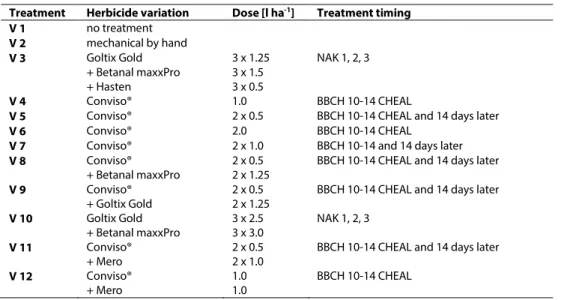
In field trials, the efficacy and selectivity of different herbicide strategies to ALS-tolerant sugar beets were tested from 2015 to 2017. The trial site was in Bingen (Rhein) with a natural weed infestation. In a randomized block design 12 herbicide programs were tested with 4 replicates (Tab. 4). The plot size was 2.5 to 8.0 m. The herbicide application was done by the same plot sprayer as in the container trial.
The investigations included number of weeds, visually assessment of herbicide selectivity, yield and quality determination.
Statistical analysis
Data analysis was made with the statistic program “R”, version 3.2.2. Differences between the herbicide programs were compared using an ANOVA with alpha > 0.05, and a Tukey post-hoc test. The investigations were done on beet fresh weight (container trial) and on white sugar yield (field trial).
Tab. 4 Herbicide programs and dosages used for the field trial from 2015 to 2017 (V 8 to V 12 were only conducted in 2016 and 2017).
Tab. 4 Herbizidbehandlungen und Dosierungen im Feldversuch von 2015 bis 2017 (V 8 bis V 12 wurden nur in 2016 und 2017 angelegt).
Treatment Herbicide variation Dose [l ha-1] Treatment timing
V 1 no treatment V 2 mechanical by hand V 3 Goltix Gold + Betanal maxxPro + Hasten 3 x 1.25 3 x 1.5 3 x 0.5 NAK 1, 2, 3 V 4 Conviso® 1.0 BBCH 10-14 CHEAL
V 5 Conviso® 2 x 0.5 BBCH 10-14 CHEAL and 14 days later
V 6 Conviso® 2.0 BBCH 10-14 CHEAL
V 7 Conviso® 2 x 1.0 BBCH 10-14 and 14 days later
V 8 Conviso®
+ Betanal maxxPro 2 x 0.5 2 x 1.25 BBCH 10-14 CHEAL and 14 days later
V 9 Conviso®
+ Goltix Gold 2 x 0.5 2 x 1.25 BBCH 10-14 CHEAL and 14 days later V 10 Goltix Gold + Betanal maxxPro 3 x 2.5 3 x 3.0 NAK 1, 2, 3 V 11 Conviso® + Mero 2 x 0.5 2 x 1.0
BBCH 10-14 CHEAL and 14 days later V 12 Conviso®
+ Mero 1.0 1.0 BBCH 10-14 CHEAL
Results
Outdoor container trial
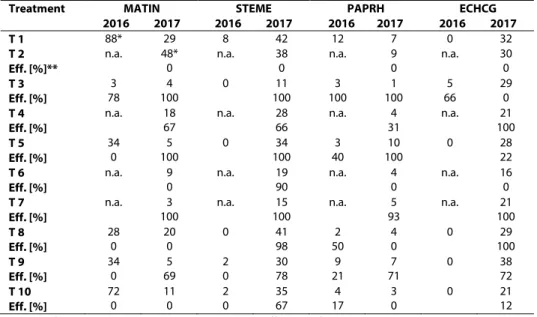
In the containers different weed species showed variation in germination. MATIN developed very fast and became the dominant weed in both years. In 2016, only single individuals of ECHCG weeds occurred in the trial. Nevertheless the final infestation level differed between the weed species and the herbicide programs. T 1 was an untreated control which included all sown weed species. The best weed control was obtained in treatments T 5 and T 7 (Conviso® plus Betanal maxxPro plus Goltix Gold). Herbicide efficacies ranged between minimum 40% (PAPRH, 2016) and maximum 100%. However, numerous individuals of ECHCG (2017) and MATIN (2016) survived in treatment T 5. T 7 achieved a slight improvement in efficiency against ECHCG by an earlier
Compared to a single application (T 2), the splitting treatment of Conviso® plus Mero (T 10) showed a better efficiency. The combination of Conviso® plus one classic herbicide (T 8 and T 9) was less effective against several weeds. In general, the infestation with ALS-resistant MATIN was difficult to eliminate in most herbicide programs.
In 2016 the highest fresh mass of sugar beet leaves were achieved in T 3, T 5 and T 10 (fig. 1). Generally, in 2017 the infestation level was lower than in 2016. It was caused by reduced amount of ALS-resistant MATIN seeds. The values of sugar beet leaf weights varied in this trial extremely. The highest sugar beet yields (beet fresh weight) were found in those herbicide treatments which also had the highest sugar beet leaf masses. As expected T 1 (untreated control) showed the lowest yields in both trial years. In 2016 the highest yield of sugar beet fresh mass was received in T 3 (3 x Goltix Gold + 3 x Betanal maxxPro) with 11.3 kg followed by T 5 (8.1 kg) and T 10 (6.0 kg). In 2017 the significant highest yields were achieved in all treatments where CONVISO® was combined with classic herbicides (T 5, T 8 and T 9). All other treatments reached a similar yield level.
Tab. 5 Number of occurring weeds per container and efficacy of herbicide applications in ALS-tolerant sugar beets infested with ALS-resistant weeds two weeks after application in 2016 and 2017.
Tab. 5 Ausgangsverunkrautung (mittlere Pflanzenanzahl pro Kübel) undWirkungsgrad derHerbizidbehandlungen in ALS-toleranten Zuckerrüben mit ALS-resistenten Unkräutern zwei Wochen nach Applikation in 2016 und 2017.
Treatment MATIN
2016 2017 2016 2017 STEME 2016 2017 PAPRH 2016 2017 ECHCG
T 1 88* 29 8 42 12 7 0 32
T 2 Eff. [%]**
n.a. 48*
0 n.a. 38 0 n.a. 9 0 n.a. 30 0 T 3 Eff. [%] 78 3 100 4 0 100 11 100 3 100 1 66 5 29 0 T 4 Eff. [%] n.a. 18 67 n.a. 28 66 n.a. 4 31 n.a. 21 100 T 5 Eff. [%] 34 0 100 5 0 100 34 40 3 100 10 0 28 22 T 6 Eff. [%] n.a. 9
0 n.a. 19 90 n.a. 4 0 n.a. 16 0 T 7
Eff. [%] n.a. 100 3 n.a. 100 15 n.a. 93 5 n.a. 100 21 T 8 Eff. [%] 28 0 20 0 0 41 98 2 50 4 0 0 29 100 T 9 Eff. [%] 34 0 69 5 2 0 30 78 21 9 71 7 0 38 72 T 10 Eff. [%] 72 0 11 0 2 0 35 67 17 4 3 0 0 21 12 *number of occurring weeds per container; **efficacy of herbicide treatment against occurring weeds; n.a., not available
a cd b bc B AB A A A b AB
F
res
h
w
ei
ght
[
k
g
/
c
ont
ai
ner
]
0 2 4 6 8 10 12 18beet fresh weight sugar beet leaf mass
T 1 no tr eat m ent T 2 T 3 T 4 T 5 T 6 T 7 T 8 T 9 T 10 C onv is o + M er o (2017) G o lt ix G o ld + B et anal m . C onv is o + S el ec t + P ar a S om m er + Lont rel ( 2017) C onv is o + G ol ti x G . + B et anal m . C onv is o + G ol ti x G . + B et anal m . (2017) C onv is o + G ol ti x G . + B et anal m . (2017) C onv is o + B et anal m . C onv is o + G o lt ix G . C onv is o + M er o (s pl it ti ng appl ic at ion) a cd b bc b d* B AB AB AB A AB A A A AB 2016 2017
Fig. 1 Fresh weight of sugar beet leaves and beet yield depending on herbicide treatment in ALS-tolerant sugar beet (outdoor container trial 2016 and 2017). *Significant differences at p≤0.05 are indicated different small letters (Tukey-HSD) only for beet fresh weight.
Abb. 1 Frischmasse von Zuckerrübenblättern und Rübenkörpermasse in Abhängigkeit der Herbizidbehandlung in ALS-toleranten Zuckerrüben (2016 und 2017). *Signifikante Unterschiede in der Rübenfrischmasse sind durch unterschiedliche Buchstaben gekennzeichnet (p≤ 0,05, Tukey-HSD).
Field trial
The field trials confirmed the high tolerance of the hybrid against CONVISO®. All treatments including a CONVISO® application showed no phenotypic damages in all three years. Only the classic treatment resulted in chlorosis and growth delay in the standard application (V 3) as well as for the double dose (V 10). Occurring growth retardation disappeared during the growing period. Table 6 displays that V 3 and V 10 achieved fewer yields, however, the yield was not influenced significantly (data not shown).
In 2015 the dominant weeds were Chenopodium album (CHEAL), Galium aparine (GALAP) and Solanum nigrum (SOLNI). In the following year, the weed population comprised of ALS-resistant Apera spica-venti (APESV) and susceptible CHEAL. In 2017 there was a wide spectrum of weeds Amaranthus retroflexus (AMARE), APESV, CHEAL, ECHCG, volunteer OSR, Setaria viridis (SETVI) and
much better efficacies than the single applications. The single application of the double dosage of Conviso® (2.0 L ha-1) was more effective than the splitting application of the double dose rate 2 x
1.0 L ha-1. The use of the adjuvant Mero improved the performance of Conviso® in V 11 (2 x 0.5
L ha-1 Conviso® + 1.0 L ha-1 Mero). The classic herbicide treatments V 3 and V 10 showed the
highest numbers of surviving CHEAL plants. Furthermore, AMARE, ECHCG, SETVI and SOLNI survived, too. In classic herbicide programs, a graminicide would have been used to control grass weeds. Generally, the best herbicide efficacy was obtained in all herbicide treatments which included Conviso®. Moreover, seeds of ALS-tolerant oilseed rape were spread from neighbouring field trials from previous years into this trial site. None of the CONVISO® treatments were able to control this ALS-tolerant volunteer OSR. The following molecular analysis confirmed the target site resistance at the position Trp-574 and Ser-653 in the surviving OSR plants. Plots with occurring OSR reached the coverage of minimum 0.5% and maximum 3.0%.
sum of weeds / m2 0 5 10 15 20 25 30 35 40 45 50 55 60 65 80 100 2015 2016 2017 V 1 no treatment V 3 Goltix Gold (3 x 1.25) + Betanal m. (3 x 1.5) V 4 CONVISO (1.0) V 5 CONVISO (2 x 0.5) V 6 CONVISO (2.0) V 7 CONVISO (2 x 1.0) V 8 CONVISO (2 x 0.5) + Betanal m. (2 x 1.25) V 9 CONVISO (2 x 0.5) + Goltix gold (2 x 1.25) V 10 Goltix Gold (3 x 2.5) + Betanal m. (3 x 3.0) V 11 CONVISO (2 x 0.5) + Mero (2 x 1.0 ) V12 CONVISO (1.0) + Mero (1.0)
Fig. 2 Weed density in ALS-tolerant sugar beet after herbicide treatment at field trial site Bingen (n = 3, 2015 – 2017). Dosages in L ha-1. Box plot with median, 25th-75th quantiles (box) and 5th- 95th quantiles (whiskers). Black circles show outliers.
Abb. 2 Unkrautdichte in ALS-toleranten Zuckerrüben in Abhängigkeit der Herbizidstrategie am
Feldversuchsstandort Bingen (n = 3, 2015 bis 2017). Aufwandmengen in L ha-1. Boxplot mit Median, 25-75 % Quantil (Box) und 5-95 % Quantil (Whisker). Schwarze Punkte zeigen Ausreißer.
Tab. 6 White sugar yield [t ha-1] 2015, 2016 and beet fresh weight [t ha-1] 2017 in ALS-tolerant sugar beet depending on the herbicide treatment.
Tab. 6 Bereinigter Zuckerertrag [t ha-1] 2015, 2016 und Rübenfrischmasse [t ha-1] 2017 in ALS-toleranten Zuckerrüben in Abhängigkeit der Herbizidbehandlung.
Herbicide
treatment Mean (SD) 2015 Mean (SD) 2016 Mean (SD) 2017 V 1 4.69a *(0.82) 0.51a (0.30) 1.56A (2.06) V 2 9.49b (0.80) 15.73b (0.49) 88.06B (9.20) V 3 8.86b (0.39) 14.92b (0.79) 90.54B (8.59) V 4 9.02b (0.54) 15.03b (0.69) 86.46B (9.96) V 5 9.57b (0.54) 15.56b (1.01) 86.56B (9.30) V 6 9.22b (0.79) 15.19b (1.15) 94.31B (6.39) V 7 8.91b (0.38) 15.42b (0.81) 95.90B (3.02) V 8 15.55b (0.58) 99.08B (5.41) V 9 15.91b (0.69) 93.85B (7.79) V 10 14.45b (0.96) 89.52B (3.67) V 11 16.13b (0.58) 92.69B (7.29) V 12 16,11b (1.60) 95.44B (5.15) *Significant differences at p ≤ 0.05 (Tukey-HSD) are indicated different small letters.
Discussion
The aim of this study was to examine the efficacy of herbicide strategies against ALS-resistant weeds using CONVISO® plus classic herbicides (container trial). Furthermore, crop selectivity of the CONVISO® SMART hybrids and efficacy of CONVISO® under natural weed infestation were investigated (field trial). Resistance to ALS-inhibitors is a result of reduced sensitivity of the target ALS enzyme to inhibition by the herbicide (TRANEL andWRIGHT,2002). The degree of the resistance
dominance varies among plant species or alleles (FOES et al.,1999). Thus, in principle, an effect of
CONVISO® against ALS-resistant weeds was assumed.
In the container trial, the best weed control was obtained in the herbicide treatments including CONVISO®, Goltix Gold and Betanal maxxPro (T 5, T 7). Adding just one classic herbicide to the CONVISO® treatment led to a decreased efficacy of the application (T 8, T 9). The herbicide treatment T 2 (1.0 L ha-1 CONVISO® plus 1.0 L/ha Mero) and the splitting application T 10 (2 x 0.5 L
ha-1 CONVISO® plus 2 x 1.0 L/ha Mero) were not effective enough for controlling ALS-resistant
weeds. This indicates that CONVISO® needs a supplement of classic herbicides for controlling ALS-resistant weeds. In the classic herbicide treatment (T 3), most of the weeds were well controlled. Surviving plants of ECHCG can be explained by the fact that Betanal maxxPro and Goltix Gold are no suitable grass herbicides. The control of ALS-resistant MATIN was a challenge for nearly all herbicide treatments. Owing to the results in most cases the hypothesis can be confirmed that even ALS-resistant weeds are controlled by supplementing CONVISO® with classic herbicides (i). The relationship between weed biomass and sugar beet leaf weight corresponded with the number of surviving weeds per container. Low infestation levels favored leaf development and beet growth.
The dominant weed species in field trials were CHEAL, SETVI and SOLNI. In addition to these susceptible species, ALS-tolerant oilseed rape occurred in 2017. These plants came from neighboring experimental areas and could not be controlled in any herbicide program. In practice, therefore, the cultivation of herbicide tolerant sugar beets and herbicide tolerant oilseed rape in same crop rotation or farm cannot be recommended at all. Even for a farm with different crop rotation systems, there might be problems with volunteer OSR. Similar to the container trial, the application of CONVISO® plus classic herbicides achieved the best efficacies (V 8, V 9) in the field trial. Investigations on CONVISO® in single and in splitting treatments showed a slight benefit of
weed controlling like classic herbicides (ii). However, this statement does not apply to the weed control of ALS-resistant species.
The use of Mero improved the performance of CONVISO® in the splitting treatment (V 11) in comparison to an application without an adjuvant (V 5). Thus, the hypothesis (iii) can be confirmed. Similar results can be found in the study of BALGHEIM et al.(2016). The number of
surviving weeds of the classic herbicides (V 3) was higher than the other herbicide treatments. Comparing the white sugar yields of 2015 and 2017 it is noticeable that there are no significant differences between the herbicide programs.
Compared to classic herbicide programs CONVISO® was very selective even with double dose in all three years. No chlorosis or stunting was observed. This may lead to quicker canopy closing and less late developing weeds. Similar results were found by WENDT et al. (2017) in more detailed
studies on crop selectivity in ALS-tolerant sugar beets. References
BALGHEIM,N.,M.WEGENER,H.MUMME,C.STIBBE andB.HOLTSCHULTE,2016:CONVISO® SMART – ein neues System zur erfolgreichen Kontrolle von Ungräsern und Unkräutern in ALS-toleranten Zuckerrüben. Julius-Kühn-Archiv 452, 327-334.
FOES,M.J.,L.LIU,G.VIGUE,E.W.STOLLER,L.M.WAX andP.J.TRANEL,1999:A kochia (Kochia scoparia) biotype resistant to triazine and ALS-inhibiting herbicides. Weed Science 47, 20-27.
HEAP,I.(2017):International Survey of Herbicide Resistant Weeds (available at: http://www.weedscience.org) [Sep 06th 2017] MÄRLÄNDER,B.andA. VON TIEDEMANN,2006:Herbizidtolerante Kulturpflanzen – Anwendungspotenziale und Perspektiven.
Schriftenreihe der Deutschen Phytomedizinischen Gesellschaft e.V. Bd. 8, 32-45.
PETERSEN,J.,2003:A review on weed control in sugar beet: from tolerance zero to period threshold. Inderjit (Publ.): Weed biology and Management. Kluwer Academic Publishers, Dordrecht, 467-483.
TRANEL,P.J.andT.R.WRIGHT,2002:Resistance of weeds to ALS-inhibiting herbicides: what have we learned? Weed Science 50, 700-712.
WEGENER, M., N. BALGHEIM,M. KLIE, C. STIBBE and B.HOLTSCHULTE,2015: Conviso® SMART – ein innovativer Ansatz der Unkrautkontrolle in Zuckerrüben. Sugar Industry 141, 517-524.
WENDT,M.J.,C.KENTER,C.STIBBE,E.LADEWIG andB.MÄRLÄNDER, 2017: Selectivity of foramsulfuron + thiencarbazone-methyl and classic herbicides in sensitive and non-sensitive sugar beet genotypes. Weed Research 57 (4), 267-277.




![Tab. 6 White sugar yield [t ha -1 ] 2015, 2016 and beet fresh weight [t ha -1 ] 2017 in ALS-tolerant sugar beet depending on the herbicide treatment](https://thumb-us.123doks.com/thumbv2/123dok_us/1346923.2680112/8.722.157.564.158.371/white-sugar-yield-weight-tolerant-depending-herbicide-treatment.webp)