Planned Engineering Training and the Role it Plays in
Improving the Quality of the Execution of Projects:
An Applied Study on the Projects of the UoH
(University of Hail)
1
Dr. Mohammed Al-Nais,
2Dr. Isam A.Q. A.R. El Badawi
1Associate Professor Mechanical Engineering Department, College of Engineering, University of Hail
1
[email protected] , 100966505494414 Hail.Saudi Arabia
2
Assistant Professor Industrial Engineering Department, College of Engineering, University of Hail 2
Hail. Saudi Arabia 2
[email protected] m, 200966547257917
Abdtract-- The great economic progress and the developmental projects in the infrastructure in the KS A calls for quality engineering training throughout the kingdom. A survey of the status quo of the engineering training that is specific to quality and giant projects in Hail revealed that this kind of training is non-existent. Universities are expected to play a leading and effective role in this regard. The applied engineering training plays a leading role in achieving the highest standards in the execution of projects. In addition, training that is highly marked by a spirit of applied practicality in design, supervision and execution helps engineers to make the right decisions. The study proposes an innovative model for the relation between the management of engineers’ training and the quality expert responsible for creating the strategies and rules for quality in the cooperation or institution, in addition to innovating solutions to the measurement problems throughout all the stages of execution. The study surveyed the opinion of engineers involved in the projects at UoH and determined the content of the engineering training courses necessary to ensure the improvement of the quality in the execution of projects.
1. INTRODUCTION
Before mentioning quality and training researchers must observe and review the main ideas of the quality gurus who have achieved success and progress academically and practically and financia lly such as Crosby, Juaran and De ming. Quality as related to engineering train ing means achieving consistent results and meeting or e xceed ing the require ments of the project. Although the them of e mployees training and education was pro moted in A merica by W (Crosby 1979), Edwards De ming, J.M . Juran, and Walter A. Shewhart, as well as the efforts beginning in the 1940's of the American Society for Quality Control (ASQC), their work was not accepted by American industry until 10 - 20 years after the Japanese began using Deming 14 points as bible for emp loyee train ing, education, and loyalty. Mr. Ed ward Deming said (Deming 1986):
“Institute modern methods of training and education for all. Modern methods of on-the-job training use control charts to determine whether a work er has been properly trained and
are able to perform the job correctly. Statistical methods must be used to discover when training is complete.” Edward Deming
Juran has much to o ffer in the tra ining fie ld, around who to involve, how to train emp loyees and engineers, tools and techniques to use (Crosby 1984), how to stratify issues and data, how to experiment to test theories. In terms of producing solutions to well defined quality pro jects this is extremely useful, and follows three steps:
1. Diagnose the cause
2. Stimulate establishment of remedies 3. Establish controls to hold the gains
Crosby developed a system and tools that are necessary to ma intain a sustainable training culture of quality through the organization (Crosby 1984). He established the foundation required for quality on four absolutes:
• the definition of quality is conformance to requirements , not as goodness
• The system for causing quality is preventive, not appraisal.
• The performance standard must be zero defect , not "that‟s close enough
• The measurement of quality is the price of nonconformance, not indexes.
The benefits of quality training come in two forms. One effect is the improved ability of the engineering staff to attract new customers, due to word of mouth, as well as the engineer‟s ability to advertise the quality of its offerings. This effect is in many ways analogous to engineers positioning and is part of those actions that s eek to attract new projects.
1.1 Implication on investor
Quality revolution has taken over the thinking of much of kingdom of Saudi Arabia (KSA) govern ment and private business by focusing on technical engineering training and industrial vocational fie lds. KSA engineering tra ining pressed by the Ministry of Municipal and Rural Affa irs standards of precision and durability of the engineering projects. The Ministry has adopted “quality” as its new idol with near-religious fervor (Greising 1994).
The following factors are considered as potential positive implications of the study:
• Customized engineering projects life cycle.
• Accurate estimate of engineering p roject resources and costs.
• High quality of engineering project contract documentation.
This makes it c lear that the UoH engineering p rojects will develop a consistent, comprehensive and fle xib le mu ltip le criteria decision-ma king model that will solve delay and project communication.
2. LITERATURE REVIEW AND PREVIOUS WORK
The overall aim of this literature rev iew is „to understand the contribution that engineering training can ma ke to the quality and effectiveness of the engineering projects e xperience and wider personal develop ment of young engineer, drawing on effective practice in University of Ha il (UoH) engineering projects. The rev iew o f literature forms part of a larger p rogra m of work contributing to the kingdom of Saudi Arabia (KSA) due to be published towards the end of 2014-2015. The literature review is e xa mining how the current system of engineering contracts and projects equips KSA engineer throughout their professional career to respond to project progress, amend ment, and change to meet the needs and the deadlines of each stage of projects progress span.
The literature revie w summa rizes recent research in KSA engineering train ing. For the purposes of this review, trained engineers are defined as: Engineers who a re co mpetent by virtue of their fundamental engineering tra ining to apply the scientific method and envisage to the analysis and solution of engineering proble ms. They are able to as sume personal responsibility for the development and application of engineering science, designing, construction, manufacturing, superintending, managing and in the tra ining of engineers. Their wo rk requires the exerc ise of origina l thought and judgment and the ability to supervise the technical and administrative work o f others. Their train ing will have been such that they will have acquired a broad and general
appreciation of the engineering sciences as well as thorough insight into the special features of their own branch.
2.1 Saudi Council of Engineers
Saudi Council of Engineers is a scientific professional body under the supervision of the Ministry of Co mme rce with many established branches within the KSA(Saudi 2012), and is e xpressed in this materia l Authority system.
The Co mmission aims to p ro mote the engineering profession and all that would develop and raise the level of the profession and its employees, and particularly the fo llo wing( A lha mmd 1996):
• To lay the foundations and standards of practice and development, including the license conditions. • Develop rules and the necessary exa minations to obtain
professional degrees.
• The preparation of studies and research and statistics on the people and the branches of engineering, and disseminatio n of, and the issuance of professional and scientific journals • Organizing courses and conferences, seminars and
exhibitions related to the profession, and to participate • Disease proposals it deems appropriate for the decisions and
instructions relating to the profession
• Provide technical advice in the fie ld of co mpetence and in accordance with the regulations approved by the Board of Directors.
2.2 Institute of Public administration IPA
The Institute of Public Administration was founded in 1961, as a body-corporate, autonomous government agency. The purpose of its establishment was to increase the efficiency of public e mp loyees and educate them, so as to ma ke them capable of shouldering their responsibilities and use their jurisdiction in a manner that would raise the level of administration and support the foundation of national economic develop ment. In addition, the IPA contributes to the administrative organization of government depart ments, offers consultations on admin istrative proble ms referred to it by government ministries and agencies, undertakes administrative research works, and enhances cultural ties in the field of public administration (IPA 2012).
2.2.1 IPA Engineering training programs
IPA engineering training programs are targeted programs to develop the skills of engineers in the local and international agencies. They targeted programs to boost engineer‟s productivity, and provide them with the knowledge, skills and attitudes that lead to positive development of the project work. The Institute is designing and implementing these programs according to the needs of engineering projects.
sectors of training, where it breaks each program to specific technical engineering skills such as being able to increase the effectiveness of trainee‟s performance capability in the field( IPA 2012)
2.2.2 IPAMajor Training Activities
1. Set up and imp le ment in-service tra ining progra ms for various employment grades in the government.
2. Set up pre -service progra ms in various administrative fields according to market needs.
3. Conduct workshops and seminars for the e xecutive branch in the government.
4. Sponsor conferences and symposia concerned with administrative development issues.
5. Provide consultations to government agencies and assist in their implementation.
6. Encourage the authoring and publishing of origina l works and conducting research and administrative studies related to administrative development.
7. Translate into Arabic outstanding international works in the fields relevant to the IPA‟s line of work.
8. Classify govern ment documents and facilitate their access.
9. See k me mbership with regional, Arab and international institutions and organizations in the field of ad ministrative development.
3. METHODOLOGY
This chapter of the study includes the research methodology and assessment techniques used to measure the engineering tra ining needs indices of Un iversity of Ha il projects.
This study was undertaken in two stages. The first stage was a field visits and data collection; which included gathering data through site visits, one to one interviews, and group discussions with engineering staffs of different e xperiences, seniority levels, and backgrounds. The second stage focused on data analysis and identification of the most relevant factors influencing engineering projects progress and causes of delay. This led to the formation of the questionnaire which was distributed to engineering head office in University of Hail fields.
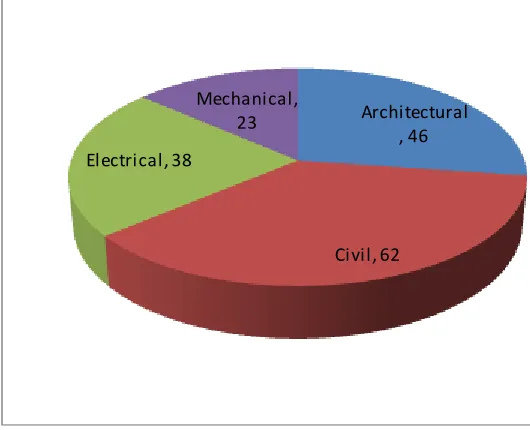
In this study, the engineers who had qualified and registered in the study will have the chance to partic ipate. The summary of the list of engineers and their background is shown in table (1.1) and figure (1)
Table (1.1) Major Total Senior ( more
than 10 years experience)
Executive ( less than 10 years experience)
1 Architectural 46 17 29
2 Civil 62 24 38
3 Electrical 38 8 30
4 Mechanical 23 7 16
Total 169 56 113
Fig. 1. Participants Engineering Counts and Backgrounds
3.1 Semi interviews
The short interviews were he ld in two d ifferent locations; engineering consultant office and construction site. During the first session, the researcher had the chance to meet with some senior engineering staff and to obtain some valuable informat ion about the topic of the study. During discussion sessions, the researcher was able to individually meet with some of the partic ipants and to conduct productive semi -formal interviews.
The ma in goals of the semi- forma l intervie ws were : to establish a line of contact with a group of engineers in the fie ld; to sense the level of urgency for an engineering training ; to seek opinion over the way the researcher should approach the topic; to assess the relevance, appropriateness and importance of the questions included in the questionnaires; to comment on the proposed preliminary list of tra ining tit les to be conducted; and to form an idea about the anticipated challenges.
3.2 Questionnaire Design
The ma in purpose of this questionnaire is to identify, categorize, and prioritize the current engineering tra ining needs for engineering projects at University of Ha il. The study will generate a targeted analysis and assessment of the current engineering train ing needs . Also, the study is hoping to generate responses and achieve consensus from a selected sample of mult i engineering disciplines. The anticipated findings are e xpected to contribute to establish guideline for training skills and knowledge needed to imp rove the quality of the current and future projects at UoH.
The questionnaire is divided into the follo wing five sections:
Architectural , 46
Civil, 62 Electrical, 38
• Section one is a general informat ion about the participant background and interest
• Section two is asking the participant to rate the importance of the including specific skills and abilities in the engineering training programs. • Section three is requesting the participant to
approve or deny some statements and proposed titles for engineering tra ining courses with specific number of weeks.
• Section four is asking the partic ipant to rate the level of agree ment on specific statements that are related to the engineering training.
• Section five is helping the participant to identify reasons behind the problems and delay in the current engineering pro jects at Un iversity of Hail.
3.3 Gathering Data
Questionnaires have been carried to the engineering consultant office, as the latest to return it back to the researcher after responding to the questionnaire forms. The responses were adequate but slow, wh ich forced the researcher to visit each engineering project to speed up the data collection process.
3.4 Questionnaire and Data Analysis
A questionnaire was conducted to assess urgent training needs that influence the performance and progress of the engineering projects at Un iversity of Ha il. To achieve this, (169) questionnaires were distributed to selected engineers who play a ma jor ro le in the engineering training project. The purpose of the questionnaire was to collect data to identify the decision factors and to determine their overa ll importance in the decision making process. Appendix A in the thesis includes informat ion pertaining to the survey and the collected data.
3.5 Research method limitation
The following limitations were inherent to the study: • The participants‟ input and feedback were not
uniform in value and depth. The difference was caused by the participants‟ background and seniority level.
• In spite of the explicit wording of the goals and objectives of the study, a few participants occasionally diverted from the study‟s objectives, and were occasionally off tune with some of their responses.
• The participants‟ personal and professional responsibilities limited the amount of time and effort they could invest in responding to questionnaires.
• The study was delimited to the University of Hail engineering projects.
• The study was delimited to the number of responses and feedback received within the timeline of questionnaire plan.
3.6 Questionnaire Finding and Results
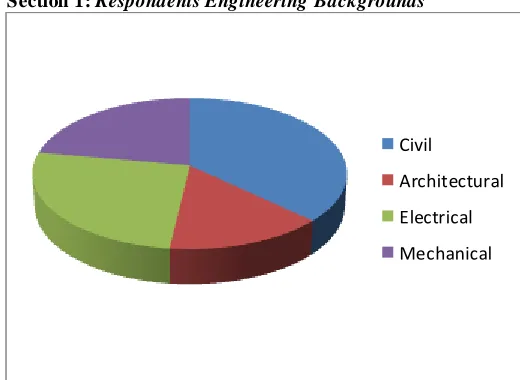
The demography of the respondents shows that most of them were e xecutive c ivil engineers (less than 10 years e xperience), wh ile the lowest respondents were senior architectural engineers figure (2).
The collected data fro m the respondents shows a high importance of inc luding the problem solving skills and the ability of materia l handling in the engineering training program figure(3). On the other hand, some of the skills rated as a moderate importance such as ability transform obstacles into opportunities. One of the reasons stated fro m the engineering consultant office was because of the lack of understanding the terminology since the English language is the second language in the KSA. Moreover, most of the mechanica l engineers rated HVA C processing principles and techniques as a very important skills to include in the engineering training programs figure (4).
It was strongly evident that there is a tangible shortage managerial and quality control skill a mong the e xecutive engineers, which most like ly generated from lo w level of orientation and continuous improvement p lans fro m the office of engineering projects in UoH.
Finally, The Yes/No questions were achieving the following:
• Enhance the significance of including specific skills and abilit ies in some suggested courses with time interval future engineering training program for UoH projects.
• Support validity of the assumption that engineering training will enhance the quality of engineering performance in UoH projects. • Develop a basic criteria for the engineering training needs
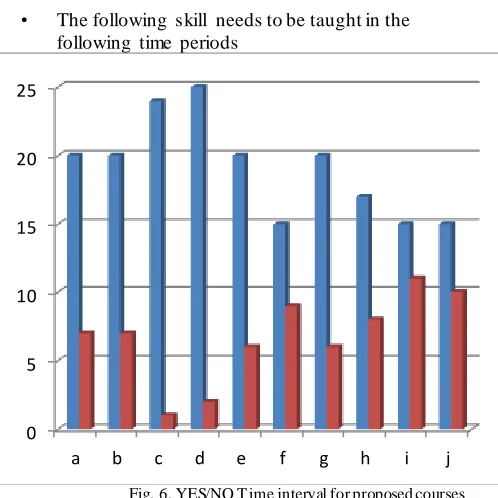
• Estimate the time interval of suggested topic in the training program
The following diagra ms show questionnaire responses distribution:
Section 1: Respondents Engineering Backgrounds
Fig. 2. Respondents Engineering Backgrounds
Civil
Architectural
Electrical
Section 2: Importance of including engineering skills and abilities in the training
• Rate the importance of including the following skills in the quality engineering training program
Fig. 3. Rating of Including Engineering skills
• Rate the importance of including the following abilities in the quality engineering training program
Fig. 4. Rating of Including Engineering abilities
Section 3: Confirmation or denying statements
• Please answer the following Yes or NO questions
Fig. 5. YES/NO Rating
• The following skill needs to be taught in the following time periods
Fig. 6. YES/NO T ime interval for proposed courses
Section 4: Agreement/Disagreement (statements Rate the level of agreement of the following statement 0
5 10 15 20 25
Q1 Q3 Q5 Q7 Q9 Q11
VI
MI
No Judgment
SI
NI
0 5 10 15 20
Q1 Q2 Q3 Q4 Q5 Q6 Q7 Q8
VI
MI
No Judgment
SI
NI
0 5 10 15 20 25 30 35
Q1 Q2 Q3 Q4 Q5 Q6 Q7
YES
NO
0 5 10 15 20 25
a b c d e f g h i j
YES
Fig. 7. Rating of importance
4. CONCLUSIONS AND RECOMMENDAT IONS This study assessed the needs for engineering training and discussed the causes of delay among the engineering projects at University of Ha il. There a re several causes for the delay, which a re co mbined into three areas, name ly late e xecutive decisions, co mmunication a mong teams, and unplanned project expansion. A questionnaire was distributed among diffe rent leve ls of engineers and a table is established to show the questionnaire results.
This research illustrates that engineering train ing is crucial to avoid poor quality and work delay. The argu ments addressed in this study aimed at minimizing, if not eliminating, a ll constraints that may lead to undes irable results. The owner of any construction project at the University of Hail shall set the criteria required for the engineering training to be conducted and assign weight for each criterion based on its importance fro m the owner‟s point of view.
Further research is recommended to develop a queuing model that should restrict or eliminate causes of delay in the construction project by managing project resources through Lean Manufacturing and Six Sig ma strategies.
RECOMMENDAT IONS
• It‟s recommended that each project owner establish a program for engineering train ing. The training progra m should be designated to cover all engineering staff to furnish a solid floor of co mmun ication among the four engineering disciplines which includes Civ il, Architectural, mechanical, and electrical engineering. • Engineers should improve the skills for handling project
constraints. A project owner may request the college of engineering at University of Ha il to provide him with training plan to enhance the ability of managing the
project safety, contract conductance, and project commissioning.
• It‟s reco mmended that a set of procedure established to restrict the delay in the construction project by managing the engineering training resources project with clea r time line synthesized with UoH projects strategic plan.
REFERENCES
[1] Crosby, Philip B. Quality Is Free. New York: New American Library,1979.
[2] Crosby, Philip. Quality Without Tears: The Art of Hassle-Free Management. New York:McGraw-Hill, 1984.
[3] Deming, W. Edwards. Out of Crisis. Cambridge, Mass.: MIT Center for Advanced Engineering Study, 1986.
[4] Broadhead, J. (February, 1991). “The Post–Deming, Diet–– Dismantling A Quality Bureaucracy.” Training. Vol. 28, No. 2. [5] Greising, David (1994), “Quality: How to Make It Pay,” Business
Week (August 8), 54–59.
[6] Al-Hammad A., and Assaf, S., "Assessment of the Work Performance of Maintenance Contractors in Saudi Arabia," ASCE, Journal of Management in Engineering, Vol. 12, No.2, pp. 44-49, March/April, 1996
[7] MMR 2012, Ministry of Municipal and Rural Affairs website, http://www.saudinf.com/main/c6t.htm
[8] KSU 2012, King Saud University website, http://ksu.edu.sa/Pages/default.aspx
[9] IPA 2011, Institute of Public Administration website, [10] http://www.ipa.edu.sa/EN/Pages/default.aspx
http://en.wikipedia.org/wiki/Institute_of_Public_Administration_(
Saudi_Arabia)
[11] SCE 2012, Saudi Council of Engineer http://www.saudieng.org/sites/searabic/Pages/default_01.aspx
APPENDIX A
Engineering Training questionnaire
Welcome to UoH engineering questionnaire for our survey on “Quality Engineering Projects Train ing.” Our hope is that your participation will help your pro ject and organization judge the effectiveness of their systems engineering practices re lative to the successes and challenges reported by you and others throughout the projects lifecycle.
The main purpose of this survey is to identify, categorize, and prioritize the current engineering projects training needs at University of Hail through questionnaire and project site interview. The study will generate a targeted analysis and assessment of the current engineering projects training needs. The study is hoping to generate responses and achieve consensus from a selected sample of mult i engineering disciplines. The anticipated findings are e xpected to contribute to establish guideline for tra ining skills and knowledge needed to improve the quality of the current and future projects at UoH.
There is no one correct response for any ite m, therefore, please considers each ite m, re late it to your knowledge in the Engineering field.
SA DA 0
5 10 15 20 25
Q1 Q2 Q3 Q4
Q5 Q6 Q7 Q8
SA
A
No Judgment
DA
Section 1.
1. What is your Job title?
2. How long have you been involved in the engineering related field?
3. In what area of engineering is your profession? Current working focus University degree
educational Focus o1 Civil
o2 Architectural o3 Mechanical o4 Electrical o5 Chemical o6 Agriculture o7 Others :
o1 Construction o2 Electro mechanical o3 Project management o4 Technical installation o5 Research & development o6 Sales
o7 Others:
Section 2.
Please use the key to answer the following questions: Very
important
Moderate Important
No Judgment
Somewhat important
Not important
VI MI No
Judgment
SI NI
1. Rate the importance of including the following skills in the quality engineering training program
VI MI No Judgment
SI NI
Project materials safety O O O O O
Failure troubleshooting and system analysis
O O O O O
Engineering Metrology equipments hands -on applications installation
O O O O O
Engineering Metrology equipment alignment and calibration
O O O O O
Techniques of preparing and modifying contracts
O O O O O
Problem-solving skill O O O O O
Soil sample preparations O O O O O
Electronic equipment instrumentation
O O O O O
Materials handling and installations
O O O O O
Engineering measurement
O O O O O
Tactics of concrete processing
O O O O O
HVAC processing principles and techniques
O O O O O
1. Rate the importance of including the following abilities in the quality engineering training program
VI MI No Judgment
SI NI
The ability to diagnose mechanical faults
O O O O O
The ability to diagnose faults electromechanical
O O O O O
The ability to diagnose mechanical failure resulting from a mismatch specifications
O O O O O
The ability to identify the immediate needs for unscheduled tasks
O O O O O
The ability to determine the times needed to complete the project
O O O O O
The ability to overcome obstacles and barriers
O O O O O
The ability to take advantage of the obstacles and impediments
O O O O O
The ability to transform obstacles and
impediments to
opportunities for success
O O O O O
Section 3
Please answer the following Yes or NO questions,
YES NO 1 Engineering projects training is an urgent
need for current UoH Engineering projects
O O
2 UoH engineering projects lack of communication between engineering branches among the new hired engineers
O O
3 UoH engineering projects lack of communication between engineering branches among the management engineers level.
O O
4 Current engineering training projects are limited to higher engineering staff
O O
5 The current engineering staff is equipped with adequate skills to meet the future needs of UoH engineering projects.
O O
6 Most of the current UoH engineering projects problems are due to lake of planning among different branches
O O
7 College if engineering visiting is a priority in the future training plan for quality engineering training
O O
a Technical engineering project commissioning
8 weeks O O
b System engineering Dynamics 2 weeks O O
c Contract 2 weeks O O
d Engineering communication skills
4 weeks O O
e Project management 16weeks O O f Hands-on mechanical system
troubleshooting and malfunctioning
4 weeks O O
g Hands-on electrical system troubleshooting and malfunctioning
4 weeks O O
h Hands-on mechanical system troubleshooting and
malfunctioning
4 weeks O O
i Lean manufacturing Techniques
4 weeks O O
j Six sigma Methodology 4 weeks O O
Section 4.
Please use the key to answer the following questions: Strongly
Agree
Agree No Judgment
DisAgree Strongly Dis Agree
SA A No
Judgment
DA SDA
Rate the level of agreement of the following statement:
SA A No
Judgment
DA SDA
UoH current projects have not changed significantly throughout the life of the project to-date
O O O O O
The requirements for this UoH current projects are not well-defined
O O O O O
The engineering project team has successfully completed projects similar to UoH current projects in the past
O O O O O
The quality engineering training project makes effective use of integrated engineering teams
O O O O O
UoH and the local companies should participate in the quality engineering training project
O O O O O
Significant constraints are placed on the quality attributes (e.g.
reliability, Scalability, security, supportability, etc.) of the engineering training project
O O O O O
UoH current projects technically challenging
O O O O O
Sufficient resources (e.g. people, funding) are available to support the project
O O O O O
Section 5.
Please Answer the following questions and comment on any of them when you feel it is necessary?
• How many times have you had to re-do the work required of you because of the lack of coordination with other engineering teams?
……… • How many times have you had to delay completion of the work required of you because of errors caused by a lack of coordination with other engineering teams?
……… • How many times have you had to delay completion
of the work required of you because you cannot communicate with other engineering teams? ……… • How many times have you had to delay completion
of the work required due to delayed supply of material from the engineering departments competent?
……… • How many times have you had to delay completion of the work required of you because mistakes are not you?
……… • How many times have you had to delay completion
of the work required of you because of mistakes made by your colleagues in the working group? ……… Comments
……… ……….
……… ………