Abstract— Considering architecture as a spatial art, the paper examines the nature of ongoing change in the design of architectural spaces, in accordance with the profound conversion in the nature of social existence on Earth. The study aims to tackle the issue mainly from a morphological standpoint with cross-references to sociological dimension of space. Recently, some started to believe that virtue s of modernity were not capable of coping with the emerging diversity and complexity brought by new bodies, who were gradually introduced into the urban scene through democratisation. Therefore, the de(con)struction of the canons of the modernism was the only solution in order to achieve a new phase in the material evolution of humankind. S patial reflection of such an ongoing social transformation, that is to say, a major shift from „an ideal society centrally controlled by corporate groups‟ to a much more pragmatic one with „flexibility of control systems‟ is of prime concern in this study. In other words, a paradigm shift from „rational and sensible‟ state to a „chaotic, yet, perverse‟ state of human condition, in the name of freedom, is central to the discussion of the evolution of space design. In brief, newly emerging social and corresponding spatial phenomena seem to have took over, our cultural landscape via guerrilla war tactics, and was supported by scholars, who advocated the „death of architecture‟ for the sake of proliferation of low culture. Albeit, an initiative with good intentions of integrating all parties of the community, turned out to be working against the sense of community. Hence, the very same issues of social concerns seem to have shifted from socialist rhetoric towards the hands of a more capitalist rhetoric. Therefore, the new power and her weapons should be disguised in a seducing new skin... Fluid architecture of late 90‟s was the ideal new mediatic solution... In result, values characterised by grace, coherence, consensus, durability, order, have been replaced by pride, unquestioned wealth, corruption, falsification, distortion, humour, irony, nihilism, and „in-your-face-attitude‟ of the new generation of
Murat Cetin is with the Kadir Has University, Dept. of Int. Architecture, Central Campus, Cibali, 34083, Istanbul, T urkey (phone:
+90-533-344-9003; fax: +90-212-533-5853; e-mail: [email protected]).
citizens. Masochistic experience of contemporary urban life, grotesque images of environment, the parasitic and violent character of architecture, yet seductive outlook of their figures have fascinated the minds of the new (yet perverted) urban population. Hence, a fluid, vague, indeterminate archi-tectonic language was becoming politically correct decor for a rapidly eroding society. In fact, this new architecture should be evaluated within the web of concepts like otherness, utopia, fantasy, media, Post-Modern popular culture, consumption, marketability, pluralism, as well as the shift in the conception of “reality and simulation”.
In this study, it is argued whether architects, as spatial artists, should shift their focus from the timeless qualities, tectonic virtues and ethical principles of modernism towards transient, ephemeral imagery of this fashionable formalism, simply because, capital is shifting hand from the former-elite towards neo-elite (formerly accepted as underground, grunge, illegal, disapproved, etc.). The decisi on obviously constitutes a fine line between architecture and prostitution in an age of social hysteria, schizophrenia, fetish, frenzy, disintegration, fragmentation, and thus, perversion. The argument is primarily based on the question of whether new vocabulary of fantastic images is an avant-garde formal jamborine, recurrent trend or fashion-like movement, or alternatively a major breakthrough in the sociological, epistemological, hence architectural frameworks..
I. INTRODUCTION
Architecture can be conceived as a form of art which deals directly with space (Gideon, 1941; Zevi, 1961) [1]. Besides, space can be considered as a medium by which social structure could be interpreted (Rapoport, 1982; Hillier et al., 1984; Lefebvre, 1991) [2]. Thus, architecture can be assumed as a public art since space, by its nature, belongs to community, in other words, it is public commodity. The history of architecture reveals the correlations between the formal language of spatial configuration and the sociological evolution of humankind (Watkin, 1992; Gombrich, 1964) [3]. This paper concentrates on the parallelisms between the ongoing radical sociological transformation (that can be defined as „perversion‟ by various sections of the society) and the epistemological transformation
Preaching to the Perverted (Spaces);
Perversion in Architecture
-
as an Art of Spatial Design
in the conception of architectural space. The paper argues that architecture (as space making) has a dual responsibility to both the patron and public, and unfortunately, it may seem to have started losing its critical, thus social, duty. In fact, by appropriating the “shock of the new” (Hughes, 1991) [4], current formal language of space is claimed to represent the increasing freedom of the “other”, that is to say, daily and ordinary life of layman, minorities, women, children and aged people, who were formerly neglected. However, this paper will attempt to put forward not only how neither space nor humanity could be liberated via this new formal vocabulary, but also how new space seems to be capitalised and disguised in a seductive make-up. It can be suggested that what has been liberated has merely been the ego of the architect (which is supposed to be bounded by various social restrictions unlike the artist) and that of the patron. This paper does not intend to argue whether or not this new formal language of space design has artistic or intellectual value. On the contrary, although the new-space may carry assets in artistic and intellectual terms, this study suggests that new-space might not seem to emerge as what it claims to be; that is to say, it does not appear as the spatial manifestation of the latest phase in the evolution of humanity towards freedom. Nevertheless, it does seem to be a testimony of frenzy and perversion as the latest stage in the evolution of society.
The ongoing social transformation can be simplified as the capital shift from the former-elite (expected to be educated and aristocrat) towards nouveau-elite (formerly accepted as underground, grunge, illegal, disapproved, etc.). This shift manifests itself with the transformation from highbrow culture to lowbrow culture, as Virginia Woolf once asserted. The present state of the culture today is defined as nobrow culture (Foster, 2004) [5]. Moreover, the spatial manifestation of this paradigm shift appears as a disguise simply because such a shift did neither genuinely stem from the realities of the larger body of public, nor as a result of a public revolution. It has rather emerged as a result of the need for the expression of intellectual evolution of the cultural elite (Derrida, 1976; Deleuze et al., 1987) [6]. It is argued here that producers, dealers and users of art (and architecture as the art of space making) should be aware of this kind of disguise and distinguish between the real and what is beyond the reality. By the same token, the paper also argues that architecture (as a spatial form of art) should not miss its own critical essence since art, as an intellectual and democratic activity, positions itself to criticise on behalf of the virtues of public. Paper further discusses whether architecture should merely serve the requirements and trends of the capital, or alternatively should
turn back to its own roots and conduct intrinsic principles. Along this route, the paper, in which the evolution of the theory of architecture (Kruft, 1994) [7] is elucidated, consists of the following successive chapters; firstly, the transition from modernity to post-modernity is discussed. Afterwards, the ongoing change is elucidated in order to see if it can be called as a social revolution or a global perversion. In the following chapter, the impact of the post-information society on the life in these new-spaces is analysed. Then, the position of architecture as space making and new-space production under the impact of consumerism is argued in the light cast by the power of media. Finally, the role of architecture as a critical activity and standpoint is re-evaluated.
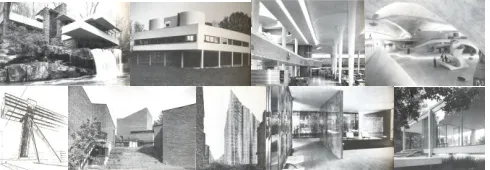
Fig. 1. Understanding of Space in Various Fractions of the Modernist Approach
II. TRANSFORM ATION OF FORM ALLANGUAGEOF
SPACEBETWEENMODERNITY AND POST-MODERNITY
The main argument in this paper is intended to be based on the “evolution of form (of space)” in architecture from Modernity to the present era, as the representation of a sociological transformation emerging all over the world. Perez-Gomez [8] (1983) asserts that the crisis of modernity (modern science, modern art & architecture) dates back to 18th century when the autonomy of the geometry from its symbolic attributes occurred. The failure of modern architecture in coming to terms with the essential question of meaning coincides not only with the emphasis on the functionality of the Industrial Revolution, but also with the divorces between; material & spiritual as well as form & content. Thus, this study attempts to capture the modernity within a much larger span, particularly from a
historical perspective (Baudelaire, 2003) [9] in which modernisation of political life is associated with modernisation of arts. Therefore, what we see as a reaction to modernity may simply be a minor inflection point within the overall curvature of modernity within the wider graph of cultural evolution in history.
One of the main targets of modernity was democratisation of people. In that sense, it was an avant-garde movement, accommodating various successive or synchronous fractions including; Neo-plasticism, De-Stijl, Purism, Expressionism, Constructivism, Brutalism, Regionalism, Vernacularism, etc. (Figure 1). The critical dimension was essential, until it started to be capitalised (Chin-tao Wu defines it as the Privatisation of Culture) [10], (Figure 2). Later, it was named with different names such as; post-modernism, new-modernism etc. It seems that these are the latest stages, which are of non -critical character, of the modern movement in architecture.
For some reason, recently, some started to believe that virtues of modernity were not capable of coping with the emerging diversity and complexity brought by new bodies (Jencks, 1995) [11], who were gradually introduced into the urban scene through democratisation. Therefore, the
de(con)struction of the canons of the modernism (Derrida, 1976) [12] was conceived as the only solution in order to achieve a new phase in the material evolution of humankind (Figure 3). The reason for such a transformation was that the
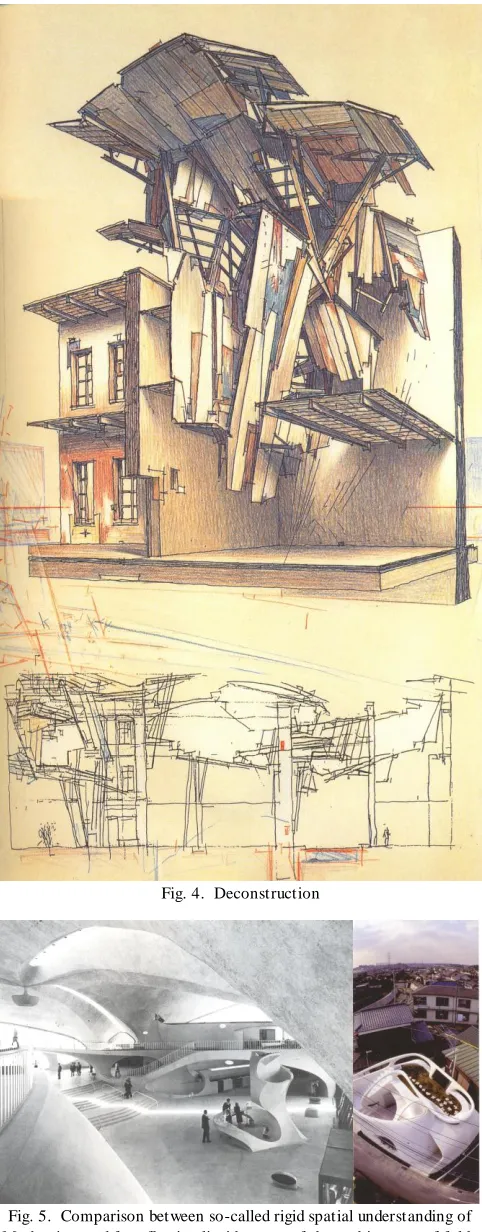
Fig. 4. Deconstruction
Fig. 3. Deconstruction
Fig. 5. Comparison between so-called rigid spatial understanding of Modernism and free-flowing liquid spaces of the architecture of folds
field of architecture needed some kind of radical o pposition. However, this demand was over exaggerated by the artists and it appeared as a type of anarchy (Ward, 2000) [13] in architectural language of form (Figure 4).
Inevitably, this new type of rebellious formal language was purchased by the corporate sector both as a new material to be marketed to emerging nouveau-rich and new-cultural-elite, and also as a precaution against the possibility of a genuine public revolt (Chomsky, 1957) [14]. As Chin-tao Wu stated [15], art was manipulated along the governmental strategies and was monopolised with the intervention of companies into art. This new formation was concealed under the umbrella of “post-modernity”. Politics was being aestheticised as Habermas was warning. As a matter of fact, all commodities (including space) needed continuously changing faces in Post-Fordist production systems (See Simmel, Kraucer, Benjamin, Harvey
and Sassen) [16]. However, some suggest that “post-modernity” is a critical stage within the ““post-modernity” itself rather than being a totally new phase or era. Moreover, it is not possible to claim that modernism is totally ruled out simply by looking at the indications of this seemingly recent architectonics of space such as;
the expression of the structure of space,
precision of measurements,
use of technology and pre-produced components,
free-flowing space,
Independence from the context, etc. (Figure 5)Therefore, a new type of opposition is demanded rather than the destruction of the canons of modernism or even those of classicism. What the formal features of this new type of opposition will be is yet to be seen. If we return to the formal characteristics of ongoing trend (Gelernter, 1995) [17], one can suggest the following; the uncontrollable freedom of form appears not only as the reminders of childish fantasies (Vidler, 2000) [18], but also the expression of (so-called) democratic disorder (Jencks, 1982) [19]. It is the expression of the splendour and misery of the density in a raging space
(Koolhaas, 1994) [20]. Tectonic language of deconstructive
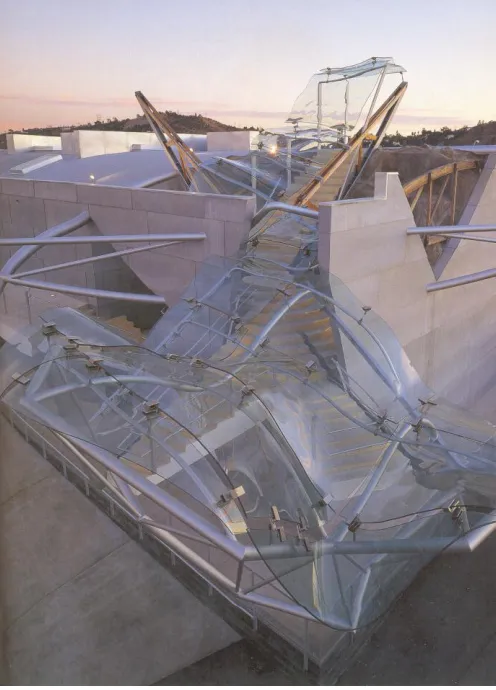
architecture, for instance, emphasise the complacency and instability of the society today through the tension amongst the structural elements (Figure 6). Fluidity of the forms appears to verbalise not only the carelessness and irresponsibility of the society, but also the vagueness in the social coherence and erosion in the public values (Figure 7).
Lightness and transparency of forms seem to further accentuate the ephemeral nature and destruction of the Fig. 6. Deconstructive T ectonics as the representation of
Complacency & Instability of T oday‟s Society
Fig. 7. Fluidity of Forms Verbalising Carelessness, Irresponsibility of T oday‟s Society
virtues regarding coherence, consistency, reliance etc. (Figure 8). It is of prime interest, at this point, how this radical transformation has emerged in the social history of humanity.
III. GLOBALSOCIALREVOLUTIONORGLOBAL PERVERSION
As mentioned above, humanity has been witnessin g an incredibly rapid metamorphosis throughout the entire world influencing the every aspect and dimension of life on earth. When the early beginnings of this process were budding, either utopias or reactions were sweeping along the intellectual circles all over the world. At the beginning of the 20th century, Modernism, as an avant-garde movement (See Peter Bürger [21] ), was a radically revolutionary and a left wing attitude particularly at its early stages. However, it was capitalised soon after and became the formal language of corporate bodies. It was innovative yet critical. Unfortunately, soon after its debut, it lost its critical stance; it has started to become a
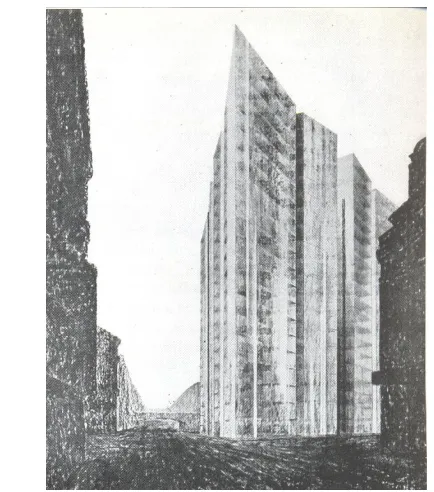
corrupted way of “preaching” to status quo through high -rise glass boxes of Mies Van Der Rohe (Figure 9). Thus, Utopia became a distopia for the sake of being spread all over the world (Tafuri, 1973) [22]. In fact, spread of a democratic movement via innovative forms was a utopia simply because such a spread was only possible via a building boom which could only be regulated by corporate sectors of the society. Hence, it was self-contradictory. Therefore, the idea of “democracy” has started to sail away not only from the shores of modernism towards the virgin coasts of Post-modernism, but also from the left to the right wing positions.
Today, a similar social transformation is being witnessed. This transformation is advocating the liberation and democratisation of the larger sections of the society towards a better, freer and totally democratic way of living. That is to say, the new social transformation occurs as a major shift from „an ideal society centrally controlled by corporate groups‟ to a much more pragmatic one with „flexibility of control systems‟. Lyotard (1990) defines this era as the age of relaxation and abandonment [23]. This change seems to suggest, however, a paradigm shift from „rational and sensible‟ state to a „chaotic, yet, perverse‟ state of human condition, in the name of freedom. However, this new movement was also trapped by the same corporate parties of the society. The battle was won through a genius use of globalism, popularism and consumerism (Baudrillard, 1981; Foucault, 1973) [24]. The arms of the advocates of “the new liberation army” were already twisted. Thus they were once again “preaching” to the perverted…
Art has always been a device for the expression of the social struggle throughout time all over the world. At the beginning, social struggle was in the form of a battle between the tyrant and the silent majority of folks. Since art was primarily controlled by the ruling body (lords, kings, rulers, emperors, religious leaders, etc.) views of the opposition was partially expressed by the literature. Later, the social struggle was regulated under the control of a central authority (Monarchies, State, Government, Senate, Parliament, etc.), however, the balances between the different parties of the society was not yet settled. The big difference between those who were powerful and those were not was climbing towards a new form of struggle. In parallel, classical art, in particular, was imposing various rules, regulations, systems, and hierarchy in all designs as the expression of a generally accepted elite class and a standard bourgeoisie, deliberately pushing “the other” aside. Meanwhile, the reaction of the masses for freedom was about to explode in form of revolutions. Art, for the first time, was telling a different story of “the other”; in other words, that of oppressed, that of layman, that of poor etc. Art, for the first time was taking its critical stand. The fight of humanity for more and more freedom did not end yet. The form of reaction is changing and we are witnessing guerrilla wars and anarchy in various places of the world. Art is not only addressing these political and socio-economic matters but also struggling against sensitive public issues such as; mechanisation of man (Seltzer, 1992) [25], destruction of nature and ecology. Art is Fig. 9. Glass T owers of Mies Van Der Rohe
Fig. 1. Lightness & T ransparency of Forms emphasising the Ephemeral Nature of T oday‟s Society
also advocating the rights of minorities, gays, and accentuating sexual freedom, feminisim etc. In sum, art has a social and critical position which cannot easily be sacrificed for the sake of patrons´ and artists´ own good.
Art was exploiting the unlimited need for freedom to an unlimited extend. However, there is a fine line between perversion and freedom. In our age, which can be characterised by; corruption, violence, horror, pathology; paranoia, schizophrenia, etc., visual and formal consequences of the current art seem to represent a state of ORGY. As a matter of fact, such a formal perversion is not totally unexpected in a society and era which can easily be conceived as the age of frenzy. Virilio‟s definition of our era through the side products of speed, that is to say, accidents, disasters, explosions, is parallel with his recent conception of human condition today (in his latest book Art & Fear) as the fear of other, which is tried to be overcome via corporate security forces instead of the public police force [26]. D.Frizby‟s conception of modern city as something inspiring insecurity and fear also reinforces this view [27].
Today, on the other hand, another process is taking place. Art clientele today seem to have changed; from the classical elite towards a younger new elite with different backgrounds and fields of interest. Art, on one hand, seem to approach the artistic requirement of the new owners of the capital. On the other hand, art seems to represent all aspects of opposition but, at the same time, both the artists and their works appear to distance themselves from the opposition towards the central authorities and corporate bodies. The major reason is that art is also industrialised. Thus, art is in a difficult position between the masses as its consumer and corporate sector as its financer. Therefore, art seem to have developed a double-faced attitude with the help of image-oriented cultural infrastructure in order to overcome this paradox caused by the sudden and radical shift in capital ownership.
Albeit, an initiative with good intentions of integrating all parties of the community under the “magic” of “freedom for all”, turned out to be working against the sense of community. Hence, the very same issues of social concerns seem to have shifted from socialist rhetoric towards the hands of a more capitalist rhetoric. Claim or battle for freedom seems to have lost its ground as it becomes exploited by corporate sector. The new power (of the corporate capital) and her (artistic and spatial) weapons should be disguised in a seducing new skin (Till, 1999) [28]. Fluid architecture of late 90‟s was the ideal new mediatic solution for this type of disguise.
In brief, newly emerging social and corresponding spatial phenomena seem to have took over, our cultural landscape via guerrilla war tactics, and was supported by scholars, who advocated the „death of architecture‟ for the sake of proliferation of low culture, which is the major resource in post-modern era.
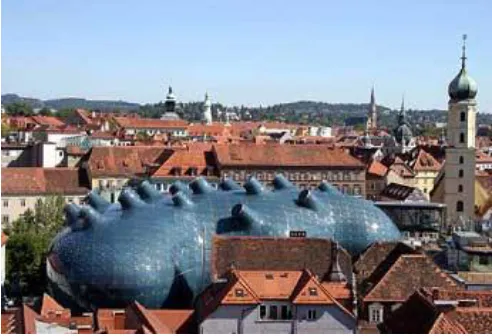
So, what could be the next? Now, new-born fluid architecture of folds and blobs is a new trend to be followed by all architects all over the world since the capital is globally turning around the various countries. It is followed to a great extent, but most of the time it is followed for the sake of it or as
a marketing tactic. If it is assumed as the latest phase in the evolution of the humanity towards freedom, and current spatial art is accepted as its artistic expression, one is tempted to ask whether there is a new formal phase lying further ahead. Or, is this a formal jamborine expected to cycle back in history, similar to baroque or mannerism followed by neo -classical revivals? It is rather difficult to answer.
Nevertheless, it is a fact that long-established social values have been shaken along with the long-established tectonics of architectural spaces. Today, publicly accepted virtues such as; coherence, solidarity, balance, strength, dignity, elegance, beauty, dependence, trust, communal consciousness, have almost disappeared, while we, the artists, were experiencing
with liberated forms in fluid spaces. The counter-values of a practically “perverted” society are assimilated and even domesticated as accepted merits. Above-listed values are immaterialised. The vagueness of existence on earth is appropriated as a new way of living, social behaviour and physical manifestation, or giving meaning to this nihilistic view of human condition on universe.
IV. POWEROFMEDIAANDCOMPOSITIONOFSPACES
Architecture has recently started to serve as a new package in order to market the products of corporate building sector. Marketing through a new package necessitated the use of a new media (Ramonet, 2000) [29]. In a society which has dogmatic belief in media, the arts have also been pumped -up by the media. Liquidity, or fluidity of space via folds and blobs, has also been characteristics that are appropriate for this image
Fig. 10. Contemporary T ypes of Spaces Emerging with Social T ransformation
consuming mechanism. As discussed above, values characterised by grace, coherence, consensus, durability, order, have been replaced by pride, unquestioned wealth, corruption, falsification, distortion, humour, irony, nihilism, and
„in-your-face-attitude‟ of the new generation of citizens. Masochistic experience of contemporary urban life, grotesque images of environment, the parasitic and violent character of architecture, yet seductive outlook of their figures have fascinated the minds of the new (yet perverted) urban population through the power of media.
What is unfamiliar, interesting (no matter how strange it could be), becomes the most wanted in this tv/video oriented media (McLuhan et al., 1989) [30]. Hence, new types of spaces have been emerging; global spaces, post-industrial spaces, fashionable spaces, humorous spaces, criminal & violent spaces, grotesque spaces, zoomorphic spaces, queer spaces etc. (Figure 10).
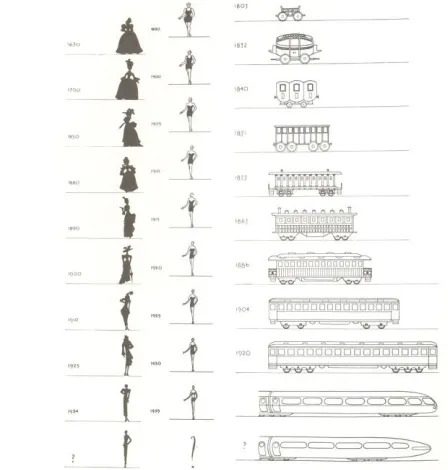
Fashion among these concepts is one of the most influential over the masses. The parallels between fashion and design of spaces and objects have long been studied. The similar processes that evolutions of both design objects and fashion objects have gone through is clearly put forward by Leowry (Figure 11). His study of the evolution of the silhouette is a typical example of this sort. The impact of obsession with the fashion manifests itself with the emergence of the concepts like; Trademark Design Objects, Houtte couture pieces, Transparency, Seduction in the design of spaces (Figure 12).
Another significant concept popularised by the media after fashion is the crime (Foster, 2004) [31], violence and horror. The impact of obsession with the violence and horror manifests itself with the emergence of the concepts like; grotesque images, irregular forms and amorphous shapes, intense use of colours, unmannerly treatment of surfaces and turbulent use of lighting in the design of spaces (Figure 13).
Furthermore, sexuality and pornography has also dominated the content of the media. The impact of obsession with the sexuality and eroticism manifests itself with the emergence of the concepts like; formal fetish (Pietz, 1993) [32], visual orgy, matters of gender, masculine and feminine forms in the design of spaces (Fig. 14).
The concept of entertainment is also another driving force in the formation of space in a culture of entertainment dominated by show-business. Impacts of globalisation, increasing wealth and developments in technology as well as in popular culture; music, cinema, tv, have been reflected Fig. 11. Parallelism with the T ransformation in Fashion and Design
Fig. 12. Impact of Fashion in Design of Objects and Spaces (trademark objects & spaces, and transparency)
Fig. 13. Impact of Violence in Design of Objects and Spaces
Fig. 14. Impact of Sexuality and Eroticism in Design of Objects and Spaces
altogether in the entertainment sector as the new market. The new concept of entertainment have gradually changed from simple and passive “relaxation and recreation” towards “breaking away from monotony” and taking active part in “extraordinary events or happenings”. Such a change inevitably necessitated “fast consumable” spaces. Additionally, advances in image, sound and lighting systems have transformed the conception of space. Thus, entertainment value of spaces became another criterion in the design of architectural spaces.
The age of madness seem to establish its very own “architecture of madness”, rather than the new era creates the architecture of freedom. All the above discussed issues could be addressed in a much more articulate and sophisticated manner as could be seen within Modernism. However, the new
conception of space prefers to tackle them in a much more vulgar manner as does the bully media.
When these ostentatious spatial images are further disseminated through Mimetic Processes (Blackmore, 1999) [33], architectural imagery of “perversion” becomes unquestionably established. Hence, a fluid, vague, indeterminate archi-tectonic language was becoming politically correct decor for a rapidly eroding society. In fact, this new architecture should be evaluated within the web of concepts like otherness, utopia, fantasy, media, Post-Modern popular culture, consumption, marketability, pluralism, as well as the shift in the conception of “reality and simulation”.
V. POST-INFORMATIONSOCIETYANDLIFEIN
SIMULATEDSPACES
Radical leaps in technological advances, profoundly transform the way people conceives art (Mitchell, 1994) [34]. The concept of simulation (Baudrillard, 1994) [35] with the help of increased ability of computation seems to have enabled the creation of a marketable imagery of space (Foucault, 1973) [36]. Although this new visual revolution is welcomed by the profession, the real problem was the possibility of realising this abstract image in concrete with the current building technologies. Moreover, further production, re-production and re-presentation of this new space unavoidably (yet magically) blurred the borders between real and virtual (Mitchell, 1996) [37]. Inevitable consequences of this phenomenon were manifold. It was meant to weaken the tectonic conditions and traditions in which architecture is evolved. Its seductive nature was meant to cause one to discard its true assets simply because of its market value. Its popular merits seem to have pushed its social responsibilities aside. Was it architecture anymore?...
VI. WHATABOUTARCHITECTUREANDCRITICISM?
Nobody dare to question the current art, but criticism as an attitude should be essential in art. In that sense, tectonics that is associated with the values as the manifestation of solidity seem to have been sacrificed at the peril of showing the abilities of the form-makers. Whether architects, as spatial artists, should shift their focus from the timeless qualities, tectonic virtues and ethical principles of modernism towards transient, ephemeral imagery of this fashionable formalism, simply because, capital is shifting hand from the former-elite towards neo-elite (formerly accepted as underground, grunge, illegal, disapproved, etc.) constitutes one of the major problems architects are facing today. The decision obviously constitutes a fine line between architecture and prostitution in an age of social hysteria, schizophrenia, fetish, frenzy, disintegration, fragmentation, and thus, perversion. For instance, the unbelievable change in Philip Johnson‟s designs, from Farnsworth house to Gate House, and the radical change in his attitude towards design mottos, from “ less is more” to “less is bore”, and eventually to “ I am a whore” clearly exemplifies this fine line. The decision should also take into account the social responsibility of architecture as an art of mak ing spaces for people. Architecture should question the current age on behalf of the larger masses of public who thinks they are not yet totally perverted.
VII. CONCLUSION
One must note that some forms of avant-garde art (ranging from Art-Nouveau to Fluid Architecture), which intend to unite art with daily and ordinary life, deliberately amalgamates the subject (artist or patron) and object (space) of her own art, as well as its use-value and art-value in order to blur the boundaries between distinctions. Therefore, according to Foster (2004) [38], they can be considered as regressive. Fig. 15. Architectural Representation of the Superficiality of Virtual
Spaces
Fig. 16. T he Loss of the Magic of Seduction through the Realisation of Architectonic Space
International Journal of Civil & Environmental Engineering IJCEE-IJENS Vol:13 No:01 49
Therefore, they are obliged to be banalised, unlike modern art, which prefers to accentuate the distinctions.
Physical manifestation of the idea of democracy seems to have shifted from modernist architectural language towards a formal vocabulary of fluid architecture, or architecture of blobs and folds. But such representation appears to have a skin -deep superficiality, particularly with virtual renderings of these spaces (Figure 15). It is extremely seductive to the eye, yet when they are built as real objects; their magic is immediately lost (Figure 16). Therefore, it can be conceived as a deliberately designed mask used for camouflage. So, one can suggest that what is democratic is not the form of the space itself but its intrinsic value. As can be summed up, both post-modernity and post-information have also been rapidly capitalised too. So what‟s going to be new?
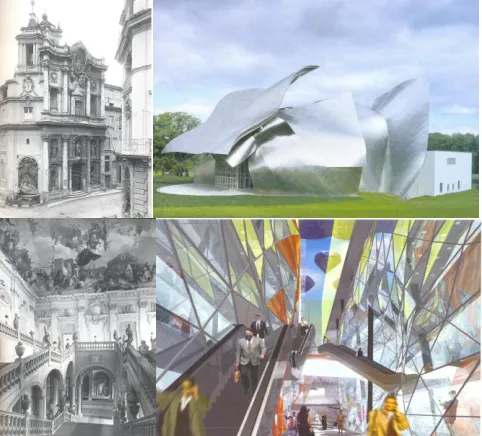
It is rather difficult to decide whether new vocabulary of fantastic images is an avant-garde formal jamborine, recurrent trend or fashion-like movement, or alternatively a major breakthrough in the sociological, epistemological, hence architectural frameworks. Nevertheless, it could be easier to suggest that it is certainly not new and not reflective of the current era but can be viewed as an u pgraded version of Baroque mannerism within modernism. If one recalls Foster referring to Bürger, Art-Nouveau (as an avant-garde phase in modernism) was aiming to unite art with life. Artist was hoping to transform the society through the arts. Also, Baroq ue, as a reaction to Classical canons of art, can be precedents of today‟s liquid spaces, particularly when evaluated in parallel with the perversion in the social life of the aristocracy in the 17th century up to the French Revolution. Furthermore, the re-emergence of detached surfaces, which first appeared in Baroque Era, in accordance with Semper´s “theory of skin” in architecture, enhances the view that today‟s fluid architecture of “blobs and folds” is a contemporary version of the Baroque relief from the Classicism, in other words, a mannerist fraction within modern movement (Figure 17). In fact, there may be no real need for a “new”, critical assets of modern itself would suffice to create novelty in architecture. There is no need to be
insane in order to be able to creative or authentic.
To sum up, space is essentially a public commodity, and therefore, it can be monopolised neither by the capital nor by the architect. New formal language of space seems to represent some kind of (i.e. technological or artistic) freedom with the free-flowing forms, particularly when compared to the seemingly rigid tectonics (principles) of modernist (as well as classical) space. However, none of these forms are totally new in history. One could easily trace their roots either in Baroque Mannerism or Modern Expressionism.
Consequently, artists of space making should not necessarily always preach to the perverted but simply be critical, since artists should be in opposition as their social duties call them. Furthermore, what is essential in architecture should be unveiling all disguises, including the most attractive or the most mediatic ones. Doubtlessly, every artist, every architect is free to choose between solidity, heaviness and fluidity or lightness.
REFERENCES
[1] Gideon, S., 1941. Space, Time and Architecture, Camb., Mass., Zevi, B., 1961. Architecture as Space, Horizon Press; New York.. [2] Rapoport, A., 1982. The Meaning in the Built Environment; A
Non-Verbal Communication Approach, Sage: Beverly Hills; Calif.:
London, Hillier, B. & Hanson, J., 1984. The Social Logic of Space, Cambridge UP; Cambridge, Lefebvre, H., 1991. The Production of
Space, Basil Blackwell; Oxford.
[3] Watkin, D., 1992, A History of Western Architecture, Laurence King; London, Gombrich, E.H., 1964, “ T he Evolution in the Arts”, British Journal of Aesthetics, V.4, pp.263-70.
[4] Hughes, R., 1991. The Shock of the New, T hames & Hudson; London.
[5] Foster, H., 2004. Tasarım ve Suç, İletişim; Istanbul. [6] Derrida, J., 1976. Of Grammatology (tr. G.C. Spivak), John
Hopkins UP; Baltimore, Deleuze, G. & Guattari, F. 1987. 1000
Plateau; Capitalism & Schizofrenia (tr. B. Massumi), University of
Minnesota Press; Minnesota.
[7] Kruft , H.W., 1994, A History of Architectural Theory, Zwemmer; London.
[8] Perez-Gomez, A., 1983. Architecture and Crisis of Modern
Science. MIT Press; Camb., Mass.
[9] Baudelaire, C., 2003. Modern Hayatın Ressamı, İletişim; Istanbul. [10]Wu, C., 2002, Privitizing Culture; Corporate Art Intervention Since
1980s,Verso : New York.
[11]Jencks, C., 1995. The Architecture of a Jumping Universe, Academy Editions; London.
[12]Derrida, J., 1976. Of Grammatology (tr. G.C. Spivak), John Hopkins UP; Baltimore.
[13]Ward, C., 2000, Eylemde Anarşi, Kaos; Istanbul.
[14]Chomsky, N., 1957. Syntactic Structures, T he Hague; Paris. [15]Wu, C., 2002, Privitizing Culture; Corporate Art Intervention Since
1980s,Verso : New York.
[16]Simmel, G. (1950). T he metropolis and mental life (1903). In K. H. Wolff (Ed. & T rans.), The sociology of Georg Sim m el (pp.
409-424). New York: Free Press, Kracauer, S. (1995). T he cult of distraction. In T . Y. Levin (Ed. & T rans.), The Mass
Ornam ent (pp. 323-330). Cambridge, MA: Harvard University
Press, Benjamin, W. (1986). Paris, capital o f the nineteenth century. In P. Demetz (Ed.), Reflections: Essays,
Aphorism s,Aautobiographical Writings. New York: Schoken,
Harvey, D., (1991), The Condition of Postm odernity; An Enquiry
into the Origins of Cultural Change, London: Wiley-blackwell,
Fig. 17. Parallelisms Between the Spatial conceptions in Baroque and Fluid Architecture
Fig. 1. Term inator and Yona Friedm an's Paris Proposal represent two different dimensions of the Body- Machine Com plex as a model to understand transformation
Sassen, S. (1991). The Global City: New York, London, Tokyo. Princeton, NJ: Princeton University Press.
[17]Gelernter, M., 1995. Sources of Architectural Form; A Critical
History of Western Design Theory, Manchester UP; Manchester.
[18]Vidler, A., 2000. Warped Space; Anxiety in Digital Culture, Power Institute, Sydney University; Sydney.
[19]Jencks, C., 1982. “Non-Linear Architecture; New Science = New Architecture ?”, British Architecture (ed. A.C. Papadakis), Academy Editions; London.
[20]Koolhaas, R., 1994. Delirious New York, Monacelli Press; New York.
[21]Bürger, ..
[22]T afuri, M., 1973. Architecture and Utopia; Design and Capitalist
Development. MIT Press; Camb., Mass.
[23]Lyotard, J.F., 1990. Post-Modernizm, Ara Yayıncılık; Istanbul. [24]Baudrillard, J., 1981. For a Critique of the Political Economy of the
Sign. T elos Press; St. Louis, Foucault, M. 1973. Order of Things;
An Archeology of the Human Sciences, Vintage Books; New York.
[25]Seltzer, M., 1992. Bodies and Machines, Routledge; New York. [26]Virilio, P., 2003. Art and Fear, Continuum International Publishing
Group; London, New York, Virilio, P., 1998. Speed and Politics;
An Essay on Dromology, Semiotext(e); Columbia University Press;
New York.
[27]Frizby, D., 2001, Cityscapes of Modernity; Critical Explorations, Polity Press: Cambridge, Frizby, D., 1985, Fragm ents of
Modernity; Theories of Modernity in the Work of Sim m el , Polity
Press: Oxford.
[28]T ill, J., 1999. “T he Vanity of Form”, The Journal of Architecture, V.4, pp.47-54.
[29]Ramonet, I., 2000. Medyanın Zorbalığı (tr. A.Derman), Om Yayınevi; Istanbul.
[30]McLuhan, M. & Powers, B.R., 1989. Global Village;
Transformations in World Life and Media in the 21st Century,
Oxford UP: Oxford.
[31]Foster, H., 2004. Tasarım ve Suç, İletişim; Istanbul.
[32]Pietz, W., 1993. Fetishism as Cultural Discourse, Cornell UP; Ithaca.
[33]Blackmore, S., 1999, Meme Machine, Oxford UP; Oxford. [34]Mitchell, W.J., 1994. Reconfigured Eye; Visual Truth in the
Post-Photographic Era, MIT Press; Camb., Mass.
[35]Baudrillard, J., 1994. Simulacra and Simulation. University of Michigan Press; Ann Arbor.
[36]Foucault, M. 1973. Order of Things; An Archeology of the Human
Sciences, Vintage Books; New York.
[37]Mitchell, W.J., 1996. City of Bits; Space, Place & Infobahn, MIT Press; Camb., Mass.
[38]Foster, H., 2004. Tasarım ve Suç, İletişim; Istanbul.
Murat C e tin studied architecture at Middle East T echnical University where he received his B.Arch and M.Arch degrees. He received his PhD degree from University of Sheffield where he was awarded a governmental scholarship.